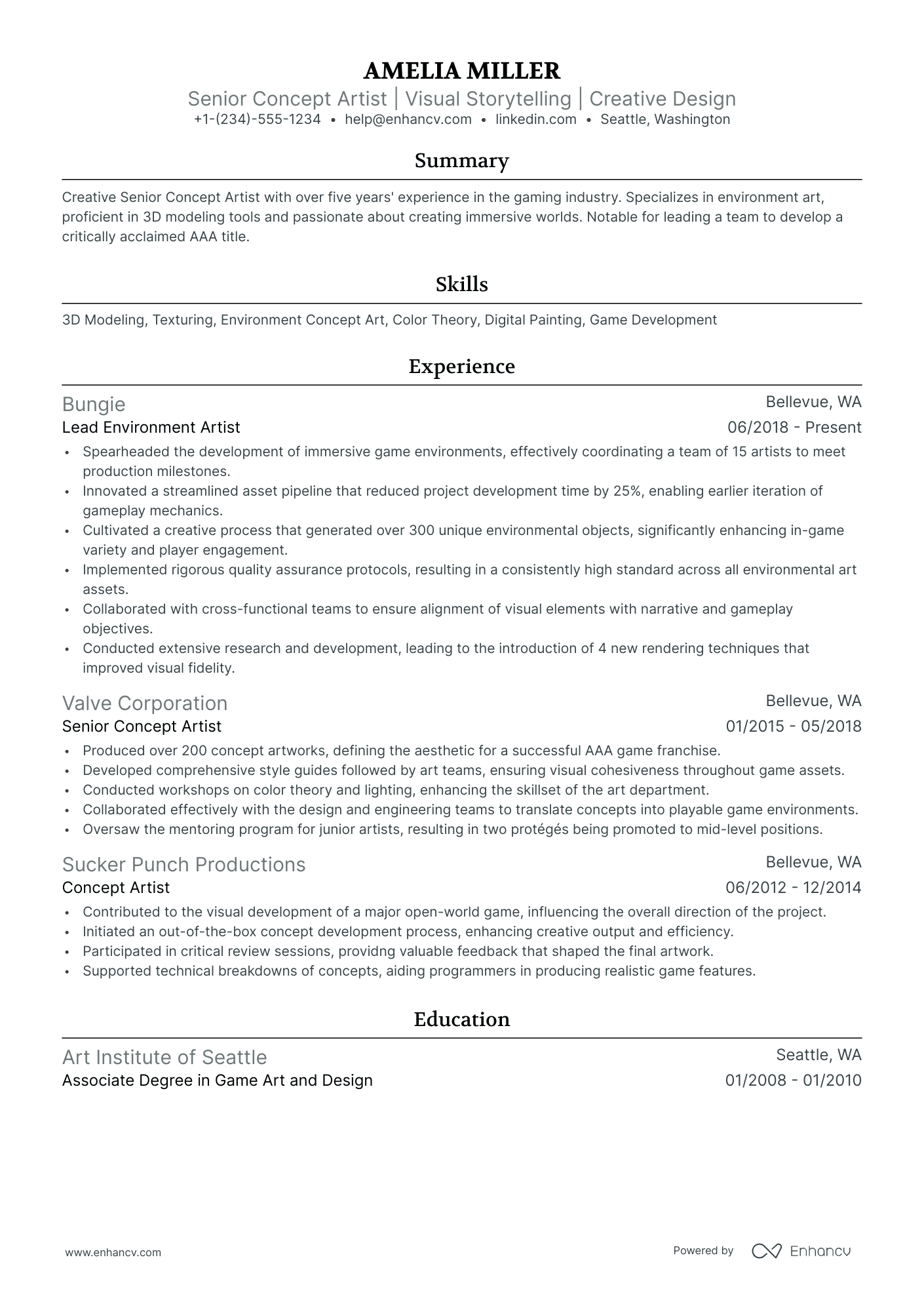
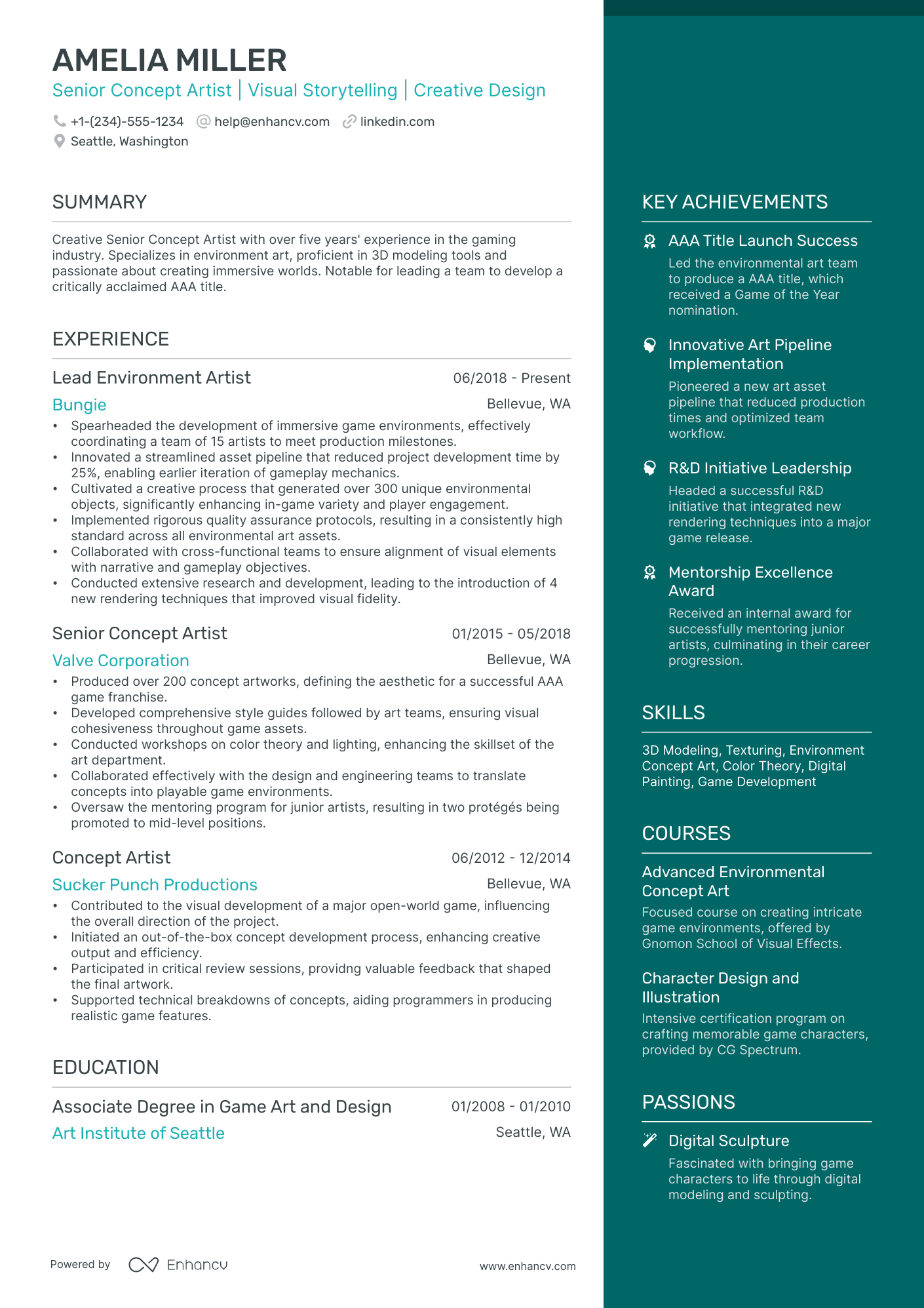
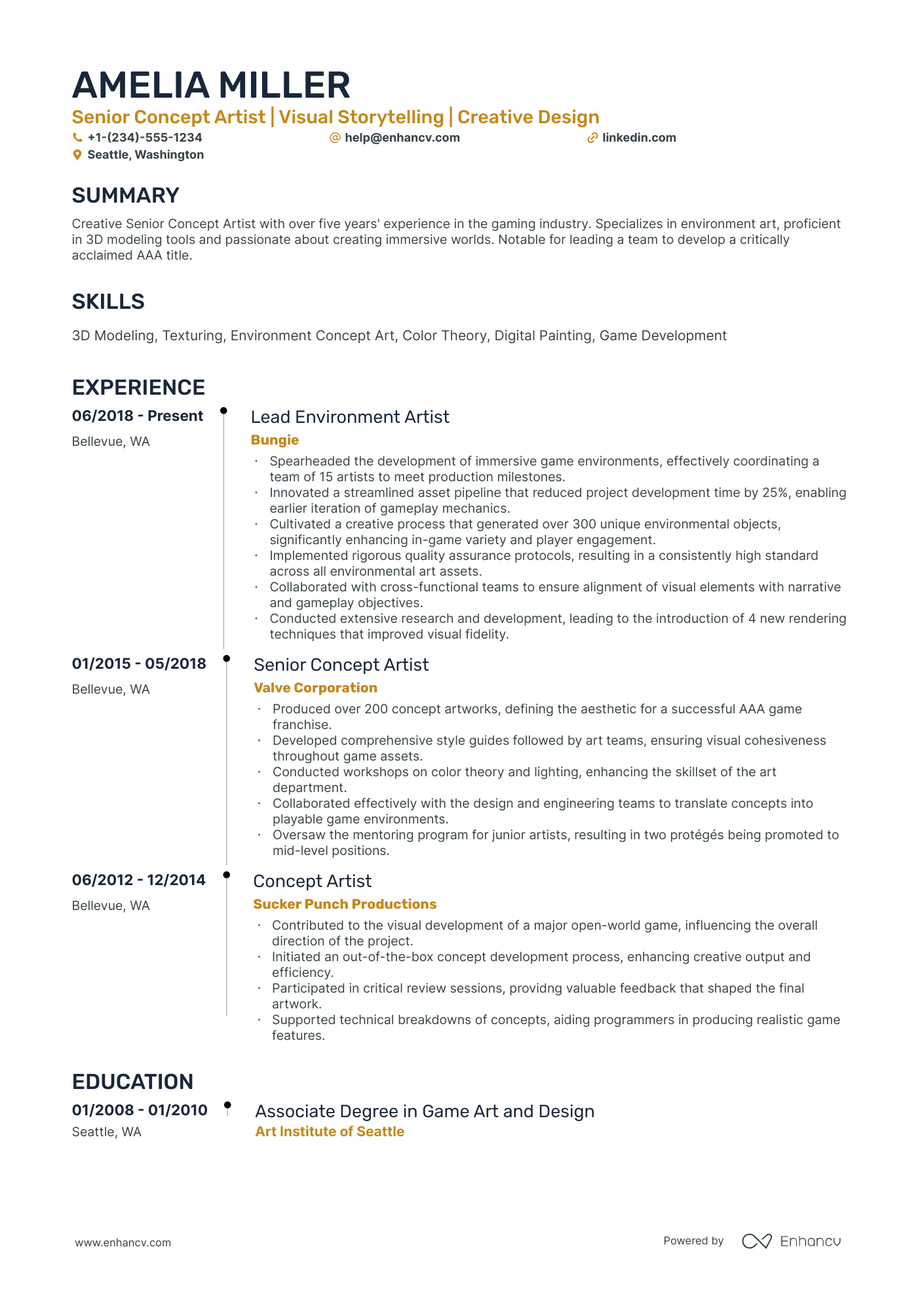
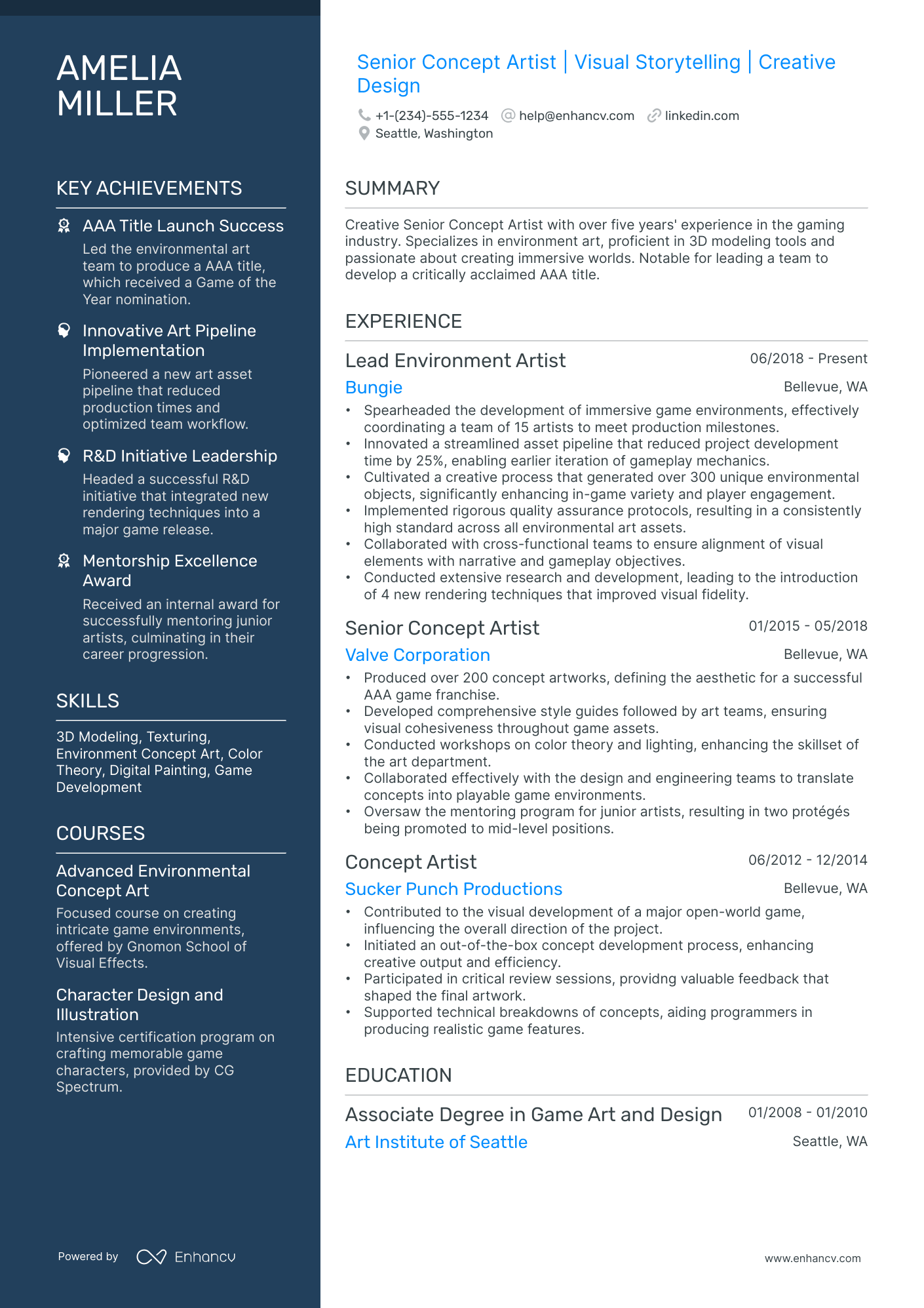
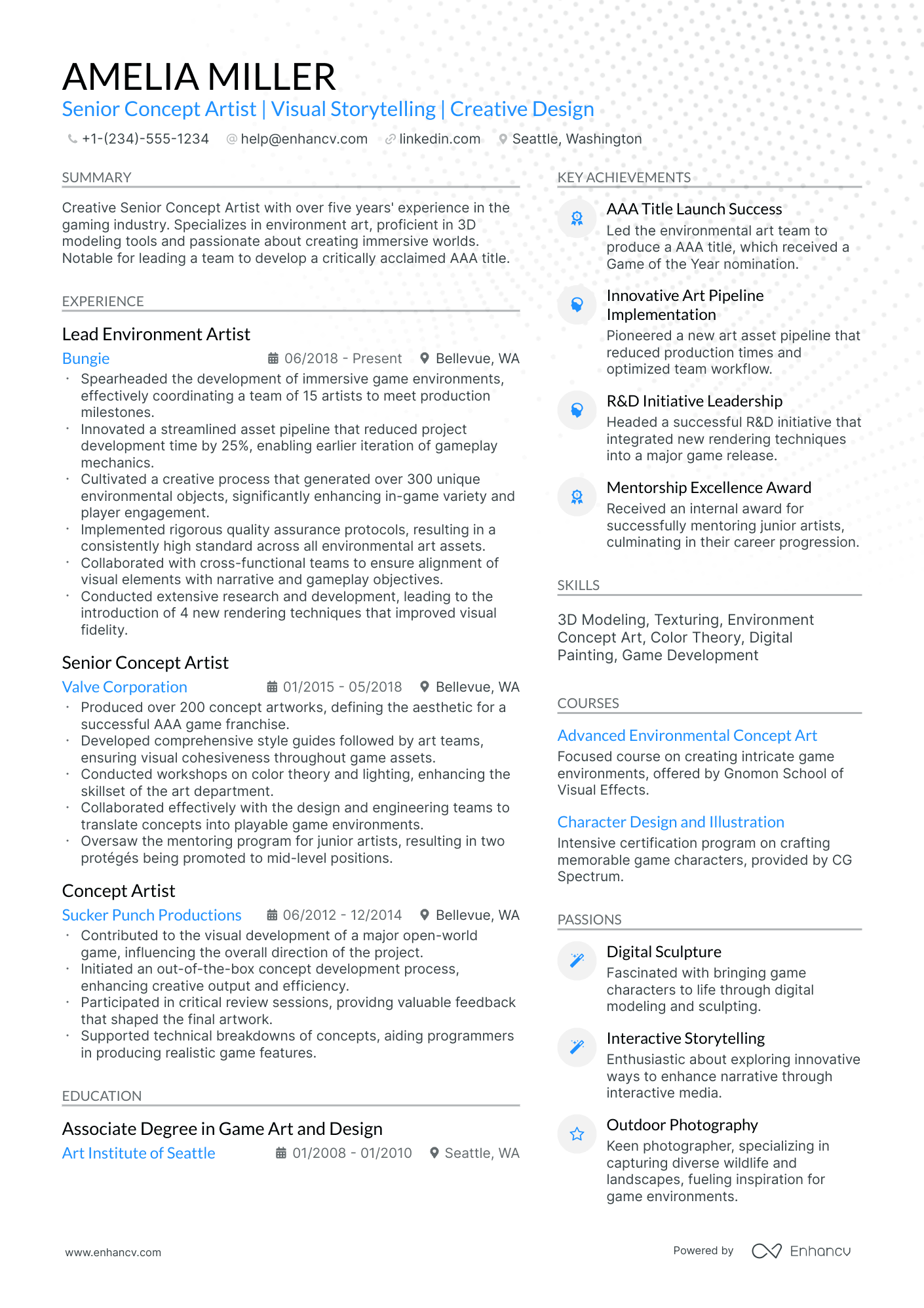
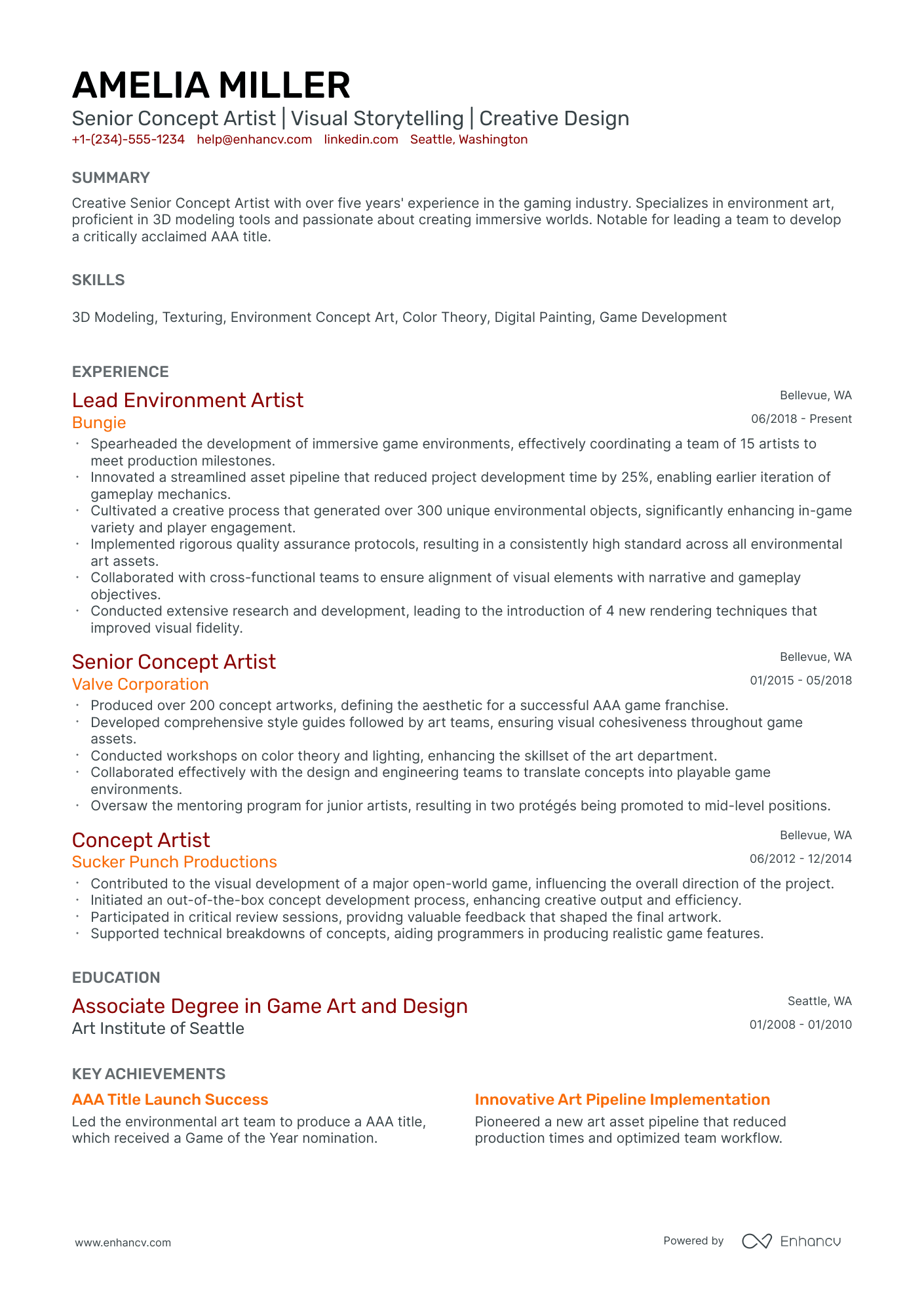
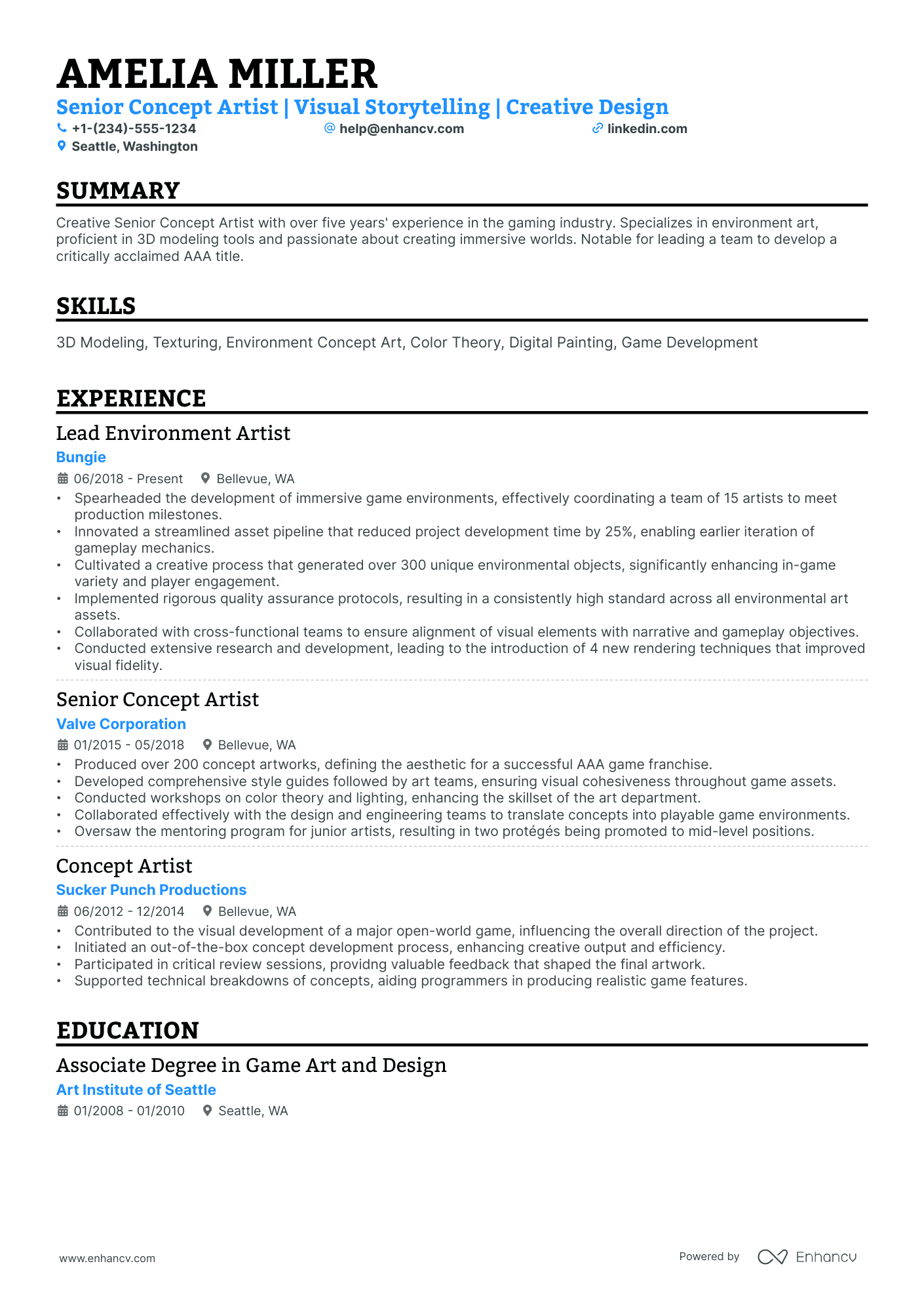
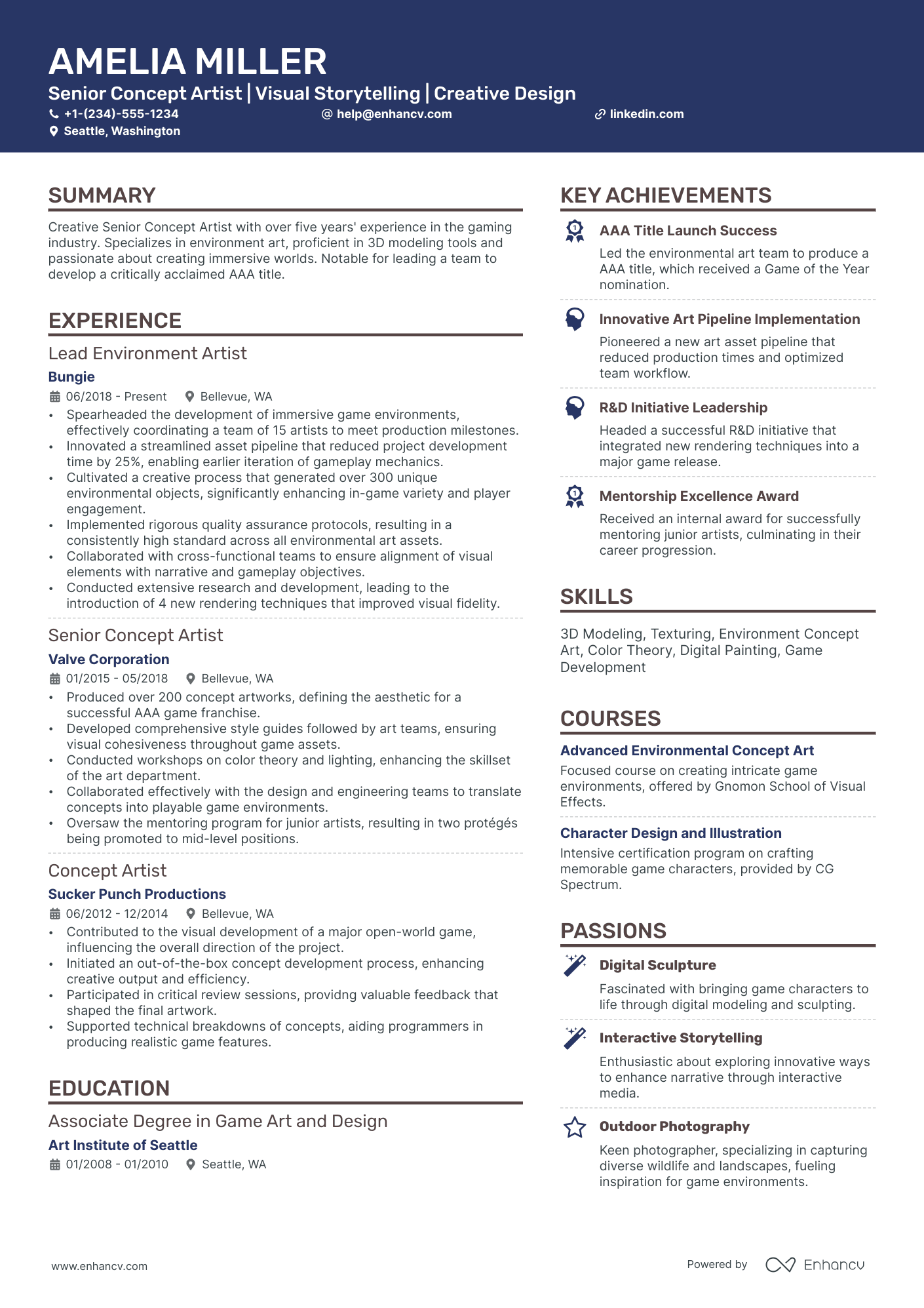

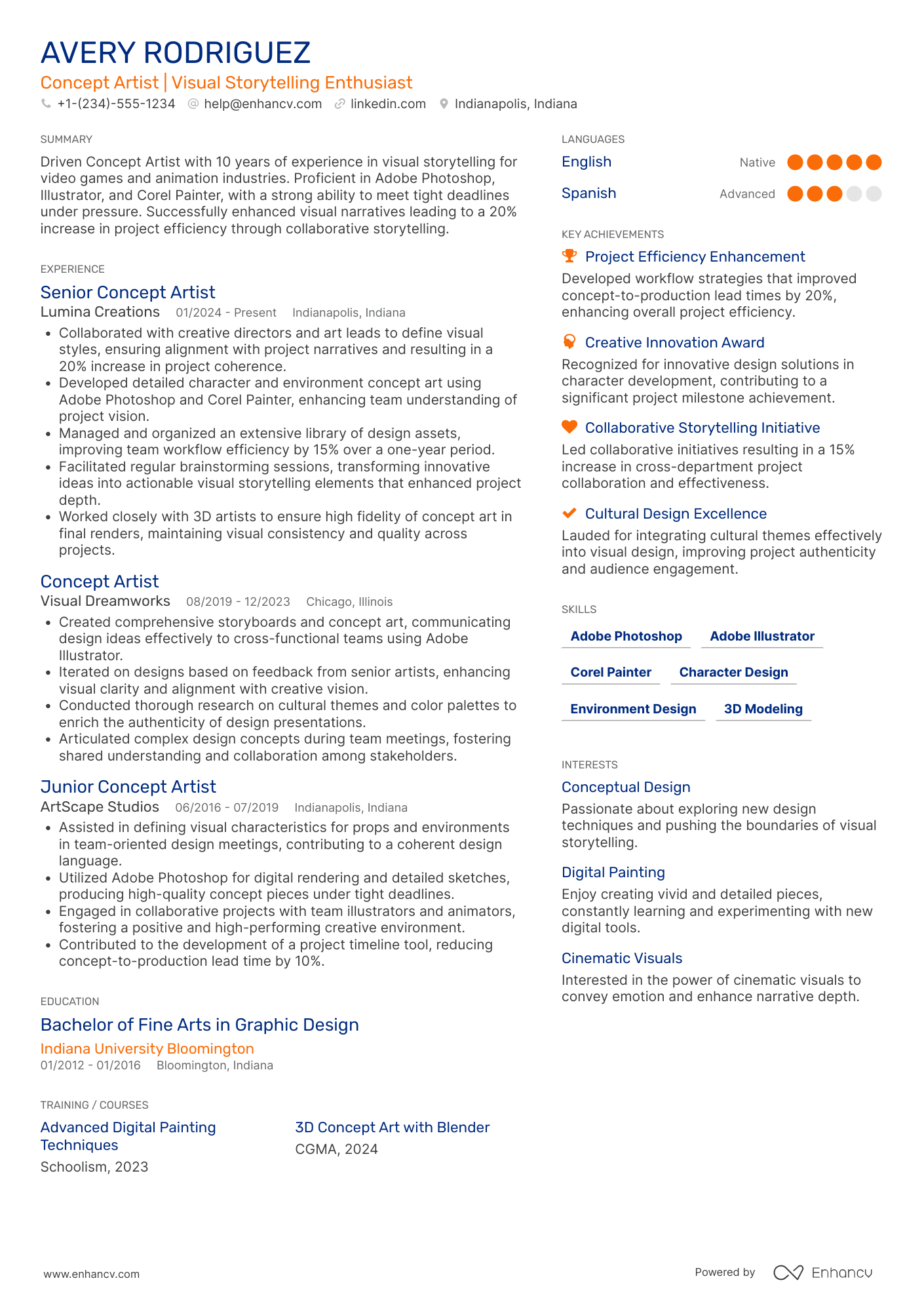
Concept art resume submissions often fail because they read like portfolios in text form, with vague style labels and tool lists instead of measurable contributions. That gets missed in ATS screening and during fast recruiter scans in a crowded market.
A strong resume shows how you move projects forward and why your work shipped. Knowing how to make your resume stand out means you should highlight delivered characters or environments, reduced iteration cycles, improved approval rates, supported a game's visual direction, boosted user engagement, met tight milestones.

Key takeaways
- Quantify concept art contributions with metrics like approval rates, revision rounds, and asset counts.
- Choose reverse-chronological format if experienced and hybrid format if junior or switching careers.
- Tailor every experience bullet to mirror the exact tools and terms in the job posting.
- Tie each listed skill to a specific project, outcome, or deliverable—never list keywords alone.
- Lead your summary with title, years of experience, domain, and one measurable achievement.
- Include a portfolio link in your header so recruiters can verify your visual range immediately.
- Use Enhancv to turn vague task descriptions into measurable, recruiter-ready resume bullets.
How to format a concept art resume
Recruiters evaluating concept artists prioritize a strong visual portfolio link, relevant project credits, and proficiency in industry-standard tools like Photoshop, Blender, or ZBrush. Your resume format determines how quickly a hiring manager can locate these signals, so choosing the right structure ensures your creative and technical strengths aren't buried.

I have significant experience in this role—which format should I use?
Use a reverse-chronological format to put your most recent and relevant project credits front and center. Do:
- Lead with your current or most recent role, emphasizing the scope of projects you contributed to (feature films, AAA games, episodic series) and the size of teams you collaborated with.
- List core tools and specializations—environment design, character design, prop design, keyframe illustration, Photoshop, Blender, Procreate—within each role entry so recruiters see them in context.
- Quantify your contributions with measurable outcomes tied to production milestones or asset delivery.
I'm junior or switching into this role—what format works best?
A hybrid format works best because it lets you lead with a targeted skills section while still showing any relevant work or project history in chronological order. Do:
- Place a skills section near the top highlighting your strongest concept art competencies—digital painting, visual development, color theory, perspective, anatomy—so recruiters and applicant tracking systems (ATS) catch them immediately.
- Include personal projects, game jams, freelance commissions, or school capstone work as experience entries to demonstrate applied ability even without studio credits.
- Connect every listed skill to a specific action and result so hiring managers see practical impact, not just a keyword list.
Why not use a functional resume?
A functional resume strips away the project and timeline context that concept art recruiters rely on to evaluate your creative range, tool fluency, and ability to deliver under production deadlines.
- Career changers with transferable visual skills: If you're moving from graphic design, illustration, or fine art into concept art and lack studio credits, a functional format can group relevant techniques (digital painting, color scripting, visual storytelling) at the top while you build industry experience.
- Recent graduates with no professional history: If your only concept art work comes from coursework, personal projects, or mentorship programs, a functional layout lets you organize by skill area rather than an empty work history section.
Now that you've established a clean, readable layout, it's time to fill it with the right sections that showcase your skills and experience effectively.
What sections should go on a concept art resume
Recruiters expect a concept art resume to quickly confirm your style fit, production experience, and portfolio impact. Understanding which resume sections to include ensures maximum clarity.
Use this structure for maximum clarity:
- Header
- Summary
- Experience
- Skills
- Projects
- Education
- Certifications
- Optional sections: Awards, Publications, Languages
Strong experience bullets should emphasize shipped titles, measurable outcomes, scope of ownership, cross-functional collaboration, and how your designs improved production speed, consistency, or player readability.
Is your resume good enough?
Drop your resume here or choose a file. PDF & DOCX only. Max 2MB file size.
Now that you’ve organized your resume with the right core components, the next step is to write your concept art resume experience section so it supports those elements with clear, relevant details.
How to write your concept art resume experience
Your work experience section proves you can move from brief to finished concept—shipping visual ideas that shape the final look of games, films, or products. Hiring managers prioritize demonstrated impact over descriptive task lists, so every bullet should highlight delivered assets, the tools or methods behind them, and measurable outcomes tied to production milestones.
Each entry should include:
- Job title
- Company and location (or remote)
- Dates of employment (month and year)
Three to five concise bullet points showing what you owned, how you executed, and what outcomes you delivered:
- Ownership scope: the visual categories, IP properties, environments, characters, or asset pipelines you were directly accountable for across a project's concept phase.
- Execution approach: the design software, traditional media techniques, rendering workflows, or iterative feedback processes you used to explore and refine visual directions.
- Collaboration context: how you worked alongside art directors, 3D modelers, animators, narrative designers, or external licensors to align concept work with broader creative and production goals.
- Value improved: changes to visual consistency, revision turnaround speed, asset handoff clarity, style-guide accuracy, or production-readiness that your concept work introduced.
- Impact delivered: outcomes expressed through shipped titles, approved asset volumes, pipeline stage completions, or creative benchmarks rather than a simple list of tasks performed.
Experience bullet formula
A concept art experience example
✅ Right example - modern, quantified, specific.
Senior Concept Artist
Ironwood Interactive | Austin, TX
2022–2025
Mid-size game studio shipping a cross-platform action role-playing game with live seasonal content and a global player base.
- Led pre-production visual development for three biomes and two enemy factions using Photoshop, Procreate, and Blender blockouts, cutting environment iteration cycles by 28% and locking art direction two sprints earlier.
- Produced one hundred twenty-plus character, creature, and prop concepts with paint-overs, photobash, and kitbash workflows, achieving a 92% first-pass approval rate from the art director and reducing rework hours by 18%.
- Built a style guide and modular shape-language library in Figma and Notion, improving cross-team consistency and decreasing outsource revision rounds from three to two per asset pack.
- Collaborated with art directors, level designers, and technical artists to translate concepts into production-ready briefs—orthos, callouts, material notes, and trim-sheet targets—improving 3D team throughput by 15% per sprint.
- Partnered with narrative, user experience, and marketing to align key art and in-game visuals, delivering eight campaign illustrations that contributed to a 12% lift in wishlists during the reveal window.
Now that you've seen how a strong experience section comes together, let's look at how to tailor it to match the specific concept art role you're applying for.
How to tailor your concept art resume experience
Recruiters evaluate concept art resumes through both human review and applicant tracking systems (ATS). Tailoring your resume to the job description by mirroring the language and priorities of each job posting helps you pass both screenings.
Ways to tailor your concept art experience:
- Match the exact software and tools listed in the job description.
- Mirror the art pipeline terminology the studio uses in its posting.
- Reflect the specific art styles or visual directions they request.
- Include relevant game or entertainment industry experience when specified.
- Highlight collaboration with art directors or cross-discipline teams they mention.
- Use the same asset types and deliverable names from the listing.
- Emphasize world-building or character design focus areas they prioritize.
- Reference quality benchmarks or revision workflow standards they describe.
Tailoring means aligning your real accomplishments with each role's stated requirements, not forcing keywords where they don't belong.
Resume tailoring examples for concept art
| Job description excerpt | Untailored | Tailored |
|---|---|---|
| "Create environment and prop concepts for AAA open-world RPG using Photoshop and Blender for 3D paintover workflows" | Created concept art for various game projects using digital tools. | Designed 120+ environment and prop concepts for an open-world RPG, using Photoshop and Blender 3D paintovers to establish visual direction across six biome types. |
| "Collaborate with art directors and 3D modelers to develop creature designs from silhouette exploration through final turnaround sheets" | Worked with team members to design characters and creatures. | Partnered with art directors and 3D modelers to develop 30+ creature designs, delivering silhouette explorations, color keys, and fully annotated turnaround sheets ready for production modeling. |
| "Define the visual language for sci-fi vehicle assets, producing callout sheets with material breakdowns in a style consistent with our existing IP" | Produced concept art for vehicles and mechanical designs. | Defined the visual language for a fleet of 15 sci-fi vehicle classes, producing detailed callout sheets with material breakdowns—metals, composites, weathering patterns—that matched the established IP style guide. |
Once you’ve aligned your experience with the role’s priorities, the next step is to quantify your concept art achievements so hiring teams can quickly see the scope and impact of your work.
How to quantify your concept art achievements
Quantifying concept art shows how your visuals improved speed, quality, and delivery. Track turnaround time, revision rounds, approval rate, asset volume, and downstream rework saved in production tools. For more guidance on quantifying achievements, focus on concrete numbers that reflect your real contributions.
Quantifying examples for concept art
| Metric | Example |
|---|---|
| Turnaround time | "Cut average concept turnaround from five days to three by standardizing Photoshop brushes, value studies, and a daily review checklist across eight briefs." |
| Revision rate | "Reduced revisions per asset from four to two by aligning mood boards in Miro and locking silhouettes before color passes for twelve character concepts." |
| Approval speed | "Improved first-pass approval from 40% to 70% by running thirty-minute stakeholder syncs and delivering three clearly labeled options per environment brief." |
| Production rework | "Lowered 3D rework tickets by 25% by providing orthographic callouts, material notes, and scale guides in Figma for twenty props." |
| Volume delivered | "Delivered 60 production-ready concepts in six weeks for a live-ops event, averaging two finished pieces per day while meeting every milestone." |
Turn vague job duties into measurable, recruiter-ready resume bullets in seconds with Enhancv's Bullet Point Generator.
Once you've crafted strong bullet points for your experience section, apply that same precision to presenting your hard and soft skills throughout your concept art resume.
How to list your hard and soft skills on a concept art resume
Your skills section shows you can translate briefs into production-ready visuals, and recruiters and an ATS (applicant tracking system) scan this section to match keywords fast—aim for a hard-skill-heavy mix supported by role-specific soft skills. concept art roles require a blend of:
- Product strategy and discovery skills
- Data, analytics, and experimentation skills
- Delivery, execution, and go-to-market discipline
- Soft skills
Your skills section should be:
- Scannable (bullet-style grouping).
- Relevant to the job post.
- Backed by proof in experience bullets.
- Updated with current tools.
Place your skills section:
- Above experience if you're junior or switching careers.
- Below experience if you're mid/senior with strong achievements.

Hard skills
- Adobe Photoshop
- Procreate
- Clip Studio Paint
- Blender, ZBrush
- 3D blockouts, kitbashing
- Photobashing, matte painting
- Perspective, composition
- Value, lighting studies
- Color scripting
- Environment design
- Character design
- Prop and vehicle design
Soft skills
- Translate briefs into visuals
- Ask targeted clarifying questions
- Present concepts to stakeholders
- Incorporate art direction fast
- Iterate with tight deadlines
- Defend choices with rationale
- Collaborate with design and 3D
- Maintain style guide consistency
- Manage scope and priorities
- Document decisions and handoffs
- Give actionable critique
- Self-review for production readiness
How to show your concept art skills in context
Skills shouldn't live only in a bulleted list on your resume. Explore resume skills examples to see how top candidates weave abilities into every section.
They should be demonstrated in:
- Your summary (high-level professional identity)
- Your experience (proof through outcomes)
Here's what this looks like in practice.
Summary example
Senior concept artist with 10+ years in AAA game development. Skilled in environment design, visual storytelling, and Photoshop workflows. Led a 6-person art team that delivered 200+ production-ready assets ahead of schedule for a franchise title.
- Reflects senior-level experience clearly
- Names industry-relevant tools and methods
- Includes a measurable team outcome
- Highlights leadership as a soft skill
Experience example
Senior Concept Artist
Iron Bloom Studios | Remote
March 2019–August 2024
- Designed 150+ environment and prop concepts in Photoshop, reducing art revision cycles by 30% across two shipped titles.
- Collaborated with narrative designers and 3D modelers to establish a unified visual language, improving cross-team approval rates by 25%.
- Created keyframe illustrations using Blender blockouts, cutting pre-production timelines by three weeks per milestone.
- Every bullet includes measurable proof.
- Skills appear naturally through outcomes.
Once you’ve demonstrated your concept art abilities through real-world applications, the next step is translating that evidence into a concept art resume when you don’t have formal experience.
How do I write a concept art resume with no experience
Even without full-time experience, you can demonstrate readiness through personal projects and applied work. If you're building a resume without work experience, focus on the following:
- Personal concept art portfolio series
- Game jam concept art deliverables
- Student film preproduction artwork
- Freelance character design commissions
- Fan art redesigns with breakdowns
- Artstation challenges and critiques
- Museum studies and master copies
- Online course capstone projects
Focus on:
- Portfolio pieces aligned to briefs
- Process: thumbnails to final renders
- Tool proficiency and file organization
- Production-ready specs and handoff
Resume format tip for entry-level concept art
Use a hybrid resume format because it highlights projects and tools first, while still showing education and any client work. Do:
- Lead with a portfolio link and role.
- Add four to six project bullets.
- List tools used per project.
- Quantify outputs: assets, hours, versions.
- Match keywords from job posts.
- Completed a game jam concept art pack in Photoshop and Procreate—twenty environment thumbnails, four final paintovers, and a style guide adopted by a five-person team.
Even without professional experience, your education section can demonstrate the foundational skills and training that make you a strong candidate.
How to list your education on a concept art resume
Your education section helps hiring teams confirm you have foundational training in art, design, and visual storytelling. It validates the core skills concept art roles demand.
Include:
- Degree name
- Institution
- Location
- Graduation year
- Relevant coursework (for juniors or entry-level candidates)
- Honors & GPA (if 3.5 or higher)
Skip month and day details—list the graduation year only.
Here's a strong education entry tailored for a concept art resume:
Example education entry
Bachelor of Fine Arts in Illustration
ArtCenter College of Design, Pasadena, CA
Graduated 2022
GPA: 3.7/4.0
- Relevant Coursework: Environment Design, Digital Painting, Visual Development, Anatomy for Artists, Color Theory
- Honors: Dean's List (six semesters), Outstanding Portfolio Award
How to list your certifications on a concept art resume
Certifications show you keep learning, master key tools, and stay aligned with concept art production standards. They help hiring teams trust your workflow, especially when your experience level is still growing.
Include:
- Certificate name
- Issuing organization
- Year
- Optional: credential ID or URL
- Place certifications below education when your degree is recent and your certifications are older or only loosely related to concept art.
- Place certifications above education when they are recent, directly match the role, or prove proficiency in tools the job requires.
Best certifications for your concept art resume
- Adobe Certified Professional in Photoshop
- Autodesk Certified User: Maya
- Autodesk Certified User: 3ds Max
- Foundry Certified Nuke Artist
- Unity Certified Associate: Game Developer
- Unreal Engine Certified Developer
Once you’ve positioned your credentials to support your skills, shift to your concept art resume summary so you can connect those qualifications to the value you bring at a glance.
How to write your concept art resume summary
Your resume summary is the first thing a recruiter reads. A strong one instantly signals you have the skills and creative range this role demands.
Keep it to three to four lines, with:
- Your title and total years of professional concept art experience.
- The domain you work in, such as games, film, animation, or themed entertainment.
- Core tools like Photoshop, Blender, ZBrush, or Procreate.
- One or two measurable achievements that show your real contributions.
- A soft skill tied to a concrete outcome, such as clear communication that shortened revision cycles.

PRO TIP
At the junior level, lead with your strongest tools, relevant project work, and any early wins that prove you can deliver. Skip vague phrases like "passionate artist" or "creative thinker." Recruiters want proof of what you can do, not declarations about who you are.
Example summary for a concept art
Concept artist with two years of experience creating environment and prop designs for indie games. Proficient in Photoshop and Blender. Delivered 40+ production-ready assets for a title that shipped on schedule.
Optimize your resume summary and objective for ATS
Drop your resume here or choose a file.
PDF & DOCX only. Max 2MB file size.
Now that your summary captures your artistic strengths and experience at a glance, make sure the header above it presents your contact details correctly so recruiters can actually reach you.
What to include in a concept art resume header
A resume header lists your key contact and professional details so recruiters can find you, trust your background, and screen you fast for concept art roles.
Essential resume header elements
- Full name
- Tailored job title and headline
- Location
- Phone number
- Professional email
- GitHub link
- Portfolio link
Including a LinkedIn link helps recruiters verify experience quickly and supports screening.
Don't include a photo on a concept art resume unless the role is explicitly front-facing or appearance-dependent.
Keep the header on one or two lines, use consistent formatting, and match the job title to the posting to improve scan speed.
Example
Concept art resume header
Jordan Lee
Concept artist | Environment and prop design
Austin, TX
(512) 555-01XX
your.name@enhancv.com github.com/yourname yourwebsite.com linkedin.com/in/yourname
Once your header clearly identifies you and your key professional details, the next step is to add additional sections that round out your resume and support the information you’ve already presented.
Additional sections for concept art resumes
When your core sections don't fully capture your creative range, additional sections help you stand out among other concept art applicants. For example, listing language skills can be especially valuable if you're targeting studios with international teams or localization pipelines.
- Languages
- Hobbies and interests
- Publications and art features
- Professional affiliations and art communities
- Workshops and masterclasses
- Gallery exhibitions and art shows
Once you've strengthened your resume with relevant additional sections, pairing it with a tailored cover letter can further set your application apart.
Do concept art resumes need a cover letter
A cover letter isn't required for most concept art roles, but it helps in competitive openings or studios that expect one. If you're unsure what a cover letter is and when it adds value, it can make a difference when your resume and portfolio need clearer context or a tighter match.
Use a cover letter to add context your concept art resume can't show:
- Explain role and team fit by naming the discipline, pipeline stage, and collaboration style you work best in.
- Highlight one or two relevant concept art projects, focusing on outcomes like approved designs, faster iteration, or clearer handoff to three-dimensional artists.
- Show you understand the product, users, and business context by referencing the genre, audience, platform limits, or brand rules.
- Address career transitions or non-obvious experience by connecting past work to concept art fundamentals, tools, and production constraints.
Drop your resume here or choose a file.
PDF & DOCX only. Max 2MB file size.
Once you decide whether to include a cover letter to add context to your concept art resume, you can use AI to refine the resume itself for clarity, relevance, and impact.
Using AI to improve your concept art resume
AI can sharpen your resume's clarity, structure, and overall impact. It helps tighten language and align content with concept art roles. But overuse dulls authenticity. Once your resume reads clearly and fits the role, step away from AI. If you're wondering which AI is best for writing resumes, start with these practical prompts you can copy and paste to strengthen specific sections:
- Strengthen your summary. "Rewrite my concept art resume summary to highlight my strongest visual development skills in under three sentences."
- Quantify your impact. "Add measurable results to my concept art experience bullets, such as project counts, deadlines met, or team sizes."
- Tighten bullet points. "Shorten each concept art experience bullet to one concise line that leads with a strong action verb."
- Align with job posts. "Compare my concept art resume skills section to this job description and suggest missing relevant keywords."
- Clarify project contributions. "Rewrite my concept art project descriptions to clearly state my specific role, tools used, and deliverables produced."
- Remove redundancy. "Identify and remove repeated or overlapping phrases across all sections of my concept art resume."
- Refine technical skills. "Organize my concept art skills list into clear categories like software, traditional media, and design specialties."
- Improve education relevance. "Rewrite my education section to emphasize coursework and training directly relevant to concept art careers."
- Boost certification descriptions. "Rewrite my certifications section to explain how each credential applies to professional concept art work."
- Fix weak language. "Replace vague words like 'helped' or 'worked on' with specific, active verbs throughout my concept art resume."
Stop using AI once your resume sounds accurate, specific, and aligned with real experience. AI should never invent experience or inflate claims—if it didn't happen, it doesn't belong here.
Conclusion
A strong concept art resume proves impact with measurable outcomes, role-specific skills, and a clear structure. It highlights shipped titles, approved designs, faster iteration cycles, and fewer revisions. It keeps key tools, pipelines, and collaboration strengths easy to scan.
This structure shows you can deliver concept art that fits production needs today. It also signals you can adapt to evolving workflows and tighter timelines. With clear results and relevant skills, you look ready for the next role.