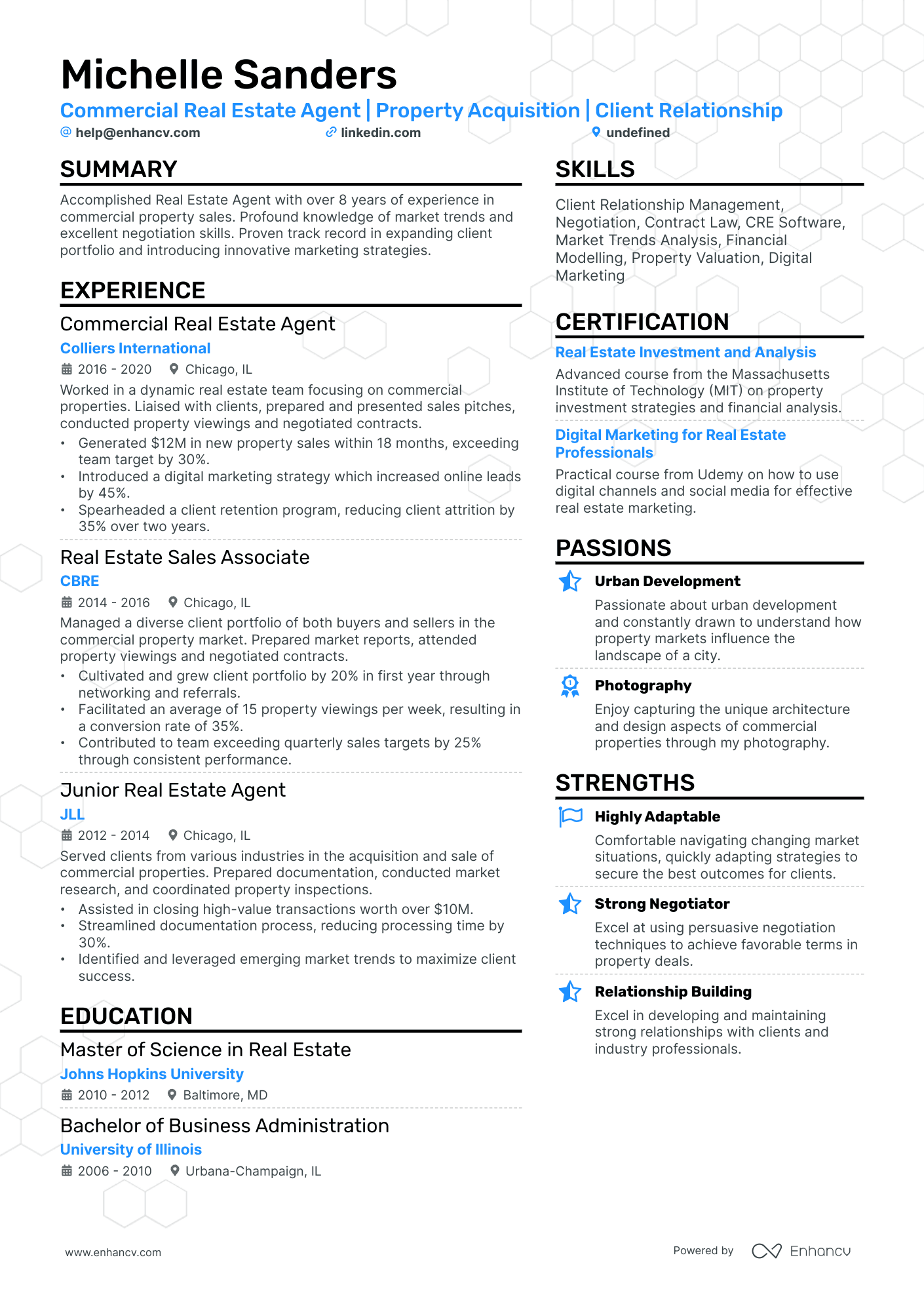
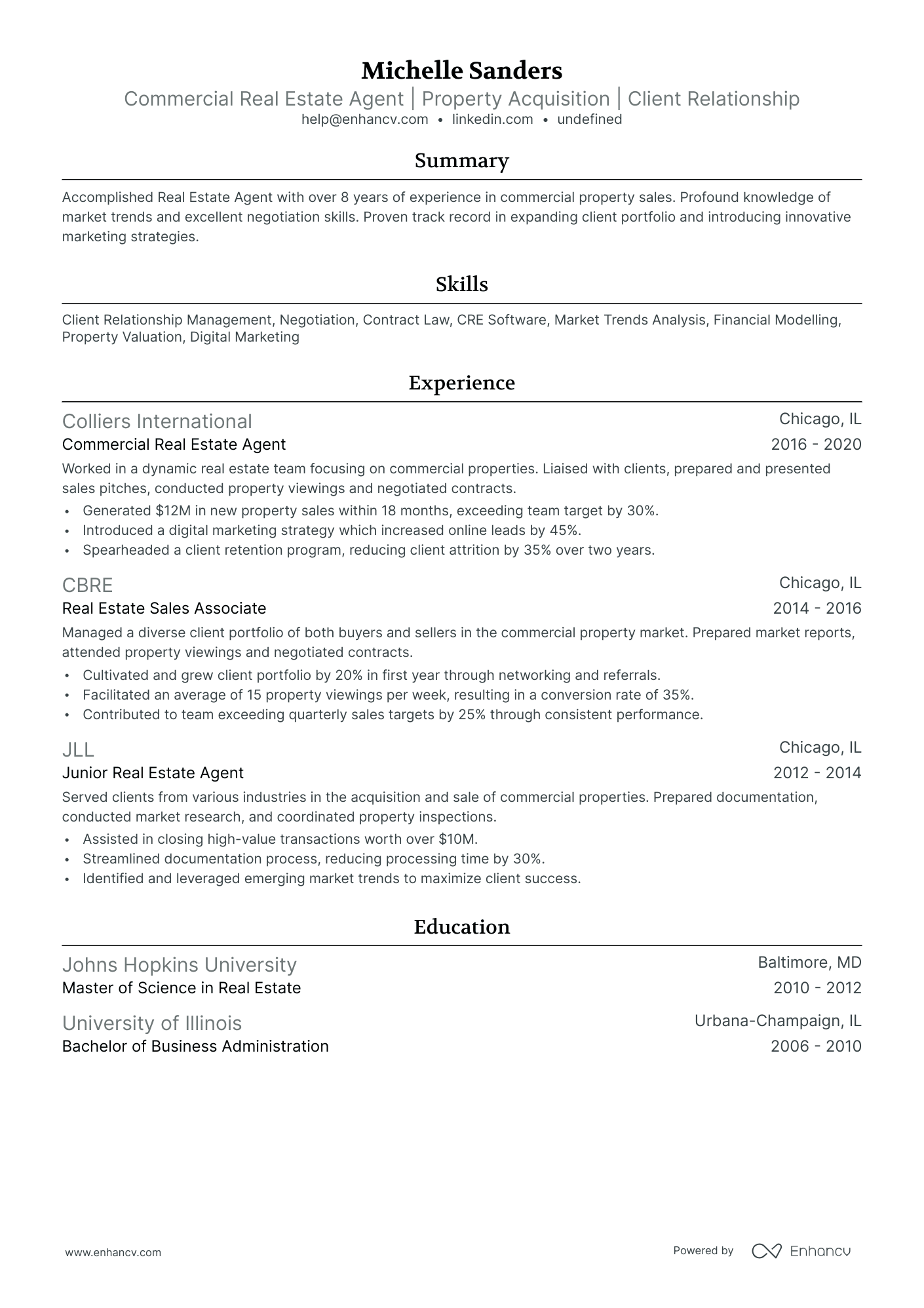
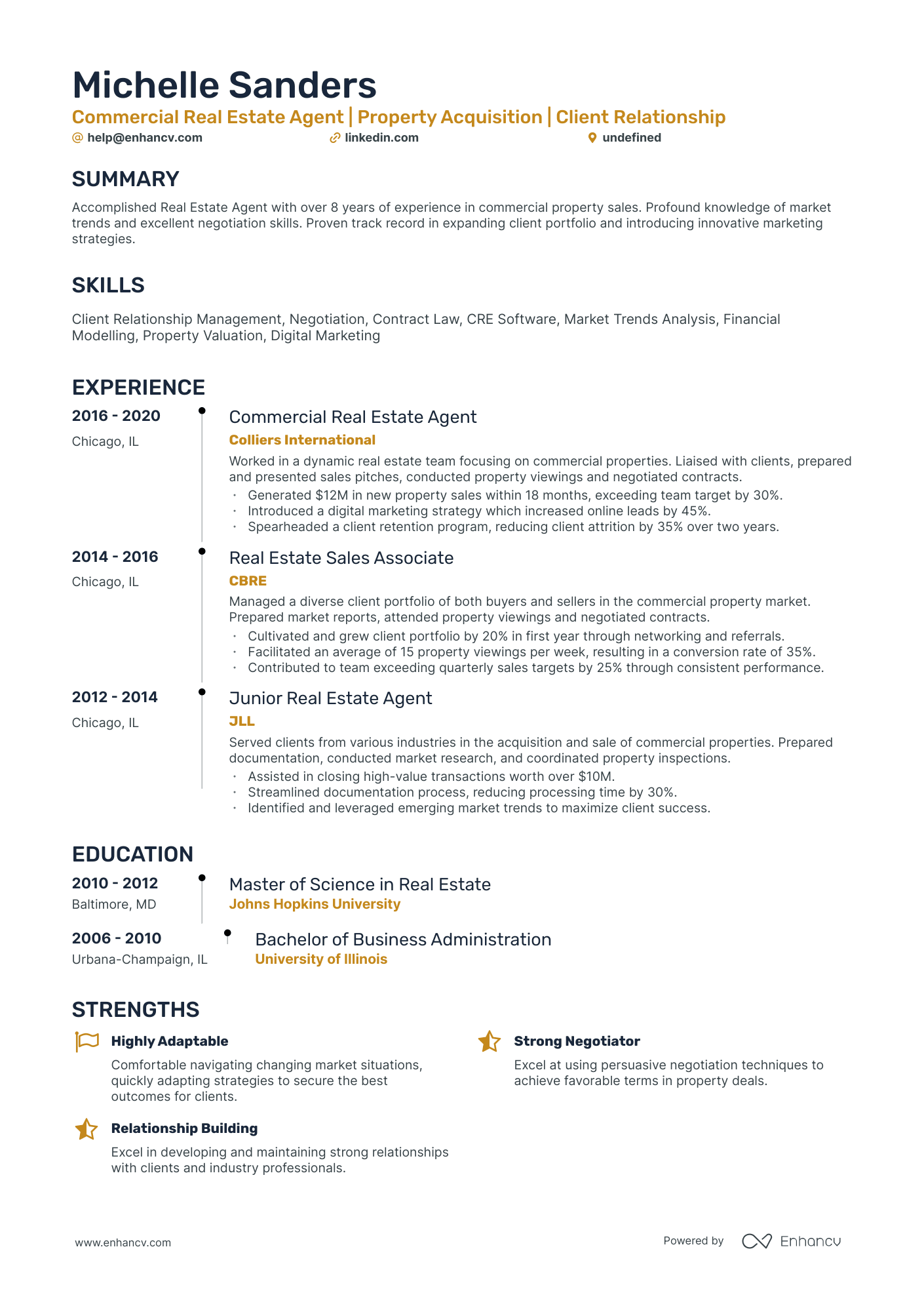
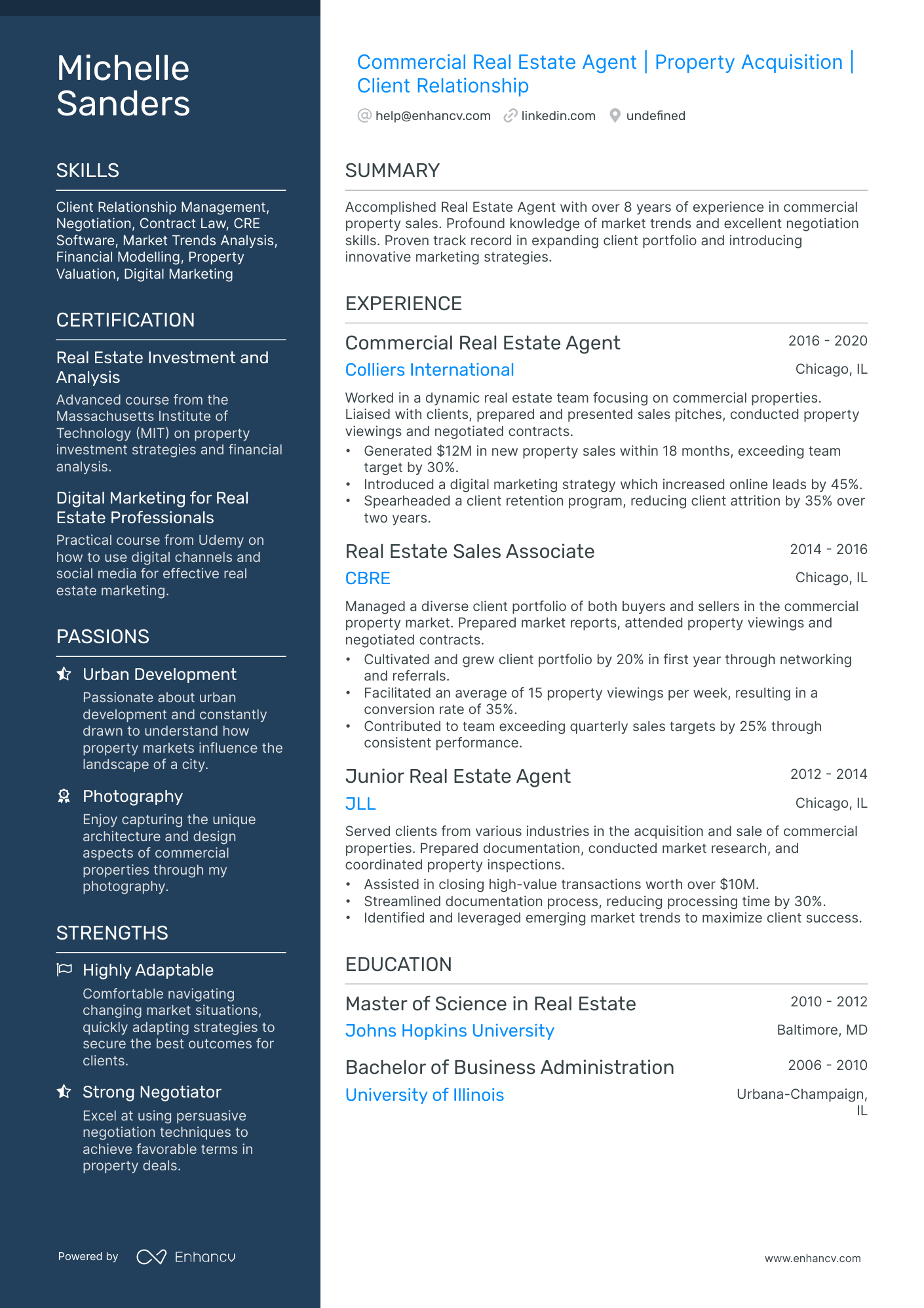
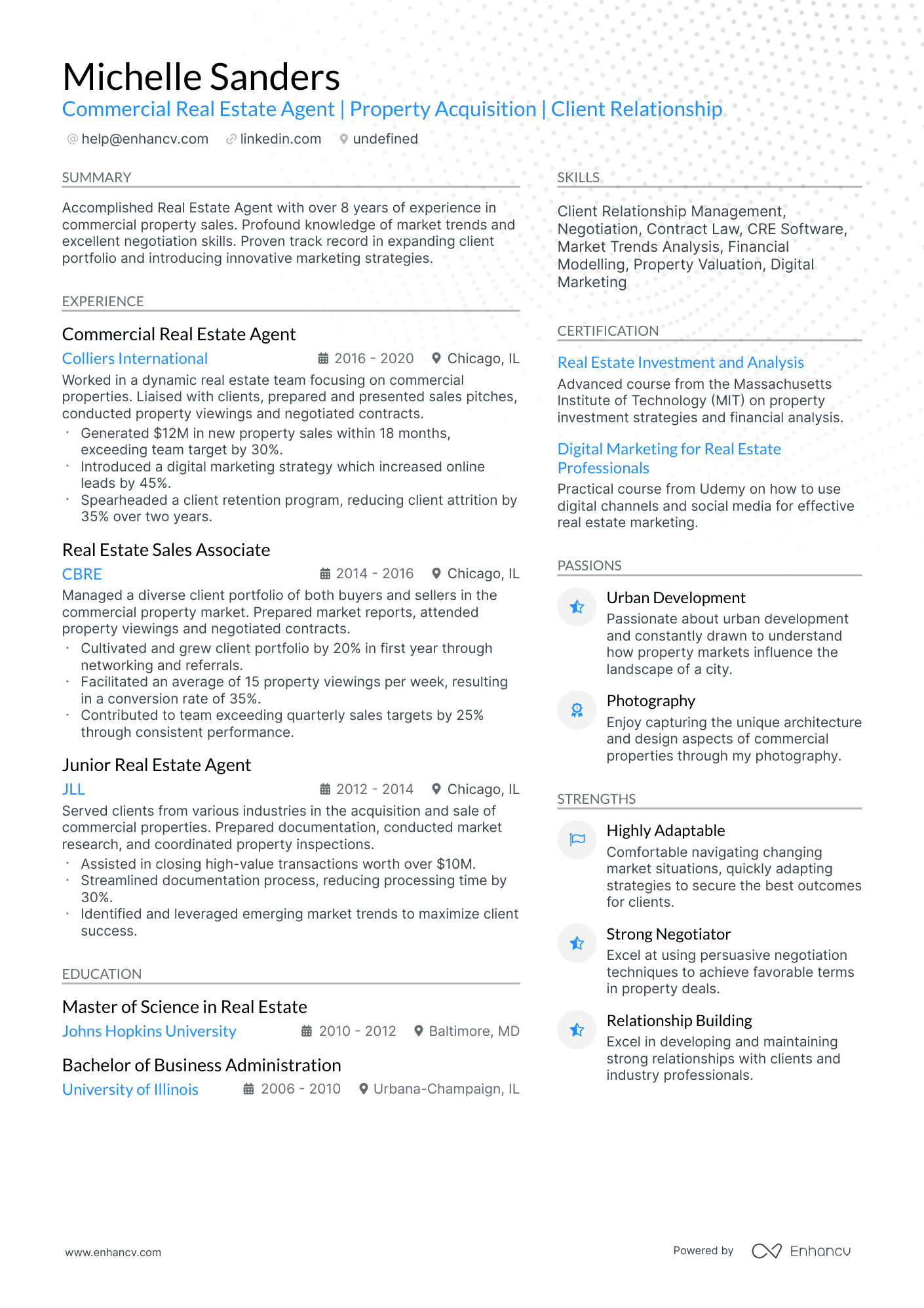
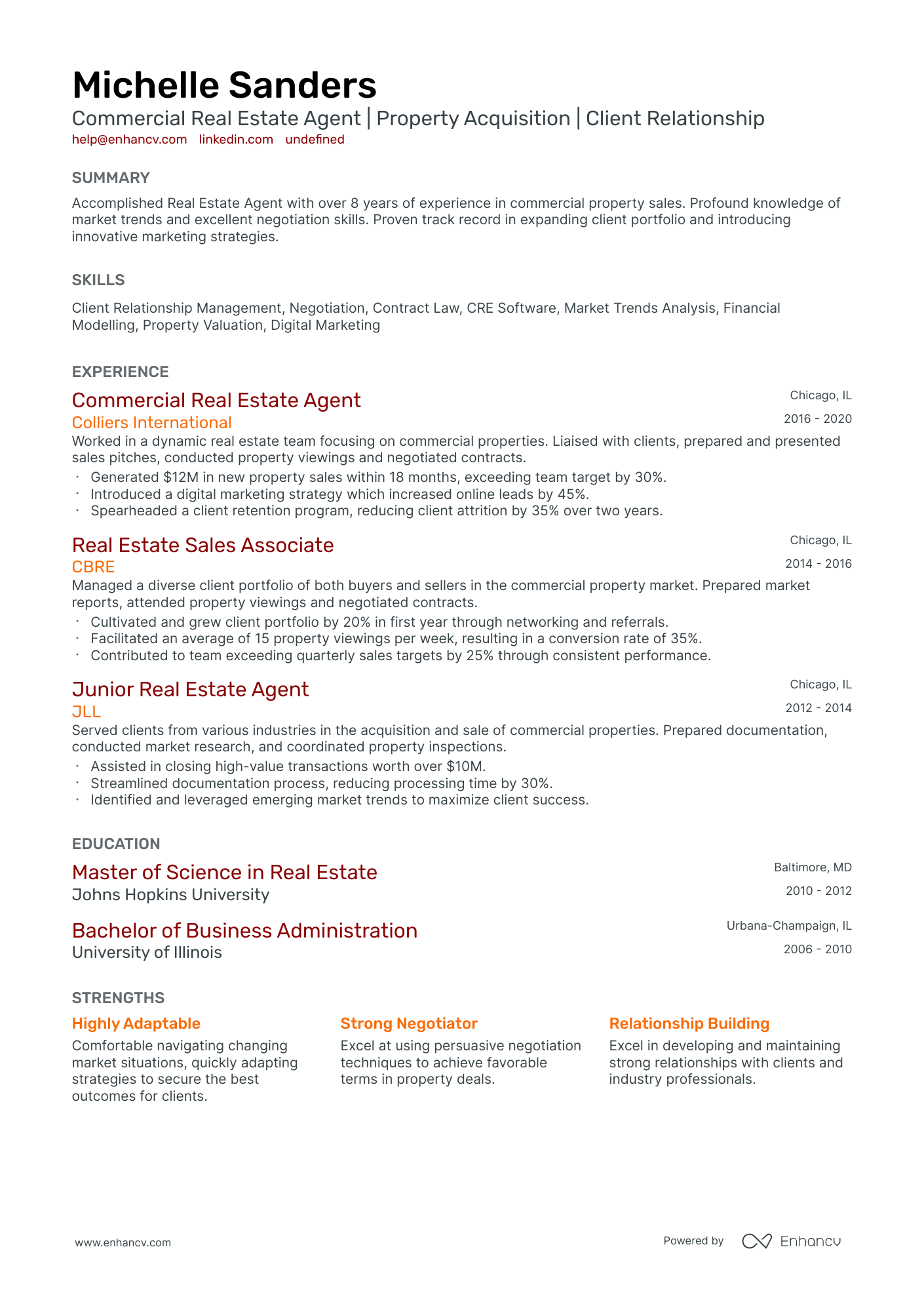
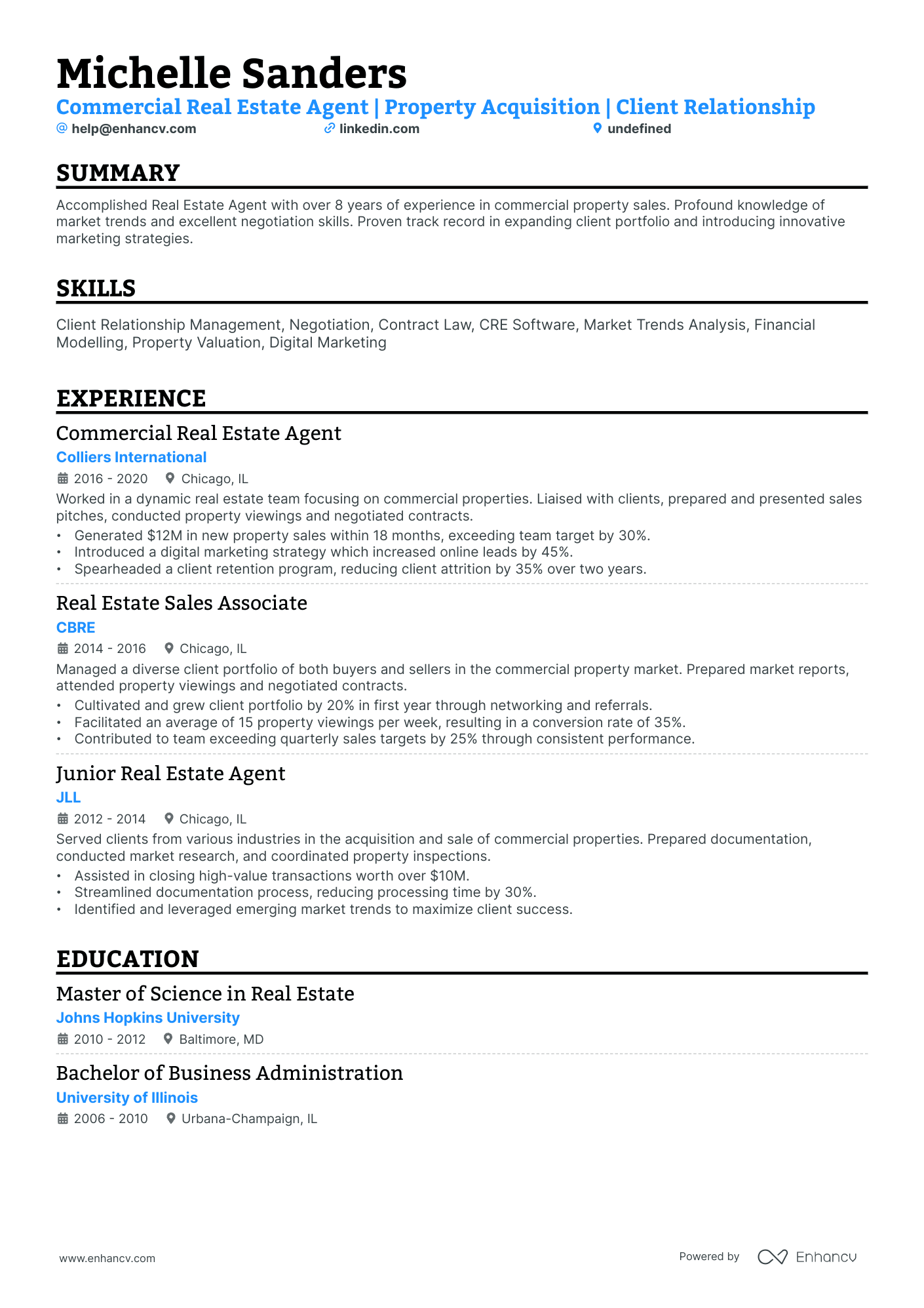
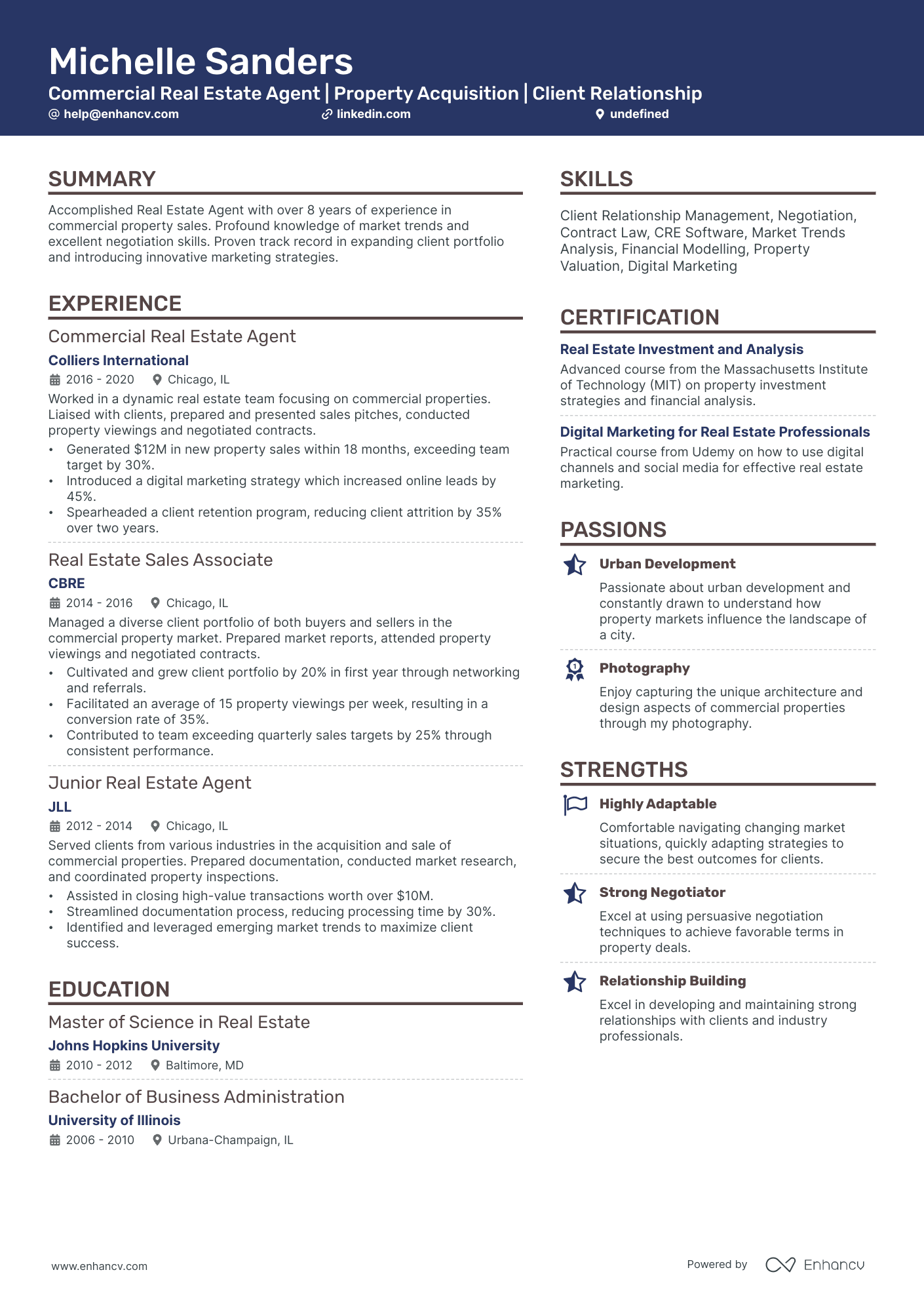
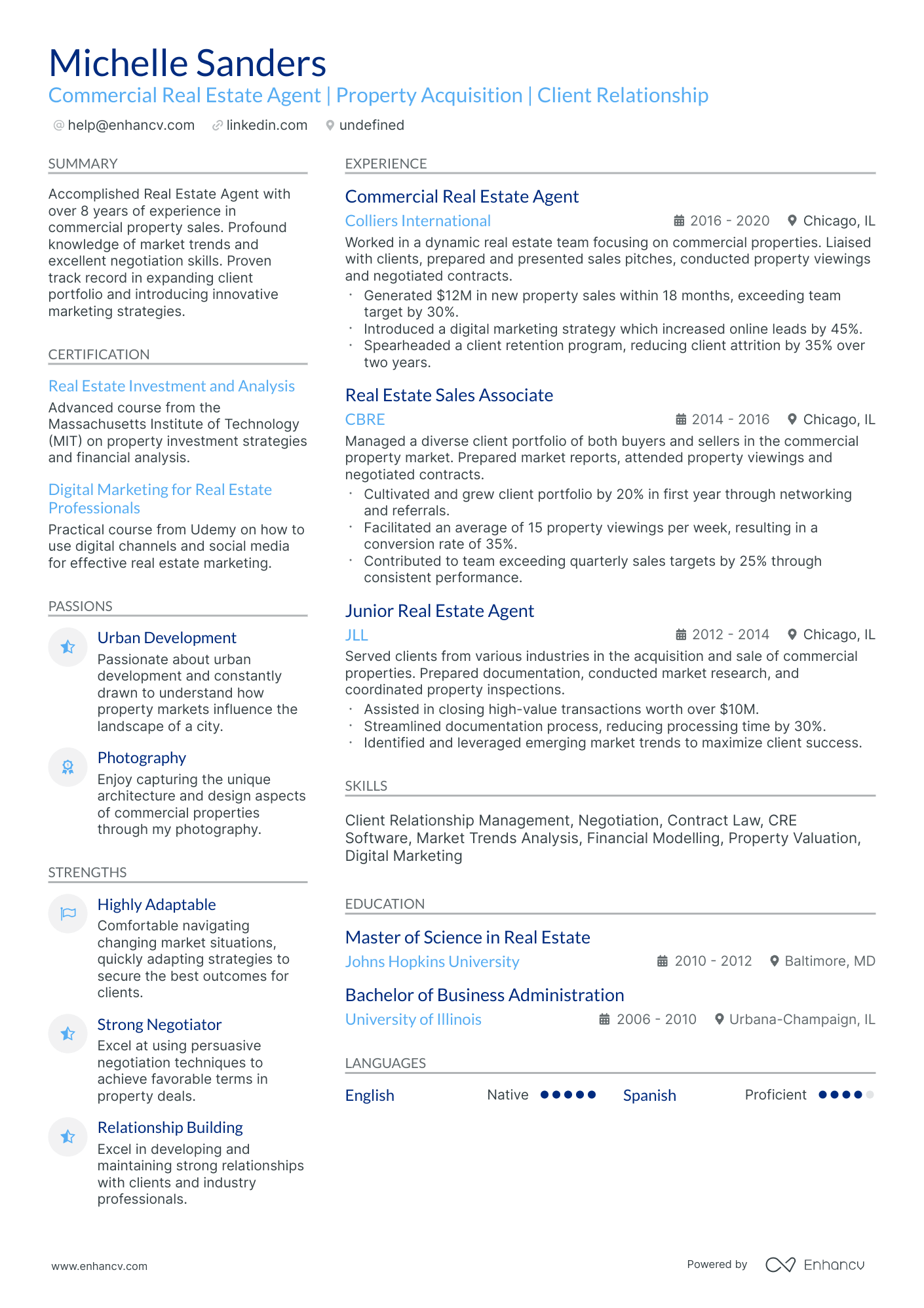
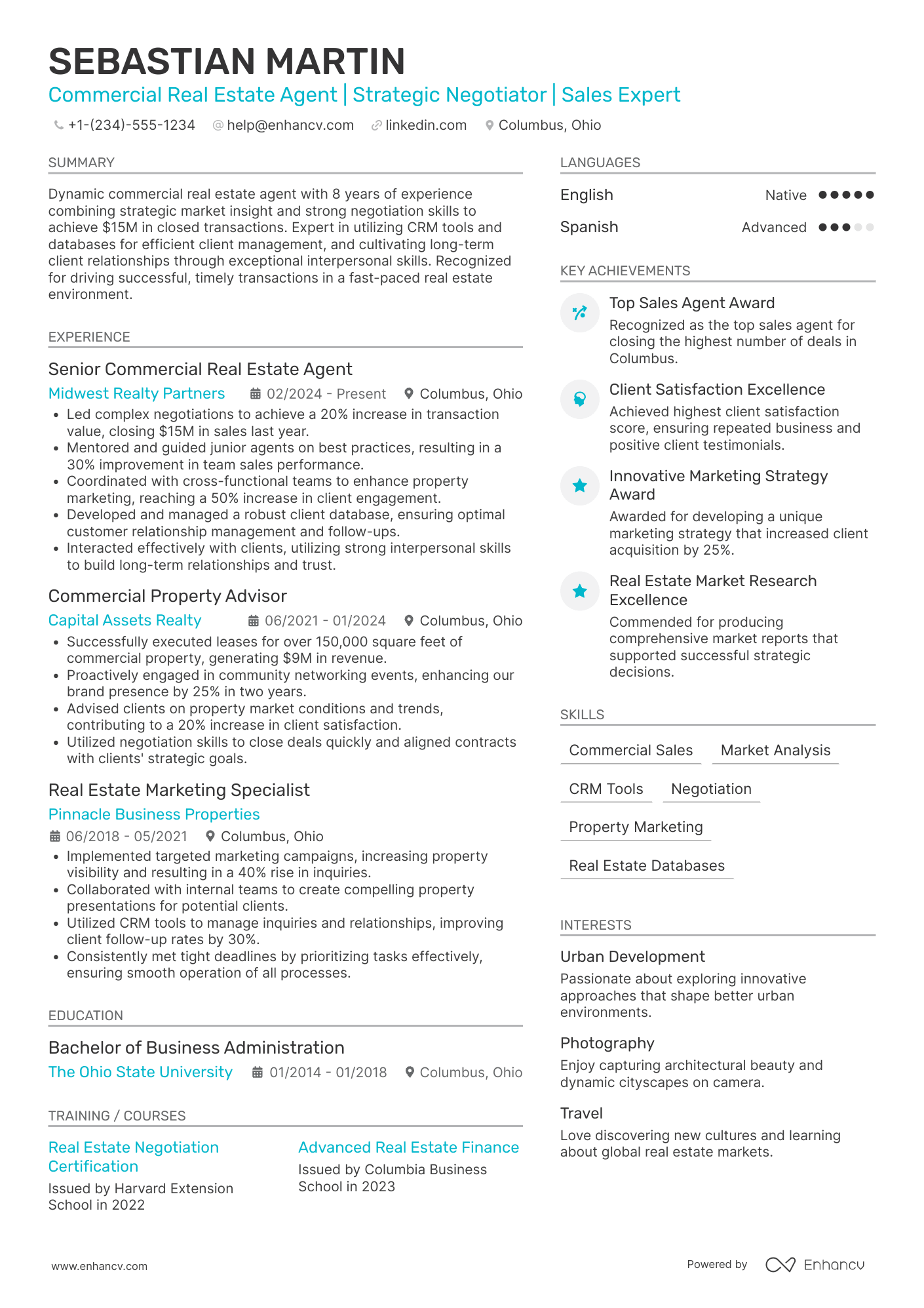
Most commercial real estate agent resume drafts fail because they list property types and tasks without quantifying deal results or pipeline impact. That omission matters when an ATS (applicant tracking system) filters fast and recruiters scan in seconds.
A strong resume shows what you delivered: closed transaction volume, number of leases executed, average days to close, and portfolio size managed. You should highlight revenue growth, occupancy gains, reduced concessions, tenant retention, and market expansion. If you're unsure where to begin, learning how to write a resume with clear, metric-driven content is the essential first step.

Key takeaways
- Quantify closed deal volume, lease counts, and revenue impact in every experience bullet.
- Use reverse-chronological format if you have direct commercial real estate brokerage experience.
- Tailor resume language to mirror each job posting's property types, tools, and priorities.
- Place skills above experience when entering the field or switching from a related role.
- Tie every listed skill to a specific action and measurable outcome on your resume.
- Add certifications like CCIM or SIOR near your education to signal specialized expertise.
- Use Enhancv to turn vague duties into concise, metric-driven bullet points faster.
How to format a commercial real estate agent resume
Recruiters evaluating commercial real estate agents prioritize deal volume, transaction value, client acquisition ability, and knowledge of local market dynamics. A clear, well-organized resume format ensures these revenue-driving signals surface immediately rather than getting buried under generic skills lists or cluttered layouts.

I have significant experience in this role—which format should I use?
Use a reverse-chronological format to showcase your growing track record of closed deals, expanding client portfolios, and deepening market expertise. Do:
- Lead each role entry with your scope of responsibility—property types handled, territory size, and portfolio value under management.
- Highlight CRE-specific tools and domains such as CoStar, LoopNet, Argus, lease negotiation, tenant representation, and investment sales.
- Quantify outcomes with dollar figures, deal counts, occupancy rates, and client retention metrics that prove direct business impact.
I'm junior or switching into this role—what format works best?
A hybrid format works best because it lets you lead with relevant skills and market knowledge while still showing a concise employment timeline. Do:
- Place a focused skills section near the top featuring competencies like market analysis, cold outreach, financial modeling, and CRM platforms.
- Include internships, real estate coursework, license certifications, or transitional experience such as residential sales or property management that demonstrates client-facing deal work.
- Connect every listed skill to a specific action and a measurable or observable result.
Why not use a functional resume?
A functional format strips away the timeline context that hiring managers need to evaluate how your deal flow, client relationships, and market knowledge developed over time—making it harder to trust the scope of your contributions. A functional resume may be acceptable if you're transitioning from a related field (such as residential real estate, property management, or commercial lending) and have no direct CRE brokerage experience, but only if every listed skill is tied to a concrete project, transaction, or measurable outcome rather than presented in isolation. Avoid this format entirely if you have any relevant commercial real estate work history, because the missing chronology will raise more questions than it answers.
With your format set, it's time to fill it with the right sections that highlight your qualifications as a commercial real estate agent.
What sections should go on a commercial real estate agent resume
Recruiters expect a commercial real estate agent resume to show deal performance, market expertise, and a clear track record of revenue-driving transactions. Understanding the essential resume sections ensures you don't leave out anything hiring managers are looking for.
Use this structure for maximum clarity:
- Header
- Summary
- Experience
- Skills
- Projects
- Education
- Certifications
- Optional sections: Awards, Leadership, Languages
Your experience bullets should emphasize closed deal volume, revenue impact, portfolio scope, client outcomes, and measurable results across leasing, sales, and negotiations.
Is your resume good enough?
Drop your resume here or choose a file. PDF & DOCX only. Max 2MB file size.
Now that you’ve outlined the key parts of your resume, the next step is learning how to write your commercial real estate agent resume experience so each role clearly supports those details.
How to write your commercial real estate agent resume experience
Your work experience section should demonstrate the deals you've closed, the client relationships you've built, and the measurable business outcomes you've generated as a commercial real estate agent. Hiring managers prioritize demonstrated impact—lease volumes negotiated, portfolios managed, revenue driven—over descriptive task lists that simply outline daily responsibilities.
Each entry should include:
- Job title
- Company and location (or remote)
- Dates of employment (month and year)
Three to five concise bullet points showing what you owned, how you executed, and what outcomes you delivered:
- Ownership scope: the property portfolios, client accounts, market territories, transaction pipelines, or listing inventories you were directly accountable for as a commercial real estate agent.
- Execution approach: the market analysis tools, CRM platforms, property valuation methods, prospecting strategies, or negotiation frameworks you used to source deals, advise clients, and close transactions.
- Value improved: changes to lease-up rates, vacancy reduction, portfolio performance, client retention, deal cycle speed, or risk mitigation that resulted from your direct involvement in commercial transactions.
- Collaboration context: how you coordinated with property owners, tenants, lenders, attorneys, appraisers, development teams, or municipal stakeholders to structure and finalize commercial real estate agreements.
- Impact delivered: outcomes expressed through closed transaction volume, revenue generated, portfolio growth, market expansion, or client acquisition rather than a summary of routine brokerage activities.
Experience bullet formula
A commercial real estate agent experience example
✅ Right example - modern, quantified, specific.
Commercial Real Estate Agent
Crestline Commercial Realty | Dallas, TX
2021–Present
Full-service brokerage specializing in office, industrial, and retail leasing and investment sales across North Texas.
- Originated and closed $18.6M in lease and sale transactions across twenty-two deals by prospecting in CoStar and Reonomy, running targeted outreach sequences in HubSpot, and negotiating LOIs through signature to execution.
- Increased listing exposure by 38% by building investor and tenant packages in Adobe InDesign and Canva, publishing OM distribution via Buildout and LoopNet, and coordinating tours and feedback loops with owners and tenant reps.
- Reduced average days-on-market from 92 to 71 by pricing assets using Argus Enterprise cash flow scenarios and Excel sensitivity models, aligning assumptions with ownership, lenders, and property management.
- Negotiated tenant improvement allowances and operating expense caps that lowered occupancy costs by 6–9% for five tenants while protecting landlord net effective rent targets through lease abstraction and redline management in Microsoft Word and DocuSign.
- Streamlined pipeline reporting by standardizing Salesforce stages, activity logging, and weekly dashboards, improving forecast accuracy by 25% and enabling faster decision-making with partners, attorneys, and clients.
Now that you've seen how a strong experience section comes together, let's break down how to adapt yours based on the specific role you're targeting.
How to tailor your commercial real estate agent resume experience
Recruiters evaluate your commercial real estate agent resume through both applicant tracking systems and manual review. Tailoring your resume to the job description helps you clear both filters.
Ways to tailor your commercial real estate agent experience:
- Match CRM platforms and listing databases named in the posting.
- Mirror the job description's terms for lease negotiation processes.
- Reflect specific deal volume or portfolio size metrics referenced.
- Highlight tenant representation or landlord representation based on the role.
- Emphasize zoning compliance and due diligence if the posting requires it.
- Align your market analysis methods with those the employer describes.
- Include property types like office retail or industrial that the role covers.
- Reference client acquisition strategies or pipeline frameworks the listing mentions.
Tailoring means aligning your real accomplishments with the employer's stated priorities, not forcing keywords where they don't belong.
Resume tailoring examples for commercial real estate agent
| Job description excerpt | Untailored | Tailored |
|---|---|---|
| "Prospect and cultivate new tenant and buyer relationships using CoStar and LoopNet to source off-market commercial opportunities in multi-tenant retail and office properties." | Responsible for finding new clients and helping them with real estate transactions. | Prospected and cultivated tenant and buyer pipelines using CoStar and LoopNet, sourcing 15+ off-market opportunities across multi-tenant retail and office properties within a 12-month period. |
| "Negotiate lease terms, tenant improvement allowances, and CAM reconciliations for Class A office portfolios exceeding 500,000 square feet." | Handled lease negotiations and worked with tenants on various contract details. | Negotiated lease terms, tenant improvement allowances, and CAM reconciliations across a 620,000-square-foot Class A office portfolio, reducing average vacancy duration by 22%. |
| "Prepare investment analyses using ARGUS Enterprise, including discounted cash flow models and sensitivity analyses, to support acquisition decisions for institutional investors." | Created financial reports and analyses to help clients make purchasing decisions. | Built discounted cash flow models and sensitivity analyses in ARGUS Enterprise to support acquisition decisions for institutional investors, underwriting $85M in commercial transactions over two years. |
Once you’ve aligned your experience to the role’s priorities, quantify your commercial real estate agent achievements to show the measurable impact behind those choices.
How to quantify your commercial real estate agent achievements
Quantifying your achievements proves business impact beyond relationships. Focus on revenue closed, deal cycle time, occupancy gains, lease economics, and risk reduction from tighter underwriting and compliance.
Quantifying examples for commercial real estate agent
| Metric | Example |
|---|---|
| Revenue closed | "Closed $12.4M in annual lease value across 18 transactions by sourcing off-market tenants and tracking pipeline in Salesforce." |
| Deal cycle time | "Cut average lease cycle from 92 to 63 days by standardizing tour schedules, LOI templates, and DocuSign routing with weekly stakeholder check-ins." |
| Occupancy rate | "Raised portfolio occupancy from 86% to 94% in nine months for 220,000 square feet by targeting medical and logistics tenants." |
| Lease economics | "Negotiated average 8.5% rent lift and $18 per square foot tenant improvement allowance savings across seven renewals using CoStar comps and pro formas." |
| Risk reduction | "Reduced lease abstract errors from 6% to 1% by implementing a two-step review and maintaining compliance checklists for insurance and indemnity clauses." |
Turn vague job duties into measurable, recruiter-ready resume bullets in seconds with Enhancv's Bullet Point Generator.
Once you've crafted strong bullet points for your experience section, it's equally important to highlight the specific hard and soft skills that qualify you for commercial real estate roles.
How to list your hard and soft skills on a commercial real estate agent resume
Your skills section shows how you source deals, underwrite opportunities, and close transactions, and recruiters and applicant tracking systems scan this section for role-matched keywords; aim for a hard-skill-heavy mix supported by a few execution-focused soft skills. commercial real estate agent roles require a blend of:
- Product strategy and discovery skills
- Data, analytics, and experimentation skills
- Delivery, execution, and go-to-market discipline
- Soft skills
Your skills section should be:
- Scannable (bullet-style grouping).
- Relevant to the job post.
- Backed by proof in experience bullets.
- Updated with current tools.
Place your skills section:
- Above experience if you're junior or switching careers.
- Below experience if you're mid/senior with strong achievements.

Hard skills
Your hard skills demonstrate your technical proficiency in deal analysis, financial modeling, and transaction management:
- Commercial lease analysis
- Argus Enterprise modeling
- Excel underwriting, cash flows
- Discounted cash flow valuation
- Comparable sales, rent comps
- Market research, submarket analysis
- Lease abstraction, critical dates
- CRM: Salesforce, HubSpot
- CoStar, LoopNet, CREXi
- Pitch decks, offering memorandums
- Letter of intent drafting
- Transaction management, due diligence
Soft skills
Meanwhile, your soft skills reflect how you build relationships, manage stakeholders, and execute under pressure:
- Prospecting cadence discipline
- Client needs discovery
- Stakeholder alignment across parties
- Negotiation and concession strategy
- Objection handling with data
- Clear deal updates to clients
- Prioritization across active deals
- Ownership of follow-ups
- Risk-based decision-making
- Cross-functional coordination with legal
- Calm execution under deadlines
- Relationship building with brokers
How to show your commercial real estate agent skills in context
Skills shouldn't live only in a bulleted list on your resume. Explore examples of resume skills shown in context to see how top candidates weave competencies into their summaries and experience bullets.
They should be demonstrated in:
- Your summary (high-level professional identity)
- Your experience (proof through outcomes)
Here's what that looks like in practice.
Summary example
Senior commercial real estate agent with 12 years brokering office and industrial leases using CoStar and Argus Enterprise. Skilled in tenant representation and market analysis, closing $180M in transactions while maintaining a 94% client retention rate.
- Reflects senior-level experience clearly
- Names industry-standard tools
- Leads with a strong metric
- Highlights client relationship skills
Experience example
Senior Commercial Real Estate Agent
Beacon Partners Realty | Charlotte, NC
March 2018–Present
- Negotiated 65+ commercial lease and sale transactions totaling $120M, leveraging CoStar analytics to identify undervalued assets.
- Collaborated with property managers and legal teams to streamline due diligence, reducing average closing timelines by 18%.
- Developed investment proposals using Argus Enterprise, helping institutional clients achieve a 12% average return on portfolio acquisitions.
- Every bullet includes measurable proof.
- Skills surface naturally through outcomes.
Once you’ve tied your abilities to specific results and responsibilities, the next step is applying that same approach to building a commercial real estate agent resume when you don’t have direct experience.
How do I write a commercial real estate agent resume with no experience
Even without full-time experience, you can demonstrate readiness through:
- Brokerage internship or job shadowing
- Real estate club deal underwriting
- Argus Enterprise cash flow modeling
- CoStar and LoopNet comp research
- Cold calling and CRM prospecting
- Property tours and site visits
- Lease abstracting and rent rolls
- Market reports and comp packages
If you're starting from scratch, our guide on building a resume without work experience walks you through how to position projects, coursework, and transferable skills effectively.
Focus on:
- Deal analysis and underwriting outputs
- Market research with cited sources
- Prospecting volume and pipeline metrics
- Clean, error-free financial documents
Resume format tip for entry-level commercial real estate agent
Use a hybrid resume format to highlight projects and skills upfront while still showing work history. It helps recruiters see commercial real estate agent readiness fast. Do:
- Lead with a Projects section.
- Quantify calls, comps, and models.
- List tools: Argus Enterprise, Excel.
- Add deal assumptions and sources.
- Tailor keywords to each posting.
- Built an Argus Enterprise model for a fifty-thousand-square-foot office, tested five rent scenarios, and improved projected internal rate of return by 1.2 points.
When you're entering the field without direct experience, your education section becomes one of the strongest tools for demonstrating relevant knowledge and qualifications.
How to list your education on a commercial real estate agent resume
Your education section helps hiring teams confirm you have the foundational knowledge needed for success. It validates your understanding of finance, property law, and market analysis relevant to the commercial real estate agent role.
Include:
- Degree name
- Institution
- Location
- Graduation year
- Relevant coursework (for juniors or entry-level candidates)
- Honors & GPA (if 3.5 or higher)
List your graduation year only. Avoid including specific months or days.
Here's a strong education entry tailored to the commercial real estate agent role.
Example education entry
Bachelor of Science in Real Estate Finance
University of Southern California, Los Angeles, CA
Graduated 2021
GPA: 3.7/4.0
- Relevant Coursework: Commercial Property Valuation, Urban Land Economics, Real Estate Investment Analysis, Contract Law
- Honors: Dean's List (six semesters), Beta Gamma Sigma Honor Society
How to list your certifications on a commercial real estate agent resume
Certifications on a resume show a commercial real estate agent's commitment to learning, proficiency with key tools, and relevance in a fast-changing market.
Include:
- Certificate name
- Issuing organization
- Year
- Optional: credential ID or URL
- Place certifications below education when your education is recent and more relevant than older credentials.
- Place certifications above education when they are recent, role-relevant, or required for your target commercial real estate agent roles.
Best certifications for your commercial real estate agent resume
- Certified Commercial Investment Member (CCIM)
- Society of Industrial and Office Realtors (SIOR)
- Certified Property Manager (CPM)
- Real Property Administrator (RPA)
- Accredited Land Consultant (ALC)
- LEED Green Associate
- ARGUS Enterprise Certification
Once you’ve positioned your credentials where recruiters can quickly verify them, shift to your commercial real estate agent resume summary to show how those qualifications translate into value.
How to write your commercial real estate agent resume summary
Your resume summary is the first thing a recruiter reads. A strong one instantly positions you as a qualified commercial real estate agent worth interviewing.
Keep it to three to four lines, with:
- Your title and total years of commercial real estate experience.
- Specific property types or market segments you specialize in.
- Core skills like lease negotiation, market analysis, or CRM platforms such as CoStar and Salesforce.
- One or two measurable wins, such as transaction volume closed or portfolio value managed.
- Interpersonal strengths tied to results, like client relationship building that drove repeat business.

PRO TIP
At this level, prioritize clarity and relevance over breadth. Highlight the property types you've worked with, tools you know, and early deal contributions. Avoid vague phrases like "passionate go-getter" or "driven professional." Recruiters want specifics, not motivation.
Example summary for a commercial real estate agent
Commercial real estate agent with two years of experience in office and retail leasing. Skilled in CoStar, tenant prospecting, and lease negotiation. Contributed to closing $4.2M in transactions during first year.
Optimize your resume summary and objective for ATS
Drop your resume here or choose a file.
PDF & DOCX only. Max 2MB file size.
Before your summary can make an impact, though, your header needs to ensure recruiters know exactly who you are and how to reach you.
What to include in a commercial real estate agent resume header
A resume header lists your key contact details and role focus, helping commercial real estate agent candidates boost visibility, build credibility, and pass recruiter screening.
Essential resume header elements
- Full name
- Tailored job title and headline
- Location
- Phone number
- Professional email
- GitHub link
- Portfolio link
A LinkedIn link helps recruiters verify experience quickly and supports screening.
Don't include a photo on a commercial real estate agent resume unless the role is explicitly front-facing or appearance-dependent.
Use a role-specific headline that matches the posting and highlights your commercial property focus, such as office, retail, industrial, or multifamily.
Example
Commercial real estate agent resume header
Jordan Taylor
Commercial Real Estate Agent | Office & Industrial Leasing
Chicago, IL
(312) 555-78XX
jordan.taylor@enhancv.com github.com/jordantaylor yourwebsite.com linkedin.com/in/jordantaylor
Once your contact details and professional identifiers are set at the top, add these additional sections to reinforce your qualifications and support the rest of your resume.
Additional sections for commercial real estate agent resumes
Adding extra sections helps you stand out when your core experience alone doesn't fully capture your expertise as a commercial real estate agent.
- Languages
- Professional affiliations (e.g., CCIM Institute, NAIOP, SIOR)
- Industry publications and market reports
- Licenses and certifications
- Volunteer work in community development or urban planning
- Awards and sales recognitions
- Conferences and speaking engagements
Once you've rounded out your resume with the right supplementary sections, it's worth pairing it with a strong cover letter to make an even bigger impact.
Do commercial real estate agent resumes need a cover letter
A cover letter isn't required for a commercial real estate agent, but it helps in competitive markets or firms with strict hiring expectations. If you're unfamiliar with this document, start by understanding what a cover letter is and when it adds value. It can make the difference when your resume doesn't clearly show fit, specialization, or deal impact.
Use a cover letter to add context your resume can't:
- Explain role or team fit by naming the asset class, market, and client type you support, and how you work with brokers and analysts.
- Highlight one or two relevant projects or outcomes, such as lease-up results, renewal wins, pipeline growth, or pricing improvements tied to measurable numbers.
- Show understanding of the business context by referencing the firm's portfolio, target tenants, and market dynamics, and how you'd source and qualify opportunities.
- Address career transitions or non-obvious experience by connecting prior roles to prospecting, underwriting support, client management, or transaction coordination.
Drop your resume here or choose a file.
PDF & DOCX only. Max 2MB file size.
Even if you decide to include a cover letter as extra context, using AI to improve your commercial real estate agent resume helps you strengthen the document hiring teams review first.
Using AI to improve your commercial real estate agent resume
AI can sharpen your resume's clarity, structure, and impact. It helps tighten language and highlight measurable wins. But overuse strips authenticity. Once your content reads clearly and fits the role, step away from AI. For specific prompt ideas, check out our guide on ChatGPT resume writing tailored to job seekers.
Here are 10 practical prompts to strengthen specific sections of your commercial real estate agent resume:
Strengthen your summary
Quantify deal experience
Tighten bullet points
Align skills to postings
Improve action verbs
Refine project descriptions
Clarify certifications
Highlight education relevance
Cut redundant content
Target a specific role
Conclusion
A strong commercial real estate agent resume shows measurable outcomes, role-specific skills, and a clear structure. Lead with results like closed deals, lease renewals, revenue, and square footage. Support them with market knowledge, negotiation, underwriting, and client management.
Keep each section easy to scan and focused on impact. A clean format and consistent language help hiring teams assess fit fast. This approach shows you’re ready for today’s hiring market and the next cycle of growth.