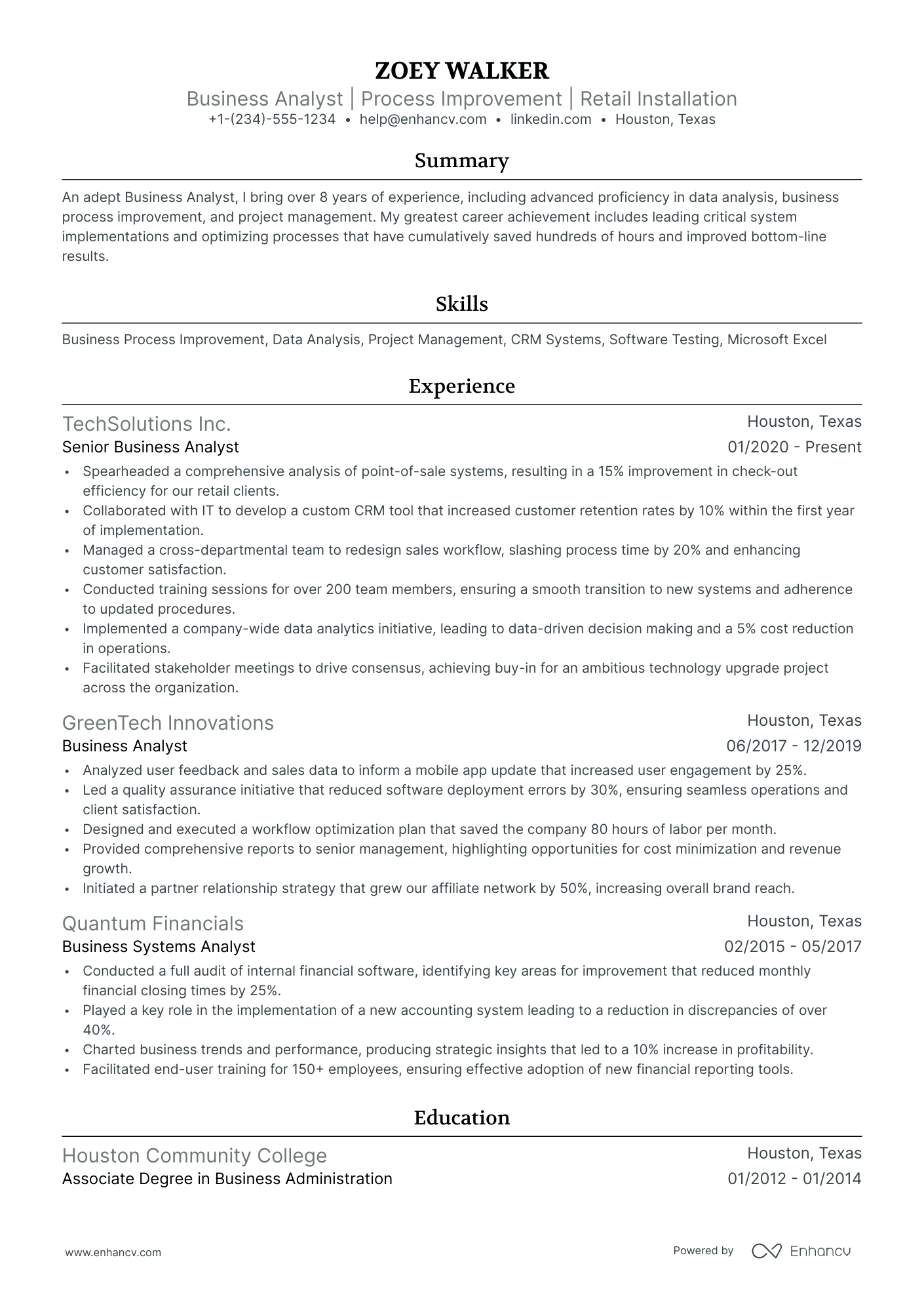
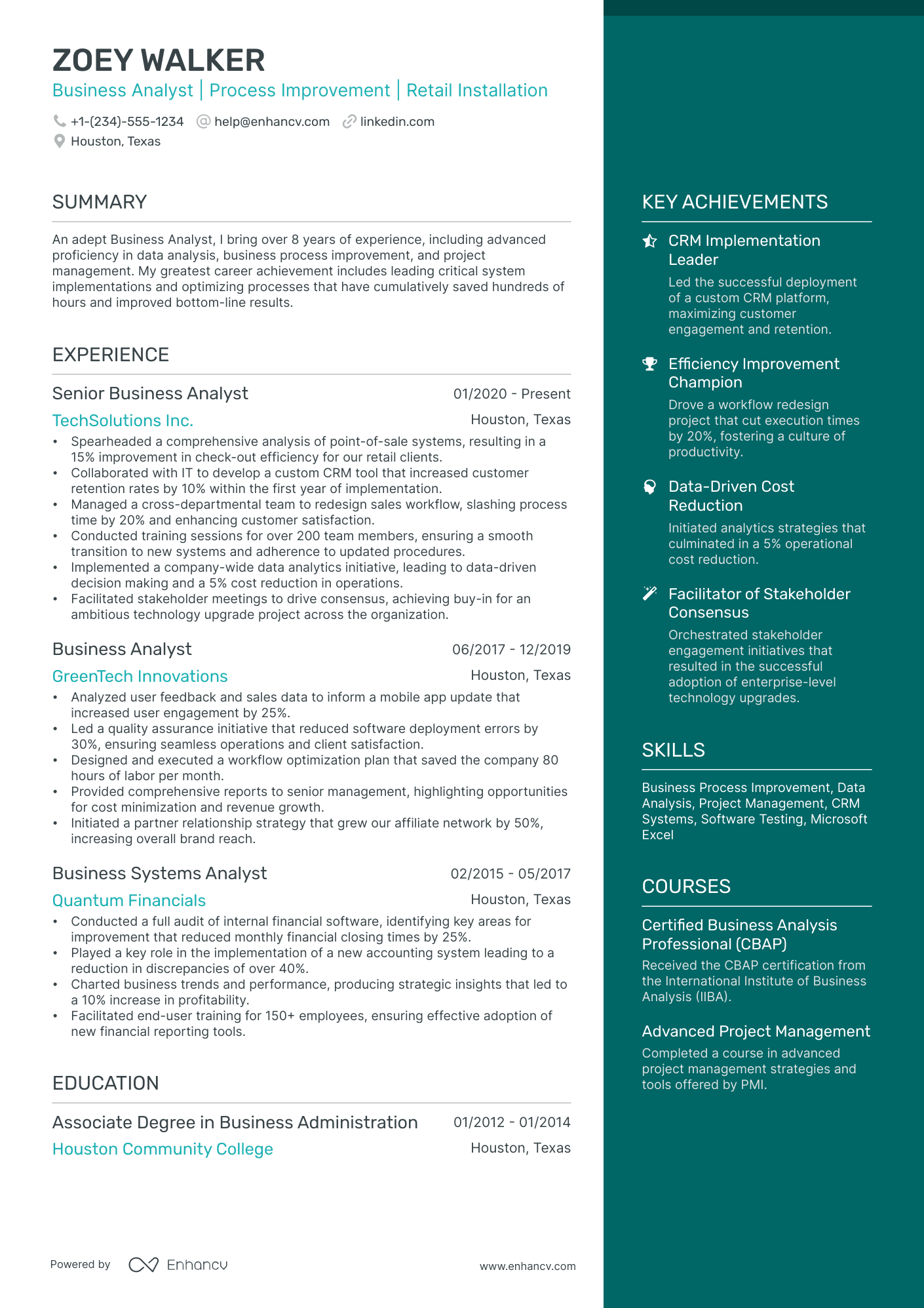
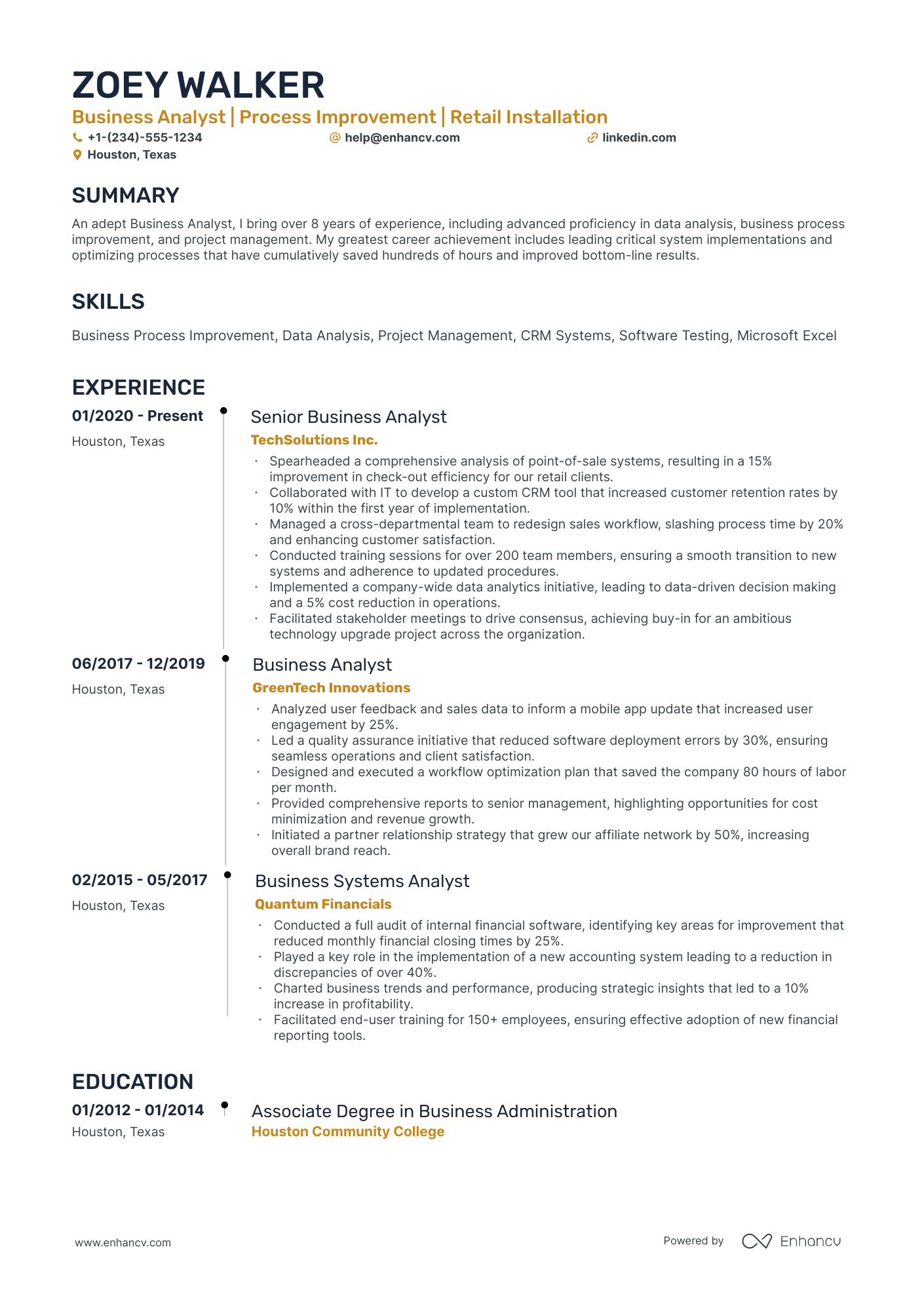
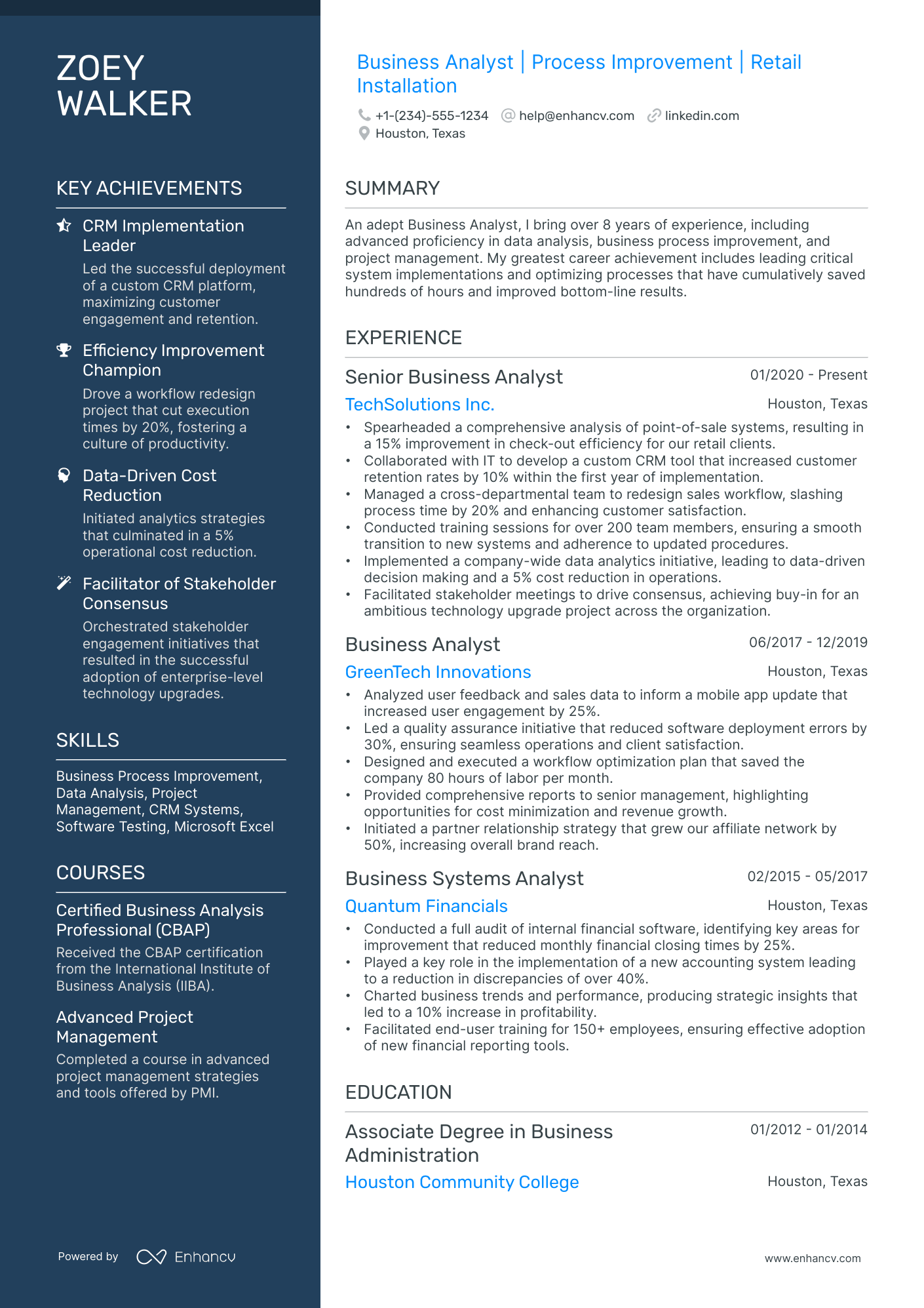
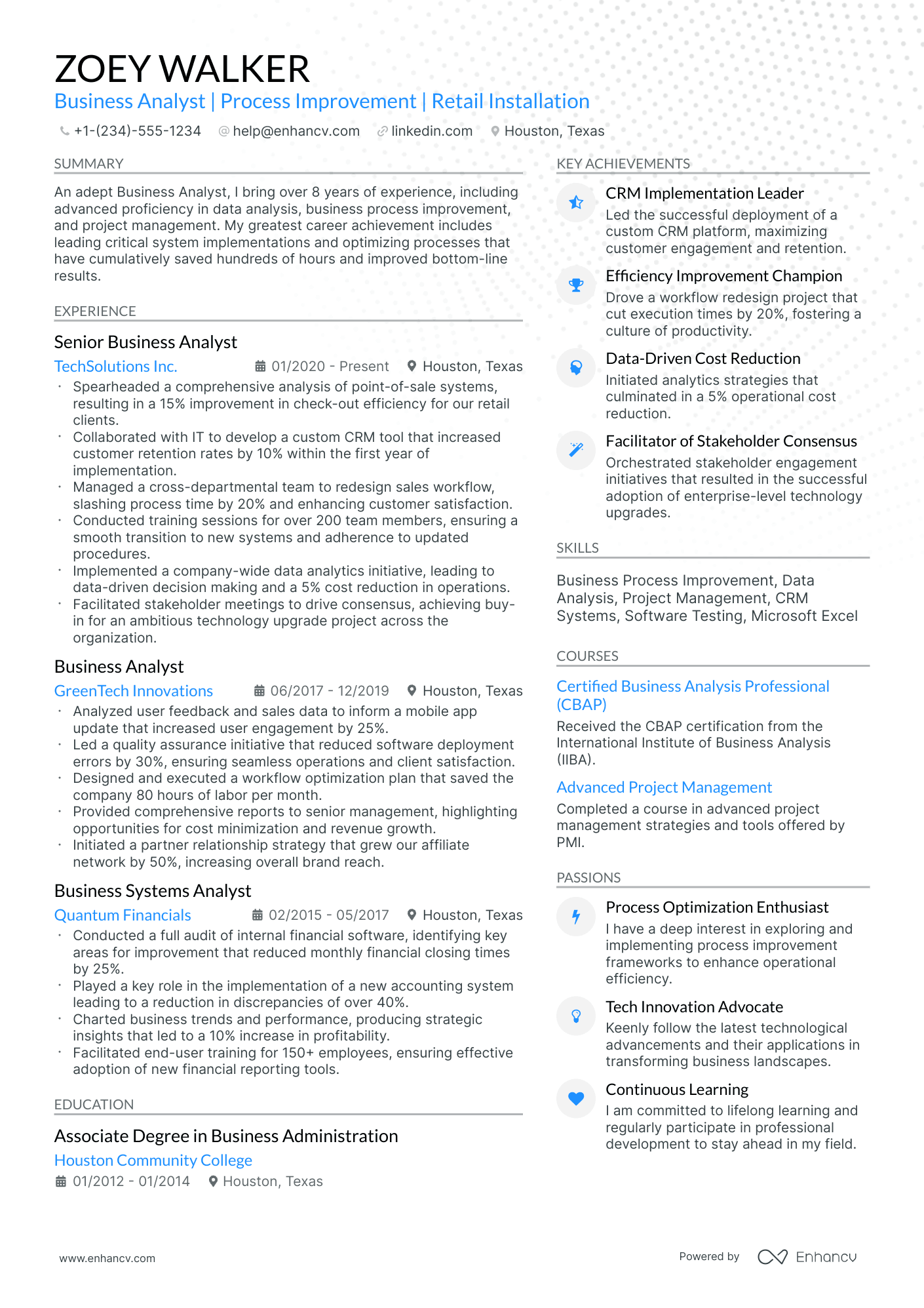
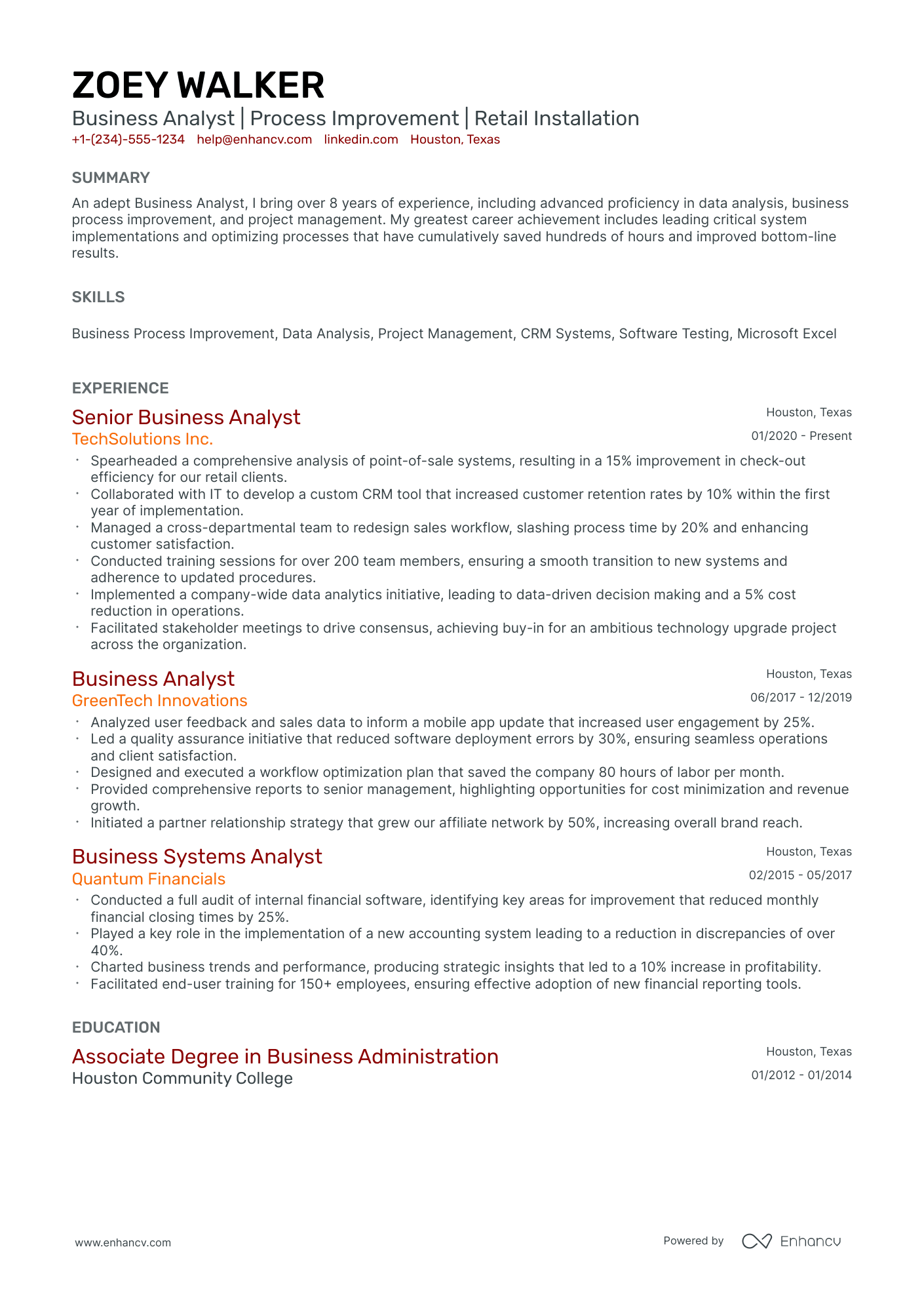
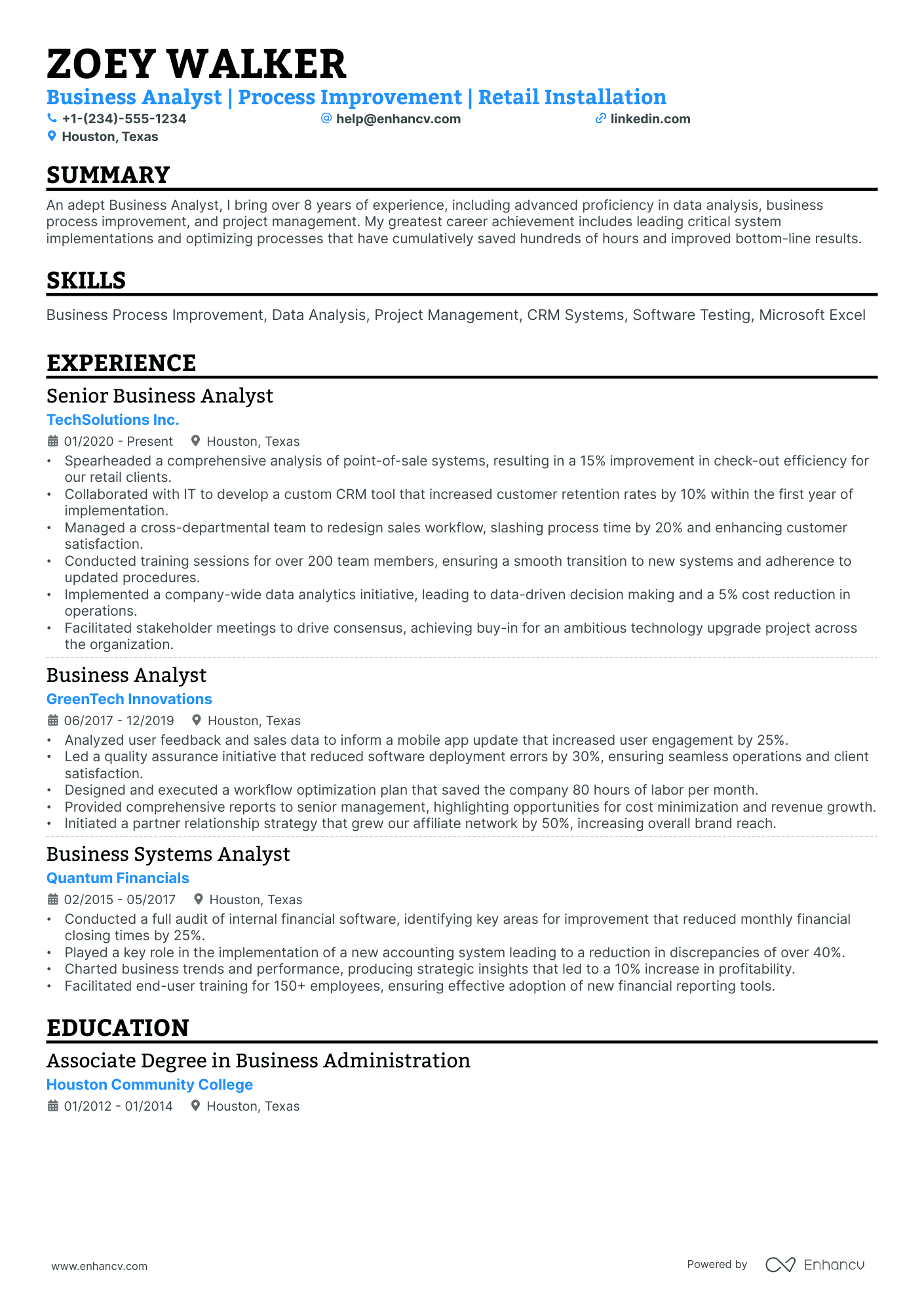
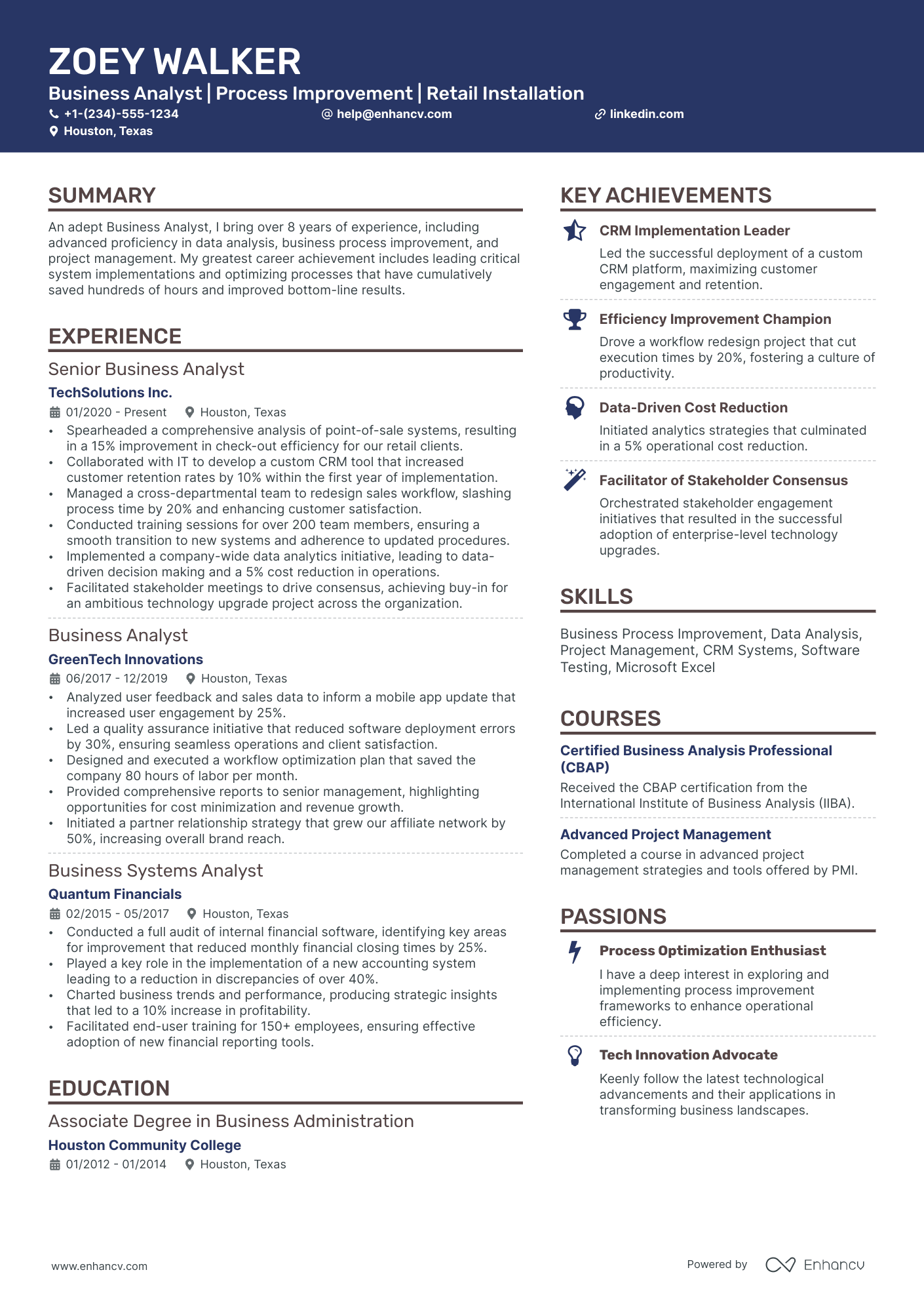
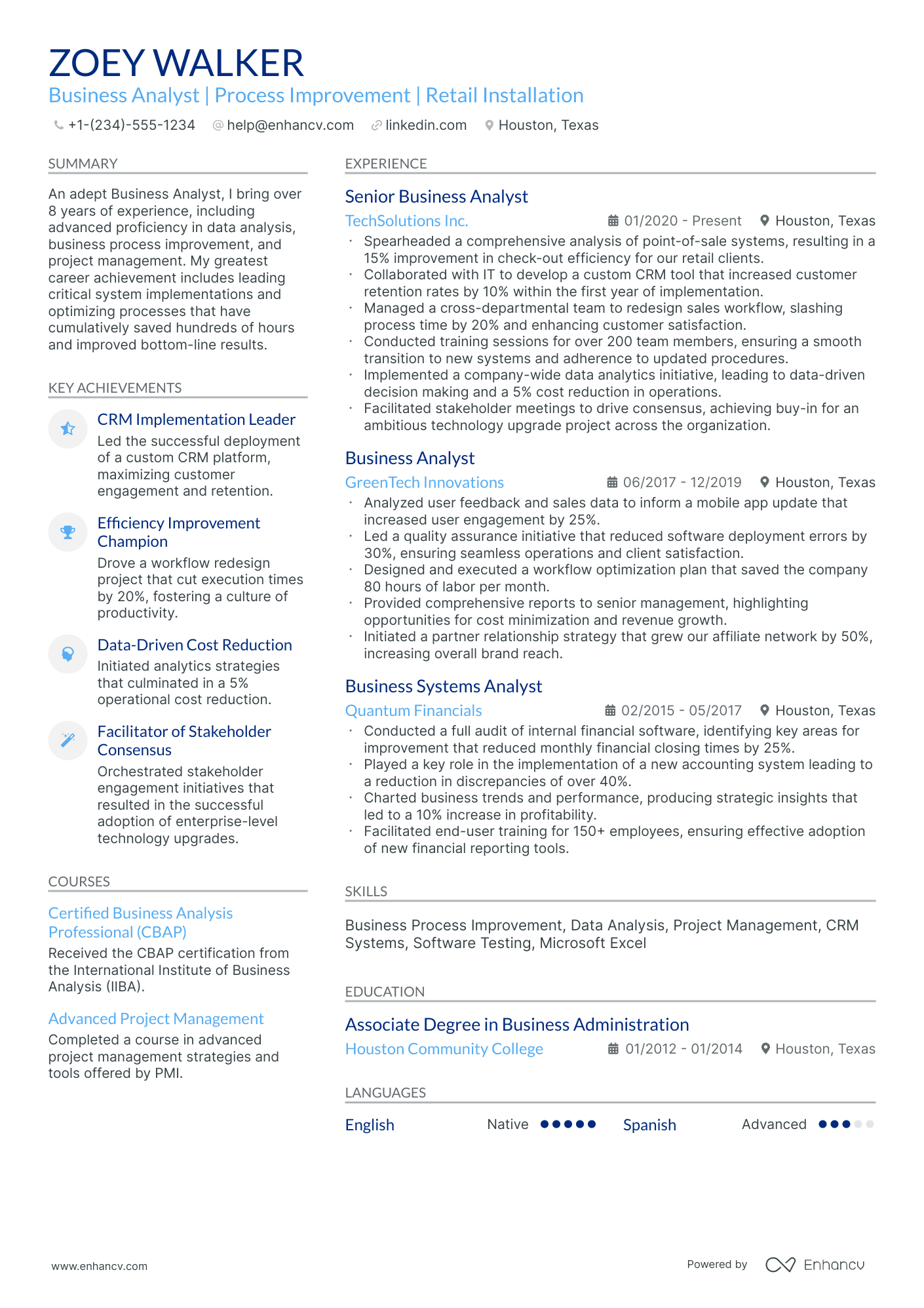
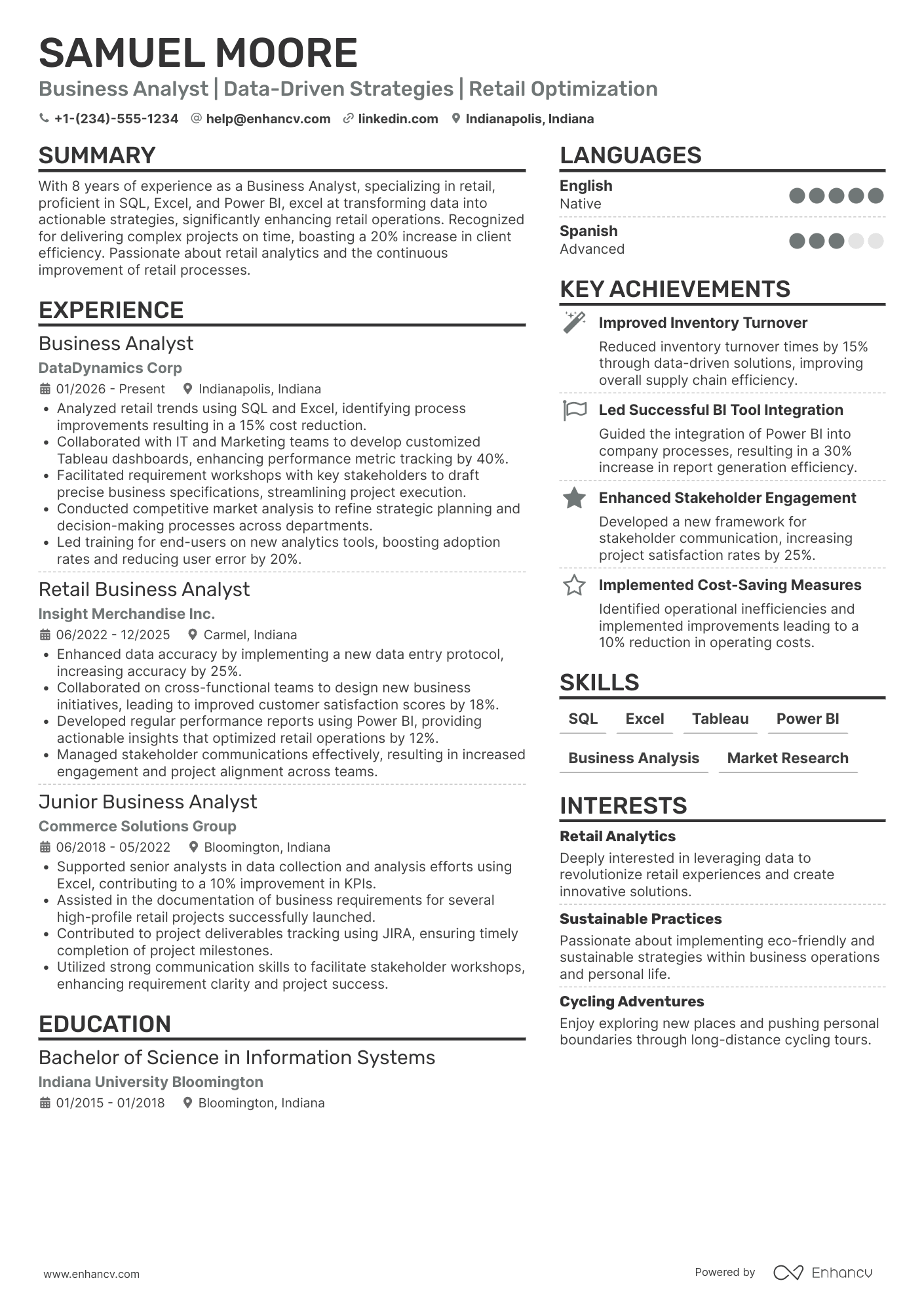
Many business analyst retail resume submissions fail because they describe tasks, not retail impact, and bury core results under tools. In today's hiring process, ATS screening and fast recruiter scans reward clear, relevant outcomes amid heavy competition.
A strong resume shows what you changed and how it measured out. Knowing how to make your resume stand out starts with highlighting revenue lift, margin gains, inventory turns, forecast accuracy, shrink reduction, rollout scope, on-time delivery, defect reduction, and adoption across stores or channels.

Key takeaways
- Quantify retail outcomes like revenue lift, shrink reduction, and forecast accuracy in every bullet.
- Use reverse-chronological format if you have relevant experience; use hybrid if you're switching careers.
- Tailor each resume to the job posting's exact tools, KPIs, and retail terminology.
- Prove skills through measurable results in your experience section, not just a skills list.
- Lead your summary with years of retail domain expertise, core tools, and one quantified win.
- Use AI to sharpen language and alignment, but stop before it invents or inflates claims.
- Build your resume with Enhancv to structure sections that surface retail impact within seconds.
How to format a business analyst retail resume
Recruiters reviewing business analyst retail resumes prioritize evidence of data-driven decision-making, cross-functional collaboration, and measurable impact on retail operations such as inventory optimization, sales forecasting, and customer behavior analysis. Choosing the right resume format determines how quickly a hiring manager can identify these signals, so the right structure ensures your strongest qualifications surface within the first few seconds of review.

I have significant experience in this role—which format should I use?
Use the reverse-chronological format to present your business analyst retail experience in a clear, progression-focused structure. Do:
- Lead each role entry with your scope of ownership—specify the retail functions, teams, or business units you supported and the scale of data or revenue involved.
- Highlight role-specific tools and domains such as SQL, Tableau, Power BI, demand forecasting models, POS analytics, and retail KPI frameworks.
- Quantify outcomes tied to business impact, including cost reductions, revenue lifts, forecast accuracy improvements, or process efficiency gains.
I'm junior or switching into this role—what format works best?
Use a hybrid format that leads with a focused skills section and follows with a concise work history to demonstrate how you've applied analytical capabilities in retail or adjacent contexts. Do:
- Place core skills—such as data visualization, requirements gathering, retail analytics, and Excel modeling—in a dedicated section near the top of your resume.
- Include academic projects, internships, freelance work, or cross-industry experience where you performed business analysis tasks like stakeholder reporting, process mapping, or data cleaning.
- Connect every action to a clear outcome so recruiters can see the link between your analytical work and a tangible business result.
Why not use a functional resume?
A functional format strips away the timeline and context that recruiters need to evaluate how, where, and when you applied your business analyst skills in a retail environment, making it harder to verify your experience and easier for applicant tracking systems to misparse your resume.
- A functional format may be acceptable if you're making a career change into retail business analysis with no direct experience, have significant resume gaps, or have limited formal work history—but only if you anchor every listed skill to a specific project, deliverable, or measurable outcome.
Once your layout and formatting choices are in place, the next step is deciding which sections to include so each one reinforces your qualifications.
What sections should go on a business analyst retail resume
Recruiters expect a business analyst retail resume to show clear ownership of retail analytics, cross-functional delivery, and measurable business impact. Understanding what to put on a resume ensures every section earns its place.
Use this structure for maximum clarity:
- Header
- Summary
- Experience
- Skills
- Projects
- Education
- Certifications
- Optional sections: Awards, Leadership, Languages
Strong experience bullets should emphasize measurable impact on retail outcomes, including revenue lift, margin improvement, inventory accuracy, conversion rate gains, and the scope of stakeholders, systems, and stores you supported.
Is your resume good enough?
Drop your resume here or choose a file. PDF & DOCX only. Max 2MB file size.
Now that you’ve set up the right resume structure, use the next section to write your business analyst retail resume experience in a way that fits those parts and highlights your impact.
How to write your business analyst retail resume experience
Your experience section proves you can translate retail data into actionable insights that drive business decisions. Hiring managers prioritize demonstrated impact—measurable outcomes from your analytical work—over descriptive task lists that simply catalog daily responsibilities. Building a targeted resume ensures each bullet speaks directly to the role's priorities.
Each entry should include:
- Job title
- Company and location (or remote)
- Dates of employment (month and year)
Three to five concise bullet points showing what you owned, how you executed, and what outcomes you delivered:
- Ownership scope: the retail systems, data pipelines, reporting frameworks, product categories, or store segments you were directly accountable for analyzing and improving.
- Execution approach: the analytical tools, business intelligence platforms, statistical methods, requirements-gathering techniques, or modeling frameworks you used to diagnose problems and recommend solutions in retail environments.
- Value improved: the specific retail performance dimensions you strengthened—whether inventory accuracy, demand forecasting reliability, customer conversion efficiency, supply chain visibility, or operational cost reduction.
- Collaboration context: how you partnered with merchandising teams, store operations, IT departments, vendor partners, or senior leadership to align analytical findings with retail strategy and implementation.
- Impact delivered: the business outcomes your analysis produced, expressed through revenue influence, process optimization scale, decision-making speed, or strategic shifts rather than the volume of reports generated or meetings attended.
Experience bullet formula
A business analyst retail experience example
✅ Right example - modern, quantified, specific.
Senior Business Analyst, Retail
Evergreen Outfitters | Chicago, IL
2022–Present
Omnichannel specialty retailer with 180 stores and a high-volume ecommerce platform serving two million loyalty members.
- Led end-to-end requirements for buy online, pick up in store enhancements using Jira, Confluence, and BPMN process maps, cutting average pickup wait time 18% and increasing order readiness within two hours from 72% to 89%.
- Built Power BI dashboards on Snowflake data models to track conversion, return rate, and inventory accuracy by store and channel, improving forecast accuracy 11% and reducing weekly reporting time by eight hours.
- Partnered with product managers, designers, and engineers to define A/B tests in Optimizely and analyze results in Google Analytics 4, lifting ecommerce conversion 2.6% and increasing average order value 3.1%.
- Implemented SQL-based root-cause analysis for pricing and promotion defects across point-of-sale and ecommerce, reducing promo-related checkout errors 34% and preventing an estimated $420K in margin leakage per quarter.
- Facilitated stakeholder workshops with merchandising, supply chain, and store operations to prioritize a backlog in Azure DevOps, improving sprint throughput 15% and raising on-time delivery from 81% to 93%.
Now that you've seen how a strong retail business analyst experience section comes together, let's break down how to tailor each element to match the specific job you're targeting.
How to tailor your business analyst retail resume experience
Recruiters evaluate your business analyst retail resume through both human review and applicant tracking systems (ATS). Tailoring your resume to the job description ensures your qualifications register with both.
Ways to tailor your business analyst retail experience:
- Match retail analytics platforms and BI tools named in the posting.
- Mirror the job description's terminology for inventory or demand planning.
- Align your listed KPIs with the performance metrics they prioritize.
- Highlight point-of-sale or omnichannel system experience when specified.
- Reference the same retail compliance or data governance standards mentioned.
- Incorporate their exact phrasing for cross-functional stakeholder collaboration models.
- Emphasize customer segmentation or merchandising methodologies the role requires.
- Include supply chain or vendor management workflows they explicitly call out.
Tailoring means aligning your real accomplishments with what the role demands, not forcing keywords where they don't belong.
Resume tailoring examples for business analyst retail
| Job description excerpt | Untailored | Tailored |
|---|---|---|
| "Gather and document business requirements for retail POS system upgrades, working with store operations and IT teams to define functional specifications." | Collected requirements from stakeholders and created documentation for various projects. | Gathered and documented business requirements for a $2.4M POS system upgrade across 180 retail locations, partnering with store operations and IT to deliver functional specifications that reduced checkout transaction time by 18%. |
| "Analyze retail sales data using SQL and Tableau to identify trends in customer purchasing behavior and recommend inventory optimization strategies." | Performed data analysis and created reports for management review. | Analyzed three years of retail sales data using SQL and Tableau to identify seasonal purchasing trends, recommending inventory reallocation strategies that cut overstock by 12% and reduced markdowns by $1.1M annually. |
| "Facilitate UAT sessions with regional retail managers to validate that the new order management system meets end-user workflows and acceptance criteria." | Helped test new software and reported issues to the development team. | Facilitated 14 UAT sessions with regional retail managers across five territories to validate the new order management system against 42 defined acceptance criteria, resolving 97% of workflow gaps before go-live. |
Once you’ve aligned your retail business analyst experience with the role’s priorities, the next step is to quantify your achievements so employers can see the measurable impact of your work.
How to quantify your business analyst retail achievements
Quantifying your work proves business impact, not just activity. Using numbers on your resume is essential for retail business analysts—focus on sales uplift, margin, inventory accuracy, forecast error, process cycle time, shrink, and on-time delivery.
Quantifying examples for business analyst retail
| Metric | Example |
|---|---|
| Revenue uplift | "Analyzed loyalty and basket data in SQL and Power BI, driving a targeted promo that lifted same-store sales 3.8% across twenty-five locations in six weeks." |
| Inventory accuracy | "Redesigned store receiving and cycle count rules, improving inventory record accuracy from 92% to 97% and cutting stockouts 14% in top one hundred SKUs." |
| Forecast quality | "Built a weekly demand forecast in Excel and Python, reducing mean absolute percentage error from 28% to 19% for seasonal apparel across three regions." |
| Cycle time | "Streamlined price-change workflows in Jira and Confluence, reducing end-to-end approval time from eight days to three and eliminating two manual handoffs." |
| Risk reduction | "Partnered with loss prevention to analyze exception reports, reducing shrink-related incidents 11% and improving audit pass rate from 85% to 96% in one quarter." |
Turn your everyday tasks into measurable, recruiter-ready resume bullets in seconds with Enhancv's Bullet Point Generator.
With strong, results-driven bullet points in place, the next step is ensuring your skills section highlights the right mix of hard and soft skills that business analyst retail roles demand.
How to list your hard and soft skills on a business analyst retail resume
Your skills section shows you can translate retail data into decisions, and recruiters and ATS scan it to match you to role requirements, so aim for a balanced mix of hard skills and job-specific soft skills. business analyst retail roles require a blend of:
- Product strategy and discovery skills.
- Data, analytics, and experimentation skills.
- Delivery, execution, and go-to-market discipline.
- Soft skills.
Your skills section should be:
- Scannable (bullet-style grouping).
- Relevant to the job post.
- Backed by proof in experience bullets.
- Updated with current tools.
Place your skills section:
- Above experience if you're junior or switching careers.
- Below experience if you're mid/senior with strong achievements.

Hard skills
- SQL (Snowflake, BigQuery)
- Excel, Google Sheets
- Tableau, Power BI, Looker
- Python for analysis
- Retail sales and margin analysis
- Demand forecasting basics
- Inventory and replenishment metrics
- Pricing and promotion analytics
- Customer segmentation, cohorts
- A/B testing, uplift analysis
- KPI dashboards and reporting
- Jira, Confluence
Soft skills
- Translate goals into requirements
- Align stakeholders on tradeoffs
- Write clear user stories
- Lead backlog prioritization
- Ask precise, data-driven questions
- Present insights to executives
- Facilitate cross-functional workshops
- Drive decisions with metrics
- Manage scope and change requests
- Partner with store and ops teams
- Communicate risks early
- Follow through on commitments
How to show your business analyst retail skills in context
Skills shouldn't live only in a dedicated skills list. Explore resume skills examples to see how top candidates weave competencies throughout their applications.
They should be demonstrated in:
- Your summary (high-level professional identity)
- Your experience (proof through outcomes)
Here's what that looks like in practice.
Summary example
Senior business analyst with eight years in retail merchandising and demand planning. Skilled in SQL, Tableau, and stakeholder collaboration. Redesigned inventory forecasting models that reduced overstock by 18%, saving $2.4M annually across 120 stores.
- Reflects senior-level experience clearly
- Names specific, role-relevant tools
- Leads with a measurable outcome
- Highlights cross-functional collaboration
Experience example
Senior Business Analyst
Bridgeport Retail Group | Charlotte, NC
March 2019–Present
- Built Tableau dashboards tracking sell-through rates, helping merchants cut slow-moving SKUs by 22% in two quarters.
- Partnered with supply chain and marketing teams to redesign promotional forecasting in SQL, improving campaign ROI by 15%.
- Led requirements gathering for a POS data integration project, reducing reporting turnaround from five days to one.
- Every bullet includes measurable proof.
- Skills surface naturally through real outcomes.
Once you’ve tied your retail business analyst strengths to real outcomes and examples, the next step is translating that same evidence into a resume when you don’t have formal experience.
How do I write a business analyst retail resume with no experience
Even without full-time experience, you can demonstrate readiness through projects and transferable work. Our guide on writing a resume without work experience covers additional strategies for entry-level candidates. Focus areas include:
- Retail sales and inventory analysis.
- Point-of-sale data reporting projects.
- Excel dashboards for store metrics.
- SQL practice on retail datasets.
- Customer journey mapping coursework.
- Requirements gathering for class apps.
- Internship in retail operations.
- Case competitions on retail analytics.
Focus on:
- Quantified impact on retail metrics.
- Clear requirements and acceptance criteria.
- SQL, Excel, and visualization outputs.
- Retail domain knowledge and terminology.
Resume format tip for entry-level business analyst retail
Use a skills-based resume format because it puts projects, tools, and retail analytics results above limited work history. Do:
- Lead with a retail analytics summary.
- List tools with proficiency levels.
- Add two to three project bullets.
- Quantify results with store metrics.
- Tailor keywords to each posting.
- Built an Excel dashboard from point-of-sale data to track sell-through and stockouts, cutting weekly reporting time by 30% for a mock store.
Once you've positioned your transferable skills to compensate for limited experience, your education section becomes the next critical area to strengthen your candidacy.
How to list your education on a business analyst retail resume
Your education section helps hiring teams confirm you have the foundational knowledge needed for a business analyst retail role. It validates analytical, technical, and business skills quickly.
Include:
- Degree name
- Institution
- Location
- Graduation year
- Relevant coursework (for juniors or entry-level candidates)
- Honors & GPA (if 3.5 or higher)
Avoid listing specific months or days. Use the graduation year only for a clean, professional look.
Here's a strong education entry tailored for a business analyst retail resume.
Example education entry
Bachelor of Science in Business Analytics
University of Wisconsin–Madison, Madison, WI
Graduated 2021
GPA: 3.7/4.0
- Relevant Coursework: Retail Analytics, Data Visualization, Supply Chain Management, Consumer Behavior, Statistical Modeling
- Honors: Dean's List (six semesters), Beta Gamma Sigma Honor Society
How to list your certifications on a business analyst retail resume
Certifications on your resume show your commitment to learning, prove tool proficiency, and signal retail industry relevance for a business analyst retail. They help recruiters trust your skills in data, processes, and stakeholder work.
Include:
- Certificate name
- Issuing organization
- Year
- Optional: credential ID or URL
- Place certifications below education when your degree is recent and your certifications are older or only loosely related to business analyst retail work.
- Place certifications above education when they are recent, highly relevant, or required for the business analyst retail roles you target.
Best certifications for your business analyst retail resume
- IIBA ECBA (Entry Certificate in Business Analysis)
- IIBA CCBA (Certification of Capability in Business Analysis)
- IIBA CBAP (Certified Business Analysis Professional)
- PMI-PBA (Professional in Business Analysis)
- Certified ScrumMaster (CSM)
- Professional Scrum Product Owner (PSPO I)
- Microsoft Certified: Power BI Data Analyst Associate
Once you’ve positioned your credentials to reinforce your expertise, you’re ready to write your business analyst retail resume summary to highlight that value upfront.
How to write your business analyst retail resume summary
Your resume summary is the first thing a recruiter reads. A strong one instantly connects your experience to the retail business analyst role.
Keep it to three to four lines, with:
- Your title and relevant years of experience in business analysis.
- Retail domain expertise, such as e-commerce, merchandising, or supply chain.
- Core tools like SQL, Tableau, JIRA, or Excel.
- One or two quantified achievements that show measurable business impact.
- Soft skills tied to real outcomes, such as cross-functional collaboration or stakeholder communication.

PRO TIP
At this level, focus on specific tools you've used and tangible contributions you've made. Highlight relevant retail projects, early wins, and analytical skills. Avoid vague phrases like "passionate problem-solver" or "eager to learn." Recruiters want proof of what you can do, not motivation statements.
Example summary for a business analyst retail
Business analyst with two years of retail experience using SQL and Tableau to optimize inventory reporting. Reduced stockout incidents by 18% through demand forecasting models. Skilled in cross-functional collaboration with merchandising and supply chain teams.
Optimize your resume summary and objective for ATS
Drop your resume here or choose a file.
PDF & DOCX only. Max 2MB file size.
Now that your summary captures your strongest qualifications, make sure your header presents the essential contact and professional details recruiters need to reach you.
What to include in a business analyst retail resume header
A well-crafted resume header lists your key identifiers and contact details, helping business analyst retail candidates improve visibility, credibility, and recruiter screening speed.
Essential resume header elements
- Full name
- Tailored job title and headline
- Location
- Phone number
- Professional email
- GitHub link
- Portfolio link
A LinkedIn link helps recruiters verify your experience quickly and supports screening with consistent dates, titles, and scope.
Don't include a photo on a business analyst retail resume unless the role is explicitly front-facing or appearance-dependent.
Match your header title to the target posting and keep links short, readable, and consistent across every profile.
Business analyst retail resume header
Jordan Lee
Business Analyst Retail | Sales Forecasting, Inventory Optimization, and Store Performance Reporting
Chicago, IL
(312) 555-01XX
your.name@enhancv.com
github.com/yourname
yourwebsite.com
linkedin.com/in/yourname
Once your contact details and key identifiers are set at the top, add targeted additional sections to reinforce your fit for business analyst retail roles and capture relevant qualifications that do not fit in the header.
Additional sections for business analyst retail resumes
Extra resume sections help you stand out when your core experience aligns with other candidates. They showcase unique strengths that reinforce your credibility as a business analyst retail. For example, listing language skills can demonstrate your ability to support multilingual retail environments and diverse customer bases.
- Languages
- Certifications
- Industry conferences and events
- Publications
- Professional affiliations
- Volunteer experience in retail or data-driven initiatives
- Awards and recognition
Once you've strengthened your resume with relevant additional sections, the next step is pairing it with a well-crafted cover letter to maximize your application's impact.
Do business analyst retail resumes need a cover letter
A cover letter isn't required for a business analyst retail, but it helps in competitive roles or when hiring managers expect one. Understanding what a cover letter is and when to use one can make a difference when your resume needs context, or when you want to show stronger fit.
Use a cover letter when it adds clarity and proof:
- Explain role or team fit: Connect your experience to the retailer's goals, operating model, and stakeholders, such as merchandising, pricing, or supply chain.
- Highlight one or two relevant projects or outcomes: Quantify impact, such as improved forecast accuracy, reduced stockouts, or faster reporting cycles.
- Show understanding of the product, users, or business context: Reference customer journeys, store operations, omnichannel flows, and key metrics that matter to the business.
- Address career transitions or non-obvious experience: Translate adjacent work into business analyst retail skills, such as requirements, testing, analytics, and cross-functional delivery.
Drop your resume here or choose a file.
PDF & DOCX only. Max 2MB file size.
If you decide a cover letter won’t add value for a retail business analyst role, using AI to improve your business analyst retail resume becomes the most direct way to strengthen your application.
Using AI to improve your business analyst retail resume
AI can sharpen your resume's clarity, structure, and measurable impact. It helps you refine language and align content with retail industry expectations. But overuse kills authenticity. Once your resume reads clearly and fits the role, step away from AI. For more ideas, explore these ChatGPT resume writing prompts tailored for job seekers.
Here are 10 practical prompts to strengthen specific sections of your business analyst retail resume:
- Strengthen your summary. "Rewrite my business analyst retail resume summary to highlight relevant retail domain expertise and measurable contributions in under four lines."
- Quantify experience bullets. "Add specific metrics and outcomes to each experience bullet on my business analyst retail resume without inventing any data."
- Align skills section. "Review my business analyst retail resume skills section and remove irrelevant entries while prioritizing skills common in retail analytics roles."
- Sharpen project descriptions. "Rewrite the project descriptions on my business analyst retail resume to clearly state the business problem, approach, and retail impact."
- Tighten action verbs. "Replace weak or repetitive action verbs in my business analyst retail resume experience section with precise, results-driven alternatives."
- Improve education relevance. "Revise the education section of my business analyst retail resume to emphasize coursework and achievements relevant to retail analysis."
- Refine certification details. "Clarify how each certification listed on my business analyst retail resume directly supports retail business analysis responsibilities."
- Remove redundant phrasing. "Identify and eliminate filler words or redundant phrases throughout my business analyst retail resume without losing key details."
- Tailor to job posting. "Compare my business analyst retail resume against this job description and suggest targeted edits to improve alignment."
- Clarify technical contributions. "Rewrite technical tool references on my business analyst retail resume so non-technical hiring managers understand the retail business value delivered."
Stop using AI once your resume sounds accurate, specific, and aligned with real experience. AI should never invent experience or inflate claims—if it didn't happen, it doesn't belong here.
Conclusion
A strong business analyst retail resume proves impact with measurable outcomes. It highlights role-specific skills, such as sales forecasting, inventory analysis, and pricing insights. It uses a clear structure that makes results, tools, and scope easy to scan.
This approach shows you can deliver value in today’s hiring market and stay relevant as priorities shift. With quantified wins, targeted skills, and clean formatting, your business analyst retail resume signals readiness from day one.