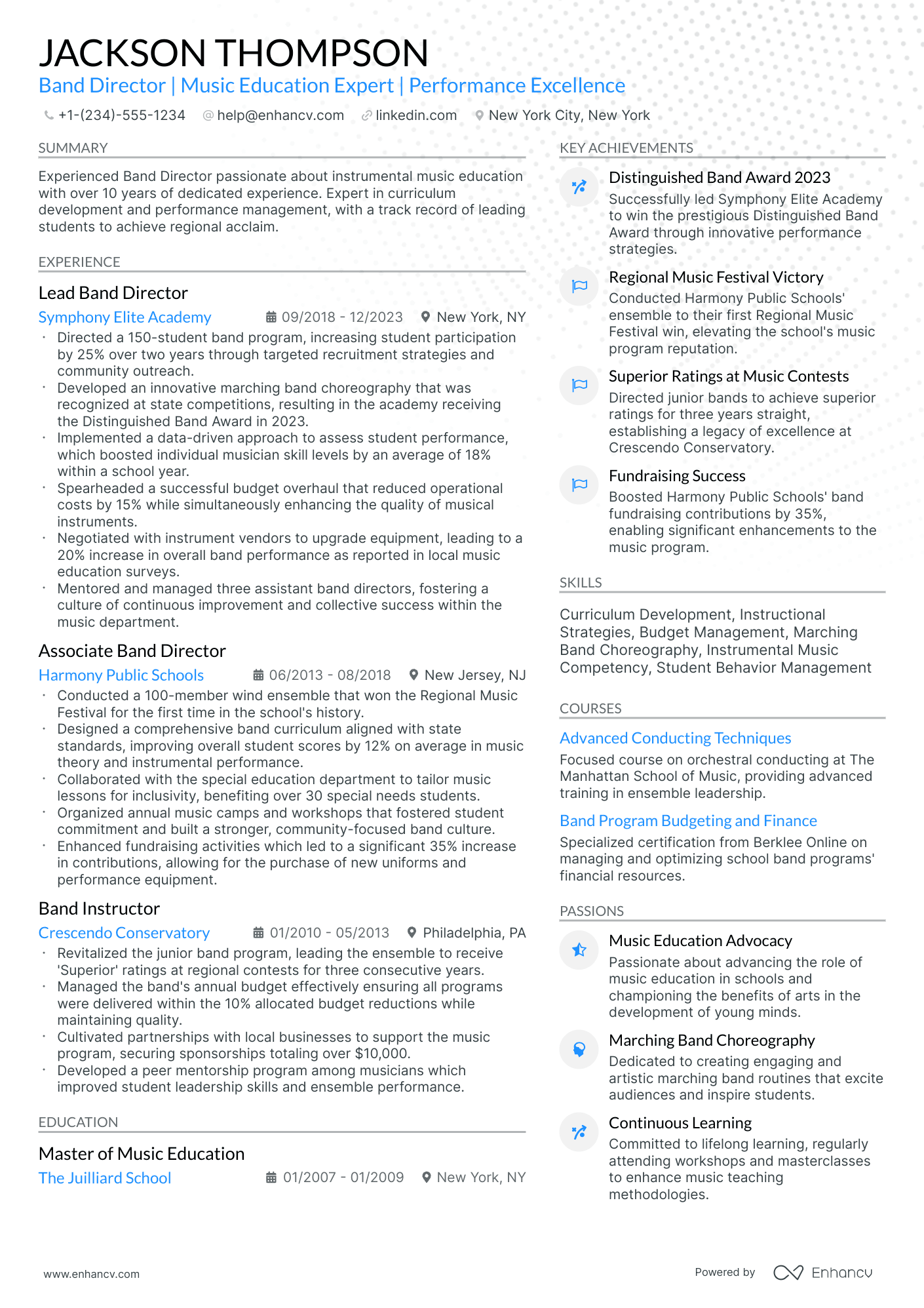
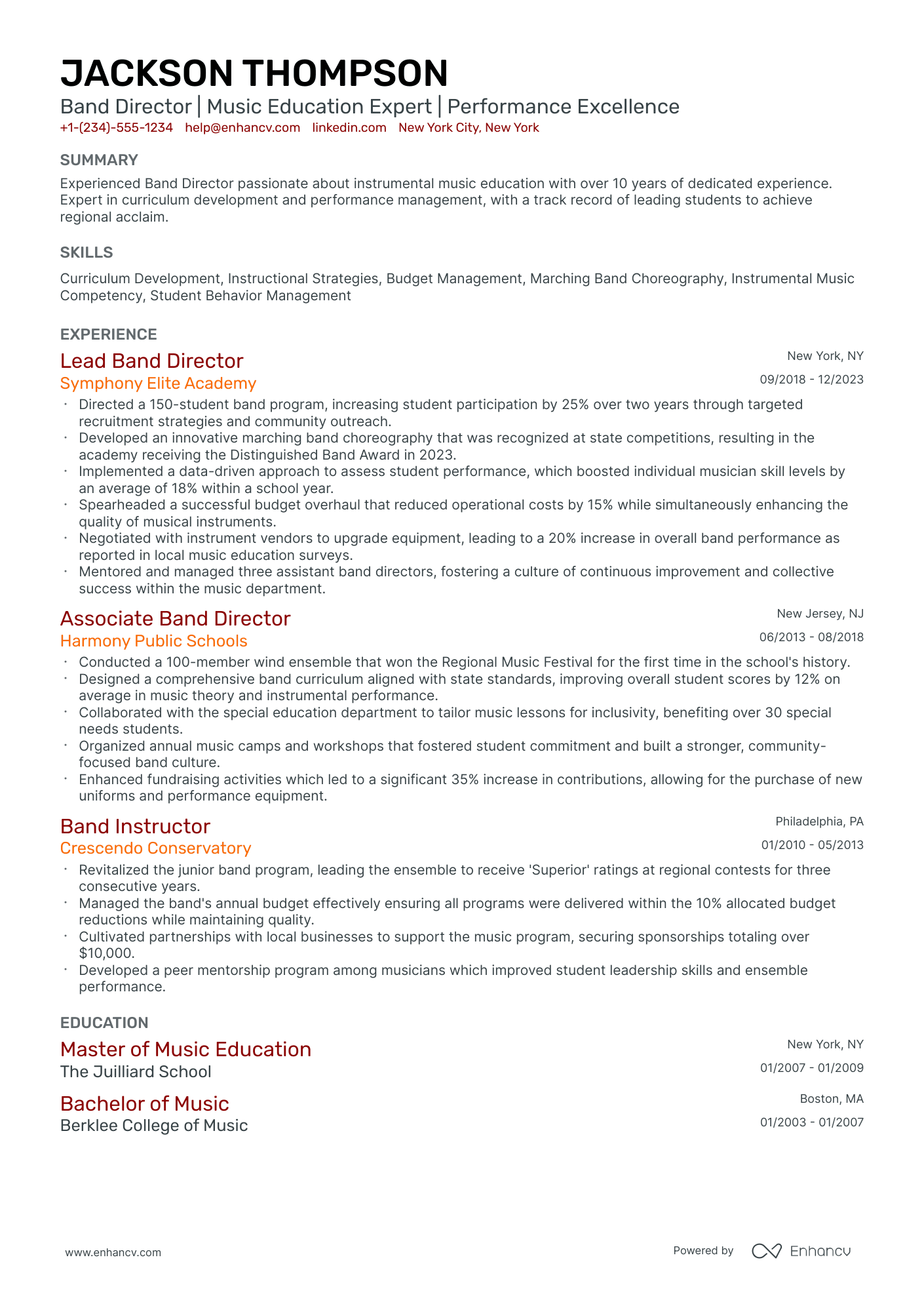
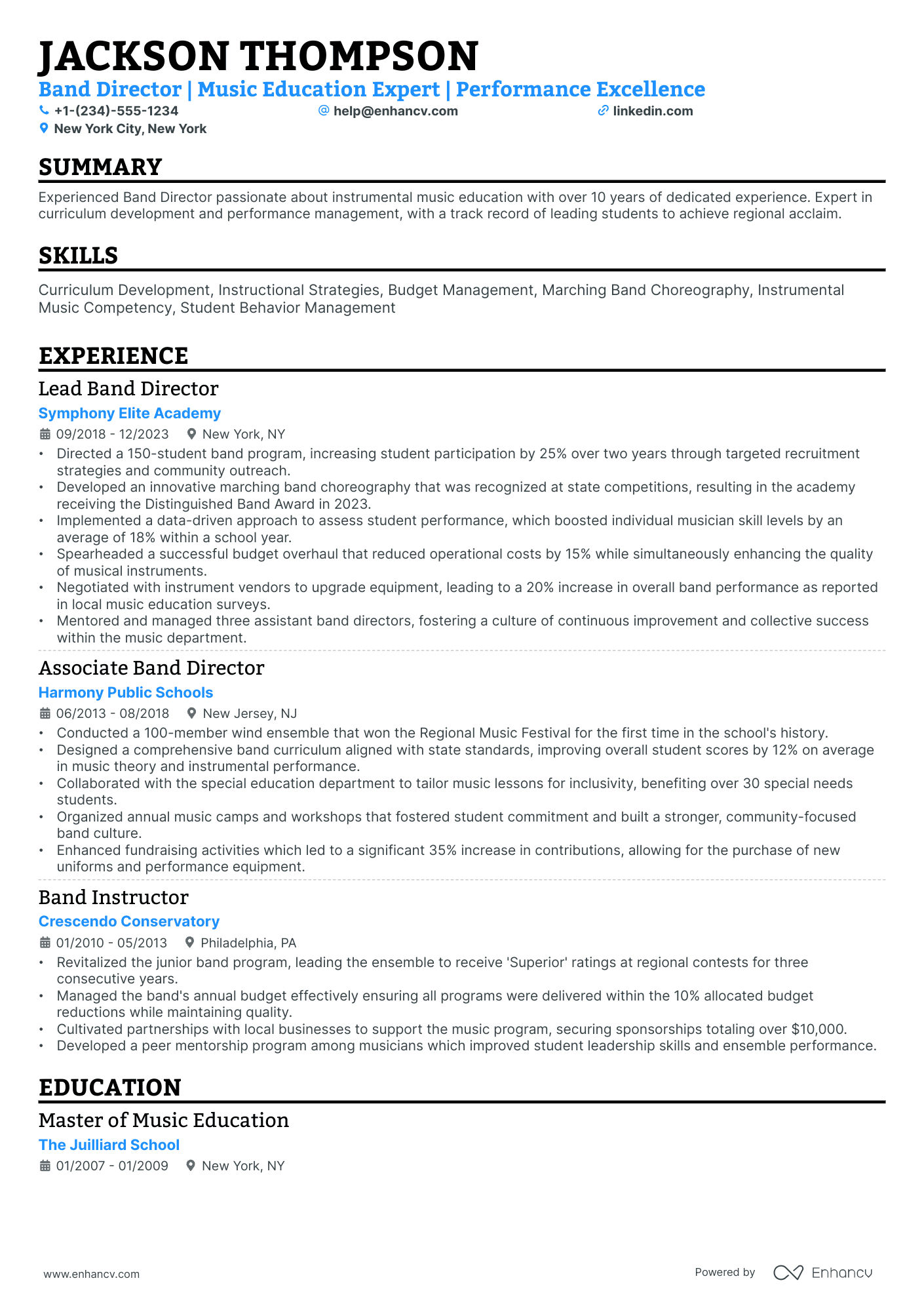
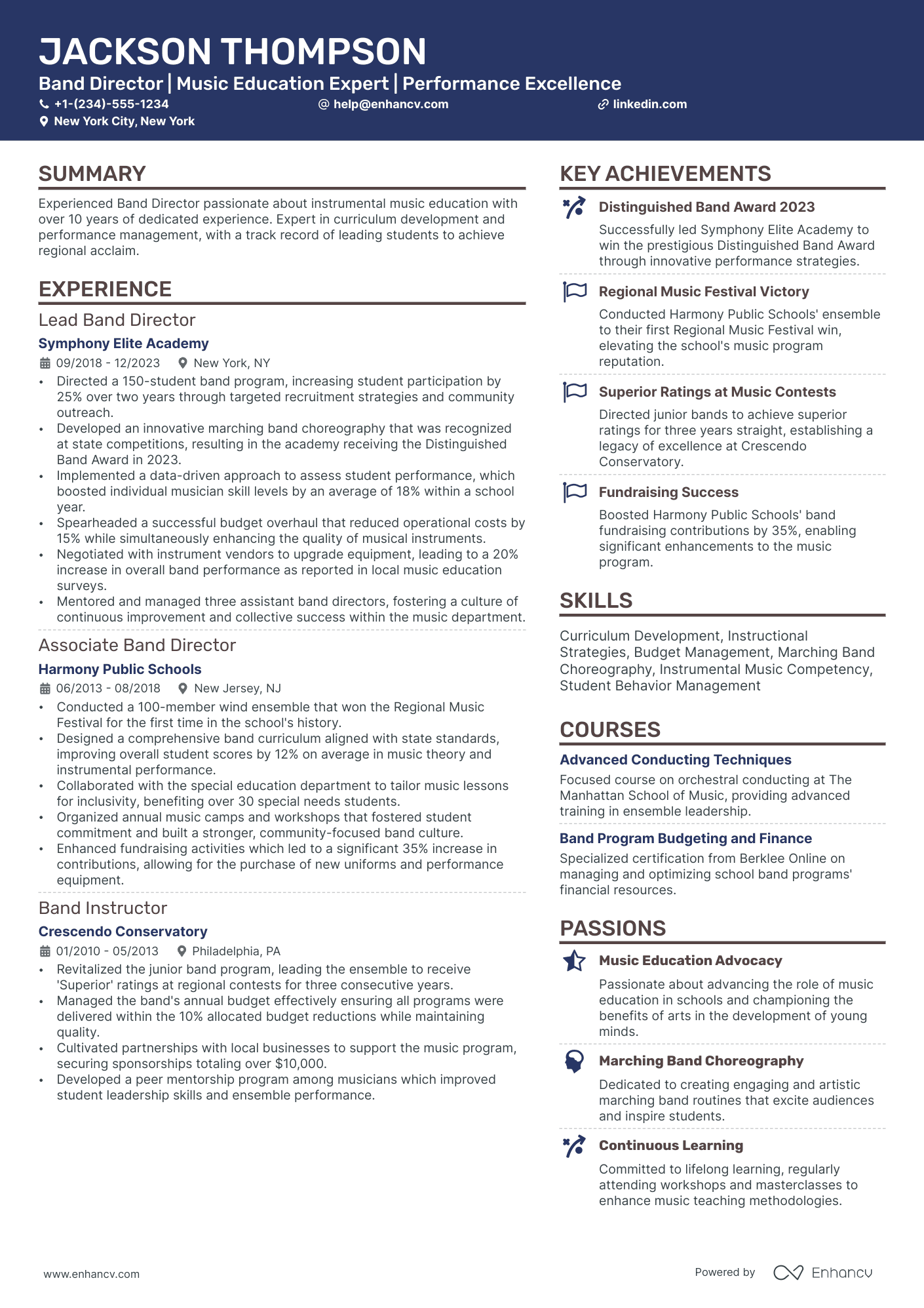
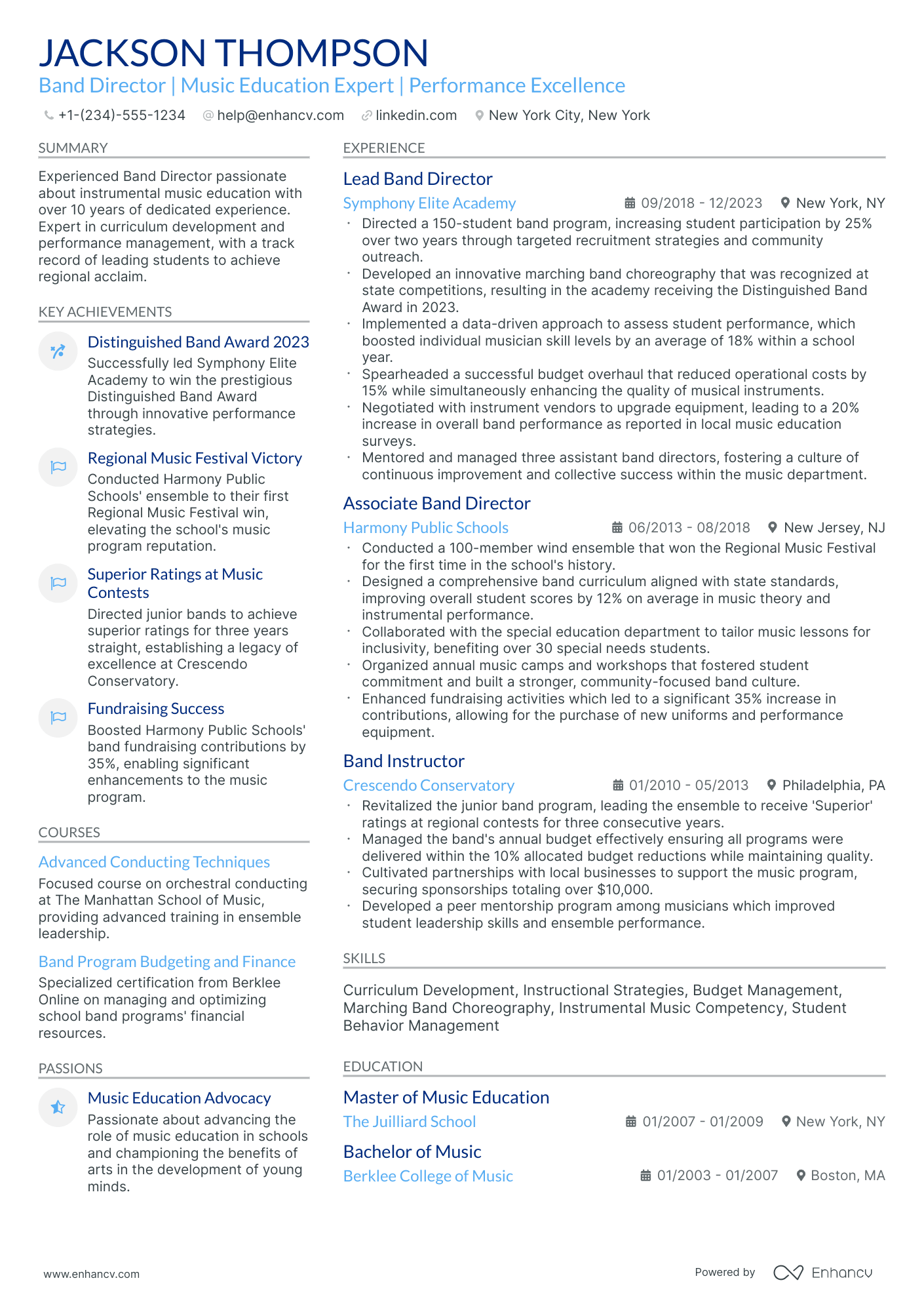
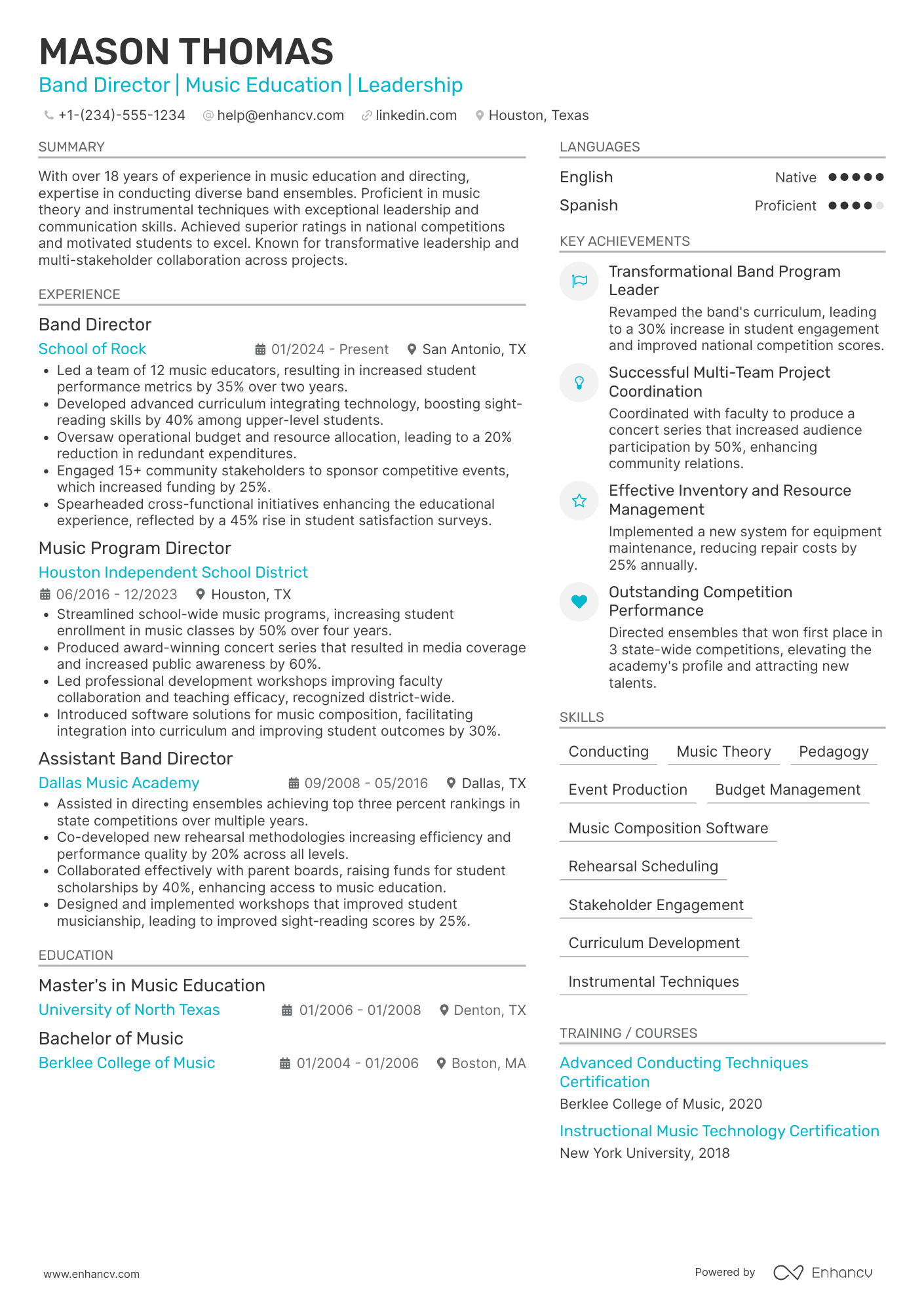
Many band director resume drafts fail because they read like job descriptions, burying measurable program results under long duty lists. That hurts when an ATS filters keywords and recruiters scan fast in a crowded applicant pool.
A strong resume shows what changed because of you: improved ensemble ratings, higher audition acceptance rates, increased participation, stronger retention, on-time show delivery, tighter rehearsal efficiency, successful budget stewardship, and consistent student growth across grade levels. Understanding how to make your resume stand out is essential when competing for band director positions in a crowded field.

Key takeaways
- Anchor every experience bullet to a measurable outcome like ratings, retention, or enrollment growth.
- Use reverse-chronological format to show progressive program leadership across roles.
- Tailor ensemble types, tools, and standards language to match each job posting directly.
- Demonstrate skills inside your summary and experience entries, not only in a standalone list.
- Quantify rehearsal efficiency, budget savings, and competition results with specific numbers and time frames.
- Entry-level candidates should highlight student teaching, section leadership, and community ensemble results.
- Use Enhancv's tools to refine bullet points and align your resume with role-specific expectations faster.
Job market snapshot for band directors
We analyzed 65 recent band director job ads across major US job boards. These numbers help you understand top companies hiring, industry demand, employer expectations at a glance.
What level of experience employers are looking for band directors
| Years of Experience | Percentage found in job ads |
|---|---|
| 3–4 years | 1.5% (1) |
| 5–6 years | 4.6% (3) |
| Not specified | 93.8% (61) |
Band director ads by area of specialization (industry)
| Industry (Area) | Percentage found in job ads |
|---|---|
| Education | 83.1% (54) |
| Finance & Banking | 16.9% (11) |
Top companies hiring band directors
| Company | Percentage found in job ads |
|---|---|
| Teach Georgia | 26.2% (17) |
Role overview stats
These tables show the most common responsibilities and employment types for band director roles. Use them to align your resume with what employers expect and to understand how the role is structured across the market.
Day-to-day activities and top responsibilities for a band director
| Responsibility | Percentage found in job ads |
|---|---|
| Music education | 21.5% (14) |
| Instrumental music | 13.8% (9) |
| Budget management | 10.8% (7) |
| Communication | 10.8% (7) |
| Computer skills | 9.2% (6) |
| Cpr | 7.7% (5) |
| Data interpretation | 7.7% (5) |
| Ferpa | 7.7% (5) |
| Idea | 7.7% (5) |
| Instructional strategies | 7.7% (5) |
| Student supervision | 7.7% (5) |
| Aed | 6.2% (4) |
How to format a band director resume
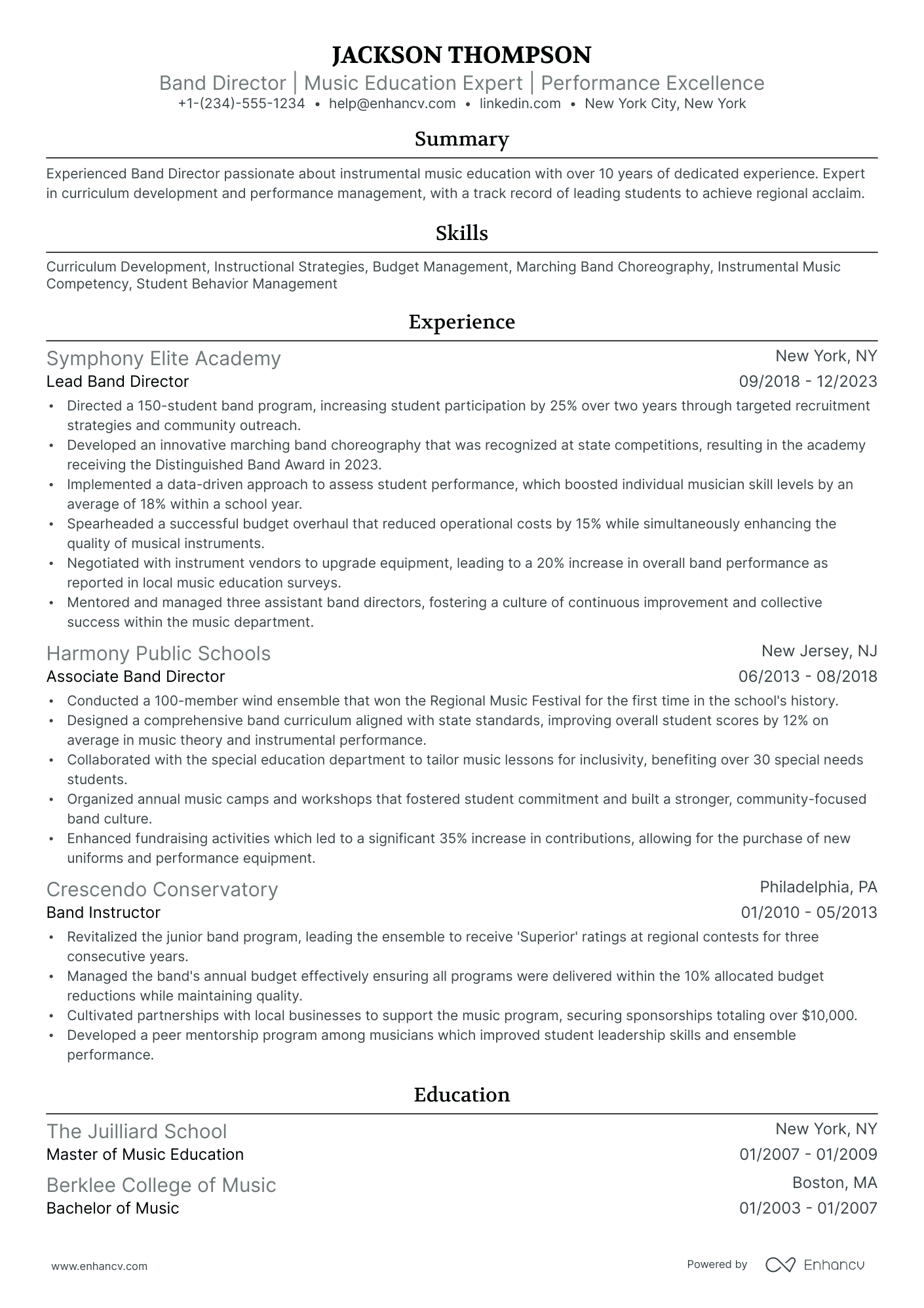
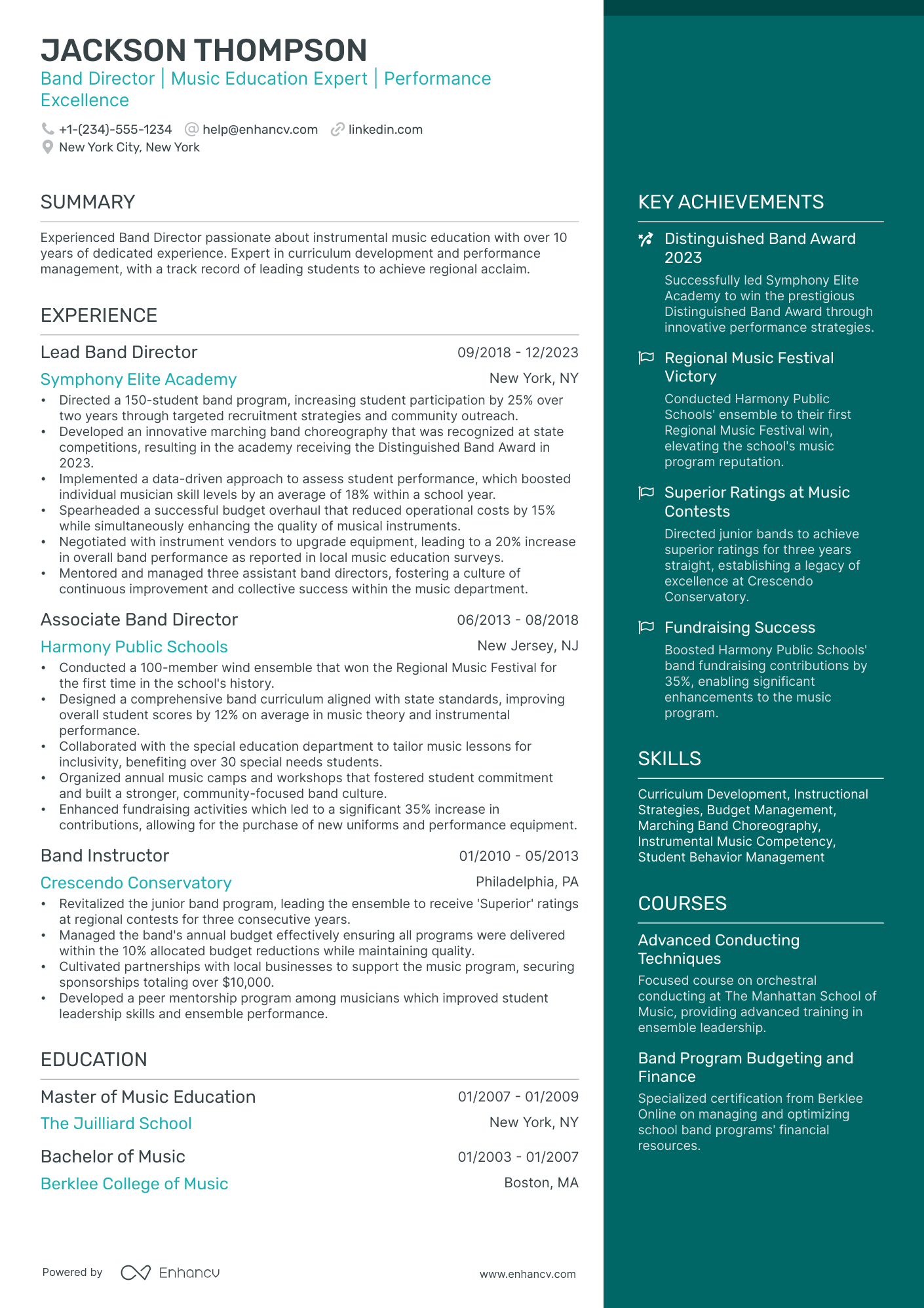
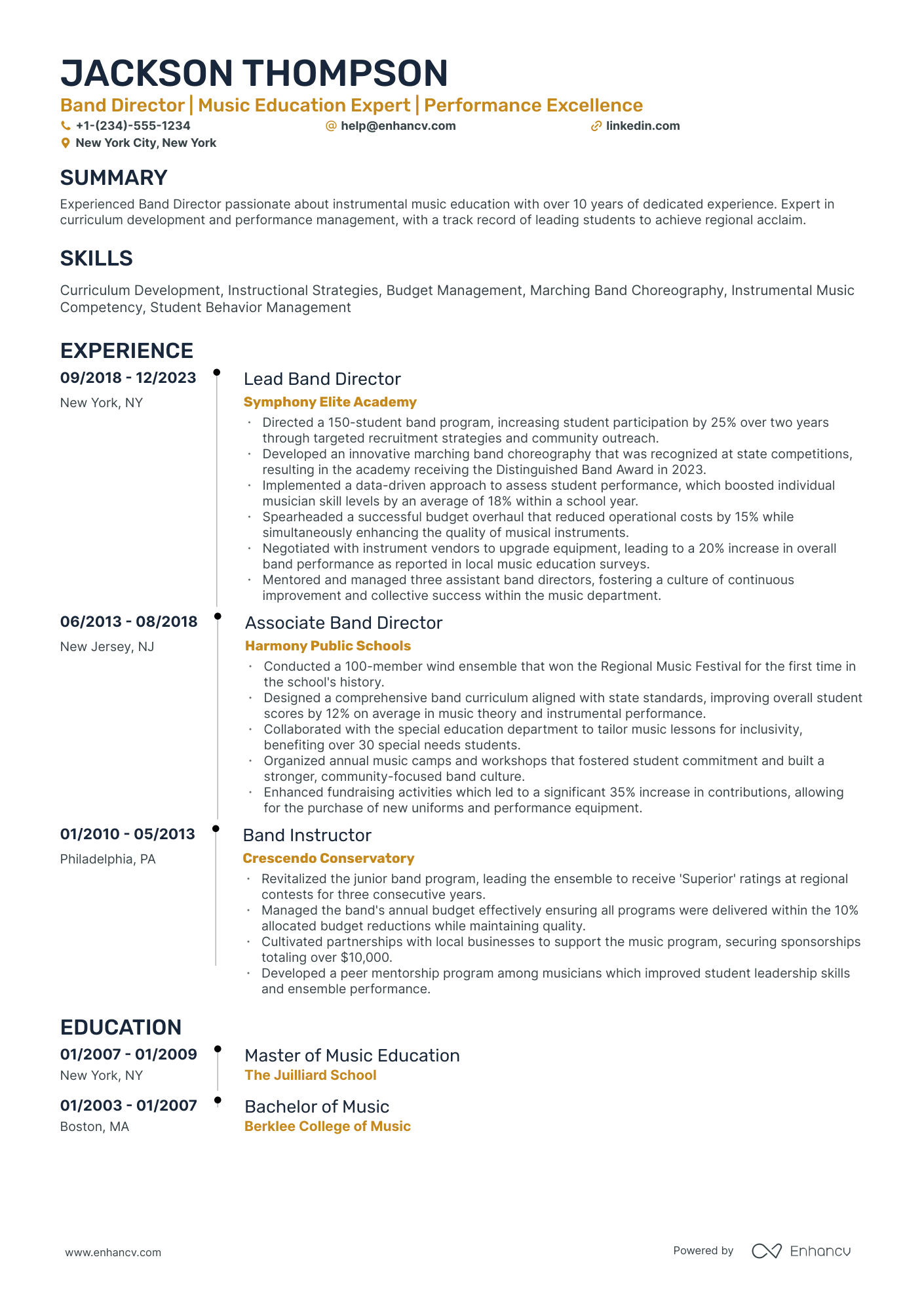
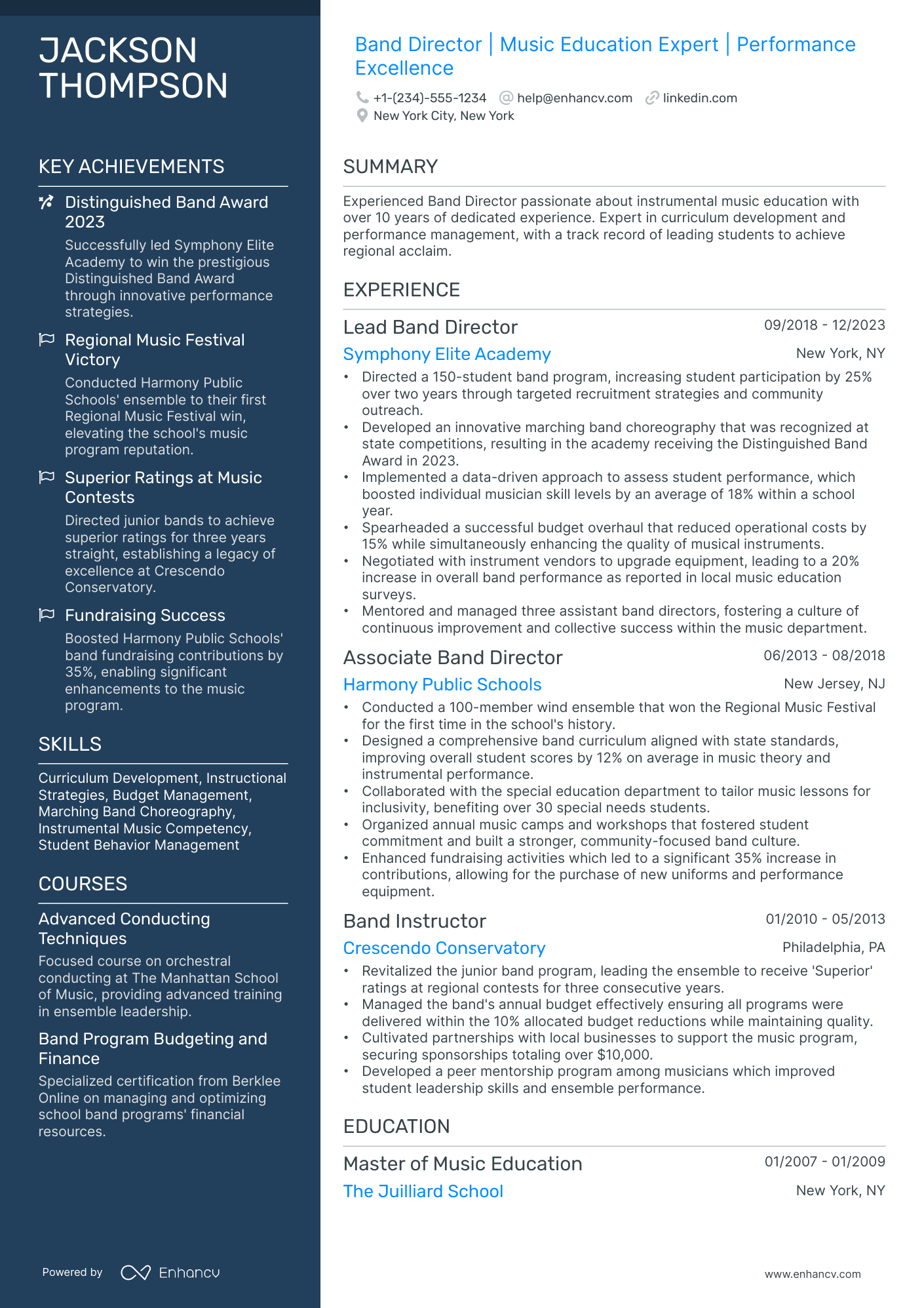
Recruiters evaluating band director candidates prioritize evidence of program leadership, ensemble development, and sustained musical achievement across increasingly complex roles. The right resume format ensures these signals—budget oversight, student growth metrics, competition results, and curriculum ownership—are immediately visible rather than buried beneath formatting that obscures your career trajectory.

I have significant experience in this role—which format should I use?
Use a reverse-chronological format to showcase the full scope of your program leadership and the progression of your responsibilities over time. Do:
- Lead with your most recent directorship, clearly defining scope: ensemble size, grade levels served, budget managed, and number of staff or assistant directors supervised.
- Highlight role-specific expertise including concert and marching band programming, music education pedagogy, instrumental instruction across woodwind/brass/percussion families, and adjudication or competition preparation.
- Anchor each role with measurable outcomes tied to program growth, student achievement, or organizational impact.
Why hybrid and functional resumes don't work for senior roles
Hybrid and functional formats fragment your career timeline, which obscures the progression from assistant director to head director and dilutes the cumulative leadership impact—budget authority, program-building decisions, staff mentorship—that defines a senior band director's value. These formats also strip accountability context, making it impossible for reviewers to connect specific outcomes to the roles and institutions where you achieved them. Avoid hybrid and functional formats entirely if you have five or more years of progressive band directing experience, as they will raise questions about gaps or stagnation rather than reinforcing your leadership narrative.
- A functional format may be acceptable only if you're transitioning into band directing from a related field such as professional performance, private instruction, or arts administration—but even then, every listed skill must be tied to a concrete project, ensemble outcome, or measurable result.
With your format established, the next step is filling it with the right sections to showcase your qualifications effectively.
What sections should go on a band director resume
Recruiters expect a band director resume to show clear leadership, instructional impact, and measurable program results. Knowing what to put on a resume helps you prioritize the details that matter most for band director roles.
Use this structure for maximum clarity:
- Header
- Summary
- Experience
- Skills
- Projects
- Education
- Certifications
- Optional sections: Awards, Leadership, Volunteering
Your experience bullets should emphasize student outcomes, ensemble achievements, program growth, and the scope of your responsibilities.
Is your resume good enough?
Drop your resume here or choose a file. PDF & DOCX only. Max 2MB file size.
Once you’ve organized your resume with the right structure and supporting details, focus next on writing your band director experience section to show impact in each role.
How to write your band director resume experience
The experience section of your band director resume should demonstrate the programs you've built, the instructional methods you've applied, and the measurable results your ensembles achieved. Hiring managers prioritize demonstrated impact—stronger performances, higher enrollment, award-winning programs—over descriptive task lists that simply restate job duties. Building a targeted resume ensures each entry speaks directly to what the hiring committee is looking for.
Each entry should include:
- Job title
- Company and location (or remote)
- Dates of employment (month and year)
Three to five concise bullet points showing what you owned, how you executed, and what outcomes you delivered:
- Ownership scope: the ensembles, music programs, budgets, instrument inventories, or student populations you were directly accountable for as band director.
- Execution approach: the rehearsal techniques, curriculum frameworks, music education technologies, or assessment methods you used to shape instruction and drive ensemble development.
- Value improved: changes to ensemble performance quality, student retention, program enrollment, concert attendance, or competitive standing that resulted from your leadership.
- Collaboration context: how you coordinated with school administrators, booster organizations, parents, guest clinicians, feeder-program directors, or community partners to advance the band program.
- Impact delivered: outcomes expressed through competition results, program growth, student advancement to honors ensembles, or community recognition rather than a list of rehearsals conducted or events attended.
Experience bullet formula
A band director experience example
✅ Right example - modern, quantified, specific.
Band Director
Riverview High School | Columbus, OH
2021–Present
Led a four-ensemble, competition-focused music program serving 180 student musicians in a Title I public high school.
- Directed rehearsals using TonalEnergy Tuner and SmartMusic, improving ensemble intonation scores by 18 percent and raising district performance ratings from “Excellent” to “Superior” in two seasons.
- Implemented a digital rehearsal workflow in Google Classroom and Noteflight, cutting music distribution time by 70 percent and increasing student practice log completion from 62 percent to 91 percent.
- Designed a data-driven audition and chair-placement process with rubric scoring in Google Sheets, reducing placement disputes by 80 percent and improving retention from 83 percent to 92 percent year over year.
- Coordinated marching band production with drill design in Pyware and audio support in QLab, delivering a nine-minute show with zero performance-day tech issues and placing top three at four regional competitions.
- Partnered with administrators, booster leadership, and vendors to manage a $85K annual budget in QuickBooks, securing $22K in sponsorships and reducing instrument repair turnaround time from fourteen days to six days.
Now that you've seen how a strong experience section comes together, let's look at how to adjust those details to match the specific job posting you're targeting.
How to tailor your band director resume experience
Recruiters evaluate band director resumes through both human review and applicant tracking systems, so tailoring your resume to the job description is essential. Tailoring ensures the specific skills, methods, and achievements you highlight match what the hiring committee prioritizes.
Ways to tailor your band director experience:
- Mirror the ensemble types and performance standards listed in the posting.
- Match rehearsal techniques or pedagogical methods the job description names.
- Reference the exact music education standards or frameworks required.
- Highlight experience with the specific grading or assessment platforms mentioned.
- Include marching band or color guard leadership if the role specifies it.
- Emphasize festival adjudication ratings that reflect the posted success criteria.
- Align your budget management scope with the program size described.
- Showcase collaboration with feeder programs or fine arts departments referenced.
Tailoring means connecting your real accomplishments to the role's stated requirements, not inserting keywords where they don't belong.
Resume tailoring examples for band director
| Job description excerpt | Untailored | Tailored |
|---|---|---|
| "Direct rehearsals and performances for concert band, marching band, and jazz ensemble programs serving 150+ students across grades 9–12." | Led band rehearsals and prepared students for concerts. | Directed daily rehearsals and seasonal performances for concert, marching, and jazz ensembles totaling 160 students in grades 9–12, coordinating repertoire selection and sectional scheduling across three concurrent programs. |
| "Develop and manage an annual budget for instrument purchases, uniform maintenance, and travel to regional and state competitions using Charms Office Assistant." | Handled budgeting tasks for the music department. | Built and managed a $45,000 annual band budget covering instrument acquisition, uniform upkeep, and travel logistics for six regional and state competitions, tracking all transactions and fundraising through Charms Office Assistant. |
| "Implement SmartMusic and sight-reading curriculum aligned with National Association for Music Education (NAfME) standards to assess individual student progress." | Used technology to help students improve their musical skills. | Integrated SmartMusic into weekly practice assignments and designed a progressive sight-reading curriculum aligned with NAfME standards, using platform analytics to track individual student growth and adjust instruction for 120 band members. |
Once you’ve aligned your experience with the role’s needs, quantify your band director achievements to show the scope and impact of that work.
How to quantify your band director achievements
Quantifying your achievements shows how your leadership improves performance, participation, and program outcomes. Focus on competition ratings, student retention, rehearsal efficiency, budget results, and event delivery reliability to prove impact clearly.
Quantifying examples for band director
| Metric | Example |
|---|---|
| Performance results | "Raised concert band ratings from 'Good' to 'Superior' at district assessment in one season by tightening sectionals and adding weekly sight-reading drills." |
| Student retention | "Improved year-over-year enrollment from 78 to 96 students by launching a peer-mentor program and hosting two middle school recruitment nights each semester." |
| Rehearsal efficiency | "Cut full-ensemble setup time from 12 minutes to six by standardizing percussion layouts and using a printed stage plot for every rehearsal." |
| Budget savings | "Reduced instrument repair costs by 22% ($3,400) by implementing a check-in checklist, monthly cleaning routines, and vendor-negotiated preventative maintenance." |
| Delivery reliability | "Delivered eight concerts and three parades with zero missed call times by using a shared Google Calendar, weekly logistics emails, and a chaperone shift roster." |
Turn your everyday tasks into measurable, recruiter-ready resume bullets in seconds with Enhancv's Bullet Point Generator.
With strong bullet points in place, it's equally important to highlight the right mix of hard and soft skills that demonstrate your full range as a band director.
How to list your hard and soft skills on a band director resume
Your skills section shows you can run a high-performing program, and recruiters and applicant tracking systems scan this section for role keywords and fit—aim for a balanced mix of technical music-program skills and job-critical leadership skills aligned to the posting. Band director roles require a blend of hard skills like instrumental pedagogy and music technology proficiency alongside soft skills such as communication, conflict resolution, and team leadership:
- Product strategy and discovery skills.
- Data, analytics, and experimentation skills.
- Delivery, execution, and go-to-market discipline.
- Soft skills.
Your skills section should be:
- Scannable (bullet-style grouping).
- Relevant to the job post.
- Backed by proof in experience bullets.
- Updated with current tools.
Place your skills section:
- Above experience if you're junior or switching careers.
- Below experience if you're mid/senior with strong achievements.

Hard skills
- Concert band repertoire selection
- Marching band drill design
- Rehearsal planning and pacing
- Instrument pedagogy, technique coaching
- Conducting, score study
- Music theory and ear training
- Sight-reading instruction
- Sectional coordination and staffing
- Festival, adjudication preparation
- Budgeting, purchasing, inventory tracking
- Scheduling, logistics, travel planning
- Music notation software: Finale, Sibelius, MuseScore
Soft skills
- Set clear rehearsal expectations
- Give actionable performance feedback
- Lead efficient rehearsals under time limits
- Align students, staff, and parents
- Communicate program goals consistently
- Resolve conflicts in the ensemble
- Make fast calls on performance issues
- Hold students accountable to standards
- Delegate to section leaders and staff
- Coordinate with administration and athletics
- Manage performance-day pressure calmly
- Build buy-in for practice routines
How to show your band director skills in context
Skills shouldn't live only in a bulleted list on your resume. Explore examples of resume skills presented in context to see how other professionals weave competencies into real accomplishments.
They should be demonstrated in:
- Your summary (high-level professional identity)
- Your experience (proof through outcomes)
Here's how that looks in practice for a band director.
Summary example
Senior band director with 15 years leading concert, marching, and jazz ensembles across Title I districts. Skilled in SmartMusic integration, differentiated rehearsal planning, and grant writing—securing over $120,000 in program funding while growing student retention by 40%.
- Reflects senior-level experience clearly
- Names role-relevant tools and methods
- Includes a concrete funding metric
- Highlights retention as a soft-skill outcome
Experience example
Senior Band Director
Westlake Consolidated School District | Pflugerville, TX
August 2016–June 2024
- Directed a 180-member marching band using Pyware 3D drill design, earning superior ratings at UIL competitions three consecutive years.
- Collaborated with fine arts faculty and booster organizations to launch a jazz ensemble, increasing program enrollment by 35% within two years.
- Implemented SmartMusic-based practice tracking across all concert bands, improving individual sight-reading assessment scores by 22%.
- Every bullet contains a measurable outcome.
- Skills appear naturally within real achievements.
Once you’ve anchored your band director strengths in real examples and outcomes, the next step is translating those details into a resume when you don’t have formal experience yet.
How do I write a band director resume with no experience
Even without full-time experience, you can demonstrate readiness through the strategies outlined in our guide on building a resume without work experience:
- Student teaching in band classrooms
- Marching band section leadership
- Private lesson instruction experience
- Community youth ensemble conducting
- Concert programming and rehearsal planning
- Music theory tutoring or coaching
- Volunteer pit orchestra coordination
- Clinic attendance with reflection notes
Focus on:
- Rehearsal plans and assessment methods
- Ensemble results and measurable growth
- Classroom management evidence and outcomes
- Repertoire selection aligned to standards
Resume format tip for entry-level band director
Use a combination resume format because it highlights teaching and conducting skills first, while still showing relevant experience substitutes and dates. Do:
- Lead with a skills summary tied to outcomes.
- Add a 'Relevant Experience' section for substitutes.
- Quantify results: attendance, growth, performance ratings.
- List repertoire, grade levels, and ensemble types.
- Include tools: notation software, metronome apps.
- Planned and led eight-week rehearsal cycle for community youth ensemble using score study, sectional plans, and notation software, improving concert accuracy by 20% on rubric.
Even without formal work experience, your educational background can demonstrate the training and knowledge that qualify you for a band director role.
How to list your education on a band director resume
Your education section helps hiring teams confirm you have the musical training and pedagogical foundation a band director needs. It validates your expertise quickly.
Include:
- Degree name
- Institution
- Location
- Graduation year
- Relevant coursework (for juniors or entry-level candidates)
- Honors & GPA (if 3.5 or higher)
Skip month and day details—list the graduation year only.
Here's a strong education entry tailored for a band director resume.
Example education entry
Bachelor of Music Education
University of North Texas, Denton, TX
Graduated 2019
GPA: 3.8/4.0
- Relevant Coursework: Instrumental Conducting, Music Theory IV, Marching Band Techniques, and Ensemble Pedagogy
- Honors: Magna Cum Laude, Dean's List (six semesters)
How to list your certifications on a band director resume
Certifications on your resume show your commitment to ongoing learning, your proficiency with essential tools, and your alignment with current expectations for a band director role.
Include:
- Certificate name
- Issuing organization
- Year
- Optional: credential ID or URL
- Place certifications below education when they're older, less relevant, or secondary to your degree and teaching credentials.
- Place certifications above education when they're recent, highly relevant, or required for the band director job you want.
Best certifications for your band director resume
- National Board Certification (Music)
- Kodály Certification
- Orff Schulwerk Certification
- Dalcroze Eurhythmics Certification
- CPR and First Aid Certification
- AED (automated external defibrillator) Certification
- Google Certified Educator Level 1
Once you’ve presented your credentials in a clear, easy-to-scan way, you can use your band director resume summary to spotlight them upfront and set context for the rest of your experience.
How to write your band director resume summary
Your resume summary is the first thing a recruiter reads, so it must immediately signal your qualifications. A strong opening sets the tone and determines whether the rest of your resume gets attention.
Keep it to three to four lines, with:
- Your title as a band director and total years of experience in music education.
- The setting you work in, such as middle school, high school, or university programs.
- Core competencies like ensemble rehearsal techniques, marching band choreography, and music theory instruction.
- One or two measurable achievements, such as competition placements or enrollment growth percentages.
- Interpersonal strengths tied to real results, like mentoring students toward scholarship offers.

PRO TIP
At this level, focus on concrete teaching outcomes, program-building results, and leadership across ensembles. Highlight competition wins, budget management, or growth in student participation. Avoid vague phrases like "passionate musician" or "dedicated educator." Recruiters want evidence, not enthusiasm.
Example summary for a band director
Band director with 12 years leading high school instrumental programs. Grew ensemble enrollment by 40% and earned six consecutive superior ratings at state competitions. Skilled in budget oversight, curriculum design, and cross-departmental collaboration.
Optimize your resume summary and objective for ATS
Drop your resume here or choose a file.
PDF & DOCX only. Max 2MB file size.
Now that your summary captures your strongest qualifications, make sure your header presents the essential contact and identification details recruiters need to reach you.
What to include in a band director resume header
A resume header is the top section with your key contact details, and it boosts visibility, credibility, and recruiter screening for a band director role.
Essential resume header elements
- Full name
- Tailored job title and headline
- Location
- Phone number
- Professional email
- GitHub link
- Portfolio link
A LinkedIn link helps recruiters verify experience quickly and supports screening.
Don't include a photo on a band director resume unless the role is explicitly front-facing or appearance-dependent.
Match your header job title to the posting and mirror the school district's keywords to improve applicant tracking system sorting.
Example
Band director resume header
Jordan Taylor
Band director | Middle school band program leadership and performance preparation
Austin, TX
(512) 555-01XX
your.name@enhancv.com
github.com/yourname
yourwebsite.com
linkedin.com/in/yourname
Once your contact details and role information are clear and easy to find, add additional sections to highlight supporting qualifications that strengthen your band director resume.
Additional sections for band director resumes
Adding extra sections helps you stand out when your core qualifications match other band director candidates closely.
They showcase unique strengths that hiring committees value beyond teaching and conducting experience.
Consider including these sections on your band director resume:
- Performance and conducting credits
- Music technology proficiencies
- Professional affiliations and honor societies
- Awards and competition results
- Publications and arrangements
- Languages
- Marching band and drill design experience
Once you've rounded out your resume with the right supplementary sections, pair it with a strong cover letter to give hiring committees the full picture of your qualifications.
Do band director resumes need a cover letter
A cover letter isn't required for a band director, but it often helps in competitive openings or districts that expect one. If you're unsure where to start, learn what a cover letter is and how it complements your resume. It can make a difference when your resume doesn't fully show fit, impact, or context.
Use a cover letter to add details your band director resume can't:
- Explain role and team fit: Connect your teaching style, rehearsal approach, and collaboration habits to the school's music program and leadership structure.
- Highlight one or two outcomes: Point to a festival rating, retention gain, fundraising result, or schedule redesign, and state what you did and what changed.
- Show program understanding: Reference the school's student mix, community expectations, course offerings, and performance calendar, and align your priorities to them.
- Address transitions or non-obvious experience: Clarify moves between grade levels, gaps, private instruction work, or non-music roles that strengthened your band director skills.
Drop your resume here or choose a file.
PDF & DOCX only. Max 2MB file size.
Even if you decide that an extra letter won’t strengthen your application, using AI to improve your band director resume helps you refine your content and tailor it faster.
Using AI to improve your band director resume
AI can sharpen your resume's clarity, structure, and overall impact. It helps refine phrasing and highlight measurable results. However, overusing it risks sounding generic. Once your content feels clear and role-aligned, step away from AI entirely. For specific guidance, explore ChatGPT resume writing prompts tailored to different resume sections.
Here are 10 practical prompts to strengthen specific sections of your band director resume:
- Strengthen your summary. "Rewrite my band director resume summary to highlight leadership, ensemble growth, and music education philosophy in three concise sentences."
- Quantify rehearsal results. "Add measurable outcomes to this band director experience bullet about improving student performance during concert and marching season rehearsals."
- Clarify skill relevance. "Review my skills section and remove any entries not directly relevant to a band director role in a public school setting."
- Improve action verbs. "Replace weak or passive verbs in my band director experience bullets with strong, specific action verbs tied to music education."
- Tighten project descriptions. "Shorten this band director project description about launching a jazz ensemble program while keeping key details and outcomes intact."
- Align with job posting. "Compare my band director resume to this job description and suggest targeted edits to better match the listed qualifications."
- Refine education details. "Rewrite my education section to emphasize coursework and training most relevant to a band director position in secondary education."
- Highlight certifications clearly. "Reorganize my band director certifications section so the most relevant music education credentials appear first with proper formatting."
- Remove redundant phrasing. "Identify and eliminate any repetitive language across my band director resume without losing important context or accomplishments."
- Sharpen accomplishment bullets. "Rewrite this band director experience bullet to follow a clear result-driven format using specific numbers and outcomes."
Stop using AI once your resume sounds accurate, specific, and aligned with real experience. AI should never invent experience or inflate claims—if it didn't happen, it doesn't belong here.
Conclusion
A strong band director resume shows measurable outcomes, role-specific skills, and a clear structure. It highlights ensemble growth, performance results, student progress, and program management with specific numbers and time frames.
Keep your resume easy to scan, with focused sections and consistent formatting. This approach matches today’s hiring expectations and stays relevant as schools prioritize accountability, student outcomes, and well-run music programs.