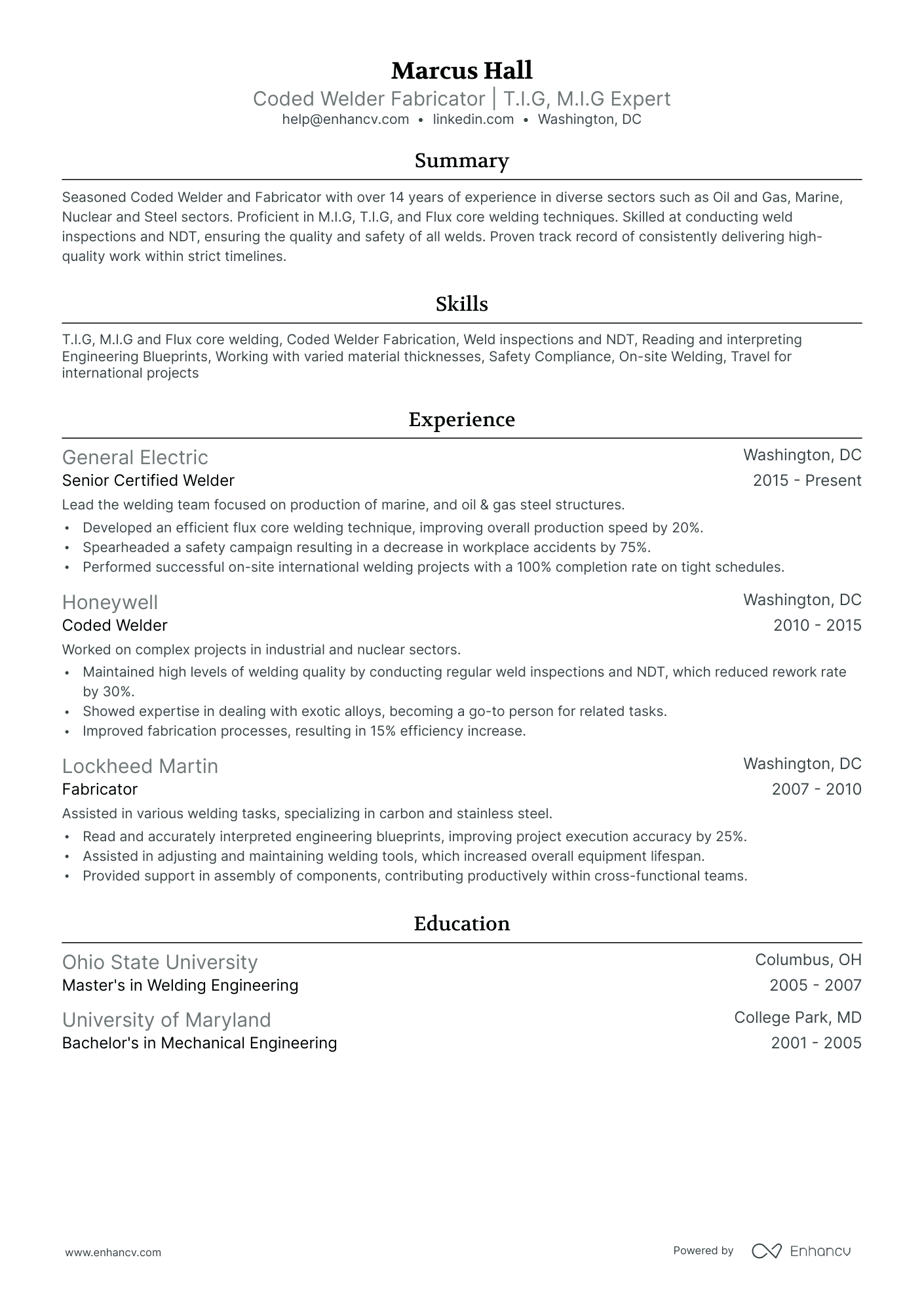
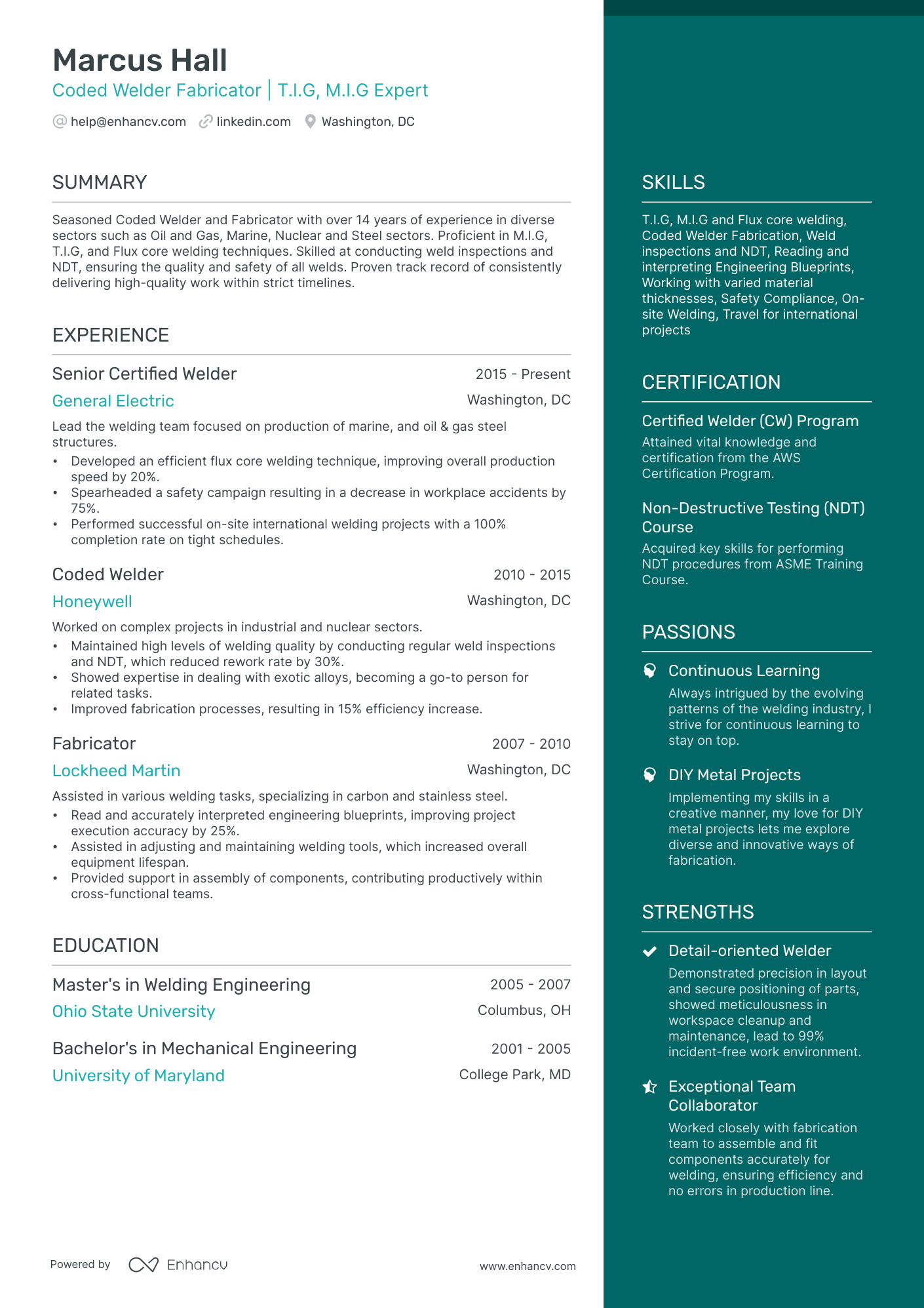
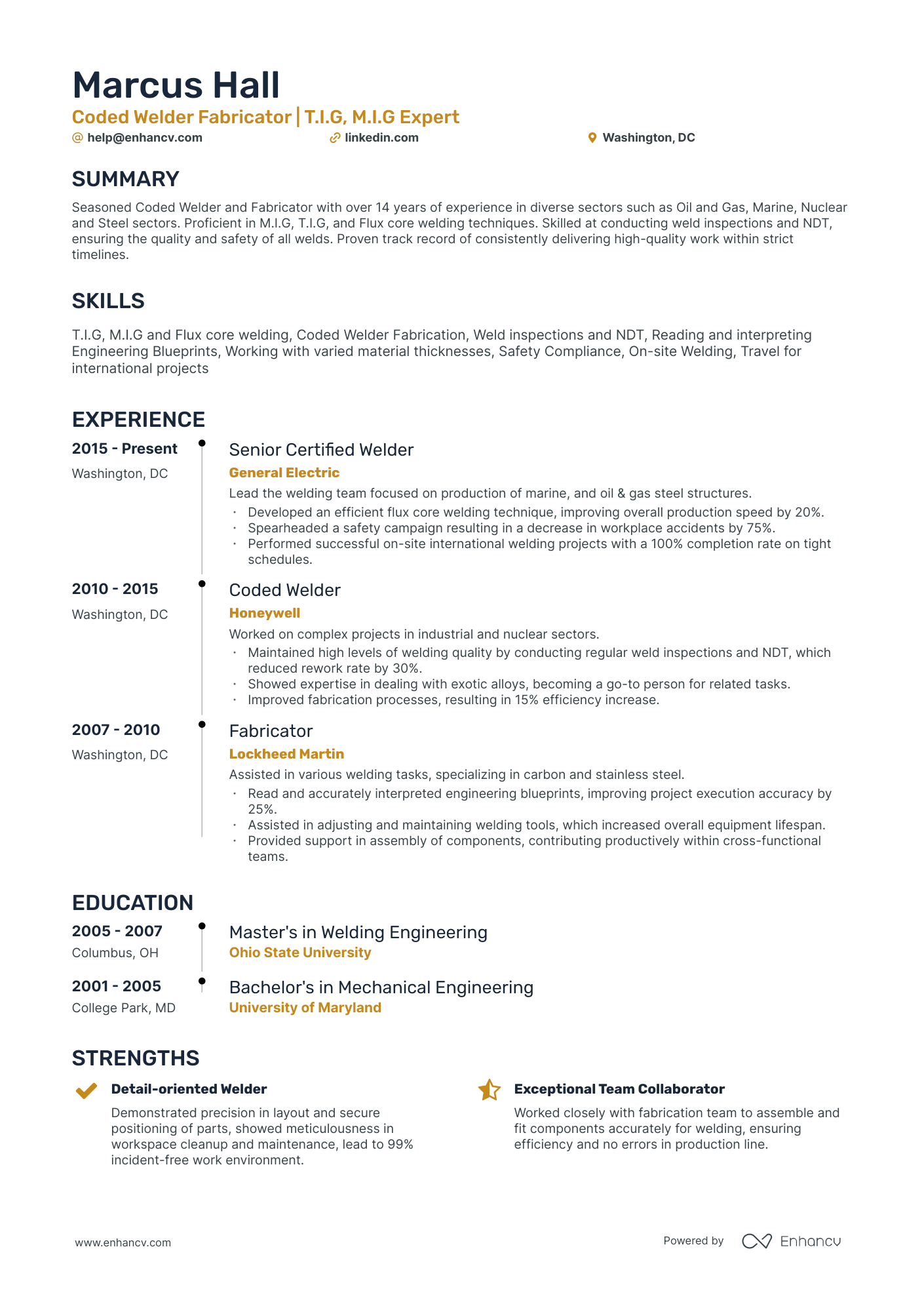
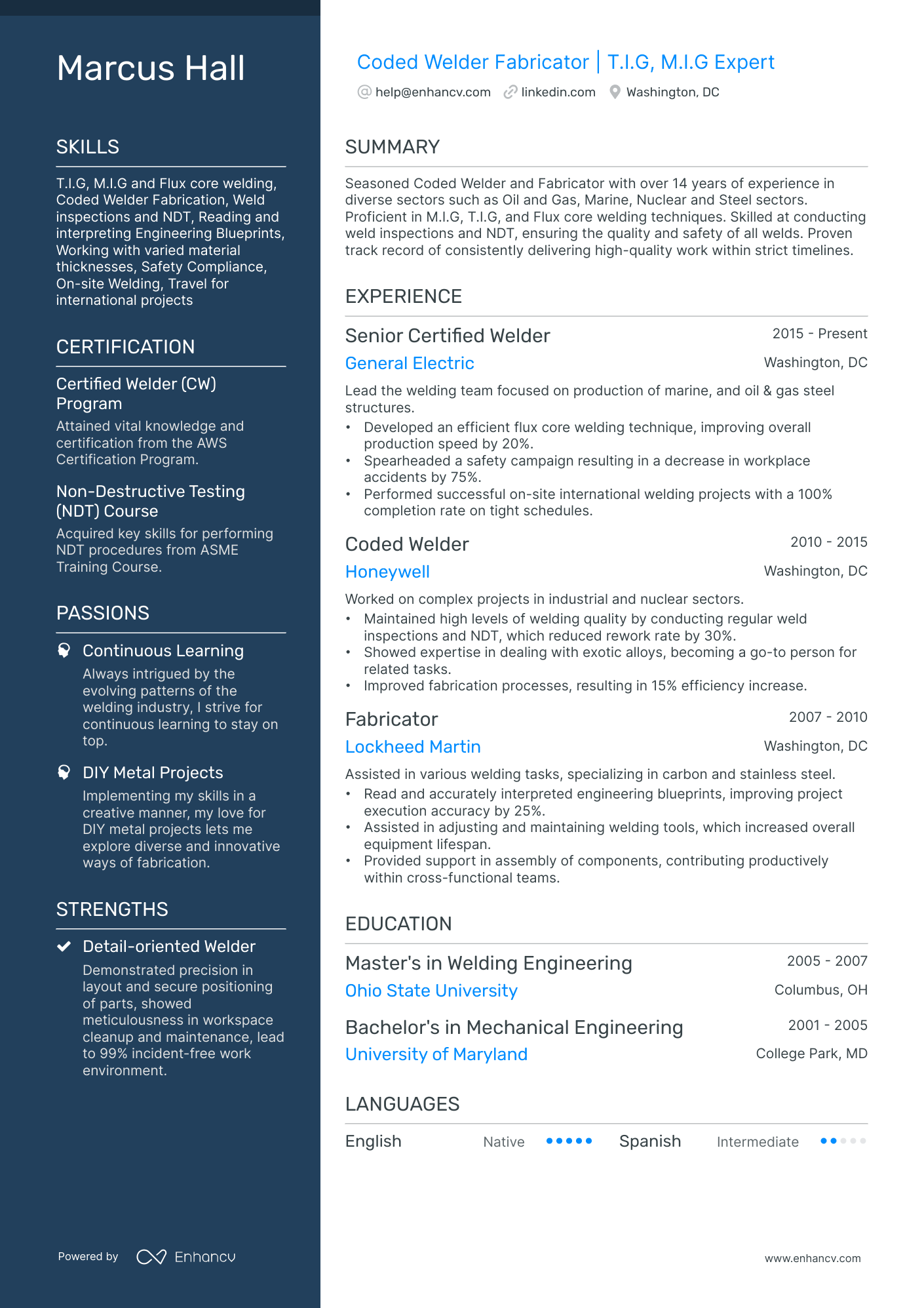
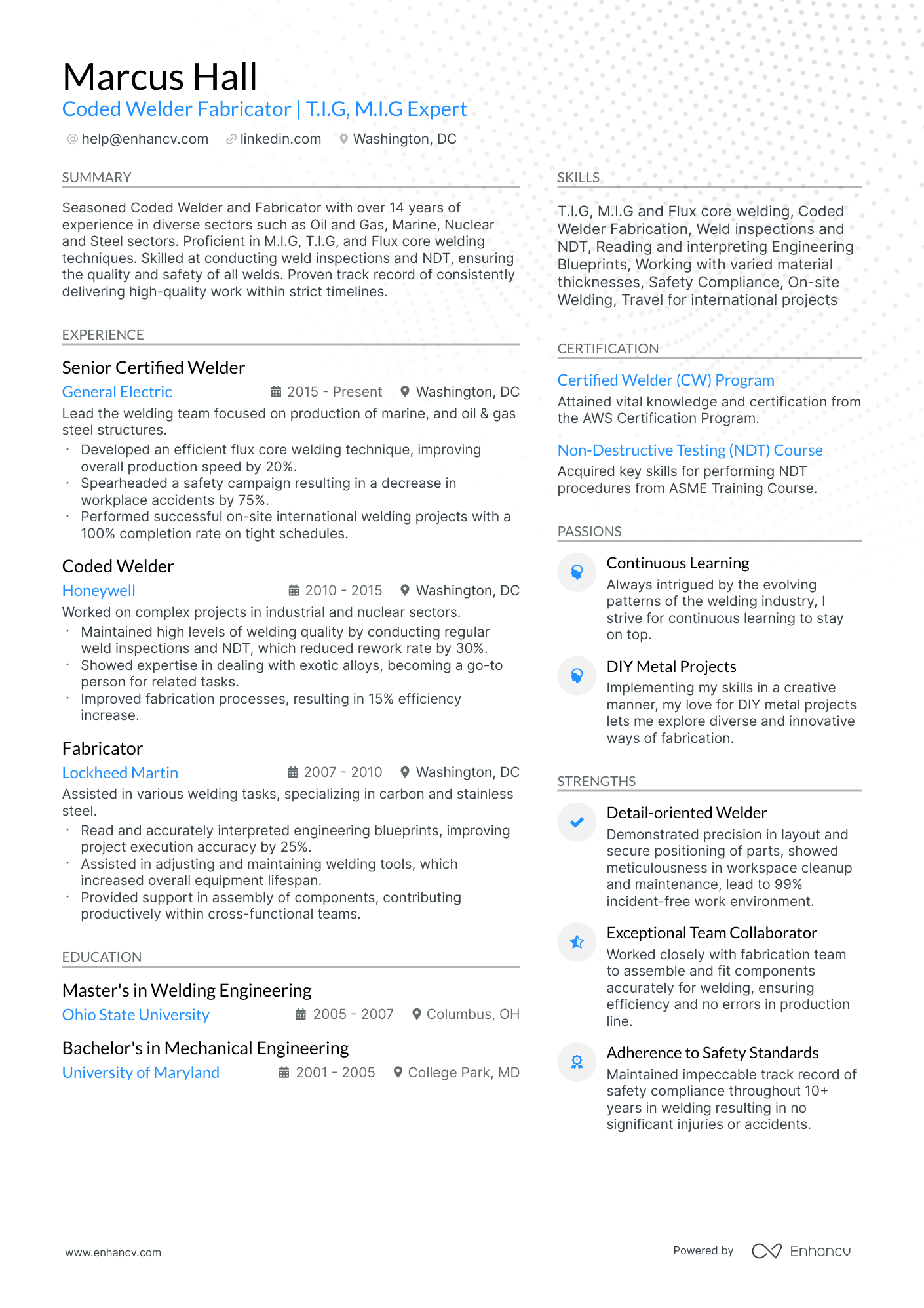
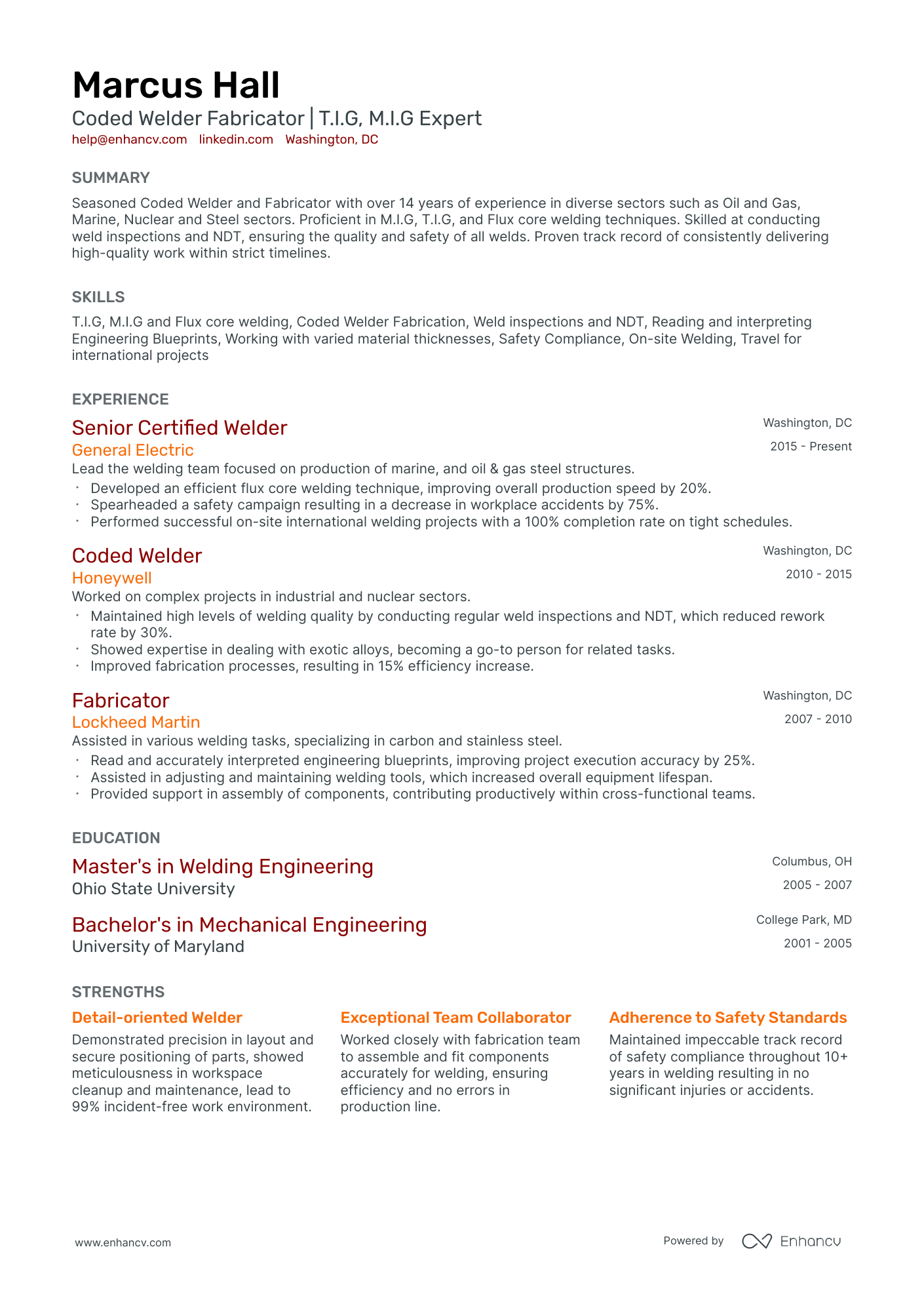
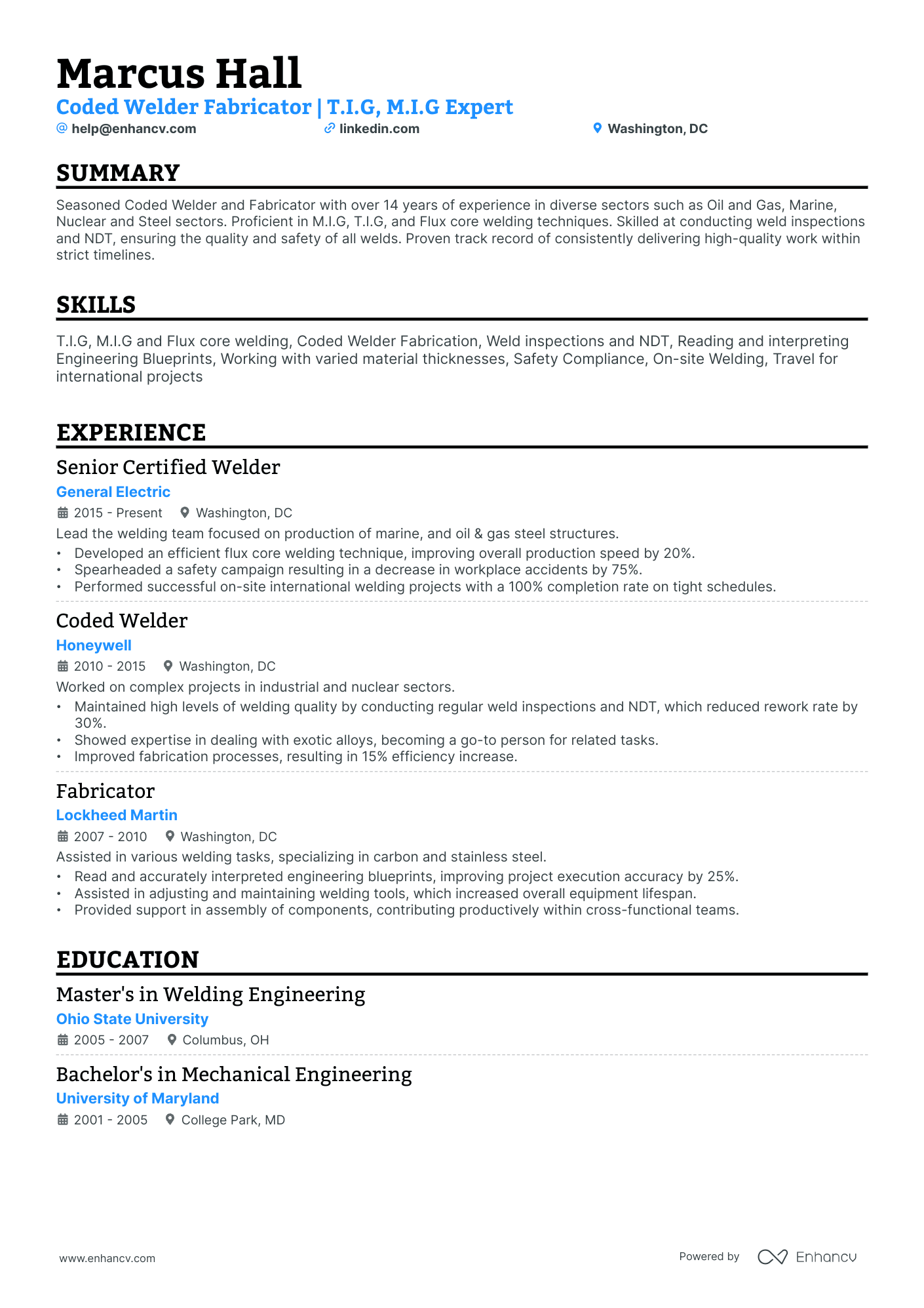
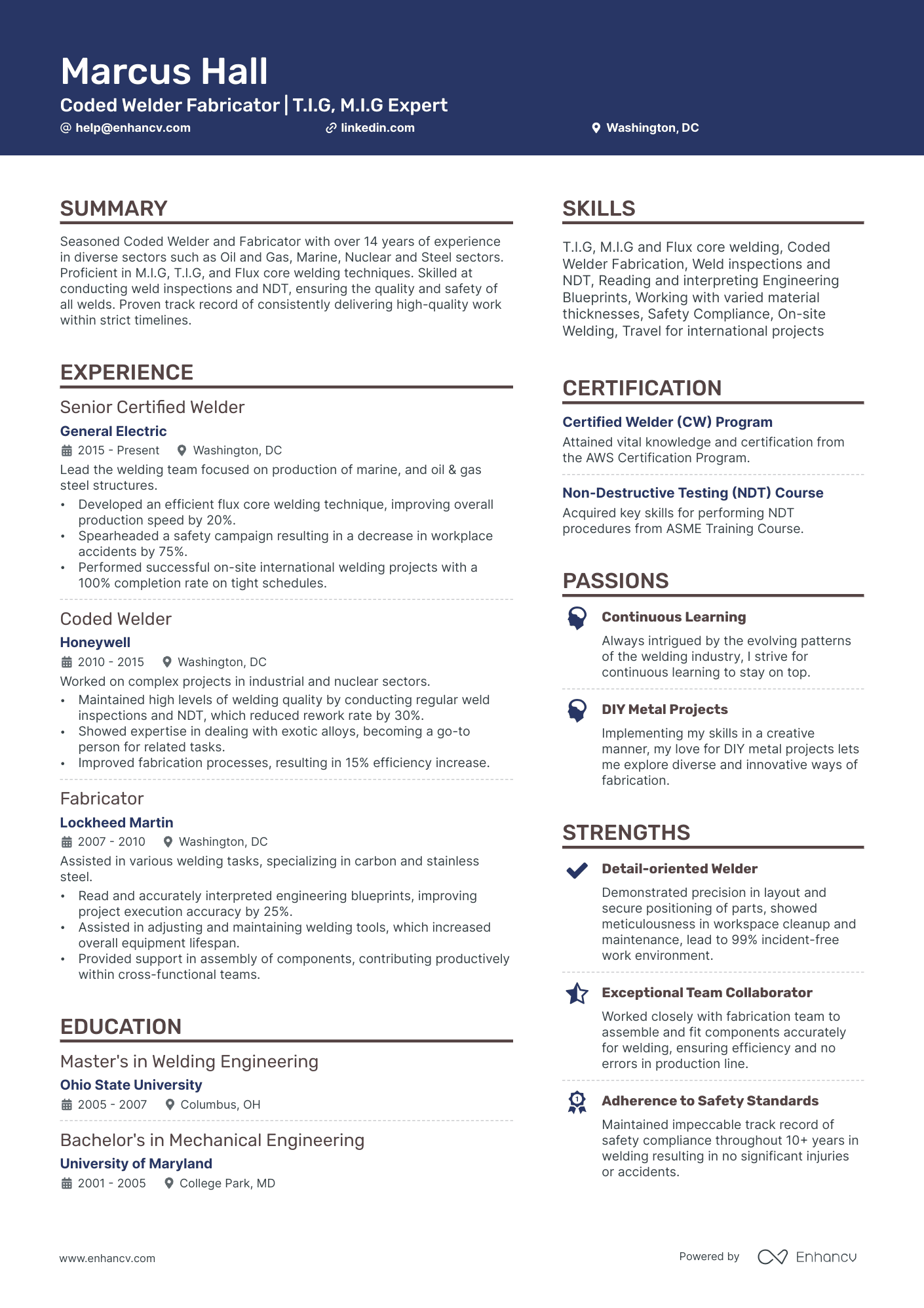
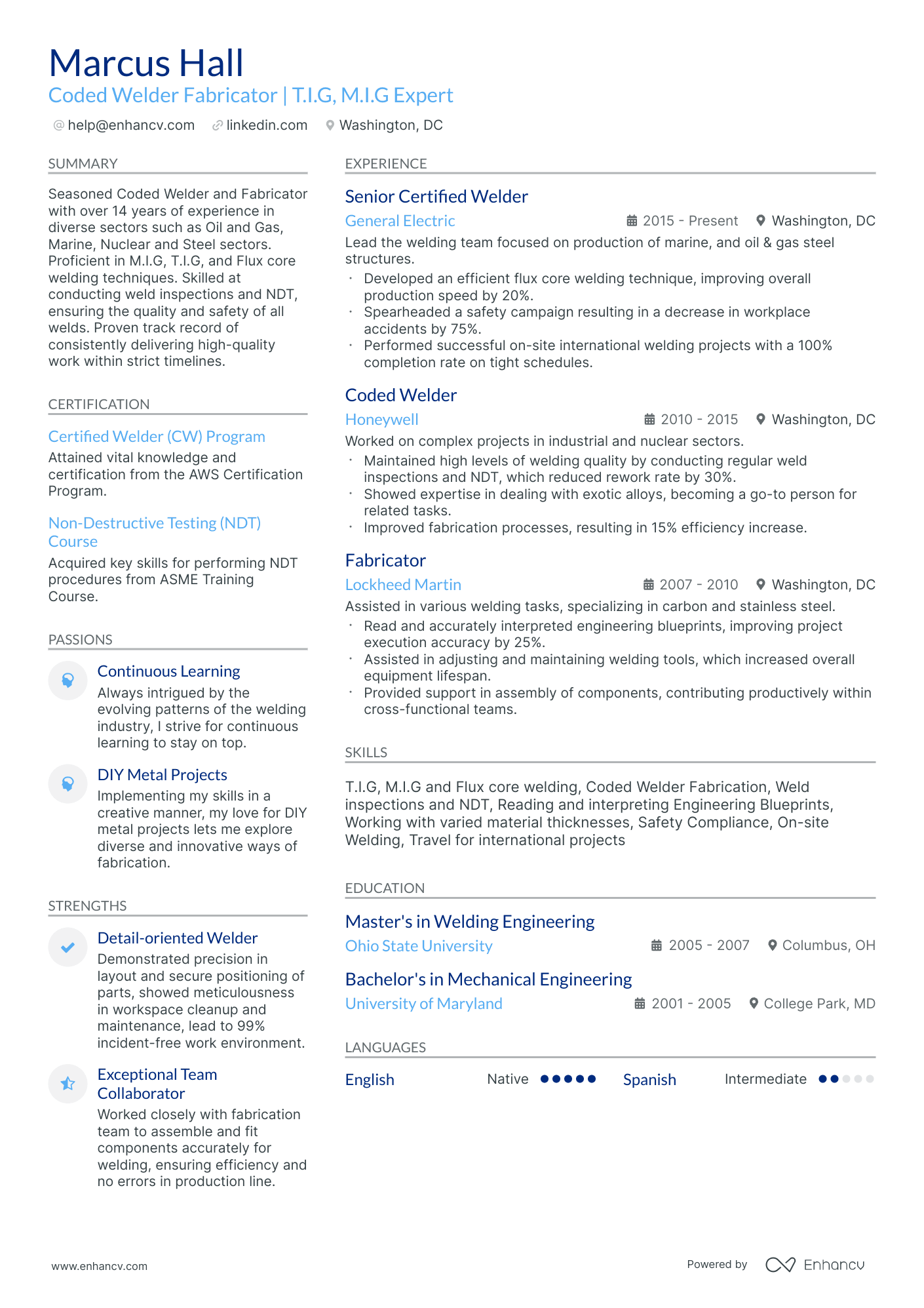
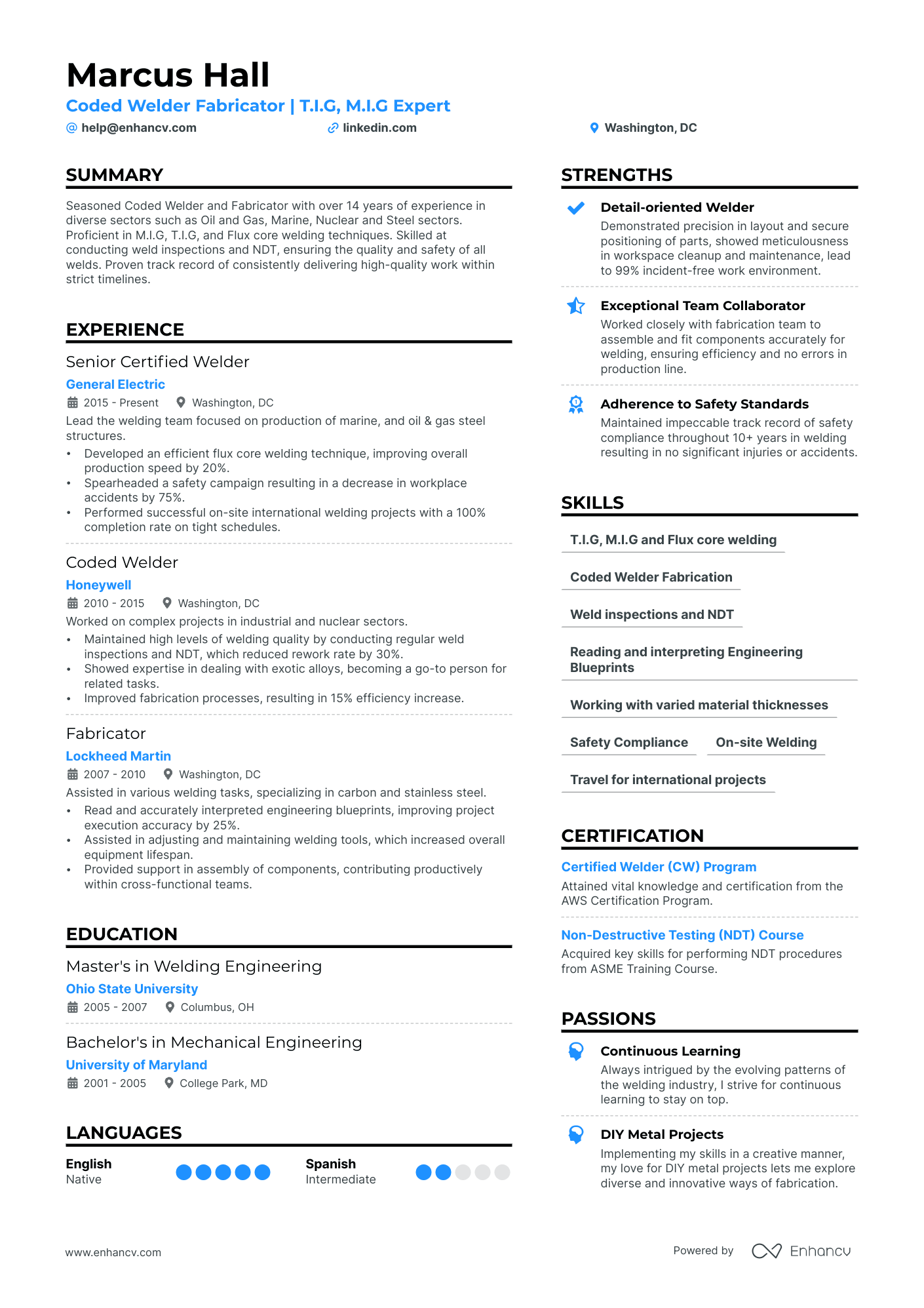
Most welder fabricator resume submissions fail because they read like task logs and bury proof of fit under tool lists. That hurts when an applicant tracking system filters keywords and recruiters scan fast in a crowded field. Knowing how to make your resume stand out is critical in a trade where hundreds of candidates may apply for the same opening.
A strong resume shows what you delivered and how well it held up. You should highlight weld quality, rework reduction, on-time completion, code compliance, and throughput gains. Include examples like defect rates, inches welded per shift, assemblies completed, and downtime avoided.

Key takeaways
- Quantify welding outcomes like defect rates, rework hours, and throughput to prove impact.
- Tailor every resume to mirror the job posting's processes, materials, and codes.
- Use reverse-chronological format if experienced; use hybrid format if entry-level or switching careers.
- Anchor each skill to a specific project, certification, or measurable result.
- Place certifications above education when they're recent or required for the role.
- Write a three- to four-line summary featuring your processes, certifications, and top metric.
- Use Enhancv to turn vague duty descriptions into measurable, recruiter-ready resume bullets.
Job market snapshot for welder fabricators
We analyzed 73 recent welder fabricator job ads across major US job boards. These numbers help you understand experience requirements, role specialization trends, employer expectations at a glance.
What level of experience employers are looking for welder fabricators
| Years of Experience | Percentage found in job ads |
|---|---|
| 1–2 years | 24.7% (18) |
| 3–4 years | 6.8% (5) |
| 5–6 years | 9.6% (7) |
| 7–8 years | 1.4% (1) |
| 10+ years | 1.4% (1) |
| Not specified | 56.2% (41) |
Welder fabricator ads by area of specialization (industry)
| Industry (Area) | Percentage found in job ads |
|---|---|
| Finance & Banking | 42.5% (31) |
| Manufacturing | 24.7% (18) |
| Healthcare | 15.1% (11) |
Role overview stats
These tables show the most common responsibilities and employment types for welder fabricator roles. Use them to align your resume with what employers expect and to understand how the role is structured across the market.
Day-to-day activities and top responsibilities for a welder fabricator
| Responsibility | Percentage found in job ads |
|---|---|
| Welding | 65.8% (48) |
| Fabrication | 49.3% (36) |
| Blueprints | 32.9% (24) |
| Mig welding | 31.5% (23) |
| Tig welding | 21.9% (16) |
| Mig | 20.5% (15) |
| Blueprint reading | 19.2% (14) |
| Hand tools | 19.2% (14) |
| Stick welding | 17.8% (13) |
| Tig | 17.8% (13) |
| Gmaw | 15.1% (11) |
| Power tools | 13.7% (10) |
How to format a welder fabricator resume
Recruiters hiring welder fabricators prioritize hands-on technical skills, relevant certifications (AWS, ASME), material expertise, and a clear record of quality workmanship and safety compliance. A clean, well-structured resume format ensures these signals are immediately visible rather than buried in dense text, which also improves performance when parsed by an applicant tracking system (ATS).

I have significant experience as a welder fabricator—which format should I use?
Use a reverse-chronological format to put your strongest, most recent welding and fabrication work front and center. Do:
- Lead each role entry with the scope of your responsibilities—types of welding processes (MIG, TIG, stick, flux-core), materials handled, and the size or complexity of projects you owned.
- Highlight role-specific certifications, blueprint reading proficiency, and equipment expertise (CNC plasma cutters, press brakes, positioners) within each position.
- Quantify outcomes tied to quality, efficiency, or safety—rejection rates, throughput improvements, on-time delivery percentages, or incident-free hours.
I'm junior or switching into a welder fabricator role—what format works best?
A hybrid format works best because it lets you lead with relevant welding skills and certifications while still showing employment or project history in chronological order. Do:
- Place a dedicated skills section near the top featuring welding processes, certifications, materials knowledge, and shop equipment you've trained on.
- Include trade school projects, apprenticeships, volunteer builds, or personal fabrication work as legitimate experience entries with specific details.
- Connect every listed skill to an action you performed and a tangible result it produced.
Why not use a functional resume?
A functional format strips away the timeline of your hands-on experience, making it difficult for hiring managers to verify where, when, and how you developed your welding and fabrication skills—context that's critical in a trade where demonstrated shop-floor competence matters more than abstract skill claims. When a functional resume might be acceptable:
- If you're transitioning from a related trade (pipefitting, sheet metal work) or returning after a significant career gap, a functional format can work—but only if every skill listed is anchored to a specific project, certification, or measurable outcome rather than presented as a standalone claim.
Once your layout and formatting choices are in place, the next step is deciding which sections to include so each one reinforces your qualifications effectively.
What sections should go on a welder fabricator resume
Recruiters expect a welder fabricator resume to show clear proof you can fabricate to spec, weld safely, and deliver quality work on schedule. Choosing the right resume sections ensures hiring managers find that proof quickly.
Use this structure for maximum clarity:
- Header
- Summary
- Experience
- Skills
- Projects
- Education
- Certifications
- Optional sections: Awards, Leadership, Languages
Strong experience bullets should emphasize measurable results—quality metrics, rework reduction, throughput, on-time delivery, safety performance, and the scope of materials, processes, and tolerances you handled.
Is your resume good enough?
Drop your resume here or choose a file. PDF & DOCX only. Max 2MB file size.
Once you’ve organized your resume with the right core sections, the next step is to write your welder fabricator experience so it fits that structure and clearly supports your qualifications.
How to write your welder fabricator resume experience
Your experience section should highlight the welding and fabrication work you've shipped—finished assemblies, structural components, repaired equipment—using role-relevant tools like MIG, TIG, stick welders, plasma cutters, and precision measuring instruments, all tied to measurable outcomes such as reduced rework rates, improved weld quality, or faster turnaround times. Hiring managers prioritize demonstrated impact over descriptive task lists, so focus on what your work achieved rather than simply cataloging daily duties.
Each entry should include:
- Job title
- Company and location (or remote)
- Dates of employment (month and year)
Three to five concise bullet points showing what you owned, how you executed, and what outcomes you delivered:
- Ownership scope: the assemblies, weldments, structural systems, production lines, or fabrication projects you were directly accountable for as a welder fabricator.
- Execution approach: the welding processes, cutting methods, blueprint interpretation techniques, inspection tools, or fabrication equipment you used to plan and complete your work.
- Value improved: the changes you drove in weld quality, dimensional accuracy, production efficiency, material waste reduction, safety compliance, or defect rates across your fabrication responsibilities.
- Collaboration context: how you coordinated with engineers, quality inspectors, project managers, fitters, machinists, or clients to align on specifications, resolve fit-up issues, or meet production schedules.
- Impact delivered: the tangible results your welding and fabrication work produced, expressed through project completion outcomes, throughput gains, cost savings, or quality benchmarks rather than a list of tasks performed.
Experience bullet formula
A welder fabricator experience example
✅ Right example - modern, quantified, specific.
Welder Fabricator
Redline Industrial Fabrication | Tulsa, OK
2021–Present
Custom metal fabrication shop supporting oil and gas, food processing, and municipal infrastructure projects.
- Fabricated carbon steel and stainless assemblies from blueprints using MIG (metal inert gas), TIG (tungsten inert gas), and flux-cored arc welding, cutting rework from 6.8% to 2.1% through tighter fit-up and weld sequencing.
- Programmed and operated CNC plasma table and press brake, reducing average cut-to-fit cycle time by 18% and improving first-pass dimensional accuracy to 97% using go, no-go gauges and calipers.
- Implemented weld procedure specifications (WPS) and improved inspection readiness with visual inspection, dye penetrant testing, and weld maps, lowering nonconformance reports by 31% across thirty-two production lots.
- Coordinated with engineers and field supervisors to resolve drawing conflicts and change orders, preventing three onsite delays and saving an estimated eighty-six labor hours per quarter.
- Maintained welding equipment and consumables—wire feeders, regulators, gas mixes, and fume extraction—reducing unplanned downtime by 22% and improving safety audit scores to 98%.
Now that you've seen what a strong experience section looks like, let's break down how to adjust yours to match a specific job posting.
How to tailor your welder fabricator resume experience
Recruiters evaluate your welder fabricator resume through both manual review and applicant tracking systems. Tailoring your resume to the job description helps you clear both filters.
Ways to tailor your welder fabricator experience:
- Match specific welding processes like MIG TIG or stick from the posting.
- Mirror the exact material types such as stainless steel or aluminum listed.
- Reference blueprint reading or shop drawing interpretation when requested.
- Include relevant certifications like AWS D1.1 or ASME codes mentioned.
- Highlight fabrication equipment and machinery named in the job description.
- Emphasize quality inspection methods or weld testing standards specified.
- Note safety compliance and OSHA protocol experience when the role requires it.
- Align your production volume language with the throughput terms they use.
Tailoring means aligning your real skills and accomplishments with what the employer asks for, not forcing disconnected keywords into your experience.
Resume tailoring examples for welder fabricator
| Job description excerpt | Untailored | Tailored |
|---|---|---|
| Perform MIG and TIG welding on stainless steel and aluminum components per AWS D1.1 standards; inspect welds using visual and dye penetrant methods. | Welded various metal parts using different techniques. | Performed MIG and TIG welding on stainless steel and aluminum assemblies in compliance with AWS D1.1, inspecting all welds through visual and dye penetrant testing with a 98% first-pass acceptance rate. |
| Read and interpret blueprints and weld symbols to fabricate structural steel frames, brackets, and supports; operate CNC plasma cutting tables and hydraulic press brakes. | Fabricated metal structures and operated shop equipment. | Interpreted blueprints and weld symbols to fabricate structural steel frames, brackets, and supports, operating CNC plasma cutting tables and hydraulic press brakes to hold tolerances within ±1/16". |
| Lay out, fit, and tack-weld pipe spools for oil and gas piping systems using GTAW root passes and SMAW fill/cap per ASME B31.3; maintain daily weld logs and track material traceability. | Worked on pipes and kept records of welding activities. | Laid out, fitted, and tack-welded carbon steel pipe spools for oil and gas systems, completing GTAW root passes and SMAW fill/cap welds per ASME B31.3 while maintaining daily weld logs and material traceability documentation for 200+ joints per project. |
Once you’ve aligned your experience with the role’s requirements, quantify your welder fabricator achievements to show the measurable impact of that work.
How to quantify your welder fabricator achievements
Numbers show how your welds hold up in production, not just on paper. Track throughput, defect rates, rework hours, on-time delivery, and cost savings from smarter fit-up, process choices, and material use. Quantifying your achievements transforms generic duty statements into compelling proof of your value.
Quantifying examples for welder fabricator
| Metric | Example |
|---|---|
| Throughput | "Increased output from twelve to eighteen skids per week by standardizing jigs and sequencing MIG welds and fit-up tasks." |
| Weld quality | "Cut weld rejection from five percent to one percent by tightening WPS settings, improving prep, and verifying with dye penetrant tests." |
| Rework reduction | "Reduced rework by twenty hours per month by adding tack-weld checkpoints and documenting fit-up tolerances on shop travelers." |
| On-time delivery | "Improved on-time delivery from eighty-two percent to ninety-five percent by batching similar assemblies and staging material with the forklift crew." |
| Cost savings | "Saved $14,000 per quarter by nesting plate cuts, minimizing scrap, and switching to flux-cored wire for heavy fillet welds." |
Turn vague job duties into measurable, recruiter-ready resume bullets in seconds with Enhancv's Bullet Point Generator.
Once you've crafted strong bullet points for your experience section, it's equally important to highlight the right hard and soft skills that reinforce your qualifications as a welder fabricator.
How to list your hard and soft skills on a welder fabricator resume
Your skills section shows hiring teams and applicant tracking systems (ATS) how you weld, fabricate, and inspect to spec. List role-specific hard skills first and add a smaller set of job-relevant soft skills that support safe, accurate, on-time work. welder fabricator roles require a blend of:
- Product strategy and discovery skills
- Data, analytics, and experimentation skills
- Delivery, execution, and go-to-market discipline
- Soft skills
Your skills section should be:
- Scannable (bullet-style grouping).
- Relevant to the job post.
- Backed by proof in experience bullets.
- Updated with current tools.
Place your skills section:
- Above experience if you're junior or switching careers.
- Below experience if you're mid/senior with strong achievements.

Hard skills
- MIG, TIG, stick welding
- Flux-cored arc welding
- Aluminum, stainless, carbon steel
- Blueprint reading, weld symbols
- Fit-up, tack, fixturing
- Oxy-fuel cutting, plasma cutting
- Press brake, shear, ironworker
- Grinding, beveling, edge prep
- Jigs, fixtures, layout tools
- Weld inspection, visual, fillet gauges
- WPS and PQR compliance
- ISO 9606-1 certification
Soft skills
- Follow WPS and safety procedures
- Communicate fit-up issues early
- Coordinate with shop leads
- Clarify tolerances before welding
- Document rework and repairs
- Prioritize jobs by due date
- Adapt to drawing revisions
- Maintain clean, organized work area
- Verify parts before final weld-out
- Escalate quality concerns quickly
- Support cross-trade collaboration
- Coach helpers on safe practices
How to show your welder fabricator skills in context
Skills shouldn't live only in a bulleted list on your resume. Explore how other professionals present their resume skills in context for inspiration.
They should be demonstrated in:
- Your summary (high-level professional identity)
- Your experience (proof through outcomes)
Here's how that looks in practice.
Summary example
Senior welder fabricator with 12 years in heavy industrial construction. Skilled in MIG, TIG, and flux-cored welding across carbon and stainless steel. Reduced rework rates by 30% through improved fit-up procedures and team coordination.
- Reflects senior-level experience clearly
- Names specific welding processes and materials
- Includes a measurable quality improvement
- Highlights leadership and collaboration
Experience example
Senior Welder Fabricator
Ironmark Industrial Services | Houston, TX
March 2018–Present
- Fabricated and welded structural steel assemblies using MIG and TIG processes, cutting average project completion time by 15% through optimized layout techniques.
- Collaborated with engineers and quality inspectors to implement weld procedure specifications, reducing defect rates across the shop by 22%.
- Trained four junior welders on flux-cored arc welding and blueprint interpretation, improving first-pass weld acceptance rates by 18%.
- Every bullet includes a measurable outcome
- Skills appear naturally within real accomplishments
Once you’ve tied your welding and fabrication abilities to real tasks and results, the next step is to apply that same approach to building a welder fabricator resume when you have no experience.
How do I write a welder fabricator resume with no experience
Even without full-time experience, you can demonstrate readiness through training and hands-on projects. If you're building a resume without work experience, focus on the following:
- Welding school shop projects
- Community college fabrication labs
- Personal metalwork builds at home
- Apprenticeship or pre-apprenticeship hours
- Volunteer repair work for nonprofits
- Manufacturing or warehouse production work
- Safety training and certifications
Focus on:
- Welding processes used and results
- Blueprint reading and layout accuracy
- Tooling: grinders, saws, clamps
- Safety training and documented compliance
Resume format tip for entry-level welder fabricator
Use a skills-based resume format because it highlights welding processes, tools, and projects when you don't have full-time welder fabricator experience. Do:
- Lead with welding processes you used.
- List tools you operated, specifically.
- Add project bullets with measurements.
- Include safety training and certifications.
- Match keywords from the job post.
- Built a mild-steel cart in welding school shop, using MIG welding, angle grinder, and chop saw; held 1/16-inch tolerance and supported 300 pounds.
Once you've structured your resume around transferable skills and hands-on training, presenting your education effectively becomes the next step in reinforcing your qualifications.
How to list your education on a welder fabricator resume
Your education section helps hiring teams confirm you have the foundational knowledge needed for the welder fabricator role. It validates technical training and relevant academic preparation quickly.
Include:
- Degree name
- Institution
- Location
- Graduation year
- Relevant coursework (for juniors or entry-level candidates)
- Honors & GPA (if 3.5 or higher)
Skip month and day details—list the graduation year only.
Here's a strong education entry tailored to a welder fabricator resume.
Example education entry
Associate of Applied Science in Welding Technology
Tulsa Welding School, Tulsa, OK
Graduated 2021
GPA: 3.7/4.0
- Relevant coursework: Blueprint Reading, Metallurgy, GMAW and GTAW Processes, Structural Fabrication Techniques
- Honors: Dean's List, graduated with distinction
How to list your certifications on a welder fabricator resume
Certifications show a welder fabricator's commitment to learning, hands-on tool proficiency, and alignment with current codes, processes, and shop standards. Knowing how to present certifications on your resume ensures they receive the attention they deserve from hiring managers.
Include:
- Certificate name
- Issuing organization
- Year
- Optional: credential ID or URL
- Place certifications below education when your training is recent, your certifications are older, or they add limited value for the target welder fabricator role.
- Place certifications above education when they are recent, required, or highly relevant to the welder fabricator role you want.
Best certifications for your welder fabricator resume
- AWS Certified Welder
- AWS Certified Welding Inspector (CWI)
- Certified Welding Educator (CWE)
- ASME Boiler and Pressure Vessel Code (BPVC) Section IX Welder Qualification
- OSHA 10-Hour General Industry
- NCCER Welding Level I or Level II
- Forklift Operator Certification
Once you’ve positioned your credentials where hiring managers can spot them fast, shift to your welder fabricator resume summary to connect those qualifications to the value you deliver.
How to write your welder fabricator resume summary
Your resume summary is the first thing a recruiter reads. A strong one immediately signals you have the welding and fabrication skills the shop needs.
Keep it to three to four lines, with:
- Your title and total years of hands-on welding and fabrication experience.
- The industry or product type you know best, such as structural steel or pressure vessels.
- Core processes and certifications like MIG, TIG, stick, flux-core, or AWS credentials.
- One or two measurable results, such as pass rates, production output, or waste reduction.
- Practical soft skills tied to outcomes, like blueprint accuracy or team coordination on tight deadlines.

PRO TIP
At this level, lead with relevant certifications, specific welding processes, and measurable contributions from your early career. Avoid vague phrases like "hard worker" or "passionate about welding." Recruiters want to see which processes you run, what materials you work with, and how your output held up under inspection.
Example summary for a welder fabricator
AWS-certified welder fabricator with three years of MIG and TIG experience in structural steel shops. Maintained a 98% first-pass weld inspection rate while reading and interpreting complex blueprints daily.
Optimize your resume summary and objective for ATS
Drop your resume here or choose a file.
PDF & DOCX only. Max 2MB file size.
Now that your summary captures your welding expertise and value, make sure your resume header presents your contact details clearly so employers can actually reach you.
What to include in a welder fabricator resume header
A resume header lists your key contact and professional details, helping welder fabricator candidates improve visibility, build credibility, and pass recruiter screening faster.
Essential resume header elements
- Full name
- Tailored job title and headline
- Location
- Phone number
- Professional email
- GitHub link
- Portfolio link
A LinkedIn link helps recruiters verify experience quickly and supports screening with consistent dates, titles, and certifications.
Don't include a photo on a welder fabricator resume unless the role is explicitly front-facing or appearance-dependent.
Use a clear job title that matches the posting and add one specialty, like "MIG, TIG, and blueprint reading," to improve keyword screening.
Example
Welder fabricator resume header
Jordan Ramirez
Welder Fabricator | MIG, TIG, blueprint reading, and structural steel
Phoenix, AZ
(602) 555-01XX
jordan.ramirez@enhancv.com
github.com/jordanramirez
yourwebsite.com
linkedin.com/in/jordanramirez
Once your contact details and professional identifiers are set, add relevant additional sections to strengthen your welder fabricator resume and provide context that does not fit in the header.
Additional sections for welder fabricator resumes
Adding extra sections helps you stand out when your core qualifications match other candidates closely.
These sections build credibility by showcasing role-specific strengths beyond certifications and work history:
- Languages
- Hobbies and interests
- Volunteer experience
- Professional affiliations
- Safety training and awards
- Continuing education
Once your resume's additional sections highlight the full scope of your qualifications, pairing it with a strong cover letter can further set your application apart.
Do welder fabricator resumes need a cover letter
A cover letter isn't required for a welder fabricator, but it helps in competitive roles or shops that expect one. If you're unfamiliar with the format, learn what a cover letter is and how it complements your resume. It can make a difference when managers compare similar skills, certifications, and work histories.
Use a cover letter to add details your resume can't show:
- Explain team and role fit by naming the shift, shop pace, materials, and processes you've worked with, and how you support quality and safety.
- Highlight one or two relevant projects or outcomes, such as tight-tolerance assemblies, rework reduction, or faster fit-up through better jigs and fixtures.
- Show you understand the product, users, or business context by referencing what you'll build, who uses it, and what matters most: uptime, compliance, or cost.
- Address career transitions or non-obvious experience by connecting past work to welding tasks, such as blueprint reading, inspection, or working with production schedules.
Drop your resume here or choose a file.
PDF & DOCX only. Max 2MB file size.
Even when you include a cover letter to add context beyond your resume, using AI to improve your welder fabricator resume is the next step to sharpen its content and alignment.
Using AI to improve your welder fabricator resume
AI can sharpen your resume's clarity, structure, and impact. It helps tighten language and highlight measurable results. But overuse kills authenticity. Once your content reads clearly and fits the role, step away from AI. If you're curious about where to start, explore ChatGPT resume writing prompts tailored for different resume sections.
Here are 10 practical prompts to strengthen specific sections of your welder fabricator resume:
- Strengthen your summary: "Rewrite my welder fabricator resume summary to highlight years of experience, core welding processes, and key industry certifications in three sentences."
- Quantify experience bullets: "Add measurable results like production rates, defect reductions, or completion times to these welder fabricator experience bullet points."
- Tighten skills formatting: "Organize my welder fabricator skills into grouped categories such as welding techniques, equipment, safety protocols, and blueprint reading."
- Align with job postings: "Compare my welder fabricator resume experience section against this job description and identify missing keywords or qualifications."
- Improve action verbs: "Replace weak or repetitive verbs in my welder fabricator experience bullets with stronger, industry-specific action verbs."
- Clarify certifications: "Reformat my welder fabricator certifications section to clearly list credential names, issuing bodies, and expiration dates."
- Refine project descriptions: "Rewrite my welder fabricator project entries to emphasize scope, materials used, and measurable outcomes for each build."
- Cut unnecessary filler: "Remove vague or redundant phrases from my welder fabricator resume without losing technical detail or accomplishments."
- Enhance education entries: "Improve my welder fabricator education section to highlight relevant coursework, shop hours, and hands-on training programs."
- Tailor the summary: "Adjust my welder fabricator resume summary to match this specific job posting while keeping my actual experience intact."
Stop using AI once your resume sounds accurate, specific, and aligned with real experience. AI should never invent experience or inflate claims—if it didn't happen, it doesn't belong here.
Conclusion
A strong welder fabricator resume proves impact with measurable outcomes, clear structure, and role-specific skills. Highlight production rates, defect reduction, rework avoidance, and safety results. Keep each section easy to scan, with consistent formatting and direct, action-focused bullets.
Show you’re ready for today’s and near-future hiring market by matching your skills to the job. Emphasize welding processes, fabrication methods, blueprint reading, fit-up, and quality checks. Back every claim with results, and your resume will stand out for the right reasons.