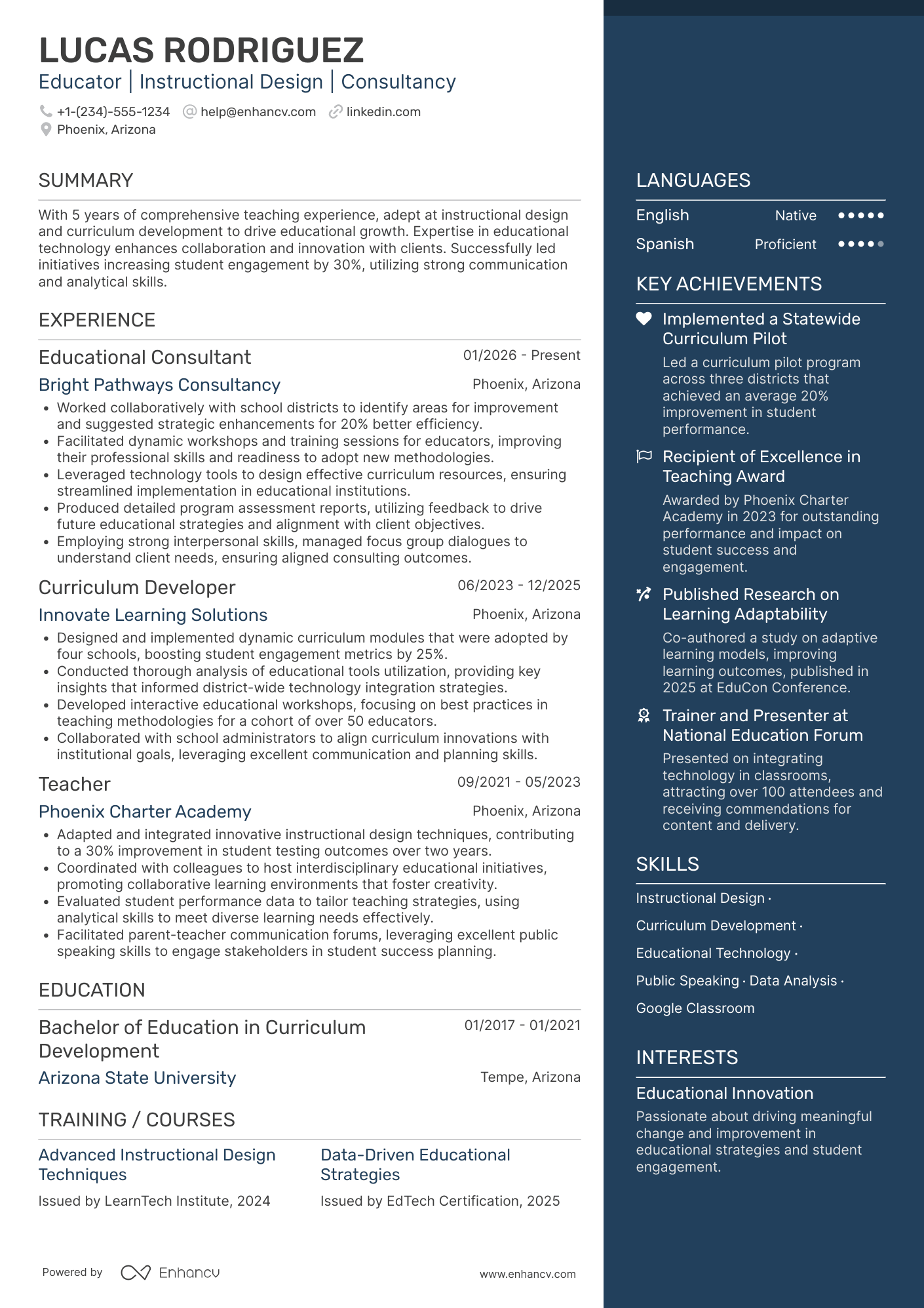
Most transitioning teacher resume drafts fail because they read like job descriptions, not evidence of business impact. That hurts in ATS screening and fast recruiter scans, where keywords, clarity, and measurable results decide who advances.
A strong resume shows what changed because of your work, not every tool or duty. If you're unsure where to begin, learning how to write a resume that emphasizes results is the essential first step. You can highlight growth in test scores, improved attendance, curriculum delivered across multiple grades, reduced behavior incidents, faster onboarding, and higher family satisfaction.

Key takeaways
- Reframe teaching duties as measurable business outcomes to pass ATS and recruiter screening.
- Use a hybrid resume format to lead with transferable skills and supporting work history.
- Quantify achievements with metrics like retention rates, cycle time, and stakeholder satisfaction.
- Tailor every experience bullet to mirror the target job description's exact language.
- Place your skills section above experience when switching careers or entering a new field.
- Use AI prompts to translate classroom language into industry terms, then stop before overediting.
- Enhancv's Bullet Point Generator helps convert vague duties into recruiter-ready, quantified bullets.
How to format a transitioning teacher resume
Recruiters reviewing a transitioning teacher resume focus on transferable skills—classroom management reframed as project leadership, curriculum design as program development, and student outcomes as measurable results. Because career changers lack direct experience in their target field, your resume format must surface relevant competencies and achievements immediately rather than burying them under education-specific job titles.

I have significant experience in this role—which format should I use?
Use a hybrid (combination) format, which leads with a strong skills summary and follows with reverse-chronological work history to show progression and context. Do:
- Open with a professional summary that reframes your teaching scope—team size, budget responsibility, program ownership—in language aligned with your target industry.
- Highlight transferable tools, skills, and domains (data analysis, stakeholder communication, training and development, project coordination) in a dedicated skills section placed above work history.
- Quantify outcomes from your teaching career using metrics that translate across industries, such as efficiency gains, engagement rates, or program growth.
I'm junior or switching into this role—what format works best?
Use a hybrid format that prioritizes a transferable skills section at the top, supported by any relevant projects, volunteer work, or transitional experience below. Do:
- Place a skills section above your work history, grouping competencies into clusters that match your target role (e.g., "Program Management," "Data-Driven Decision Making," "Stakeholder Engagement").
- Include freelance projects, volunteer leadership, certifications, or coursework that bridges your teaching background to your target field—even informal experience counts if it demonstrates relevant capability.
- Connect every bullet to a clear action-to-result chain so recruiters can see how your classroom experience produces business-relevant outcomes.
When does a functional resume make sense?
A functional format can work in narrow situations where your teaching history dominates your resume and you need to redirect attention entirely toward newly acquired skills. Consider a functional format if:
- You're making a complete career pivot with no adjacent professional experience and have recently completed a certification, bootcamp, or degree in your target field.
- You have significant gaps between your last teaching role and your current job search that would create visual disruption in a chronological layout.
- Your transferable skills are strong but spread across non-traditional experiences (volunteering, freelancing, personal projects) that don't fit neatly into a standard work history section.
- A functional resume is acceptable when you're a career changer with no work history outside education and a resume gap of one year or more, but only if every listed skill is anchored to a specific project, classroom initiative, or measurable outcome rather than presented as a standalone claim.
With your format established, the next step is filling it with the right sections to highlight your most relevant qualifications.
What sections should go on a transitioning teacher resume
Recruiters expect a clear, role-aligned resume that translates your teaching background into measurable business impact. Knowing exactly what to put on a resume when changing careers ensures you include only the sections that strengthen your candidacy.
Use this structure for maximum clarity:
- Header
- Summary
- Experience
- Skills
- Projects
- Education
- Certifications
- Optional sections: Awards, Leadership, Volunteering
Your experience bullets should emphasize outcomes, scope, and results by quantifying impact, highlighting cross-functional work, and showing how you improved performance, efficiency, or stakeholder satisfaction.
Is your resume good enough?
Drop your resume here or choose a file. PDF & DOCX only. Max 2MB file size.
Now that your resume’s structure and key components are in place, the next step is to write your transitioning teacher resume experience section so it supports each part with targeted, relevant impact.
How to write your transitioning teacher resume experience
The work experience section is where you prove you've delivered meaningful results—not just held a position. Hiring managers reviewing a transitioning teacher resume prioritize demonstrated impact, role-relevant tools and methods, and measurable outcomes over descriptive task lists.
Each entry should include:
- Job title
- Company and location (or remote)
- Dates of employment (month and year)
Three to five concise bullet points showing what you owned, how you executed, and what outcomes you delivered:
- Ownership scope: the programs, curricula, classrooms, student populations, or initiatives you were directly accountable for, framed in terms that translate to the industry or role you're targeting.
- Execution approach: the instructional strategies, assessment frameworks, learning technologies, data analysis methods, or project management tools you used to plan, make decisions, and deliver results.
- Value improved: the specific changes you drove in student performance, program quality, operational efficiency, accessibility, compliance, or organizational effectiveness that connect to the demands of your new target role.
- Collaboration context: how you partnered with administrators, parents, counselors, community organizations, cross-departmental teams, or external vendors to achieve shared goals—demonstrating stakeholder management and communication skills valued outside education.
- Impact delivered: the outcomes you produced expressed through scale, reach, improvements, or organizational results rather than routine duties, showing a hiring manager the tangible difference your work made.
Experience bullet formula
A transitioning teacher experience example
✅ Right example - modern, quantified, specific.
Learning Experience Designer (Transitioning Teacher)
BrightPath EdTech | Austin, TX (Remote)
2022–Present
Series A education technology company delivering literacy and math programs to K–12 districts nationwide.
- Designed ten standards-aligned, interactive lesson modules in Articulate Storyline and Google Workspace, improving student completion rates from 68% to 84% across five pilot districts.
- Built and maintained a learning analytics dashboard in Looker Studio using data from Canvas learning management system (LMS) exports, cutting weekly reporting time by 60% for product and customer success teams.
- Partnered with product managers and user experience designers to run monthly usability tests with twenty teachers, translating findings into prioritized backlog items that reduced support tickets by 25% quarter over quarter.
- Implemented accessibility and quality checks using Web Content Accessibility Guidelines (WCAG) 2.1 AA criteria and internal rubrics, increasing first-pass quality assurance (QA) approvals from 70% to 92%.
- Led cross-functional content reviews with subject matter experts and engineers in Jira, shipping updates two weeks faster by standardizing templates, acceptance criteria, and version control in Google Drive.
Now that you've seen how a transitioning teacher's experience can be structured on a resume, let's break down the specific strategies you can use to tailor each entry to your target role.
How to tailor your transitioning teacher resume experience
Recruiters evaluate your resume through applicant tracking systems and manual review, filtering for alignment with the posted role. Tailoring your resume to the job description increases your chances of passing both screenings.
Ways to tailor your transitioning teacher experience:
- Match curriculum frameworks or learning management systems named in the posting.
- Mirror the exact terminology used for assessment standards or methodologies.
- Highlight student performance outcomes that reflect the role's success criteria.
- Include grade-level or subject-area experience when the posting specifies it.
- Emphasize compliance with IEP accommodations or accessibility requirements if referenced.
- Reflect collaborative teaching models or co-teaching workflows the school uses.
- Align professional development topics with instructional strategies the role prioritizes.
- Reference data-driven instruction tools or platforms listed in the job description.
Tailoring means aligning your actual accomplishments with what the role demands, not forcing disconnected keywords into your experience bullets.
Resume tailoring examples for transitioning teacher
| Job description excerpt | Untailored | Tailored |
|---|---|---|
| "Develop and deliver training programs for adult learners using Articulate 360 and LMS platforms such as TalentLMS." | Experienced in creating educational materials for diverse audiences. | Designed and delivered 12 instructor-led and self-paced training modules for adult learners, building interactive content in Articulate 360 and managing course deployment through TalentLMS for a 200-person department. |
| "Coordinate cross-functional projects with product, engineering, and customer success teams to improve client onboarding processes." | Worked collaboratively with team members on various projects. | Coordinated a cross-functional curriculum rollout across four departments—including product, support, and operations—streamlining the new-hire onboarding process and reducing ramp-up time by three weeks. |
| "Analyze learner performance data to identify skill gaps and recommend targeted interventions using Salesforce and Tableau dashboards." | Used data to track student progress and adjust instruction. | Tracked and analyzed performance data for 150+ learners using Tableau dashboards, identified three recurring skill gaps in client-facing workflows, and recommended targeted interventions that improved assessment pass rates by 22%. |
Once you’ve aligned your teaching experience with the target role’s requirements, the next step is to quantify your achievements so employers can quickly see your impact.
How to quantify your transitioning teacher achievements
Quantifying your achievements shows hiring managers the results you deliver, not just what you did. Focus on outcomes like student growth, retention, satisfaction, accuracy, cycle time, and risk reduction—especially when you translate them into business-friendly metrics.
Quantifying examples for transitioning teacher
| Metric | Example |
|---|---|
| Learning growth | "Raised Algebra I pass rates from 68% to 84% in one semester by using weekly exit tickets and targeted small-group reteaching." |
| Retention | "Improved course completion from 76% to 90% for a ninth-grade cohort (one hundred twenty students) by launching a biweekly check-in and parent outreach plan." |
| Cycle time | "Cut grading turnaround from five days to forty-eight hours by using Google Classroom rubrics and comment banks for three sections (ninety students)." |
| Quality accuracy | "Reduced IEP documentation errors by 35% across forty plans by standardizing templates and running a two-step review in Microsoft Word and Excel." |
| Stakeholder satisfaction | "Increased parent conference satisfaction from 4.1 to 4.7 out of five (post-event survey, one hundred ten responses) by adding scheduling links and translated materials." |
Turn vague job duties into measurable, recruiter-ready resume bullets in seconds with Enhancv's Bullet Point Generator.
Once you've crafted strong bullet points for your experience section, you'll want to apply that same precision to presenting your hard and soft skills effectively.
How to list your hard and soft skills on a transitioning teacher resume
Your skills section shows how your classroom experience maps to business outcomes, and recruiters and an ATS (applicant tracking system) scan this section to confirm keyword fit quickly; aim for a balanced mix of hard skills and soft skills.
transitioning teacher roles require a blend of:
- Product strategy and discovery skills
- Data, analytics, and experimentation skills
- Delivery, execution, and go-to-market discipline
- Soft skills
Your skills section should be:
- Scannable (bullet-style grouping).
- Relevant to the job post.
- Backed by proof in experience bullets.
- Updated with current tools.
Place your skills section:
- Above experience if you're junior or switching careers.
- Below experience if you're mid/senior with strong achievements.

Hard skills
- Curriculum design, scope and sequence
- Learning experience design
- Backward design, standards alignment
- Assessment design, rubric development
- Data analysis: Excel, Google Sheets
- Learning management systems: Canvas, Google Classroom
- Student information systems, gradebook reporting
- Presentation tools: PowerPoint, Google Slides
- Survey design: Google Forms
- Project planning: Asana, Trello
- Documentation: Google Workspace, Microsoft 365
Soft skills
- Translate complex ideas clearly
- Facilitate cross-functional meetings
- Stakeholder management with parents and admins
- Write crisp, actionable documentation
- Prioritize tasks under constraints
- Drive projects to deadlines
- Use data to adjust decisions
- Coach and develop others
- Resolve conflict and de-escalate
- Build alignment across teams
- Own outcomes end-to-end
How to show your transitioning teacher skills in context
Skills shouldn't live only in a dedicated skills list. Browse resume skills examples to see how other career changers present transferable competencies effectively.
They should be demonstrated in:
- Your summary (high-level professional identity).
- Your experience (proof through outcomes).
Here's how that looks in practice.
Summary example
Veteran educator with 12 years in secondary STEM instruction, skilled in curriculum design, data-driven differentiation, and Google Classroom. Boosted standardized test scores 18% through targeted intervention programs while mentoring a team of eight junior teachers.
- Reflects senior-level experience clearly.
- Names specific tools and methods.
- Leads with a measurable outcome.
- Highlights mentorship and soft skills.
Experience example
Lead Science Teacher
Ridgemont Academy | Austin, TX
June 2017–August 2024
- Redesigned the 9th-grade biology curriculum using backward design, raising end-of-year assessment pass rates by 22%.
- Collaborated with a cross-departmental team of six to implement PBIS strategies, reducing behavioral referrals by 35%.
- Trained 14 staff members on Canvas LMS integration, cutting average lesson-planning time by three hours weekly.
- Every bullet includes measurable proof.
- Skills surface naturally through outcomes.
Once you’ve tied your classroom strengths to the demands of your target role, the next step is learning how to write a transitioning teacher resume with no experience so that alignment comes through clearly on the page.
How do I write a transitioning teacher resume with no experience
Even without full-time experience, you can demonstrate readiness through projects and initiatives. Our guide on writing a resume without work experience walks you through exactly how to do this effectively. Consider showcasing:
- Student data analysis dashboards
- Curriculum redesign with outcomes tracking
- Learning management system course builds
- Parent and stakeholder reporting deliverables
- Committee leadership and process improvements
- Grant writing and budget tracking
- Professional development facilitation sessions
- Classroom technology tool implementations
Focus on:
- Measurable outcomes and deliverables
- Relevant tools and systems used
- Scope, volume, and timelines managed
- Industry-aligned projects and artifacts
Resume format tip for entry-level transitioning teacher
Use a combination resume so skills and projects lead, while your teaching role supports them with evidence and metrics. Do:
- Add a Projects section with two to four items.
- Write bullets with a tool, action, and metric.
- Translate teaching tasks into business deliverables.
- Include relevant tools like Google Workspace and Canvas.
- Tailor keywords to each job posting.
- Built a Google Sheets student data dashboard and weekly report workflow, cutting grading and outreach time by 30% across five classes.
Once you've structured your resume to highlight transferable strengths, presenting your education strategically becomes the next step in building credibility for your new teaching career.
How to list your education on a transitioning teacher resume
Your education section helps hiring teams confirm foundational knowledge. It validates that you hold credentials relevant to the transitioning teacher role you're pursuing.
Include:
- Degree name
- Institution
- Location
- Graduation year
- Relevant coursework (for juniors or entry-level candidates)
- Honors & GPA (if 3.5 or higher)
Skip month and day details—list the graduation year only.
Here's a strong education entry tailored for a transitioning teacher:
Example education entry
Bachelor of Science in Education
University of Wisconsin–Madison, Madison, WI
Graduated 2019
GPA: 3.7/4.0
- Relevant Coursework: Curriculum Design, Educational Psychology, Instructional Technology, Data-Driven Assessment Strategies
- Honors: Magna Cum Laude, Dean's List (six semesters)
How to list your certifications on a transitioning teacher resume
Certifications on your resume show a transitioning teacher's commitment to learning, proficiency with modern tools, and alignment with industry expectations in a new role.
Include:
- Certificate name
- Issuing organization
- Year
- Optional: credential ID or URL
- Place certifications below education when they support your degree and your education is more relevant to the target role.
- Place certifications above education when they are recent and directly match the target role's tools, methods, or compliance requirements.
Best certifications for your transitioning teacher resume
- Project Management Professional (PMP)
- Certified Associate in Project Management (CAPM)
- Professional Scrum Master I (PSM I)
- Google Project Management Certificate
- SHRM Certified Professional (SHRM-CP)
- CompTIA A+
- Google Data Analytics Certificate
Once you’ve positioned your credentials to highlight their relevance, shift to your transitioning teacher resume summary to quickly connect those qualifications to the value you’ll bring in your target role.
How to write your transitioning teacher resume summary
Your resume summary is the first thing a recruiter reads. A strong one frames your teaching background as a direct asset for your new career path.
Keep it to three to four lines, with:
- Your current professional title and total years of relevant experience.
- The domain or industry you're targeting, such as corporate training, curriculum design, or EdTech.
- Core transferable skills like project management, data analysis, or instructional design tools.
- One or two quantified achievements from your teaching career that translate to business value.
- Soft skills tied to real outcomes, such as stakeholder communication that improved parent engagement by 30%.

PRO TIP
At an early-career level, emphasize specific transferable skills and tools you've used. Highlight concrete results from your classroom, even small ones. Avoid vague phrases like "passionate educator seeking new opportunities" or "dedicated team player." Recruiters want proof of what you can do, not enthusiasm alone.
Example summary for a transitioning teacher
Former educator with five years of experience in curriculum development and data-driven instruction. Designed training programs for 120+ staff members. Skilled in project coordination, LMS platforms, and cross-functional communication. Improved student assessment outcomes by 22%.
Optimize your resume summary and objective for ATS
Drop your resume here or choose a file.
PDF & DOCX only. Max 2MB file size.
Now that your summary captures the professional value you bring, make sure your resume header presents the essential contact details hiring managers need to reach you.
What to include in a transitioning teacher resume header
A resume header lists your key identity and contact details, and it boosts visibility, credibility, and recruiter screening for a transitioning teacher.
Essential resume header elements
- Full name
- Tailored job title and headline
- Location
- Phone number
- Professional email
- GitHub link
- Portfolio link
Including a LinkedIn link helps recruiters verify experience quickly and supports screening.
Do not include photos on a transitioning teacher resume unless the role is explicitly front-facing or appearance-dependent.
Match your header to the target role by using a job title and headline that mirror the posting's wording and required skills.
Example
Transitioning teacher resume header
Jordan Rivera
Instructional Designer | Transitioning Teacher Focused on eLearning and Curriculum Development
Austin, TX
(512) 555-01XX
your.name@enhancv.com
github.com/yourname
yourwebsite.com
linkedin.com/in/yourname
Once your header clearly reflects your target role and key details, add relevant additional sections to provide the supporting information employers expect next.
Additional sections for transitioning teacher resumes
Adding extra sections helps a transitioning teacher stand out by showcasing transferable strengths that don't fit neatly into work experience. For example, listing language skills can demonstrate communication versatility valued in diverse workplaces.
- Languages
- Certifications and professional development
- Volunteer experience
- Publications and presentations
- Professional affiliations
- Hobbies and interests
- Awards and recognitions
Once you've rounded out your resume with sections that showcase your full range of qualifications, the next step is pairing it with a cover letter that ties everything together for hiring managers.
Do transitioning teacher resumes need a cover letter
A cover letter isn't required for a transitioning teacher, but it helps in competitive roles or when hiring managers expect one. Understanding what a cover letter is and how it complements your resume can make a difference when your application doesn't clearly show direct experience or industry fit.
Use a cover letter to add context your resume can't:
- Explain role or team fit: Connect classroom strengths to the role's daily work, tools, and collaboration style.
- Highlight one or two relevant projects or outcomes: Pick results that match the job needs, and include scope, metrics, and your specific contribution.
- Show understanding of the product, users, or business context: Reference the company's users, constraints, and goals, and explain how you'd support them.
- Address career transitions or non-obvious experience: Clarify why you're changing paths and map teaching experience to the new role's expectations.
Drop your resume here or choose a file.
PDF & DOCX only. Max 2MB file size.
Once you’ve decided how to present your story without relying on a cover letter, you can use AI to strengthen your transitioning teacher resume faster and more consistently.
Using AI to improve your transitioning teacher resume
AI can sharpen your resume's clarity, structure, and impact. It's especially useful when translating classroom experience into corporate language. But overuse strips authenticity fast. Once your content reads clearly and aligns with your target role, step away from AI. For specific prompt ideas, check out our guide on ChatGPT resume writing prompts tailored for career changers.
Here are 10 practical prompts to strengthen specific sections of your transitioning teacher resume:
- Strengthen your summary. "Rewrite this transitioning teacher resume summary to highlight transferable skills relevant to [target role] in two concise sentences."
- Quantify experience bullets. "Add measurable outcomes to these transitioning teacher experience bullets using student data, program results, or efficiency improvements."
- Translate classroom skills. "Rewrite this transitioning teacher skills section using industry-standard terminology for [target industry] without losing accuracy."
- Sharpen action verbs. "Replace weak verbs in these transitioning teacher experience bullets with strong, specific action verbs that convey leadership and results."
- Tailor project descriptions. "Rewrite this transitioning teacher project description to emphasize skills directly relevant to a [target role] position."
- Align education details. "Revise this transitioning teacher education section to highlight coursework and training most relevant to [target industry]."
- Refine certification entries. "Reformat these transitioning teacher certifications to clearly show relevance to [target role] requirements and qualifications."
- Remove redundant phrasing. "Identify and cut repetitive or filler language from this transitioning teacher resume while preserving key accomplishments."
- Improve bullet consistency. "Standardize the structure, tense, and format of all experience bullets on this transitioning teacher resume."
- Focus role alignment. "Flag any content on this transitioning teacher resume that doesn't directly support a career move into [target role]."
Stop using AI once your resume sounds accurate, specific, and aligned with real experience. AI should never invent experience or inflate claims—if it didn't happen, it doesn't belong here.
Conclusion
A strong transitioning teacher resume proves impact with measurable outcomes, highlights role-specific skills, and follows a clear structure that’s easy to scan. It connects classroom results to business needs using direct language, consistent formatting, and targeted keywords.
With these elements in place, your transitioning teacher resume shows you’re ready for today’s hiring market and the roles employers will keep filling next. It communicates value fast, supports interviews, and positions you as a confident, capable candidate.