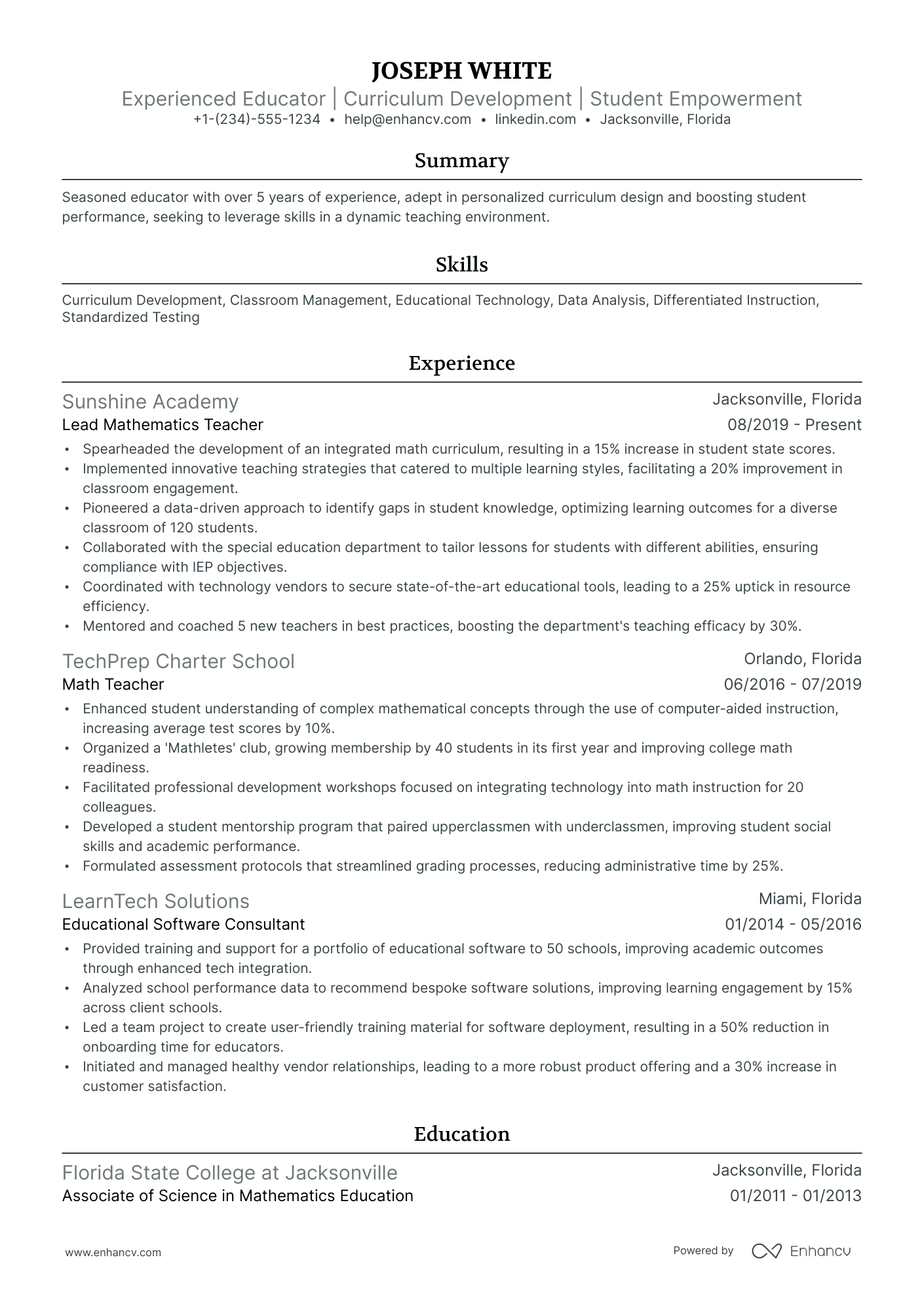
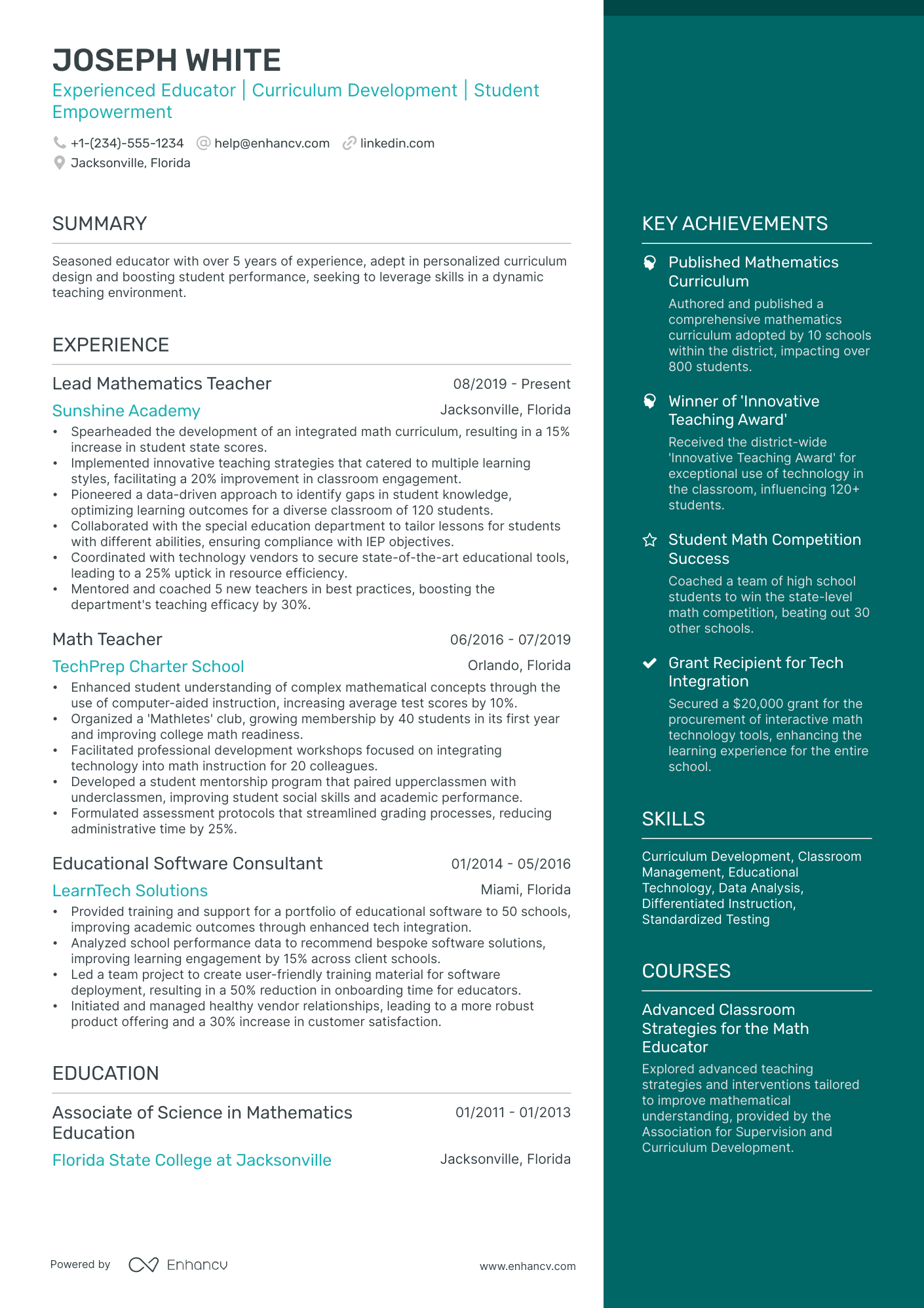
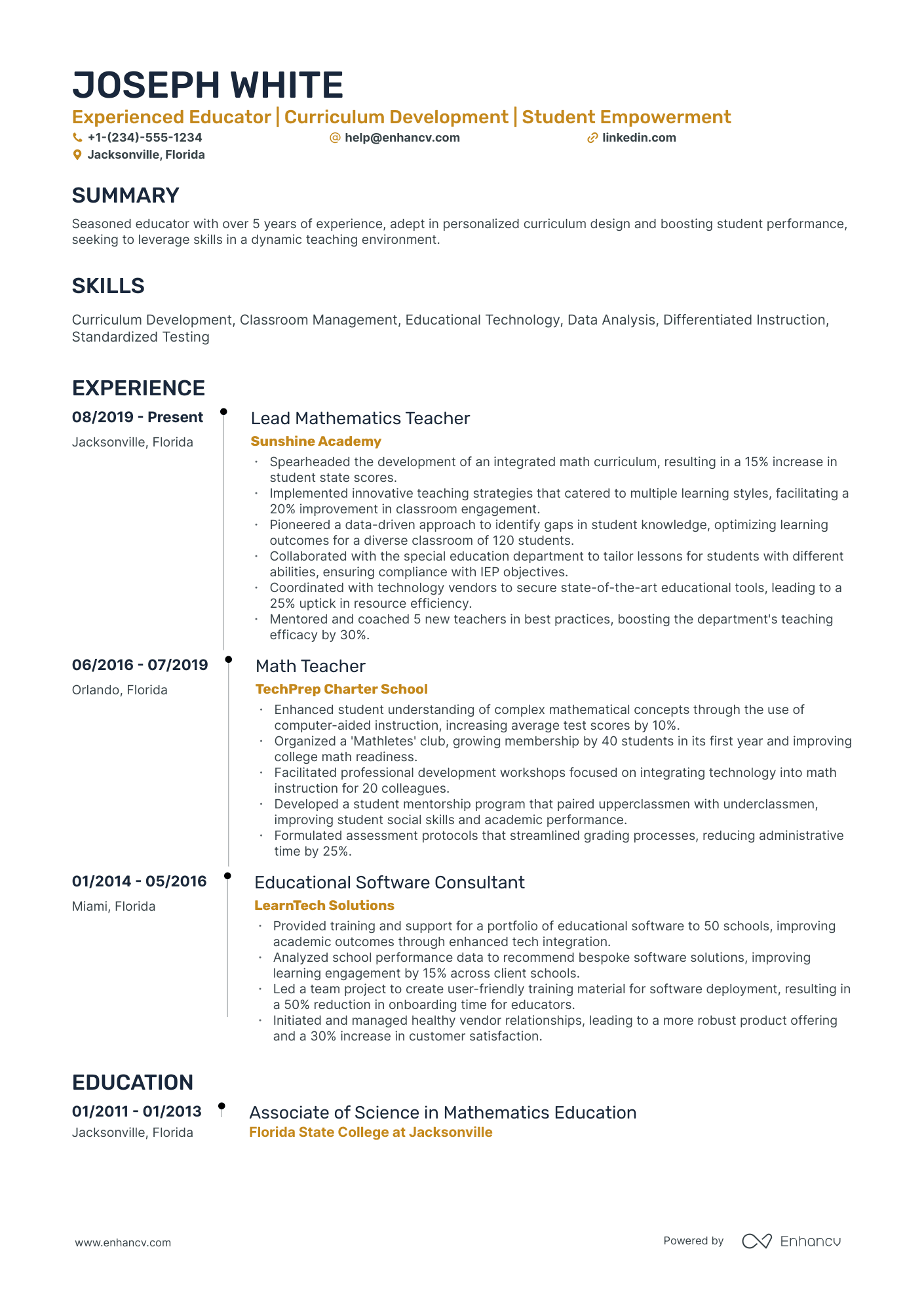
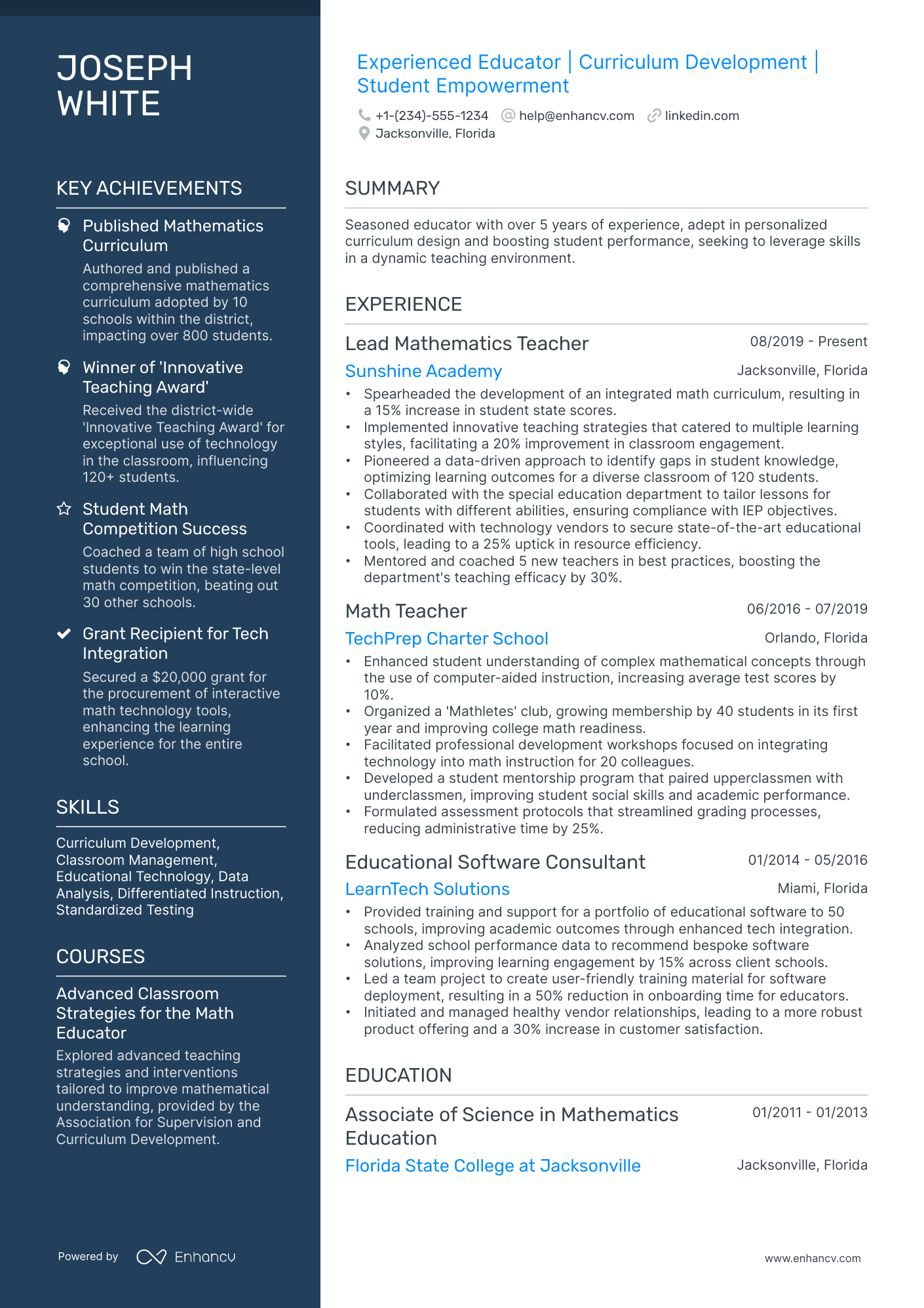
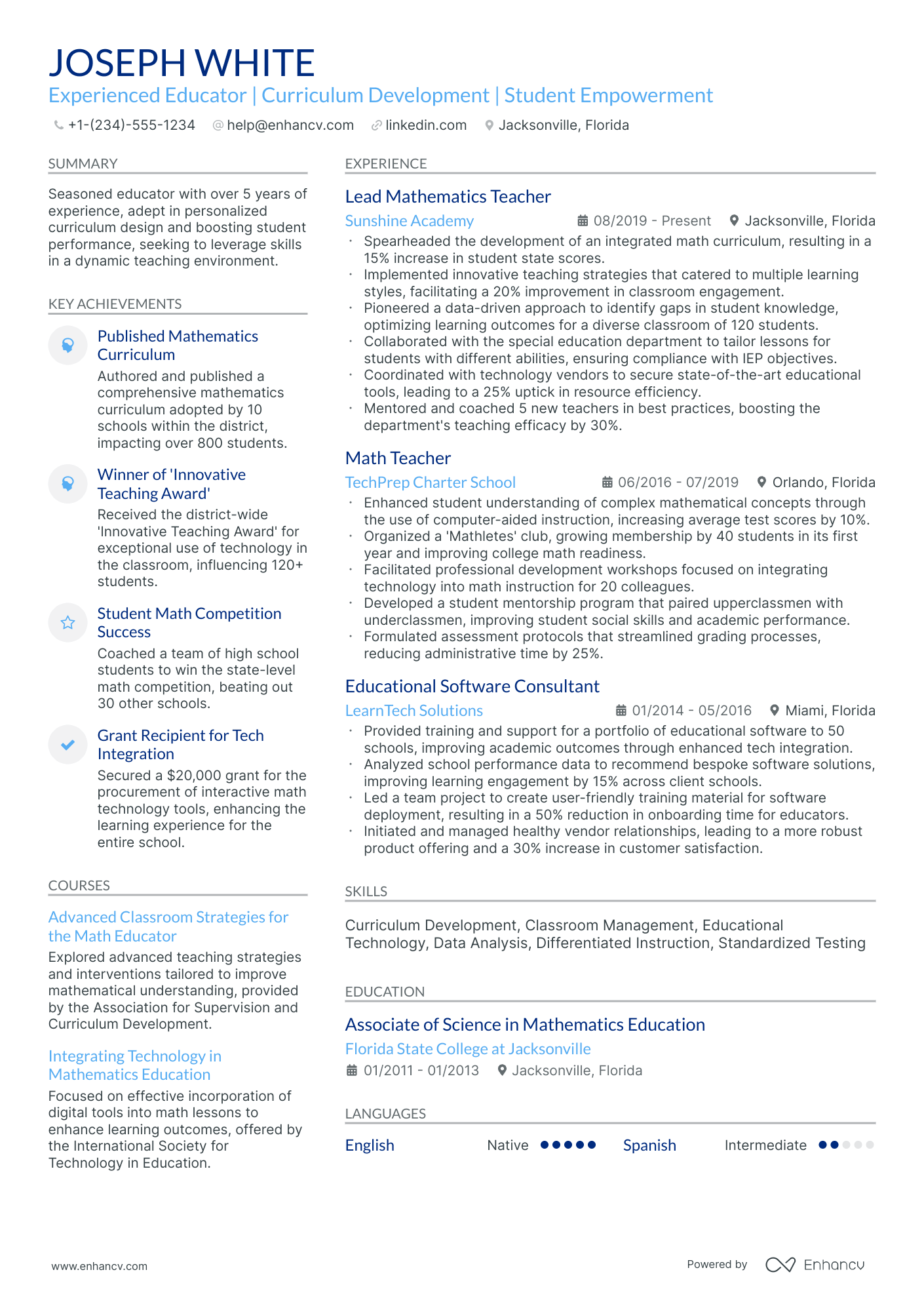
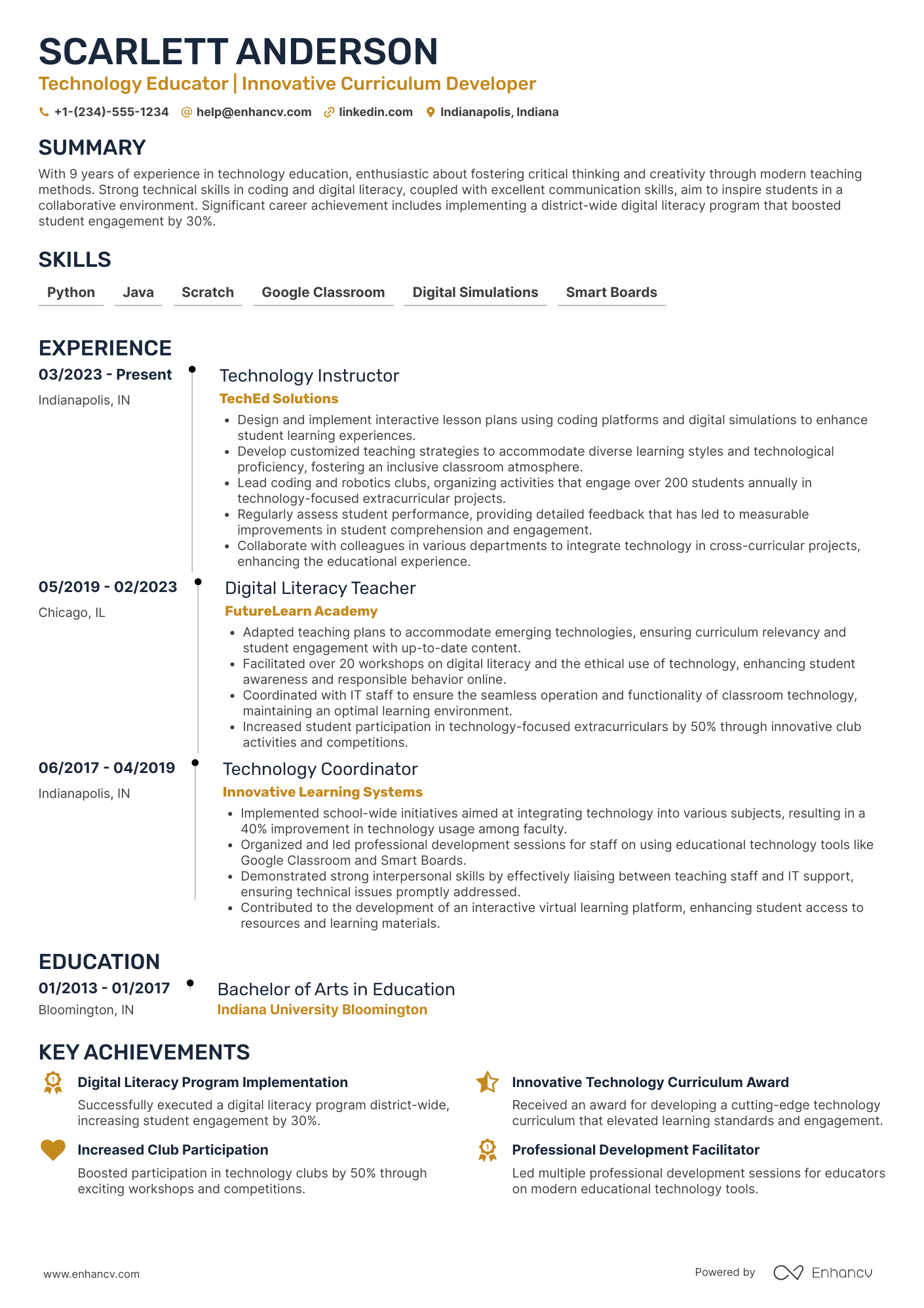
Many technology teacher resume drafts fail because they read like tool inventories, not evidence of instruction, outcomes, and classroom impact. That hurts in technology teacher resume reviews, where applicant tracking system filters and fast recruiter scans reward clear, results-first proof.
A strong resume shows what you improved and how you measured it. You'll highlight student growth, certification pass rates, project delivery, reduced device downtime, stronger digital citizenship, and higher course enrollment. You'll quantify scope, timelines, budgets, and stakeholder satisfaction. If you're unsure where to begin, learning how to write a resume with a results-first mindset will set the right foundation.

Key takeaways
- Quantify student outcomes, adoption rates, and program growth in every experience bullet.
- Use reverse-chronological format if you have teaching tenure; use hybrid if switching careers.
- Tailor each resume to mirror the job posting's tools, standards, and grade levels.
- Lead with ownership scope, execution method, and measurable results—not task descriptions.
- Place skills above experience when junior, below experience when you have strong achievements.
- Pair hard skills like Python instruction with soft skills like differentiated instruction for balance.
- Use Enhancv's tools to turn routine classroom tasks into concise, results-driven resume bullets.
How to format a technology teacher resume
Recruiters hiring for technology teacher positions prioritize classroom instruction experience, technical skill breadth across relevant platforms and tools, and evidence of student learning outcomes. A clear, well-structured resume format ensures these signals surface quickly during both human review and applicant tracking system (ATS) scans.

I have significant experience as a technology teacher—which format should I use?
Use a reverse-chronological format to showcase your classroom tenure, curriculum development history, and growing instructional responsibilities in a clear timeline. Do:
- Lead with your most recent teaching role and highlight scope—grade levels served, number of students, and subjects or technology domains covered.
- Feature specific platforms, programming languages, and tools you've taught (e.g., Google Workspace, Scratch, Python, Adobe Creative Suite, robotics kits) to align with job posting requirements.
- Quantify outcomes tied to student achievement, program growth, or technology integration milestones.
I'm junior or switching into a technology teacher role—what format works best?
A hybrid format works best because it lets you lead with transferable technical and instructional skills while still providing a concise employment timeline. Do:
- Place a dedicated skills section near the top of your resume listing classroom technologies, programming languages, learning management systems, and instructional design competencies.
- Include relevant projects, student teaching placements, volunteer tutoring, or technology training facilitation—even if outside a formal teaching role—to demonstrate instructional ability.
- Connect every skill or project to a concrete action and a measurable or observable result.
Why not use a functional resume?
A functional resume strips away the timeline context that principals and hiring committees rely on to verify teaching tenure, progression from student teacher to lead instructor, and consistency of classroom performance.
- A functional format may be acceptable if you're transitioning into technology education from an industry role (e.g., IT, software development, or instructional design) and have limited formal classroom experience—but only if you anchor every listed skill to a specific project, training session, or measurable learner outcome.
Once your layout and formatting choices are in place, the next step is deciding which sections to include so each one serves a clear purpose on your resume.
What sections should go on a technology teacher resume
Recruiters expect a clear, complete resume that proves you can teach technology effectively, manage classrooms, and improve student outcomes. Understanding which resume sections to include ensures you cover every area hiring teams evaluate.
Use this structure for maximum clarity:
- Header
- Summary
- Experience
- Skills
- Projects
- Education
- Certifications
- Optional sections: Awards, Leadership, Volunteering
Strong experience bullets should emphasize measurable student learning gains, curriculum and tool adoption outcomes, classroom scope, and results you delivered across courses, grades, or programs.
Is your resume good enough?
Drop your resume here or choose a file. PDF & DOCX only. Max 2MB file size.
Once you’ve organized the key resume components, focus next on your work history section to show how you’ve applied those qualifications in the classroom.
How to write your technology teacher resume experience
The experience section is where you prove you've delivered meaningful results in technology education—not just occupied a classroom. Hiring managers prioritize demonstrated impact through curriculum you shipped, instructional tools and methods you applied, and measurable student or program outcomes over descriptive task lists.
Each entry should include:
- Job title
- Company and location (or remote)
- Dates of employment (month and year)
Three to five concise bullet points showing what you owned, how you executed, and what outcomes you delivered:
- Ownership scope: the courses, curricula, digital platforms, lab environments, or student populations you were directly accountable for as a technology teacher.
- Execution approach: the instructional frameworks, learning management systems, programming languages, educational technologies, or pedagogical methods you used to plan lessons, assess learning, and deliver instruction.
- Value improved: changes to student achievement, digital literacy rates, course completion, classroom accessibility, equipment reliability, or curriculum relevance that resulted from your work.
- Collaboration context: how you partnered with administrators, fellow educators, IT departments, parents, industry volunteers, or district-level curriculum teams to advance technology education goals.
- Impact delivered: outcomes expressed through student growth, program expansion, adoption of new technologies across the school, or contributions to institutional priorities rather than routine teaching activities.
Experience bullet formula
A technology teacher experience example
✅ Right example - modern, quantified, specific.
Technology Teacher (Computer Science & Digital Literacy)
Riverview Public Schools | Austin, TX
2021–Present
Title I middle school serving 1,200 students with a one-to-one Chromebook program and districtwide learning management system.
- Designed and delivered project-based units in Python, Scratch, and web development (HTML, CSS, JavaScript), increasing end-of-course proficiency from 58% to 81% across six sections.
- Built a Canvas-based curriculum with auto-graded quizzes and rubric-driven projects, cutting grading time by 35% and returning feedback within forty-eight hours for 95% of assignments.
- Led cybersecurity and digital citizenship instruction using Google Workspace for Education and Common Sense Education resources, reducing repeat academic integrity incidents by 28% year over year.
- Implemented data-driven intervention cycles using Google Forms, Sheets, and Looker Studio dashboards, improving on-time assignment submission by 22% and reducing missing work by 18%.
- Partnered with district information technology, counselors, and local software engineers to launch a student help desk and career pathway events, resolving 300+ device tickets per semester and boosting computer science elective enrollment by 19%.
Now that you've seen how a strong experience section looks in practice, let's break down how to customize yours to match the specific job you're targeting.
How to tailor your technology teacher resume experience
Recruiters evaluate technology teacher resumes through both human review and applicant tracking systems, scanning for alignment between your experience and the specific role. Tailoring your resume to the job description ensures your qualifications stand out in both screening methods.
Ways to tailor your technology teacher experience:
- Match the specific software platforms and tools listed in the posting.
- Use the same curriculum standards terminology the district references.
- Mirror student performance metrics or learning outcomes they prioritize.
- Highlight experience with the exact grade levels they specify.
- Reflect classroom management frameworks or instructional models they mention.
- Incorporate digital citizenship or online safety language from the posting.
- Emphasize integration of assistive technology if accessibility is referenced.
- Include experience with their stated learning management systems.
Tailoring means aligning your real accomplishments with the role's stated requirements, not forcing keywords where they don't belong.
Resume tailoring examples for technology teacher
| Job description excerpt | Untailored | Tailored |
|---|---|---|
| Teach coding and robotics courses using Python and LEGO Mindstorms to students in grades 6–8, integrating project-based learning into daily instruction. | Taught technology classes to middle school students. | Designed and delivered project-based Python and LEGO Mindstorms robotics courses for grades 6–8, with 92% of students completing end-of-unit coding challenges. |
| Manage school-wide 1:1 Chromebook program, provide staff training on Google Workspace for Education, and troubleshoot hardware and software issues across campus. | Helped with school technology and trained teachers on various tools. | Administered a 1:1 Chromebook program for 800+ students, led quarterly Google Workspace for Education training for 45 staff members, and reduced average device downtime by 30% through a streamlined ticketing workflow. |
| Develop and align digital citizenship and cybersecurity curriculum to ISTE Standards, assessing student progress through portfolio-based evaluations. | Created lesson plans about internet safety and computer skills. | Built a digital citizenship and introductory cybersecurity curriculum aligned to ISTE Standards for 150 high school students, using portfolio-based assessments that improved student demonstration of responsible technology use by two rubric levels over one semester. |
Once you’ve aligned your experience with the role’s priorities, quantify your technology teacher achievements to show the measurable impact of that work.
How to quantify your technology teacher achievements
Quantifying your work proves you improved learning and reduced tech friction. Focus on student proficiency gains, device and network uptime, support ticket volume, security incidents, and adoption of learning platforms.
Quantifying examples for technology teacher
| Metric | Example |
|---|---|
| Student proficiency | "Raised average coding assessment scores from 62% to 81% across five classes by teaching Scratch, Python, and Git fundamentals." |
| Platform adoption | "Increased Google Classroom assignment submission rate from 74% to 96% within one semester by standardizing workflows and training staff." |
| Support efficiency | "Cut average student help-desk wait time from twenty minutes to seven by using a ticket form, triage rules, and weekly open lab hours." |
| Reliability uptime | "Improved classroom device readiness from 85% to 98% by deploying an imaging process and weekly Chromebook health checks." |
| Security risk | "Reduced phishing click-through from 18% to 6% after running three simulations and teaching password managers and multi-factor authentication." |
Turn your everyday tasks into measurable, recruiter-ready resume bullets in seconds with Enhancv's Bullet Point Generator.
With strong bullet points in place, the next step is ensuring your skills section highlights the right mix of hard and soft skills for a technology teacher role.
How to list your hard and soft skills on a technology teacher resume
Your skills section shows you can teach modern tools safely and effectively, and recruiters and ATS scan it to match your keywords to the job post—aim for a balanced mix of hard skills and classroom-ready soft skills. technology teacher roles require a blend of:
- Product strategy and discovery skills.
- Data, analytics, and experimentation skills.
- Delivery, execution, and go-to-market discipline.
- Soft skills.
Your skills section should be:
- Scannable (bullet-style grouping).
- Relevant to the job post.
- Backed by proof in experience bullets.
- Updated with current tools.
Place your skills section:
- Above experience if you're junior or switching careers.
- Below experience if you're mid/senior with strong achievements.

Hard skills
- Google Classroom, Canvas
- Microsoft 365, Google Workspace
- Learning management system administration
- Chromebook, iPad fleet management
- Jamf School, Google Admin Console
- Coding instruction: Scratch, Python
- Robotics: LEGO SPIKE, VEX
- Makerspace tools: 3D printing, CAD
- Digital citizenship curriculum
- Data privacy and compliance (FERPA)
Soft skills
- Translate tech into student-friendly steps
- Differentiate instruction by skill level
- Facilitate project-based learning
- Set clear classroom tech norms
- Troubleshoot calmly under time pressure
- Collaborate with grade-level teams
- Coach teachers on tool adoption
- Communicate with families on progress
- Use assessment data to reteach
- Document incidents and follow up
How to show your technology teacher skills in context
Skills shouldn't live only in a bulleted list on your resume. Explore examples of resume skills to see how other professionals present theirs effectively.
They should be demonstrated in:
- Your summary (high-level professional identity)
- Your experience (proof through outcomes)
Here's what that looks like in practice.
Summary example
Senior technology teacher with 12 years of experience designing standards-aligned computer science curricula. Skilled in Google Workspace, Python instruction, and project-based learning. Boosted student coding proficiency scores by 34% through differentiated instruction and cross-departmental STEM collaboration.
- Reflects senior-level expertise immediately.
- Names specific tools and methods.
- Leads with a measurable outcome.
- Highlights collaboration as a soft skill.
Experience example
Senior Technology Teacher
Ridgemont Preparatory Academy | Austin, TX
August 2018–June 2024
- Redesigned the 9–12 computer science curriculum using Python and block-based coding, raising AP pass rates by 27% over three years.
- Partnered with math and science departments to launch an interdisciplinary STEM lab, increasing student enrollment in elective tech courses by 40%.
- Trained 15 faculty members on Google Workspace integration, cutting administrative task time by 20% across grade-level teams.
- Every bullet contains measurable proof.
- Skills surface naturally through real outcomes.
Once you’ve demonstrated your teaching technology strengths through specific classroom-relevant examples, the next step is to apply the same approach to building a technology teacher resume with no experience.
How do I write a technology teacher resume with no experience
Even without full-time experience, you can demonstrate readiness through:
- Student teaching technology lessons
- Classroom tech integration practicum
- Tutoring coding or digital literacy
- After-school robotics club coaching
- Learning management system course builds
- Technology curriculum unit design
- Education technology workshop facilitation
- Volunteer computer lab support
Our guide on writing a resume without work experience walks you through how to make these activities count.
Focus on:
- Standards-aligned lesson planning evidence
- Classroom technology tool proficiency
- Student data tracking and reporting
- Safety, privacy, and accessibility
Resume format tip for entry-level technology teacher
Use a combination resume format because it highlights relevant projects and skills first while still showing your education and practicum history. Do:
- Lead with a "Projects" section.
- Add tools like Google Classroom.
- Quantify outcomes with student data.
- Align bullets to job descriptions.
- Include certifications and coursework.
- Built a six-week Google Classroom coding unit, created rubrics and quizzes, and improved average quiz scores by 18% across twenty-five students.
Even without classroom experience, your education section can serve as the foundation of your resume, so presenting it effectively is essential.
How to list your education on a technology teacher resume
Your education section helps hiring teams confirm you hold the foundational knowledge needed to teach technology effectively. It validates your academic preparation and subject-matter expertise.
Include:
- Degree name
- Institution
- Location
- Graduation year
- Relevant coursework (for juniors or entry-level candidates)
- Honors & GPA (if 3.5 or higher)
List only the graduation year. Avoid including specific months or days.
Here's a strong education entry tailored for a technology teacher resume.
Example education entry
Bachelor of Science in Technology Education
Virginia Polytechnic Institute and State University, Blacksburg, VA
Graduated 2021
GPA: 3.7/4.0
- Relevant Coursework: Instructional Technology Design, Computer Science Foundations, Digital Literacy Pedagogy, and STEM Curriculum Development
- Honors: Magna Cum Laude, Dean's List (six semesters)
How to list your certifications on a technology teacher resume
Certifications on a resume show a technology teacher's commitment to learning, proficiency with classroom tools, and alignment with current industry standards.
Include:
- Certificate name
- Issuing organization
- Year
- Optional: credential ID or URL
- Place certifications below education when your degree is recent and your certifications support it without adding stronger role relevance.
- Place certifications above education when they are recent, highly relevant to the technology teacher role, or required for the jobs you target.
Best certifications for your technology teacher resume
Google Certified Educator Level 1 Google Certified Educator Level 2 Microsoft Certified Educator (MCE) CompTIA A+ CompTIA Network+ Certified Internet Web Professional (CIW) Web Foundations Associate Adobe Certified Professional (ACP)
Now that your summary captures your teaching expertise and technical skills, make sure the header presenting your contact details is equally polished and professional.
What to include in a technology teacher resume header
A resume header lists your key contact and professional links, helping a technology teacher stand out in recruiter screening through clear visibility and credibility.
Essential resume header elements
- Full name
- Tailored job title and headline
- Location
- Phone number
- Professional email
- GitHub link
- Portfolio link
Including a LinkedIn link helps recruiters verify your experience quickly and supports screening.
Don't include a photo on a technology teacher resume unless the role is explicitly front-facing or appearance-dependent.
Use the same name, job title, and links across your resume and profiles to avoid mismatches during recruiter screening.
Example
Technology teacher resume header
Jordan Ramirez
Technology Teacher | Computer Science and Robotics (Grades 6–12)
Austin, TX
(512) 555-01XX
jordan.ramirez@enhancv.com
github.com/jordanramirez
jordanramirez.com
linkedin.com/in/jordanramirez
Once your header clearly identifies you and your key contact details, the next step is to add additional sections for technology teacher resumes to round out the rest of your application.
Additional sections for technology teacher resumes
Extra resume sections help you stand out when your core qualifications closely match other candidates. They showcase unique strengths that reinforce your credibility as a technology teacher.
- Certifications and professional development
- Technical skills and tools
- Publications and conference presentations
- Languages
- Professional memberships and affiliations
- Hobbies and interests
- Volunteer experience in STEM education
Once you've strengthened your resume with these supplementary sections, pairing it with a well-crafted cover letter can further set your application apart.
Do technology teacher resumes need a cover letter
A cover letter isn't required for a technology teacher, but it helps in competitive roles or districts that expect one. It can make a difference when you need to connect your experience to a specific program, team, or student population. If you're unfamiliar with the format, start by understanding what a cover letter is and how it complements your resume.
Use a cover letter to add context your resume can't:
- Explain role or team fit by linking your teaching approach to the school's curriculum, tools, and collaboration style.
- Highlight one or two relevant projects or outcomes, such as a new coding unit, device rollout support, or measurable student skill gains.
- Show understanding of the product, users, or business context by referencing the school's learning platforms, accessibility needs, and classroom constraints.
- Address career transitions or non-obvious experience by translating prior roles into classroom impact, technology integration, and student support.
Drop your resume here or choose a file.
PDF & DOCX only. Max 2MB file size.
Once you’ve decided whether to include a cover letter to add context beyond your resume, you can use AI to improve your technology teacher resume by sharpening how you present that information.
Using AI to improve your technology teacher resume
AI can sharpen your resume's clarity, structure, and impact. It helps tighten language and highlight relevant achievements. But overuse strips authenticity. Once your content feels clear and role-aligned, step away from AI. For a deeper look at available options, explore which AI is best for writing resumes before choosing a tool.
Here are 10 practical prompts to strengthen specific sections of your technology teacher resume:
- Strengthen your summary. "Rewrite my technology teacher resume summary to highlight classroom technology integration, student outcomes, and curriculum development in under four sentences."
- Quantify experience bullets. "Add measurable outcomes to these technology teacher experience bullets, focusing on student performance gains, adoption rates, or program growth."
- Align skills to postings. "Compare my technology teacher skills section against this job description and suggest missing technical or instructional skills I should add."
- Tighten action verbs. "Replace weak or repeated verbs in my technology teacher experience section with specific, active alternatives that reflect teaching and mentoring."
- Clarify project descriptions. "Rewrite my technology teacher project descriptions to clearly state the goal, tools used, student involvement, and measurable results."
- Improve certification details. "Reorganize my technology teacher certifications section so the most relevant credentials appear first, with issuing bodies and dates included."
- Refine education entries. "Edit my technology teacher education section to emphasize coursework, honors, or specializations directly related to instructional technology."
- Remove filler language. "Identify and remove vague or redundant phrases from my technology teacher resume that add length without adding meaning."
- Target specific roles. "Tailor my technology teacher experience bullets to match this specific job posting without fabricating responsibilities or outcomes."
- Enhance readability overall. "Simplify long or complex sentences across my technology teacher resume so every bullet is clear, direct, and under 20 words."
Stop using AI once your resume sounds accurate, specific, and aligned with real experience. AI should never invent experience or inflate claims—if it didn't happen, it doesn't belong here.
Conclusion
A strong technology teacher resume shows measurable outcomes, role-specific skills, and a clear structure. It highlights student growth, project results, and classroom impact with numbers. It uses clean headings, consistent formatting, and targeted keywords to stay easy to scan.
Keep your technology teacher experience focused on what hiring teams need now. Show current tools, sound instructional practice, and evidence of collaboration. With clear results and an organized layout, your resume will fit today’s market and stay relevant.