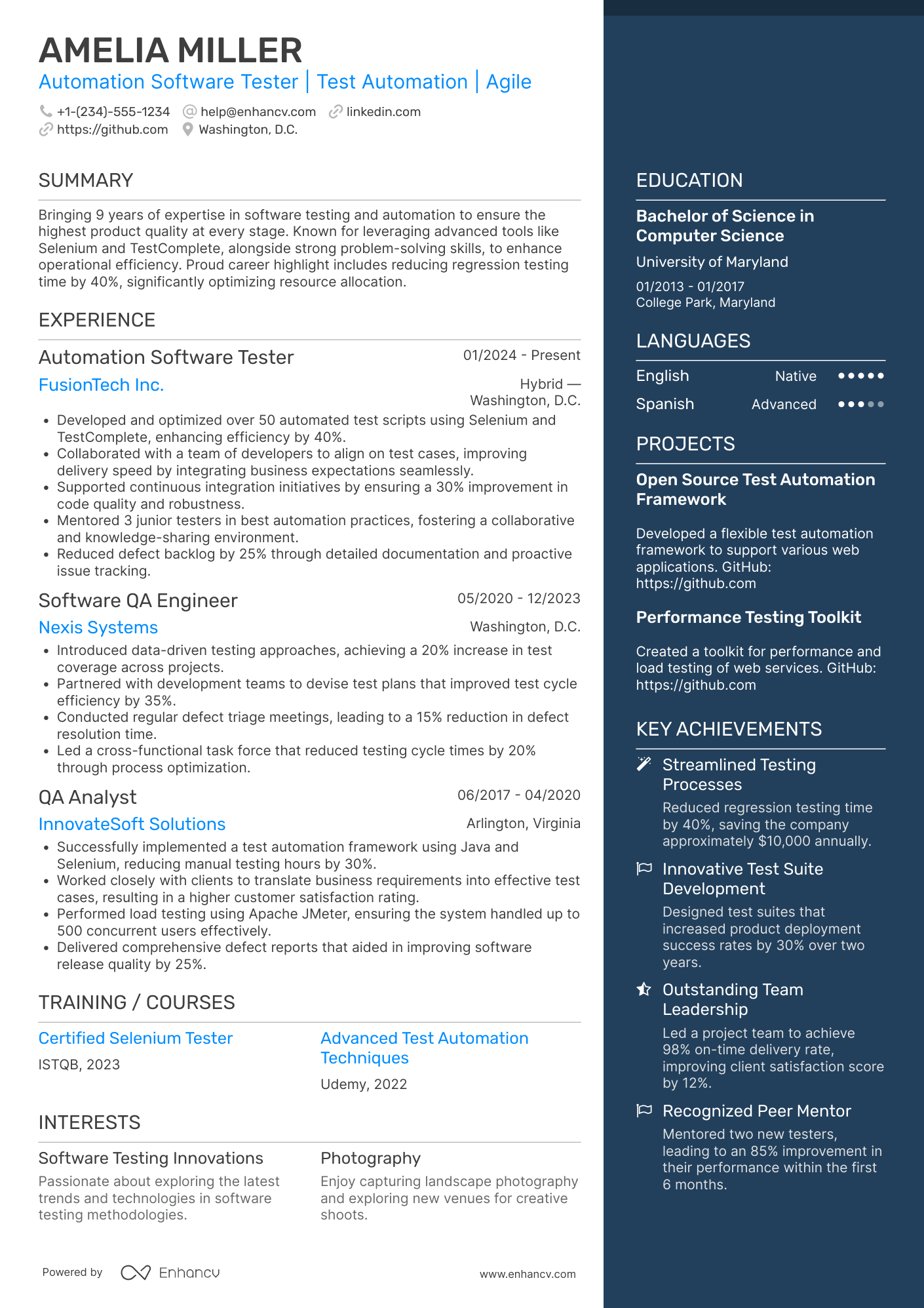
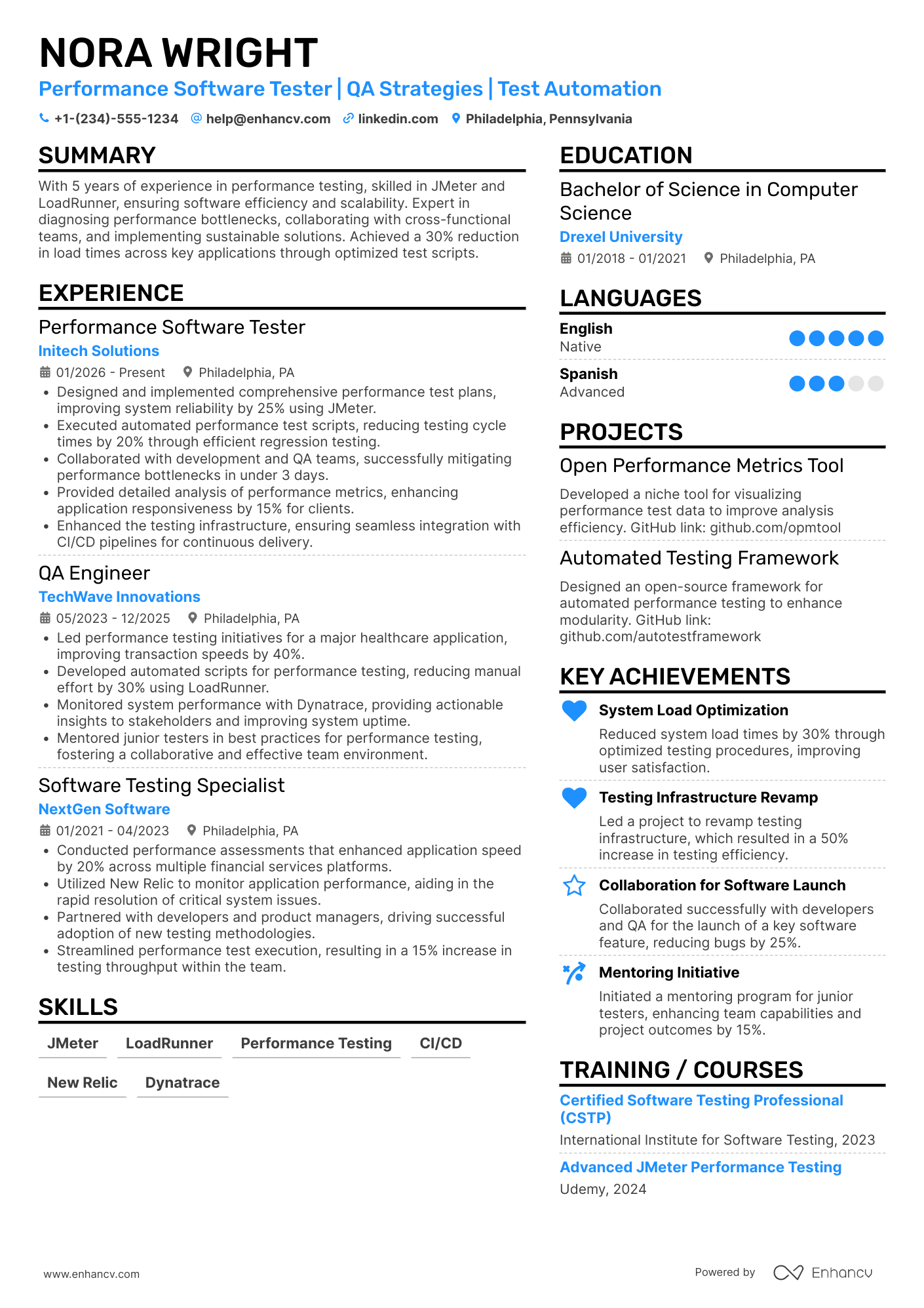
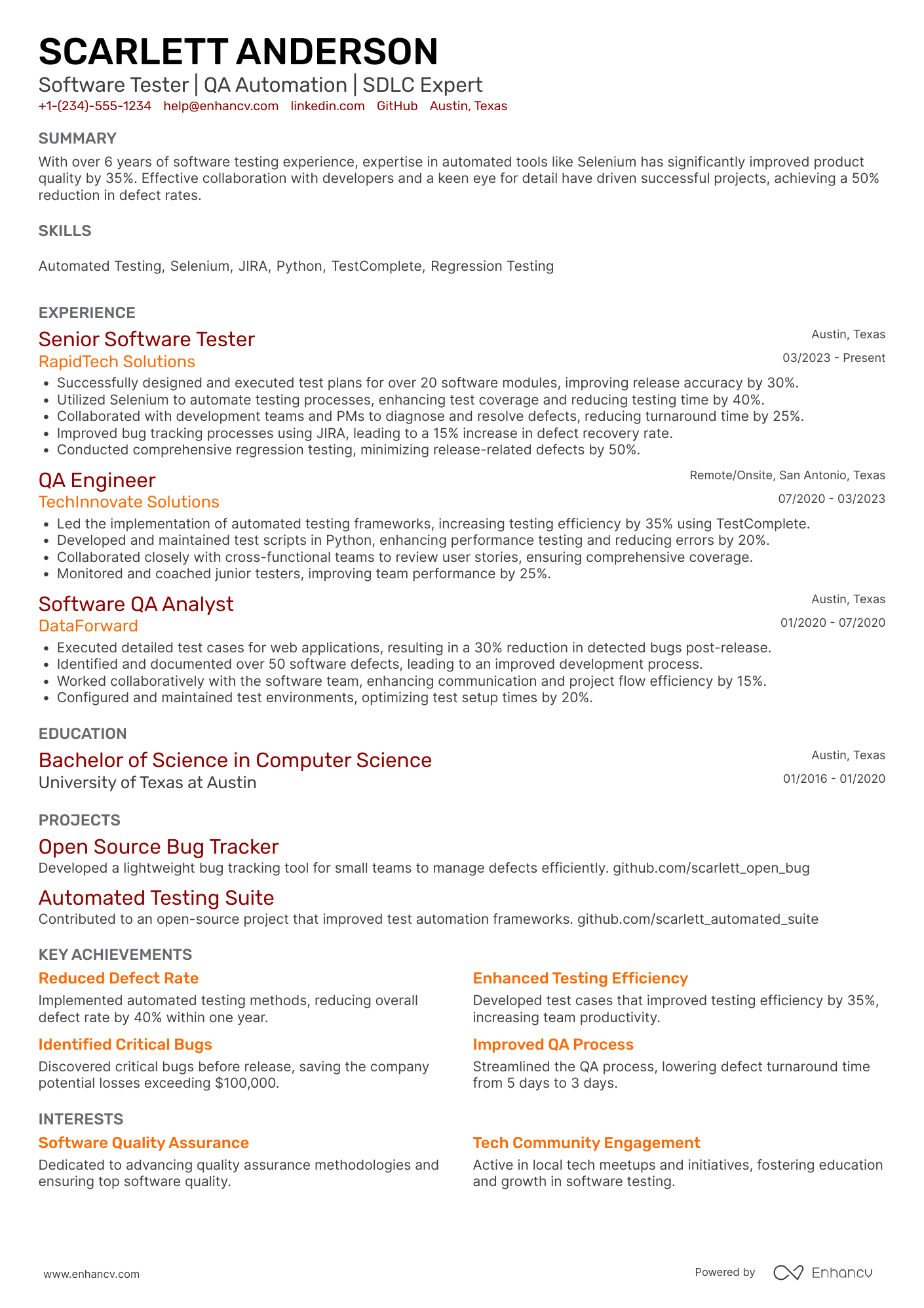
Many software tester resume submissions fail because they list tools and test cases but don't show measurable impact or risk reduction. In today's ATS filters and fast recruiter scans, that missing evidence keeps you out in a competitive pipeline.
A strong resume shows how you improved quality and delivery, not just what you used. Knowing how to make your resume stand out is essential in this competitive field. You'll highlight defect escape reduction, faster release cycles, higher automation coverage, fewer flaky tests, improved pass rates, and prevented incidents affecting users or revenue.

Key takeaways
- Quantify every testing achievement with metrics like defect reduction, coverage gains, or faster release cycles.
- Choose reverse-chronological format for experienced testers and hybrid format for career changers or juniors.
- Tailor your experience bullets to mirror each job posting's tools, methodologies, and quality metrics.
- Anchor every listed skill to a specific project, outcome, or experience bullet on your resume.
- Place certifications above education when they're recent, role-relevant, or required by the posting.
- Write a three- to four-line summary that names your tools, domain, and one quantified result.
- Use Enhancv to turn vague job duties into measurable, recruiter-ready resume bullets efficiently.
How to format a software tester resume
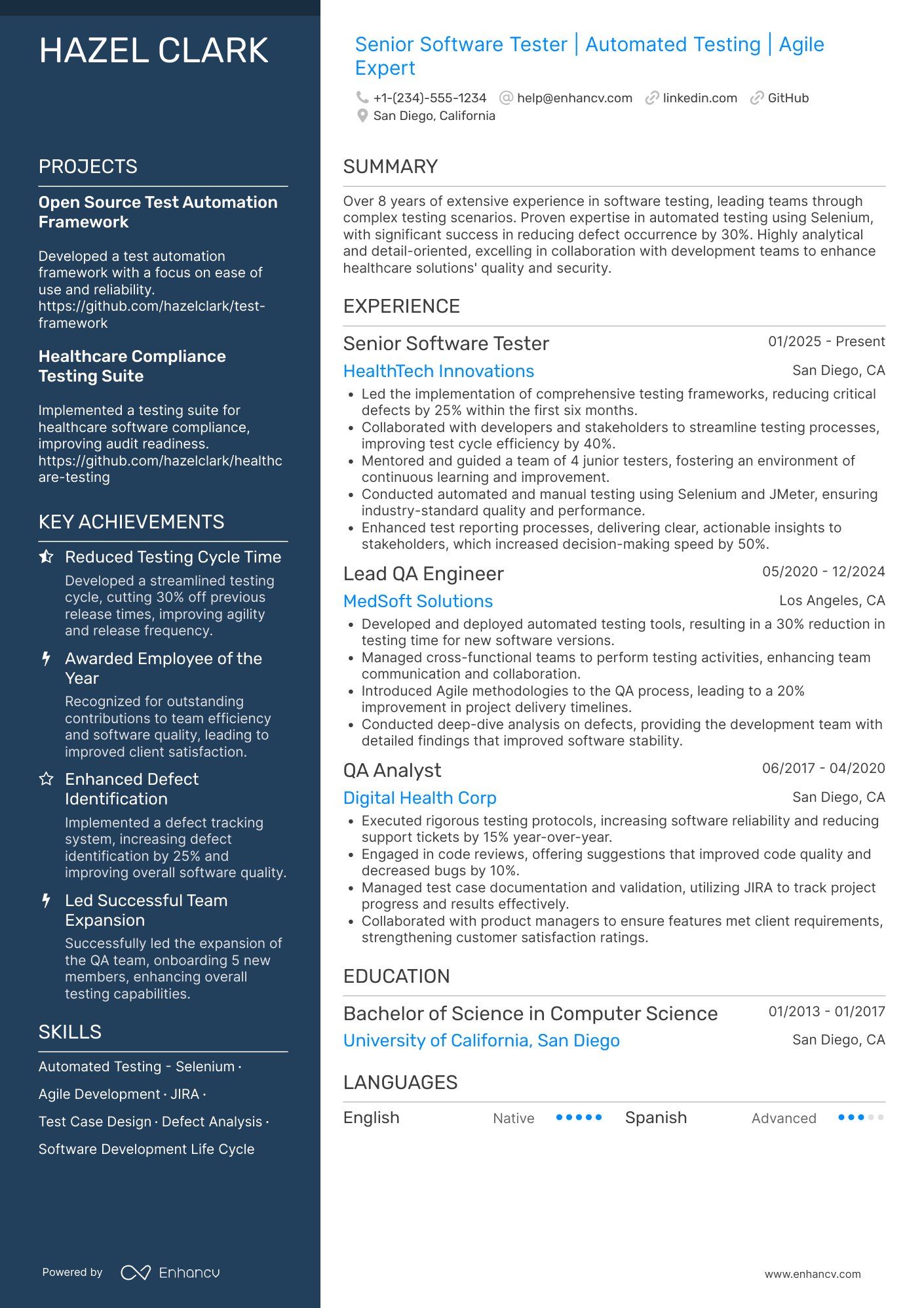
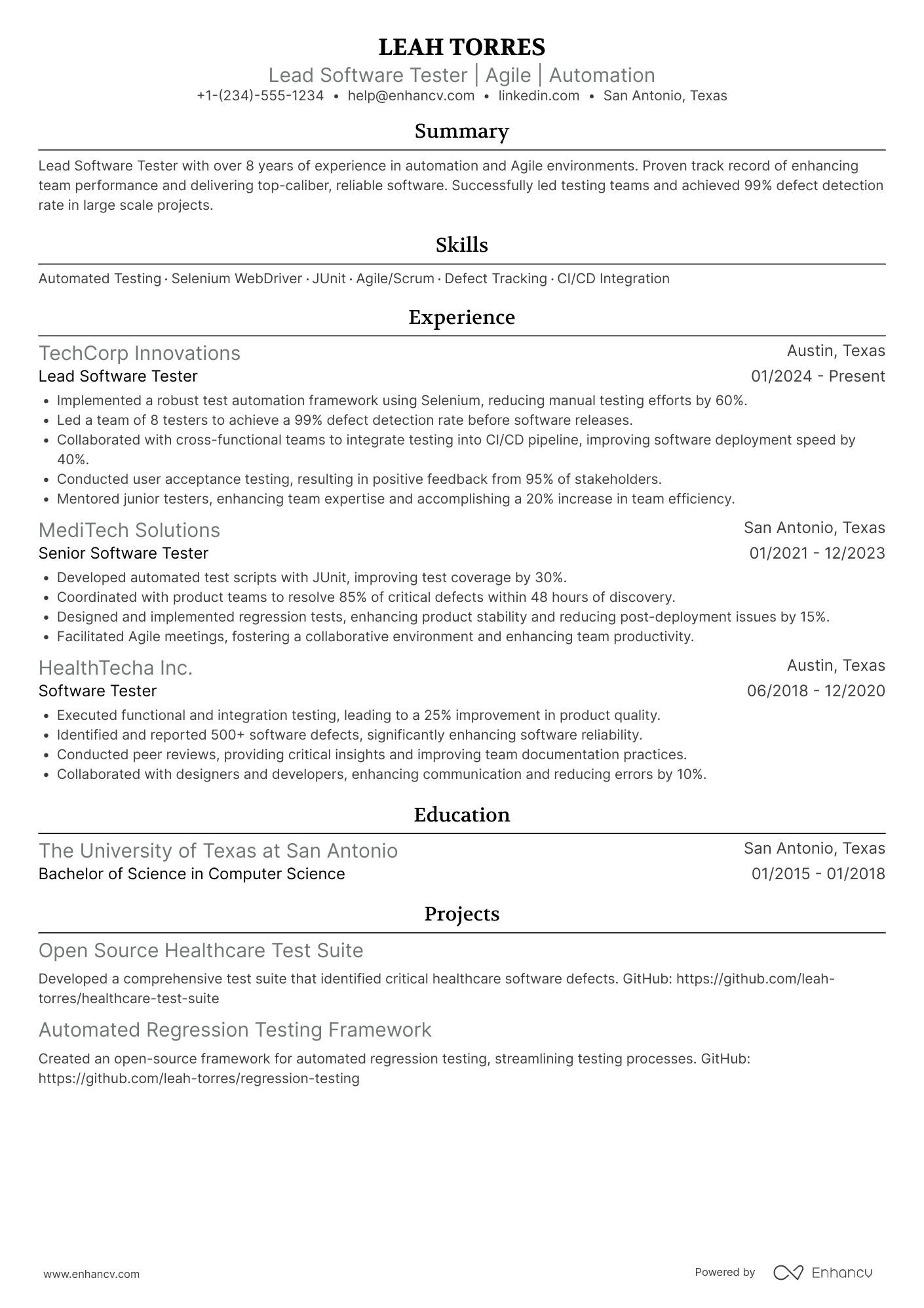
Recruiters evaluating software tester resumes prioritize hands-on testing methodologies, familiarity with specific tools and frameworks, and evidence that your work directly improved software quality or reduced defects. The right resume format ensures these signals surface quickly, both for human reviewers scanning in seconds and for applicant tracking systems parsing your document.

I have significant experience in this role—which format should I use?
Use a reverse-chronological format to put your deepest and most recent testing experience front and center. Do:
- Lead each role entry with your scope of ownership—types of testing performed (functional, regression, performance, UAT), team size, and product complexity.
- Highlight proficiency in role-specific tools and domains such as Selenium, JIRA, TestRail, Postman, SQL, API testing, and Agile or Scrum environments.
- Quantify outcomes tied to quality improvement, release efficiency, or defect reduction.
I'm junior or switching into this role—what format works best?
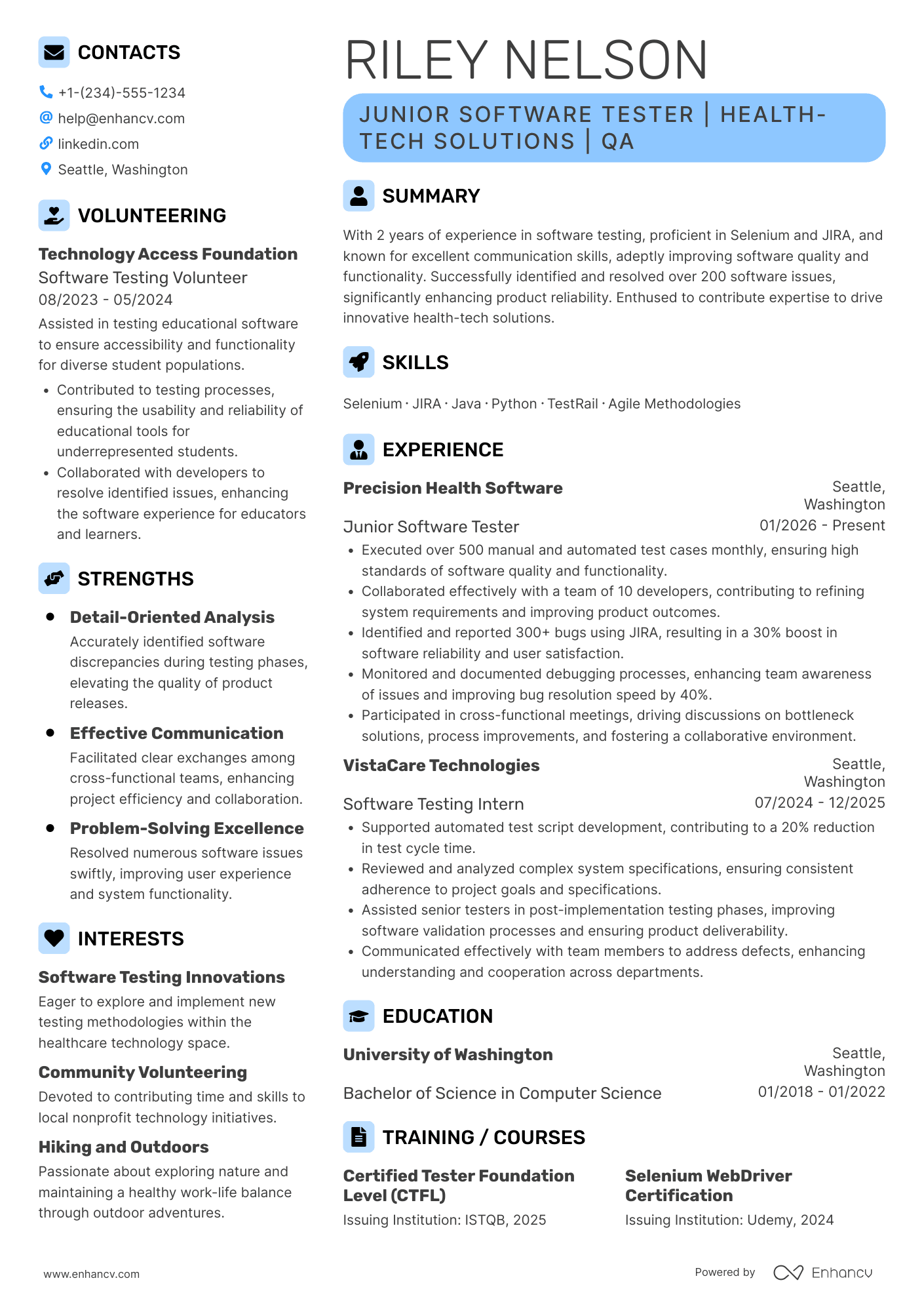
A hybrid format works best, letting you lead with a strong skills section while still providing a concise work history that shows progression or relevant experience. Do:
- Place a dedicated skills section near the top of your resume, grouping testing tools, methodologies, and programming or scripting languages (e.g., SQL, Python, Selenium) for immediate visibility.
- Include academic projects, certification labs, freelance QA work, or open-source testing contributions to demonstrate practical application even without formal job titles.
- Connect every action to a clear result—show what you tested, how you tested it, and what improved because of your work.
Why not use a functional resume?
A functional format strips away the timeline and context recruiters need to verify where, when, and how you applied your testing skills, making it harder to assess your actual hands-on experience.
- Career changers with no QA history: You have transferable analytical or technical skills from a related field (e.g., development, IT support, data analysis) but no formal testing job titles.
- Recent graduates or bootcamp completers: Your testing experience comes entirely from coursework, certifications (like ISTQB), or personal projects rather than employment.
- Professionals with extended resume gaps: You need to foreground current skills and recent upskilling over a fragmented work timeline.
- A functional format is acceptable only when you genuinely lack professional testing experience—and even then, every skill listed should be anchored to a specific project, lab, or measurable outcome rather than presented as an unsupported claim.
Once your format establishes a clean, readable structure, the next step is filling it with the right sections to showcase your qualifications effectively.
What sections should go on a software tester resume
Recruiters expect to see a clean, QA-focused resume that proves you can find defects, improve quality, and support reliable releases. Understanding which resume sections to include is critical for maximum clarity:
- Header
- Summary
- Experience
- Skills
- Projects
- Education
- Certifications
- Optional sections: Awards, open-source work, languages
Strong experience bullets should emphasize measurable quality impact, release outcomes, testing scope, defect trends, and the results you delivered across teams and environments.
Is your resume good enough?
Drop your resume here or choose a file. PDF & DOCX only. Max 2MB file size.
Once you’ve organized the key resume components, the next step is to write your software tester resume experience section so it fits that structure and highlights your impact.
How to write your software tester resume experience
Your experience section is where you prove you've shipped reliable software—not just checked boxes on a test plan. Hiring managers prioritize demonstrated impact over descriptive task lists, so every bullet should connect the tools and methods you used to measurable outcomes like defect reduction, faster release cycles, or improved product stability.
Each entry should include:
- Job title
- Company and location (or remote)
- Dates of employment (month and year)
Three to five concise bullet points showing what you owned, how you executed, and what outcomes you delivered:
- Ownership scope: the specific products, features, platforms, or system modules you were responsible for testing, including the breadth of coverage across environments, device types, or user segments.
- Execution approach: the testing frameworks, automation tools, CI/CD pipelines, defect-tracking systems, or methodologies—such as regression, exploratory, or performance testing—you applied to validate software quality.
- Value improved: the measurable changes you drove in defect detection rates, test coverage, release stability, mean time to resolution, or risk exposure that directly strengthened the product's reliability.
- Collaboration context: how you partnered with developers, product managers, DevOps engineers, or external vendors to triage issues, align on acceptance criteria, and ensure quality gates were met before deployment.
- Impact delivered: the tangible results your testing work produced—expressed through improvements in release confidence, regression prevention, production incident reduction, or accelerated delivery timelines rather than a list of tests you ran.
Experience bullet formula
A software tester experience example
✅ Right example - modern, quantified, specific.
Software QA Engineer
BrightCart | Remote
2022–Present
E-commerce platform serving 2M+ monthly shoppers across web and iOS, processing 50K+ orders per day.
- Automated end-to-end regression coverage with Playwright, TypeScript, and GitHub Actions, cutting release verification time 55% (from nine hours to four hours) and increasing weekly release cadence from one to two.
- Designed and executed API test suites in Postman and REST Assured against microservices, reducing production defects 32% quarter over quarter and improving defect detection before code freeze by 18%.
- Implemented risk-based test planning and traceability in Jira and TestRail, improving requirements coverage from 78% to 95% and reducing escaped severity-one incidents from six to two per quarter.
- Partnered with product managers, designers, and engineers to define acceptance criteria and reproduce issues with HAR logs and Chrome DevTools, shortening bug triage time 40% and raising first-pass fix rate to 85%.
- Led performance testing with JMeter and Grafana dashboards, identifying checkout bottlenecks and improving p95 response time 22% during peak traffic events, lowering cart abandonment 3.1%.
Now that you've seen how a strong experience section comes together, let's focus on adjusting those details to match the specific job you're applying for.
How to tailor your software tester resume experience
Recruiters evaluate your software tester resume through both human review and applicant tracking systems (ATS). Tailoring your resume to the job description ensures your qualifications align with what hiring teams actively seek.
Ways to tailor your software tester experience:
- Match testing tools and platforms listed in the job description.
- Mirror the exact terminology used for QA methodologies or standards.
- Reflect specific KPIs or quality metrics the employer prioritizes.
- Highlight automation frameworks referenced in the posting.
- Include relevant domain experience such as fintech or healthcare.
- Emphasize compliance or security testing if the role requires it.
- Align your workflow descriptions with their SDLC or Agile model.
- Reference accessibility or performance testing when the posting specifies it.
Tailoring means aligning your real accomplishments with each role's requirements—not forcing keywords where they don't belong.
Resume tailoring examples for software tester
| Job description excerpt | Untailored | Tailored |
|---|---|---|
| "Execute automated regression test suites using Selenium and Jenkins in an Agile/Scrum environment for our e-commerce platform." | Performed testing activities across various projects and environments. | Executed automated regression suites using Selenium and Jenkins across 12 sprint cycles, reducing e-commerce checkout defects by 34%. |
| "Design and maintain test plans and test cases for RESTful APIs using Postman, ensuring compliance with HIPAA security standards." | Created test documentation and conducted API testing for different applications. | Designed and maintained 200+ test cases for RESTful APIs in Postman, validating HIPAA-compliant data handling across three healthcare microservices. |
| "Identify, document, and track defects in Jira while collaborating with developers to resolve critical issues for our mobile banking application." | Logged bugs and worked with the development team to fix software issues. | Documented and triaged 150+ defects in Jira for a mobile banking app serving 500K users, cutting average critical-bug resolution time from five days to two through direct collaboration with developers. |
Once you’ve aligned your testing experience with the role’s priorities, quantify your software tester achievements to show the impact of that work in measurable terms.
How to quantify your software tester achievements
Quantifying your achievements proves business impact beyond "found bugs." Focus on defect leakage, test coverage, cycle time, automation throughput, and performance or reliability improvements tied to releases.
Quantifying examples for software tester
| Metric | Example |
|---|---|
| Defect leakage | "Reduced production defect leakage from 2.1% to 0.8% by tightening regression suites and adding boundary tests in Jira and TestRail." |
| Automation throughput | "Built 120 Selenium and Cypress automated tests, cutting smoke test runtime from 3 hours to 45 minutes in GitHub Actions." |
| Release cycle time | "Shortened QA sign-off from five days to two by introducing risk-based test plans and parallel execution across three environments." |
| Performance reliability | "Identified and verified memory leak in API service using JMeter and Grafana, improving p95 response time from 650 ms to 420 ms." |
| Risk reduction | "Prevented two critical payment defects by adding PCI-focused negative tests and increasing high-risk scenario coverage from 60% to 90%." |
Turn vague job duties into measurable, recruiter-ready resume bullets in seconds with Enhancv's Bullet Point Generator.
Once you've refined how your experience reads on the page, it's equally important to ensure your skills section clearly highlights the right mix of technical and interpersonal strengths.
How to list your hard and soft skills on a software tester resume
Your skills section shows recruiters and an ATS (applicant tracking system) how you test, what tools you use, and how you work with engineers, so aim for a balanced mix of hard skills and role-specific soft skills aligned to the job post. software tester roles require a blend of:
- Product strategy and discovery skills.
- Data, analytics, and experimentation skills.
- Delivery, execution, and go-to-market discipline.
- Soft skills.
Your skills section should be:
- Scannable (bullet-style grouping).
- Relevant to the job post.
- Backed by proof in experience bullets.
- Updated with current tools.
Place your skills section:
- Above experience if you're junior or switching careers.
- Below experience if you're mid/senior with strong achievements.

Hard skills
- Test planning and strategy
- Test case design, test suites
- Manual functional testing
- Regression, smoke, sanity testing
- Exploratory testing
- Defect tracking: Jira, Azure DevOps
- Test management: TestRail, Zephyr
- API testing: Postman, REST
- UI automation: Selenium, Cypress
- Mobile testing: Appium
- SQL querying and validation
- Continuous integration: GitHub Actions, Jenkins
Soft skills
- Clarify acceptance criteria early
- Write reproducible bug reports
- Challenge assumptions with evidence
- Prioritize defects by user impact
- Communicate risk and release readiness
- Collaborate tightly with developers
- Align on quality gates and definitions
- Negotiate scope under deadlines
- Own test coverage end to end
- Document decisions and test outcomes
- Ask precise, unblocker questions
- Stay calm during incident triage
How to show your software tester skills in context
Skills shouldn't live only in a bulleted list on your resume. Browse examples of how other testers present their abilities on the resume skills page for inspiration.
They should be demonstrated in:
- Your summary (high-level professional identity)
- Your experience (proof through outcomes)
Here's what that looks like in practice.
Summary example
Senior QA engineer with eight years in fintech, specializing in Selenium-based automation and API testing. Led regression testing strategies that reduced production defects by 35%. Skilled in Agile collaboration, JIRA workflows, and performance benchmarking.
- Specifies seniority and domain expertise
- Names relevant tools and frameworks
- Quantifies impact with a clear metric
- Highlights cross-functional collaboration skills
Experience example
Senior Software Tester
Veridian Financial Technologies | Remote
March 2019–August 2024
- Built a Selenium and Jenkins CI/CD test suite that cut regression testing time by 40% across three product lines.
- Partnered with developers and product managers to define acceptance criteria, reducing post-release defects by 28%.
- Designed API test frameworks using Postman and RestAssured, achieving 95% automated coverage for microservices endpoints.
- Every bullet ties skills to measurable results.
- Tools appear naturally within real accomplishments.
Once you’ve tied your testing abilities to real outcomes and examples, the next step is structuring a software tester resume with no experience so those strengths still come through clearly.
How do I write a software tester resume with no experience
Even without full-time experience, you can demonstrate readiness through projects and self-directed learning. If you're building a resume without work experience, focus on showcasing practical testing skills:
- Self-directed bug-hunt portfolio
- QA coursework and labs
- Open-source issue triage
- Personal app test plans
- Freelance website testing gigs
- Test case writing samples
- API testing practice projects
- Accessibility testing audits
Focus on:
- Clear test cases and results
- Bug reports with reproduction steps
- Tools: Jira, Postman, Selenium
- Metrics: coverage, defects, time
Resume format tip for entry-level software tester
Use a combination resume format because it highlights testing skills and projects first, while still showing education and any work history. Do:
- Put a "Projects" section first.
- List tools used in each project.
- Write bullets with metrics and scope.
- Include bug report links or screenshots.
- Match keywords to the job post.
- Built and executed 45 test cases for a personal app using Jira and Postman, logged 12 reproducible defects, and improved pass rate from 78% to 94%.
When hands-on experience is limited, your education section becomes one of the strongest tools for proving your technical foundation and readiness for the role.
How to list your education on a software tester resume
Your education section helps hiring teams confirm you have foundational knowledge in testing principles, programming, and analytical thinking. It validates your readiness for software tester responsibilities.
Include:
- Degree name
- Institution
- Location
- Graduation year
- Relevant coursework (for juniors or entry-level candidates)
- Honors & GPA (if 3.5 or higher)
Avoid listing specific months or days for graduation. Use the year only to keep things clean.
Here's a realistic education entry tailored to a software tester role.
Example education entry
Bachelor of Science in Computer Science
University of Texas at Austin, Austin, TX
Graduated 2022
GPA: 3.7/4.0
- Relevant Coursework: Software Quality Assurance, Database Systems, Object-Oriented Programming, Introduction to Automation Testing
- Honors: Dean's List (six semesters), Magna Cum Laude
How to list your certifications on a software tester resume
Certifications on your resume show your commitment to learning, your proficiency with testing tools, and your relevance to current industry practices as a software tester.
Include:
- Certificate name
- Issuing organization
- Year
- Optional: credential ID or URL
- Put certifications below education when they're older, less role-specific, or your degree and recent experience carry the most weight.
- Put certifications above education when they're recent, highly relevant to the software tester role, or required by the job posting.
Best certifications for your software tester resume
ISTQB Certified Tester Foundation Level (CTFL) ISTQB Agile Tester Extension (CTFL-AT) Certified Software Tester (CSTE) Certified Associate in Software Testing (CAST) Certified Agile Tester (CAT) ICAgile Certified Professional—Agile Testing (ICP-TST) Microsoft Certified: Azure Fundamentals (AZ-900)
Once you’ve positioned your credentials where they add the most value, shift to crafting a resume summary that highlights them alongside your testing strengths.
How to write your software tester resume summary
Your resume summary is the first thing a recruiter reads. A strong one instantly signals you're qualified for the software tester role.
Keep it to three to four lines, with:
- Your title and relevant years of testing experience.
- The domain, industry, or product type you've worked in.
- Core tools and skills such as Selenium, JIRA, SQL, or API testing.
- One or two quantified achievements that prove your impact.
- Soft skills tied to real outcomes, like collaboration that reduced release delays.

PRO TIP
At this level, focus on relevant skills, tools, and early contributions that show you can deliver. Highlight specific testing methodologies you've used and measurable results, even from internships or projects. Avoid vague phrases like "passionate learner" or "motivated team player." Recruiters want proof of what you've done, not promises about what you hope to do.
Example summary for a software tester
Detail-oriented software tester with two years of experience in manual and automated testing using Selenium and JIRA. Reduced post-release defects by 30% through systematic regression testing across e-commerce platforms.
Optimize your resume summary and objective for ATS
Drop your resume here or choose a file.
PDF & DOCX only. Max 2MB file size.
Now that your summary is ready to showcase your testing expertise, make sure the header above it presents your contact details correctly so recruiters can actually reach you.
What to include in a software tester resume header
A resume header lists your key contact and professional details, helping a software tester stand out in searches, build credibility, and pass recruiter screening fast.
Essential resume header elements
- Full name
- Tailored job title and headline
- Location
- Phone number
- Professional email
- GitHub link
- Portfolio link
A LinkedIn link lets recruiters confirm your roles, dates, and endorsements quickly, which supports fast screening.
Do not include a photo on a software tester resume unless the role is explicitly front-facing or appearance-dependent.
Match your header title and links to the job posting, and keep formatting consistent so recruiters can scan it in seconds.
Software tester resume header
Jordan Lee
Software Tester | Web and API Testing | Selenium, Cypress, and SQL
Austin, TX
(512) 555-01XX
jordan.lee@enhancv.com
github.com/jordanlee
yourwebsite.com
linkedin.com/in/jordanlee
Once your contact details and role identifiers are in place at the top of your resume, add targeted additional sections to reinforce your qualifications and round out your application.
Additional sections for software tester resumes
When your core sections don't fully capture your expertise, additional sections help you stand out and reinforce your credibility as a software tester.
- Certifications (e.g., ISTQB, CSTE, or CSQA)
- Technical tools and testing frameworks
- Languages
- Professional affiliations and QA communities
- Publications or conference presentations
- Hobbies and interests
- Continuing education and training
Once you've rounded out your resume with the right additional sections, it's worth pairing it with a cover letter to strengthen your overall application.
Do software tester resumes need a cover letter
A cover letter isn't required for a software tester, but it helps in competitive roles or teams that expect one. If you're unsure what a cover letter is and when it adds value, it can make a difference when your resume needs context or when hiring managers compare many similar candidates.
Use these pointers to decide when to include one and what to say:
- Explain role and team fit by matching your testing approach to their stack, cadence, and collaboration style with developers and product managers.
- Highlight one or two relevant projects or outcomes, such as reduced escaped defects, improved test coverage, or faster release cycles.
- Show you understand the product, users, and business context by naming key risks, workflows, or quality metrics that matter to the team.
- Address career transitions or non-obvious experience by connecting prior work to testing skills, tools, and domain knowledge.
Drop your resume here or choose a file.
PDF & DOCX only. Max 2MB file size.
Even if you decide a cover letter adds value for your application, using AI to improve your software tester resume helps you strengthen the document that hiring teams review first.
Using AI to improve your software tester resume
AI can sharpen your resume's clarity, structure, and impact. It helps tighten language and highlight results. But overuse makes your resume sound robotic and generic. Once your content feels clear and role-aligned, step away from AI. If you're wondering which AI is best for writing resumes, start with tools that let you control the output rather than auto-generate entire sections.
Here are 10 practical prompts you can copy and paste to strengthen specific sections of your software tester resume:
- Strengthen your summary: "Rewrite my software tester resume summary to highlight my top testing skills, tools, and years of experience in under four sentences."
- Quantify your impact: "Add specific metrics like defect detection rates or test coverage percentages to these software tester experience bullets."
- Tighten bullet points: "Shorten each of these software tester experience bullets to one concise line starting with a strong action verb."
- Align with job postings: "Compare my software tester skills section against this job description and identify missing relevant keywords."
- Improve project descriptions: "Rewrite this software tester project description to emphasize testing methodology, tools used, and measurable outcomes."
- Refine technical skills: "Organize my software tester skills section into clear categories like automation tools, manual testing, and programming languages."
- Boost certification entries: "Rewrite my software tester certifications section to include issuing bodies, dates, and relevance to current testing roles."
- Clarify education details: "Improve my software tester education section by connecting coursework and projects directly to real-world testing applications."
- Eliminate filler language: "Remove vague phrases like 'responsible for' or 'assisted with' from these software tester resume bullets and replace them with direct actions."
- Target specific roles: "Tailor my software tester resume summary and experience bullets to match this senior QA engineer job description precisely."
Stop using AI once your resume sounds accurate, specific, and aligned with real experience. AI should never invent experience or inflate claims—if it didn't happen, it doesn't belong here.
Conclusion
A strong software tester resume shows measurable outcomes, role-specific skills, and a clear structure. It highlights defect trends, test coverage, automation impact, and release quality with numbers that hiring teams can verify.
Keep each section easy to scan and focused on what you delivered. This approach shows you can support modern testing needs and adapt to near-future expectations with confidence and consistency.