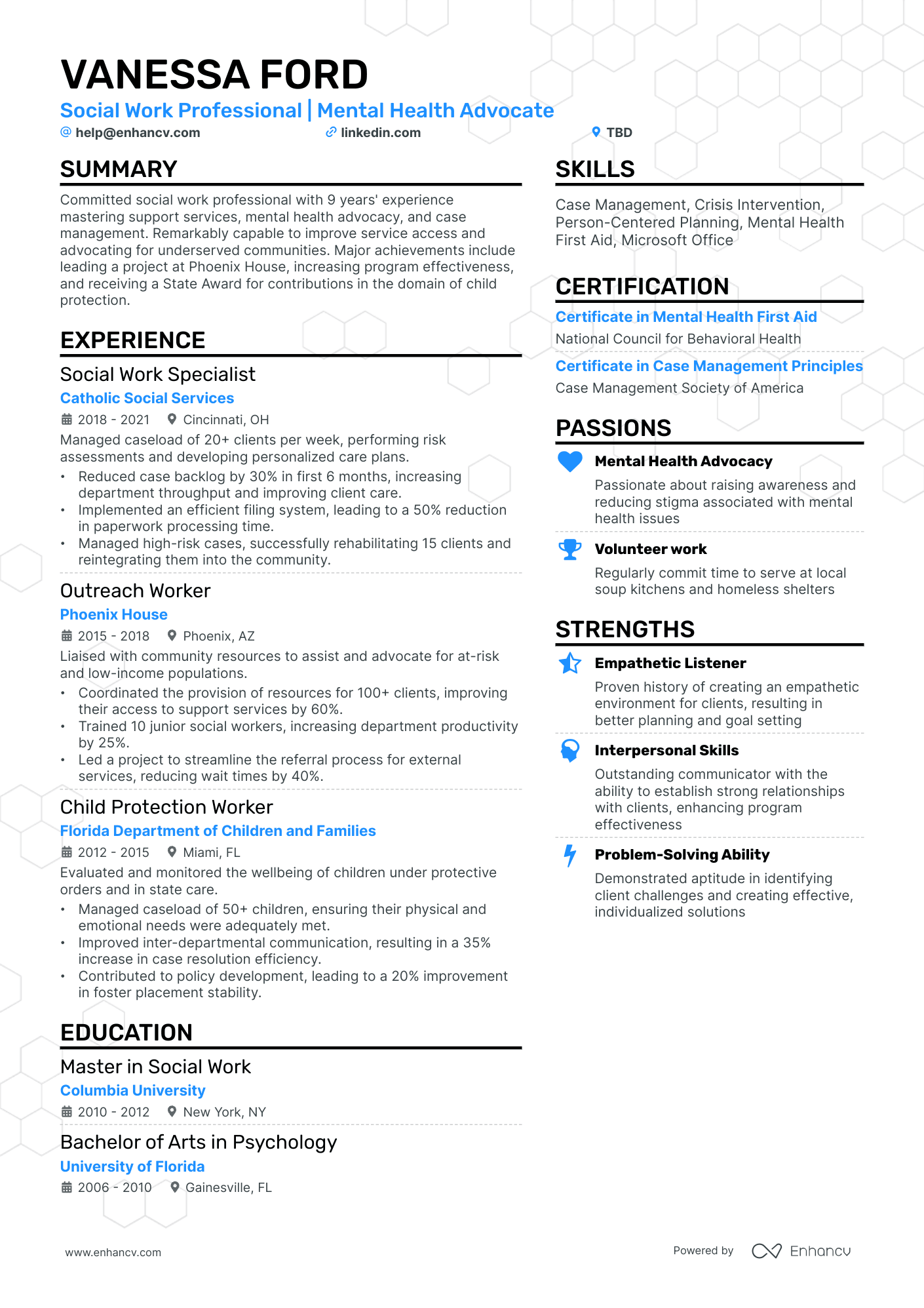
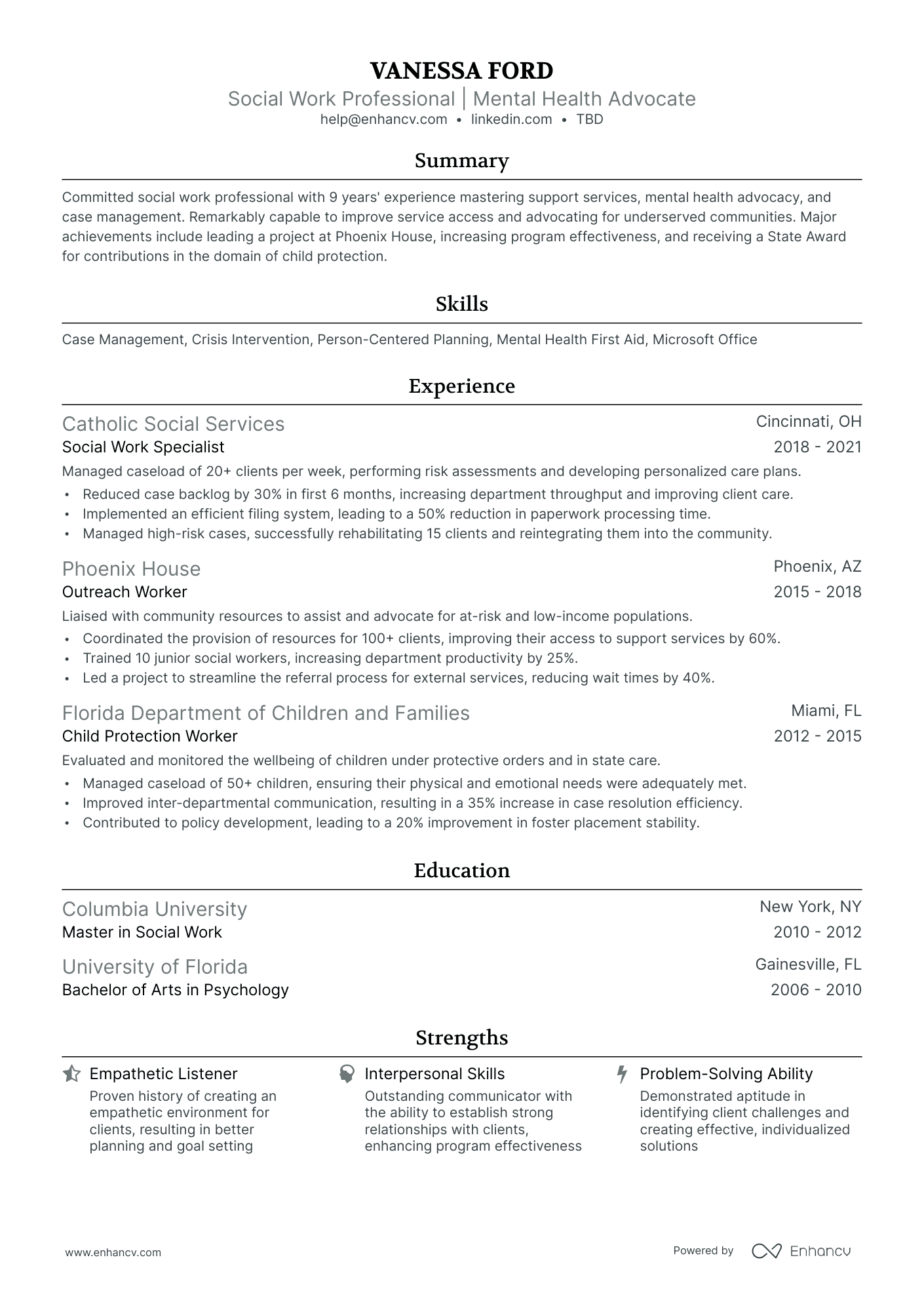
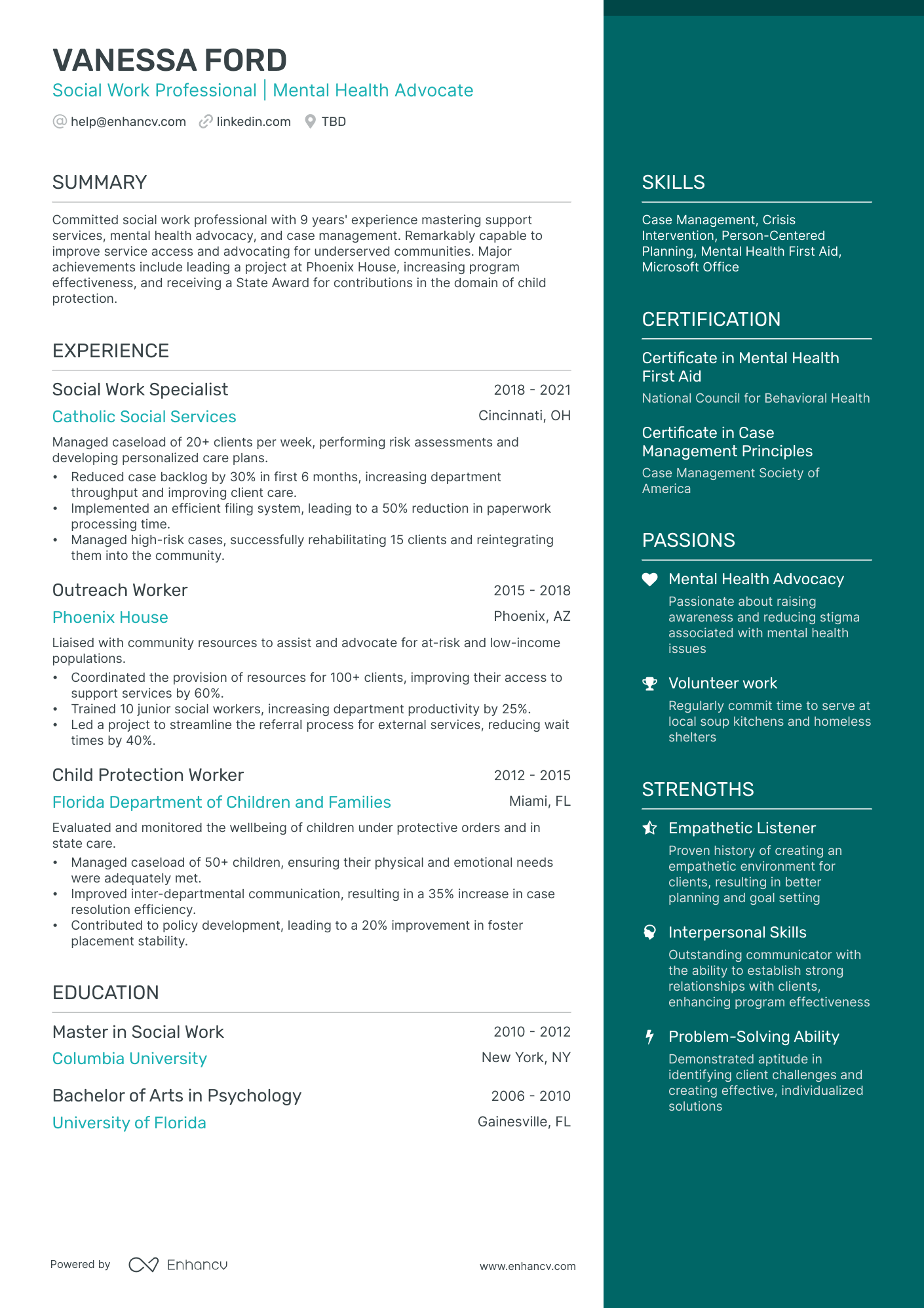
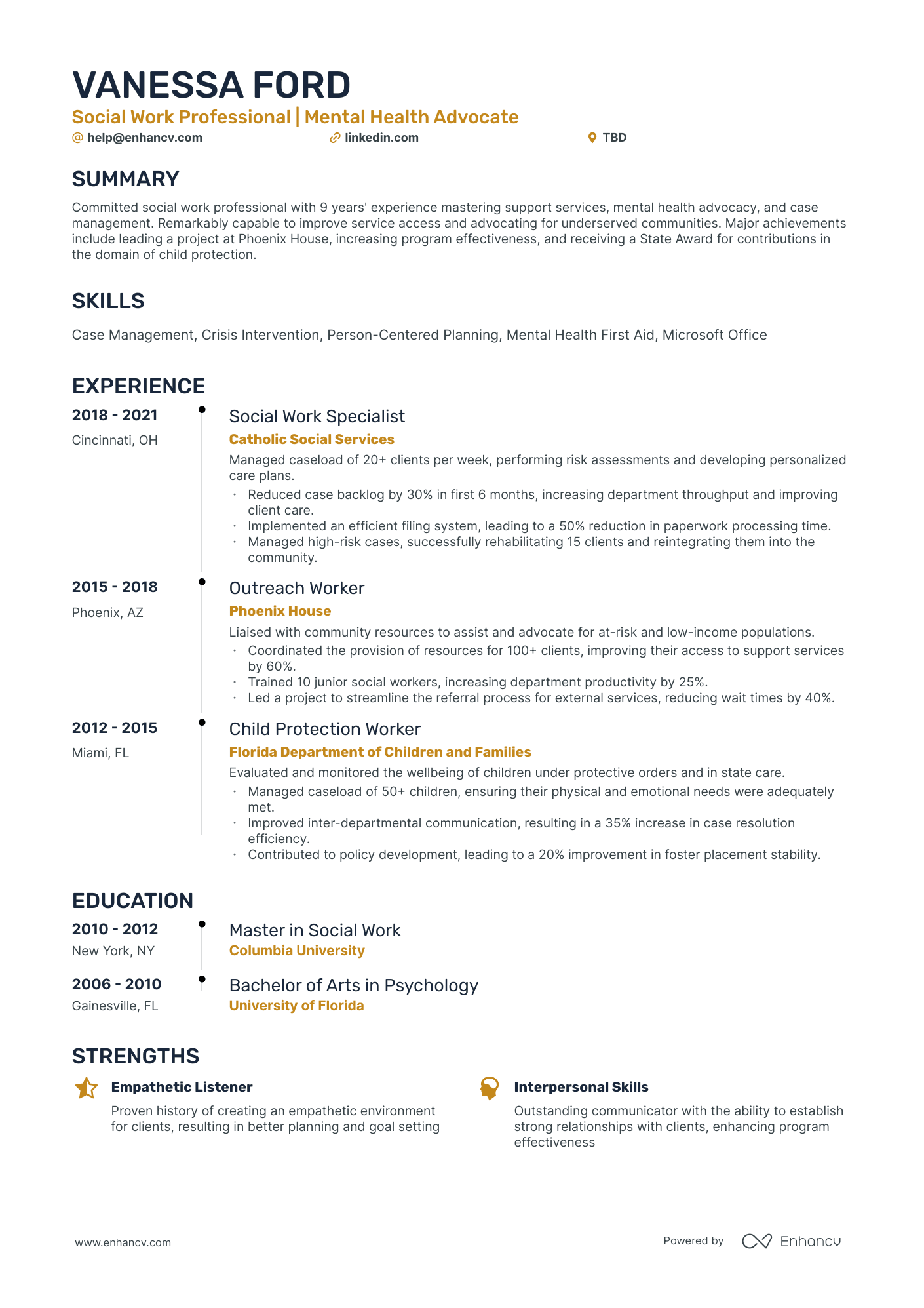
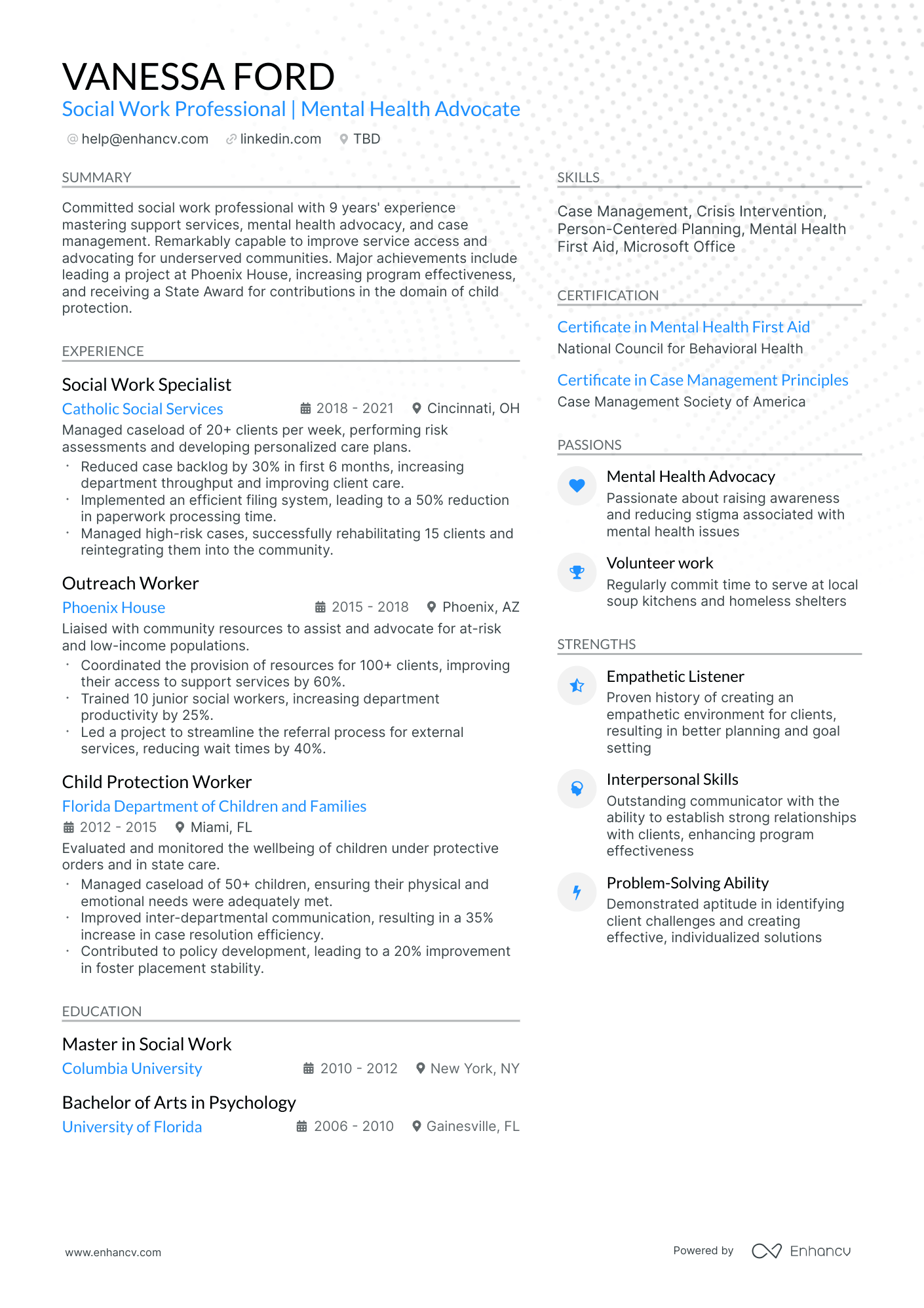
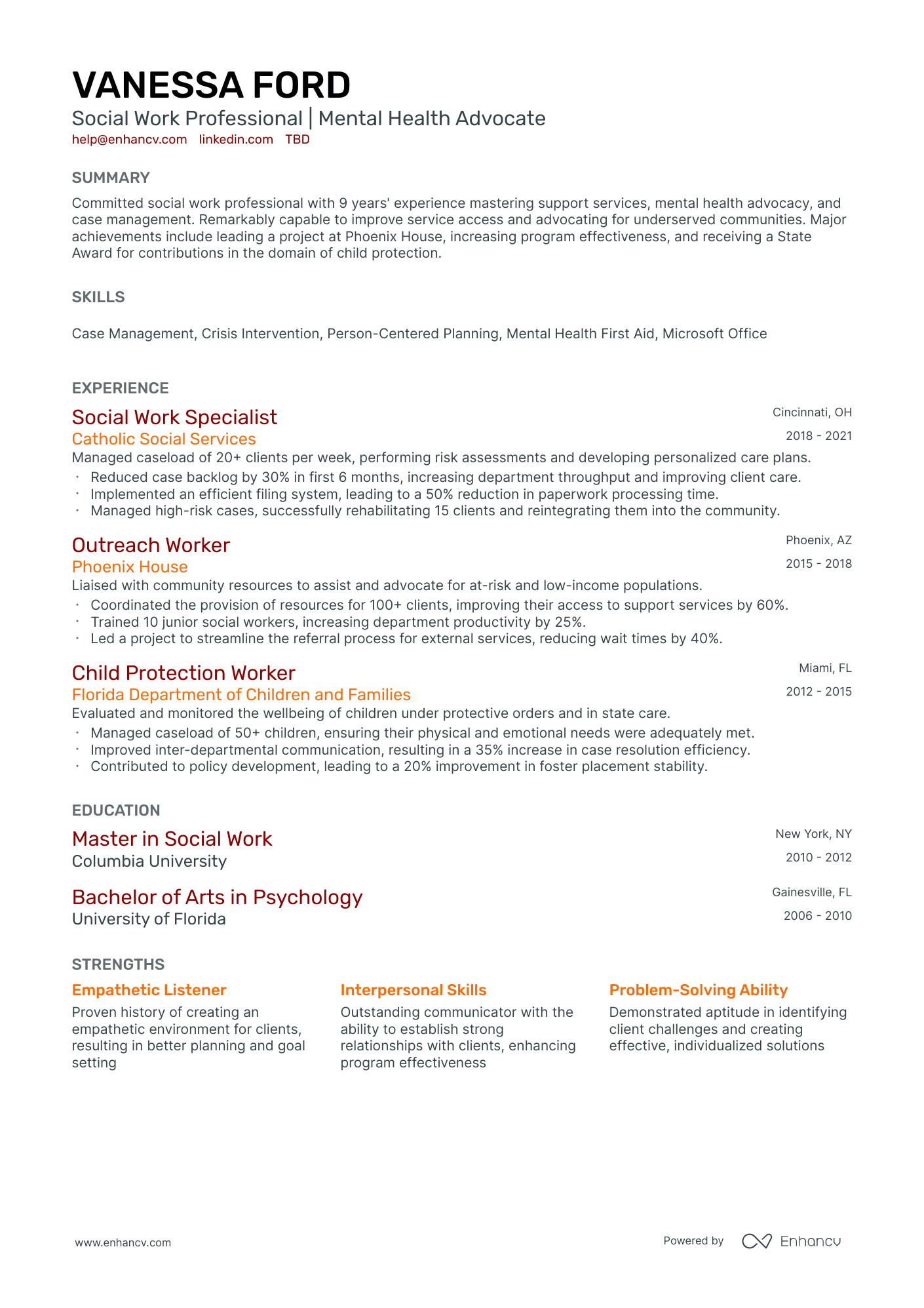
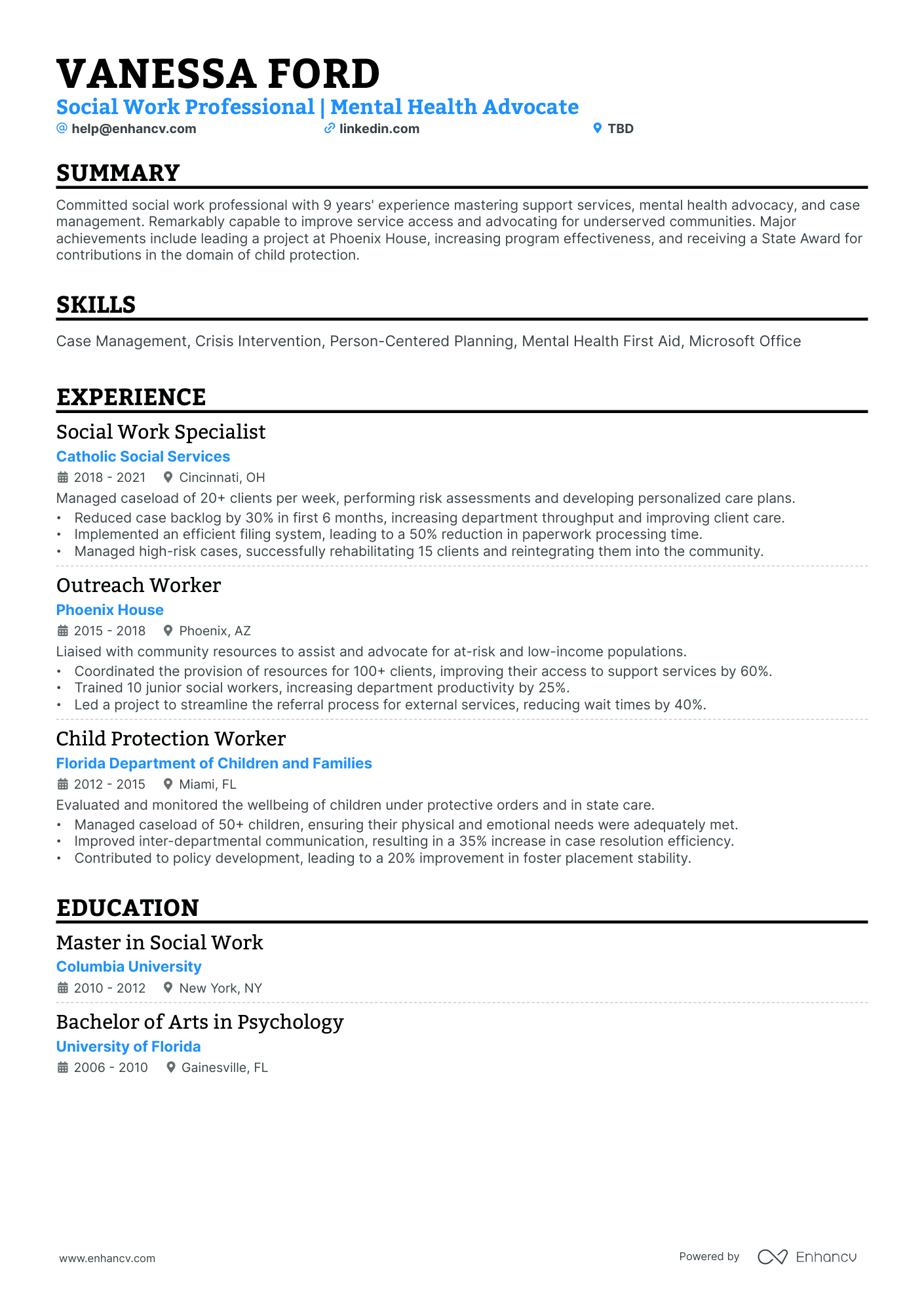
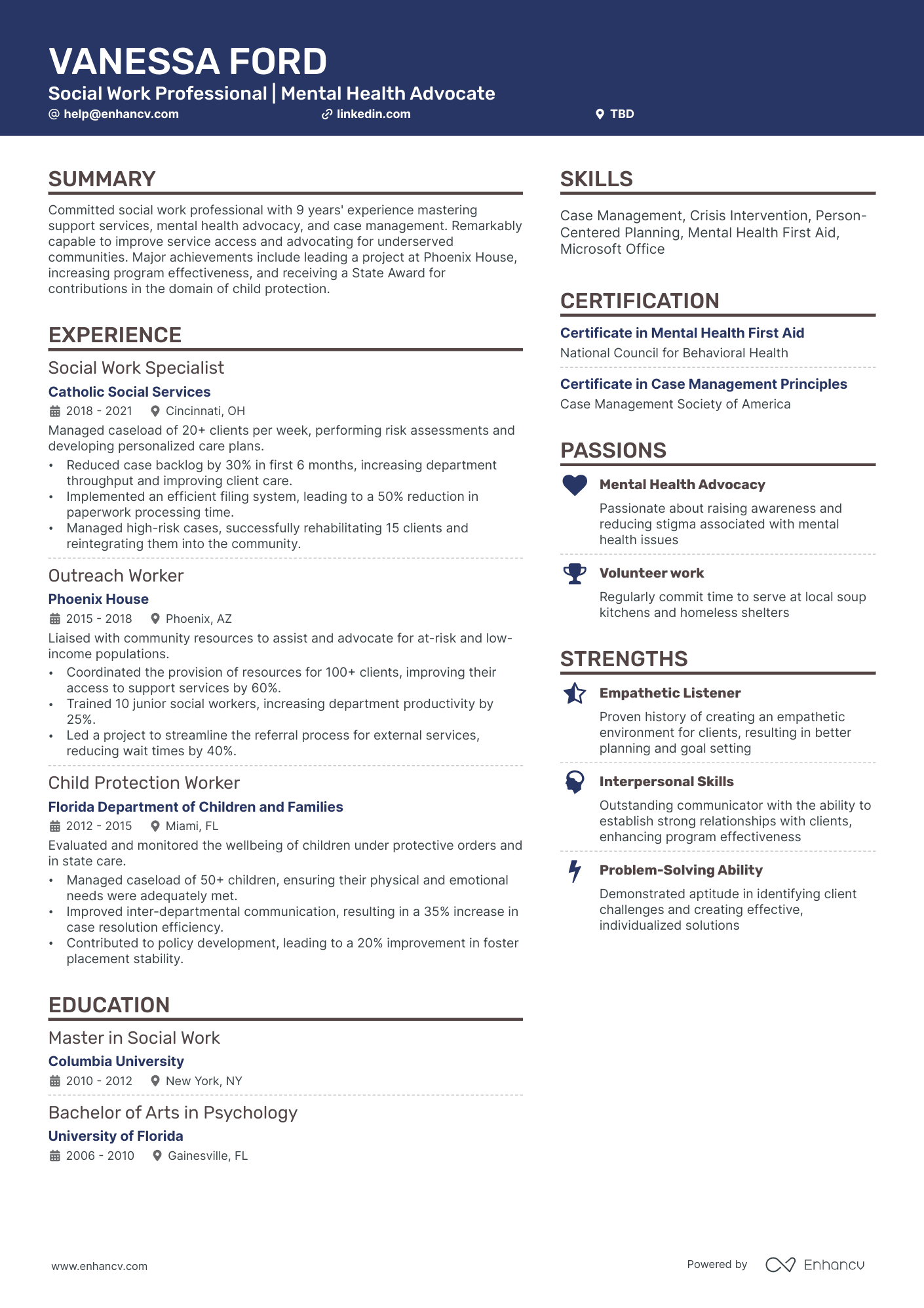
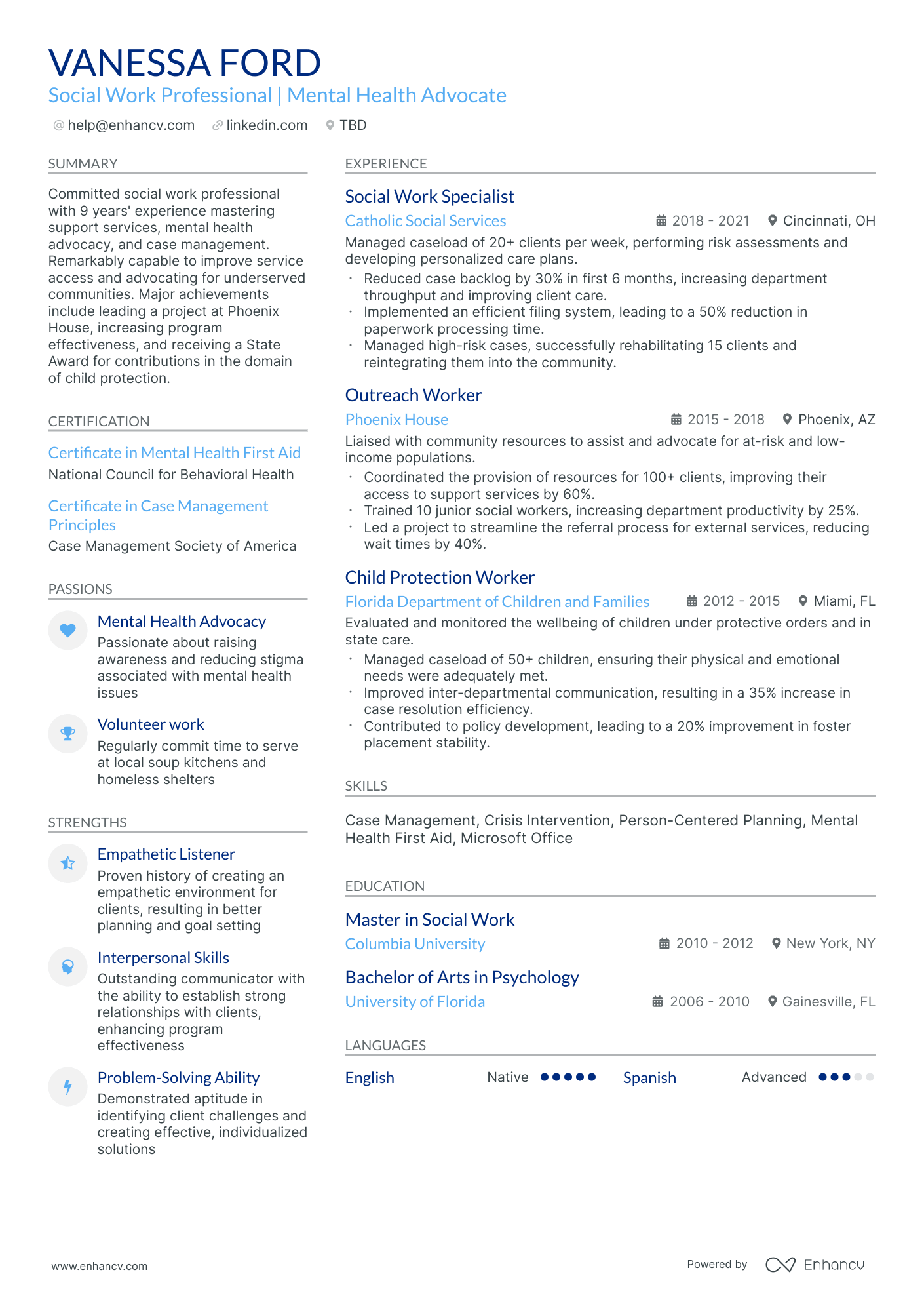
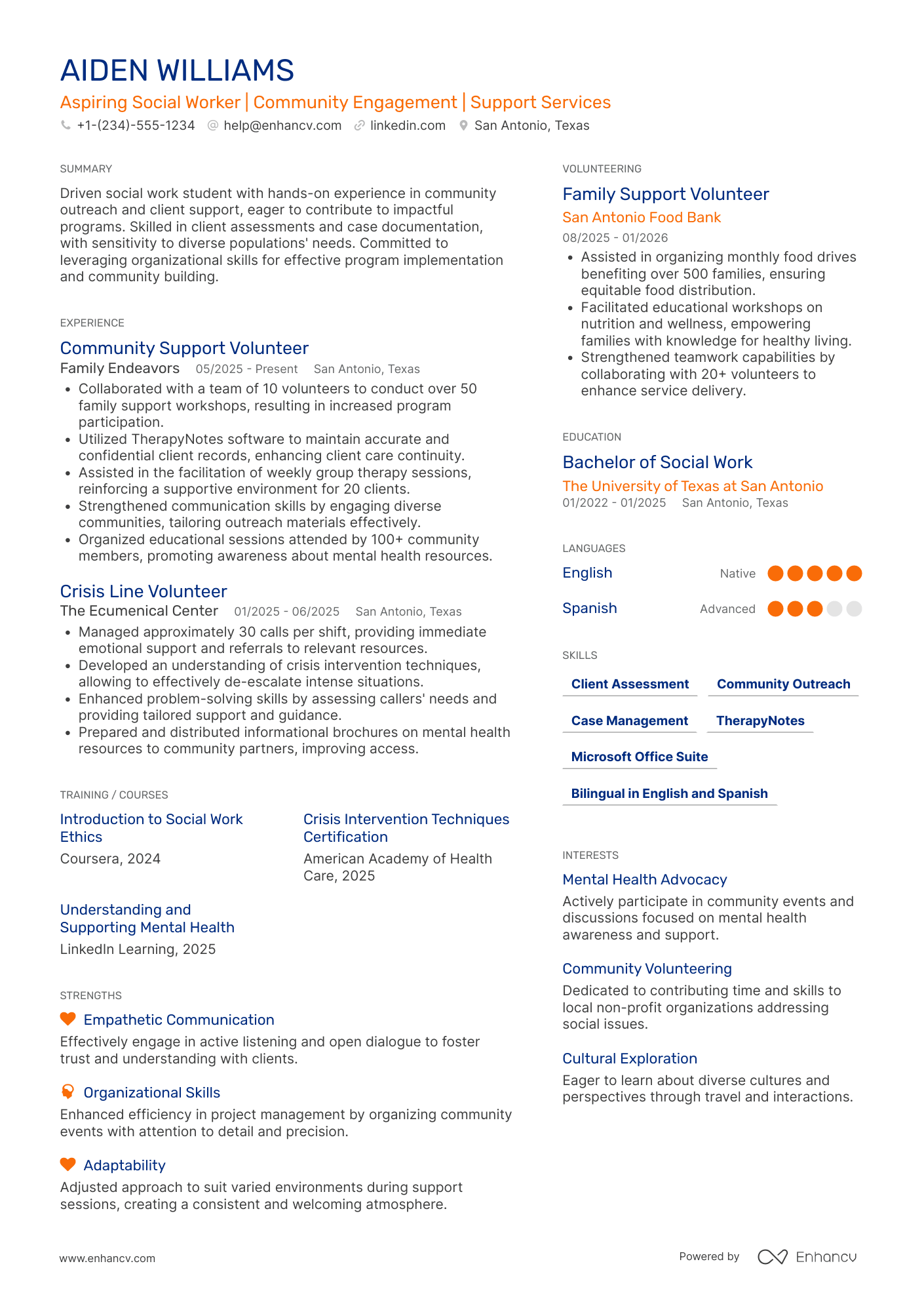
Most social work intern resume drafts fail because they read like class logs, not evidence of impact. That hurts in ATS screening and quick recruiter scans, where high-volume competition rewards clear outcomes.
A strong resume shows what changed because of your work. Knowing how to make your resume stand out starts with quantifying cases supported, intake accuracy, referral turnaround time, documentation compliance, client satisfaction, crisis de-escalations, and follow-up completion rates. Highlight collaboration that improved care continuity and reduced missed appointments.

Key takeaways
- Quantify caseload volume, turnaround time, and client outcomes instead of listing daily duties.
- Use a reverse-chronological format when you have practicum or fieldwork experience.
- Choose a hybrid format to lead with skills when formal social work experience is limited.
- Tailor every experience bullet to match the job posting's exact terminology and priorities.
- Anchor each skill to a specific placement, project, or measurable result.
- Pair certifications like Mental Health First Aid with education to show applied readiness.
- Use Enhancv's Bullet Point Generator to turn vague duties into measurable, recruiter-ready bullets.
How to format a social work intern resume
Recruiters reviewing social work intern resumes prioritize relevant coursework, fieldwork placements, transferable interpersonal skills, and any direct client-facing experience—even if unpaid or academic. Your resume format determines how quickly a hiring supervisor can spot these signals, so choosing the right structure ensures your strongest qualifications aren't buried. A well-organized resume layout also helps applicant tracking systems parse your information accurately.

I have significant experience in this role—which format should I use?
If you've already completed one or more practicum placements or held related human services positions, use a reverse-chronological format to present a clear timeline of growing responsibility. Do:
- Lead with your most recent field placement or internship, highlighting the population served, setting type, and scope of your caseload.
- Feature role-specific skills such as biopsychosocial assessments, crisis intervention, case documentation in systems like AWARDS or Apricot, and knowledge of DSM-5 criteria.
- Quantify outcomes wherever possible—client retention, referral completions, group session attendance, or documentation accuracy rates.
I'm junior or switching into this role—what format works best?
A hybrid format works best because it lets you lead with a targeted skills section while still showing employers a chronological account of your academic and volunteer experience. Do:
- Place a skills section near the top of your resume featuring competencies like active listening, motivational interviewing, cultural humility, and trauma-informed care.
- Include academic projects, volunteer work, or community involvement that demonstrates direct engagement with vulnerable populations—even if the experience wasn't a formal internship.
- Connect every listed experience to a concrete action and a visible result so supervisors can assess your readiness for fieldwork.
When does a functional resume make sense?
A functional format is generally not the strongest choice for a social work intern position because it separates your skills from the settings where you applied them, making it harder for supervisors to evaluate your readiness for supervised practice. However, it can work in a narrow set of circumstances:
- You're transitioning from an unrelated field (such as teaching, ministry, or customer service) and need to reframe transferable skills like advocacy, de-escalation, and resource coordination.
- You have a gap in your academic or work timeline due to caregiving, health, or other personal circumstances and want to foreground relevant competencies.
- Your experience is almost entirely volunteer-based or informal, and a chronological layout would appear thin.
- A functional format is acceptable when you're entering social work from an unrelated career or have limited formal work history, but each skill listed should still reference a specific project, volunteer role, or academic experience along with a tangible outcome.
Once your format establishes a clean, readable structure, the next step is filling it with the right sections to highlight your qualifications effectively.
What sections should go on a social work intern resume
Recruiters expect to see clear, relevant training, client-facing exposure, and supervised practice that matches the internship setting. Understanding which resume sections to include ensures you present a complete picture of your qualifications.
Use this structure for maximum clarity:
- Header
- Summary
- Experience
- Skills
- Projects
- Education
- Certifications
- Optional sections: Volunteering, Research, Languages
Strong experience bullets should emphasize client outcomes, caseload scope, measurable impact, and your specific contributions under supervision.
Is your resume good enough?
Drop your resume here or choose a file. PDF & DOCX only. Max 2MB file size.
Now that you’ve identified the key components to include, the next step is learning how to write your social work intern resume experience so those details translate into clear, role-relevant impact.
How to write your social work intern resume experience
Your experience section should highlight the direct services you delivered, the clinical or community-based methods you applied, and the measurable outcomes your work produced for clients, families, or programs. Hiring managers prioritize demonstrated impact—such as improved client outcomes, expanded access to resources, or strengthened program effectiveness—over descriptive task lists that simply catalog daily duties. Building a targeted resume that aligns each bullet with the role's priorities will strengthen your candidacy significantly.
Each entry should include:
- Job title
- Company and location (or remote)
- Dates of employment (month and year)
Three to five concise bullet points showing what you owned, how you executed, and what outcomes you delivered:
- Ownership scope: the caseloads, client populations, intake processes, community programs, or outreach initiatives you were directly accountable for as a social work intern.
- Execution approach: the assessment frameworks, evidence-based interventions, case management platforms, crisis de-escalation techniques, or documentation systems you used to guide your practice and inform service delivery.
- Value improved: the changes you drove in client well-being, service accessibility, treatment adherence, program participation, resource coordination efficiency, or risk reduction across your assigned cases or projects.
- Collaboration context: how you partnered with licensed social workers, multidisciplinary care teams, community organizations, government agencies, or families to coordinate holistic support for the populations you served.
- Impact delivered: the tangible results your contributions produced—expressed through client progress, program reach, referral effectiveness, or strengthened organizational capacity—rather than a summary of tasks you performed.
Experience bullet formula
A social work intern experience example
✅ Right example - modern, quantified, specific.
Social Work Intern
Harbor Youth & Family Services | Columbus, OH
2024–2025
Community mental health nonprofit serving youth and families through school-based and outpatient programs.
- Conducted twenty-five psychosocial intakes and risk screenings using DSM-5-TR-aligned templates in an electronic health record (EHR), cutting average documentation turnaround from seventy-two to forty-eight hours.
- Coordinated care for a caseload of fifteen clients by building SMART goals and updating treatment plans in the EHR, improving on-time plan reviews from sixty-eight percent to ninety-two percent.
- Facilitated eight psychoeducation groups using cognitive behavioral therapy (CBT) and motivational interviewing (MI) techniques, increasing average attendance from seven to ten participants per session.
- Streamlined community referrals by standardizing releases of information (ROI) and tracking follow-ups in Microsoft Excel, reducing missed referral handoffs by thirty percent across the team.
- Partnered with clinicians, school counselors, and probation liaisons to deliver safety planning and crisis de-escalation for six high-risk cases, achieving zero emergency department transfers during the internship period.
Now that you've seen how a strong experience section comes together, let's look at how to adjust yours to match the specific role you're applying for.
How to tailor your social work intern resume experience
Recruiters evaluate your social work intern resume through both human review and applicant tracking systems. Tailoring your resume to the job description increases your chances of passing both screenings.
Ways to tailor your social work intern experience:
- Match specific assessment tools or screening instruments named in the posting.
- Mirror the exact terminology used for case management processes.
- Reflect client population demographics or service areas the role prioritizes.
- Highlight experience with electronic health record systems the agency uses.
- Emphasize trauma-informed care or evidence-based intervention frameworks referenced.
- Include mandated reporting or compliance standards the posting specifies.
- Align interdisciplinary collaboration language with the team structure described.
- Reference community outreach or resource coordination methods the role requires.
Tailoring means aligning your real accomplishments with each job's stated requirements, not forcing keywords where they don't genuinely belong.
Resume tailoring examples for social work intern
| Job description excerpt | Untailored | Tailored |
|---|---|---|
| Conduct biopsychosocial assessments for clients in a community mental health setting using a trauma-informed care framework | Assisted with client assessments and helped gather information for case files. | Completed biopsychosocial assessments for 15+ clients weekly in a community mental health clinic, applying a trauma-informed care framework to identify behavioral health needs and inform treatment planning. |
| Collaborate with interdisciplinary teams to develop individualized service plans and connect families to housing, food assistance, and Medicaid resources | Worked with other staff members to help clients access services they needed. | Partnered with interdisciplinary teams—including psychiatrists, case managers, and school counselors—to develop individualized service plans and connect 30+ families to housing vouchers, SNAP benefits, and Medicaid enrollment. |
| Facilitate psychoeducational group sessions for adolescents using cognitive behavioral therapy (CBT) techniques to build coping skills | Led group sessions for young people on various mental health topics. | Co-facilitated weekly psychoeducational group sessions for 8–12 adolescents, using CBT techniques to teach coping strategies that reduced self-reported anxiety scores by 20% over a 10-week cycle. |
Once you’ve aligned your experience with the role’s requirements, quantify your social work intern achievements to show the measurable impact of that work.
How to quantify your social work intern achievements
Quantifying your work proves impact beyond compassion. Using numbers on your resume to track caseload volume, turnaround time, documentation accuracy, client engagement, and risk or compliance outcomes shows safer, faster, and more consistent support.
Quantifying examples for social work intern
| Metric | Example |
|---|---|
| Caseload volume | "Supported a caseload of 18 clients weekly, completing check-ins and case notes for 95% of assigned contacts." |
| Turnaround time | "Reduced intake-to-first-contact time from five days to two days by using a shared tracker and daily outreach blocks." |
| Documentation accuracy | "Improved case note completeness to 98% in the electronic health record (EHR) by using a checklist aligned to supervisor standards." |
| Client engagement | "Increased group session attendance from 10 to 16 participants per week by coordinating reminders and adjusting schedules with staff." |
| Compliance risk | "Flagged seven high-risk cases for supervisor review within twenty-four hours, supporting timely safety planning and mandated reporting." |
Turn vague job duties into measurable, recruiter-ready resume bullets in seconds with Enhancv's Bullet Point Generator.
With strong bullet points in place, the next step is ensuring your skills section presents the right mix of hard and soft skills that social work hiring managers look for.
How to list your hard and soft skills on a social work intern resume
Your skills section shows you can support clients, document accurately, and follow ethical standards; recruiters and an ATS (applicant tracking system) scan this section for job-match keywords, then confirm them in experience bullets, so aim for a balanced mix of hard skills and soft skills. social work intern roles require a blend of:
- Product strategy and discovery skills
- Data, analytics, and experimentation skills
- Delivery, execution, and go-to-market discipline
- Soft skills
Your skills section should be:
- Scannable (bullet-style grouping).
- Relevant to the job post.
- Backed by proof in experience bullets.
- Updated with current tools.
Place your skills section:
- Above experience if you're junior or switching careers.
- Below experience if you're mid/senior with strong achievements.

Hard skills
- Psychosocial assessments
- Intake screening and triage
- Crisis intervention protocols
- Safety planning documentation
- Case notes, SOAP format
- Treatment planning support
- Motivational interviewing
- Trauma-informed care
- Child welfare reporting
- Community resource navigation
- Electronic health records, Epic
- HIPAA compliance
Soft skills
- Build rapport with clients
- Ask structured, nonleading questions
- De-escalate tense interactions
- Communicate boundaries clearly
- Coordinate with multidisciplinary teams
- Present concise case updates
- Manage competing priorities
- Follow supervision and feedback
- Document objectively under time pressure
- Advocate for client needs
- Maintain confidentiality in practice
- Reflect on bias and impact
How to show your social work intern skills in context
Skills shouldn't live only in a bulleted list on your resume.
They should be demonstrated in:
- Your summary (high-level professional identity)
- Your experience (proof through outcomes)
Here's what that looks like in practice. You can explore common resume skills by role to see how other candidates present their competencies effectively.
Summary example
MSW intern with three years of clinical fieldwork in community mental health. Skilled in trauma-informed care, motivational interviewing, and EHR documentation. Facilitated group therapy sessions that improved client retention by 28% across two program cycles.
- Reflects senior-level clinical experience
- Names specific tools and methods
- Includes a measurable client outcome
- Highlights empathy-driven soft skills
Experience example
Social Work Intern
Harbor Light Community Services | Portland, OR
August 2022–May 2024
- Conducted 120+ biopsychosocial assessments using trauma-informed frameworks, reducing average intake processing time by 18%.
- Collaborated with a multidisciplinary team of five clinicians to develop individualized treatment plans tracked through Apricot case management software.
- Facilitated weekly psychoeducation groups for 15 at-risk adolescents, achieving a 92% participant attendance rate over two semesters.
- Every bullet contains measurable proof
- Skills appear naturally within achievements
Once you’ve demonstrated your abilities through specific coursework, volunteer work, and field placements, the next step is to translate that evidence into a social work intern resume when you don’t have formal experience.
How do I write a social work intern resume with no experience
Even without full-time experience, you can demonstrate readiness through:
- Field placement observation hours
- Capstone case management project
- Crisis hotline volunteer shifts
- Campus peer support program
- Community needs assessment report
- Advocacy event planning role
- Research assistant data collection
- Shadowing licensed social workers
Our guide on writing a resume without work experience offers additional strategies for showcasing your qualifications when formal roles are limited.
Focus on:
- Client-facing hours and outcomes
- Documentation and case note accuracy
- Assessment methods and screening tools
- Confidentiality training and compliance
Resume format tip for entry-level social work intern
Use a hybrid resume format because it highlights relevant projects and training while still showing consistent education and service history. Do:
- Add a "Relevant Experience" section for volunteer and projects.
- Write bullets with action, tool, and outcome.
- List documentation tools like SOAP notes.
- Include training in HIPAA and ethics.
- Tailor keywords to each posting.
- Conducted a community needs assessment using surveys and focus groups, analyzed results in Excel, and presented three service gaps that informed two new referral partnerships.
Once you've structured your resume around transferable strengths rather than direct experience, the next step is presenting your education—often your strongest qualifying asset as an intern.
How to list your education on a social work intern resume
Your education section helps hiring teams confirm you have the foundational knowledge a social work intern needs. It validates your academic training in human behavior, ethics, and community practice.
Include:
- Degree name
- Institution
- Location
- Graduation year
- Relevant coursework (for juniors or entry-level candidates)
- Honors & GPA (if 3.5 or higher)
Skip month and day details—list the graduation year only.
Here's a strong education entry tailored for a social work intern resume.
Example education entry
Bachelor of Social Work
University of Michigan, Ann Arbor, MI
Graduated 2024
GPA: 3.7/4.0
- Relevant Coursework: Human Behavior in the Social Environment, Crisis Intervention, Case Management, Social Welfare Policy, Community Organizing
- Honors: Dean's List (six consecutive semesters), National Association of Social Workers Student Merit Award
How to list your certifications on a social work intern resume
Listing certifications on your resume shows a social work intern's commitment to learning, proficiency with key tools, and alignment with current practice standards in the field.
Include:
- Certificate name
- Issuing organization
- Year
- Optional: credential ID or URL
- Put certifications below education when you earned them earlier, they're less relevant to your target role, or your education is your strongest qualifier.
- Put certifications above education when you earned them recently, they match the role closely, or they add required skills your education does not highlight.
Best certifications for your social work intern resume
- Mental Health First Aid
- Applied Suicide Intervention Skills Training (ASIST)
- Crisis Prevention Institute (CPI) Nonviolent Crisis Intervention
- Trauma-Focused Cognitive Behavioral Therapy (TF-CBT) Online Training
- Child Abuse Mandated Reporter Training
- QPR Gatekeeper Training for Suicide Prevention
- Motivational Interviewing Training Certificate
Once you’ve added your credentials in a clear, easy-to-scan format, use your social work intern resume summary to highlight them in context and set up the rest of your application.
How to write your social work intern resume summary
Your resume summary is the first thing a recruiter reads, so it must immediately signal your relevance. For a social work intern position, it frames your education, skills, and early experience in a compelling snapshot.
Keep it to three to four lines, with:
- Your title and relevant months or years of experience in social work settings.
- The domain or population you've worked with, such as youth services or mental health.
- Core skills like case documentation, crisis intervention, or client intake procedures.
- One or two quantified contributions, such as clients served or programs supported.
- Soft skills tied to real outcomes, like empathetic communication that improved client retention.

PRO TIP
At the intern level, emphasize transferable coursework, fieldwork hours, and specific skills you've applied in real settings. Highlight early contributions with numbers whenever possible. Avoid vague phrases like "passionate about helping others" or "seeking to grow." Recruiters want evidence, not enthusiasm statements.
Example summary for a social work intern
BSW student with 400+ fieldwork hours in community mental health, skilled in client intake, case documentation, and crisis de-escalation. Supported caseloads of 25+ clients and connected families to housing resources.
Optimize your resume summary and objective for ATS
Drop your resume here or choose a file.
PDF & DOCX only. Max 2MB file size.
Now that your summary is ready to capture a recruiter's attention, make sure the header above it presents your contact details clearly so employers can actually reach you.
What to include in a social work intern resume header
Your resume header lists your key contact and identity details, helping a social work intern stand out in recruiter screening through clear visibility and credibility.
Essential resume header elements
- Full name
- Tailored job title and headline
- Location
- Phone number
- Professional email
- GitHub link
- Portfolio link
A LinkedIn link helps recruiters verify experience quickly and supports screening.
Do not include photos on a social work intern resume unless the role is explicitly front-facing or appearance-dependent.
Keep your header to one or two lines, use consistent formatting, and match the job posting's wording for the social work intern title.
Social work intern resume header
Jordan Lee
Social Work Intern | BSW Candidate, Community Outreach Focus
Chicago, IL
(312) 555-01XX
jordan.lee@enhancv.com github.com/jordanlee yourwebsite.com linkedin.com/in/jordanlee
Once your contact details and professional identifiers are in place at the top, you can strengthen your application with additional sections that highlight relevant qualifications and experience.
Additional sections for social work intern resumes
Extra resume sections help you stand out when your core experience looks similar to other social work intern candidates applying for the same position.
Choose sections that reinforce your commitment to service, cultural competence, or specialized training relevant to social work practice. For example, listing language skills on your resume can demonstrate your ability to serve diverse client populations.
- Languages
- Volunteer experience
- Certifications and training
- Professional affiliations
- Publications
- Community involvement
- Conferences and workshops
Once you've strengthened your resume with relevant additional sections, pairing it with a well-crafted cover letter can further set your application apart.
Do social work intern resumes need a cover letter
A cover letter isn't always required for a social work intern, but it often helps. If you're unsure what a cover letter is or when to use one, it matters most in competitive placements or when hiring teams expect one. It can make a difference when your resume needs context or clearer fit.
Use a cover letter to add value in these cases:
- Explain role or team fit by linking your interests to the placement setting, client population, and supervision model.
- Highlight one or two relevant projects or outcomes, including your actions, results, and what you learned that applies to the social work intern role.
- Show you understand the organization's services, users, and constraints, and connect that understanding to how you'll support day-to-day work.
- Address career transitions or non-obvious experience by translating skills into social work intern tasks, such as documentation, outreach, or resource coordination.
Drop your resume here or choose a file.
PDF & DOCX only. Max 2MB file size.
Even if you include a cover letter to add context beyond your resume, you can use AI to improve your social work intern resume by strengthening clarity, relevance, and alignment with the role.
Using AI to improve your social work intern resume
AI can sharpen your resume's clarity, structure, and impact. It helps refine language and highlight relevant strengths. But overuse strips authenticity. Once your content reads clearly and fits the role, step away from AI. If you're wondering which AI is best for writing resumes, the answer depends on your specific needs and how much editing control you want.
Here are 10 practical prompts you can copy and paste to strengthen specific sections of your resume:
- Strengthen your summary: "Rewrite my social work intern resume summary to highlight client-facing experience and relevant coursework in two concise sentences."
- Quantify experience bullets: "Add measurable outcomes to these social work intern experience bullets using caseload numbers, client totals, or program participation rates."
- Align skills with postings: "Compare my social work intern skills section against this job description and suggest missing keywords that match my actual abilities."
- Clarify project descriptions: "Simplify these social work intern project descriptions so each one clearly states the population served, my role, and the outcome."
- Tighten action verbs: "Replace weak or repetitive verbs in my social work intern experience section with specific action verbs tied to direct service delivery."
- Improve education details: "Reformat my social work intern education section to emphasize relevant coursework, field placement hours, and academic honors."
- Refine certification entries: "Rewrite my social work intern certifications section so each entry includes the credential name, issuing body, and date earned."
- Reduce redundancy: "Identify and remove redundant phrases across my social work intern resume without losing important details about my responsibilities."
- Tailor to populations: "Adjust my social work intern experience bullets to better reflect direct work with children, families, or vulnerable populations mentioned here."
- Sharpen bullet structure: "Restructure each social work intern experience bullet to follow a clear action-context-result format in under 20 words."
Stop using AI once your resume sounds accurate, specific, and aligned with real experience. AI should never invent experience or inflate claims—if it didn't happen, it doesn't belong here.
Conclusion
A strong social work intern resume highlights measurable outcomes, role-specific skills, and a clear structure. Use concise bullets, action verbs, and numbers to show impact, reliability, and growth. Keep sections consistent so hiring teams can scan fast and trust what they see.
This approach matches today’s hiring market and stays relevant as expectations evolve. It shows you can document work, collaborate with teams, and support clients with care and accuracy. With a focused resume, you present as a prepared social work intern.