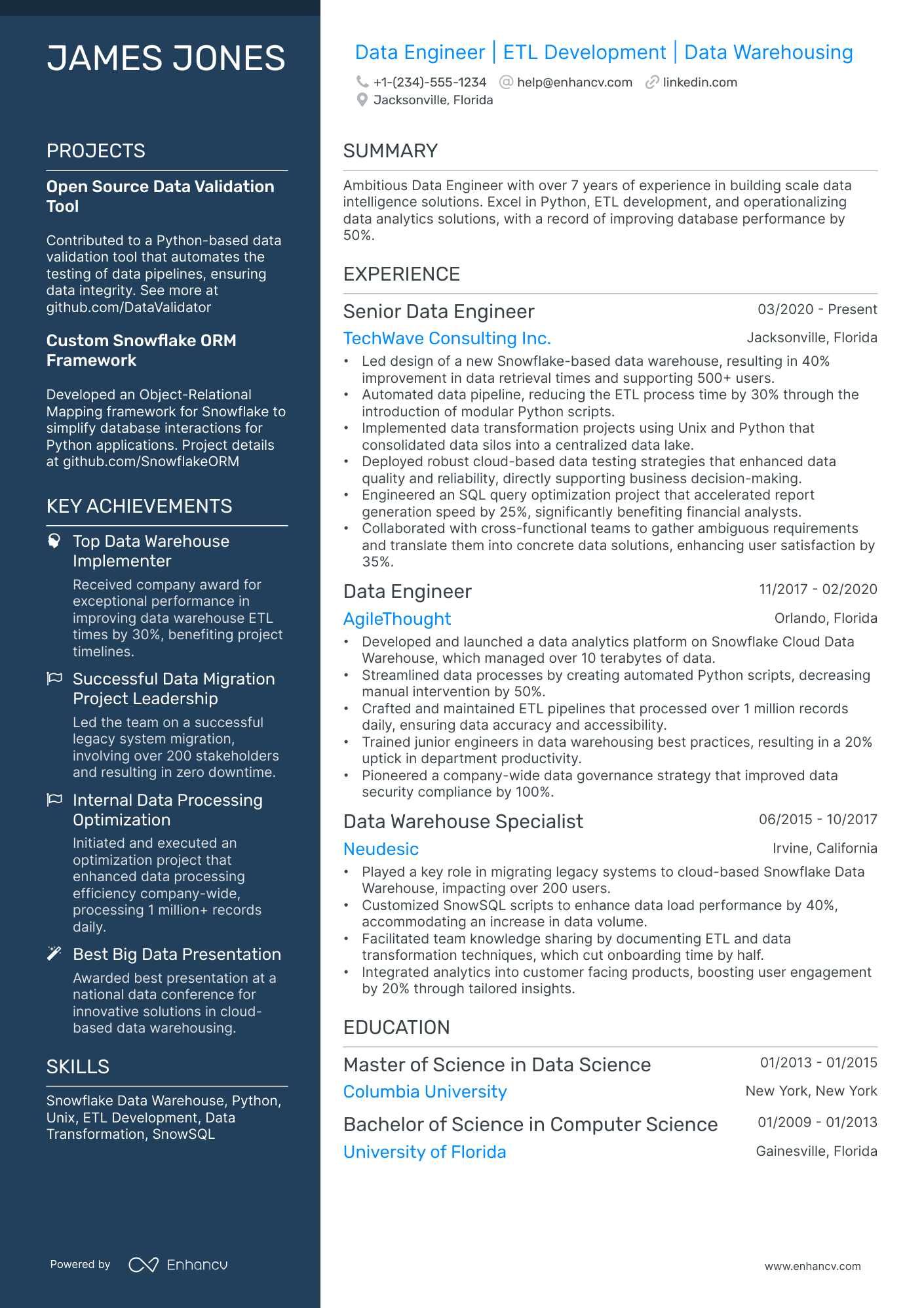
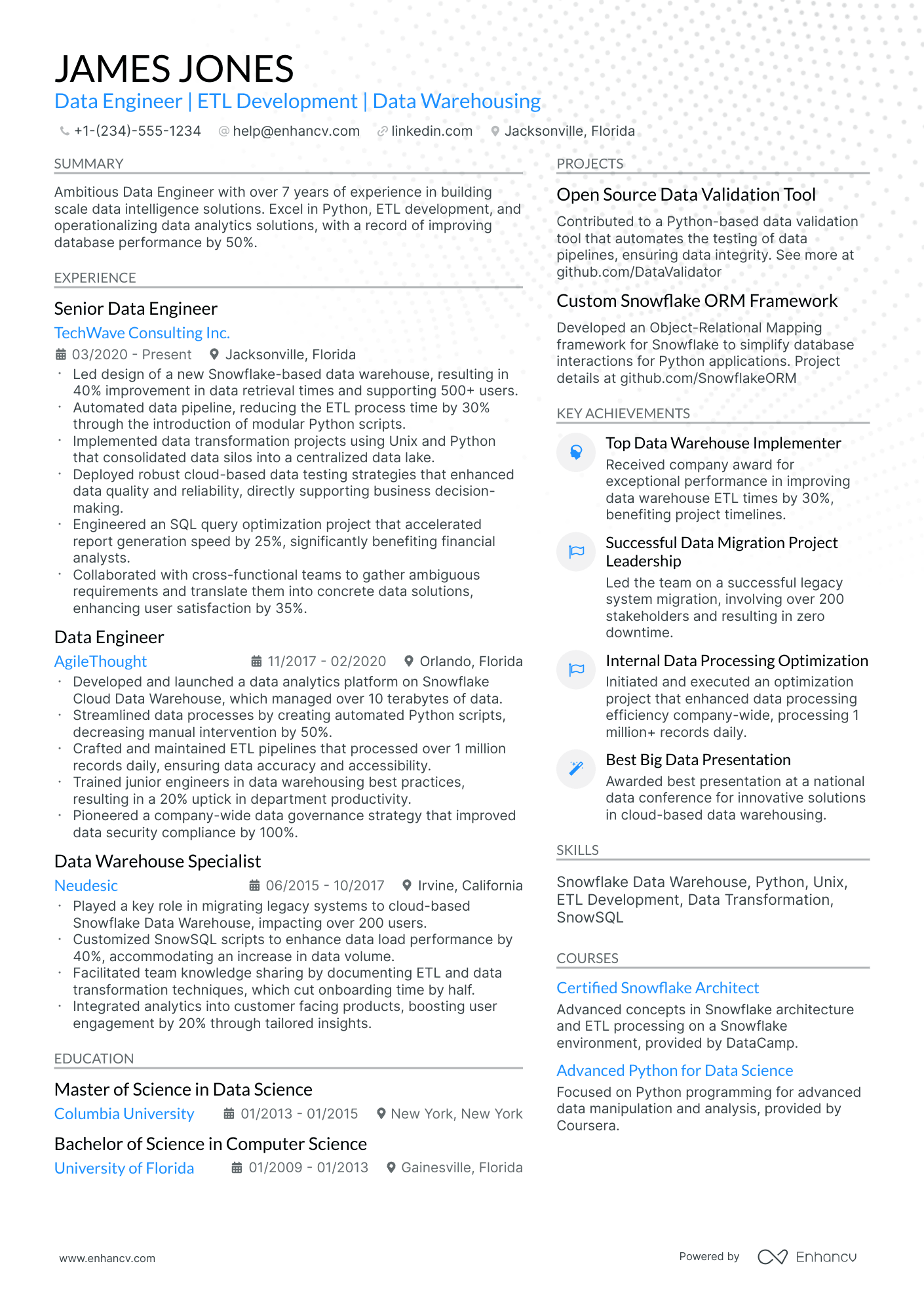
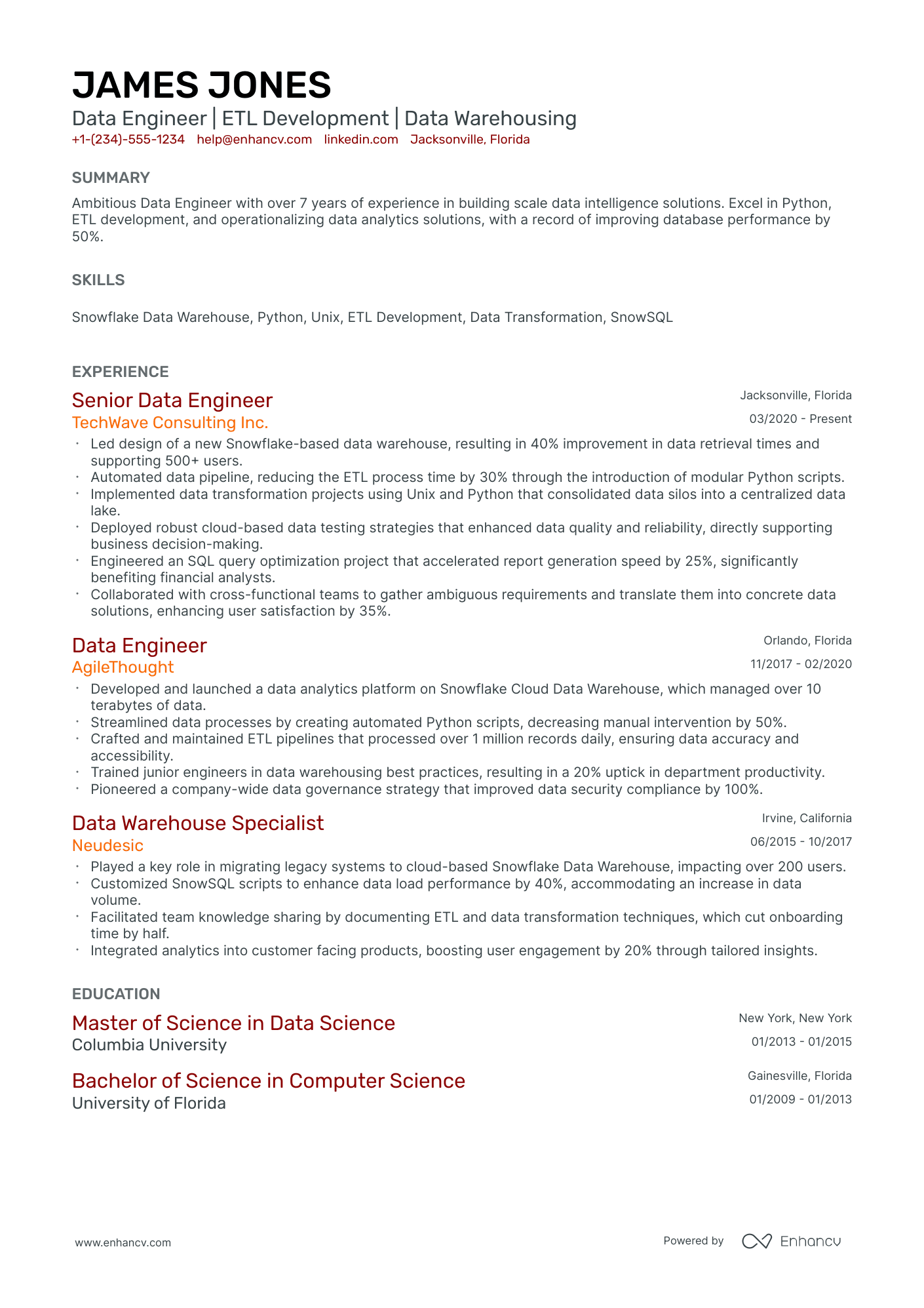
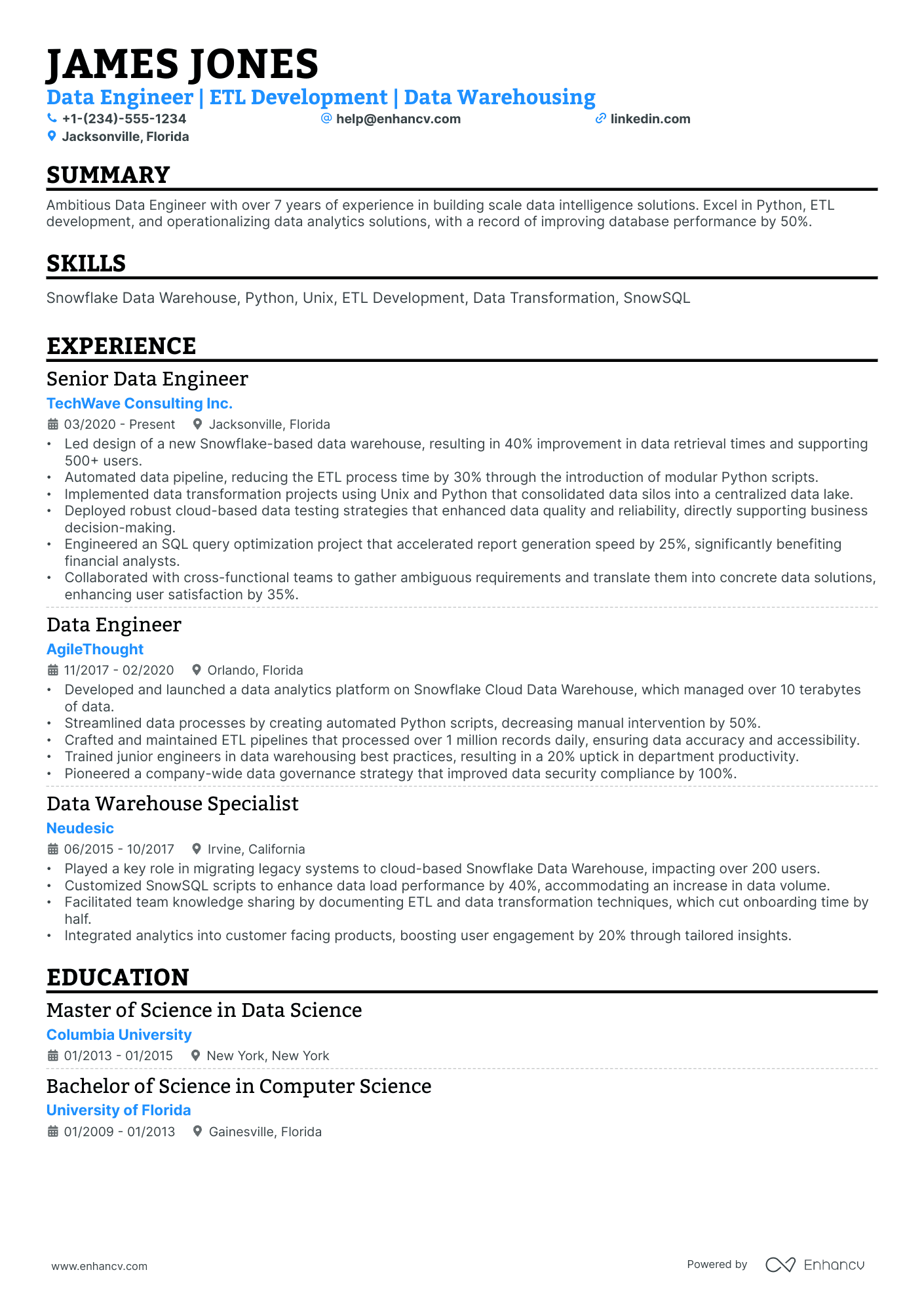
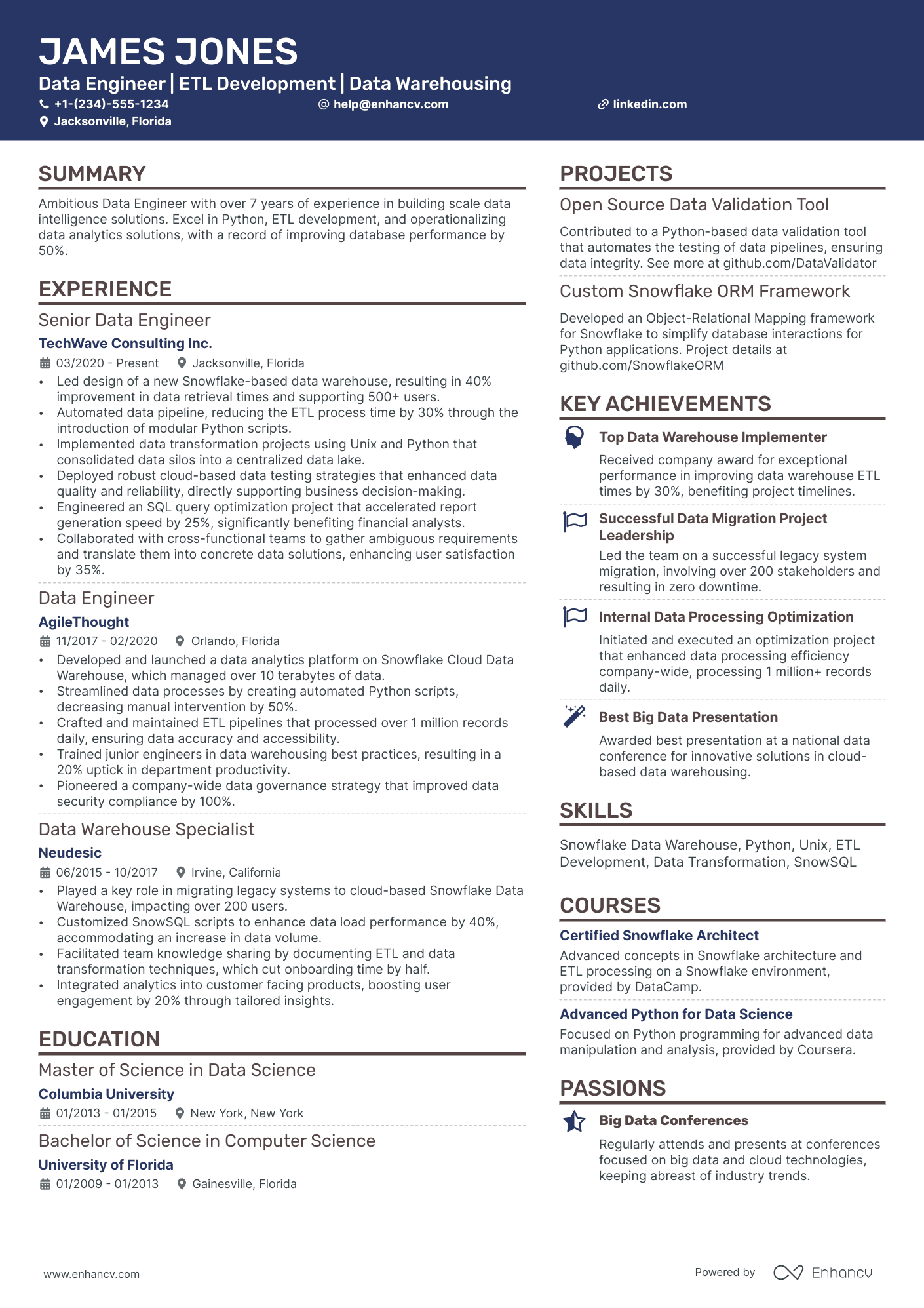
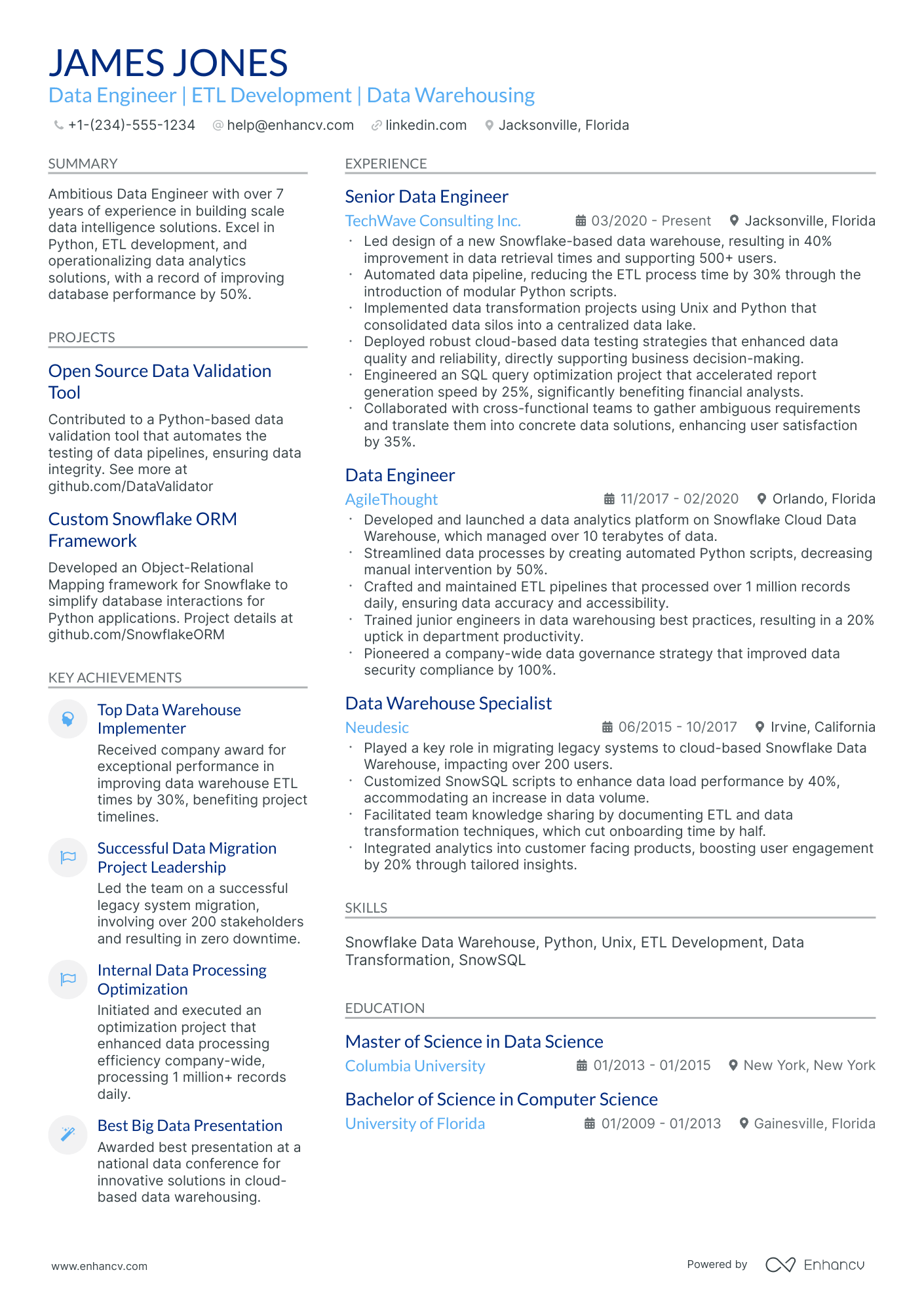
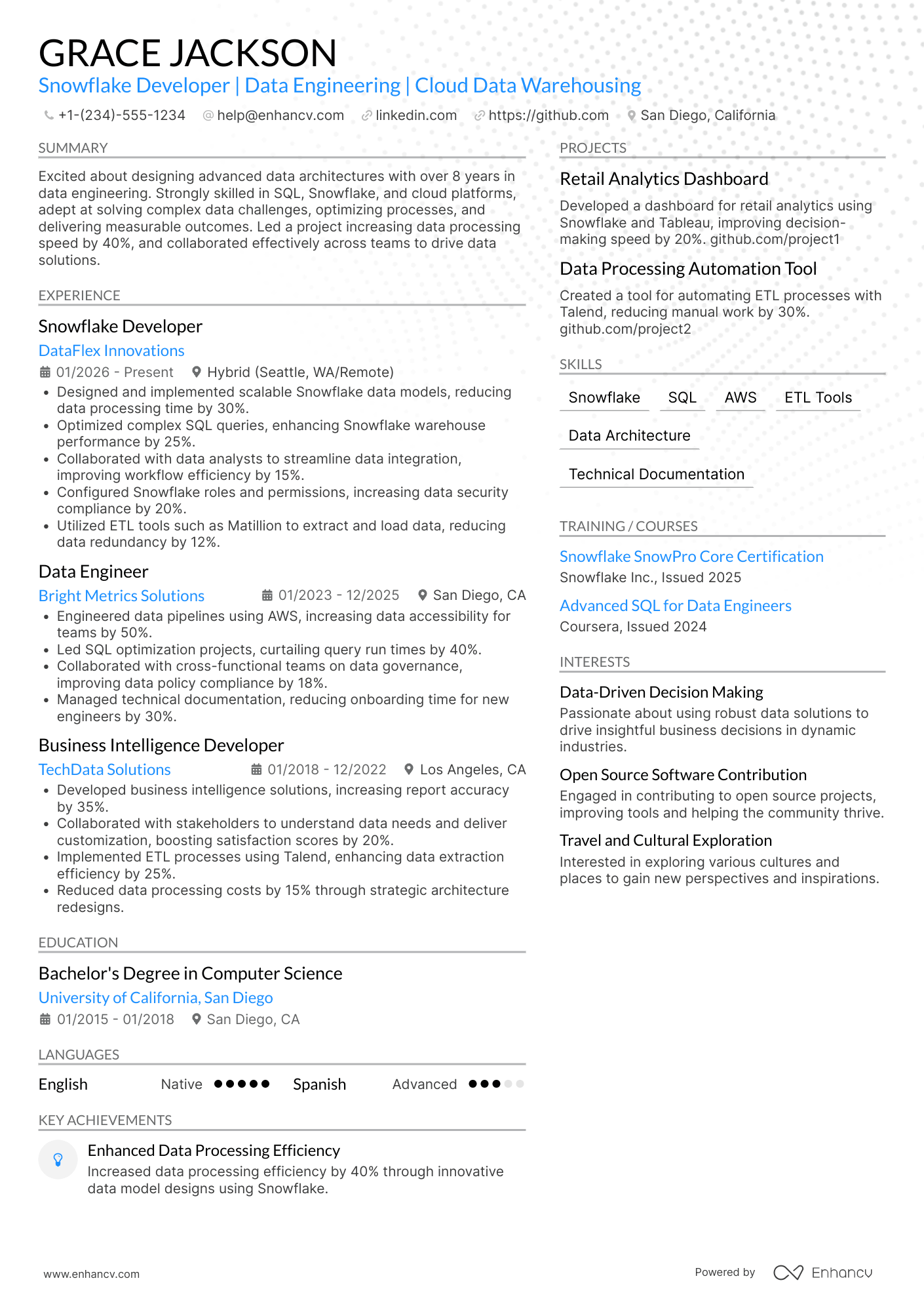
Many Snowflake developer resume drafts fail because they list tools and tasks but don't show measurable data platform outcomes. That hurts when an ATS filters keywords and recruiters scan fast in a crowded market.
A strong resume shows what you delivered and why it mattered. Knowing how to make your resume stand out starts with highlighting faster query performance, lower warehouse spend, reliable pipelines, fewer data quality incidents, on-time releases, and reporting that improved decisions. Include scale, latency, uptime, and stakeholder impact.

Key takeaways
- Quantify Snowflake achievements with metrics like query speed, cost savings, and pipeline reliability.
- Use reverse-chronological format if you have relevant experience, hybrid if you're switching careers.
- Tailor every experience bullet to match the specific job posting's tools and terminology.
- Anchor each listed skill to a concrete project, outcome, or measurable result.
- Place certifications like SnowPro Core near education to validate hands-on platform expertise.
- Write a three-to-four-line summary linking your Snowflake tools to one quantified achievement.
- Use Enhancv to turn vague task descriptions into measurable, recruiter-ready resume bullets.
How to format a Snowflake developer resume
Recruiters hiring for Snowflake developer roles prioritize hands-on experience with Snowflake's cloud data platform, proficiency in SQL and data pipeline development, and evidence of contributing to real-world data engineering or analytics projects. Choosing the right resume format ensures these technical signals surface quickly during both ATS parsing and recruiter screening.

I have significant experience in this role—which format should I use?
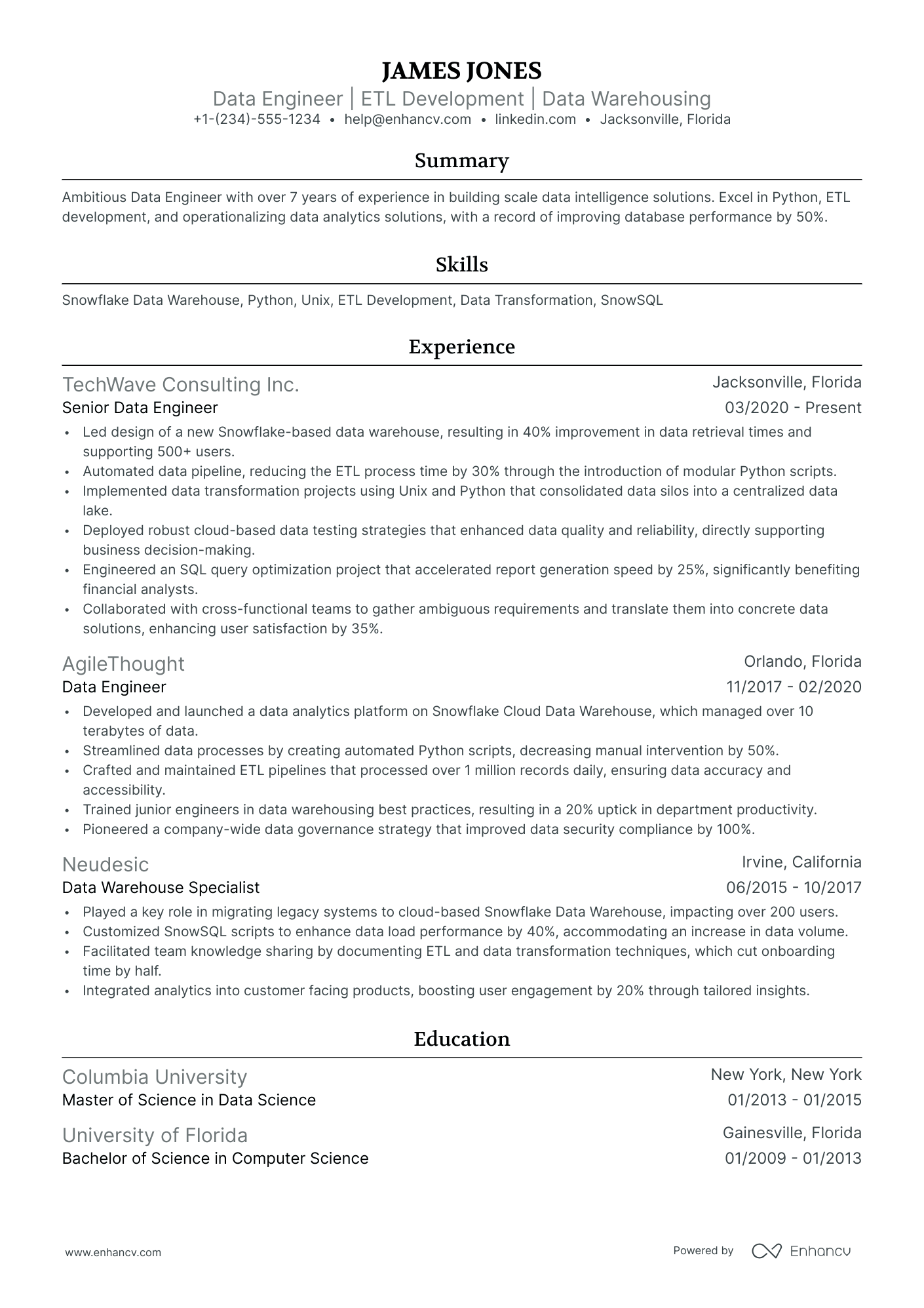
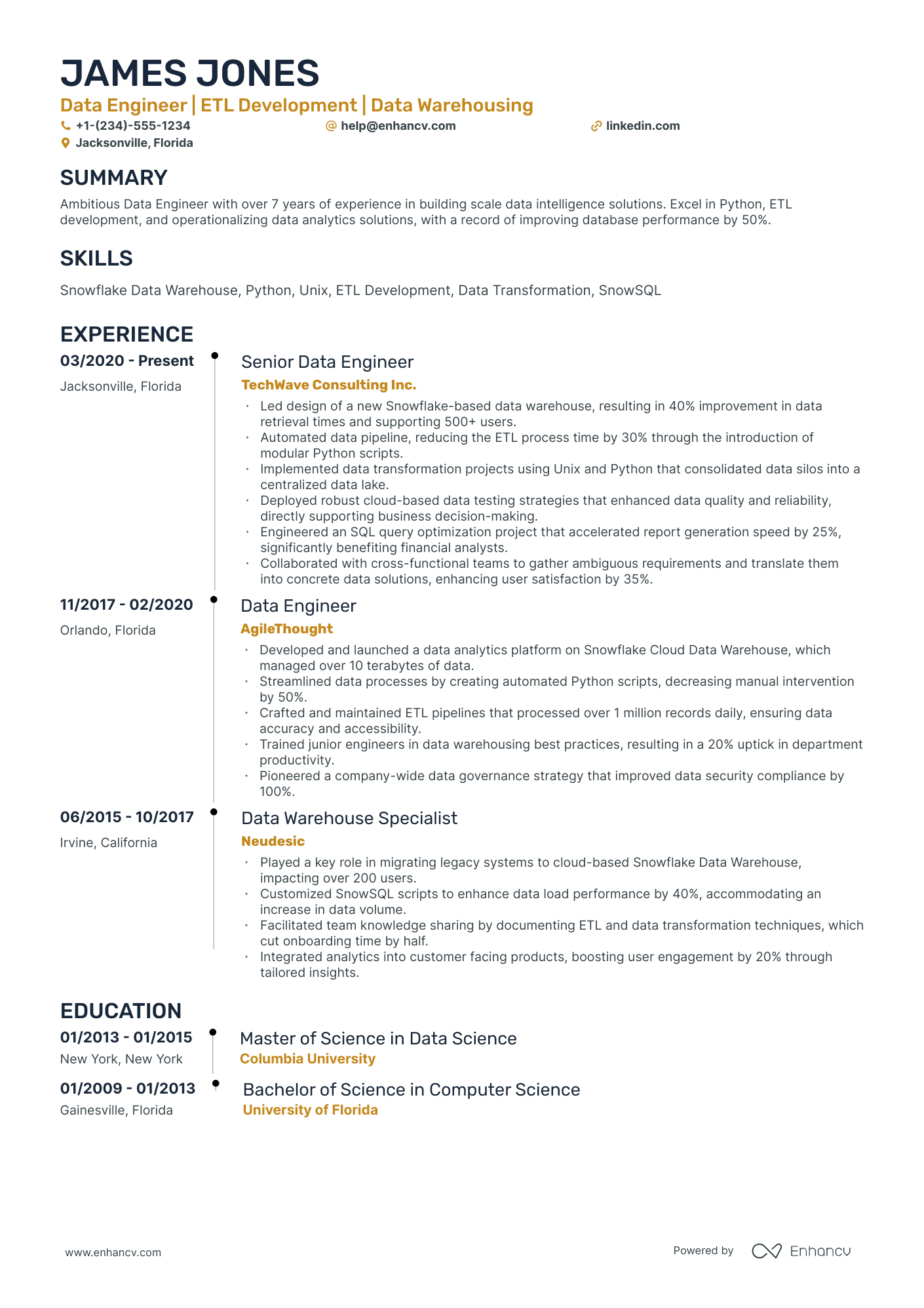
Use a reverse-chronological format to present your Snowflake development experience in order of recency and relevance. Do:
- Lead each role entry with your scope of ownership—datasets managed, environments supported, and cross-functional teams you collaborated with.
- Highlight specific Snowflake features and complementary tools you've worked with, such as Snowpipe, Streams, Tasks, dbt, Airflow, or Terraform.
- Quantify your contributions with measurable outcomes tied to performance, cost, or delivery timelines.
I'm junior or switching into this role—what format works best?
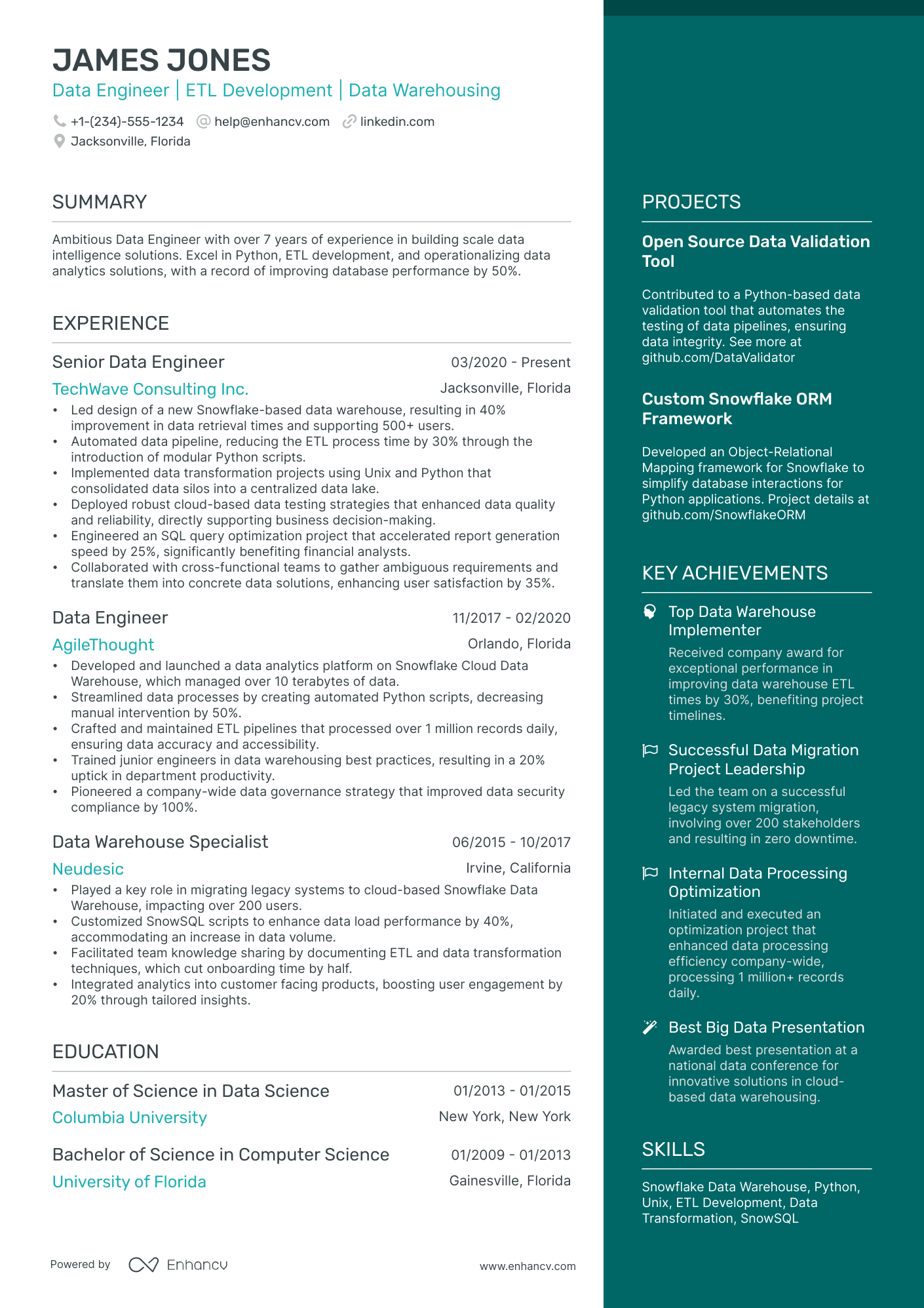
Use a hybrid format that places a focused technical skills section at the top, followed by your experience or project history in reverse-chronological order. Do:
- Position your Snowflake skills, SQL proficiency, and relevant certifications (such as SnowPro Core) prominently near the top of the resume.
- Include personal projects, coursework, or freelance work where you built or maintained Snowflake environments, even if it wasn't in a formal job setting.
- Connect every listed skill to a specific action and outcome so recruiters can see applied ability, not just keyword familiarity.
Why not use a functional resume?
A functional format strips away the timeline and context that recruiters need to evaluate how and where you applied your Snowflake skills, making it harder to verify your experience depth.
- Career changers with adjacent technical experience: If you're transitioning from a data analyst, database administrator, or backend engineering role and have completed Snowflake-specific projects or certifications, a functional format can help foreground transferable skills while you build direct experience.
- Limited formal work history: If you're a recent graduate or bootcamp completer whose Snowflake experience comes entirely from personal projects, labs, or open-source contributions, a functional layout can organize your skills around project outcomes rather than sparse job entries.
- A functional resume may be acceptable if you have notable resume gaps or are making a career change into Snowflake development, but only if every listed skill is anchored to a specific project, certification lab, or measurable outcome rather than presented as a standalone keyword.
With your resume's format established, the next step is determining which sections to include so each one reinforces your Snowflake expertise.
What sections should go on a Snowflake developer resume
Recruiters expect to see clear evidence that you can design, build, and optimize Snowflake data solutions that deliver measurable business results. Knowing what to put on a resume for this role is critical. Use this structure for maximum clarity:
- Header
- Summary
- Experience
- Skills
- Projects
- Education
- Certifications
- Optional sections: Open-source work, publications, languages
Strong experience bullets should emphasize performance gains, cost savings, data reliability improvements, and end-to-end ownership across ingestion, modeling, orchestration, and governance.
Is your resume good enough?
Drop your resume here or choose a file. PDF & DOCX only. Max 2MB file size.
Once you’ve organized your resume with the right structure and supporting details, focus next on writing your Snowflake developer resume experience to show how you applied those elements in real work.
How to write your Snowflake developer resume experience
Your work experience section should showcase the data platforms, pipelines, and cloud-based solutions you've shipped or delivered using Snowflake and its surrounding ecosystem. Hiring managers prioritize demonstrated impact—optimized queries, scalable architectures, and measurable performance gains—over descriptive task lists that merely catalog daily responsibilities.
Each entry should include:
- Job title
- Company and location (or remote)
- Dates of employment (month and year)
Three to five concise bullet points showing what you owned, how you executed, and what outcomes you delivered:
- Ownership scope: the Snowflake environments, data warehouses, ELT/ETL pipelines, schemas, or cross-account architectures you were directly accountable for building, maintaining, or scaling.
- Execution approach: the tools, frameworks, and technologies you relied on to deliver work—such as Snowflake SQL, Snowpark, dbt, Apache Airflow, Terraform, Python, or native Snowflake features like Streams, Tasks, and Time Travel.
- Value improved: the specific changes you drove in query performance, warehouse cost efficiency, data freshness, pipeline reliability, storage optimization, or governance posture within the Snowflake platform.
- Collaboration context: how you partnered with data engineers, analytics teams, cloud infrastructure groups, security stakeholders, or business users to align Snowflake solutions with organizational data strategy and consumption needs.
- Impact delivered: the tangible outcomes your work produced, expressed through improvements in processing speed, reduction in compute spend, data availability at scale, or acceleration of downstream reporting and machine learning workflows—framed as results rather than activity.
Experience bullet formula
A Snowflake developer experience example
✅ Right example - modern, quantified, specific.
Snowflake Data Engineer
BrightPay Health | Remote
2022–Present
Built and scaled a Snowflake analytics platform supporting two hundred-plus internal users across claims, finance, and member experience.
- Architected a Snowflake medallion model using Snowpipe, Streams, and Tasks to ingest one point five billion monthly events, cutting data availability from six hours to twenty minutes.
- Developed dbt (data build tool) models with automated tests and documentation, raising pipeline pass rate from ninety-one percent to ninety-eight percent and reducing production defects by forty percent in partnership with analytics engineers and data analysts.
- Optimized query performance with clustering keys, search optimization, and warehouse right-sizing, lowering average dashboard latency by forty-five percent and reducing Snowflake spend by twenty-two percent.
- Implemented role-based access control, dynamic data masking, and row access policies aligned to HIPAA requirements, passing three audits with zero critical findings alongside security and compliance stakeholders.
- Delivered governed semantic datasets for Tableau and Looker using secure views and data contracts, enabling ten self-serve dashboards and saving product managers and finance teams thirty hours per month in ad hoc requests.
Now that you've seen how a strong experience section comes together, let's look at how to adjust yours to match a specific Snowflake developer job posting.
How to tailor your Snowflake developer resume experience
Recruiters evaluate your Snowflake developer resume through both human review and applicant tracking systems (ATS). Tailoring your resume to the job description ensures your qualifications align directly with what the hiring team is looking for.
Ways to tailor your Snowflake developer experience:
- Match the specific Snowflake features and cloud platforms listed in the posting.
- Mirror the exact data warehousing terminology the job description uses.
- Reflect performance optimization KPIs or success criteria the employer highlights.
- Include industry or domain experience when the role specifies it.
- Emphasize data security and governance practices if the posting mentions compliance.
- Highlight collaboration with data engineering or analytics teams as referenced.
- Align your ETL and ELT workflow descriptions with their stated methodology.
- Reference the BI or visualization tools named in the job requirements.
Tailoring means aligning your real accomplishments with each role's specific requirements, not forcing keywords where they don't belong.
Resume tailoring examples for Snowflake developer
| Job description excerpt | Untailored | Tailored |
|---|---|---|
| "Design and optimize Snowflake data warehouses, implement ELT pipelines using dbt, and ensure data quality across production datasets." | Worked on database projects and helped move data between systems. | Designed and optimized a multi-terabyte Snowflake data warehouse supporting 12 business units, building 40+ dbt models for ELT pipelines that reduced data freshness lag from six hours to 45 minutes while enforcing automated data quality checks across all production datasets. |
| "Collaborate with data engineering and analytics teams to build scalable Snowpark solutions for real-time ML feature generation on Snowflake." | Assisted with machine learning tasks and supported analytics teams on various initiatives. | Partnered with data engineering and analytics teams to develop Snowpark-based Python pipelines that generated over 200 real-time ML features directly in Snowflake, cutting external processing costs by 35% and eliminating cross-platform data movement for the fraud detection model. |
| "Manage Snowflake cost optimization, including warehouse scaling policies, resource monitors, and query performance tuning for enterprise workloads." | Helped reduce cloud costs and monitored system performance on a regular basis. | Implemented Snowflake warehouse auto-scaling policies and resource monitors across eight virtual warehouses, tuning query performance for enterprise workloads that served 500+ daily users—reducing monthly Snowflake credit consumption by 28% without degrading P95 query response times. |
Once you’ve aligned your experience with the role’s requirements, quantify your Snowflake developer achievements to show the measurable impact of that work.
How to quantify your Snowflake developer achievements
Quantifying your achievements proves business impact, not just effort. For Snowflake developers, focus on query performance, warehouse cost, pipeline reliability, data quality, security risk reduction, and delivery speed.
Quantifying examples for Snowflake developer
| Metric | Example |
|---|---|
| Query performance | "Reduced dashboard query time from 48s to 9s by clustering FACT_SALES and rewriting joins using Snowflake Query Profile." |
| Cost efficiency | "Cut compute spend 22% by right-sizing warehouses, enabling auto-suspend at 60s, and moving nightly jobs to a smaller scheduled warehouse." |
| Pipeline reliability | "Improved ELT success rate from 96.8% to 99.6% by adding retries, idempotent loads, and alerting in Airflow for Snowflake tasks." |
| Data quality | "Lowered duplicate customer records 73% by implementing dbt tests and dedup logic with Snowflake streams and tasks." |
| Delivery speed | "Shipped a new secure data share to three partner accounts in eight days by templating Terraform and standardizing Snowflake roles and grants." |
Turn vague job duties into measurable, recruiter-ready resume bullets in seconds with Enhancv's Bullet Point Generator.
Once your bullet points clearly convey your impact, it's equally important to showcase the specific hard and soft skills that reinforce your qualifications as a Snowflake developer.
How to list your hard and soft skills on a Snowflake developer resume
Your skills section shows you can build, optimize, and govern Snowflake data solutions, and recruiters and ATS scan this section for exact platform, SQL, and pipeline keywords—aim for a hard-skill-heavy mix with a smaller set of role-specific collaboration skills. Snowflake developer roles require a blend of:
- Product strategy and discovery skills.
- Data, analytics, and experimentation skills.
- Delivery, execution, and go-to-market discipline.
- Soft skills.
Your skills section should be:
- Scannable (bullet-style grouping).
- Relevant to the job post.
- Backed by proof in experience bullets.
- Updated with current tools.
Place your skills section:
- Above experience if you're junior or switching careers.
- Below experience if you're mid/senior with strong achievements.

Hard skills
- Snowflake SQL, CTEs, window functions
- Snowflake schema design, modeling
- Snowflake performance tuning
- Warehouses, scaling, caching
- Micro-partitioning, clustering keys
- Snowflake tasks, streams
- Snowflake stored procedures, UDFs
- Snowpark (Python), pandas
- dbt, semantic models
- ELT orchestration: Airflow, Dagster
- Data ingestion: Fivetran, Kafka
- Security: RBAC, masking policies
Soft skills
- Translate requirements into data specs
- Ask sharp data quality questions
- Align stakeholders on definitions
- Document tables and transformations
- Communicate tradeoffs and impacts
- Own incidents through resolution
- Prioritize fixes by business risk
- Review code with clear feedback
- Partner with analytics and engineering
- Present results to nontechnical teams
- Drive consensus on standards
- Manage scope and timelines
How to show your Snowflake developer skills in context
Skills shouldn't live only in a bulleted list on your resume. Explore resume skills examples to see how top candidates weave abilities into real accomplishments.
They should be demonstrated in:
- Your summary (high-level professional identity)
- Your experience (proof through outcomes)
Here's what that looks like in practice.
Summary example
Senior Snowflake developer with eight years in healthcare data engineering. Skilled in dbt, Kafka, and Python-based ELT pipelines. Architected a Snowflake lakehouse that cut reporting latency by 60%, enabling real-time clinical dashboards for cross-functional analytics teams.
- Establishes senior-level expertise immediately
- Names role-relevant tools and frameworks
- Leads with a measurable outcome
- Signals cross-team collaboration skills
Experience example
Senior Data Engineer
Vantage Health Systems | Remote
March 2020–Present
- Redesigned legacy ETL workflows using Snowflake, dbt, and Airflow, reducing pipeline failures by 74% across 12 production environments.
- Partnered with product and analytics teams to build Snowflake Secure Data Shares, cutting cross-department data request turnaround from five days to four hours.
- Optimized Snowflake warehouse configurations and clustering strategies, lowering monthly compute costs by 38% while supporting a 3x increase in concurrent users.
- Every bullet includes measurable proof
- Skills appear naturally within achievements
Once you’ve demonstrated your Snowflake developer capabilities through relevant projects and outcomes, the next step is to apply that approach to structuring a Snowflake developer resume when you don’t have formal experience.
How do I write a Snowflake developer resume with no experience
Even without full-time experience, you can demonstrate readiness through projects and self-directed learning. If you need guidance on building a resume without work experience, focus on showcasing applied skills:
- Snowflake developer personal data warehouse
- SQL and dbt transformation portfolio
- Public GitHub Snowflake developer scripts
- Kaggle datasets loaded into Snowflake
- AWS S3 to Snowflake pipelines
- Streamlit app on Snowflake data
- Snowflake certifications and badges
- Volunteer analytics for local nonprofit
Focus on:
- Snowflake developer SQL query tuning
- Data modeling for analytics schemas
- ELT pipelines with tested code
- Security basics: roles and grants
Resume format tip for entry-level Snowflake developer
Use a skills-based resume format because it highlights Snowflake developer projects, tools, and outcomes when your work history is limited. Do:
- Put projects above work history.
- List Snowflake developer tools per project.
- Quantify runtime, cost, and rows.
- Link GitHub repositories and dashboards.
- Add tests, docs, and version control.
- Built a Snowflake developer ELT pipeline from AWS S3 using Snowpipe, Streams, and Tasks, loading five million rows daily and cutting refresh time by 60%.
Even without hands-on work experience, your educational background can demonstrate relevant Snowflake knowledge and technical foundations—here's how to present it effectively.
How to list your education on a Snowflake developer resume
Your education section helps hiring teams confirm you have the foundational knowledge needed. It validates your technical training in data engineering, SQL, and cloud computing relevant to the Snowflake developer role.
Include:
- Degree name
- Institution
- Location
- Graduation year
- Relevant coursework (for juniors or entry-level candidates)
- Honors & GPA (if 3.5 or higher)
Skip month and day details—list the graduation year only.
Here's a strong education entry tailored to the Snowflake developer role:
Example education entry
Bachelor of Science in Computer Science
University of Wisconsin–Madison, Madison, WI
Graduated 2021
GPA: 3.7/4.0
- Relevant coursework: Database Systems, Distributed Computing, Cloud Architecture, Data Warehousing, Advanced SQL
- Honors: Dean's List (six semesters), Magna Cum Laude
How to list your certifications on a Snowflake developer resume
Certifications on your resume show a Snowflake developer's commitment to learning, hands-on tool proficiency, and alignment with current data platform needs across the industry. Include:
- Certificate name
- Issuing organization
- Year
- Optional: credential ID or URL
- Place certifications below education when your degree is recent and more relevant than the certifications.
- Place certifications above education when they are recent and directly align with Snowflake developer responsibilities.
Best certifications for your Snowflake developer resume
- SnowPro Core Certification
- SnowPro Advanced: Architect Certification
- SnowPro Advanced: Data Engineer Certification
- AWS Certified Data Engineer – Associate
- Microsoft Certified: Azure Data Engineer Associate
- Google Cloud Professional Data Engineer
- Databricks Certified Data Engineer Associate
Once you’ve positioned your credentials where hiring teams can spot them quickly, shift to your Snowflake developer resume summary to tie those qualifications to the role you’re targeting.
How to write your Snowflake developer resume summary
Your resume summary is the first thing a recruiter reads. A strong one instantly connects your Snowflake skills to what the role demands.
Keep it to three to four lines, with:
- Your title and total years of relevant experience.
- The domain or industry you've worked in, such as fintech or e-commerce.
- Core tools like Snowflake, dbt, SQL, Python, or AWS.
- One or two quantified achievements that show real impact.
- Soft skills tied to outcomes, such as cross-team collaboration that accelerated delivery.

PRO TIP
At the junior level, lead with your technical skills and any measurable contributions from internships, projects, or early roles. Avoid vague phrases like "passionate learner" or "motivated self-starter." Instead, show recruiters you can already deliver results with Snowflake in a real-world setting.
Example summary for a Snowflake developer
Snowflake developer with two years of experience building data pipelines in e-commerce. Reduced query runtimes by 40% using Snowflake optimization and dbt. Skilled in SQL, Python, and AWS.
Optimize your resume summary and objective for ATS
Drop your resume here or choose a file.
PDF & DOCX only. Max 2MB file size.
Now that your summary effectively showcases your Snowflake expertise and value, make sure the header above it presents your contact details and professional identity just as clearly.
What to include in a Snowflake developer resume header
Your resume header lists your key identity and contact details, helping a Snowflake developer show up in searches, build credibility, and pass recruiter screening.
Essential resume header elements
- Full name
- Tailored job title and headline
- Location
- Phone number
- Professional email
- GitHub link
- Portfolio link
A LinkedIn link helps recruiters verify experience quickly and supports screening.
Don't include a photo on a Snowflake developer resume unless the role is explicitly front-facing or appearance-dependent.
Use a clear job title with "Snowflake developer," keep links short, and match your header wording to the target job description.
Example
Snowflake developer resume header
Jordan Lee
Snowflake developer | Data Warehouse Development and SQL Optimization
Austin, TX
(512) 555-01XX
jordan.lee@enhancv.com
github.com/jordanlee
jordanlee.dev
linkedin.com/in/jordanlee
Once your header clearly establishes your Snowflake developer role and key identifiers, add the following additional sections to round out your resume with supporting details.
Additional sections for Snowflake developer resumes
When your core sections don't fully capture your expertise, additional sections help you stand out and reinforce your credibility as a Snowflake developer.
- Certifications (e.g., SnowPro Core, SnowPro Advanced)
- Technical publications and blog posts
- Open-source contributions and GitHub projects
- Conference talks and presentations
- Languages
- Professional memberships and data engineering communities
Once your resume sections are fully built out, pairing them with a strong cover letter can give your application an extra competitive edge.
Do Snowflake developer resumes need a cover letter
A cover letter isn't required for most Snowflake developer roles. If you're wondering what is a cover letter and when it matters, it helps when the role is competitive, the hiring team expects one, or your resume needs context. It can make a difference when several candidates have similar technical skills.
Use a cover letter when it adds specific context:
- Explain why you fit the role and team: Connect your Snowflake developer strengths to the team's data stack, workflows, and priorities.
- Highlight one or two outcomes: Cite a Snowflake developer project with measurable impact, such as faster pipelines, lower costs, or stronger data quality.
- Show product and business understanding: Reference the users, data consumers, or decisions your work supported, and how Snowflake developer choices improved outcomes.
- Address transitions or non-obvious experience: Clarify a move into Snowflake developer work, a career gap, or transferable skills from adjacent data platforms.
Drop your resume here or choose a file.
PDF & DOCX only. Max 2MB file size.
Once you’ve decided whether to include a cover letter to add context beyond your resume, the next step is using AI to sharpen your Snowflake developer resume faster and more consistently.
Using AI to improve your Snowflake developer resume
AI can sharpen your resume's clarity, structure, and impact. It helps tighten language and highlight relevant achievements. For practical prompts and strategies, explore how ChatGPT can help with resume writing. But overuse strips authenticity. Once your content is clear and role-aligned, step away from AI.
Here are 10 practical prompts to strengthen specific sections of your Snowflake developer resume:
Strengthen your summary
Quantify experience bullets
Tighten skills formatting
Sharpen project descriptions
Improve action verbs
Align with job postings
Refine certifications section
Clarify education details
Remove redundant phrasing
Tailor the experience section
Conclusion
A strong Snowflake developer resume highlights measurable outcomes, role-specific skills, and a clear structure. It shows impact with metrics, proves Snowflake expertise, and stays easy to scan from summary to experience.
Keep your Snowflake developer resume focused on results, relevant tools, and clean formatting. This approach matches today’s hiring needs and supports near-future roles that demand speed, reliability, and scalable data work.