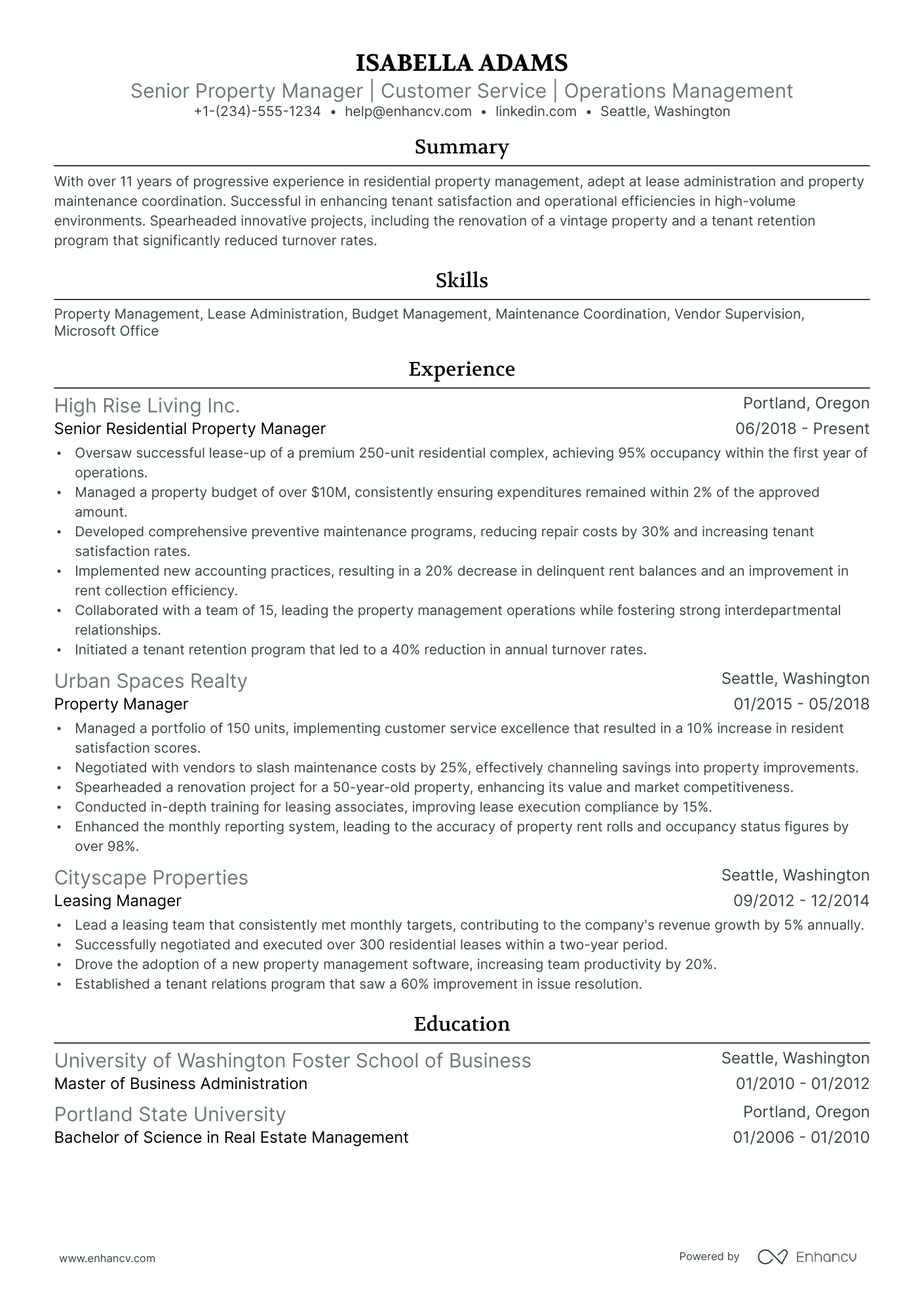
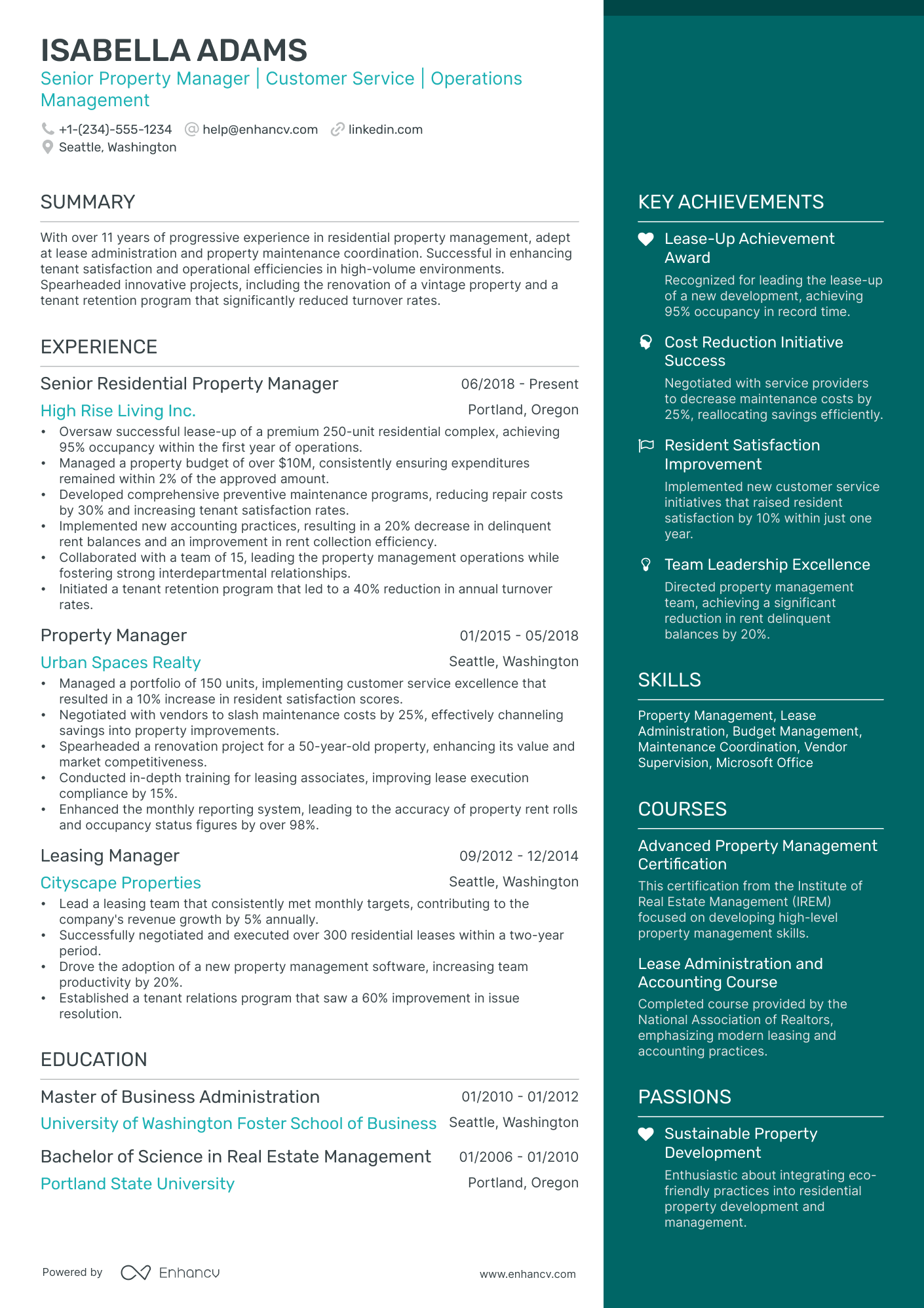
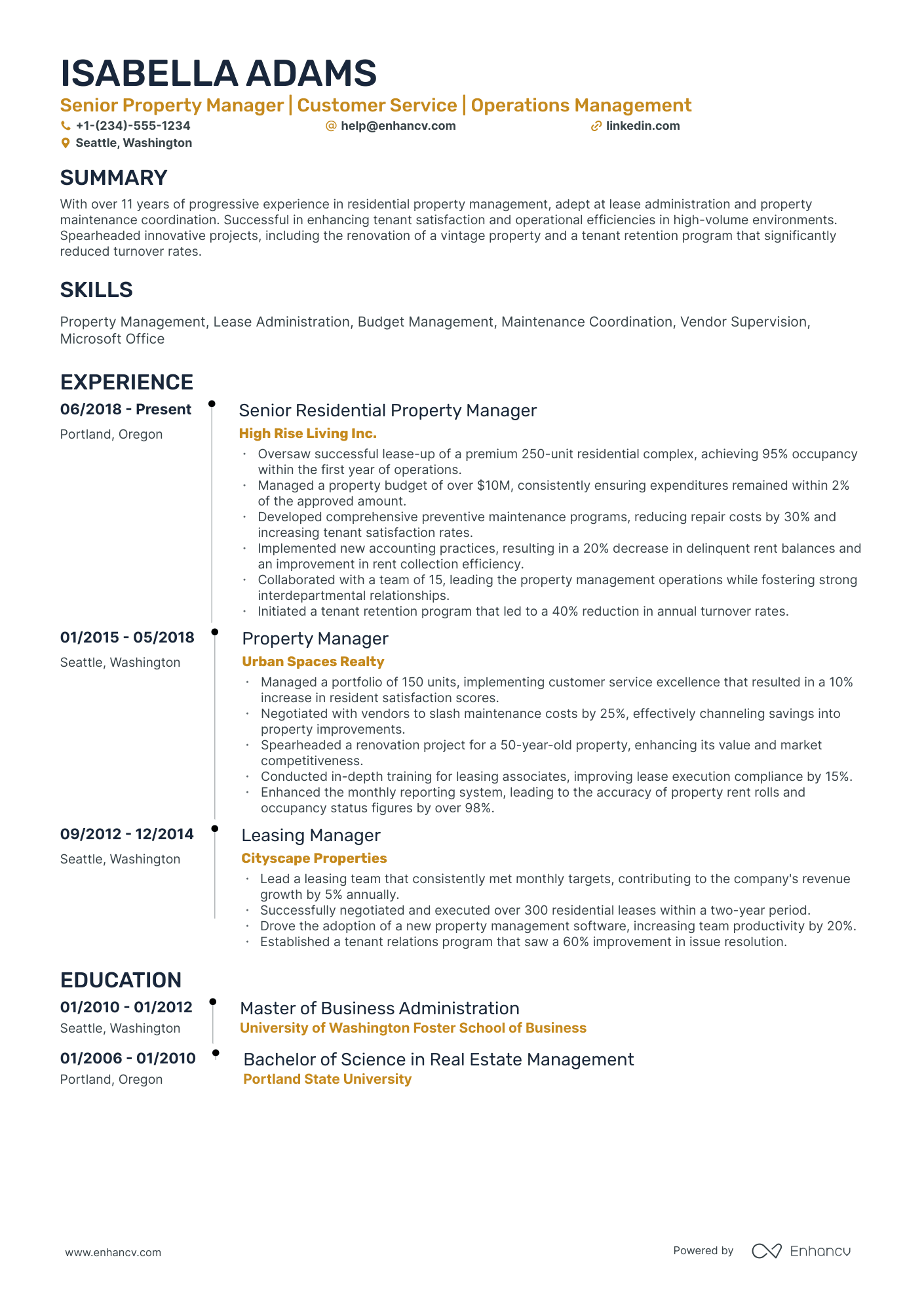
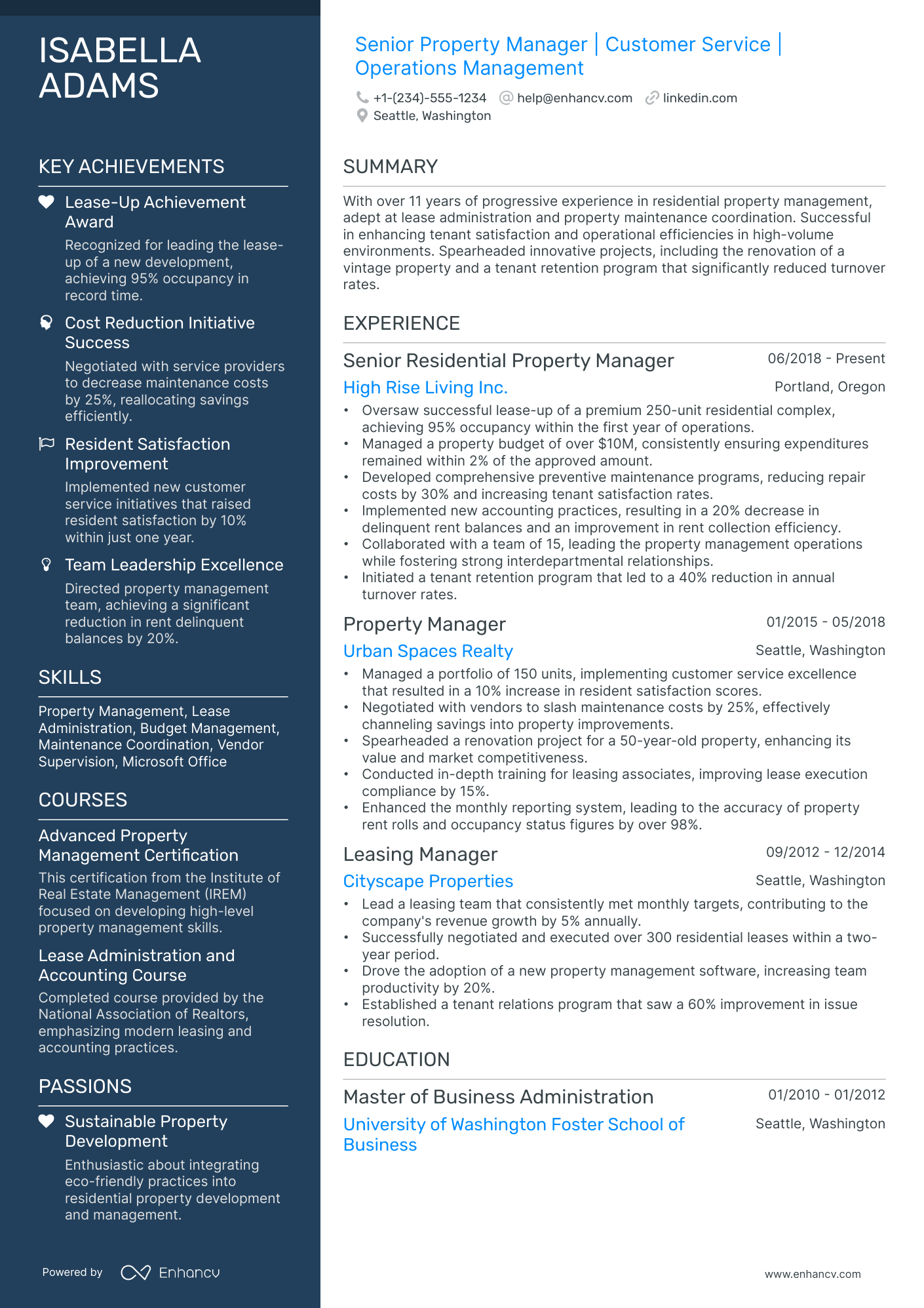
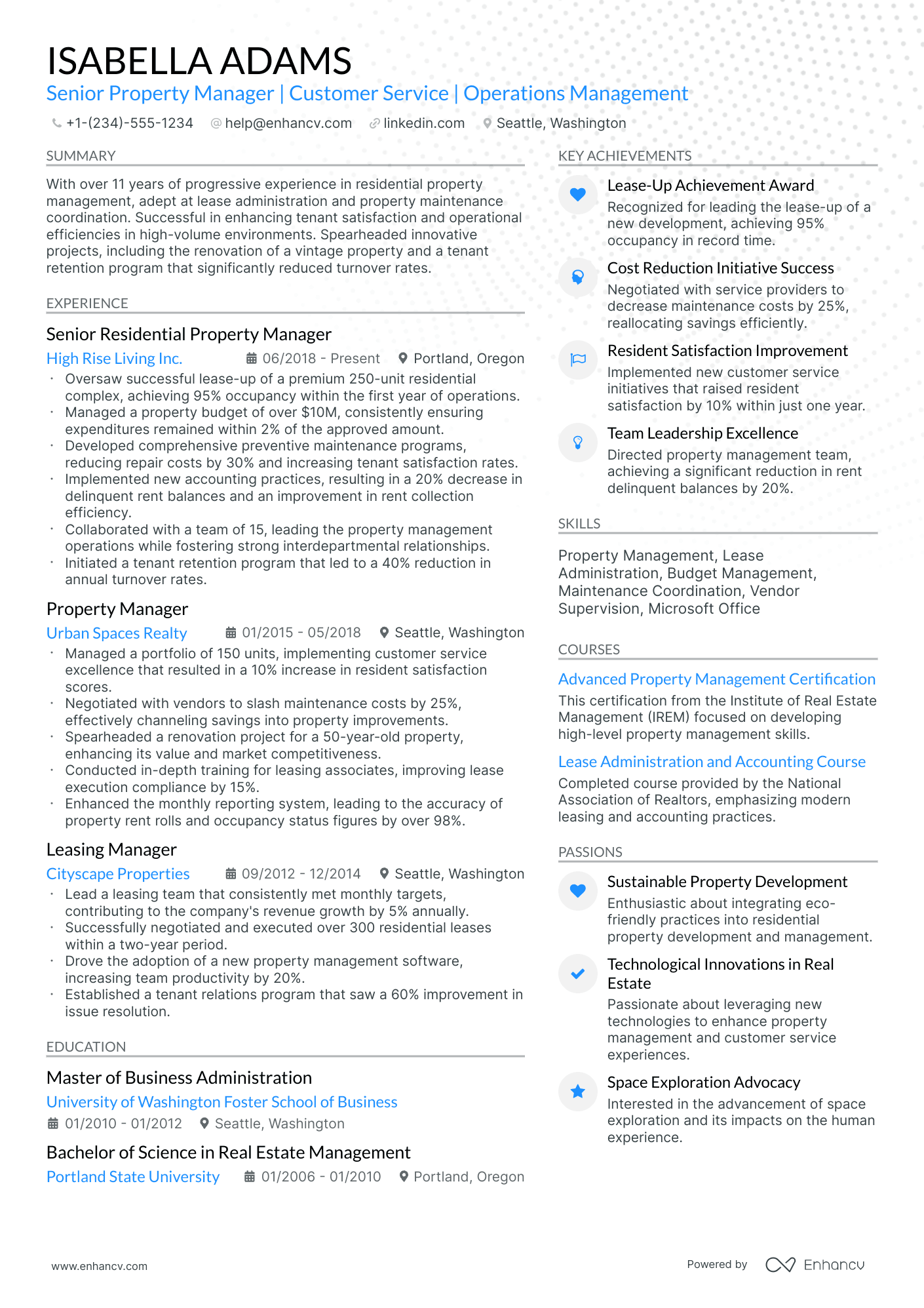
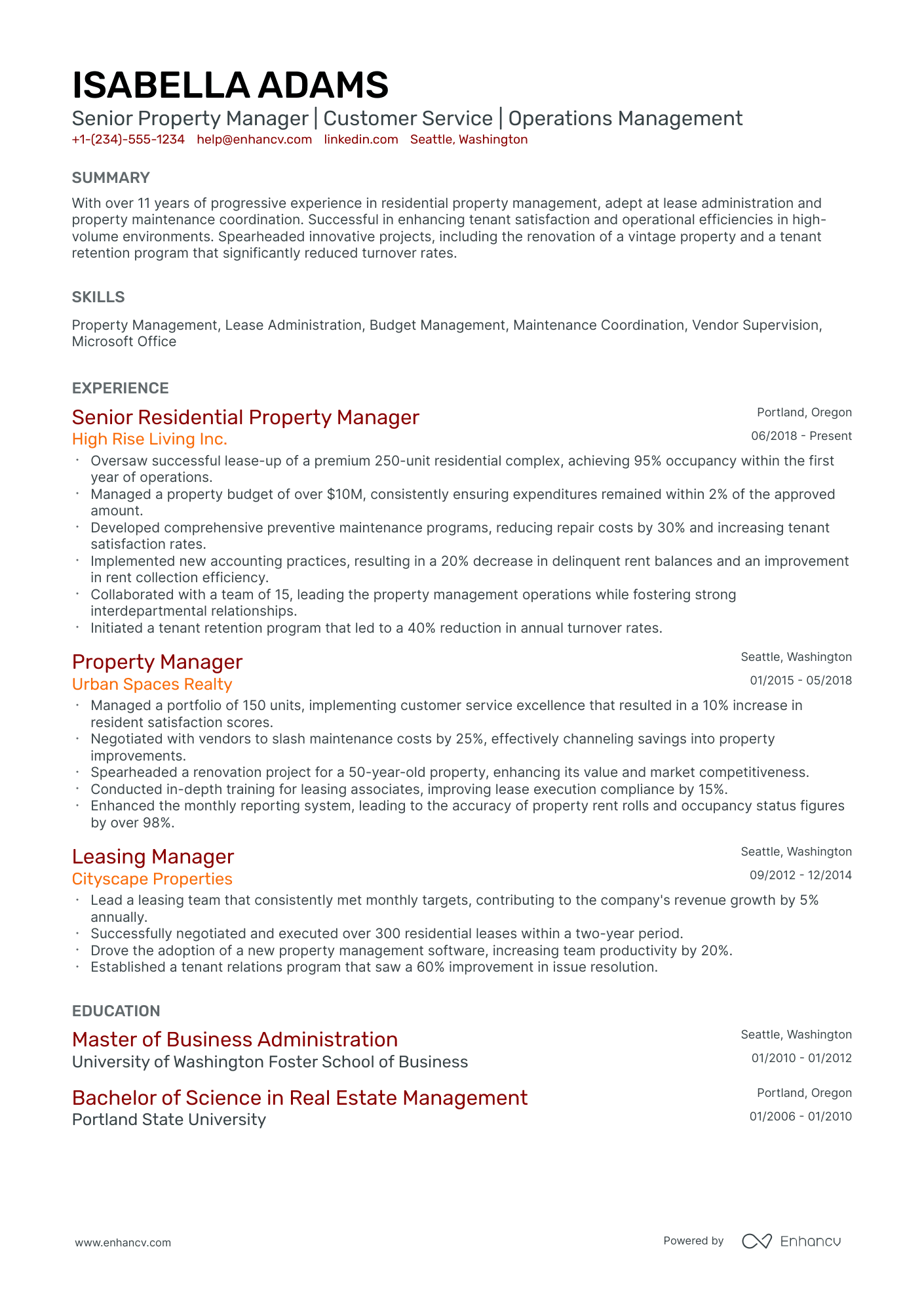
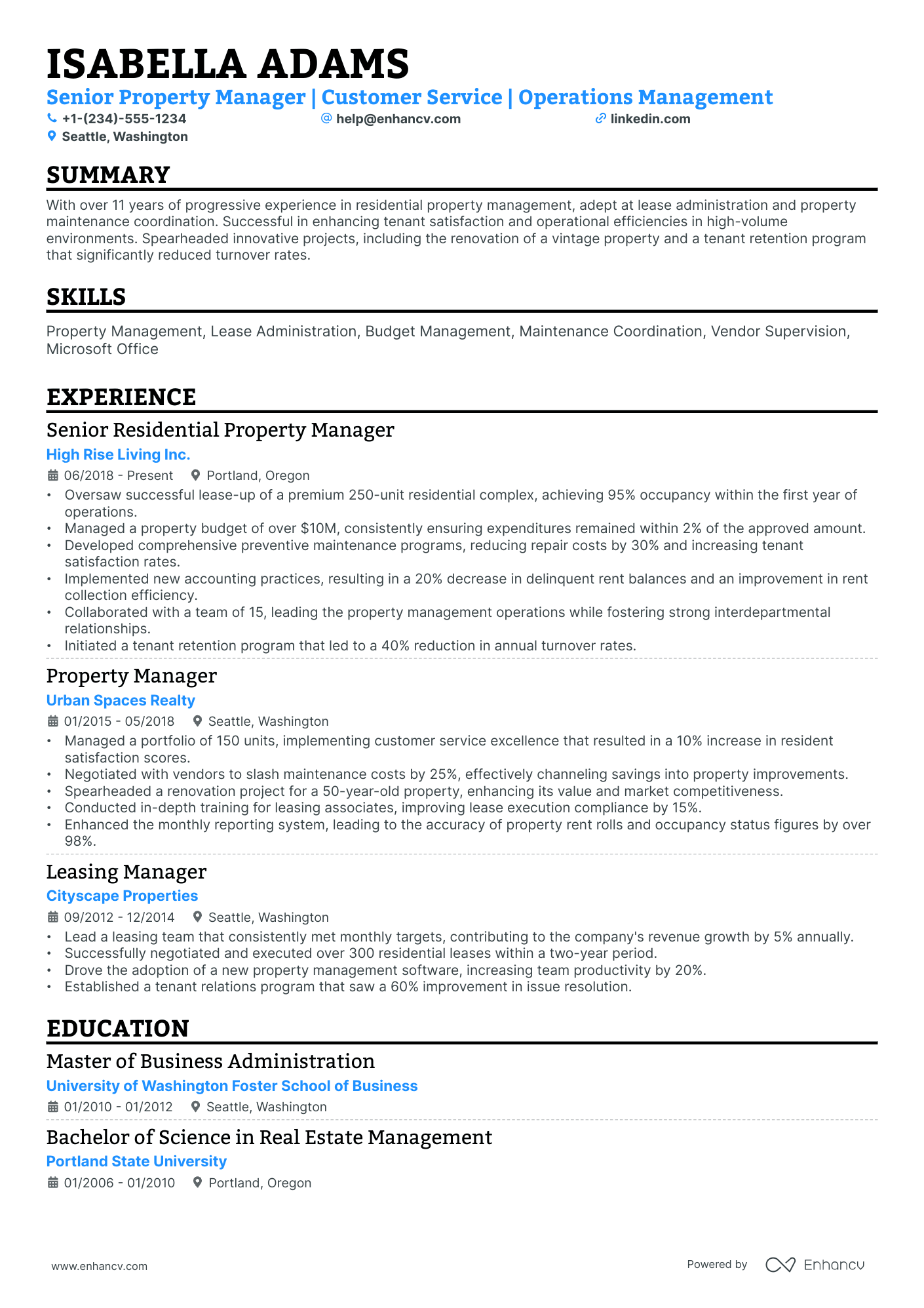
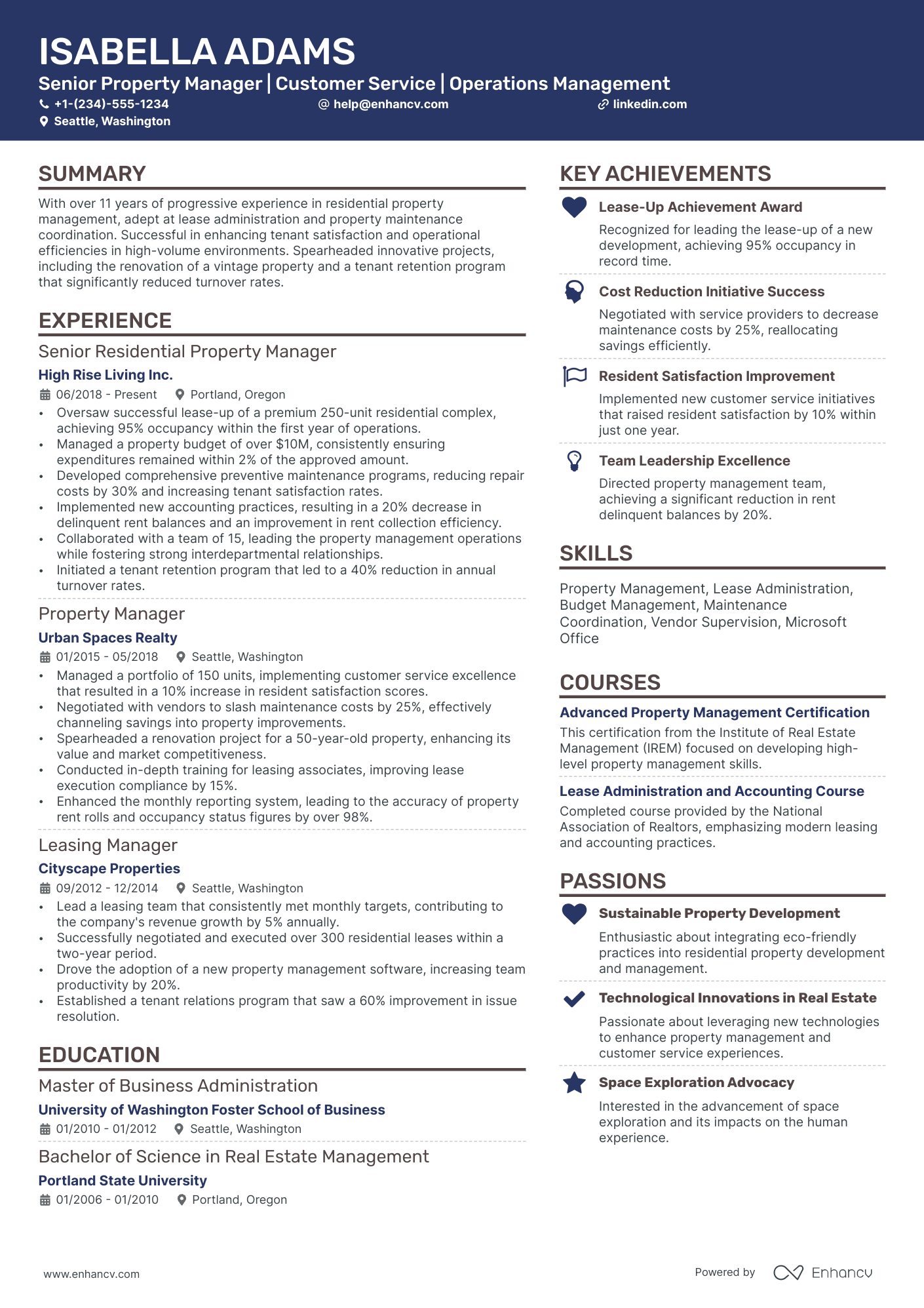
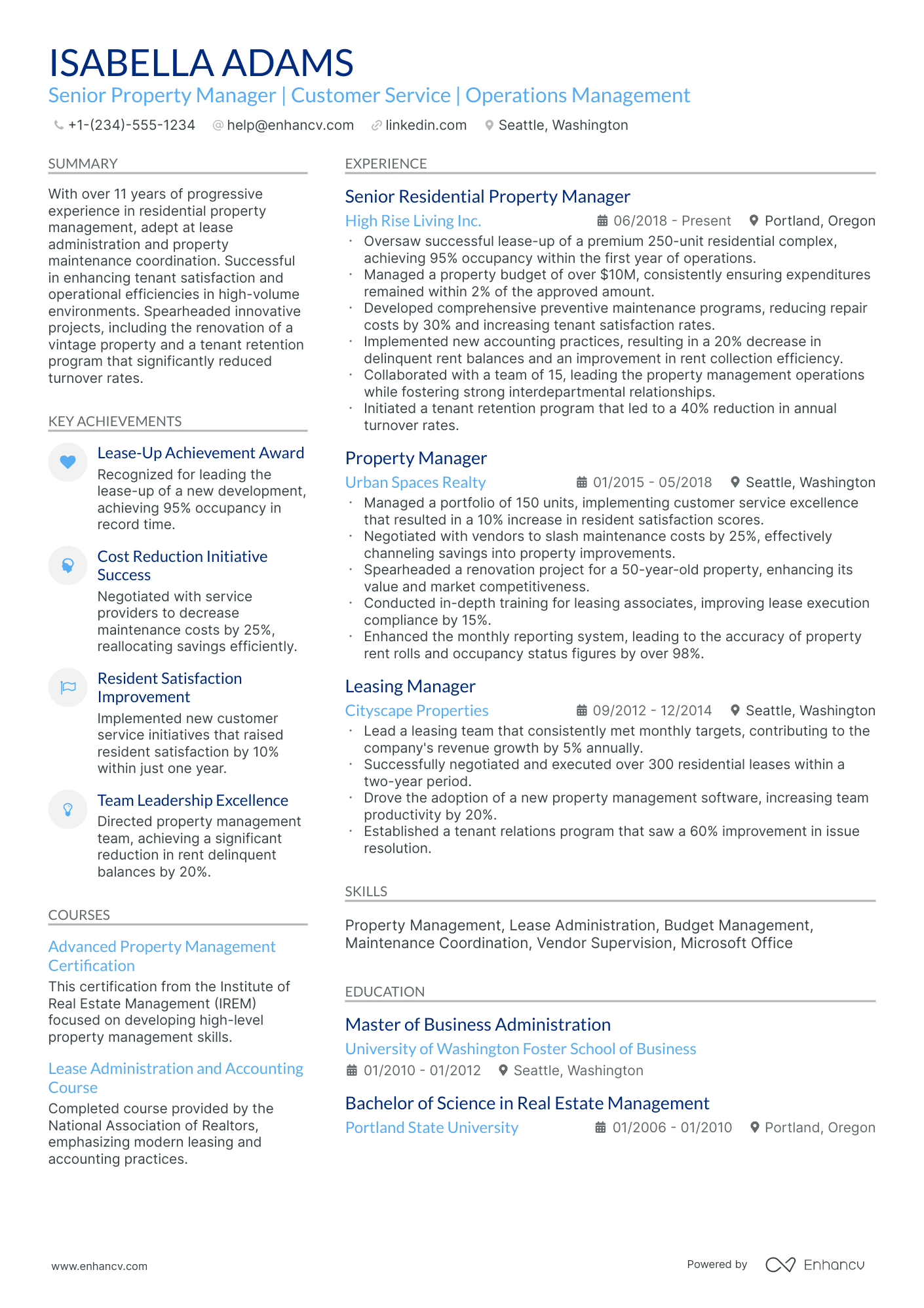
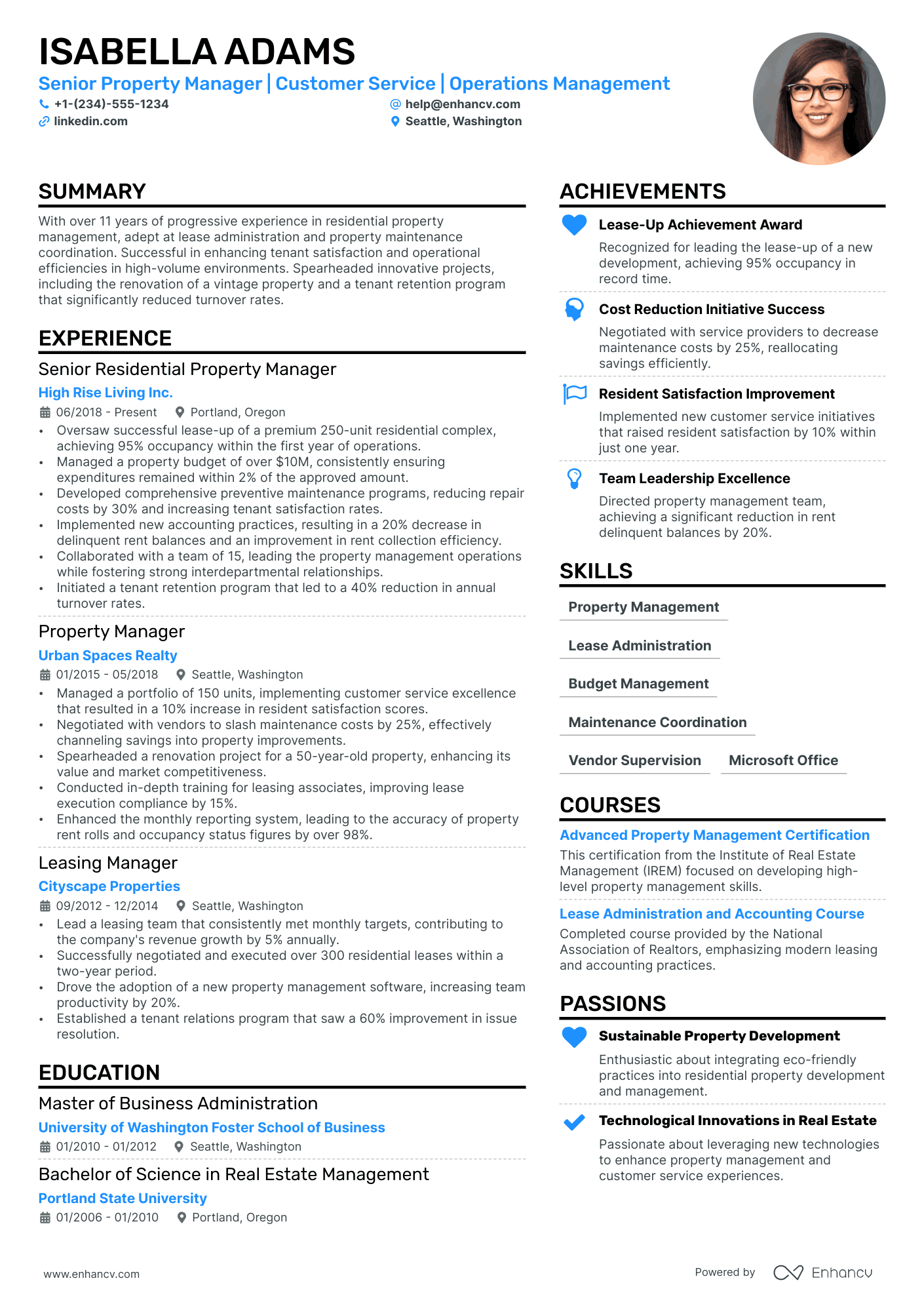
Many residential property manager resume drafts fail because they read like task lists, not proof of performance. That hurts when an applicant tracking system filters keywords and recruiters scan fast in a crowded market.
A strong resume shows outcomes you delivered and the scale you managed. Knowing how to make your resume stand out means you should highlight higher occupancy, faster lease-up timelines, lower delinquency, fewer maintenance tickets, stronger renewal rates, and budget savings across your unit portfolio.

Key takeaways
- Quantify occupancy gains, delinquency reductions, and maintenance turnaround times in every experience bullet.
- Use reverse-chronological format if you have direct property management experience.
- Tailor resume keywords to match each job posting's software, property class, and KPIs.
- Lead each role entry with portfolio scope—unit count, property type, budget, and team size.
- Demonstrate skills through measurable outcomes in your summary and experience, not just a list.
- Place certifications like CPM or ARM near your education to signal specialized expertise.
- Use Enhancv's tools to turn vague duties into clear, recruiter-ready bullets with real metrics.
How to format a residential property manager resume
Recruiters evaluating residential property manager candidates prioritize hands-on property operations experience, tenant relations skills, lease administration knowledge, and measurable outcomes like occupancy rates or cost reductions. A clean, well-structured resume format ensures these signals surface quickly during both automated screening and the initial human scan.

I have significant experience in this role—which format should I use?
Use a reverse-chronological format to lead with your most recent and relevant property management positions. Do:
- Open each role entry with the scope of your portfolio—unit count, property type, team size, and budget authority.
- Highlight proficiency with industry tools and domains such as Yardi, AppFolio, RentManager, fair housing compliance, and preventive maintenance planning.
- Quantify outcomes tied to occupancy, revenue, cost savings, or tenant retention in every role.
I'm junior or switching into this role—what format works best?
A hybrid format works best because it lets you lead with transferable skills while still showing a clear work history. Do:
- Place a skills section near the top featuring competencies like lease negotiation, tenant screening, property inspections, and maintenance coordination.
- Include relevant projects, internships, or transitional experience—such as managing a homeowners association, coordinating facility operations, or completing a property management certification.
- Connect every listed action to a concrete result so recruiters can see your impact even without a long tenure in the field.
Why not use a functional resume?
A functional format strips away the timeline and context recruiters need to verify where and when you applied your property management skills, which weakens your credibility even at the entry or mid-career level.
- Career changers with no direct property management experience who hold transferable skills from hospitality, facilities management, or real estate sales and can tie those skills to relevant projects or outcomes.
- Candidates with significant resume gaps who completed property management coursework, certifications (such as CPM or ARM), or volunteer property oversight during the gap period.
- Recent graduates whose academic projects, internships, or part-time roles involved tenant relations, lease processing, or building operations but don't yet form a full work history.
With your format established, the next step is filling it with the right sections to give hiring managers exactly what they're looking for.
What sections should go on a residential property manager resume
Recruiters expect a clear, results-focused resume that shows you can run day-to-day property operations, keep occupancy high, and resolve resident issues fast. Understanding what to put on a resume for this role is critical to passing both ATS screening and recruiter review.
Use this structure for maximum clarity:
- Header
- Summary
- Experience
- Skills
- Projects
- Education
- Certifications
- Optional sections: Awards, Leadership, Languages
Strong experience bullets should emphasize measurable impact—occupancy, renewals, rent collection, maintenance turnaround time, resident satisfaction, portfolio size, and cost savings.
Is your resume good enough?
Drop your resume here or choose a file. PDF & DOCX only. Max 2MB file size.
Now that you’ve organized the key parts of your resume, the next step is to write your residential property manager experience section so it supports each one with clear, relevant proof.
How to write your residential property manager resume experience
The experience section is where you prove you've delivered results—not just handled responsibilities. Hiring managers reviewing residential property manager resumes prioritize demonstrated impact, including the properties you managed, the tools and methods you relied on, and the measurable outcomes you produced over descriptive task lists. Building a targeted resume that aligns your experience with the specific role ensures your qualifications resonate with each employer.
Each entry should include:
- Job title
- Company and location (or remote)
- Dates of employment (month and year)
Three to five concise bullet points showing what you owned, how you executed, and what outcomes you delivered:
- Ownership scope: the residential portfolios, property types, unit counts, or on-site teams you were directly accountable for managing and maintaining.
- Execution approach: the property management software, lease administration processes, vendor coordination methods, or compliance frameworks you used to make decisions and keep operations running.
- Value improved: changes to occupancy rates, tenant satisfaction, maintenance turnaround, regulatory compliance, operating costs, or property condition tied to your direct involvement.
- Collaboration context: how you worked with tenants, owners, maintenance crews, contractors, HOA boards, legal counsel, or municipal agencies to resolve issues and sustain community standards.
- Impact delivered: outcomes expressed through retention improvements, revenue preservation, cost reductions, inspection results, or portfolio growth rather than a list of daily duties.
Experience bullet formula
A residential property manager experience example
✅ Right example - modern, quantified, specific.
Residential Property Manager
Maplewood Residential | Austin, TX
2021–Present
Managed a three-hundred-unit Class B multifamily community with on-site maintenance and leasing teams.
- Increased occupancy from ninety-two percent to ninety-seven percent in nine months by tightening lead response times in Yardi Voyager CRM, standardizing tour scripts with the leasing team, and launching weekly traffic reporting in Google Sheets.
- Reduced delinquency from five point one percent to two point eight percent by implementing AppFolio payment reminders, negotiating structured payment plans, and coordinating escalations with legal counsel and ownership.
- Cut average work order completion time from three point four days to one point nine days by triaging in Maintenance Connection, enforcing service-level agreements with vendors, and running daily standups with maintenance supervisors.
- Lowered monthly utility expenses by eight percent by auditing submeter reads, correcting billing exceptions in RealPage, and partnering with a local energy consultant to optimize common-area lighting schedules.
- Improved resident satisfaction scores from four point one to four point five out of five by deploying a resident portal in Buildium, closing the loop on service requests within twenty-four hours, and aligning renewal offers with regional revenue management guidance.
Now that you've seen how a strong experience section comes together, let's look at how to adjust yours to match a specific job posting.
How to tailor your residential property manager resume experience
Recruiters evaluate your residential property manager resume through both manual review and applicant tracking systems. Tailoring your resume to the job description ensures your qualifications stand out in both screening methods.
Ways to tailor your residential property manager experience:
- Match property management software like Yardi or AppFolio from the posting.
- Mirror the exact lease administration terminology the employer uses.
- Reflect occupancy rate or tenant retention KPIs the listing prioritizes.
- Highlight fair housing and local housing code compliance if referenced.
- Include experience with the specific property class or unit count mentioned.
- Align your maintenance coordination workflow with their described process.
- Emphasize vendor management or contract negotiation when the role requires it.
- Reference tenant screening methods or criteria the job description specifies.
Tailoring means aligning your real accomplishments with what the employer asks for, not forcing keywords where they don't belong.
Resume tailoring examples for residential property manager
| Job description excerpt | Untailored | Tailored |
|---|---|---|
| Manage day-to-day operations of a 200+ unit residential community using Yardi Voyager, including rent collection, lease enforcement, and vendor coordination | Handled daily property management tasks and worked with tenants and vendors | Oversaw daily operations for a 240-unit residential community in Yardi Voyager, managing rent collection for $2.1M in annual revenue, enforcing lease terms, and coordinating 15+ vendor contracts |
| Conduct regular property inspections, ensure compliance with local housing codes, and maintain occupancy rates above 95% | Performed inspections and helped keep the property in good condition | Conducted monthly property inspections across three residential buildings, resolved 100% of housing code violations within 30 days, and sustained a 97% occupancy rate over two consecutive fiscal years |
| Respond to tenant maintenance requests within 24 hours using AppFolio, track work order completion, and manage a $500K annual maintenance budget | Addressed maintenance issues and managed budgets for the property | Triaged and responded to an average of 45 weekly tenant maintenance requests within 24 hours through AppFolio, tracked work orders to 98% on-time completion, and managed a $500K annual maintenance budget with 12% cost savings through competitive vendor bidding |
Once you’ve aligned your experience with the role’s priorities, the next step is to quantify your residential property manager achievements so employers can see the scope and impact of your results.
How to quantify your residential property manager achievements
Quantifying your achievements proves you protect revenue, reduce risk, and keep residents happy. Focus on occupancy, rent collection speed, maintenance turnaround, compliance results, and resident satisfaction across your unit portfolio.
Quantifying examples for residential property manager
| Metric | Example |
|---|---|
| Occupancy rate | "Raised occupancy from 91% to 97% in six months across 180 units by tightening renewal outreach and improving tour-to-lease follow-up in Yardi." |
| Rent collection | "Cut delinquency from 6.2% to 2.1% and improved on-time payments to 96% by rolling out ACH autopay and weekly aging reviews in AppFolio." |
| Maintenance cycle time | "Reduced average work order completion time from 4.8 days to 2.6 days by triaging emergencies, standardizing vendor SLAs, and tracking backlog weekly." |
| Compliance risk | "Passed two city housing inspections with zero critical violations by completing 100% of required unit checks and documenting corrections within 48 hours." |
| Resident satisfaction | "Improved resident satisfaction from 3.9 to 4.5 out of five by responding to messages within four business hours and closing service follow-ups within 24 hours." |
Turn vague job duties into measurable, recruiter-ready resume bullets in seconds with Enhancv's Bullet Point Generator.
With strong bullet points in place, the next step is ensuring your skills section clearly highlights the hard and soft skills that make you a competitive residential property manager.
How to list your hard and soft skills on a residential property manager resume
Your skills section shows you can run compliant, profitable properties, and recruiters and applicant tracking systems scan it for role keywords and fit; aim for a balanced mix of hard skills like leasing and maintenance operations and soft skills like resident communication. residential property manager roles require a blend of:
- Product strategy and discovery skills
- Data, analytics, and experimentation skills
- Delivery, execution, and go-to-market discipline
- Soft skills
Your skills section should be:
- Scannable (bullet-style grouping).
- Relevant to the job post.
- Backed by proof in experience bullets.
- Updated with current tools.
Place your skills section:
- Above experience if you're junior or switching careers.
- Below experience if you're mid/senior with strong achievements.

Hard skills
- Yardi Voyager, RealPage
- AppFolio Property Manager
- Buildium
- Leasing and renewals
- Rent collection, delinquency control
- Fair Housing compliance
- Lease administration
- Vendor management, bid leveling
- Work order and preventive maintenance
- Property inspections, punch lists
- Budgeting, variance reporting
- Resident retention programs
Soft skills
- De-escalate resident conflicts
- Set clear expectations with residents
- Negotiate win-win renewals
- Coordinate vendors and onsite teams
- Prioritize urgent maintenance issues
- Document decisions and follow-ups
- Communicate policy changes clearly
- Hold owners and vendors accountable
- Make judgment calls under pressure
- Resolve issues end-to-end
- Build trust with residents and owners
- Collaborate across leasing and maintenance teams
How to show your residential property manager skills in context
Skills shouldn't live only in a bulleted list on your resume.
They should be demonstrated in:
- Your summary (high-level professional identity)
- Your experience (proof through outcomes)
Here's what that looks like in practice. You can explore more examples of how to present resume skills effectively across different roles.
Summary example
Residential property manager with 10+ years overseeing 800+ multifamily units. Skilled in Yardi, lease compliance, and vendor negotiations. Reduced tenant turnover by 22% through proactive maintenance programs and community-building initiatives that strengthened resident satisfaction scores.
- Reflects senior-level experience clearly
- Names industry-standard tools like Yardi
- Quantifies retention impact with metrics
- Highlights resident-focused soft skills
Experience example
Senior Residential Property Manager
Greystone Living Communities | Denver, CO
March 2018–Present
- Managed a 540-unit portfolio using AppFolio, collaborating with maintenance teams to cut work order resolution time by 35%.
- Negotiated vendor contracts alongside the operations director, saving $128,000 annually while maintaining service quality benchmarks.
- Led quarterly resident satisfaction surveys and implemented feedback-driven improvements, boosting retention rates by 19% over two years.
- Every bullet includes measurable proof.
- Skills surface naturally through outcomes.
Once you’ve demonstrated these abilities through specific examples and outcomes, the next step is learning how to present them on a residential property manager resume when you don’t have direct experience.
How do I write a residential property manager resume with no experience
Even without full-time experience, you can demonstrate readiness through:
- Leasing office volunteer or internship
- Resident assistant housing operations
- HOA board or committee service
- Customer service rent collection handling
- Maintenance work order coordination
- Tenant screening and application processing
- Fair Housing training certificate
If you're in this situation, our guide on building a resume without work experience offers additional strategies for showcasing your qualifications.
Focus on:
- Property software and tracking workflows
- Leasing metrics and occupancy results
- Rent collection and documentation accuracy
- Maintenance coordination with vendors
Resume format tip for entry-level residential property manager
Use a combination resume format to highlight relevant projects and skills first, while still showing steady work history and impact. Do:
- Add a "Relevant Projects" section.
- List property management software you used.
- Quantify leasing, collections, and response times.
- Include Fair Housing and local compliance.
- Tailor keywords to the job posting.
- Coordinated forty-five maintenance work orders in AppFolio, cut average tenant response time from three days to one, and closed ninety percent within seven days.
Once you've positioned your transferable skills and relevant strengths to offset limited experience, presenting your education effectively becomes your next opportunity to reinforce your qualifications.
How to list your education on a residential property manager resume
Your education section helps hiring teams confirm you have the foundational knowledge needed for the residential property manager role. It validates relevant training in property management, real estate, or business.
Include:
- Degree name
- Institution
- Location
- Graduation year
- Relevant coursework (for juniors or entry-level candidates)
- Honors & GPA (if 3.5 or higher)
Skip month and day details—list the graduation year only.
Here's a strong education entry tailored to a residential property manager resume.
Example education entry
Bachelor of Science in Real Estate Management
University of Central Florida, Orlando, FL
Graduated 2021
GPA: 3.7/4.0
- Relevant coursework: Property Law, Tenant Relations, Real Estate Finance, Facilities Management
- Honors: Magna Cum Laude, Dean's List (six consecutive semesters)
How to list your certifications on a residential property manager resume
Certifications on a resume show a residential property manager's commitment to learning, proficiency with modern tools, and alignment with current housing regulations and leasing practices.
Include:
- Certificate name
- Issuing organization
- Year
- Optional: credential ID or URL
- Place certifications below education when your degree is recent and your certifications add support, not a primary qualification.
- Place certifications above education when they are recent, highly relevant, or required, and they strengthen your residential property manager fit.
Best certifications for your residential property manager resume
- Certified Apartment Manager (CAM)
- Certified Property Manager (CPM)
- Accredited Residential Manager (ARM)
- Certified Residential Property Manager (CRPM)
- Fair Housing Compliance Certification
- OSHA 10-Hour General Industry
Once you’ve positioned your credentials to confirm your qualifications, shift to your residential property manager resume summary to highlight that value upfront.
How to write your residential property manager resume summary
Your resume summary is the first thing a recruiter reads. A strong one instantly signals you're qualified for the residential property manager role.
Keep it to three to four lines, with:
- Your title and total years of experience in property management.
- Residential property type, such as multifamily, single-family, or mixed-use portfolios.
- Core skills like lease administration, tenant relations, budgeting, and maintenance coordination.
- One or two measurable achievements, such as occupancy rates improved or costs reduced.
- Soft skills tied to real outcomes, like conflict resolution that lowered tenant turnover.

PRO TIP
At this level, emphasize hands-on skills, relevant certifications, and early wins that show initiative. Highlight specific property types you've managed and tools like Yardi or AppFolio. Avoid vague phrases like "passionate self-starter" or "team player." Replace them with concrete results.
Example summary for a residential property manager
Residential property manager with three years of experience overseeing 120+ multifamily units. Increased occupancy rates by 14% through proactive tenant retention strategies. Proficient in Yardi, lease administration, and vendor coordination.
Optimize your resume summary and objective for ATS
Drop your resume here or choose a file.
PDF & DOCX only. Max 2MB file size.
Now that your summary is ready to showcase your qualifications, make sure your header presents the essential contact and professional details hiring managers need to reach you.
What to include in a residential property manager resume header
A resume header lists your key contact and professional details, improving visibility, credibility, and recruiter screening for a residential property manager role.
Essential resume header elements
- Full name
- Tailored job title and headline
- Location
- Phone number
- Professional email
- GitHub link
- Portfolio link
A LinkedIn link lets recruiters verify your work history quickly and supports faster screening decisions.
Do not include a photo on a residential property manager resume unless the role is explicitly front-facing or appearance-dependent.
Keep your header on one or two lines, match your job title to the posting, and use consistent formatting recruiters can scan in seconds.
Residential property manager resume header
Jordan Taylor
Residential Property Manager | Lease Renewals, Resident Relations, Vendor Coordination
Austin, TX
(512) 555-01XX
jordan.taylor@enhancv.com github.com/jordantaylor yourwebsite.com linkedin.com/in/jordantaylor
With your contact details and key identifiers set at the top, add additional sections to highlight qualifications that don’t fit in the header but still strengthen your residential property manager resume.
Additional sections for residential property manager resumes
Adding extra sections helps you stand out when your core qualifications match other candidates and you need to showcase unique, role-specific strengths. For example, listing language skills on your resume can be a differentiator when managing diverse resident communities.
- Languages
- Certifications and licenses
- Professional affiliations
- Volunteer experience
- Awards and recognitions
- Hobbies and interests
- Continuing education
Once you've strengthened your resume with relevant additional sections, pairing it with a well-written cover letter can further set your application apart.
Do residential property manager resumes need a cover letter
A cover letter isn't required for a residential property manager, but it helps in competitive markets or when hiring teams expect one. If you're unsure where to start, understanding what a cover letter is and how it complements your resume can clarify its value. It can make a difference when your resume doesn't clearly show fit, scope, or context.
Use a cover letter to add details your resume can't:
- Explain role or team fit by matching your strengths to the property type, resident profile, and management style.
- Highlight one or two projects or outcomes, such as reducing delinquency, improving renewals, or speeding up maintenance response times.
- Show you understand the business context, including owner goals, budget limits, compliance needs, and resident experience priorities.
- Address career transitions or non-obvious experience by connecting prior work to leasing, operations, vendor management, and conflict resolution.
Drop your resume here or choose a file.
PDF & DOCX only. Max 2MB file size.
Even if you choose to submit your application without an additional letter, using AI to improve your residential property manager resume helps you strengthen the document hiring teams review first.
Using AI to improve your residential property manager resume
AI can sharpen your resume's clarity, structure, and overall impact. It helps refine language and highlight relevant achievements. However, overusing it risks making your resume sound generic. If you're wondering which AI is best for writing resumes, the answer depends on how you use it. Once your content feels clear and aligned with the role, step away from AI.
Here are 10 practical prompts you can copy and paste to strengthen specific sections of your resume:
Tighten your summary
Quantify experience bullets
Align skills with the role
Strengthen action verbs
Tailor to a job posting
Refine certifications placement
Clarify project descriptions
Remove filler language
Improve education relevance
Check for consistency
Conclusion
A strong residential property manager resume proves results with numbers, highlights role-specific skills, and stays easy to scan. Show occupancy gains, faster leasing, lower delinquencies, and controlled maintenance costs. Use a clear structure with focused sections and consistent formatting.
Hiring teams need residential property manager candidates who can deliver now and adapt quickly. A results-led, skills-forward resume shows you can handle resident relations, vendor coordination, compliance, and budgeting with confidence. Keep it direct, measurable, and organized.