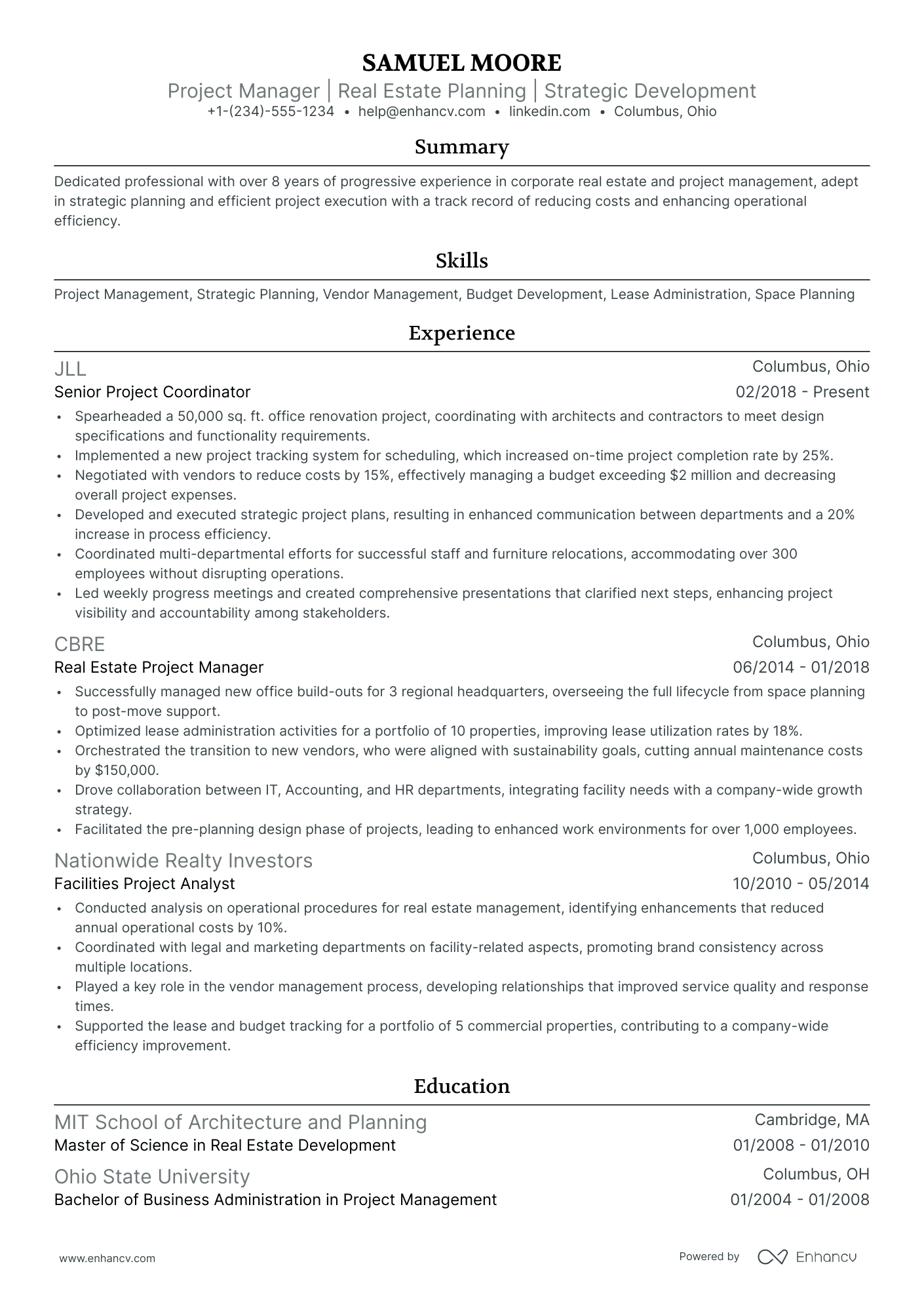
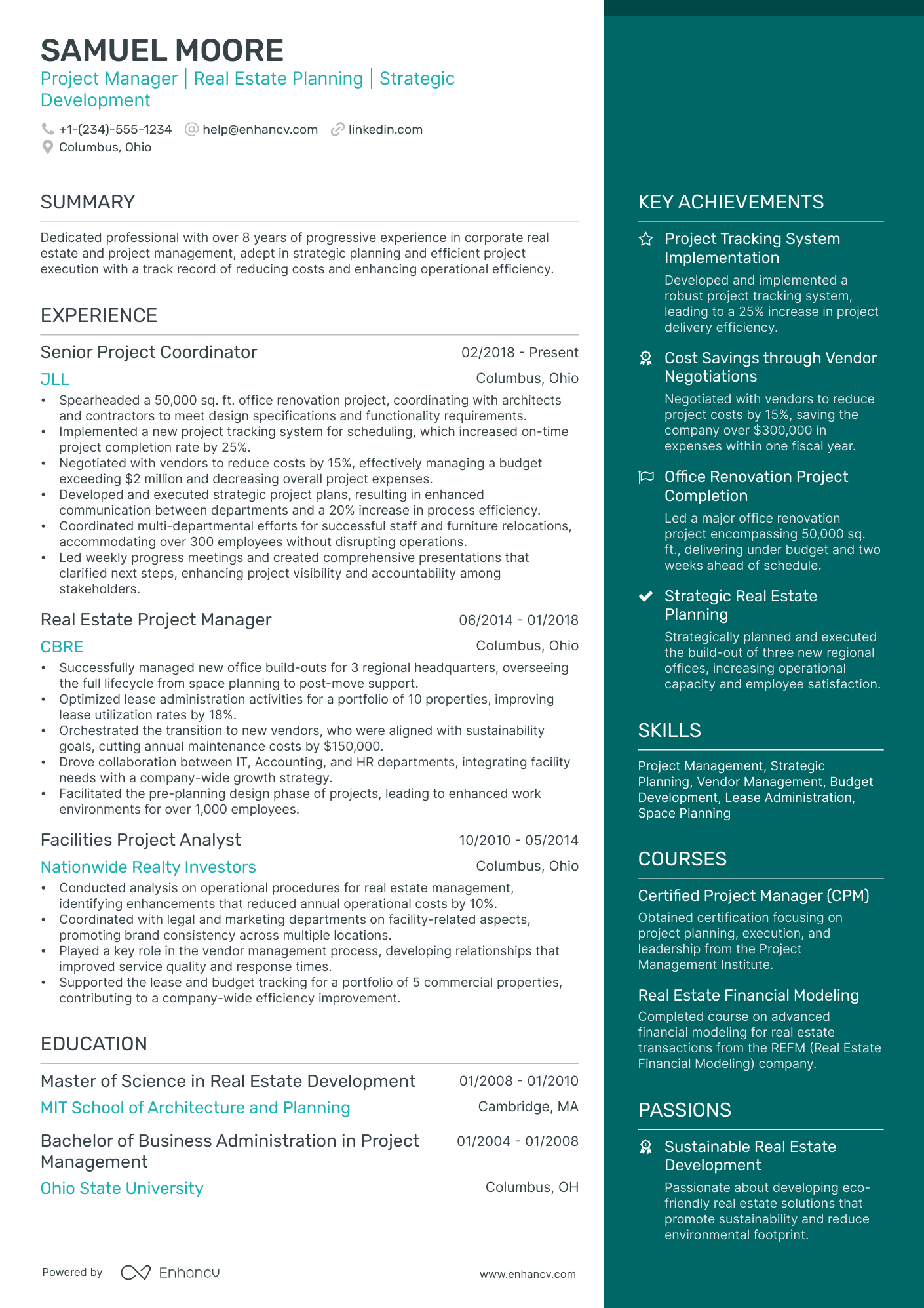
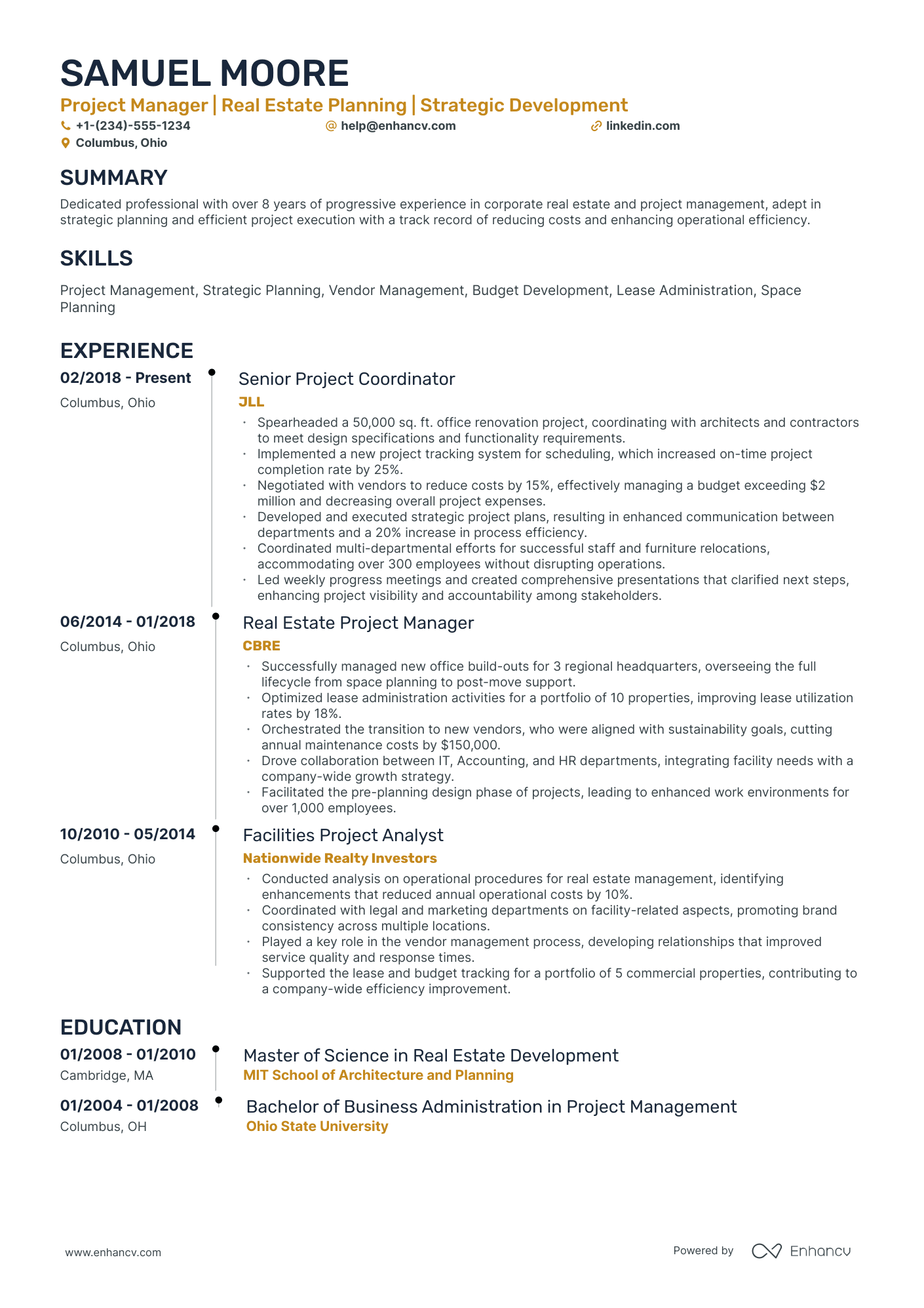
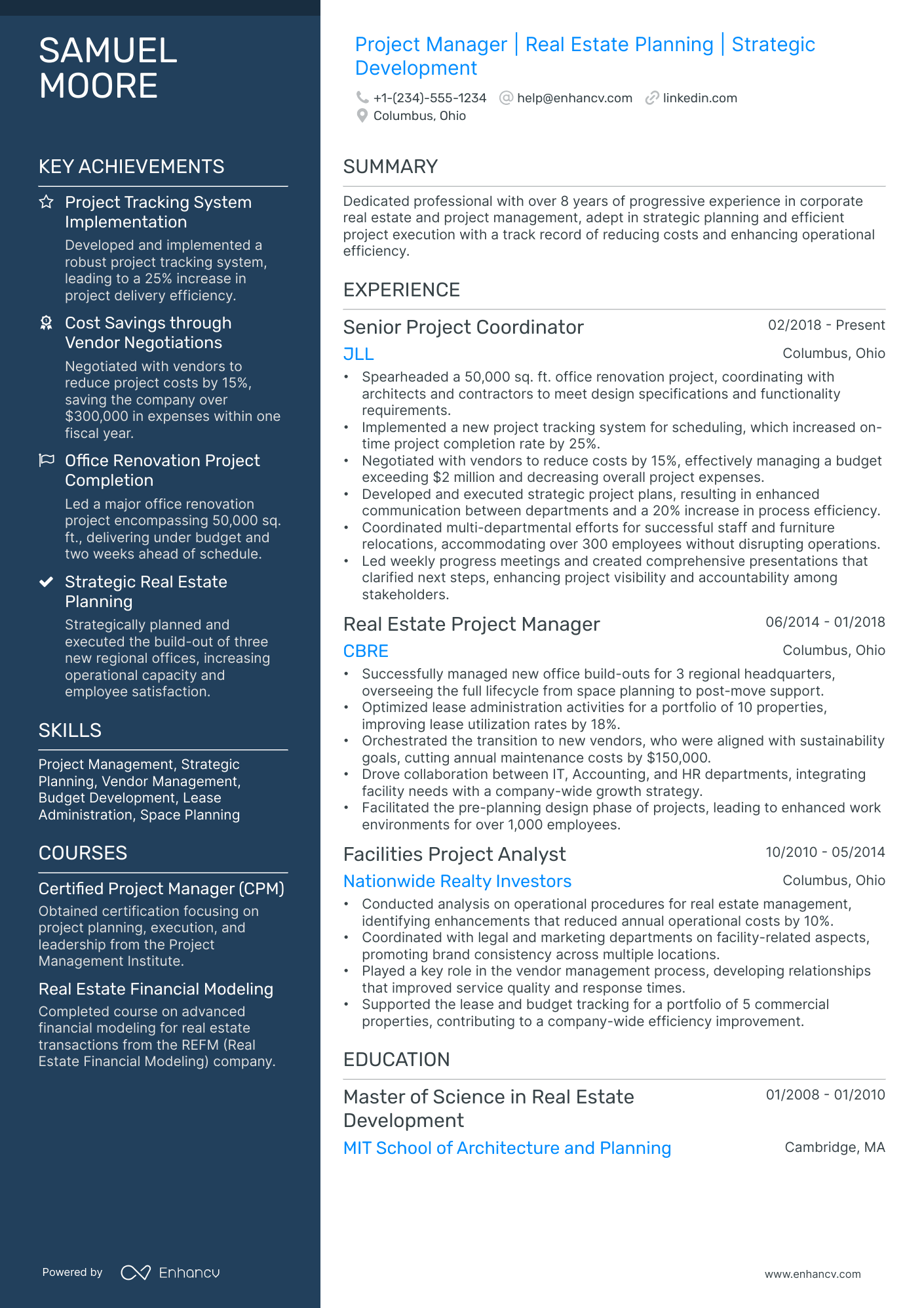
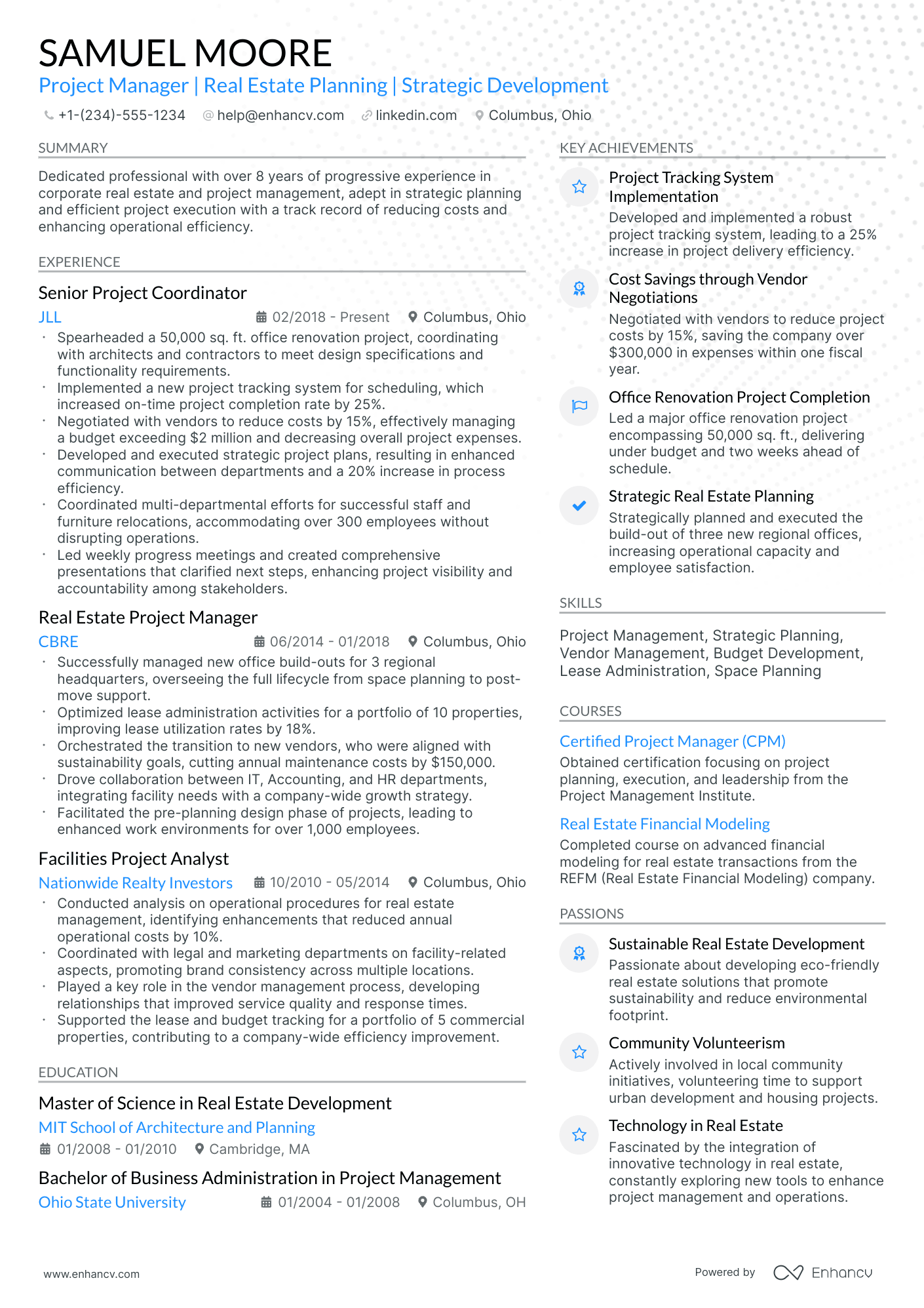
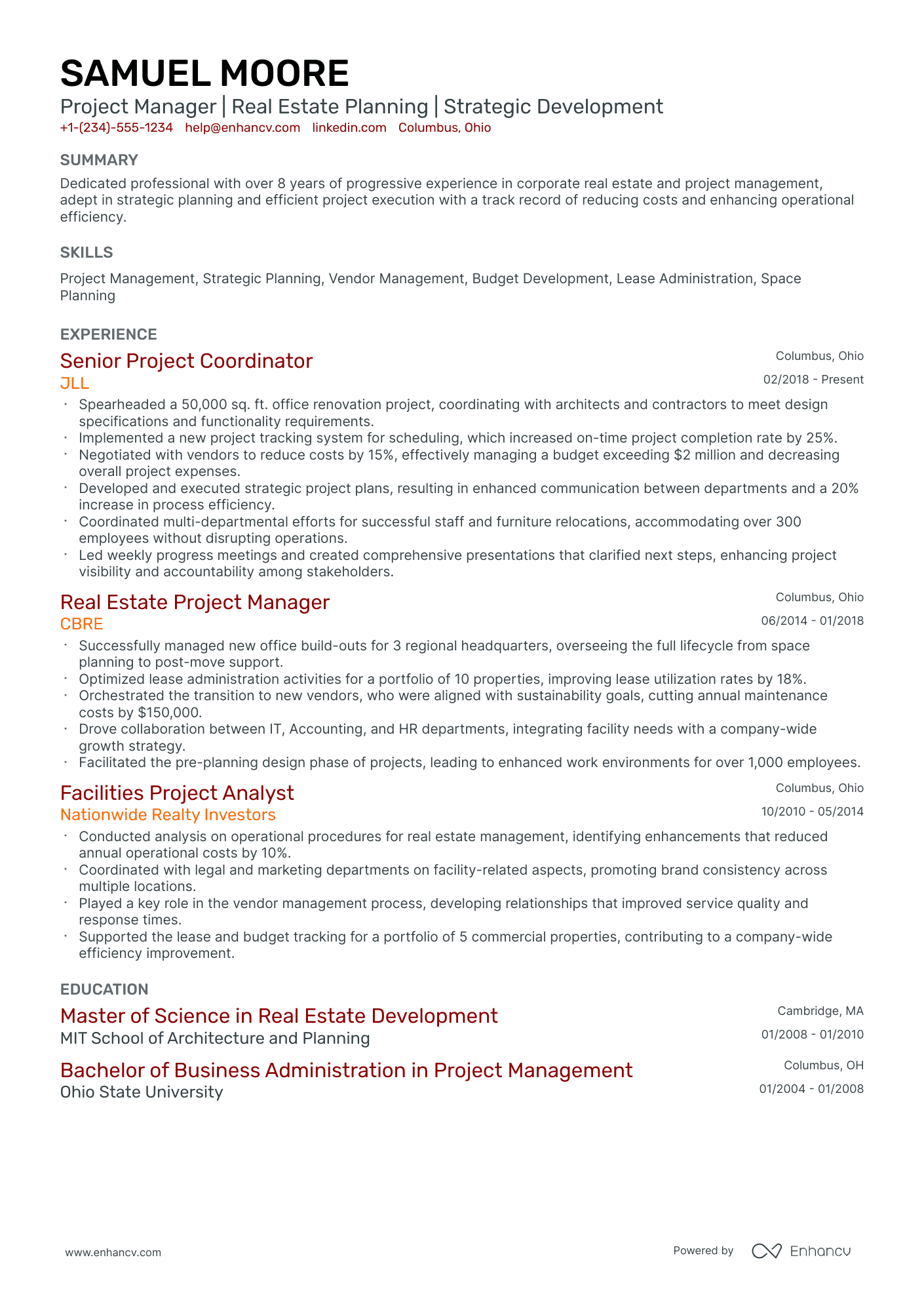
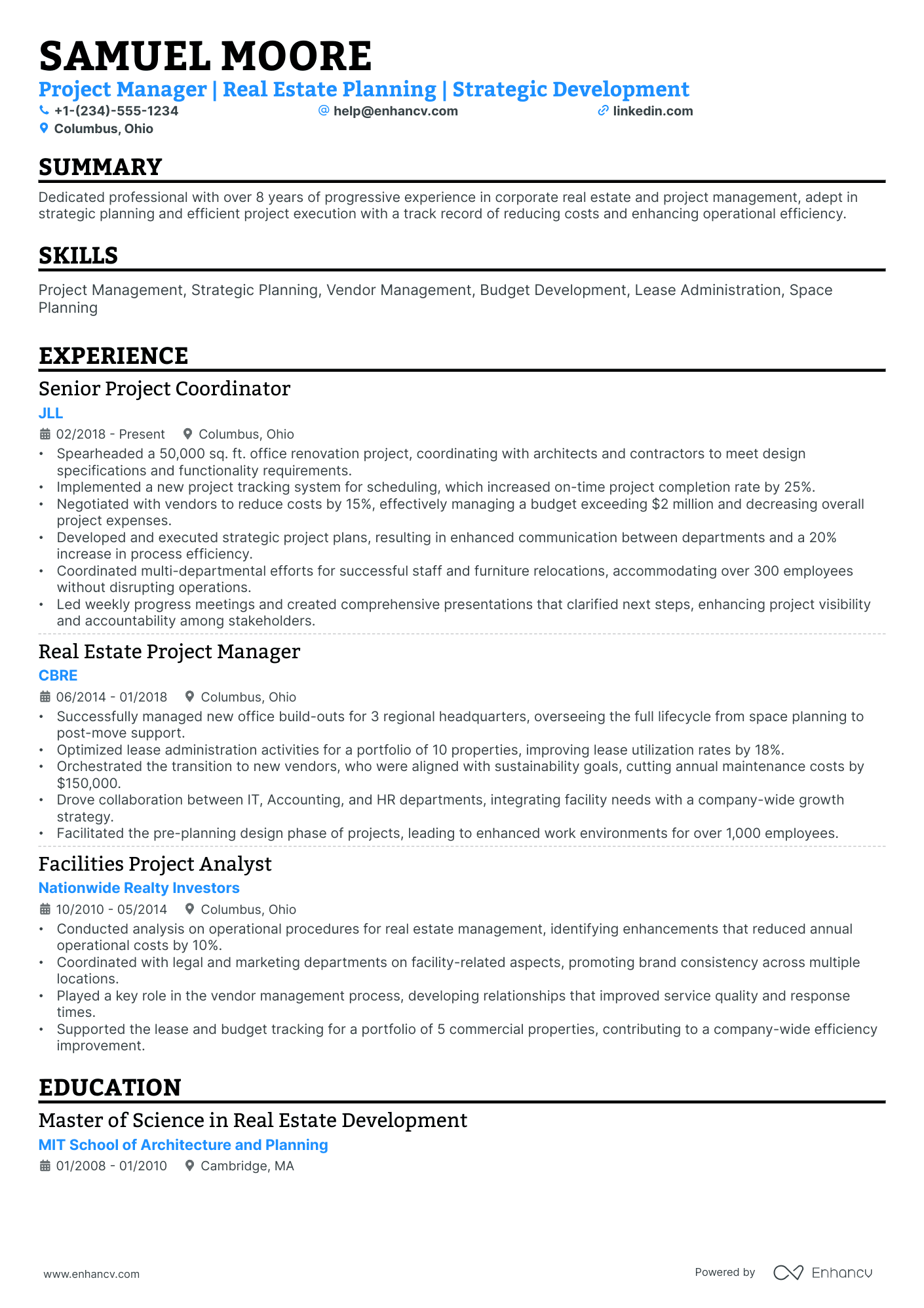
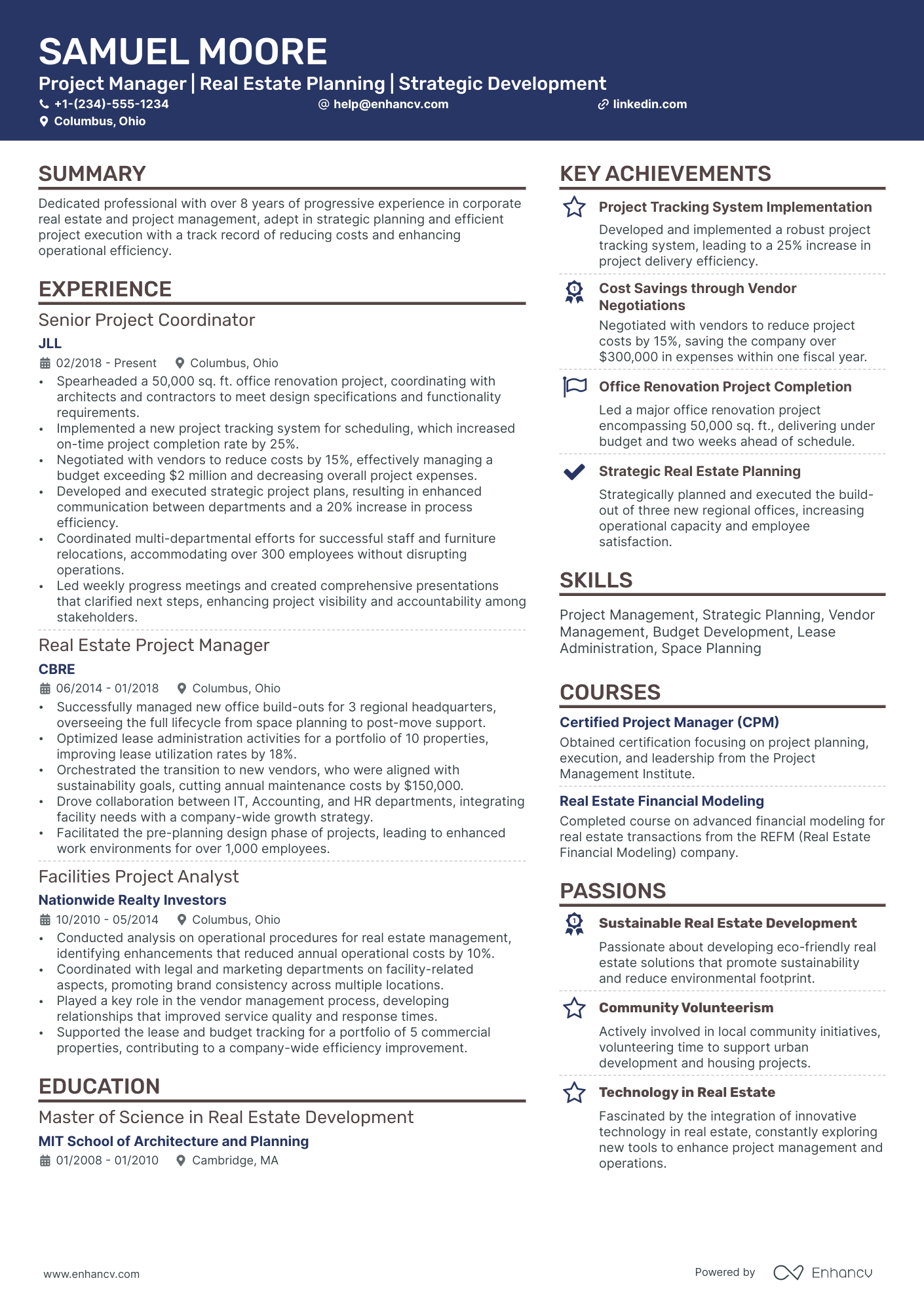
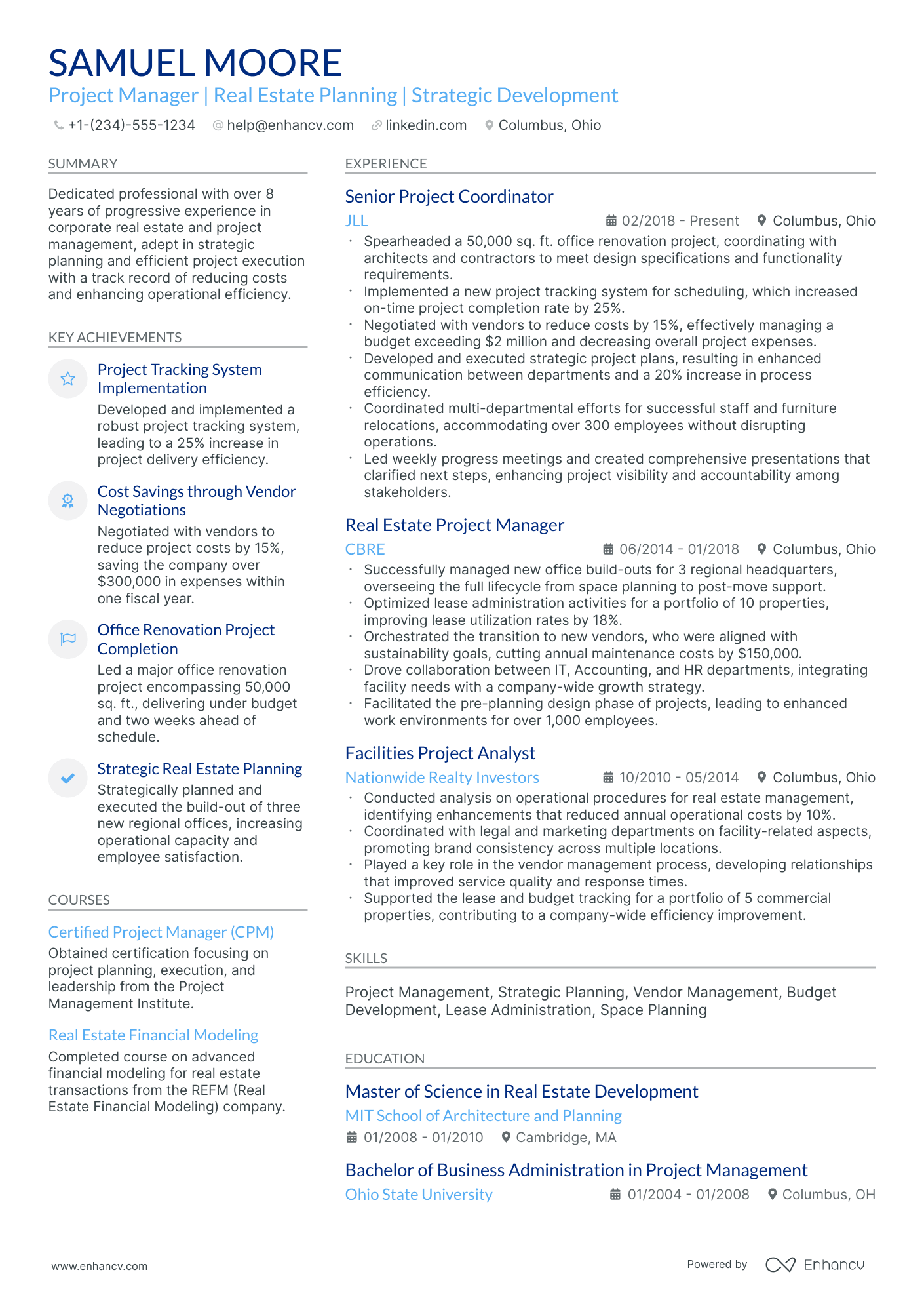
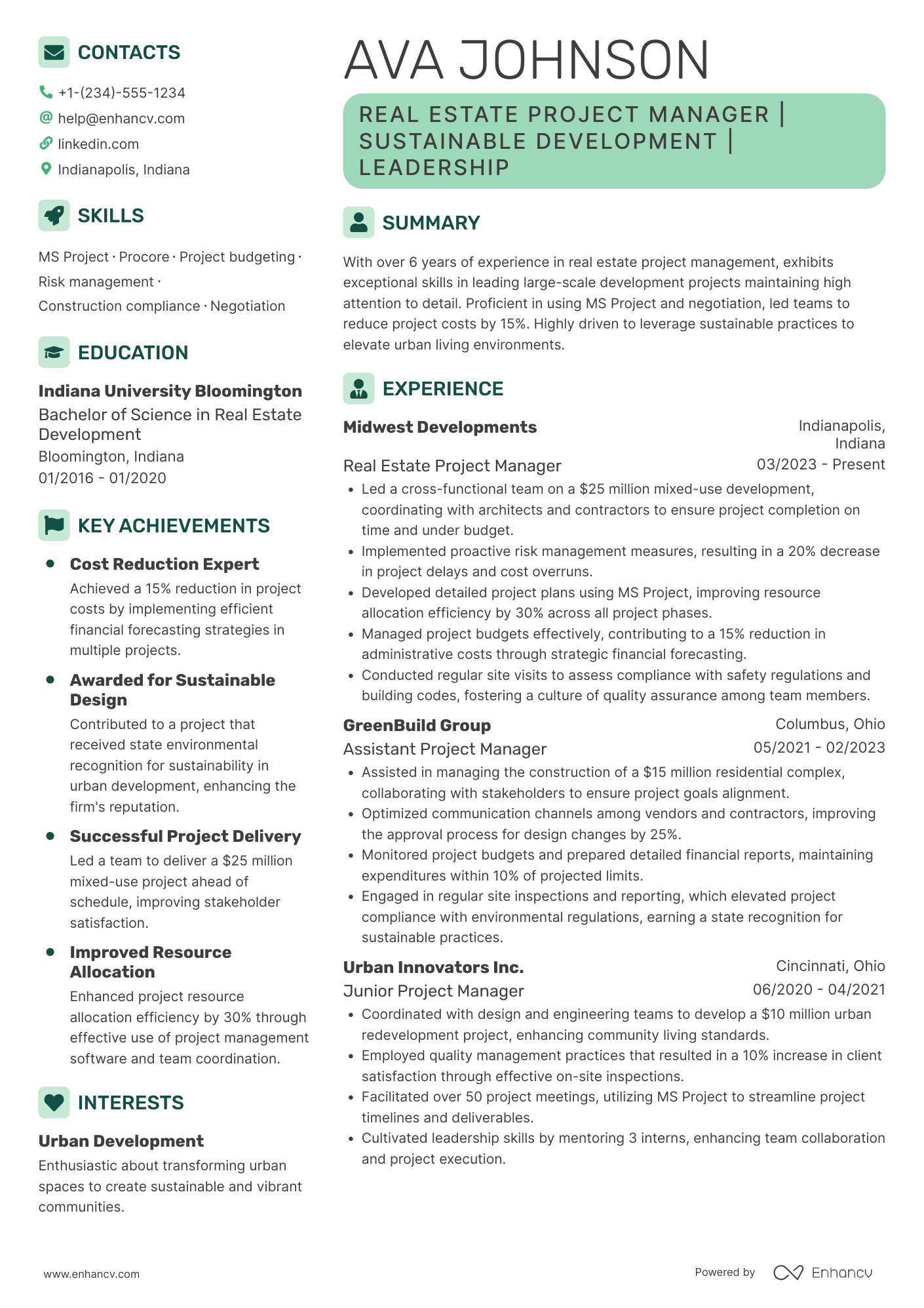
Many real estate project manager resume drafts fail because they bury scope, budgets, and delivery results under generic task lists and software. That hurts when an ATS (applicant tracking system) filters fast and recruiters scan in seconds.
A strong resume shows what you delivered and why it mattered. Knowing how to make your resume stand out means highlighting on-time openings, budget variance, square footage managed, change orders reduced, schedule compression, punch-list closeout speed, tenant satisfaction, safety performance, permit approvals, and revenue protected.

Key takeaways
- Quantify budget, schedule, and delivery outcomes instead of listing generic daily tasks.
- Use reverse-chronological format for experienced candidates and hybrid format for career changers.
- Tailor experience bullets to mirror each job posting's terminology, tools, and KPIs.
- Anchor every listed skill to a specific project, measurable result, or stakeholder outcome.
- Place certifications like PMP or LEED AP near education to reinforce credibility fast.
- Write a three- to four-line summary featuring your sector focus and top achievements.
- Use Enhancv to turn vague duties into measurable, recruiter-ready resume bullets quickly.
How to format a real estate project manager resume
Recruiters evaluating real estate project managers prioritize evidence of end-to-end project delivery, budget oversight, stakeholder coordination, and familiarity with development lifecycles across commercial or residential portfolios. The right resume format ensures these signals surface quickly, both for human reviewers scanning for scope and accountability and for applicant tracking systems parsing structured work history.

I have significant experience in this role—which format should I use?
Use a reverse-chronological format—it's the strongest way to showcase a proven track record of delivering real estate projects on time and within budget. Do:
- Lead each role entry with project scope and ownership: portfolio size, asset classes managed, and team or vendor oversight responsibilities.
- Highlight domain-specific tools and competencies such as Procore, MS Project, Bluebeam, zoning and entitlement processes, contract administration, and LEED or sustainability compliance.
- Quantify outcomes tied to business impact—cost savings, schedule compression, revenue generation, or risk mitigation across the project lifecycle.
I'm junior or switching into this role—what format works best?
A hybrid format works best—it lets you lead with transferable skills and relevant competencies while still showing a clear, chronological employment history. Do:
- Place a skills section near the top that highlights project coordination, budgeting, scheduling, and real estate fundamentals so recruiters see role alignment immediately.
- Include academic projects, internships, or cross-industry experience that involved construction oversight, vendor management, or capital planning—even if the setting wasn't real estate.
- Connect every listed action to a concrete outcome so hiring managers can assess your potential impact, not just your task list.
Why not use a functional resume?
A functional format strips away the project timelines, escalating responsibilities, and employer context that real estate hiring managers rely on to evaluate whether you can manage complex, multi-phase developments. A functional resume may be acceptable if you're transitioning from construction management, architecture, or facilities management into real estate project management and have limited direct titles to show—but only if every listed skill is anchored to specific projects, measurable deliverables, and real outcomes rather than presented as a standalone list.
Once your layout and structure are set, it's time to fill in each section with content that highlights your real estate project management expertise.
What sections should go on a real estate project manager resume
Recruiters expect to quickly find proof that you can deliver real estate projects on time, on budget, and to spec while coordinating multiple stakeholders. Understanding what to put on a resume helps you prioritize the right details.
Use this structure for maximum clarity:
- Header
- Summary
- Experience
- Skills
- Projects
- Education
- Certifications
- Optional sections: Awards, Leadership, Languages
Strong experience bullets should emphasize measurable impact, project scope, budget and schedule outcomes, risk mitigation, and stakeholder coordination results.
Is your resume good enough?
Drop your resume here or choose a file. PDF & DOCX only. Max 2MB file size.
Now that you’ve organized the essential resume components, focus on writing your real estate project manager experience section to show how you delivered results in each role.
How to write your real estate project manager resume experience
Your work experience section should spotlight the projects you've delivered, the tools and methods you relied on to keep them on track, and the measurable outcomes those efforts produced. Hiring managers prioritize demonstrated impact—budgets held, timelines met, developments completed—over descriptive task lists that merely catalog daily duties.
Each entry should include:
- Job title
- Company and location (or remote)
- Dates of employment (month and year)
Three to five concise bullet points showing what you owned, how you executed, and what outcomes you delivered:
- Ownership scope: the developments, portfolios, construction phases, or cross-functional teams you were directly accountable for as a real estate project manager.
- Execution approach: the scheduling platforms, project management software, procurement methods, budgeting frameworks, or regulatory processes you used to drive decisions and deliver work.
- Value improved: the changes you created in project timelines, cost efficiency, build quality, code compliance, risk mitigation, or tenant readiness across your real estate projects.
- Collaboration context: how you coordinated with architects, general contractors, municipal agencies, investors, leasing teams, or other stakeholders to align priorities and resolve issues.
- Impact delivered: the results your work produced—expressed through completed milestones, portfolio-level scale, or business outcomes rather than routine activity.
Experience bullet formula
A real estate project manager experience example
✅ Right example - modern, quantified, specific.
Real Estate Project Manager
Crescent Ridge Development | Austin, TX
2021–Present
Mid-size multifamily and mixed-use developer delivering ground-up projects across Central Texas.
- Led end-to-end delivery of a 312-unit, $94M Class A multifamily project using Procore, Microsoft Project, and Smartsheet—achieved certificate of occupancy three weeks early and closed out punch list within 14 days.
- Negotiated and administered $18.6M in trade contracts with AIA (American Institute of Architects) forms and DocuSign—reduced change order value from 6.2% to 3.9% through scope clarity, bid leveling, and weekly cost reviews in Excel.
- Implemented a two-week lookahead planning cadence with the general contractor and key subcontractors—cut schedule variance by 22% and improved on-time inspections from 78% to 93% using city portal tracking and Procore RFIs.
- Coordinated architects, civil engineers, and MEP (mechanical, electrical, and plumbing) consultants through Bluebeam Revu markups and BIM (building information modeling) clash reviews—prevented four major field conflicts and avoided an estimated $410K in rework.
- Built a stakeholder communication plan for ownership, lenders, and property management—standardized monthly draw packages and risk logs, shortening lender approval cycles by five days and improving forecast accuracy to within 1.5%.
Now that you've seen how a strong experience section comes together, let's look at how to adapt yours to match a specific job posting.
How to tailor your real estate project manager resume experience
Recruiters evaluate your real estate project manager resume through both human review and applicant tracking systems. Tailoring your resume to the job description increases your chances of passing both screenings.
Ways to tailor your real estate project manager experience:
- Match project management tools like Procore or MS Project from the listing.
- Mirror the job posting's terminology for development phases or milestones.
- Reflect specific KPIs such as occupancy targets or budget benchmarks mentioned.
- Include relevant property types like commercial or mixed-use when specified.
- Highlight zoning compliance or building code adherence if the role requires it.
- Reference stakeholder coordination models described in the job description.
- Align your experience with construction delivery methods the employer uses.
- Emphasize vendor procurement or contract negotiation when the posting prioritizes it.
Tailoring means aligning your real accomplishments with what the employer asked for, not forcing keywords where they don't belong.
Resume tailoring examples for real estate project manager
| Job description excerpt | Untailored | Tailored |
|---|---|---|
| "Oversee full project lifecycle for mixed-use developments valued at $10M+, ensuring delivery within budget and schedule using Procore and MS Project." | Managed various construction projects from start to finish. | Directed the full project lifecycle for three mixed-use developments valued at $12M–$18M each, delivering all phases within budget and an average of two weeks ahead of schedule using Procore and MS Project. |
| "Coordinate due diligence, entitlements, and zoning approvals for commercial acquisitions across multiple municipalities." | Helped with research and paperwork for new property purchases. | Coordinated due diligence, entitlement applications, and zoning approvals for 15 commercial acquisitions across four municipalities, reducing average approval timelines by 20%. |
| "Lead cross-functional teams including architects, contractors, and leasing agents to align construction milestones with tenant occupancy targets." | Worked with different teams to keep projects on track. | Led cross-functional teams of architects, general contractors, and leasing agents across six retail and office developments, aligning construction milestones with tenant occupancy targets and achieving 95% on-time tenant move-ins. |
Once you’ve aligned your experience with the role’s priorities, the next step is to quantify your real estate project manager achievements so employers can see the impact you delivered.
How to quantify your real estate project manager achievements
Quantifying your achievements shows how you protect budgets, timelines, and stakeholders. Focus on schedule variance, cost savings, change orders, risk and compliance outcomes, and delivery volume across sites, vendors, and permitting milestones.
Quantifying examples for real estate project manager
| Metric | Example |
|---|---|
| Schedule | "Delivered a 220-unit multifamily build two weeks early by resequencing trades in MS Project and running weekly look-aheads with five subcontractors." |
| Budget | "Cut hard-cost overruns from 6% to 2% on a $18M renovation by renegotiating three bid packages and tracking commitments in Procore." |
| Change orders | "Reduced change order value by $410K by tightening RFIs, issuing 28 clarified ASIs, and enforcing scope sign-off with architect and general contractor." |
| Risk and compliance | "Passed city inspections on first attempt across 14 permit milestones by maintaining a permit log, closing 100% of punch items, and documenting safety audits." |
| Delivery volume | "Managed eight concurrent tenant improvement projects totaling 96,000 square feet, coordinating 12 vendors and hitting 90% on-time handovers over six months." |
Turn vague job duties into measurable, recruiter-ready resume bullets in seconds with Enhancv's Bullet Point Generator.
Once your bullet points clearly convey your impact, the next step is ensuring your skills section reinforces those achievements with the right mix of hard and soft skills.
How to list your hard and soft skills on a real estate project manager resume
Your skills section shows you can run real estate projects end to end, and recruiters and an ATS (applicant tracking system) scan it to confirm role fit fast—aim for a hard skills-heavy mix supported by a focused set of execution and soft skills. real estate project manager roles require a blend of:
- Product strategy and discovery skills.
- Data, analytics, and experimentation skills.
- Delivery, execution, and go-to-market discipline.
- Soft skills.
Your skills section should be:
- Scannable (bullet-style grouping).
- Relevant to the job post.
- Backed by proof in experience bullets.
- Updated with current tools.
Place your skills section:
- Above experience if you're junior or switching careers.
- Below experience if you're mid/senior with strong achievements.

Hard skills
- MS Project, Primavera P6
- Smartsheet, Asana, Jira
- Project scheduling and CPM
- Budgeting, cost forecasting
- Procore project controls
- RFI, submittals, change orders
- Contract administration (AIA)
- Vendor procurement and bid leveling
- Permitting and entitlement tracking
- Risk registers and mitigation plans
- Site due diligence, feasibility analysis
- Excel financial modeling, cash flow
Soft skills
- Lead owner-architect-contractor alignment
- Drive decisions with trade-offs
- Manage scope and expectation resets
- Run tight weekly status cadences
- Negotiate change order outcomes
- Resolve field conflicts fast
- Escalate risks with clear options
- Communicate schedule impacts plainly
- Hold vendors accountable to commitments
- Document decisions and approvals
- Balance speed, cost, and quality
- Stay calm under delivery pressure
How to show your real estate project manager skills in context
Skills shouldn't live only in a dedicated skills list. Explore resume skills examples to see how top candidates weave competencies throughout their resumes.
They should be demonstrated in:
- Your summary (high-level professional identity)
- Your experience (proof through outcomes)
Here's what that looks like in practice.
Summary example
Senior real estate project manager with 12 years overseeing mixed-use developments totaling $180M. Skilled in Procore, stakeholder negotiation, and value engineering. Reduced average project delivery timelines by 14% through agile scheduling and cross-functional team leadership.
- Reflects senior-level experience clearly
- Names industry-standard tools
- Leads with a measurable outcome
- Highlights negotiation and leadership
Experience example
Senior Real Estate Project Manager
Meridian Development Partners | Denver, CO
June 2018–Present
- Delivered 11 mixed-use projects valued at $210M using Procore and MS Project, finishing 93% on or under budget.
- Coordinated with architects, contractors, and city planners to cut permitting delays by 22% across the portfolio.
- Introduced earned value management reporting, improving cost forecast accuracy by 17% for executive stakeholders.
- Every bullet includes measurable proof
- Skills surface naturally through outcomes
Once you’ve tied your abilities to measurable outcomes and relevant project examples, the next step is applying that same approach to build a real estate project manager resume when you don’t have direct experience.
How do I write a real estate project manager resume with no experience
Even without full-time experience, you can demonstrate readiness through:
- Construction management coursework projects
- Internship supporting project scheduling
- Volunteer renovation or community build
- Property management assistant responsibilities
- Capstone budget and procurement plan
- Permit research and submittal support
- Student-led site safety inspections
- Software training project simulations
If you're starting out, our guide on building a resume without work experience walks you through how to leverage these types of entries effectively.
Focus on:
- Scheduling, budgets, and change logs
- Permit tracking and inspection readiness
- Vendor bids, scopes, and contracts
- Real estate project manager tools usage
Resume format tip for entry-level real estate project manager
Use a hybrid resume format because it highlights project work and tools while keeping education and limited experience easy to scan. Do:
- Lead with a projects section.
- Add tools like Microsoft Project.
- Quantify scope, cost, and timeline.
- List permits, bids, and submittals.
- Match keywords from job postings.
- Built a Microsoft Project schedule for a student-led renovation, tracked ten tasks and two milestones, and cut timeline variance from 12% to 4%.
Even without direct experience, your educational background can strengthen your candidacy—here's how to present it effectively.
How to list your education on a real estate project manager resume
Your education section helps hiring teams confirm you have the foundational knowledge needed for a real estate project manager role. It signals relevant training in construction, business, or project management.
Include:
- Degree name
- Institution
- Location
- Graduation year
- Relevant coursework (for juniors or entry-level candidates)
- Honors & GPA (if 3.5 or higher)
Skip month and day details—list the graduation year only.
Here's a strong education entry tailored to a real estate project manager resume.
Example education entry
Bachelor of Science in Construction Management
University of Southern California, Los Angeles, CA
Graduated 2019
GPA: 3.7/4.0
- Relevant coursework: Real Estate Development, Project Scheduling, Construction Cost Estimating, and Urban Land Use Planning
- Honors: Magna Cum Laude, Dean's List (six consecutive semesters)
How to list your certifications on a real estate project manager resume
Certifications on a resume show a real estate project manager's commitment to learning, proficiency with key tools and methods, and relevance to real estate delivery, compliance, and stakeholder needs.
Include:
- Certificate name
- Issuing organization
- Year
- Optional: credential ID or URL
- Place certifications below education when they're older, less relevant, or you want your degree and core training to lead.
- Place certifications above education when they're recent, highly relevant, or required for the real estate project manager role.
Best certifications for your real estate project manager resume
- Project Management Professional (PMP)
- Certified Construction Manager (CCM)
- LEED Green Associate
- LEED Accredited Professional (LEED AP)
- OSHA 30-Hour Construction Safety
- Certified ScrumMaster (CSM)
- RICS Project Management Certificate
Once you’ve positioned your credentials where they’ll carry the most weight, focus on writing your real estate project manager resume summary to highlight them in a clear, results-driven opening.
How to write your real estate project manager resume summary
Your resume summary is the first thing a recruiter reads. A strong one immediately signals you're qualified for this real estate project manager role.
Keep it to three to four lines, with:
- Your title and total years of experience in project management.
- Real estate sector focus, such as commercial, residential, or mixed-use development.
- Core tools and skills like MS Project, Procore, budgeting, and contract negotiation.
- One or two measurable achievements, such as cost savings or on-time delivery rates.
- Soft skills tied to real outcomes, like stakeholder communication that reduced approval delays.

PRO TIP
At a mid-level role, emphasize hands-on project delivery and domain-specific skills. Highlight measurable results from projects you managed directly. Avoid vague phrases like "passionate professional" or "results-driven team player." Recruiters want proof of impact, not self-assessment.
Example summary for a real estate project manager
Real estate project manager with six years of experience delivering commercial builds using Procore and MS Project. Managed $12M in developments, completing 93% of projects on time through proactive stakeholder coordination.
Optimize your resume summary and objective for ATS
Drop your resume here or choose a file.
PDF & DOCX only. Max 2MB file size.
Now that your summary captures your professional value, make sure your header presents your contact details clearly so recruiters can actually reach you.
What to include in a real estate project manager resume header
A resume header is the top section with your key identifiers, and it boosts visibility, credibility, and recruiter screening for a real estate project manager.
Essential resume header elements
- Full name
- Tailored job title and headline
- Location
- Phone number
- Professional email
- GitHub link
- Portfolio link
A LinkedIn link helps recruiters verify experience quickly and supports screening.
Don't include a photo on a real estate project manager resume unless the role is explicitly front-facing or appearance-dependent.
Match your headline to the job posting and keep all contact details on one line for fast scanning.
Example
Real estate project manager resume header
Jordan Lee
Real estate project manager | Ground-up multifamily and tenant improvement delivery
Austin, TX
(512) 555-01XX
your.name@enhancv.com github.com/yourname yourwebsite.com linkedin.com/in/yourname
Once your contact details and role branding are set at the top, add targeted additional sections to reinforce your qualifications and fill in details the header can’t cover.
Additional sections for real estate project manager resumes
Adding extra sections helps you stand out when your core qualifications closely match other candidates for the same real estate project manager role.
Choose sections that reinforce your industry credibility and project leadership skills:
- Languages
- Professional affiliations (e.g., PMI, ULI, NAIOP)
- Certifications and licenses
- Publications or industry presentations
- Volunteer experience in community development or housing
- Awards and recognitions
- Continuing education and training
Once you've strengthened your resume with relevant additional sections, pairing it with a tailored cover letter can further set your application apart.
Do real estate project manager resumes need a cover letter
A cover letter isn't required for a real estate project manager, but it often helps in competitive searches or when hiring teams expect one. If you're unsure where to start, learn what a cover letter is and how it complements your resume. It can make a difference when your resume needs context, or when the role involves complex stakeholder and budget management.
Use a cover letter to add context your resume can't show:
- Explain role and team fit by connecting your delivery style to the firm's project types, partners, and decision process.
- Highlight one or two relevant projects with clear outcomes, such as schedule recovery, change order reduction, or budget variance control.
- Show understanding of the business context by referencing the asset class, tenant needs, permitting risks, and how the team measures success.
- Address career transitions or non-obvious experience by mapping prior work to real estate project manager responsibilities and key tools.
Drop your resume here or choose a file.
PDF & DOCX only. Max 2MB file size.
Even if you include a cover letter to add context beyond your resume, using AI to improve your real estate project manager resume helps you strengthen the document itself and align it with the role.
Using AI to improve your real estate project manager resume
AI can sharpen your resume's clarity, structure, and impact. It helps refine language and highlight measurable results. But overuse strips authenticity. Once your content feels clear and role-aligned, step away from AI. For practical starting points, explore these ChatGPT resume writing prompts.
Here are 10 practical prompts to strengthen specific sections of your real estate project manager resume:
- Sharpen your summary. "Rewrite my resume summary to highlight my top three achievements as a real estate project manager in under four sentences."
- Quantify experience bullets. "Add specific metrics like budget size, timelines, and square footage to these real estate project manager experience bullets."
- Align skills section. "Compare my listed skills against this real estate project manager job description and suggest missing hard skills."
- Strengthen action verbs. "Replace weak verbs in my real estate project manager experience section with stronger, industry-specific action verbs."
- Tighten project descriptions. "Condense these real estate project manager project descriptions to two lines each while keeping measurable outcomes."
- Optimize certifications section. "Reorder my certifications to prioritize those most relevant to a real estate project manager role."
- Improve education relevance. "Rewrite my education section to emphasize coursework and achievements relevant to a real estate project manager career."
- Remove redundant phrasing. "Identify and remove filler words or repeated phrases across my real estate project manager resume."
- Tailor to job posting. "Adjust my real estate project manager experience bullets to mirror the language used in this specific job posting."
- Clarify scope of work. "Rewrite these bullets to clearly define my role versus team contributions in each real estate project manager position."
Stop using AI once your resume sounds accurate, specific, and aligned with real experience. AI should never invent experience or inflate claims—if it didn't happen, it doesn't belong here.
Conclusion
A strong real estate project manager resume proves impact with measurable outcomes, role-specific skills, and a clear structure. Highlight budget control, schedule performance, risk management, vendor oversight, and stakeholder communication using numbers, dates, and scope.
Keep every section easy to scan, with consistent titles and focused bullet points. This approach shows you can deliver results now and adapt to today’s and near-future hiring market.