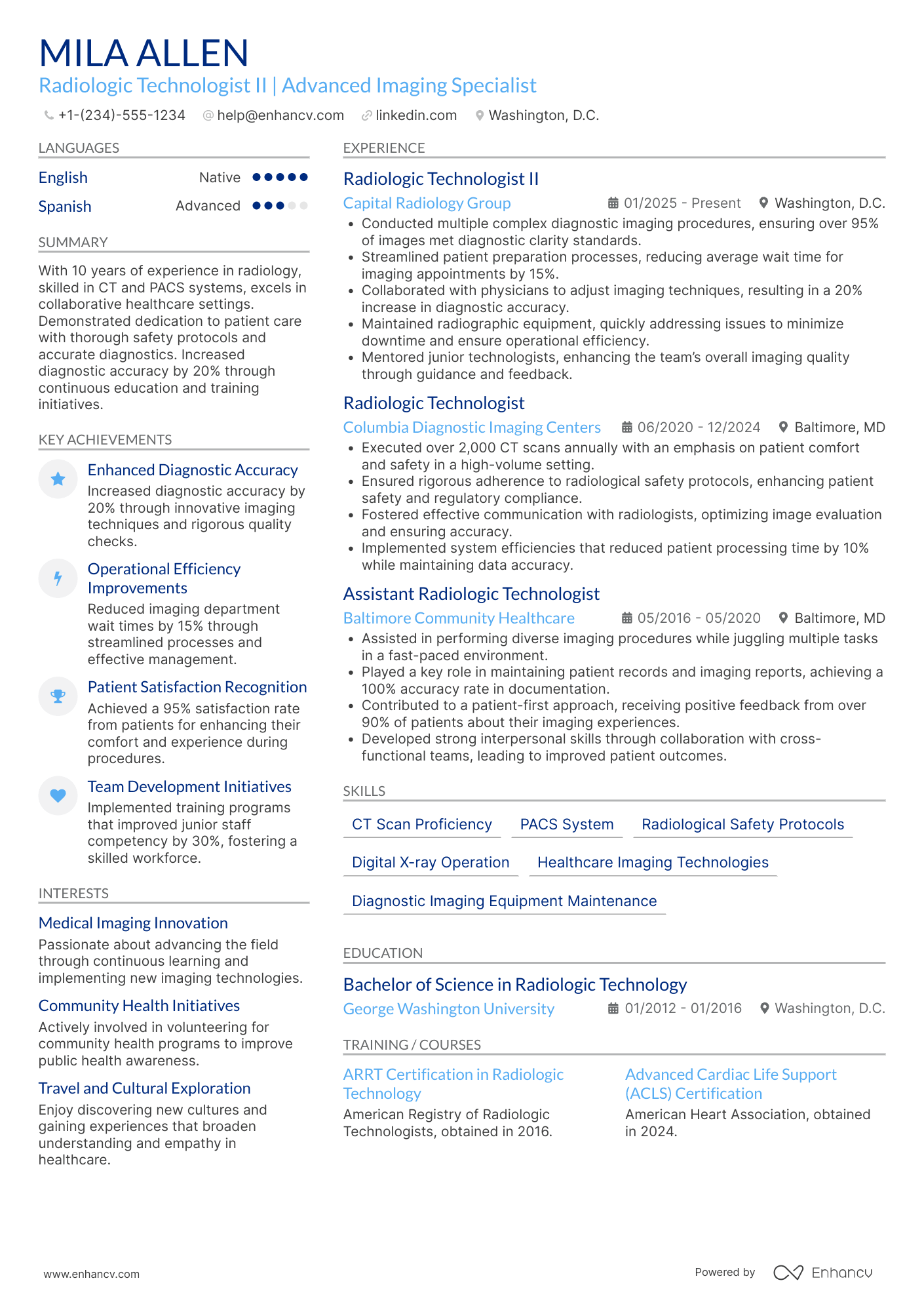
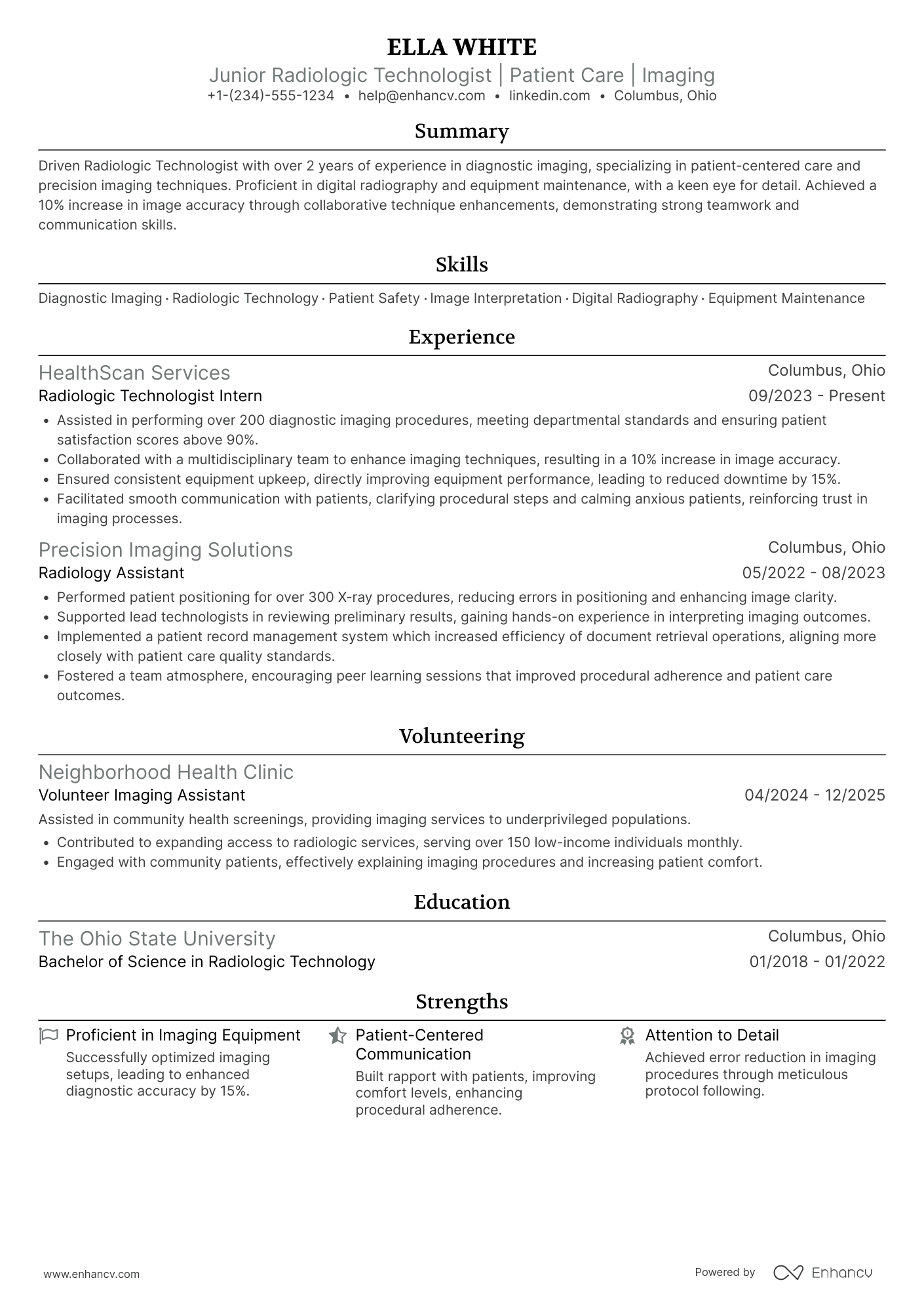
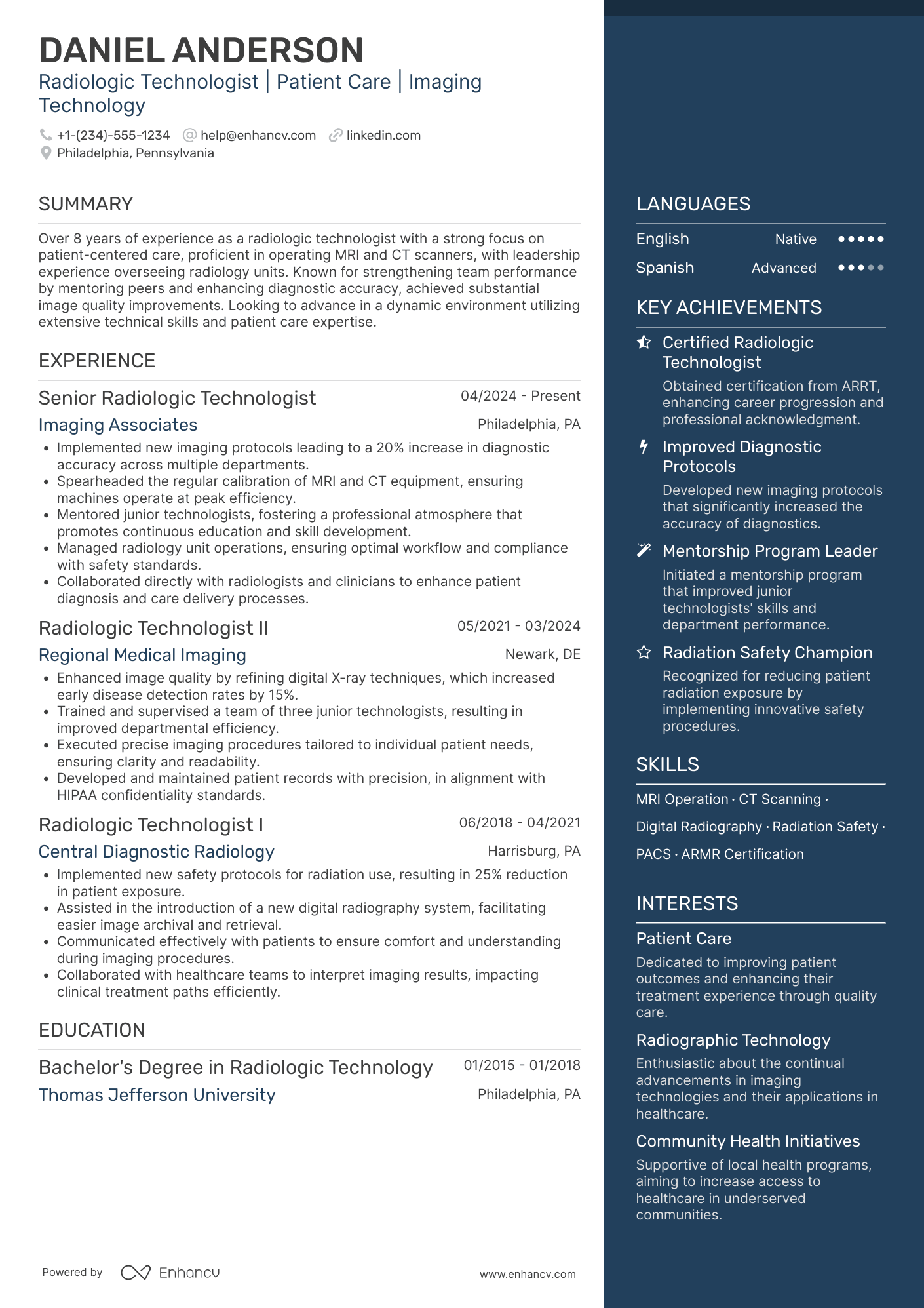
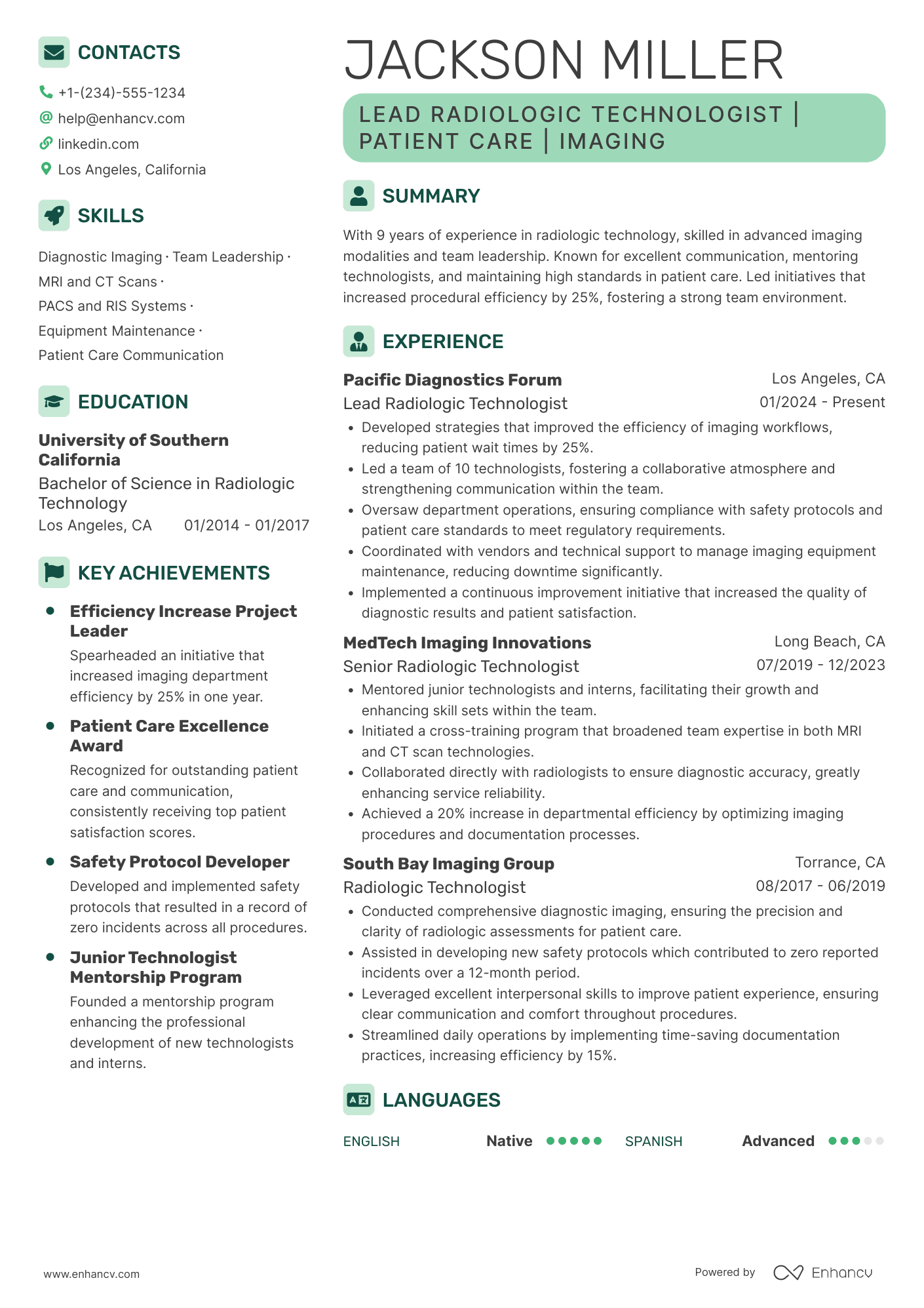
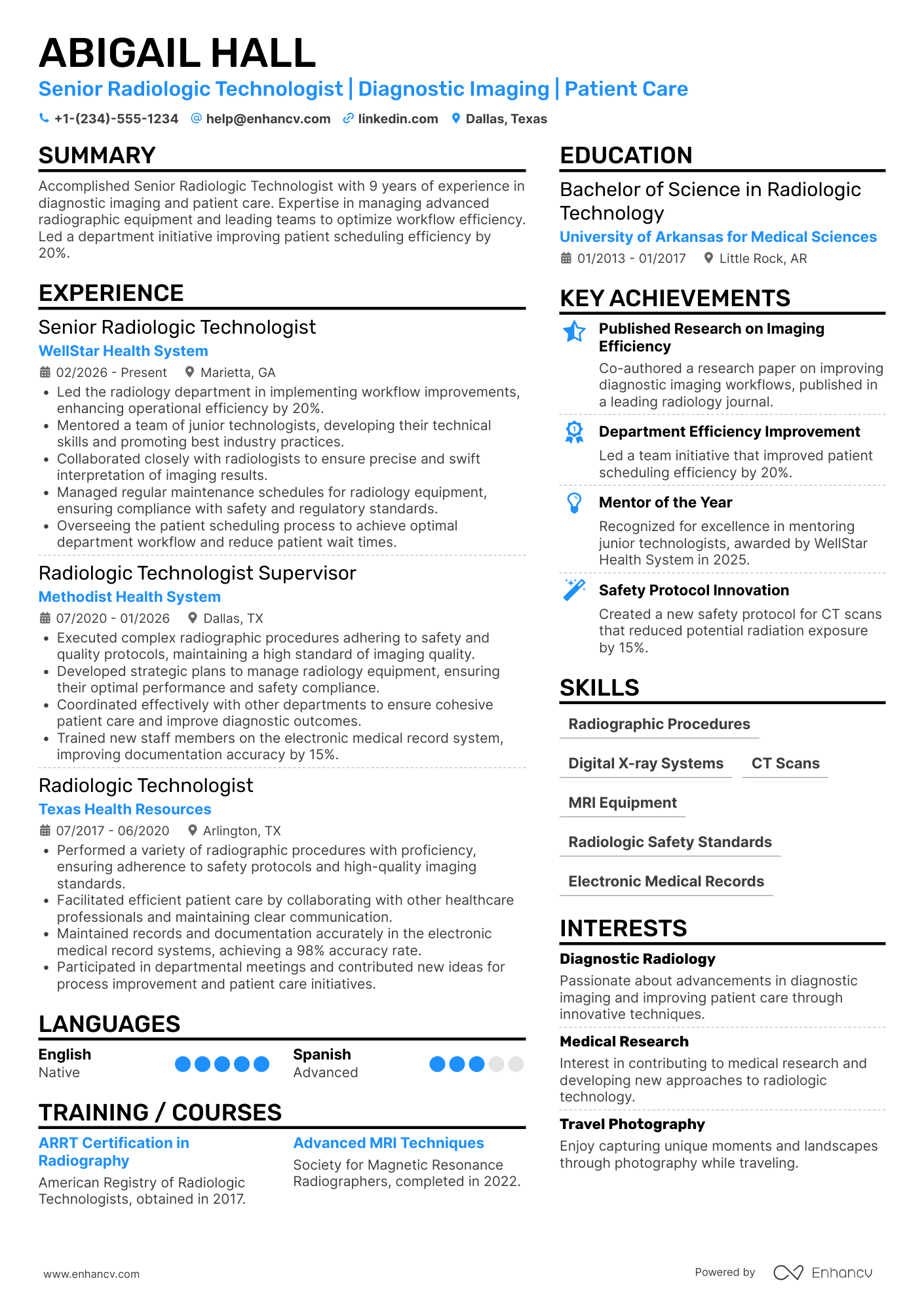
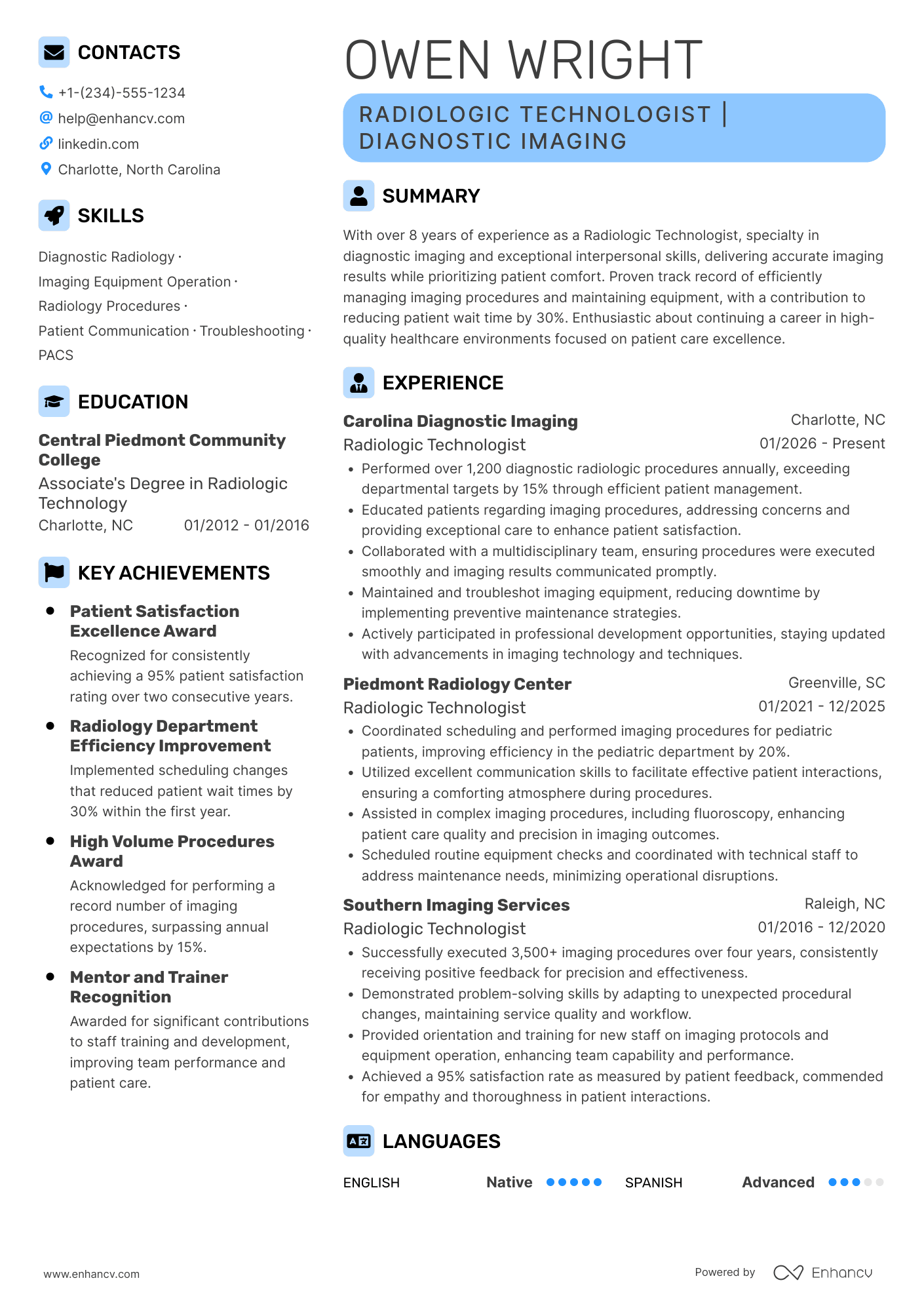
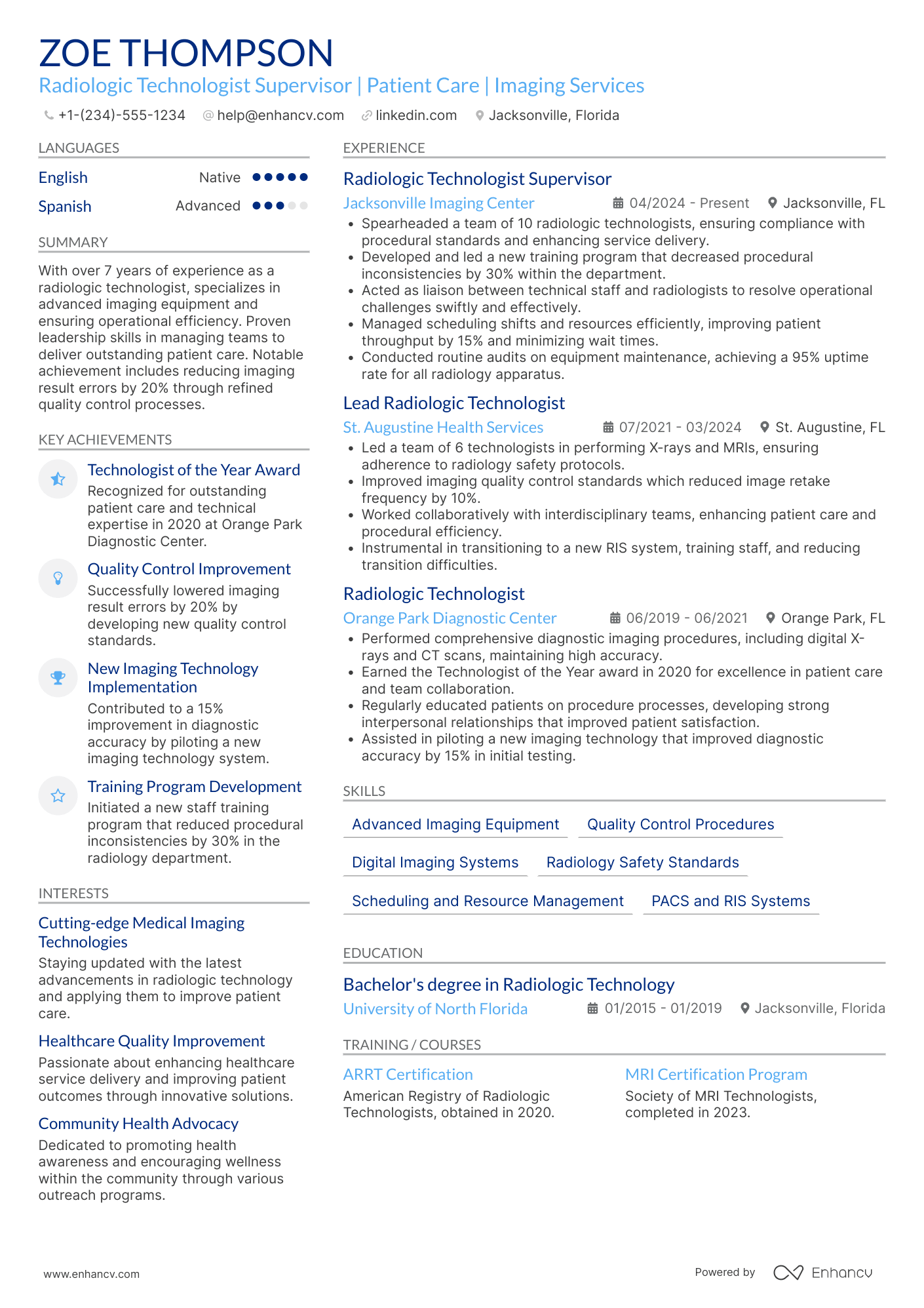
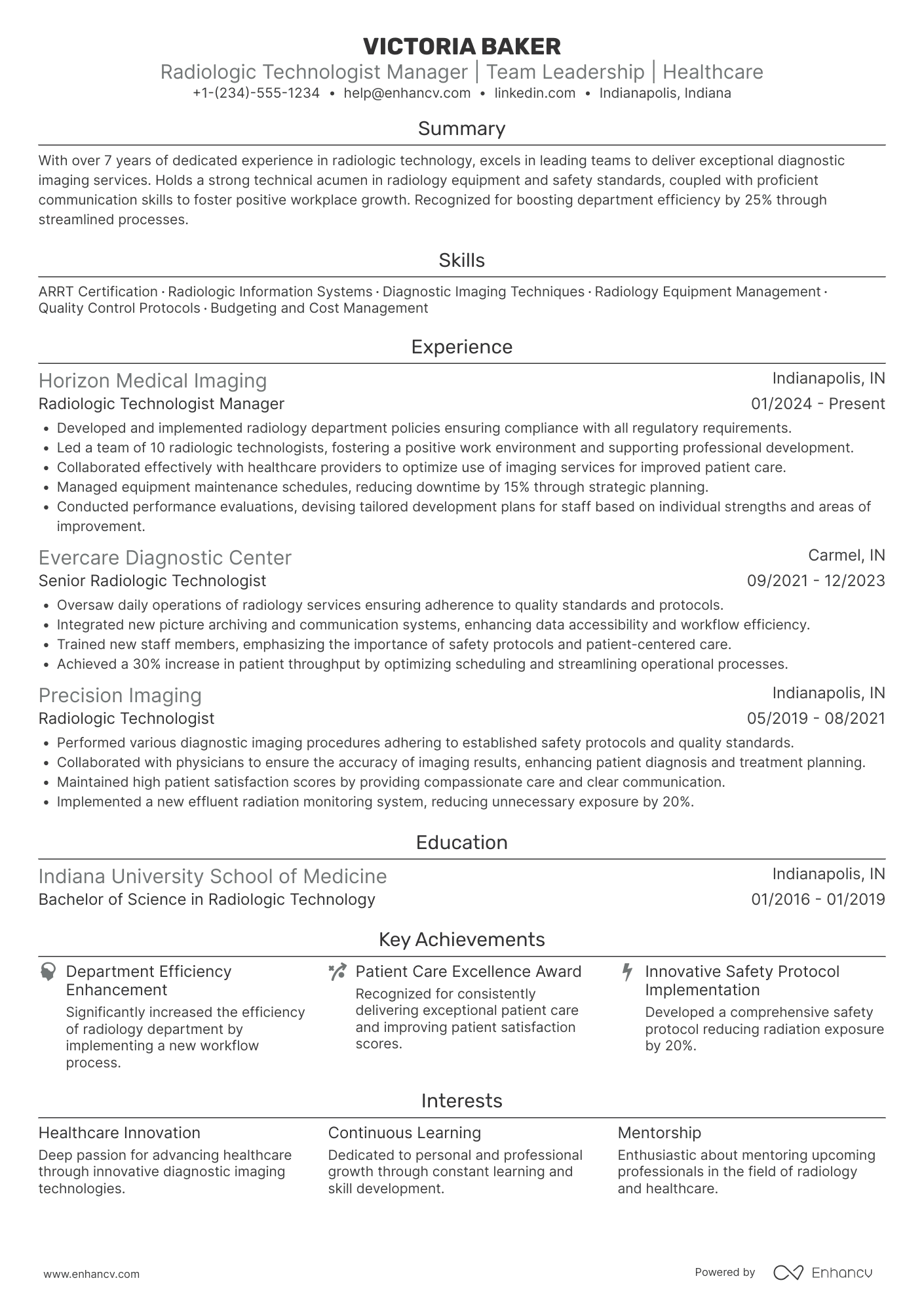
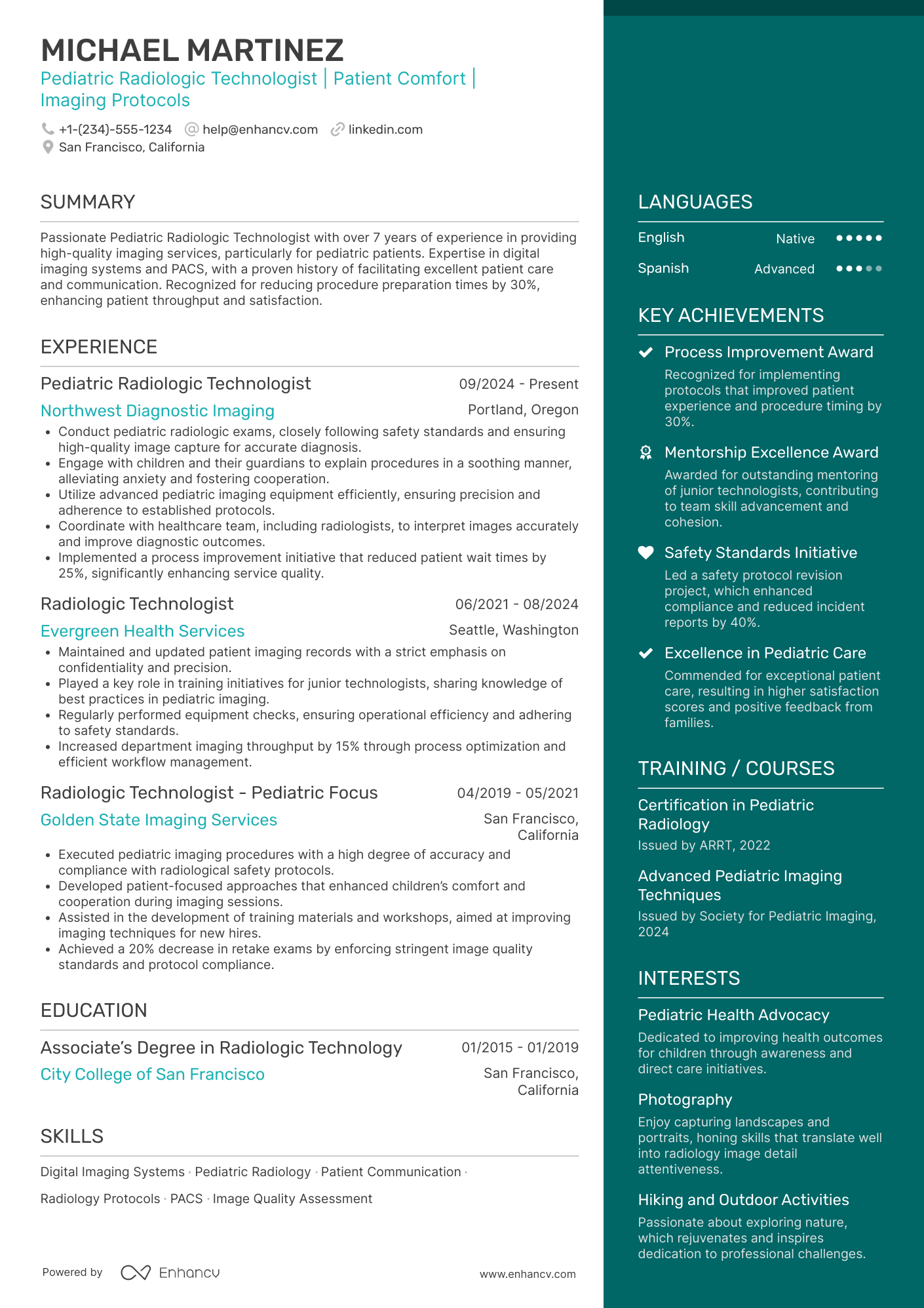
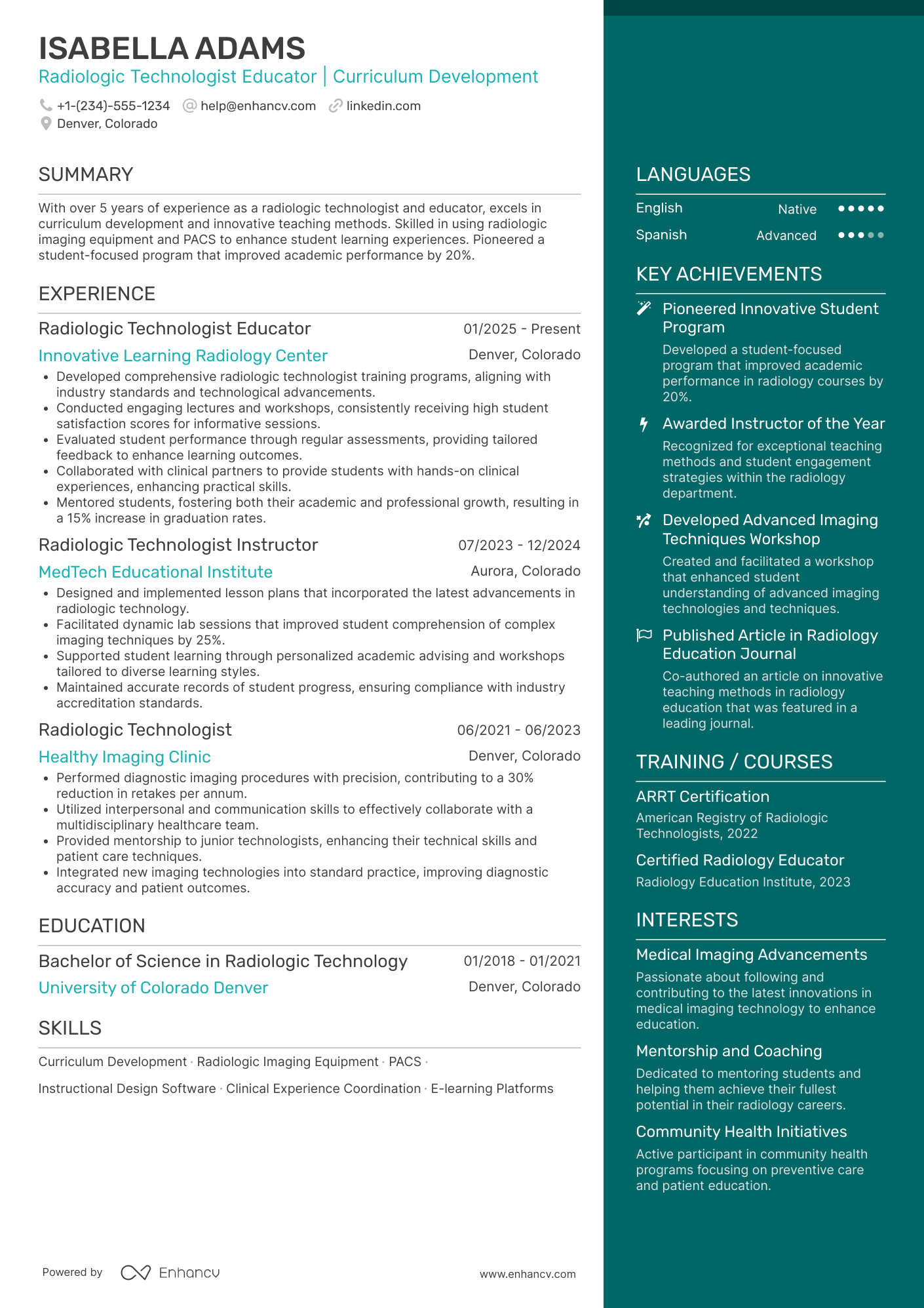
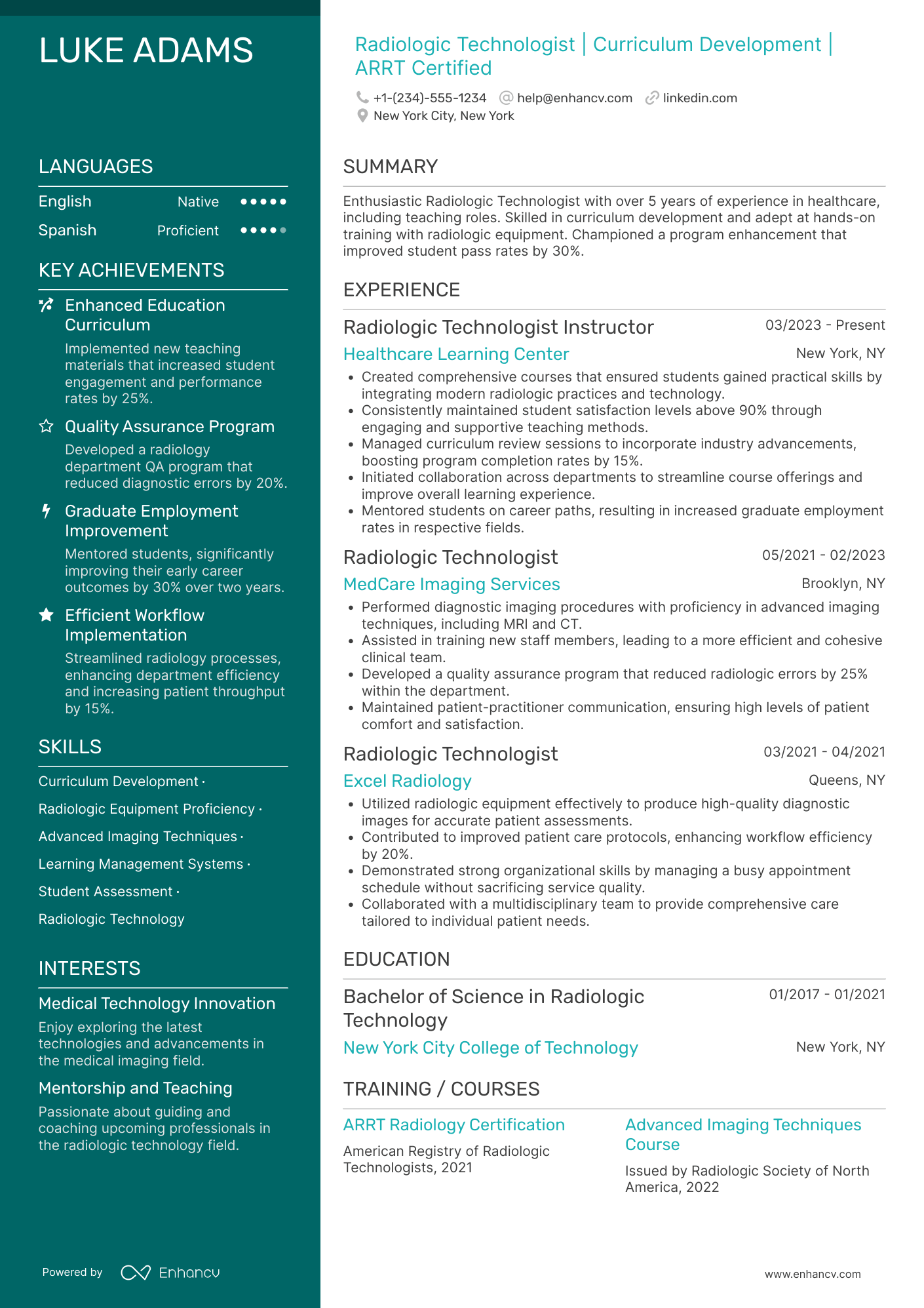
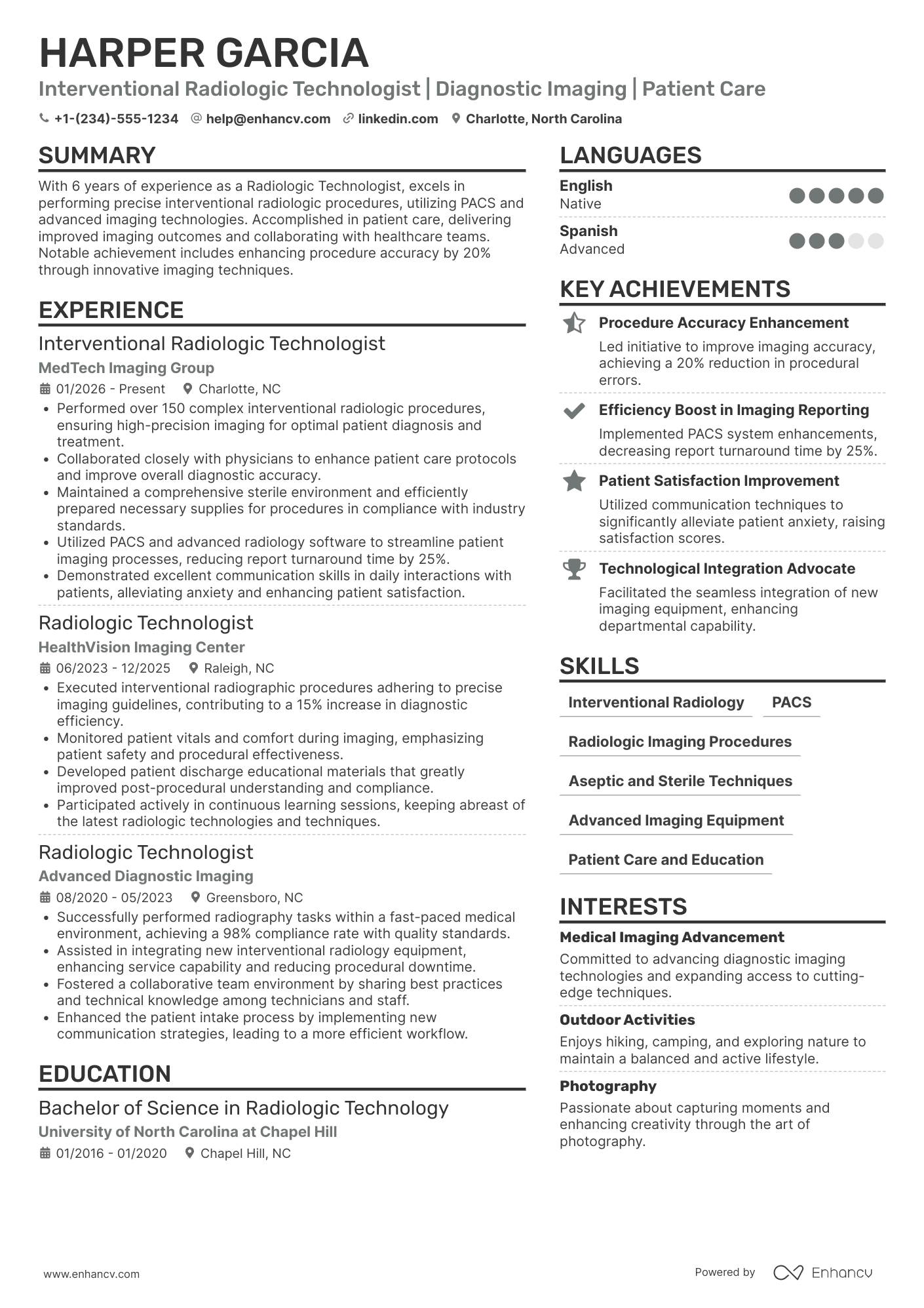
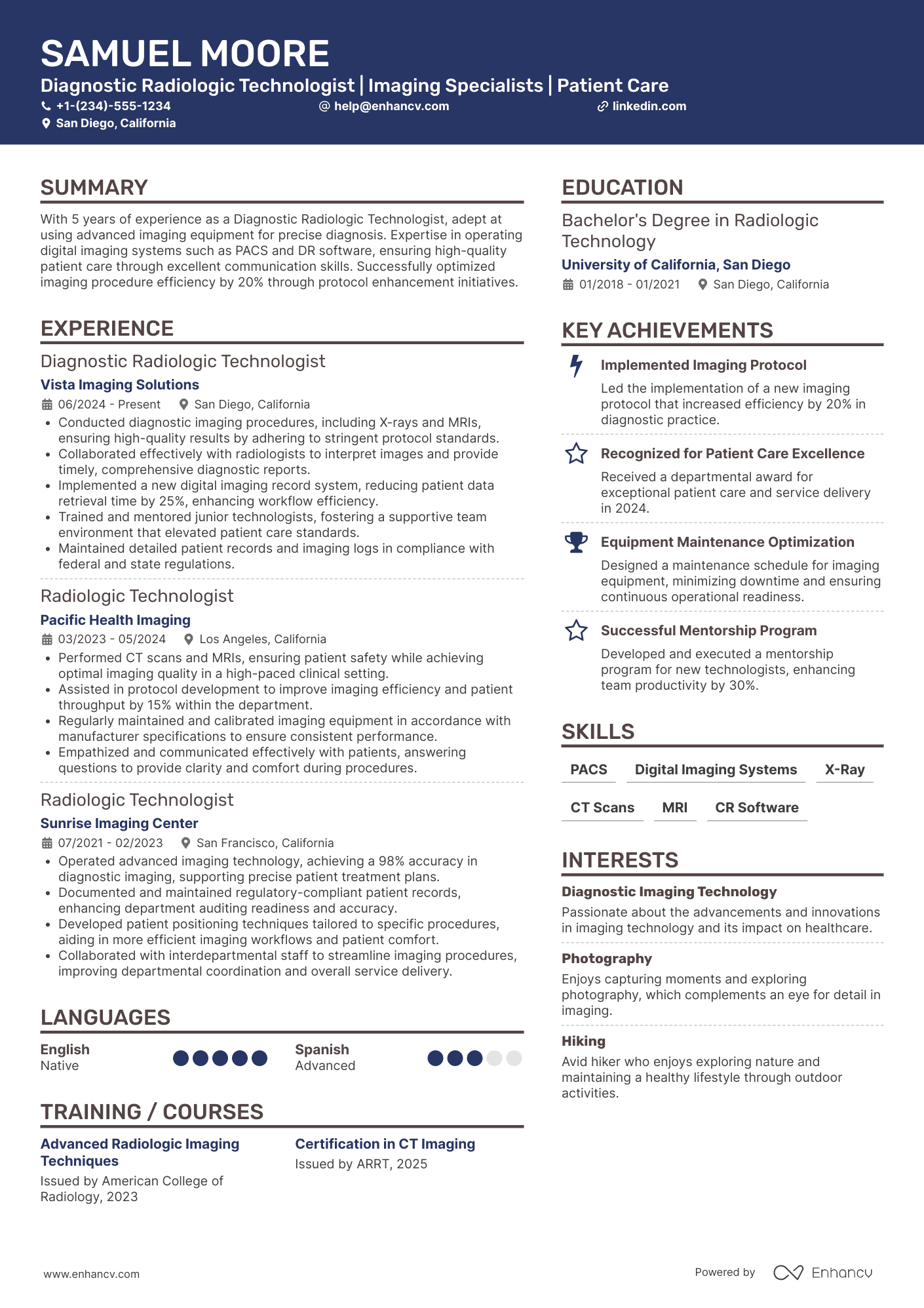
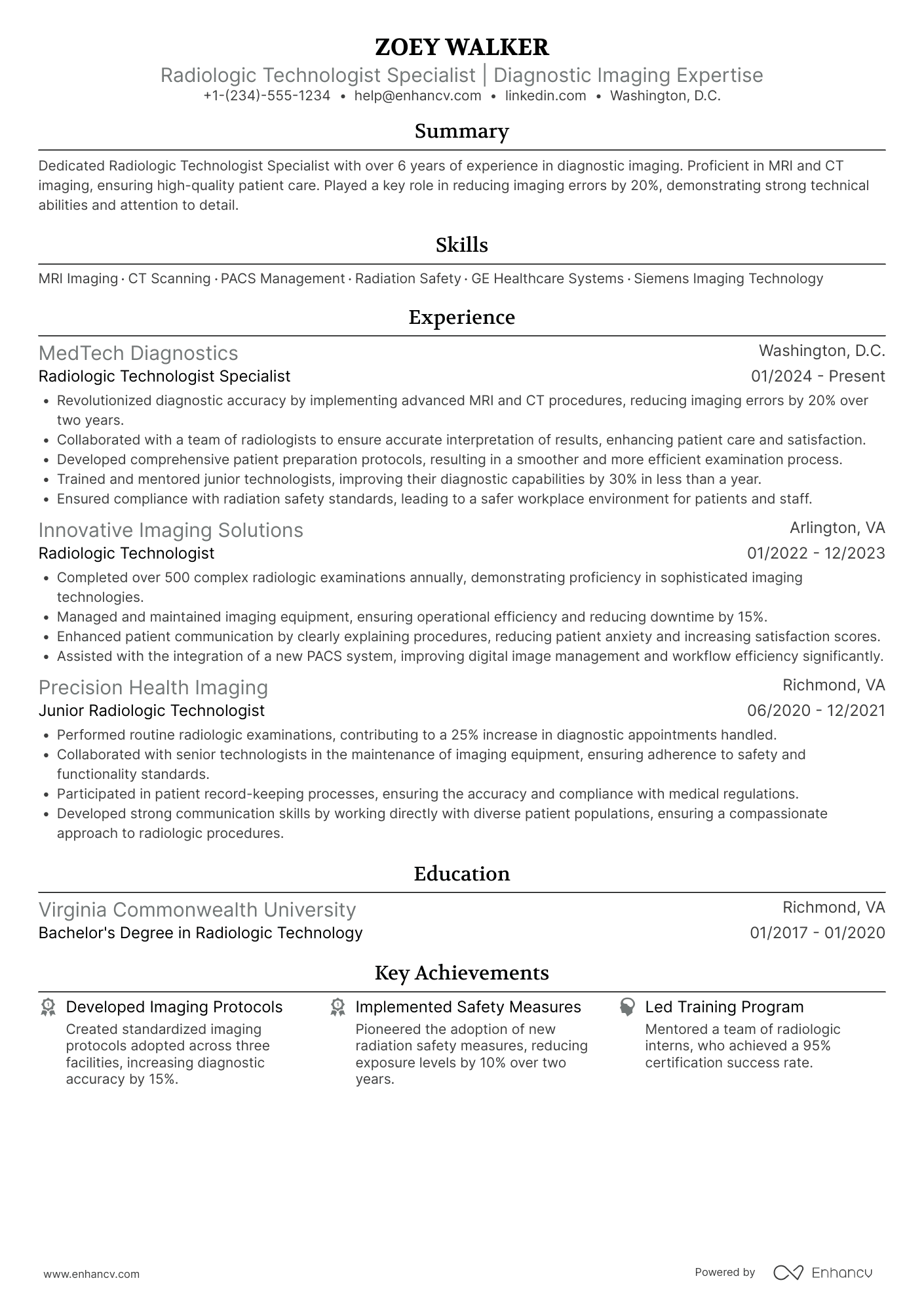
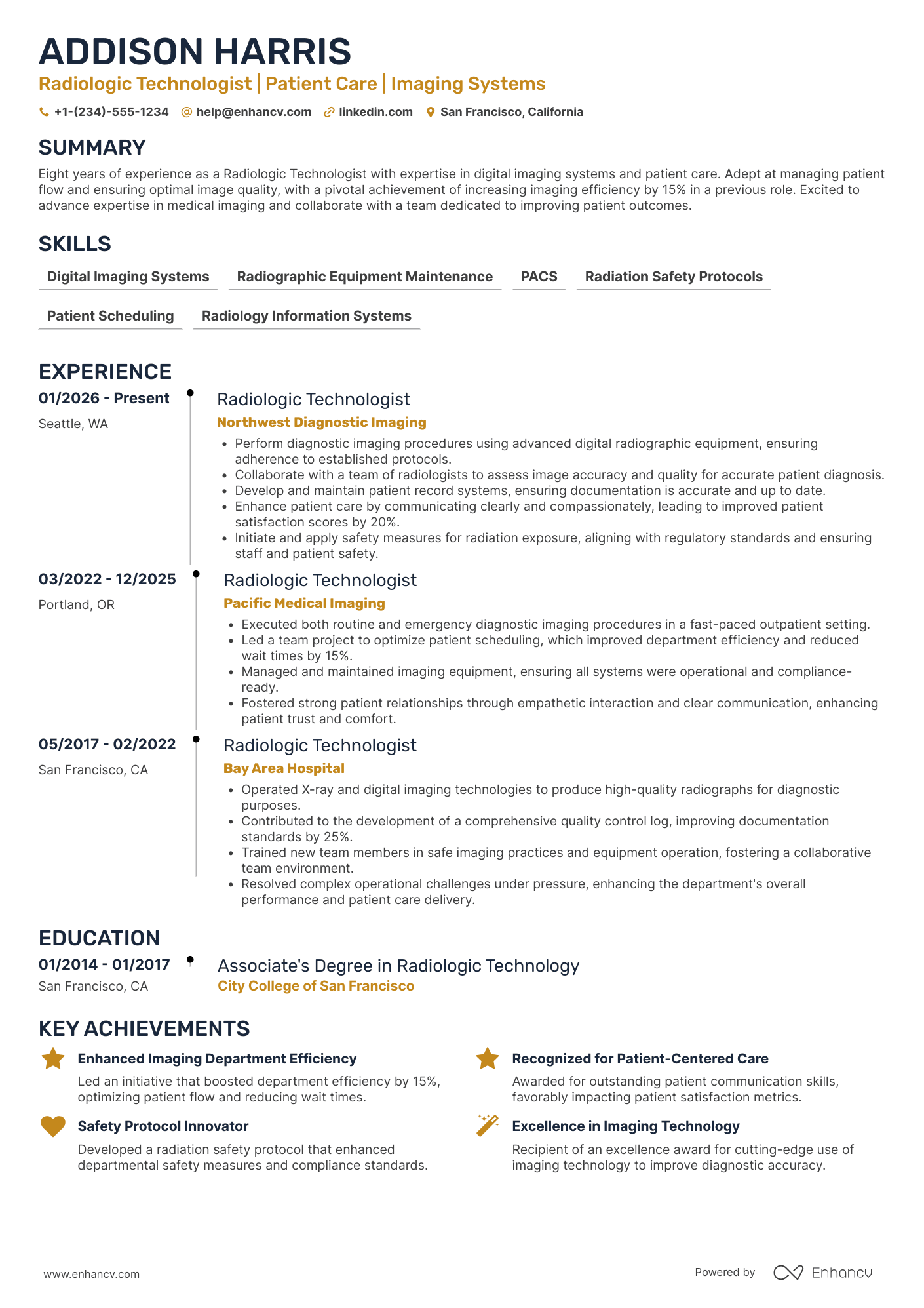
Many radiologic technologist resume drafts fail because they list equipment and duties but skip measurable results and compliance details. That hurts in ATS screening and fast recruiter scans, where high competition rewards clear proof of impact.
Once the resume documents the modalities and certifications, the letter is where one exam, one protocol change, or one patient-care moment earns a paragraph — our radiologic technologist cover letter guide covers how to frame it without restating the resume.
A strong resume shows what you improved and how you supported patient care. Knowing how to make your resume stand out means highlighting throughput gains, repeat rate reductions, faster turnaround times, high patient satisfaction, and consistent protocol adherence across high-volume shifts.

Key takeaways
- Quantify exam volume, repeat rates, and turnaround times instead of listing routine duties.
- Use reverse-chronological format if you have steady radiologic technologist experience.
- Mirror the job posting's exact modalities, equipment names, and compliance terminology.
- Place certifications above education when they're recent or required for the target role.
- Demonstrate skills inside experience bullets, not only in a standalone skills section.
- Lead with clinical rotations and measurable training outcomes if you lack full-time experience.
- Use Enhancv's Bullet Point Generator to turn vague task descriptions into results-driven bullets.
Job market snapshot for radiologic technologists
We analyzed 2,644 recent radiologic technologist job ads across major US job boards. These numbers help you understand role specialization trends, skills in demand, salary landscape at a glance.
What level of experience employers are looking for radiologic technologists
| Years of Experience | Percentage found in job ads |
|---|---|
| 1–2 years | 16.0% (422) |
| 3–4 years | 1.2% (31) |
| 5–6 years | 0.5% (14) |
| 7–8 years | 0.0% (1) |
| 9–10 years | 0.2% (5) |
| 10+ years | 0.3% (7) |
| Not specified | 79.7% (2108) |
Radiologic technologist ads by area of specialization (industry)
| Industry (Area) | Percentage found in job ads |
|---|---|
| Healthcare | 78.4% (2072) |
| Finance & Banking | 11.7% (310) |
| Government | 6.3% (167) |
| Education | 3.6% (95) |
Top companies hiring radiologic technologists
| Company | Percentage found in job ads |
|---|---|
| Department of Veterans Affairs | 4.9% (130) |
| All-Stat Portable | 3.4% (89) |
| Indiana University Health | 2.2% (58) |
| Providence Health & Services | 2.2% (58) |
| Tenet Healthcare Corporation | 2.0% (53) |
| AdventHealth | 2.0% (52) |
| Henry Ford Hospital | 1.7% (44) |
| MultiCare Health System | 1.7% (44) |
| HCA | 1.6% (41) |
| Trinity Health Corporation | 1.6% (41) |
Role overview stats
These tables show the most common responsibilities and employment types for radiologic technologist roles. Use them to align your resume with what employers expect and to understand how the role is structured across the market.
Day-to-day activities and top responsibilities for a radiologic technologist
| Responsibility | Percentage found in job ads |
|---|---|
| Radiologic technology | 32.6% (862) |
| Basic life support | 23.8% (628) |
| Radiography | 21.7% (573) |
| Bls | 19.7% (521) |
| Pacs | 19.6% (519) |
| Radiation safety | 17.3% (458) |
| X-ray | 15.8% (418) |
| Radiology | 14.7% (389) |
| Fluoroscopy | 12.0% (316) |
| Radiologic technologist | 11.3% (300) |
| Cpr | 11.0% (292) |
| Patient care | 9.7% (256) |
How to format a radiologic technologist resume
Recruiters evaluating radiologic technologist resumes prioritize clinical competencies, imaging modality proficiency, and patient volume experience—signals that must be immediately visible within the first few seconds of a scan. Your resume format directly controls whether these qualifications surface quickly or get buried, especially when an applicant tracking system (ATS) parses your document before a human ever sees it.

I have significant experience in this role—which format should I use?
Use a reverse-chronological format to showcase your growing expertise across imaging modalities, clinical settings, and patient care responsibilities. Do:
- Lead each role entry with your scope of work, including imaging modalities operated (CT, MRI, fluoroscopy, mammography), department size, and daily patient volume.
- Highlight proficiency in role-specific tools and systems such as PACS, RIS, CR/DR equipment, and radiation safety protocols, listing them in a dedicated skills section and reinforcing them in your experience bullets.
- Quantify outcomes wherever possible, including patient throughput, image retake reduction rates, equipment uptime improvements, or compliance audit results.
I'm junior or switching into this role—what format works best?
A hybrid format works best, placing your technical skills and certifications at the top while supporting them with clinical rotations, internships, or transferable experience below. Do:
- Position your ARRT certification, state licensure, and core imaging competencies (radiographic positioning, radiation protection, anatomy knowledge) in a prominent skills section above your experience.
- Include clinical rotations, externships, volunteer radiology work, or adjacent healthcare roles as experience entries, detailing specific modalities used and patient interactions.
- Connect every listed skill or responsibility to a concrete action and a measurable or observable result.
When does a functional resume make sense?
A functional format is generally a weak choice for radiologic technologist roles because it strips away the clinical context—specific facilities, modalities, and patient populations—that hiring managers need to assess your readiness. However, it may apply in a narrow set of circumstances:
- You're transitioning from a related healthcare field (such as nursing or sonography) and need to foreground overlapping clinical and technical skills.
- You have a significant employment gap but maintained your ARRT certification and completed continuing education or volunteer imaging work during that time.
- You're a recent graduate whose clinical rotation experience is stronger than your formal employment history.
- A functional format is only acceptable when you tie every listed skill directly to a specific project, clinical rotation, or measurable outcome—never list skills in isolation without supporting context.
Once your layout and formatting choices are in place, the next step is deciding which sections to include so each one reinforces your qualifications.
What sections should go on a radiologic technologist resume
Recruiters expect a radiologic technologist resume to quickly confirm licensure, modality experience, patient care competence, and safety compliance. Understanding which resume sections to include helps you organize this information for maximum clarity.
Use this structure for maximum clarity:
- Header
- Summary
- Experience
- Skills
- Projects
- Education
- Certifications
- Optional sections: Awards, Leadership, Volunteering
Your strongest experience bullets should emphasize exam volume, modality scope, safety and quality outcomes, patient experience, and measurable improvements to throughput or repeat rates.
Is your resume good enough?
Drop your resume here or choose a file. PDF & DOCX only. Max 2MB file size.
Once you’ve organized the key resume components, the next step is to write your radiologic technologist experience section so those details clearly show your impact.
How to write your radiologic technologist resume experience
Your experience section should showcase the imaging work you've delivered, the modalities and equipment you've operated, and the measurable outcomes you've produced for patients and departments. Hiring managers prioritize demonstrated impact—improved image quality, reduced retake rates, enhanced patient throughput—over descriptive task lists that simply restate job duties. Writing a targeted resume that aligns your experience with the specific role ensures your qualifications resonate with both recruiters and ATS.
Each entry should include:
- Job title
- Company and location (or remote)
- Dates of employment (month and year)
Three to five concise bullet points showing what you owned, how you executed, and what outcomes you delivered:
- Ownership scope: the imaging modalities, patient populations, exam types, or departmental functions you were directly accountable for as a radiologic technologist.
- Execution approach: the radiographic equipment, positioning techniques, dose optimization protocols, PACS workflows, or quality assurance methods you used to produce diagnostic-quality images and deliver consistent patient care.
- Value improved: changes to image quality, patient safety, exam turnaround time, retake rates, radiation dose levels, equipment uptime, or compliance with regulatory and accreditation standards tied to your radiologic technologist responsibilities.
- Collaboration context: how you coordinated with radiologists, referring physicians, nursing staff, physicists, or department leadership to ensure accurate diagnoses, streamlined scheduling, or improved departmental protocols.
- Impact delivered: outcomes expressed through patient volume handled, departmental efficiency gains, safety improvements, accreditation results, or workflow enhancements rather than routine activity descriptions.
Experience bullet formula
A radiologic technologist experience example
✅ Right example - modern, quantified, specific.
Radiologic Technologist (ARRT)
Northview Medical Center | Phoenix, AZ
2021–Present
Three-hundred-bed acute care hospital with a high-volume emergency department and orthopedic service line.
- Performed fifty to sixty digital radiography and portable exams per shift using DR systems and mobile X-ray units, sustaining a 98 percent first-pass image acceptance rate while meeting emergency department turnaround targets.
- Reduced repeat imaging by 22 percent by standardizing exposure protocols, positioning, and collimation in alignment with ALARA (as low as reasonably achievable) and ACR (American College of Radiology) guidelines and coaching four new hires during onboarding.
- Accelerated patient throughput by 15 percent by optimizing RIS (radiology information system) scheduling, barcode patient identification, and PACS (picture archiving and communication system) workflows, cutting average order-to-image time from twenty-six to twenty-two minutes.
- Improved patient safety by eliminating wrong-patient and wrong-side near misses for twelve consecutive months through consistent time-outs, EMR (electronic medical record) verification, and closed-loop communication with emergency department nurses and ordering physicians.
- Partnered with radiologists, orthopedic surgeons, and biomedical engineering to troubleshoot detector artifacts and recalibrate QA (quality assurance) checks, reducing downtime events by 30 percent and avoiding an estimated $18,000 in outsourced imaging costs.
Now that you've seen what a strong experience section looks like, let's break down how to customize yours to match the specific job you're targeting.
How to tailor your radiologic technologist resume experience
Recruiters evaluate your radiologic technologist resume through both human review and applicant tracking systems. Tailoring your resume to the job description ensures your qualifications stand out in both screening methods.
Ways to tailor your radiologic technologist experience:
- Match specific imaging modalities and equipment listed in the posting.
- Mirror the exact terminology used for radiologic procedures or protocols.
- Reflect patient volume or throughput metrics the employer emphasizes.
- Highlight ARRT certification and state licensure requirements mentioned.
- Include experience with the PACS or RIS platforms they reference.
- Emphasize radiation safety and dose optimization if the role prioritizes compliance.
- Reference interdisciplinary collaboration with radiologists or ordering physicians as described.
- Align quality assurance or ACR accreditation experience with stated expectations.
Tailoring means aligning your real accomplishments with what the employer values, not forcing keywords where they don't belong.
Resume tailoring examples for radiologic technologist
| Job description excerpt | Untailored | Tailored |
|---|---|---|
| Perform diagnostic imaging procedures using CR and DR systems, ensuring compliance with ALARA principles and ACR quality standards. | Operated imaging equipment and followed safety protocols. | Performed diagnostic imaging using Carestream CR and Canon DR systems, applying ALARA dose-reduction principles and maintaining 100% compliance across quarterly ACR quality audits. |
| Position patients for fluoroscopy, orthopedic, and trauma exams in a high-volume Level I trauma center, collaborating with emergency physicians. | Helped position patients for various types of exams. | Positioned patients for fluoroscopy, orthopedic, and trauma radiographic exams in a Level I trauma center averaging 120 cases daily, coordinating directly with emergency physicians to prioritize critical imaging. |
| Operate Siemens and GE portable X-ray units for bedside imaging in ICU and NICU settings, verifying image quality before submission to PACS. | Took X-rays using portable machines in different departments. | Operated Siemens Mobilett and GE Optima portable X-ray units for bedside imaging across 48-bed ICU and 22-bed NICU, reviewing each image for diagnostic quality before submission to the Fuji Synapse PACS. |
Once you’ve aligned your experience with the role’s priorities, the next step is to quantify your radiologic technologist achievements so hiring managers can quickly see your impact.
How to quantify your radiologic technologist achievements
Quantifying your achievements shows how your work improves patient safety, image quality, throughput, and compliance. Track exam volume, repeat rates, turnaround time, dose metrics, and patient satisfaction tied to CT, MRI, X-ray, or fluoroscopy workflows.
Quantifying examples for radiologic technologist
| Metric | Example |
|---|---|
| Throughput | "Increased daily X-ray volume from twenty-eight to thirty-six exams per shift by streamlining room turnover and pre-checking orders in Epic." |
| Image quality | "Reduced repeat imaging rate from 6.2% to 3.1% by standardizing positioning and exposure protocols across GE and Siemens systems." |
| Turnaround time | "Cut STAT portable chest X-ray turnaround from forty-five to twenty-two minutes by batching transport calls and prioritizing PACS uploads." |
| Radiation safety | "Lowered average CT dose-length product by 12% using AEC tuning and protocol reviews while maintaining diagnostic image quality." |
| Compliance | "Achieved 98% on-time completion of MRI safety screening and implant verification audits over six months with zero reportable incidents." |
Turn vague job duties into measurable, recruiter-ready resume bullets in seconds with Enhancv's Bullet Point Generator.
Once you've crafted strong bullet points for your experience section, you'll want to apply that same precision to presenting your hard and soft skills effectively.
How to list your hard and soft skills on a radiologic technologist resume
Your skills section shows you can produce diagnostic-quality images safely and efficiently, and recruiters and an ATS (applicant tracking system) scan this section to confirm modality fit and compliance; aim for mostly hard skills supported by a smaller set of job-specific soft skills. radiologic technologist roles require a blend of:
- Product strategy and discovery skills
- Data, analytics, and experimentation skills
- Delivery, execution, and go-to-market discipline
- Soft skills
Your skills section should be:
- Scannable (bullet-style grouping).
- Relevant to the job post.
- Backed by proof in experience bullets.
- Updated with current tools.
Place your skills section:
- Above experience if you're junior or switching careers.
- Below experience if you're mid/senior with strong achievements.

Hard skills
- Digital radiography (DR)
- Computed radiography (CR)
- Portable X-ray imaging
- Fluoroscopy support
- C-arm operation
- PACS, RIS, DICOM
- EHR documentation, Epic
- Radiation safety, ALARA
- Contrast media protocols
- Image quality optimization
- Patient positioning techniques
- ACR accreditation standards
Soft skills
- Verify orders and patient identity
- Explain procedures clearly
- De-escalate anxious patients
- Adapt positioning for limitations
- Coordinate with radiologists
- Partner with nurses and transport
- Prioritize STAT and inpatient queues
- Document deviations and incidents
- Maintain sterile field awareness
- Escalate safety concerns promptly
- Manage throughput without re-takes
- Mentor students and new hires
How to show your radiologic technologist skills in context
Skills shouldn't live only in a bulleted list on your resume. Explore our resume skills resource to see how different roles present their competencies effectively.
They should be demonstrated in:
- Your summary (high-level professional identity)
- Your experience (proof through outcomes)
Here's what that looks like in practice.
Summary example
Senior radiologic technologist with 10+ years in trauma and orthopedic imaging. Skilled in CT, MRI, and digital radiography using GE and Siemens systems. Reduced repeat exam rates by 22% through refined positioning protocols and consistent patient communication.
- Reflects senior-level expertise immediately
- Names specific modalities and equipment
- Quantifies a meaningful quality improvement
- Highlights patient communication skills
Experience example
Senior Radiologic Technologist
Lakeview Regional Medical Center | Milwaukee, WI
March 2018–Present
- Performed 40+ diagnostic imaging exams daily using Siemens MAGNETOM MRI and GE Revolution CT, maintaining a 98.5% image quality acceptance rate.
- Collaborated with radiologists and emergency physicians to prioritize trauma cases, cutting average report turnaround time by 15%.
- Mentored four junior technologists on positioning techniques and radiation safety protocols, reducing departmental repeat rates by 18% within one year.
- Every bullet includes measurable proof
- Skills appear naturally within achievements
Once you’ve shown how your radiologic technologist strengths come through in real responsibilities and results, the next step is to apply that approach to building a resume with no experience so your training and transferable skills still read as job-ready.
How do I write a radiologic technologist resume with no experience
Even without full-time experience, you can demonstrate readiness through clinical training and transferable skills. Our guide on writing a resume without work experience covers strategies that apply directly to entry-level radiologic technologist candidates.
- Clinical rotations in imaging departments
- Documented competencies and skill checklists
- ARRT exam prep practice logs
- Volunteer patient transport in radiology
- Capstone imaging quality improvement project
- Radiation safety training certificates
- PACS mock workflow assignments
- Faculty-validated positioning lab assessments
Focus on:
- Clinical hours, modalities, outcomes
- Patient positioning and image quality
- Radiation safety and dose awareness
- Documentation, PACS, and workflow accuracy
Resume format tip for entry-level radiologic technologist
Use a combination resume format to lead with skills and clinical training, then back them up with rotations, projects, and measurable results. Do:
- Put clinical rotations above unrelated jobs.
- List modalities used, with hours.
- Add ARRT eligibility and graduation date.
- Quantify volume, repeats, and dose checks.
- Name tools like PACS and EMR.
- Completed one hundred twenty clinical-rotation exams using PACS workflow, maintained under five percent repeat rate, and documented dose metrics per protocol with preceptor sign-off.
Once you've structured your resume around transferable strengths rather than direct experience, your education section becomes the next critical area to get right—especially since it carries more weight when your work history is limited.
How to list your education on a radiologic technologist resume
Your education section lets hiring teams confirm you have the foundational training required. It validates your knowledge of anatomy, patient care, and imaging physics essential for any radiologic technologist role.
Include:
- Degree name
- Institution
- Location
- Graduation year
- Relevant coursework (for juniors or entry-level candidates)
- Honors & GPA (if 3.5 or higher)
Keep dates simple—list the graduation year only and skip month or day details.
Here's an example of a well-formatted education entry for a radiologic technologist:
Example education entry
Associate of Applied Science in Radiologic Technology
Portland Community College, Portland, OR
Graduated 2022
GPA: 3.7/4.0
- Relevant Coursework: Radiographic Procedures, Cross-Sectional Anatomy, Radiation Physics, Patient Positioning, and Medical Imaging Ethics.
- Honors: Dean's List (four consecutive semesters), Outstanding Radiologic Technology Student Award.
How to list your certifications on a radiologic technologist resume
Certifications on your resume show a radiologic technologist's commitment to learning, proficiency with imaging tools, and alignment with current clinical standards and regulations. Include:
- Certificate name
- Issuing organization
- Year
- Optional: credential ID or URL
- List certifications below education when your degree is recent and your certifications mainly support your entry-level radiologic technologist training.
- List certifications above education when they are recent, highly relevant, or required for your radiologic technologist specialty or target role.
Best certifications for your radiologic technologist resume
- American Registry of Radiologic Technologists (ARRT) Certification in Radiography
- ARRT Postprimary Certification in Computed Tomography (CT)
- ARRT Postprimary Certification in Magnetic Resonance Imaging (MRI)
- ARRT Postprimary Certification in Mammography
- ARRT Postprimary Certification in Vascular Interventional Radiography
- Basic Life Support (BLS)
Once you’ve presented your credentials clearly and in the right place, shift to your radiologic technologist resume summary to show how those qualifications support your overall value.
How to write your radiologic technologist resume summary
Your resume summary is the first thing a recruiter reads. A strong one instantly signals you're qualified and worth interviewing for a radiologic technologist role.
Keep it to three to four lines, with:
- Your title and total years of hands-on radiologic technology experience.
- Clinical setting or specialty, such as orthopedic, emergency, or outpatient imaging.
- Core modalities and equipment, including X-ray, CT, fluoroscopy, or PACS systems.
- One or two measurable achievements, like patient throughput or image retake reduction.
- Soft skills tied to real outcomes, such as patient communication that improved satisfaction scores.

PRO TIP
At this level, emphasize technical proficiency, relevant certifications, and early clinical contributions. Highlight specific modalities you've mastered and measurable results from clinical rotations or your first positions. Avoid vague phrases like "passionate team player" or "eager to learn." Recruiters want concrete skills and real impact, not motivation statements.
Example summary for a radiologic technologist
ARRT-registered radiologic technologist with three years of experience in emergency and outpatient imaging. Proficient in digital X-ray, CT, and PACS. Reduced image retake rates by 18% through improved patient positioning protocols.
Optimize your resume summary and objective for ATS
Drop your resume here or choose a file.
PDF & DOCX only. Max 2MB file size.
Now that you've crafted a summary that highlights your top qualifications, make sure the header above it presents your contact details correctly so recruiters can actually reach you.
What to include in a radiologic technologist resume header
A resume header lists your key contact and professional details so recruiters can find you fast, trust your credentials, and screen you accurately.
Essential resume header elements
- Full name
- Tailored job title and headline
- Location
- Phone number
- Professional email
- GitHub link
- Portfolio link
A LinkedIn link helps recruiters verify experience quickly and supports screening.
Don't include a photo on a radiologic technologist resume unless the role is explicitly front-facing or appearance-dependent.
Keep your header consistent with your certifications and modality focus so recruiters can match you to the right radiologic technologist role.
Example
Radiologic technologist resume header
Jordan M. Taylor
Radiologic Technologist | ARRT (R) | X-ray and Fluoroscopy
Austin, TX
(512) 555-01XX
your.name@enhancv.com github.com/yourname yourwebsite.com linkedin.com/in/yourname
Once your contact details and professional identifiers are clearly presented at the top, add relevant additional sections to round out your radiologic technologist resume.
Additional sections for radiologic technologist resumes
When your core qualifications match other applicants, well-chosen additional sections can set your radiologic technologist resume apart. For example, listing language skills can be especially valuable in facilities serving diverse patient populations.
- Languages
- Certifications and licenses
- Continuing education
- Professional affiliations
- Volunteer experience
- Publications
- Hobbies and interests
Once your resume's additional sections reinforce your qualifications, pairing it with a strong cover letter can further set your application apart.
Do radiologic technologist resumes need a cover letter
A cover letter isn't required for a radiologic technologist, but it helps in competitive openings or systems that expect one. If you're unsure where to start, understanding what a cover letter is and how it complements your resume can help you decide. It can make a difference when your resume needs context, or when hiring managers compare similar credentials.
Use these tips to decide when to include one and what to say:
- Explain role and team fit: Match your strengths to the modality mix, shift needs, patient population, and collaboration style with radiologists and nursing.
- Highlight one or two outcomes: Describe a protocol improvement, repeat-rate reduction, throughput gain, or patient experience result, and state your role and impact.
- Show context awareness: Reference the facility's service lines, safety priorities, and workflow constraints, such as trauma volume, outpatient scheduling, or contrast policies.
- Address transitions or non-obvious experience: Connect prior roles, gaps, or new modality training to the radiologic technologist duties you'll perform on day one.
Drop your resume here or choose a file.
PDF & DOCX only. Max 2MB file size.
Even if you decide to skip a cover letter and rely on your resume to carry your application, using AI to improve your radiologic technologist resume helps you strengthen it faster and more consistently.
Using AI to improve your radiologic technologist resume
AI can sharpen your resume's clarity, structure, and impact. It helps tighten language and highlight relevant qualifications. But overuse strips authenticity fast. Once your content is clear and role-aligned, step away from AI. If you're wondering which AI is best for writing resumes, choose tools that enhance your existing content rather than generate it from scratch.
Here are 10 practical prompts to strengthen specific sections of your radiologic technologist resume:
- Strengthen your summary: "Rewrite my radiologic technologist resume summary to highlight clinical expertise, patient volume, and imaging specialties in three concise sentences."
- Quantify experience bullets: "Add measurable outcomes to these radiologic technologist experience bullets, focusing on patient throughput, image accuracy rates, and equipment utilization."
- Tailor skills formatting: "Organize my radiologic technologist skills section into clinical, technical, and interpersonal categories, removing anything irrelevant to diagnostic imaging roles."
- Improve action verbs: "Replace weak verbs in my radiologic technologist experience section with strong, specific action verbs used in medical imaging job descriptions."
- Refine certification details: "Reformat my radiologic technologist certifications section to clearly list credential names, issuing bodies, and expiration dates in a scannable layout."
- Tighten education entries: "Edit my radiologic technologist education section to emphasize relevant coursework, clinical rotations, and honors directly tied to imaging practice."
- Align with job postings: "Compare my radiologic technologist resume bullets against this job description and suggest wording changes that better match the listed requirements."
- Clarify project contributions: "Rewrite my radiologic technologist project descriptions to specify my individual role, the imaging technology used, and the measurable result."
- Eliminate redundancy: "Identify and remove repeated phrases or overlapping bullet points across my radiologic technologist resume without losing key qualifications."
- Improve readability: "Simplify overly technical sentences in my radiologic technologist resume so hiring managers and recruiters outside radiology can still understand my impact."
Stop using AI once your resume sounds accurate, specific, and aligned with real experience. AI should never invent experience or inflate claims—if it didn't happen, it doesn't belong here.
Conclusion
A strong radiologic technologist resume shows measurable outcomes, role-specific skills, and a clear structure. It highlights exam volume, repeat rate reductions, turnaround times, and patient satisfaction. It also reflects safe imaging practices, precise positioning, and consistent quality control.
Keep your resume easy to scan and focused on the work you do today. A results-driven, well-organized resume shows you’re ready for current hiring needs and near-future expectations in imaging departments.