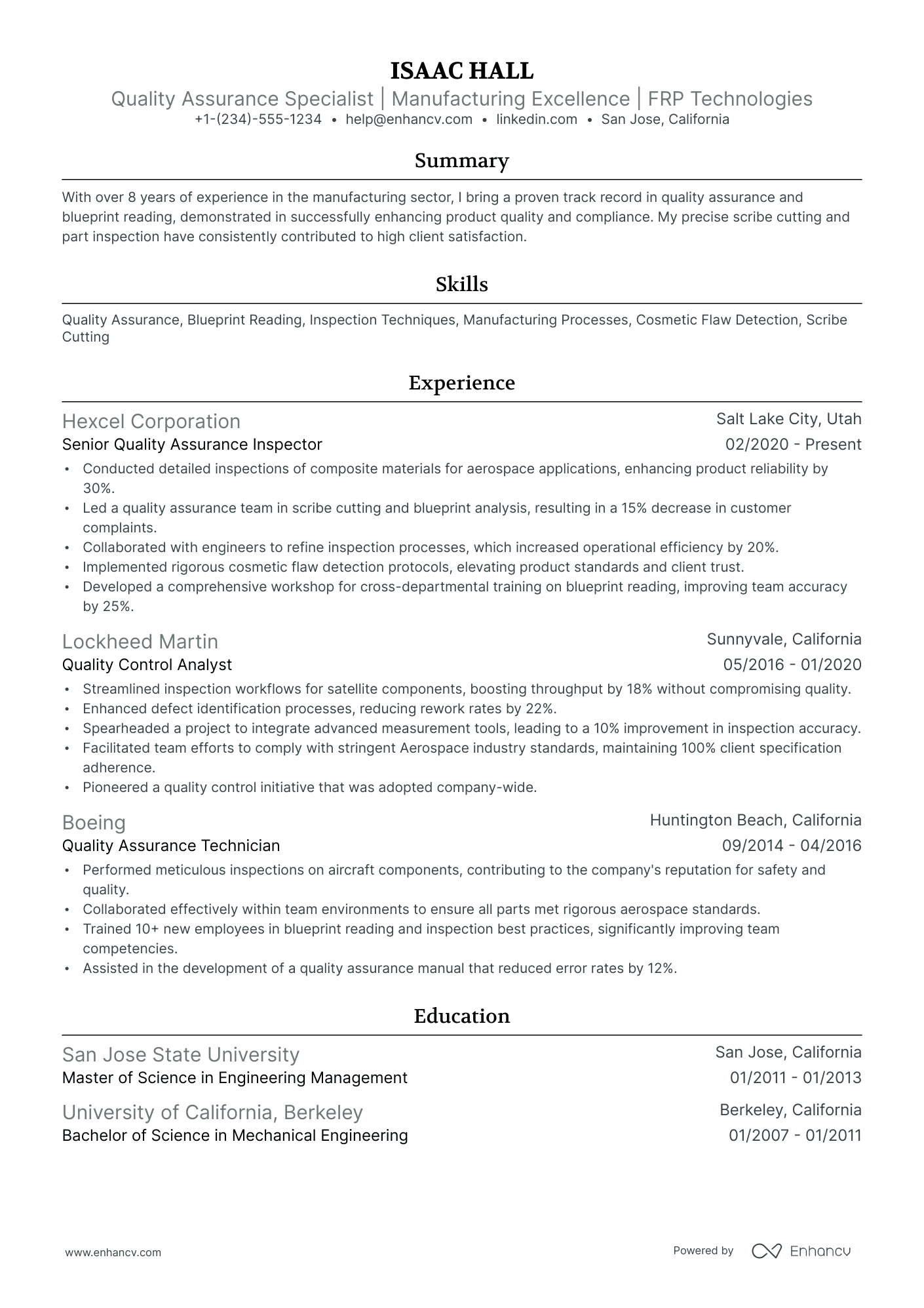
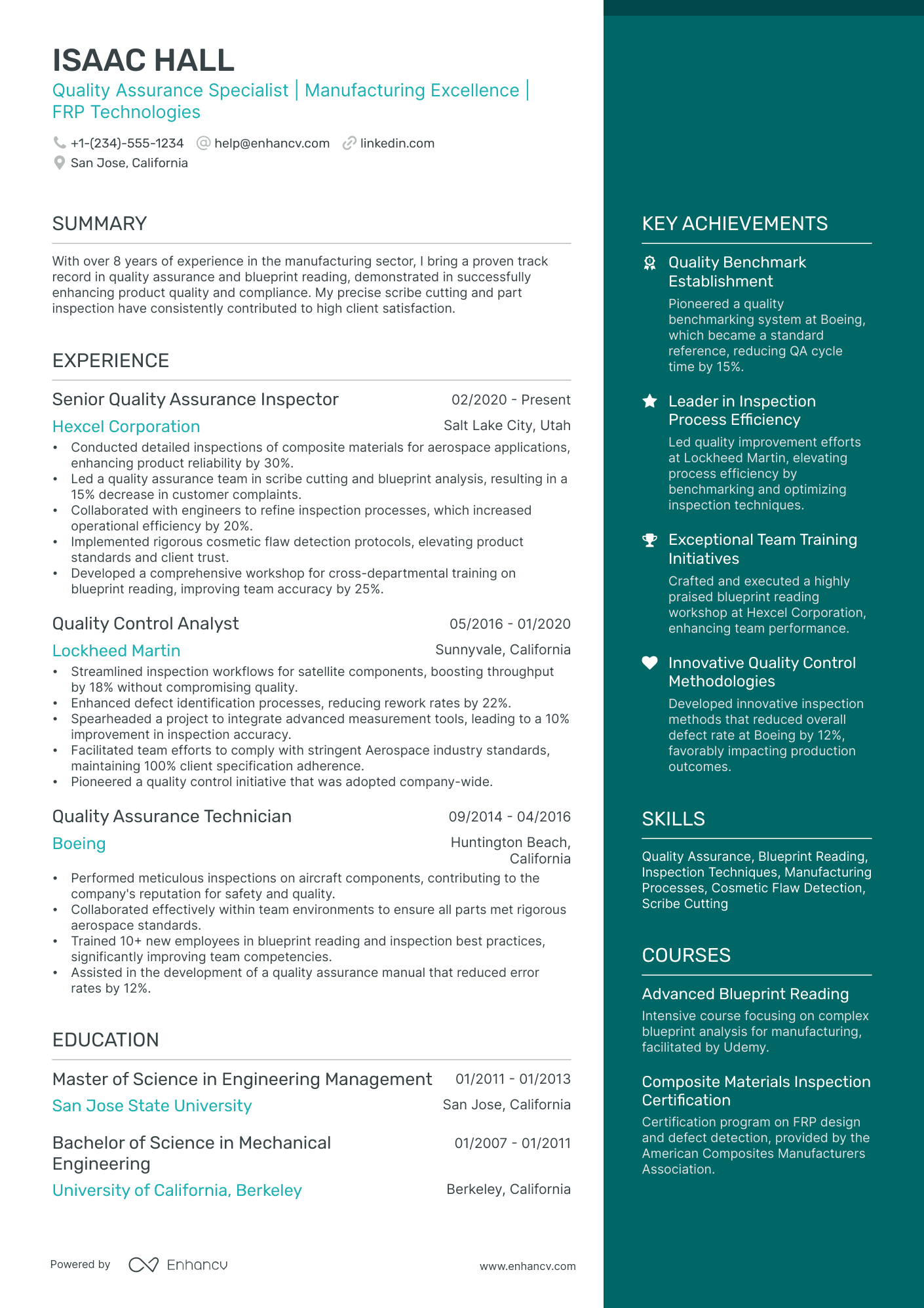
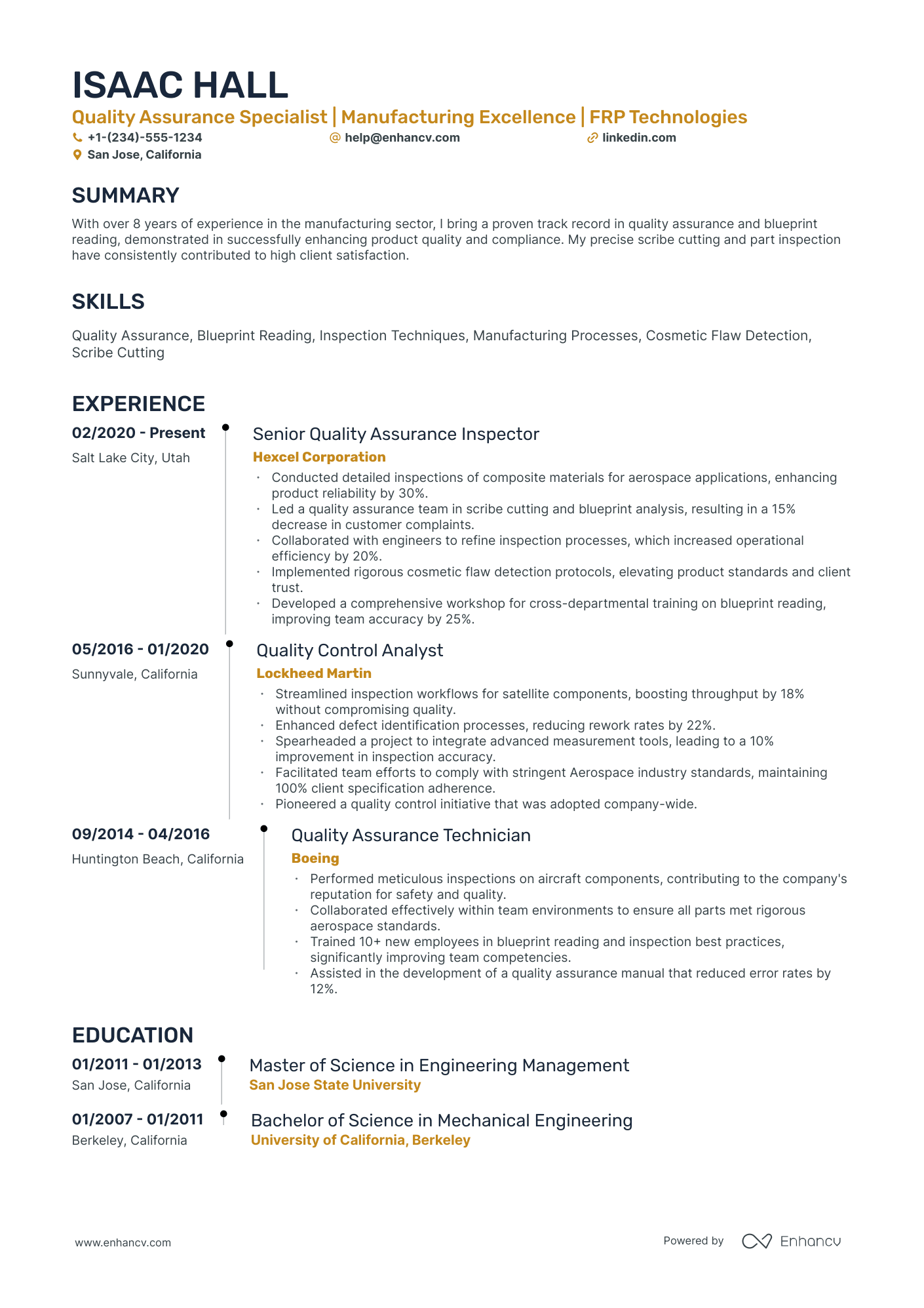
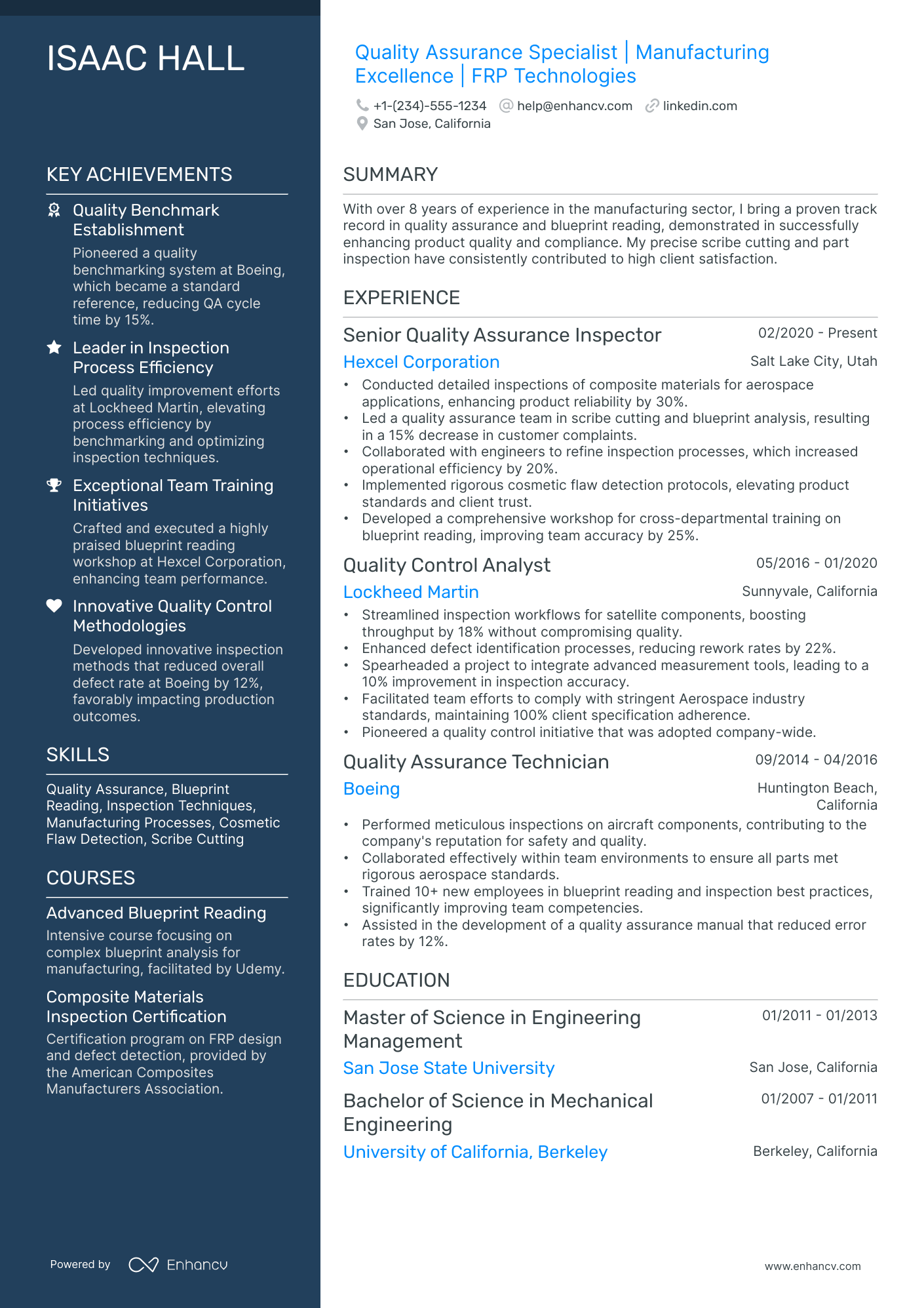
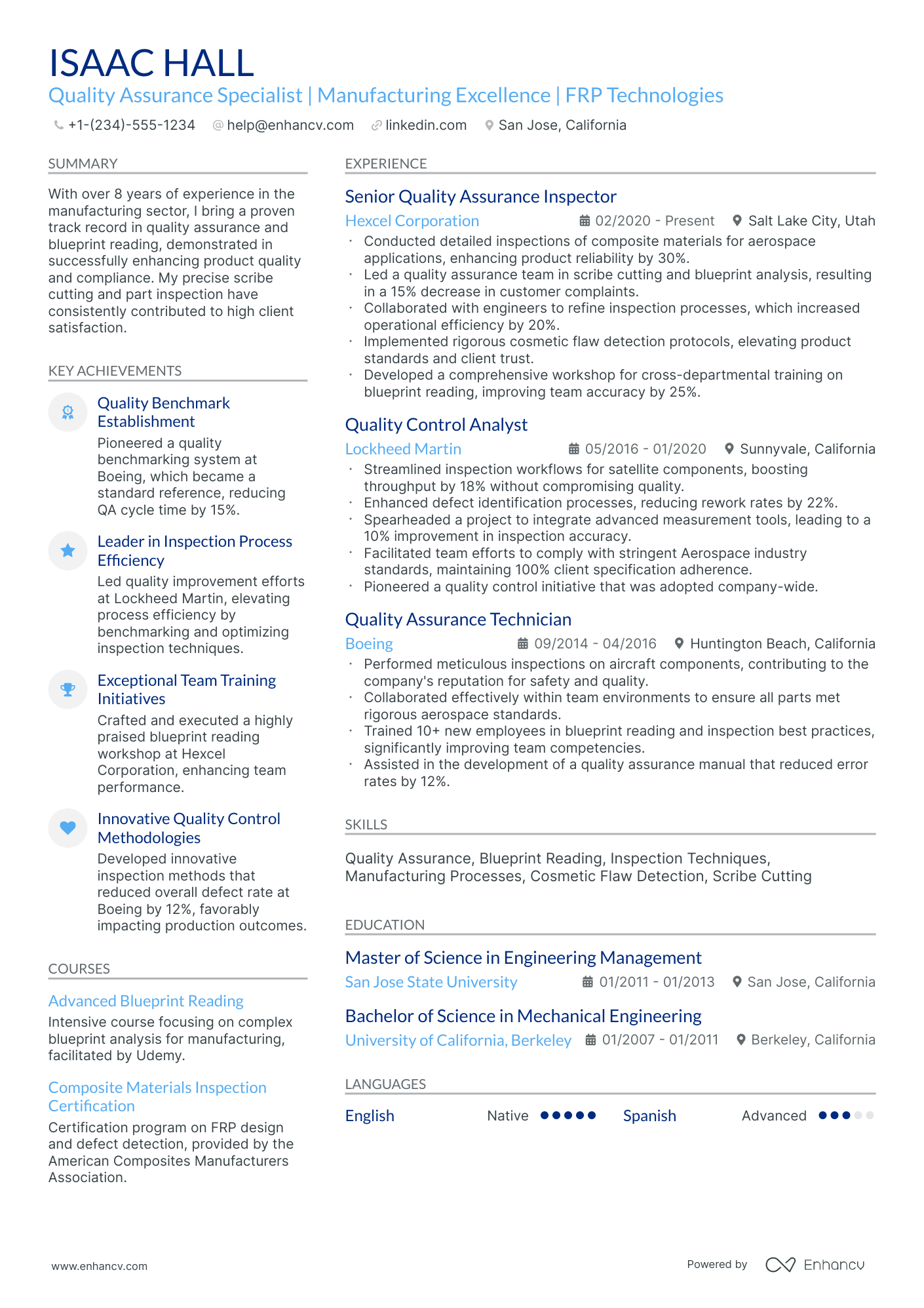
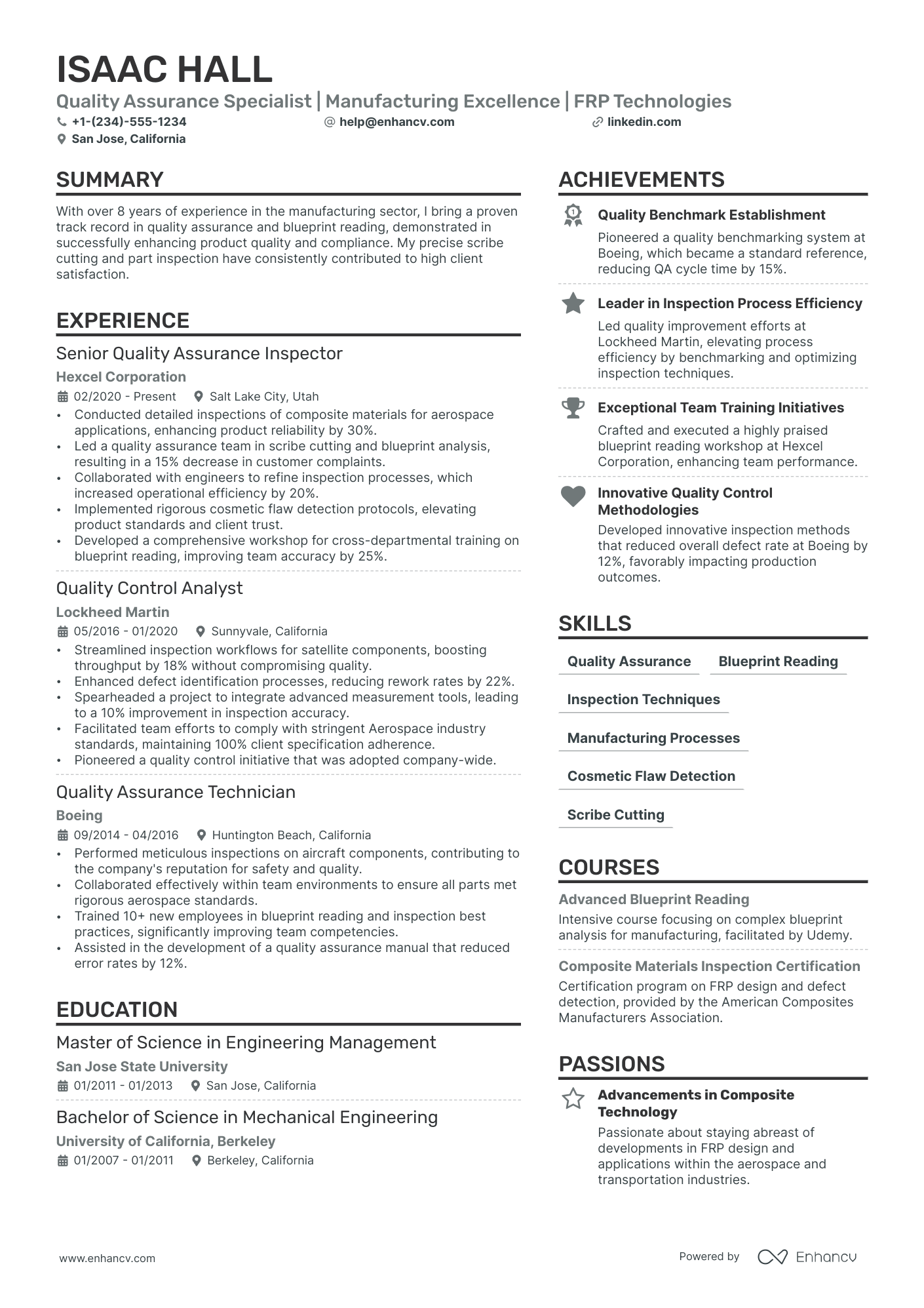
Many QA technician resume drafts fail because they list test tools and duties but don't show measurable defect prevention or release impact. In today's hiring process, ATS filters and fast recruiter scans favor clear outcomes amid heavy competition. If you're unsure where to begin, understanding how to write a resume that highlights results over responsibilities is the essential first step.
A strong resume shows what you improved, shipped, or safeguarded. You'll highlight reduced defect escape rates, faster regression cycles, higher test coverage, fewer production incidents, smoother releases across multiple builds, and better customer satisfaction tied to quality.

Key takeaways
- Quantify defect reductions, cycle time savings, and coverage gains instead of listing routine duties.
- Use reverse-chronological format for experienced candidates and hybrid format for career changers.
- Tailor every experience bullet to mirror the job posting's tools, standards, and terminology.
- Anchor each skill to a specific action and measurable outcome rather than listing it in isolation.
- Place certifications above education when they're recent, relevant, or required for the role.
- Write a three-to-four-line summary that names your domain, core tools, and a concrete achievement.
- Use Enhancv to turn vague task descriptions into metric-driven, recruiter-ready resume bullets.
Job market snapshot for QA technicians
We analyzed 88 recent QA technician job ads across major US job boards. These numbers help you understand employment type trends, employer expectations, salary landscape at a glance.
What level of experience employers are looking for QA technicians
| Years of Experience | Percentage found in job ads |
|---|---|
| 1–2 years | 34.1% (30) |
| 3–4 years | 15.9% (14) |
| 5–6 years | 2.3% (2) |
| 10+ years | 2.3% (2) |
| Not specified | 45.5% (40) |
QA technician ads by area of specialization (industry)
| Industry (Area) | Percentage found in job ads |
|---|---|
| Finance & Banking | 45.5% (40) |
| Healthcare | 28.4% (25) |
| Manufacturing | 15.9% (14) |
Top companies hiring QA technicians
| Company | Percentage found in job ads |
|---|---|
| Actalent | 17.0% (15) |
Role overview stats
These tables show the most common responsibilities and employment types for QA technician roles. Use them to align your resume with what employers expect and to understand how the role is structured across the market.
Day-to-day activities and top responsibilities for a QA technician
| Responsibility | Percentage found in job ads |
|---|---|
| Gmp | 42.0% (37) |
| Quality assurance | 34.1% (30) |
| Haccp | 33.0% (29) |
| Food safety | 20.5% (18) |
| Microsoft office | 20.5% (18) |
| Microsoft word | 20.5% (18) |
| Excel | 14.8% (13) |
| Sqf | 14.8% (13) |
| Sap | 13.6% (12) |
| Microsoft excel | 11.4% (10) |
| Microsoft outlook | 11.4% (10) |
| Quality control | 11.4% (10) |
How to format a QA technician resume
Recruiters reviewing QA technician resumes prioritize hands-on testing experience, familiarity with quality frameworks and tools, and evidence that you can identify defects and drive process improvements. Choosing the right resume format ensures these signals surface quickly, both for human reviewers scanning in seconds and for applicant tracking systems parsing your document.

I have significant experience in this role—which format should I use?
Use a reverse-chronological format to present your QA testing history in a clear, progression-driven timeline. Do:
- Lead each role entry with your scope of responsibility—product lines covered, team size, and testing environments you owned.
- Highlight proficiency with role-specific tools and methodologies such as Selenium, JIRA, Six Sigma, ISO 9001, or statistical process control.
- Quantify outcomes tied to quality improvements, defect reduction, or cost savings.
I'm junior or switching into this role—what format works best?
A hybrid format works best, placing a focused skills section at the top while still grounding your background in a concise work history. Do:
- Position your strongest QA-relevant skills—such as root cause analysis, GMP compliance, or test documentation—above your experience section so recruiters see them immediately.
- Include academic projects, internships, or certification coursework where you performed inspection, testing, or quality documentation tasks.
- Connect every listed skill to a specific action and a measurable or observable result.
Why not use a functional resume?
A functional resume strips away the timeline and context recruiters need to verify where, when, and how you applied your QA skills, which weakens your credibility even at the entry level.
- Career changers with transferable quality or compliance experience from adjacent fields such as manufacturing, lab work, or food safety.
- Candidates with limited formal work history who completed QA certification programs, co-ops, or capstone projects with documented testing outcomes.
- Applicants with resume gaps who maintained skills through freelance inspection work or continued education in quality standards.
- A functional resume is only acceptable for a QA technician role when you have no direct QA work history to list chronologically—and even then, every skill you feature must be anchored to a specific project, certification exercise, or measurable outcome rather than listed in isolation.
Once your layout and formatting choices are in place, the next step is deciding which sections to include so each one serves a clear purpose on your resume.
What sections should go on a QA technician resume
Recruiters expect to see clear evidence that you can execute reliable testing, document defects, and support consistent product quality. Knowing which resume sections to include and how to order them ensures nothing critical gets buried.
Use this structure for maximum clarity:
- Header
- Summary
- Experience
- Skills
- Projects
- Education
- Certifications
- Optional sections: Awards, Volunteering, Languages
Strong experience bullets should emphasize defect trends you identified, test coverage you improved, cycle time you reduced, and measurable quality outcomes you delivered.
Is your resume good enough?
Drop your resume here or choose a file. PDF & DOCX only. Max 2MB file size.
Once you’ve organized your resume with the right components in place, the next step is to write your QA technician experience so it fits that structure and highlights your impact.
How to write your QA technician resume experience
The experience section is where you prove you've shipped reliable, tested work—not just participated in quality processes. Hiring managers prioritize demonstrated impact through role-relevant tools, inspection methods, and measurable outcomes over descriptive task lists. Building a targeted resume that aligns each bullet with the specific role's requirements will strengthen this section significantly.
Each entry should include:
- Job title
- Company and location (or remote)
- Dates of employment (month and year)
Three to five concise bullet points showing what you owned, how you executed, and what outcomes you delivered:
- Ownership scope: the specific product lines, manufacturing stages, test environments, or inspection areas you were directly accountable for as a QA technician.
- Execution approach: the testing equipment, quality frameworks, statistical methods, or compliance standards you applied to identify defects, validate specifications, and drive corrective actions.
- Value improved: the measurable changes you brought to defect rates, product reliability, inspection turnaround, process efficiency, or regulatory compliance within your QA technician responsibilities.
- Collaboration context: how you partnered with production teams, engineers, suppliers, or regulatory bodies to resolve quality issues and align on acceptance criteria.
- Impact delivered: the tangible results your QA work produced—expressed through reductions in nonconformance, improvements in first-pass yield, or contributions to audit readiness and customer satisfaction rather than routine activity descriptions.
Experience bullet formula
A QA technician experience example
✅ Right example - modern, quantified, specific.
QA Technician
BrightLine Medical Devices | Minneapolis, MN
2022–Present
Quality assurance team supporting FDA-regulated Class II devices across two production lines and a contract manufacturer network.
- Executed risk-based test plans and protocols in Jira and Zephyr, cutting escaped defects by 32% across three quarterly releases.
- Investigated nonconformances using 8D and 5 Whys, driving corrective and preventive actions (CAPA) that reduced repeat deviations by 28% in six months.
- Performed incoming, in-process, and final inspections using calibrated gauges and optical comparators, improving first-pass yield from 91% to 96% on the top-volume SKU.
- Partnered with manufacturing engineers and suppliers to validate process changes (IQ/OQ/PQ), reducing rework hours by 18% and saving $74K annually.
- Authored and maintained controlled documentation in MasterControl (work instructions, inspection records, traceability logs), achieving 98% on-time training completion and zero audit findings in the last surveillance audit.
Now that you've seen what a strong experience section looks like in practice, let's break down how to customize yours for each specific job posting.
How to tailor your QA technician resume experience
Recruiters evaluate your QA technician resume through both human review and applicant tracking systems, so generic descriptions often get overlooked. Tailoring your resume to the job description increases your chances of passing both screenings.
Ways to tailor your QA technician experience:
- Match the exact testing tools and equipment listed in the job description.
- Mirror the quality standards or methodologies the employer references.
- Use the same terminology for inspection processes and documentation systems.
- Highlight compliance or regulatory experience when the posting requires it.
- Emphasize defect tracking or reporting workflows the role specifically mentions.
- Include industry or domain experience that aligns with the company's products.
- Reference the KPIs or success criteria the job description outlines.
- Reflect collaboration models like cross-functional teams if the posting values them.
Tailoring means aligning your real accomplishments with what the role demands, not forcing keywords where they don't naturally belong.
Resume tailoring examples for QA technician
| Job description excerpt | Untailored | Tailored |
|---|---|---|
| Perform incoming, in-process, and final inspections using calipers, micrometers, and CMM equipment per AS9100 standards | Inspected parts and checked for quality issues | Conducted incoming, in-process, and final inspections using calipers, micrometers, and CMM equipment, maintaining 99.2% compliance with AS9100 standards across 12,000+ aerospace components annually |
| Execute test protocols for PCB assemblies, document non-conformances in SAP, and collaborate with engineering to resolve defects | Tested products and reported problems to the team | Executed functional and in-circuit test protocols for PCB assemblies, logged non-conformances in SAP, and partnered with design engineering to resolve 30+ defect root causes, reducing board failure rates by 18% |
| Perform environmental and reliability testing (thermal cycling, vibration, humidity) on medical device subassemblies per FDA 21 CFR Part 820 | Ran tests on products to make sure they worked correctly | Performed thermal cycling, vibration, and humidity testing on Class II medical device subassemblies, ensuring full traceability and compliance with FDA 21 CFR Part 820 across three concurrent product lines |
Once you’ve aligned your experience with the role’s requirements, the next step is to quantify your QA technician achievements so hiring managers can see the results your work delivered.
How to quantify your QA technician achievements
Quantifying your achievements proves you improved quality, speed, and release confidence. Focus on defect escape rate, test coverage, cycle time, automation throughput, and risk reduction tied to critical workflows.
Quantifying examples for QA technician
| Metric | Example |
|---|---|
| Defect escape rate | "Cut production defect escapes by 38% in three months by adding regression suites in TestRail and tightening Jira triage for P1 and P2 bugs." |
| Test coverage | "Expanded regression coverage from 120 to 310 test cases across web and mobile, raising requirements-to-tests traceability to 95% for audited releases." |
| Cycle time | "Reduced test cycle time from five days to three days by parallelizing runs in Selenium Grid and standardizing smoke tests for every build." |
| Automation throughput | "Increased automated test execution from 600 to 1,800 checks per day by stabilizing flaky tests and moving nightly runs to GitHub Actions." |
| Risk reduction | "Prevented three high-risk payment defects from shipping by adding OWASP-focused test scenarios and blocking releases until critical security checks passed." |
Turn vague job duties into measurable, recruiter-ready resume bullets in seconds with Enhancv's Bullet Point Generator.
How to list your hard and soft skills on a QA technician resume
Your skills section shows how you prevent defects and validate releases, and recruiters and an ATS (applicant tracking system) scan this section for job-match keywords, so aim for a balanced mix of technical testing capabilities and execution-focused collaboration skills. QA technician roles require a blend of:
- Product strategy and discovery skills.
- Data, analytics, and experimentation skills.
- Delivery, execution, and go-to-market discipline.
- Soft skills.
Your skills section should be:
- Scannable (bullet-style grouping).
- Relevant to the job post.
- Backed by proof in experience bullets.
- Updated with current tools.
Place your skills section:
- Above experience if you're junior or switching careers.
- Below experience if you're mid/senior with strong achievements.

Hard skills
- Test case design and execution
- Defect tracking: Jira, Azure DevOps
- Test management: TestRail, Zephyr
- API testing: Postman, Swagger
- SQL queries for validation
- Web testing: Chrome DevTools
- Mobile testing: iOS, Android
- Regression, smoke, sanity testing
- Exploratory testing charters
- Cross-browser testing: BrowserStack
- Basic automation: Selenium, Playwright
- CI checks: GitHub Actions, Jenkins
Your hard skills should reflect the specific tools, frameworks, and testing methodologies you've used in practice.
Soft skills
- Write clear, reproducible bug reports
- Triage defects by user impact
- Communicate release risk early
- Collaborate with developers on fixes
- Ask precise clarifying questions
- Maintain test coverage under deadlines
- Challenge requirements with evidence
- Document test results consistently
- Escalate blockers with options
- Balance speed with quality standards
- Coordinate handoffs across teams
- Own follow-through on retests
Pairing these execution-focused soft skills with your technical abilities shows hiring managers you can collaborate effectively under pressure.
How to show your QA technician skills in context
Skills shouldn't live only in a bulleted list on your resume. Explore resume skills examples to see how top candidates weave abilities into every section.
They should be demonstrated in:
- Your summary (high-level professional identity)
- Your experience (proof through outcomes)
Here's what that looks like in practice.
Summary example
Senior QA technician with 9 years in medical device manufacturing. Skilled in IQ/OQ/PQ validation, root cause analysis, and FDA compliance. Led cross-functional audits that reduced nonconformance rates by 34%. Known for mentoring junior inspectors and streamlining documentation workflows.
- Specifies senior-level experience clearly
- Names industry-relevant tools and methods
- Includes a concrete, measurable outcome
- Highlights mentoring as a soft skill
Experience example
Senior QA Technician
Aethon Medical Systems | Minneapolis, MN
March 2019–Present
- Executed IQ/OQ/PQ protocols across three product lines, cutting validation cycle time by 22% through improved test documentation.
- Partnered with engineering and production teams to implement statistical process control, reducing defect rates by 17% within one year.
- Trained 12 junior technicians on CAPA procedures and GMP standards, improving first-pass audit scores by 29% across the department.
- Every bullet includes a measurable outcome
- Skills appear naturally within real achievements
Once you’ve tied your quality assurance abilities to real tasks and outcomes, the next step is learning how to build a QA technician resume with no experience so those same strengths still come through without a work history.
How do I write a QA technician resume with no experience
Even without full-time experience, you can demonstrate readiness through projects and self-directed practice. For a deeper guide, see how to build a resume without work experience that still impresses hiring managers.
- QA technician coursework and labs
- Personal test plans and cases
- Bug reports from app testing
- Jira issue tracking practice
- SQL queries for test data
- API testing with Postman
- GitHub test automation scripts
- Volunteer website QA technician testing
Focus on:
- Clear test cases and results
- Reproducible defect reports with evidence
- Tool familiarity: Jira, Postman, SQL
- Process alignment: regression, smoke tests
Resume format tip for entry-level QA technician
Use a hybrid resume format, since it highlights skills and projects first while still showing education and any related work history. Do:
- Put a Projects section above Experience.
- Quantify testing scope: cases, defects, coverage.
- Name tools used: Jira, Postman, SQL.
- Show artifacts: test plan, cases, bug reports.
- Tailor keywords to each job post.
- Wrote fifty test cases for a volunteer website, logged eighteen defects in Jira with steps and screenshots, and helped cut repeat issues by thirty percent.
Once you've structured your resume to highlight transferable skills and relevant projects, the next step is presenting your education effectively—often the strongest section for candidates entering the QA field.
How to list your education on a QA technician resume
Your education section helps hiring teams confirm you have the foundational knowledge needed for the QA technician role. It validates your technical training and analytical background quickly.
Include:
- Degree name
- Institution
- Location
- Graduation year
- Relevant coursework (for juniors or entry-level candidates)
- Honors & GPA (if 3.5 or higher)
Skip month and day details—list only the graduation year for a cleaner format.
Here's a realistic education entry tailored to a QA technician resume:
Example education entry
Bachelor of Science in Manufacturing Engineering Technology
Purdue University, West Lafayette, IN
Graduated 2022
GPA: 3.7/4.0
- Relevant Coursework: Statistical Process Control, Quality Assurance Methods, Materials Testing, and Technical Documentation
- Honors: Dean's List (six semesters), Magna Cum Laude
How to list your certifications on a QA technician resume
Certifications on your resume show your commitment to learning, your proficiency with QA tools, and your relevance to current industry standards as a QA technician.
Include:
- Certificate name
- Issuing organization
- Year
- Optional: credential ID or URL
- Place certifications below education when your degree is recent and your certifications are older or only loosely related to QA technician work.
- Place certifications above education when they are recent, highly relevant, or required for the QA technician roles you target.
Best certifications for your QA technician resume
ISTQB Certified Tester Foundation Level (CTFL) ISTQB Certified Tester Advanced Level (CTAL) Certified Software Quality Analyst (CSQA) Certified ScrumMaster (CSM) Certified Agile Tester (CAT) AWS Certified Cloud Practitioner CompTIA IT Fundamentals (ITF+)
Once your credentials are clearly presented to validate your qualifications, the next step is writing your QA technician resume summary to highlight that value upfront.
How to write your QA technician resume summary
Your resume summary is the first thing a recruiter reads, so it must immediately prove you're qualified. A strong opening tied to the QA technician role can mean the difference between a callback and a pass.
Keep it to three to four lines, with:
- Your title and total years of hands-on QA experience.
- The domain or industry you've worked in, such as manufacturing, electronics, or software.
- Core tools and skills like test automation frameworks, defect tracking systems, or inspection methodologies.
- One or two measurable achievements that show your direct impact on quality outcomes.
- Soft skills tied to real results, such as cross-team communication that reduced defect resolution time.

PRO TIP
At this level, emphasize specific tools you've used and concrete contributions, even if they seem small. Highlight early wins like defect detection rates or process improvements you supported. Avoid vague phrases like "passionate team player" or "eager to learn." Recruiters want proof of skill, not motivation.
Example summary for a QA technician
Detail-oriented QA technician with two years of experience in electronics manufacturing. Skilled in root cause analysis and IPC standards compliance. Reduced product defect rates by 18% through improved inspection protocols.
Optimize your resume summary and objective for ATS
Drop your resume here or choose a file.
PDF & DOCX only. Max 2MB file size.
Now that your summary communicates your value at a glance, make sure the header above it presents your contact details clearly and professionally.
What to include in a QA technician resume header
A well-structured resume header lists your key contact details and role focus, helping recruiters spot you fast, trust your profile, and screen you accurately.
Essential resume header elements
- Full name
- Tailored job title and headline
- Location
- Phone number
- Professional email
- GitHub link
- Portfolio link
A LinkedIn link helps recruiters confirm your work history fast and supports consistent screening across applicants.
Don't include photos on a QA technician resume unless the role is explicitly front-facing or appearance-dependent.
Keep the header on one to two lines, match the QA technician title to the job post, and use links that open to your best work first.
QA technician resume header
Jordan Lee
QA technician | Manual Testing, Bug Reporting, Test Case Execution
Austin, TX
(512) 555-01XX | jordan.lee@enhancv.com | github.com/yourname | yourwebsite.com | linkedin.com/in/yourname
Once your contact details and role information are clear and complete, add relevant additional sections to strengthen the rest of your QA technician resume.
Additional sections for QA technician resumes
Adding extra sections helps you stand out when your core qualifications match other candidates, showcasing unique strengths relevant to quality assurance. For example, listing language skills can be a differentiator if you work with international suppliers or global manufacturing teams.
- Languages
- Certifications
- Professional affiliations
- Publications
- Hobbies and interests
- Continuing education
- Volunteer experience
Once your resume sections are finalized, pairing them with a well-crafted cover letter can further strengthen your application.
Do QA technician resumes need a cover letter
A cover letter isn't required for a QA technician, but it helps in competitive roles or teams that expect one. If you're unsure where to start, learning what a cover letter is and how it complements your resume can clarify when it's worth including. It can make a difference when your resume needs context, or when you want to show product understanding.
Use a cover letter to add details your resume can't:
- Explain role or team fit: Match your testing style to their workflow, tools, release pace, and collaboration with developers, product, and support.
- Highlight one or two relevant projects or outcomes: Share a defect pattern you reduced, a regression suite you improved, or a release risk you helped prevent.
- Show understanding of the product, users, or business context: Name key user journeys, quality risks, and what "good" looks like for their customers.
- Address career transitions or non-obvious experience: Connect past roles to QA technician work, such as documentation, customer support, data entry accuracy, or hardware handling.
Drop your resume here or choose a file.
PDF & DOCX only. Max 2MB file size.
Once you’ve decided whether to include a cover letter, the next step is to use AI to improve your QA technician resume so it communicates your qualifications clearly and consistently.
Using AI to improve your QA technician resume
AI can sharpen your resume's clarity, structure, and impact. It helps tighten language and highlight measurable results. But overuse strips authenticity fast. Once your content is clear and role-aligned, step away from AI entirely. For practical starting points, explore these ChatGPT resume writing prompts tailored to resume improvement.
Here are 10 practical prompts to strengthen specific sections of your QA technician resume:
- Strengthen your summary: "Rewrite my QA technician resume summary to highlight hands-on testing experience and key industry skills in three concise sentences."
- Quantify experience bullets: "Add specific metrics and measurable outcomes to these QA technician experience bullet points without inventing any data."
- Tighten skills formatting: "Organize my QA technician skills section into clear categories like testing tools, methodologies, and software proficiencies."
- Improve action verbs: "Replace weak or passive verbs in my QA technician experience bullets with strong, precise action verbs."
- Align with job posting: "Compare my QA technician resume to this job description and identify missing keywords or qualifications I actually possess."
- Refine project descriptions: "Rewrite my QA technician project descriptions to emphasize testing scope, defect resolution, and documented results."
- Clarify certifications section: "Format my QA technician certifications section consistently, listing credential name, issuing body, and date earned."
- Remove redundant phrasing: "Identify and eliminate filler words or redundant phrases across my entire QA technician resume."
- Enhance education relevance: "Highlight coursework and lab experience in my QA technician education section that directly relates to quality assurance."
- Fix bullet consistency: "Ensure all QA technician experience bullets follow parallel structure, start with action verbs, and stay under two lines."
Stop using AI once your resume sounds accurate, specific, and aligned with real experience. AI should never invent experience or inflate claims—if it didn't happen, it doesn't belong here.
Conclusion
A strong QA technician resume proves impact with measurable outcomes, role-specific skills, and a clear structure. Use metrics to show fewer defects, faster test cycles, and higher pass rates. Keep sections consistent, and highlight testing tools, documentation, and collaboration.
Today’s hiring market rewards QA technician candidates who show reliable results and disciplined execution. A focused summary, scannable bullets, and clean formatting help hiring teams review your work fast. With clear evidence and structure, your resume signals readiness now and next.