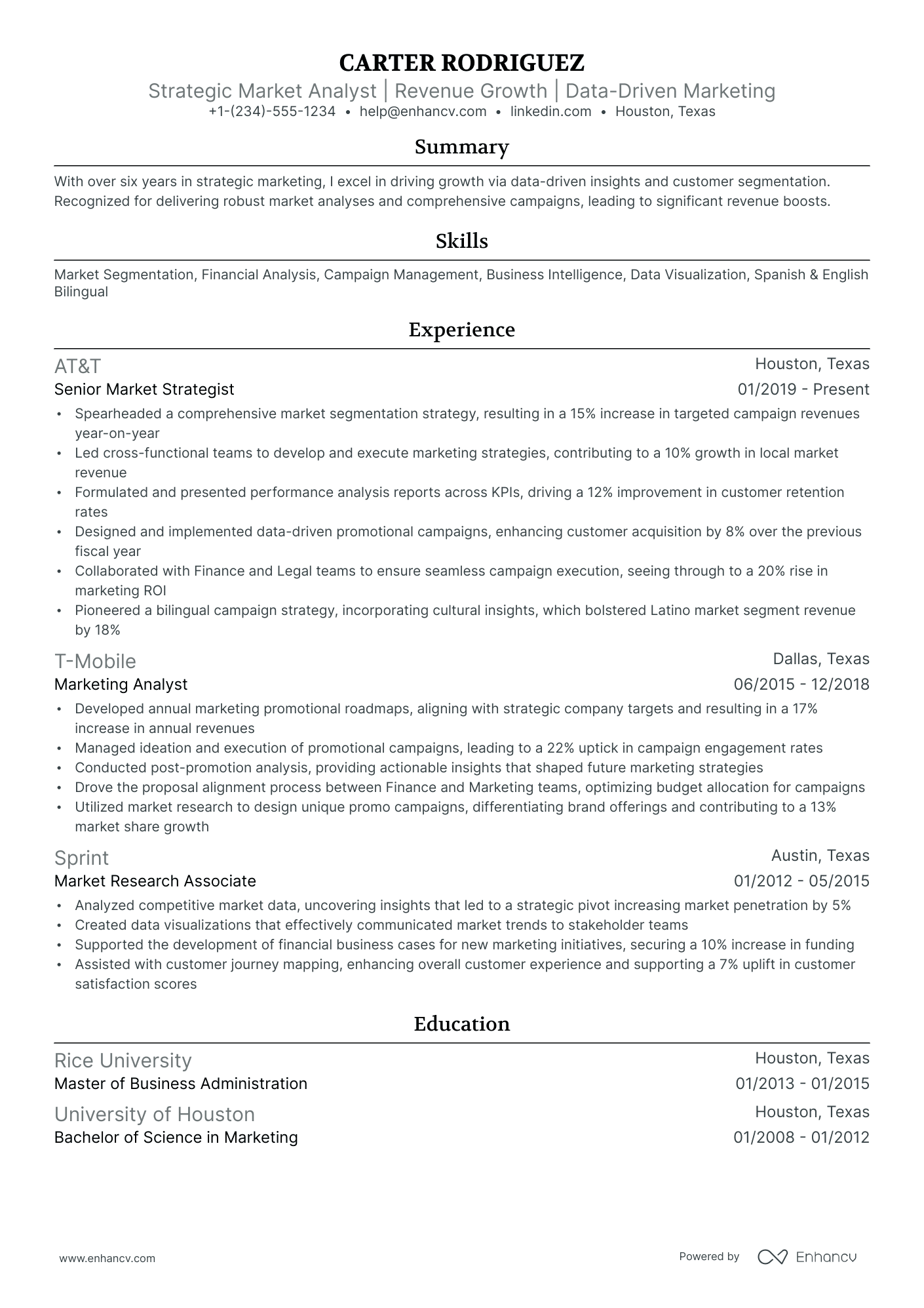
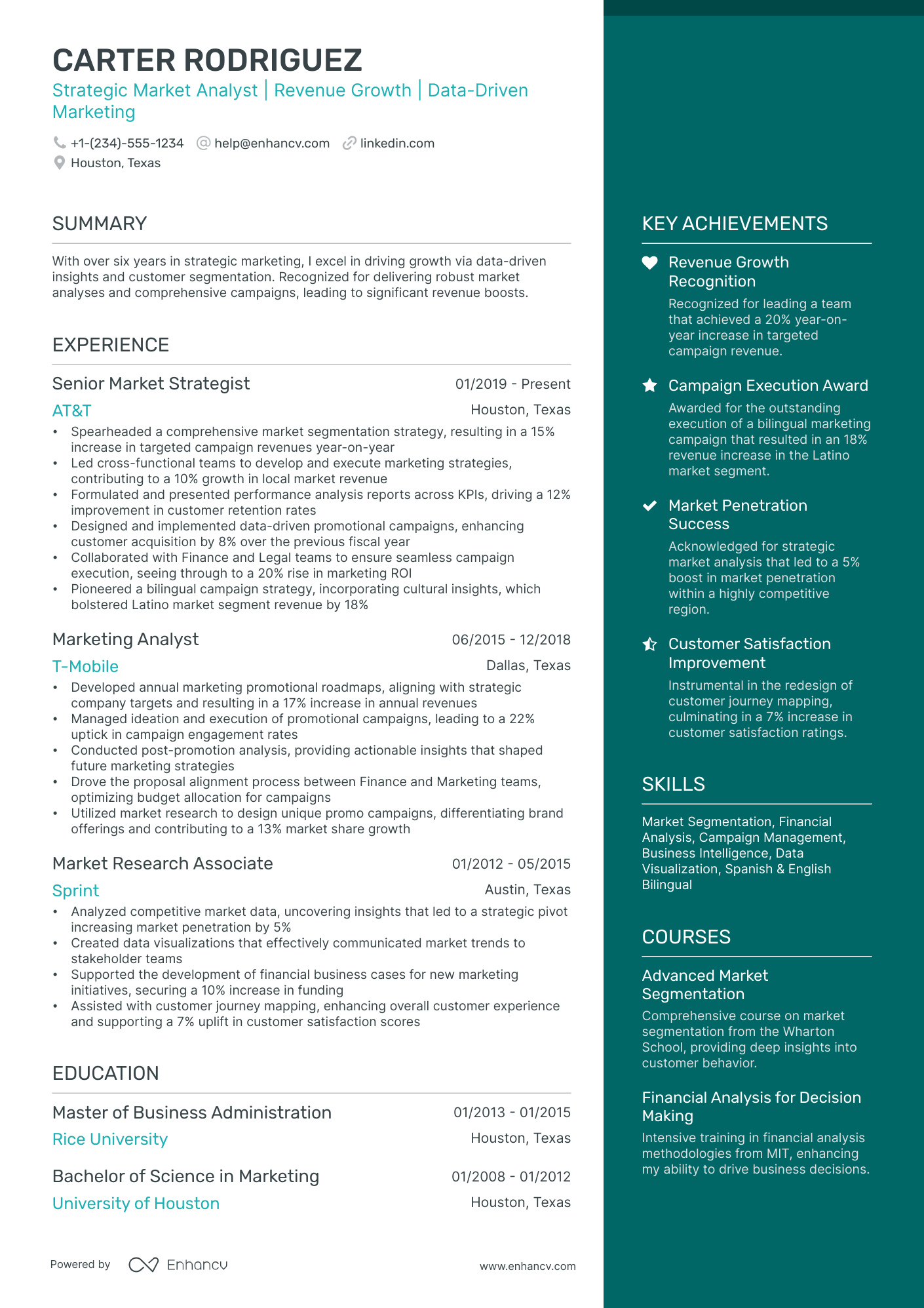
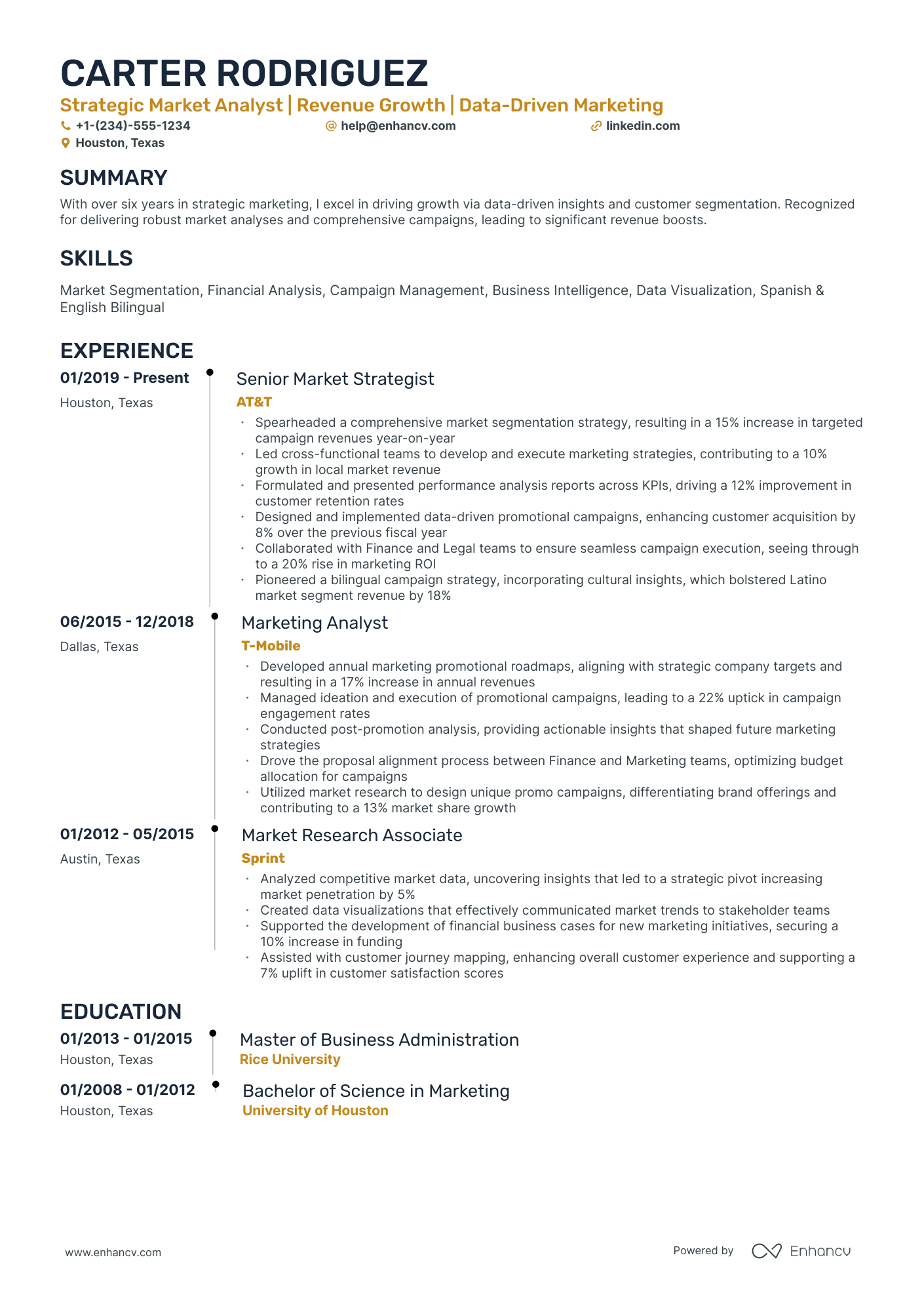
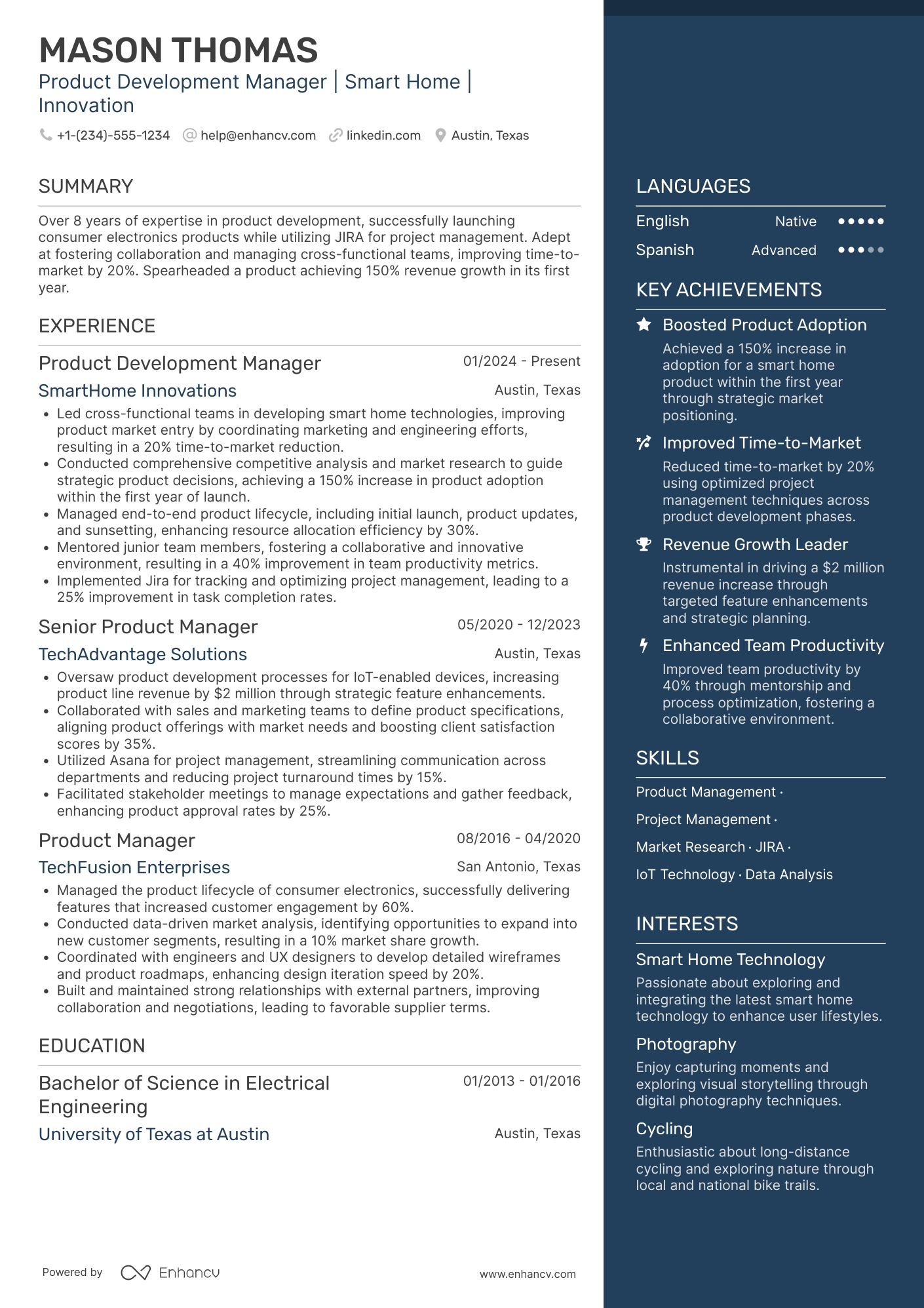
Many product development manager resume submissions fail because they list duties and tools but don't show measurable delivery impact. That hides your value during applicant tracking system screening and ten-second recruiter scans in a crowded market.
A strong resume shows outcomes: how you reduced cycle time, improved on-time delivery, raised first-pass yield, lowered defect escape rates, or increased gross margin. You should quantify scope, such as teams led, budgets owned, suppliers managed, and launches delivered. If you're unsure where to begin, learning how to write a resume that highlights impact over responsibilities is a critical first step.

Key takeaways
- Quantify product outcomes like revenue, cycle time, and defect rates instead of listing duties.
- Use reverse-chronological format if you're experienced and hybrid format if you're switching roles.
- Tailor every experience bullet to mirror the job posting's language and priorities.
- Anchor each skill in a measurable outcome within your summary or experience section.
- Place certifications like CSPO, PMP, or NPDP near education to reinforce credibility.
- Write a three-to-four-line summary that leads with scope, tools, and one quantified achievement.
- Use Enhancv to turn routine responsibilities into metric-driven, recruiter-ready resume bullets.
Job market snapshot for product development managers
We analyzed 54 recent product development manager job ads across major US job boards. These numbers help you understand salary landscape, employment type trends, career growth patterns at a glance.
What level of experience employers are looking for product development managers
| Years of Experience | Percentage found in job ads |
|---|---|
| 3–4 years | 3.7% (2) |
| 5–6 years | 11.1% (6) |
| 7–8 years | 9.3% (5) |
| 9–10 years | 1.9% (1) |
| 10+ years | 1.9% (1) |
| Not specified | 74.1% (40) |
Product development manager ads by area of specialization (industry)
| Industry (Area) | Percentage found in job ads |
|---|---|
| Finance & Banking | 66.7% (36) |
Top companies hiring product development managers
| Company | Percentage found in job ads |
|---|---|
| Philadelphia Insurance Companies | 18.5% (10) |
Role overview stats
These tables show the most common responsibilities and employment types for product development manager roles. Use them to align your resume with what employers expect and to understand how the role is structured across the market.
Day-to-day activities and top responsibilities for a product development manager
| Responsibility | Percentage found in job ads |
|---|---|
| Excel | 35.2% (19) |
| Word | 33.3% (18) |
| Project management | 31.5% (17) |
| Microsoft office | 20.4% (11) |
| Powerpoint | 20.4% (11) |
| Product development | 20.4% (11) |
| Jira | 13.0% (7) |
| Access | 11.1% (6) |
| Actuarial | 11.1% (6) |
| Compliance | 11.1% (6) |
| Google's g suite | 11.1% (6) |
| Microsoft powerpoint | 11.1% (6) |
Type of employment (remote vs on-site vs hybrid)
| Employment type | Percentage found in job ads |
|---|---|
| On-site | 63.0% (34) |
| Hybrid | 24.1% (13) |
| Remote | 13.0% (7) |
How to format a product development manager resume
Recruiters evaluating product development manager candidates prioritize cross-functional leadership, end-to-end product lifecycle ownership, and measurable business outcomes tied to launches, revenue, or efficiency gains. Your resume format must surface these signals immediately, making career progression and scope of accountability visible within the first few seconds of a scan.

I have significant experience in this role—which format should I use?
Use a reverse-chronological format to give recruiters a clear, linear view of how your product development responsibilities and leadership scope have grown over time. Do:
- Lead each role entry with scope and ownership details—team size, budget authority, number of product lines managed, and cross-functional stakeholders engaged.
- Highlight role-specific expertise in areas like stage-gate processes, roadmap prioritization, agile or waterfall methodologies, PLM tools, and go-to-market strategy.
- Quantify outcomes tied to business impact: revenue generated, time-to-market improvements, cost reductions, or portfolio growth.
I'm junior or switching into this role—what format works best?
A hybrid format works best, letting you lead with a targeted skills section while still showing relevant experience in chronological order. Do:
- Place a focused skills section near the top, covering product lifecycle management, stakeholder communication, prototyping tools, and data-driven decision-making.
- Feature project-based experience—capstone products, internal launches, or cross-functional initiatives—that demonstrates product development thinking, even if from adjacent roles.
- Connect every action to an outcome so recruiters can evaluate your potential impact.
Why not use a functional resume?
A functional resume strips away the timeline and context that recruiters need to evaluate how you've applied product development skills in real working environments, making it harder to assess your readiness for the role.
- A functional format may be acceptable if you're making a career change from engineering, design, or project management into product development and lack direct titles—but only if every skill listed is anchored to a specific project, deliverable, or measurable outcome.
With your format established, the next step is filling it with the right sections to give recruiters exactly what they're looking for.
What sections should go on a product development manager resume
Recruiters expect to see clear evidence that you can lead cross-functional product development from concept through launch while delivering measurable business results. Knowing what to put on a resume for this role ensures you include the right details without cluttering your document.
Use this structure for maximum clarity:
- Header
- Summary
- Experience
- Skills
- Projects
- Education
- Certifications
- Optional sections: Awards, Publications, Languages
Strong experience bullets should emphasize shipped outcomes, business impact, cross-functional scope, timelines, budgets, and measurable results.
Is your resume good enough?
Drop your resume here or choose a file. PDF & DOCX only. Max 2MB file size.
Once you’ve organized your resume with the right components, the next step is to write a strong experience section that shows how you delivered results in product development roles.
How to write your product development manager resume experience
Your work experience section should spotlight the products you've shipped, the development methods you've applied, and the measurable outcomes you've driven as a product development manager. Hiring managers prioritize demonstrated impact—revenue growth, faster time-to-market, improved product quality—over descriptive task lists that only catalog daily responsibilities.
Each entry should include:
- Job title
- Company and location (or remote)
- Dates of employment (month and year)
Three to five concise bullet points showing what you owned, how you executed, and what outcomes you delivered:
- Ownership scope: the products, platforms, product lines, or development pipelines you were directly accountable for, including the size of the teams or the markets those products served.
- Execution approach: the frameworks, tools, and methodologies you relied on to guide development—stage-gate processes, agile sprints, design-for-manufacturing principles, prototyping technologies, or data-driven prioritization techniques relevant to product development management.
- Value improved: the specific dimensions of product or process performance you strengthened, such as product quality, development cycle time, manufacturability, cost efficiency, regulatory compliance, or reliability.
- Collaboration context: how you partnered with engineering, design, supply chain, marketing, quality assurance, or external vendors to align cross-functional efforts and move products from concept through launch.
- Impact delivered: the tangible results your work produced, expressed through business outcomes, scale of delivery, or strategic value rather than a list of activities—connecting every bullet back to what changed because of your leadership as a product development manager.
Experience bullet formula
A product development manager experience example
✅ Right example - modern, quantified, specific.
Product Development Manager
Aurora Home Systems | Austin, TX
2021–Present
Smart home hardware and mobile app platform serving 1.2M active users across North America.
- Led end-to-end development for a Matter-enabled smart thermostat line using Jira, Confluence, and Figma, launching in eight months (down from twelve) and generating $8.4M in first-year revenue.
- Implemented a stage-gate process with PRD templates, RACI ownership, and weekly cross-functional reviews with product managers, engineering, and industrial design, cutting scope churn by 32% and improving on-time milestone delivery from 68% to 90%.
- Established a supplier quality and validation program using DFMEA, PPAP, and reliability testing (HALT, thermal cycling), reducing field failure rate from 1.6% to 0.9% and lowering warranty costs by $540K annually.
- Negotiated contract manufacturing and component sourcing with procurement and operations, securing dual-source coverage for three critical parts and reducing lead times by 21% while maintaining target gross margin within 1.5 points.
- Partnered with firmware and mobile engineers to instrument telemetry in Snowflake and Amplitude, prioritizing fixes that cut device setup time by 24% and reduced support tickets per 1,000 devices by 18%.
Now that you've seen how a strong experience section comes together, let's look at how to adjust yours to match a specific job posting.
How to tailor your product development manager resume experience
Recruiters evaluate your product development manager resume through both applicant tracking systems and manual review. Tailoring your resume to the job description ensures your qualifications register with both.
Ways to tailor your product development manager experience:
- Match product lifecycle tools and platforms named in the job description.
- Mirror the exact terminology used for stage-gate or development processes.
- Align your KPIs with the success metrics the posting prioritizes.
- Highlight cross-functional collaboration models referenced in the role requirements.
- Include industry or domain experience that the posting specifically requests.
- Reflect quality assurance or compliance standards mentioned in the listing.
- Use the same language for agile or lean methodologies the team follows.
- Emphasize vendor management or sourcing workflows the role describes.
Tailoring means aligning your real accomplishments with the language and priorities of each job posting, not forcing in keywords where they don't belong.
Resume tailoring examples for product development manager
| Job description excerpt | Untailored | Tailored |
|---|---|---|
| Lead cross-functional teams through Stage-Gate processes to bring new consumer products from concept to commercialization within regulated environments. | Led teams on various product projects from start to finish. | Led eight cross-functional teams through a Stage-Gate framework, delivering 12 consumer products from concept to commercialization in FDA-regulated categories over three years. |
| Define product roadmaps using voice-of-customer research and competitive analysis to prioritize features that drive market share growth. | Helped create product plans based on customer needs. | Built and maintained a two-year product roadmap informed by voice-of-customer interviews with 200+ users and quarterly competitive analysis, prioritizing features that grew category market share by 6%. |
| Manage $5M+ annual development budgets and vendor relationships to accelerate time-to-market using Agile and SAFe methodologies. | Managed budgets and worked with outside vendors on product timelines. | Oversaw a $5.8M annual development budget and six vendor partnerships, applying SAFe practices to compress average time-to-market from 14 months to nine months across the product portfolio. |
Once you’ve aligned your experience with the role’s priorities, quantify your product development manager achievements to show the measurable impact behind those choices.
How to quantify your product development manager achievements
Quantifying your achievements proves you shipped better products, faster, and with less risk. Focus on delivery speed, quality, cost, reliability, adoption, and revenue impact across releases, teams, and customer segments.
Quantifying examples for product development manager
| Metric | Example |
|---|---|
| Delivery speed | "Cut release cycle from eight to five weeks by implementing Jira-based sprint planning and Definition of Done across three squads." |
| Quality | "Reduced post-release defects by 32% by adding automated regression in GitHub Actions and tightening acceptance criteria with QA." |
| Cost efficiency | "Lowered bill of materials cost by 11% by renegotiating two suppliers and redesigning one assembly without changing performance targets." |
| Reliability | "Improved field failure rate from 1.8% to 0.9% within six months by driving root-cause analysis and corrective actions with manufacturing." |
| Revenue impact | "Delivered two premium features that increased average selling price by 7% and added $1.2M in annual recurring revenue within one quarter." |
Turn your everyday tasks into measurable, recruiter-ready resume bullets in seconds with Enhancv's Bullet Point Generator.
Once your bullet points clearly convey your impact, pairing them with a well-curated mix of hard and soft skills strengthens your resume's overall appeal to hiring managers.
How to list your hard and soft skills on a product development manager resume
Your skills section shows you can lead product discovery, execution, and launch, and recruiters and an ATS (applicant tracking system) scan this section to confirm job-fit keywords—aim for a balanced mix of hard skills and role-specific soft skills. product development manager roles require a blend of:
- Product strategy and discovery skills.
- Data, analytics, and experimentation skills.
- Delivery, execution, and go-to-market discipline.
- Soft skills.
Your skills section should be:
- Scannable (bullet-style grouping).
- Relevant to the job post.
- Backed by proof in experience bullets.
- Updated with current tools.
Place your skills section:
- Above experience if you're junior or switching careers.
- Below experience if you're mid/senior with strong achievements.

Hard skills
- Product discovery, user research
- Jobs to Be Done framework
- Roadmapping, prioritization, RICE scoring
- Agile, Scrum, Kanban
- Jira, Confluence
- PRDs, user stories, acceptance criteria
- Prototyping, Figma
- SQL, data querying
- A/B testing, experimentation design
- Amplitude, Mixpanel, Google Analytics
- API integration requirements
- Go-to-market planning, launch readiness
Soft skills
- Align stakeholders on trade-offs
- Lead cross-functional decision-making
- Translate customer needs into scope
- Write clear, actionable requirements
- Run effective discovery workshops
- Negotiate priorities with engineering
- Communicate timelines and risks early
- Drive accountability across teams
- Make data-informed decisions
- Manage ambiguity through iteration
- Resolve conflicts with facts and empathy
- Influence without formal authority
How to show your product development manager skills in context
Skills shouldn't live only in a dedicated skills list. Browse resume skills examples to see how top candidates weave competencies into real achievements.
They should be demonstrated in:
- Your summary (high-level professional identity)
- Your experience (proof through outcomes)
Here's what strong, context-rich examples look like in practice.
Summary example
Product development manager with 10+ years in consumer electronics, skilled in stage-gate methodology, Jira, and cross-functional leadership. Launched 15 products generating $40M in cumulative revenue while reducing average time-to-market by 22%.
- Signals senior-level depth immediately
- Names specific tools and frameworks
- Leads with a measurable revenue outcome
- Highlights cross-functional leadership ability
Experience example
Senior Product Development Manager
Vantage Hardware Co. | Austin, TX
March 2019–Present
- Directed a 14-person cross-functional team using Agile sprints, delivering a flagship smart home line that drove $12M in first-year sales.
- Partnered with engineering and supply chain leads to implement design-for-manufacturing practices, cutting unit production costs by 18%.
- Introduced Aha! for roadmap prioritization, improving stakeholder alignment scores by 35% across three consecutive quarterly surveys.
- Every bullet contains measurable proof.
- Skills surface naturally through outcomes.
Once you’ve tied your abilities to measurable outcomes and real examples, the next step is applying the same approach to a product development manager resume when you don’t have direct experience.
How do I write a product development manager resume with no experience
Even without full-time experience, you can demonstrate readiness through:
- Internship supporting product launches
- Capstone new product development project
- Market research and customer interviews
- Cross-functional class team leadership
- Prototype testing and iteration cycles
- Agile backlog and sprint planning
- Supplier sourcing and cost analysis
- Product requirements document ownership
If you're entering the field without traditional job history, our guide on building a resume without work experience walks you through how to position projects and transferable skills effectively.
Focus on:
- Shipped outcomes with measurable impact
- Requirements, roadmap, and prioritization
- Customer insights tied to decisions
- Cross-functional execution and delivery
Resume format tip for entry-level product development manager
Use a combination resume format to highlight projects and skills first, then list experience. It keeps attention on shipped work and methods, not job titles. Do:
- Lead with a Projects section.
- Add tools beside each project.
- Quantify results with clear metrics.
- Show requirements through deliverables.
- Include a one-line product summary.
- Led capstone new product development using Jira, Figma, and a product requirements document; ran twelve interviews and cut prototype revisions by 30%.
When you're building your resume without direct experience, your education section becomes one of the strongest tools for demonstrating relevant knowledge and qualifications.
How to list your education on a product development manager resume
Your education section helps hiring teams confirm you have the foundational knowledge needed for a product development manager role. It quickly validates relevant academic training and credentials.
Include:
- Degree name
- Institution
- Location
- Graduation year
- Relevant coursework (for juniors or entry-level candidates)
- Honors & GPA (if 3.5 or higher)
Skip month and day details—list the graduation year only.
Here's a strong education entry tailored to a product development manager resume.
Example education entry
Bachelor of Science in Industrial Engineering
University of Michigan, Ann Arbor, MI
Graduated 2018
GPA: 3.7/4.0
- Relevant coursework: Product Design, Systems Engineering, Supply Chain Management, and Project Leadership
- Honors: Graduated magna cum laude, Dean's List all semesters
How to list your certifications on a product development manager resume
Certifications on a resume show a product development manager's commitment to learning, tool proficiency, and industry relevance, especially across agile delivery, customer discovery, and cross-functional leadership.
Include:
- Certificate name
- Issuing organization
- Year
- Optional: credential ID or URL
- Place certifications below education when they're older, less relevant, or you want your degree and core qualifications to lead.
- Place certifications above education when they're recent, highly relevant, or required for the role you're targeting.
Best certifications for your product development manager resume
- Certified Scrum Product Owner (CSPO)
- Professional Scrum Product Owner (PSPO I)
- Project Management Professional (PMP)
- Pragmatic Institute Certified Product Manager (PMC)
- Certified SAFe Product Owner/Product Manager (POPM)
- Certified Product Manager (AIPMM CPM)
Once you’ve included your certifications in a way that supports your qualifications, shift to writing your product development manager resume summary so you can highlight those strengths upfront.
How to write your product development manager resume summary
Your resume summary is the first thing a recruiter reads. A strong one instantly signals you're qualified for the product development manager role.
Keep it to three to four lines, with:
- Your title and total years of product development experience.
- The domain, industry, or product type you know best.
- Core tools and skills such as roadmapping, Agile, Jira, or A/B testing.
- One or two quantified achievements that prove your impact.
- Soft skills tied to real outcomes, like cross-functional collaboration that shortened launch cycles.

PRO TIP
At the mid-level, emphasize hands-on ownership of product lifecycles and measurable contributions to launches or revenue. Highlight specific tools and methodologies you've used daily. Avoid vague descriptors like "passionate" or "results-driven." Replace them with concrete numbers and outcomes that show what you've actually delivered.
Example summary for a product development manager
Product development manager with six years of experience leading B2B SaaS roadmaps. Skilled in Agile, Jira, and user research. Drove a 28% improvement in time-to-market by restructuring sprint workflows across three cross-functional teams.
Optimize your resume summary and objective for ATS
Drop your resume here or choose a file.
PDF & DOCX only. Max 2MB file size.
Now that your summary is crafted to highlight your strongest qualifications, make sure the header above it presents your contact details correctly so recruiters can actually reach you.
What to include in a product development manager resume header
A resume header lists your key contact and professional links, helping a product development manager improve visibility, build credibility, and pass recruiter screening faster.
Essential resume header elements
- Full name
- Tailored job title and headline
- Location
- Phone number
- Professional email
- GitHub link
- Portfolio link
A LinkedIn link helps recruiters verify your experience quickly and supports screening.
Don't include a photo on a product development manager resume unless the role is explicitly front-facing or appearance-dependent.
Keep the header to one or two lines, match it to the job posting, and use consistent naming across your resume and profiles.
Example
Product development manager resume header
Jordan Lee
Product Development Manager | Consumer Electronics and Manufacturing
Austin, TX
(512) 555-12XX
your.name@enhancv.com
github.com/yourname
yourwebsite.com
linkedin.com/in/yourname
Once your header clearly identifies you and your role at a glance, add targeted additional sections to reinforce your qualifications and support the details that follow.
Additional sections for product development manager resumes
When your core sections don't fully capture your expertise, additional sections help you stand out and reinforce role-specific credibility.
- Languages
- Patents and intellectual property
- Publications and conference presentations
- Professional affiliations and industry memberships
- Technical certifications
- Volunteer product mentorship
Once you've strengthened your resume with relevant additional sections, pairing it with a tailored cover letter can further set your application apart.
Do product development manager resumes need a cover letter
A cover letter isn't required for a product development manager, but it often helps. If you're unsure what a cover letter is and when it adds value, it can make a difference in competitive searches or when hiring teams expect clear writing and stakeholder alignment. Skip it when the posting says not to include one.
Use a cover letter when it adds information your resume can't:
- Explain role and team fit: Connect your experience to the company's stage, product area, and cross-functional partners.
- Highlight one or two outcomes: Pick projects with measurable results, and state what you owned and what changed.
- Show product and user understanding: Reference the user problem, constraints, and business goal you balanced, not just the features shipped.
- Address career transitions: Clarify industry changes, gaps, or non-obvious experience, and link it to product development manager responsibilities.
Drop your resume here or choose a file.
PDF & DOCX only. Max 2MB file size.
Even if you choose not to include a cover letter, using AI to improve your product development manager resume helps you strengthen the document that hiring teams review first.
Using AI to improve your product development manager resume
AI can sharpen your resume's clarity, structure, and overall impact. It helps tighten language and highlight results. But overuse strips authenticity fast. If you're wondering which AI is best for writing resumes, choose tools that enhance your real experience rather than fabricate it. Once your content feels clear and role-aligned, step away from AI entirely.
Here are 10 practical prompts to strengthen specific sections of your product development manager resume:
- Sharpen your summary: "Rewrite my product development manager resume summary to emphasize cross-functional leadership and measurable product outcomes in three sentences or fewer."
- Quantify experience bullets: "Review my product development manager experience bullets and suggest specific metrics or numbers I could add to demonstrate business impact."
- Tighten action verbs: "Replace weak or passive verbs in my product development manager experience section with strong, precise action verbs tied to product delivery."
- Align skills strategically: "Compare my product development manager skills section against this job description and identify missing keywords I should add."
- Refine project descriptions: "Rewrite my project descriptions to clearly show my product development manager role, contributions, and measurable results for each initiative."
- Strengthen certifications context: "Add brief, relevant context to each certification on my product development manager resume explaining how it applies to product leadership."
- Cut filler language: "Identify and remove vague, redundant, or filler phrases throughout my product development manager resume without losing any meaning."
- Improve education relevance: "Rewrite my education section to highlight coursework and achievements most relevant to a product development manager role."
- Target leadership impact: "Revise my product development manager experience bullets to better showcase team leadership, stakeholder management, and strategic decision-making."
- Ensure role consistency: "Check my entire product development manager resume for inconsistent job titles, tense shifts, or formatting errors and suggest fixes."
Stop using AI once your resume sounds accurate, specific, and aligned with real experience. AI should never invent experience or inflate claims—if it didn't happen, it doesn't belong here.
Conclusion
A strong product development manager resume shows measurable outcomes, role-specific skills, and a clear structure. It highlights launches, cost control, cycle time gains, quality improvements, and customer impact with specific numbers.
Keep your product development manager resume easy to scan and focused on today’s hiring needs. Use precise metrics, strong ownership, and cross-functional execution to show you can deliver now and adapt next.