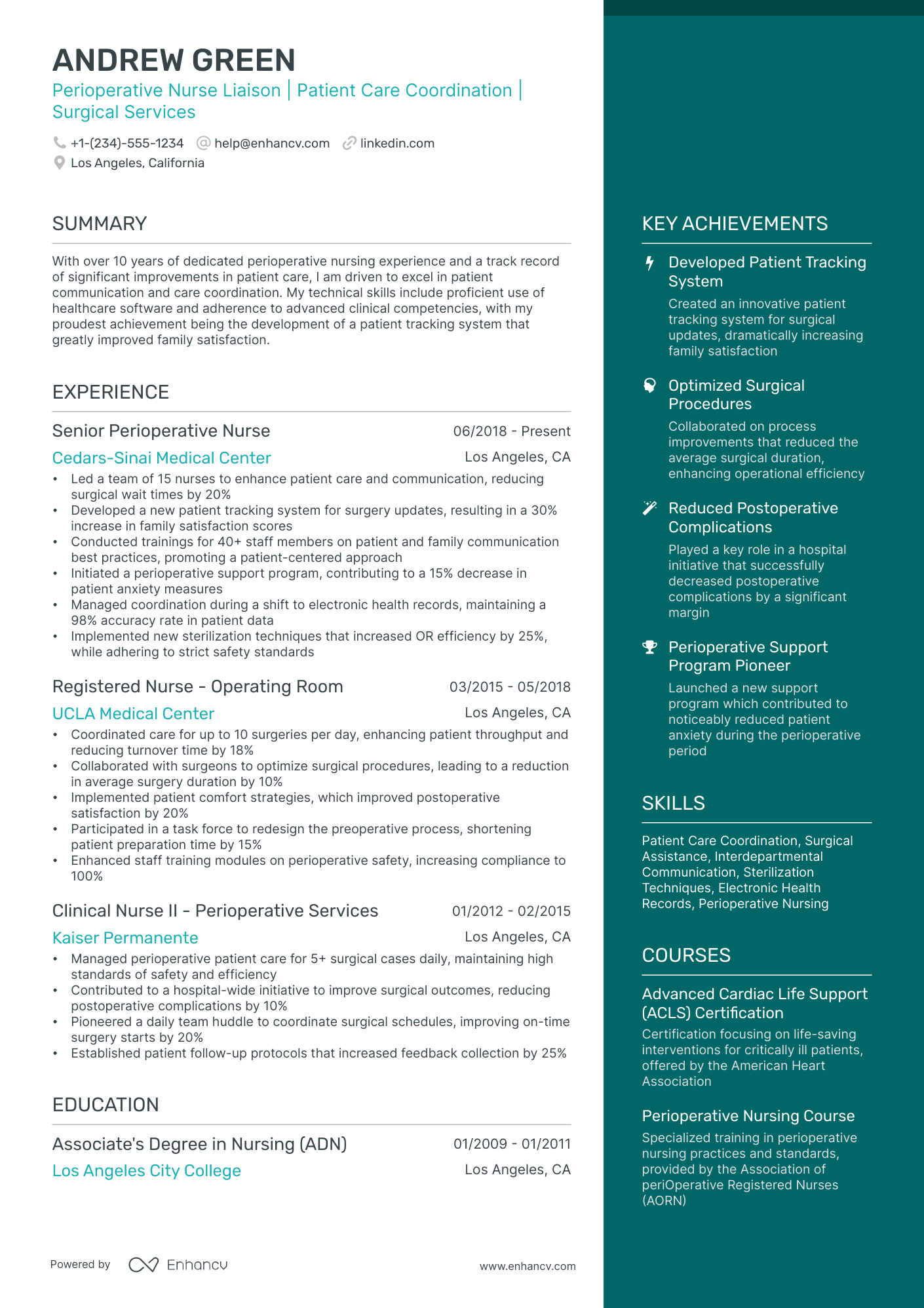
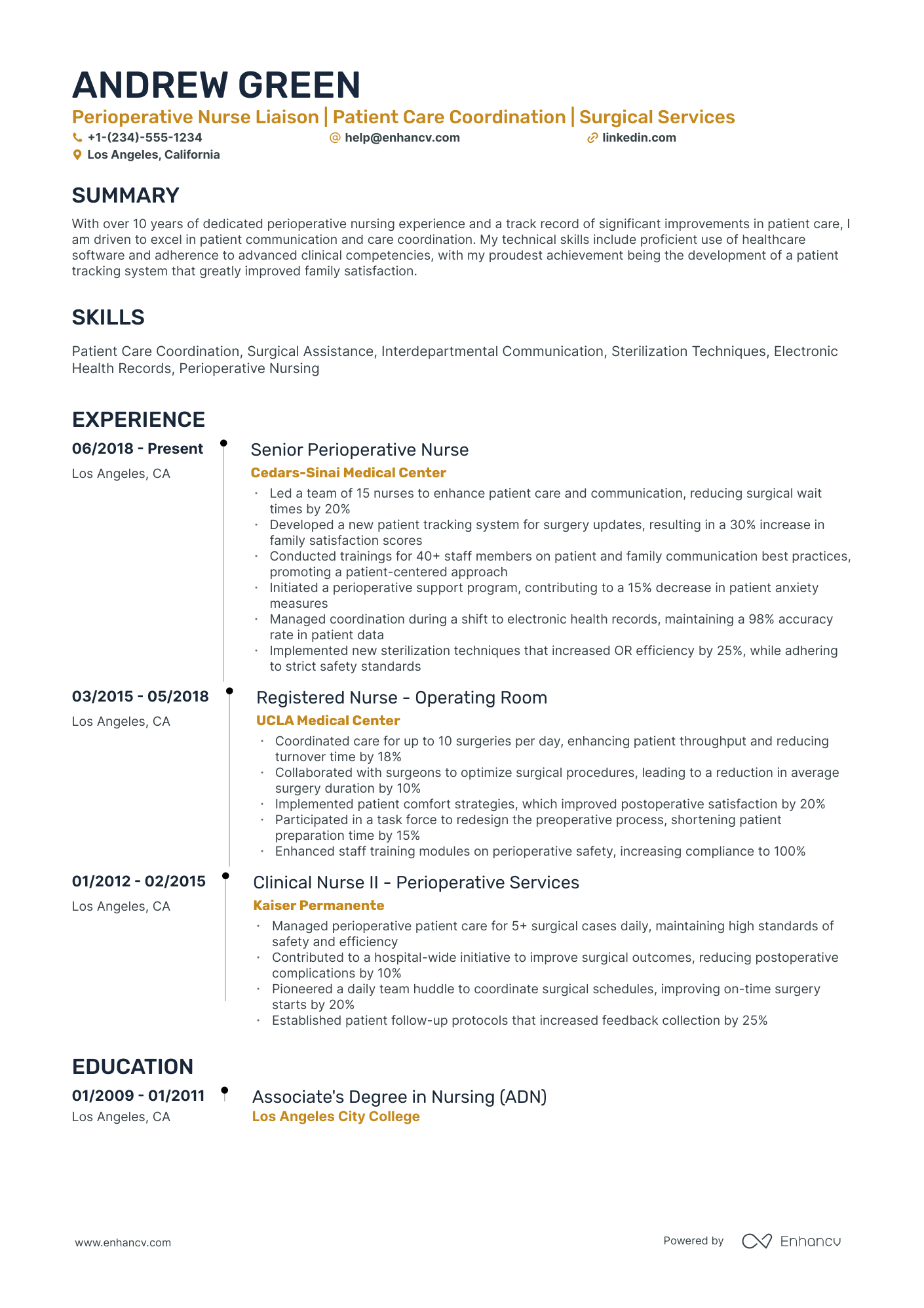
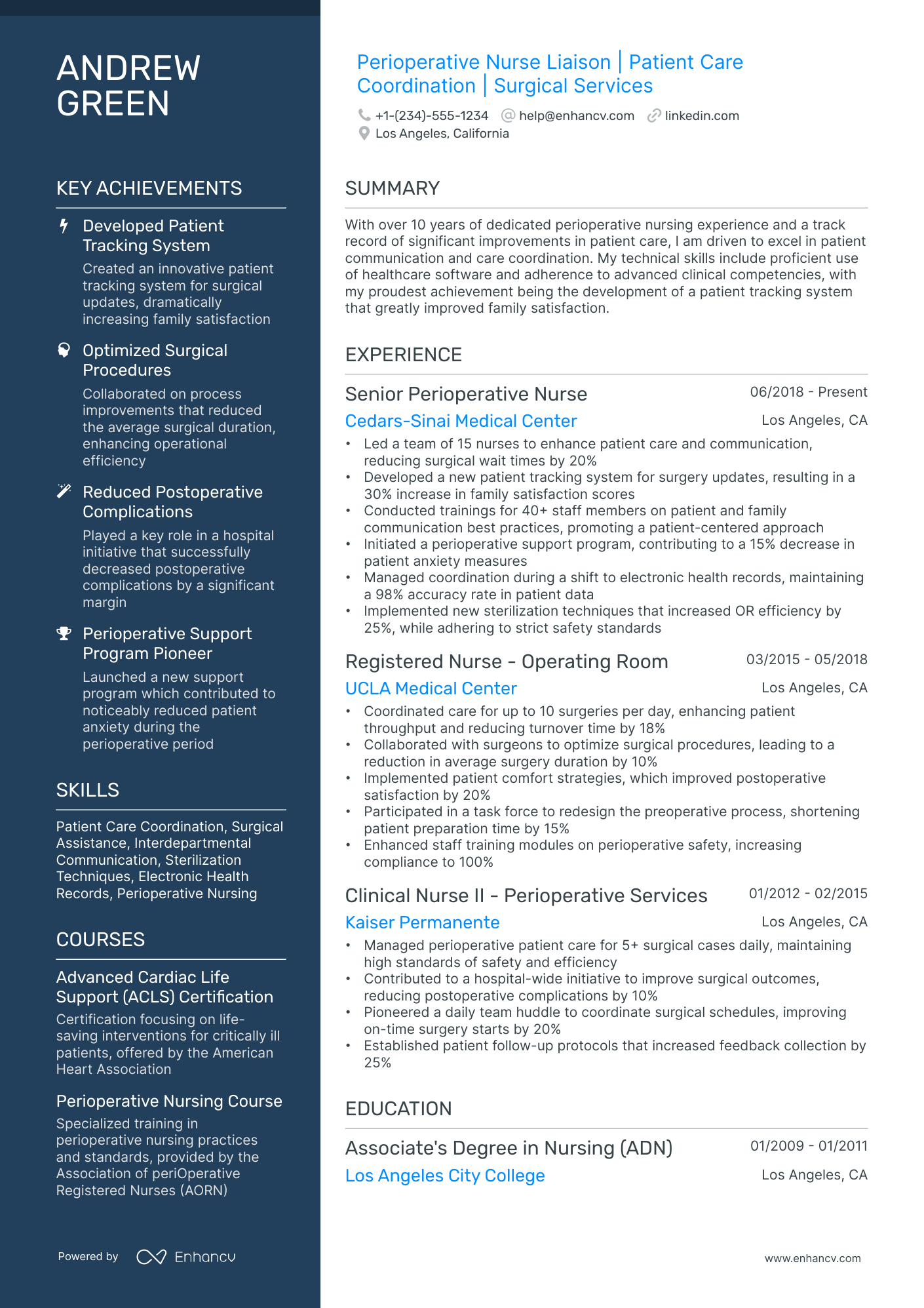
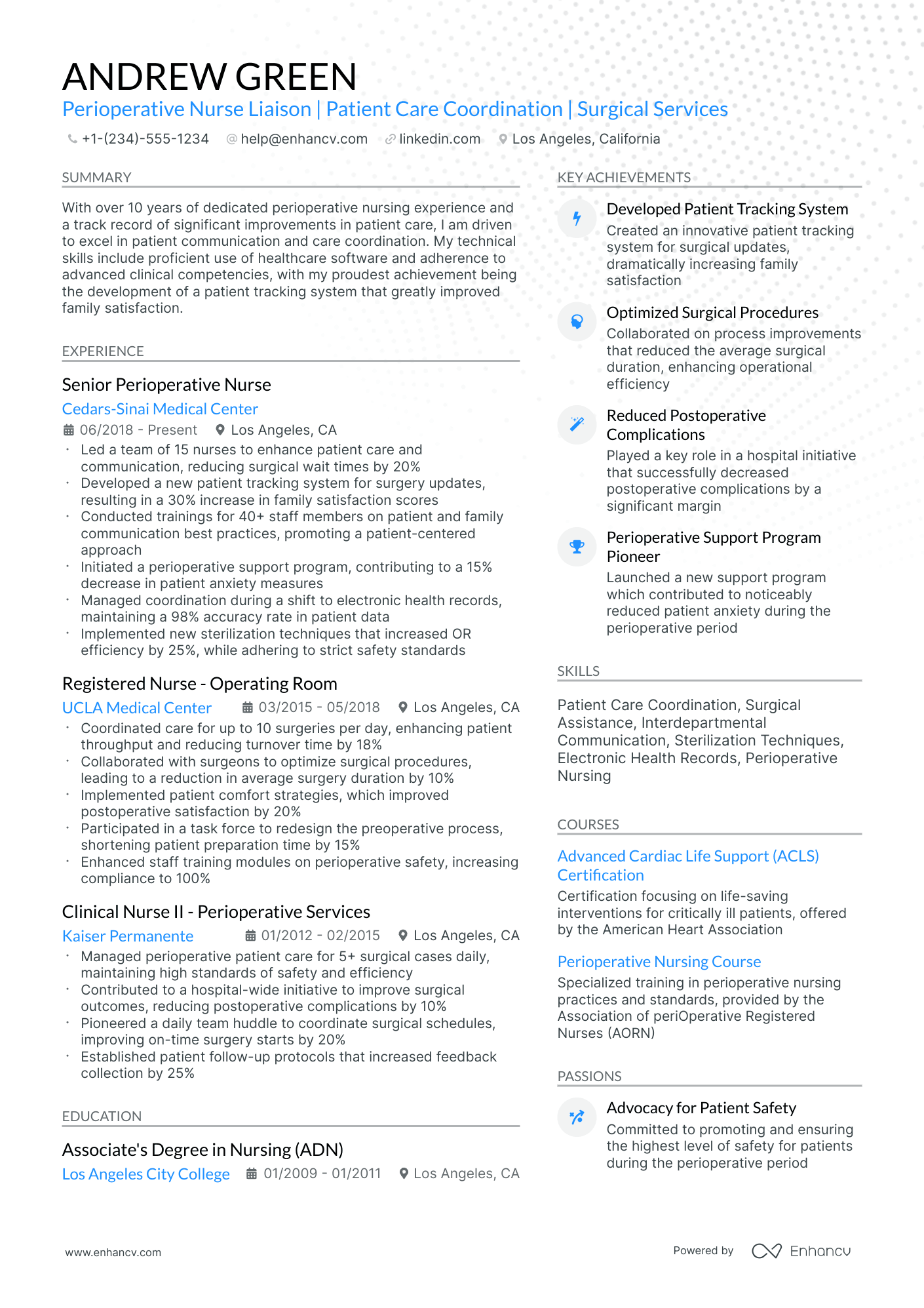
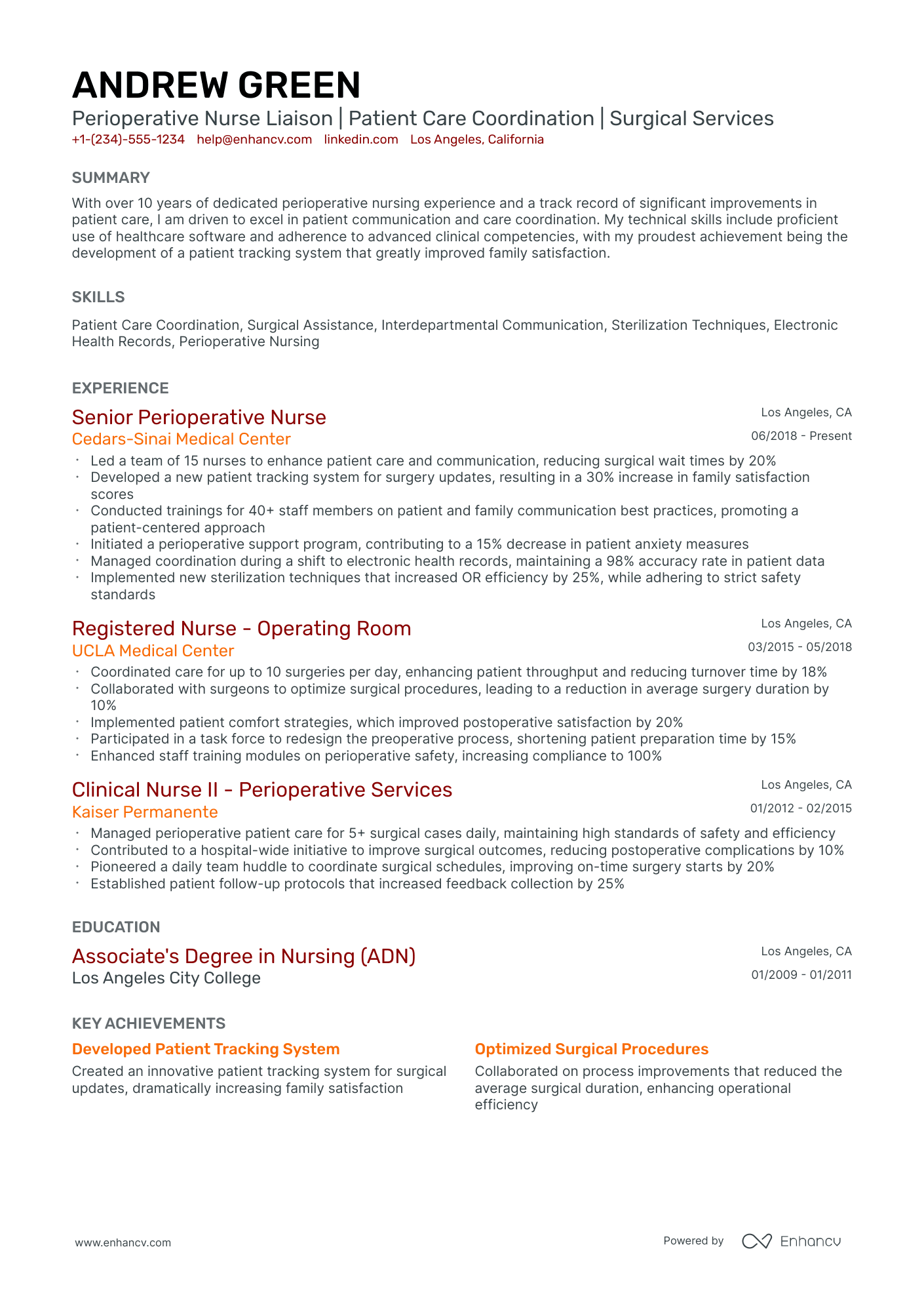
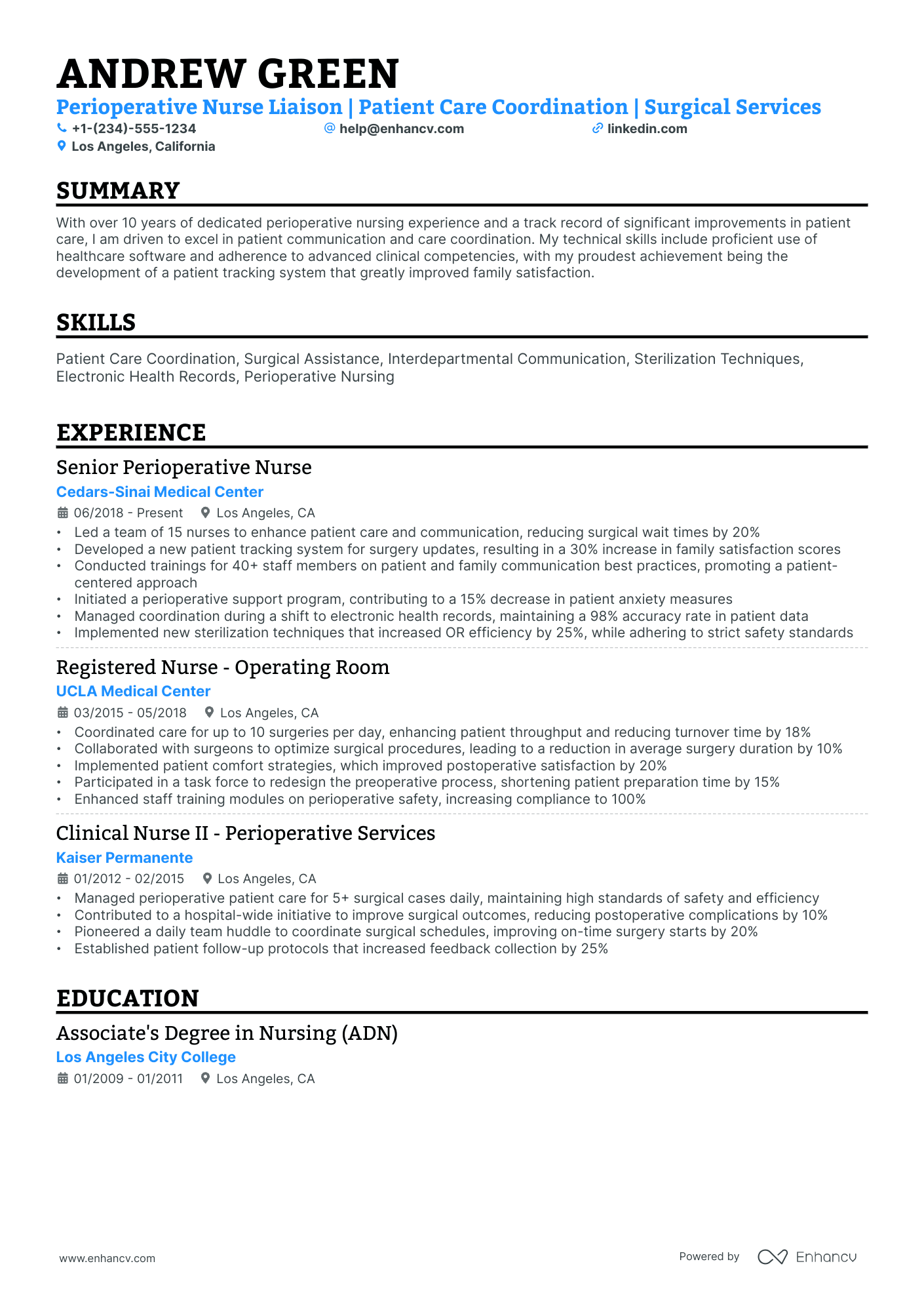
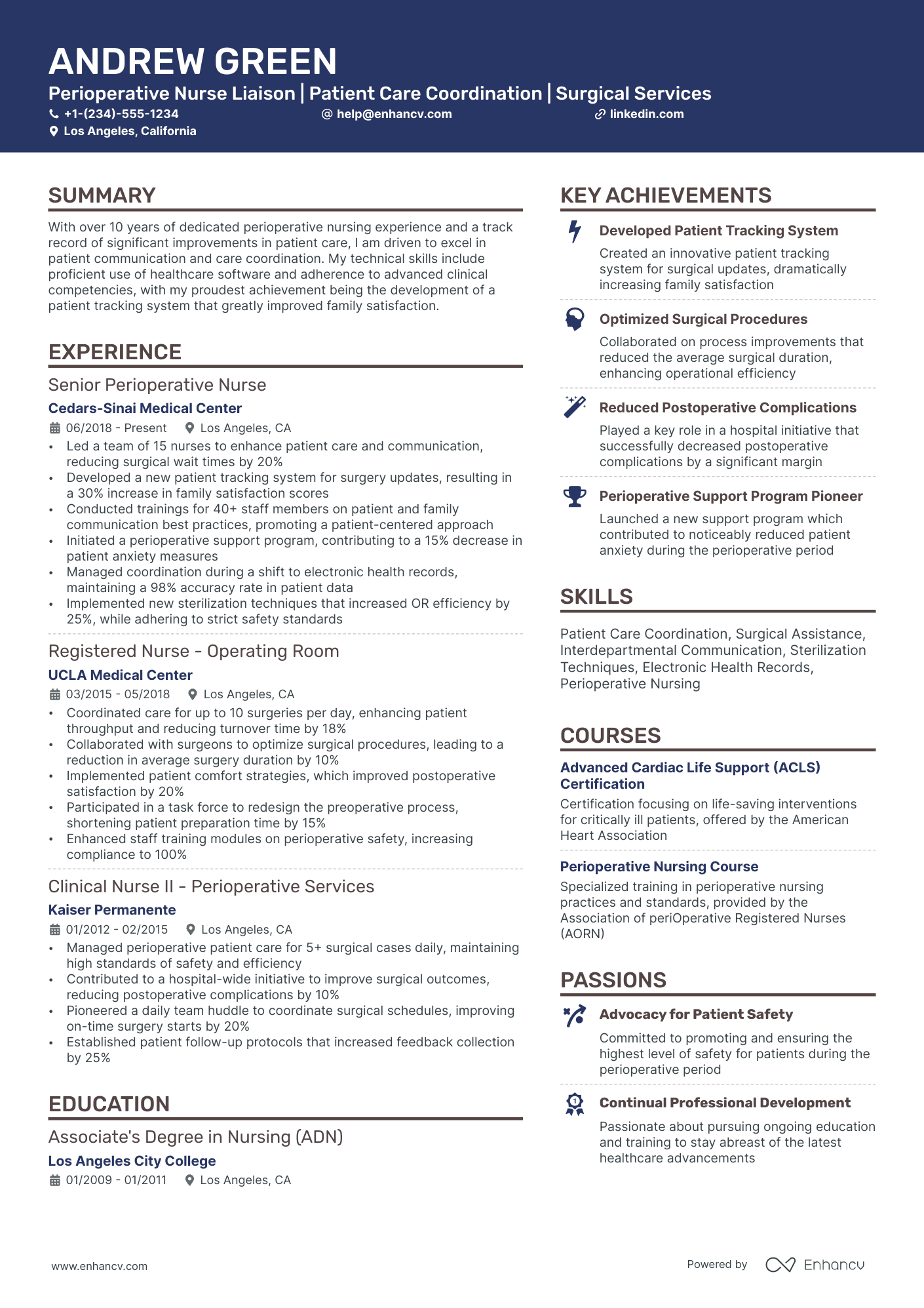
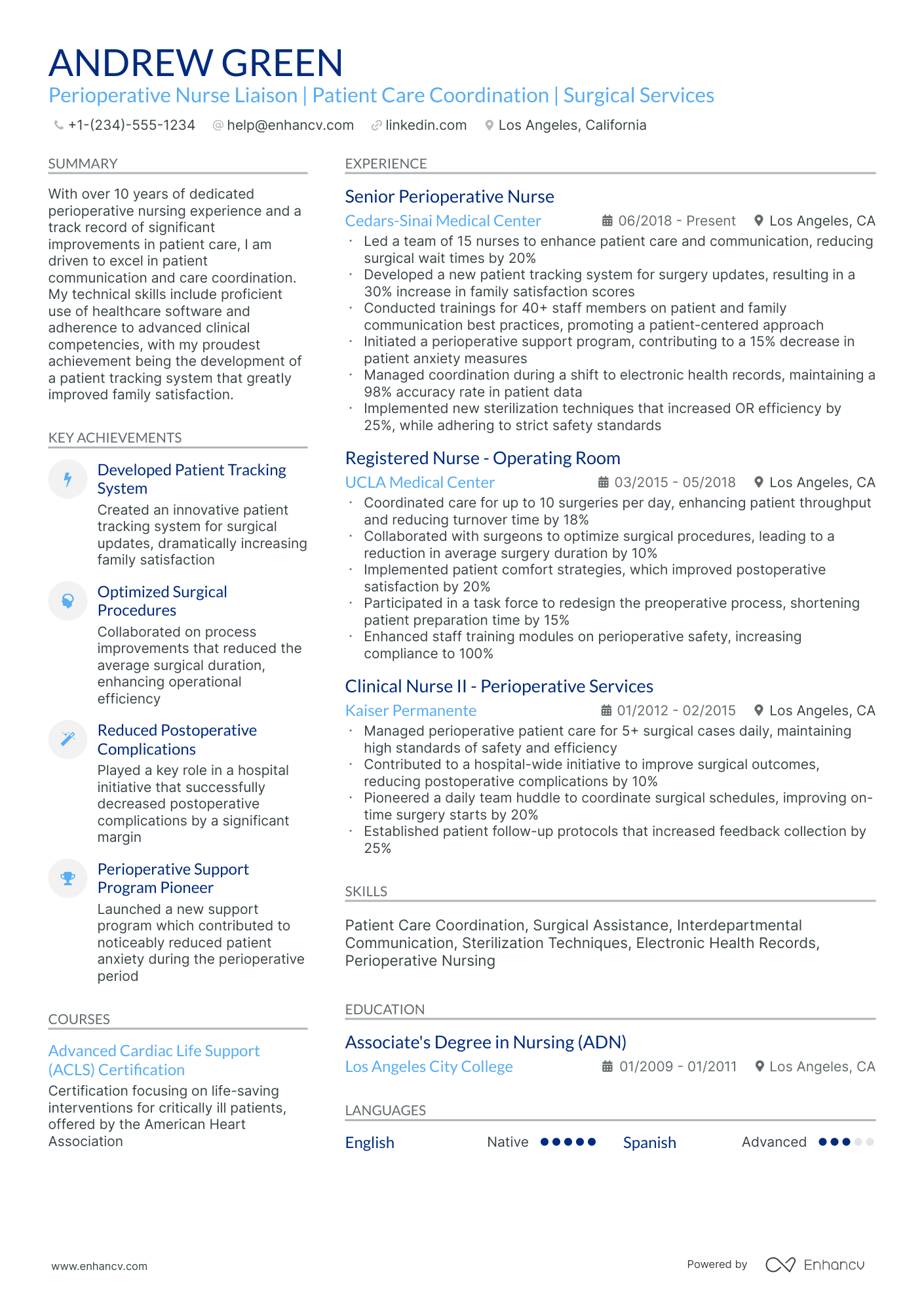
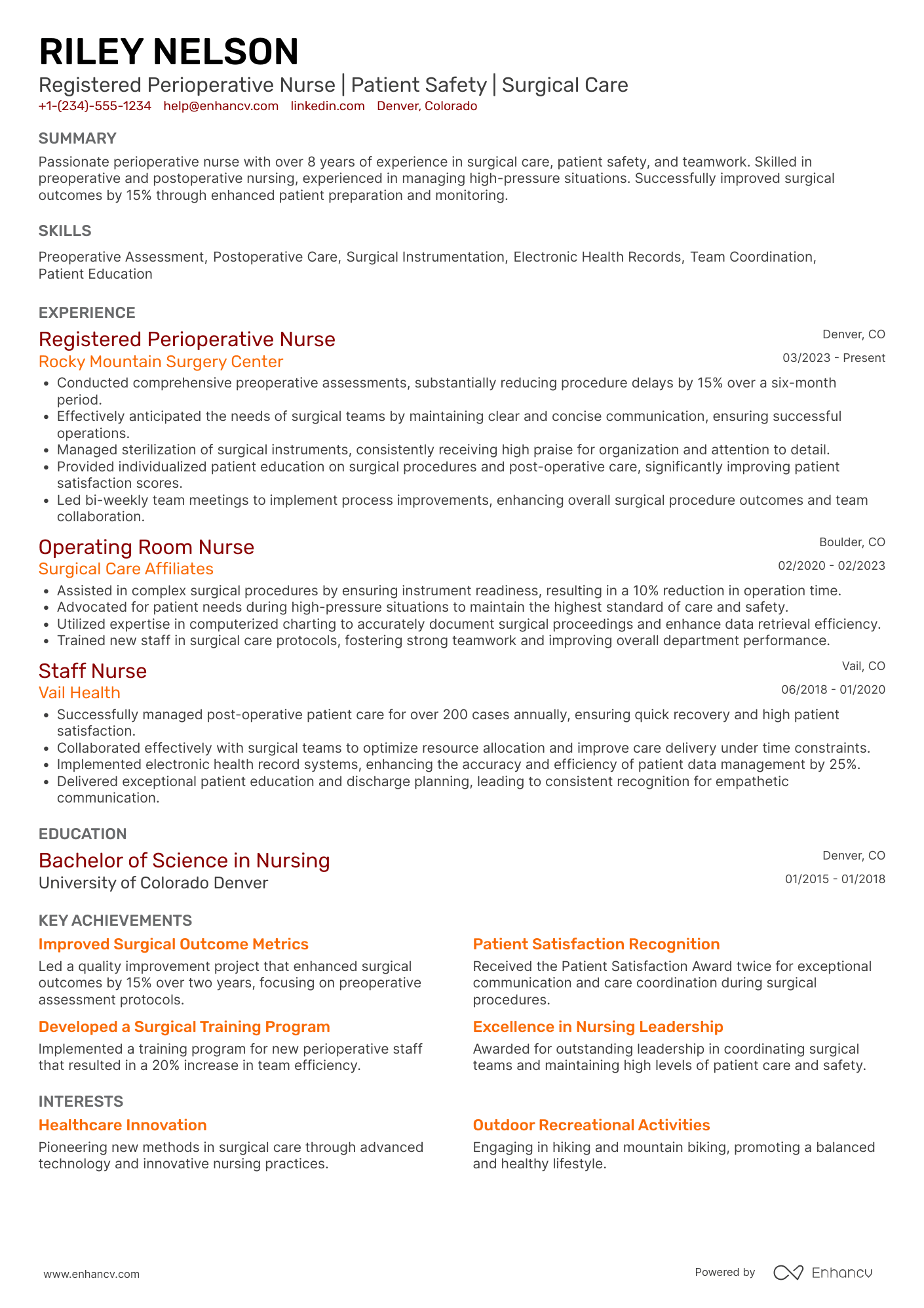
Many perioperative nurse resume drafts fail because they read like task logs and bury results under equipment lists and unit jargon. That format gets filtered by ATS screening and missed in rapid recruiter scans in a competitive market.
A strong resume shows how you improve safety, flow, and outcomes, not just what you do. If you're unsure where to begin, learning how to write a resume that highlights results over duties is the first step. You should highlight reduced turnover time, fewer surgical site infections, on-time case starts, lower instrument errors, and smooth high-volume days.

Key takeaways
- Quantify surgical outcomes like turnover time, infection rates, and case volume in every experience bullet.
- Tailor resume language to mirror each job posting's specific specialties, tools, and safety standards.
- Use reverse-chronological format for experienced nurses and hybrid format for career changers.
- Tie every listed skill to a measurable result in your summary or experience section.
- Place certifications like CNOR above education when they're recent and role-relevant.
- Enhancv's Bullet Point Generator helps convert routine duties into recruiter-ready, results-driven statements.
- Stop using AI once your resume accurately reflects real experience—never fabricate or inflate claims.
How to format a perioperative nurse resume
Recruiters evaluating perioperative nurse candidates prioritize clinical competencies in surgical settings, familiarity with sterile technique and patient safety protocols, and evidence of effective collaboration with surgical teams. Choosing the right resume format ensures these signals surface quickly during both human review and applicant tracking system (ATS) screening.

I have significant experience in this role—which format should I use?
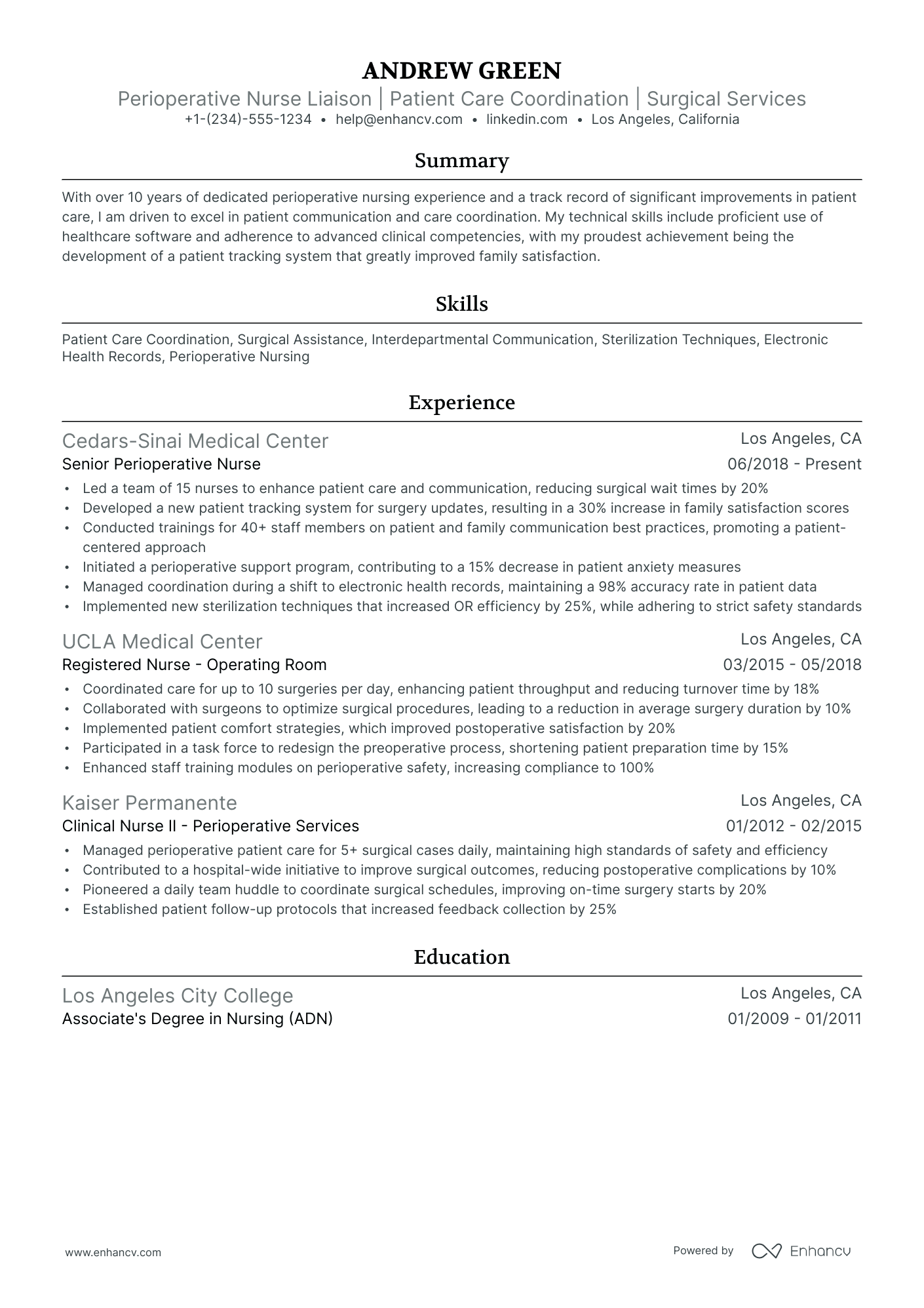
Use a reverse-chronological format to present your perioperative nursing career in a clear, linear progression. Do:
- Lead each role entry with your scope of responsibility, including surgical specialties covered, case volume, and team coordination duties.
- Highlight proficiency with role-specific tools and domains such as electronic health records (EHR) systems, surgical instrumentation, AORN standards, and patient assessment frameworks.
- Quantify outcomes tied to patient safety, efficiency, or quality improvement initiatives.
I'm junior or switching into this role—what format works best?
A hybrid format works best because it lets you lead with relevant clinical skills while still showing your work history in order. Do:
- Place a dedicated skills section near the top of your resume featuring perioperative competencies such as sterile field management, patient positioning, and surgical instrumentation.
- Include clinical rotations, preceptorships, OR externships, or any transitional experience that demonstrates direct exposure to surgical environments.
- Connect each action to a measurable or observable result, even in academic or training contexts.
Why not use a functional resume?
A functional format strips away the clinical timeline that hiring managers rely on to verify where, when, and how you developed your perioperative skills, making it harder to assess your readiness for the OR environment. If you're a career changer with limited direct surgical nursing experience or returning after a significant gap, a functional resume might seem appealing—but even then, every listed skill should be tied to a specific clinical project, rotation, or patient outcome to maintain credibility.
- Edge-case exception: A functional format may be acceptable if you're transitioning from a non-surgical nursing specialty (such as med-surg or ICU) into perioperative nursing and lack dedicated OR job titles, provided you anchor each competency to concrete clinical experiences and measurable results rather than listing skills in isolation.
With your format established, it's time to fill it with the right sections that showcase your perioperative expertise.
What sections should go on a perioperative nurse resume
Recruiters expect a perioperative nurse resume to show operating room expertise, patient safety focus, and measurable results across the surgical workflow. Knowing which resume sections to include ensures maximum clarity:
- Header
- Summary
- Experience
- Skills
- Projects
- Education
- Certifications
- Optional sections: Awards, Leadership, Volunteering
Strong experience bullets should emphasize surgical case volume and complexity, patient safety outcomes, cross-functional coordination, and measurable improvements in efficiency, compliance, or patient care.
Is your resume good enough?
Drop your resume here or choose a file. PDF & DOCX only. Max 2MB file size.
Once you’ve organized the key resume components, the next step is writing your perioperative nurse experience section so each entry supports the role you’re targeting.
How to write your perioperative nurse resume experience
Your experience section should demonstrate the clinical work you've delivered across preoperative, intraoperative, and postoperative settings—highlighting the surgical tools, patient safety protocols, and evidence-based methods you've applied to produce measurable patient outcomes. Hiring managers prioritize demonstrated impact over descriptive task lists, so every entry needs to reflect how your contributions improved surgical workflows, patient recovery metrics, or team performance. Building a targeted resume that aligns each entry with the specific role ensures your qualifications resonate with both recruiters and ATS filters.
Each entry should include:
- Job title
- Company and location (or remote)
- Dates of employment (month and year)
Three to five concise bullet points showing what you owned, how you executed, and what outcomes you delivered:
- Ownership scope: the patient populations, surgical specialties, operating room environments, sterile processing systems, or nursing teams you were directly accountable for throughout the perioperative continuum.
- Execution approach: the clinical assessment frameworks, surgical instrumentation, electronic health record platforms, infection prevention protocols, or evidence-based practices you used to guide patient care decisions and deliver safe perioperative outcomes.
- Value improved: changes to patient safety indicators, surgical site infection rates, operating room turnover efficiency, pain management effectiveness, documentation accuracy, or compliance with regulatory standards resulting from your direct contributions.
- Collaboration context: how you coordinated with surgeons, anesthesiologists, surgical technologists, central sterile supply teams, post-anesthesia care unit nurses, or patient families to ensure seamless handoffs and continuity of care across every phase of the surgical experience.
- Impact delivered: outcomes expressed through reductions in adverse events, improvements in patient satisfaction, gains in procedural efficiency, or contributions to departmental quality benchmarks—framed as results and scale rather than routine activity descriptions.
Experience bullet formula
A perioperative nurse experience example
✅ Right example - modern, quantified, specific.
Perioperative Registered Nurse (RN), CNOR
Riverside Regional Medical Center | Richmond, VA
2021–Present
Level II trauma hospital with twenty operating rooms and a high-volume orthopedic, general surgery, and vascular service line.
- Coordinated pre-op verification and intraoperative time-outs using Epic and AORN checklists, cutting documentation defects by 32% and reducing day-of-surgery delays by 18% across six surgeons.
- Executed sterile field setup, instrument counts, and specimen handling with radio-frequency identification (RFID) tracking and bar-code labeling, driving zero retained surgical items for 24 consecutive months and improving count completion time by 14%.
- Managed anesthesia and hemodynamic monitoring workflows in partnership with anesthesiologists and certified registered nurse anesthetists using automated vital sign capture, decreasing charting time by nine minutes per case and improving on-time case starts by 11%.
- Led surgical site infection prevention bundle adherence—chlorhexidine gluconate prep, normothermia, and antibiotic timing—using audit dashboards, lowering orthopedic surgical site infections from 1.1% to 0.7% year over year.
- Streamlined case turnover with surgeons, sterile processing, and environmental services by standardizing preference cards and tray readiness in Epic, reducing average turnover time from thirty-four to twenty-eight minutes and adding three cases per week without overtime.
Now that you've seen how a strong experience section looks in practice, let's break down the specific strategies you can use to tailor each entry to the perioperative nursing role you're targeting.
How to tailor your perioperative nurse resume experience
Recruiters evaluate your perioperative nurse resume through both human review and applicant tracking systems. Tailoring your resume to the job description ensures your qualifications stand out in both screening methods.
Ways to tailor your perioperative nurse experience:
- Match specific surgical specialties and procedure types listed in the posting.
- Use the exact terminology for sterile processing and infection control standards.
- Mirror patient safety metrics or quality benchmarks the employer prioritizes.
- Include experience with their named EHR or surgical documentation systems.
- Highlight AORN guidelines and perioperative standards referenced in the description.
- Emphasize circulating or scrub roles that align with their stated needs.
- Reference interdisciplinary collaboration models mentioned for the surgical team.
- Align your compliance experience with accreditation bodies they specify.
Tailoring means aligning your real clinical achievements with stated job requirements, not forcing unrelated keywords into your experience bullets.
Resume tailoring examples for perioperative nurse
| Job description excerpt | Untailored | Tailored |
|---|---|---|
| "Assist surgical team during procedures, maintain sterile field, and operate advanced laparoscopic equipment in a Level I trauma center OR." | Helped with surgeries and kept the operating room clean. | Maintained sterile field integrity across 10+ daily procedures in a Level I trauma center, operating and troubleshooting Karl Storz laparoscopic towers during minimally invasive general and trauma surgeries. |
| "Coordinate patient positioning, conduct surgical counts per AORN standards, and manage instrument trays for orthopedic and neurosurgical cases." | Prepared patients and instruments before surgery. | Coordinated patient positioning using Allen stirrups and Jackson tables for orthopedic and neurosurgical cases, completing surgical counts per AORN guidelines with a 100% compliance rate across 1,200+ annual procedures. |
| "Serve as circulating nurse, document intraoperative events in Epic, and communicate with PACU staff to ensure safe handoffs." | Documented patient information and communicated with other nurses. | Served as circulating nurse for 6–8 daily cases, documenting intraoperative events, implant logs, and specimen handling in Epic OpTime while delivering structured SBAR handoffs to PACU staff to reduce post-surgical communication errors. |
Once your experience aligns with the role’s requirements, quantify your perioperative nurse achievements to show the measurable impact behind that fit.
How to quantify your perioperative nurse achievements
Numbers show how you improve safety, flow, and outcomes in the operating room. Quantifying your achievements with metrics like on-time starts, turnover time, infection and error rates, compliance, and case volume supported across specialties makes your impact undeniable to hiring managers.
Quantifying examples for perioperative nurse
| Metric | Example |
|---|---|
| Turnover time | "Cut average room turnover from 32 to 24 minutes across two operating rooms by standardizing setup checklists and coordinating EVS and sterile processing." |
| Infection prevention | "Improved surgical site infection rate from 0.9% to 0.5% in orthopedic cases by tightening skin prep compliance and auditing antibiotic timing in the electronic health record." |
| Throughput volume | "Supported an average of eight to ten cases per day in a high-acuity general surgery room while maintaining instrument readiness and accurate counts for every case." |
| Compliance accuracy | "Raised on-time prophylactic antibiotic administration from 86% to 97% over three months using pre-incision time-out prompts and real-time chart checks." |
| Safety risk reduction | "Reduced count discrepancies from five per quarter to zero for two consecutive quarters by implementing a two-person count protocol and documenting in SurgiCount." |
Turn vague job duties into measurable, recruiter-ready resume bullets in seconds with Enhancv's Bullet Point Generator.
Once you've crafted strong bullet points for your experience section, it's equally important to strategically present your hard and soft skills to give hiring managers a complete picture of your qualifications.
How to list your hard and soft skills on a perioperative nurse resume
Your skills section shows you can keep patients safe across pre-op, intra-op, and post-op care, and recruiters and an ATS (applicant tracking system) scan them to match job requirements; aim for a balanced mix of hard skills like clinical competencies and role-specific soft skills. perioperative nurse roles require a blend of:
- Product strategy and discovery skills
- Data, analytics, and experimentation skills
- Delivery, execution, and go-to-market discipline
- Soft skills
Your skills section should be:
- Scannable (bullet-style grouping).
- Relevant to the job post.
- Backed by proof in experience bullets.
- Updated with current tools.
Place your skills section:
- Above experience if you're junior or switching careers.
- Below experience if you're mid/senior with strong achievements.

Hard skills
- AORN standards compliance
- Sterile technique, aseptic practice
- Surgical instrumentation, counts
- Scrub and circulating workflows
- Surgical site infection prevention
- Patient positioning, pressure injury prevention
- Electrosurgery safety, grounding
- Specimen handling, chain of custody
- Pre-op assessment, consent verification
- Post-anesthesia care unit monitoring
- Electronic health records documentation
- Time-out, Universal Protocol
Soft skills
- Closed-loop communication in the operating room
- Rapid prioritization during case changes
- Assertive escalation for safety concerns
- Anticipating surgeon and team needs
- Coordinating handoffs across units
- Staying calm in high-acuity cases
- Coaching peers on sterile breaks
- Managing turnover and room readiness
- Clear patient and family education
- Documentation discipline under time pressure
- Cross-functional collaboration with anesthesia
- Owning follow-through on incident reports
How to show your perioperative nurse skills in context
Skills shouldn't live only in a bulleted list on your resume. Explore resume skills examples to see how top candidates weave competencies throughout their documents.
They should be demonstrated in:
- Your summary (high-level professional identity)
- Your experience (proof through outcomes)
Here's how that looks in practice.
Summary example
Perioperative nurse with 10 years of experience in Level I trauma centers. Skilled in surgical safety checklists, AORN standards, and EHR documentation. Reduced surgical site infections by 22% through improved sterile technique protocols and interdisciplinary team communication.
- Reflects senior-level expertise clearly
- Names role-specific tools and standards
- Leads with a measurable clinical outcome
- Highlights communication as a soft skill
Experience example
Perioperative Registered Nurse
Mercy Health Surgical Center | Toledo, OH
June 2018–Present
- Coordinated with surgeons, anesthesiologists, and surgical techs across 1,200+ annual procedures using AORN-compliant safety checklists, reducing near-miss events by 18%.
- Implemented a standardized instrument count protocol in Epic EHR, decreasing retained surgical item incidents to zero over three years.
- Mentored four new perioperative nurses on intraoperative workflows, cutting average onboarding time by 25%.
- Every bullet includes measurable proof
- Skills appear naturally within achievements
Once you’ve tied your perioperative nursing strengths to real clinical situations, the next step is to apply that same approach when building a perioperative nurse resume with no experience so your training and transferable skills still read as job-ready.
How do I write a perioperative nurse resume with no experience
Even without full-time experience, you can demonstrate readiness through clinical training and transferable competencies. If you're building a resume without work experience, focus on these elements:
- Perioperative clinical rotation hours logged
- Operating room shadowing with preceptor
- Simulation lab sterile technique checkoffs
- Surgical case observation logs maintained
- Capstone quality improvement project results
- Basic life support certification and renewal
- Precepted circulating nurse skills practice
- Instrument counting and documentation drills
Focus on:
- Sterile technique, gowning, gloving evidence
- Surgical safety checklist participation logs
- Documentation accuracy and compliance metrics
- Exposure to operating room workflows
Resume format tip for entry-level perioperative nurse
Use a hybrid resume format because it highlights perioperative nurse skills and clinical training while still showing a clear timeline. Do:
- Put licenses, certifications, and clinicals first.
- Quantify clinical hours, cases observed, and checkoffs completed.
- List perioperative nurse skills with proof, like logs or evaluations.
- Add relevant coursework tied to operating room practice.
- Use action verbs and include tools used.
- Completed 120 perioperative nurse clinical hours and assisted with surgical safety checklist documentation for 25 cases, achieving 98% chart completeness on preceptor audits.
Even without direct perioperative experience, your nursing education and clinical rotations can demonstrate the foundational knowledge employers are looking for—so presenting them effectively on your resume is essential.
How to list your education on a perioperative nurse resume
Your education section helps hiring teams confirm you have the clinical foundation required for perioperative nurse roles. It validates your training in surgical care and patient safety.
Include:
- Degree name
- Institution
- Location
- Graduation year
- Relevant coursework (for juniors or entry-level candidates)
- Honors & GPA (if 3.5 or higher)
Skip month and day details—list the graduation year only.
Here's a strong education entry tailored to a perioperative nurse resume:
Example education entry
Bachelor of Science in Nursing
University of Pittsburgh, Pittsburgh, PA
Graduated 2021
GPA: 3.7/4.0
- Relevant Coursework: Surgical Nursing, Perioperative Patient Care, Pharmacology, Anatomy & Physiology, Sterile Technique Principles
- Honors: Magna Cum Laude, Dean's List (all semesters)
How to list your certifications on a perioperative nurse resume
Certifications on your resume show a perioperative nurse's commitment to learning, proficiency with surgical tools and protocols, and current industry relevance in fast-changing operating room environments. Include:
- Certificate name
- Issuing organization
- Year
- Optional: credential ID or URL
- Place certifications below education when they're older, less role-specific, or secondary to your nursing degree and clinical training.
- Place certifications above education when they're recent, highly relevant to perioperative nursing, or required for the jobs you're targeting.
Best certifications for your perioperative nurse resume
- Certified Perioperative Nurse (CNOR)
- Certified Registered Nurse First Assistant (CRNFA)
- Basic Life Support (BLS)
- Advanced Cardiovascular Life Support (ACLS)
- Pediatric Advanced Life Support (PALS)
- Certified Surgical Services Manager (CSSM)
- Trauma Nursing Core Course (TNCC)
Once you’ve highlighted the credentials that validate your operating room expertise, focus on your perioperative nurse resume summary to tie those qualifications to the value you bring.
How to write your perioperative nurse resume summary
Your resume summary is the first thing a recruiter reads. A strong one immediately signals you're qualified for the perioperative nurse role.
Keep it to three to four lines, with:
- Your title and total years of perioperative or surgical nursing experience.
- Clinical setting, such as inpatient OR, ambulatory surgery, or trauma center.
- Core skills like sterile technique, patient assessment, surgical instrumentation, and EHR documentation.
- One or two measurable achievements, such as reduced surgical site infections or improved turnover times.
- Soft skills tied to real outcomes, like clear communication during hand-offs or calm performance in emergencies.

PRO TIP
At this level, focus on clinical skills, certifications like CNOR, and specific contributions to patient safety or efficiency. Avoid vague phrases like "passionate team player" or "hardworking go-getter." Replace them with concrete actions and measurable results that prove your value in the OR.
Example summary for a perioperative nurse
CNOR-certified perioperative nurse with three years of experience in Level I trauma ORs. Skilled in sterile technique, surgical counts, and Epic charting. Reduced instrument setup errors by 18% through standardized tray audits.
Optimize your resume summary and objective for ATS
Drop your resume here or choose a file.
PDF & DOCX only. Max 2MB file size.
Now that your summary spotlights your strongest qualifications, make sure the header framing it presents your contact details correctly so recruiters can reach you without friction.
What to include in a perioperative nurse resume header
A well-crafted resume header lists your key contact details and professional identity, boosting visibility, credibility, and recruiter screening for perioperative nurse roles.
Essential resume header elements
- Full name
- Tailored job title and headline
- Location
- Phone number
- Professional email
- GitHub link
- Portfolio link
A LinkedIn link helps recruiters verify experience quickly and supports screening.
Don't include a photo on a perioperative nurse resume unless the role is explicitly front-facing or appearance-dependent.
Match your header title to the perioperative nurse job posting and keep formatting consistent across your resume and application profiles.
Example
Perioperative nurse resume header
Jordan Taylor
Perioperative nurse | Operating room circulator and scrub nurse
Denver, CO
(303) 555-01XX
your.name@enhancv.com
github.com/yourname
yourwebsite.com
linkedin.com/in/yourname
Once your contact details and role identifiers are clear at the top, you can strengthen the rest of your resume with additional sections that support your perioperative nursing qualifications.
Additional sections for perioperative nurse resumes
Adding extra sections helps you stand out when your core qualifications match other perioperative nurse candidates competing for the same role.
- Languages
- Certifications and licenses
- Professional affiliations (e.g., AORN membership)
- Continuing education and surgical training
- Publications or clinical research
- Volunteer experience in healthcare settings
Once you've strengthened your resume with these targeted sections, pairing it with a well-crafted cover letter can further set your application apart.
Do perioperative nurse resumes need a cover letter
A cover letter isn't required for every perioperative nurse application. If you're wondering what a cover letter is and when it matters, it helps most when the role is competitive or the employer expects one. It can make a difference when your resume needs context or your fit isn't obvious.
Use a cover letter to add details your resume can't:
- Explain role and team fit by matching your operating room workflow, case mix, and collaboration style to the unit's needs.
- Highlight one or two outcomes, such as reducing turnover time, improving instrument readiness, or strengthening surgical site infection practices.
- Show you understand the hospital's services, patient population, and quality goals, and connect your perioperative nurse experience to those priorities.
- Address transitions or non-obvious experience, like moving from bedside nursing, returning after a gap, or shifting specialties within perioperative nursing.
Drop your resume here or choose a file.
PDF & DOCX only. Max 2MB file size.
Even if you include a cover letter when you apply, using AI to improve your perioperative nurse resume helps you strengthen the document that hiring teams review first.
Using AI to improve your perioperative nurse resume
AI can sharpen your resume's clarity, structure, and impact. It helps tighten language and highlight measurable results. But overuse strips authenticity. Once your content is clear and role-aligned, step away from AI. If you're exploring options, learn which AI is best for writing resumes before committing to a tool.
Here are 10 practical prompts to strengthen specific sections of your perioperative nurse resume:
Strengthen your summary
Quantify experience bullets
Align skills with job posts
Improve action verbs
Tighten certification details
Clarify education entries
Refine project descriptions
Remove redundant phrasing
Tailor for specialties
Check consistency throughout
Conclusion
A strong perioperative nurse resume shows measurable outcomes, role-specific skills, and a clear structure. Lead with results like reduced turnover time, fewer safety events, and high patient satisfaction. Highlight circulating, scrubbing, sterile technique, and documentation skills.
Keep sections easy to scan, and match your experience to the role’s needs. A focused summary, clean work history, and relevant certifications show readiness for today’s hiring market. This approach also supports near-future expectations for safety, efficiency, and consistent team communication.