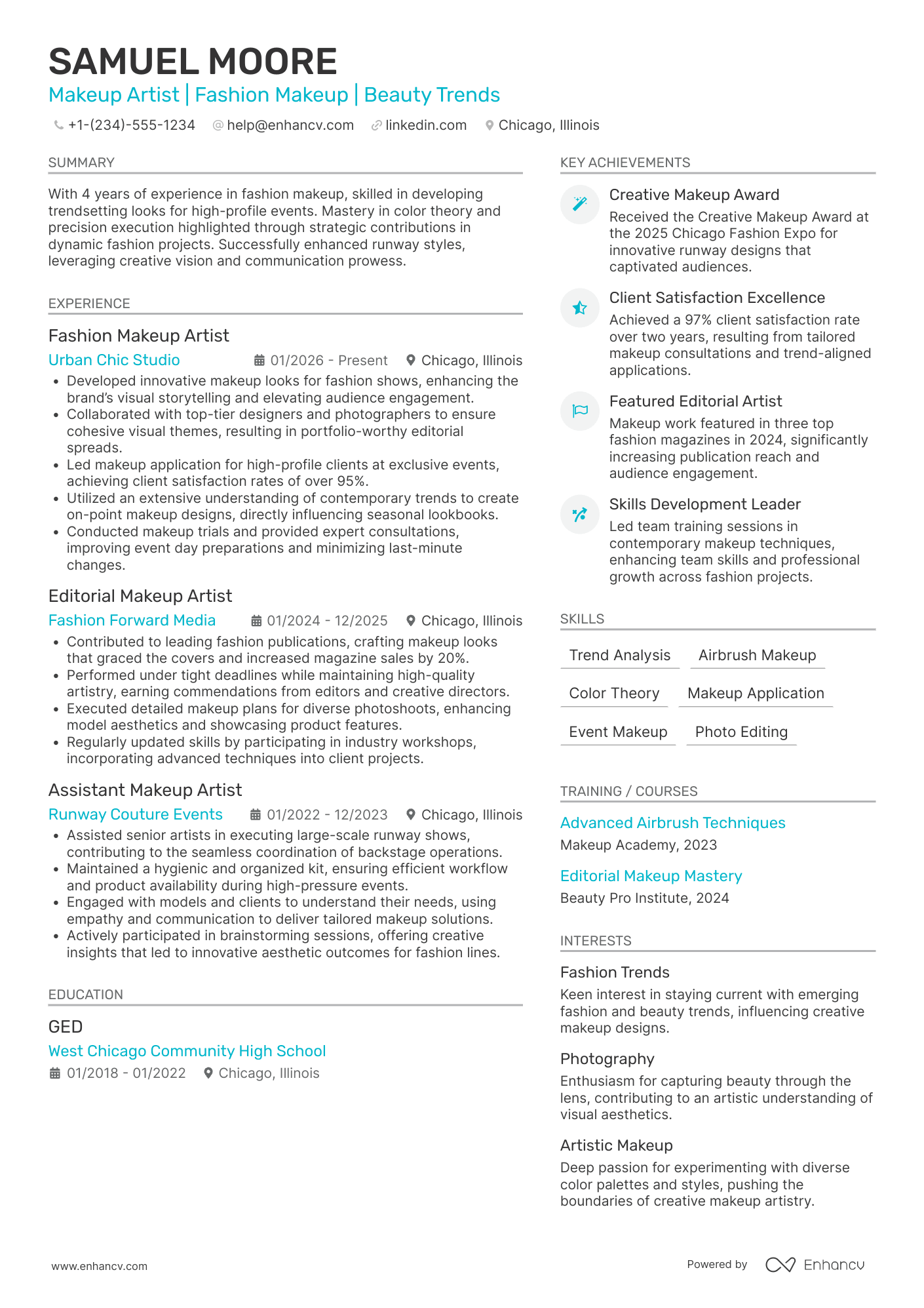
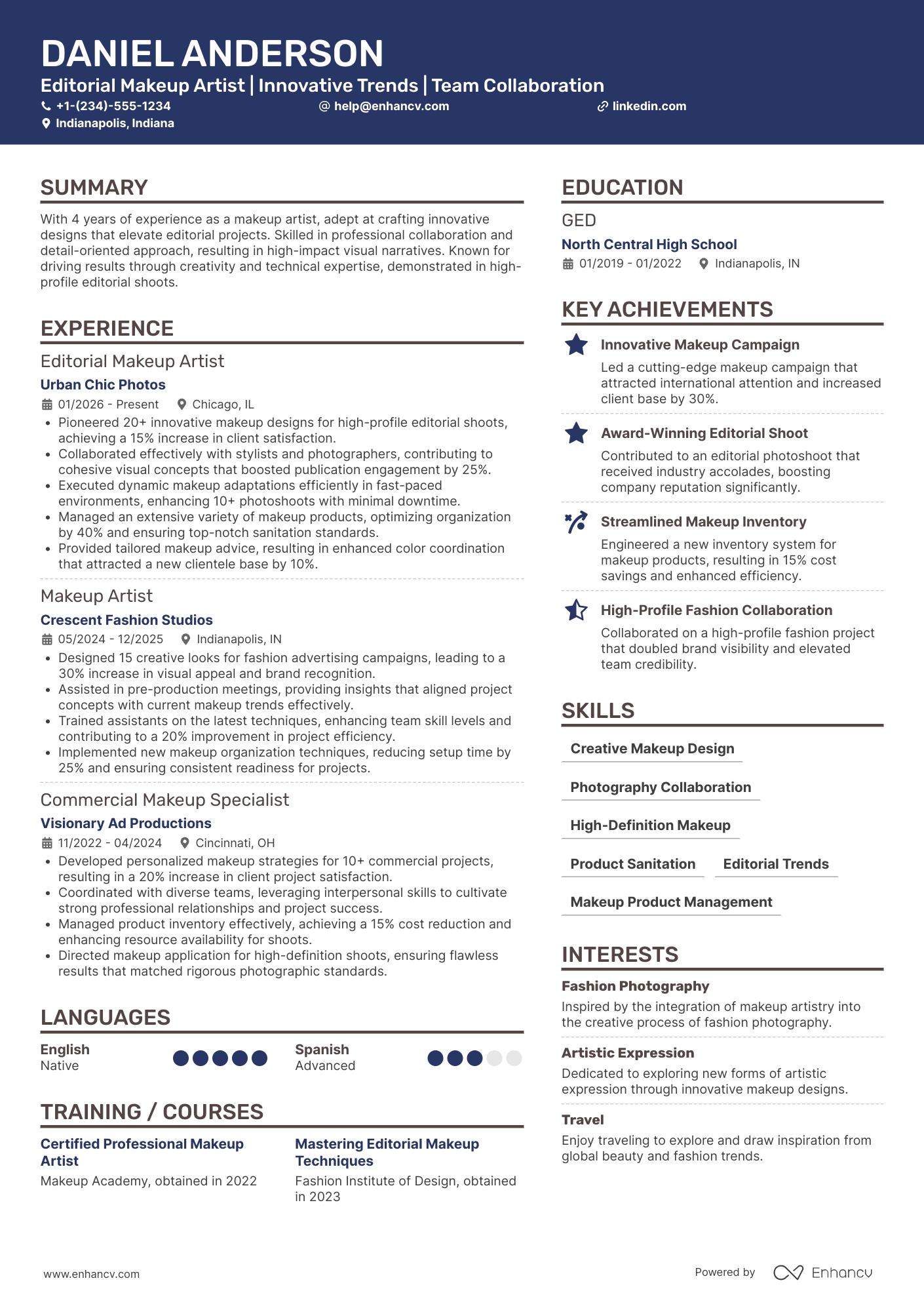
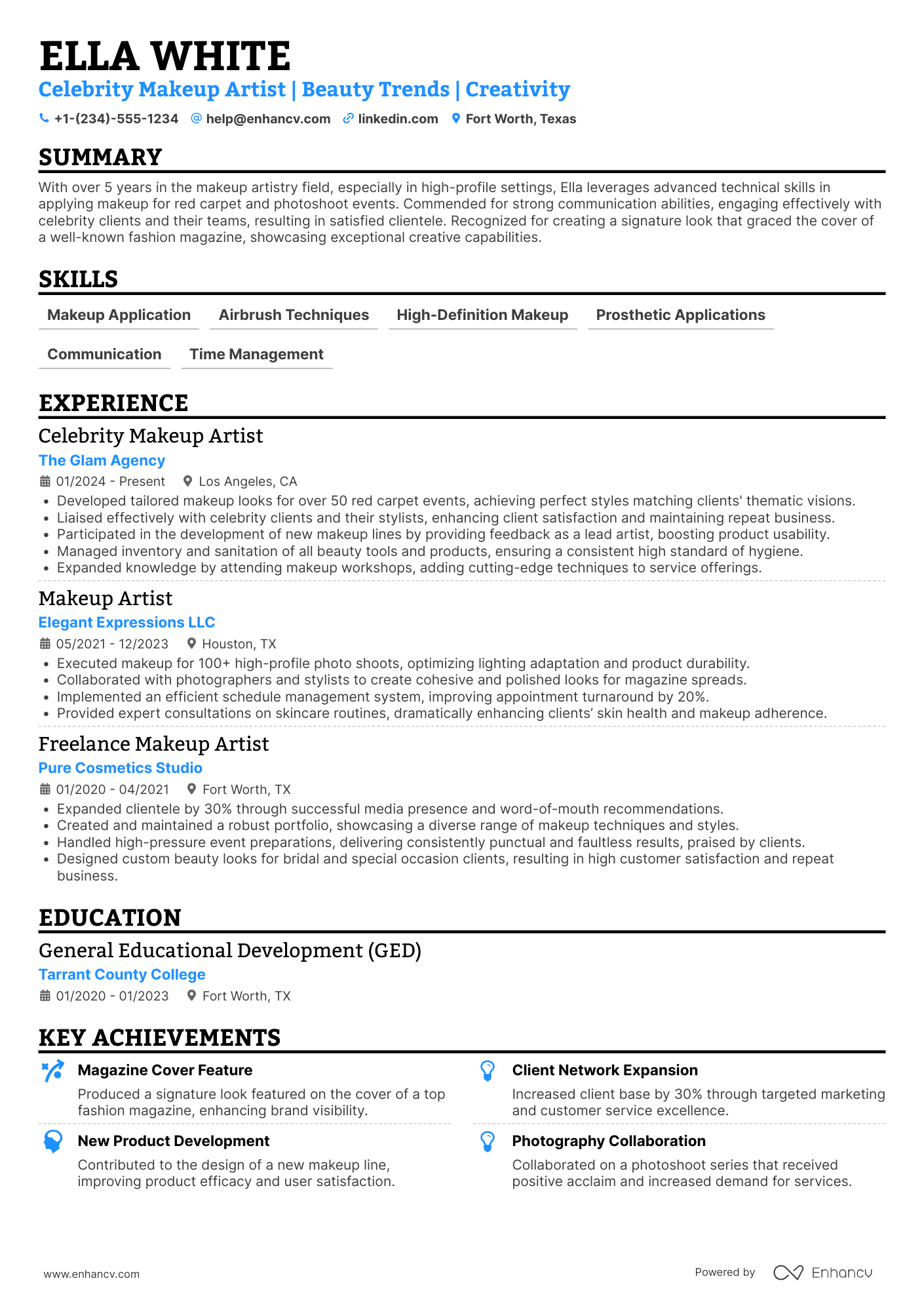
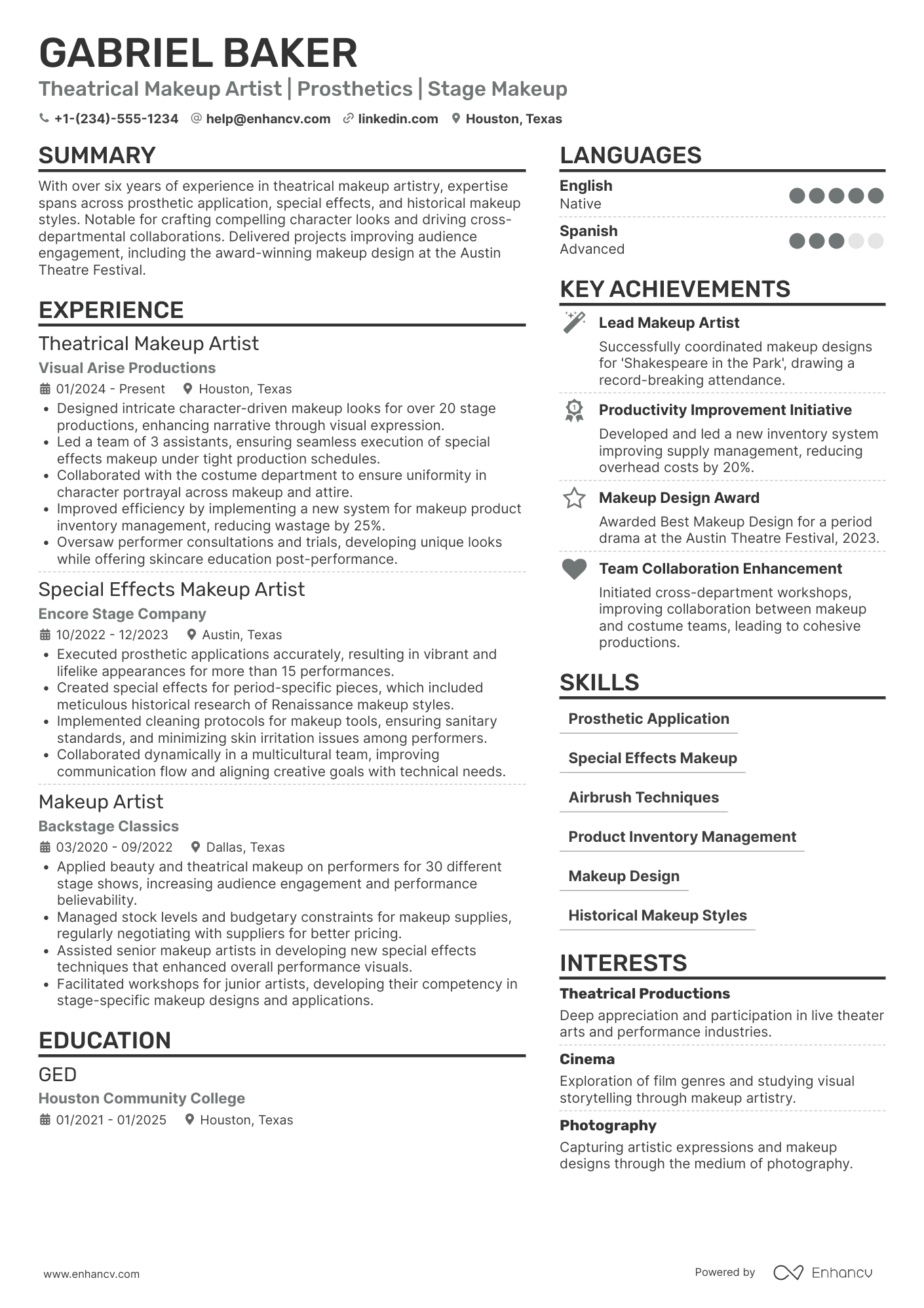
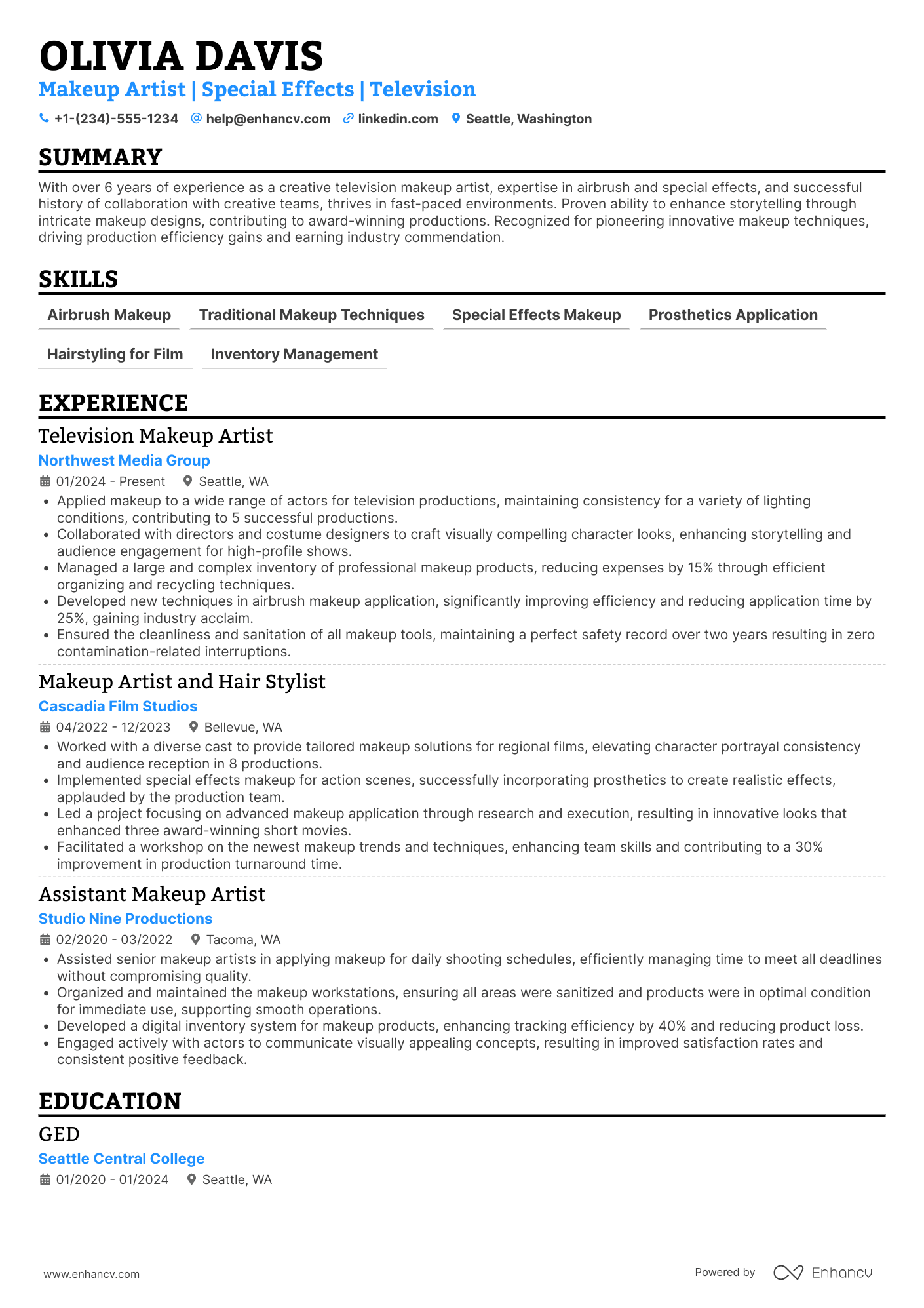
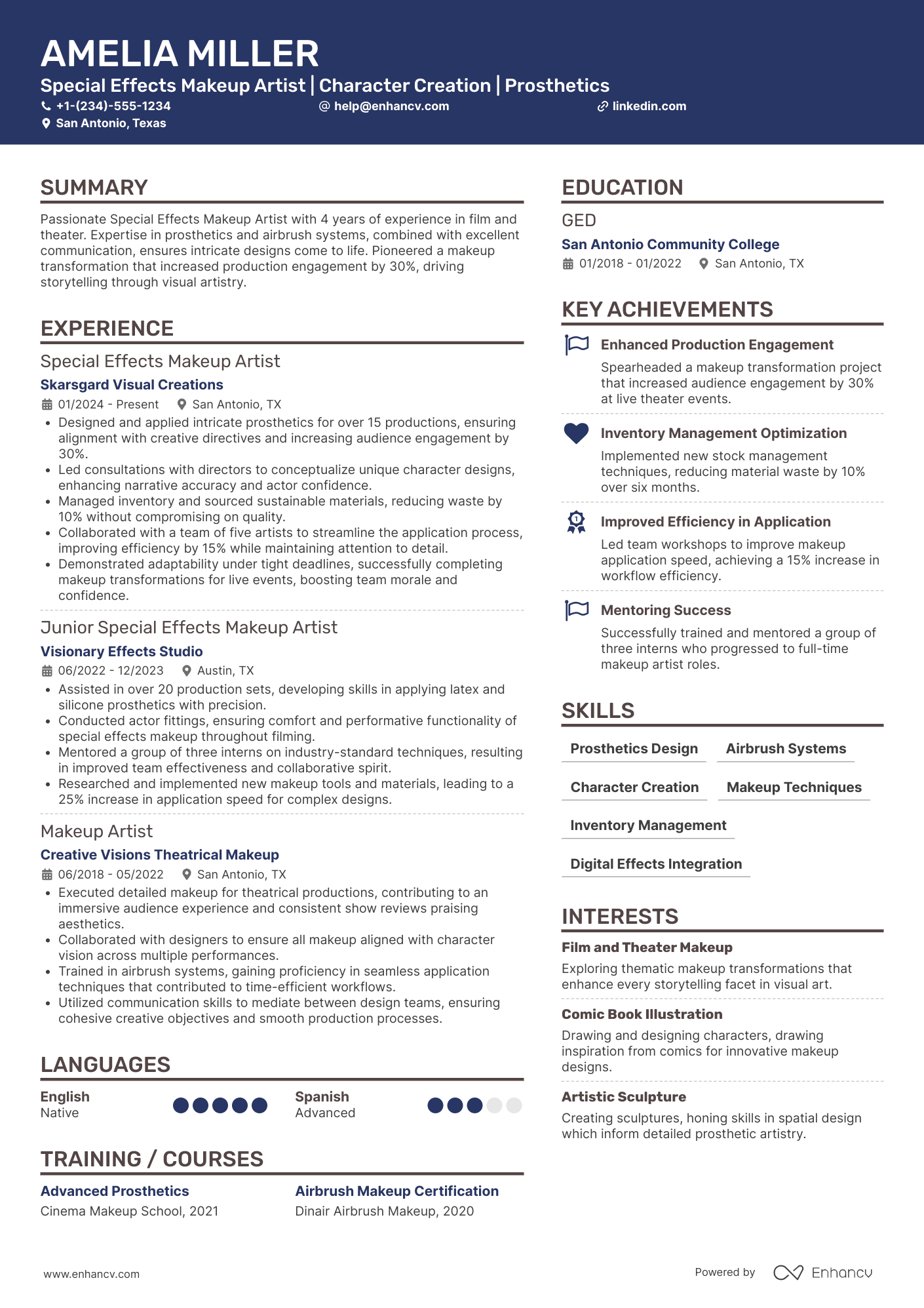
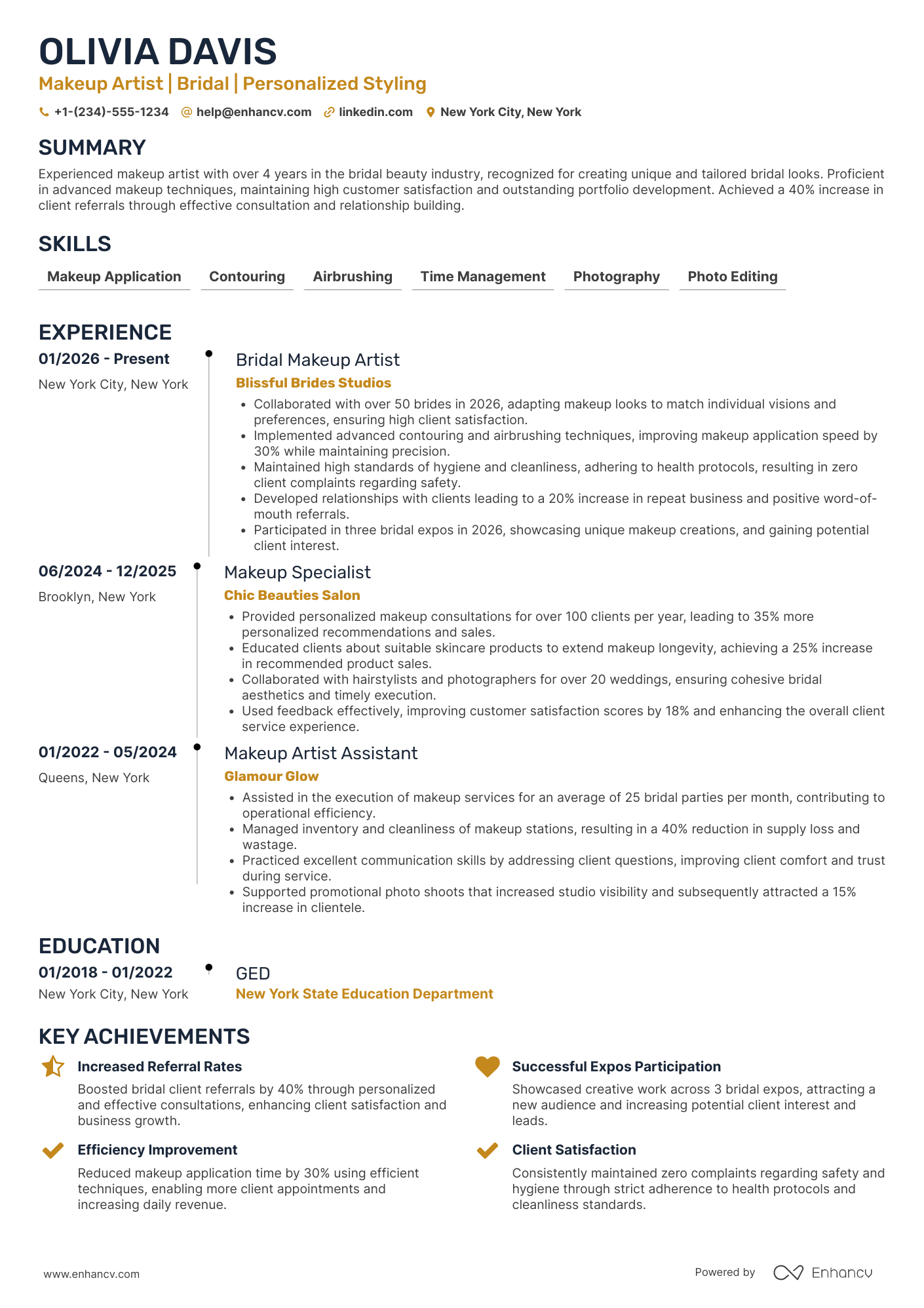
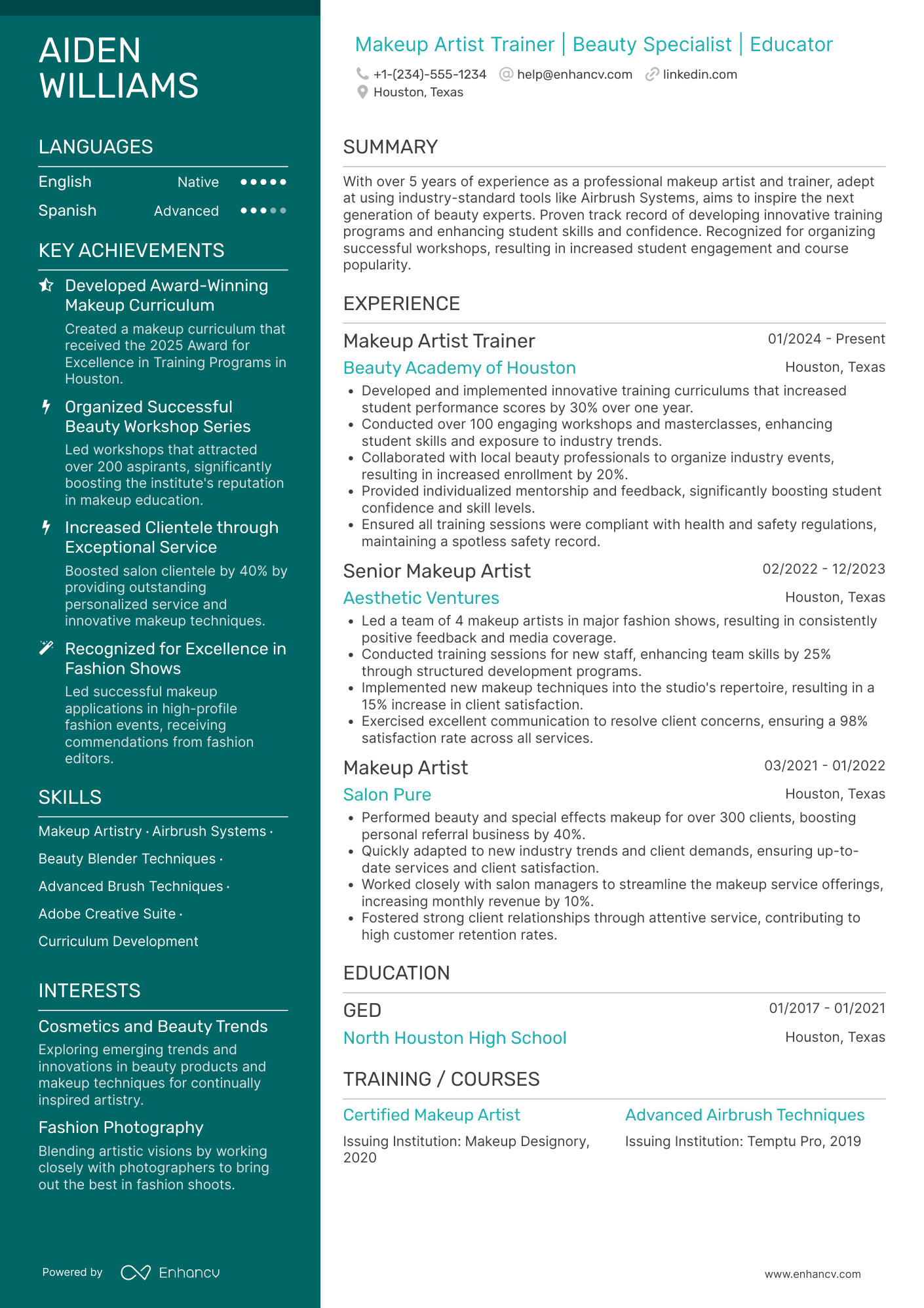
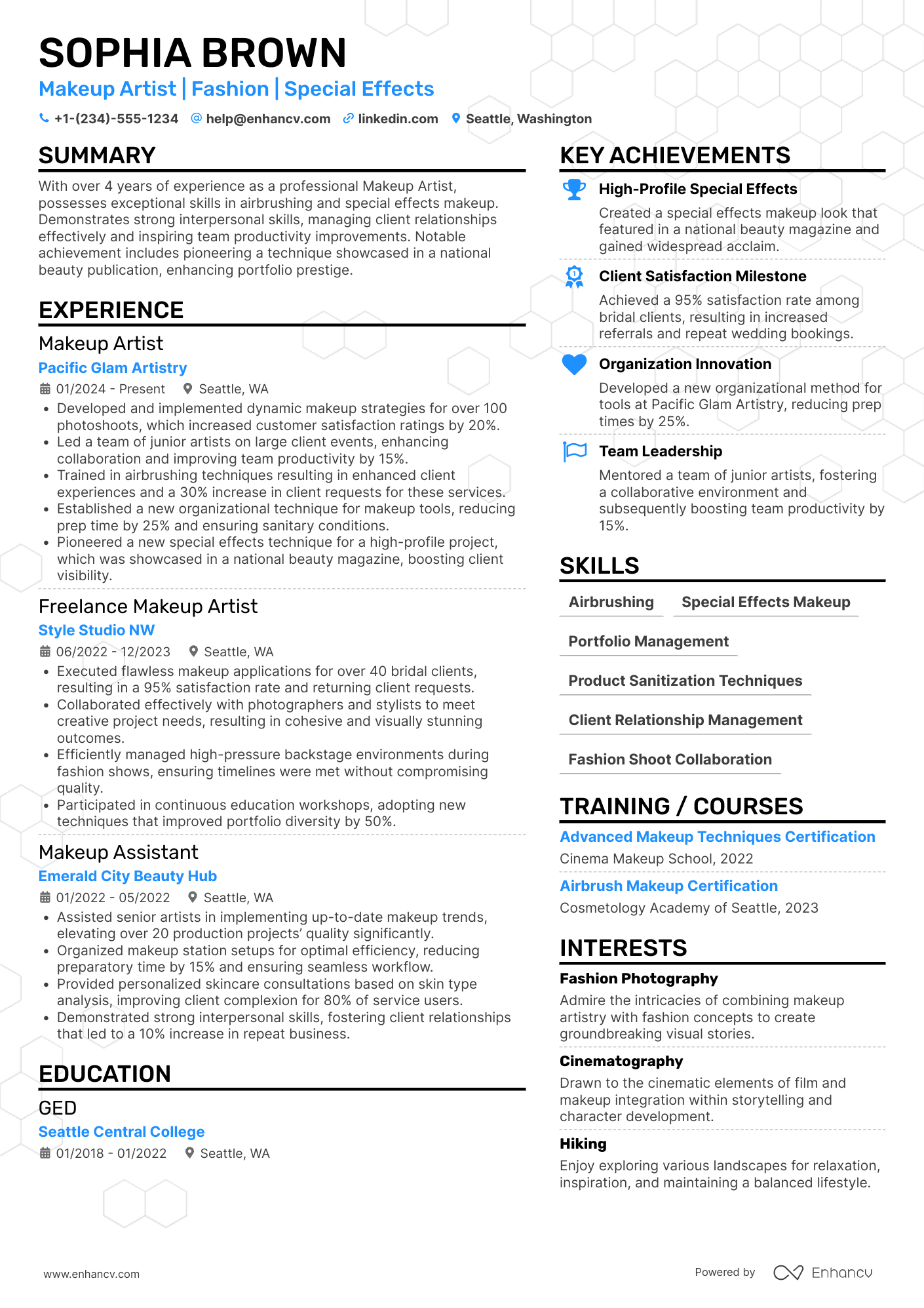
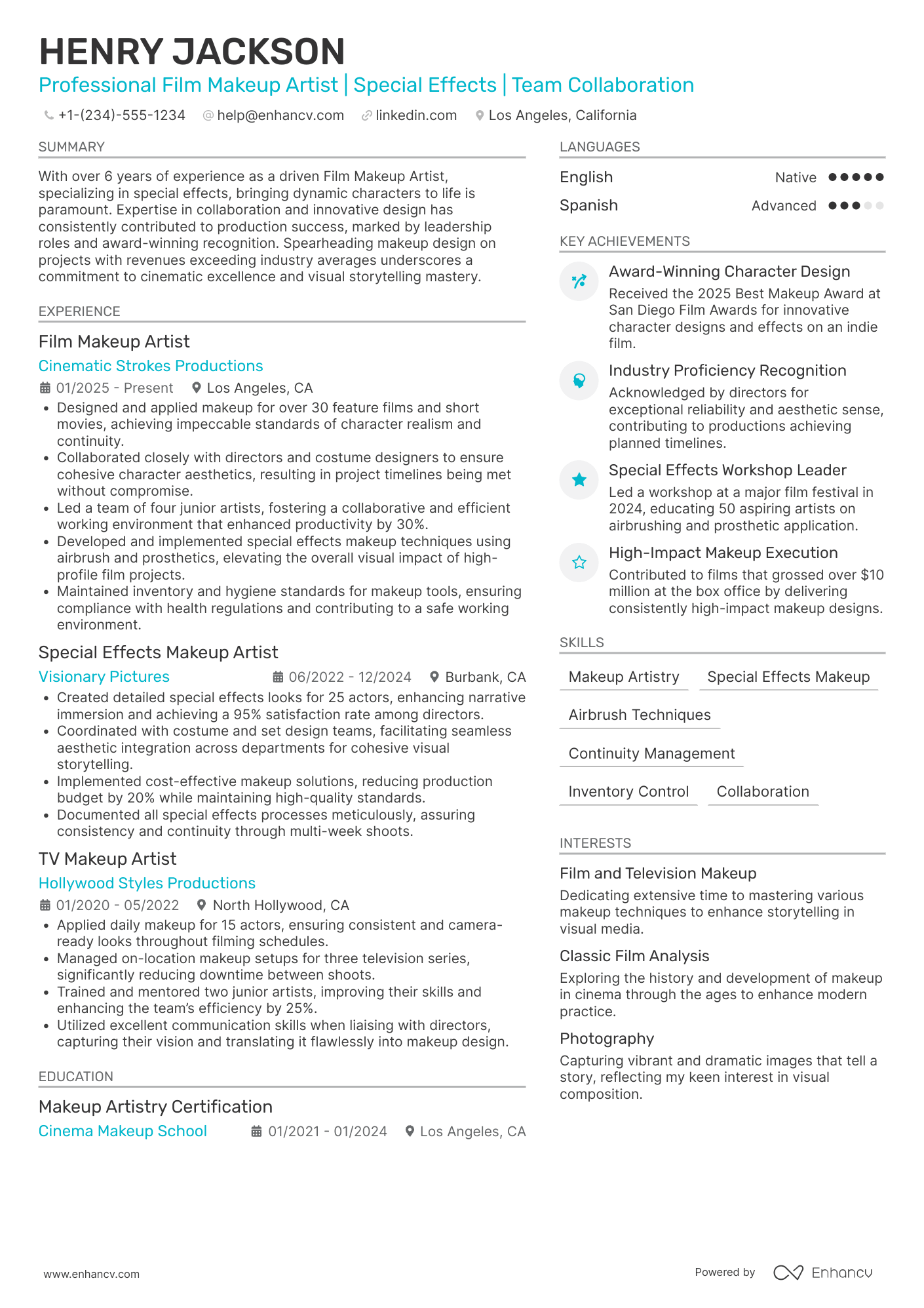
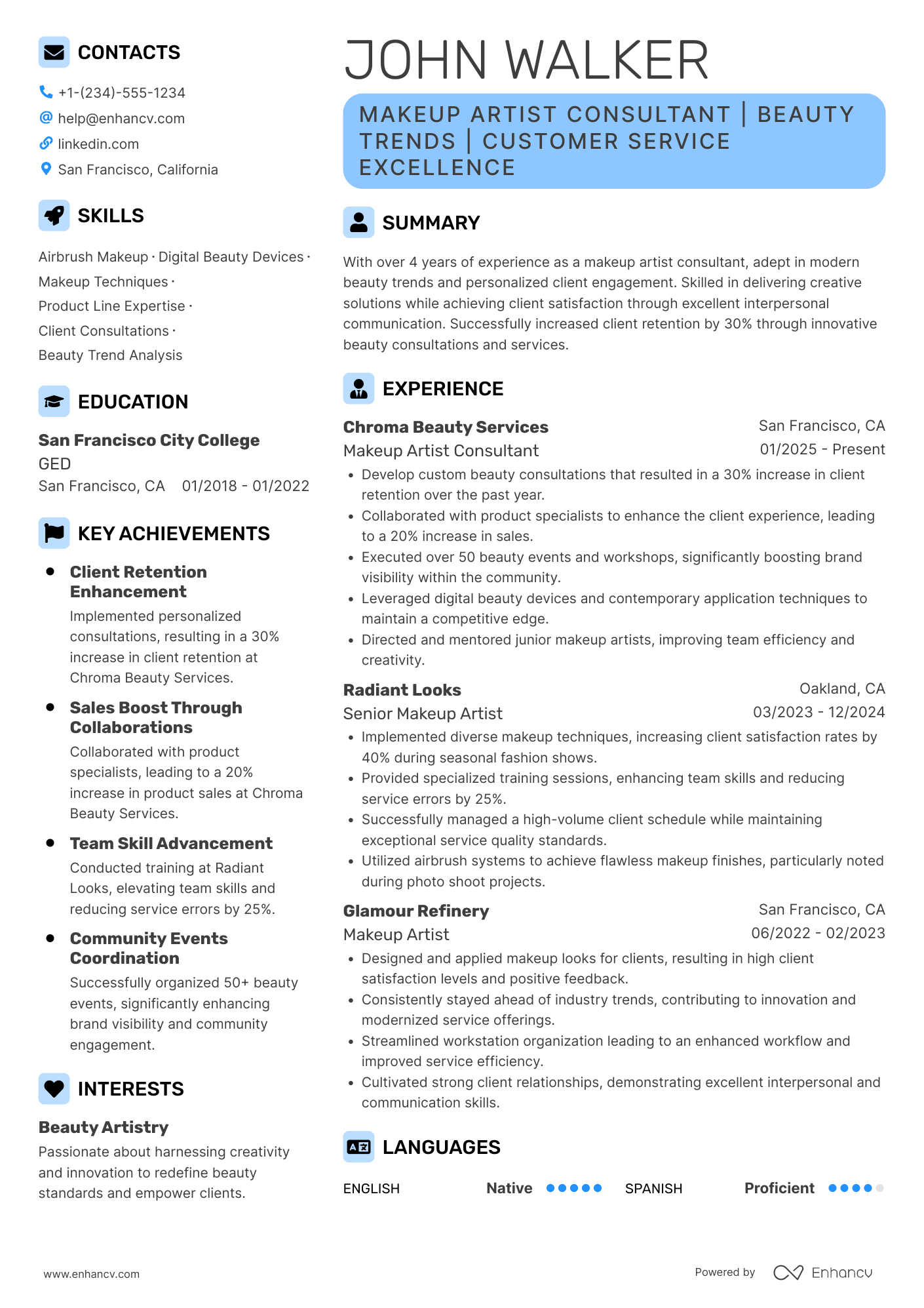
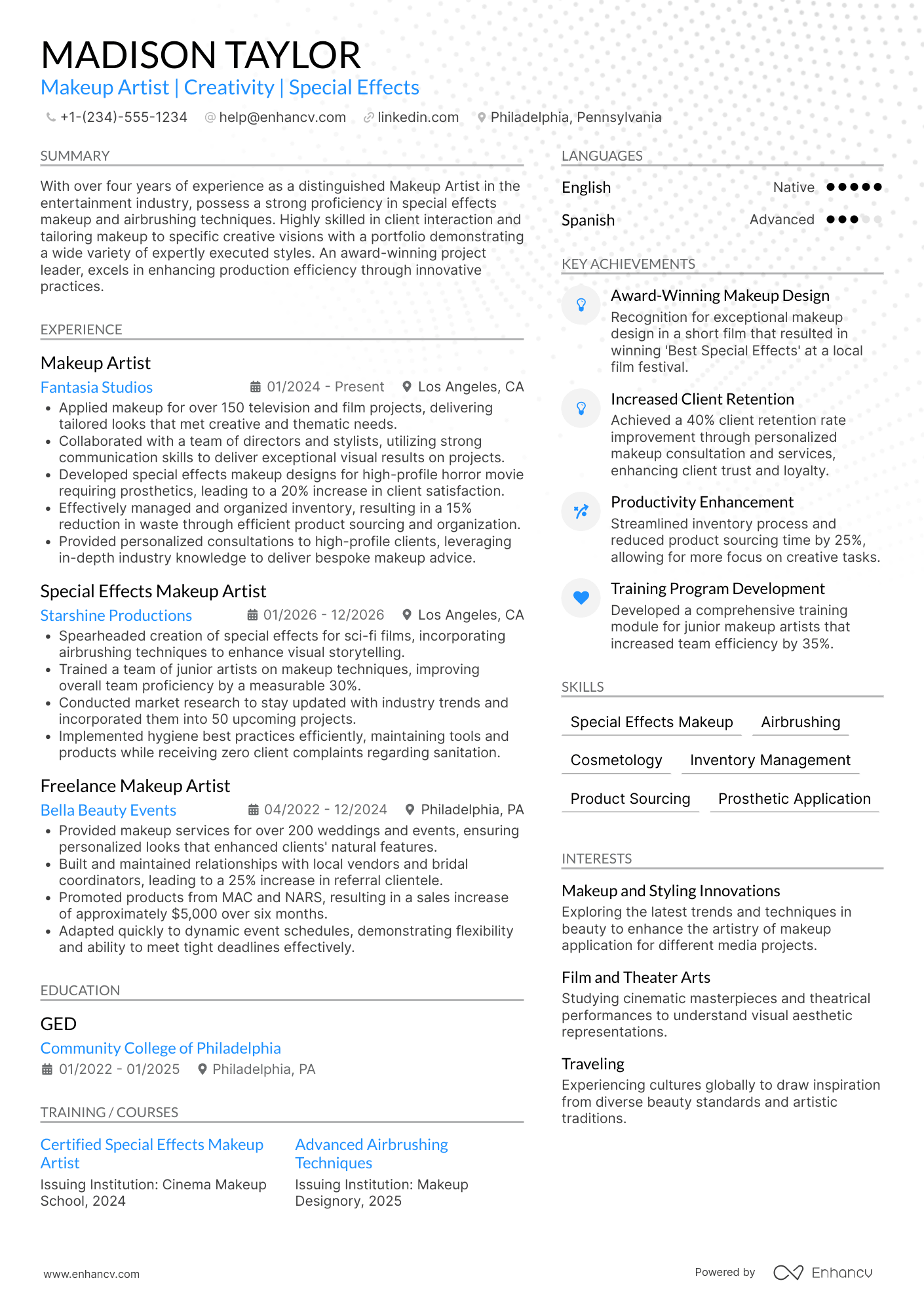
Many makeup artist resumes fail because they read like product lists and training summaries, not proof of results. That hurts when an ATS filters keywords and recruiters scan fast in a crowded applicant pool.
For roles that also require a short note, our makeup artist cover letter examples show how to walk a creative director through one signature look without rehashing the bullet points beside it.
You'll stand out by showing outcomes: bookings increased, repeat clients grew, and on-time call times held across multi-look days. Quantify kit sanitation compliance, reduced touch-ups, and consistent photo-ready finishes under harsh lighting. Tie your work to client satisfaction, brand standards, and shoot efficiency. Understanding how to make your resume stand out is essential in a field where creativity meets fierce competition.

Key takeaways
- Quantify outcomes like rebooking rates, turnaround times, and client satisfaction instead of listing duties.
- Use reverse-chronological format if experienced; use a hybrid format if junior or switching careers.
- Tailor every experience bullet to match the job posting's products, techniques, and settings.
- Demonstrate skills inside your summary and experience sections, not only in a standalone list.
- Include freelance projects, portfolio shoots, and student work as legitimate experience entries.
- Place certifications above or below education based on recency and relevance to the role.
- Use Enhancv's tools to turn vague task descriptions into measurable, recruiter-ready bullet points.
How to format a makeup artist resume
Recruiters evaluating makeup artist resumes prioritize a clear portfolio of work contexts (film, bridal, editorial, SFX), proficiency with specific product lines and techniques, and evidence of client satisfaction or repeat bookings. Choosing the right resume format ensures these signals surface quickly during a scan and pass through an applicant tracking system without formatting errors stripping away critical details.

I have significant experience as a makeup artist—which format should I use?
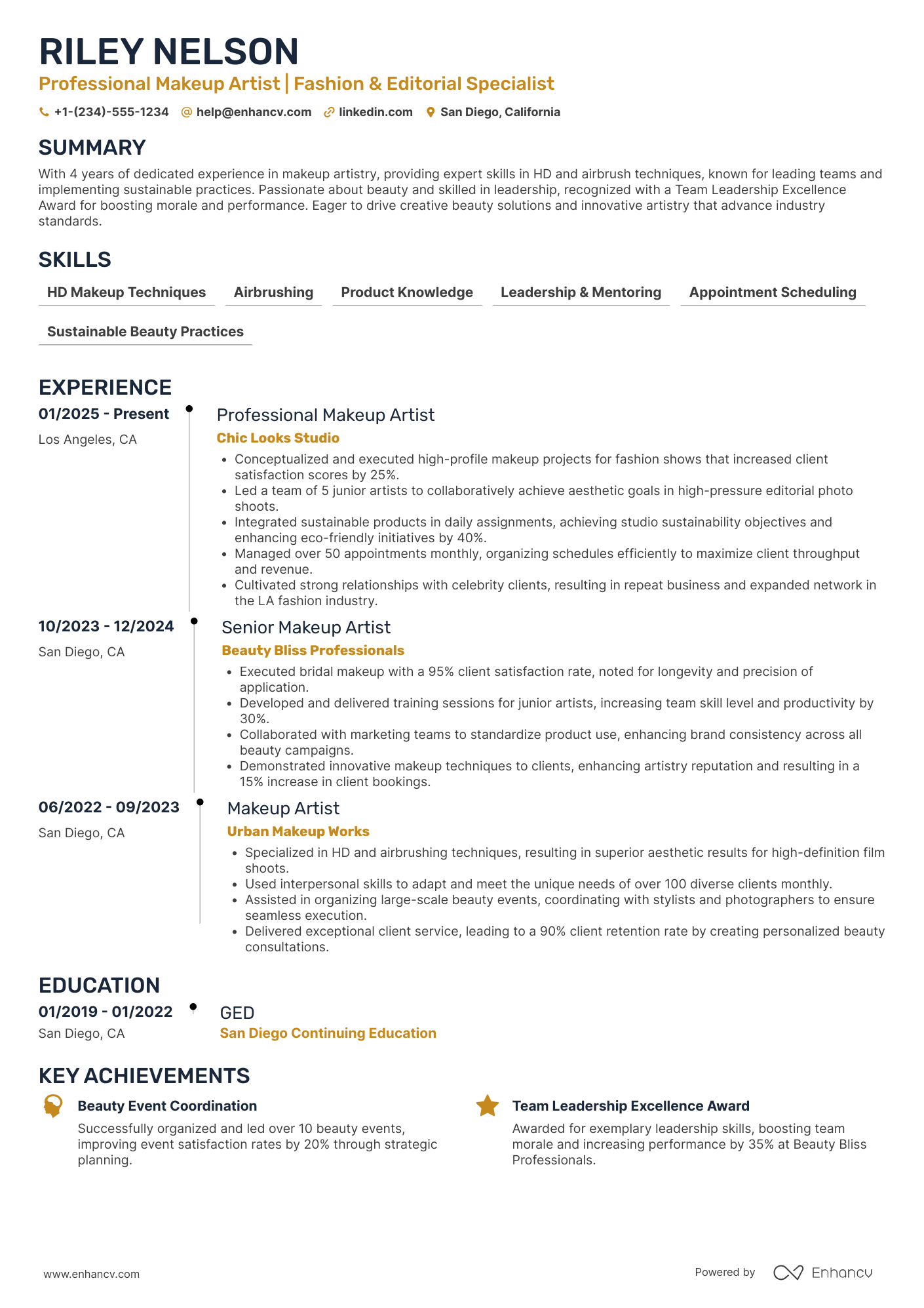
Use the reverse-chronological format to showcase your depth of client work, expanding service range, and professional growth across different makeup disciplines. Do:
- Lead each role entry with the scope of your work—types of clients served, team size if applicable, and the settings you operated in (on-set, salon, freelance, retail counter).
- Highlight the specific techniques, product lines, and tools you're proficient in, such as airbrush systems, prosthetic application, HD/4K camera-ready techniques, or brands like MAC Pro, Kryolan, or Ben Nye.
- Quantify outcomes wherever possible using metrics like client retention rates, number of bookings per month, revenue generated, or portfolio features in named publications.
I'm junior or switching into a makeup artist role—what format works best?
Use a hybrid format that leads with a focused skills section and follows with any relevant work or project experience listed in reverse-chronological order. Do:
- Place your strongest technical skills—such as color matching, sanitation protocols, airbrush technique, or SFX basics—near the top of the resume so recruiters and ATS filters register them immediately.
- Include freelance projects, student film collaborations, volunteer work for theater productions, or personal portfolio shoots as legitimate experience entries, with clear descriptions of your role and contributions.
- Connect every listed skill or project to a specific action you took and a tangible result it produced, even on a small scale.
Why not use a functional resume?
A functional resume strips away the timeline and context of your work, making it difficult for hiring managers to verify where and how you developed your skills—which is a significant disadvantage in a field where hands-on, demonstrable experience matters.
- Career changers with transferable skills: If you're transitioning from esthetics, cosmetology, or theatrical costume work, a functional format can group relevant techniques (skin prep, color theory, client consultation) to bridge the gap.
- Limited formal work history: If you've completed a makeup artistry program but have only personal projects or informal gigs, a functional layout can spotlight trained competencies over a thin employment section.
Once you've locked in a clean, readable format, the next step is deciding which sections to include so every part of your resume serves a clear purpose.
What sections should go on a makeup artist resume
Recruiters expect to quickly see your specialties, client-facing experience, and a clear record of results across looks, settings, and productions. Knowing what to put on a resume ensures every section earns its place.
Use this structure for maximum clarity:
- Header
- Summary
- Experience
- Skills
- Projects
- Education
- Certifications
- Optional sections: Awards, Publications, Languages
Strong experience bullets should emphasize measurable outcomes, client or production scope, consistency under deadlines, and the results you delivered for talent, brands, or events.
Is your resume good enough?
Drop your resume here or choose a file. PDF & DOCX only. Max 2MB file size.
Once you’ve organized your resume with the right structure and supporting details, focus on writing the experience section to show how you’ve applied those elements in real work.
How to write your makeup artist resume experience
The experience section is where you prove you've delivered real results—whether that means flawless bridal looks, editorial shoots completed on deadline, or client retention built through consistent artistry and professionalism. Hiring managers prioritize demonstrated impact over descriptive task lists, so focus on the work you shipped, the products and techniques you used, and the measurable outcomes you achieved. Building a targeted resume for each application helps you highlight the most relevant accomplishments.
Each entry should include:
- Job title
- Company and location (or remote)
- Dates of employment (month and year)
Three to five concise bullet points showing what you owned, how you executed, and what outcomes you delivered:
- Ownership scope: the client categories, service menus, product lines, set environments, or team members you were directly accountable for as a makeup artist.
- Execution approach: the application techniques, cosmetic products, sanitation protocols, color-matching methods, or booking systems you relied on to deliver consistent, high-quality work.
- Value improved: changes to client satisfaction, service turnaround time, skin safety, look durability, creative quality, or waste reduction that resulted from your work.
- Collaboration context: how you coordinated with photographers, hair stylists, wardrobe teams, creative directors, dermatologists, or clients to align on a shared creative or commercial vision.
- Impact delivered: outcomes framed through client growth, repeat booking rates, production efficiency, brand recognition, or revenue contribution rather than a simple list of duties you performed.
Experience bullet formula
A makeup artist experience example
✅ Right example - modern, quantified, specific.
Lead Makeup Artist
Lumen Bridal Studio | Austin, TX
2022–Present
High-volume bridal and event studio serving two hundred plus clients annually across Central Texas.
- Delivered airbrush and traditional makeup using Temptu airbrush systems, MAC Pro palettes, and RCMA foundations for one hundred fifty plus bridal clients per year, sustaining a 4.9 out of 5 average rating and a ninety-two percent rebooking and referral rate.
- Standardized sanitation and kit-prep workflows using Barbicide, 70 percent isopropyl alcohol, and disposable applicators, cutting setup time by twenty percent and reducing product waste by twelve percent across a six-artist team.
- Collaborated with photographers, hairstylists, and wedding planners to align looks with lighting plans and timelines, reducing day-of touch-up requests by thirty percent and keeping ninety-five percent of parties on schedule.
- Built shade-match profiles and face charts in Trello and Google Sheets, improving consultation-to-service time by fifteen minutes per client and increasing add-on sales (lashes and touch-up kits) by eighteen percent.
- Trained and coached four junior artists on color theory, skin prep, and long-wear setting techniques using Mehron setting spray and Laura Mercier powder, improving first-pass approval rate from eighty-four percent to ninety-four percent.
Now that you've seen how a strong experience section comes together, let's break down how to tailor each element to match the specific role you're applying for.
How to tailor your makeup artist resume experience
Recruiters evaluate your makeup artist resume through both human review and applicant tracking systems (ATS), so tailoring your resume to the job description is essential. Aligning your skills and achievements with the specific role increases your chances of passing both screening stages.
Ways to tailor your makeup artist experience:
- Match specific product lines or brands named in the job posting.
- Mirror the exact techniques or application methods the employer requests.
- Use the same terminology for skin prep or finishing processes listed.
- Highlight experience in the industry setting the role requires.
- Emphasize sanitation and hygiene standards referenced in the description.
- Include collaboration experience with photographers or creative directors mentioned.
- Reflect client volume or workflow pace the posting prioritizes.
- Align your specialties with the makeup styles the role focuses on.
Tailoring means connecting your real accomplishments to what the employer asks for, not forcing keywords where they don't belong.
Resume tailoring examples for makeup artist
| Job description excerpt | Untailored | Tailored |
|---|---|---|
| "Apply bridal and editorial makeup using airbrush techniques for on-location photo shoots" | Applied makeup for various clients in different settings. | Applied airbrush bridal and editorial makeup for 200+ on-location photo shoots, ensuring camera-ready finishes that met creative directors' specifications. |
| "Collaborate with production teams to create character looks using prosthetics and SFX makeup for film sets" | Worked with teams to do creative makeup looks. | Collaborated with production teams on three feature films to design and apply SFX makeup, including silicone prosthetics and wound simulations, for 15+ character looks per project. |
| "Maintain sanitation standards and organize a professional kit with MAC, NARS, and Kryolan products for high-volume fashion events" | Kept makeup tools clean and organized supplies. | Maintained strict sanitation protocols across 30+ high-volume fashion events, organizing a professional kit stocked with MAC, NARS, and Kryolan products to serve 50+ models per show. |
Once you’ve aligned your experience with the role’s priorities, the next step is to quantify your makeup artist achievements so hiring managers can see the impact of your work.
How to quantify your makeup artist achievements
Quantifying your achievements proves impact beyond aesthetics by showing speed, consistency, client satisfaction, and revenue results. Track bookings converted, turnaround time per look, redo rates, product waste, and client ratings across events, shoots, and retail settings.
Quantifying examples for makeup artist
| Metric | Example |
|---|---|
| Client satisfaction | "Maintained a 4.9/5 average rating across 120 bridal clients, with zero day-of cancellations and a 98% on-time start rate." |
| Turnaround time | "Reduced full-glam application time from 60 to 45 minutes by standardizing prep and using a 12-step kit layout checklist." |
| Rework rate | "Cut touch-up requests from 18% to 7% across eight fashion shows by matching foundation under stage lighting and setting with airbrush." |
| Revenue conversion | "Increased retail add-on sales by 22% over three months by recommending shade-matched bundles and logging preferences in the point-of-sale system." |
| Product cost control | "Lowered product waste by 15% per month by using disposable palettes, tracking expiration dates, and decanting liquids into labeled 30 ml bottles." |
Turn vague job duties into measurable, recruiter-ready resume bullets in seconds with Enhancv's Bullet Point Generator.
Once you've crafted strong bullet points for your experience section, the next step is ensuring your skills section effectively highlights the hard and soft skills that makeup artist employers prioritize.
How to list your hard and soft skills on a makeup artist resume
A well-organized skills section shows recruiters and an ATS (applicant tracking system) how you match the role, from technical application and sanitation to set readiness and client management; aim for a balanced mix of hard skills, with targeted soft skills that support delivery. makeup artist roles require a blend of:
- Product strategy and discovery skills
- Data, analytics, and experimentation skills
- Delivery, execution, and go-to-market discipline
- Soft skills
Your skills section should be:
- Scannable (bullet-style grouping).
- Relevant to the job post.
- Backed by proof in experience bullets.
- Updated with current tools.
Place your skills section:
- Above experience if you're junior or switching careers.
- Below experience if you're mid/senior with strong achievements.

Hard skills
- Complexion matching, undertone analysis
- Color theory for makeup
- Sanitation, disinfection protocols
- Airbrush makeup application
- Bridal makeup techniques
- HD, photo-ready makeup
- Editorial, runway makeup
- Special effects makeup basics
- Lash application, individual and strip
- Brow shaping, mapping, tinting
- Kit hygiene, inventory tracking
- Lighting-aware makeup for camera
Soft skills
- Client consultation and needs discovery
- Shade selection decision-making
- Time-boxed application under deadlines
- Clear communication with talent and crew
- Collaboration with hair, wardrobe, and photo teams
- Calm triage during last-minute changes
- Hygiene-first accountability in shared spaces
- Proactive kit readiness and restocking
- Constructive feedback intake and iteration
- Service recovery for dissatisfied clients
- Professional boundaries and consent checks
- On-set etiquette and discretion
How to show your makeup artist skills in context
Skills shouldn't live only in a dedicated skills list. You can explore resume skills examples to see how top candidates weave abilities into every section.
They should be demonstrated in:
- Your summary (high-level professional identity)
- Your experience (proof through outcomes)
Here's what that looks like in practice.
Summary example
Senior makeup artist with 12 years in bridal and editorial beauty. Skilled in airbrush techniques, Temptu systems, and color theory. Increased client rebooking rates by 35% through personalized consultations and trend-forward looks.
- Reflects senior-level expertise clearly
- Names specific tools and methods
- Includes a measurable client outcome
- Highlights consultation as a soft skill
Experience example
Lead Makeup Artist
Blanc Beauty Collective | Los Angeles, CA
June 2019–March 2024
- Designed airbrush looks for 200+ editorial shoots annually, reducing on-set touch-up time by 40% using Temptu and RCMA products.
- Collaborated with photographers and wardrobe stylists to develop cohesive visual concepts, boosting client satisfaction scores to 97%.
- Trained and mentored four junior artists on sanitation protocols and color-matching techniques, cutting product waste by 25%.
- Every bullet includes measurable proof
- Skills appear naturally within accomplishments
Once you’ve demonstrated your makeup artistry through concrete examples and results, the next step is applying the same approach to a resume when you don’t have formal experience.
How do I write a makeup artist resume with no experience
Even without full-time experience, you can demonstrate readiness through:
- Freelance event makeup bookings
- Student film set makeup
- Theater production makeup roles
- Bridal trials for friends
- Beauty counter product demos
- Portfolio shoots with photographers
- Makeup certification coursework projects
- Before-and-after client photo sets
Our guide on writing a resume without work experience covers how to turn these projects into compelling resume entries.
Focus on:
- Clean, labeled portfolio examples
- Sanitation and kit organization proof
- Product knowledge tied to results
- On-time delivery across bookings
Resume format tip for entry-level makeup artist
Use a combination resume format because it highlights makeup artist skills and projects first, while still showing relevant work history and training. Do:
- Lead with a skills summary.
- Add a projects section with results.
- List tools, products, and techniques.
- Link to a curated portfolio.
- Quantify looks completed and timing.
- Completed ten portfolio looks using airbrush foundation, color correction, and sanitized brush sets, delivering 90% client satisfaction from post-session surveys.
Even without professional experience, your educational background can demonstrate relevant training and qualifications—here's how to present it effectively.
How to list your education on a makeup artist resume
Your education section helps hiring teams confirm you have foundational training in beauty techniques, color theory, and skin science relevant to the makeup artist role.
Include:
- Degree name
- Institution
- Location
- Graduation year
- Relevant coursework (for juniors or entry-level candidates)
- Honors & GPA (if 3.5 or higher)
Skip month and day details—list the graduation year only.
Here's a strong education entry tailored for a makeup artist resume:
Example education entry
Associate of Applied Science in Cosmetology
Aveda Institute Los Angeles, Los Angeles, CA
Graduated 2022
GPA: 3.7/4.0
- Relevant coursework: Color Theory, Special Effects Makeup, Skincare Science, Studio Lighting Techniques
- Honors: Dean's List, 2021–2022
How to list your certifications on a makeup artist resume
Certifications on your resume show your commitment to learning, your proficiency with tools and products, and your alignment with current industry standards as a makeup artist.
Include:
- Certificate name
- Issuing organization
- Year
- Optional: credential ID or URL
- Place certifications below education when your degree or training is recent and more relevant than your certification list.
- Place certifications above education when they're recent, highly relevant to the role, or your education is older and less directly related.
Best certifications for your makeup artist resume
- Makeup Artistry Certification — Makeup Designory (MUD)
- Professional Makeup Artistry Certification — QC Makeup Academy
- Makeup Artistry Program Certificate — Cinema Makeup School
- Airbrush Makeup Certification — Temptu
- Infection Prevention and Control Certificate — Barbicide Certification Program
- Basic Life Support (BLS) Certification — American Heart Association
- State Cosmetology License — State Board of Cosmetology
Once you’ve positioned your credentials where hiring managers can spot them fast, use your makeup artist resume summary to frame those qualifications in a clear, value-focused snapshot.
How to write your makeup artist resume summary
Your resume summary is the first thing a recruiter reads. A strong one instantly signals you're the right fit for the makeup artist role.
Keep it to three to four lines, with:
- Your title and total years of hands-on makeup artistry experience.
- The domain you work in, such as bridal, editorial, film, or commercial beauty.
- Core skills and tools like airbrushing, color theory, SFX techniques, or specific product lines.
- One or two measurable achievements, such as clients served or projects completed.
- Soft skills tied to real results, like client communication that drove repeat bookings.

PRO TIP
At the junior level, emphasize technical skills, relevant training, and early wins that prove you can deliver. Avoid vague phrases like "passionate self-starter" or "hardworking team player." Instead, anchor every claim to a specific tool, technique, or measurable result from real work.
Example summary for a makeup artist
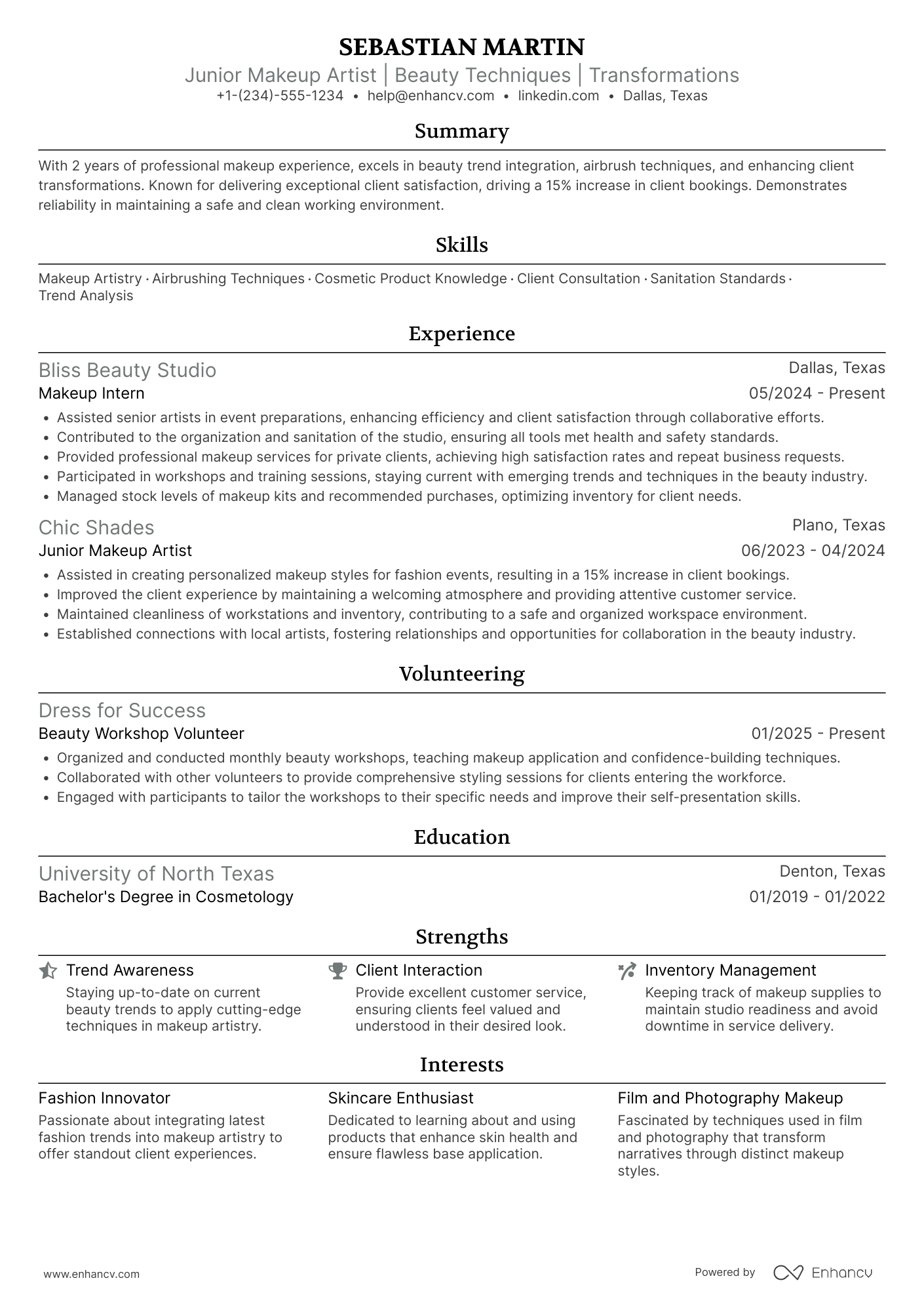
Makeup artist with two years of experience in bridal and editorial beauty. Skilled in airbrushing and color matching. Completed looks for 120+ clients, earning a 98% satisfaction rate through clear consultations.
Optimize your resume summary and objective for ATS
Drop your resume here or choose a file.
PDF & DOCX only. Max 2MB file size.
Now that your summary captures your professional strengths, make sure your header presents your contact details clearly so hiring managers can easily reach you.
What to include in a makeup artist resume header
Your resume header lists your key contact details and role focus, improving visibility, credibility, and recruiter screening for a makeup artist.
Essential resume header elements
- Full name
- Tailored job title and headline
- Location
- Phone number
- Professional email
- GitHub link
- Portfolio link
A LinkedIn link helps recruiters verify experience quickly and supports screening.
Don't include photos on a makeup artist resume unless the role is explicitly front-facing or appearance-dependent.
Keep your header consistent with your portfolio branding and match your job title to the posting to improve search results.
Example
Makeup artist resume header
Jordan Rivera
Makeup artist | Bridal, editorial, and on-set makeup
Los Angeles, CA
(323) 555-01XX
jordan.rivera@enhancv.com
github.com/jordanrivera
jordanrivera.com
linkedin.com/in/jordanrivera
Once your contact details and professional identifiers are in place at the top, you can strengthen the rest of your application with the additional sections for makeup artist resumes that support those essentials.
Additional sections for makeup artist resumes
When your core qualifications match other candidates, additional sections help you stand out with unique credentials and personality. For example, listing language skills can set you apart when working with diverse clients or international productions.
- Languages
- Certifications and licenses
- Awards and competitions
- Professional affiliations and memberships
- Volunteer work and charity events
- Hobbies and interests
- Publications and media features
Once you've strengthened your resume with relevant extra sections, the next step is pairing it with a cover letter to give hiring managers a fuller picture of your qualifications.
Do makeup artist resumes need a cover letter
A cover letter isn't required for every makeup artist role, but it often helps in competitive openings or when hiring managers expect one. If you're unsure where to start, understanding what a cover letter is and how it complements your resume can clarify when to include one. It can make a difference when your resume needs context, or when the role demands strong client or team collaboration.
Use a cover letter to add context your resume can't:
- Explain fit for the role and team by naming the work style, pace, and collaboration you thrive in.
- Highlight one or two relevant projects with outcomes, such as improved client retention, faster turnaround, or consistent on-brand looks.
- Show you understand the product, users, or business context, like a brand's aesthetic, target customer, or set and production needs.
- Address career transitions or non-obvious experience by connecting past work to makeup artist skills and expectations.
Drop your resume here or choose a file.
PDF & DOCX only. Max 2MB file size.
Even when you include a tailored cover letter to add context beyond your resume, AI tools can help you strengthen the resume itself by improving clarity, keyword alignment, and overall impact.
Using AI to improve your makeup artist resume
AI can sharpen your resume's clarity, structure, and overall impact. It helps you find stronger words and tighter phrasing. But overuse strips away authenticity. Once your content feels clear and aligned with the role, step away from AI. If you're curious about where to begin, our guide on ChatGPT resume writing offers practical prompts tailored to different resume sections.
Here are 10 practical prompts you can copy and paste to strengthen specific sections of your makeup artist resume:
- Strengthen your summary: "Rewrite my makeup artist resume summary to highlight my top specialties, years of experience, and the types of clients I've served."
- Quantify experience: "Add measurable results to these makeup artist experience bullets, such as client counts, event sizes, or efficiency improvements."
- Tighten bullet points: "Shorten each makeup artist experience bullet to one concise line that leads with a strong action verb."
- Align with job posts: "Compare my makeup artist resume skills section to this job description and identify missing keywords I genuinely possess."
- Improve skills formatting: "Reorganize my makeup artist skills into clear categories—like bridal, editorial, SFX, and product knowledge."
- Refine project descriptions: "Rewrite my makeup artist portfolio project descriptions to emphasize my specific role, techniques used, and final outcomes."
- Clarify education details: "Edit my makeup artist education section so each entry highlights relevant coursework, training hours, and specializations."
- Highlight certifications: "Reformat my makeup artist certifications section to include issuing organizations, dates earned, and any renewal requirements."
- Remove filler language: "Identify and remove vague or generic phrases from my makeup artist resume that don't add specific value."
- Check overall consistency: "Review my entire makeup artist resume for consistent tense, parallel structure, and uniform formatting across all sections."
Stop using AI once your resume sounds accurate, specific, and aligned with real experience. AI should never invent experience or inflate claims—if it didn't happen, it doesn't belong here.
Conclusion
A strong makeup artist resume shows measurable outcomes, role-specific skills, and a clear structure. It highlights results like repeat bookings, retail sales, on-time delivery, and client satisfaction. It lists core skills such as sanitation, color matching, and product knowledge.
Keep your makeup artist resume easy to scan with focused sections, consistent formatting, and relevant details. This approach signals professionalism and readiness for today’s hiring market and the roles ahead. It helps hiring managers trust your work before the interview.