



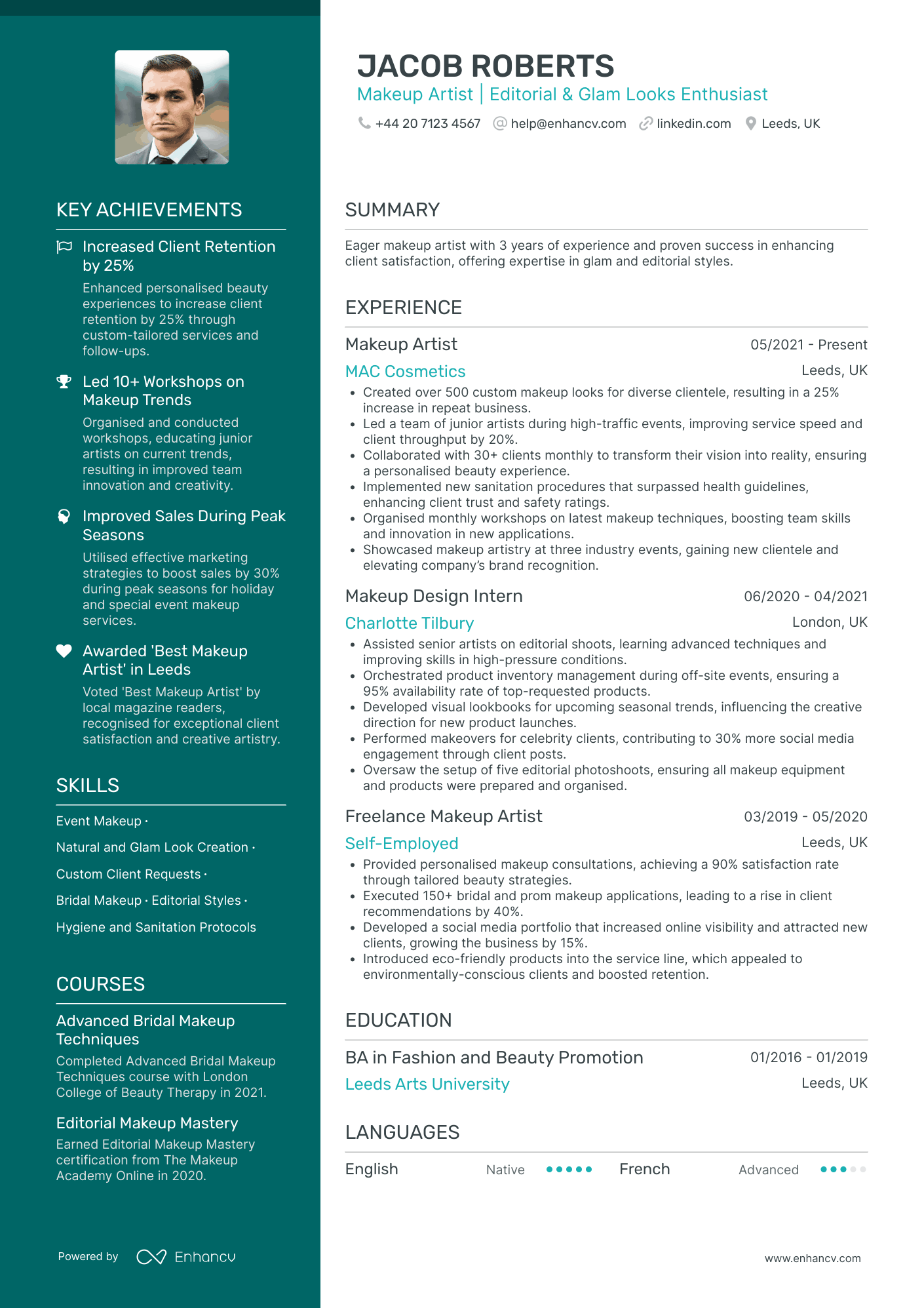
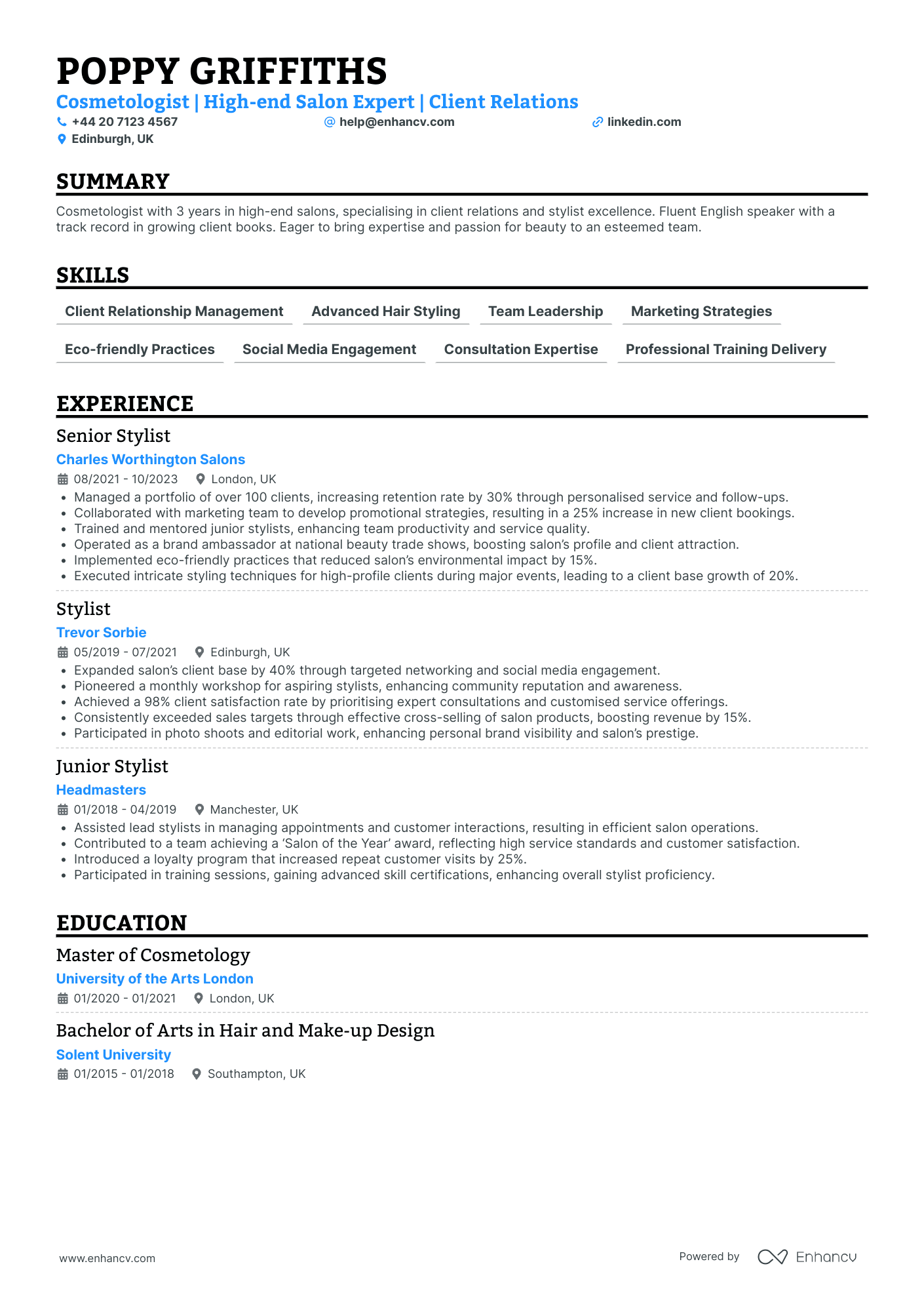
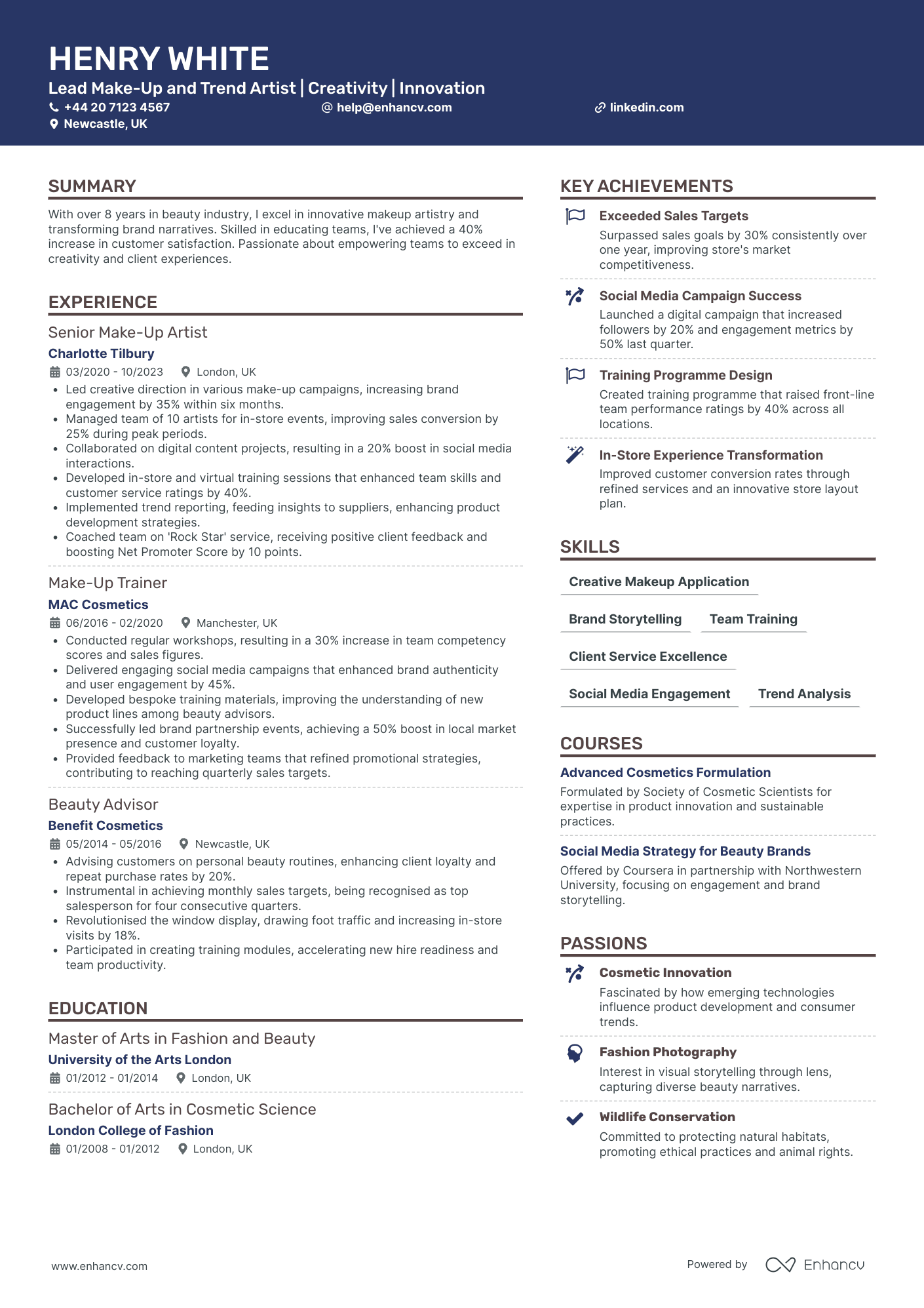
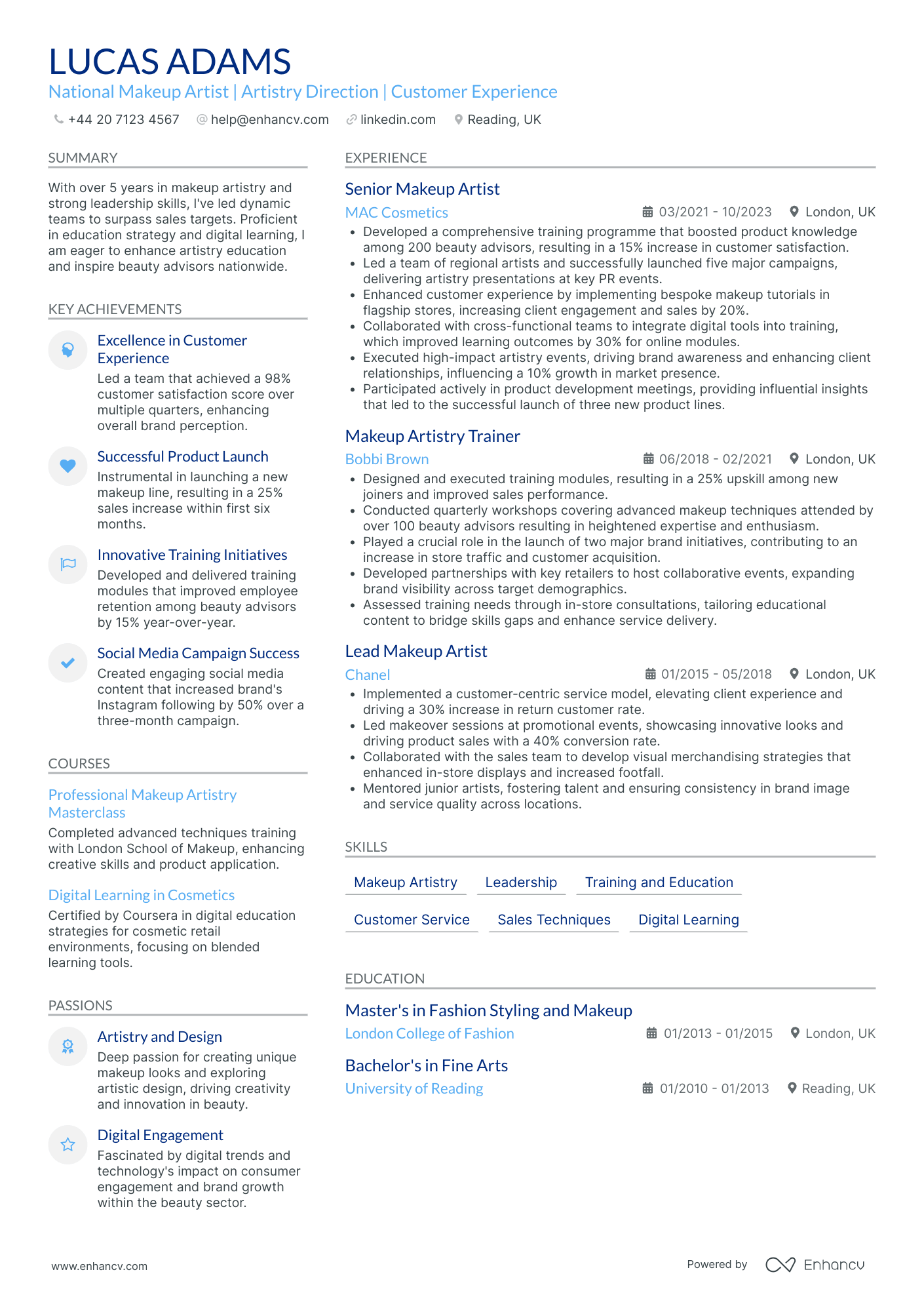
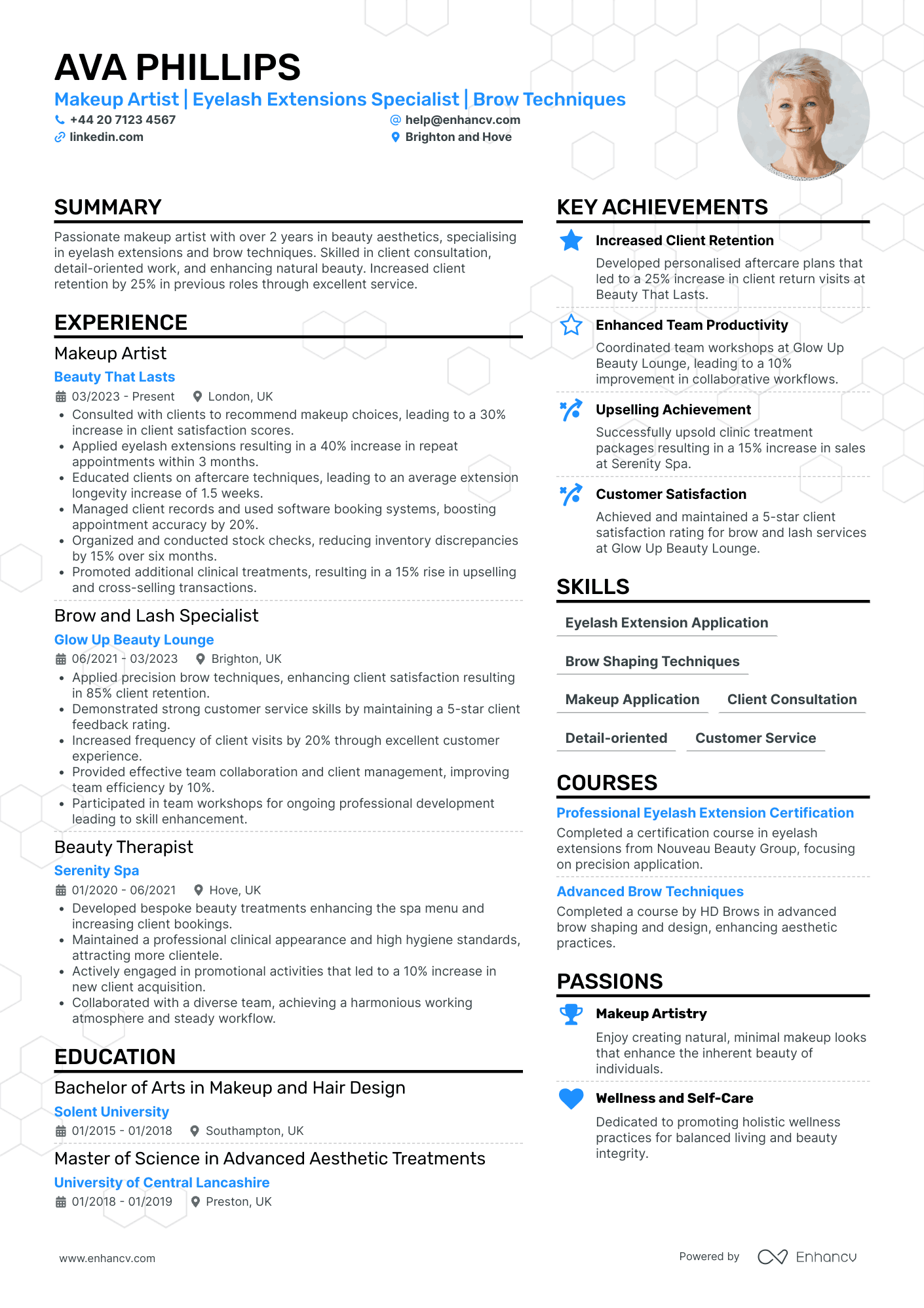
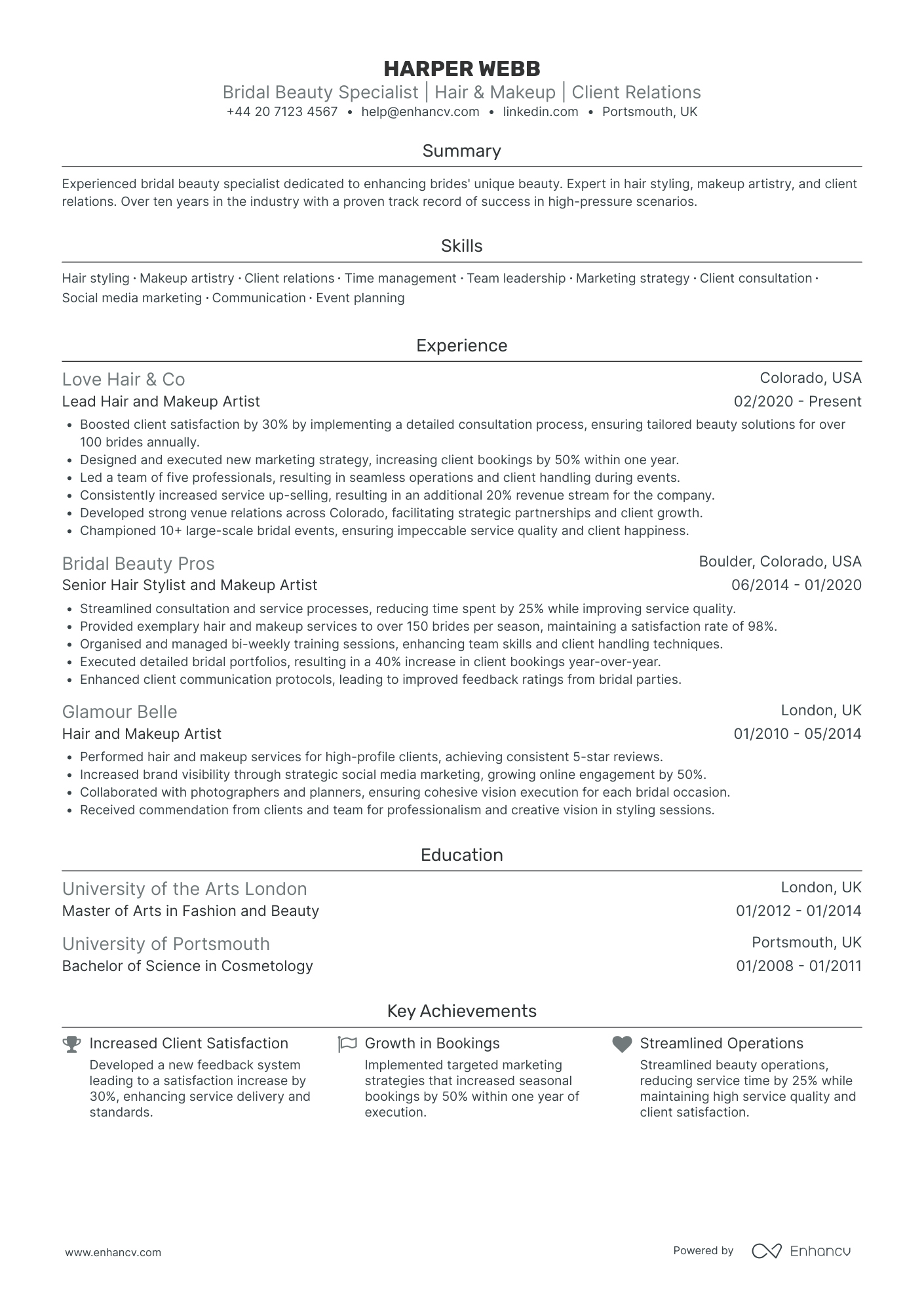
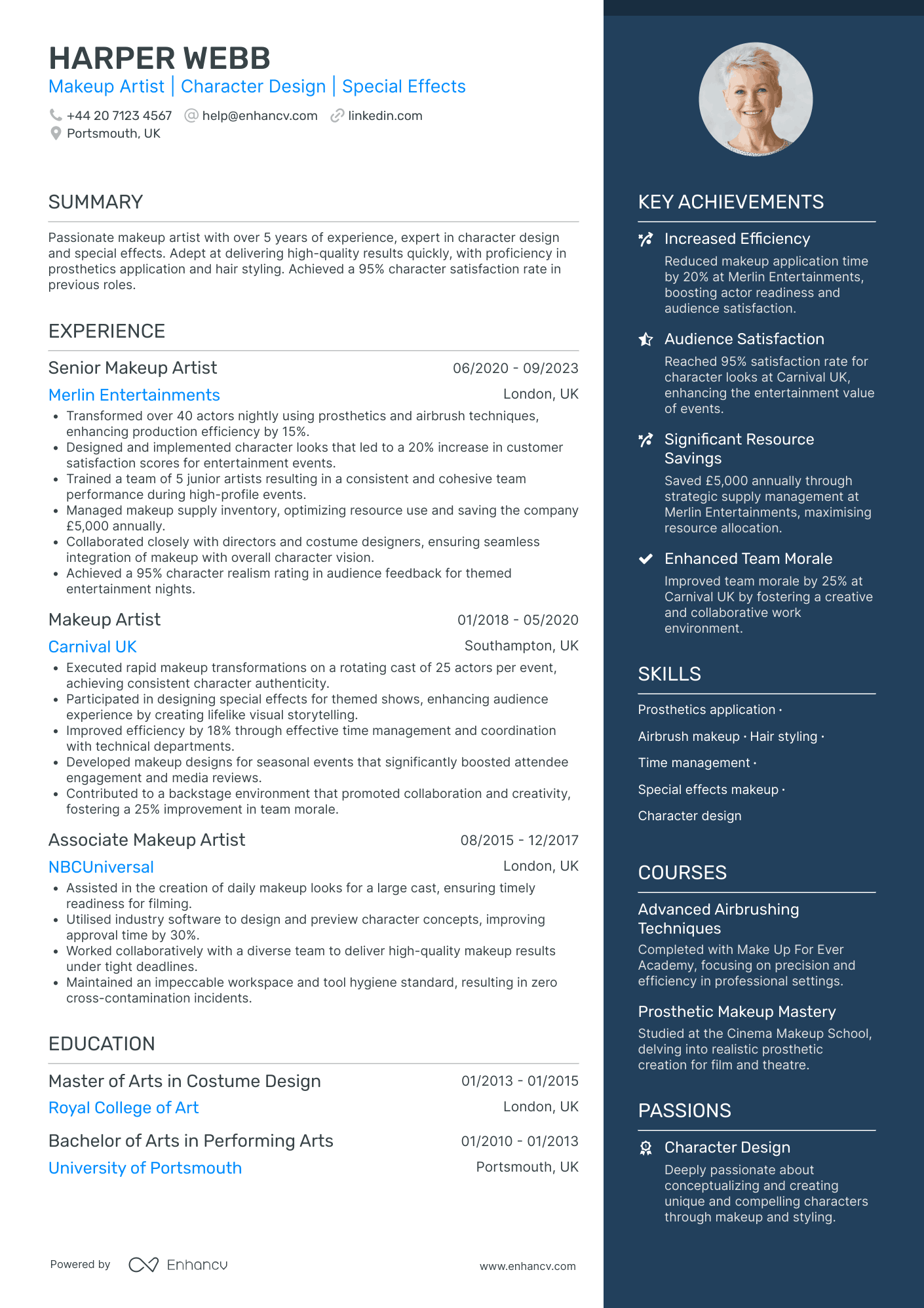
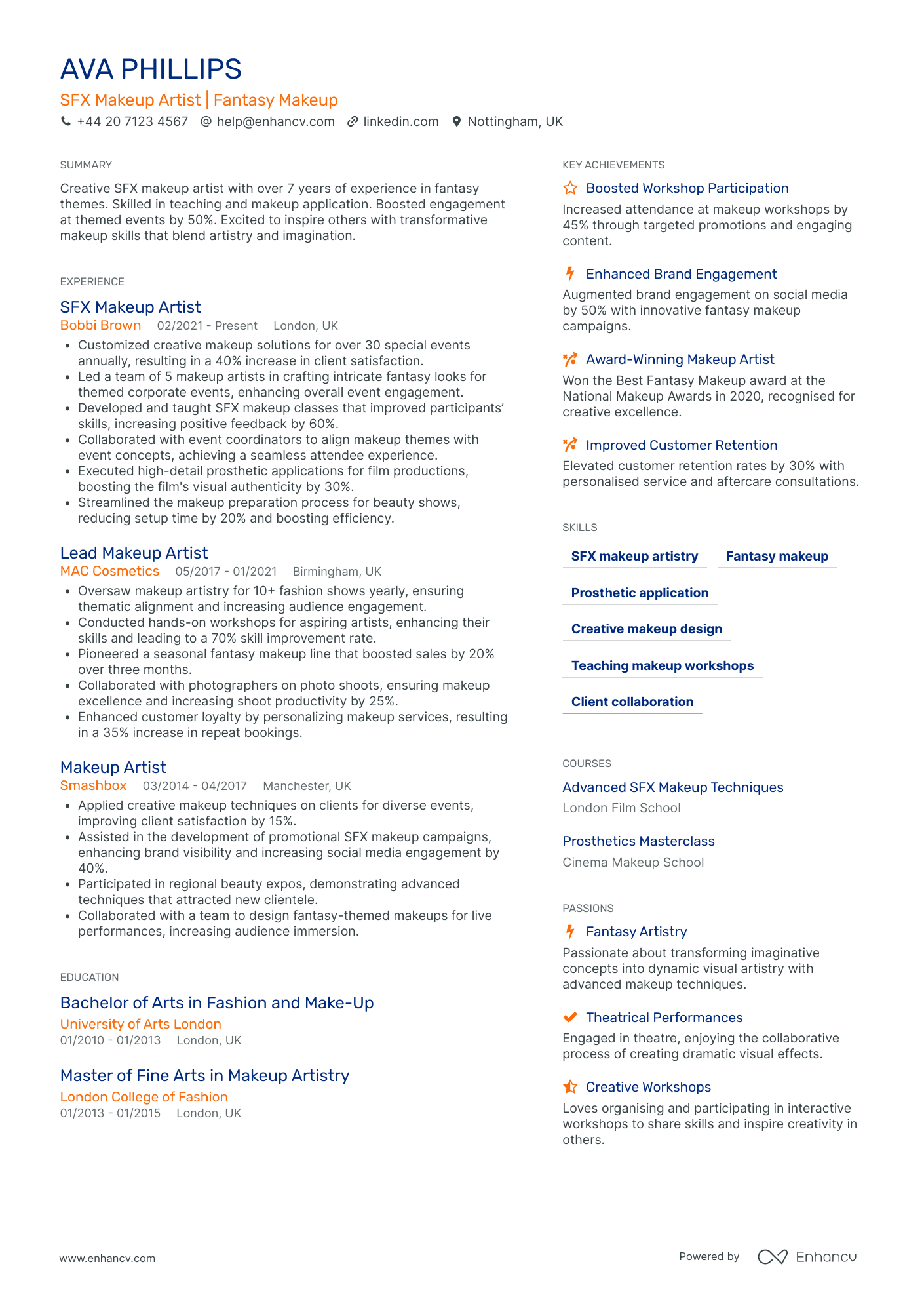
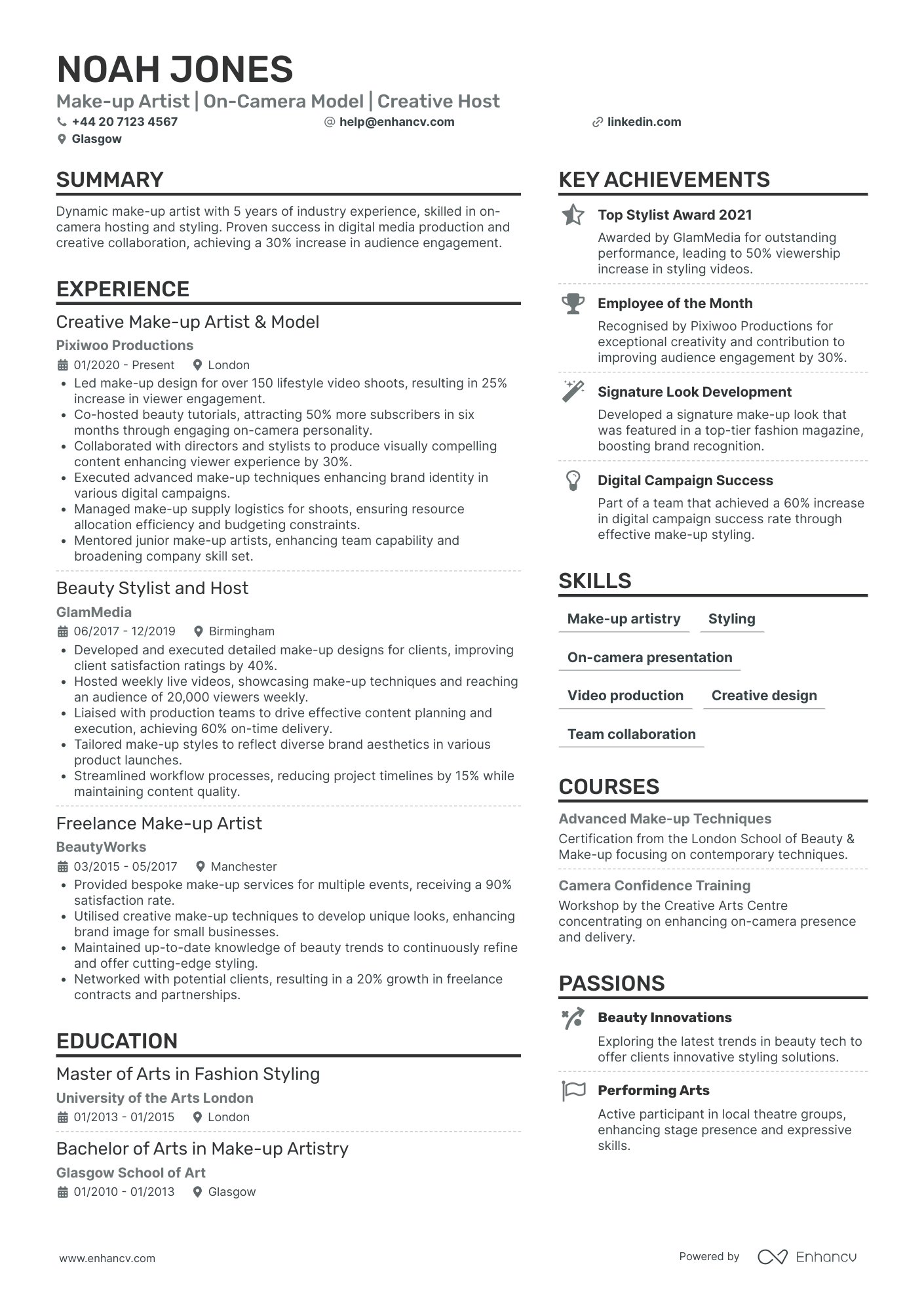
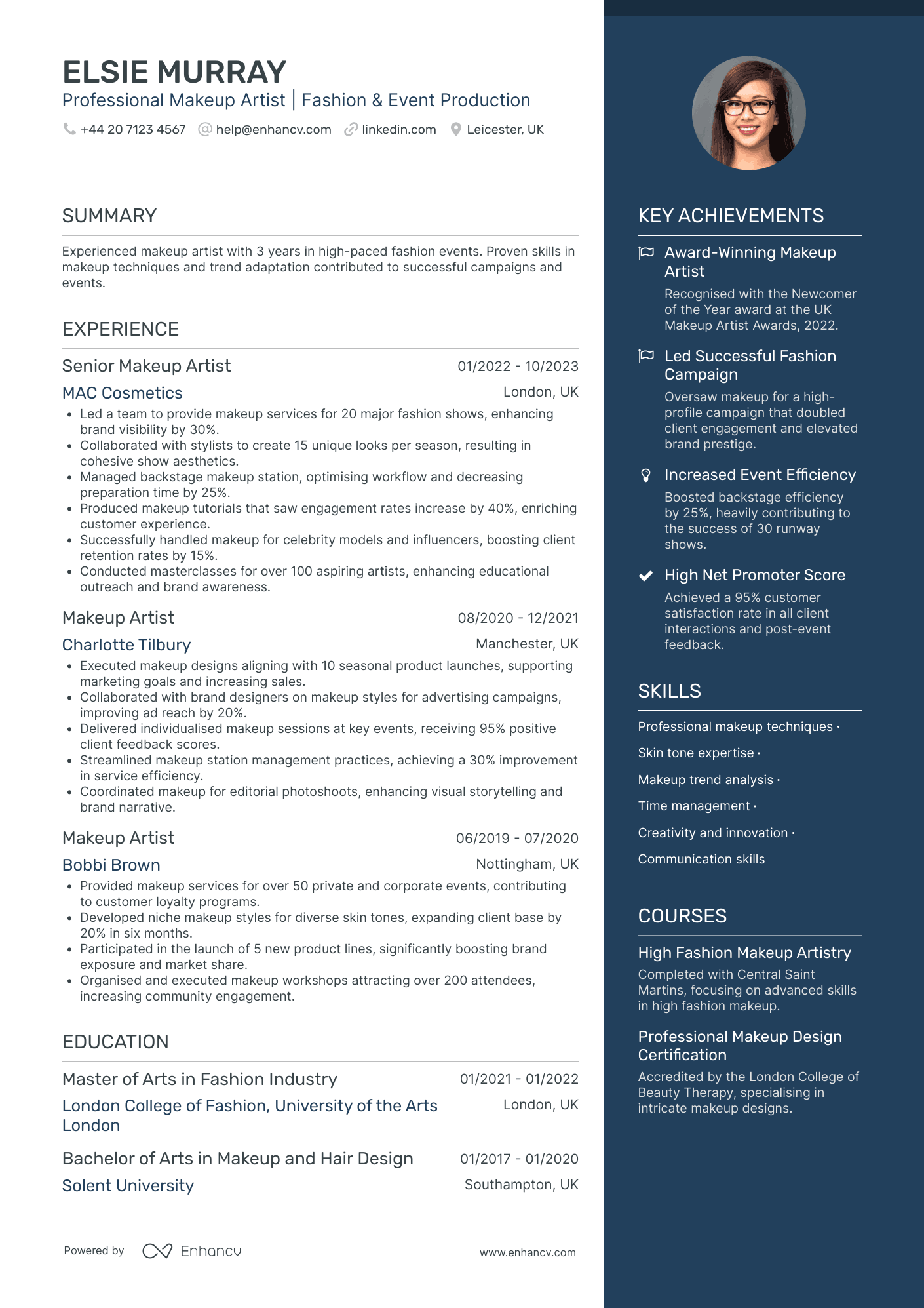
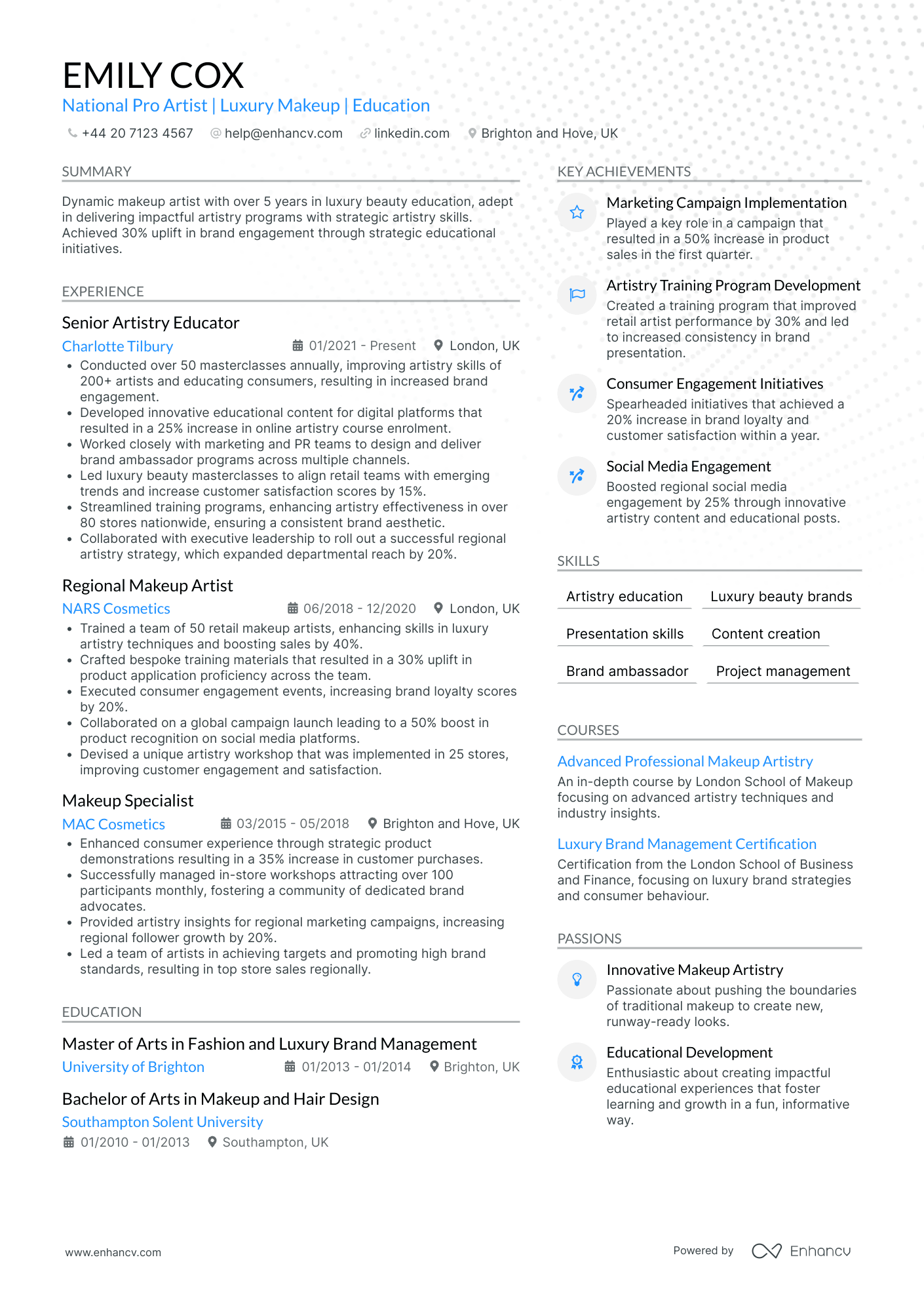
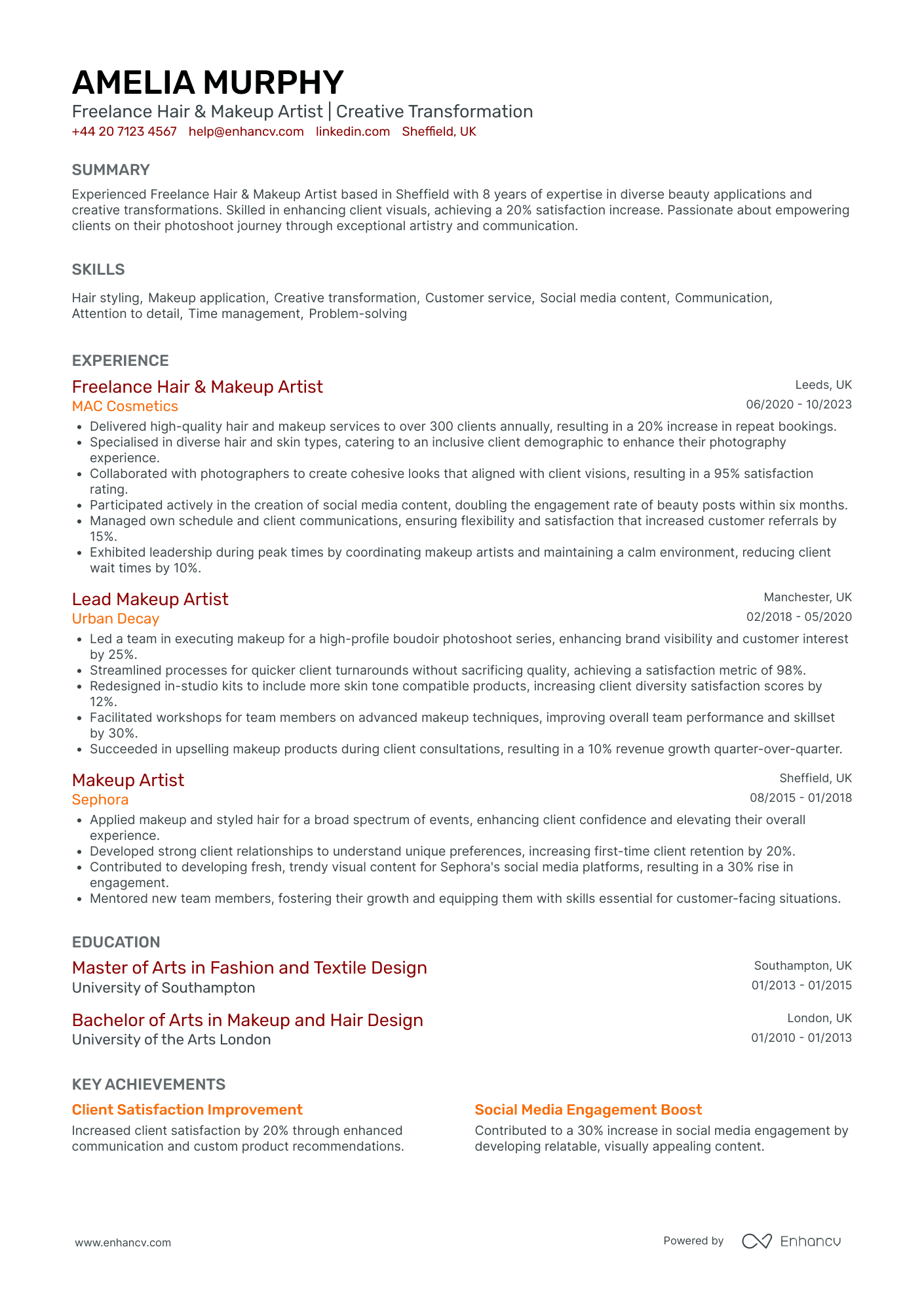
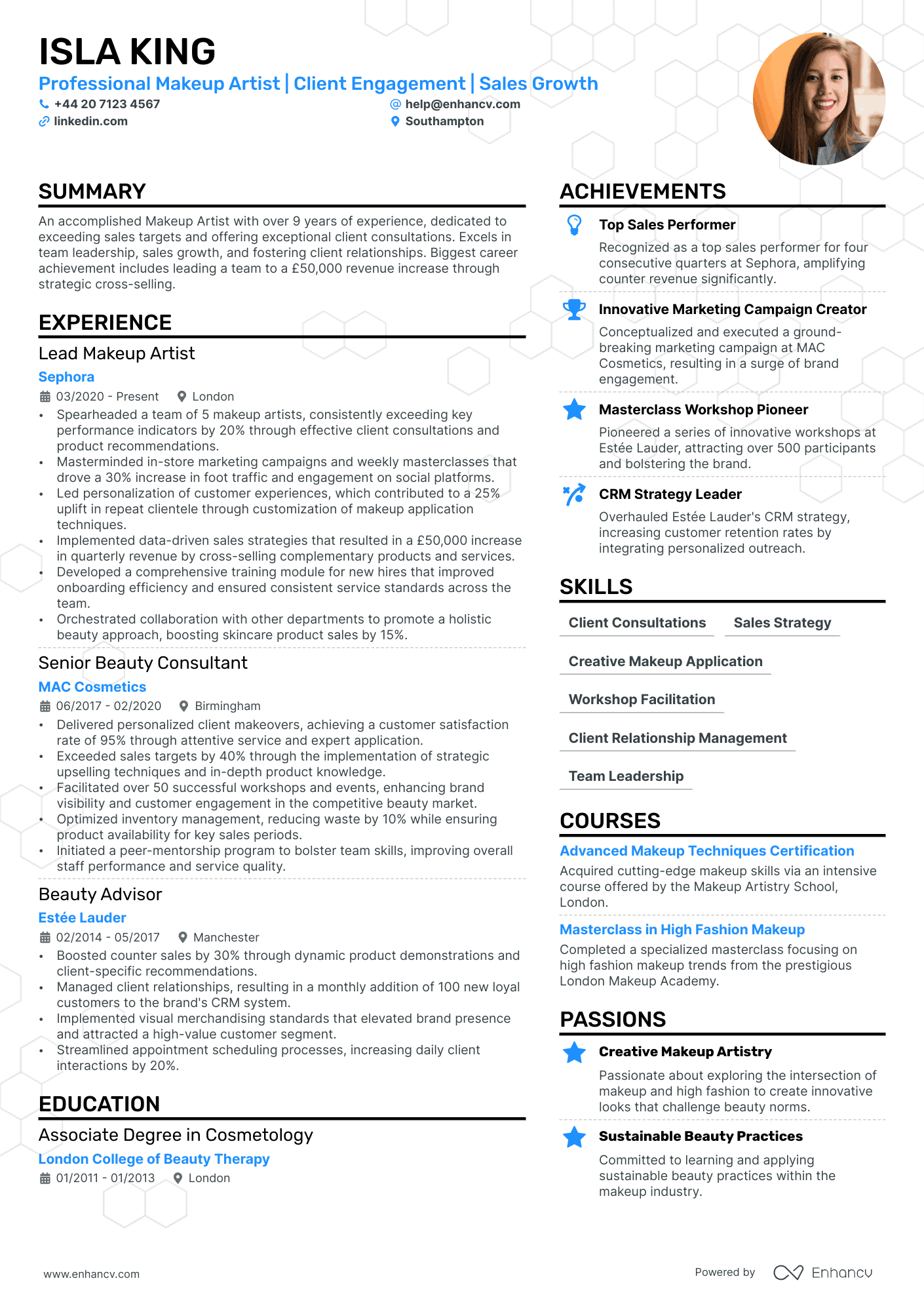
For a makeup artist, the CV rarely books the job on its own. The portfolio does. What the CV has to do is convince a client or a lead artist to open that portfolio in the first place.
Most makeup artist CVs never earn that click. They list every palette and brush brand, then bury the one link that shows the actual work. The strong ones put the folio front and centre and use the words to prove range, reliability, and the kinds of faces you have made up for real.

Key takeaways
- Lead with your portfolio link and put it in the header, where a client or lead artist cannot miss it.
- Show range, not products. Bridal, editorial, SFX, film and TV, and counter work each read differently to a booker.
- Build the personal statement on the work you have done and the settings you have worked in, not a stack of adjectives.
- Quantify the way the industry measures it: faces per day, call times hit, productions, weddings, and repeat clients.
- Keep it to two pages, send a PDF so the layout and your folio links hold, and reserve a Word copy for agencies.
- List the training and hygiene credentials clients check, including any airbrush or SFX certificates, first aid, and insurance.
Building your makeup artist portfolio and linking it on your CV
Your folio is the product. The CV is the thing that points to it, so the link cannot be an afterthought at the bottom of the page.
Put a clickable portfolio link in your CV header, next to your name and location, and repeat it inside any experience entry where that work lives. A lead artist reading your bridal history should be able to jump straight to bridal images in one click.
Curate hard. Eight to fifteen finished looks beat forty half-lit phone snaps, and a tight edit signals taste as much as skill. Use high-resolution images, consistent lighting, and credit the photographer, stylist, and model on each shoot the way the industry expects.
Show range across the categories you actually work in:
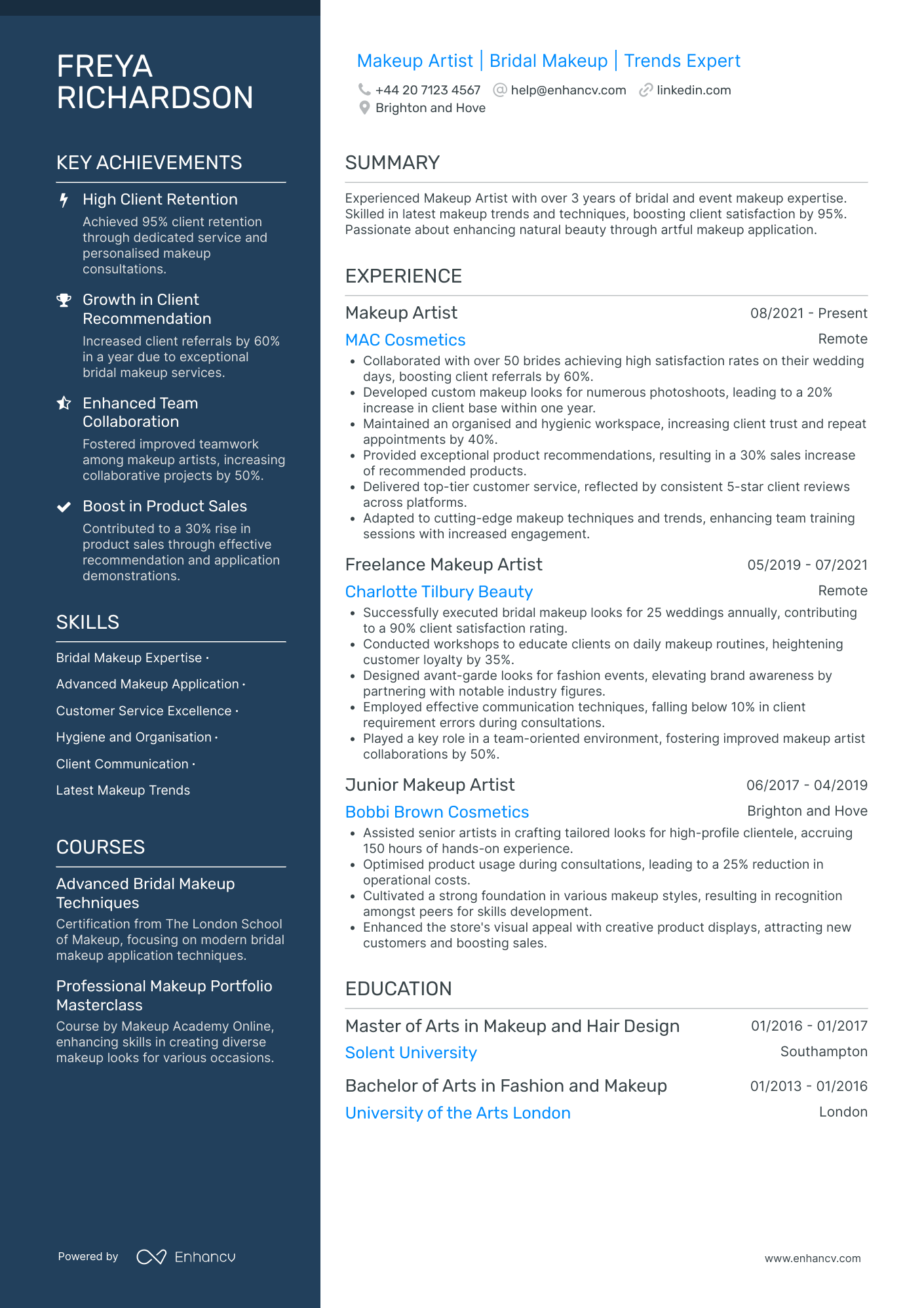
- Bridal and occasion, with clean before-and-after pairs where you have them.
- Editorial and fashion, to prove you can push a concept past everyday glam.
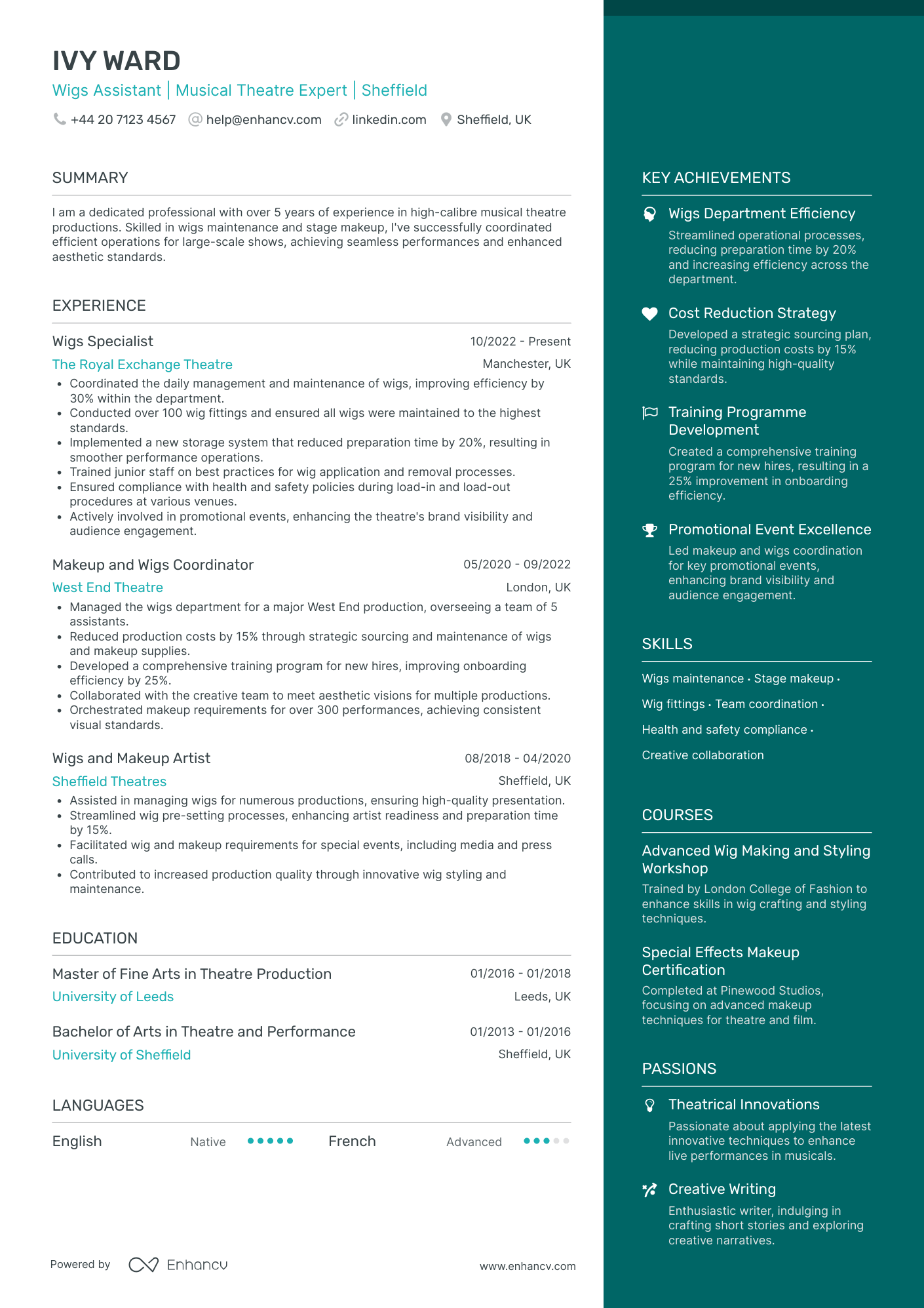
- Film, TV, and theatre, including any continuity, ageing, or basic special effects work.
- Beauty counter and retail, where wearable skin and product knowledge matter more than the avant-garde.
If you are starting out and your folio is thin, build it on purpose. Collaborate on test shoots with photographers and models, offer a few trials in exchange for images and reviews, and photograph every paid look you are allowed to. Two strong test shoots can carry a first CV further than a certificate.
Include before-and-after pairs where the transformation is the selling point, and a short reel if you work in bridal or SFX, where movement and timing matter. Keep everything in date order and refresh it every few months so your best recent work sits first.
Order the folio to match the gig. A bridal enquiry should land on weddings first. An application to a cosmetics counter should open with wearable, camera-ready skin, not a fantasy horns-and-latex piece.
Decide where the folio actually lives. A single social handle is fine when your grid is curated and your best work is near the top, but a simple personal site lets you group looks by category and control the order a client sees them. Whichever you pick, keep the link tidy and memorable, and make sure it is public.
For a printed CV, add a small QR code so the work is one scan away. And keep the folio and the CV in step, because a client who reads "six years in bridal" and then finds two wedding images online will trust neither.

PRO TIP
Name the shoot, not just the look. "Bridal trial and wedding-day makeup for a 12-person party in the Cotswolds" tells a client far more than "natural glam". Context proves you can run the real job, not just style a single image.
On a makeup artist's CV, the words are the trailer and the folio is the film. The first thing worth looking for is a link you can actually click, then evidence the artist has worked the exact setting being hired for, whether that is a bridal morning, a fashion shoot, or a set with a 5am call. A tidy list of products says nothing. Ten strong images and one honest line about the last wedding you ran say everything.
the Enhancv team
Writing your makeup artist personal statement
Three or four sentences at the top: who you are, the work you do, the settings you have worked in, and what you are looking for next. This is where you answer the question every client is really asking, which is how you would describe yourself as an artist. See more personal statement examples if the opening line will not come.
Skip the adjective soup. "Passionate, creative, and detail-oriented" sits on every other CV, and a client cannot check a word of it.
Lead with the work instead:
Makeup artist personal statement example
Freelance makeup artist with six years across bridal, editorial, and short-film sets. Trained in airbrush and basic SFX, comfortable running a chair solo or as part of a glam team against a tight call time. Booked more than 40 weddings in 2025 with a five-star average across reviews. Looking to take on more commercial and editorial work with a London agency.
What to avoid
Passionate and creative makeup artist who loves making people look and feel beautiful. Hard-working, reliable, and a real team player with a keen eye for detail and a love of all things beauty.
The first version reads like a booking sheet a client can trust. The second could describe anyone who owns a makeup bag. Numbers, named settings, and real work are what a client cannot argue with.
Rewrite the statement for the gig in front of you. A bridal client wants to read "weddings" and "trials" in the first line, while an agency scouting editorial talent wants to see shoots and concepts. The rest of the CV can stay put, but the opening lines should always speak to the booking.
Writing your makeup artist experience section
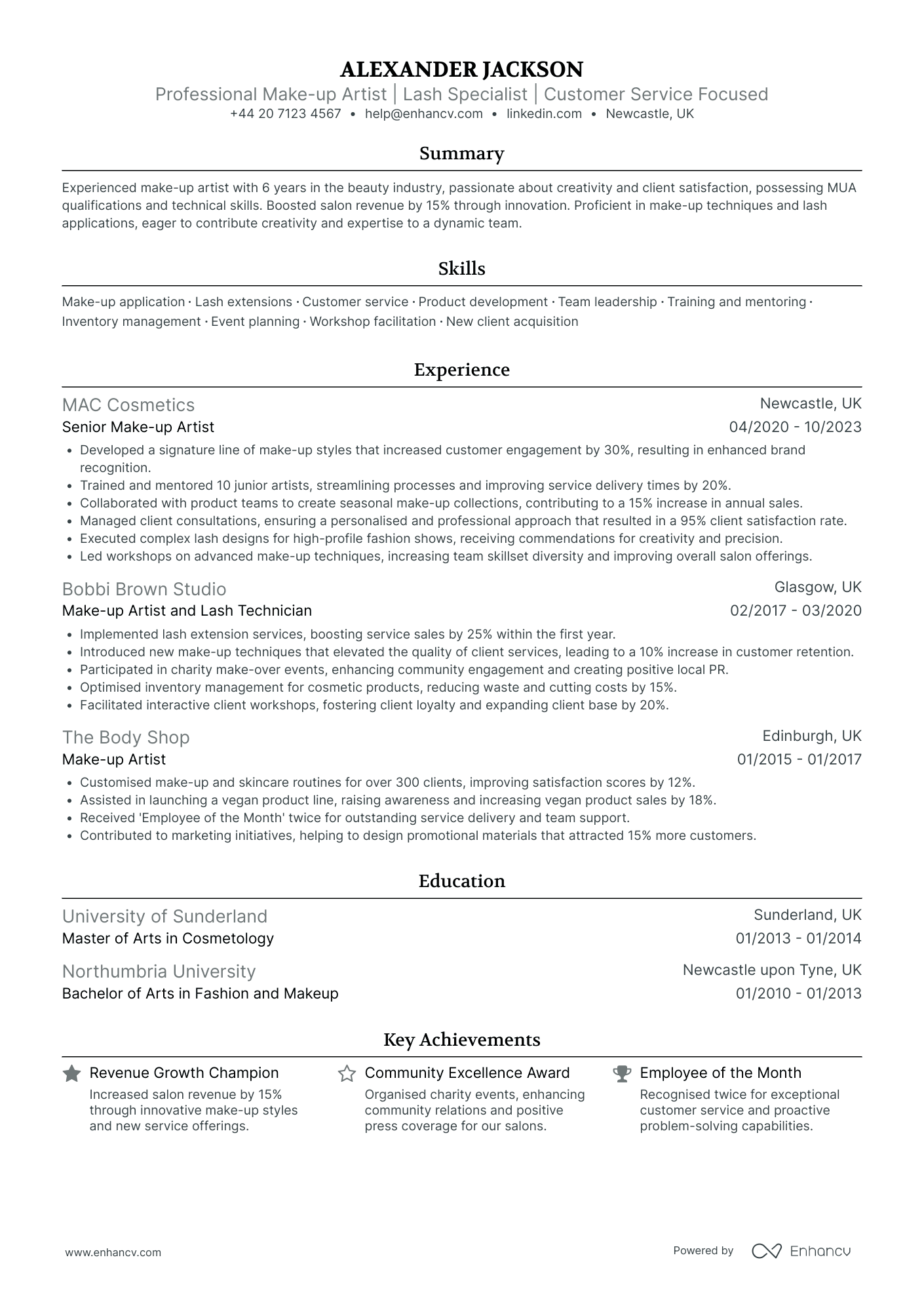
Whether the work is salon, counter, freelance, or set based, write every entry the same way: a dated heading, then bullets that lead with a verb and land on a result. For the mechanics, see work experience on a CV.
Makeup work is more measurable than it feels. Faces per day, call times hit, productions and weddings covered, counter sales against target, and clients who rebook are all CV achievements worth a bullet.
Group freelance bookings under one self-employed heading rather than listing every wedding as a separate job. Underneath, pull out the standout gigs by name, the recurring clients, and the numbers that show scale.
Write each kind of work in the terms a booker recognises. A salon or counter role wants throughput, retail figures, and repeat custom. A film, TV, or theatre credit wants the production, the department you sat in, and continuity or timing under pressure. Bridal wants party sizes, trials, and reviews.
Mirror the language of the booking. Pull the terms from the brief or advert and reflect them where they are true of you, so a film enquiry sees "continuity" and a counter role sees "sales" and "product knowledge". Enhancv's CV tailoring feature reads the ad and suggests the matching edits, which saves rewriting from scratch for every application.
- Deliver bridal, editorial, and occasion makeup for 60-plus clients a year, averaging a 4.9 out of 5 review score across 40 weddings in 2025
- Run solo and team glam mornings to fixed call times, keeping a wedding party of up to 12 camera-ready without overrunning the schedule
- Hold public liability insurance and a sanitised, hypoallergenic kit, and colour-match confidently across a full range of skin tones
- Grew repeat and referral bookings to roughly 55% of the diary through consistent trials and clear pre-booking consultations
PRO TIP
One real number beats five lines of duties. "Made up 18 faces before an 8am call with zero delays" proves you are safe to book on set faster than any inventory of the products in your kit.
Skills to put on a makeup artist CV
A makeup artist CV needs two kinds of skill, and clients read them differently. Your hard skills are the techniques and settings you can perform, listed in the words the booking uses.
Your soft skills are the ones that decide whether a client books you twice, and on this job they are real and checkable: consultation, communication, and staying calm when a bride is running late. Prove each in a bullet rather than parking it in a skills section as a bare word.
List only what you can stand behind on the day. If you have trained in airbrush or SFX, name it. If you have not, leave it off rather than have it surface on a live set.
Hygiene is a skill worth stating outright, not an assumption. Sanitised brushes, single-use applicators, and a clean, well-organised kit are the quiet signals that separate a professional from a hobbyist, and clients working with skin, weddings, or minors look for them.
Top skills for your makeup artist CV:
Bridal and occasion makeup
Editorial and fashion makeup
Airbrush application
Special effects (SFX) makeup
Skin preparation and colour matching
Hygiene and kit sanitation
Working to call sheets
Retail and counter sales
Client consultation
Communication
Time management
Reliability
Calm under pressure
Formatting your makeup artist CV
Lead with a skills-led layout if your strongest asset is the folio and your paid history is patchy. Once you have a steady run of bookings, switch to reverse chronological so your most recent work sits at the top.
Keep it to two pages, one column, standard headings, and a readable font. Agencies and salon managers skim quickly, and a fussy layout hides the one thing they want, which is the work itself.
Send a PDF for direct applications so the layout holds and, just as important, so your portfolio link stays clickable. Keep a Word copy for agencies that reformat CVs into their own template, and follow the file type if an advert names one.
Applications to larger salon chains and cosmetics retailers often pass through tracking software, so keep the headings standard for an ATS-friendly CV. Build it from a tested layout rather than a blank page, and Enhancv's CV templates export to a clean PDF that keeps your links live.
Education and training for a makeup artist CV
You do not always need a formal qualification to work as a makeup artist, and a strong folio can outweigh a certificate. Training still reassures a client, so list what you hold in your education section.
Name any VTCT or NVQ makeup qualifications, brand and counter training, and short courses in airbrush, SFX, or bridal work. A current first aid certificate and public liability insurance are worth listing too, and any certificates you hold save a client a question.
If you are largely self-taught, put a short line about your training route under education and let the portfolio carry the proof. Do not pad the section with qualifications that have nothing to do with makeup.
The freelance makeup artist CV
Most makeup artists work for themselves, so a freelance CV should read like a small business rather than a gap-filled work history. List yourself as self-employed with a clear date range and group your bookings underneath.
Show the breadth a client is buying: the settings you cover, your travel radius and whether you are mobile, your day-rate range if you choose to share it, and the insurance and kit you bring. A driving licence and a dependable way to reach early call times both matter.
Where you have worked with agencies, studios, or repeat commercial clients, name them. Named productions and referrals do the same job a permanent employer's logo does on a standard CV.
Let social proof carry weight the way it does in the trade. A line such as "4.9 average across 120 reviews" or a short quote from a recent bride belongs on a freelance CV, because reputation is most of what a client is buying.
Keep the business details easy to find. A booking email, the areas you cover, and whether you travel for destination weddings save a client a round of questions and make you the easy artist to say yes to.
Conclusion
Lead with the folio, prove range and reliability in the words, and keep the format clean enough that nothing competes with the work.
Pair the CV with a short cover letter that names the client and the kind of work you want, and you turn a list of skills into a booking worth making.

Author's take - the Enhancv team
On a makeup artist's CV, the words are the trailer and the folio is the film. The first thing worth looking for is a link you can actually click, then evidence the artist has worked the exact setting being hired for, whether that is a bridal morning, a fashion shoot, or a set with a 5am call. A tidy list of products says nothing. Ten strong images and one honest line about the last wedding you ran say everything.