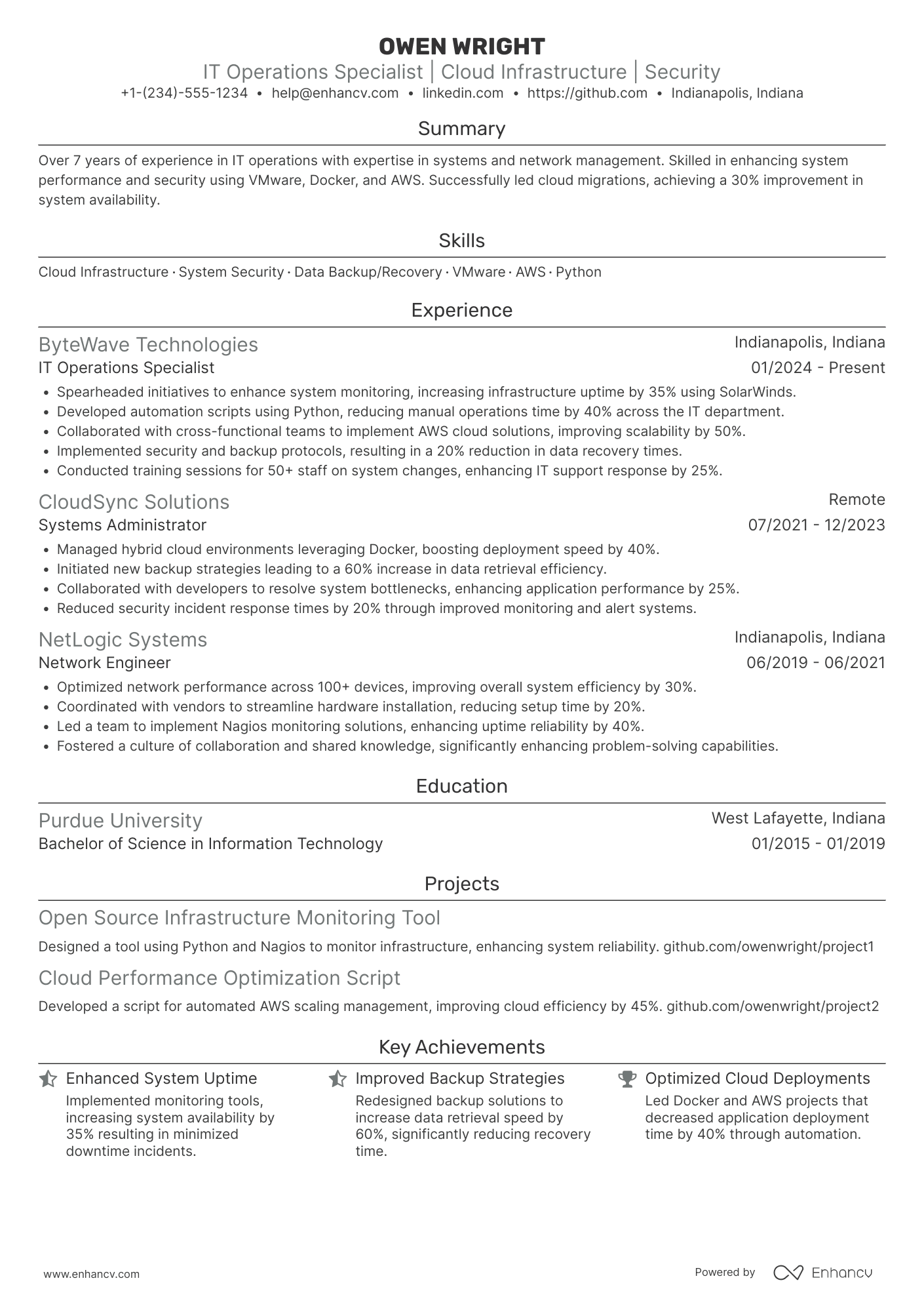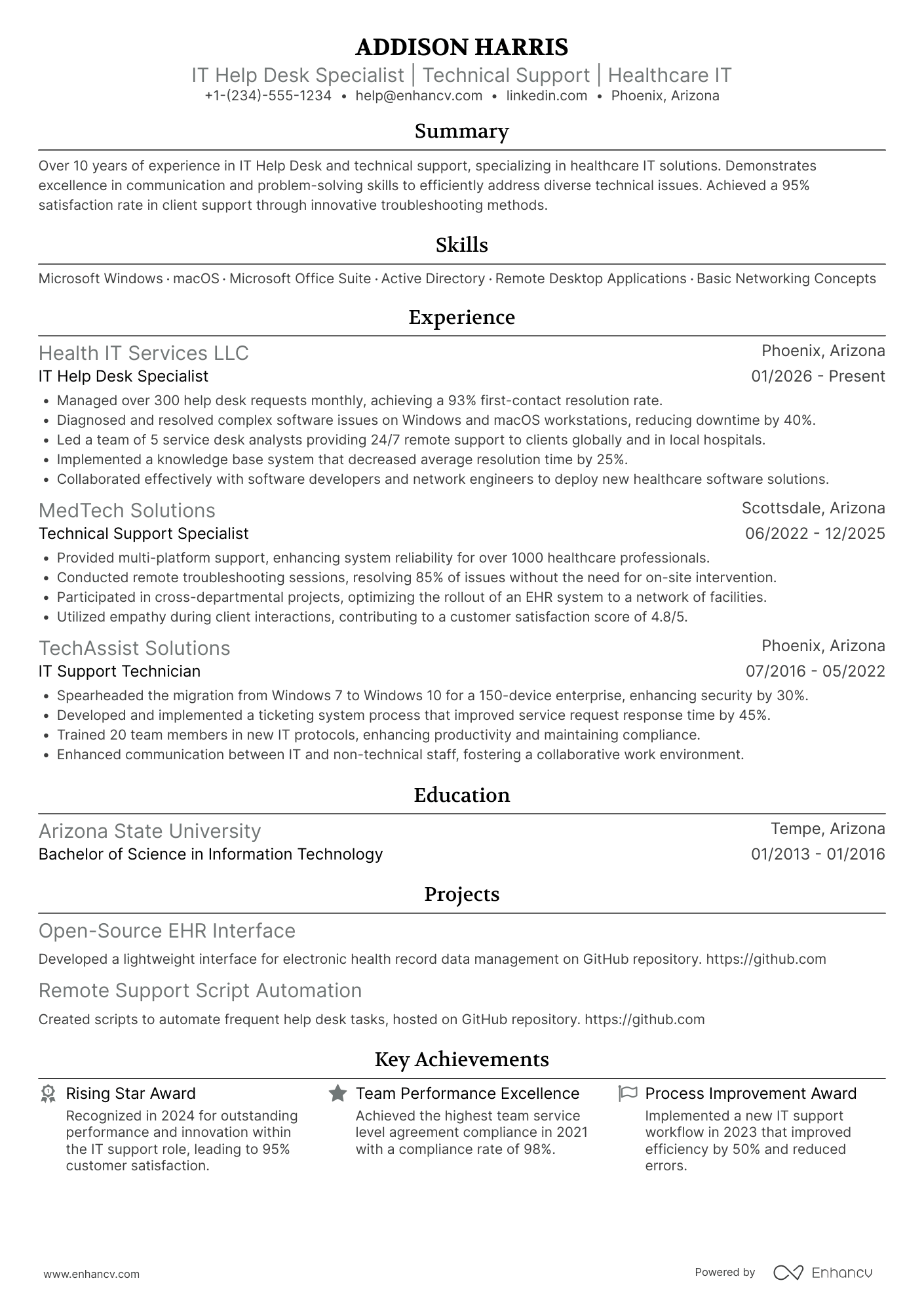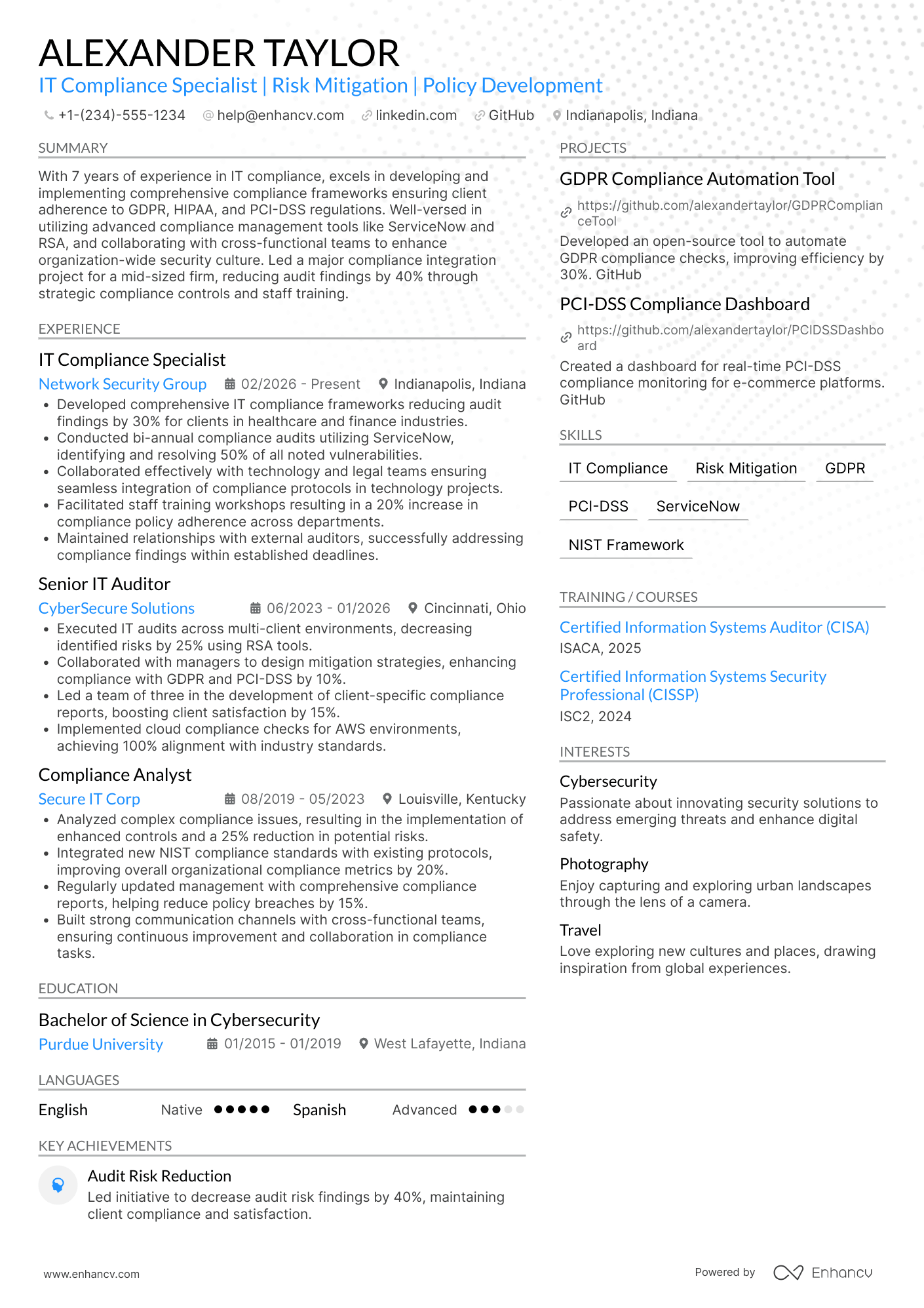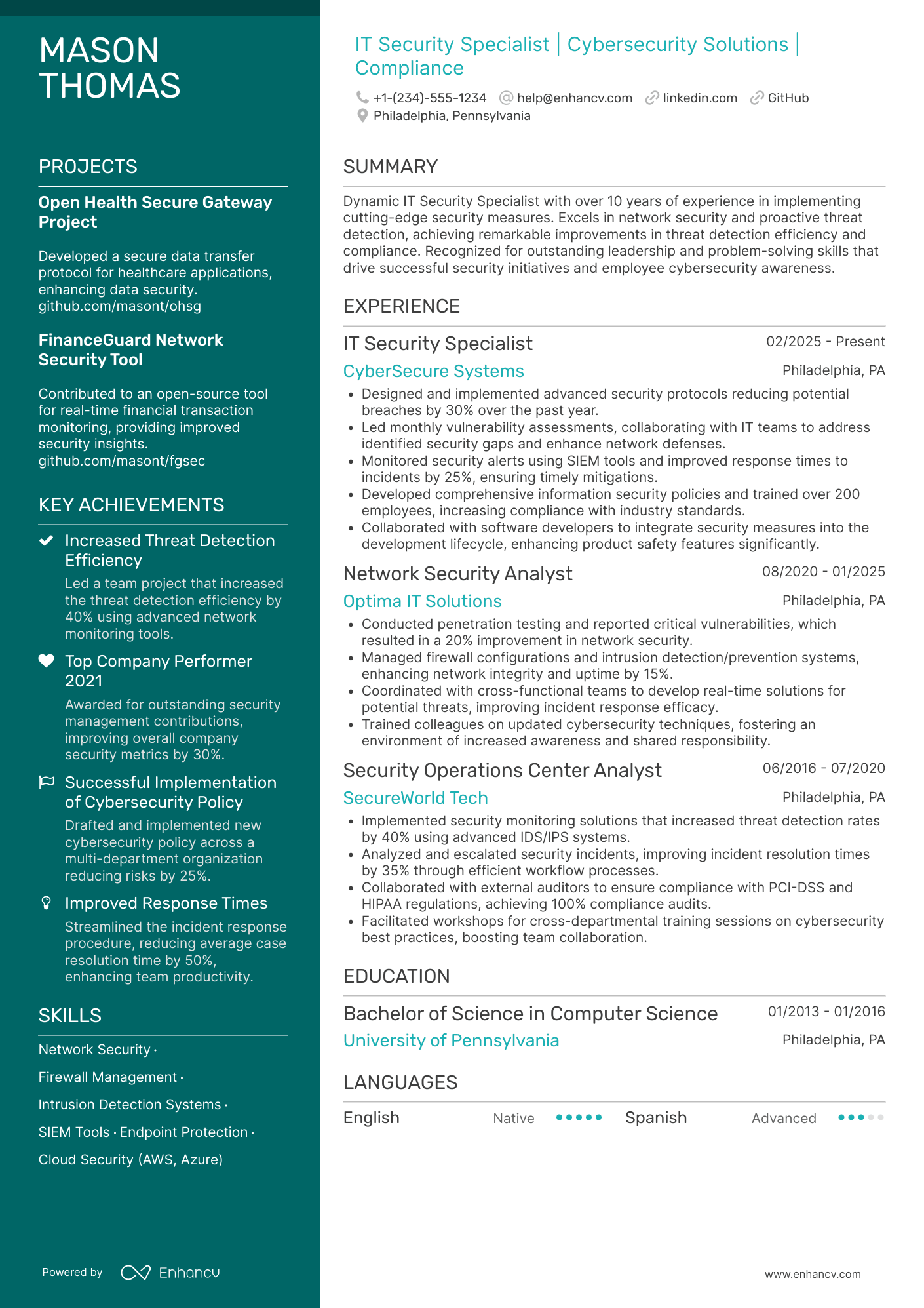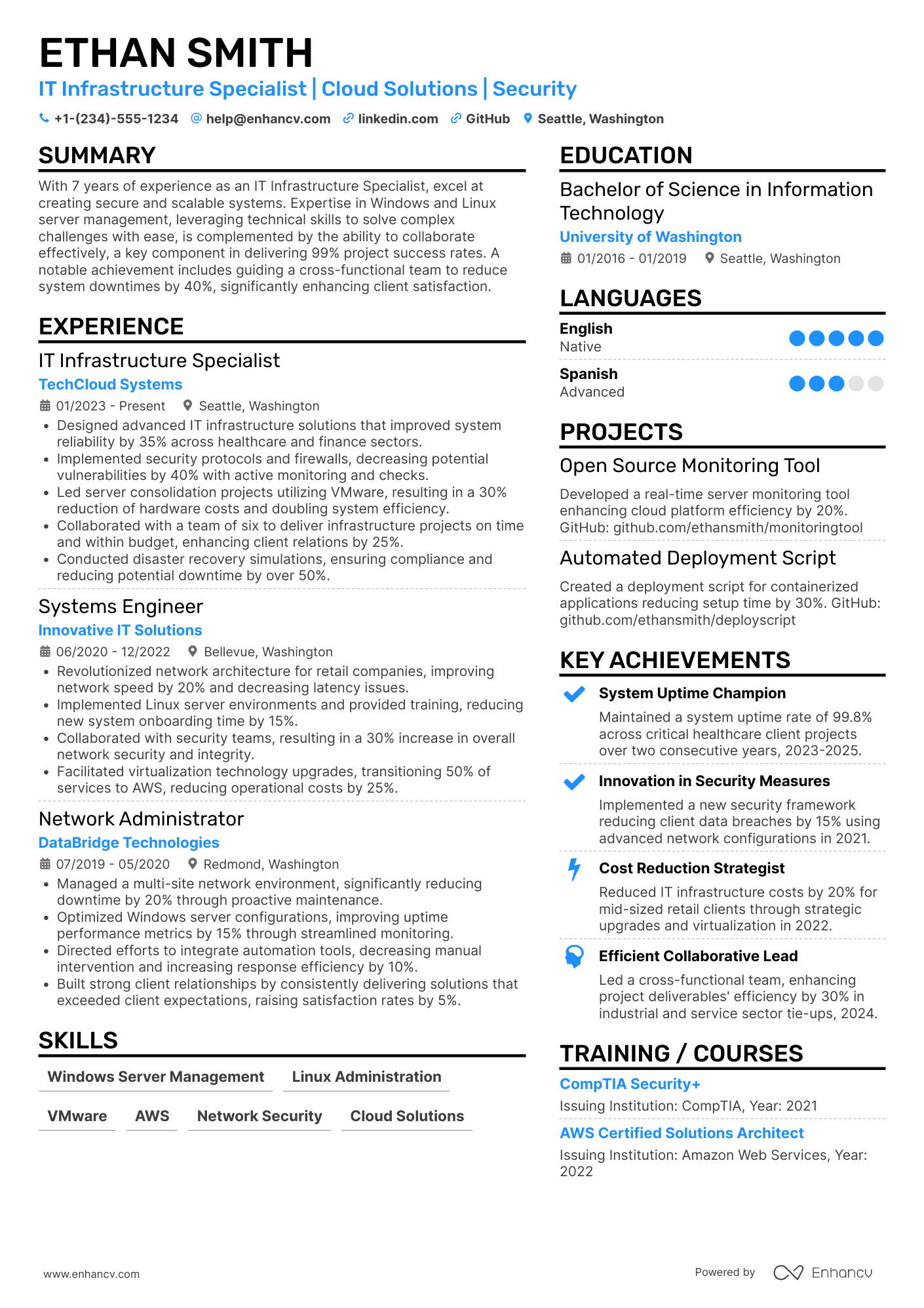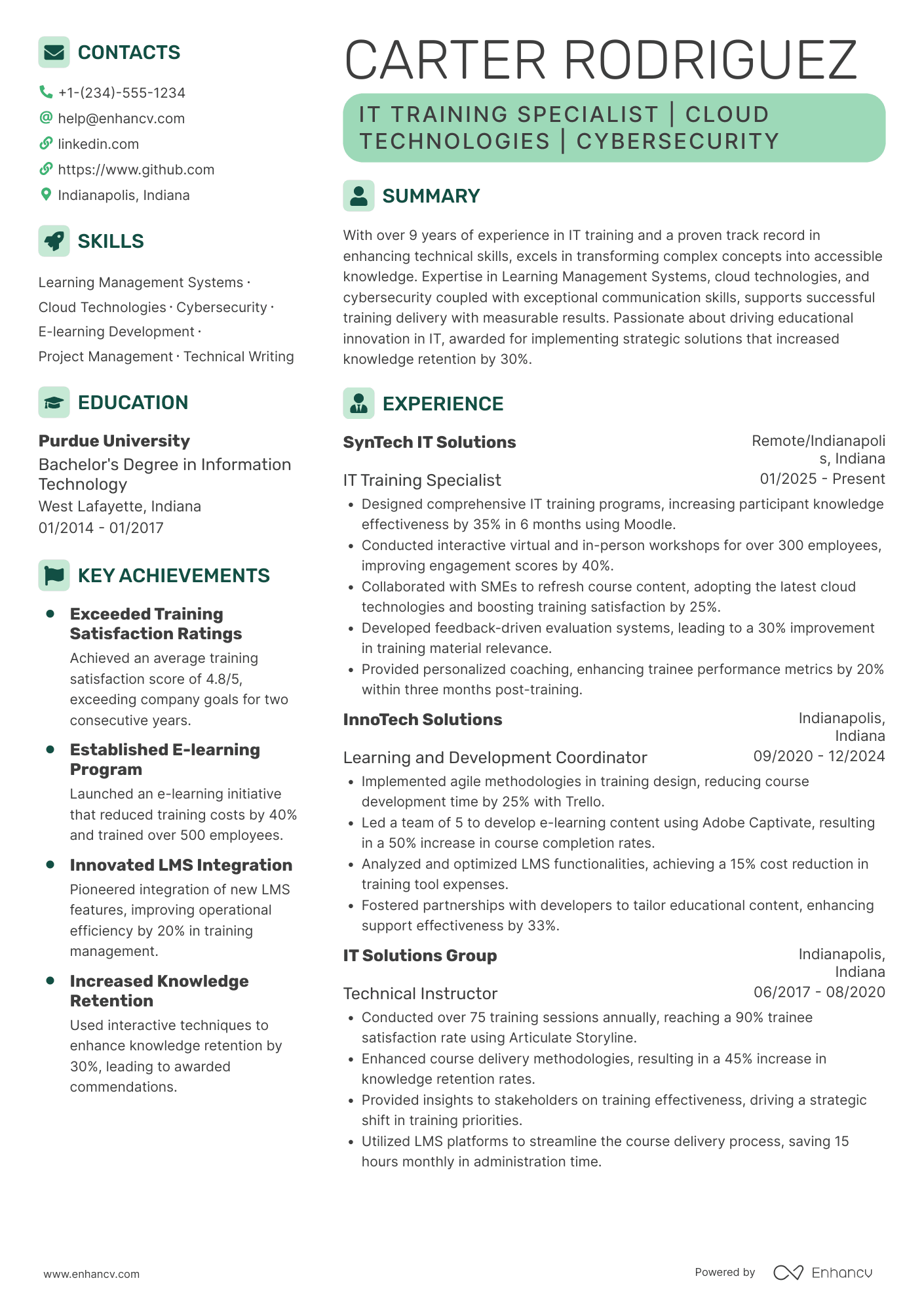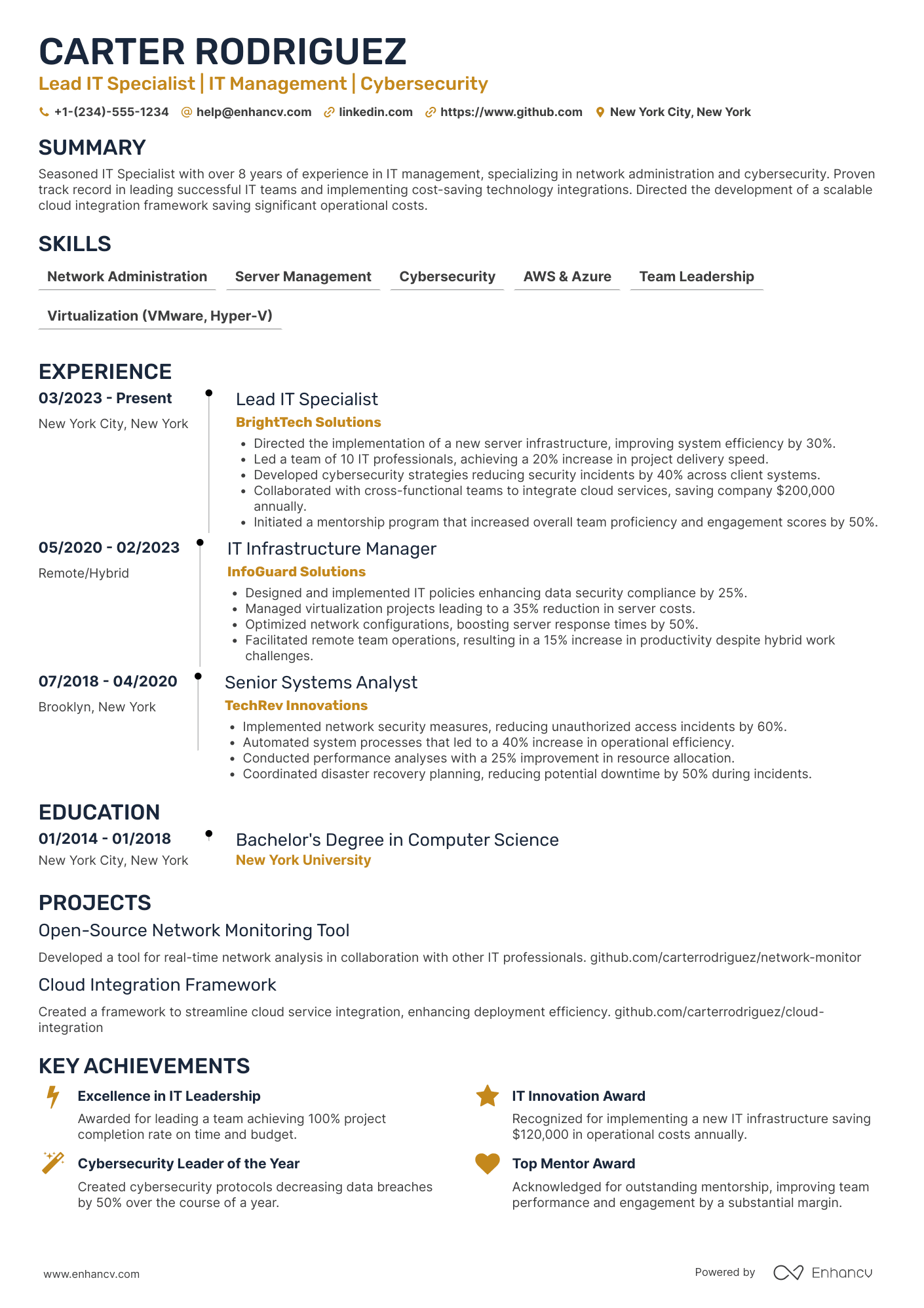
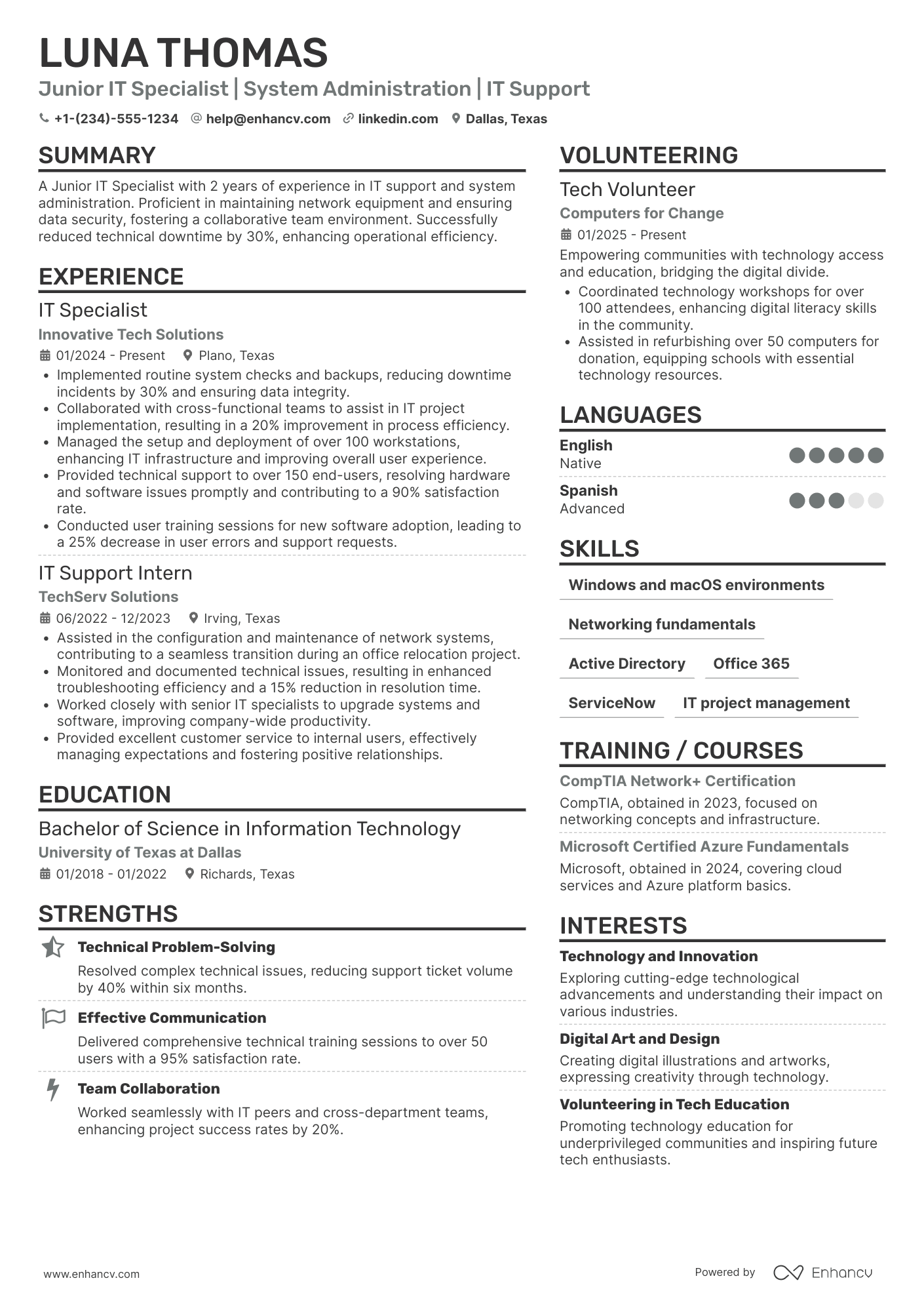
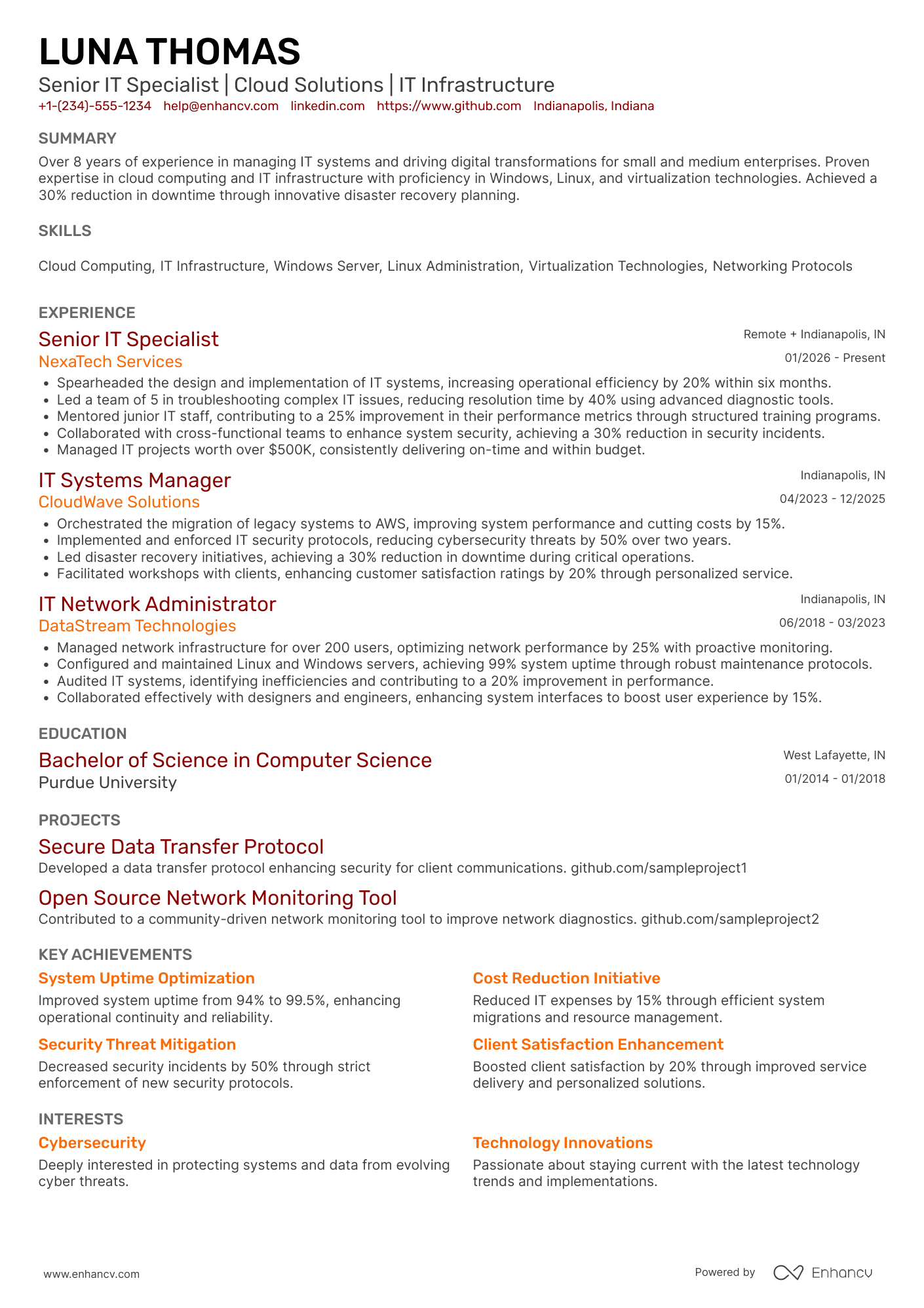
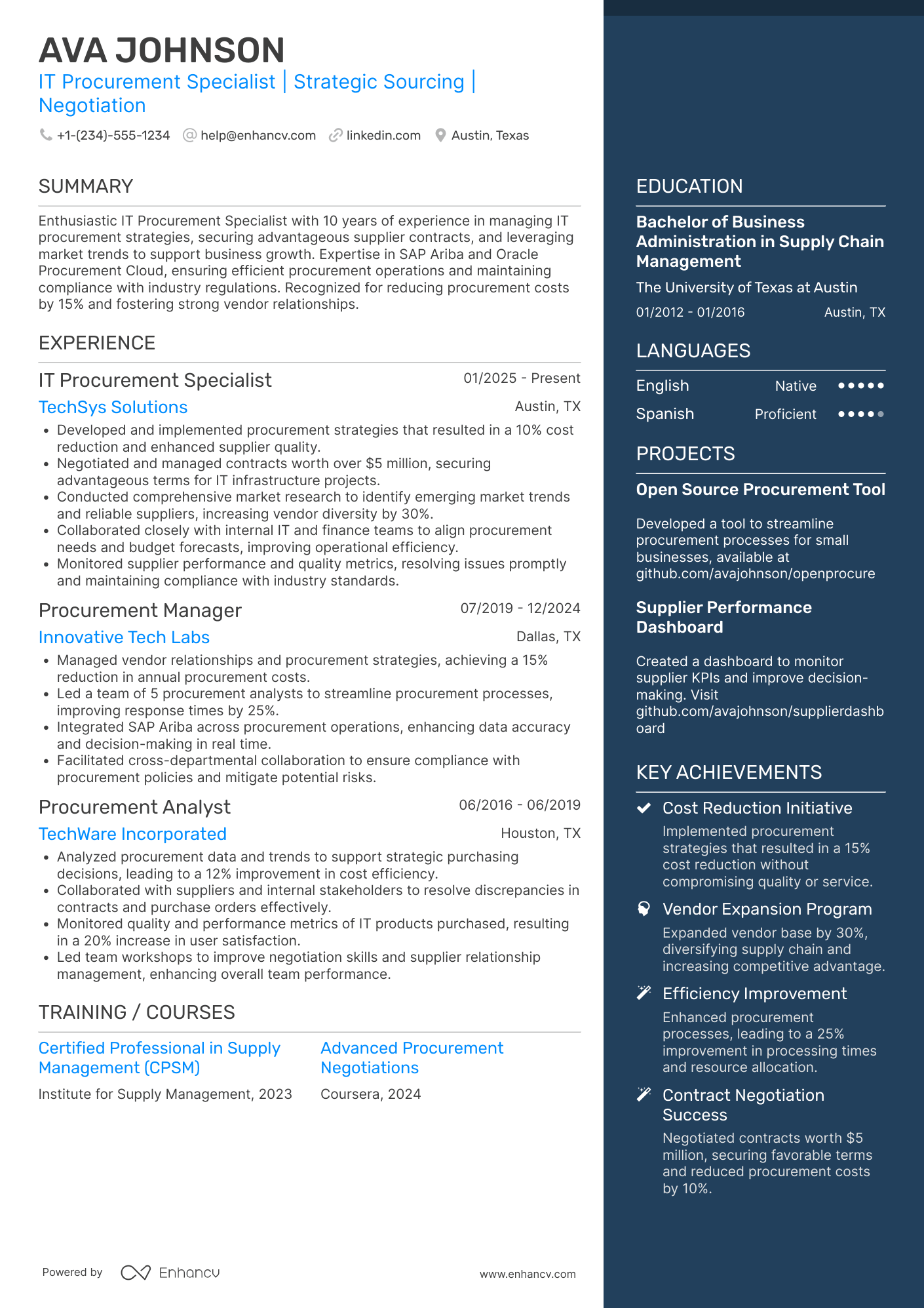
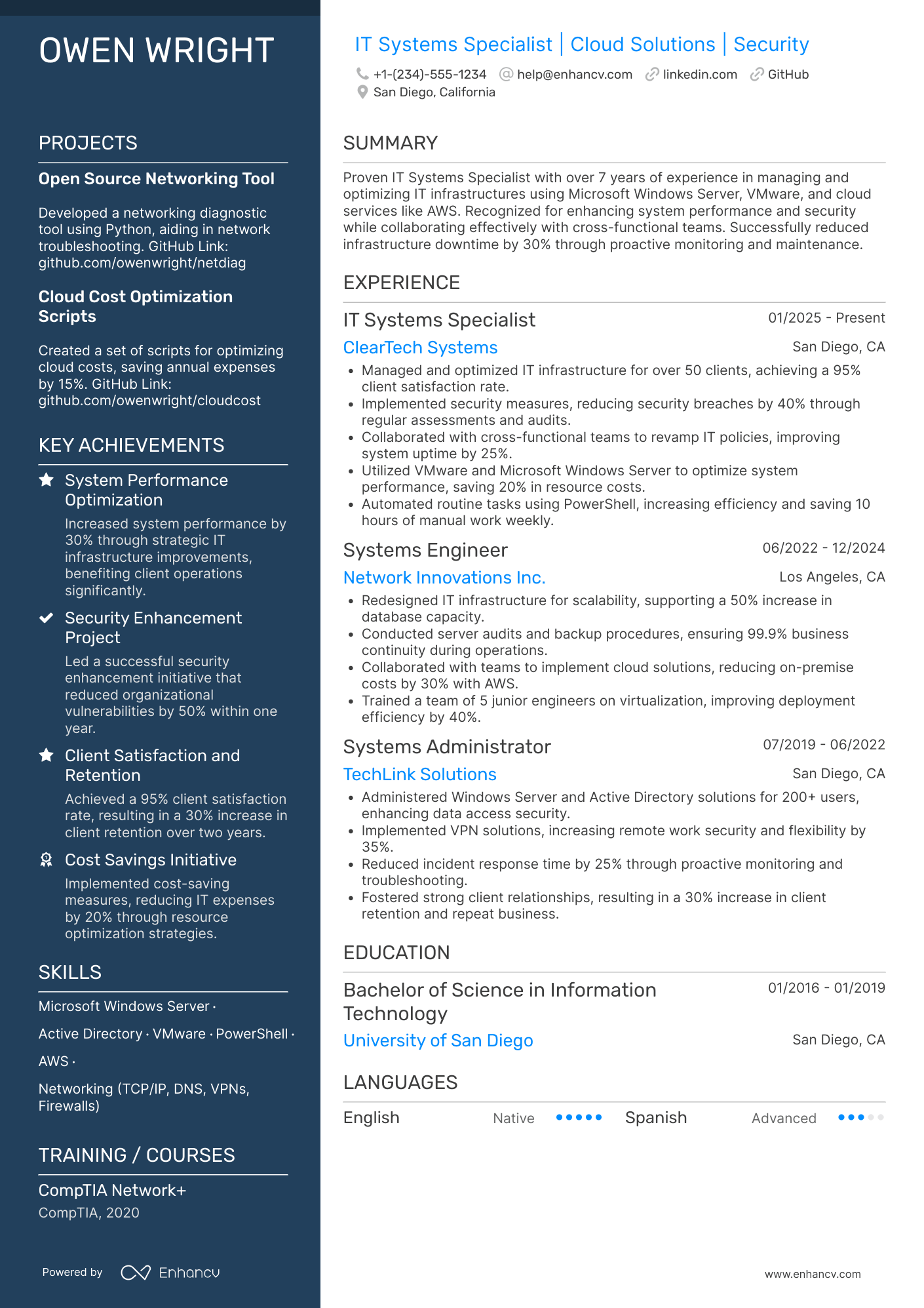
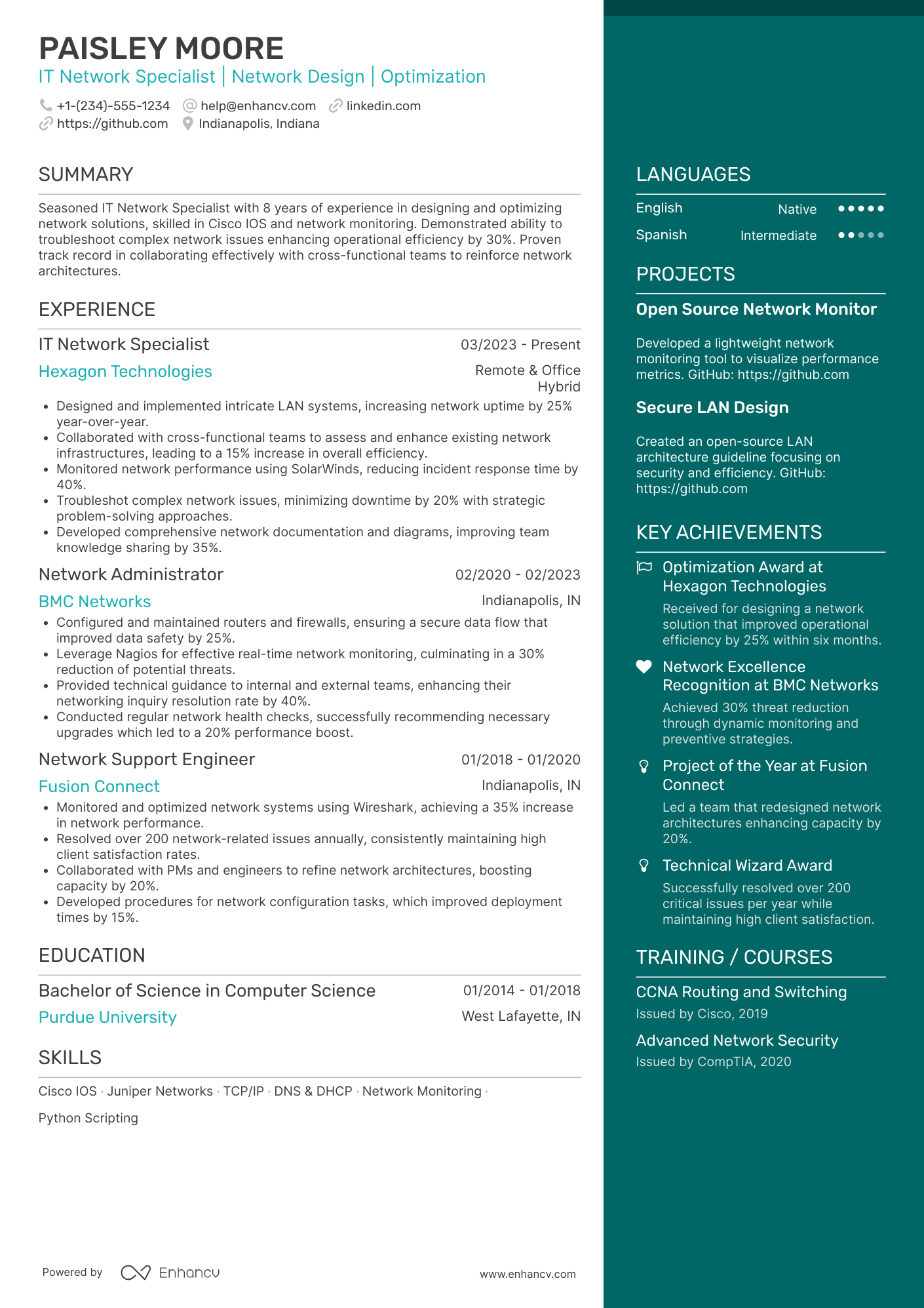
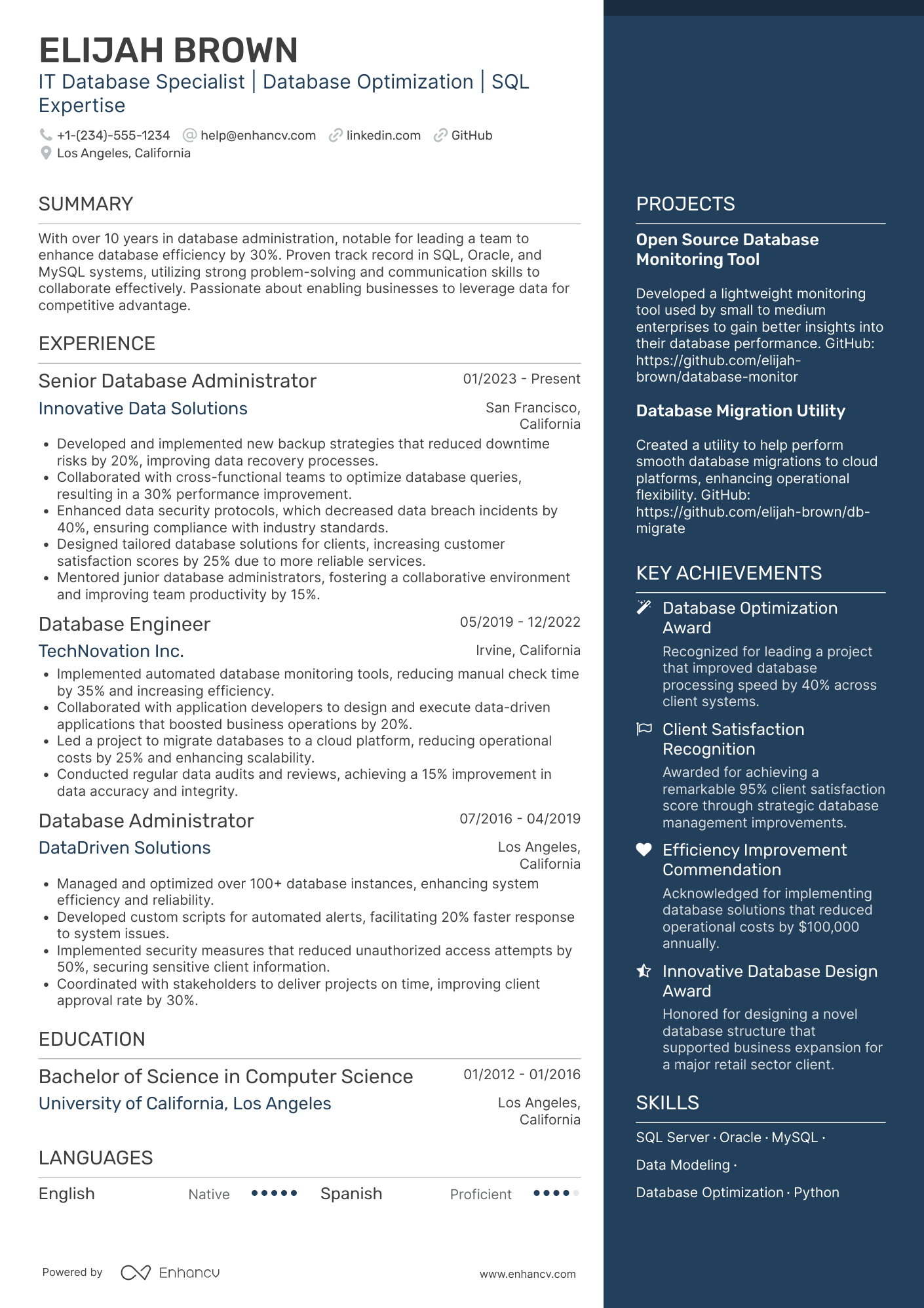
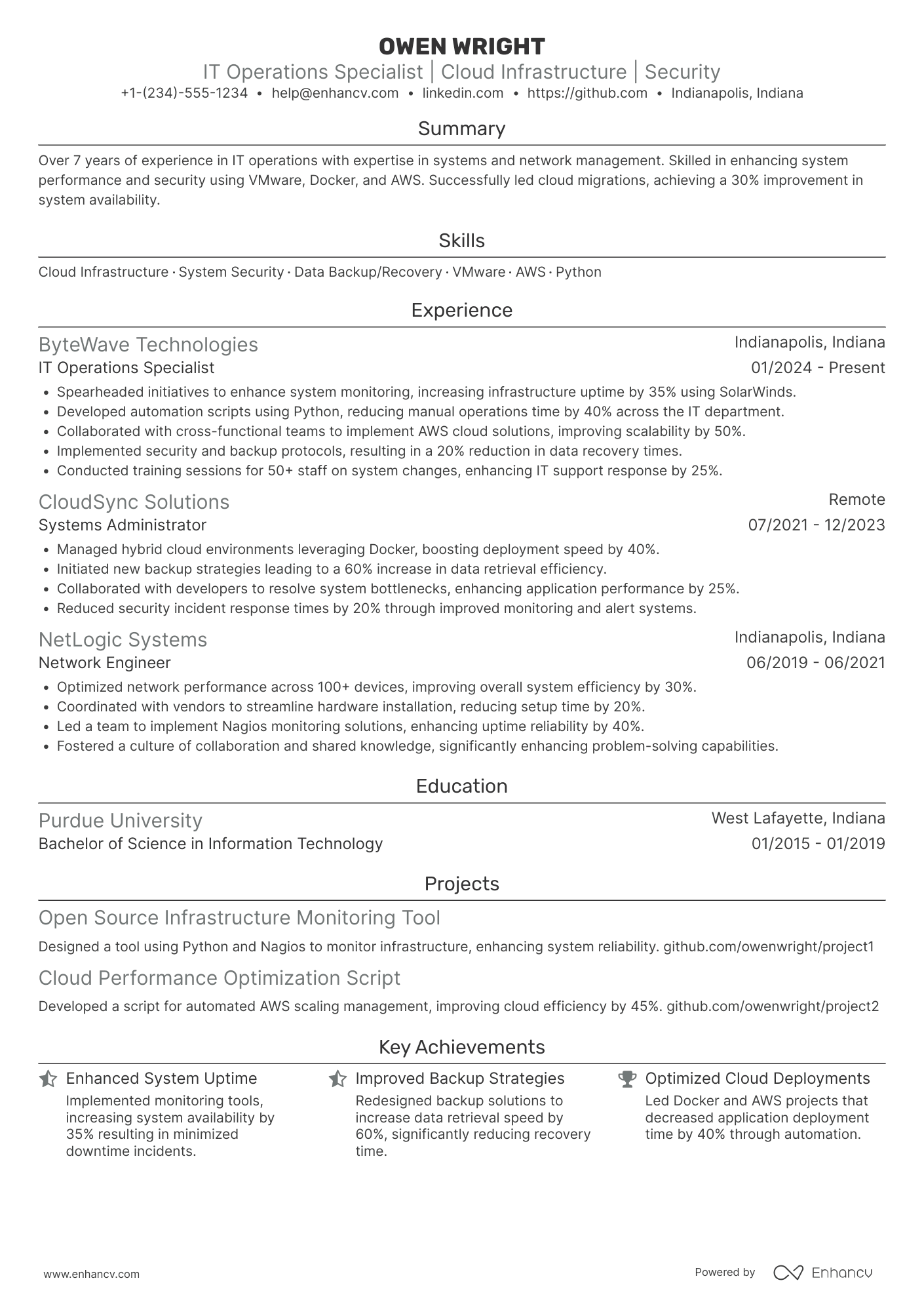
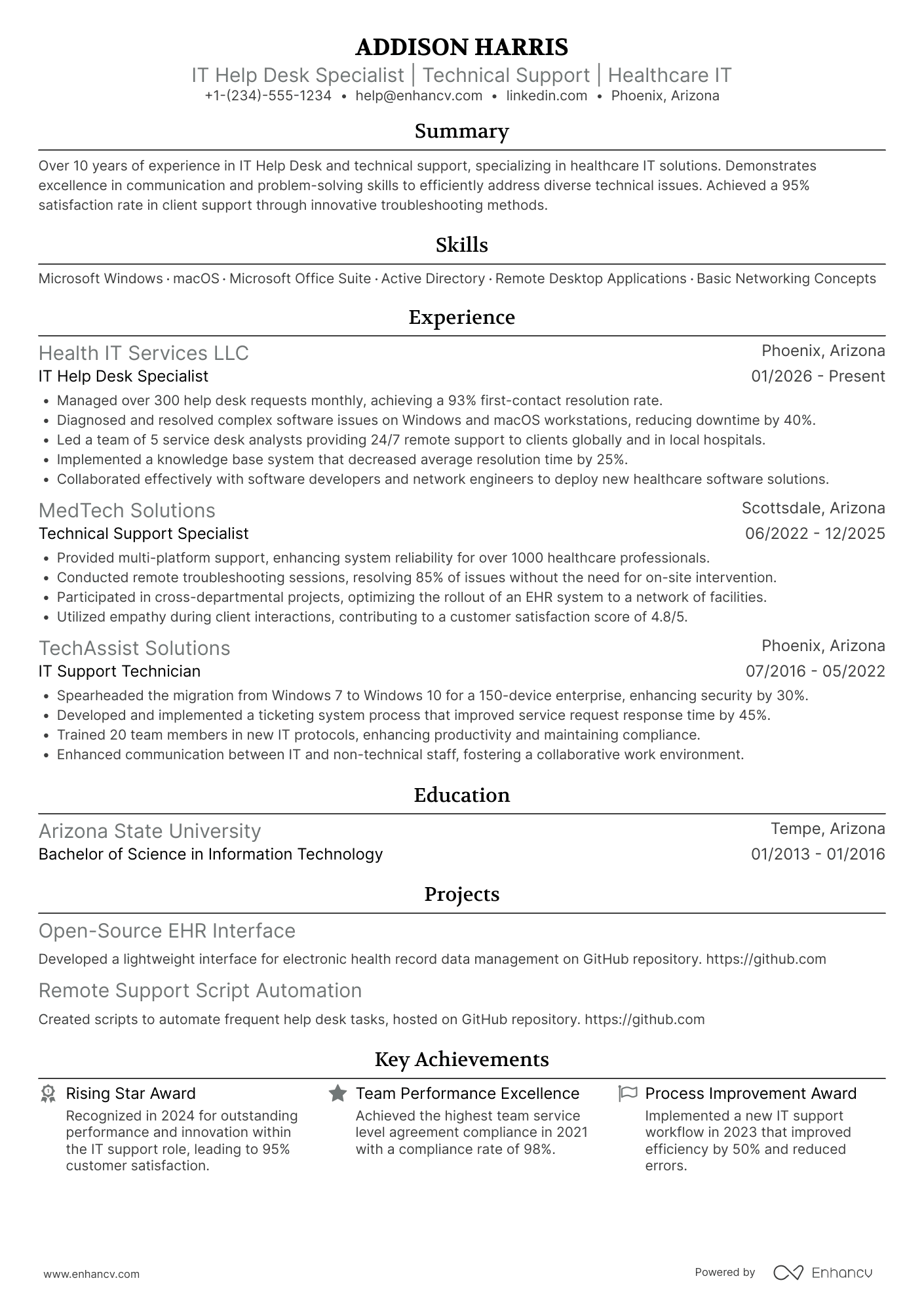
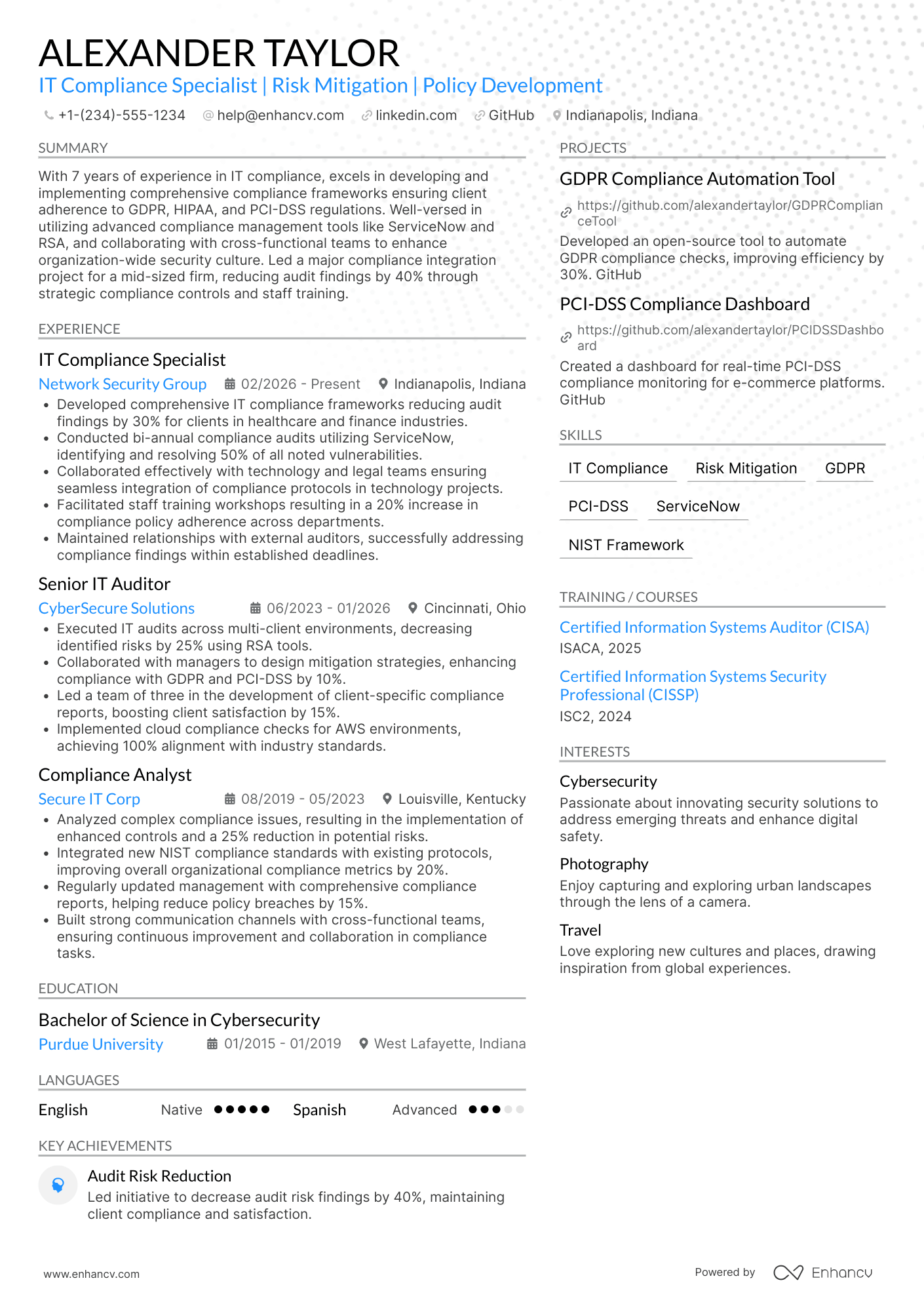
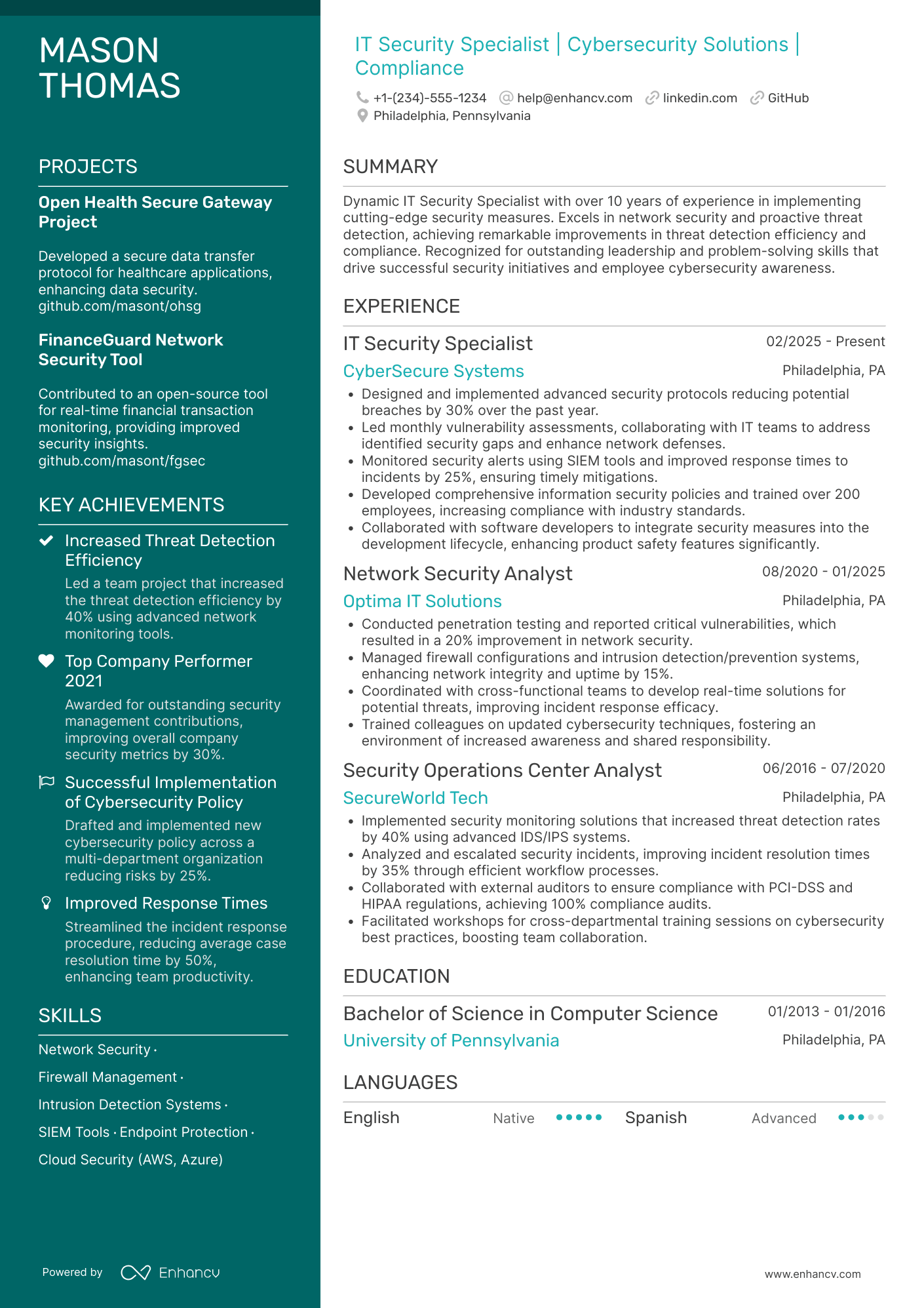
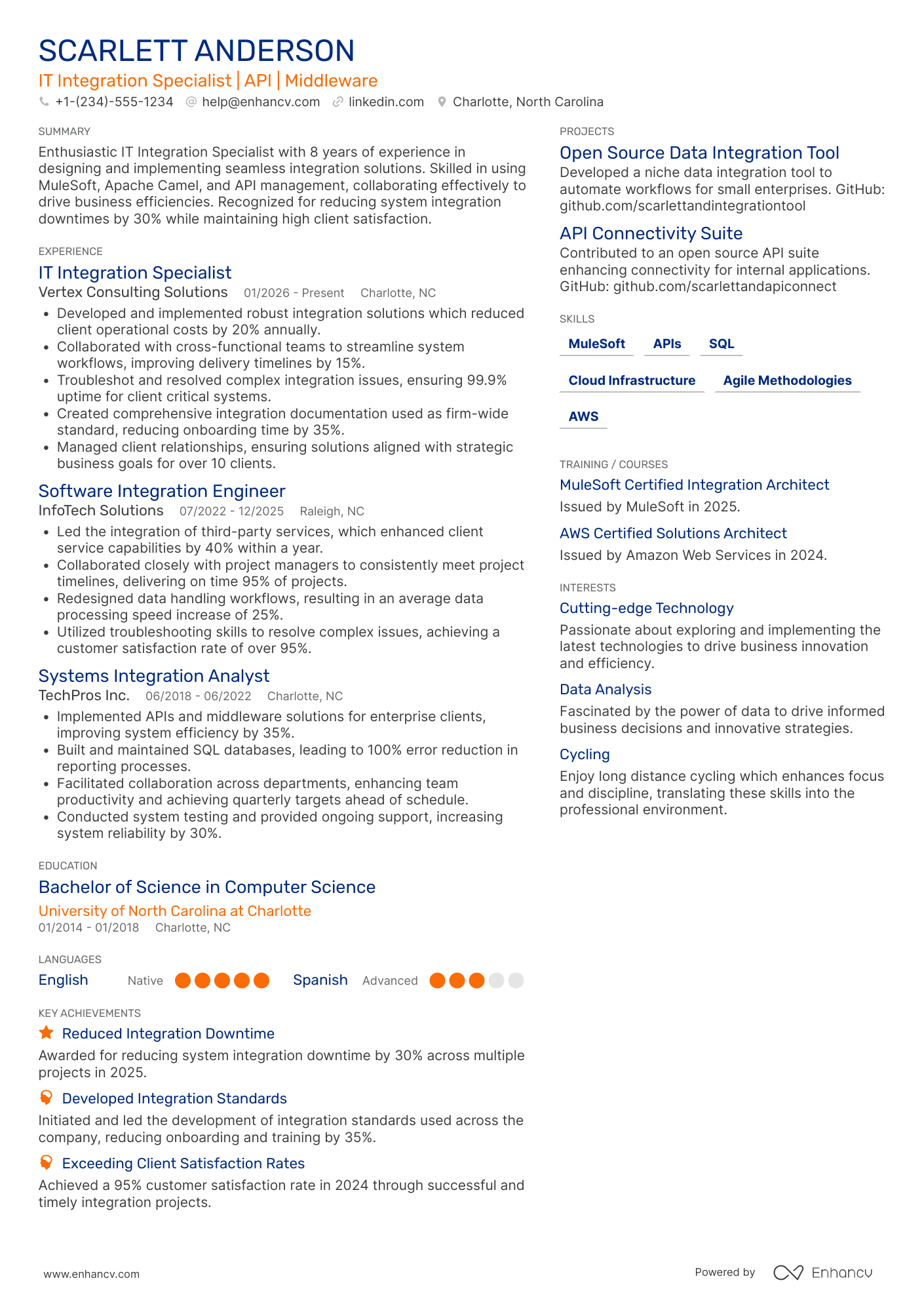
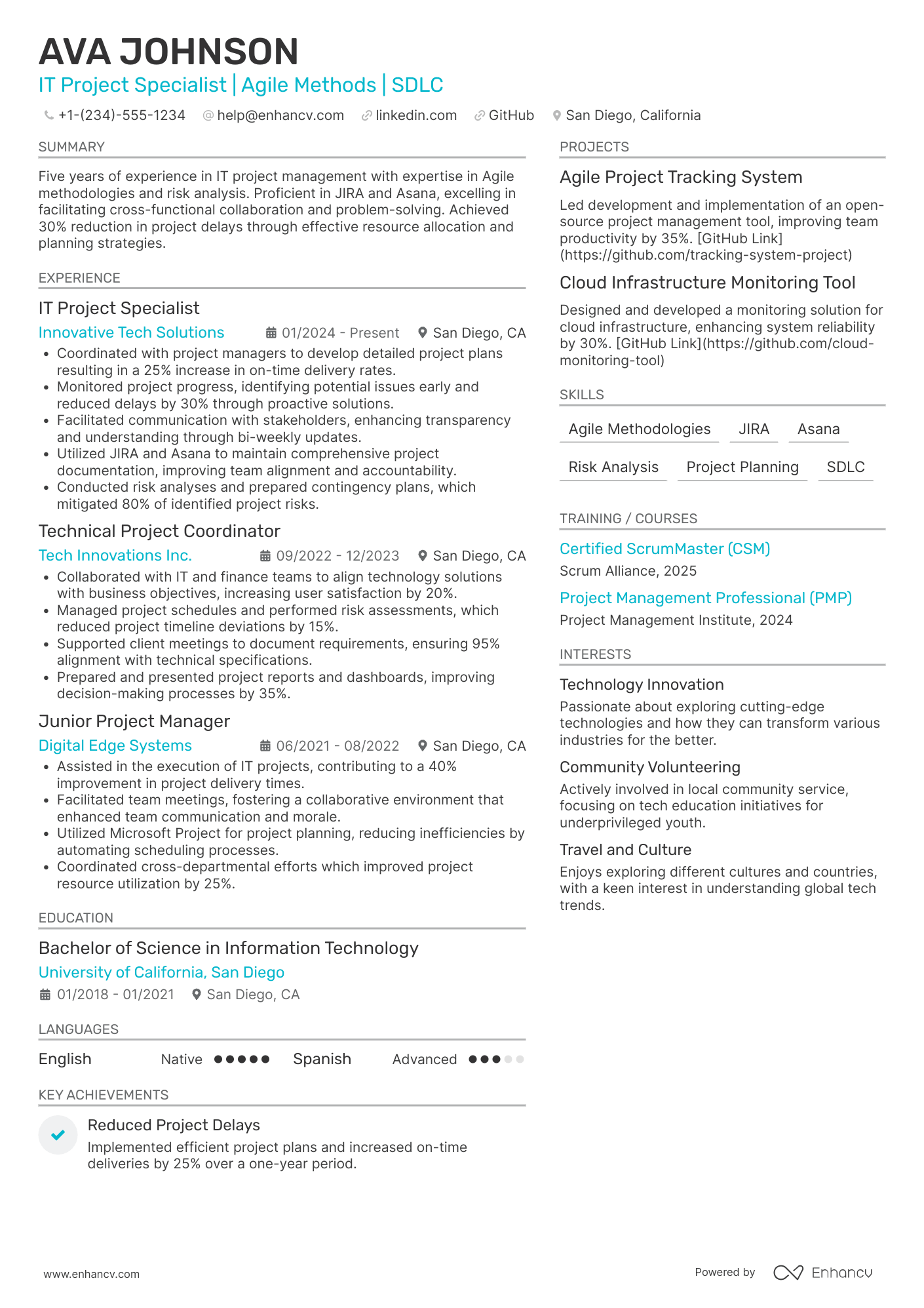
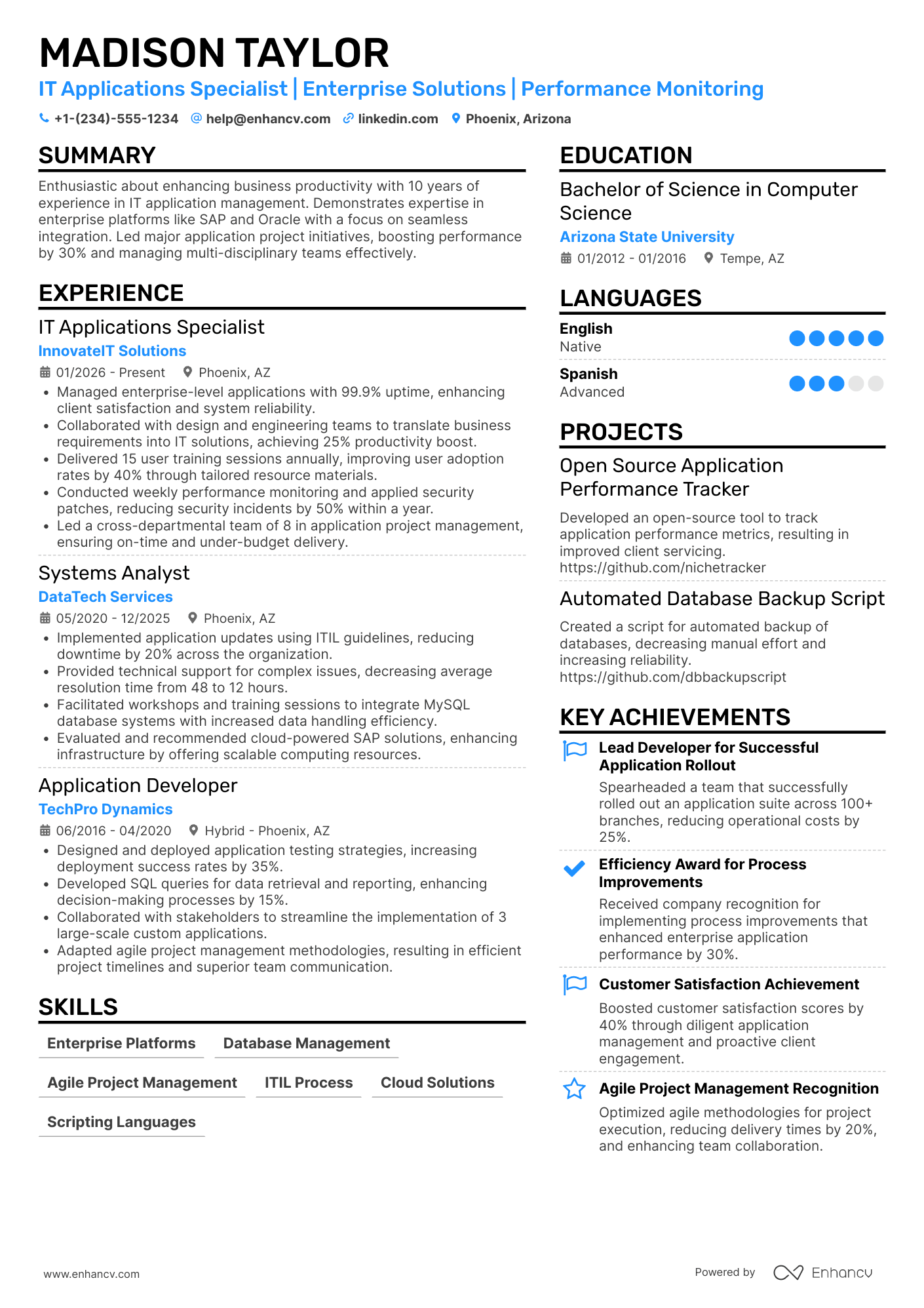
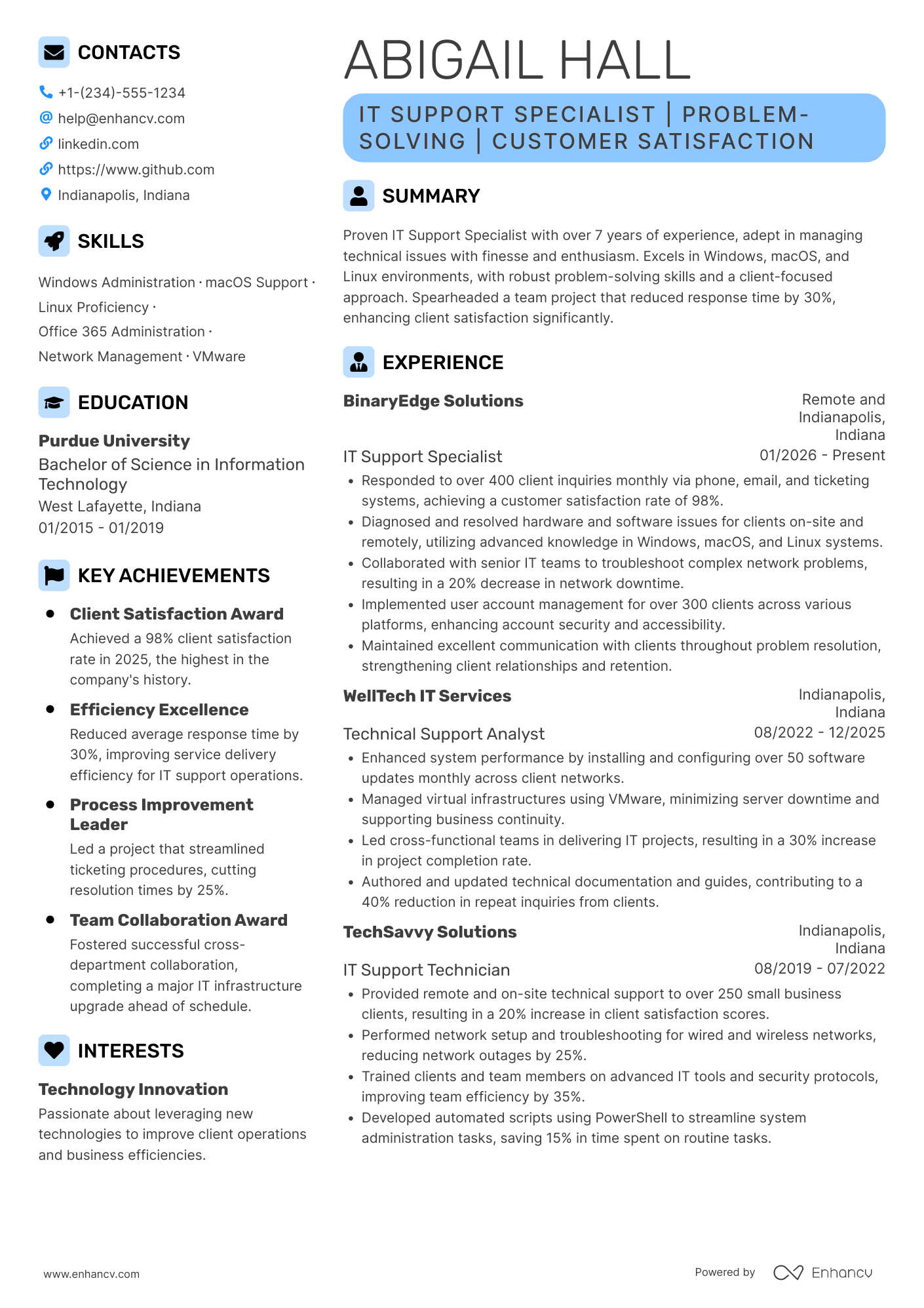
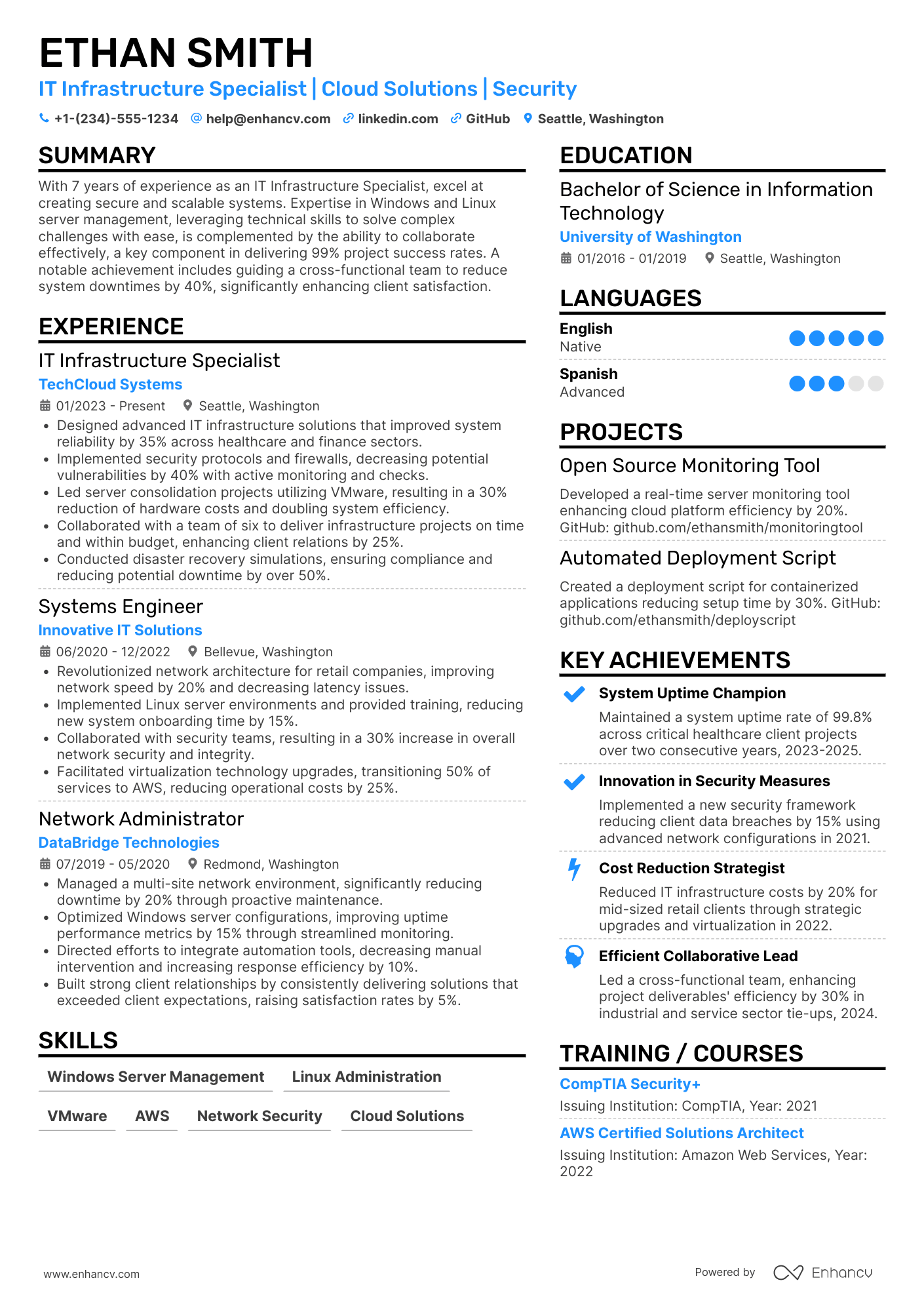
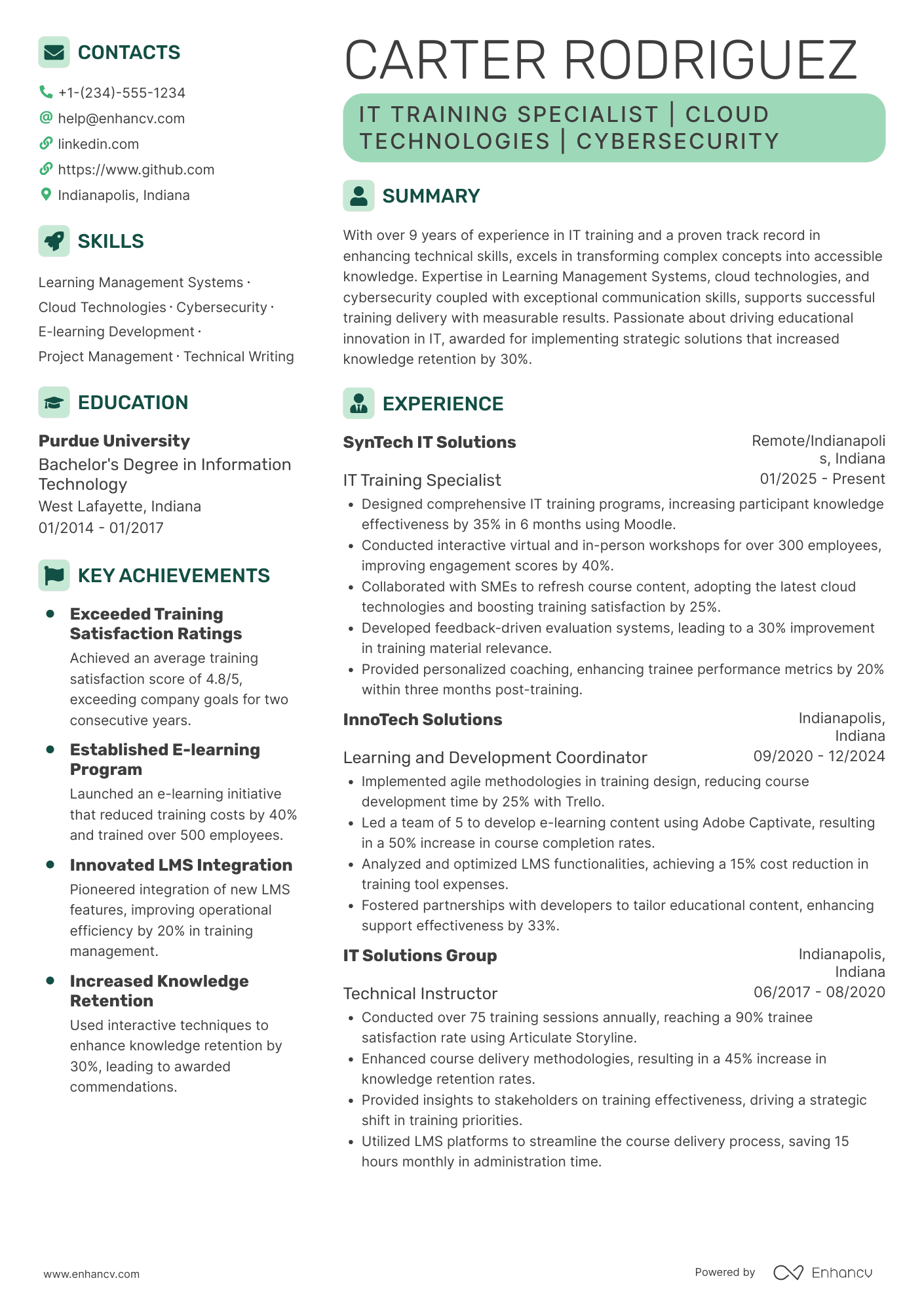
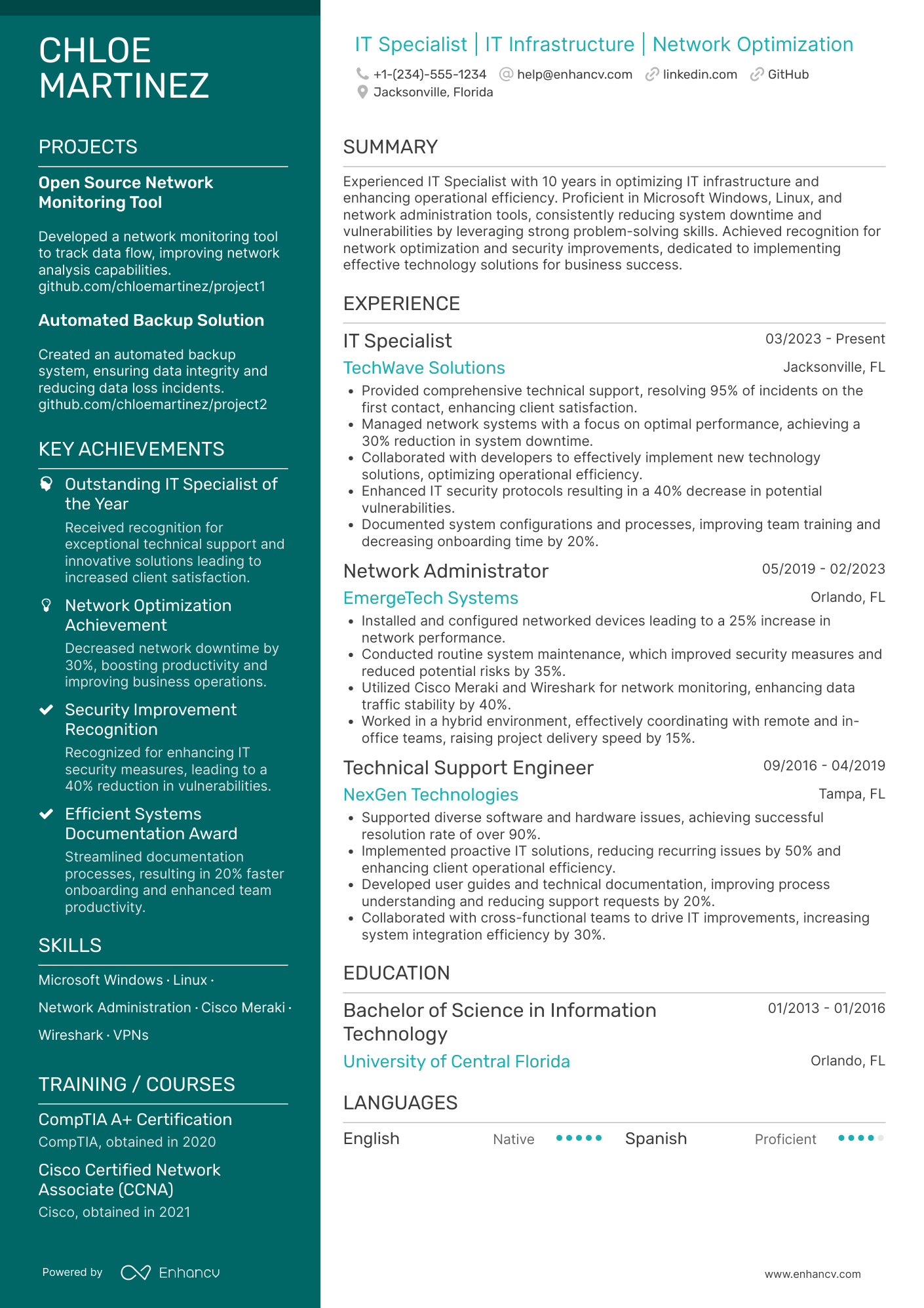
Many IT specialist resume submissions fail because they read like ticket logs, not proof of reliability, security, or business impact. In today's hiring process, an ATS filters quickly and recruiters scan fast, so weak signal gets ignored.
Once the resume lands the uptime and resolution-time wins, an IT specialist cover letter covers the incidents and rollouts behind the numbers — context an IT director reads before bringing you to interview.
A strong resume shows how you improve uptime, speed resolution, and protect systems, not just which tools you used. If you're unsure where to begin, learning how to write a resume that communicates value is a critical first step. You should quantify reduced incident volume, faster mean time to resolution, successful migrations, fewer security findings, higher user satisfaction, and smoother onboarding.

Key takeaways
- Quantify achievements like uptime, resolution time, and cost savings instead of listing routine duties.
- Use reverse-chronological format for experienced candidates and hybrid format for career switchers.
- Tailor each resume to the job posting's exact tools, platforms, and terminology.
- Anchor every listed skill to a measurable outcome in your experience section.
- Place certifications near education or above it when they're required for the role.
- Write a three- to four-line summary that names your tools, domain, and top metric.
- Use Enhancv's Bullet Point Generator to turn vague duties into recruiter-ready, quantified bullets.
Job market snapshot for IT specialists
We analyzed 85,466 recent IT specialist job ads across major US job boards. These numbers help you understand skills in demand, career growth patterns, role specialization trends at a glance.
What level of experience employers are looking for IT specialists
| Years of Experience | Percentage found in job ads |
|---|---|
| 1–2 years | 13.4% (11457) |
| 3–4 years | 8.1% (6885) |
| 5–6 years | 6.0% (5115) |
| 7–8 years | 1.8% (1532) |
| 9–10 years | 1.0% (861) |
| 10+ years | 4.1% (3530) |
| Not specified | 66.2% (56559) |
IT specialist ads by area of specialization (industry)
| Industry (Area) | Percentage found in job ads |
|---|---|
| Finance & Banking | 43.3% (36983) |
| Healthcare | 24.8% (21177) |
| Government | 10.9% (9276) |
| Education | 8.9% (7635) |
| Retail & E-commerce | 6.3% (5353) |
| Manufacturing | 2.7% (2346) |
| Travel & Hospitality | 0.8% (719) |
| Energy | 0.7% (604) |
| Real Estate & Construction | 0.5% (444) |
| Telecommunications | 0.3% (278) |
Top companies hiring IT specialists
| Company | Percentage found in job ads |
|---|---|
| O'Reilly Auto Parts | 3.7% (3124) |
| State of Florida | 2.1% (1829) |
| Army National Guard | 1.8% (1527) |
| Ross Stores, Inc | 1.4% (1227) |
| Deloitte | 1.4% (1223) |
| Acosta, Inc. | 1.1% (948) |
| Department of the Air Force | 1.1% (940) |
| Department of Veterans Affairs | 1.0% (845) |
| Accenture | 0.9% (776) |
| Medtronic Inc. | 0.9% (770) |
Role overview stats
These tables show the most common responsibilities and employment types for IT specialist roles. Use them to align your resume with what employers expect and to understand how the role is structured across the market.
Day-to-day activities and top responsibilities for a IT specialist
| Responsibility | Percentage found in job ads |
|---|---|
| Microsoft office | 11.1% (9481) |
| Excel | 9.1% (7765) |
| Customer service | 5.5% (4687) |
| Word | 4.8% (4092) |
| Project management | 4.5% (3873) |
| Microsoft excel | 4.3% (3651) |
| Data analysis | 3.9% (3343) |
| Powerpoint | 3.9% (3304) |
| Microsoft word | 3.9% (3300) |
| Outlook | 3.5% (2969) |
| Crm | 2.9% (2440) |
| Communication | 2.6% (2204) |
Type of employment (remote vs on-site vs hybrid)
| Employment type | Percentage found in job ads |
|---|---|
| On-site | 79.8% (68168) |
| Hybrid | 12.3% (10523) |
| Remote | 7.9% (6775) |
How to format a IT specialist resume
Recruiters evaluating IT specialist resumes prioritize technical breadth, hands-on problem-solving ability, and evidence of reliable infrastructure or systems support. A clean, well-structured format ensures these signals surface quickly during both human review and applicant tracking system (ATS) parsing. Choosing the right resume format is essential to making the right first impression.

I have significant experience in this role—which format should I use?
Use a reverse-chronological format to give recruiters a clear, linear view of your growing technical responsibilities and project ownership. Do:
- Lead each role entry with your scope of ownership—number of systems managed, users supported, or environments maintained.
- Highlight role-specific tools and domains such as Active Directory, SCCM, VMware, cloud platforms, ticketing systems, and network monitoring suites.
- Quantify outcomes tied to uptime, resolution speed, cost savings, or security improvements.
I'm junior or switching into this role—what format works best?
A hybrid format works best because it lets you lead with a focused technical skills section while still providing chronological proof of how you've applied those skills. Do:
- Place a dedicated skills section near the top, grouping competencies by category (networking, operating systems, security, cloud).
- Include lab projects, home-lab builds, freelance support work, or IT internships as legitimate experience entries.
- Connect every listed skill to a concrete action and a measurable or observable result.
Why not use a functional resume?
A functional format strips away the timeline and context that hiring managers rely on to verify where, when, and how you applied your technical skills, making it harder to trust your claimed competencies. Functional formats also tend to trigger skepticism during ATS screening and interviewer review, so avoid them unless you have no other viable option.
- A functional resume may be acceptable if you're making a significant career change into IT with no direct employment history in the field—but only if every listed skill is anchored to a specific project, certification lab, or volunteer engagement with a clear outcome.
Once you've established a clean, readable format, the next step is deciding which sections to include so each one earns its place on the page.
What sections should go on a IT specialist resume
Recruiters expect you to present a clear, role-relevant snapshot of your technical support, systems, and troubleshooting experience. Understanding which resume sections to include ensures you cover everything hiring managers look for.
Use this structure for maximum clarity:
- Header
- Summary
- Experience
- Skills
- Projects
- Education
- Certifications
- Optional sections: Open-source work, leadership, volunteering
Strong experience bullets should emphasize measurable impact, incident and ticket volume, systems supported, uptime or resolution improvements, and outcomes tied to business results.
Is your resume good enough?
Drop your resume here or choose a file. PDF & DOCX only. Max 2MB file size.
Once you’ve organized your resume with the right structure and supporting details, the next step is to write your IT specialist resume experience in a way that fits that format and shows impact.
How to write your IT specialist resume experience
Your experience section should highlight the IT projects, systems, and solutions you've shipped or delivered—using role-relevant tools, platforms, and methodologies that demonstrate your technical depth. Hiring managers prioritize demonstrated impact over descriptive task lists, so focus on measurable outcomes like uptime improvements, resolution times, successful migrations, or security enhancements rather than routine responsibilities.
Each entry should include:
- Job title
- Company and location (or remote)
- Dates of employment (month and year)
Three to five concise bullet points showing what you owned, how you executed, and what outcomes you delivered:
- Ownership scope: the infrastructure, networks, systems, applications, or end-user environments you were directly accountable for managing, maintaining, or improving as an IT specialist.
- Execution approach: the hardware, software, platforms, protocols, or troubleshooting frameworks you applied to diagnose issues, deploy solutions, and maintain IT operations.
- Value improved: the changes you drove in system uptime, network performance, security posture, response times, data integrity, or operational efficiency within your IT environment.
- Collaboration context: how you partnered with departments, vendors, managed service providers, or leadership to align IT solutions with organizational needs and resolve cross-functional technical challenges.
- Impact delivered: the business outcomes your IT work produced—expressed through scale of users supported, infrastructure reliability gains, cost reductions, risk mitigation, or successful project completions rather than day-to-day activity descriptions.
Experience bullet formula
A IT specialist experience example
✅ Right example - modern, quantified, specific.
IT Specialist
NorthBridge Logistics | Chicago, IL
2022–Present
Supported a three-hundred-user, multi-site transportation company with twenty-four seven operations and strict uptime requirements.
- Standardized endpoint management with Microsoft Intune and Windows Autopilot, cutting new-hire provisioning from three hours to forty minutes and improving device compliance to ninety-six percent.
- Reduced ticket volume by twenty-two percent by building a self-service knowledge base in ServiceNow and automating password resets with Azure Active Directory (Azure AD) and conditional access policies.
- Improved network reliability by deploying Meraki switch and access point templates, tightening firewall rules, and implementing monitoring with PRTG, reducing unplanned outages by thirty-five percent.
- Strengthened security posture by rolling out multi-factor authentication, BitLocker, and phishing simulations with Microsoft Defender, decreasing successful phishing clicks from nine percent to two percent in six months.
- Partnered with finance, operations, and a managed service provider to migrate on-prem file shares to SharePoint Online and OneDrive, cutting storage costs by eighteen percent and enabling secure external sharing for fifty-plus vendors.
Now that you've seen how a strong experience section comes together, let's look at how to adjust those details to match the specific job you're applying for.
How to tailor your IT specialist resume experience
Recruiters evaluate your IT specialist resume through both human review and applicant tracking systems (ATS). Tailoring your resume to the job description ensures your qualifications register with both.
Ways to tailor your IT specialist experience:
- Match the specific tools and platforms listed in the job description.
- Mirror the exact terminology used for IT methodologies and standards.
- Reflect the KPIs or performance benchmarks the employer prioritizes.
- Highlight relevant industry or domain experience the posting requests.
- Emphasize security and compliance responsibilities when the role requires them.
- Incorporate the collaboration models or team structures the employer describes.
- Align your troubleshooting and support workflows with their environment.
- Feature system reliability or uptime achievements that match stated goals.
Tailoring means aligning your real accomplishments with what the employer needs—not forcing keywords where they don't belong.
Resume tailoring examples for IT specialist
| Job description excerpt | Untailored | Tailored |
|---|---|---|
| Manage and maintain Windows Server 2019/2022 environments, including Active Directory, Group Policy, and DNS/DHCP services across 500+ endpoints. | Maintained servers and handled various IT tasks for the company. | Administered Windows Server 2019/2022 environments supporting 500+ endpoints, managing Active Directory, Group Policy Objects, and DNS/DHCP services with 99.8% uptime. |
| Provide Tier 2 support using ServiceNow, resolving escalated hardware, software, and network issues within established SLA targets of 4-hour response and 24-hour resolution. | Helped users troubleshoot computer problems and resolve tickets. | Resolved 40+ escalated Tier 2 tickets weekly in ServiceNow, addressing hardware, software, and network issues while maintaining a 95% SLA compliance rate against 4-hour response and 24-hour resolution targets. |
| Deploy and manage endpoint security solutions using CrowdStrike Falcon and Microsoft Intune, ensuring compliance with NIST 800-53 controls across a hybrid workforce. | Installed security software and made sure devices were compliant with policies. | Deployed and managed CrowdStrike Falcon and Microsoft Intune across 350 endpoints in a hybrid environment, enforcing NIST 800-53 controls and reducing security incidents by 30% within the first quarter. |
Once you’ve aligned your experience with the role’s priorities, the next step is to quantify your IT specialist achievements to show the measurable impact of that work.
How to quantify your IT specialist achievements
Quantifying shows how your work improves uptime, speed, security, and support outcomes. Learning how to use numbers on your resume effectively can transform generic duty descriptions into compelling proof of value. Focus on ticket volume and resolution time, service availability, incident reduction, patch compliance, cost savings, and user satisfaction.
Quantifying examples for IT specialist
| Metric | Example |
|---|---|
| Reliability | "Improved network uptime from 99.2% to 99.9% by replacing failing switches and tuning monitoring alerts in PRTG across three sites." |
| Support efficiency | "Reduced average ticket resolution time from 18 hours to 6 hours by standardizing triage in ServiceNow and building ten self-service knowledge articles." |
| Security risk | "Cut critical vulnerability exposure by 70% by enforcing weekly patch windows and deploying Microsoft Defender for Endpoint to 250 endpoints." |
| Cost savings | "Lowered monthly cloud spend by $2,800 by rightsizing twenty virtual machines and implementing automated shutdown schedules in Azure." |
| Delivery speed | "Deployed forty-five Windows updates to 180 laptops in two days using Microsoft Intune, down from seven days with manual installs." |
Turn vague job duties into measurable, recruiter-ready resume bullets in seconds with Enhancv's Bullet Point Generator.
With your bullet points clearly articulating your accomplishments, the next step is ensuring your skills section effectively showcases the technical and interpersonal abilities employers expect from an IT specialist.
How to list your hard and soft skills on a IT specialist resume
A well-organized skills section shows you can troubleshoot, secure, and support systems at scale, and recruiters and ATS scan this section to confirm role fit fast—aim for a heavier mix of hard skills with a smaller set of job-specific soft skills. IT specialist roles require a blend of:
- Product strategy and discovery skills.
- Data, analytics, and experimentation skills.
- Delivery, execution, and go-to-market discipline.
- Soft skills.
Your skills section should be:
- Scannable (bullet-style grouping).
- Relevant to the job post.
- Backed by proof in experience bullets.
- Updated with current tools.
Place your skills section:
- Above experience if you're junior or switching careers.
- Below experience if you're mid/senior with strong achievements.

Hard skills
- Windows Server, Active Directory
- Microsoft 365 administration
- Azure, Entra ID (Azure AD)
- TCP/IP, DNS, DHCP
- VLANs, VPNs, Wi-Fi
- PowerShell, Bash scripting
- Endpoint management, Intune
- Patch management, WSUS
- Ticketing systems, ServiceNow
- Monitoring, Splunk, Datadog
- Vulnerability management, Nessus
- Backup and recovery, Veeam
Soft skills
- Triage and prioritize incidents
- Explain technical issues clearly
- Document fixes and runbooks
- Partner with security and engineering
- Manage stakeholders during outages
- Ask targeted diagnostic questions
- Own issues through resolution
- Escalate with complete context
- Balance speed and risk
- Improve processes after incidents
- Train users on best practices
- Communicate status updates consistently
How to show your IT specialist skills in context
Skills shouldn't live only in a bulleted list on your resume. You can explore common resume skills by role to see how other IT professionals present their abilities.
They should be demonstrated in:
- Your summary (high-level professional identity)
- Your experience (proof through outcomes)
Here's what strong, skills-rich content looks like in practice.
Summary example
Senior IT specialist with 10+ years in enterprise infrastructure and cloud migration. Skilled in AWS, VMware, and ITIL-driven service management. Led a hybrid cloud transition that cut hosting costs by 34% while improving system uptime to 99.95%.
- Signals senior-level expertise immediately
- Names specific, in-demand tools
- Leads with a measurable cost outcome
- Highlights process and leadership ability
Experience example
Senior IT Infrastructure Specialist
Redstone Health Systems | Remote
March 2019–Present
- Migrated 120+ on-premise servers to AWS, reducing infrastructure costs by 34% and achieving 99.95% uptime across all production environments.
- Partnered with cybersecurity and DevOps teams to implement zero-trust architecture using CrowdStrike and Okta, cutting security incidents by 61%.
- Standardized incident response workflows in ServiceNow, decreasing average ticket resolution time from 14 hours to under four.
- Every bullet includes measurable proof
- Skills appear naturally within achievements
Once you’ve demonstrated your technical strengths through specific, real-world examples, the next step is applying the same approach to build an IT specialist resume when you have no experience.
How do I write a IT specialist resume with no experience
Even without full-time experience, you can demonstrate readiness through:
- Home lab Active Directory setup
- Help desk volunteer ticket handling
- Internship shadowing and documentation
- CompTIA A+ or Network+ certification
- Campus IT support work study
- Personal PC repair and imaging
- GitHub scripts for automation
- Network troubleshooting on home router
If you're starting from scratch, our guide on building a resume without work experience walks you through exactly how to structure your application.
Focus on:
- Ticketing, triage, and resolution metrics
- Windows, macOS, and Linux support
- Networking fundamentals and troubleshooting
- Documentation, SOPs, and asset tracking
Resume format tip for entry-level IT specialist
Use a hybrid resume format because it highlights skills and projects first, while still showing a clear work history and education timeline. Do:
- Add a Skills section with tools.
- Include two to four project bullets.
- Quantify outcomes: time, volume, uptime.
- List certifications with earned dates.
- Tailor keywords to each job posting.
- Built a Windows home lab with Active Directory, created twenty user accounts and group policies, and cut account setup time from ten minutes to two.
Even without hands-on experience, your education section can demonstrate the technical foundation and relevant coursework that qualify you for an IT specialist role.
How to list your education on a IT specialist resume
Your education section helps hiring teams confirm you have the foundational technical knowledge an IT specialist needs. It validates your training in systems, networking, and infrastructure.
Include:
- Degree name
- Institution
- Location
- Graduation year
- Relevant coursework (for juniors or entry-level candidates)
- Honors & GPA (if 3.5 or higher)
Skip month and day details—list the graduation year only.
Here's a strong education entry tailored for an IT specialist resume:
Example education entry
Bachelor of Science in Information Technology
George Mason University, Fairfax, VA
Graduated 2021
GPA: 3.7/4.0
- Relevant Coursework: Network Administration, Systems Security, Cloud Computing, Database Management, IT Infrastructure
- Honors: Magna Cum Laude, Dean's List (six semesters)
How to list your certifications on a IT specialist resume
Certifications on your resume show your commitment to learning, confirm tool proficiency, and prove industry relevance as an IT specialist. They also help recruiters quickly match your skills to role requirements.
Include:
- Certificate name
- Issuing organization
- Year
- Optional: credential ID or URL
- Place certifications below education when your degree is recent and closely aligns with the IT specialist role.
- Place certifications above education when they are recent, highly relevant, or required for the IT specialist role.
Best certifications for your IT specialist resume
CompTIA A+ CompTIA Network+ CompTIA Security+ Microsoft Certified: Windows Server Hybrid Administrator Associate Microsoft Certified: Azure Fundamentals Cisco Certified Network Associate (CCNA) ITIL 4 Foundation
Once you’ve placed your certifications where they’re easy to scan and tied to the role, you can write your IT specialist resume summary to reinforce those qualifications upfront.
How to write your IT specialist resume summary
Your resume summary is the first thing a recruiter reads. A strong one instantly signals you're qualified and worth interviewing for an IT specialist role.
Keep it to three to four lines, with:
- Your title and total years of IT experience.
- The domain or industry you've worked in, such as healthcare, finance, or SaaS.
- Core tools and technologies like Active Directory, Linux, AWS, or ITIL frameworks.
- One or two measurable achievements, such as reducing downtime or resolving ticket volume.
- A soft skill tied to a real outcome, like cross-team collaboration that improved response times.

PRO TIP
At this level, focus on technical relevance and early contributions that show initiative. Highlight specific tools you've used and problems you've solved. Avoid vague phrases like "passionate team player" or "eager to learn." Recruiters want proof of capability, not motivation.
Example summary for a IT specialist
IT specialist with three years of experience supporting enterprise Windows and Linux environments. Reduced average ticket resolution time by 30% through streamlined escalation workflows. Skilled in Active Directory, VMware, and cross-department technical communication.
Optimize your resume summary and objective for ATS
Drop your resume here or choose a file.
PDF & DOCX only. Max 2MB file size.
Now that your summary captures your strongest qualifications, make sure recruiters can actually reach you by setting up a clear, complete header.
What to include in a IT specialist resume header
A well-crafted resume header lists your key contact and professional links, which improves visibility, builds credibility, and speeds recruiter screening for a IT specialist role.
Essential resume header elements
- Full name
- Tailored job title and headline
- Location
- Phone number
- Professional email
- GitHub link
- Portfolio link
A LinkedIn link helps recruiters verify experience quickly and supports screening.
Do not include a photo on a IT specialist resume unless the role is explicitly front-facing or appearance-dependent.
Use a tailored job title that matches the posting, and keep links readable and consistent across your resume and profiles.
Example
IT specialist resume header
Jordan Lee
IT specialist | Windows, Microsoft 365, Networking, Service Desk
Austin, TX
(512) 555-01XX
your.name@enhancv.com
github.com/yourname
yourwebsite.com
linkedin.com/in/yourname
Once your header clearly presents your name, role, contact details, and key links, add optional sections that support the rest of your information and strengthen your resume.
Additional sections for IT specialist resumes
Beyond core qualifications, additional sections help you stand out when multiple candidates share similar technical backgrounds and certifications.
Choose sections that reinforce your expertise or highlight unique value relevant to the IT specialist role:
- Certifications (CompTIA, Cisco, Microsoft, AWS)
- Technical projects
- Languages
- Professional affiliations and memberships
- Publications or technical blog contributions
- Volunteer IT work
- Hobbies and interests
Once you've strengthened your resume with relevant additional sections, pair it with a cover letter to give hiring managers a fuller picture of your qualifications.
Do IT specialist resumes need a cover letter
An IT specialist cover letter usually isn't required, but it helps in competitive roles or when employers expect one. If you're unsure where to start, understanding what a cover letter is and how it complements your resume can help you decide. It can make a difference when your resume needs context, or when you want to show clear fit.
Use a cover letter when you need to add detail that a resume can't:
- Explain role or team fit by matching your strengths to the environment, such as help desk, infrastructure, or security operations.
- Highlight one or two relevant projects or outcomes, including tools used, impact, and what improved after your work.
- Show understanding of the product, users, or business context by naming key systems, uptime needs, compliance requirements, or service expectations.
- Address career transitions or non-obvious experience by connecting past work to IT specialist duties and stating what you can deliver now.
Drop your resume here or choose a file.
PDF & DOCX only. Max 2MB file size.
Once you’ve decided how to handle a cover letter for your IT specialist application, the next step is using AI to improve your IT specialist resume so it aligns with the role and reads clearly.
Using AI to improve your IT specialist resume
AI can sharpen your resume's clarity, structure, and overall impact. It helps you find stronger phrasing and tighter formatting. But overuse can strip away your authentic voice. Once your content is clear and role-aligned, step away from AI. For specific guidance, explore our collection of ChatGPT resume writing prompts designed to improve each section of your resume.
Here are 10 practical prompts to strengthen specific sections of your IT specialist resume:
- Strengthen your summary. "Rewrite my IT specialist resume summary to highlight my core technical strengths and years of experience in under four sentences."
- Quantify your impact. "Add measurable results to these IT specialist experience bullets, focusing on uptime improvements, ticket resolution times, or cost savings."
- Tighten bullet points. "Shorten each IT specialist experience bullet to one concise line, starting with a strong action verb."
- Align skills strategically. "Reorganize my IT specialist skills section to prioritize the most relevant technical proficiencies for this job description."
- Clarify project contributions. "Rewrite my IT specialist project descriptions to clearly state my specific role, tools used, and the outcome delivered."
- Refine certifications. "Format my IT specialist certifications section consistently, listing credential name, issuing body, and date earned."
- Improve education details. "Revise my IT specialist education section to emphasize relevant coursework, labs, or capstone projects tied to infrastructure support."
- Remove filler language. "Identify and remove vague or redundant phrases from my IT specialist resume that don't add specific value."
- Target the job posting. "Compare my IT specialist resume against this job description and suggest wording changes to improve keyword alignment."
- Polish formatting consistency. "Review my IT specialist resume for inconsistent tense, punctuation, or formatting and suggest corrections."
Stop using AI once your resume sounds accurate, specific, and aligned with real experience. AI should never invent experience or inflate claims—if it didn't happen, it doesn't belong here.
Conclusion
A strong IT specialist resume shows measurable outcomes, role-specific skills, and a clear structure. It connects your impact to uptime, ticket volume, response time, security improvements, and user satisfaction.
Keep each section easy to scan, and match your skills to the role. This approach shows you’re ready for today’s hiring market and the near-future focus on automation, security, and reliable support.
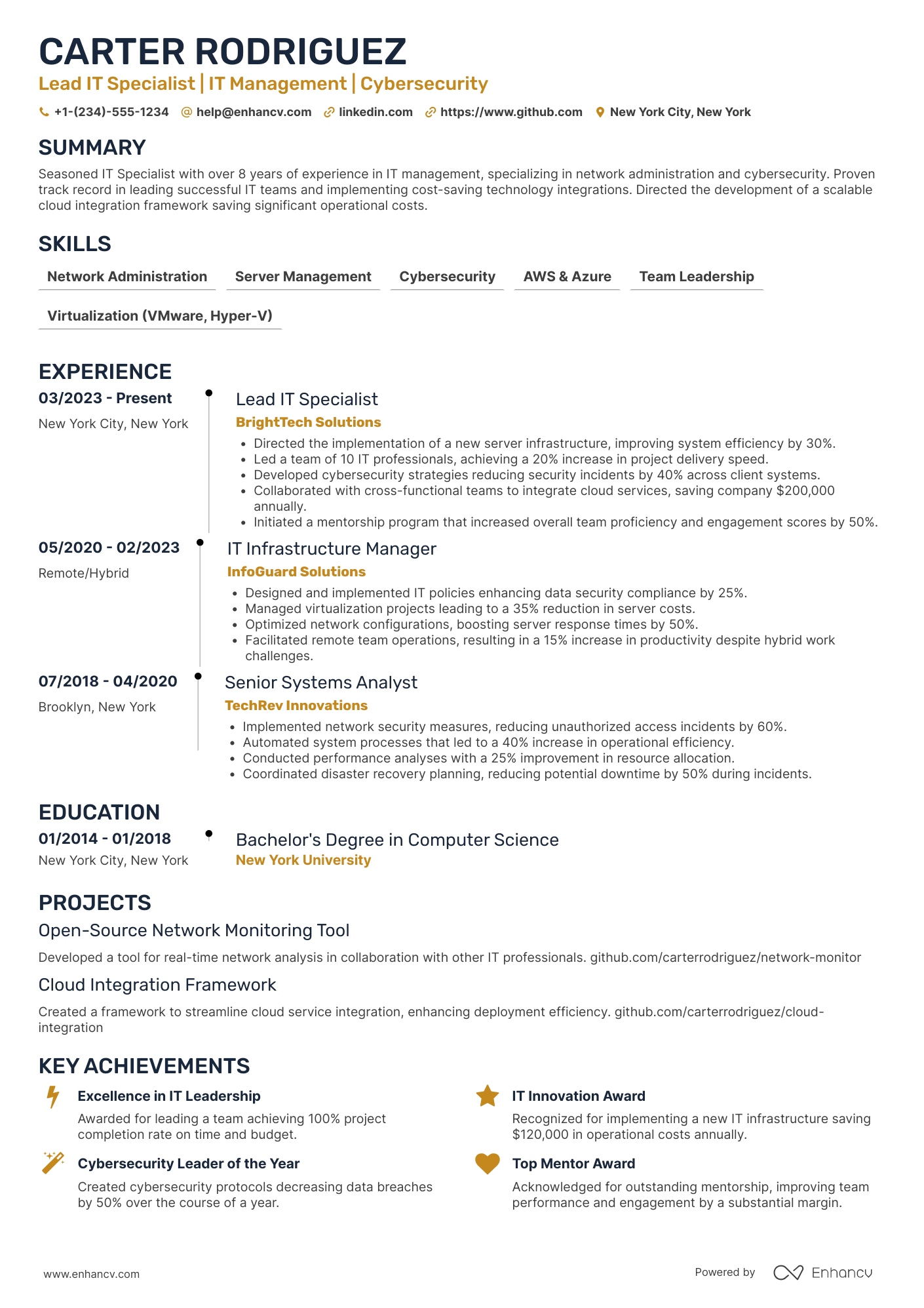
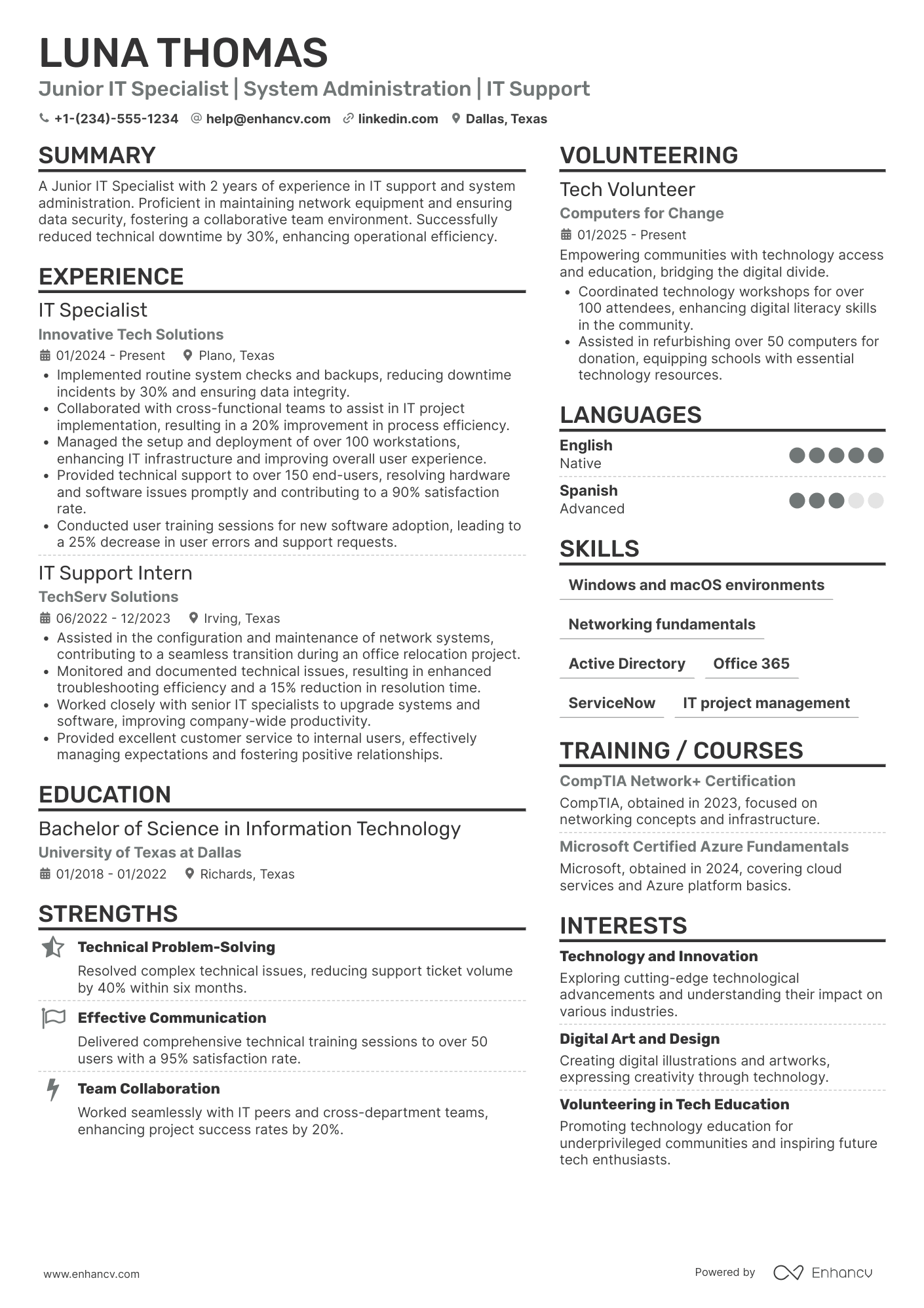
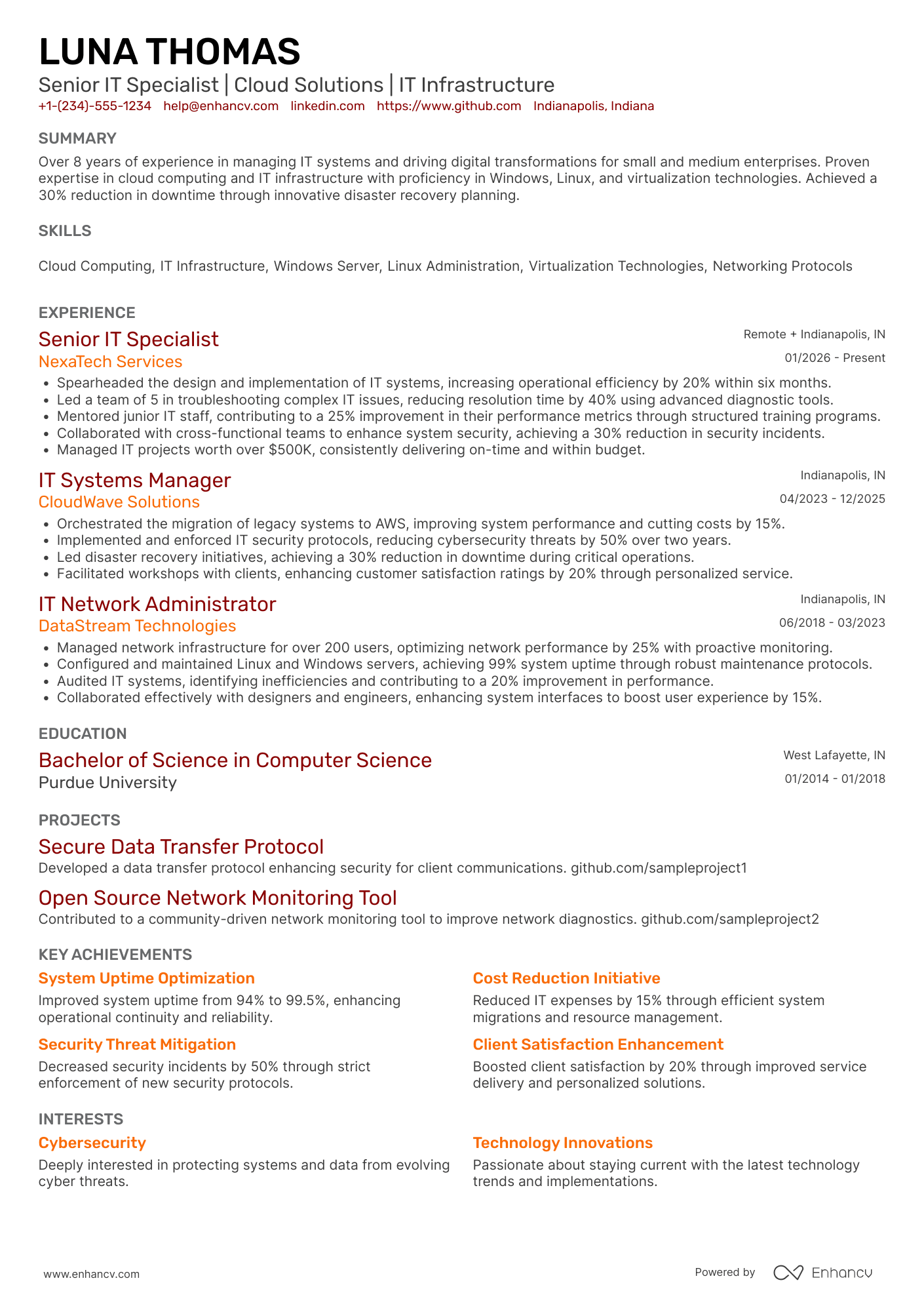
IT Specialist resume examples
By Experience
By Role