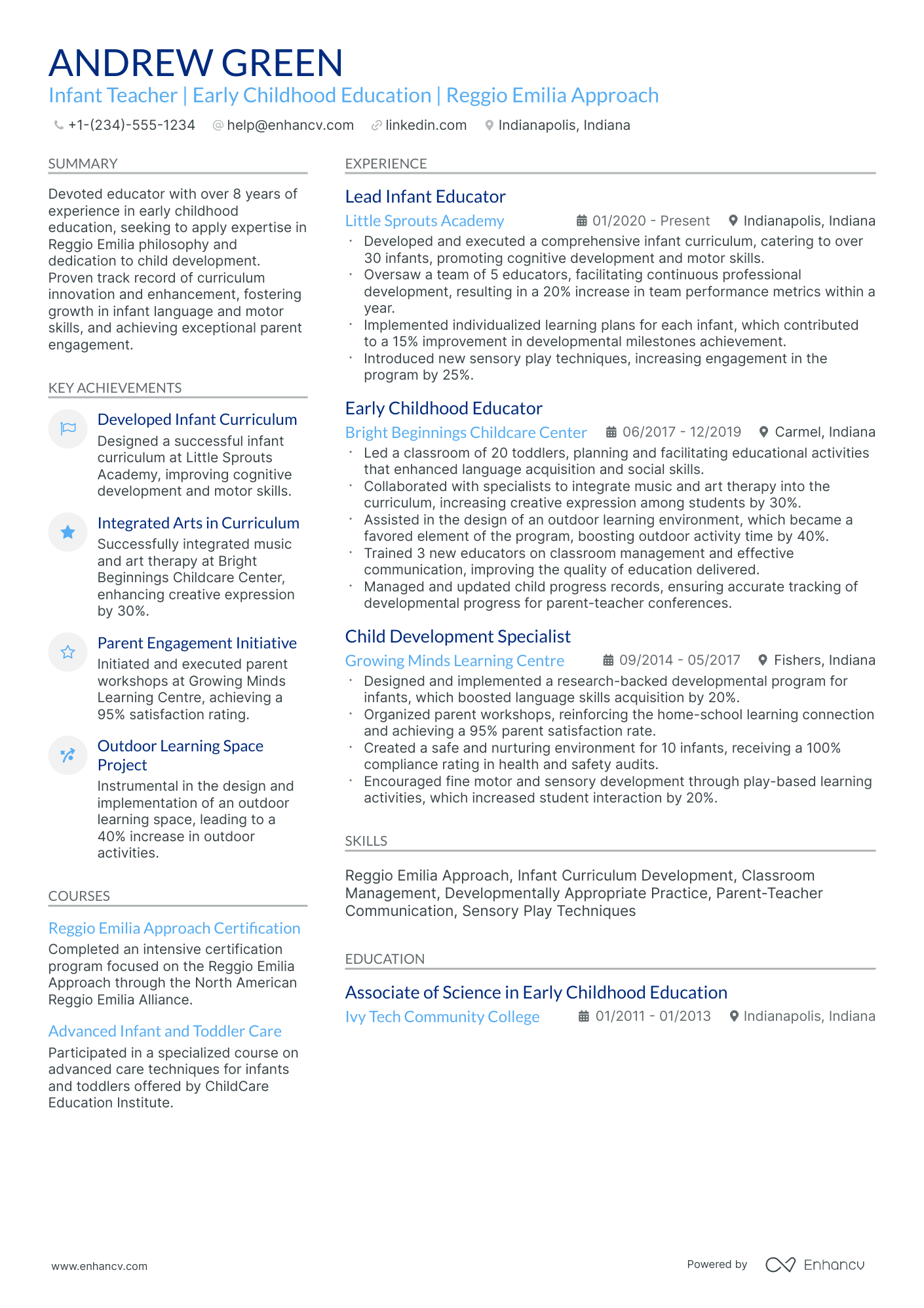
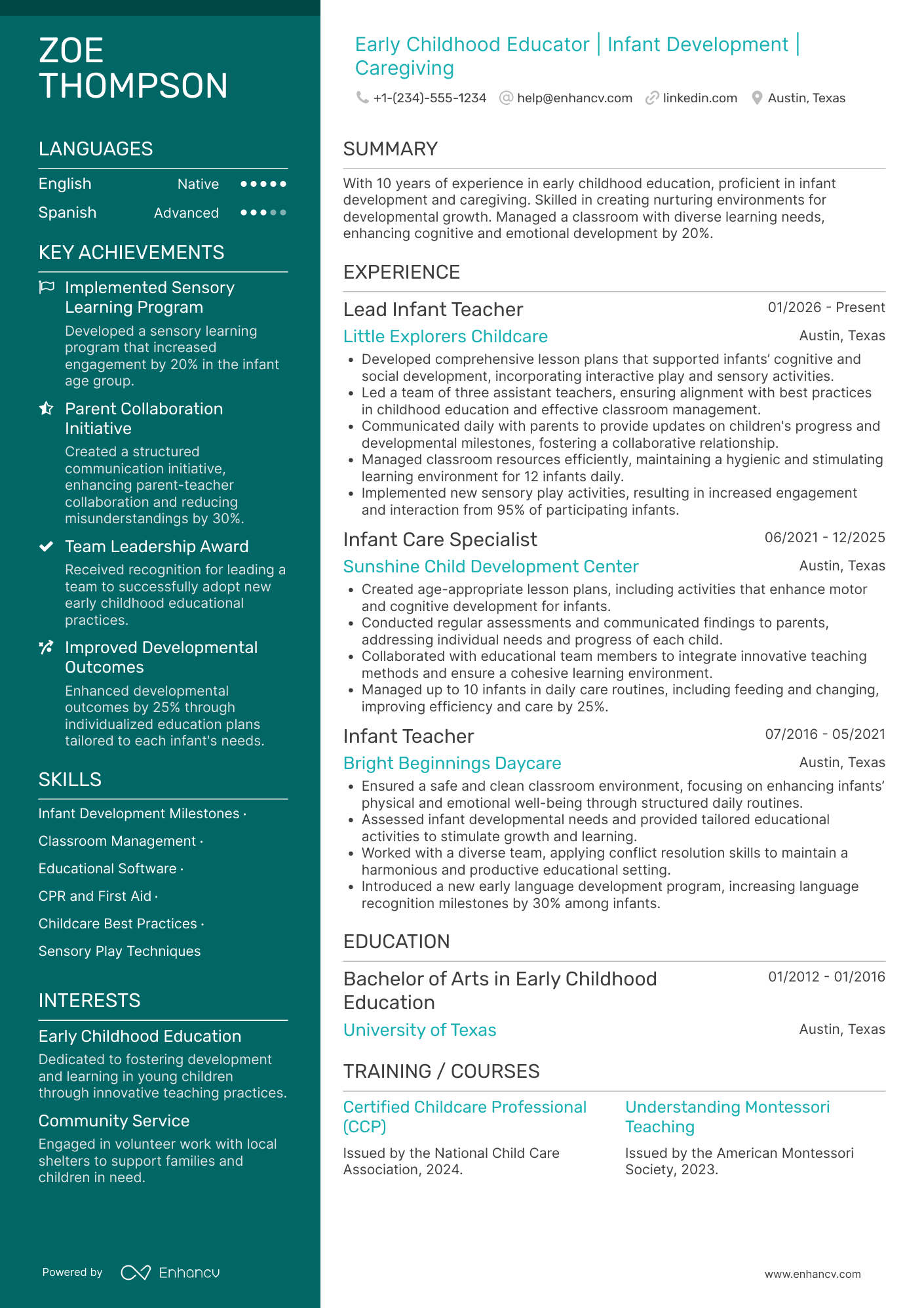
Many infant teacher resume drafts fail because they read like duty lists and bury licensure, ratios, and safety practices. That costs you in ATS screening and fast recruiter scans, especially when openings attract many qualified applicants.
A strong resume shows outcomes you drove, not tools you used. Knowing how to make your resume stand out is critical here—you'll highlight improved daily reports completion rates, maintained compliance across eight infants, reduced incident reports, increased parent satisfaction scores, and supported on-time developmental milestone progress through individualized routines.

Key takeaways
- Quantify caregiving outcomes like milestone rates, incident reductions, and parent satisfaction scores.
- Mirror the job posting's exact curriculum, tools, and compliance language in your experience bullets.
- Use reverse-chronological format with experience; use hybrid format when switching into infant teaching.
- Place certifications like CDA, CPR, and safe sleep training prominently near your education section.
- Tie every listed skill to a measurable result in your summary or experience section.
- Enhancv's Bullet Point Generator helps turn routine infant care tasks into recruiter-ready accomplishments.
- Stop using AI once your resume accurately reflects real experience—never invent or inflate claims.
Job market snapshot for infant teachers
We analyzed 109 recent infant teacher job ads across major US job boards. These numbers help you understand employer expectations, skills in demand, role specialization trends at a glance.
What level of experience employers are looking for infant teachers
| Years of Experience | Percentage found in job ads |
|---|---|
| 1–2 years | 5.5% (6) |
| 10+ years | 3.7% (4) |
| Not specified | 90.8% (99) |
Infant teacher ads by area of specialization (industry)
| Industry (Area) | Percentage found in job ads |
|---|---|
| Education | 82.6% (90) |
| Finance & Banking | 16.5% (18) |
Top companies hiring infant teachers
| Company | Percentage found in job ads |
|---|---|
| Primrose School | 44.0% (48) |
| The Learning Experience | 37.6% (41) |
| Bright Horizons Family Solutions | 11.9% (13) |
Role overview stats
These tables show the most common responsibilities and employment types for infant teacher roles. Use them to align your resume with what employers expect and to understand how the role is structured across the market.
Day-to-day activities and top responsibilities for a infant teacher
| Responsibility | Percentage found in job ads |
|---|---|
| Cpr | 0.9% (1) |
| Developmentally appropriate practice | 0.9% (1) |
| Early childhood education | 0.9% (1) |
| Ece certification | 0.9% (1) |
| First aid | 0.9% (1) |
| Infant development | 0.9% (1) |
| Ipad | 0.9% (1) |
How to format a infant teacher resume
Recruiters hiring for infant teacher positions prioritize hands-on caregiving experience, knowledge of early childhood development milestones, and the ability to create safe, nurturing learning environments for children ages 0–2. A clean, well-organized resume format ensures these qualifications surface quickly during both initial scans and applicant tracking system (ATS) parsing.

I have significant experience in this role—which format should I use?
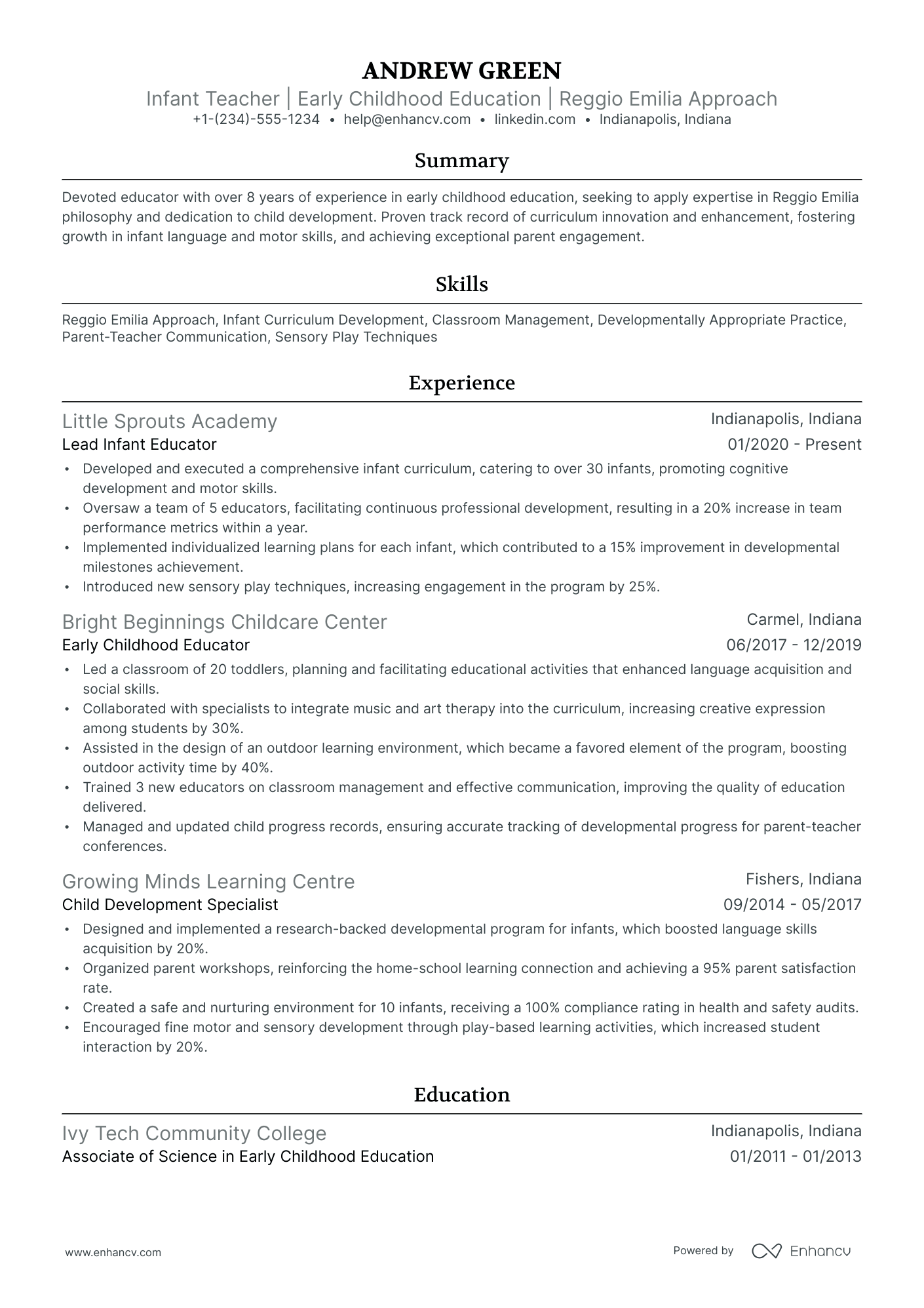
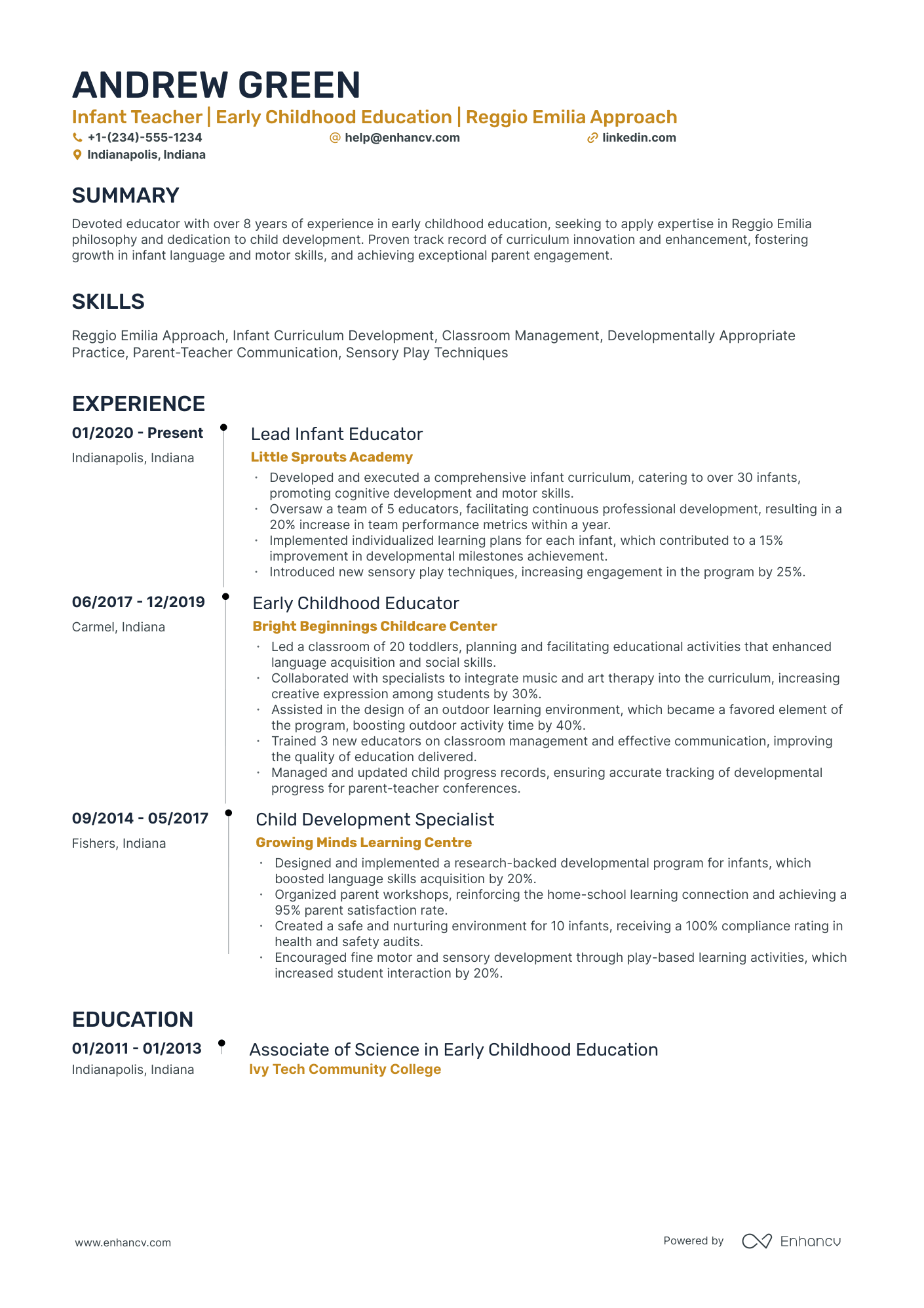
Use a reverse-chronological format to showcase your depth of infant caregiving experience and professional growth across classroom settings. Do:
- Lead with your most recent infant teacher role, highlighting classroom size, age groups served, and supervisory scope.
- Feature relevant credentials, tools, and domains—such as CPR/First Aid certification, developmental screening tools (ASQ-3), Creative Curriculum for Infants, and state licensing standards.
- Quantify outcomes tied to child development, parent engagement, or program compliance.
I'm junior or switching into this role—what format works best?
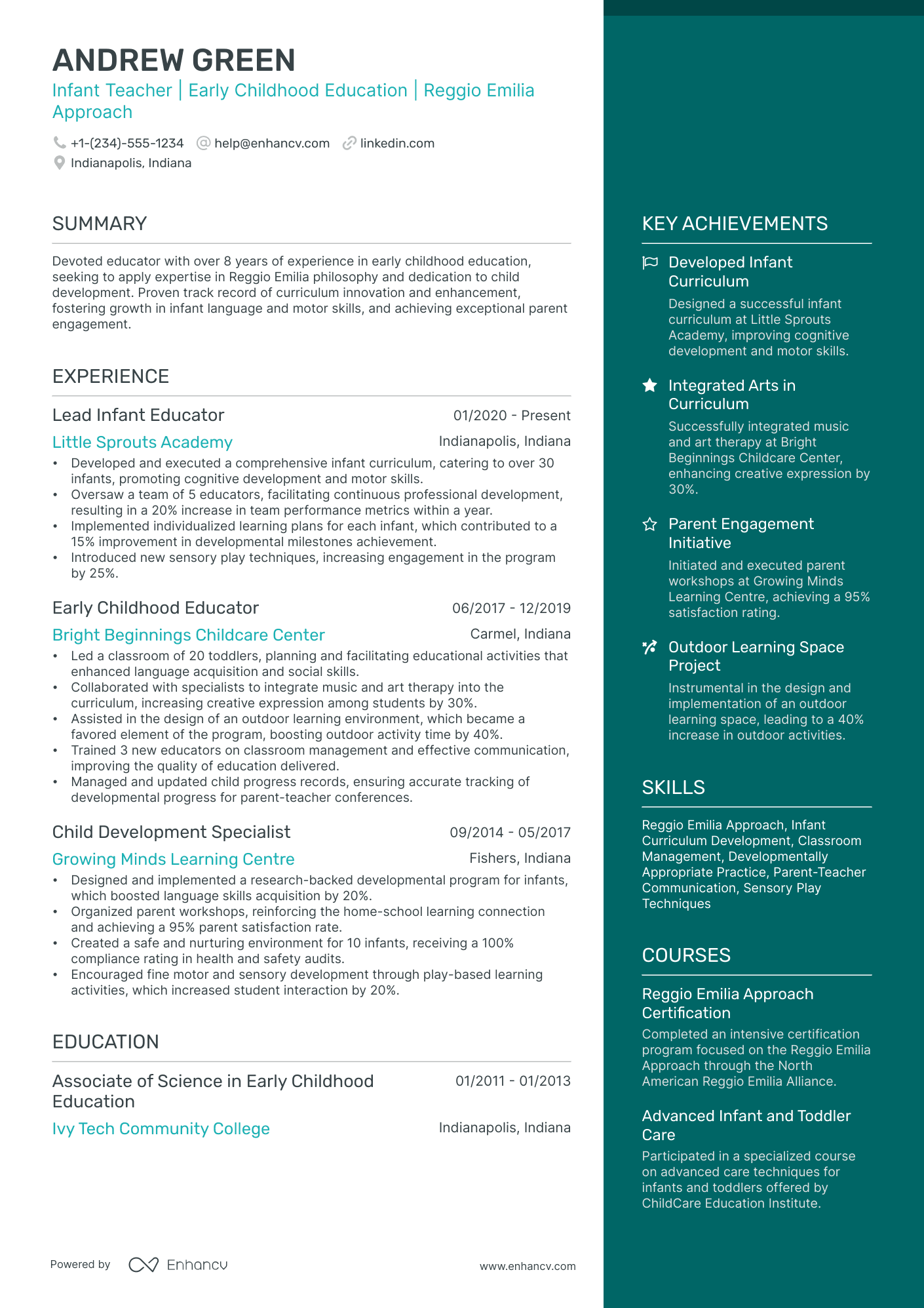
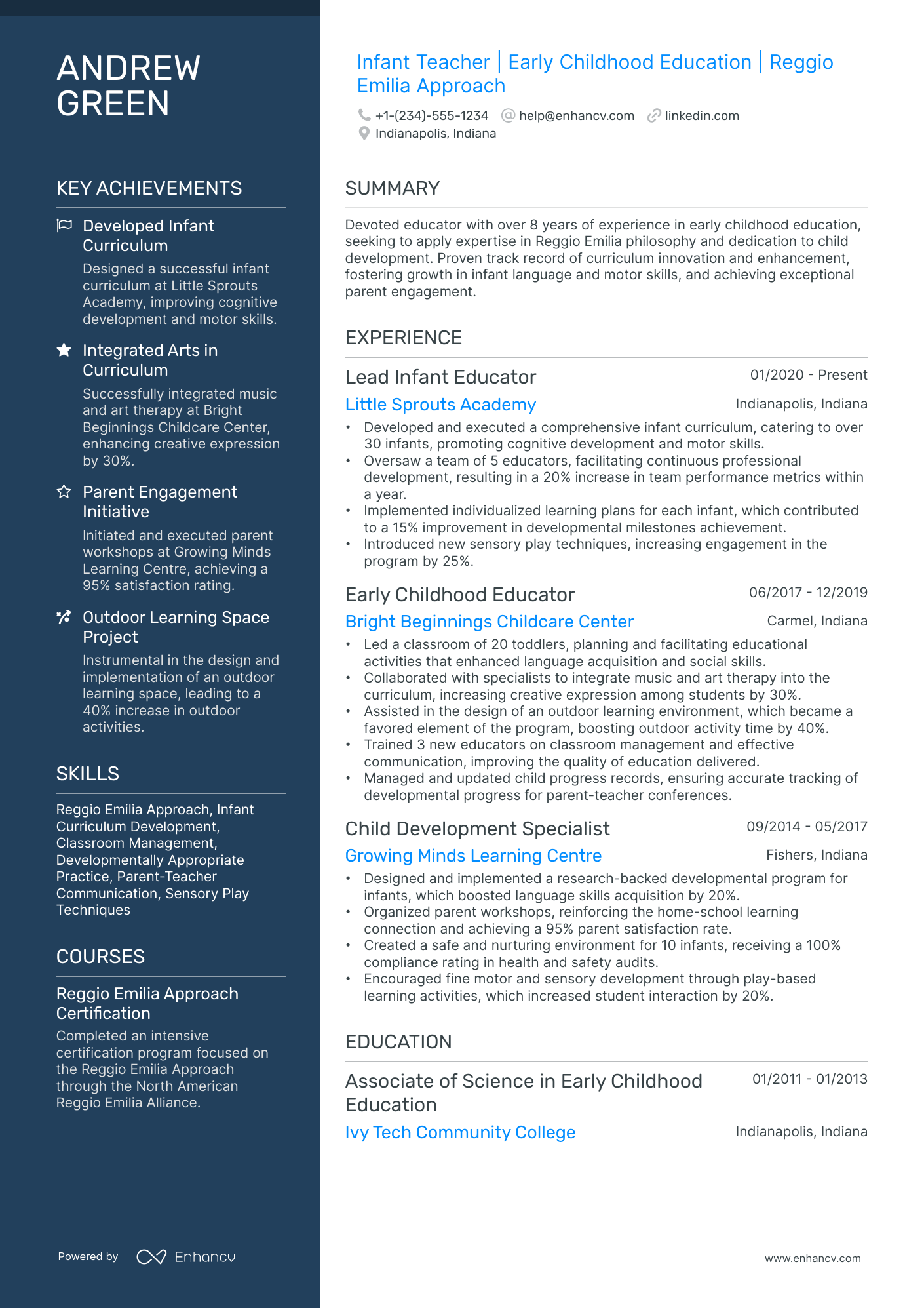
A hybrid format works best, letting you lead with relevant early childhood skills and certifications while still showing your work or practicum history in chronological order. Do:
- Place a dedicated skills section near the top featuring infant-specific competencies like safe sleep practices, bottle/feeding protocols, and developmental observation techniques.
- Include practicum placements, student teaching, volunteer work, or related caregiving roles as professional experience entries.
- Connect every skill or action to a concrete outcome, even from non-traditional settings.
Why not use a functional resume?
A functional format strips away the classroom context and timeline that hiring managers need to verify your hands-on infant caregiving experience, making it harder to assess your readiness for this role.
- A functional resume may be acceptable if you're transitioning from a related caregiving field (such as nannying or pediatric healthcare), have a gap in employment, or hold limited formal classroom experience—but only if you tie every listed skill directly to specific projects, placements, or documented outcomes.
Once your resume's layout and structure are in place, the next step is filling it with the right sections to showcase your qualifications as an infant teacher.
What sections should go on a infant teacher resume
Recruiters expect a clean, complete resume that shows your infant care expertise, safety compliance, and measurable classroom impact. Understanding what to put on a resume helps you prioritize the most relevant details.
Use this structure for maximum clarity:
- Header
- Summary
- Experience
- Skills
- Projects
- Education
- Certifications
- Optional sections: Awards, Volunteering, Languages
In your experience bullets, emphasize child development outcomes, safety and compliance results, family communication impact, and the scope of infants supported.
Is your resume good enough?
Drop your resume here or choose a file. PDF & DOCX only. Max 2MB file size.
Once you’ve organized your resume with the right core components, the next step is to write your infant teacher experience section so it supports each part with clear, relevant detail.
How to write your infant teacher resume experience
The experience section of your infant teacher resume should spotlight the caregiving practices, developmental strategies, and classroom outcomes you've delivered—not just the duties you performed. Hiring managers prioritize demonstrated impact, such as improvements in developmental milestones, parent satisfaction, or classroom safety, over generic task lists. Building a targeted resume ensures every bullet point aligns with what the employer is looking for.
Each entry should include:
- Job title
- Company and location (or remote)
- Dates of employment (month and year)
Three to five concise bullet points showing what you owned, how you executed, and what outcomes you delivered:
- Ownership scope: the infant classrooms, age groups, caseloads, curriculum areas, or daily care routines you were directly accountable for as an infant teacher.
- Execution approach: the developmental frameworks, observation tools, lesson-planning methods, or health and safety protocols you applied to guide infant care and early learning.
- Value improved: changes to developmental progress tracking, classroom safety standards, caregiver-to-child ratios, daily routine efficiency, or compliance with licensing and accreditation requirements.
- Collaboration context: how you partnered with co-teachers, parents and guardians, early intervention specialists, program directors, or licensing agencies to support each infant's growth and well-being.
- Impact delivered: outcomes framed around infant developmental gains, family engagement improvements, program quality ratings, or reductions in safety incidents—expressed as results rather than activities.
Experience bullet formula
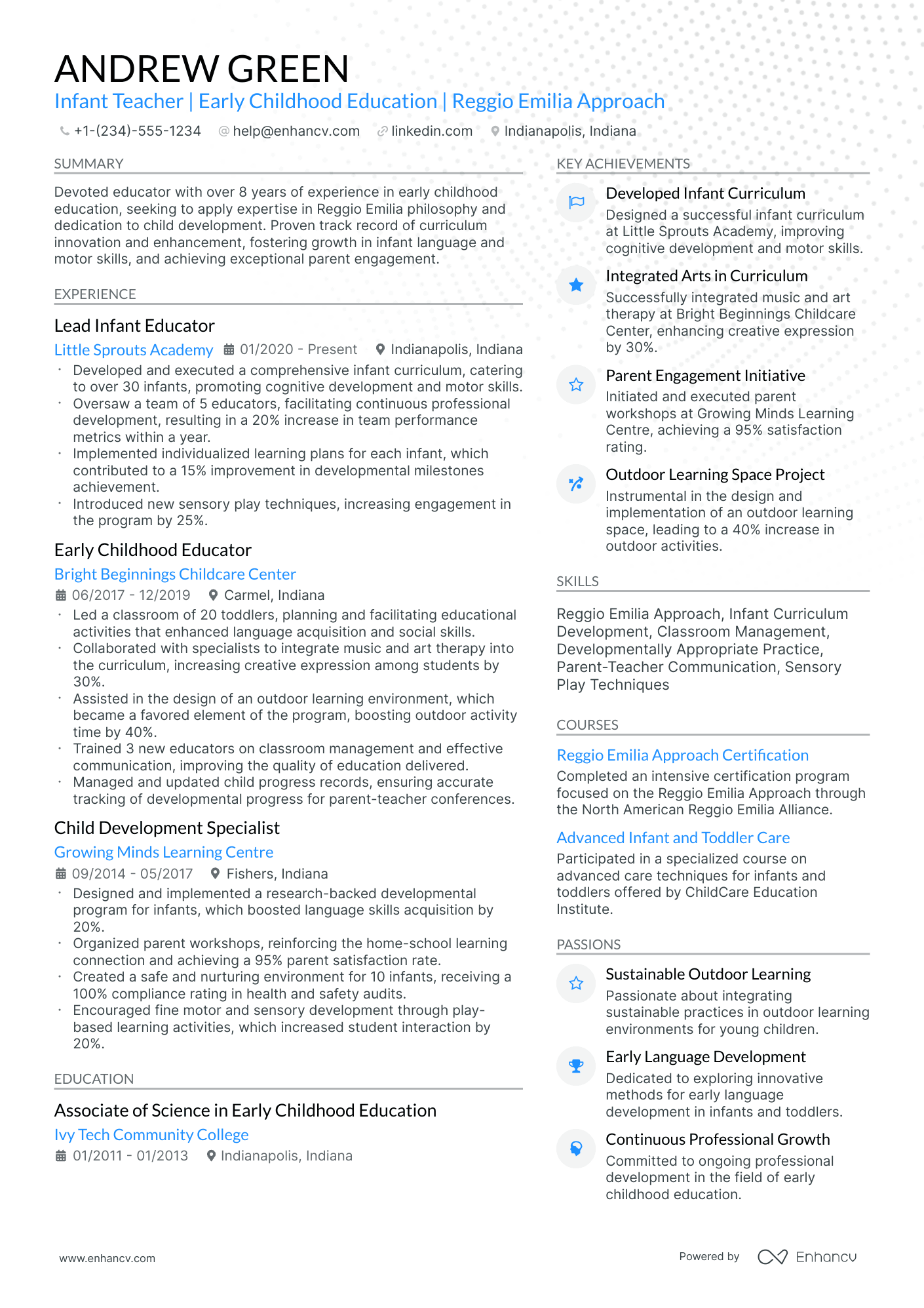
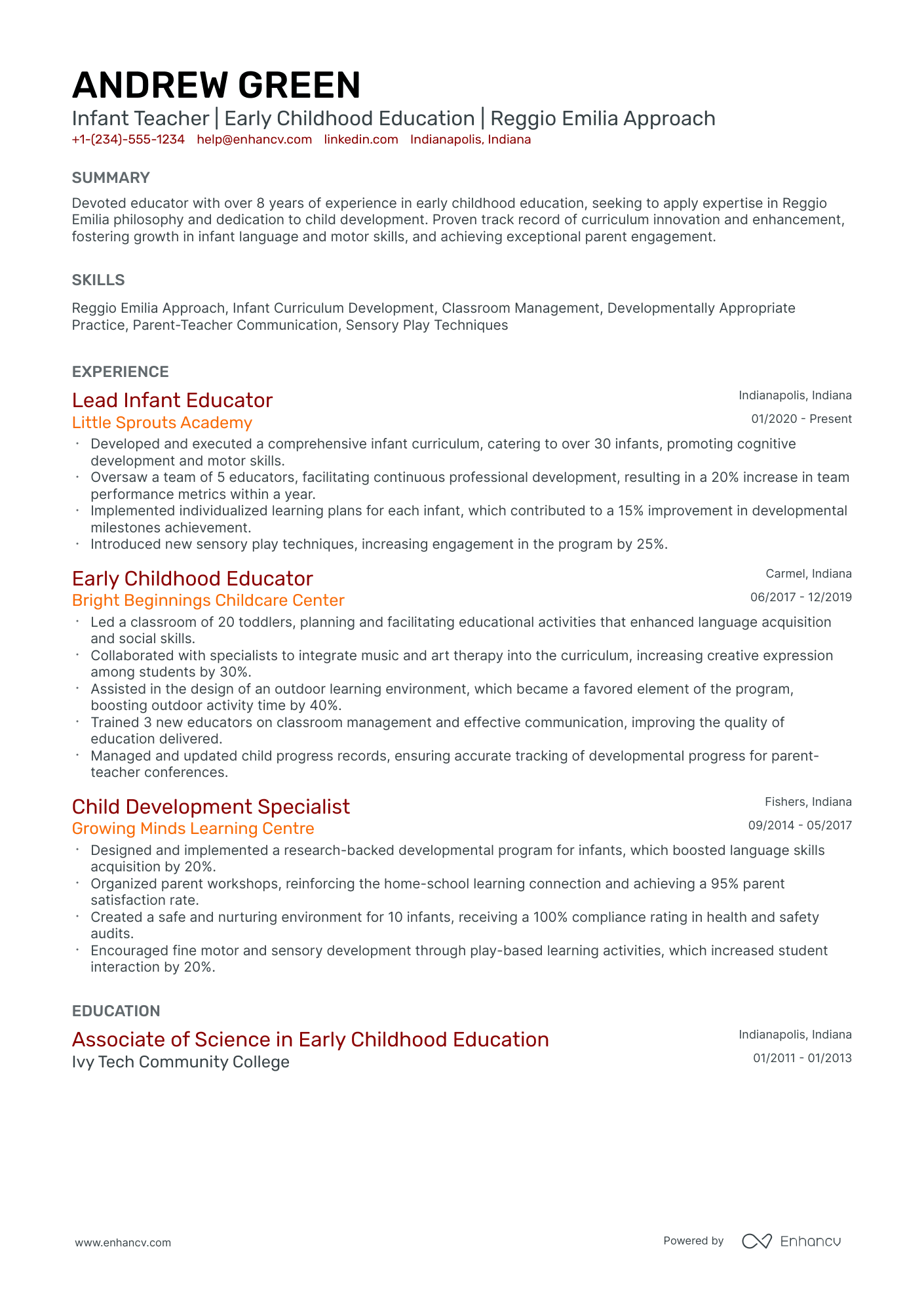
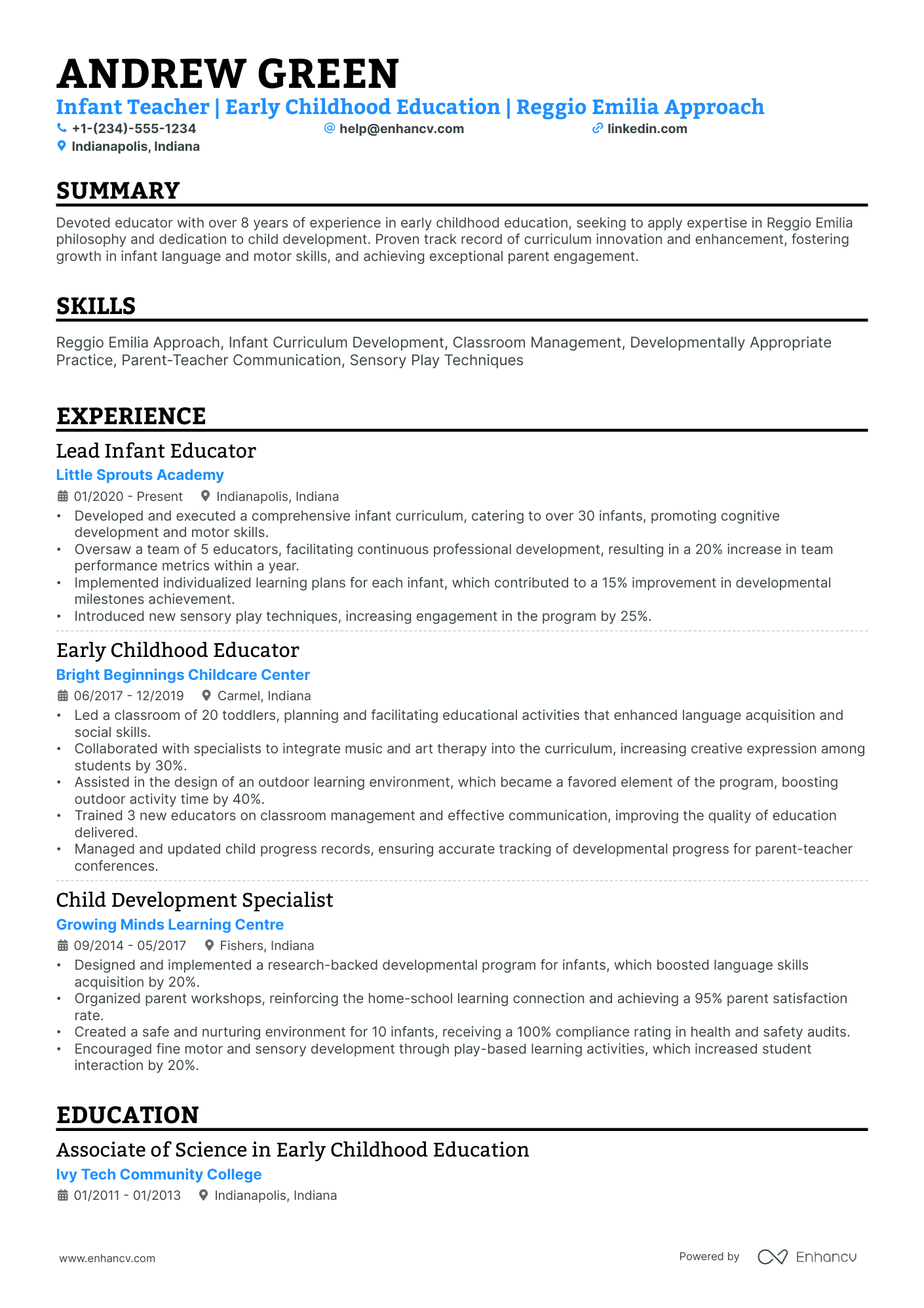
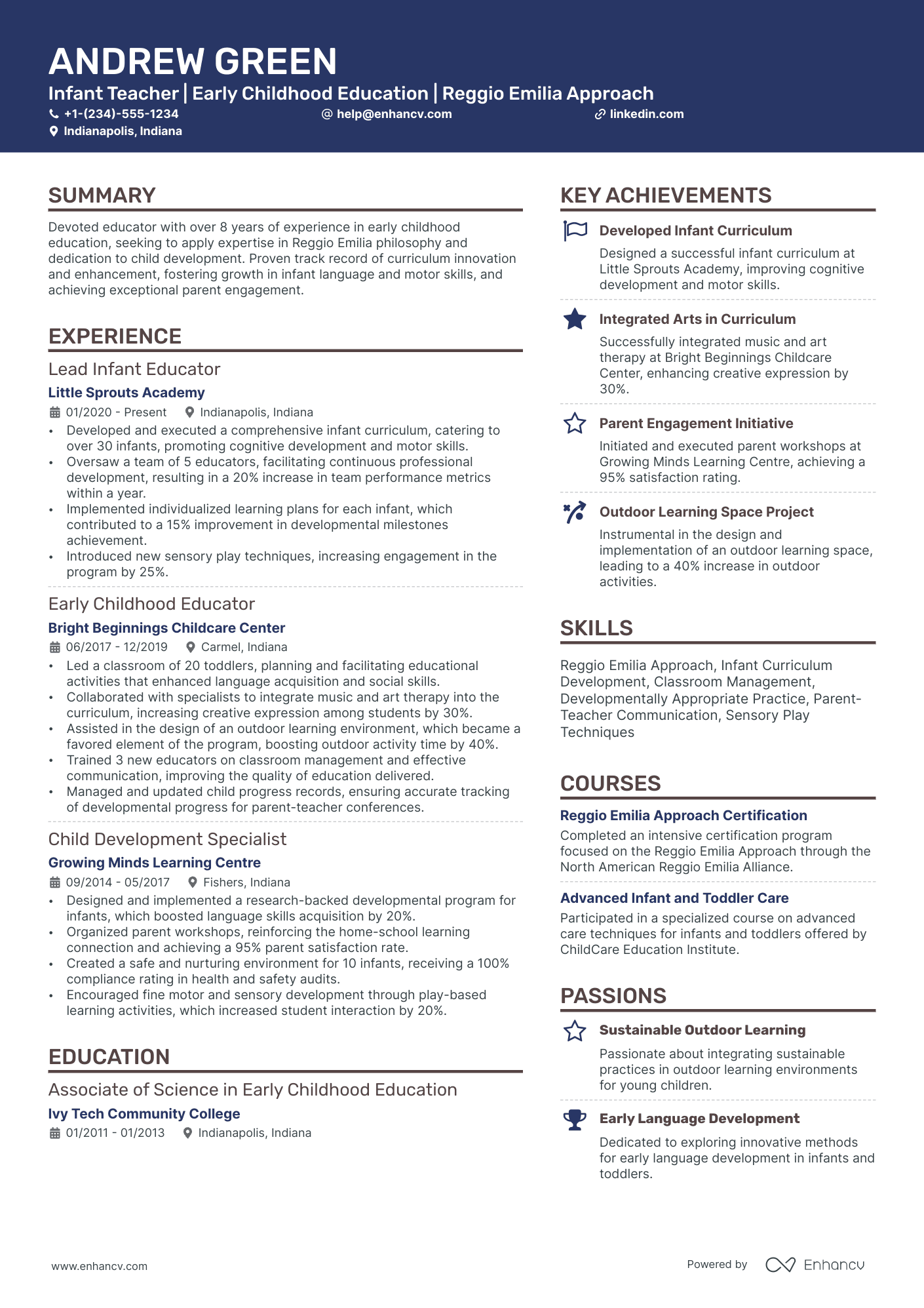
A infant teacher experience example
✅ Right example - modern, quantified, specific.
Infant Teacher
BrightSteps Early Learning Center | Austin, TX
2022–Present
NAEYC-aligned childcare center serving 120 families, with a dedicated infant wing and integrated health-and-safety program.
- Implemented individualized care plans in Procare, aligning daily routines with ASQ-3 screenings for 12 infants per cycle and improving on-time developmental documentation from 76% to 98%.
- Designed and delivered sensory-rich, RIE-informed learning experiences using daily observation logs and photo documentation, increasing family engagement in the parent portal by 41% and reducing end-of-day follow-up calls by 28%.
- Streamlined bottle prep, labeling, and feeding tracking with state-compliant sanitation checklists and digital timers, cutting missed or late feeding entries by 62% across a four-teacher rotation.
- Partnered with the center director, pediatric consultants, and families to execute individualized sleep and transition plans, reducing average settling time from 18 minutes to 11 minutes and lowering incident reports by 33%.
- Coordinated with float teachers and the kitchen team to manage allergy-safe meal workflows in accordance with licensing requirements, maintaining zero allergen exposure incidents across 9,400 infant care hours.
Now that you've seen what a strong experience section looks like in practice, let's break down how to tailor each element to match the specific infant teacher role you're applying for.
How to tailor your infant teacher resume experience
Recruiters evaluate your infant teacher resume through applicant tracking systems and hands-on review, scanning for alignment with their specific posting. Tailoring your resume to the job description by mirroring the posting's language and priorities increases your chances of passing both filters.
Ways to tailor your infant teacher experience:
- Match developmental assessment tools named in the job posting.
- Use the exact curriculum framework terminology the employer specifies.
- Mirror health and safety compliance standards the listing references.
- Reflect parent communication methods or platforms the role requires.
- Highlight experience with the age group or ratios described.
- Align your milestones tracking language with their stated expectations.
- Include referenced certifications like infant CPR or first aid.
- Emphasize collaborative teaching models the job description outlines.
Tailoring means aligning your real accomplishments with what the employer asks for, not forcing disconnected keywords into your experience bullets.
Resume tailoring examples for infant teacher
| Job description excerpt | Untailored | Tailored |
|---|---|---|
| Implement developmentally appropriate curricula for infants ages 6 weeks to 12 months using the Creative Curriculum framework, conducting ongoing assessments via Teaching Strategies GOLD. | Helped plan lessons and activities for babies in the classroom. | Implemented Creative Curriculum for infants ages 6 weeks to 12 months, completing quarterly Teaching Strategies GOLD assessments for 8 children to track developmental milestones across all learning domains. |
| Maintain compliance with state licensing ratios (1:4), ensure safe sleep practices per SIDS guidelines, and document daily feeding, diapering, and nap schedules for each infant using the Brightwheel app. | Took care of infants and kept records of their daily routines. | Maintained 1:4 teacher-to-infant ratio in full compliance with state licensing standards, enforced safe sleep practices per SIDS guidelines, and logged daily feeding, diapering, and nap data for 8 infants through Brightwheel with 100% on-time documentation. |
| Partner with families to support infant social-emotional development, conduct bi-annual parent-teacher conferences, and apply strategies from the Program for Infant/Toddler Care (PITC) to strengthen secure attachment. | Communicated with parents about their child's progress and behavior. | Applied PITC attachment-based strategies to support social-emotional growth, built trusting relationships with families through daily Brightwheel updates, and led bi-annual parent-teacher conferences for all enrolled infants to collaboratively set developmental goals. |
Once you’ve aligned your experience with the role’s priorities, the next step is to quantify your infant teacher achievements so employers can see the impact behind those responsibilities.
How to quantify your infant teacher achievements
Quantifying your achievements proves you improve safety, learning, and family trust. Track ratios, compliance, incident rates, daily care accuracy, and family satisfaction across your classroom, routines, and documentation.
Quantifying examples for infant teacher
| Metric | Example |
|---|---|
| Safety incidents | "Reduced classroom incident reports from four per quarter to one by updating safe-sleep checks and adding a 15-minute room scan checklist." |
| Compliance accuracy | "Maintained 100% on state licensing audits for twelve months by keeping digital sanitation, diapering, and attendance logs in Brightwheel." |
| Family satisfaction | "Raised parent satisfaction from 4.3 to 4.8 out of 5 across twenty families by sending daily Brightwheel updates and same-day responses." |
| Care routine throughput | "Completed feeding, diapering, and nap transitions for eight infants within a 30-minute window, meeting individualized schedules without missed care times." |
| Development progress | "Improved Ages and Stages Questionnaire (ASQ) on-time completion from 70% to 98% for sixteen infants by scheduling assessments biweekly." |
Turn your everyday tasks into measurable, recruiter-ready resume bullets in seconds with Enhancv's Bullet Point Generator.
With strong bullet points in place, the next step is ensuring your infant teacher resume highlights the right mix of hard and soft skills to back them up.
How to list your hard and soft skills on a infant teacher resume
Your skills section shows you can keep infants safe, supported, and progressing—recruiters and an ATS (applicant tracking system) scan this section for job-match keywords—so aim for a mix of role-specific hard skills and practical soft skills. infant teacher roles require a blend of:
- Product strategy and discovery skills.
- Data, analytics, and experimentation skills.
- Delivery, execution, and go-to-market discipline.
- Soft skills.
Your skills section should be:
- Scannable (bullet-style grouping).
- Relevant to the job post.
- Backed by proof in experience bullets.
- Updated with current tools.
Place your skills section:
- Above experience if you're junior or switching careers.
- Below experience if you're mid/senior with strong achievements.

Hard skills
- Infant CPR, first aid
- Safe sleep protocols
- Diapering, sanitization procedures
- Bottle feeding support
- Solid food introduction
- Developmental milestone tracking
- Daily sheets, incident reports
- Child observation documentation
- Ages and Stages Questionnaires (ASQ)
- Classroom ratio compliance
- State licensing compliance
- Emergency preparedness drills
Soft skills
- Calm, responsive caregiving
- Clear parent communication
- De-escalate infant distress
- Consistent routine execution
- Prioritize safety decisions
- Coordinate with co-teachers
- Document and escalate concerns
- Adapt to changing needs
- Follow protocols under pressure
- Provide developmentally appropriate support
How to show your infant teacher skills in context
Skills shouldn't live only in a bulleted list on your resume. Explore comprehensive resume skills examples to see how infant teachers effectively weave competencies throughout their documents.
They should be demonstrated in:
- Your summary (high-level professional identity)
- Your experience (proof through outcomes)
Here's what this looks like in practice.
Summary example
Infant teacher with eight years of experience in NAEYC-accredited programs, skilled in ASQ developmental screening and sensory-based curriculum design. Built a parent communication framework that increased family engagement by 34%. Passionate about nurturing secure attachment in early learners.
- Reflects senior-level experience clearly
- Names role-specific tools and methods
- Includes a measurable engagement outcome
- Highlights empathy and attachment-focused teaching
Experience example
Lead Infant Teacher
Bright Horizons Early Learning Center | Austin, TX
June 2019–March 2024
- Designed sensory-rich lesson plans using Creative Curriculum, improving developmental milestone achievement by 22% across a 12-infant classroom.
- Collaborated with speech therapists and families to implement individualized care plans, reducing developmental referral wait times by 30%.
- Trained four assistant teachers on safe sleep protocols and ASQ screening tools, raising classroom compliance scores to 98%.
- Every bullet includes measurable proof
- Skills appear naturally through real outcomes
Once you’ve tied your infant teacher abilities to real classroom outcomes, the next step is to apply that same approach to writing an infant teacher resume with no experience.
How do I write a infant teacher resume with no experience
Even without full-time experience, you can demonstrate readiness through relevant training and hands-on practice. Our guide on writing a resume without work experience walks you through proven strategies for entry-level candidates. Consider showcasing:
- Child development coursework and labs
- CPR and First Aid certification
- Infant room practicum or observation hours
- Volunteer nursery or church childcare
- Babysitting infants with references
- Early childhood workshops and webinars
- Parent communication logs and updates
Focus on:
- Infant safety and sanitation protocols
- Age-appropriate activity planning evidence
- Documentation using daily reports
- Compliance with licensing requirements
Resume format tip for entry-level infant teacher
Use a combination resume format because it highlights relevant skills and training first, while still showing any childcare experience and projects. Do:
- Add a skills section tied to proof.
- List infant care tasks with specifics.
- Include certifications with expiration dates.
- Quantify hours, ratios, and routines.
- Tailor keywords to the job post.
- Completed 40 practicum hours in an infant room, used daily sheets and safe sleep checks, and documented feeding and diapering for six infants with 100% on-time logs.
Even without formal work experience, your educational background can demonstrate the foundational knowledge and training that qualify you for an infant teacher role.
How to list your education on a infant teacher resume
Your education section helps hiring teams confirm you have the foundational knowledge needed for infant teacher roles. It validates your training in child development, safety, and early learning practices.
Include:
- Degree name
- Institution
- Location
- Graduation year
- Relevant coursework (for juniors or entry-level candidates)
- Honors & GPA (if 3.5 or higher)
Skip month and day details—list the graduation year only.
Here's a strong education entry tailored to the infant teacher role.
Example education entry
Bachelor of Science in Early Childhood Education
University of Central Florida, Orlando, FL
Graduated 2022
GPA: 3.7/4.0
- Relevant Coursework: Infant and Toddler Development, Child Health and Nutrition, Early Language Acquisition, Classroom Safety Practices
- Honors: Magna Cum Laude, Dean's List (six semesters)
How to list your certifications on a infant teacher resume
Certifications on your resume show your commitment to learning, proficiency with classroom tools, and alignment with early childhood standards in infant teacher work.
Include:
- Certificate name
- Issuing organization
- Year
- Optional: credential ID or URL
- Place certifications below education when they're older, less relevant, or supplemental to your degree for infant teacher roles.
- Place certifications above education when they're recent, highly relevant, or required for the infant teacher job posting.
Best certifications for your infant teacher resume
- Child Development Associate (CDA) Credential
- Infant and Toddler Care Certificate
- Pediatric First Aid and CPR Certification
- Child Abuse Prevention and Reporting Training Certificate
- Safe Sleep for Infants Training Certificate
- Early Childhood Education (ECE) Certificate
- Medication Administration Training Certificate
Once you’ve included your credentials in a clear, easy-to-scan format, focus on your infant teacher resume summary to highlight them upfront and show their impact.
How to write your infant teacher resume summary
Your resume summary is the first thing a recruiter reads. A strong one instantly signals you're qualified and passionate about early childhood education.
Keep it to three to four lines, with:
- Your title and total years of experience in infant or early childhood care.
- The type of setting, such as daycare centers, Montessori programs, or private nurseries.
- Core skills like developmental milestones tracking, lesson planning, or CPR certification.
- One or two measurable achievements, such as improved parent satisfaction or reduced incident rates.
- Soft skills tied to outcomes, like patience that lowered classroom behavioral issues by a specific percentage.

PRO TIP
At this level, emphasize hands-on skills, relevant certifications, and any early wins you can quantify. Avoid vague phrases like "passionate team player" or "hardworking self-starter." Instead, connect every trait to a real classroom result.
Example summary for a infant teacher
Infant teacher with three years of experience in licensed daycare settings. Skilled in developmental assessments and sensory-based lesson planning. Boosted parent satisfaction scores by 20% through structured daily progress updates.
Optimize your resume summary and objective for ATS
Drop your resume here or choose a file.
PDF & DOCX only. Max 2MB file size.
Now that your summary captures your caregiving expertise and teaching philosophy, make sure the header presenting your contact details is equally polished so recruiters can reach you without any friction.
What to include in a infant teacher resume header
A resume header is the contact block at the top that boosts visibility, builds credibility, and helps recruiter screening for a infant teacher role.
Essential resume header elements
- Full name
- Tailored job title and headline
- Location
- Phone number
- Professional email
- GitHub link
- Portfolio link
A LinkedIn link helps recruiters verify experience quickly and supports screening.
Don't include photos on a infant teacher resume unless the role is explicitly front-facing or appearance-dependent.
Use a clear, consistent format and match your job title to the posting so recruiters can scan and contact you fast.
Infant teacher resume header
Jordan Taylor
Infant teacher | Infant care, routines, and family communication
Austin, TX
(512) 555-01XX
your.name@enhancv.com
github.com/yourname
yourwebsite.com
linkedin.com/in/yourname
Once your contact details and role information are clear and easy to scan, add supporting sections to highlight qualifications that don’t fit in the header but strengthen your infant teacher resume.
Additional sections for infant teacher resumes
When your core qualifications match other applicants, additional sections help you stand out with unique strengths relevant to infant care. For example, listing language skills on your resume can set you apart in centers serving multilingual families.
- Languages
- Certifications (CPR, First Aid, Child Development Associate)
- Volunteer experience with infants or toddlers
- Professional development and workshops
- Awards and recognitions in early childhood education
- Hobbies and interests related to child development
Once you've strengthened your resume with these supplementary sections, pair it with a tailored cover letter to give hiring managers a fuller picture of your qualifications.
Do infant teacher resumes need a cover letter
An infant teacher resume rarely requires a cover letter, but it helps in competitive roles or centers that expect one. If you're unsure what a cover letter is and when to use one, it can make a difference when hiring teams compare similar experience and credentials.
Use a cover letter to add context your infant teacher resume can't show:
- Explain role and team fit by linking your caregiving approach to the center's routines, ratios, communication style, and curriculum expectations.
- Highlight one or two relevant projects or outcomes, such as improving daily logs, strengthening safe sleep compliance, or increasing family engagement touchpoints.
- Show understanding of the center's users and business context, including infant needs, family trust, licensing requirements, and how consistency supports retention.
- Address career transitions or non-obvious experience by connecting prior roles to infant teacher work, such as behavior support, health training, or bilingual communication.
Drop your resume here or choose a file.
PDF & DOCX only. Max 2MB file size.
Even if you include a cover letter to add context beyond your resume, using AI to improve your infant teacher resume helps you strengthen the document hiring teams review first.
Using AI to improve your infant teacher resume
AI can sharpen your resume's clarity, structure, and overall impact. It helps you find stronger words and tighter phrasing. But overuse strips away authenticity. Once your content feels clear and aligned with the infant teacher role, step back. If you're wondering which AI is best for writing resumes, focus on tools that enhance rather than replace your authentic voice.
Here are ten practical prompts you can copy, paste, and use right away:
- Strengthen summary statement: "Rewrite my infant teacher resume summary to highlight caregiving expertise, developmental knowledge, and classroom impact in three concise sentences."
- Quantify experience bullets: "Add measurable outcomes to these infant teacher experience bullets, focusing on child development milestones, parent satisfaction, or group sizes managed."
- Improve action verbs: "Replace weak or repeated verbs in my infant teacher experience section with specific, active verbs that reflect early childhood caregiving responsibilities."
- Tailor skills section: "Reorganize my infant teacher skills section to prioritize abilities most relevant to this specific job description I'm pasting below."
- Refine certifications list: "Review my infant teacher certifications section for clarity, correct formatting, and proper ordering by relevance to early childhood education roles."
- Align education details: "Rewrite my education section to emphasize coursework, training, and achievements most applicable to an infant teacher position."
- Tighten project descriptions: "Condense my infant teacher project descriptions into two-line bullets that clearly state my role, actions taken, and results achieved."
- Remove redundant phrasing: "Identify and eliminate repetitive or filler language across my entire infant teacher resume without losing any meaningful content."
- Match job posting language: "Compare my infant teacher resume against this job posting and suggest specific wording changes that better mirror the employer's preferred terminology."
- Check overall consistency: "Review my infant teacher resume for inconsistent tense, formatting errors, and tone shifts across all sections, then suggest corrections."
Stop using AI once your resume sounds accurate, specific, and true to your real experience. AI should never invent experience or inflate claims—if it didn't happen, it doesn't belong here.
Conclusion
A strong infant teacher resume shows measurable outcomes, role-specific skills, and a clear structure. Use numbers to show progress, safety results, and family engagement. Highlight infant care routines, developmental support, observation, documentation, and calm, responsive communication.
Keep formatting clean and consistent so hiring teams can scan fast. Match your skills and results to the job needs, and make your experience easy to follow. This approach shows you’re ready for today’s hiring market and near-future expectations.