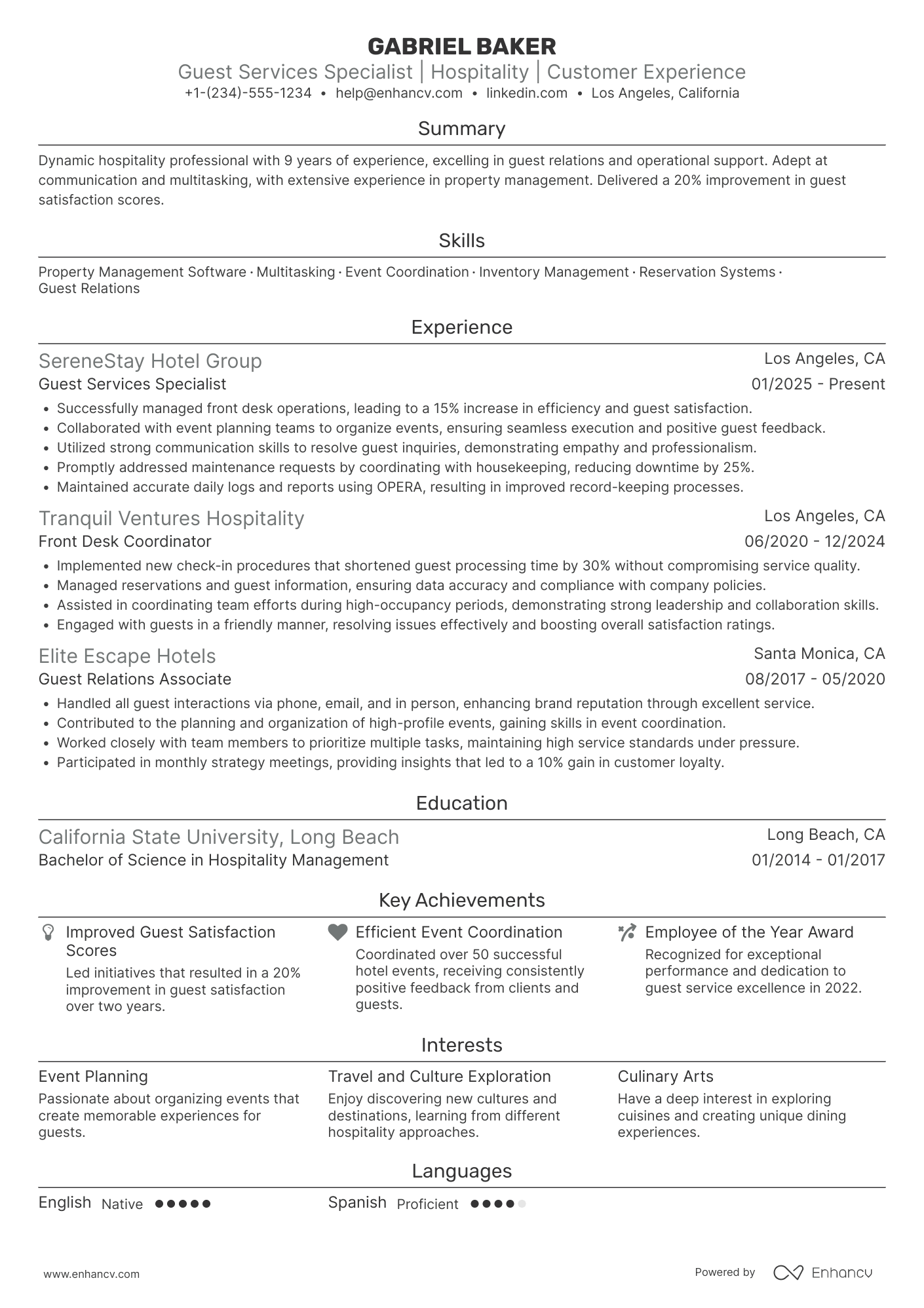
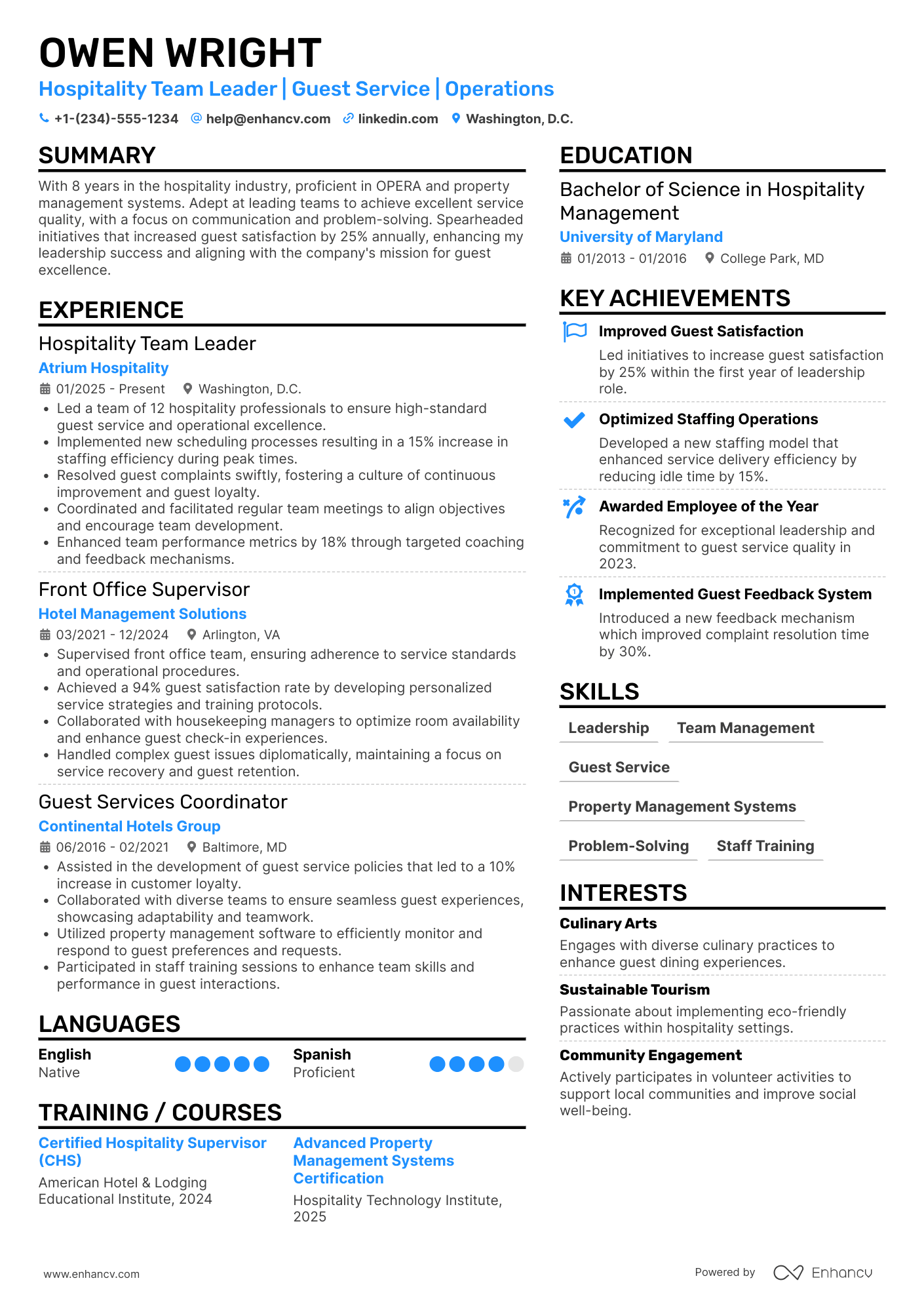
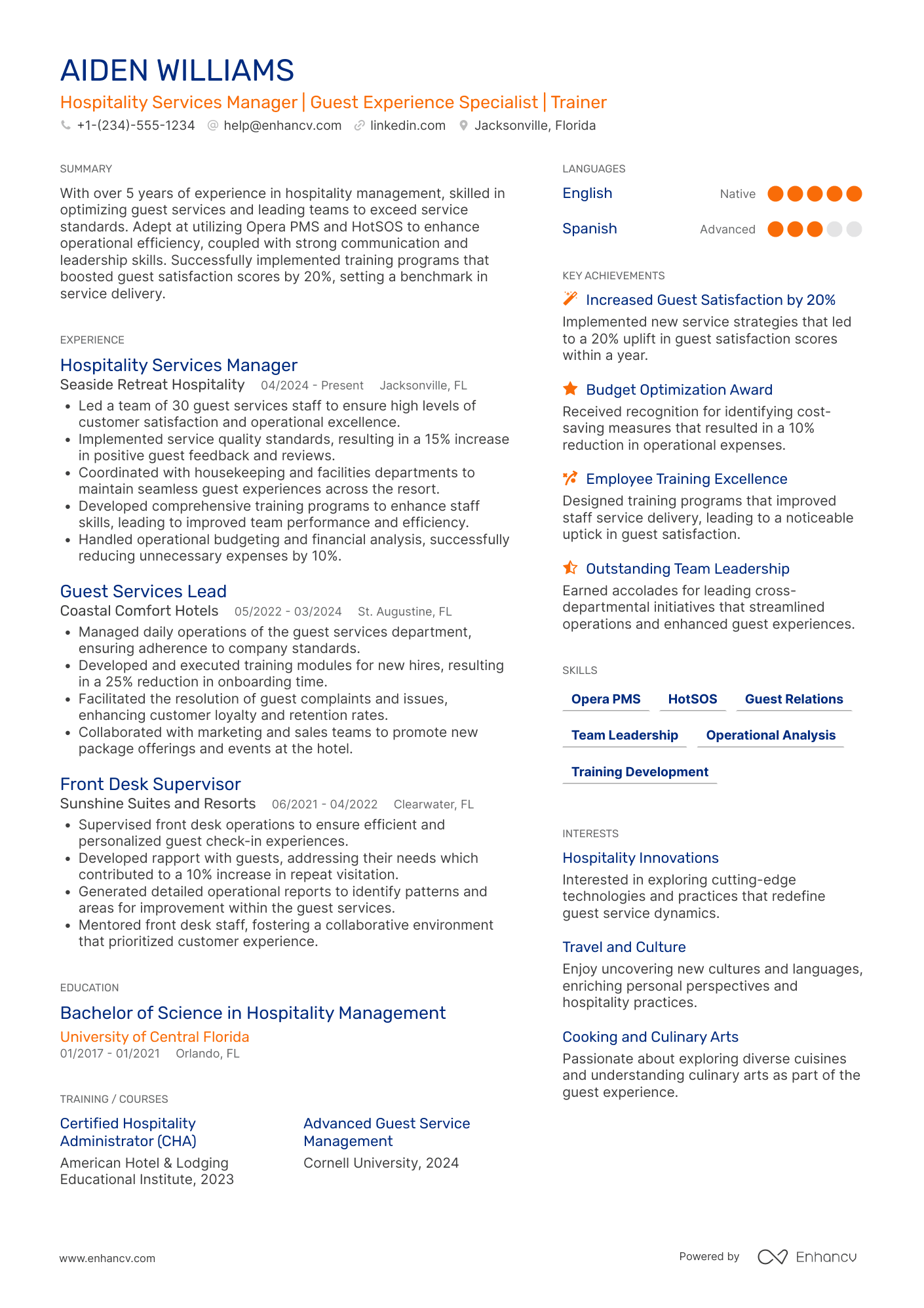
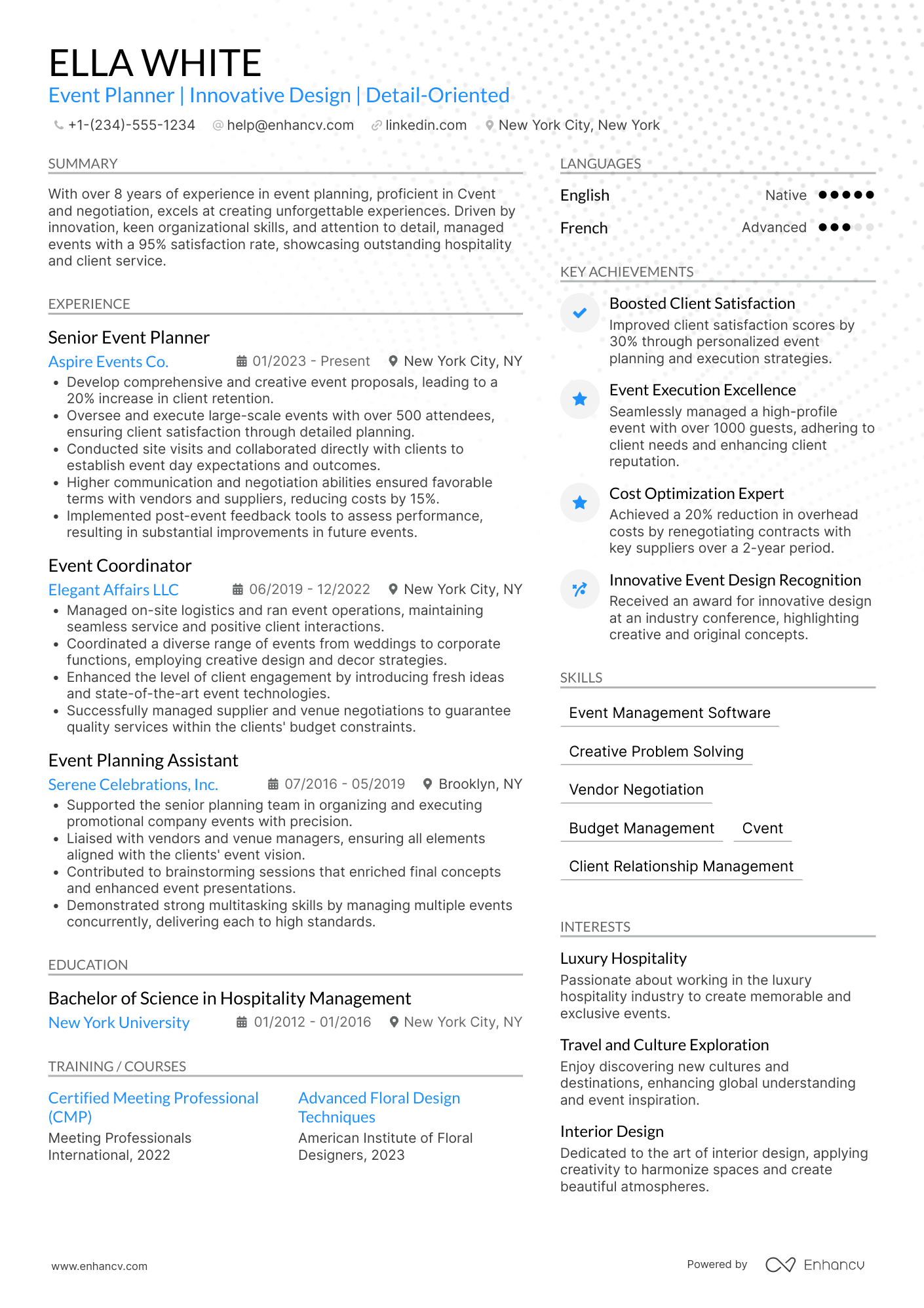
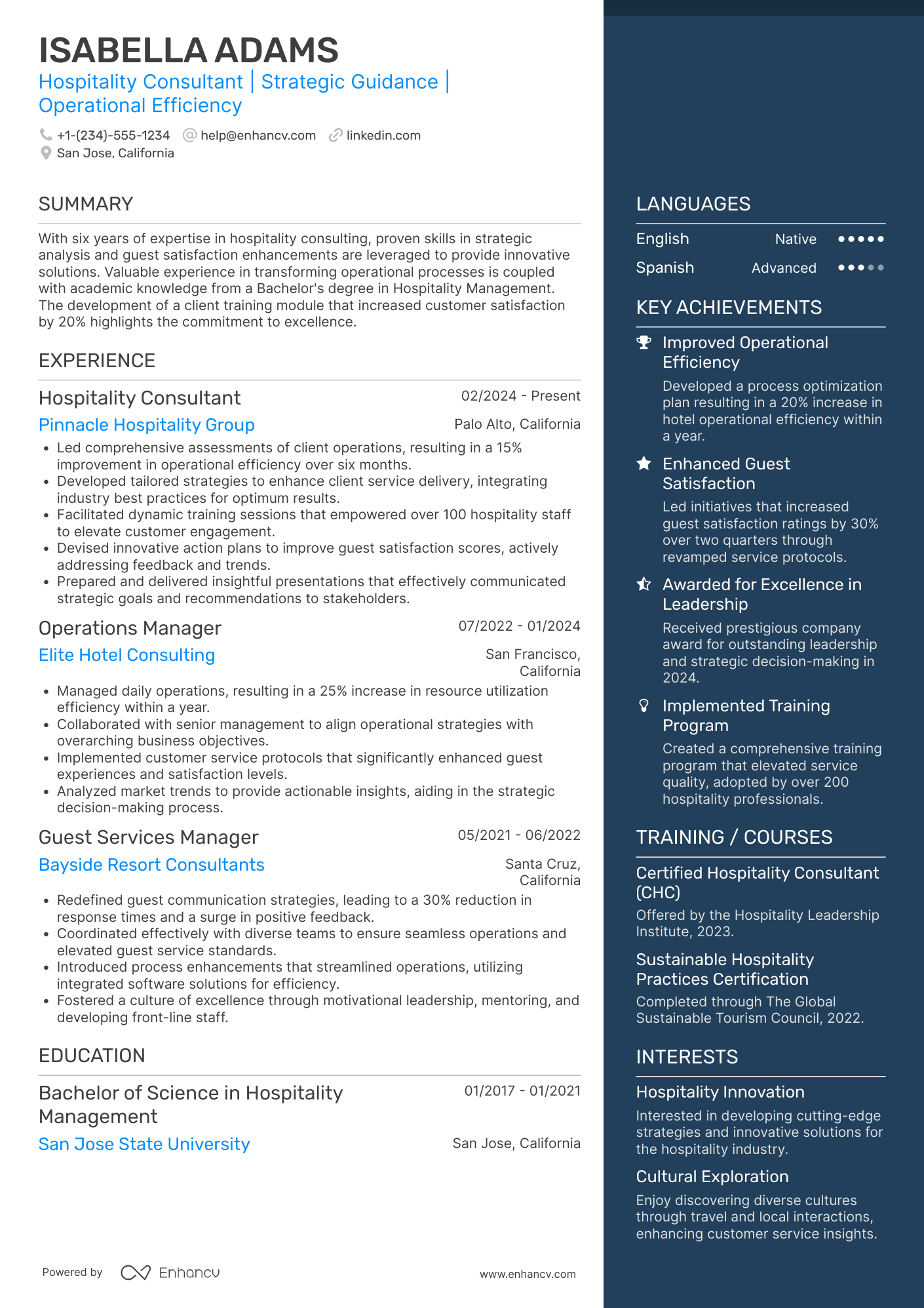
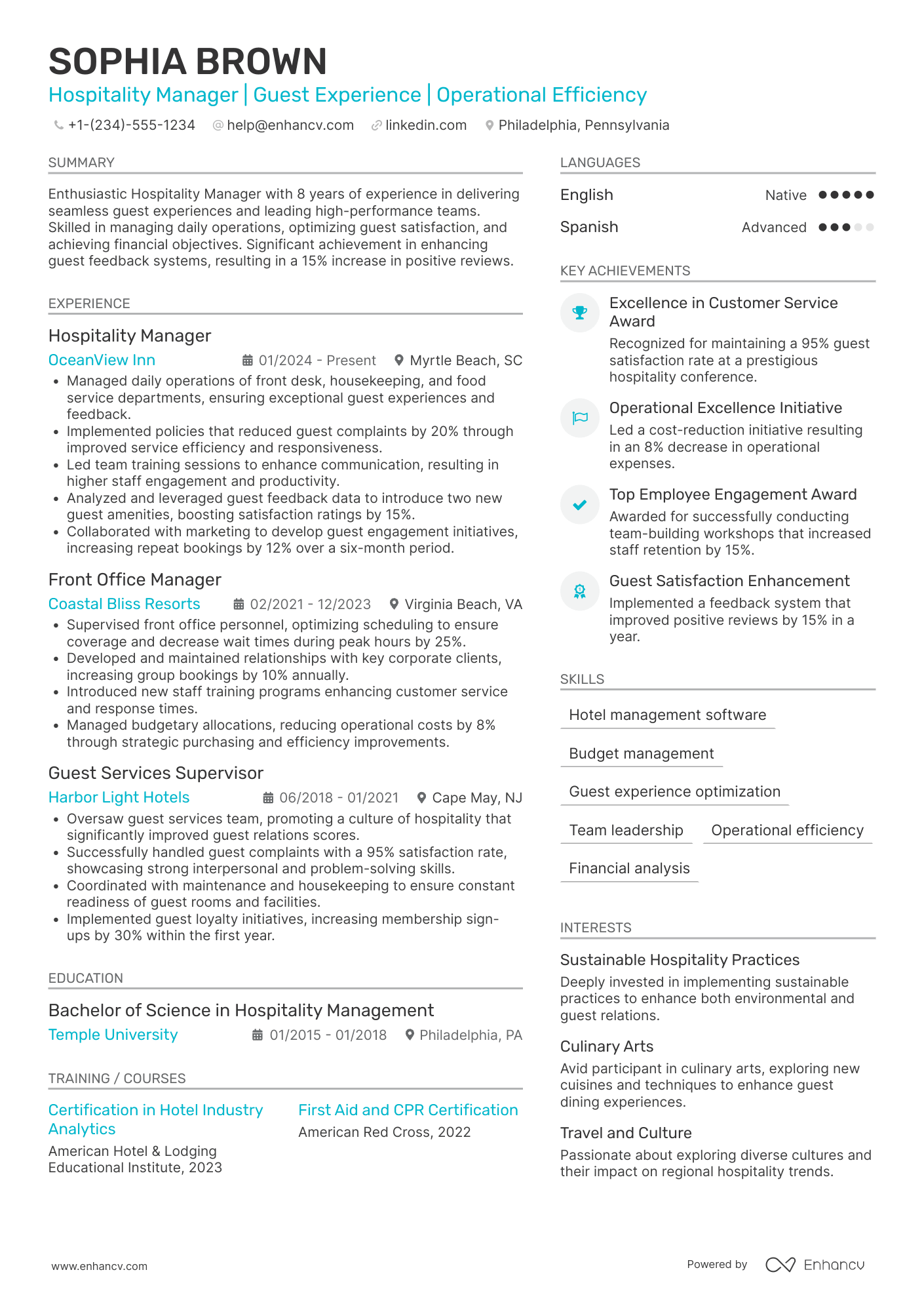
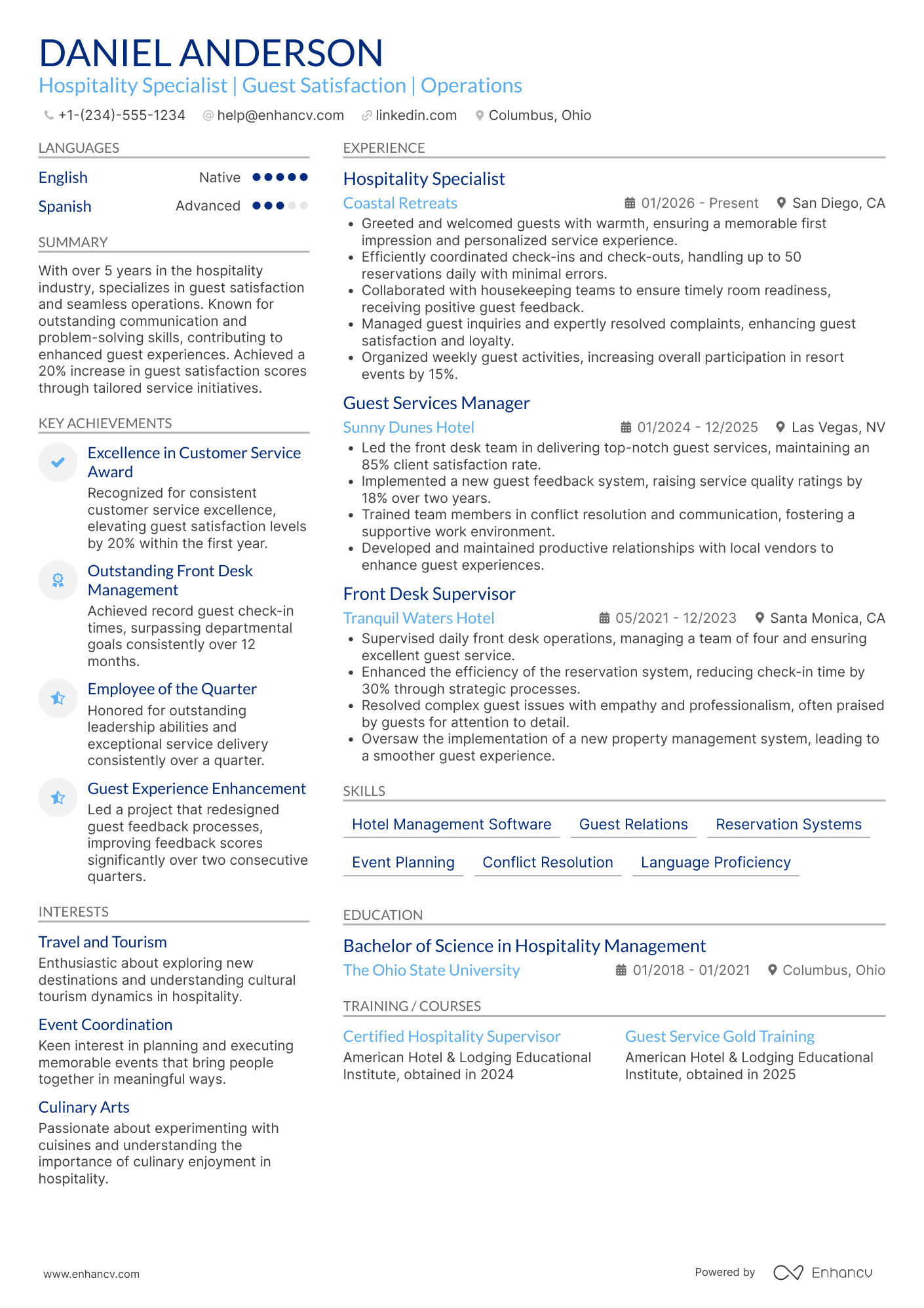
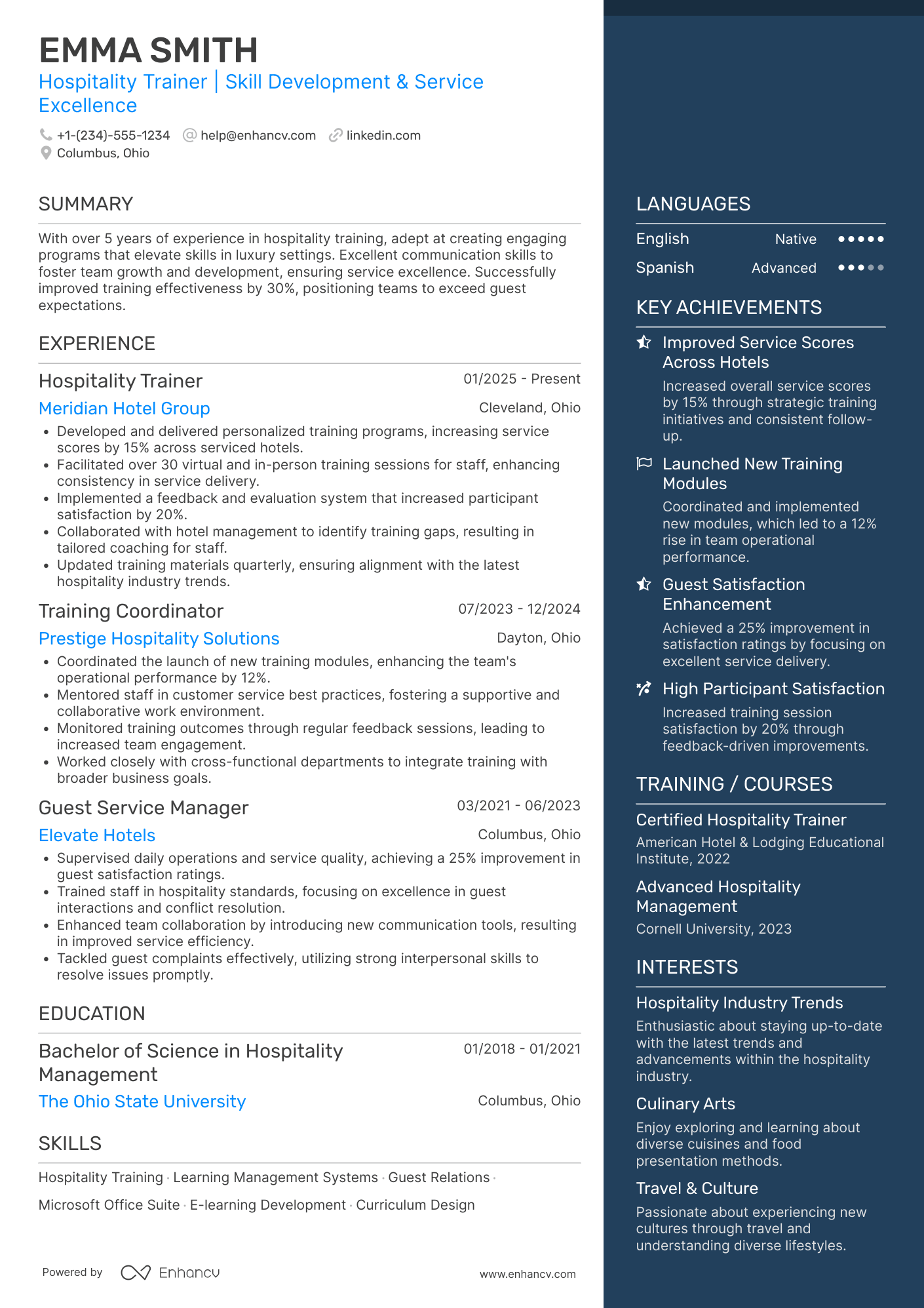
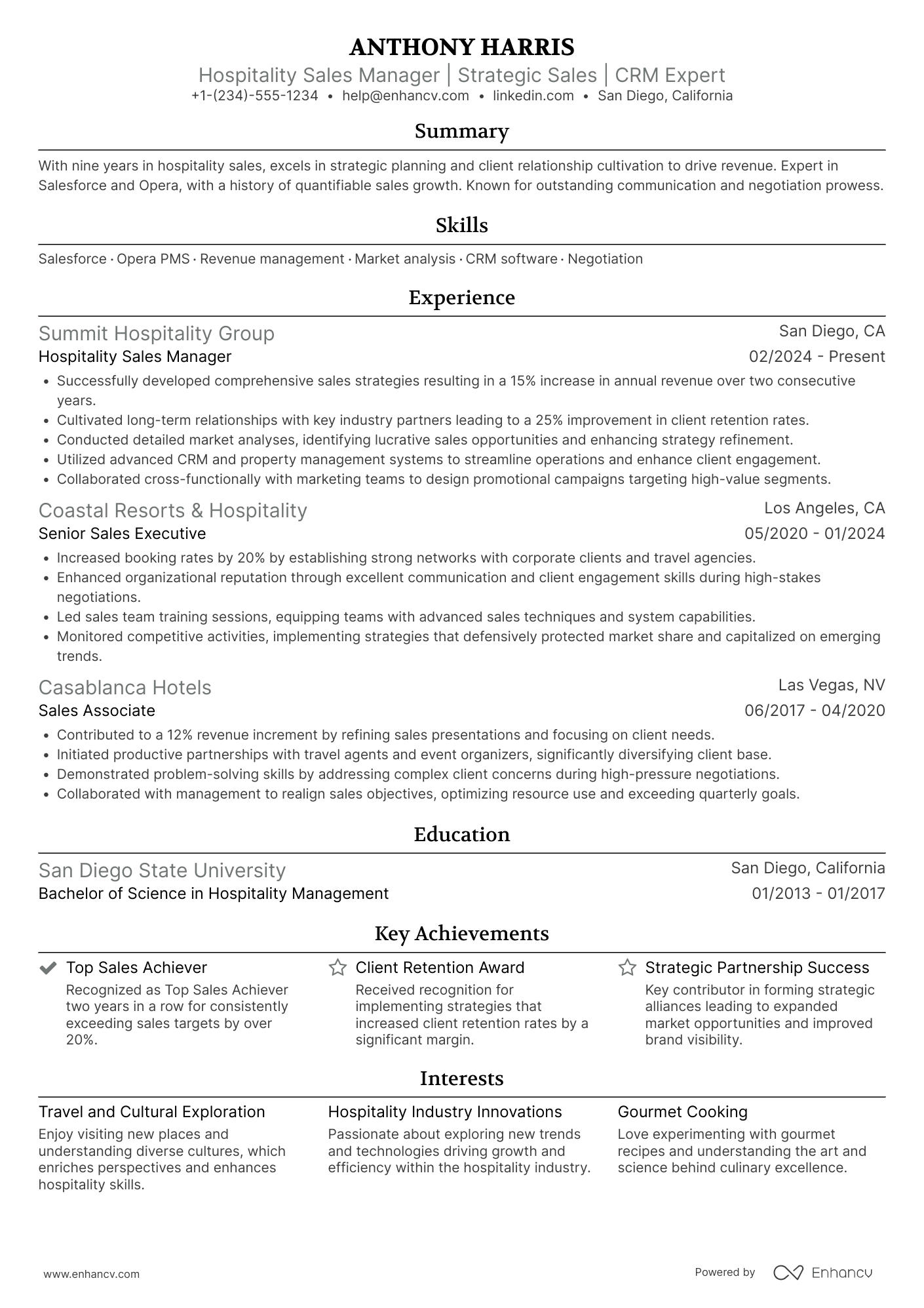
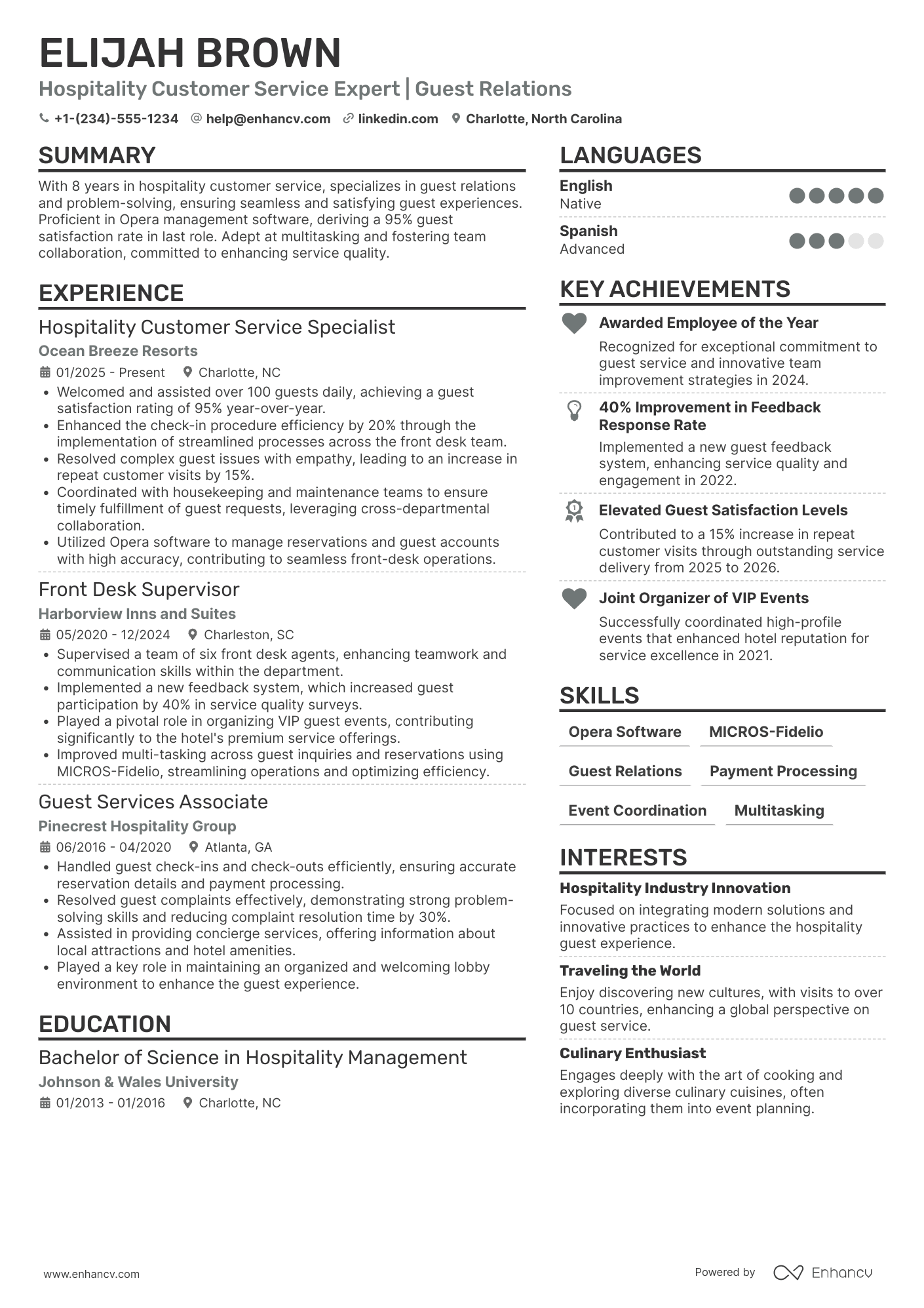
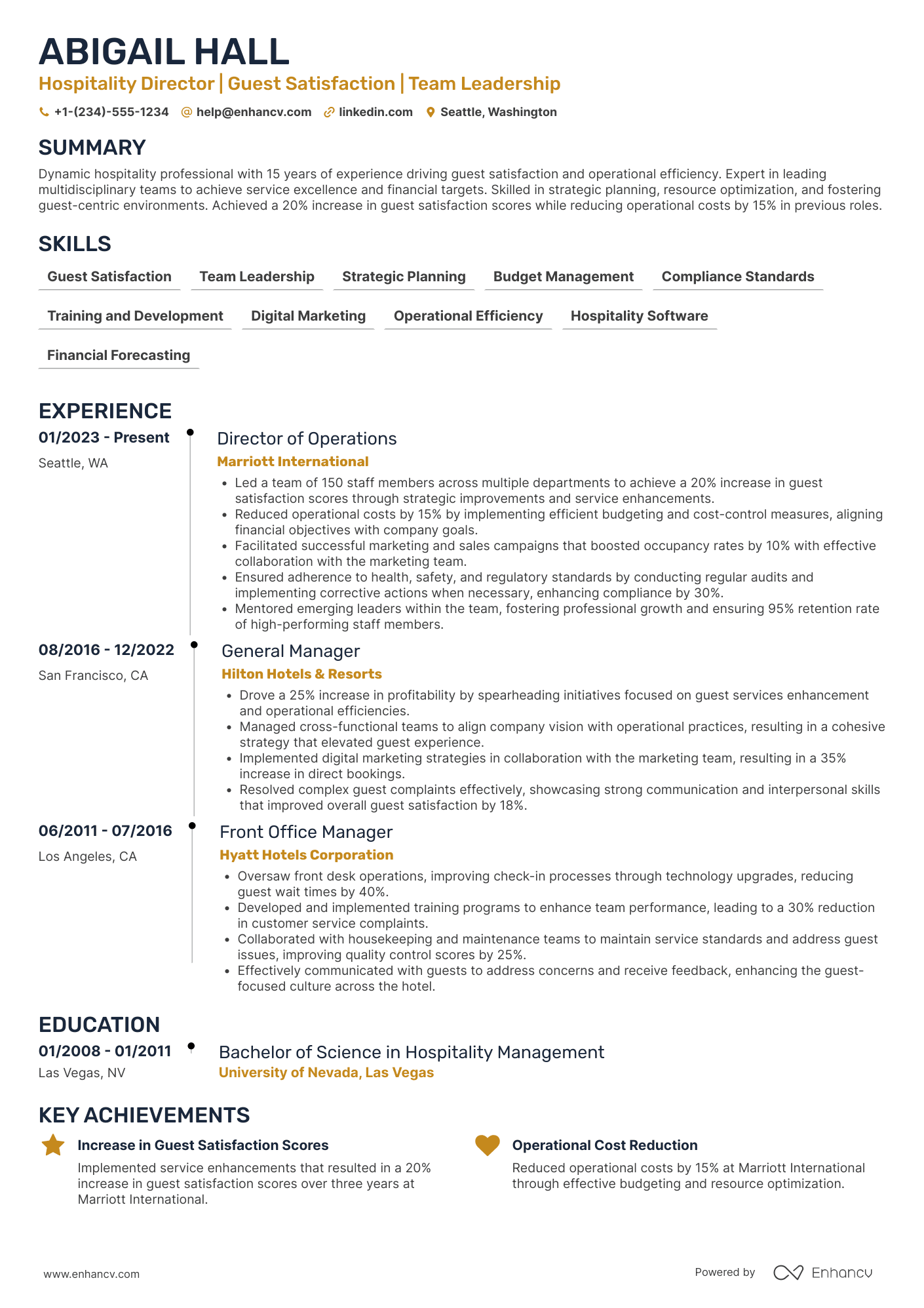
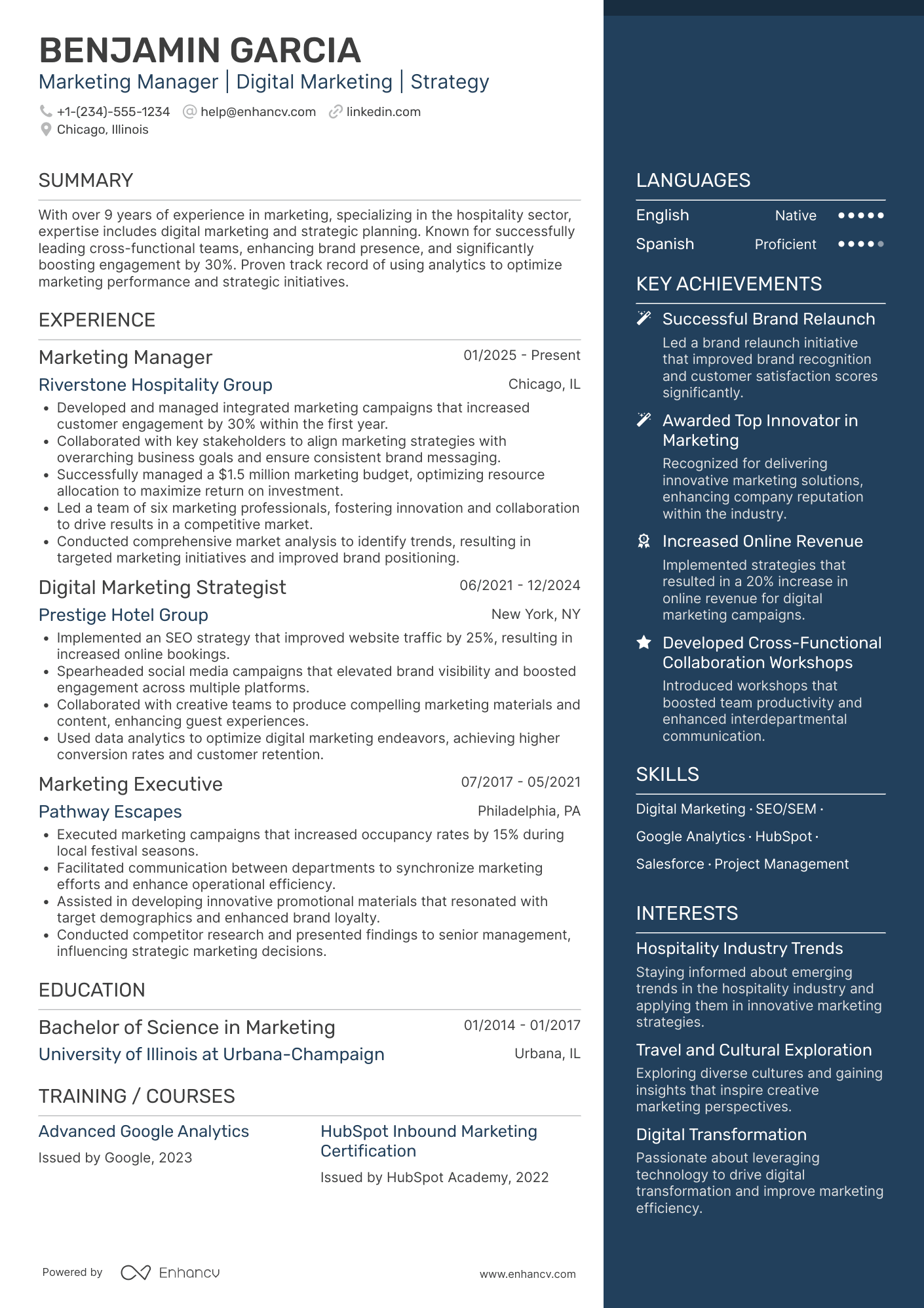
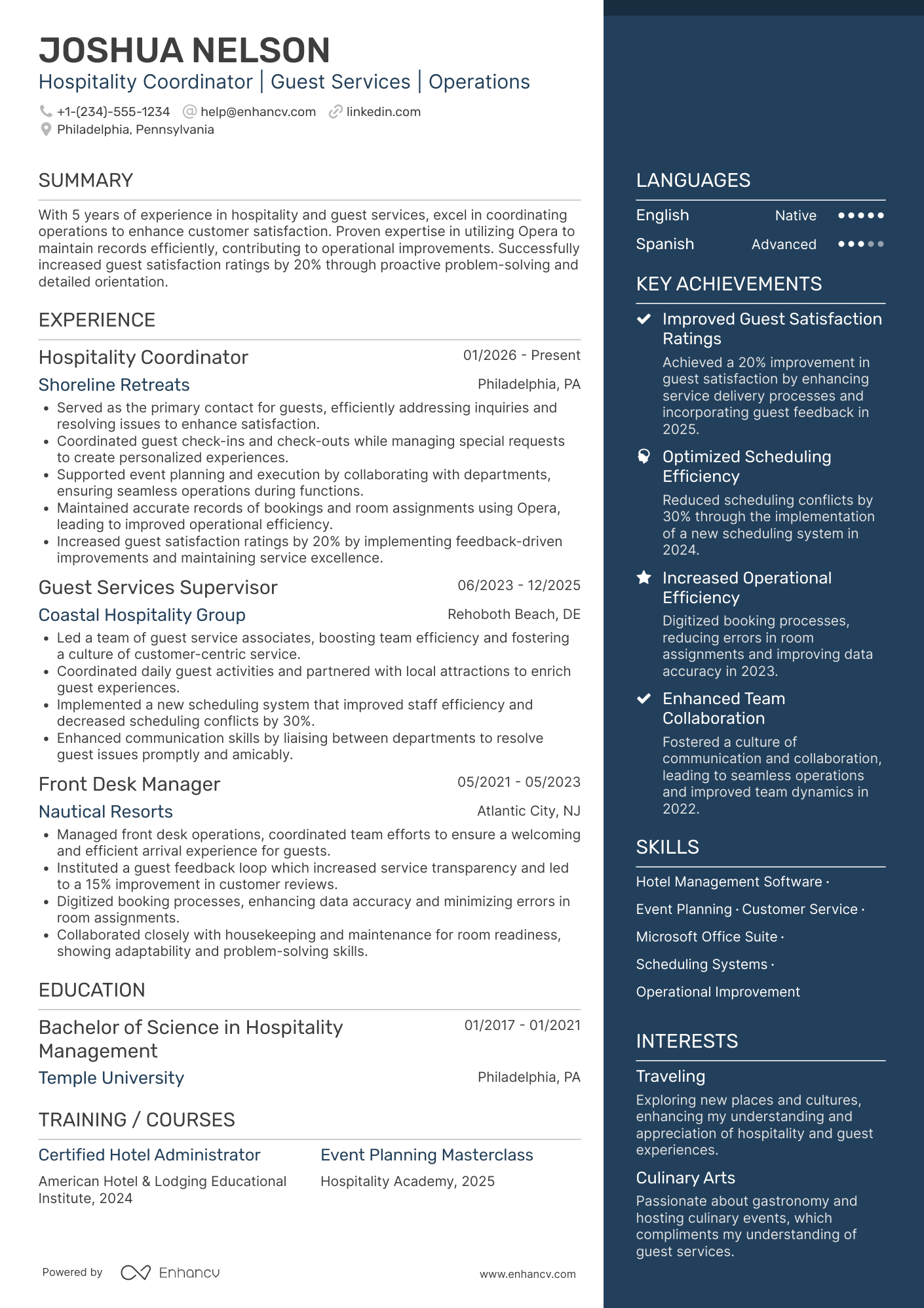
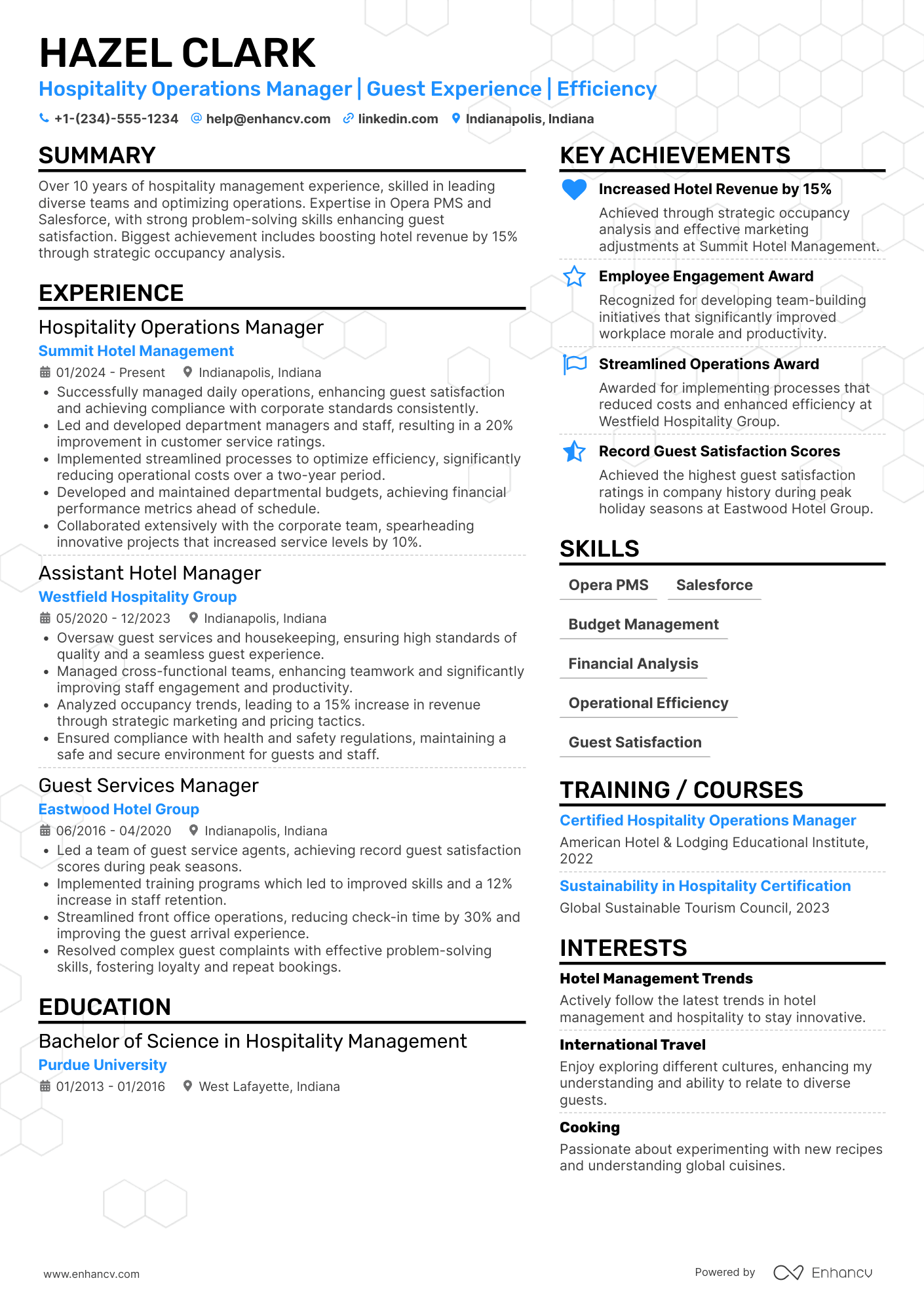
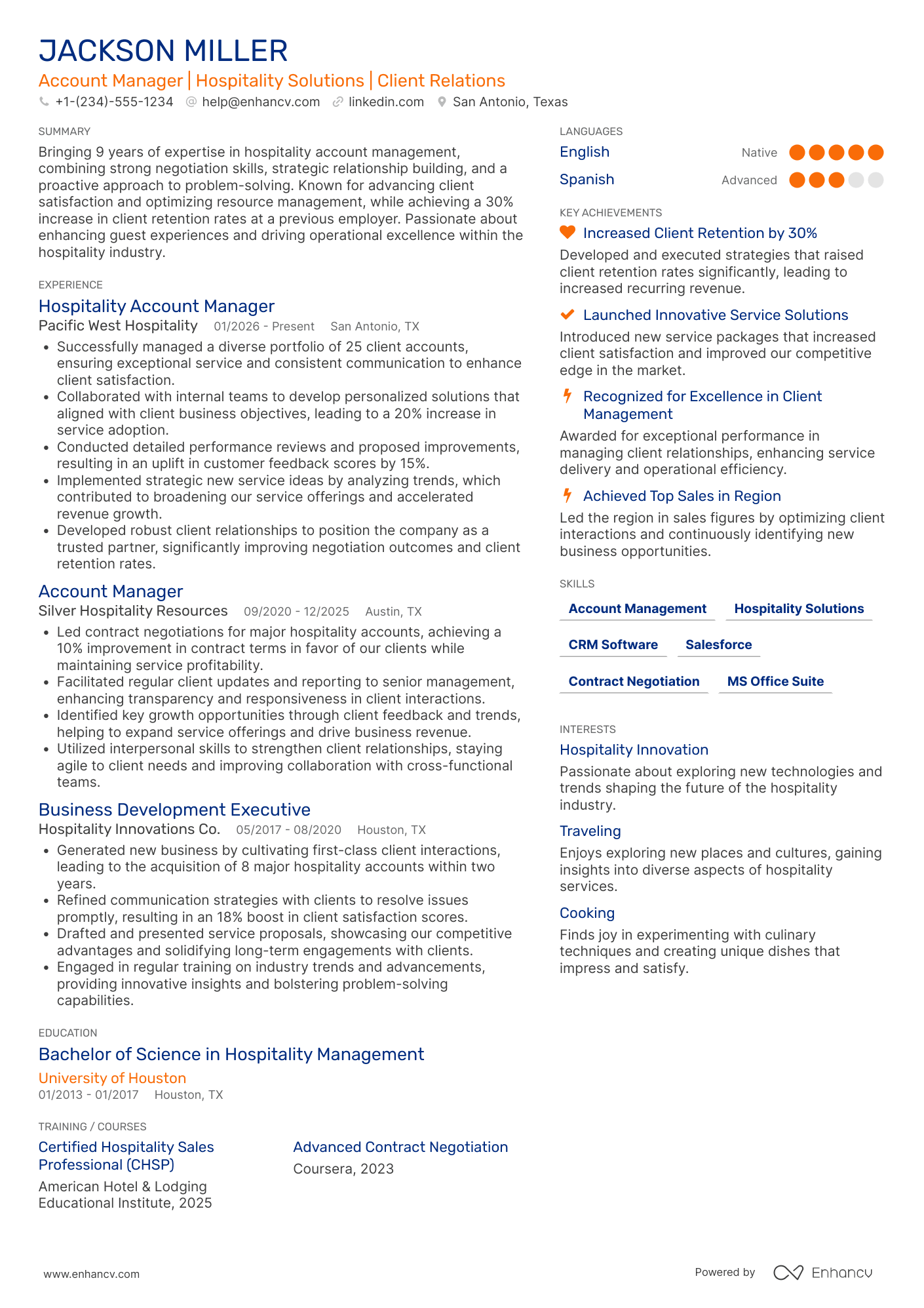
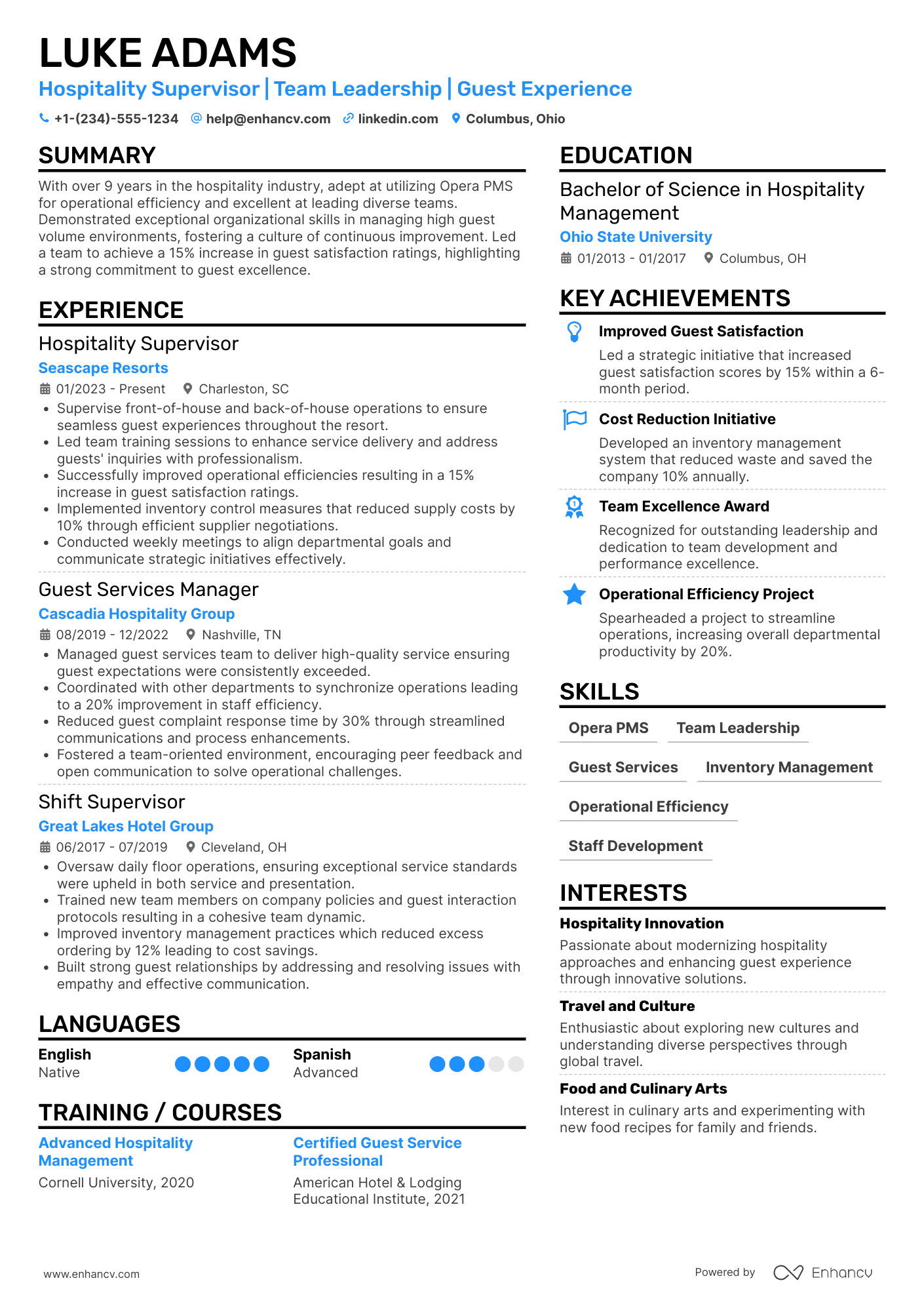
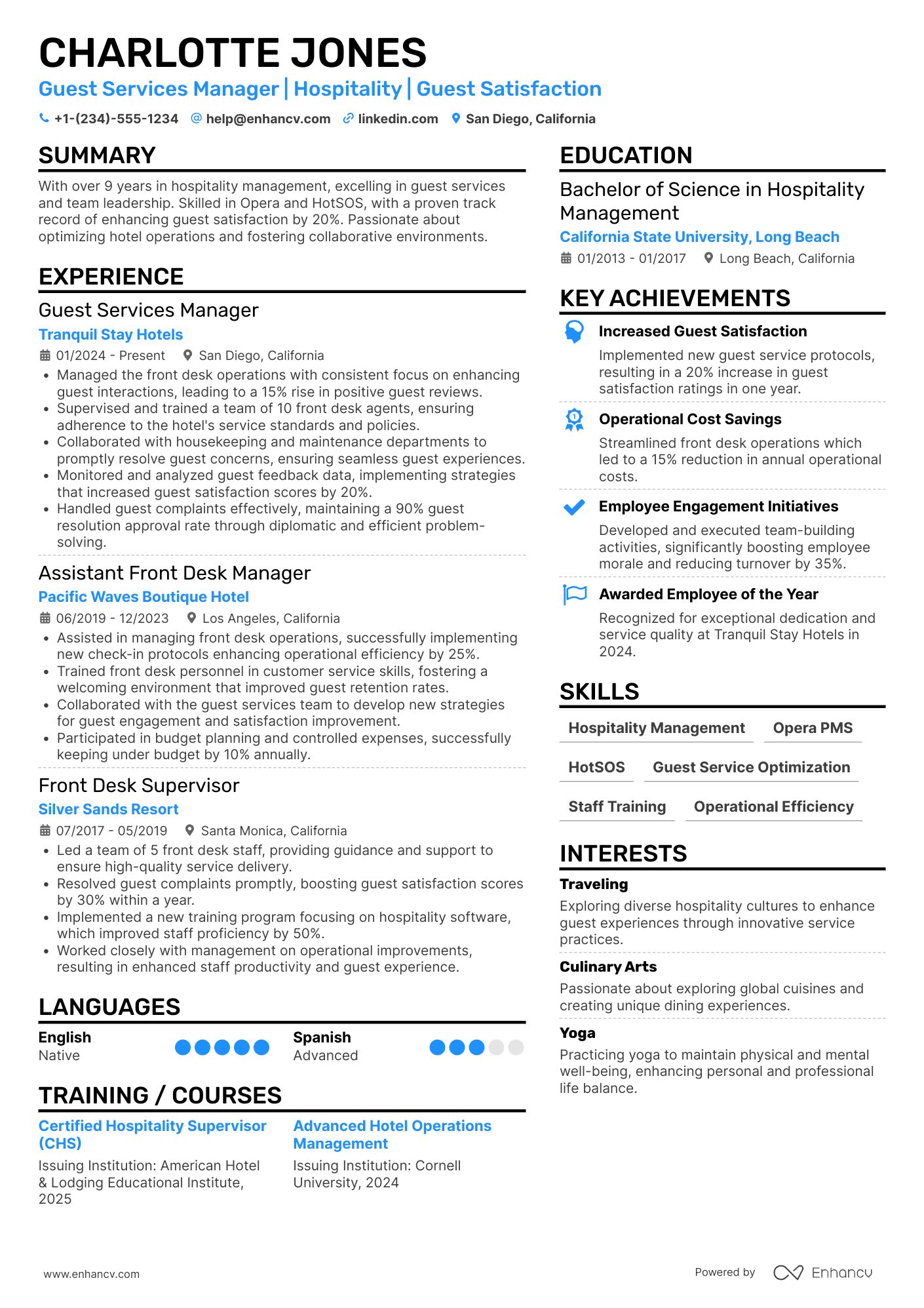
Many hospitality manager resume drafts fail because they read like shift checklists, not hiring evidence. That forces recruiters to guess your impact during rapid scans, and it also weakens your odds in applicant tracking system screening and crowded applicant pools.
When the GM is ready to call, the next document they open is your hospitality cover letter, which is where you explain why this property and what kind of service culture you actually want to build for them.
A strong resume shows what changed because you led the work. Learning how to make your resume stand out starts with highlighting revenue lift, higher guest satisfaction scores, lower labor costs, faster table turns, fewer complaints, stronger audit results, and smoother openings across multiple locations.

Key takeaways
- Quantify guest satisfaction, revenue growth, and service speed in every experience bullet.
- Use reverse-chronological format if you have consistent hospitality work history.
- Tailor each resume to the job posting's systems, standards, and property type.
- Lead with a three- to four-line summary naming your setting, tools, and top results.
- Place certifications like ServSafe near education to signal job-ready compliance knowledge.
- Demonstrate soft skills through measurable outcomes, not vague personality descriptions.
- Use Enhancv to turn routine hospitality duties into focused, results-driven resume bullets.
Job market snapshot for hospitalities
We analyzed 9,470 recent hospitality job ads across major US job boards. These numbers help you understand skills in demand, role specialization trends, salary landscape at a glance.
What level of experience employers are looking for hospitalities
| Years of Experience | Percentage found in job ads |
|---|---|
| 1–2 years | 14.9% (1413) |
| 3–4 years | 3.2% (302) |
| 5–6 years | 2.2% (206) |
| 7–8 years | 0.7% (64) |
| 9–10 years | 0.4% (35) |
| 10+ years | 5.6% (533) |
| Not specified | 73.1% (6919) |
Hospitality ads by area of specialization (industry)
| Industry (Area) | Percentage found in job ads |
|---|---|
| Healthcare | 70.8% (6706) |
| Finance & Banking | 19.7% (1865) |
| Education | 6.5% (612) |
| Government | 1.9% (181) |
| Retail & E-commerce | 0.5% (46) |
| Travel & Hospitality | 0.2% (19) |
| Manufacturing | 0.2% (15) |
Top companies hiring hospitalities
| Company | Percentage found in job ads |
|---|---|
| Mercy Health | 8.2% (781) |
| Bon Secours Mercy Health | 5.4% (515) |
| Orlando Health | 4.8% (457) |
| Allied Universal Security | 3.4% (324) |
| Charleston Area Medical Center | 2.9% (273) |
| Highmark Inc. | 2.2% (205) |
| Trinity Health Corporation | 2.2% (204) |
| St. Peters Health Partners | 1.8% (170) |
| UofL Health | 1.8% (170) |
| ProMedica | 1.6% (153) |
Role overview stats
These tables show the most common responsibilities and employment types for hospitality roles. Use them to align your resume with what employers expect and to understand how the role is structured across the market.
Day-to-day activities and top responsibilities for a hospitality
| Responsibility | Percentage found in job ads |
|---|---|
| Bls | 11.4% (1079) |
| Patient care | 9.7% (923) |
| Basic life support | 9.7% (917) |
| Acls | 8.2% (781) |
| Nursing | 5.7% (538) |
| Documentation | 4.6% (438) |
| Cpr | 4.5% (430) |
| Pals | 3.9% (373) |
| Microsoft office | 3.7% (353) |
| Customer service | 3.5% (332) |
| Patient assessment | 3.5% (332) |
| Epic electronic health record | 3.5% (331) |
How to format a hospitality resume
Hospitality recruiters prioritize guest service skills, operational competence, and a candidate's ability to thrive in fast-paced environments. A clean, well-structured resume format ensures these signals surface quickly during the six to eight seconds a hiring manager typically spends on an initial scan.

I have significant experience in hospitality—which format should I use?
Use a reverse-chronological format to place your strongest and most recent hospitality roles front and center. Do:
- Lead with your current or most recent position, highlighting operational scope such as team size, property type, revenue volume, or number of covers per service.
- Feature role-specific competencies like POS systems (Toast, Aloha, Micros), reservation platforms (Opera, Resy), food safety certifications, or front-of-house management.
- Quantify outcomes tied to guest satisfaction, revenue growth, cost reduction, or staff retention.
I'm junior or switching into hospitality—what format works best?
A hybrid format works well here, letting you lead with relevant skills while still showing any work history that demonstrates reliability and people-facing experience. Do:
- Place a skills section near the top of your resume, grouping hospitality-relevant abilities like guest relations, food handling, conflict resolution, or point-of-sale proficiency.
- Include projects, internships, volunteer events, or part-time roles where you interacted with customers, managed logistics, or worked under time pressure—even outside hospitality.
- Connect every skill or experience to a clear action and a tangible result so recruiters see what you can deliver, not just what you claim to know.
When does a functional resume make sense?
A functional format is rarely the strongest choice for hospitality roles, but it can work in a narrow set of circumstances:
- You're transitioning from a related service industry (retail, event planning, tourism) and need to reframe transferable skills like scheduling, customer communication, or inventory management.
- You have a gap in employment but completed relevant certifications, food safety training, or hospitality coursework during that time.
- Your work history is limited to informal or seasonal roles that don't translate well into a traditional chronological layout.
Once you've settled on the right format, it's time to fill it with the sections that hiring managers in hospitality expect to see.
What sections should go on a hospitality resume
Recruiters expect a hospitality resume to show clear guest service impact, operational reliability, and measurable performance. Knowing what to put on a resume helps you prioritize the right content from the start.
Use this structure for maximum clarity:
- Header
- Summary
- Experience
- Skills
- Projects
- Education
- Certifications
- Optional sections: Awards, Languages, Volunteering
Your experience bullets should highlight guest satisfaction outcomes, service speed or quality improvements, revenue impact, and the scope of responsibilities you owned.
Is your resume good enough?
Drop your resume here or choose a file. PDF & DOCX only. Max 2MB file size.
Once you’ve organized your resume with the right core components, focus next on writing your hospitality experience section so hiring managers can quickly see your impact in each role.
How to write your hospitality resume experience
Your work experience section is the core of your hospitality resume—it should spotlight the service standards you've upheld, the tools and systems you've operated, and the measurable guest satisfaction or revenue outcomes you've driven. Hiring managers in hospitality prioritize demonstrated impact over descriptive task lists, so every line needs to prove you delivered real results in fast-paced, guest-facing environments.
Each entry should include:
- Job title
- Company and location (or remote)
- Dates of employment (month and year)
Three to five concise bullet points showing what you owned, how you executed, and what outcomes you delivered:
- Ownership scope: the front-of-house operations, dining rooms, guest service desks, housekeeping floors, event spaces, or teams you were directly accountable for managing on a daily basis.
- Execution approach: the reservation platforms, point-of-sale systems, property management software, service recovery frameworks, or scheduling methods you used to coordinate operations and make staffing or service decisions.
- Value improved: changes to guest satisfaction scores, table turnover efficiency, room readiness timelines, health and safety compliance, service consistency, or waste reduction that you influenced through your work.
- Collaboration context: how you partnered with kitchen teams, event coordinators, vendors, housekeeping staff, maintenance crews, or corporate management to deliver seamless guest experiences across departments.
- Impact delivered: outcomes expressed through occupancy improvements, revenue growth, repeat guest rates, online review ratings, or operational cost savings rather than a simple list of daily duties.
Experience bullet formula
A hospitality experience example
✅ Right example - modern, quantified, specific.
Guest Experience Manager
Harborview Hotel Group | San Diego, CA
2022–Present
Four-star, 220-room waterfront hotel with high-volume leisure and corporate travel, averaging 82% annual occupancy.
- Led daily operations across front office and concierge using Opera Property Management System (property management system) and HotSOS, cutting average check-in time from 6.2 to 4.1 minutes and improving guest satisfaction score from 4.3 to 4.6 in Medallia.
- Implemented a service recovery workflow in Zendesk integrated with Opera Property Management System (property management system), reducing unresolved guest cases older than 24 hours by 58% and increasing issue resolution within one hour from 41% to 67%.
- Partnered with revenue management and sales to optimize room upgrade and late checkout offers in Revinate and Salesforce, increasing ancillary revenue by 14% year over year and lifting upsell conversion from 9% to 13%.
- Built a staffing forecast model in Microsoft Excel and Power BI using occupancy, arrival patterns, and event calendars, reducing overtime spend by 11% while maintaining a 1:45 guest-to-agent peak ratio.
- Coordinated with housekeeping, engineering, and food and beverage leaders to standardize VIP and group arrival playbooks in Microsoft Teams, improving on-time room readiness for early arrivals by 19% and cutting guest complaint rate by 23%.
Now that you've seen what a strong hospitality experience section looks like, let's break down how to tailor yours to match the specific role you're applying for.
How to tailor your hospitality resume experience
Recruiters evaluate hospitality resumes through a combination of human review and applicant tracking systems (ATS). Tailoring your resume to the job description ensures your qualifications align directly with what the employer needs.
Ways to tailor your hospitality experience:
- Match property management systems and reservation platforms named in the posting.
- Mirror the exact service standards or brand terminology the employer uses.
- Reflect occupancy rates or guest satisfaction KPIs the role prioritizes.
- Highlight food safety or health compliance certifications the listing requires.
- Emphasize front-of-house or back-of-house focus based on the role.
- Include relevant experience with the property type or hospitality segment.
- Reference team coordination models or shift management workflows they describe.
- Align your language with quality assurance or brand audit processes mentioned.
Tailoring means framing your real accomplishments in the language of each job posting, not forcing in keywords where they don't belong.
Resume tailoring examples for hospitality
| Job description excerpt | Untailored | Tailored |
|---|---|---|
| "Manage front desk operations using Opera PMS, ensure smooth guest check-in/check-out, and resolve guest complaints within 15 minutes." | Handled front desk duties and helped guests with their needs. | Managed daily front desk operations in Opera PMS for a 250-room hotel, maintaining an average check-in time of three minutes and resolving 95% of guest complaints within the 15-minute service window. |
| "Coordinate banquet events for up to 500 guests, working with the culinary team on BEO execution and ensuring compliance with health and safety codes." | Assisted with event planning and food service tasks. | Coordinated banquet event orders (BEOs) for functions of up to 500 guests, collaborating directly with the culinary team to execute menus on schedule while maintaining full compliance with local health and safety codes. |
| "Drive RevPAR growth through upselling suite upgrades, managing OTA listings on Expedia and Booking.com, and optimizing rate strategies in IDeaS RMS." | Worked on increasing hotel revenue and managing online bookings. | Increased RevPAR by 18% year over year by executing upsell strategies for suite upgrades at check-in and optimizing rate positioning across Expedia and Booking.com using IDeaS RMS demand forecasting tools. |
Once you’ve aligned your experience with the role’s priorities, quantify your hospitality achievements to show the measurable impact of that work.
How to quantify your hospitality achievements
Quantifying your achievements proves you improved guest experience and business results. Focus on revenue, service speed, satisfaction scores, accuracy, compliance, and volume handled—numbers that show how you raised quality while protecting margins.
Quantifying examples for hospitality
| Metric | Example |
|---|---|
| Revenue growth | "Upsold premium rooms and late checkouts, adding $18,400 in monthly revenue while maintaining a 4.7/5 guest rating." |
| Service speed | "Cut average check-in time from six minutes to four by pre-assigning rooms in Opera Property Management System and staging key packets." |
| Guest satisfaction | "Raised post-stay satisfaction from 88% to 93% by resolving complaints within fifteen minutes and tracking follow-ups in Medallia." |
| Accuracy rate | "Reduced billing adjustments by 32% by auditing folios nightly and standardizing charge codes across front desk and concierge." |
| Compliance and risk | "Achieved 100% pass rate on quarterly cash-handling audits by retraining eight agents and tightening shift closeout checklists." |
Turn vague job duties into measurable, recruiter-ready resume bullets in seconds with Enhancv's Bullet Point Generator.
Once you've crafted strong bullet points for your experience section, you'll want to apply that same precision to presenting your hard and soft skills on a hospitality resume.
How to list your hard and soft skills on a hospitality resume
Your skills section shows you can deliver guest satisfaction and smooth operations, and recruiters and an ATS (applicant tracking system) scan this section to confirm role fit fast—aim for a balanced mix of technical hard skills and job-specific soft skills. Hospitality roles require a blend of:
- Product strategy and discovery skills.
- Data, analytics, and experimentation skills.
- Delivery, execution, and go-to-market discipline.
- Soft skills.
Your skills section should be:
- Scannable (bullet-style grouping).
- Relevant to the job post.
- Backed by proof in experience bullets.
- Updated with current tools.
Place your skills section:
- Above experience if you're junior or switching careers.
- Below experience if you're mid/senior with strong achievements.

Hard skills
- Opera Property Management System, Cloudbeds
- OpenTable, Resy
- Toast Point of Sale, Square Point of Sale
- SevenRooms guest profiles
- Revenue management and pricing
- Labor scheduling and forecasting
- Inventory control and purchasing
- Food safety and sanitation compliance
- Cash handling and reconciliation
- Guest recovery workflows
- Upselling and add-on tracking
- Event and banquet operations
Soft skills
- De-escalate guest complaints fast
- Prioritize during peak service
- Coordinate across front and back of house
- Communicate clear shift handoffs
- Train and coach new hires
- Hold teams to service standards
- Make judgment calls with limited info
- Manage vendor and partner communication
- Adapt to last-minute schedule changes
- Resolve conflicts between staff
- Maintain composure under pressure
- Follow through on closing tasks
How to show your hospitality skills in context
Skills shouldn't live only in a dedicated skills list. You can explore common resume skills across hospitality roles to identify which ones match your background.
They should be demonstrated in:
- Your summary (high-level professional identity)
- Your experience (proof through outcomes)
Here's what that looks like in practice.
Summary example
Senior hotel operations leader with 12 years managing luxury properties. Skilled in revenue management, Opera PMS, and guest experience strategy. Boosted guest satisfaction scores by 18% through staff training and service redesign.
- Reflects senior-level expertise clearly
- Names industry-relevant tools
- Includes a measurable outcome
- Signals strong leadership soft skills
Experience example
Director of Guest Services
The Bellamy Hotel Group | Charleston, SC
March 2019–Present
- Redesigned front-desk workflows using Opera PMS, reducing average check-in time by 35% across three properties.
- Partnered with the F&B and housekeeping teams to launch a VIP welcome program, lifting repeat-guest bookings by 22%.
- Trained and mentored a 40-person guest services team on conflict resolution, cutting formal complaints by 28% year over year.
- Every bullet contains measurable proof
- Skills surface naturally through outcomes
Once you’ve tied your customer service strengths to real situations, the next step is learning how to write a hospitality resume with no experience so you can present those examples effectively.
How do I write a hospitality resume with no experience
How do I write a hospitality resume with no experience?
Even without full-time experience, you can demonstrate readiness through:
- Catering or banquet volunteer shifts
- Campus dining or café work
- Event check-in and guest support
- Fundraising galas or ticketing
- Customer-facing retail cashiering
- Food safety or alcohol training
- Club hospitality or front desk
If you're starting out, our guide on writing a resume without work experience covers strategies that apply directly to hospitality candidates.
Focus on:
- Customer volume handled per shift
- Cash handling and POS accuracy
- Scheduling reliability and availability
- Food safety and compliance training
Resume format tip for entry-level hospitality
Use a combination resume format to lead with skills and relevant projects, then list experience. It helps recruiters spot hospitality readiness fast. Do:
- Add a short hospitality summary.
- List tools like POS systems.
- Quantify guests served and transactions.
- Include food safety certifications and dates.
- Tailor bullets to the job posting.
- Volunteered at a fundraising gala, used Square POS to process 120 payments with zero discrepancies and kept a three-minute average guest wait time.
Even without direct experience, your education section can demonstrate relevant knowledge and training that strengthens your candidacy—here's how to present it effectively.
How to list your education on a hospitality resume
Your education section helps hiring teams confirm you have the foundational knowledge hospitality roles demand. It validates your training in guest services, operations, and business principles.
Include:
- Degree name
- Institution
- Location
- Graduation year
- Relevant coursework (for juniors or entry-level candidates)
- Honors & GPA (if 3.5 or higher)
Avoid listing specific months or days. Use the graduation year only for a cleaner format.
Here's a strong education entry tailored to hospitality:
Example education entry
Bachelor of Science in Hospitality Management
Cornell University, Ithaca, NY
Graduated 2023
GPA: 3.7/4.0
- Relevant Coursework: Revenue Management, Food & Beverage Operations, Hotel Financial Analysis, Guest Experience Strategy
- Honors: Dean's List (six consecutive semesters), National Society of Minorities in Hospitality Scholar
How to list your certifications on a hospitality resume
Certifications on your resume show your commitment to learning, prove tool proficiency, and signal industry relevance in hospitality, especially when you lack long experience or changed roles recently.
Include:
- Certificate name
- Issuing organization
- Year
- Optional: credential ID or URL
- Place certifications below education when they're older, less relevant, or you want your degree or training to lead.
- Place certifications above education when they're recent, role-relevant, or required for hospitality roles you target.
Best certifications for your hospitality resume
- ServSafe Food Handler
- ServSafe Manager
- TIPS (Training for Intervention ProcedureS) Alcohol Certification
- Certified Hospitality Supervisor (CHS)
- Certified Hospitality Department Trainer (CHDT)
- AHLEI Certified Guest Service Professional (CGSP)
- CPR and First Aid Certification
Now that you’ve positioned your credentials where hiring managers can spot them quickly, you’re ready to write your hospitality resume summary to reinforce those qualifications upfront.
How to write your hospitality resume summary
Your resume summary is the first thing a recruiter reads when reviewing your application. A strong opening instantly signals you have the skills and service mindset the role demands.
Keep it to three to four lines, with:
- Your current title and total years of hospitality experience.
- The type of setting you've worked in, such as hotels, resorts, or restaurants.
- Core skills like guest relations, POS systems, or reservation platforms.
- One or two measurable wins, such as improved guest scores or reduced wait times.
- Soft skills tied to real results, like communication that boosted team efficiency.

PRO TIP
At the entry level, focus on relevant skills, specific tools you know, and any early results you can quantify. Avoid vague phrases like "passionate team player" or "hardworking go-getter." Recruiters want proof of what you've done, not a list of personality traits.
Example summary for a hospitality
Front desk associate with two years of experience in boutique hotels. Skilled in Opera PMS and guest relations, contributing to a 15% increase in positive review scores.
Optimize your resume summary and objective for ATS
Drop your resume here or choose a file.
PDF & DOCX only. Max 2MB file size.
Now that your summary captures your strongest hospitality qualifications, make sure recruiters can actually reach you by setting up a clear, complete header.
What to include in a hospitality resume header
A resume header is the contact and role summary at the top of your resume, and it boosts visibility, credibility, and recruiter screening in hospitality.
Essential resume header elements
- Full name
- Tailored job title and headline
- Location
- Phone number
- Professional email
- GitHub link
- Portfolio link
A LinkedIn link helps recruiters verify experience quickly and supports screening.
Don't include a photo on a hospitality resume unless the role is explicitly front-facing or appearance-dependent.
Keep your header on one to two lines, match the job title to the posting, and use links that open and load fast.
Example
Hospitality resume header
Jordan Taylor
Restaurant Manager | Hospitality Operations & Guest Experience
Austin, TX
(512) 555-12XX | jordan.taylor@enhancv.com github.com/jordantaylor yourwebsite.com linkedin.com/in/jordantaylor
Once your contact details and role focus are clear at the top, you can strengthen the rest of your application with additional sections for hospitality resumes that add relevant context and support your qualifications.
Additional sections for hospitality resumes
Standing out in hospitality means showing skills beyond the basics. Extra sections help prove your service mindset, cultural awareness, and hands-on industry credibility. For example, listing language skills can be especially valuable in guest-facing roles at international properties or diverse markets.
- Languages
- Certifications (food safety, sommelier, first aid)
- Volunteer experience
- Hobbies and interests
- Awards and recognition
- Professional memberships
Once you've rounded out your resume with the right additional sections, it's worth pairing it with a cover letter to strengthen your overall application.
Do hospitality resumes need a cover letter
A cover letter isn't required for a hospitality role, but it helps in competitive positions or when hiring managers expect one. If you're unsure where to start, understanding what a cover letter is and how it complements your resume can clarify when it's worth writing one. It can make a difference when your resume needs context or your fit isn't obvious.
Use a cover letter to add value in these situations:
- Explain role and team fit by matching your hospitality strengths to the job's scope, pace, and collaboration style.
- Highlight one or two relevant projects or outcomes, and state your role, impact, and what you'd repeat in this hospitality role.
- Show you understand the product, users, or business context by referencing a specific workflow, customer segment, or operational constraint.
- Address career transitions or non-obvious experience by connecting past work to hospitality requirements, and clarifying why the move makes sense.
Drop your resume here or choose a file.
PDF & DOCX only. Max 2MB file size.
Even when you decide a cover letter won’t add value for a hospitality role, using AI to improve your hospitality resume helps you strengthen the document hiring teams review first.
Using AI to improve your hospitality resume
AI can sharpen your resume's clarity, structure, and impact. It helps tighten language and highlight results that matter to hiring managers. But overuse kills authenticity. Once your content feels clear and role-aligned, step away from AI. If you're exploring tools, our breakdown of which AI is best for writing resumes can help you choose the right one for hospitality applications.
Here are 10 practical prompts to strengthen specific sections of your hospitality resume:
- Strengthen your summary. "Rewrite my hospitality resume summary to highlight guest satisfaction results and leadership experience in under four sentences."
- Quantify your impact. "Add measurable outcomes to these hospitality experience bullets, focusing on revenue, guest ratings, or efficiency improvements."
- Tighten bullet points. "Shorten each hospitality experience bullet to one concise line that leads with a strong action verb."
- Align with postings. "Compare my hospitality resume skills section to this job description and suggest missing keywords."
- Improve skills relevance. "Remove generic skills from my hospitality resume and replace them with industry-specific technical and soft skills."
- Refine project descriptions. "Rewrite this hospitality project entry to emphasize my specific role, the challenge, and the measurable result."
- Upgrade education details. "Make my education section more relevant to hospitality by highlighting coursework, honors, or capstone projects."
- Showcase certifications clearly. "Reorganize my hospitality certifications section by relevance to front-of-house and food safety roles."
- Eliminate filler language. "Identify and remove vague or redundant phrases across my entire hospitality resume."
- Tailor for leadership. "Adjust my hospitality experience bullets to emphasize team supervision, training, and scheduling responsibilities."
Stop using AI once your resume sounds accurate, specific, and aligned with real experience. AI should never invent experience or inflate claims—if it didn't happen, it doesn't belong here.
Conclusion
A strong hospitality resume shows measurable outcomes, role-specific skills, and a clear structure. Use numbers to prove impact, highlight the tools and service standards you use, and keep every section easy to scan.
This approach signals you can deliver results in today’s hiring market and adapt as expectations change. With focused content, consistent formatting, and quantified wins, your hospitality resume reads as ready from the first glance.