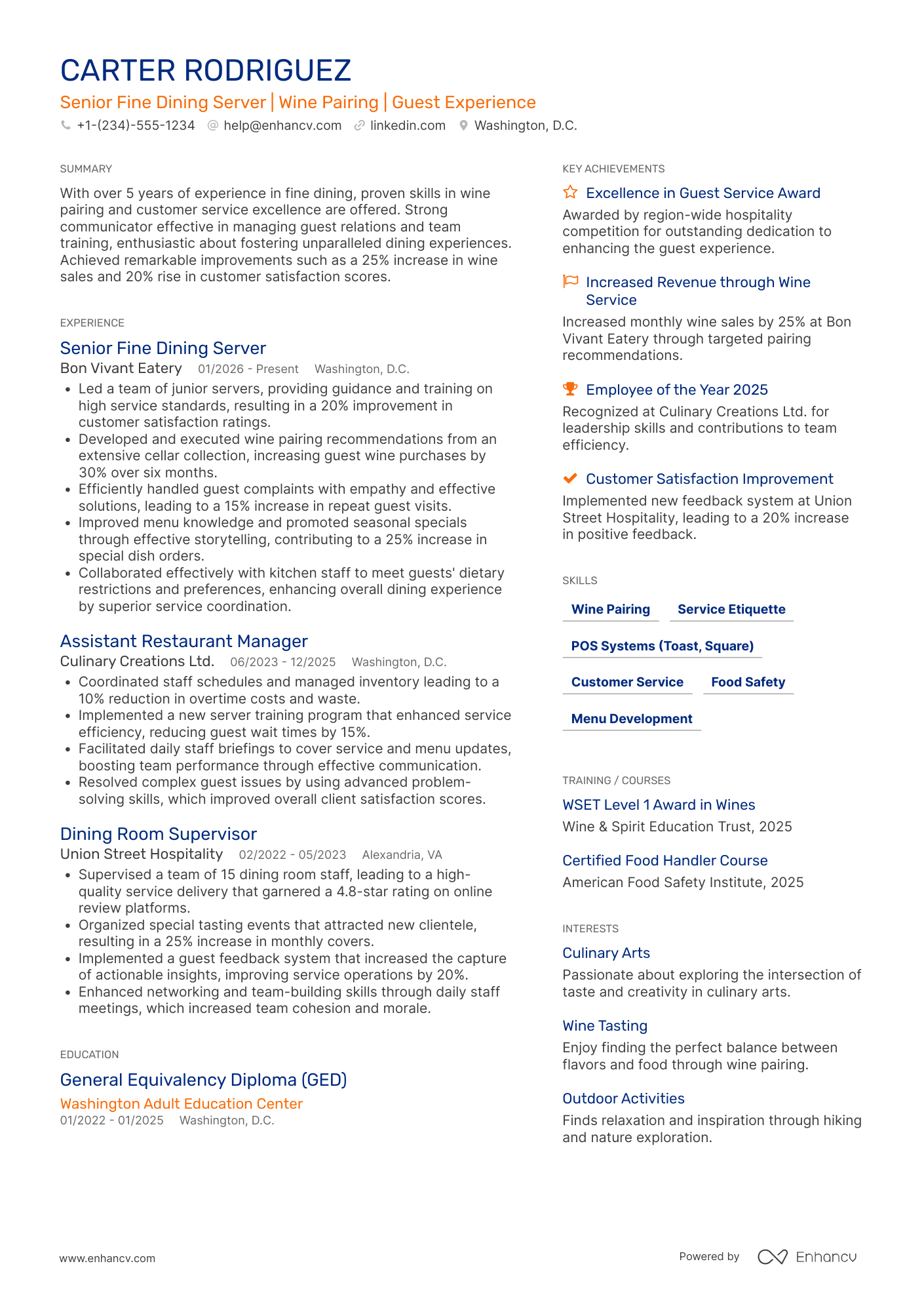
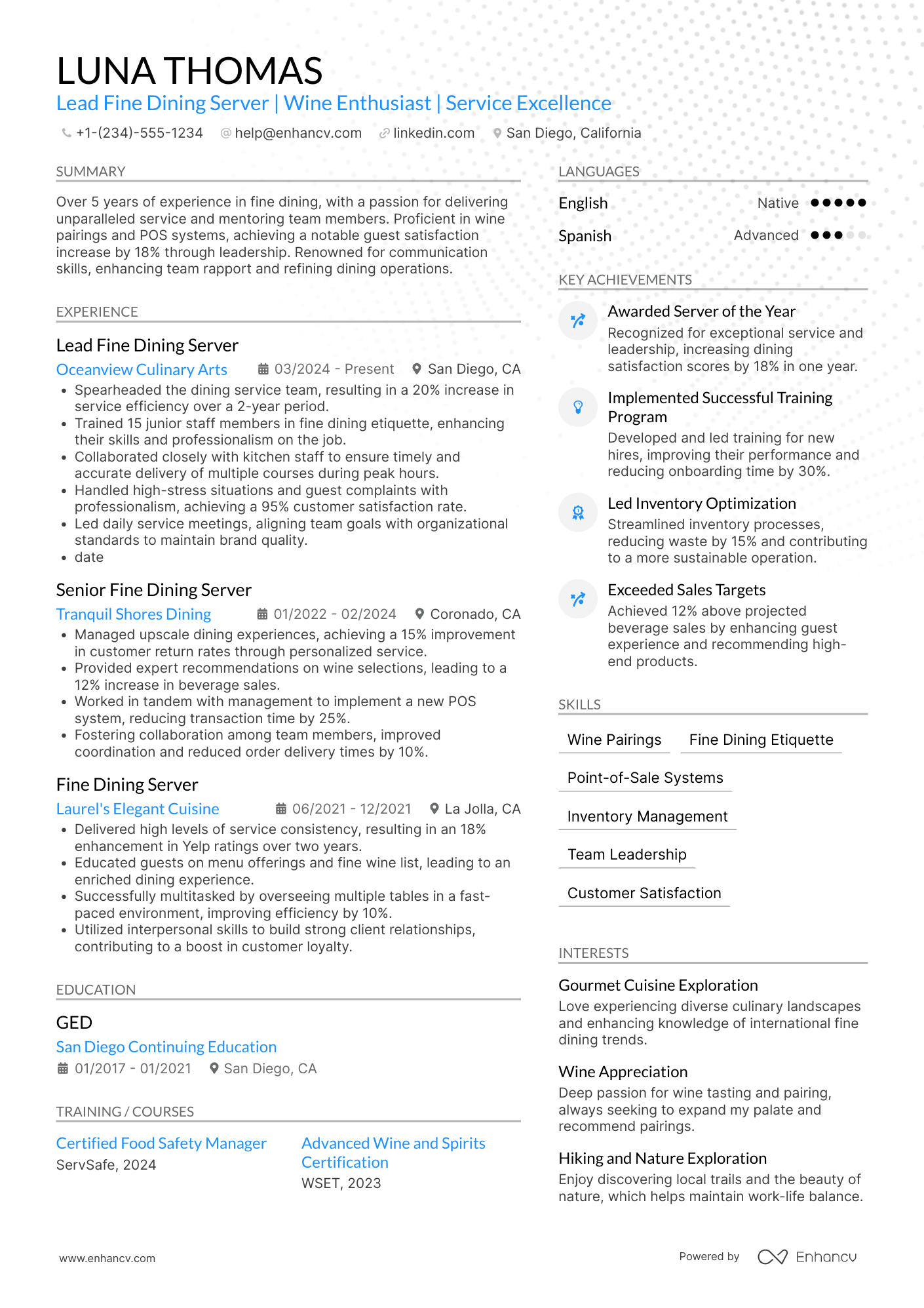
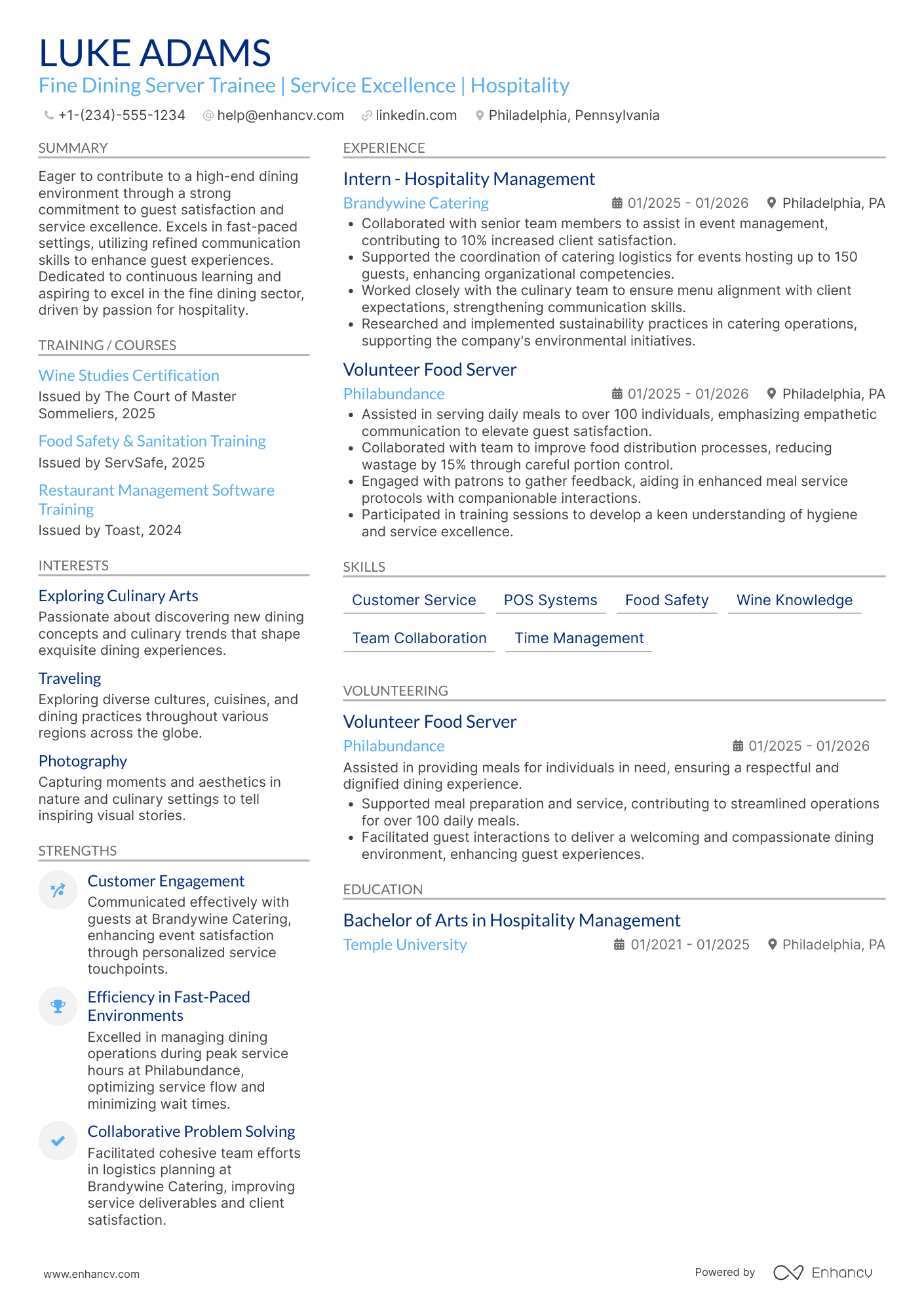
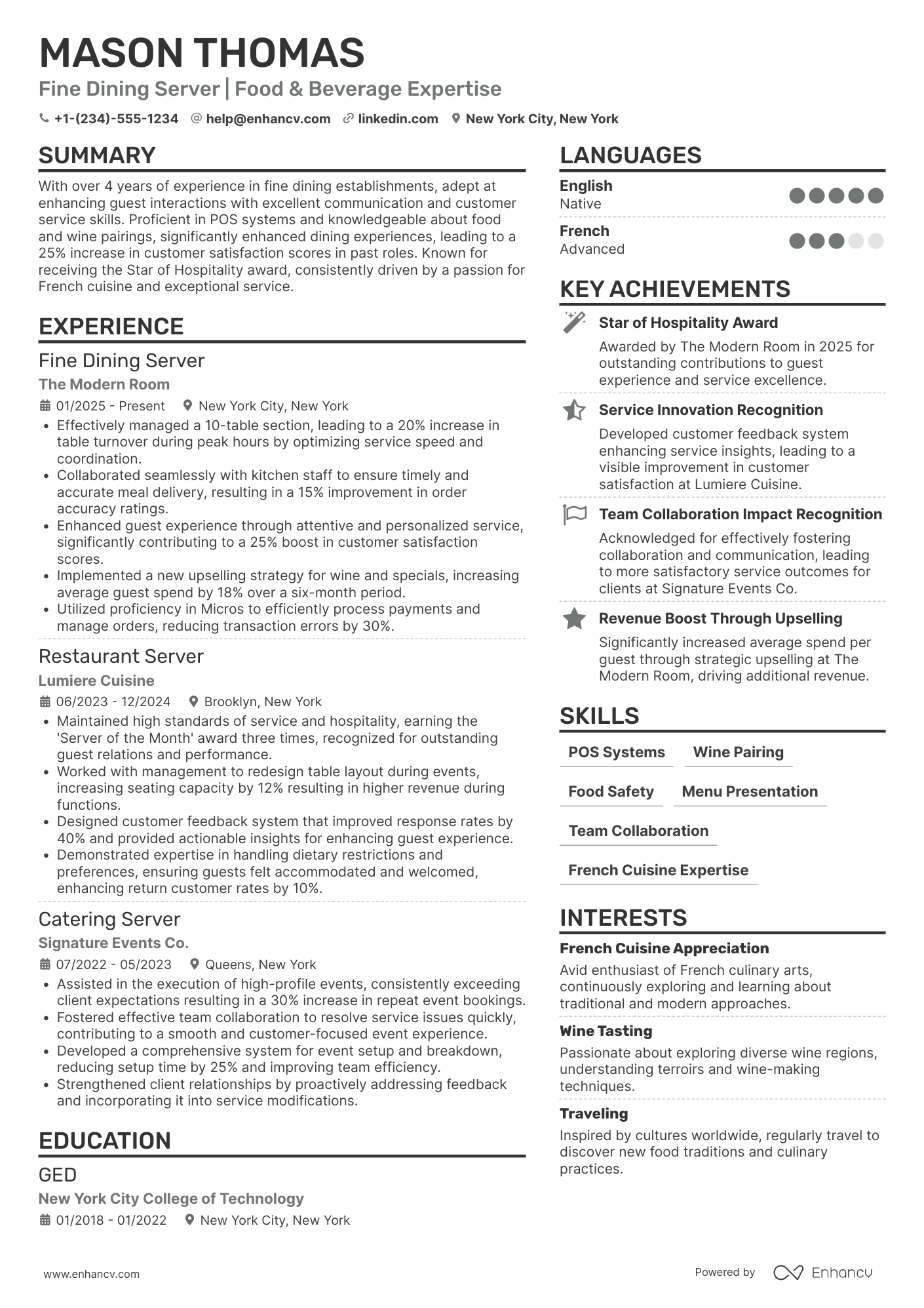
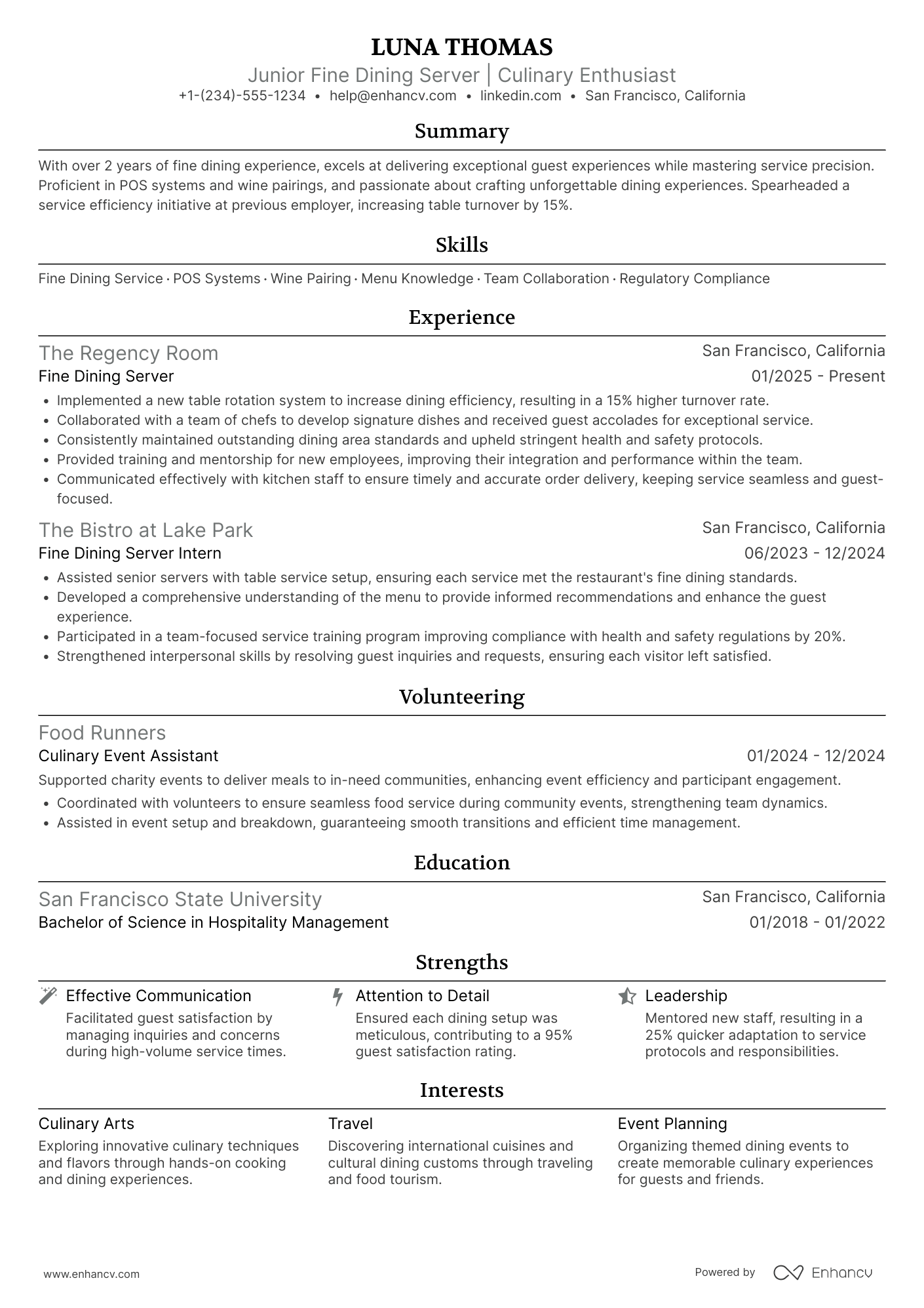
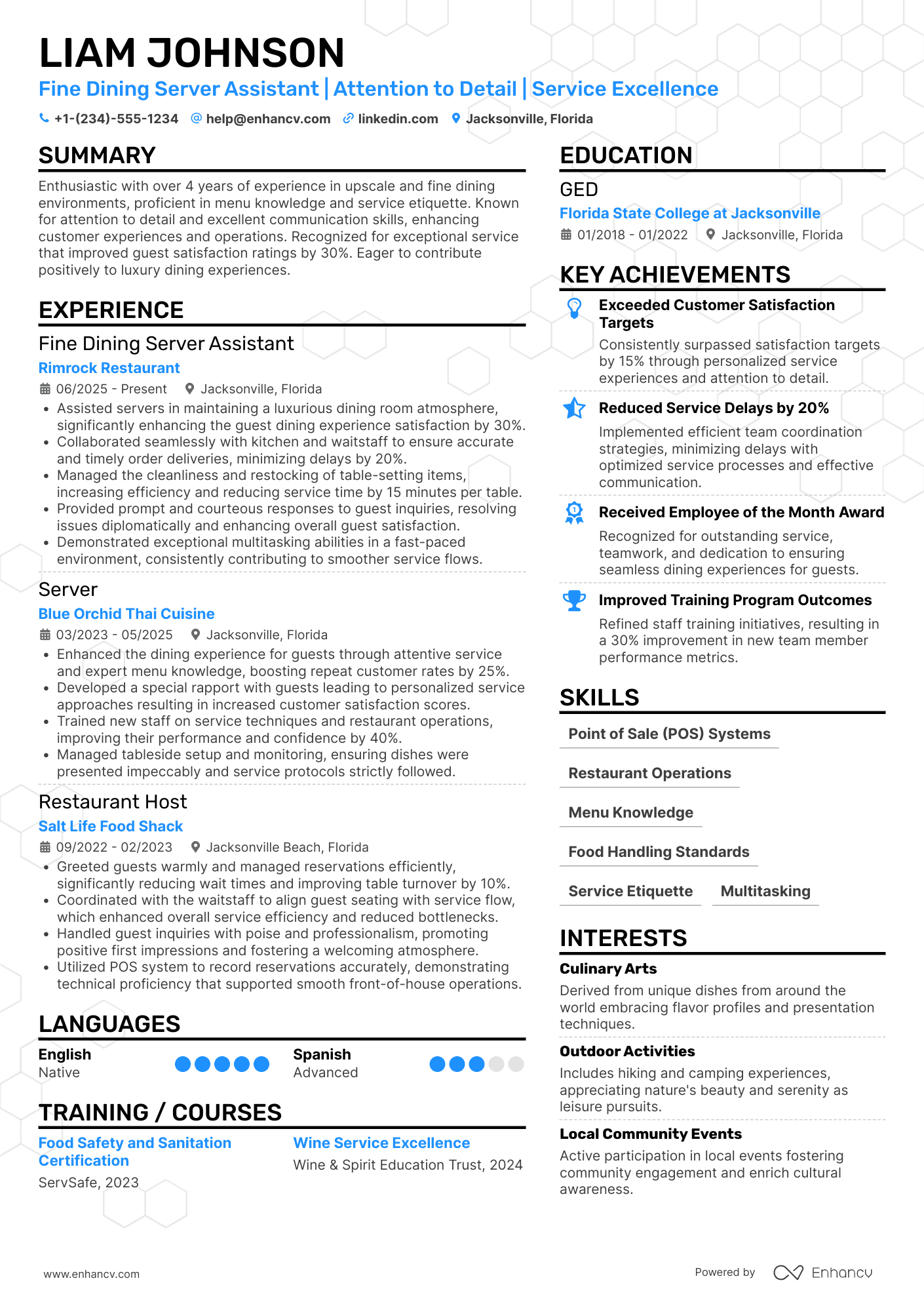
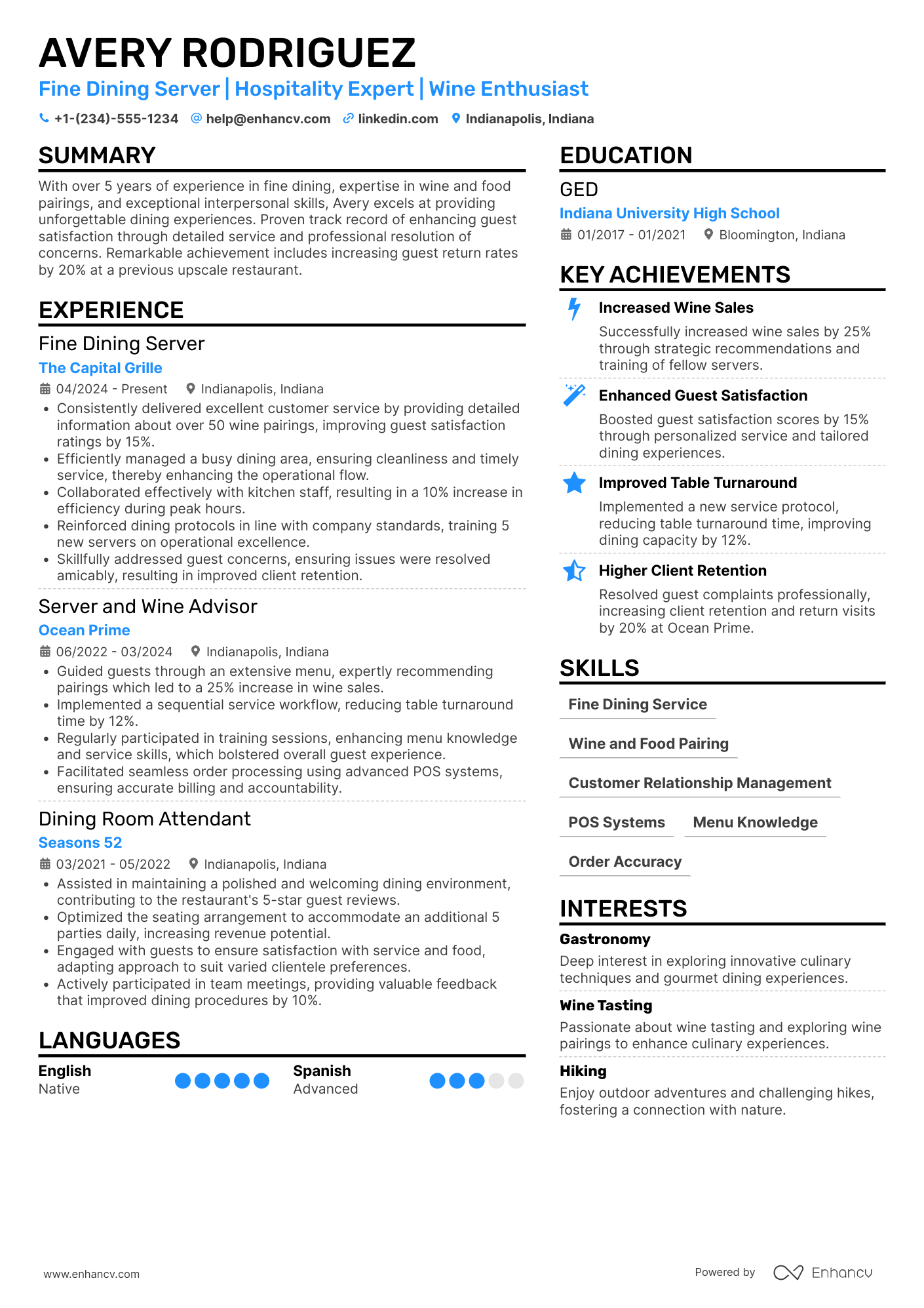
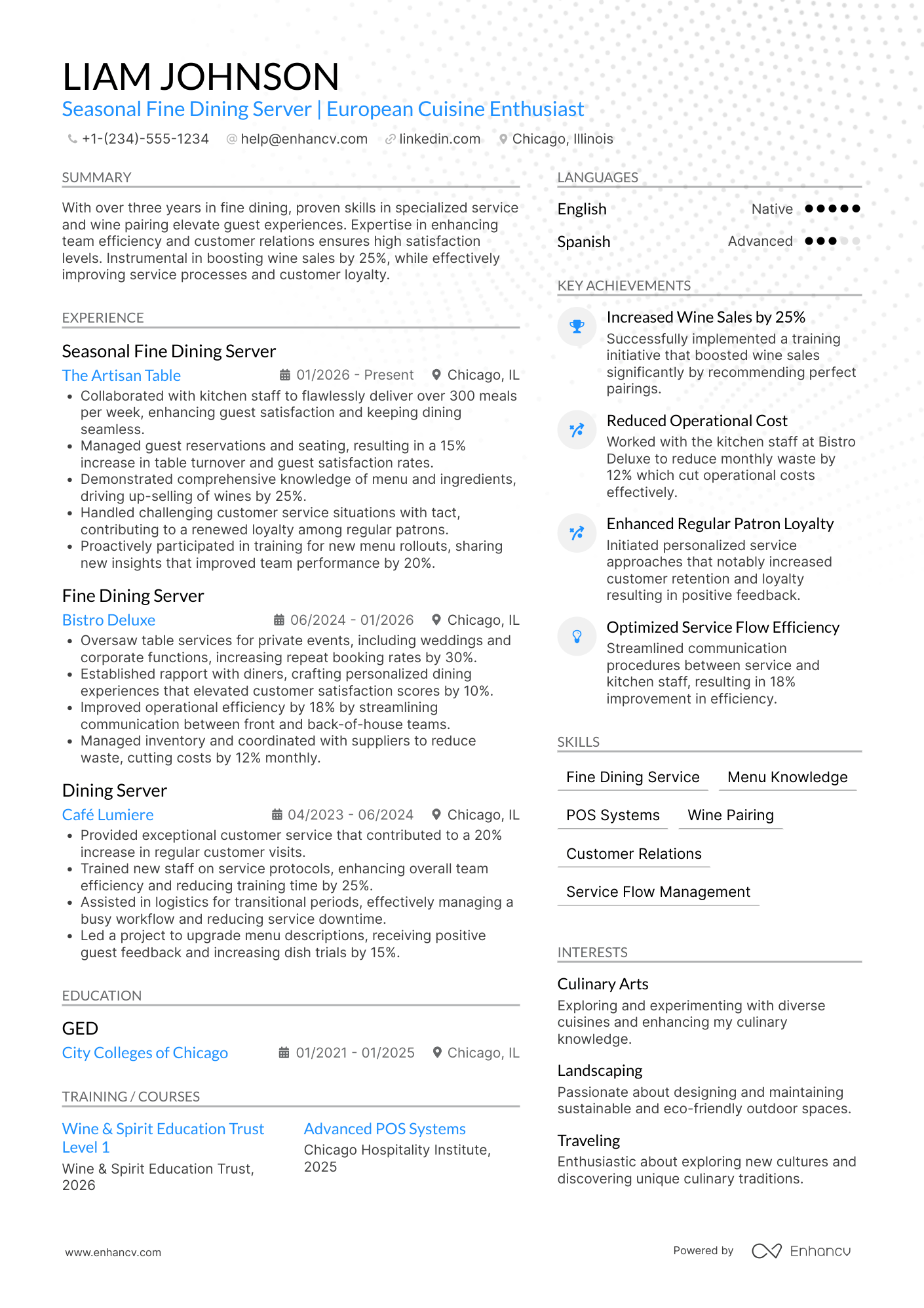
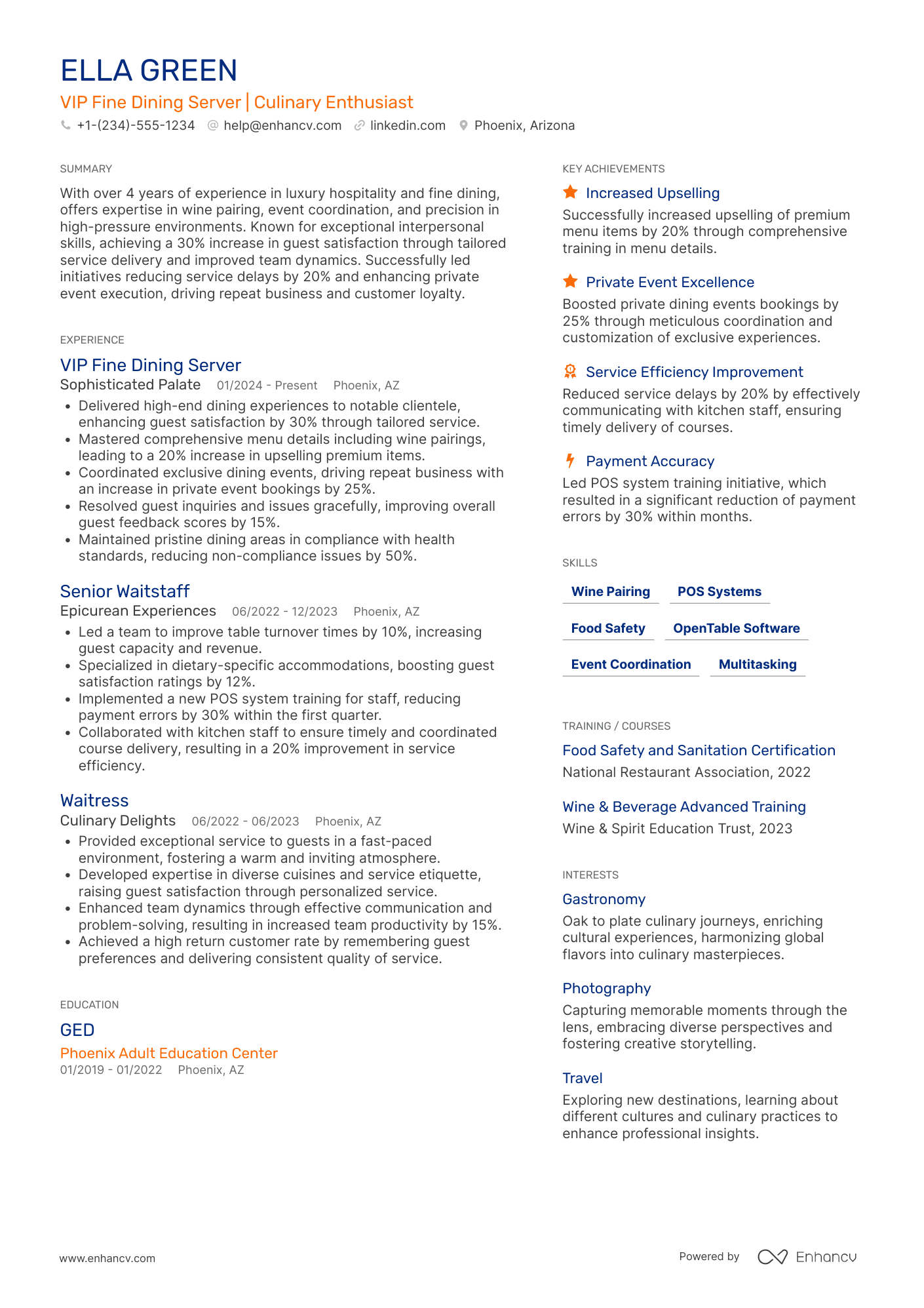
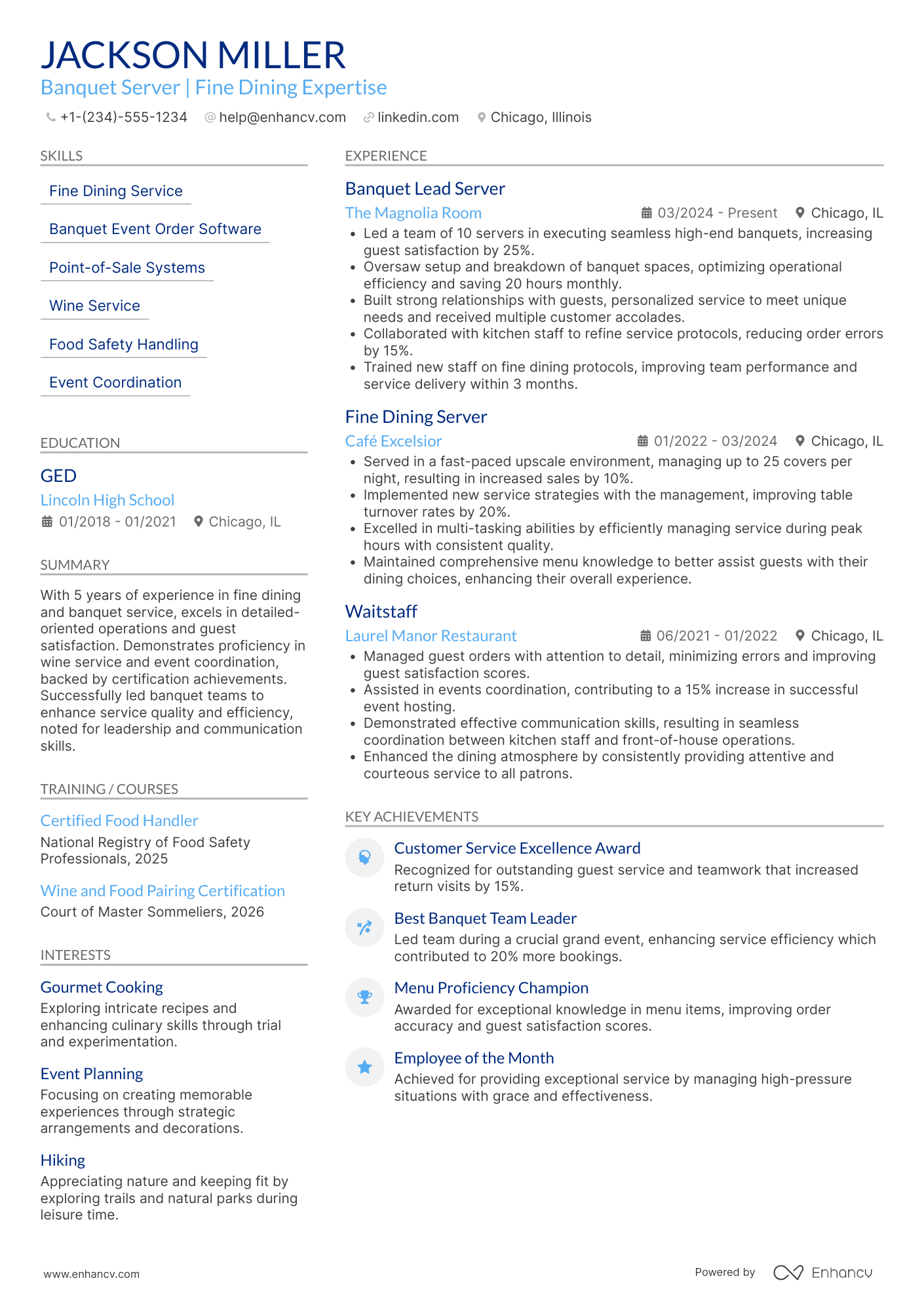
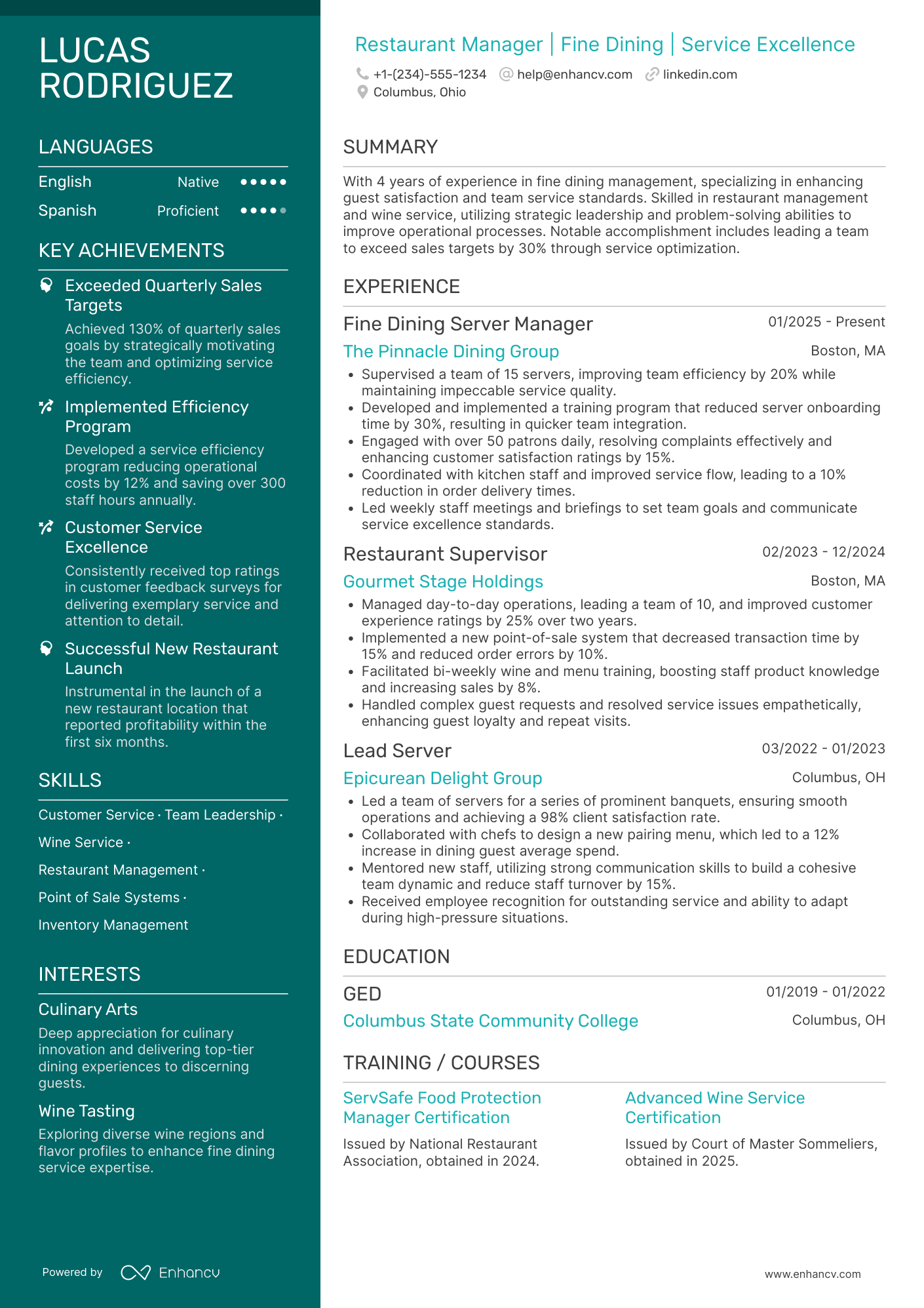
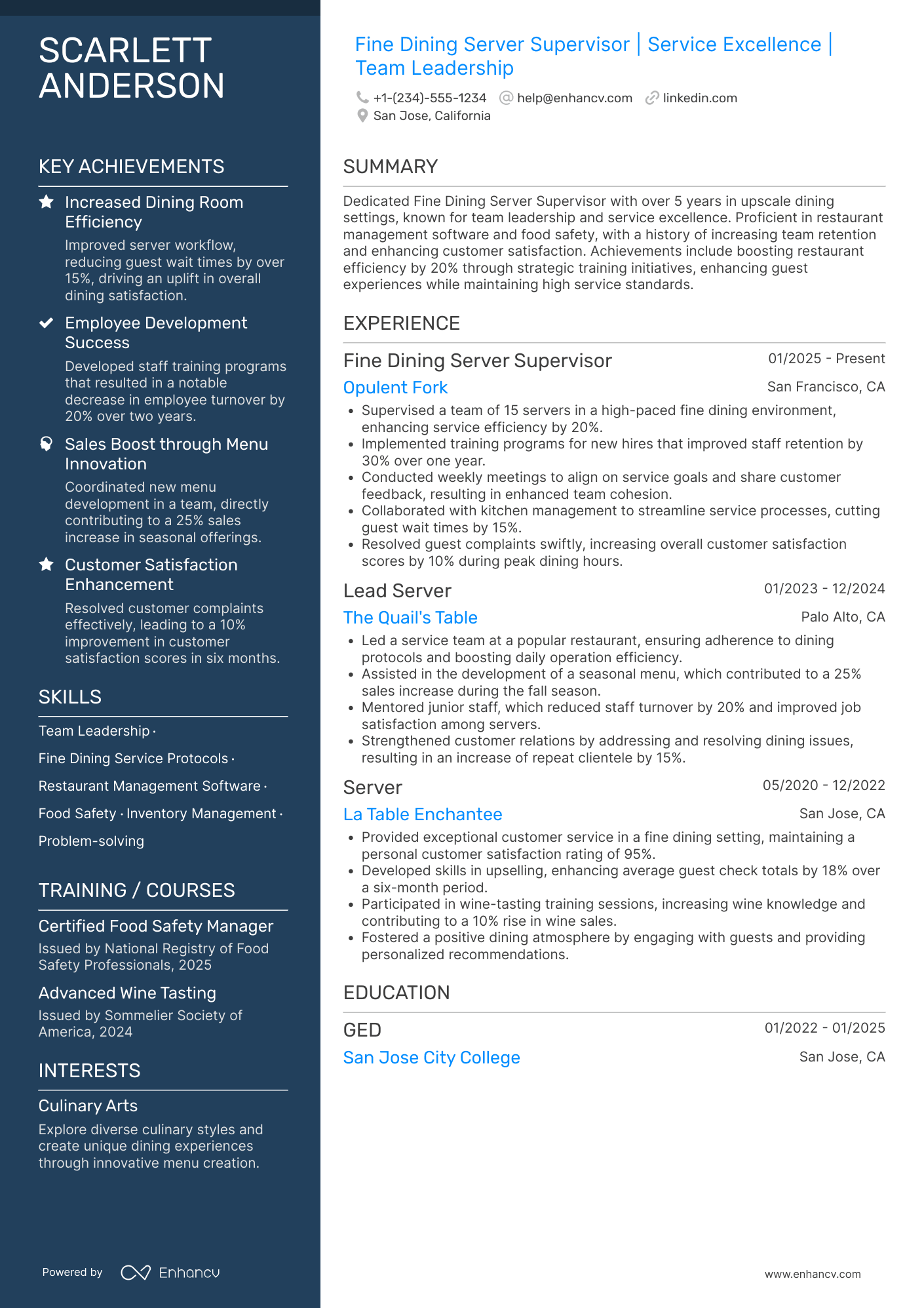
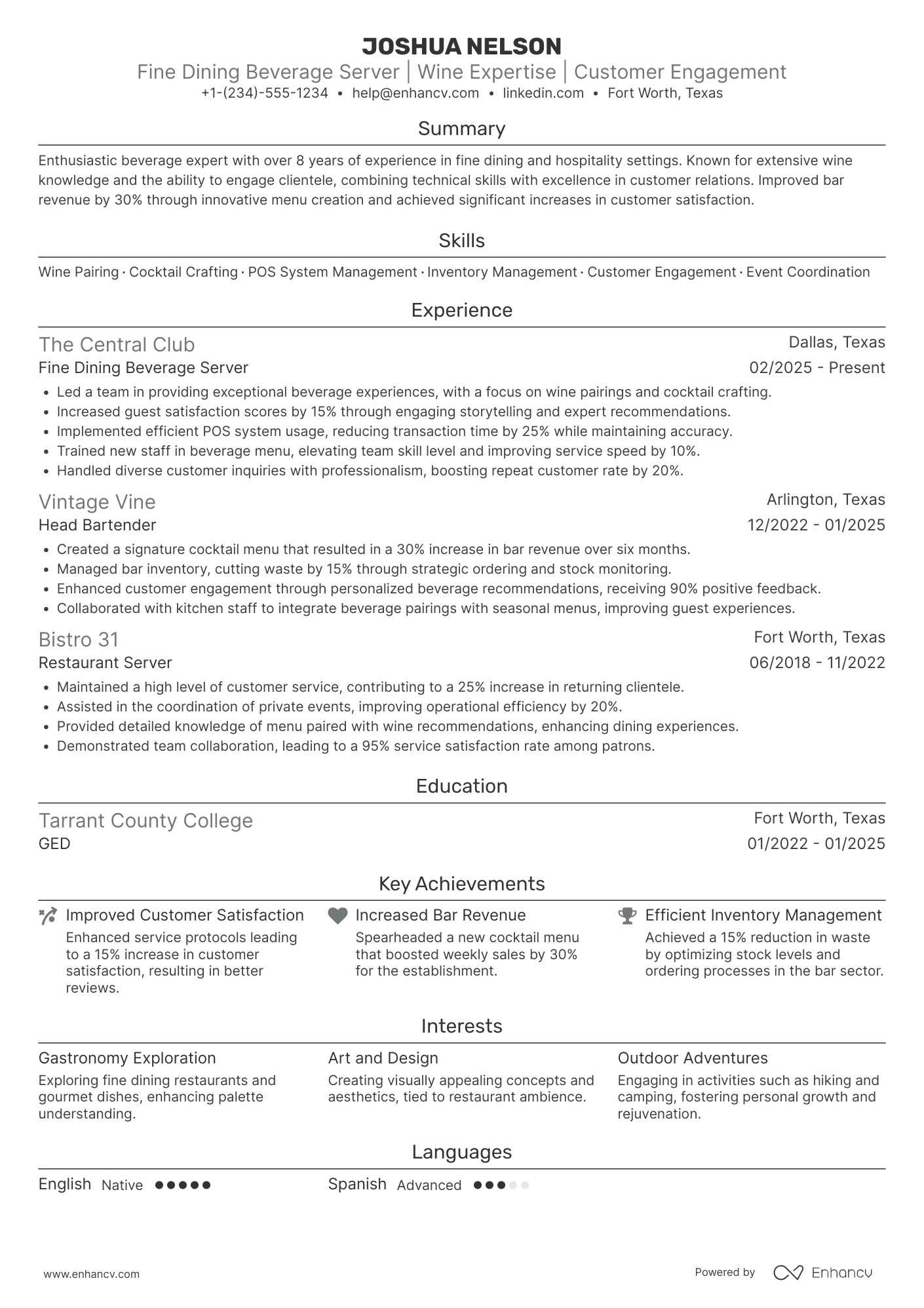
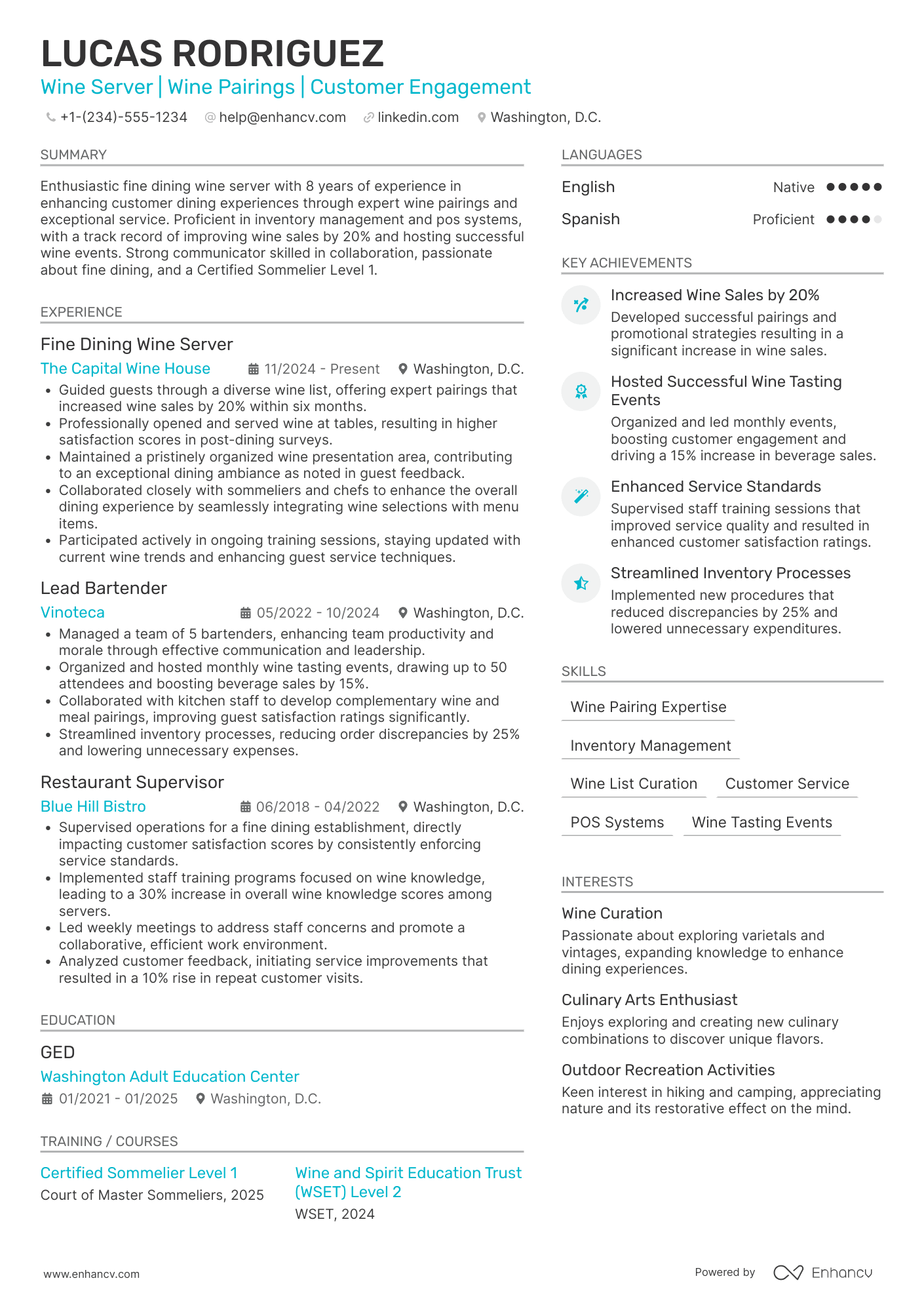
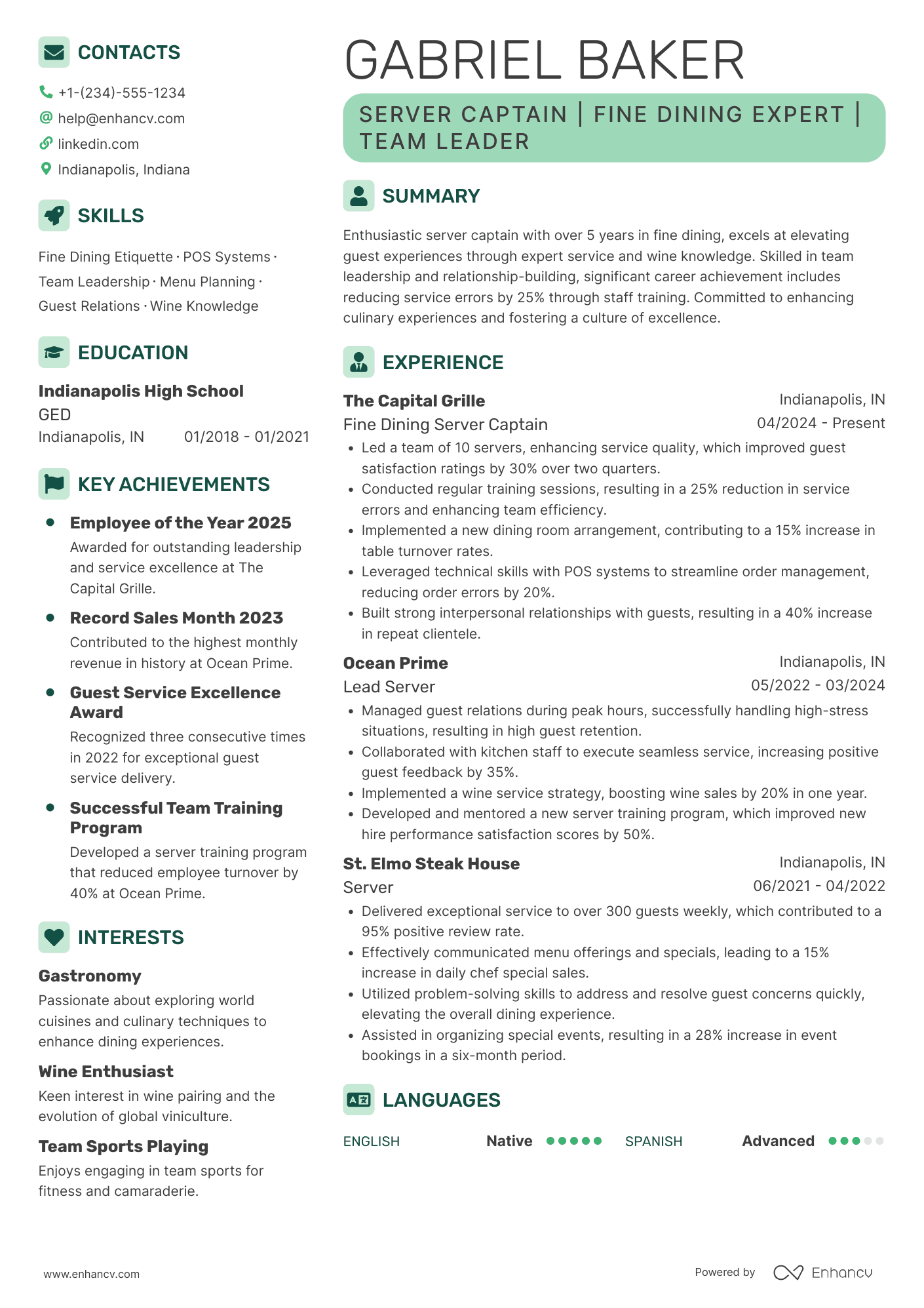
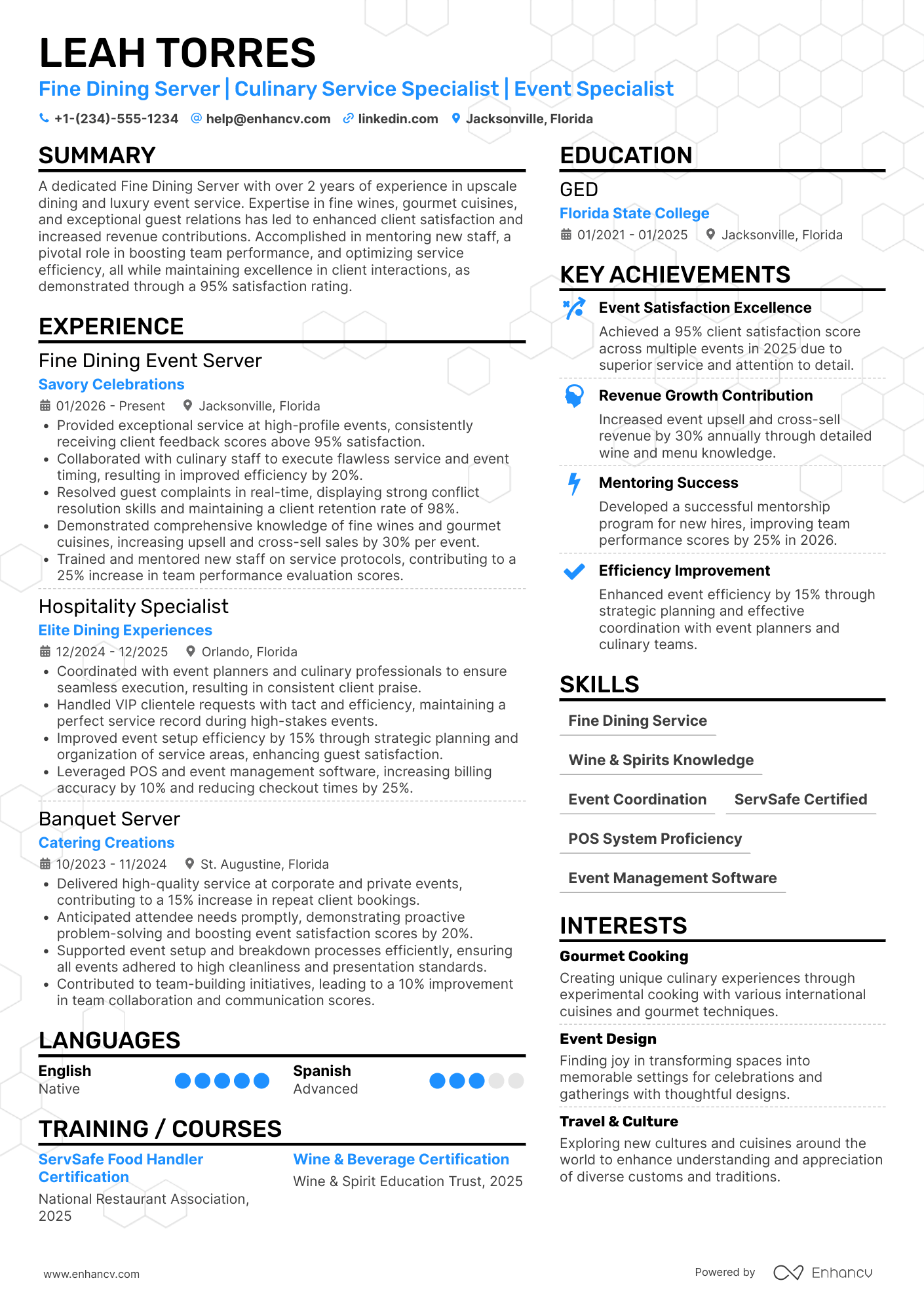
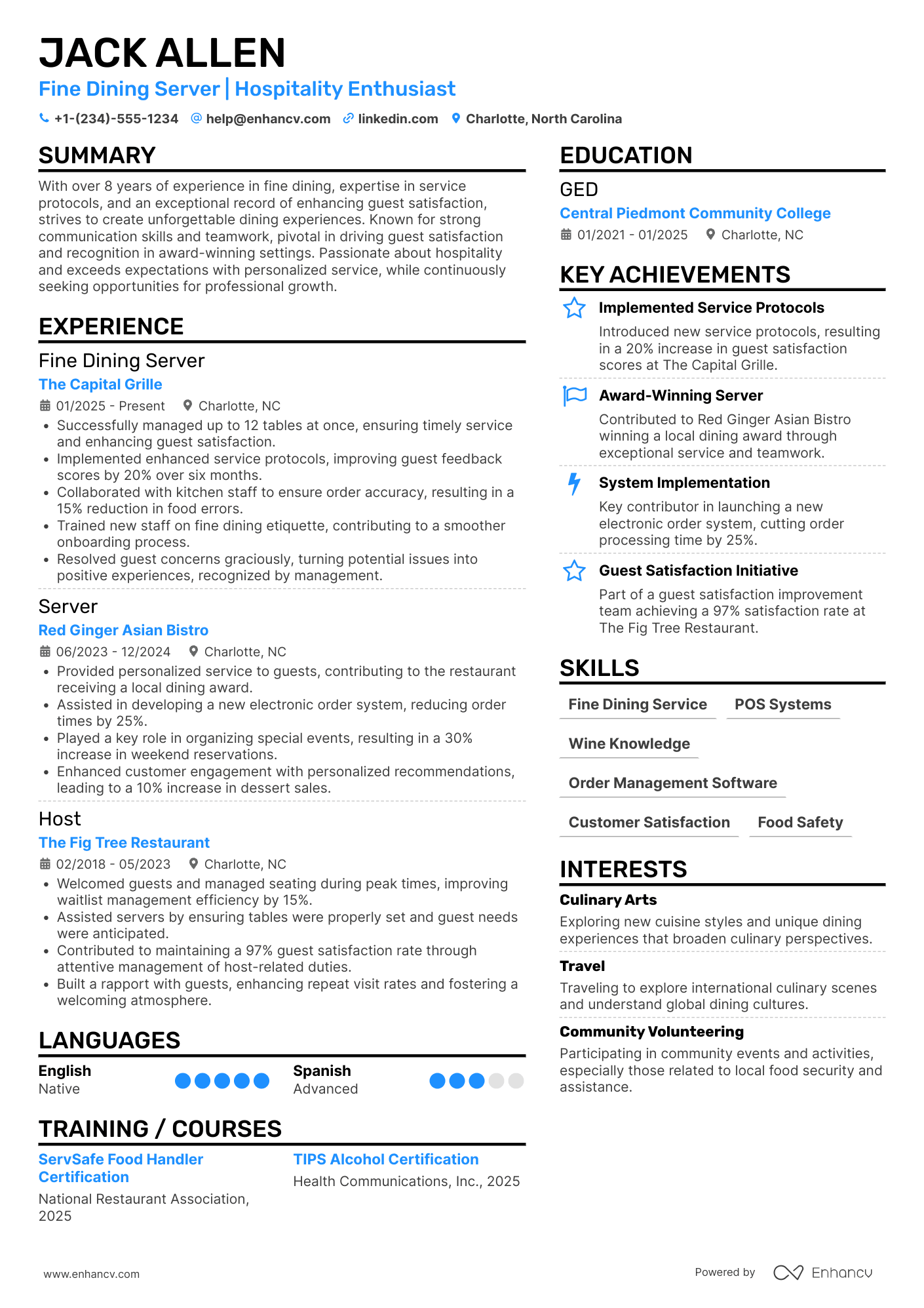
A fine dining server resume often lists duties like taking orders and clearing plates, which every applicant can claim. Restaurant managers scan resumes fast, and applicant tracking system (ATS) filters look for service skills and wine knowledge.
Once you know what a resume is for, treat yours as proof of the guest experience you create. Show check averages, wine and dessert sales, covers per shift, guest reviews, and returning regulars who ask for you.

Key takeaways
- Lead each bullet with a sales or guest result, not a list of duties.
- Quantify check averages, wine sales, and covers served per shift.
- Name the service style, POS system, and wine knowledge you bring.
- Use a reverse-chronological format to show steady growth in fine dining.
- Add sommelier or food safety certifications when you hold them.
- Use Enhancv's Bullet Point Generator to turn service tasks into measurable bullets.
How to format a fine dining server resume
Restaurant managers look first for fine dining experience, wine knowledge, and proof you raise sales while keeping service polished. A clean resume layout puts those strengths where a quick scan finds them.
Resume formatting strategy for fine dining servers
| Category | Senior & leadership strategy | Entry to mid-level strategy |
|---|---|---|
| Recommended format | Reverse-chronological | Reverse-chronological or hybrid |
| Core dos | Lead each role with the restaurant's style, covers per night, and your section size. Name the service programs you led, such as wine service or captain duties. Tie every bullet to sales, reviews, or guest retention. | Put wine knowledge, POS skills, and service style near the top. Count casual dining, banquet, or bar work as transitional experience. Link each duty to a result such as higher check averages. |
| Example bullet | Led a 6-server team as captain in a 140-seat tasting-menu restaurant, raising wine sales per cover by 22% in one year. | Wine pairing knowledge → recommended pairings on 30+ covers a night → lifted average check by $18. |
| Format to avoid | Hybrid and functional formats hide which restaurants and seasons your results came from. Managers can't see your growth from server to captain. Keep each result tied to a named restaurant and dates. | A functional format hides where you built each service skill. Edge cases: a move from casual dining or retail into fine dining, or a return after a career gap. |
A functional resume suits edge cases only, and each skill on it still needs a shift, a sale, or a guest result behind it.
With the format set, the sections you include decide how fast a manager sees your fit.
What sections should go on a fine dining server resume?
Managers expect a fine dining server resume to show service style and sales results, and knowing what to put on a resume keeps it focused.
Use this structure for maximum clarity:
- Header
- Summary
- Experience
- Skills
- Education
- Certifications
- Optional sections: Languages, Awards, Volunteer work
Strong experience bullets should emphasize check averages, wine and dessert sales, guest feedback, and the service standards you kept.
Is your resume good enough?
Drop your resume here or choose a file. PDF & DOCX only. Max 2MB file size.
Experience carries the most weight on a server's resume, and it's where your service results belong.
How to write your fine dining server resume experience
Your restaurant work experience should show the dining rooms you've worked, the service style you know, and tools like Toast or Resy. Hiring managers prioritize demonstrated sales and guest results over lists of side work and duties.
Each entry should include:
- Job title
- Company and location (or remote)
- Dates of employment (month and year)
Three to five concise bullet points showing what you owned, how you executed, and what outcomes you delivered:
- Ownership scope: the section size, covers, and service style you were accountable for as a fine dining server
- Execution approach: the service sequence, wine knowledge, and POS or reservation tools you used each shift
- Value improved: changes to check averages, table turn times, guest satisfaction, or order accuracy
- Collaboration context: how you worked with the sommelier, kitchen, and front-of-house team to time each course
- Impact delivered: results stated as sales, reviews, repeat guests, or recognition

Experience bullet formula
A fine dining server experience example
✅ Right example - modern, quantified, specific.
Fine Dining Server
Maison Verre | Chicago, IL
2022–Present
French tasting-menu restaurant with 120 seats, serving 180 covers a night.
- Served 30–40 covers a night in a 7-course tasting menu, keeping course timing within the kitchen's 12-minute standard.
- Recommended wine pairings with the sommelier, lifting wine sales per cover by 19% over 12 months.
- Raised average check from $142 to $168 by suggesting supplements, cheese courses, and dessert wines.
- Earned 85 guest mentions by name in online reviews, the most on a 14-server team in 2025.
- Trained 5 new servers on steps of service and allergy protocols, cutting order errors by 30%.
A strong entry shows the bar, and tailoring adjusts each one to the restaurant you want to join.
How to tailor your fine dining server resume experience
Larger restaurant groups screen fine dining server resumes in an ATS, then a manager reads them closely. A targeted resume matches your real service experience to that restaurant's style.
Ways to tailor your fine dining server experience:
- Match the service style the posting describes such as tasting menu.
- Use the restaurant's terms for steps of service.
- Mirror the wine or spirits knowledge the role requires.
- Highlight the POS and reservation systems the posting names.
- Emphasize allergy and food safety training when it's listed.
- Name the guest volume you've handled in similar dining rooms.
- Reflect the team roles the job mentions such as captain.
Tailoring frames your real service record in the restaurant's language without stuffing in keywords.
Resume tailoring examples for fine dining servers
| Job description excerpt | Untailored | Tailored |
|---|---|---|
| "Deliver exceptional tableside service in a 10-course tasting menu experience." | Served food to guests. | Delivered tableside service for a 10-course tasting menu, averaging 32 covers a night with a 4.9/5 guest rating. |
| "Must have strong wine knowledge and recommend pairings with confidence." | Knowledgeable about wine. | Recommended pairings from a 400-label wine list, raising wine sales per cover by 21% over six months. |
| "Proficiency with Toast POS and Resy reservation management." | Used computer systems at work. | Managed orders in Toast and guest notes in Resy, cutting order errors by 25% and flagging every allergy before service. |
A tailored resume shows fit, and numbers prove how much your service adds to each table.
How to quantify your fine dining server achievements
Numbers in a resume turn good service into proof a manager can compare. For this role, the numbers that matter are check averages, wine sales, covers per shift, guest ratings, and repeat guests.
Quantifying examples for fine dining servers
| Metric | Example |
|---|---|
| Check average | "Raised average check from $95 to $118 per guest by suggesting add-ons and dessert pairings." |
| Wine sales | "Sold $210K in wine in 2025, the highest total on a 12-server team." |
| Guest volume | "Served up to 45 covers a night across 3 seatings while keeping course timing on target." |
| Guest ratings | "Kept a 4.9/5 average on post-dinner surveys across 1,800 guests in one year." |
| Repeat guests | "Built a base of 60 regular guests who booked by name, adding $40K in yearly sales." |
Turn busy shifts and wine recommendations into measurable, recruiter-ready bullets with Enhancv's Bullet Point Generator.
Those numbers show what you deliver, and your skills section shows the expertise behind it.
How to list your hard and soft skills on a fine dining server resume
Restaurant managers and ATS filters check your skills section for service and wine expertise, and strong lists pair hard skills like wine pairing with soft skills like reading a table.
Fine dining server roles require a blend of:
- Fine dining service skills
- Wine and beverage skills
- Restaurant systems and safety skills
- Soft skills
Your skills section should be:
- Scannable (bullet-style grouping)
- Relevant to the job post
- Backed by proof in experience bullets
- Updated with current tools
Place your skills section:
- Above experience if you're junior or switching careers
- Below experience if you're mid/senior with strong achievements

Hard skills
- Steps of service
- Tableside service and plating
- Wine pairing and decanting
- Spirits and cocktail knowledge
- Menu and ingredient knowledge
- Allergy and dietary protocols
- Toast POS, Resy, OpenTable
- Upselling and suggestive selling
- Course pacing
- ServSafe food safety
- Cash and payment handling
- Banquet and private event service
Soft skills
- Reading guests' needs
- Calm under pressure
- Clear communication with the kitchen
- Discretion with VIP guests
- Teamwork with front-of-house staff
- Attention to detail
- Handling complaints gracefully
- Memory for guest preferences
- Professional presence
- Adapting to last-minute changes
How to show your fine dining server skills in context
Your strongest skills for a resume should show up in your summary and bullets, beyond the skills list.
Show them in:
- Your summary (high-level professional identity)
- Your experience (proof through outcomes)
Here's how a fine dining server can show them in context.
Summary example
Fine dining server with five years in tasting-menu restaurants, skilled in wine pairing, tableside service, and Toast POS. Raised wine sales per cover by 20% and kept a 4.8/5 guest rating across 2,000+ diners.
- States experience level and setting
- Names service skills managers want
- Proves sales impact with numbers
- Shows guest satisfaction results
Experience example
Fine Dining Server
Saltmarsh Supper Room | Charleston, SC
May 2021–Present
- Partnered with the sommelier on nightly pairing notes, raising by-the-glass sales by 26% in one year.
- Coordinated course timing with the kitchen for 35 covers a night, keeping ticket times within 2 minutes of target.
- Handled guest concerns tableside with the manager on duty, keeping a 4.9/5 average on post-visit surveys.
- Each bullet shows a measured result
- Skills appear inside real service
Those examples come from experienced servers, and candidates new to fine dining need another way to show readiness.
How do I write a fine dining server resume with no experience?
Even without full-time experience, you can demonstrate readiness through:
- Casual dining server roles
- Host or busser positions
- Banquet or catering service
- Barback or bartending shifts
- Hospitality school coursework
- Retail sales with upsell targets
- Volunteer event service
Focus on:
- Guests or tables you served
- Sales or upsells you made
- Training or certifications you earned
- Feedback from managers or guests
Resume format tip for entry-level fine dining server
A hybrid format works well: lead with service skills and wine training, then list hospitality jobs. The approach for a resume without work experience applies: back each skill with a shift or sales result. Do:
- Lead with service skills and any wine training.
- Quantify covers served, sales, or upsells.
- List the POS and reservation systems you've used.
- Add a summary aimed at fine dining roles.
- Place food safety or sommelier certificates near the top.
- Served 25 tables a night as a banquet server at a 300-guest wedding venue, earning a 98% positive rating on client surveys.
Training and early jobs show readiness, and your education section can add hospitality coursework behind them.
How to list your education on a fine dining server resume
Your education section helps managers confirm any hospitality, culinary, or wine training behind your service, and a diploma is often enough.
Include:
- Degree name
- Institution
- Location
- Graduation year
- Relevant coursework (for juniors or entry-level candidates)
- Honors & GPA (if 3.5 or higher)
Show the graduation year only, without months or days.
Here's an education entry for a fine dining server:
Example education entry
Associate in Science in Culinary Arts
Johnson & Wales University, Providence, RI
Graduated: 2019
- Relevant Coursework: Wine and Beverage Management, Dining Room Service, Food Safety, Menu Planning
Certifications usually follow education, and wine or food safety credentials show managers you're ready for a fine dining floor.
How to list your certifications on a fine dining server resume
Listing certifications on your resume shows a fine dining server keeps learning, knows wine and food safety standards, and takes the craft seriously.
Include:
- Certificate name
- Issuing organization
- Year
- Optional: credential ID or URL
- Place certifications below education when they're older or less tied to the role.
- Place certifications above education when they're recent, wine-related, or named in the posting.
Best certifications for your fine dining server resume
- Introductory Sommelier Certificate, Court of Master Sommeliers
- Certified Sommelier, Court of Master Sommeliers
- WSET Level 2 Award in Wines
- WSET Level 3 Award in Wines
- ServSafe Food Handler
- ServSafe Alcohol
A wine credential adds credibility, and your summary is where a manager first sees it.
How to write your fine dining server resume summary
A strong resume summary tells a restaurant manager your service style and best results before they read a single job. Three or four lines should cover your experience, skills, and one sales or guest result.
Keep it to three to four lines, with:
- Your title and years in fine dining.
- The restaurant style you know, such as tasting menus.
- Core skills, like wine pairing or tableside service.
- One or two quantified results, such as wine sales.
- Soft skills tied to outcomes, like regulars who request you.

PRO TIP
At the mid level, lead with the restaurants and service style you know, then add one sales or guest result. Skip phrases like "people person" or "passionate about food," and let your check averages and reviews show your commitment.
Example summary for a fine dining server
Fine dining server with six years in tasting-menu and steakhouse service. Sold $180K in wine in 2025 and kept a 4.9/5 guest rating, earning a promotion to captain.
Optimize your resume summary and objective for ATS
Drop your resume here or choose a file.
PDF & DOCX only. Max 2MB file size.
A polished summary works best under a header that makes you easy to contact.
What to include in a fine dining server resume header
Your header gives your name, a short headline, and contact information on your resume, and it's the first sign of the polish managers expect.
Essential resume header elements
- Full name
- Tailored job title and headline
- Location
- Phone number
- Professional email
A LinkedIn link helps managers confirm your restaurants, dates, and references quickly.
Leave the photo off a fine dining server resume unless the role is explicitly front-facing or appearance-dependent.
Match the posting's title in your headline, such as captain or fine dining server, and name your wine training.
Example
Fine dining server resume header
Sophie Laurent
Fine dining server | Tasting menus, wine pairing, and tableside service
Chicago, IL | (312) 555-01XX | sophie.laurent@enhancv.com linkedin.com/in/sophielaurent
With the core sections set, a few extras can show the hospitality behind your service.
Additional sections for fine dining server resumes
Extra sections help when they make you more useful on the floor, such as language skills for international guests or awards from service competitions.
- Languages
- Awards and recognition
- Wine tastings and events
- Volunteer work
- Hobbies and interests
Those extras show personality, and a cover letter lets you speak to one restaurant directly.
Do fine dining server resumes need a cover letter?
Most fine dining server postings don't require a cover letter. A short one helps at top restaurants, when you're moving up from casual dining, or when you admire the chef's work.
A short cover letter for a restaurant should explain:
- Style fit: Connect your service style to the restaurant's menu and pace.
- One result: Share a wine sales or guest rating number you're proud of.
- Restaurant knowledge: Mention a dish, wine program, or chef detail that drew you.
- Career moves: Explain a move from casual dining or another field in one sentence.
Drop your resume here or choose a file.
PDF & DOCX only. Max 2MB file size.
Your letter shows enthusiasm, and AI can help you tighten how the resume shows your results.
Using AI to improve your fine dining server resume
AI can tighten wording, organize sections, and bring out the results in your fine dining server resume. Use clear AI prompts for your resume on content you've drafted, and stop when the wording starts sounding generic.
Use these prompts on specific sections:
- Lead with service: "Rewrite my fine dining server resume summary to lead with my service style, wine knowledge, and one sales result."
- Quantify each shift: "Review my fine dining server experience bullets and suggest where to add covers, check averages, or wine sales."
- Replace duty lists: "Rewrite my fine dining server bullets so each duty shows a guest or sales result."
- Fix weak verbs: "Replace weak verbs in my fine dining server experience section with precise verbs that show ownership of my section."
- Match the job post: "Compare my fine dining server skills section with this job description and list the skills to add or remove."
- Tailor by restaurant: "Adjust my fine dining server resume for this restaurant's style, keeping only claims my experience supports."
- Highlight wine knowledge: "Edit my fine dining server resume to show wine training and pairing results without overstating my expertise."
- Polish the headline: "Rewrite my fine dining server resume headline to name my service style in under 12 words."
- Connect certifications: "Rewrite my certifications section so each credential ties to a fine dining server skill such as wine service."
- Remove filler: "Scan my fine dining server resume for filler, passive voice, and vague phrases, and suggest direct replacements."
Stop using AI once your resume reads accurate, specific, and true to your real service. AI should never invent experience or inflate claims: if it didn't happen, it doesn't belong on your resume.
Conclusion
A strong fine dining server resume proves sales and guest results with numbers, names your service and wine skills, and stays easy to scan.
Great restaurants will keep looking for servers who make every course feel personal. Keep your resume focused on that skill, and you'll be ready for your next fine dining role.