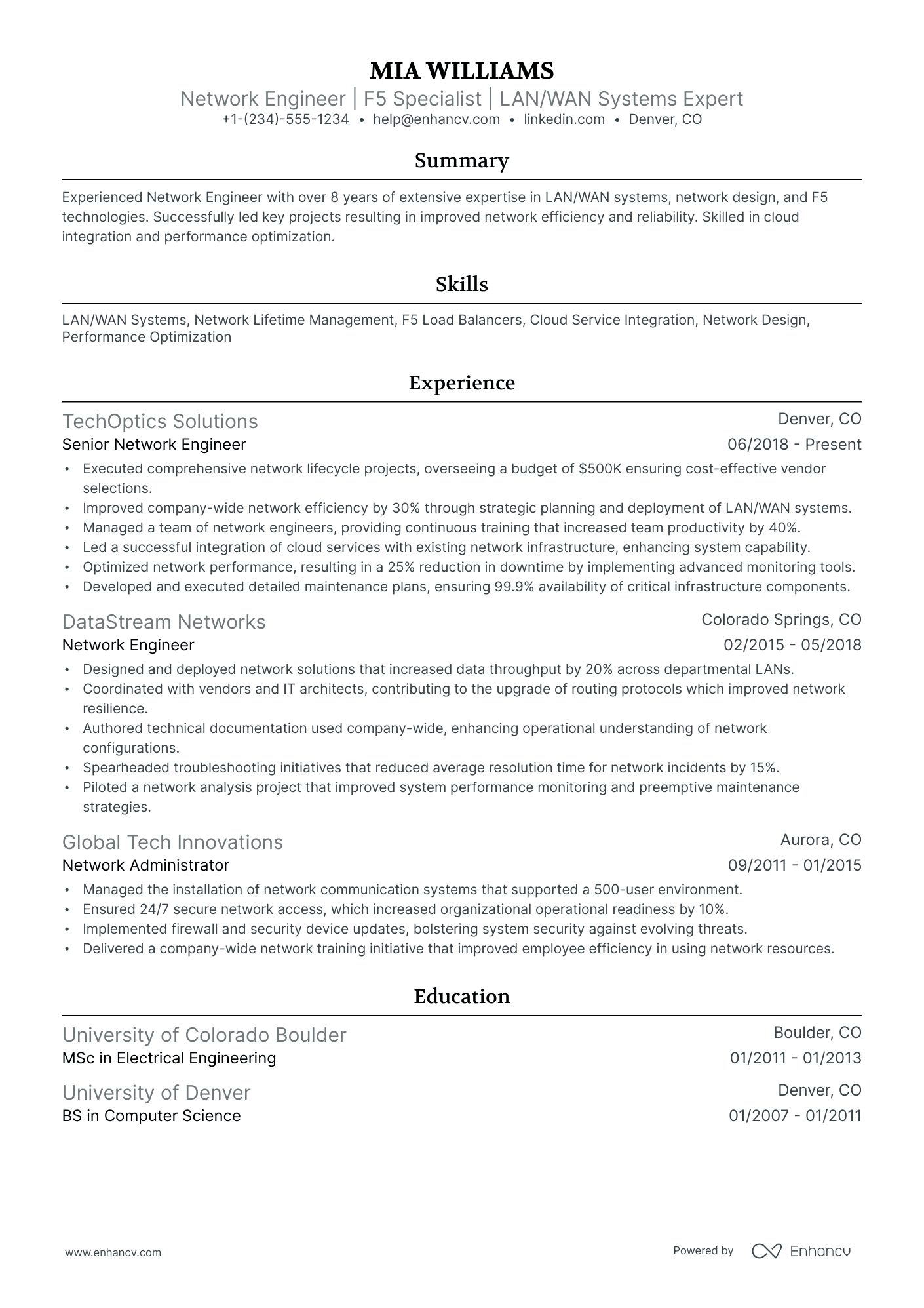
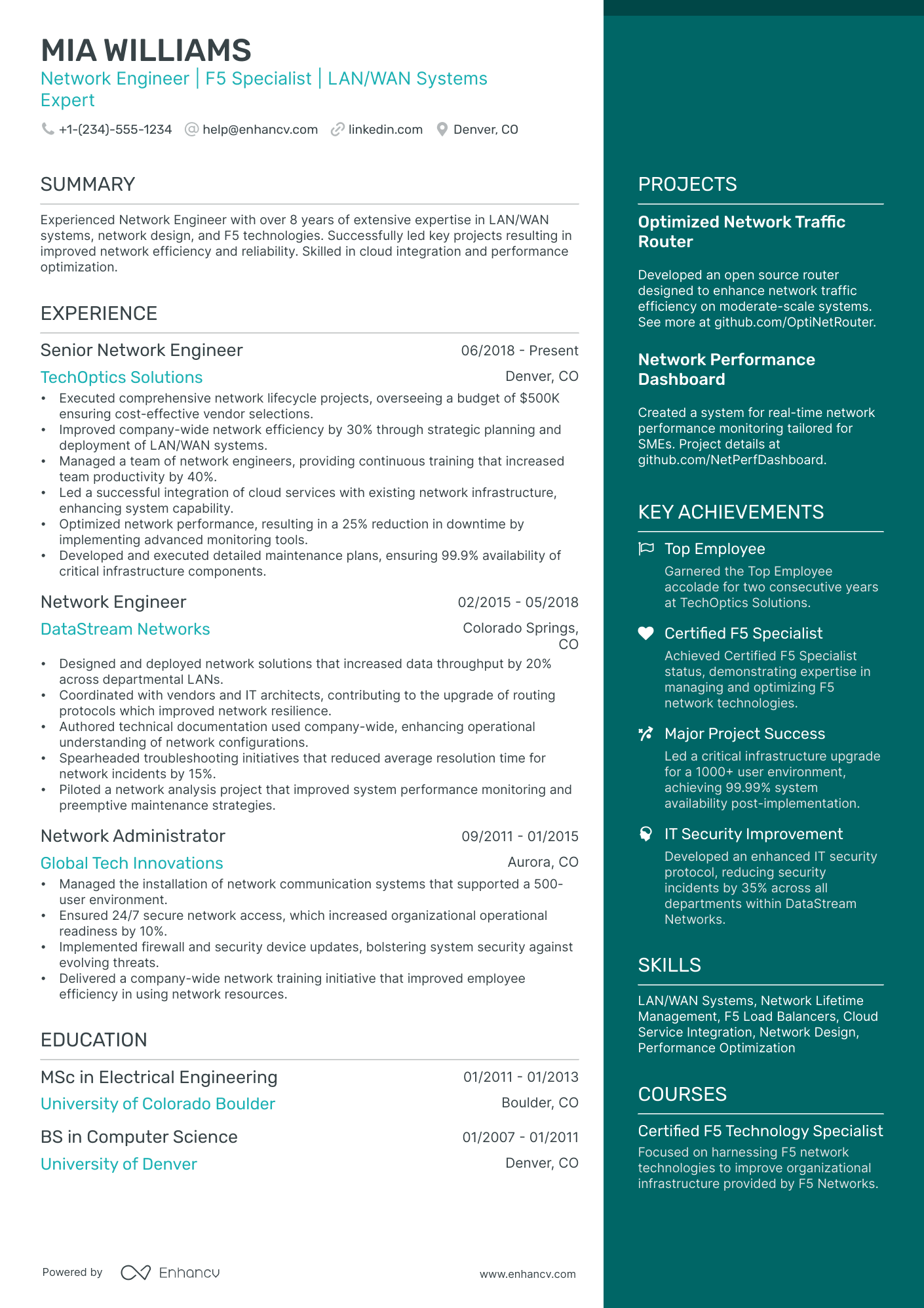
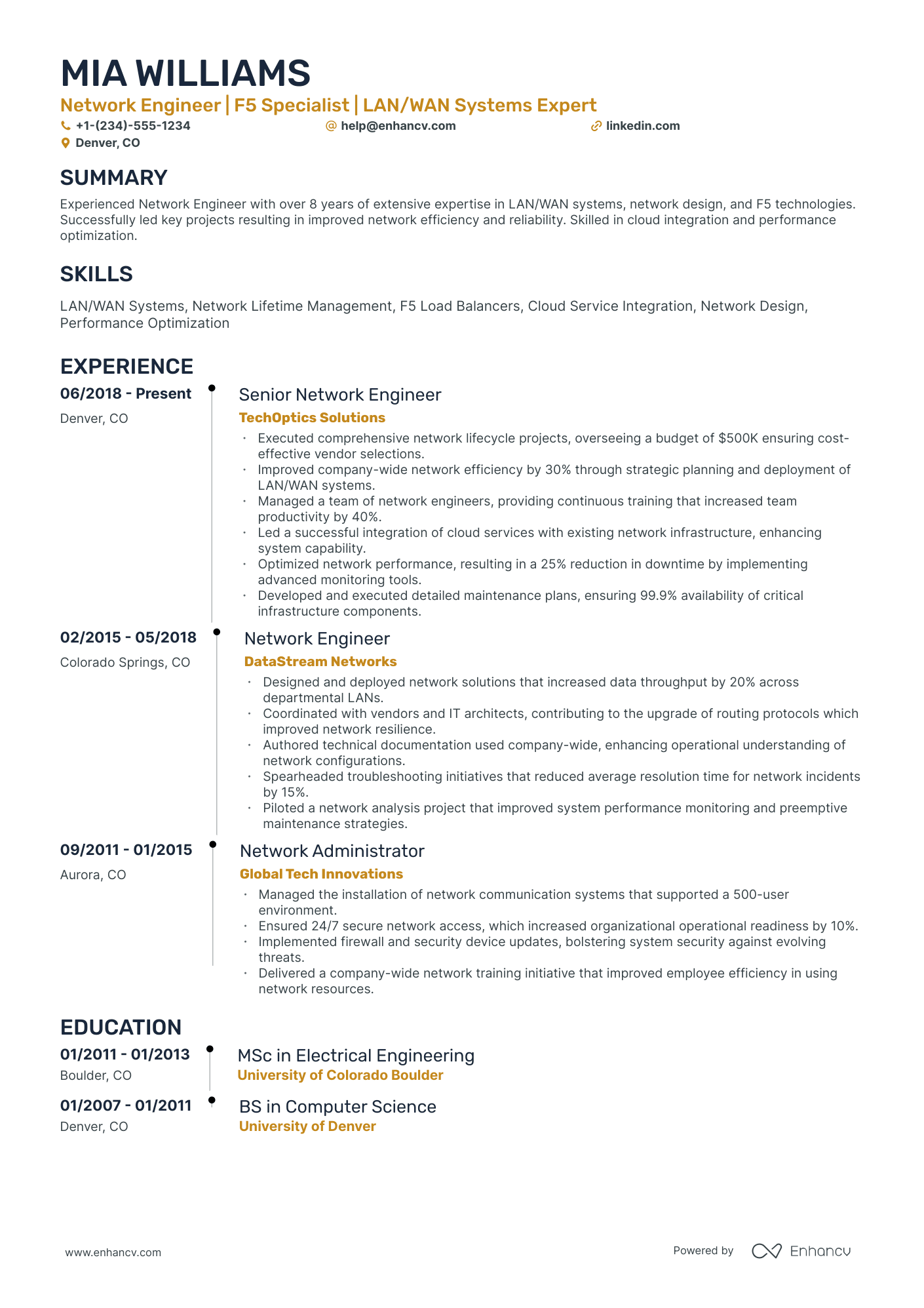
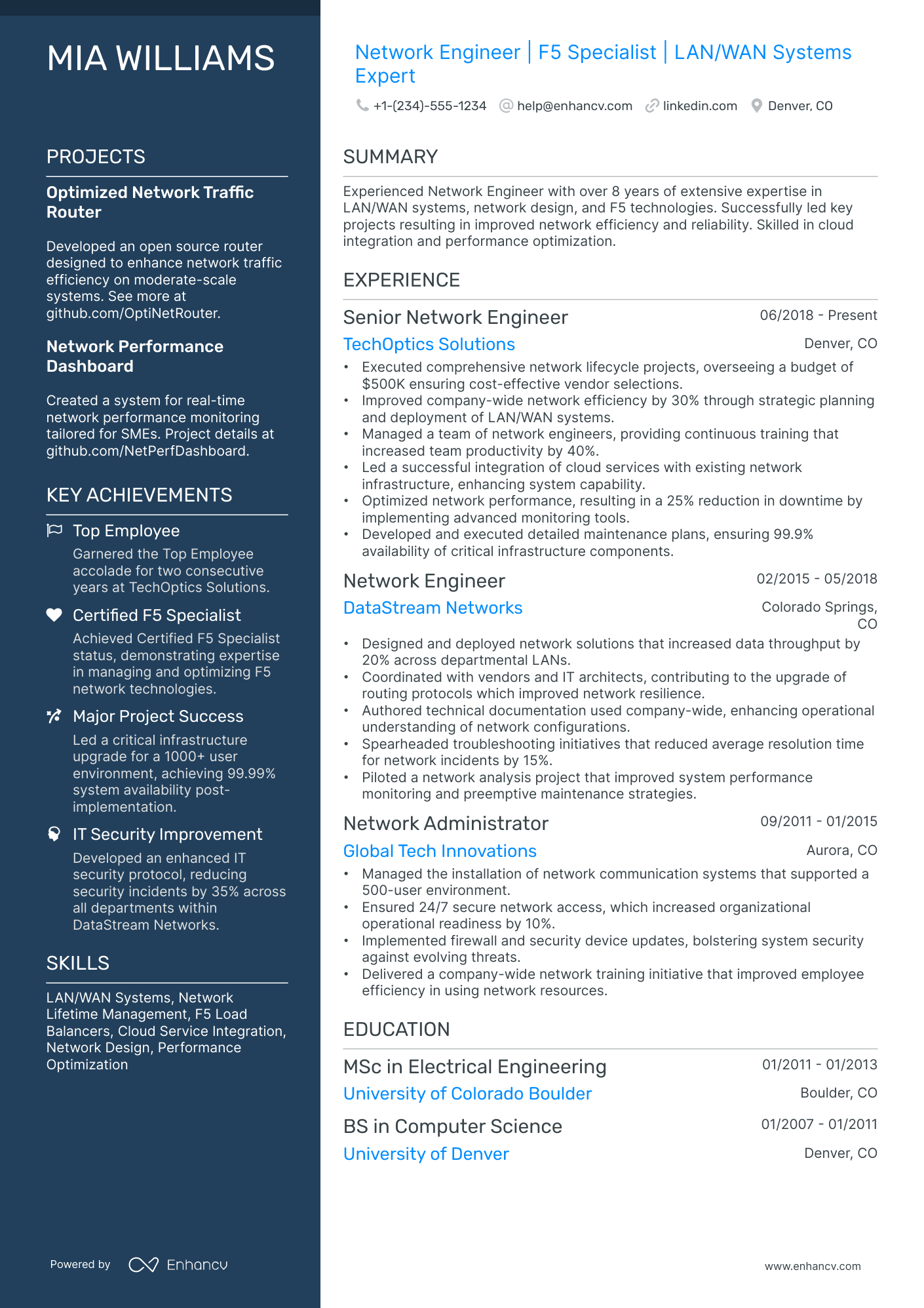
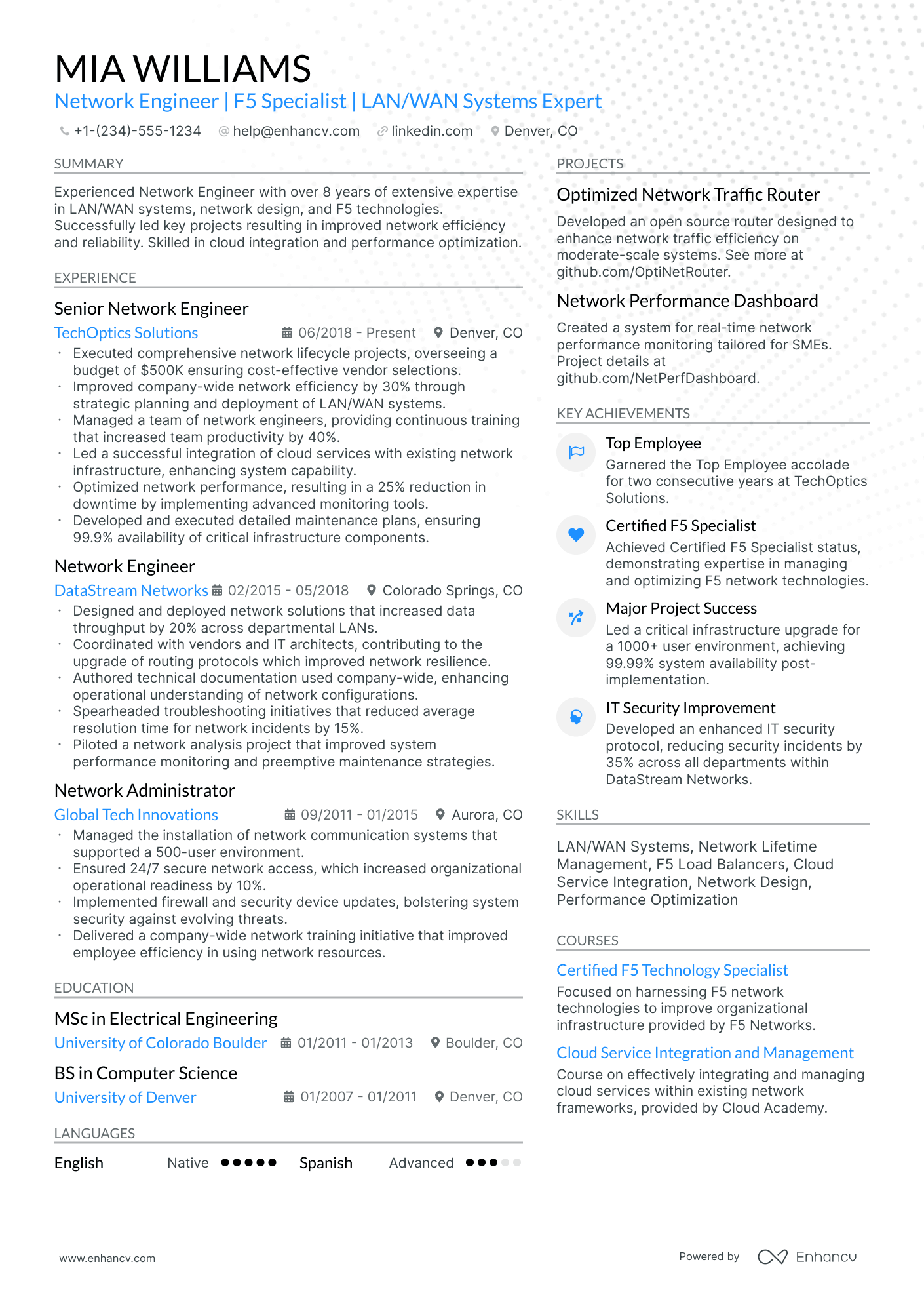
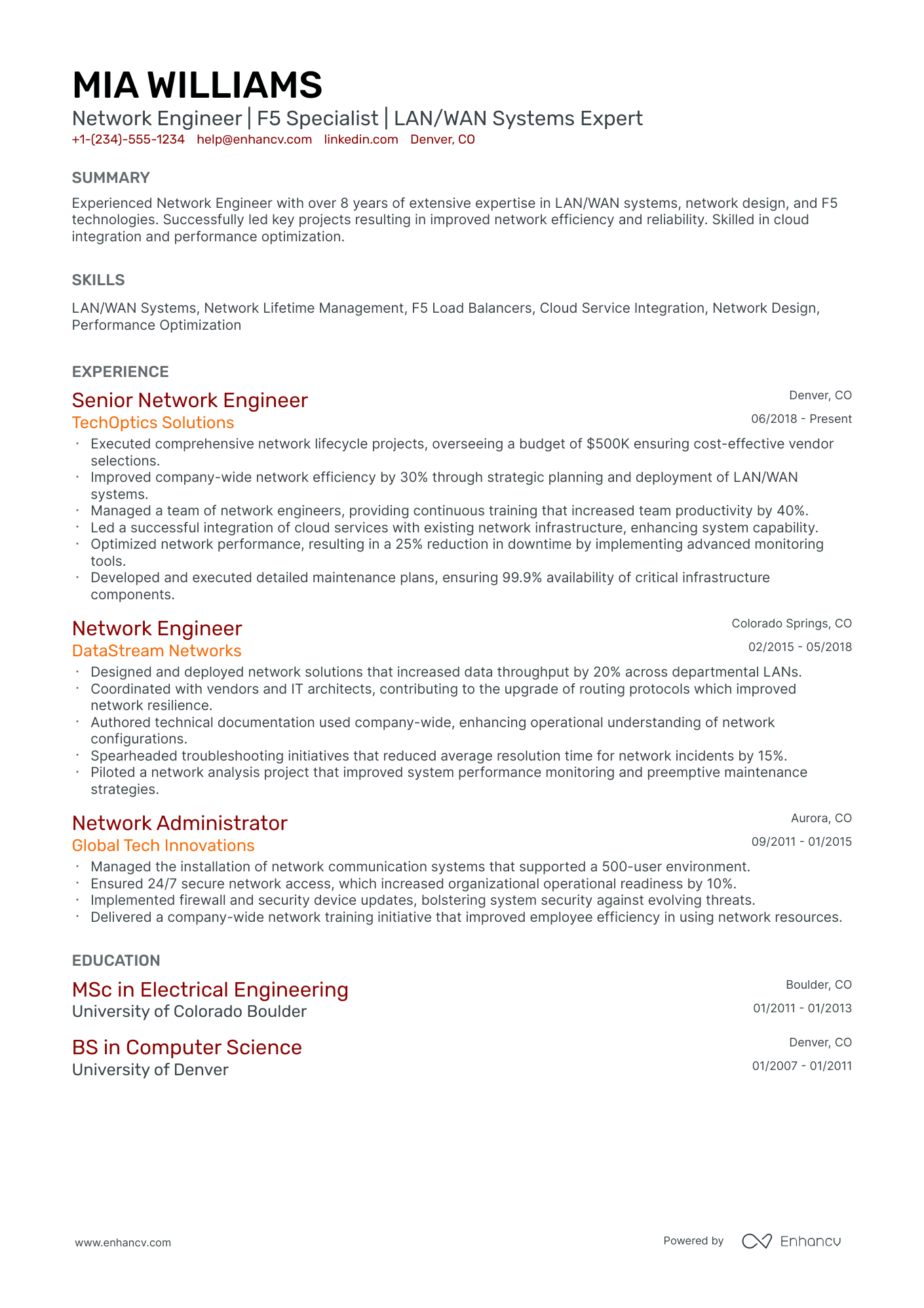
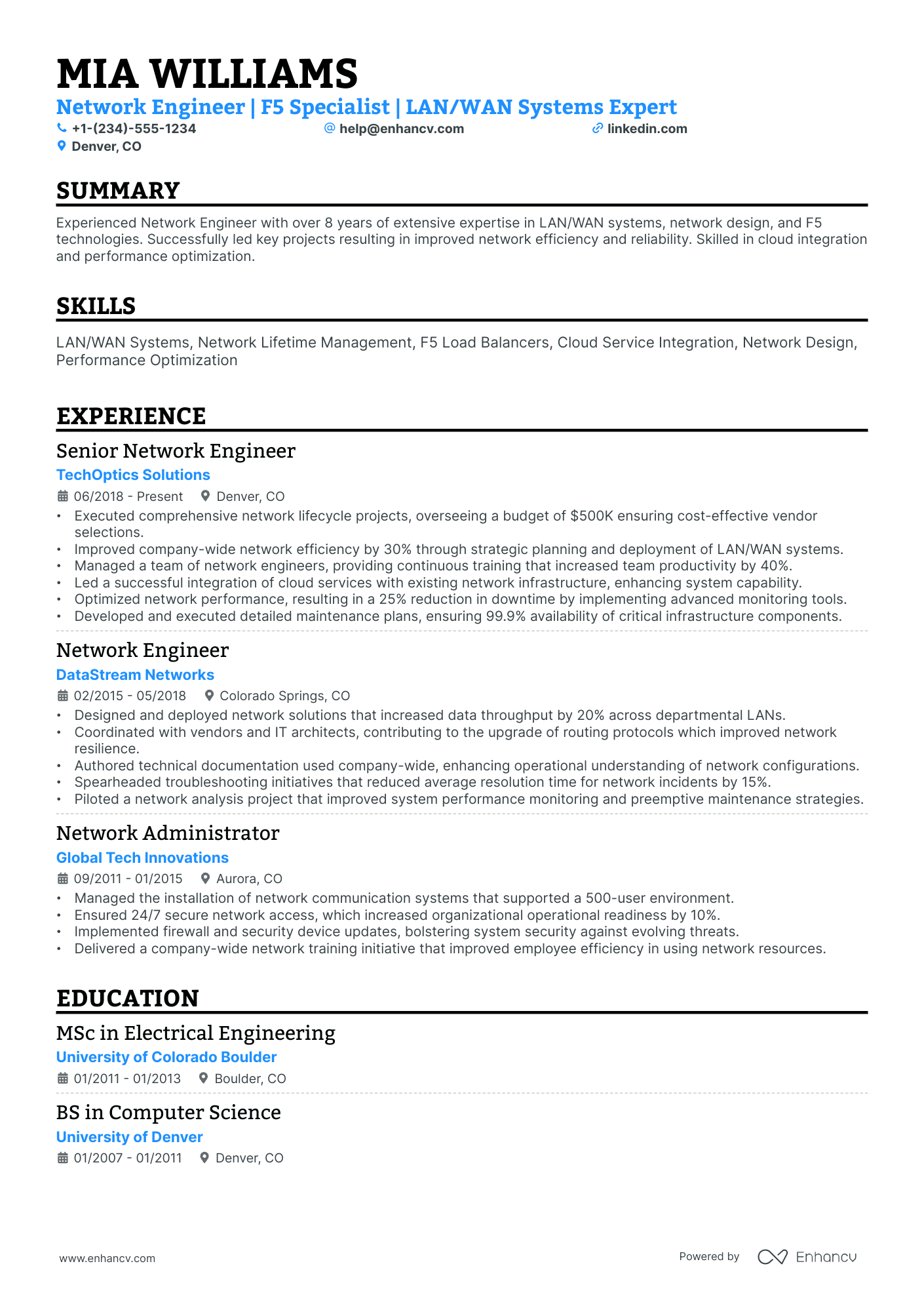
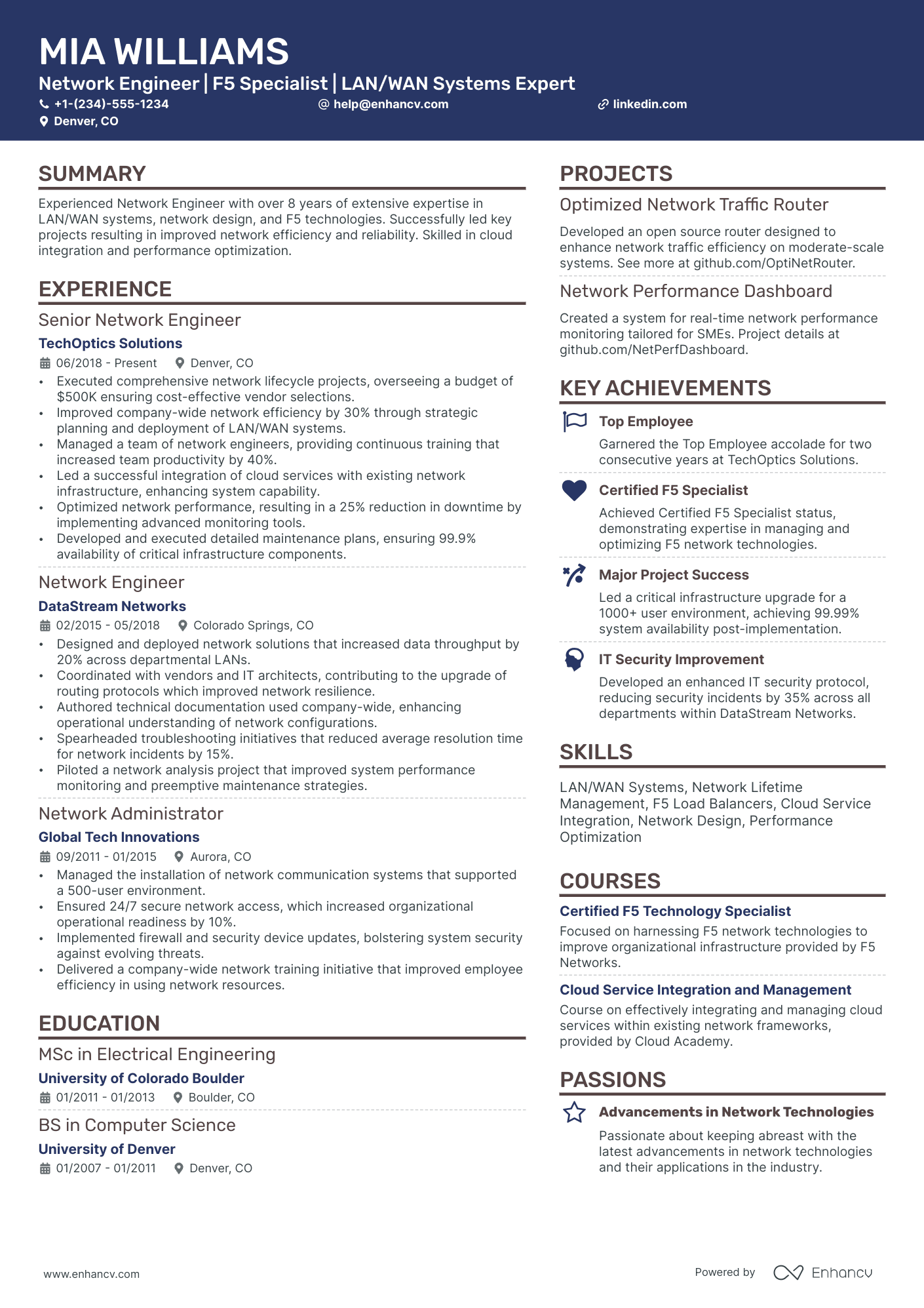
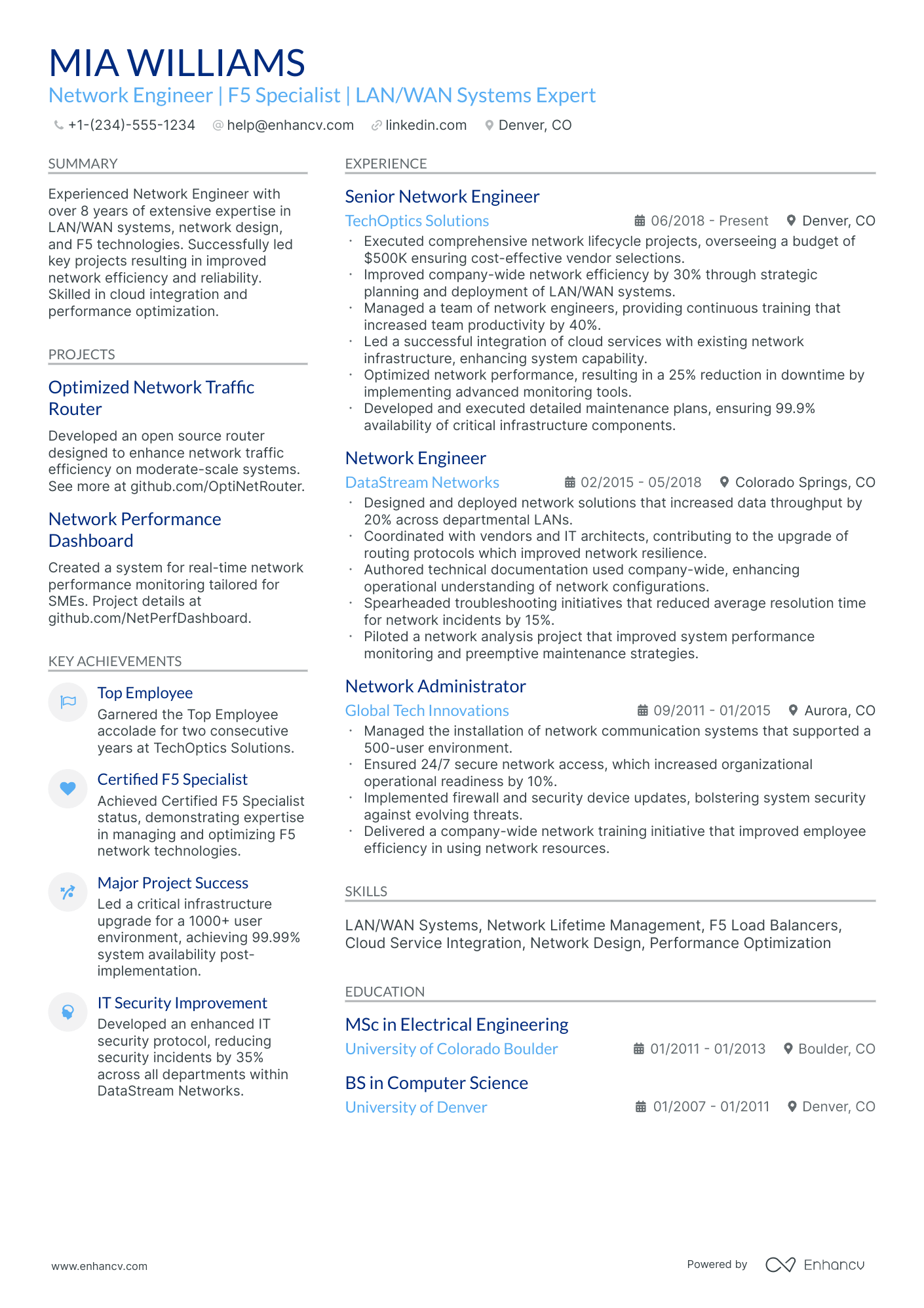
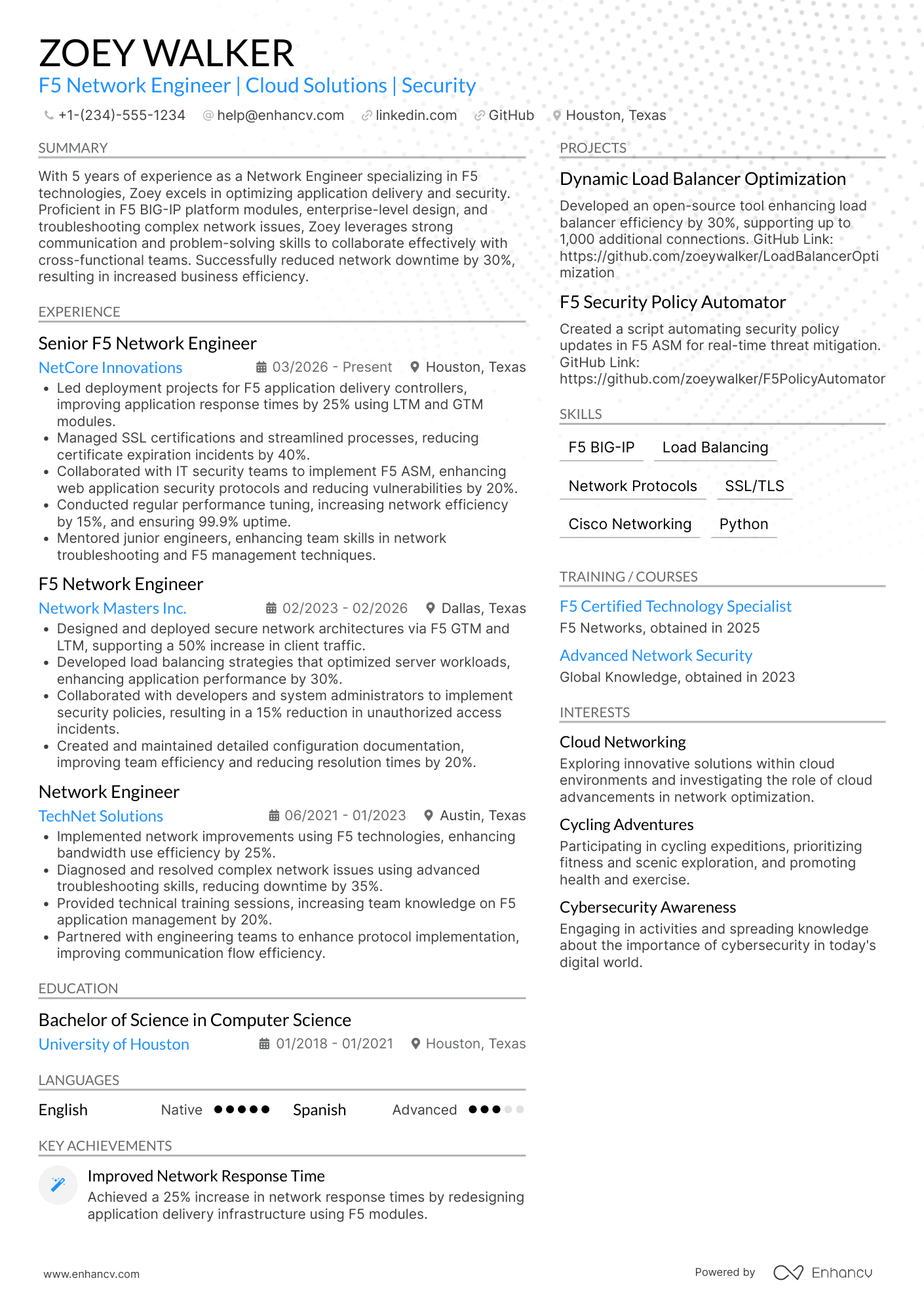
Many F5 network engineer resume submissions fail because they list iRules, BIG-IP modules, and ticket duties without proving impact. That omission gets you filtered by ATS keywords and overlooked in fast recruiter scans in a crowded market.
A strong resume shows what changed because of your work. Knowing how to make your resume stand out means you should highlight reduced latency, higher application availability, faster failover, fewer incidents, clean change windows, and smoother releases across environments. Quantify throughput gains, device counts, uptime, and migration delivery dates.

Key takeaways
- Quantify F5 outcomes like uptime, latency, and failover time in every experience bullet.
- Tailor your resume to each job posting's exact F5 platforms and terminology.
- Use reverse-chronological format if you have hands-on F5 engineering experience.
- Lead with a skills section if you're junior or switching into F5 roles.
- Tie every listed skill to a specific action and measurable result.
- Enhancv can help you turn vague task descriptions into sharp, metric-driven bullets.
- Pair certifications like F5-CA or F5-CTS with proven achievements to stand out.
How to format a F5 network engineer resume
Recruiters evaluating F5 network engineer candidates prioritize hands-on expertise with F5 platforms (BIG-IP, LTM, GTM, ASM, APM), network infrastructure design, and the ability to troubleshoot complex load balancing and application delivery issues under pressure. Your resume format directly affects how quickly a hiring manager can identify these technical competencies, relevant certifications, and a track record of maintaining high-availability environments.

I have significant experience in this role—which format should I use?
Use a reverse-chronological format to present your F5 network engineering career in a clear, linear progression that highlights growing technical scope and infrastructure ownership. Do:
- Lead each role entry with your scope of ownership—number of F5 devices managed, data center environments supported, and size of the networks or application ecosystems you maintained.
- Feature F5-specific skills and tooling prominently, including BIG-IP modules (LTM, GTM, ASM, APM, AFM), iRules/iApps development, SSL offloading, and integration with automation platforms like Ansible or Terraform.
- Quantify outcomes tied to availability, performance, and cost, such as uptime improvements, latency reductions, incident resolution times, or infrastructure cost savings.
I'm junior or switching into this role—what format works best?
Use a hybrid format that positions your F5 and networking skills at the top, followed by a concise work history that demonstrates how you've applied those skills in practice. Do:
- Place a dedicated skills section near the top of your resume, listing F5 technologies (BIG-IP, LTM, iRules), networking fundamentals (TCP/IP, DNS, SSL/TLS, VLANs), and any relevant certifications such as F5 Certified BIG-IP Administrator or CCNA.
- Include lab projects, home lab configurations, internships, or transitional roles where you configured or troubleshot F5 or load balancing technologies, even if they weren't your primary responsibility.
- Connect every skill mention to a specific action and a measurable or observable result.
Why not use a functional resume?
A functional resume strips away the context of where and when you applied your F5 and networking skills, making it difficult for recruiters to assess the depth of your hands-on experience or verify your technical growth across roles.
- Edge-case exception: A functional format may be acceptable if you're transitioning into F5 network engineering from a general systems administration or network operations background with limited direct F5 experience, or if you have significant resume gaps—but only if every listed skill is tied to a specific project, lab, or outcome rather than presented as a standalone keyword.
With your resume's structure and layout established, the next step is determining which sections to include to best showcase your F5 expertise.
What sections should go on a F5 network engineer resume
Recruiters expect you to present F5 BIG-IP expertise, network fundamentals, and production impact in a clean, easy-to-scan resume. Understanding which resume sections to include ensures maximum clarity.
Use this structure for maximum clarity:
- Header
- Summary
- Experience
- Skills
- Projects
- Education
- Certifications
- Optional sections: Awards, Publications, Open-source work
Your experience bullets should emphasize measurable impact, uptime and performance outcomes, scale and traffic scope, incident reduction, and the results of F5 changes in production.
Is your resume good enough?
Drop your resume here or choose a file. PDF & DOCX only. Max 2MB file size.
Once you’ve organized your resume with the right core elements, the next step is learning how to write your F5 network engineer resume experience so each role clearly supports those sections.
How to write your F5 network engineer resume experience
Your experience section should spotlight the infrastructure you've built, optimized, or maintained using F5 technologies—backed by measurable outcomes that prove your impact. Hiring managers prioritize demonstrated results over descriptive task lists, so every bullet should connect your technical execution to a tangible business or operational outcome. Building a targeted resume ensures each entry speaks directly to the role you're pursuing.
Each entry should include:
- Job title
- Company and location (or remote)
- Dates of employment (month and year)
Three to five concise bullet points showing what you owned, how you executed, and what outcomes you delivered:
- Ownership scope: the F5 platforms, network environments, application delivery infrastructure, load balancing configurations, or traffic management systems you were directly accountable for—including the scale of users, applications, or data centers involved.
- Execution approach: the specific F5 tools, modules, and methods you relied on—such as BIG-IP LTM, GTM, ASM, APM, iRules, iApps, or automation frameworks—along with supporting technologies like Ansible, Terraform, or Python scripting that shaped how you diagnosed issues and delivered solutions.
- Value improved: the changes you drove in network performance, application availability, security posture, failover reliability, latency reduction, or operational efficiency that tied directly to your F5 engineering work.
- Collaboration context: how you partnered with security teams, application developers, cloud architects, NOC staff, or vendors to align F5 configurations with broader infrastructure goals, compliance requirements, or migration initiatives.
- Impact delivered: the outcomes your work produced—expressed through improvements in uptime, throughput, incident resolution speed, cost savings, or risk reduction rather than a summary of daily responsibilities.
Experience bullet formula
A F5 network engineer experience example
✅ Right example - modern, quantified, specific.
F5 Network Engineer
BluePeak Health | Remote
2022–Present
Supported a multi-region healthcare platform serving five million members with strict availability and compliance requirements.
- Engineered F5 BIG-IP Local Traffic Manager (LTM) and Access Policy Manager (APM) stacks across three regions, improving application availability from 99.90% to 99.99% and reducing mean time to recover by 38%.
- Automated iRules, pools, virtual servers, and SSL profiles using Ansible and Terraform, cutting change windows from two hours to twenty-five minutes and eliminating 70% of manual configuration drift.
- Optimized SSL offload and cipher policies with F5 Advanced Web Application Firewall (Advanced WAF) and Hardware Security Module (HSM) integration, reducing handshake latency by 22% while meeting Health Insurance Portability and Accountability Act audit controls.
- Implemented active-active global load balancing with F5 BIG-IP Domain Name System (DNS) and health monitors, decreasing failover time from six minutes to forty-five seconds and preventing an estimated $180K per quarter in downtime impact.
- Partnered with security, site reliability engineering, and application teams to tune Web Application Firewall policies and bot defenses, cutting false positives by 34% and blocking 1.2M malicious requests per month without impacting conversion flows.
Now that you've seen how to structure your experience entries, let's focus on aligning them with the specific requirements of each job posting.
How to tailor your F5 network engineer resume experience
Recruiters evaluate your F5 network engineer resume through both applicant tracking systems and manual review. Tailoring your resume to the job description ensures your qualifications stand out in both screening methods.
Ways to tailor your F5 network engineer experience:
- Match specific F5 platforms like BIG-IP or Viprion listed in the posting.
- Mirror the exact iRules or iApps terminology the employer uses.
- Reflect load balancing methods or traffic management approaches they prioritize.
- Include referenced network security protocols like SSL offloading or WAF configuration.
- Highlight high availability or disaster recovery frameworks the role requires.
- Align your experience with their cited compliance standards like PCI or HIPAA.
- Reference collaboration with DevOps or NetOps teams if the posting mentions them.
- Emphasize monitoring or performance optimization KPIs the job description specifies.
Tailoring means aligning your real accomplishments with what the role demands—not artificially stuffing keywords where they don't belong.
Resume tailoring examples for F5 network engineer
| Job description excerpt | Untailored | Tailored |
|---|---|---|
| Design, implement, and maintain F5 BIG-IP LTM/GTM infrastructure to ensure high availability and optimal application delivery across multi-data center environments. | Managed network infrastructure and supported application availability. | Designed and maintained F5 BIG-IP LTM/GTM configurations across three data centers, ensuring 99.99% application availability and optimizing traffic distribution for 200+ virtual servers. |
| Configure and troubleshoot F5 iRules, SSL offloading, and advanced health monitors to support secure, compliant application traffic for enterprise clients. | Handled security configurations and performed troubleshooting on network devices. | Developed and optimized 50+ F5 iRules to manage application traffic routing, configured SSL offloading for PCI-compliant environments, and built custom health monitors that reduced false-positive outage alerts by 35%. |
| Collaborate with application and security teams to automate F5 provisioning using Ansible and F5 AS3 declarative APIs, reducing manual change windows and accelerating deployment cycles. | Worked with other teams to automate tasks and improve processes. | Partnered with application and security teams to automate F5 BIG-IP provisioning using Ansible playbooks and F5 AS3 declarative APIs, cutting manual change windows from four hours to 20 minutes per deployment cycle. |
Once you’ve aligned your experience with the role’s needs, the next step is to quantify your F5 network engineer achievements so hiring managers can quickly see the impact of your work.
How to quantify your F5 network engineer achievements
Quantifying your achievements shows how your F5 work improved speed, uptime, and safety, not just configuration output. Focus on latency, throughput, availability, incident reduction, deployment time, and risk reduction across BIG-IP Local Traffic Manager, BIG-IP Application Security Manager, iRules, and load balancing pools.
Quantifying examples for F5 network engineer
| Metric | Example |
|---|---|
| Availability | "Improved critical application availability from 99.90% to 99.99% by tuning BIG-IP health monitors and redesigning pool member failover across two data centers." |
| Latency | "Reduced average client-to-app latency by 18% by optimizing BIG-IP profiles (TCP, OneConnect, and HTTP compression) and right-sizing SSL offload ciphers." |
| Throughput | "Increased peak throughput from 6 Gbps to 9 Gbps during quarterly traffic spikes by rebalancing virtual servers, enabling connection reuse, and tuning SNAT settings." |
| Security risk | "Cut high-severity web attack alerts by 35% by tightening BIG-IP Application Security Manager policies, updating signatures weekly, and enforcing bot defenses on five public apps." |
| Delivery speed | "Reduced change window time from 90 minutes to 25 minutes by standardizing iRules, automating deployments with Ansible, and adding pre-change validation checks." |
Turn vague job duties into measurable, recruiter-ready resume bullets in seconds with Enhancv's Bullet Point Generator.
Once you've crafted strong bullet points to showcase your accomplishments, the next step is ensuring your resume highlights the right mix of hard and soft skills that F5 network engineer roles demand.
How to list your hard and soft skills on a F5 network engineer resume
Your skills section shows you can design, secure, and operate F5 BIG-IP platforms at scale, and recruiters and an ATS (applicant tracking system) scan them to confirm keyword match and seniority; aim for a hard-skill-heavy mix with targeted operational soft skills. F5 network engineer roles require a blend of:
- Product strategy and discovery skills.
- Data, analytics, and experimentation skills.
- Delivery, execution, and go-to-market discipline.
- Soft skills.
Your skills section should be:
- Scannable (bullet-style grouping).
- Relevant to the job post.
- Backed by proof in experience bullets.
- Updated with current tools.
Place your skills section:
- Above experience if you're junior or switching careers.
- Below experience if you're mid/senior with strong achievements.

Hard skills
- F5 BIG-IP LTM, GTM/DNS, ASM/Advanced WAF
- iRules, iApps, TCL scripting
- SSL/TLS, PKI, certificate management
- Load balancing, health monitors, persistence
- High availability, failover, sync groups
- HTTP/2, TCP optimization, SNAT, NAT
- BGP, OSPF, VLANs, routing, switching
- DDoS mitigation, bot defense, WAF tuning
- Linux, bash, system troubleshooting
- REST APIs, Postman, automation workflows
- Ansible, Terraform, Git
- Splunk, Prometheus, Grafana
Soft skills
- Translate app needs into traffic policies
- Run structured incident triage and escalation
- Write clear change plans and rollbacks
- Coordinate maintenance windows with owners
- Communicate risk and impact to stakeholders
- Prioritize fixes by severity and blast radius
- Document runbooks and operational standards
- Lead root cause analysis and postmortems
- Partner with security on threat response
- Mentor peers on F5 best practices
- Drive configuration consistency across environments
- Challenge requirements to reduce complexity
How to show your F5 network engineer skills in context
Skills shouldn't appear only in isolated lists on your resume. Browse examples of resume skills to see how top candidates present their technical abilities in context.
They should be demonstrated in:
- Your summary (high-level professional identity)
- Your experience (proof through outcomes)
Here's how that looks in practice.
Summary example
Senior F5 network engineer with 10 years in healthcare infrastructure. Skilled in BIG-IP LTM, iRules, and GTM deployments. Reduced application downtime by 42% through proactive traffic optimization and cross-team incident response planning.
- Reflects senior-level expertise clearly
- Names specific F5 tools and modules
- Quantifies a meaningful operational outcome
- Highlights collaboration as a soft skill
Experience example
Senior Network Engineer
Meridian Health Systems | Charlotte, NC
March 2019–January 2024
- Architected BIG-IP LTM configurations across 14 data centers, cutting failover time by 38% through optimized health monitors and iRules.
- Partnered with security and DevOps teams to deploy ASM policies, blocking 96% of application-layer attacks within the first quarter.
- Automated SSL certificate management using Ansible and F5 AS3 declarations, reducing manual provisioning effort by 60% across production environments.
- Every bullet includes a measurable outcome.
- Skills appear naturally within real achievements.
Once you’ve tied your technical capabilities to real outcomes, the next step is to apply that same approach to building a strong F5 network engineer resume when you don’t have formal experience.
How do I write a F5 network engineer resume with no experience
Even without full-time experience, you can demonstrate readiness through projects and labs. If you're building a resume without work experience, focus on tangible demonstrations of your skills:
- BIG-IP virtual lab configurations
- iRules scripting practice projects
- Load balancing capstone deployment
- Packet capture troubleshooting labs
- Network automation scripts for F5
- Security hardening lab checklists
- Monitoring dashboards and alert tuning
- Vendor training labs and badges
Focus on:
- BIG-IP LTM configuration evidence
- iRules and traffic policy examples
- Troubleshooting with packet captures
- Security, monitoring, and documentation
Resume format tip for entry-level F5 network engineer
Use a skills-based resume format because it highlights BIG-IP projects, labs, and certifications when you lack full-time F5 network engineer experience. Do:
- Put BIG-IP modules and versions first.
- Add a "Projects" section above work.
- Quantify results: latency, uptime, errors.
- List tools: tmsh, tcpdump, Wireshark.
- Link to a GitHub iRules repo.
- Built a BIG-IP LTM lab with two pools and health monitors, then tuned persistence and profiles to cut simulated five hundred error responses by 35%.
Even without formal work experience, your education section can demonstrate the foundational knowledge and technical training that make you a strong candidate for F5 network engineer roles.
How to list your education on a F5 network engineer resume
Your education section helps hiring teams confirm you have the foundational networking and systems knowledge required for a F5 network engineer role.
Include:
- Degree name
- Institution
- Location
- Graduation year
- Relevant coursework (for juniors or entry-level candidates)
- Honors & GPA (if 3.5 or higher)
Skip month and day details—list the graduation year only.
Here's a strong education entry tailored to a F5 network engineer resume:
Example education entry
Bachelor of Science in Network Engineering
George Mason University, Fairfax, VA
Graduated 2021
GPA: 3.7/4.0
- Relevant Coursework: Network Security, TCP/IP Architecture, Load Balancing Technologies, Systems Administration, Cloud Infrastructure
- Honors: Magna Cum Laude, Dean's List (six semesters)
How to list your certifications on a F5 network engineer resume
Certifications on your resume show a F5 network engineer's commitment to learning, proficiency with key tools, and alignment with current industry standards and practices.
Include:
- Certificate name
- Issuing organization
- Year
- Optional: credential ID or URL
- Place certifications below education when your degree is recent and directly relevant, and your certifications are older or less central to the role.
- Place certifications above education when they are recent, highly relevant to F5 network engineer work, or required for the jobs you target.
Best certifications for your F5 network engineer resume
F5 Certified BIG-IP Administrator (F5-CA) F5 Certified Technology Specialist—BIG-IP LTM (F5-CTS) F5 Certified Technology Specialist—BIG-IP ASM (F5-CTS) Cisco Certified Network Associate (CCNA) Cisco Certified Network Professional (CCNP) Enterprise AWS Certified Advanced Networking—Specialty CompTIA Security+
Once you’ve positioned your credentials where they’re easy to verify, move to your F5 network engineer resume summary to highlight them upfront and set context for the rest of your resume.
How to write your F5 network engineer resume summary
Your resume summary is the first thing a recruiter reads. A sharp, focused opening signals you understand F5 technologies and can deliver results from day one.
Keep it to three to four lines, with:
- Your title and total years of experience in network engineering.
- Domain focus such as enterprise infrastructure, data centers, or cloud networking.
- Core tools like F5 BIG-IP, LTM, GTM, ASM, iRules, and load balancing platforms.
- One or two measurable achievements such as uptime improvements or latency reductions.
- Soft skills tied to outcomes, like cross-team collaboration that accelerated deployments.

PRO TIP
At this level, emphasize hands-on technical skills, specific F5 product experience, and early wins. Highlight certifications like F5-CA or F5-CTS if you hold them. Avoid vague claims like "passionate problem solver" or "motivated team player." Replace them with concrete results.
Example summary for a F5 network engineer
F5 network engineer with three years of experience managing BIG-IP LTM and GTM across enterprise environments. Reduced application downtime by 35% through optimized iRules and proactive health monitoring.
Optimize your resume summary and objective for ATS
Drop your resume here or choose a file.
PDF & DOCX only. Max 2MB file size.
With your summary crafted to highlight your F5 expertise, make sure your resume header presents the essential contact and professional details recruiters need to reach you.
What to include in a F5 network engineer resume header
Your resume header lists your key contact and professional details so recruiters can find you fast, trust your profile, and screen you accurately as a F5 network engineer.
Essential resume header elements
- Full name
- Tailored job title and headline
- Location
- Phone number
- Professional email
- GitHub link
- Portfolio link
A LinkedIn link helps recruiters confirm your roles, dates, and certifications quickly, which supports faster screening.
Do not include a photo on a F5 network engineer resume unless the role is explicitly front-facing or appearance-dependent.
Match your header title and headline to the exact F5 network engineer posting and keep every link current and easy to scan.
Example
F5 network engineer resume header
Jordan Taylor
F5 network engineer | BIG-IP LTM, GTM, iRules, and load balancing
Austin, TX
(512) 555-01XX
jordan.taylor@enhancv.com
github.com/jordantaylor
yourwebsite.com
linkedin.com/in/jordantaylor
Once your contact details and role focus are clear at the top, add supporting resume sections to round out your F5 network engineer profile and reinforce what you’ve already established.
Additional sections for F5 network engineer resumes
Adding extra sections helps you stand out when core qualifications are similar among candidates applying for the same F5 network engineer role.
- Certifications (F5 Certified Administrator, F5 Certified Technology Specialist, CCNP)
- Languages
- Professional affiliations (F5 DevCentral community, ISACA, IEEE)
- Publications and technical blog contributions
- Conference presentations and speaking engagements
- Hobbies and interests
- Volunteer work in IT or networking education
Once your resume's additional sections reinforce your F5 expertise, pairing it with a strong cover letter can further set your application apart.
Do F5 network engineer resumes need a cover letter
A cover letter isn't required for a F5 network engineer, but it helps in competitive roles or teams with strict hiring expectations. It can make a difference when your resume doesn't clearly show fit, impact, or context.
Use a cover letter to add details your resume can't:
- Explain role and team fit: Match your experience to the stack, on-call model, change process, and collaboration with security, network, and application teams.
- Highlight one or two outcomes: Summarize a F5 BIG-IP rollout, iRules cleanup, or migration, and quantify results like reduced incidents or improved latency.
- Show product and business understanding: Connect F5 features to user needs, such as availability, security controls, or performance for customer-facing applications.
- Address transitions or non-obvious experience: Clarify a move from general networking, security, or systems work, and map skills to F5 network engineer responsibilities.
Drop your resume here or choose a file.
PDF & DOCX only. Max 2MB file size.
Even if you decide to include a cover letter to add context beyond your resume, using AI to improve your F5 network engineer resume helps you sharpen the document itself before you submit it.
Using AI to improve your F5 network engineer resume
AI can sharpen your resume's clarity, structure, and impact. It helps refine bullet points and align content with job descriptions. But overuse kills authenticity. Once your resume reads clearly and matches your target role, step away from AI. For practical prompt ideas, explore ChatGPT resume writing prompts tailored to resume improvement.
Here are 10 practical prompts to strengthen specific sections of your F5 network engineer resume:
Strengthen your summary
Quantify experience bullets
Align skills with job posts
Tighten project descriptions
Improve action verbs
Refine certification details
Clarify education relevance
Remove filler language
Tailor for iRules expertise
Focus on troubleshooting impact
Conclusion
A strong F5 network engineer resume stays focused on outcomes, not tasks. It uses measurable results, role-specific skills, and clear structure to show impact across availability, performance, and security.
With a clean summary, targeted experience, and skills that match the job, you show you can deliver now. This format also signals readiness for today’s hiring market and near-future needs.