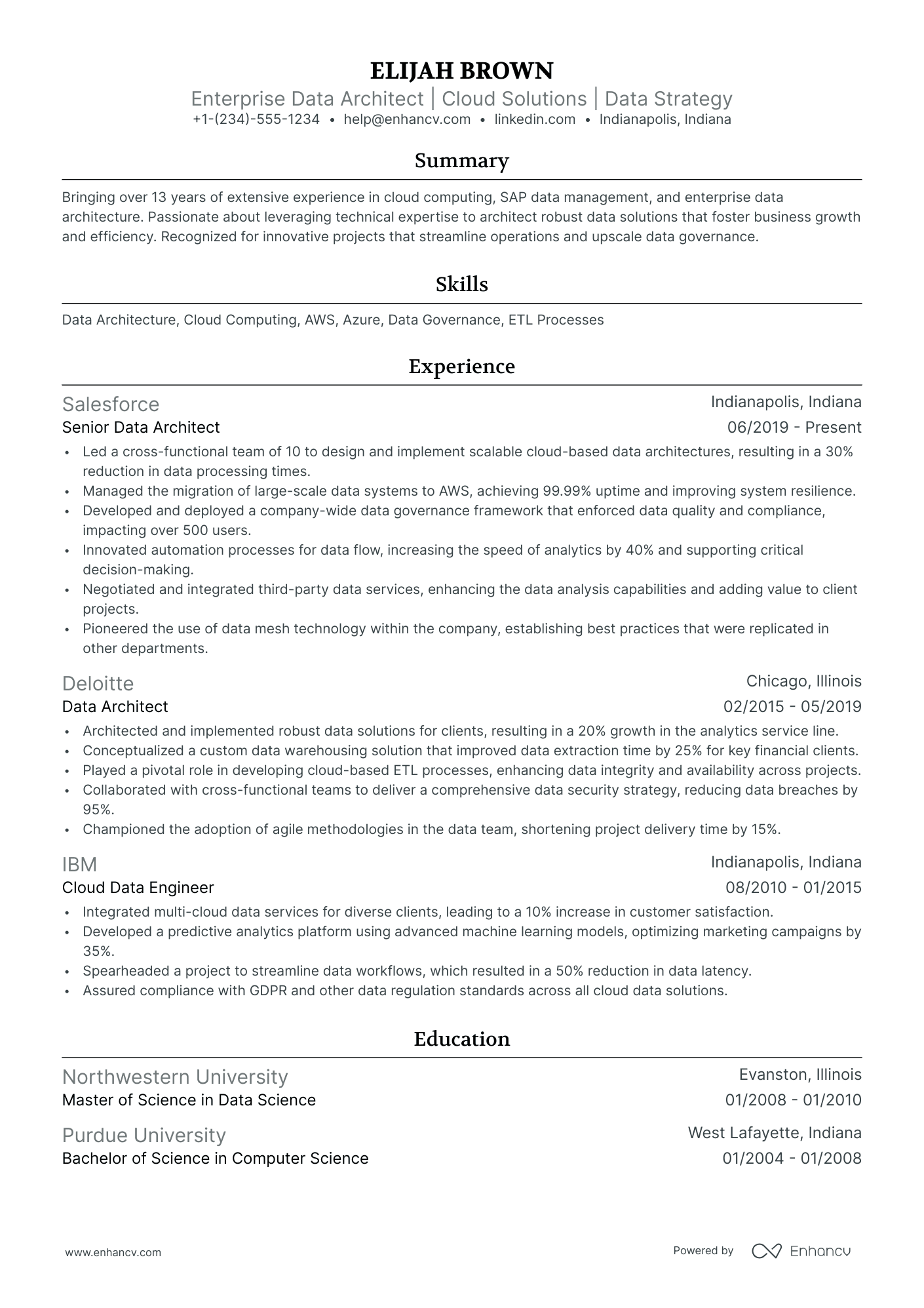
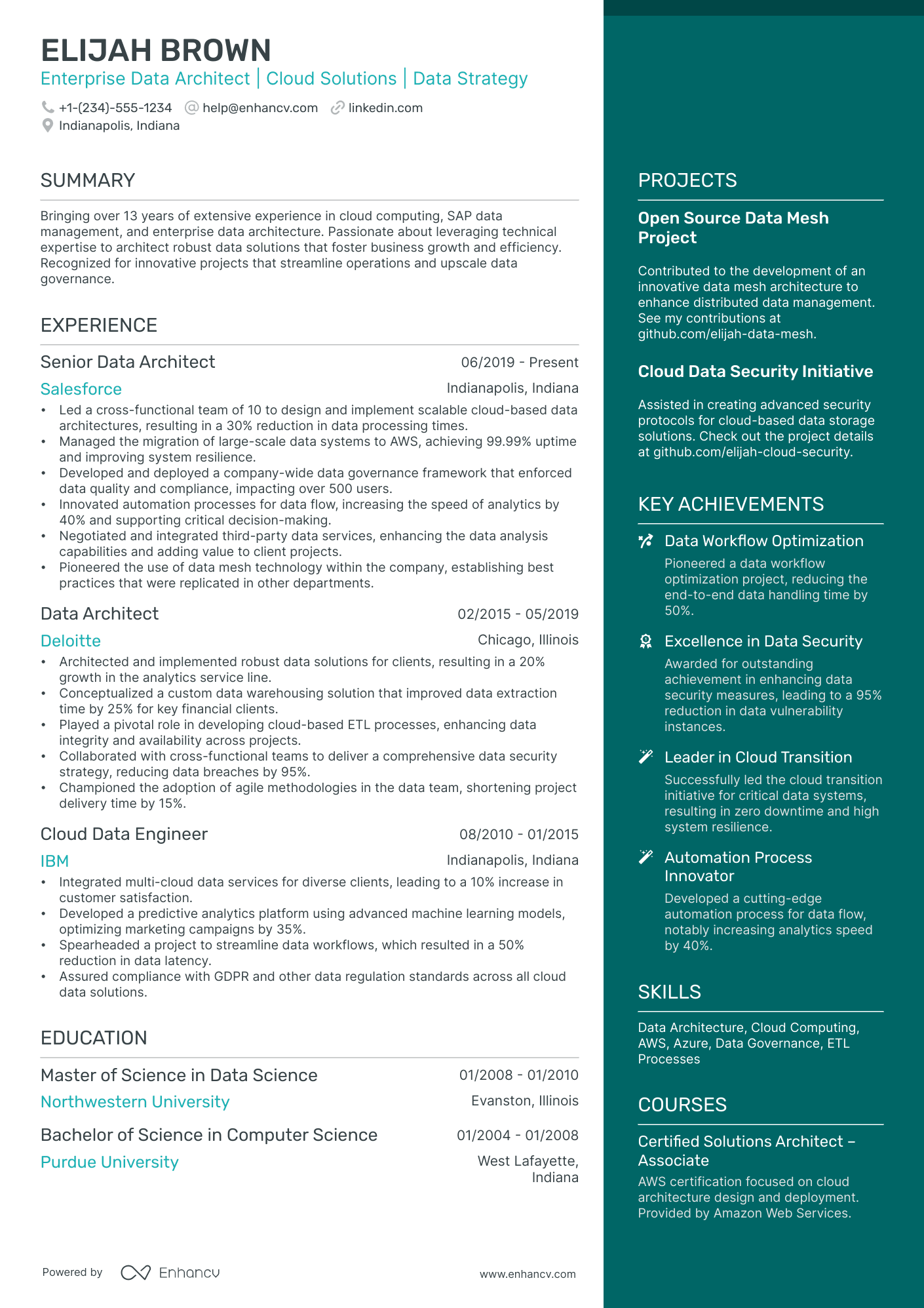
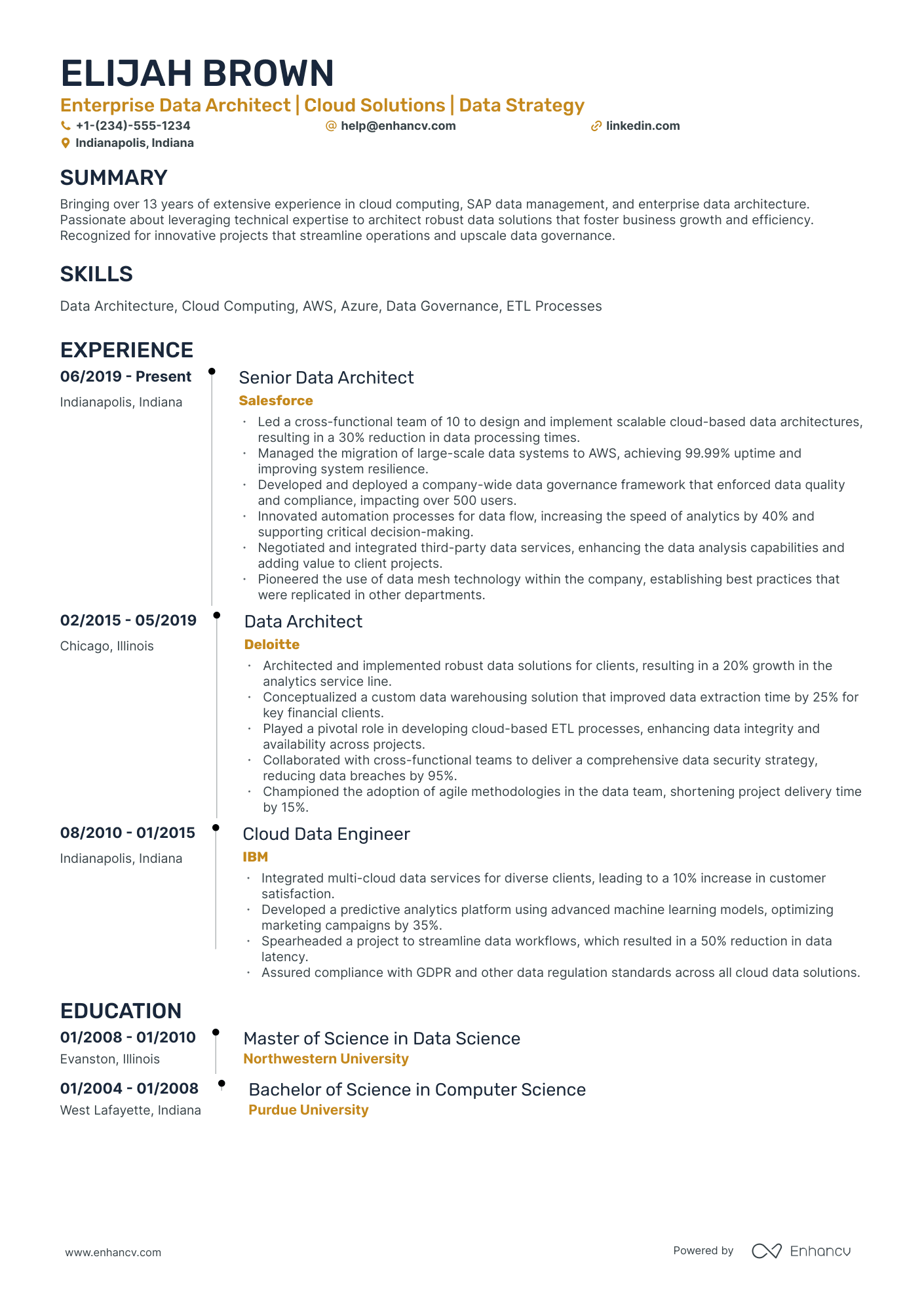
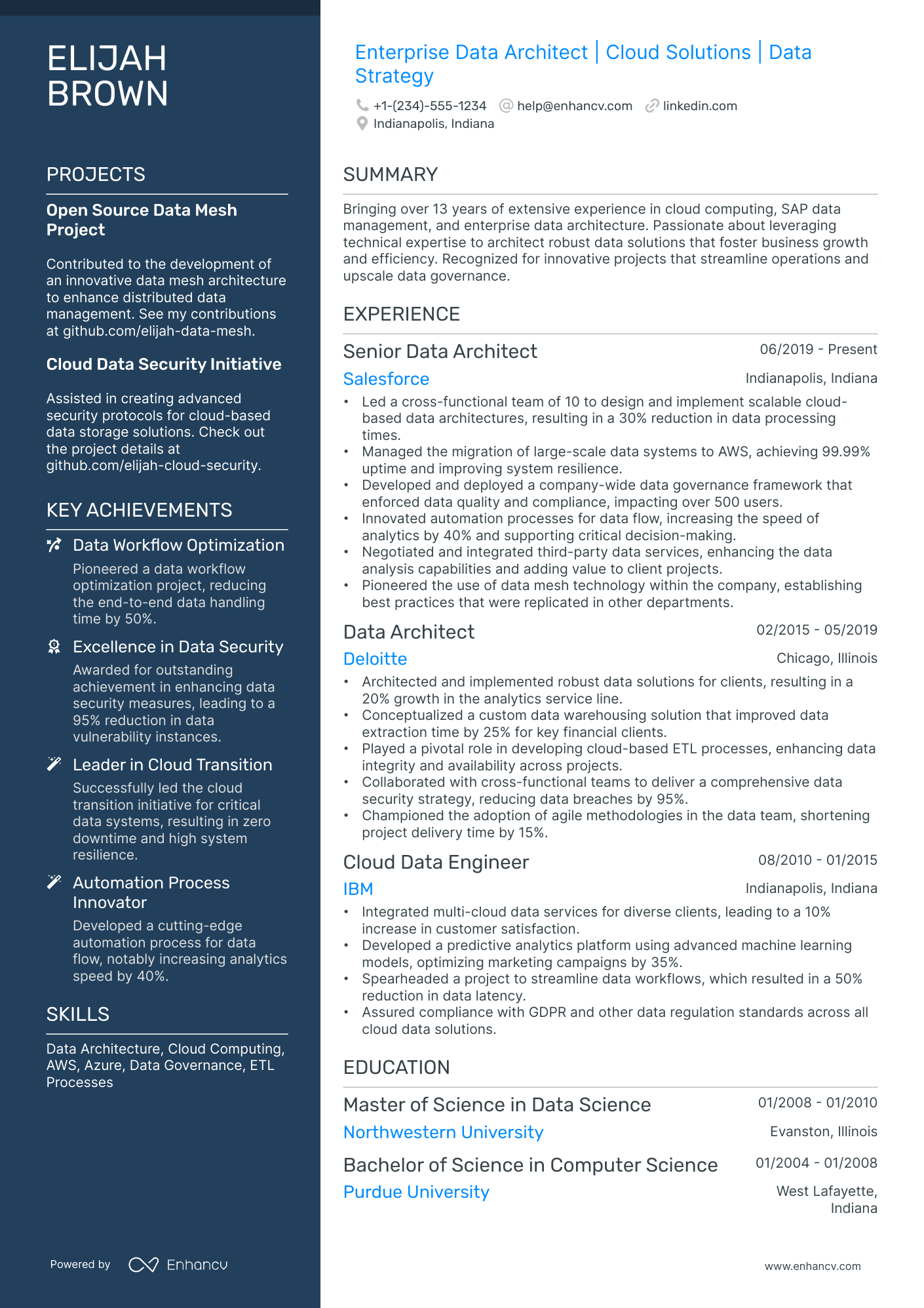
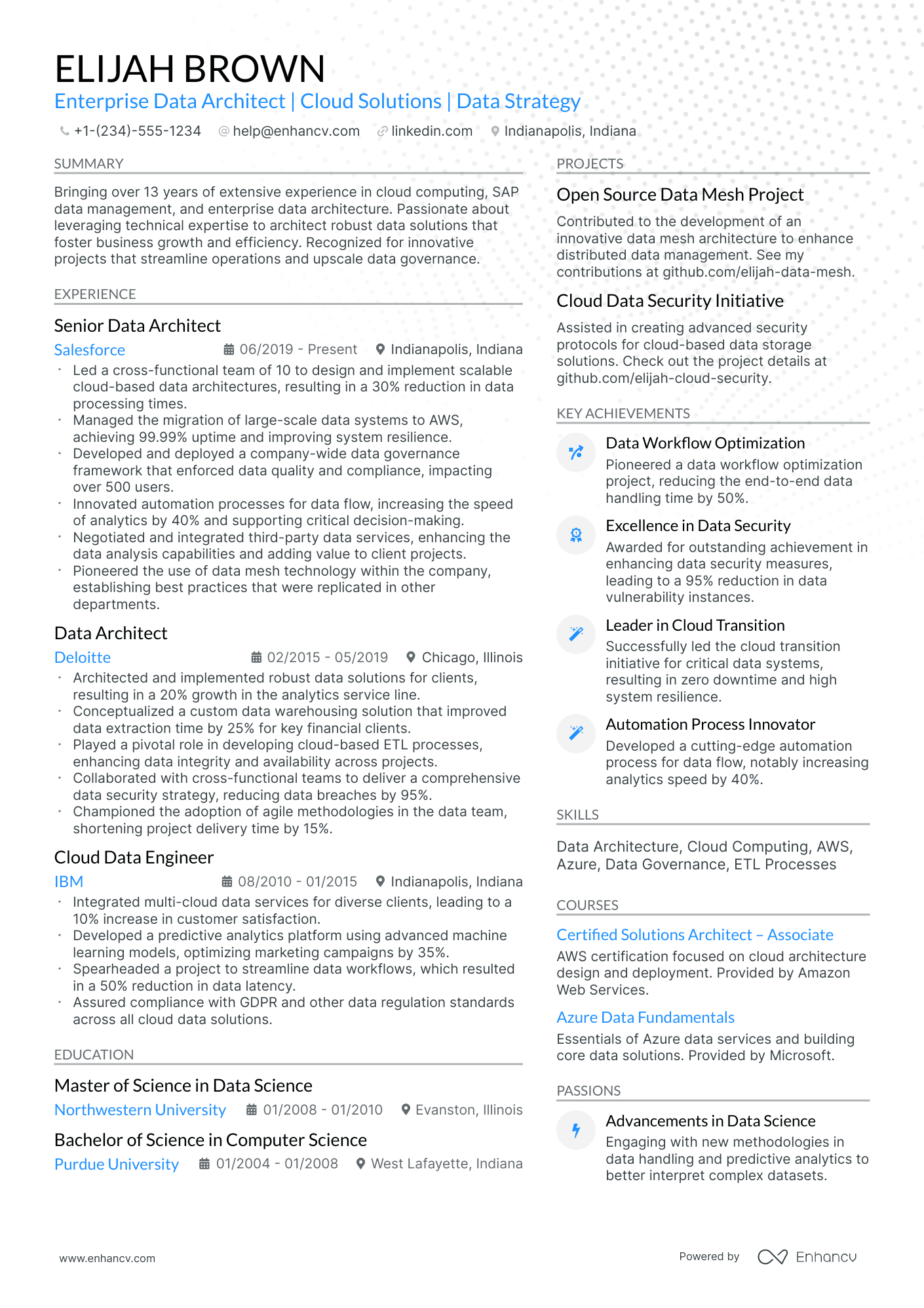
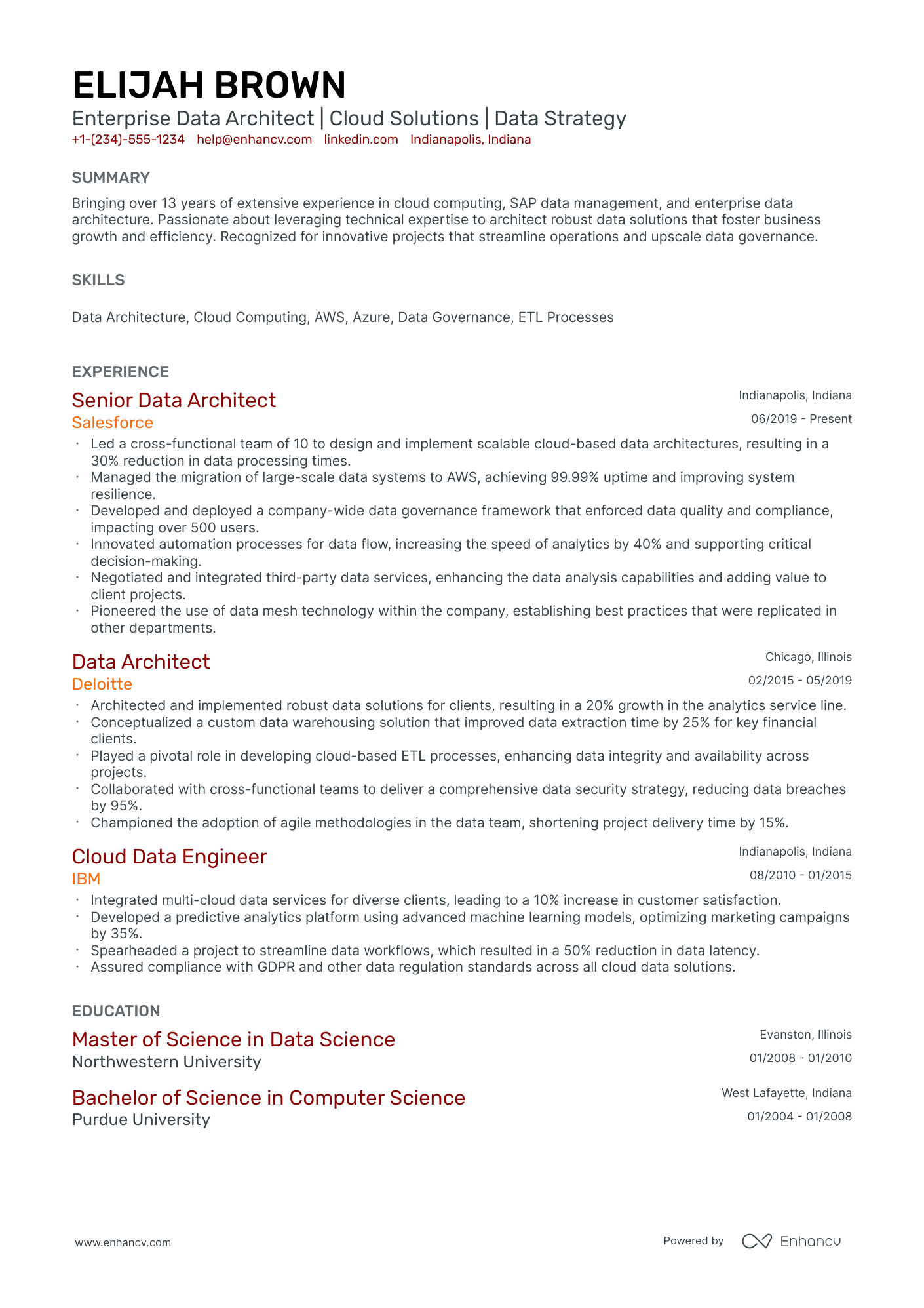
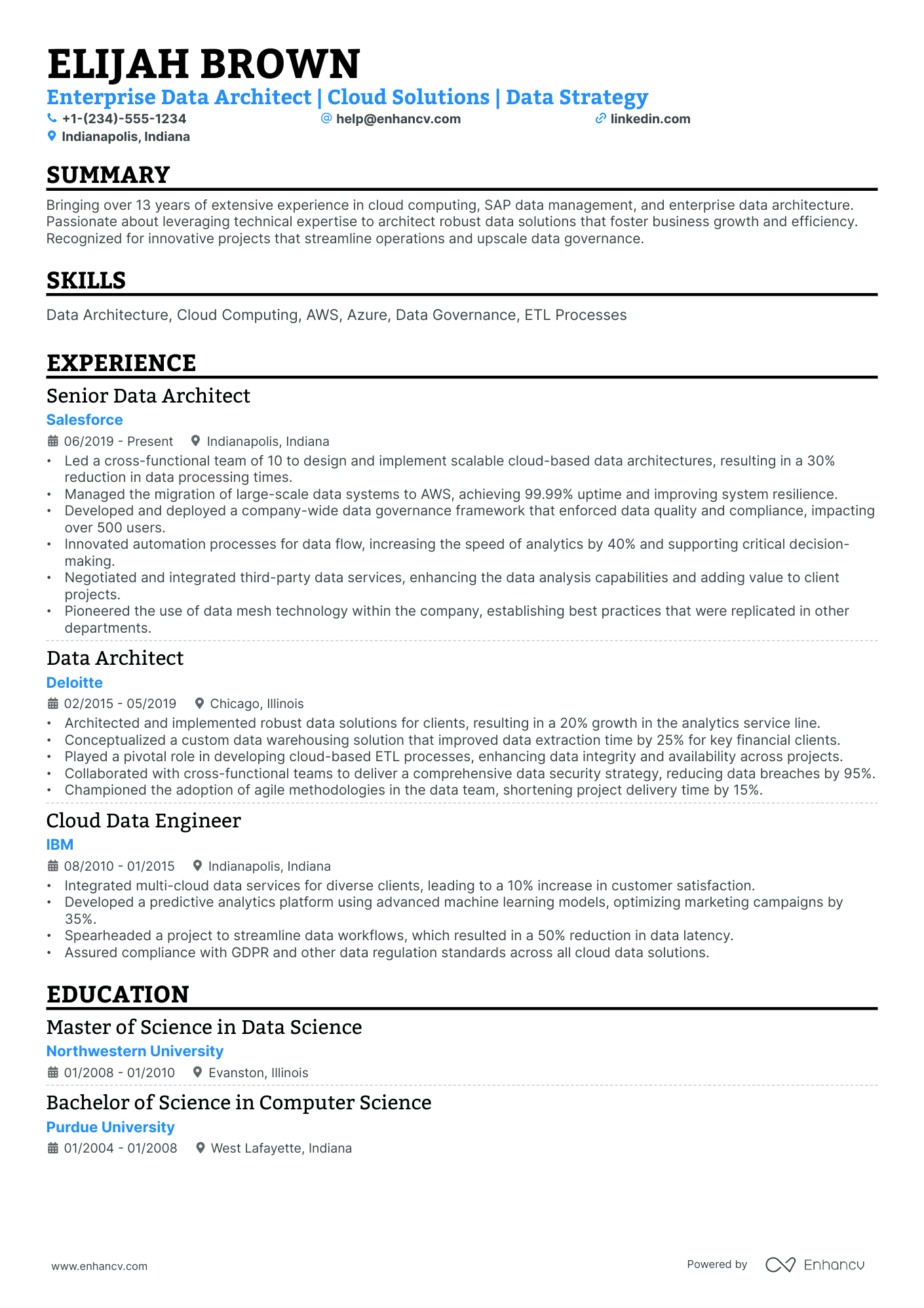
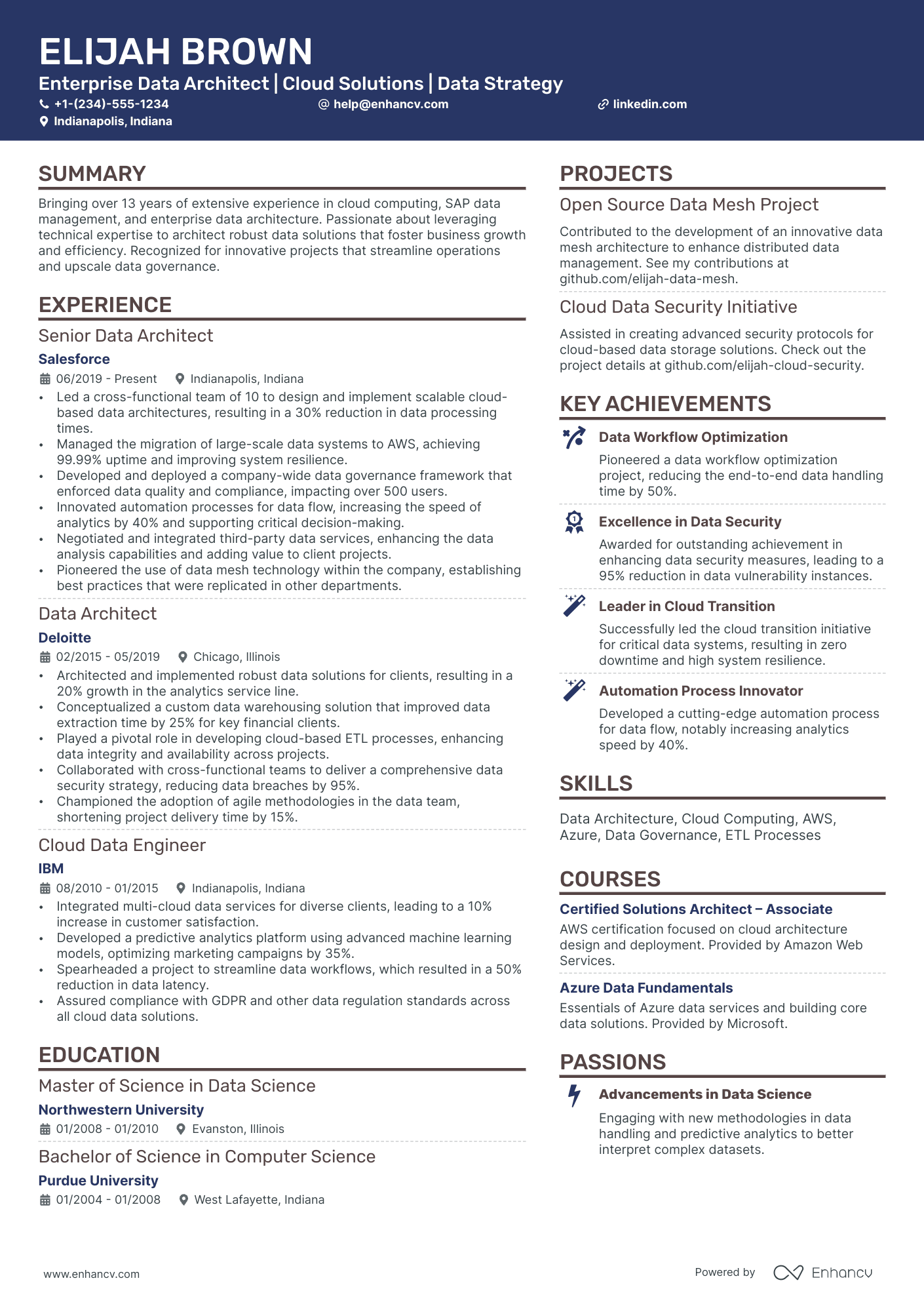
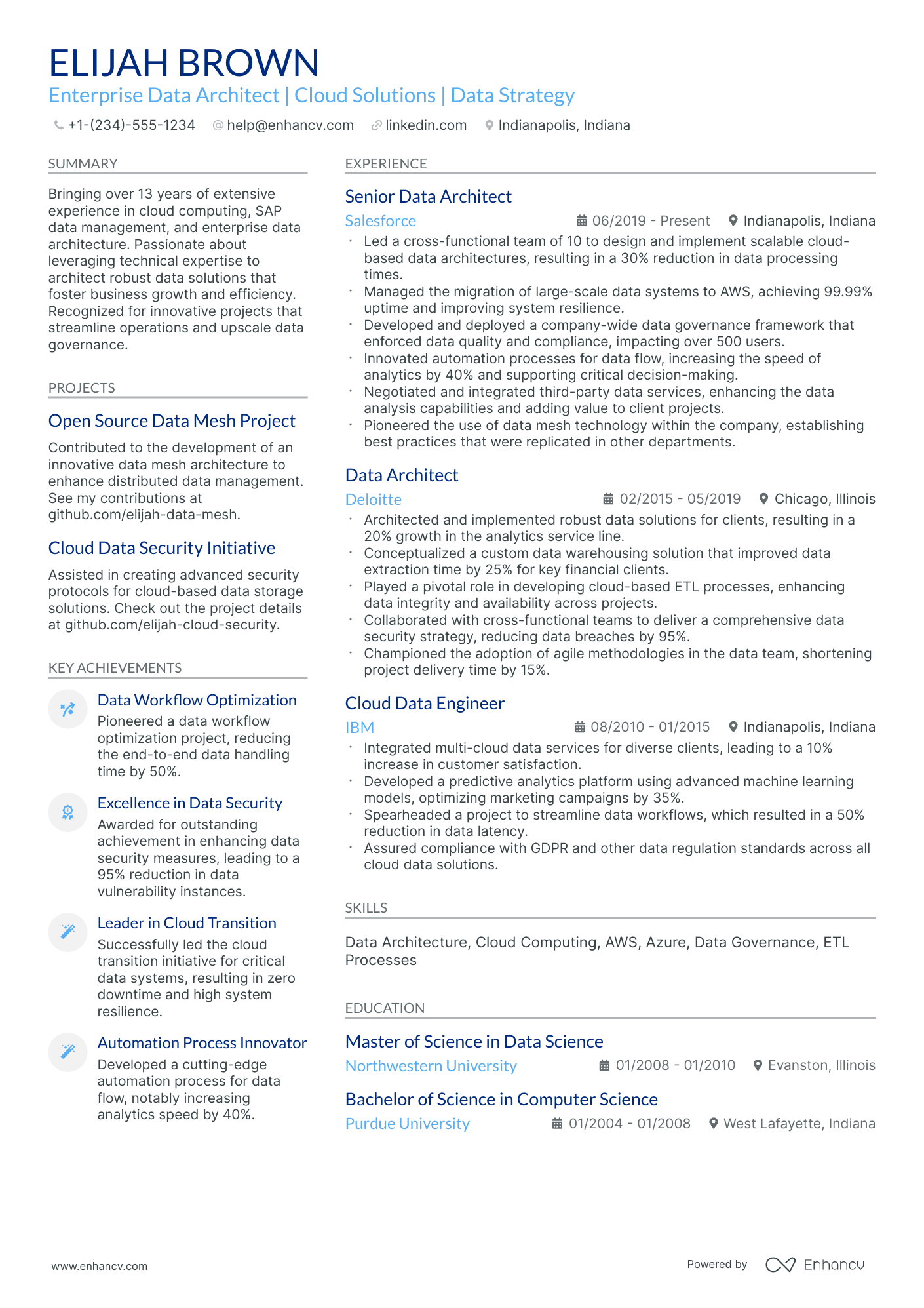
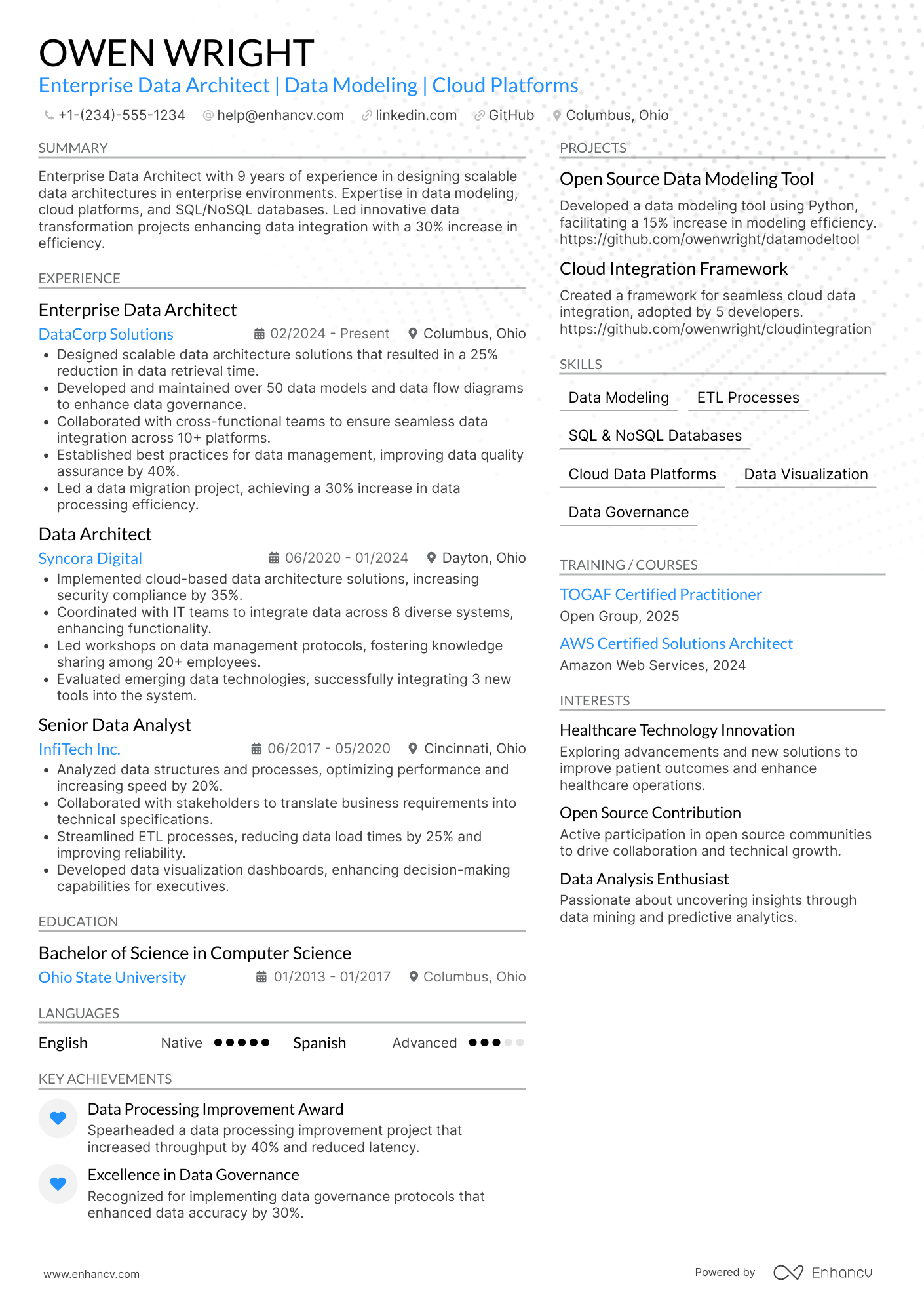
Most enterprise data architect resume drafts fail because they read like tool inventories and governance checklists, not decision-ready impact. That hurts in ATS screening, fast recruiter scans, and competitive shortlists where relevance and scope must appear immediately.
A strong resume shows how you shaped strategy and delivered measurable results. Understanding how to make your resume stand out is critical at this level. You should highlight data domain ownership, platform modernization outcomes, latency reductions, cost savings, improved data quality scores, regulatory audit readiness, and adoption across business units.

Key takeaways
- Use reverse-chronological format to showcase leadership progression and strategic ownership clearly.
- Quantify every experience bullet with metrics like cost savings, latency, or data quality gains.
- Tailor resume language to mirror each job posting's exact platforms, frameworks, and terminology.
- Anchor skills in real project outcomes rather than listing them only in a standalone section.
- Lead your summary with measurable achievements and architecture ownership, not vague descriptors.
- Place certifications like TOGAF or CDMP near education to validate specialized, current expertise.
- Use Enhancv to sharpen bullet points and align your resume with enterprise data architect role requirements.
How to format a enterprise data architect resume
Recruiters evaluating enterprise data architect resumes prioritize evidence of large-scale architecture ownership, cross-functional leadership, and measurable business outcomes tied to data strategy. A well-chosen resume format ensures these signals surface immediately, especially when applicant tracking systems parse your resume for progression, technical depth, and executive-level accountability.

I have significant experience in this role—which format should I use?
Use a reverse-chronological format—it's the strongest choice for showcasing the leadership trajectory and strategic ownership that enterprise data architect roles demand. Do:
- Lead each position with scope and ownership: enterprise-wide platforms managed, number of business units served, budget authority, and team size.
- Highlight role-specific expertise across data modeling, cloud architecture (AWS, Azure, GCP), governance frameworks, master data management, and integration platforms like Informatica or Talend.
- Quantify business impact in every bullet—cost savings, performance improvements, migration scale, or compliance milestones tied directly to your architectural decisions.
Why hybrid and functional resumes don't work for senior roles
Hybrid formats fragment your career narrative by pulling key achievements out of their timeline context, making it harder for reviewers to evaluate the progression from hands-on architecture into enterprise strategy and leadership. Functional formats are even more damaging—they obscure decision ownership, dilute accountability for large-scale outcomes, and strip away the organizational context that proves you've operated at the scope this role requires. Avoid hybrid and functional formats entirely if you have five or more years of progressive data architecture experience, as they'll raise concerns about gaps or stagnation rather than reinforcing your candidacy.
- Edge-case exception: A functional format may be acceptable only if you're transitioning into enterprise data architecture from an adjacent senior role (e.g., solutions architecture or data engineering leadership) and lack direct title progression—but even then, every listed skill must be anchored to specific projects, platforms, and quantified outcomes.
With your format established, the next step is filling it with the right sections to present your qualifications effectively.
What sections should go on a enterprise data architect resume
Recruiters expect a clear, end-to-end view of how you design, govern, and scale enterprise data platforms. Knowing which resume sections to include ensures nothing critical is missing from your application.
Use this structure for maximum clarity:
- Header
- Summary
- Experience
- Skills
- Projects
- Education
- Certifications
- Optional sections: Awards, Publications, Open-source work
Strong experience bullets should emphasize measurable impact, business outcomes, platform scale, data governance maturity, and cross-functional influence.
Is your resume good enough?
Drop your resume here or choose a file. PDF & DOCX only. Max 2MB file size.
Once you’ve included the right resume components, the next step is to write your enterprise data architect resume experience so each section supports your impact and qualifications.
How to write your enterprise data architect resume experience
The experience section is where you prove you've designed, delivered, and governed enterprise-scale data architectures—not just participated in meetings about them. Hiring managers prioritize demonstrated impact over descriptive task lists, so every bullet should connect a role-relevant tool, framework, or method to a measurable business outcome. Building a targeted resume ensures each entry speaks directly to the position you're pursuing.
Each entry should include:
- Job title
- Company and location (or remote)
- Dates of employment (month and year)
Three to five concise bullet points showing what you owned, how you executed, and what outcomes you delivered:
- Ownership scope: the enterprise data platforms, cloud environments, governance frameworks, data models, or cross-domain systems you were directly accountable for as an enterprise data architect.
- Execution approach: the architectural methodologies, modeling standards, integration patterns, cloud services, or data management technologies you applied to design solutions and drive decisions.
- Value improved: the specific changes you brought to data quality, system performance, query efficiency, regulatory compliance, platform reliability, or organizational data accessibility.
- Collaboration context: how you partnered with engineering teams, business stakeholders, security and compliance groups, vendor partners, or executive leadership to align data architecture with enterprise strategy.
- Impact delivered: the tangible results your architectural decisions produced—expressed through scale of data managed, reduction in redundancy or technical debt, acceleration of analytics capabilities, or direct contribution to business objectives.
Experience bullet formula
A enterprise data architect experience example
✅ Right example - modern, quantified, specific.
Enterprise Data Architect
NorthBridge Health Systems | Chicago, IL
2021–Present
Multi-hospital healthcare network supporting eight million patient records across clinical, claims, and digital channels.
- Designed and governed an enterprise data architecture using TOGAF (The Open Group Architecture Framework) and ArchiMate, reducing duplicate data domains by thirty-five percent and accelerating cross-domain analytics delivery by twenty percent.
- Implemented a lakehouse platform on Databricks with Delta Lake and Unity Catalog on AWS, cutting data pipeline runtimes by forty-two percent and improving platform availability to 99.9% in partnership with data engineering and cloud teams.
- Established master data management for patient, provider, and facility entities using Informatica Master Data Management and Apache Kafka, improving match accuracy from eighty-eight percent to ninety-six percent and reducing downstream reconciliation effort by twenty-five percent.
- Standardized metadata management and lineage in Collibra integrated with Apache Airflow and dbt, increasing data asset discoverability by sixty percent and reducing audit evidence collection time by forty percent for compliance stakeholders.
- Led a data security and privacy architecture program with HR, legal, and security teams, implementing role-based access control, tokenization, and row-level policies in Snowflake, reducing high-risk access findings by fifty percent and supporting zero critical audit issues.
Now that you've seen how a strong experience section comes together, let's look at how to adjust yours to match the specific job you're targeting.
How to tailor your enterprise data architect resume experience
Recruiters evaluate your enterprise data architect resume through applicant tracking systems and manual review, screening for specific technical qualifications and domain expertise. Tailoring your resume to the job description and mirroring the posting's language and priorities increases your chances of passing both filters.
Ways to tailor your enterprise data architect experience:
- Match data platforms and tools listed in the job description exactly.
- Mirror the posting's terminology for data governance frameworks and standards.
- Reflect specific data modeling methodologies the employer references by name.
- Include cloud architecture experience when the role specifies cloud environments.
- Highlight data security and compliance work if the posting mentions regulations.
- Emphasize cross-functional collaboration with engineering or analytics teams when noted.
- Align your scalability or performance achievements with stated success criteria.
- Reference industry-specific data challenges relevant to the employer's domain.
Every tailored bullet should reflect a genuine accomplishment reframed to match the employer's stated priorities—not keywords inserted where they don't belong.
Resume tailoring examples for enterprise data architect
| Job description excerpt | Untailored | Tailored |
|---|---|---|
| Design and govern enterprise data models across cloud and on-premises environments using Erwin and Collibra, ensuring compliance with GDPR and CCPA regulations. | Worked on data modeling projects and helped with data governance initiatives. | Designed and governed enterprise data models spanning AWS and on-premises systems using Erwin and Collibra, establishing data lineage frameworks that achieved full GDPR and CCPA compliance across 12 business domains. |
| Lead migration of legacy data warehouses to Snowflake, partnering with cross-functional teams to define medallion architecture and reduce data latency for real-time analytics. | Participated in data warehouse migration and worked with different teams on architecture. | Led migration of three legacy Oracle data warehouses to Snowflake, defining a medallion architecture with bronze, silver, and gold layers that reduced data latency from 24 hours to under 15 minutes for real-time analytics serving 2,000+ users. |
| Establish enterprise data standards and reference architectures, mentor junior architects, and drive adoption of a unified metadata management strategy using Apache Atlas and Kafka-based streaming pipelines. | Helped set up data standards and mentored team members on best practices. | Established enterprise data standards and reference architectures adopted across eight engineering teams, mentored four junior architects, and drove organization-wide adoption of Apache Atlas for metadata management integrated with Kafka-based streaming pipelines processing 3M+ events daily. |
Once your experience aligns with the role’s priorities, the next step is to quantify your enterprise data architect achievements so hiring teams can quickly see the impact you delivered.
How to quantify your enterprise data architect achievements
Quantifying achievements shows how your architecture improved speed, reliability, cost, security, and delivery. Focus on latency, uptime, data quality, cloud spend, incident counts, and time-to-deliver across platforms and teams.
Quantifying examples for enterprise data architect
| Metric | Example |
|---|---|
| Performance | "Cut customer-360 query latency from 45s to 8s by redesigning Snowflake clustering keys and adding dbt incremental models across 120+ tables." |
| Reliability | "Improved pipeline availability from 99.2% to 99.95% by implementing Airflow retries, idempotent loads, and automated backfills for 300 daily workflows." |
| Data quality | "Reduced duplicate customer records by 62% using Great Expectations checks and MDM matching rules, raising downstream report accuracy from 93% to 98%." |
| Cost efficiency | "Lowered monthly cloud data platform spend by $85K by retiring five legacy ETL jobs and optimizing Databricks autoscaling and storage tiering." |
| Security risk | "Cut high-severity data access findings from 14 to 2 by enforcing role-based access control, column masking, and audit logging across three domains." |
Turn vague job duties into measurable, recruiter-ready resume bullets in seconds with Enhancv's Bullet Point Generator.
With strong bullet points in place, the next step is ensuring your enterprise data architect resume highlights the right mix of hard and soft skills to match what employers are looking for.
How to list your hard and soft skills on a enterprise data architect resume
Your skills section shows your ability to design, govern, and scale enterprise data platforms, and recruiters and applicant tracking systems (ATS) scan this section for role-match keywords; aim for a hard skill-heavy mix with targeted collaboration and decision-making soft skills.
enterprise data architect roles require a blend of:
- Product strategy and discovery skills.
- Data, analytics, and experimentation skills.
- Delivery, execution, and go-to-market discipline.
- Soft skills.
Your skills section should be:
- Scannable (bullet-style grouping).
- Relevant to the job post.
- Backed by proof in experience bullets.
- Updated with current tools.
Place your skills section:
- Above experience if you're junior or switching careers.
- Below experience if you're mid/senior with strong achievements.

Hard skills
- Enterprise data modeling
- Conceptual, logical, physical modeling
- Data architecture roadmaps
- Cloud data platforms: AWS, Azure, Google Cloud
- Data warehousing: Snowflake, BigQuery, Redshift
- Lakehouse architecture: Databricks, Delta Lake
- Data integration: Informatica, Talend, dbt
- Streaming data: Kafka, Kinesis
- Metadata and lineage: Collibra, Alation
- Data governance and stewardship
- Master data management (MDM)
- SQL, Python for data
Soft skills
- Translate business goals to data designs
- Facilitate architecture decision records
- Align stakeholders on domain boundaries
- Negotiate standards across teams
- Lead governance councils and working groups
- Communicate trade-offs and risk
- Influence without direct authority
- Drive cross-team delivery commitments
- Prioritize architectural debt reduction
- Mentor engineers and analysts
- Run effective design reviews
- Resolve data ownership conflicts
How to show your enterprise data architect skills in context
Skills shouldn't live only in a bulleted list on your resume. Explore resume skills examples to see how top candidates weave competencies throughout their documents.
They should be demonstrated in:
- Your summary (high-level professional identity)
- Your experience (proof through outcomes)
Here's what strong, context-driven examples look like in practice.
Summary example
Enterprise data architect with 12 years in healthcare, specializing in data governance, lakehouse design, and Informatica-driven integration. Led a cross-functional migration to AWS that cut reporting latency by 60% and unified 14 legacy data sources.
- Signals senior-level depth immediately
- Names specific platforms and tools
- Leads with a measurable outcome
- Highlights cross-functional collaboration
Experience example
Senior Enterprise Data Architect
Meridian Health Systems | Remote
March 2019–Present
- Designed a unified data lakehouse on Snowflake and dbt, reducing average query time by 45% across five business units.
- Partnered with compliance and engineering teams to implement a master data management framework using Collibra, resolving 3,200 data quality issues quarterly.
- Led migration of 11 on-premise Oracle databases to AWS Redshift, cutting annual infrastructure costs by $380K while improving uptime to 99.97%.
- Every bullet contains measurable proof.
- Skills surface naturally through outcomes.
Once you’ve demonstrated your enterprise data architect capabilities through real deliverables and outcomes, the next step is learning how to write an enterprise data architect resume with no experience so you can present that evidence effectively without relying on prior job titles.
How do I write a enterprise data architect resume with no experience
Even without full-time experience, you can demonstrate readiness through:
- Capstone enterprise data architecture project
- Internship supporting data platform migration
- Cloud data warehouse lab build
- Data modeling portfolio with ERDs
- Governance and lineage documentation samples
- ETL pipeline prototypes with testing
- Certifications in cloud data platforms
- Open-source contributions to data tools
If you're building a resume without work experience, focus on:
- Enterprise data models and standards
- Cloud platform design decisions
- Governance, lineage, and security artifacts
- Measurable outcomes from projects
Resume format tip for entry-level enterprise data architect
Use a hybrid resume format because it highlights projects and skills first, while still showing relevant education and experience in context. Do:
- Lead with a projects section.
- Name tools: AWS, Azure, Snowflake.
- Include diagrams: ERDs, data flows.
- Quantify impact: cost, latency, errors.
- Tailor keywords to each posting.
- Built an enterprise data architect capstone on Azure Synapse using Kimball dimensional modeling and Purview lineage, cutting query time from twelve seconds to four.
Even without direct experience, your educational background can demonstrate the foundational knowledge employers need to see on your enterprise data architect resume.
How to list your education on a enterprise data architect resume
Your education section helps hiring teams confirm you hold the foundational knowledge needed for an enterprise data architect role. It validates technical depth and academic rigor quickly.
Include:
- Degree name
- Institution
- Location
- Graduation year
- Relevant coursework (for juniors or entry-level candidates)
- Honors & GPA (if 3.5 or higher)
Avoid listing specific months or days—use the graduation year only for a clean, professional look.
Here's a strong education entry tailored for an enterprise data architect resume.
Example education entry
Master of Science in Computer Science
Carnegie Mellon University, Pittsburgh, PA
Graduated 2019
GPA: 3.8/4.0
- Relevant Coursework: Distributed Systems, Advanced Database Design, Data Warehousing, Cloud Architecture, and Information Governance
- Honors: Dean's List, Graduate Research Fellowship in Large-Scale Data Systems
How to list your certifications on a enterprise data architect resume
Certifications on a resume show an enterprise data architect's commitment to learning, proficiency with modern platforms, and alignment with current industry standards and frameworks.
Include:
- Certificate name
- Issuing organization
- Year
- Optional: credential ID or URL
- Put certifications below education when they're older, less relevant, or supplemental to your core enterprise data architect requirements.
- Put certifications above education when they're recent, highly relevant, or required for the enterprise data architect roles you target.
Best certifications for your enterprise data architect resume
- AWS Certified Data Analytics—Specialty
- Microsoft Certified: Azure Data Engineer Associate
- Google Cloud Professional Data Engineer
- DAMA Certified Data Management Professional (CDMP)
- SnowPro Advanced: Data Architect
- TOGAF Certification
- IBM Certified Data Architect—Big Data
Once your credentials are positioned to reinforce your qualifications, use that same focus to craft an enterprise data architect resume summary that quickly communicates your value to hiring teams.
How to write your enterprise data architect resume summary
Your resume summary is the first thing a recruiter reads. A strong one immediately signals you have the leadership, technical depth, and strategic vision this senior role demands.
Keep it to three to four lines, with:
- Your title and 8+ years of experience in data architecture or enterprise systems.
- Domain expertise such as financial services, healthcare, or large-scale cloud migration.
- Core technologies like Snowflake, AWS, Azure, Spark, Kafka, or Informatica.
- One or two quantified achievements, such as reducing data latency by 40% or leading a platform consolidation saving $2M annually.
- Soft skills tied to real outcomes, like cross-functional leadership that accelerated delivery timelines.

PRO TIP
At the enterprise architect level, lead with outcomes and ownership. Emphasize decisions you drove, systems you designed at scale, and measurable business impact. Avoid vague descriptors like "passionate" or "results-oriented." Recruiters want evidence of strategic influence, not motivational language.
Example summary for a enterprise data architect
Enterprise data architect with 12 years of experience designing scalable cloud platforms across financial services. Led a firmwide data consolidation that cut infrastructure costs by $1.8M annually while improving query performance by 60%.
Optimize your resume summary and objective for ATS
Drop your resume here or choose a file.
PDF & DOCX only. Max 2MB file size.
Once your summary captures the strategic value you bring, make sure your header presents the essential contact and professional details that let recruiters act on that interest immediately.
What to include in a enterprise data architect resume header
A resume header lists your key identity and contact details, helping enterprise data architect candidates gain visibility, build credibility, and pass recruiter screening fast.
Essential resume header elements
- Full name
- Tailored job title and headline
- Location
- Phone number
- Professional email
- GitHub link
- Portfolio link
A LinkedIn link helps recruiters verify experience quickly and supports screening.
Do not include photos on a enterprise data architect resume unless the role is explicitly front-facing or appearance-dependent.
Use a clear job title that matches the posting and keep every link and contact detail current and easy to scan.
Example
Enterprise data architect resume header
Jordan Lee
Enterprise Data Architect | Data Modeling, Governance, and Cloud Data Platforms
Austin, TX
(512) 555-01XX
jordan.lee@enhancv.com
github.com/jordanlee
jordanlee.com
linkedin.com/in/jordanlee
Once your contact details and professional identifiers are clear at the top, add targeted additional sections to reinforce your qualifications and support the rest of your resume.
Additional sections for enterprise data architect resumes
Adding extra sections strengthens your resume when they showcase specialized expertise or credibility that core sections can't fully capture. For example, listing language skills can set you apart when applying to global organizations with distributed data teams.
- Languages
- Publications and whitepapers
- Industry certifications
- Conference presentations and speaking engagements
- Professional affiliations and memberships
- Patents and intellectual property
- Open source contributions and technical community involvement
Once you've strengthened your resume with well-chosen additional sections, the next step is pairing it with a cover letter that adds even more context to your candidacy.
Do enterprise data architect resumes need a cover letter
A cover letter isn't required for an enterprise data architect, but it often helps in competitive searches. If you're unsure what a cover letter is or when to use one, it can make a difference when hiring managers expect concise context beyond the resume. Skip it when the application explicitly says not to include one.
Use a cover letter to add context your resume can't show:
- Explain role and team fit: Connect your architecture approach to the team's operating model, governance needs, and delivery pace.
- Highlight one or two outcomes: Summarize a project with measurable impact, such as improved data quality, lower platform costs, or faster analytics delivery.
- Show business context understanding: Reference the product, users, and key metrics, and explain how your data strategy supports them.
- Address transitions or non-obvious experience: Clarify shifts across industries, platforms, or responsibilities, and tie them to enterprise data architect requirements.
Drop your resume here or choose a file.
PDF & DOCX only. Max 2MB file size.
Even if you skip a cover letter, using AI to improve your enterprise data architect resume helps you sharpen your messaging and align your experience with the role faster.
Using AI to improve your enterprise data architect resume
AI can sharpen your resume's clarity, structure, and impact. It helps tighten language and highlight results. But overuse strips authenticity fast. Once your content feels clear and role-aligned, step away from AI entirely. If you're exploring this approach, learn more about ChatGPT resume writing prompts to get the most from AI tools.
Here are 10 practical prompts to strengthen specific sections of your enterprise data architect resume:
- Sharpen your summary. "Rewrite my resume summary to clearly position me as an enterprise data architect with measurable contributions to data strategy and governance."
- Quantify experience bullets. "Add specific metrics and outcomes to these experience bullet points for an enterprise data architect role, focusing on scalability and efficiency gains."
- Align skills precisely. "Review my skills section and remove any entries that aren't directly relevant to an enterprise data architect position in a Fortune 500 environment."
- Strengthen project descriptions. "Rewrite these project descriptions to emphasize my enterprise data architect responsibilities, including architecture decisions, tools used, and business outcomes."
- Tighten certification details. "Reformat my certifications section so each entry clearly supports my qualifications as an enterprise data architect, prioritizing the most relevant credentials."
- Clarify technical scope. "Revise these experience bullets to specify the platforms, frameworks, and data models I managed as an enterprise data architect."
- Remove vague language. "Identify and replace any vague or generic phrases in my enterprise data architect resume with concrete, specific language."
- Improve education relevance. "Rewrite my education section to highlight coursework, research, or projects directly applicable to an enterprise data architect career path."
- Tailor for job postings. "Compare my enterprise data architect resume against this job description and suggest targeted edits to close any gaps in language or qualifications."
- Eliminate redundancy. "Find and consolidate any repeated ideas across my enterprise data architect resume so every bullet point communicates something unique and essential."
Stop using AI once your resume sounds accurate, specific, and aligned with real experience. AI should never invent experience or inflate claims—if it didn't happen, it doesn't belong here.
Conclusion
A strong enterprise data architect resume proves impact with measurable outcomes, role-specific skills, and a clear structure. Show results like faster pipelines, lower costs, higher data quality, or improved governance. Keep bullets direct, and align each section to the role.
Hiring teams want enterprise data architect candidates who can deliver now and adapt next. Highlight architecture leadership, data modeling, cloud platforms, security, and governance with metrics. Use consistent formatting, clean headings, and focused content that’s easy to scan.