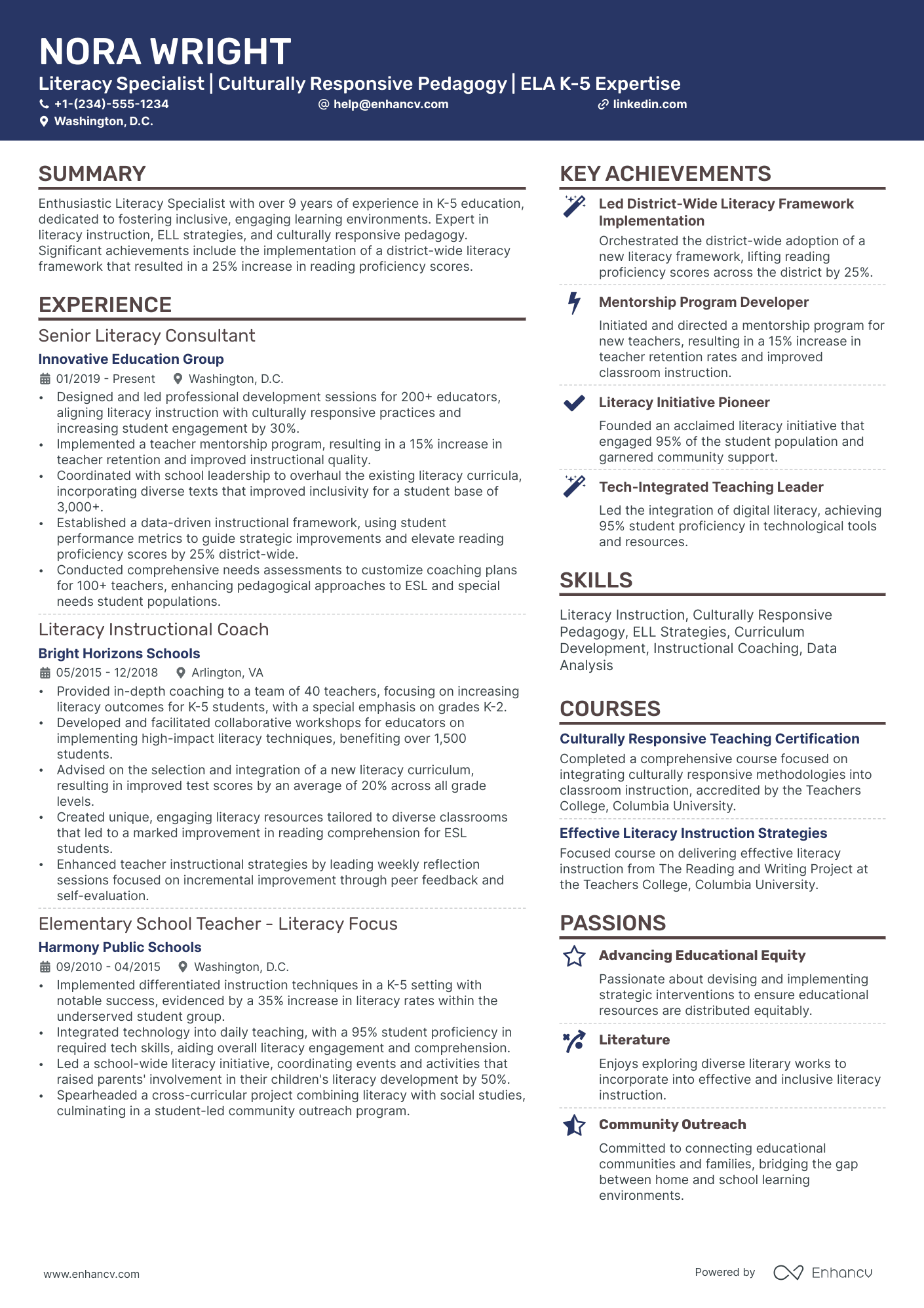
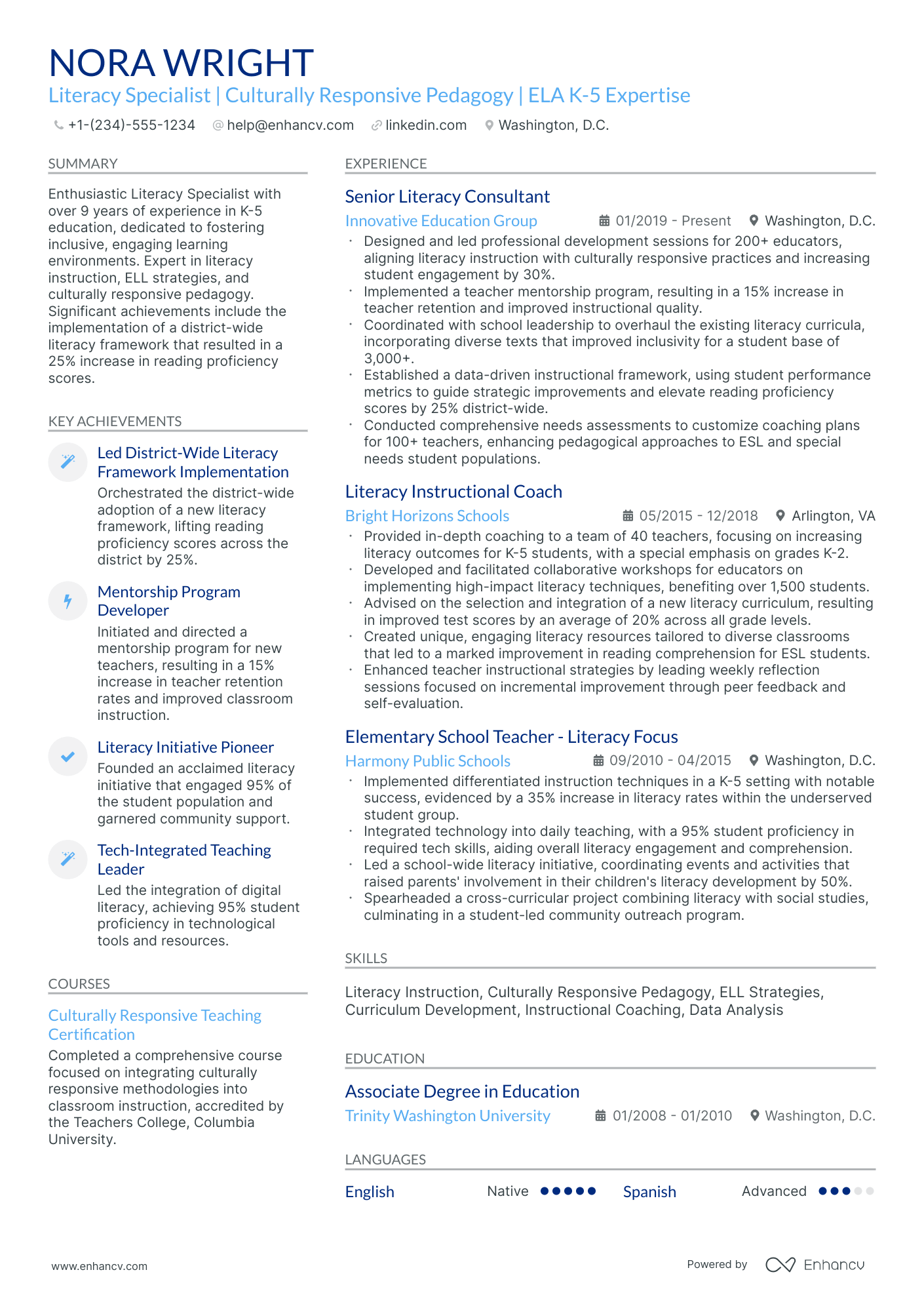
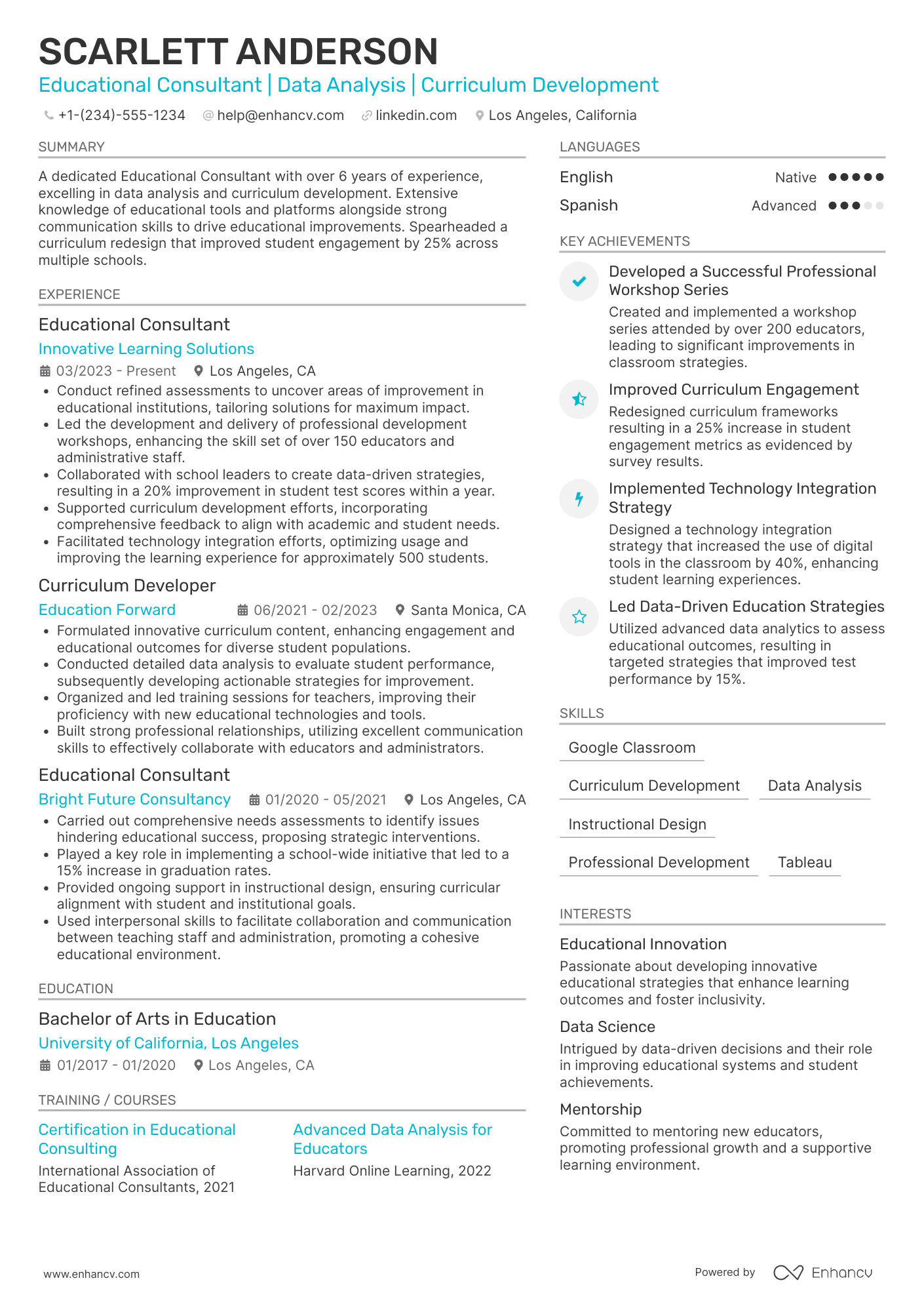
Many educational consultant resume drafts fail because they read like job descriptions, burying measurable impact under program lists and broad responsibilities. That hurts in ATS screening and fast recruiter scans, where high competition rewards clear outcomes.
This guide shows you how to write a resume that leads with results: improved student achievement growth, higher graduation rates, district-wide adoption across multiple schools, on-time rollout of new curricula, reduced compliance findings, and stronger stakeholder satisfaction. You'll connect strategy to delivery and impact.

Key takeaways
- Lead every experience bullet with a measurable outcome, not a job duty.
- Use reverse-chronological format if you have significant consulting experience.
- Tailor resume language to mirror each job posting's specific frameworks and tools.
- Quantify achievements using student outcomes, retention rates, compliance accuracy, and scope.
- Place skills above experience when switching careers or entering the field.
- Pair your resume with a cover letter to explain transitions or highlight role fit.
- Use Enhancv to turn vague responsibilities into quantified, recruiter-ready bullet points.
Job market snapshot for educational consultants
We analyzed 51 recent educational consultant job ads across major US job boards. These numbers help you understand employer expectations, career growth patterns, industry demand at a glance.
What level of experience employers are looking for educational consultants
| Years of Experience | Percentage found in job ads |
|---|---|
| 1–2 years | 7.8% (4) |
| 3–4 years | 5.9% (3) |
| 5–6 years | 9.8% (5) |
| 9–10 years | 2.0% (1) |
| 10+ years | 2.0% (1) |
| Not specified | 74.5% (38) |
Educational consultant ads by area of specialization (industry)
| Industry (Area) | Percentage found in job ads |
|---|---|
| Government | 45.1% (23) |
| Finance & Banking | 29.4% (15) |
Role overview stats
These tables show the most common responsibilities and employment types for educational consultant roles. Use them to align your resume with what employers expect and to understand how the role is structured across the market.
Day-to-day activities and top responsibilities for a educational consultant
| Responsibility | Percentage found in job ads |
|---|---|
| Data analysis | 19.6% (10) |
| Webex | 17.6% (9) |
| Zoom | 17.6% (9) |
| Communication | 15.7% (8) |
| Audiovisual equipment | 11.8% (6) |
| Computer equipment | 11.8% (6) |
| Data collection | 11.8% (6) |
| Report writing | 11.8% (6) |
| Community health improvement | 9.8% (5) |
| Grant writing | 9.8% (5) |
| Health promotion | 9.8% (5) |
| Adult learning principles | 7.8% (4) |
Type of employment (remote vs on-site vs hybrid)
| Employment type | Percentage found in job ads |
|---|---|
| On-site | 74.5% (38) |
| Remote | 13.7% (7) |
| Hybrid | 11.8% (6) |
How to format a educational consultant resume
Recruiters evaluating educational consultant resumes prioritize evidence of client-facing advisory work, curriculum or program expertise, and measurable improvements in student or institutional outcomes. A clean, well-chosen resume format ensures these signals surface quickly during both human review and applicant tracking system (ATS) scans.

I have significant experience in this role—which format should I use?
Use a reverse-chronological format to showcase your deepening expertise and growing client or institutional impact over time. Do:
- Lead each role entry with your scope of responsibility—number of schools served, districts consulted, or program budgets managed.
- Highlight domain-specific proficiencies such as curriculum alignment frameworks, state and federal compliance standards, data-driven assessment tools, and stakeholder facilitation methods.
- Quantify outcomes tied to your recommendations, including improvements in test scores, graduation rates, accreditation results, or grant funding secured.
I'm junior or switching into this role—what format works best?
A hybrid format works best because it lets you lead with relevant consulting, education, or training skills while still providing a clear work history. Do:
- Place a skills section near the top that groups competencies like needs assessment, instructional design, data analysis, and stakeholder communication.
- Include project-based entries—such as practicum consulting engagements, grant-funded initiatives, or student-teaching placements—that demonstrate advisory or program improvement work.
- Connect every listed action to a concrete result so reviewers can see the impact of your contributions, even from adjacent roles.
Why not use a functional resume?
A functional format strips away the timeline and context recruiters need to evaluate where, when, and how you applied your consulting skills, which weakens your candidacy even at the entry or mid level.
- Career changers from classroom teaching: A functional format can work if your teaching roles didn't carry advisory responsibilities but you completed independent consulting projects, led professional development sessions, or managed curriculum pilots outside your day-to-day duties.
- Candidates with resume gaps: If you stepped away from the workforce but continued relevant work—such as freelance tutoring program design or nonprofit education advising—a functional layout can spotlight those engagements.
- A functional resume is acceptable when you have limited formal consulting experience but can tie every listed skill directly to a specific project, engagement, or outcome—such as a capstone consulting practicum or a volunteer-led school improvement initiative.
Once you've established a clean, readable format, the next step is deciding which sections to include so each one earns its place on the page.
What sections should go on a educational consultant resume
Recruiters expect a clear, results-focused resume that shows how you improved student outcomes, strengthened academic programs, and guided stakeholders. Knowing what to put on a resume helps you prioritize the sections that matter most.
Use this structure for maximum clarity:
- Header
- Summary
- Experience
- Skills
- Projects
- Education
- Certifications
- Optional sections: Awards, Publications, Languages
Strong experience bullets should emphasize measurable impact, outcomes, scope, and results across schools, districts, or programs.
Is your resume good enough?
Drop your resume here or choose a file. PDF & DOCX only. Max 2MB file size.
Once you’ve organized your resume with the right core components, the next step is to write your educational consultant resume experience section so it aligns with that structure and supports the role you’re targeting.
How to write your educational consultant resume experience
Your experience section should function as evidence of what you've delivered—not a summary of what you were responsible for. Hiring managers reviewing educational consultant resumes prioritize demonstrated impact on student outcomes, institutional performance, and program effectiveness over generic descriptions of daily tasks.
Each entry should include:
- Job title
- Company and location (or remote)
- Dates of employment (month and year)
Three to five concise bullet points showing what you owned, how you executed, and what outcomes you delivered:
- Ownership scope: the programs, curricula, student populations, school districts, or institutional partnerships you were directly accountable for as an educational consultant.
- Execution approach: the assessment frameworks, data analysis tools, instructional design methodologies, compliance standards, or stakeholder engagement strategies you used to inform recommendations and deliver consulting work.
- Value improved: the measurable changes you drove in student achievement, program quality, regulatory compliance, institutional efficiency, accessibility, or educational equity through your consulting engagements.
- Collaboration context: how you partnered with administrators, teachers, parents, policy teams, government agencies, or community organizations to align educational strategies and implement sustainable improvements.
- Impact delivered: the outcomes your work produced—expressed through institutional results, enrollment shifts, accreditation milestones, adoption scale, or long-term program sustainability rather than a list of activities performed.
Experience bullet formula
A educational consultant experience example
✅ Right example - modern, quantified, specific.
Educational Consultant
BrightPath Learning Partners | Austin, TX
2022–Present
Supported K–12 districts in implementing evidence-based instruction, assessment systems, and professional learning across multi-campus networks.
- Led a district-wide curriculum audit across eight campuses using Google Workspace, Excel, and rubric-based alignment protocols; reduced instructional gaps by 22% on standards-alignment checks within two semesters.
- Designed and facilitated thirty-six professional learning sessions using adult learning principles and coaching cycles; increased teacher implementation fidelity from 58% to 81% based on walkthrough data collected in TeachBoost.
- Built a Power BI dashboard integrating MAP Growth, state assessment, and attendance data; cut weekly reporting time by 65% and enabled principals to identify and intervene with at-risk students two weeks earlier on average.
- Partnered with superintendents, campus leaders, and special education teams to revise Multi-Tiered System of Supports (MTSS) decision rules; improved Tier two intervention placement accuracy by 18% and reduced over-identification by 12%.
- Managed stakeholder communications and project timelines in Smartsheet; delivered five concurrent implementation plans on schedule, contributing to a 14% increase in renewal revenue for the consulting engagement year over year.
Now that you've seen how a strong experience section comes together, let's break down how to tailor each element to match the specific role you're targeting.
How to tailor your educational consultant resume experience
Recruiters evaluate your educational consultant resume through both human review and applicant tracking systems. Tailoring your resume to the job description ensures you pass both screenings.
Ways to tailor your educational consultant experience:
- Match curriculum frameworks or assessment tools named in the posting.
- Mirror the exact terminology used for accreditation standards or processes.
- Highlight student outcome metrics or program KPIs the role prioritizes.
- Include specific grade levels or educational domains the position requires.
- Emphasize compliance with state or federal education regulations if referenced.
- Reflect collaborative models like co-teaching or stakeholder engagement workflows.
- Align your data analysis methods with those the job description specifies.
- Reference learning management systems or edtech platforms the employer uses.
Tailoring means aligning your real accomplishments with what the role demands, not forcing disconnected keywords into your experience.
Resume tailoring examples for educational consultant
| Job description excerpt | Untailored | Tailored |
|---|---|---|
| Develop and implement individualized education plans (IEPs) for K–12 students with diverse learning needs using data-driven assessment tools such as NWEA MAP and DIBELS. | Helped students with their learning plans and assessments. | Developed and implemented IEPs for 45+ K–12 students annually, using NWEA MAP and DIBELS data to set measurable goals that improved reading proficiency rates by 22% over two academic years. |
| Collaborate with school leadership teams to design and deliver professional development workshops focused on culturally responsive teaching and differentiated instruction strategies. | Led training sessions for teachers on various educational topics. | Partnered with school leadership teams across six Title I campuses to design and facilitate 12 professional development workshops on culturally responsive teaching and differentiated instruction, reaching 180+ educators and earning a 94% satisfaction rating. |
| Advise families and school districts on postsecondary transition planning for students with disabilities, ensuring compliance with IDEA and Section 504 regulations. | Provided guidance to families about college and career options. | Advised 30+ families and three school districts on postsecondary transition planning for students with disabilities, ensuring full compliance with IDEA and Section 504 while increasing successful postsecondary placements by 35% year over year. |
Once you’ve aligned your experience with the role’s priorities, the next step is to quantify your educational consultant achievements so hiring managers can see the measurable impact behind those choices.
How to quantify your educational consultant achievements
Quantifying your achievements proves you drive measurable student outcomes and program results. Track student success rates, retention, satisfaction, process turnaround time, and compliance, plus the number of schools, programs, and stakeholders you support.
Quantifying examples for educational consultant
| Metric | Example |
|---|---|
| Student outcomes | "Raised college acceptance rate from 68% to 82% across 110 seniors by redesigning advising plans in Naviance and running biweekly application reviews." |
| Cycle time | "Cut scholarship application turnaround time from 12 days to five by standardizing intake in Google Forms and automating reminders in Gmail and Sheets." |
| Retention | "Improved program retention from 76% to 88% for a 240-student tutoring initiative by adding early-alert check-ins and parent updates every two weeks." |
| Compliance accuracy | "Reduced Individualized Education Program documentation errors by 35% across four schools by auditing files and training staff on state submission requirements." |
| Satisfaction | "Increased parent satisfaction from 4.1 to 4.7 out of five on post-meeting surveys by introducing structured agendas and follow-up notes within 24 hours." |
Turn vague job duties into measurable, recruiter-ready resume bullets in seconds with Enhancv's Bullet Point Generator.
Once you've crafted strong bullet points for your experience section, you'll want to apply that same precision to presenting your hard and soft skills throughout your educational consultant resume.
How to list your hard and soft skills on a educational consultant resume
Your skills section shows how you improve student outcomes and program performance, and recruiters and ATS scan it for role keywords and tool fit—aim for a balanced mix of hard skills and soft skills that match the job post. educational consultant roles require a blend of:
- Product strategy and discovery skills.
- Data, analytics, and experimentation skills.
- Delivery, execution, and go-to-market discipline.
- Soft skills.
Your skills section should be:
- Scannable (bullet-style grouping).
- Relevant to the job post.
- Backed by proof in experience bullets.
- Updated with current tools.
Place your skills section:
- Above experience if you're junior or switching careers.
- Below experience if you're mid/senior with strong achievements.

Hard skills
- Curriculum design and mapping
- Individualized Education Program compliance
- Multi-Tiered System of Supports (MTSS)
- Response to Intervention frameworks
- Student data analysis, dashboards
- Excel, Google Sheets
- Power BI, Tableau
- Learning management systems administration
- Program evaluation and logic models
- Survey design and analysis
- Professional development facilitation
- Grant writing and reporting
Soft skills
- Stakeholder alignment across schools
- Clear, parent-ready communication
- Facilitation of difficult meetings
- Prioritization under tight timelines
- Change management in classrooms
- Consultative questioning and listening
- Actionable feedback for educators
- Cross-functional collaboration with HR
- Decision-making with incomplete data
- Conflict de-escalation and resolution
- Ownership of deliverables end-to-end
- Documentation and follow-through
How to show your educational consultant skills in context
Skills shouldn't live only in a bulleted list on your resume. Explore common resume skills to see how top candidates present their competencies effectively.
They should be demonstrated in:
- Your summary (high-level professional identity)
- Your experience (proof through outcomes)
Here's what each looks like in practice.
Summary example
Educational consultant with 12 years of experience in K–12 curriculum design, leveraging backward design and data-driven program evaluation. Partnered with 30+ districts to boost student proficiency rates by 18% through equity-centered instructional frameworks.
- Reflects senior-level experience clearly
- Names specific tools and methods
- Leads with a measurable outcome
- Signals collaboration and leadership
Experience example
Senior Educational Consultant
Brightpath Learning Partners | Remote
June 2019–March 2024
- Redesigned literacy curricula across nine school districts using Universal Design for Learning, raising reading benchmarks by 22% within two years.
- Collaborated with administrators and instructional coaches to implement Panorama Education surveys, improving family engagement scores by 15%.
- Facilitated 40+ professional development workshops on differentiated instruction, earning a 96% satisfaction rating from participating educators.
- Every bullet includes measurable proof.
- Skills surface naturally through real outcomes.
Once you’ve demonstrated your educational consulting strengths through concrete examples, the next step is to apply that same approach to structuring an educational consultant resume when you have no experience.
How do I write a educational consultant resume with no experience
Even without full-time experience, you can demonstrate readiness through projects and transferable work. If you're building a resume without work experience, focus on these areas:
- Student advising and tutoring results
- Curriculum mapping for a course
- Education needs assessment surveys
- Workshop facilitation for families
- Individualized learning plan drafts
- Internship with school support team
- Data analysis of student outcomes
- Volunteer college application coaching
Focus on:
- Quantified student outcome improvements
- Documented curriculum and assessment work
- Stakeholder deliverables and timelines
- Tools: Google Workspace, Excel
Resume format tip for entry-level educational consultant
Use a combination resume format to highlight projects and relevant coursework first, while still listing roles and volunteering to prove reliability. Do:
- Add a "Projects" section above work history.
- Write bullets with action, tool, outcome.
- Include education metrics you improved.
- List education tools you used daily.
- Tailor keywords to each job post.
- Analyzed student outcome data in Excel, identified three learning gaps, and helped raise unit assessment scores by 12% across a tutoring cohort.
Even without direct experience, your academic background can demonstrate the knowledge and credentials that qualify you for the role—making how you present your education section especially important.
How to list your education on a educational consultant resume
Your education section helps hiring teams confirm you hold the foundational knowledge needed for an educational consultant role. It validates your expertise in pedagogy, curriculum design, and learning theory.
Include:
- Degree name
- Institution
- Location
- Graduation year
- Relevant coursework (for juniors or entry-level candidates)
- Honors & GPA (if 3.5 or higher)
Avoid listing specific months or days for graduation. Use the year only to keep things clean.
Here's a strong education entry tailored for an educational consultant resume.
Example education entry
Master of Education in Curriculum and Instruction
University of Virginia, Charlottesville, VA
Graduated 2021
GPA: 3.8/4.0
- Relevant Coursework: Instructional Design, Education Policy Analysis, Learning Assessment Strategies, Program Evaluation Methods
- Honors: Graduated summa cum laude, Dean's List all semesters
How to list your certifications on a educational consultant resume
Certifications on your resume show an educational consultant's commitment to learning, proficiency with key tools, and alignment with current standards in education and training.
Include:
- Certificate name
- Issuing organization
- Year
- Optional: credential ID or URL
- List certifications below education when your highest degree is recent and the certifications add supporting, secondary value.
- List certifications above education when they are recent, highly relevant, or required for your educational consultant focus area.
Best certifications for your educational consultant resume
Project Management Professional (PMP) Certified Professional in Learning and Performance (CPLP) Google Certified Educator Level 1 International Coaching Federation (ICF) Associate Certified Coach (ACC) Certified ScrumMaster (CSM) Prosci Certified Change Practitioner SHRM Certified Professional (SHRM-CP)
Once you’ve positioned your credentials where recruiters can spot them quickly, shift to crafting your educational consultant resume summary to connect those qualifications to the value you deliver.
How to write your educational consultant resume summary
Your resume summary is the first thing a recruiter reads. A strong one instantly signals you're qualified for the educational consultant role.
Keep it to three to four lines, with:
- Your title and total years of experience in education consulting.
- The domain you specialize in, such as K–12, higher education, or curriculum design.
- Core skills like needs assessment, program evaluation, data analysis, or stakeholder training.
- One or two quantified achievements that show measurable impact on student outcomes or institutional performance.
- Soft skills tied to real outcomes, such as cross-functional collaboration that improved adoption rates.

PRO TIP
At this level, focus on relevant skills, specific tools, and early contributions you've made. Highlight any measurable results, even from internships or practicum work. Avoid vague phrases like "passionate educator" or "driven self-starter." Replace them with concrete actions and outcomes.
Example summary for a educational consultant
Educational consultant with two years of experience in K–12 curriculum alignment. Skilled in data-driven needs assessments and teacher training. Improved standardized test scores by 14% across three partner districts through targeted intervention programs.
Optimize your resume summary and objective for ATS
Drop your resume here or choose a file.
PDF & DOCX only. Max 2MB file size.
Now that your summary captures your consulting expertise and value, make sure your header presents the essential contact and professional details recruiters need to reach you.
What to include in a educational consultant resume header
A well-structured resume header lists your key contact and professional links, helping a educational consultant stand out in searches, build credibility, and pass recruiter screening fast.
Essential resume header elements
- Full name
- Tailored job title and headline
- Location
- Phone number
- Professional email
- GitHub link
- Portfolio link
A LinkedIn link helps recruiters confirm roles, dates, and recommendations quickly, which supports faster screening.
Do not include a photo on a educational consultant resume unless the role is explicitly front-facing or appearance-dependent.
Keep your header on one to two lines, match the job title to the posting, and use links that open to updated, public profiles.
Educational consultant resume header
Jordan Taylor
Educational Consultant | K-12 Program Design & Student Support
Austin, TX
(512) 555-12XX | jordan.taylor@enhancv.com | github.com/yourname | yourwebsite.com | linkedin.com/in/yourname
Once your contact details and professional identifiers are clearly presented at the top, you can strengthen the rest of your application by adding relevant additional sections to your educational consultant resume.
Additional sections for educational consultant resumes
Extra resume sections help you stand out when your core qualifications match other candidates. They showcase unique expertise and build role-specific credibility that hiring committees value. For example, listing language skills on your resume can be especially valuable when consulting with multilingual communities or diverse school districts.
- Languages
- Publications
- Professional affiliations
- Conference presentations
- Certifications and licenses
- Volunteer work in education
- Curriculum development projects
Once you've rounded out your resume with the right supplementary sections, it's worth pairing it with a strong cover letter to maximize your impact.
Do educational consultant resumes need a cover letter
A cover letter isn't required for an educational consultant, but it often helps in competitive searches or when hiring managers expect one. If you're unsure where to start, understanding what a cover letter is and how it complements your resume can help you decide. It can make a difference when your resume needs context, or when the role demands tight alignment with a specific team.
Use a cover letter to add context your resume can't:
- Explain role and team fit by matching your approach to the school, district, nonprofit, or company's priorities and constraints.
- Highlight one or two relevant projects or outcomes, using clear scope, actions, and results tied to student or educator impact.
- Show understanding of the product, users, or business context by naming the audience, decision makers, and success metrics you'd support.
- Address career transitions or non-obvious experience by connecting past work to educational consultant responsibilities and the role's requirements.
Drop your resume here or choose a file.
PDF & DOCX only. Max 2MB file size.
Once you’ve decided whether to include a cover letter based on the role and the employer’s expectations, you can use AI to strengthen your educational consultant resume faster and more consistently.
Using AI to improve your educational consultant resume
AI can sharpen your resume's clarity, structure, and impact. It helps refine language and highlight results. But overuse strips authenticity. Once your content feels clear and role-aligned, step away from AI. If you're exploring tools, check out which AI is best for writing resumes to find the right fit for your needs.
Here are 10 practical prompts to strengthen specific sections of your educational consultant resume:
Strengthen your summary
Quantify experience bullets
Tighten skills section
Improve action verbs
Align with job posting
Refine project descriptions
Clarify education section
Highlight certifications
Remove filler language
Tailor accomplishment statements
Conclusion
A strong educational consultant resume shows measurable outcomes, role-specific skills, and a clear structure. It highlights impact with numbers, aligns experience to the role, and stays easy to scan.
This approach signals you’re ready for today’s hiring market and the near-future one. When your educational consultant resume stays focused and results-driven, employers can quickly see your value and fit.