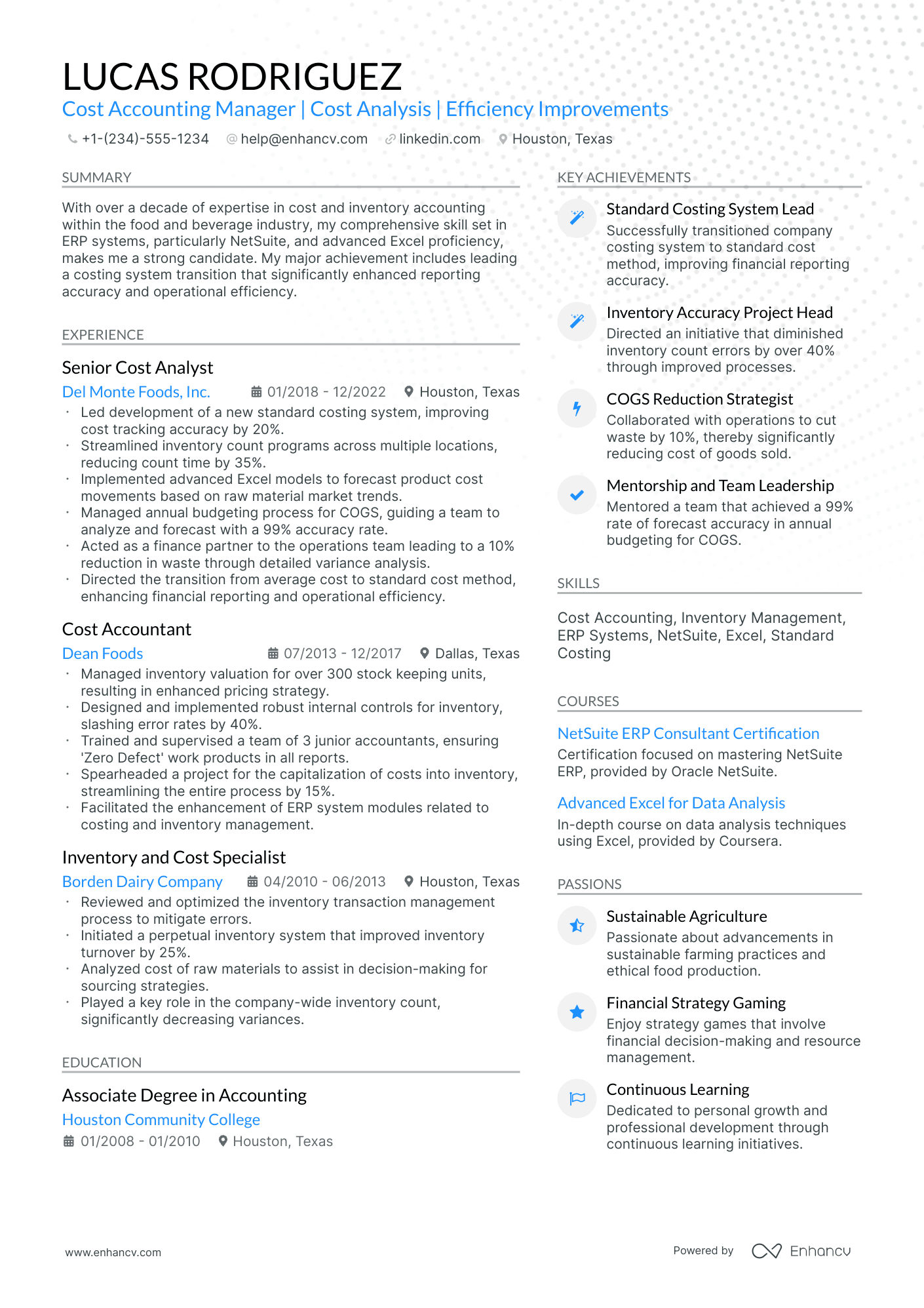
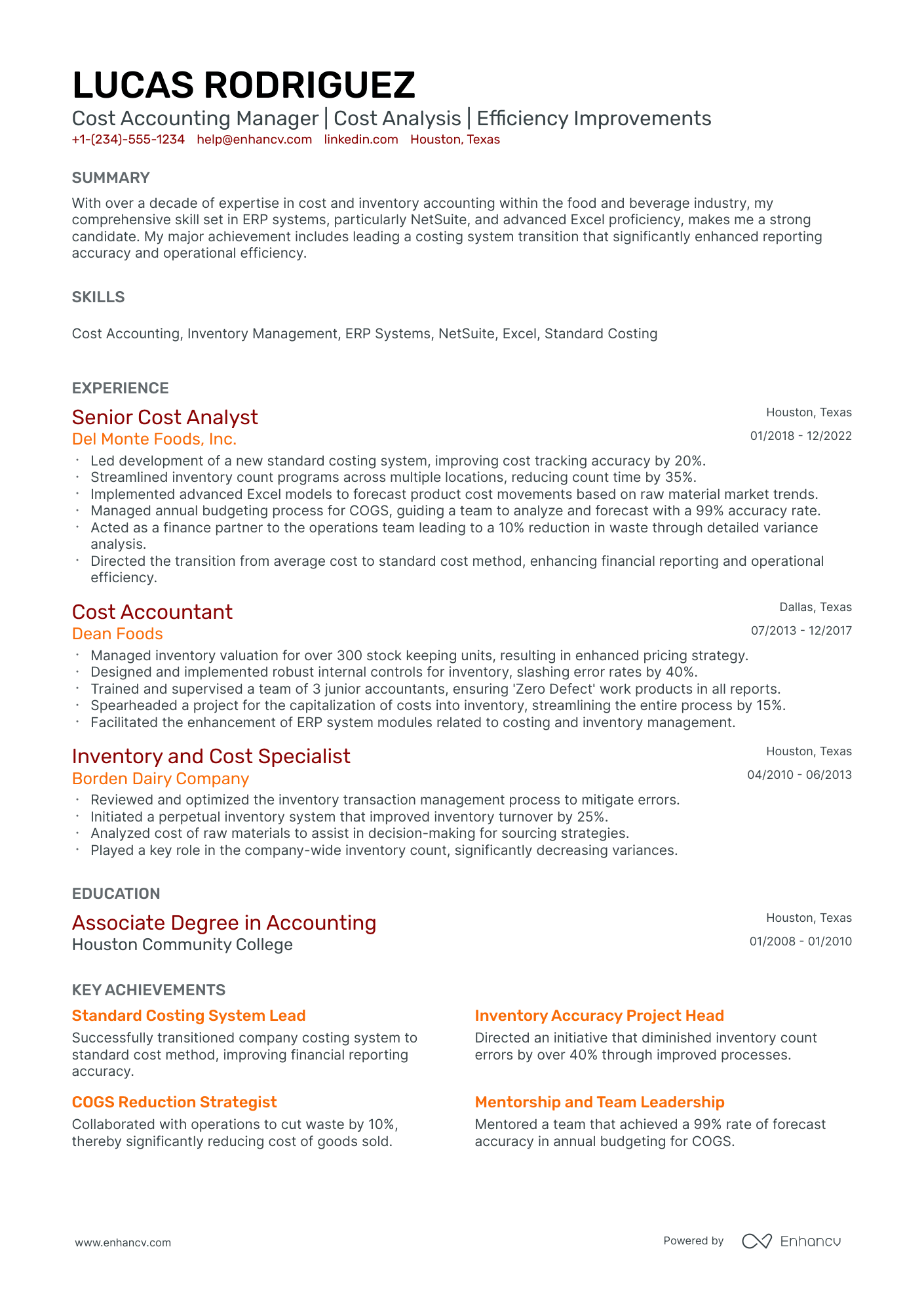
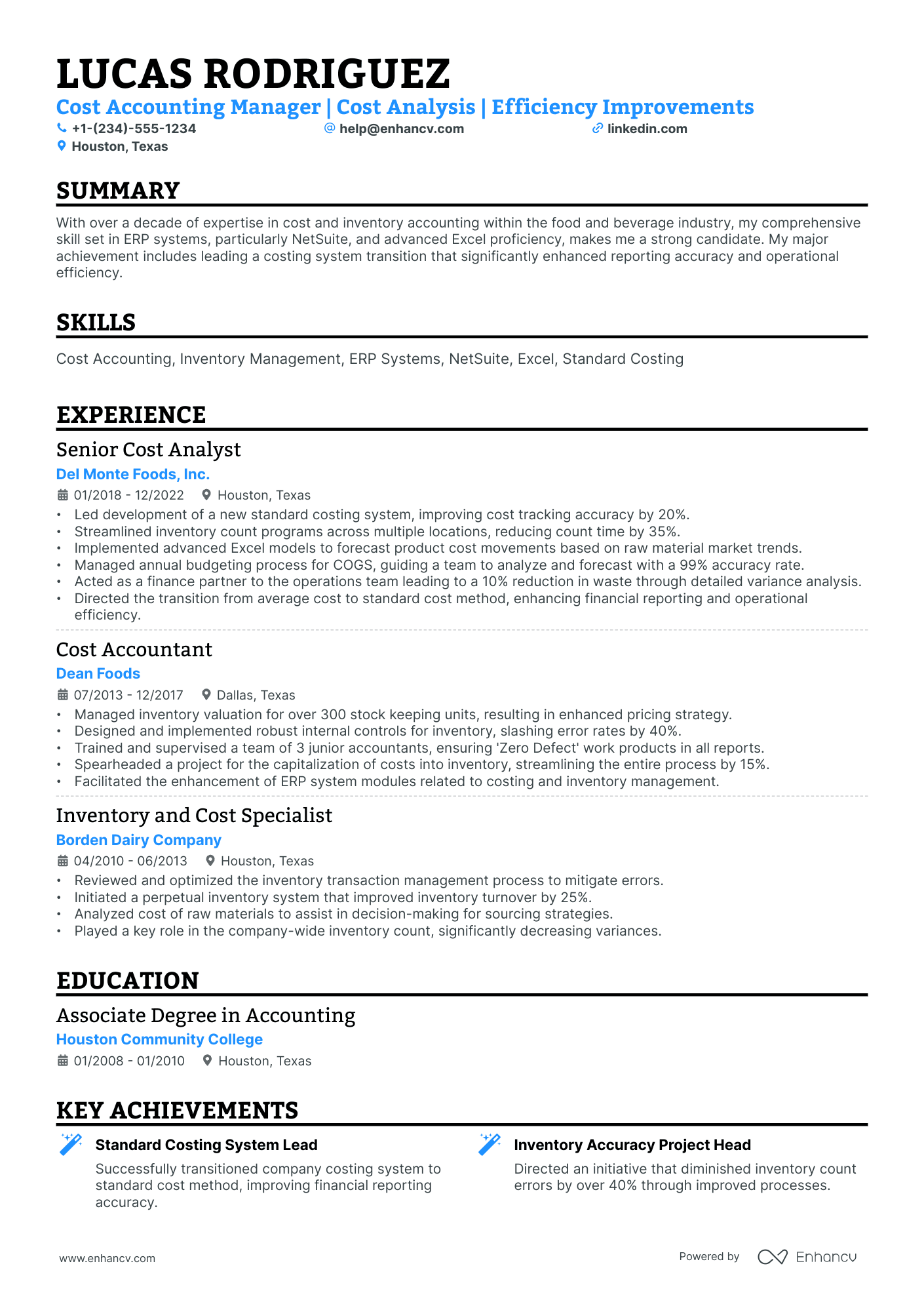
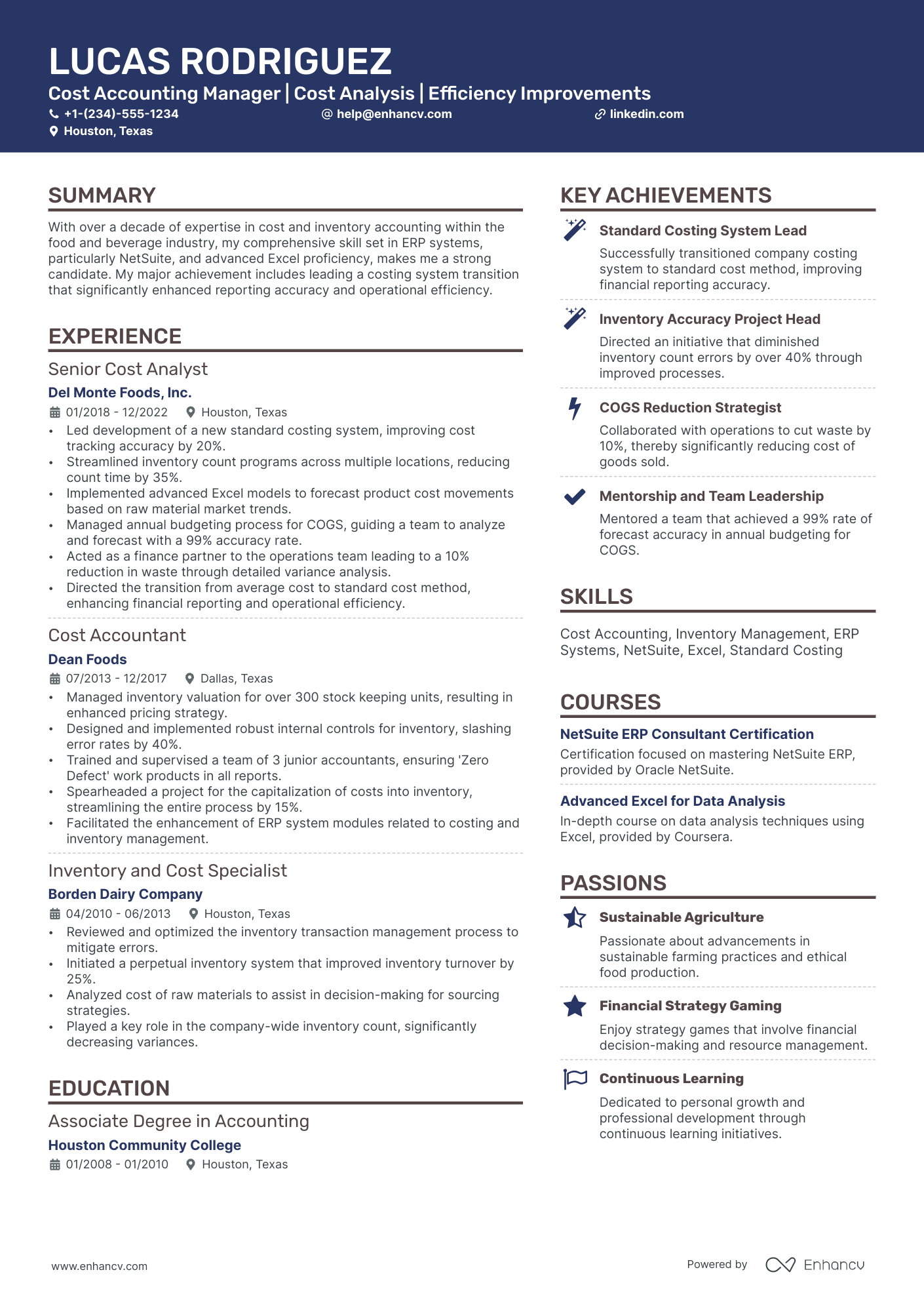
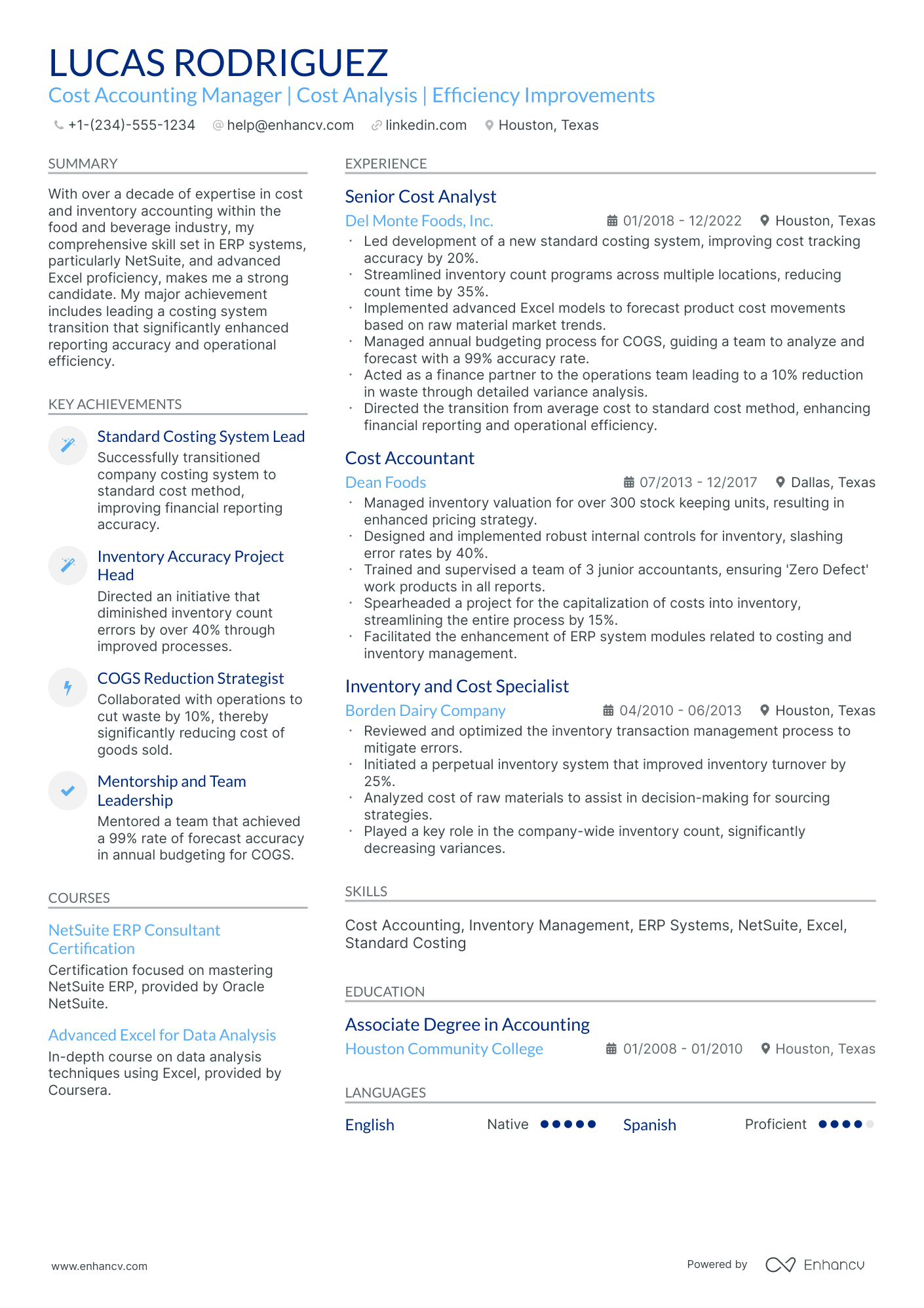
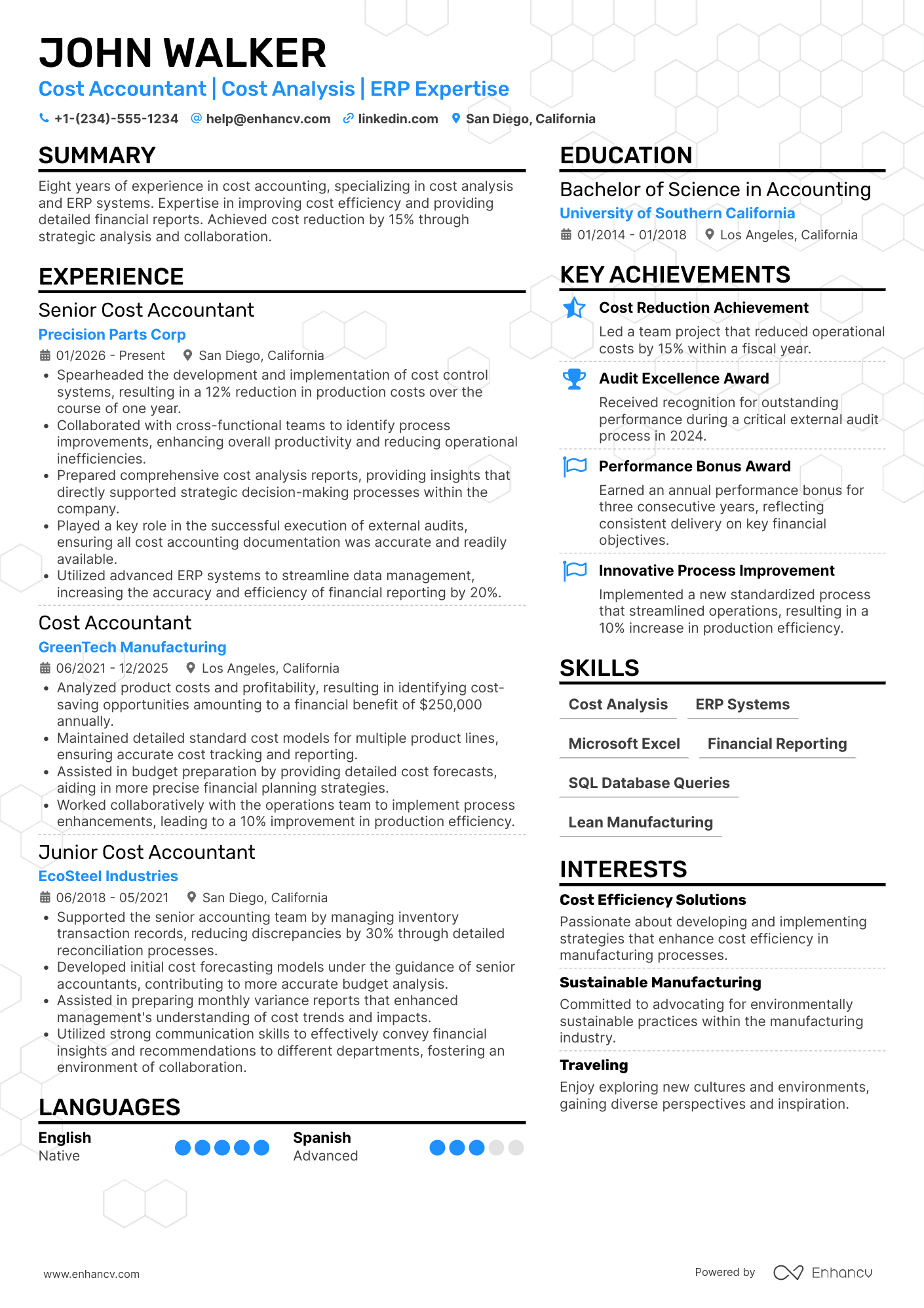
Most cost accounting resumes fail because they list tasks and software but don't connect cost data to decisions. In today's ATS filters and fast recruiter scans, that gap hides your impact in a crowded field, so you lose interviews.
A strong resume shows what you changed and what it delivered. Knowing how to make your resume stand out starts with highlighting cost reductions, margin gains, budget accuracy, variance drivers found, and cycle times improved. Include scope, such as plants supported, spend analyzed, close speed, audit findings reduced, and pricing decisions enabled.

Key takeaways
- Connect every cost accounting bullet to a measurable outcome like savings or variance reduction.
- Use reverse-chronological format for experienced candidates and hybrid format for career switchers.
- Tailor your resume to each job posting by mirroring its exact tools, methods, and KPIs.
- Quantify achievements with dollars, percentages, and cycle times to prove business impact.
- Anchor skills in your experience section with real results, not just a standalone list.
- Pair your CMA, CPA, or other certifications with education to reinforce credibility fast.
- Use Enhancv to turn vague duties into specific, recruiter-ready bullets aligned with cost accounting roles.
Job market snapshot for cost accountings
We analyzed 172 recent cost accounting job ads across major US job boards. These numbers help you understand role specialization trends, salary landscape, employment type trends at a glance.
What level of experience employers are looking for cost accountings
| Years of Experience | Percentage found in job ads |
|---|---|
| 1–2 years | 10.5% (18) |
| 3–4 years | 17.4% (30) |
| 5–6 years | 14.5% (25) |
| 7–8 years | 2.9% (5) |
| 9–10 years | 1.7% (3) |
| 10+ years | 3.5% (6) |
| Not specified | 51.2% (88) |
Cost accounting ads by area of specialization (industry)
| Industry (Area) | Percentage found in job ads |
|---|---|
| Finance & Banking | 84.9% (146) |
| Healthcare | 5.8% (10) |
Role overview stats
These tables show the most common responsibilities and employment types for cost accounting roles. Use them to align your resume with what employers expect and to understand how the role is structured across the market.
Day-to-day activities and top responsibilities for a cost accounting
| Responsibility | Percentage found in job ads |
|---|---|
| Cost accounting | 47.1% (81) |
| Excel | 43.6% (75) |
| Sap | 35.5% (61) |
| Erp | 29.7% (51) |
| Oracle | 18.6% (32) |
| Microsoft excel | 17.4% (30) |
| Financial reporting | 16.9% (29) |
| Gaap | 16.9% (29) |
| Accounting | 15.7% (27) |
| Variance analysis | 15.1% (26) |
| Microsoft office | 14.5% (25) |
| Journal entries | 12.2% (21) |
Type of employment (remote vs on-site vs hybrid)
| Employment type | Percentage found in job ads |
|---|---|
| On-site | 79.1% (136) |
| Hybrid | 16.3% (28) |
| Remote | 4.7% (8) |
How to format a cost accounting resume
Recruiters evaluating cost accounting resumes prioritize demonstrated expertise in variance analysis, standard costing, inventory valuation, and ERP-driven reporting—along with a clear track record of reducing costs and improving financial accuracy. Your resume format determines how quickly a hiring manager can trace that progression and connect your technical depth to measurable business outcomes.

I have significant experience in this role—which format should I use?
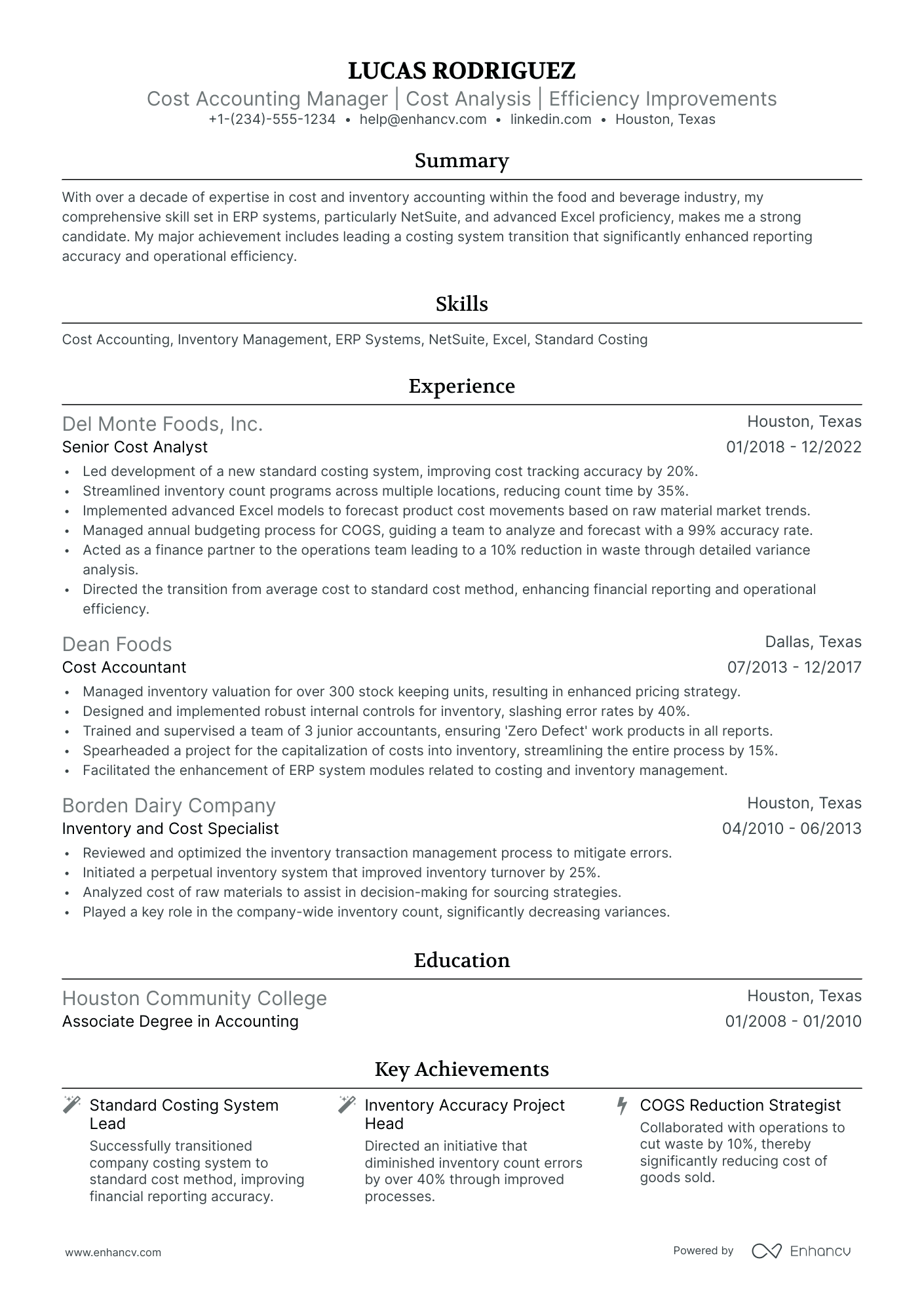
Use a reverse-chronological format to present your cost accounting career in a linear, progression-focused structure that highlights increasing responsibility and scope. Do:
- Lead each role entry with your scope of ownership—plant-level, multi-site, or business-unit cost accounting oversight, including team size and budget authority.
- Feature role-specific tools and domains prominently: standard costing methodologies, ERP platforms (SAP, Oracle), activity-based costing, bill of materials analysis, and inventory accounting standards (GAAP/IFRS).
- Quantify outcomes tied to margin improvement, cost reduction initiatives, and reporting accuracy gains.
I'm junior or switching into this role—what format works best?
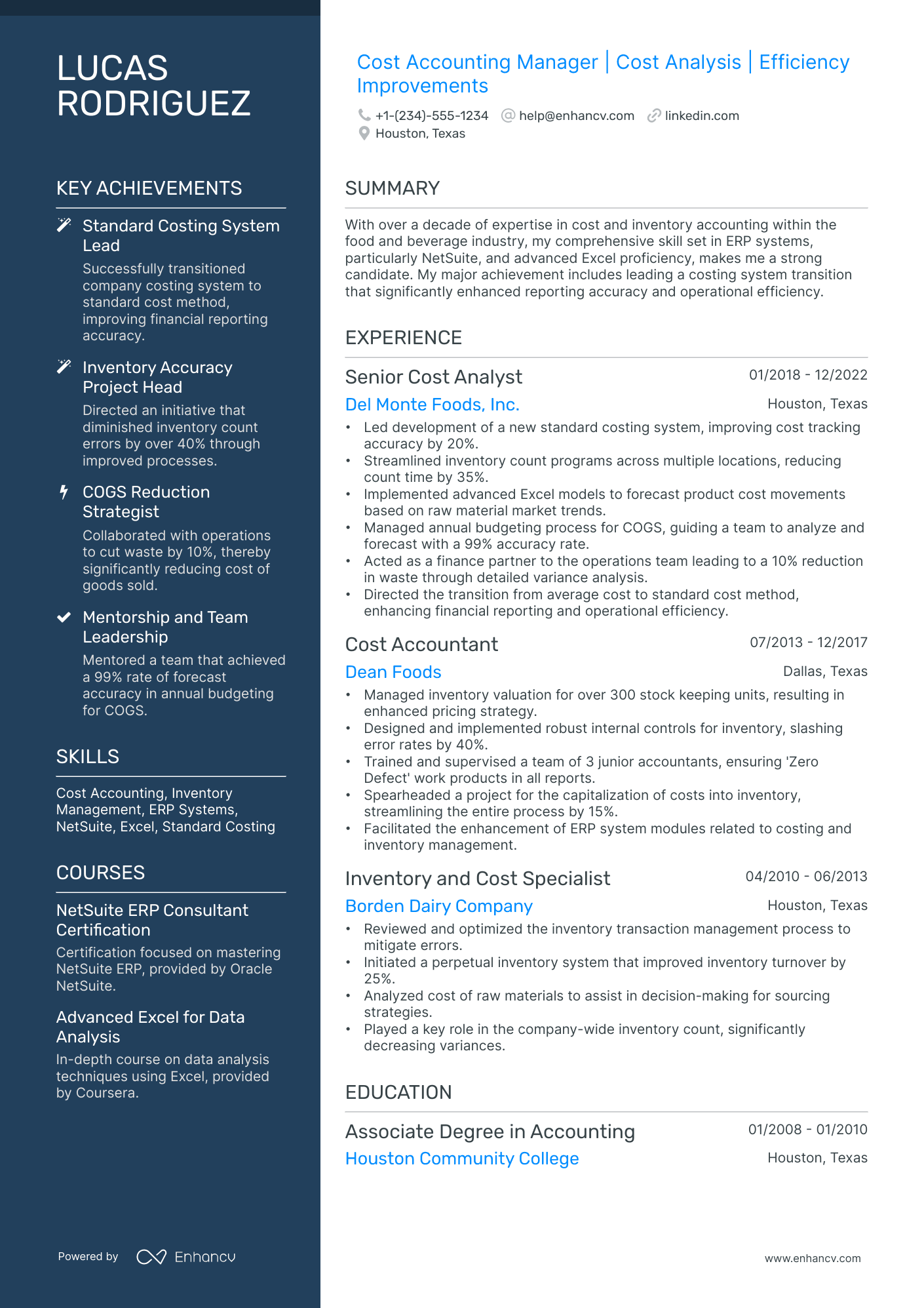
A hybrid format works best because it lets you lead with relevant cost accounting skills and analytical competencies while still providing a chronological work history that shows professional development. Do:
- Place a dedicated skills section near the top of your resume featuring cost accounting competencies such as variance analysis, standard costing, inventory reconciliation, and ERP proficiency.
- Include academic projects, internships, or cross-functional assignments that involved cost analysis, budgeting, or financial reporting—even if they weren't formal cost accounting roles.
- Connect every listed skill or experience to a concrete action and a measurable or observable result.
Why not use a functional resume?
A functional format strips away the timeline and context that hiring managers need to verify where and how you applied cost accounting skills, making it harder to assess your readiness for a role that demands precision, accountability, and systematic thinking. A functional resume may be acceptable if you're making a career change from general accounting or financial analysis into cost accounting, have a gap in your work history, or have limited formal cost accounting experience—but only if every skill listed is anchored to a specific project, coursework, or outcome rather than presented as a standalone claim.
Once you've established a clean, readable format, the next step is deciding which sections to include and how to organize them for maximum impact.
What sections should go on a cost accounting resume
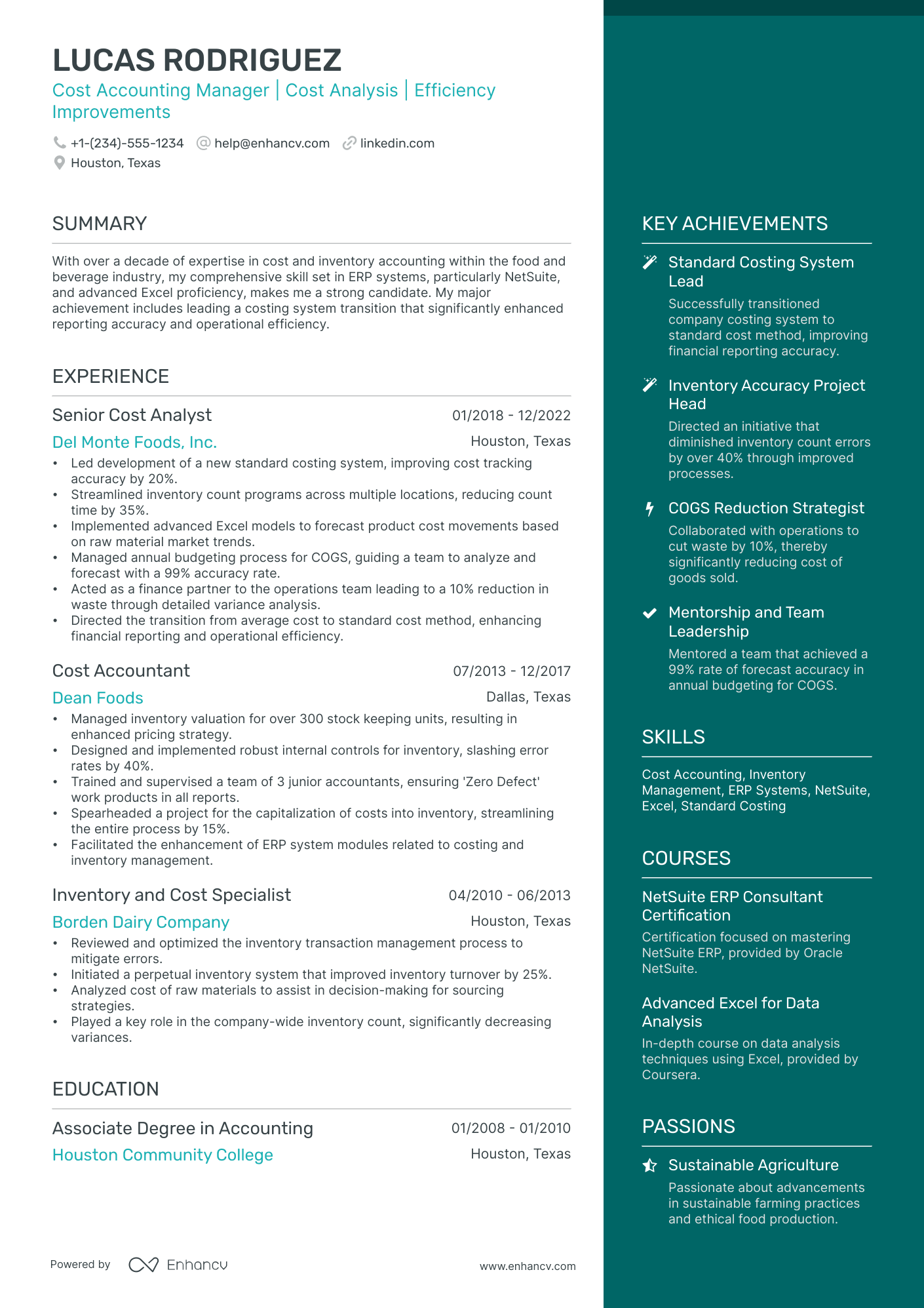
Recruiters expect a cost accounting resume to show clean financial reporting experience, cost analysis expertise, and measurable business impact. Understanding which resume sections to include ensures hiring managers find what they need quickly.
Use this structure for maximum clarity:
- Header
- Summary
- Experience
- Skills
- Projects
- Education
- Certifications
- Optional sections: Awards, Leadership, Languages
Strong experience bullets should emphasize quantifiable savings, variance reduction, process improvements, reporting accuracy, and the scope of cost systems and stakeholders you supported.
Is your resume good enough?
Drop your resume here or choose a file. PDF & DOCX only. Max 2MB file size.
With your resume structure in place, the next step is to write your cost accounting resume experience so your work history fits that layout and supports your key qualifications.
How to write your cost accounting resume experience
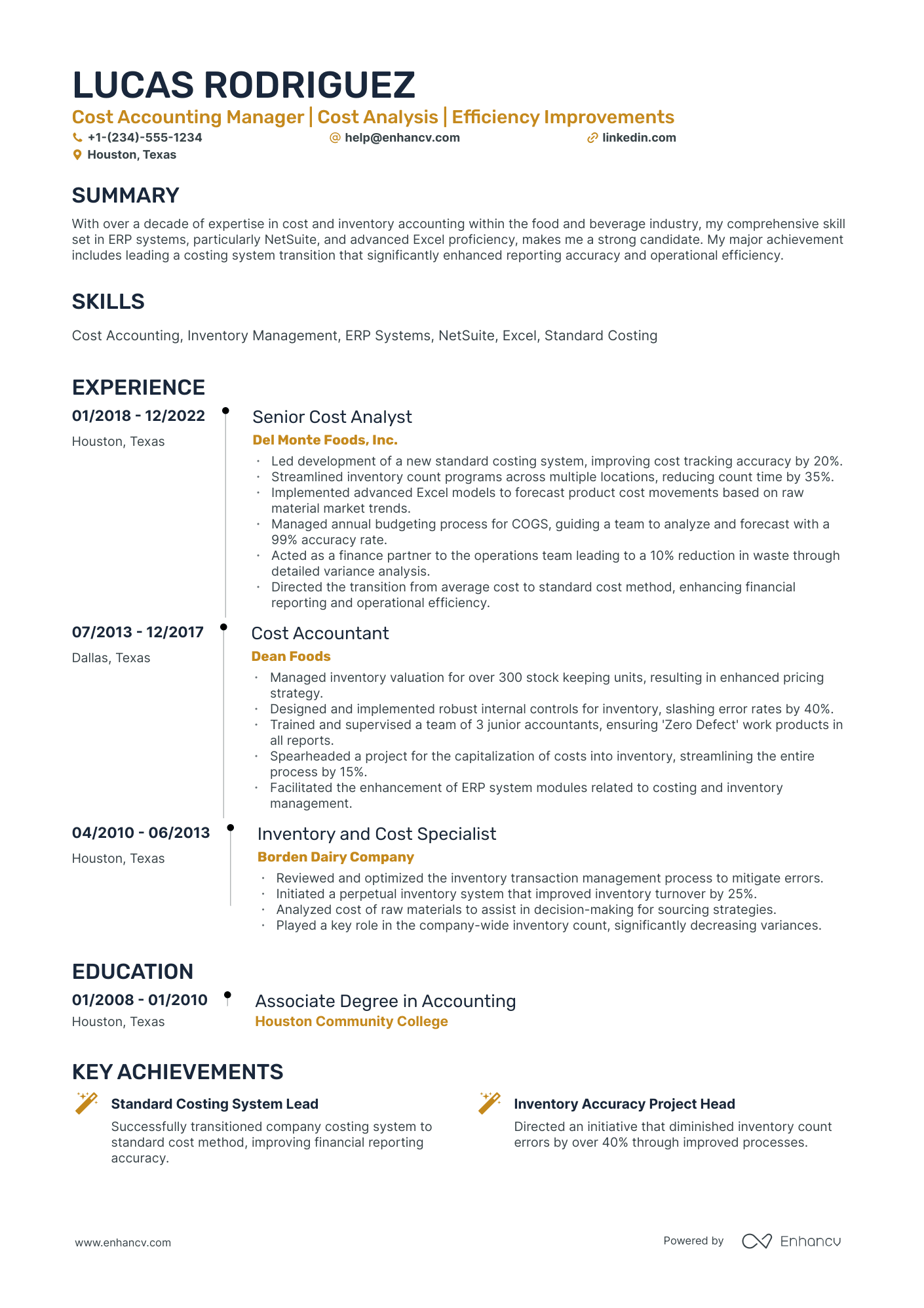
The experience section of your cost accounting resume should highlight work you've shipped—variance analyses completed, cost models delivered, and process improvements implemented using role-relevant tools like ERP systems, standard costing methods, and activity-based costing frameworks. Hiring managers prioritize demonstrated impact over descriptive task lists, so every bullet should connect what you did to a measurable outcome such as reduced production costs, improved forecast accuracy, or tighter inventory controls. Building a targeted resume ensures each entry speaks directly to the role's priorities.
Each entry should include:
- Job title
- Company and location (or remote)
- Dates of employment (month and year)
Three to five concise bullet points showing what you owned, how you executed, and what outcomes you delivered:
- Ownership scope: the cost centers, product lines, manufacturing processes, inventory categories, or budgets you were directly accountable for in your cost accounting role.
- Execution approach: the tools, frameworks, and methods you relied on—such as ERP platforms, standard or activity-based costing models, variance analysis techniques, or general ledger reconciliation processes—to analyze costs and inform financial decisions.
- Value improved: the specific improvements you drove in areas like cost accuracy, production efficiency, waste reduction, margin visibility, or compliance with internal controls relevant to cost accounting.
- Collaboration context: how you partnered with cross-functional stakeholders—operations teams, procurement, plant managers, supply chain leaders, or external auditors—to validate cost data, align on budgets, or resolve discrepancies.
- Impact delivered: the business outcomes your work produced, expressed through results such as tighter cost controls, more reliable financial reporting, stronger margins, or reduced overhead rather than a list of daily activities.
Experience bullet formula
A cost accounting experience example
✅ Right example - modern, quantified, specific.
Senior Cost Accountant
Apex Components Manufacturing | Columbus, OH
2022–Present
Multi-plant manufacturer of precision components serving automotive and industrial customers with high-mix, tight-margin production.
- Led a standard cost refresh across three plants using SAP S/4HANA, Excel Power Query, and BOM routings—reduced monthly purchase price variance by 18% and improved gross margin accuracy by 1.2 points.
- Built an activity-based costing model in Excel and Power BI with operations and engineering—identified five high-cost drivers and reduced conversion cost per unit by 6% through routing and setup-time changes.
- Automated month-end cost allocation and variance reporting via SAP CO extracts and Power BI dashboards—cut close time from seven days to five days and improved on-time reporting from 82% to 98%.
- Partnered with supply chain and production on cycle count analytics and root-cause reviews—reduced inventory adjustments by 31% and improved inventory accuracy from 96.4% to 98.1%.
- Supported pricing and quoting for new programs with sales and product managers using margin waterfalls and cost-to-serve analysis—improved quote win rate by 9% while holding target contribution margin within ±0.5 points.
Now that you've seen how a strong experience section comes together, let's look at how to adjust yours to match a specific job posting.
How to tailor your cost accounting resume experience
Recruiters evaluate your cost accounting resume through applicant tracking systems and manual review, scanning for alignment with specific job requirements. Tailoring your resume to the job description ensures your qualifications register with both screening methods.
Ways to tailor your cost accounting experience:
- Match ERP platforms and costing software named in the job description.
- Mirror the exact variance analysis methods the employer specifies.
- Use the same terminology for standard costing or activity-based costing.
- Reflect specific KPIs like cost-per-unit or margin targets mentioned.
- Highlight manufacturing or industry experience relevant to the posting.
- Emphasize GAAP compliance or internal audit responsibilities if referenced.
- Align your budgeting and forecasting language with the listed duties.
- Reference cross-functional collaboration with operations or procurement teams.
Tailoring means aligning your real accomplishments with what the employer asks for, not forcing disconnected keywords into your experience.
Resume tailoring examples for cost accounting
| Job description excerpt | Untailored | Tailored |
|---|---|---|
| Perform standard cost analysis, maintain bill of materials costing in SAP, and report monthly manufacturing variances to plant leadership. | Helped with cost analysis and reporting for the finance team. | Maintained bill of materials costing in SAP for 1,200+ SKUs and delivered monthly manufacturing variance reports to plant leadership, identifying $340K in unfavorable material usage variances over two quarters. |
| Conduct inventory valuations using weighted-average costing, reconcile work-in-process accounts, and support annual external audits with cost documentation. | Assisted with inventory tracking and supported audits. | Performed quarterly inventory valuations using weighted-average costing across three warehouse locations, reconciled work-in-process accounts within five business days of month-end, and prepared cost documentation packages that reduced external audit inquiries by 30%. |
| Develop and update job cost estimates for capital projects, partner with engineering on cost-benefit analyses, and present findings to the CFO. | Worked on project budgets and collaborated with other departments. | Built and updated job cost estimates for capital projects totaling $12M annually, partnered with engineering to deliver cost-benefit analyses on equipment upgrades, and presented quarterly findings directly to the CFO to inform capital allocation decisions. |
Once you’ve aligned your experience to the role’s priorities, the next step is to quantify your cost accounting achievements so hiring managers can see the impact behind those choices.
How to quantify your cost accounting achievements
Quantifying shows how your work improves cost control, close speed, and decision quality. Using numbers on your resume to highlight variance reduction, standard cost accuracy, close cycle time, audit findings, and savings from process or system improvements makes your impact concrete and verifiable.
Quantifying examples for cost accounting
| Metric | Example |
|---|---|
| Cost variance | "Reduced material purchase price variance from 2.8% to 1.6% in two quarters by tightening standard cost updates in SAP and partnering with procurement." |
| Close cycle time | "Cut cost accounting close from seven to five business days by automating inventory accruals in Excel Power Query and standardizing journal entry templates." |
| Inventory accuracy | "Improved inventory valuation accuracy by $420K by reconciling bill of materials routings to shop floor usage and correcting standard labor rates for three plants." |
| Compliance risk | "Passed external audit with zero cost accounting findings by documenting overhead allocation logic, adding monthly controls, and retaining support for one hundred percent of key journal entries." |
| Process efficiency | "Saved $95K annually by redesigning overhead absorption reports in Power BI, reducing manual data prep time from ten hours to three hours weekly." |
Turn vague job duties into measurable, recruiter-ready resume bullets in seconds with Enhancv's Bullet Point Generator.
Once you've crafted strong bullet points to showcase your experience, you'll want to pair them with a well-organized skills section that highlights both your hard and soft skills.
How to list your hard and soft skills on a cost accounting resume
Cost accounting skills matter because they show you can control costs, improve margins, and support accurate reporting; recruiters and ATS scan your skills section for job-match keywords, and strong resumes usually balance hard skills with role-specific soft skills.
cost accounting roles require a blend of:
- Product strategy and discovery skills
- Data, analytics, and experimentation skills
- Delivery, execution, and go-to-market discipline
- Soft skills
Your skills section should be:
- Scannable (bullet-style grouping).
- Relevant to the job post.
- Backed by proof in experience bullets.
- Updated with current tools.
Place your skills section:
- Above experience if you're junior or switching careers.
- Below experience if you're mid/senior with strong achievements.

Hard skills
- Standard costing, variance analysis
- Bill of materials, routings
- Work-in-process accounting
- Cost allocation, overhead absorption
- Activity-based costing (ABC)
- Inventory valuation, reserves
- Journal entries, reconciliations
- Month-end close support
- ERP: SAP, Oracle, NetSuite
- Microsoft Excel: Power Query, PivotTables
- Power BI dashboards, DAX
- SQL reporting, data extracts
Soft skills
- Partner with operations leaders
- Translate costs into actions
- Challenge assumptions with data
- Prioritize high-impact analyses
- Present variance drivers clearly
- Align stakeholders on trade-offs
- Own close deadlines end-to-end
- Document processes and controls
- Escalate risks early
- Ask precise, clarifying questions
- Audit-ready attention to detail
- Follow through on corrective actions
How to show your cost accounting skills in context
Skills shouldn't live only in a bulleted list on your resume. Explore curated resume skills examples to see how top candidates present their competencies effectively.
They should be demonstrated in:
- Your summary (high-level professional identity)
- Your experience (proof through outcomes)
Here's what strong cost accounting entries look like in practice.
Summary example
Senior cost accountant with 10+ years in food manufacturing. Skilled in standard costing, variance analysis, and SAP FICO. Reduced production cost variances by 18% through cross-functional process improvements and tighter inventory controls.
- Signals senior-level expertise immediately
- Names industry-relevant tools and methods
- Leads with a measurable cost reduction
- Highlights cross-functional collaboration skills
Experience example
Senior Cost Accountant
Redstone Manufacturing Co. | Milwaukee, WI
March 2019–Present
- Redesigned the standard costing model in SAP FICO, cutting monthly close time by 3 days and improving margin accuracy by 12%.
- Partnered with operations and procurement teams to analyze raw material variances, identifying $640K in annual savings opportunities.
- Built automated variance reporting dashboards in Excel and Power BI, reducing manual analysis effort by 35% across the finance team.
- Every bullet includes a measurable outcome.
- Skills appear naturally within real accomplishments.
Once you’ve tied your cost accounting skills to real results and responsibilities, the next step is structuring a cost accounting resume when you don’t have formal experience so you can present that evidence effectively.
How do I write a cost accounting resume with no experience
Even without full-time experience, you can demonstrate readiness through:
- Cost accounting course capstone project
- Manufacturing case study cost models
- Internship in finance operations
- Student consulting for local manufacturer
- ERP system lab simulations
- Excel-based standard cost builds
- Variance analysis practice datasets
- Inventory cycle count volunteering
If you're entering the field without a traditional background, learning how to write a resume without work experience can help you structure these projects and academic achievements effectively.
Focus on:
- Standard costing and variance analysis
- Inventory valuation and reconciliations
- Excel modeling with audit trails
- ERP exposure and clean documentation
Resume format tip for entry-level cost accounting
Use a combination resume format because it highlights cost accounting skills and projects first, while still showing education and any related work. Do:
- Lead with a skills-and-projects section.
- Add a "Cost Accounting Projects" section.
- Quantify results with dollars, units, or percentages.
- List tools: Excel, ERP, SQL.
- Match keywords to the job post.
- Built a standard cost model in Excel for a five-product line, ran variance analysis, and identified a seven percent material price variance driver using sample purchase data.
Even without hands-on experience, your education section can demonstrate the foundational knowledge and relevant coursework that qualify you for a cost accounting role.
How to list your education on a cost accounting resume
Your education section helps hiring teams confirm you have the foundational accounting knowledge cost accounting roles demand. It validates your training in financial analysis, budgeting, and managerial accounting principles.
Include:
- Degree name
- Institution
- Location
- Graduation year
- Relevant coursework (for juniors or entry-level candidates)
- Honors & GPA (if 3.5 or higher)
Skip month and day details—list the graduation year only.
Here's a strong education entry tailored for a cost accounting resume:
Example education entry
Bachelor of Science in Accounting
University of Illinois Urbana-Champaign, Champaign, IL
Graduated 2021
GPA: 3.7/4.0
- Relevant Coursework: Managerial Accounting, Cost Analysis, Corporate Finance, Budgeting and Forecasting, Financial Statement Analysis
- Honors: Dean's List (six semesters), Beta Alpha Psi Accounting Honor Society
How to list your certifications on a cost accounting resume
Certifications show your commitment to learning, prove tool proficiency, and signal industry relevance for cost accounting roles. They also help hiring teams trust your technical judgment and process discipline.
Include:
- Certificate name
- Issuing organization
- Year
- Optional: credential ID or URL
- List certifications below education when your degree is recent and directly aligned with cost accounting, and your certifications are older or less central.
- List certifications above education when they are recent, highly relevant to cost accounting, or required, and your education is older or less related.
Best certifications for your cost accounting resume
- Certified Management Accountant (CMA)
- Certified Public Accountant (CPA)
- Chartered Global Management Accountant (CGMA)
- Certified Cost Professional (CCP)
- Certified Internal Auditor (CIA)
- Certified in Strategy and Competitive Analysis (CSCA)
- Lean Six Sigma Green Belt
Once you’ve placed your credentials where hiring managers can find them quickly, shift to writing your cost accounting resume summary to reinforce those qualifications upfront.
How to write your cost accounting resume summary
Your resume summary is the first thing a recruiter reads, so it needs to earn their attention fast. A strong opening tied to cost accounting signals you understand the role and its priorities.
Keep it to three to four lines, with:
- Your title and total years of cost accounting experience.
- The industry or domain you've worked in, such as manufacturing or supply chain.
- Core tools and skills like SAP, standard costing, or variance analysis.
- One or two quantified achievements that prove your impact.
- Soft skills tied to real outcomes, such as cross-functional collaboration that reduced cycle times.

PRO TIP
At the entry or mid level, lead with relevant skills, tools, and certifications like CMA or CPA. Highlight early wins such as cost savings or process improvements. Avoid vague phrases like "passionate professional" or "hard worker." Recruiters want proof, not motivation.
Example summary for a cost accounting
Cost accountant with three years of experience in manufacturing environments. Skilled in SAP, standard costing, and variance analysis. Identified $120K in annual material waste savings through improved inventory tracking and cross-departmental reporting.
Optimize your resume summary and objective for ATS
Drop your resume here or choose a file.
PDF & DOCX only. Max 2MB file size.
Now that your summary captures your cost accounting expertise, make sure the header presenting your contact details is equally polished and error-free.
What to include in a cost accounting resume header
A resume header lists your key identifiers and contact details, helping cost accounting recruiters spot you fast, trust your profile, and screen you efficiently.
Essential resume header elements
- Full name
- Tailored job title and headline
- Location
- Phone number
- Professional email
- GitHub link
- Portfolio link
A LinkedIn link helps recruiters verify your titles, dates, and scope quickly, which supports faster screening.
Don't include a photo on a cost accounting resume unless the role is explicitly front-facing or appearance-dependent.
Match your header job title to the cost accounting posting and align it with your strongest, relevant specialty.
Example
Cost accounting resume header
Jordan Taylor
Cost Accounting Analyst | Standard costing, variance analysis, inventory valuation
Chicago, IL
(312) 555-01XX
jordan.taylor@enhancv.com github.com/jordantaylor yourwebsite.com linkedin.com/in/jordantaylor
Once your header clearly identifies you and your cost accounting focus, you can strengthen the rest of your resume with additional sections that add relevant context and credibility.
Additional sections for cost accounting resumes
When your core qualifications match other applicants, well-chosen additional sections can set your cost accounting resume apart from the competition.
Consider adding these sections if they strengthen your candidacy:
- Languages — listing language skills can be especially valuable if you work with international suppliers or multi-site operations
- Certifications and licenses
- Professional affiliations
- Industry conferences and presentations
- Technical proficiencies
- Volunteer experience
- Publications
Once you've strengthened your resume with relevant additional sections, pairing it with a well-crafted cover letter can further set your cost accounting application apart.
Do cost accounting resumes need a cover letter
A cover letter isn't required for most cost accounting roles, but it helps in competitive searches or when hiring managers expect one. If you're unsure about the basics, understanding what a cover letter is and when to use one can help you decide. It can make a difference when your resume needs context or when the team wants a clear fit story.
Use a cover letter to add context your cost accounting resume can't show:
- Explain role and team fit: Connect your experience to the company's cost accounting needs, reporting cadence, systems, and cross-functional partners.
- Highlight one or two outcomes: Share a specific cost accounting project, the approach you used, and the measurable result.
- Show business context: Reference the product, users, and cost drivers you'd focus on, such as labor, materials, overhead, or service delivery.
- Address transitions: Clarify a move into cost accounting, an industry switch, or a non-linear path, and tie it to skills you'll use on day one.
Drop your resume here or choose a file.
PDF & DOCX only. Max 2MB file size.
Once you’ve decided whether to submit a cover letter based on the role and employer expectations, you can use AI to strengthen your cost accounting resume with faster, more targeted improvements.
Using AI to improve your cost accounting resume
AI can sharpen your resume's clarity, structure, and impact. It helps refine language and highlight measurable results. But overuse kills authenticity. For practical guidance, explore these ChatGPT resume writing prompts tailored for different resume sections. Once your content feels clear and role-aligned, step away from AI.
Here are 10 practical prompts to strengthen specific sections of your cost accounting resume:
Strengthen your summary
Quantify experience bullets
Tailor skills section
Sharpen action verbs
Refine project descriptions
Align education details
Improve certification entries
Eliminate vague phrasing
Tighten bullet length
Check role alignment
Conclusion
A strong cost accounting resume proves impact with measurable outcomes, role-specific skills, and a clear structure. Use metrics that show cost savings, variance reduction, margin improvement, and faster close cycles. Highlight costing methods, budgeting, forecasting, and analysis that match the role.
Keep your cost accounting resume easy to scan, consistent, and tailored to the job. Clear headings, focused bullets, and relevant keywords show you can deliver results now. This approach signals readiness for today’s hiring market and near-future needs.