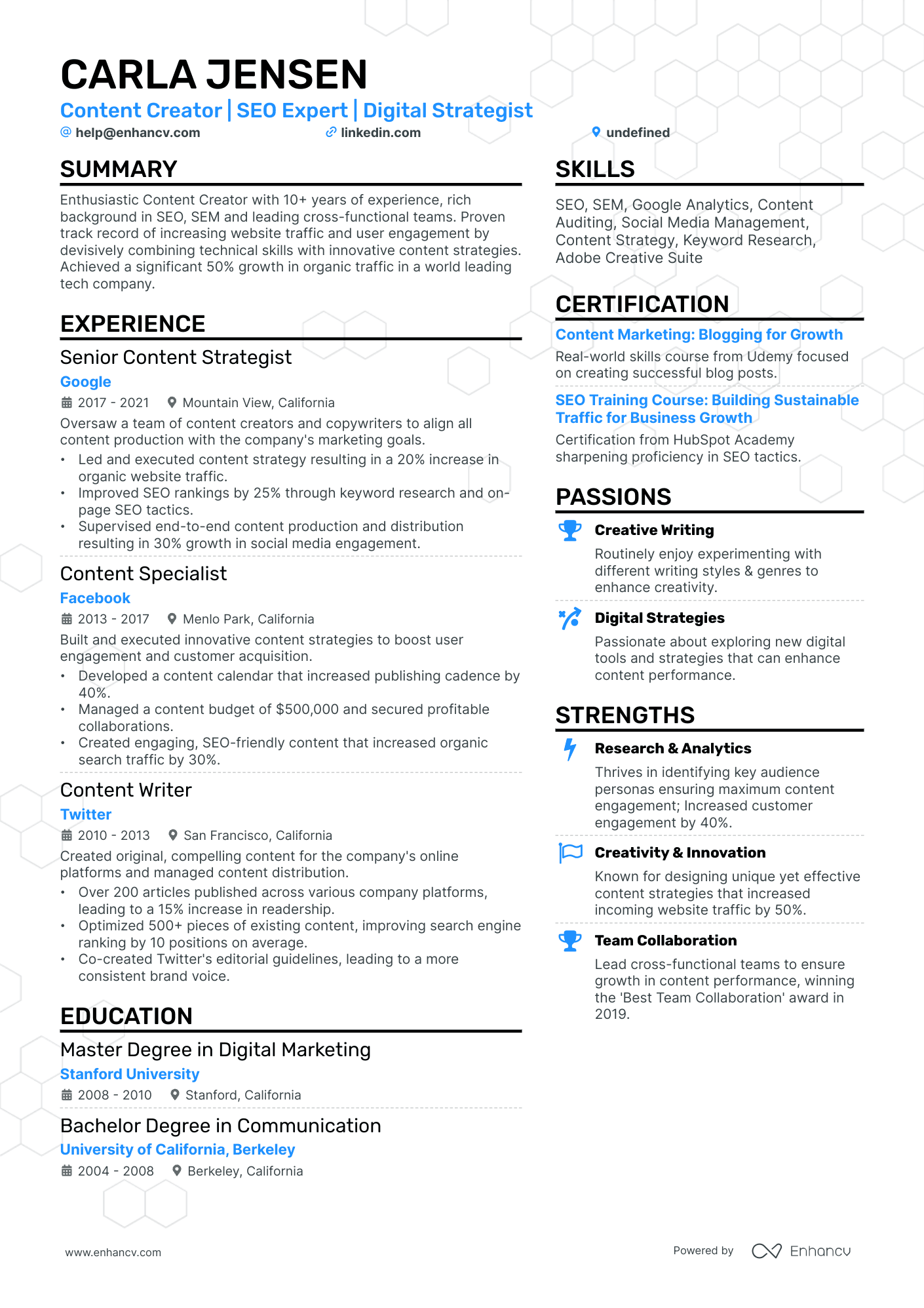
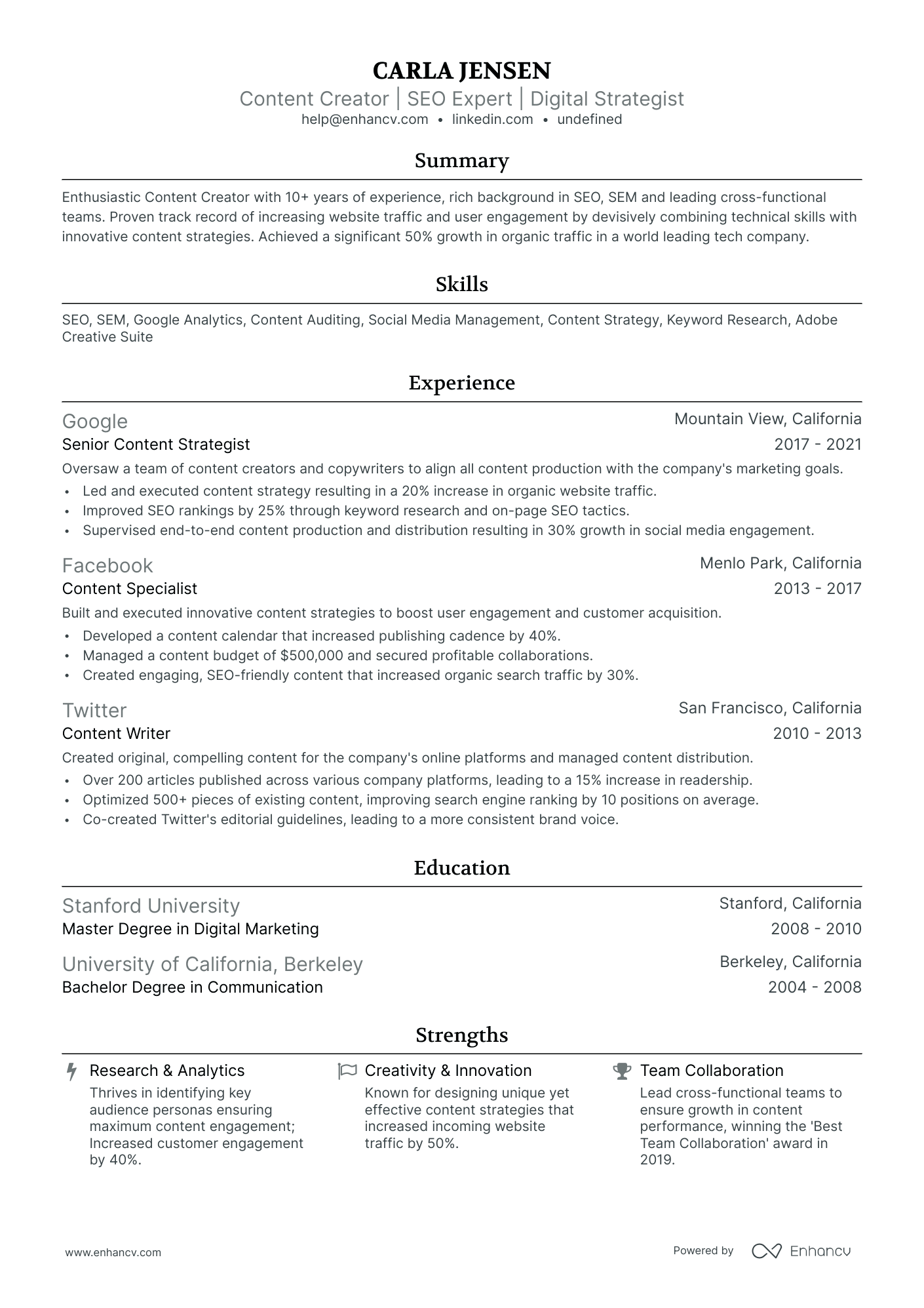
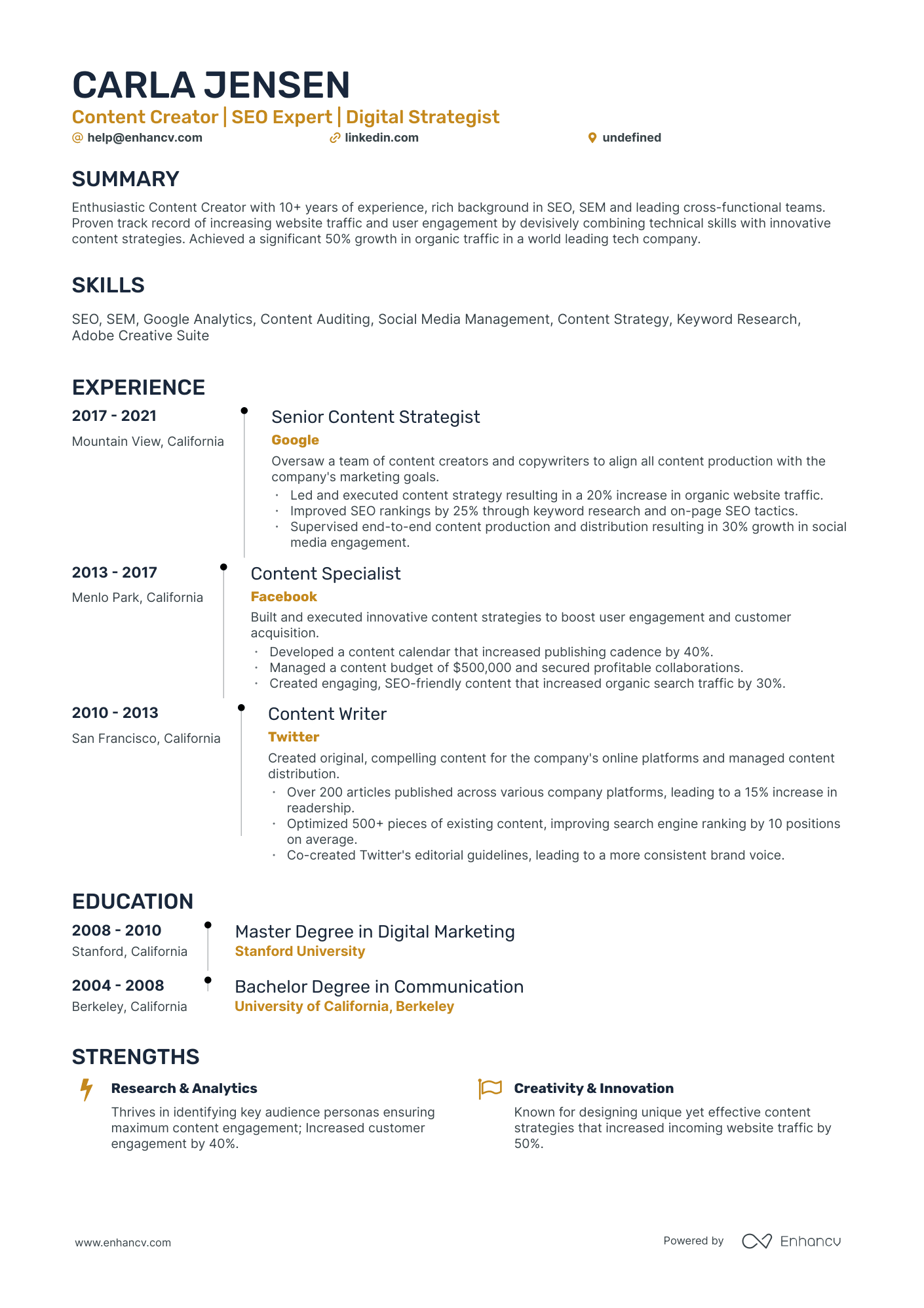
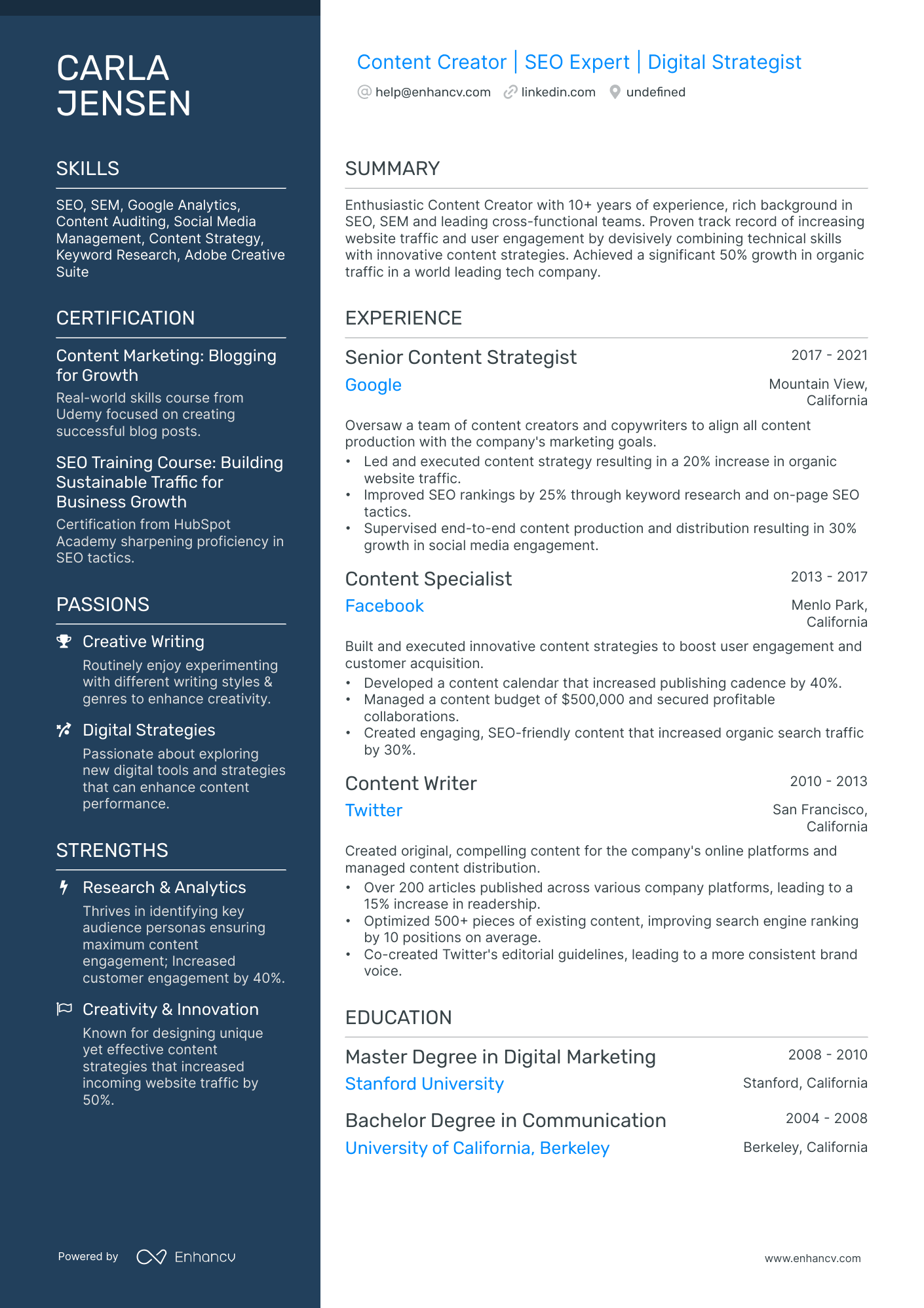
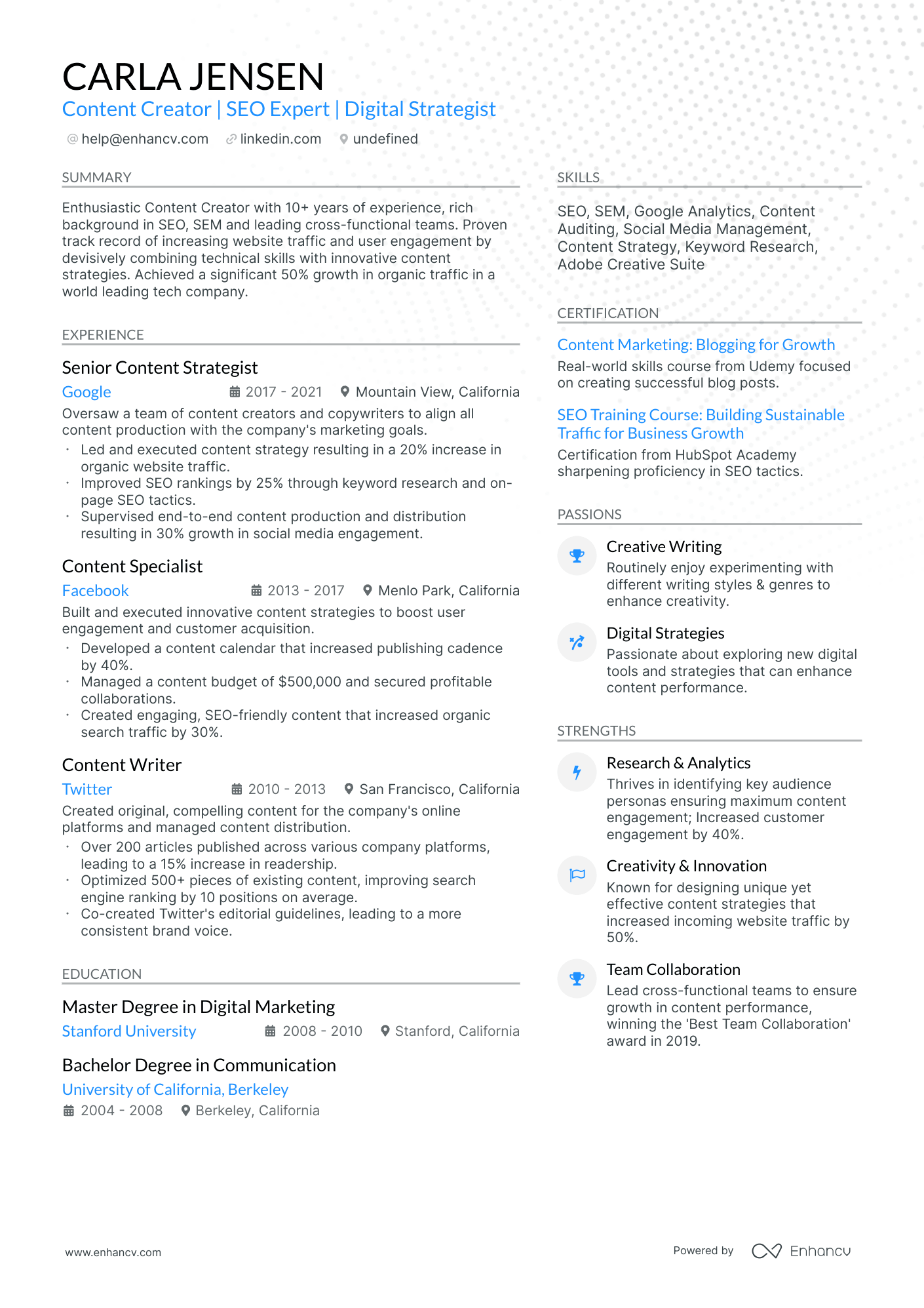
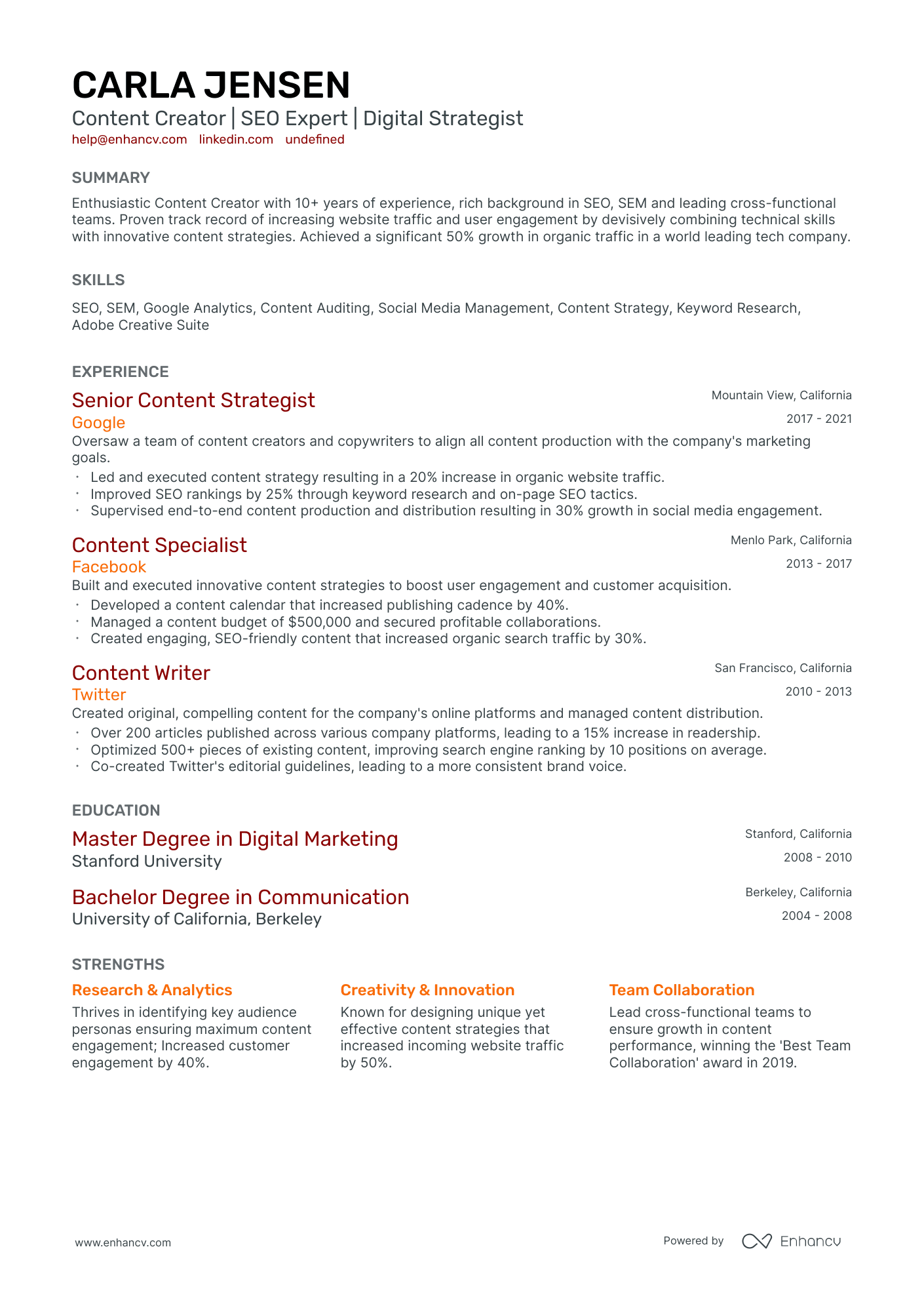
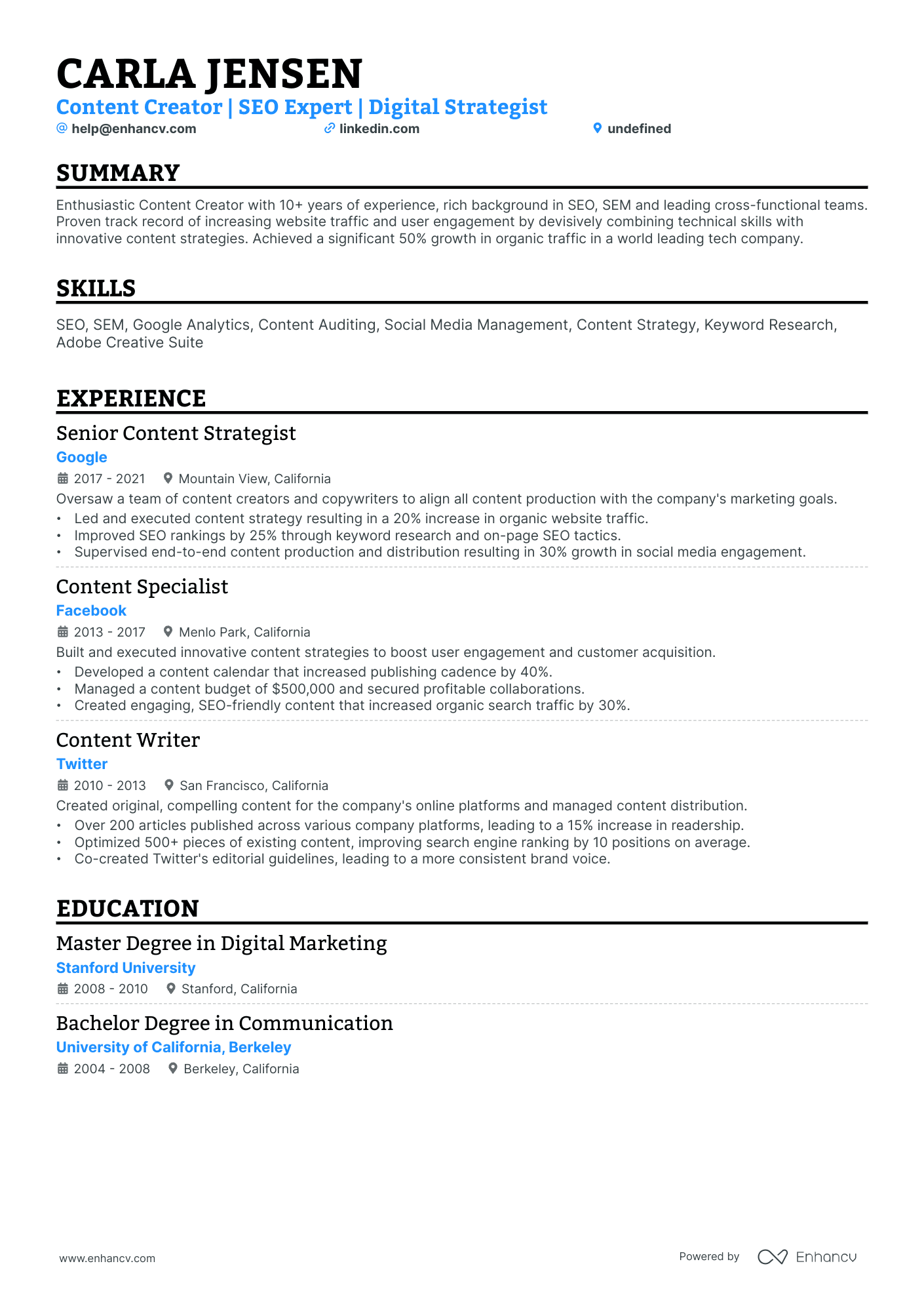
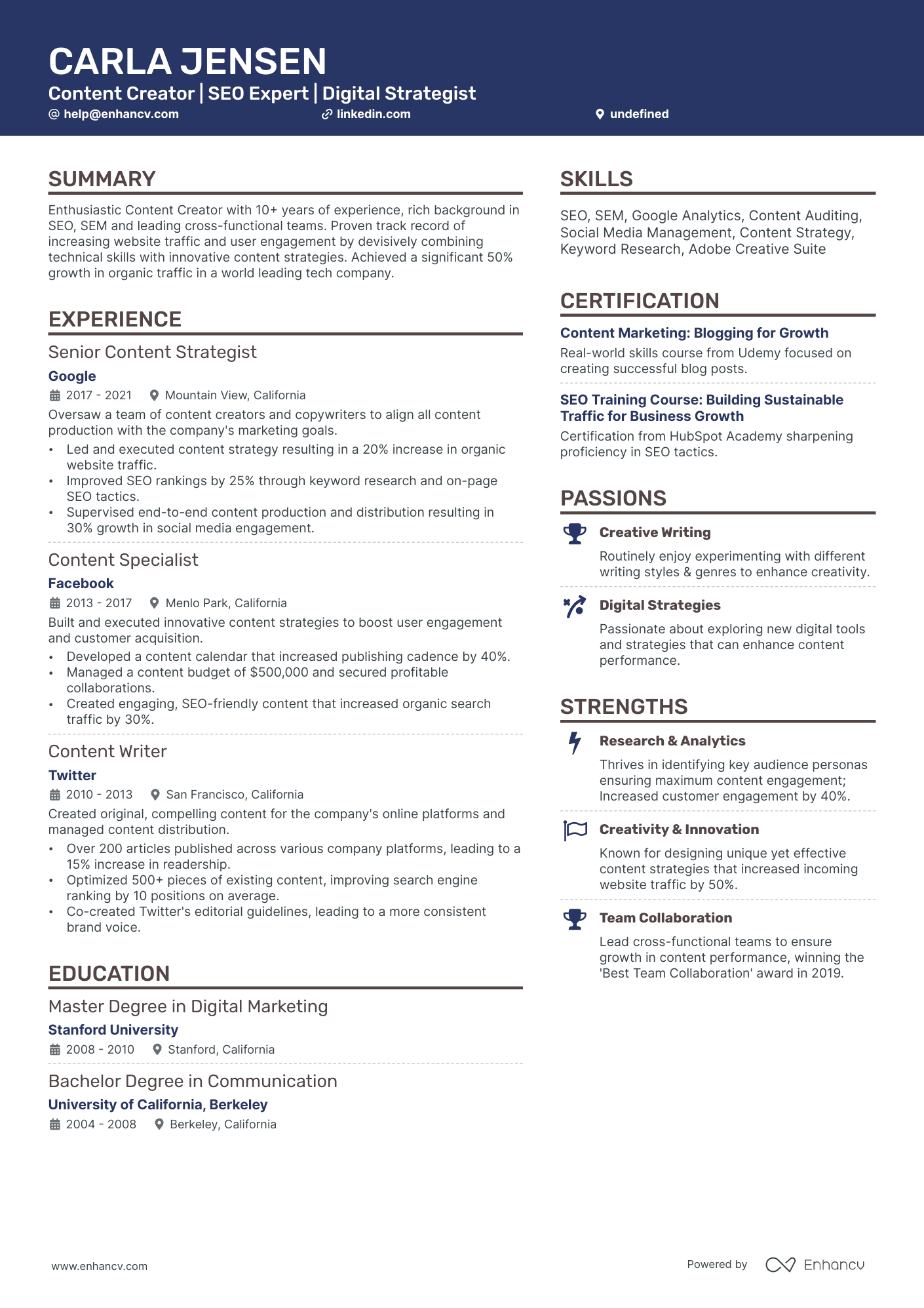
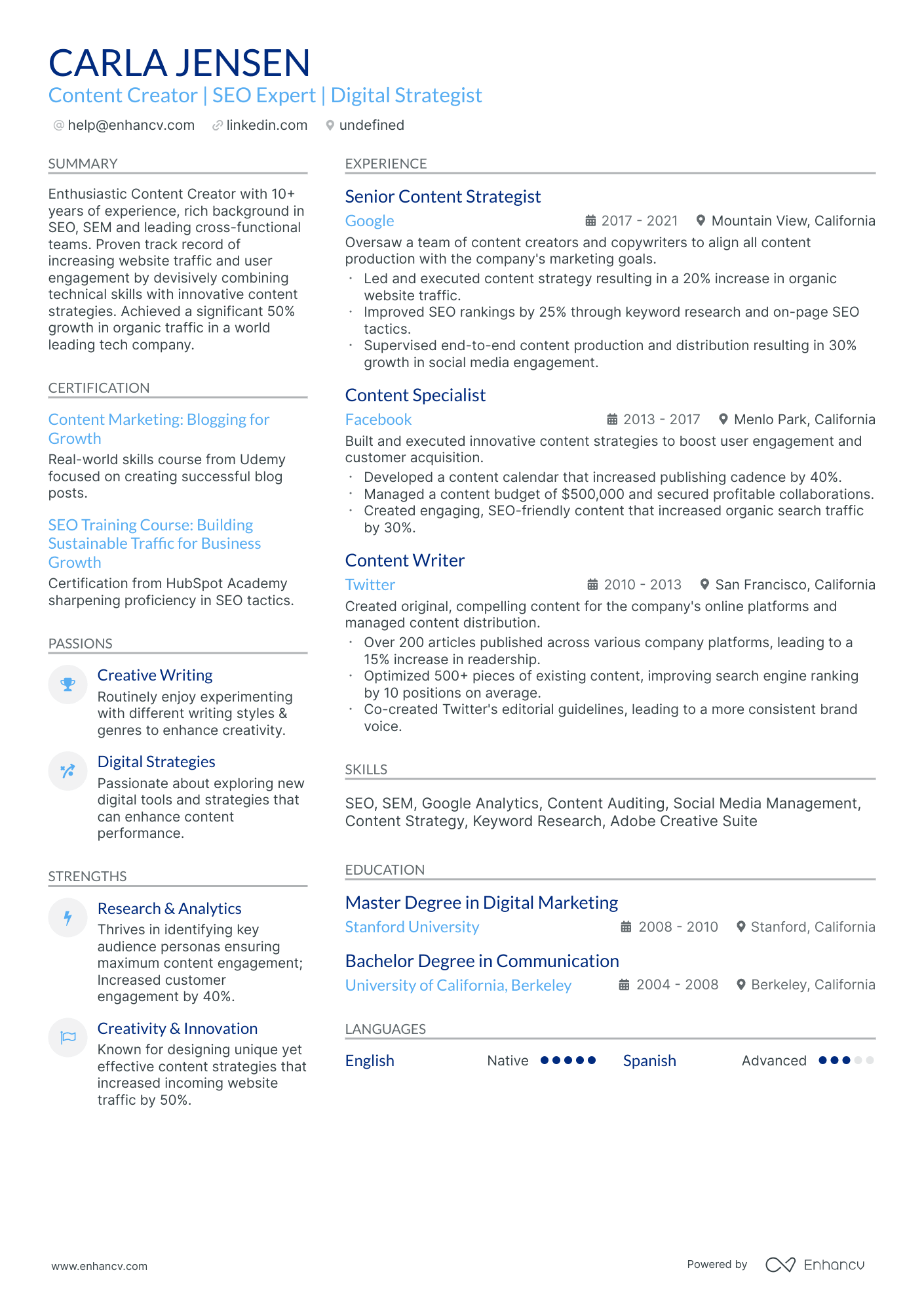
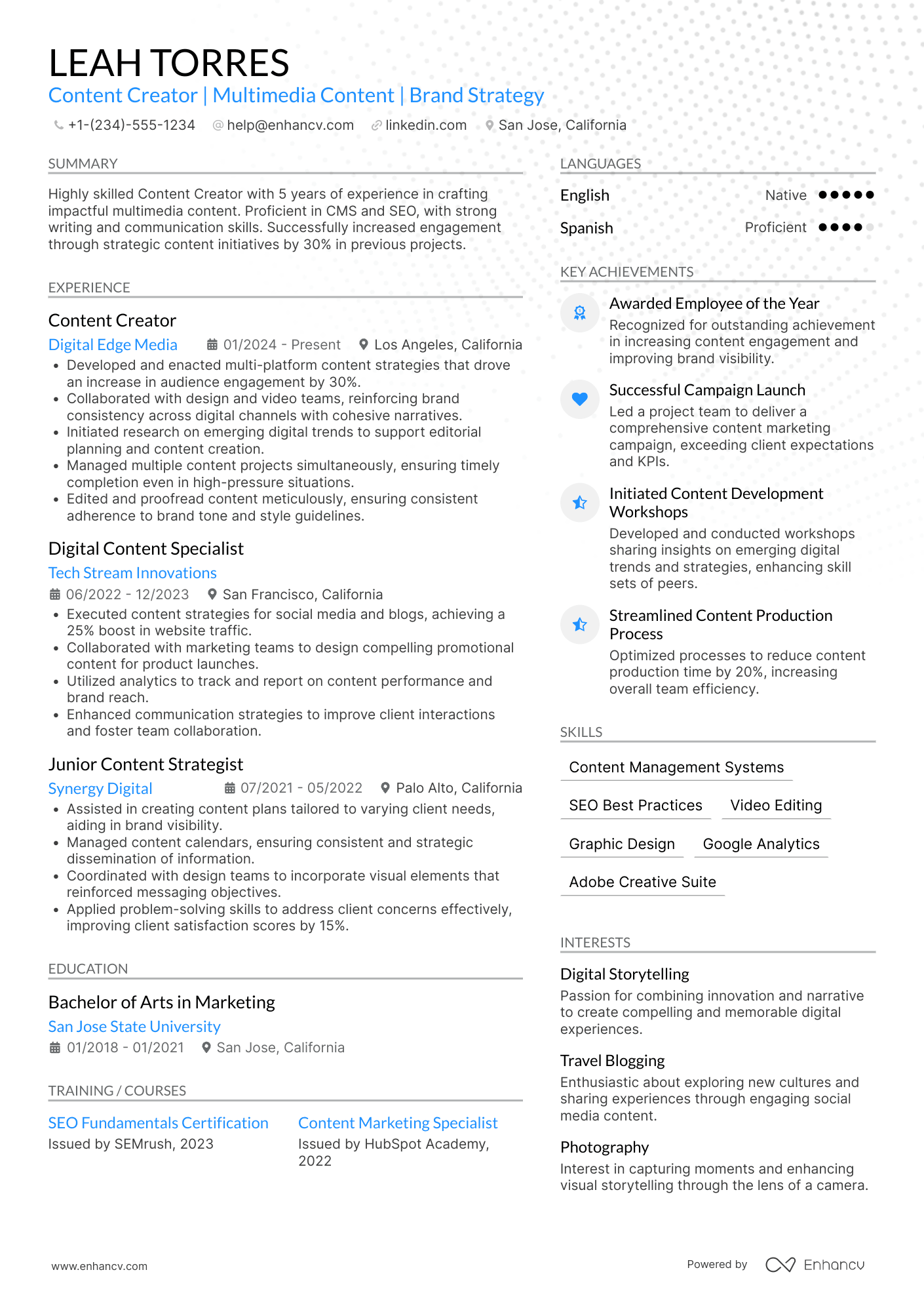
Most content creator resume drafts fail because they list tools and tasks but don't show measurable content performance or audience impact. That gap gets you filtered by ATS screening and missed in fast recruiter scans. Competition makes every line count.
A strong resume shows outcomes you drove and how you improved results. Knowing how to make your resume stand out means highlighting growth in traffic, subscribers, or qualified leads, faster production cycles, higher engagement rates, stronger search rankings, and content that improved retention or revenue.

Key takeaways
- Quantify content outcomes like traffic growth, engagement rates, and revenue to pass ATS and recruiter screens.
- Use reverse-chronological format for experienced creators and hybrid format for career changers.
- Tailor every experience bullet to match the job posting's platforms, tools, and KPIs.
- Anchor each listed skill to a specific project, metric, or measurable outcome.
- Place certifications above or below education based on which better proves your qualifications.
- Write a three- to four-line summary featuring your title, core tools, and a standout result.
- Use Enhancv to turn everyday content tasks into measurable, recruiter-ready resume bullets.
Job market snapshot for content creators
We analyzed 113 recent content creator job ads across major US job boards. These numbers help you understand experience requirements, top companies hiring, industry demand at a glance.
What level of experience employers are looking for content creators
| Years of Experience | Percentage found in job ads |
|---|---|
| 1–2 years | 9.7% (11) |
| 3–4 years | 14.2% (16) |
| 5–6 years | 8.0% (9) |
| 7–8 years | 0.9% (1) |
| 9–10 years | 1.8% (2) |
| 10+ years | 7.1% (8) |
| Not specified | 60.2% (68) |
Content creator ads by area of specialization (industry)
| Industry (Area) | Percentage found in job ads |
|---|---|
| Finance & Banking | 27.4% (31) |
| Healthcare | 22.1% (25) |
| Education | 20.4% (23) |
| Media & Entertainment | 10.6% (12) |
| Retail & E-commerce | 9.7% (11) |
| Manufacturing | 8.8% (10) |
Role overview stats
These tables show the most common responsibilities and employment types for content creator roles. Use them to align your resume with what employers expect and to understand how the role is structured across the market.
Day-to-day activities and top responsibilities for a content creator
| Responsibility | Percentage found in job ads |
|---|---|
| Video editing | 33.6% (38) |
| Content creation | 24.8% (28) |
| Social media | 23.0% (26) |
| After effects | 21.2% (24) |
| Photoshop | 21.2% (24) |
| Adobe creative suite | 18.6% (21) |
| 15.9% (18) | |
| Capcut | 15.0% (17) |
| Illustrator | 15.0% (17) |
| Tiktok | 14.2% (16) |
| Video production | 14.2% (16) |
| Canva | 12.4% (14) |
Type of employment (remote vs on-site vs hybrid)
| Employment type | Percentage found in job ads |
|---|---|
| On-site | 54.9% (62) |
| Hybrid | 25.7% (29) |
| Remote | 19.5% (22) |
How to format a content creator resume
Recruiters evaluating content creator resumes prioritize a strong portfolio of measurable content performance, platform fluency, and the ability to connect creative output to audience growth or revenue. Your resume format determines how quickly a hiring manager can spot these signals, so choosing the right structure ensures your best work isn't buried.

I have significant experience in this role—which format should I use?
Use a reverse-chronological format to lead with your most recent and impactful content roles first. Do:
- Highlight the scope and ownership of your content programs, including channels managed, team size, and editorial calendars you directed.
- Feature platform-specific skills and tools—such as Adobe Creative Suite, CMS platforms, SEO tools, YouTube Studio, or social analytics dashboards—relevant to the target role.
- Quantify outcomes tied to content you produced or led, including audience growth, engagement rates, conversion lifts, or revenue attributed to content campaigns.
I'm junior or switching into this role—what format works best?
A hybrid format works best, allowing you to lead with relevant content skills while still showing your experience timeline. Do:
- Place a skills section near the top of your resume featuring content-specific competencies like copywriting, video editing, SEO, social media management, and analytics.
- Include freelance projects, personal content channels, or coursework that demonstrates hands-on content creation, even outside traditional employment.
- Link every skill to an action and a result so recruiters see how your abilities translate into real content outcomes.
Why not use a functional resume?
A functional resume strips away the timeline context recruiters need to evaluate how your content skills developed and where you applied them, making it harder to verify your contributions.
- Career changers with transferable creative skills: If you're moving from journalism, marketing, or video production into content creation, a functional format can foreground relevant skills while de-emphasizing unrelated job titles.
- Limited formal work history: Recent graduates or freelancers without a long employment record can use a functional layout to organize portfolio work, personal projects, and platform-specific results by skill category rather than by employer.
- Gaps in employment: If you took extended time away from the workforce but continued creating content independently, a functional format lets you showcase that work without drawing attention to timeline gaps.
- A functional resume is acceptable when you're pivoting into content creation from an unrelated field, have minimal formal employment, or are addressing significant resume gaps—but even then, anchor every listed skill to a specific project, platform, or measurable outcome to maintain credibility.
Once your layout and formatting choices are in place, the next step is deciding which sections to include so each one reinforces your qualifications.
What sections should go on a content creator resume
Recruiters expect a content creator resume to show clear proof you can plan, produce, and grow content that drives measurable results. Understanding which resume sections to include ensures you present that proof in the clearest way possible.
Use this structure for maximum clarity:
- Header
- Summary
- Experience
- Skills
- Projects
- Education
- Certifications
- Optional sections: Awards, Publications, Languages
Strong experience bullets should emphasize measurable impact, audience growth, engagement, conversions, production scope, and the results you delivered across channels.
Is your resume good enough?
Drop your resume here or choose a file. PDF & DOCX only. Max 2MB file size.
Now that you’ve identified the key parts your content creator resume needs, use the next section to write your experience in a way that fits those elements and presents it clearly.
How to write your content creator resume experience
The experience section is where you prove you've shipped real content—across platforms, formats, and audiences—using the tools, methods, and creative strategies that define the role. Hiring managers prioritize demonstrated impact over descriptive task lists, so every line should connect what you did to a result someone can measure.
Each entry should include:
- Job title
- Company and location (or remote)
- Dates of employment (month and year)
Three to five concise bullet points showing what you owned, how you executed, and what outcomes you delivered:
- Ownership scope: the channels, content verticals, editorial calendars, brand voices, or audience segments you were directly accountable for as a content creator.
- Execution approach: the production tools, content management systems, SEO frameworks, analytics platforms, or creative workflows you used to plan, produce, and distribute content.
- Value improved: changes to engagement rates, content quality, publishing consistency, audience growth, search visibility, or brand perception tied to your content work.
- Collaboration context: how you partnered with designers, videographers, social media managers, marketing strategists, brand partners, or clients to align content with broader goals.
- Impact delivered: outcomes expressed through audience reach, revenue influence, community growth, or campaign performance rather than a simple list of content you posted.
Experience bullet formula
A content creator experience example
✅ Right example - modern, quantified, specific.
Senior Content Creator
BrightNest | Remote
2022–Present
Creator-led home and lifestyle brand serving two million monthly viewers across TikTok, Instagram, YouTube, and email.
- Produced and published 180 short-form videos monthly using CapCut, Adobe Premiere Pro, and Frame.io, increasing three-second view rate by 22% and average watch time by 18% quarter over quarter.
- Built a Notion-based content system—briefs, scripts, shot lists, and a Monday.com calendar—cutting concept-to-publish cycle time from five days to three days and improving on-time delivery to 96%.
- Ran A/B tests on hooks, captions, and thumbnail frames using YouTube Studio and Instagram Insights, lifting click-through rate by 14% and adding $38K in monthly affiliate revenue.
- Partnered with designers and product marketing managers to launch eight creator campaigns; delivered brand-safe assets via a Digital Asset Management (DAM) library and reduced revision rounds by 30%.
- Negotiated and executed fifteen paid collaborations with creators and agencies; aligned deliverables in Airtable, tracked UTM performance in Google Analytics 4, and improved cost per acquisition by 19%.
Now that you've seen how a strong experience section comes together, let's look at how to adjust yours to match the specific role you're targeting.
How to tailor your content creator resume experience
Recruiters evaluate your content creator resume through both human review and applicant tracking systems (ATS), so tailoring your resume to the job description is essential. Aligning your bullet points with the specific role increases your chances of passing automated screening and catching a hiring manager's attention.
Ways to tailor your content creator experience:
- Match the exact content platforms and publishing tools listed in the posting.
- Mirror the engagement metrics or KPIs the employer prioritizes.
- Use the same terminology for content workflows and approval processes.
- Highlight experience with SEO strategies or analytics tools they mention.
- Reference the specific social media channels or formats they require.
- Include industry or niche expertise when the role targets a defined audience.
- Emphasize brand voice development or style guide adherence if referenced.
- Spotlight cross-functional collaboration with design or marketing teams when relevant.
Tailoring means aligning your real accomplishments with what the employer asks for, not forcing keywords into places where they don't belong.
Resume tailoring examples for content creator
| Job description excerpt | Untailored | Tailored |
|---|---|---|
| Create and manage content across TikTok, Instagram Reels, and YouTube Shorts to grow brand awareness among Gen Z audiences | Created social media content for various platforms. | Produced 15+ short-form videos per week across TikTok, Instagram Reels, and YouTube Shorts, growing Gen Z engagement by 40% over six months. |
| Develop SEO-driven blog posts and landing page copy using Ahrefs and WordPress to support organic lead generation | Wrote blog posts and website copy as needed. | Wrote 10 monthly SEO-optimized blog posts and landing pages in WordPress, using Ahrefs for keyword targeting that increased organic traffic by 25%. |
| Collaborate with the design team in Figma to produce email newsletters in HubSpot that drive subscriber retention and repeat purchases | Helped with email marketing campaigns and worked with designers. | Partnered with designers in Figma to build weekly HubSpot email newsletters, boosting subscriber retention by 18% and driving a 12% increase in repeat purchases. |
Once you’ve aligned your experience with the role’s priorities, quantify your achievements to show the impact behind that fit.
How to quantify your content creator achievements
Quantifying your work proves your content drove outcomes, not just activity. Track efficiency, quality, and audience actions—like production speed, revision rates, conversions, retention, and revenue influenced.
Quantifying examples for content creator
| Metric | Example |
|---|---|
| Conversion rate | "Improved landing page conversion from 2.1% to 3.0% by rewriting headlines and CTAs in Google Docs, then validating changes with GA4 and VWO A/B tests." |
| Production speed | "Cut script-to-publish cycle from five days to three by templating briefs in Notion and batching edits in Adobe Premiere Pro for twelve weekly videos." |
| Content quality | "Reduced revision rounds from 3.2 to 1.7 per asset by standardizing brand voice guidelines and running Grammarly and Hemingway checks before stakeholder review." |
| Revenue influenced | "Generated $48,000 in attributed revenue in one quarter by launching a five-email nurture series in HubSpot, averaging 6.4% click-through and 1.2% purchase rate." |
| Retention lift | "Increased newsletter retention from 88% to 93% over six months by segmenting audiences in Mailchimp and tailoring topics based on reader survey results (n=620)." |
Turn your everyday tasks into measurable, recruiter-ready resume bullets in seconds with Enhancv's Bullet Point Generator.
Once your bullet points clearly convey your impact, the next step is ensuring your skills section reinforces that same value with the right mix of hard and soft skills.
How to list your hard and soft skills on a content creator resume
Your skills section matters because content creators drive measurable audience growth and brand outcomes, and recruiters and an ATS (applicant tracking system) scan this section to match role keywords; aim for a hard-skill-heavy mix with role-specific soft skills.
content creator roles require a blend of:
- Product strategy and discovery skills.
- Data, analytics, and experimentation skills.
- Delivery, execution, and go-to-market discipline.
- Soft skills.
Your skills section should be:
- Scannable (bullet-style grouping).
- Relevant to the job post.
- Backed by proof in experience bullets.
- Updated with current tools.
Place your skills section:
- Above experience if you're junior or switching careers.
- Below experience if you're mid/senior with strong achievements.

Hard skills
Your hard skills demonstrate your technical proficiency with the tools and platforms recruiters expect:
- Content strategy and planning
- Editorial calendars and workflows
- Search engine optimization keyword research
- On-page search engine optimization
- YouTube Studio, TikTok Analytics
- Instagram Insights, Meta Business Suite
- Google Analytics 4, Looker Studio
- A/B testing and experimentation
- Adobe Premiere Pro, After Effects
- Canva, Figma
- Content management systems: WordPress, Webflow
- Email marketing: Mailchimp, Klaviyo
Soft skills
Meanwhile, the right soft skills show how you collaborate, communicate, and deliver under pressure:
- Translate briefs into concepts
- Write clear, audience-first copy
- Align stakeholders on priorities
- Give and apply feedback fast
- Manage deadlines across projects
- Make data-informed tradeoffs
- Collaborate with design and video
- Communicate status and risks early
- Maintain brand voice consistency
- Iterate quickly after performance reviews
- Interview subject matter experts
- Own outcomes end to end
How to show your content creator skills in context
Skills shouldn't live only in a dedicated skills list. Browse resume skills examples to see how top candidates weave competencies throughout their resumes.
They should be demonstrated in:
- Your summary (high-level professional identity)
- Your experience (proof through outcomes)
Here's what that looks like in practice.
Summary example
Senior content creator with eight years in B2B SaaS, skilled in SEO strategy, Adobe Creative Suite, and audience development. Built a content engine that increased organic traffic 140% in 12 months through data-driven storytelling and cross-functional collaboration.
- Signals senior-level expertise immediately
- Names industry-relevant tools directly
- Leads with a measurable outcome
- Highlights collaboration as a strength
Experience example
Senior Content Creator
Ridgeline Digital | Remote
March 2020–Present
- Developed a multichannel content strategy using SEMrush and Google Analytics, boosting organic leads by 65% year over year.
- Partnered with product marketing and design teams to launch a branded video series, generating 2.1 million views in six months.
- Managed an editorial calendar in Asana across four content verticals, improving on-time publishing rates from 72% to 96%.
- Every bullet includes measurable proof.
- Skills surface naturally through real outcomes.
Once you’ve demonstrated your capabilities through real examples and measurable outcomes, the next step is translating that evidence into a resume format that works even if you don’t have formal content creator experience.
How do I write a content creator resume with no experience
Even without full-time experience, you can demonstrate readiness through:
- Personal niche content series
- Freelance content creator gigs
- Campus club social media management
- Volunteer nonprofit content campaigns
- UGC brand collaborations
- Internship content calendars and posts
- Blog, newsletter, or podcast publishing
- Portfolio case studies with metrics
If you're starting out, learn how to build a strong resume without work experience by leveraging projects, freelance gigs, and personal content channels.
Focus on:
- Portfolio links with performance metrics
- Platform-native formats and workflows
- Content strategy tied to outcomes
- Brand voice consistency across channels
Resume format tip for entry-level content creator
Use a combination resume format because it spotlights projects and skills first, while still showing relevant roles, coursework, and volunteer work. Do:
- Lead with a portfolio section and links.
- Turn projects into bullets with metrics.
- List tools used for each project.
- Add a skills section with proof.
- Tailor keywords to each job posting.
- Produced a six-week Instagram Reels series in CapCut, Canva, and Later; grew followers by 18% and averaged 2,400 views per reel.
Even without formal work history, your education section can demonstrate relevant knowledge and skills that strengthen your candidacy—here's how to present it effectively.
How to list your education on a content creator resume
Your education section helps hiring teams confirm you have foundational knowledge in communications, media, or marketing. It validates your ability to create strategic, audience-focused content.
Include:
- Degree name
- Institution
- Location
- Graduation year
- Relevant coursework (for juniors or entry-level candidates)
- Honors & GPA (if 3.5 or higher)
Skip month and day details—list the graduation year only.
Here's a strong education entry tailored for a content creator resume.
Example education entry
Bachelor of Arts in Digital Media and Communications
University of Oregon, Eugene, OR
Graduated 2021
GPA: 3.7/4.0
- Relevant Coursework: Content Strategy, Social Media Marketing, Visual Storytelling, Audience Analytics, and Copywriting
- Honors: Magna Cum Laude, Dean's List (six consecutive semesters)
How to list your certifications on a content creator resume
Certifications show a content creator's commitment to learning, proficiency with key tools, and alignment with current industry standards.
Include:
- Certificate name
- Issuing organization
- Year
- Optional: credential ID or URL
- List certifications below education when your degree is recent and your certifications support, rather than define, your content creator focus.
- List certifications above education when they're recent, highly relevant, or required, and they better prove your content creator qualifications than your degree.
Best certifications for your content creator resume
Google Analytics Certification Google Ads Search Certification HubSpot Content Marketing Certification HubSpot Social Media Marketing Certification Meta Certified Digital Marketing Associate Hootsuite Social Marketing Certification Adobe Certified Professional in Adobe Premiere Pro
Once you’ve positioned your credentials where they add the most value, use your content creator resume summary to connect them to your strongest results and role fit.
How to write your content creator resume summary
Your resume summary is the first thing a recruiter reads. A strong one instantly signals you're the right content creator for the role.
Keep it to three to four lines, with:
- Your title and total years of experience in content creation.
- The domain, industry, or product type you've worked in.
- Core tools and skills like Adobe Creative Suite, CMS platforms, or SEO.
- One or two quantified achievements that show real impact.
- Soft skills tied to outcomes, such as collaboration that improved turnaround times.

PRO TIP
At the junior level, prioritize clarity and relevance over breadth. Highlight specific tools you've used and early wins you've delivered. Avoid vague traits like "passionate" or "self-starter." Instead, connect every detail to something measurable or skill-based. Skip motivational language entirely.
Example summary for a content creator
Content creator with two years of experience producing social media and blog content in the B2C wellness space. Grew organic Instagram engagement by 45% using Canva, Later, and keyword-driven captions.
Optimize your resume summary and objective for ATS
Drop your resume here or choose a file.
PDF & DOCX only. Max 2MB file size.
Now that your summary is ready to hook recruiters, make sure your header presents the essential contact and professional details they'll need to reach you.
What to include in a content creator resume header
A resume header is the top section that identifies you and your contact details, helping content creators boost visibility, build credibility, and pass recruiter screening.
Essential resume header elements
- Full name
- Tailored job title and headline
- Location
- Phone number
- Professional email
- GitHub link
- Portfolio link
A LinkedIn link helps recruiters verify experience quickly and supports screening.
Don't include a photo on a content creator resume unless the role is explicitly front-facing or appearance-dependent.
Keep your header consistent with your online profiles, and use the same name, title, and links across every platform.
Example
Content creator resume header
Jordan Taylor
Content Creator | Short-form video, social captions, and content calendars
Austin, TX
(512) 555-01XX
your.name@enhancv.com
github.com/yourname
yourwebsite.com
linkedin.com/in/yourname
Once your header clearly identifies who you are and how to reach you, use the additional sections to round out the rest of your resume with supporting details.
Additional sections for content creator resumes
Standing out as a content creator often requires showing skills and experiences that go beyond standard resume sections.
Here are high-impact sections worth adding to your resume:
- Languages
- Publications
- Portfolio or content links
- Certifications
- Awards and recognition
- Hobbies and interests
- Professional affiliations
Once you've rounded out your resume with the right supplementary sections, pair it with a cover letter to give hiring managers even more context for your candidacy.
Do content creator resumes need a cover letter
A cover letter isn't required for a content creator, but it helps in competitive roles or teams that expect one. If you're unsure where to start, learn what a cover letter is and when it adds the most value. It can make a difference when your resume needs context, or when hiring managers want clear fit.
Use a cover letter to add value in these situations:
- Explain role and team fit by connecting your strengths to the content creator responsibilities, workflows, and stakeholders in the job description.
- Highlight one or two relevant projects or outcomes, and include a specific result such as traffic growth, conversions, retention, or reduced support tickets.
- Show you understand the product, users, and business context by referencing the audience, key use cases, and the content's job in the funnel.
- Address career transitions or non-obvious experience by mapping past work to content creator skills, such as research, interviewing, editing, or analytics.
Drop your resume here or choose a file.
PDF & DOCX only. Max 2MB file size.
While a cover letter can add context beyond your resume when it strengthens your application, the next section shows how using AI can help you refine your content creator resume faster and more effectively.
Using AI to improve your content creator resume
AI can sharpen your resume's clarity, structure, and impact. It helps tighten language and highlight measurable results. But overuse strips authenticity fast. Once your content reads clearly and aligns with your target role, step away from AI. If you're curious about where to begin, explore ChatGPT resume writing prompts for practical starting points.
Here are 10 practical prompts to strengthen specific sections of your content creator resume:
- Strengthen your summary. "Rewrite my content creator resume summary to highlight my top skills, audience growth metrics, and brand voice expertise in three sentences or fewer."
- Quantify experience bullets. "Add specific metrics like engagement rates, follower growth, or content output to each experience bullet on my content creator resume."
- Tighten wordy bullets. "Shorten each experience bullet on my content creator resume to one concise line without losing key achievements or context."
- Align skills section. "Compare my content creator resume skills section to this job description and suggest which skills to add, remove, or reorder."
- Improve project descriptions. "Rewrite the projects section of my content creator resume to emphasize campaign goals, creative strategy, and measurable outcomes."
- Tailor to role. "Adjust my content creator resume experience section to better match this specific job posting's language and priorities."
- Refine education details. "Simplify the education section of my content creator resume and highlight only coursework or honors relevant to content creation."
- Showcase certifications. "Rewrite the certifications section of my content creator resume to clarify how each credential supports my content strategy expertise."
- Eliminate vague language. "Identify and replace vague phrases like 'helped with' or 'responsible for' throughout my content creator resume with direct action verbs."
- Check overall consistency. "Review my full content creator resume for inconsistent tense, formatting errors, and tone shifts, then suggest specific corrections."
Stop using AI once your resume sounds accurate, specific, and aligned with real experience. AI should never invent experience or inflate claims—if it didn't happen, it doesn't belong here.
Conclusion
A strong content creator resume proves impact with measurable outcomes, highlights role-specific skills, and follows a clear structure that’s easy to scan. Keep your experience focused, your results specific, and your voice consistent across each section.
Hiring teams want content creators who can deliver results now and adapt as platforms and formats change. Your resume should show steady performance, strong craft, and clear ownership of outcomes. Keep it direct, current, and ready for today’s market.