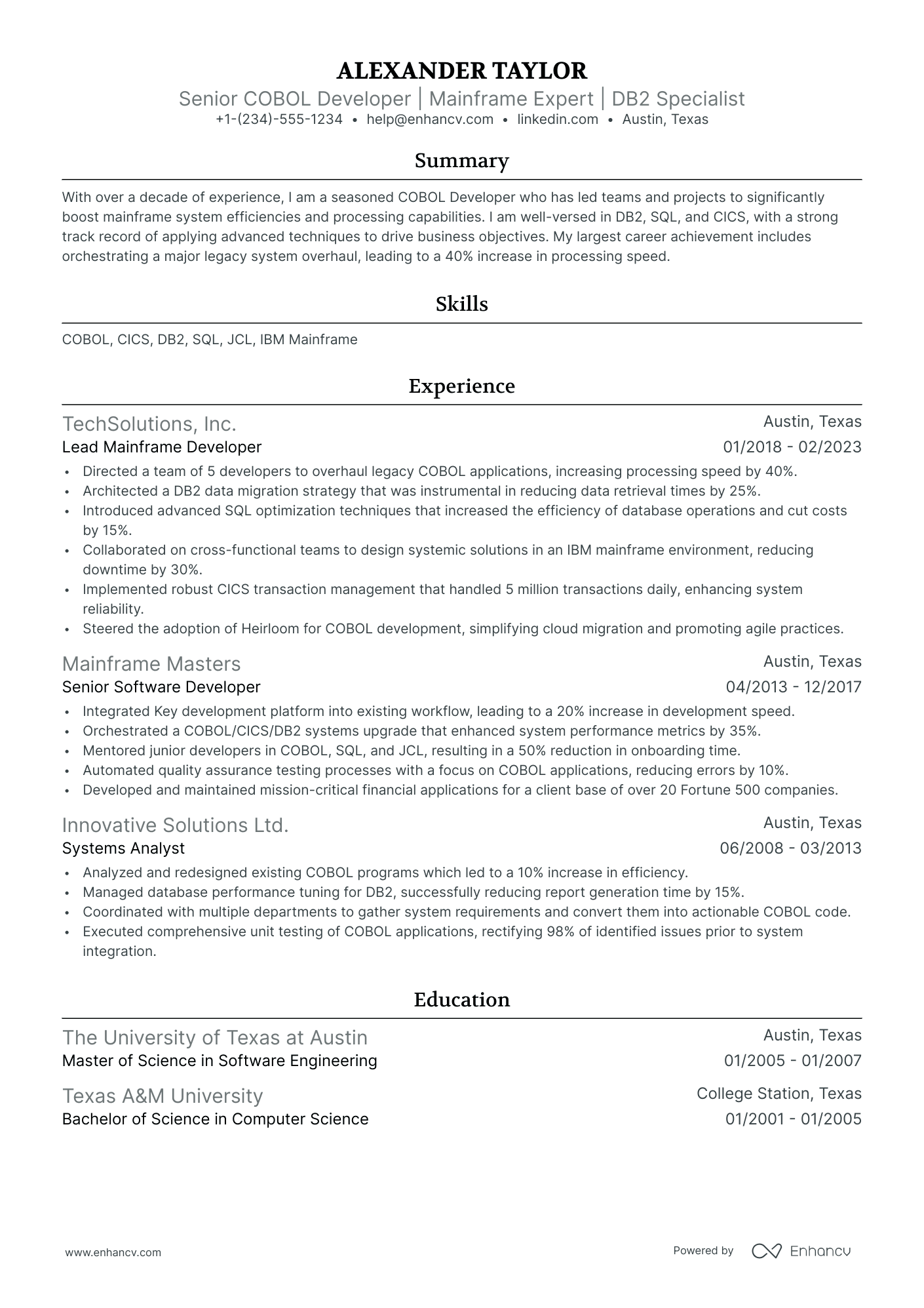
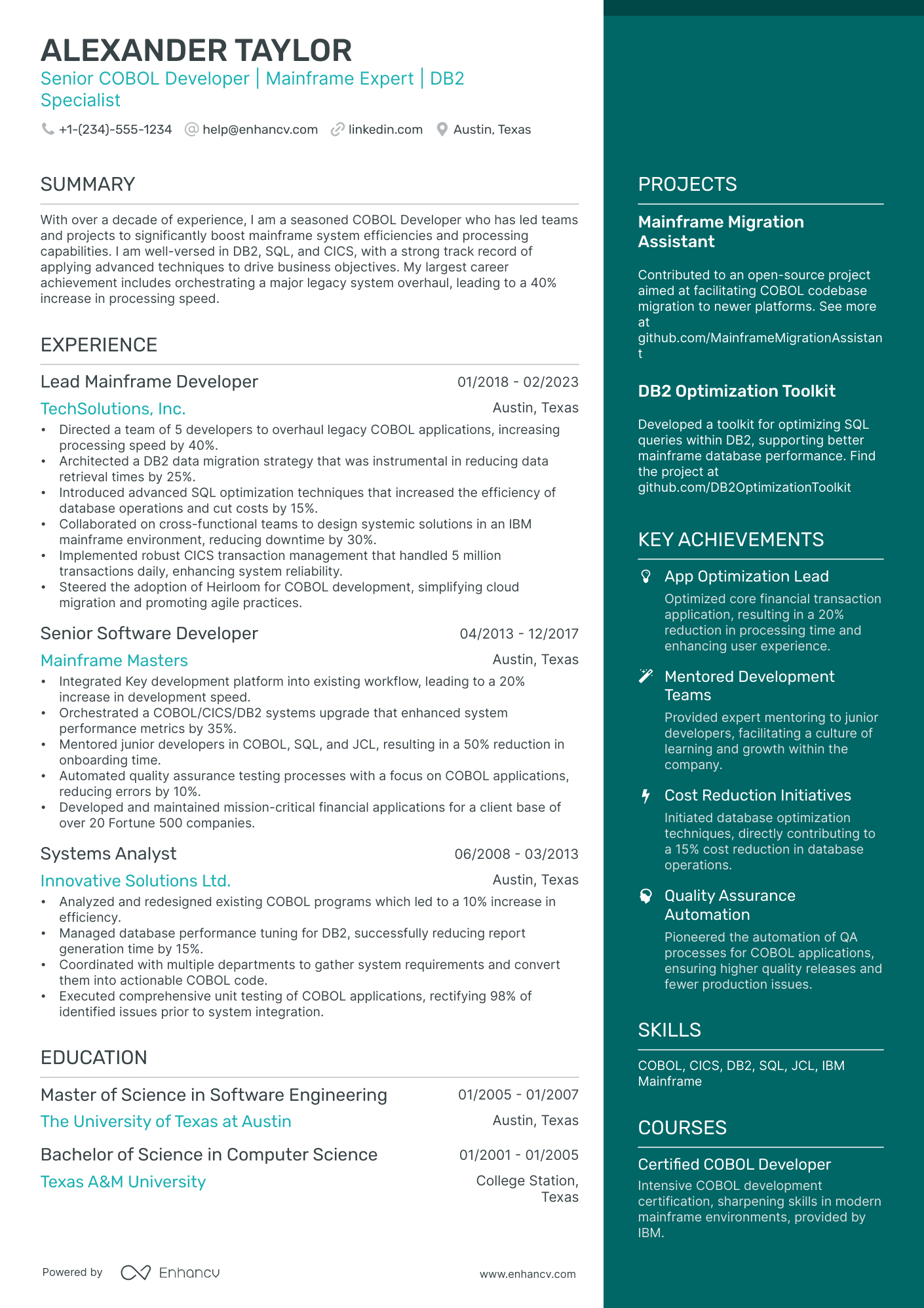
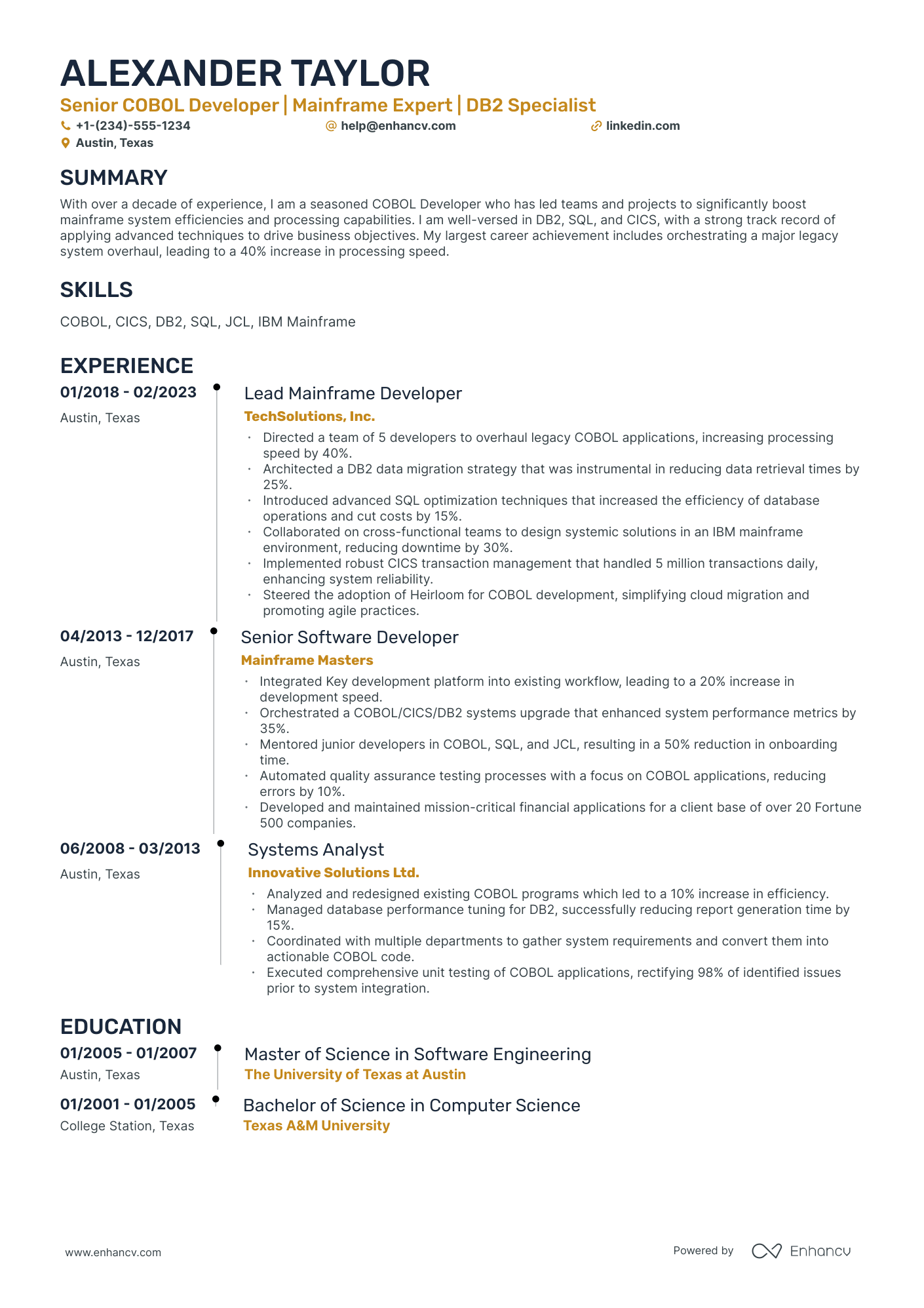
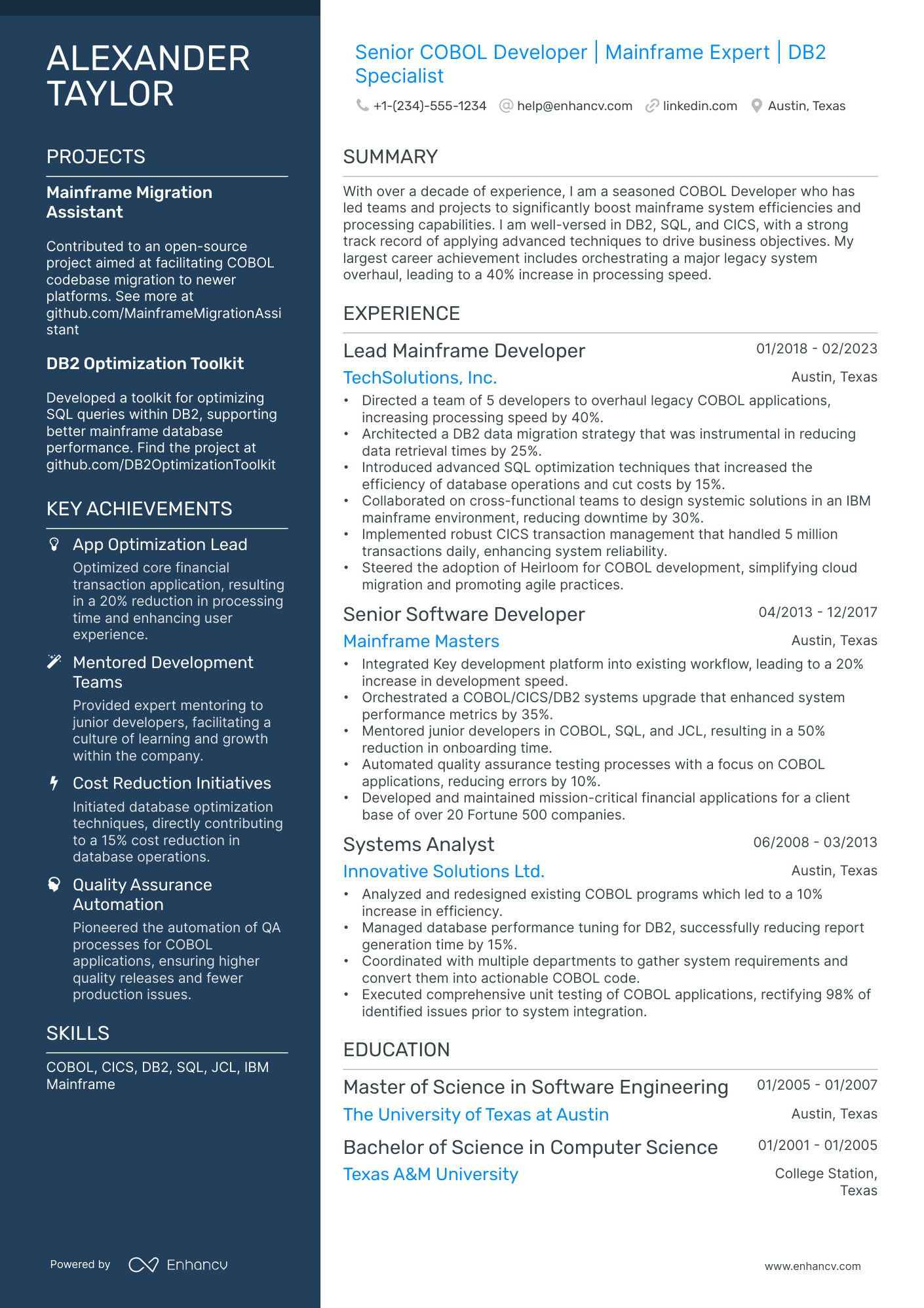
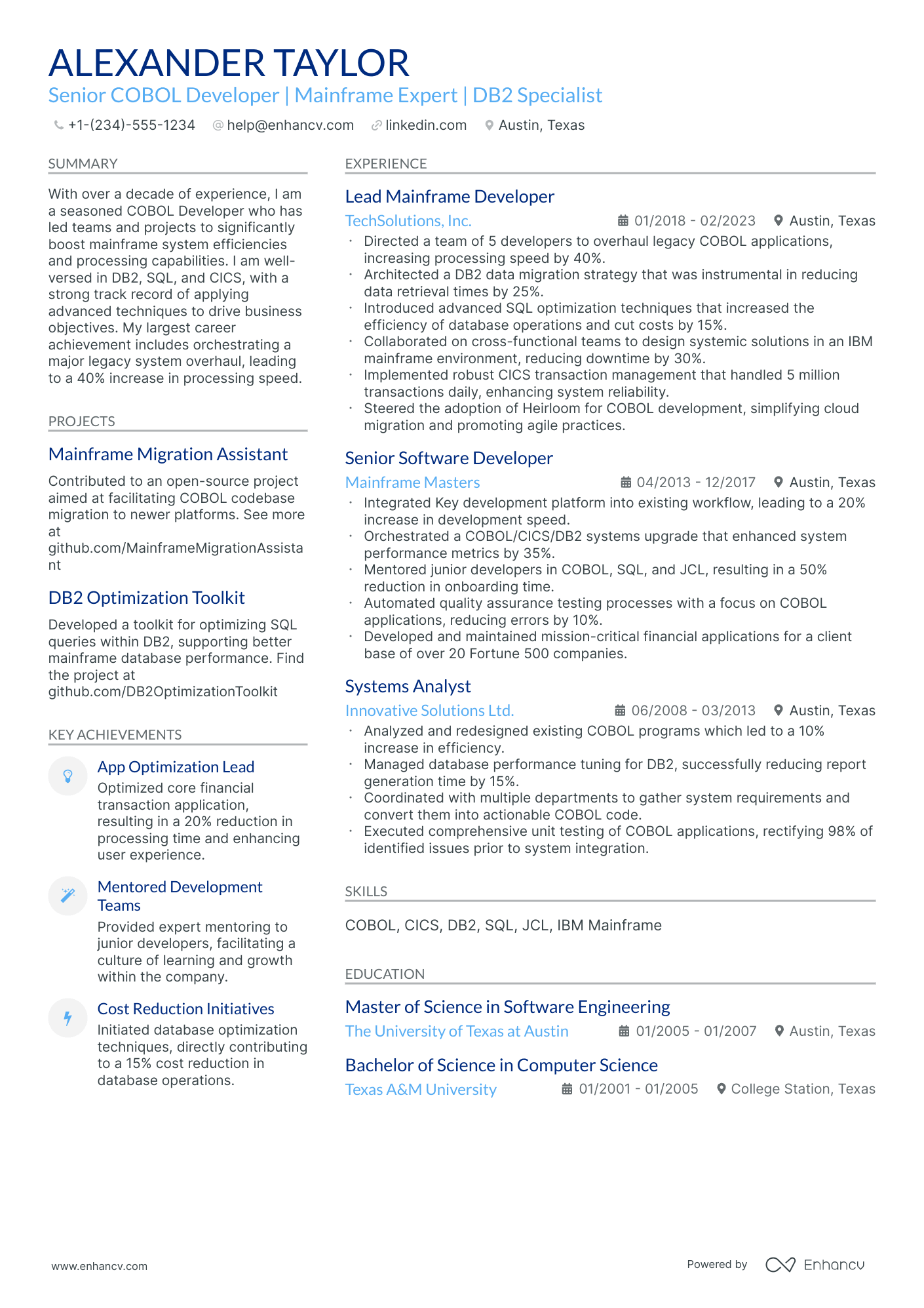
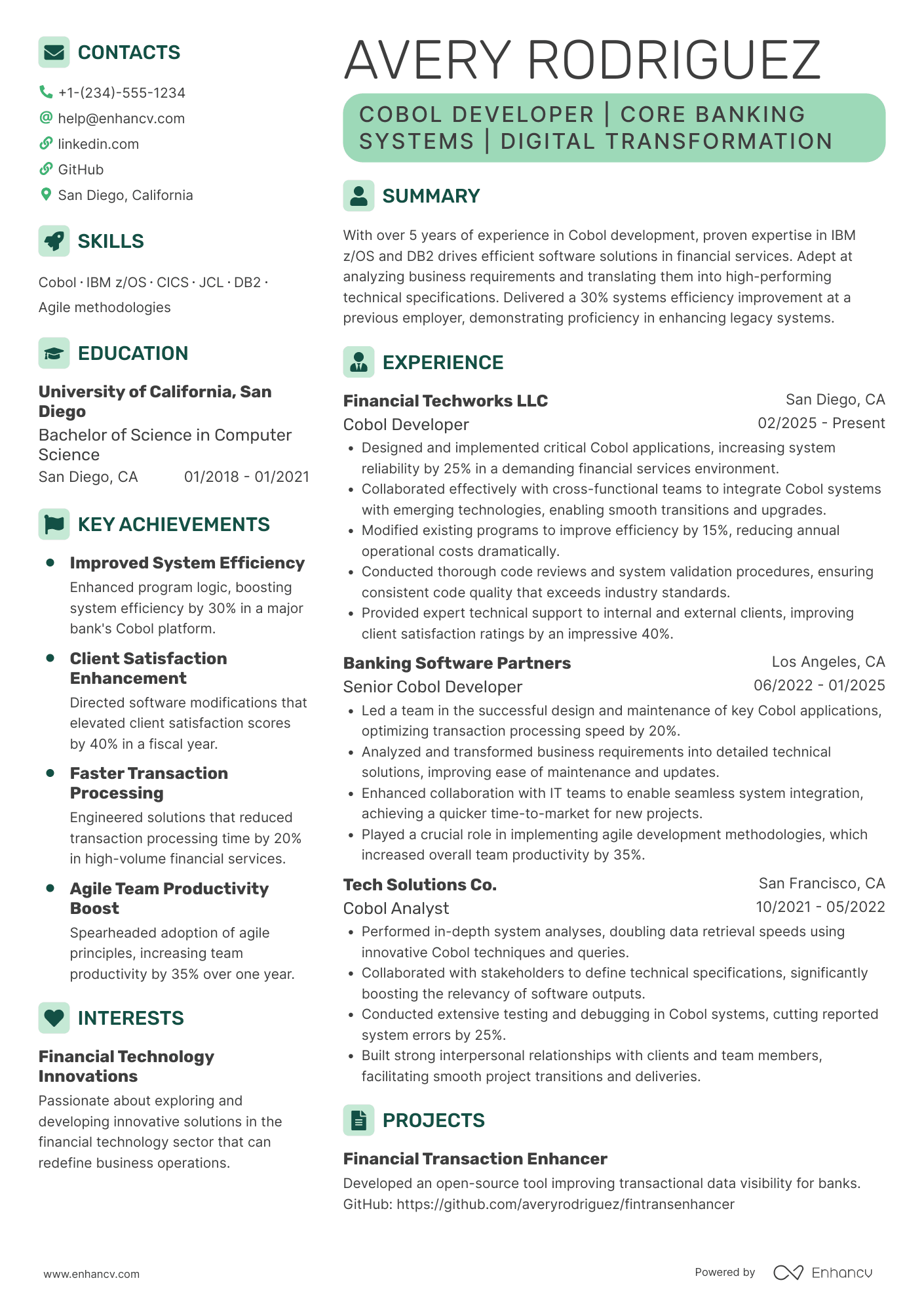
Many COBOL developer resume submissions fail because they bury modernization and business impact under tool lists and dense legacy jargon. A COBOL developer resume that can't pass ATS screening or a ten-second recruiter scan gets overlooked in a crowded market.
A strong resume shows what you improved, not just what you maintained. Knowing how to make your resume stand out means highlighting outcomes like batch window reduced by 35%, defect leakage cut, millions of records migrated safely, outages prevented, audit findings closed, and releases delivered on schedule.

Key takeaways
- Quantify COBOL achievements with metrics like batch runtime cuts, cost savings, and defect reductions.
- Tailor every experience bullet to mirror the job posting's exact tools and terminology.
- Use reverse-chronological format for experienced developers and hybrid format for career changers.
- Place your skills section above experience if you're junior or switching into COBOL.
- Prove skills in your summary and experience bullets—don't rely on a standalone list.
- Entry-level candidates should lead with lab projects, coursework, and emulator-based COBOL work.
- Enhancv can help you turn vague job duties into measurable, recruiter-ready resume bullets.
How to format a COBOL developer resume
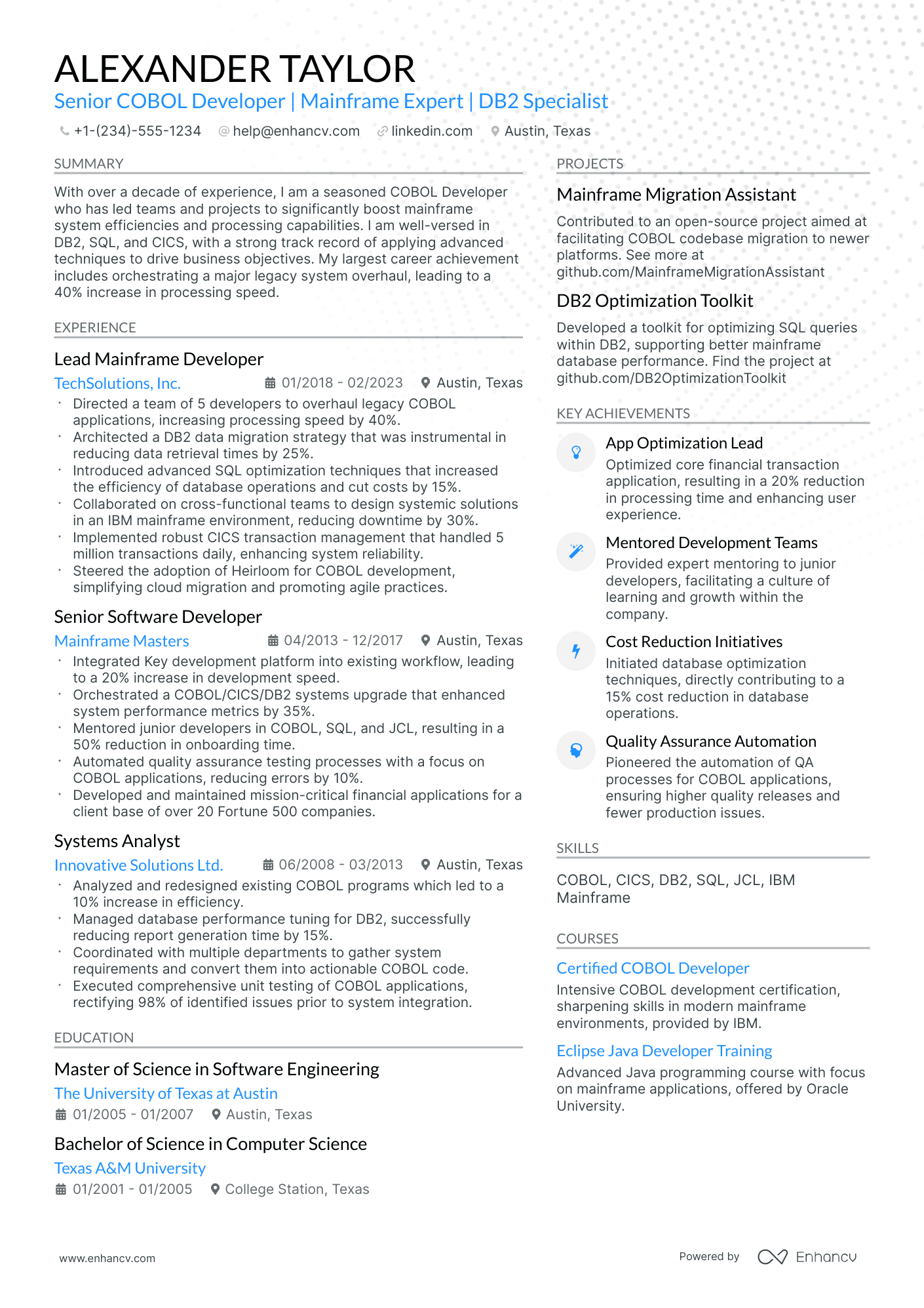
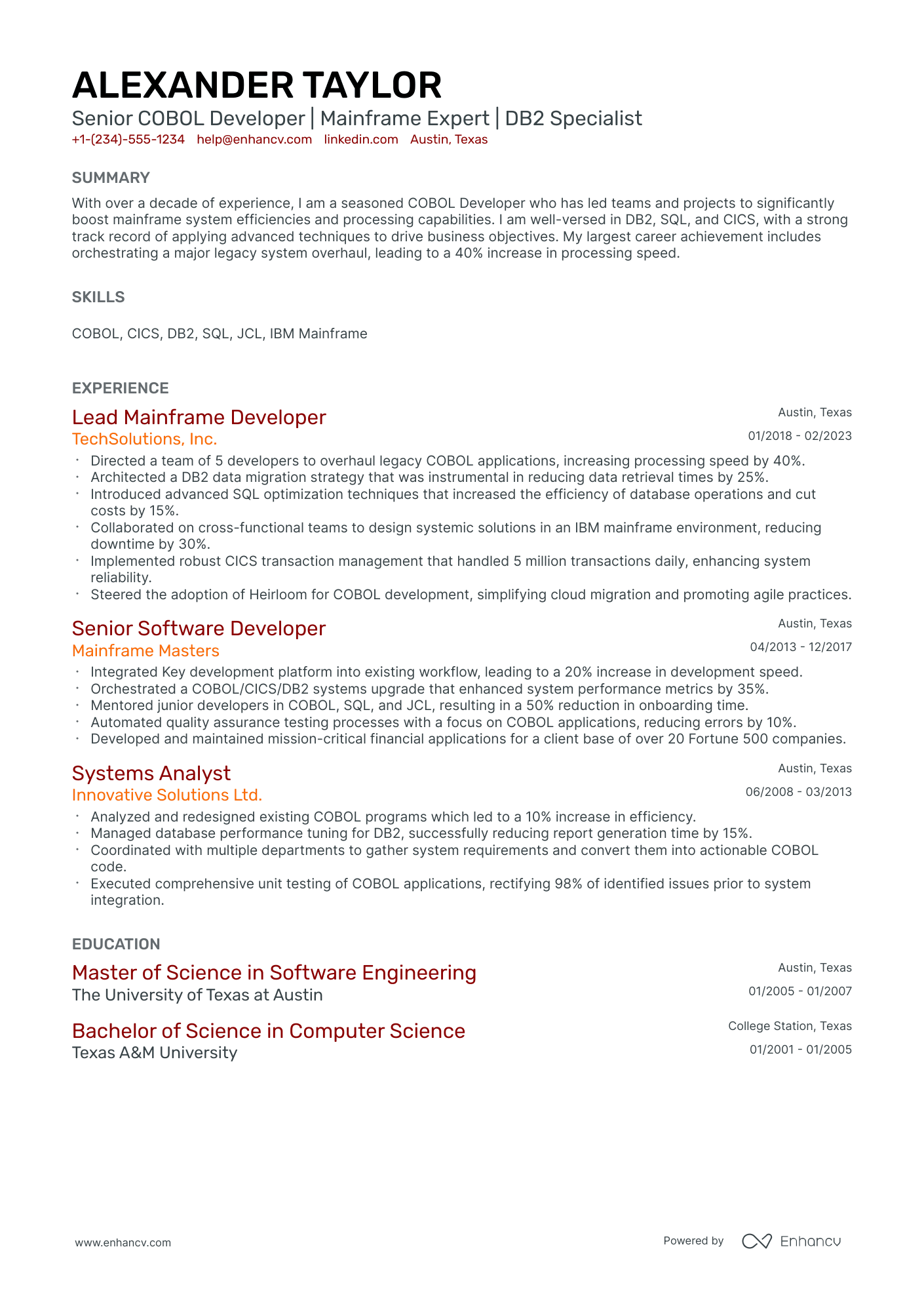
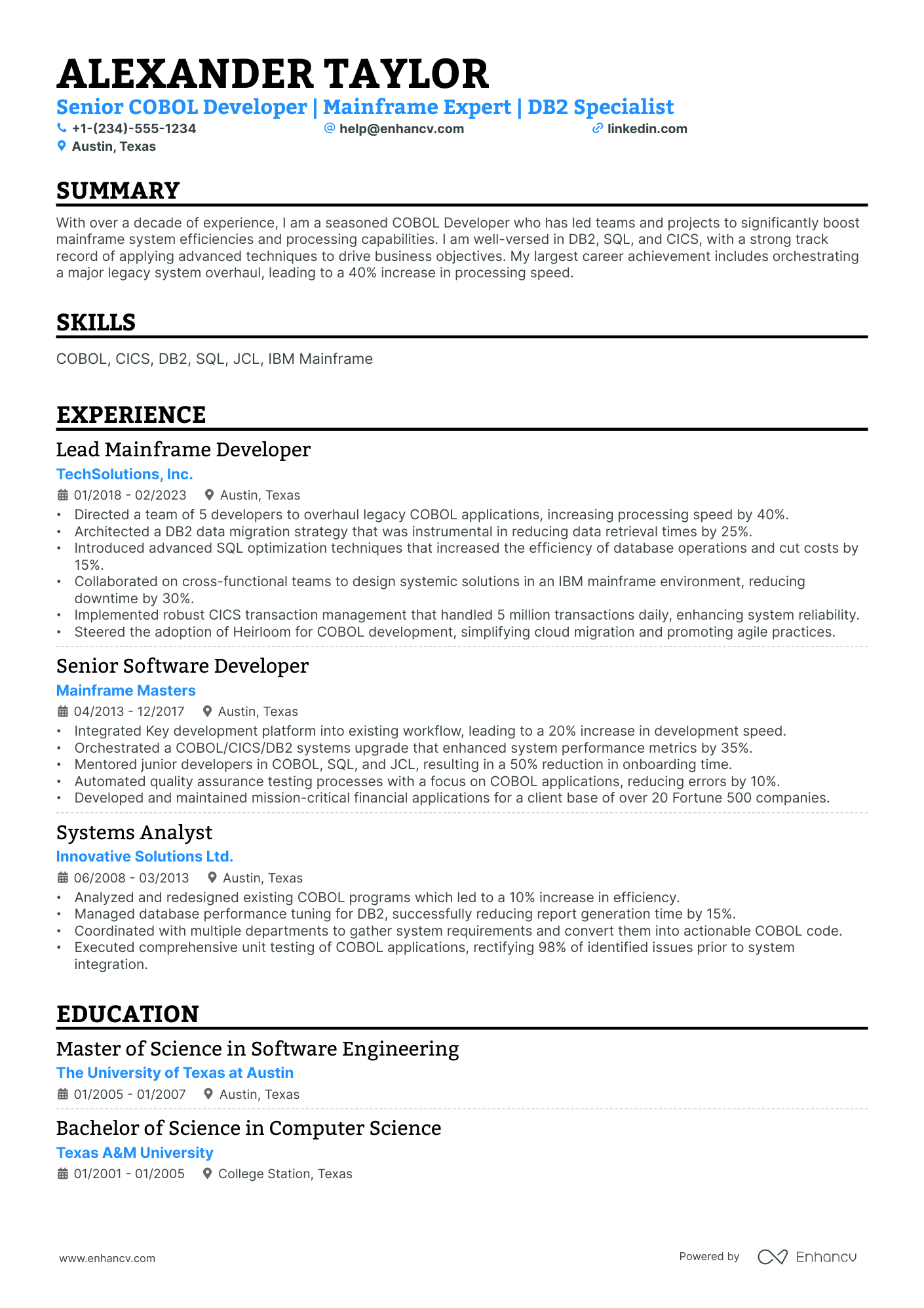
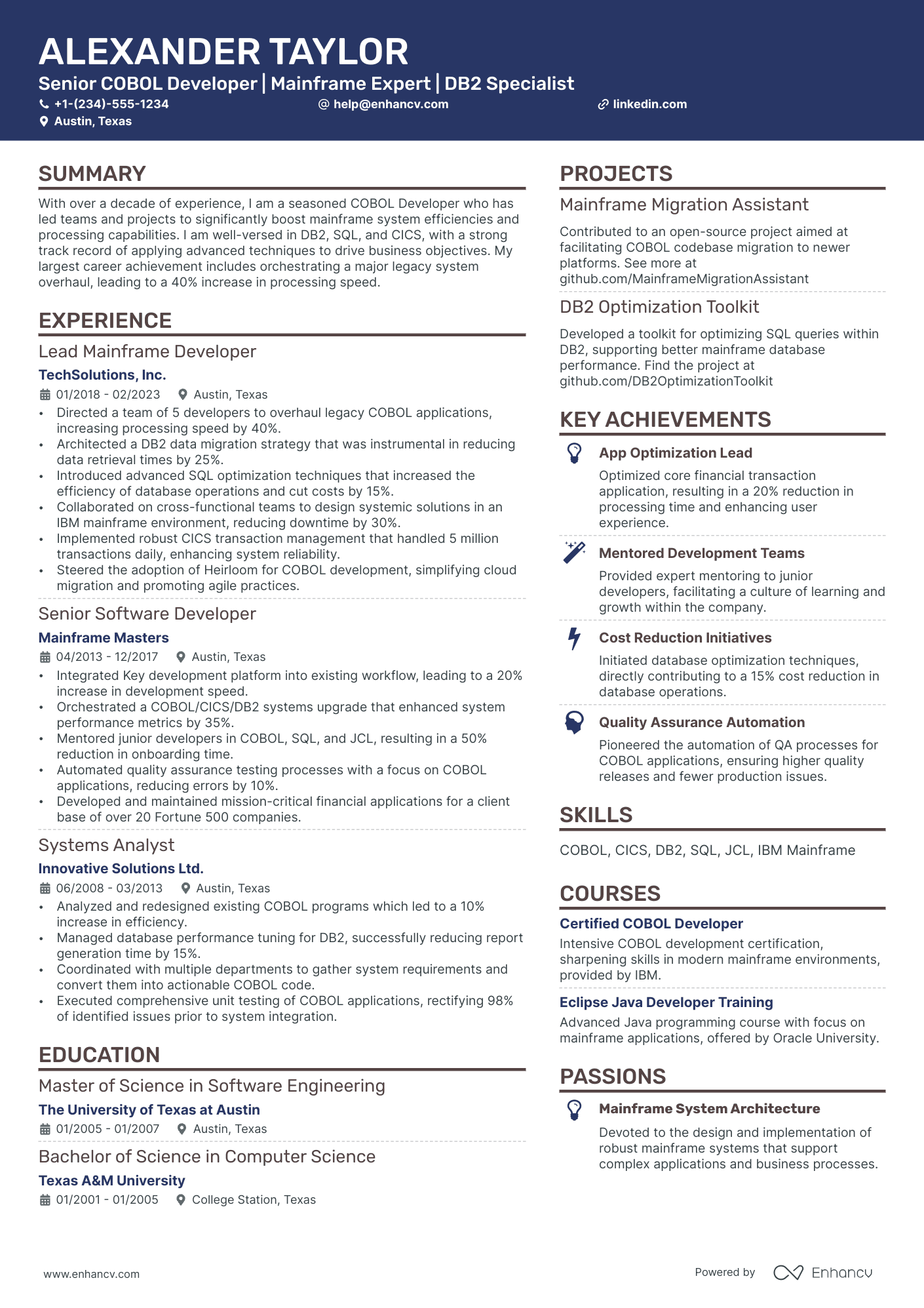
Recruiters hiring COBOL developers prioritize hands-on experience with legacy system maintenance, mainframe environments (z/OS, JCL, CICS, DB2), and the ability to modernize or integrate aging codebases with newer platforms. Your resume format determines how quickly a hiring manager can identify those technical competencies, trace your project history, and assess the depth of your mainframe expertise.

I have significant experience in this role—which format should I use?
Use a reverse-chronological format to give recruiters a clear, linear view of your COBOL development career and growing technical responsibilities. Do:
- Lead each role entry with your scope of ownership—number of programs maintained, systems supported, lines of code managed, and environments overseen (z/OS, MVS, VSAM, CICS).
- Highlight role-specific tools and domains such as JCL, DB2, IMS, Endevor, COBOL 85/2002, batch processing, and any modernization frameworks or middleware you've worked with.
- Quantify outcomes and business impact—processing time reductions, cost savings from optimization, downtime prevention, or successful migration milestones.
I'm junior or switching into this role—what format works best?
Use a hybrid format that leads with a focused COBOL and mainframe skills section, then supports it with your work or project history in reverse-chronological order. Do:
- Place core technical skills—COBOL, JCL, VSAM, DB2, CICS, TSO/ISPF—at the top of your resume so ATS parsers and recruiters see them immediately.
- Feature academic projects, internships, or personal labs where you wrote, compiled, or debugged COBOL programs, even on emulated mainframe environments like Hercules or IBM zPDT.
- Connect every listed skill to a specific action and result so recruiters can see applied ability, not just keyword awareness.
Why not use a functional resume?
A functional format strips away the chronological context that proves you've built real competency in mainframe environments over time, making it harder for recruiters to verify where and how you applied your COBOL skills.
- Career changers with transferable programming experience: If you're moving from another language or platform (e.g., RPG, PL/I, or AS/400 development) and have completed COBOL coursework, certifications, or lab projects that demonstrate applied mainframe skills.
- Candidates with resume gaps returning to mainframe work: If you've been out of COBOL development but have recently upskilled through IBM training, community college mainframe programs, or open-source COBOL contributions on GnuCOBOL.
With your resume's structure and layout in place, the next step is filling it with the right sections to showcase your COBOL expertise effectively.
What sections should go on a COBOL developer resume
Recruiters expect to quickly find your mainframe experience, COBOL expertise, and measurable delivery results. Understanding which resume sections to include ensures maximum clarity.
Use this structure for maximum clarity:
- Header
- Summary
- Experience
- Skills
- Projects
- Education
- Certifications
- Optional sections: Awards, Leadership, Languages
Strong experience bullets should emphasize production impact, performance or reliability outcomes, modernization scope, and quantified results across critical systems.
Is your resume good enough?
Drop your resume here or choose a file. PDF & DOCX only. Max 2MB file size.
Now that you’ve organized the key resume components, focus on writing your COBOL developer experience section to show how your work delivers results.
How to write your COBOL developer resume experience
Your experience section should highlight the COBOL systems you've shipped, maintained, or modernized—anchored by the tools, methodologies, and platforms you used to deliver measurable results. Hiring managers prioritize demonstrated impact over descriptive task lists, so every line should prove you drove real outcomes rather than simply occupied a seat. Building a targeted resume ensures each entry speaks directly to what the employer needs.
Each entry should include:
- Job title
- Company and location (or remote)
- Dates of employment (month and year)
Three to five concise bullet points showing what you owned, how you executed, and what outcomes you delivered:
- Ownership scope: the mainframe applications, batch processing systems, legacy codebases, or enterprise platforms you were directly accountable for as a COBOL developer—including the business domains, end users, or downstream systems that depended on your work.
- Execution approach: the languages, tools, frameworks, and methods you relied on to deliver—such as JCL, VSAM, CICS, DB2, IMS, Endevor, or specific testing and debugging utilities—along with any development practices like structured walkthroughs, code reviews, or change management workflows.
- Value improved: the tangible shifts in system performance, processing reliability, transaction throughput, data accuracy, code maintainability, or operational risk that resulted from your COBOL development or modernization efforts.
- Collaboration context: how you partnered with business analysts, database administrators, QA teams, operations staff, or end users to gather requirements, resolve production issues, or coordinate releases across mainframe environments.
- Impact delivered: the business-level outcomes your work produced—expressed through scale of records processed, reduction in downtime, faster batch cycle completion, successful migrations, or compliance milestones rather than a simple list of activities performed.
Experience bullet formula
A COBOL developer experience example
✅ Right example - modern, quantified, specific.
Senior COBOL Developer
First Midwest Bank | Chicago, IL
2021–Present
Regional bank supporting five million customers across retail and commercial banking on IBM z/OS core systems.
- Modernized COBOL and CICS transaction flows for deposits and payments, cutting average response time by 32% and reducing peak-hour timeouts by 41% across 1,200+ daily batch and online jobs.
- Refactored DB2 stored procedure calls and optimized SQL access paths using EXPLAIN and index tuning, lowering CPU consumption by 18% and avoiding an estimated $240K in annual mainframe capacity costs.
- Automated nightly batch controls with JCL, DFSORT, and Control-M, improving job success rate from 97.8% to 99.6% and saving nine hours per week in operator interventions.
- Implemented CI/CD gates for COBOL with Git, Jenkins, and IBM Dependency Based Build (IBM Dependency Based Build), reducing release cycle time from four weeks to two weeks while maintaining zero Sev-1 production incidents for six consecutive releases.
- Partnered with product managers, QA, and fraud stakeholders to deliver a new ISO 8583 authorization rule set, decreasing false positives by 14% and reducing chargeback losses by $1.1M year over year.
Now that you've seen how to structure a strong experience entry, let's look at how to align each detail with the specific job posting you're targeting.
How to tailor your COBOL developer resume experience
Recruiters evaluate your COBOL developer resume through both applicant tracking systems and manual review. Tailoring your resume to the job description ensures your qualifications register with both.
Ways to tailor your COBOL developer experience:
- Match the specific COBOL version or dialect named in the posting.
- Mirror the exact mainframe platform referenced like z/OS or AS/400.
- Use the same terminology for batch processing or online transaction workflows.
- Highlight JCL and job scheduling tools the employer lists as required.
- Include VSAM or DB2 database experience when the role specifies it.
- Reflect the SDLC methodology the team follows such as Agile or Waterfall.
- Emphasize CICS or IMS subsystem work if the posting calls for it.
- Reference compliance or audit standards relevant to the employer's industry.
Tailoring means aligning your real accomplishments with what the role demands, not forcing disconnected keywords into your experience.
Resume tailoring examples for COBOL developer
| Job description excerpt | Untailored | Tailored |
|---|---|---|
| Maintain and modernize legacy COBOL applications running on IBM z/OS mainframes, ensuring compliance with banking regulatory standards. | Worked on legacy systems and helped with updates. | Maintained and modernized 12 COBOL applications on IBM z/OS mainframes, ensuring full compliance with FDIC and OCC banking regulatory standards across three production environments. |
| Write and optimize COBOL batch programs using JCL and DB2 to process nightly transaction files for a high-volume payment processing platform. | Wrote programs and handled data processing tasks. | Developed and optimized 15+ COBOL batch programs using JCL and DB2, processing over 2 million nightly transaction records for a payment processing platform with 99.98% accuracy. |
| Collaborate with business analysts to translate requirements into COBOL/CICS online programs supporting real-time customer account inquiries for an insurance claims system. | Worked with team members to build software based on requirements. | Partnered with business analysts to translate functional requirements into COBOL/CICS online programs, enabling real-time customer account inquiries that reduced insurance claims lookup time by 40%. |
Once you’ve aligned your experience with the role’s requirements, the next step is to quantify your COBOL developer achievements so hiring teams can quickly see the impact behind that fit.
How to quantify your COBOL developer achievements
Quantifying your achievements proves business impact in legacy, high-volume systems. Focus on transaction throughput, batch runtime, defect rates, incident reduction, cost savings, delivery speed, and compliance outcomes tied to mainframe changes.
Quantifying examples for COBOL developer
| Metric | Example |
|---|---|
| Batch runtime | "Cut nightly billing batch from 4.2 hours to 2.9 hours by tuning COBOL I-O, optimizing DB2 indexes, and reducing SORT steps." |
| Reliability | "Reduced Sev-one incidents from eight per quarter to two by adding CICS transaction retries, improving abend handling, and tightening monitoring alerts." |
| Quality | "Lowered production defect escape rate by 35% by expanding unit tests, adding JCL validation checks, and enforcing peer reviews for COBOL changes." |
| Cost savings | "Saved $120,000 per year in mainframe costs by reducing CPU time 18% through code refactoring and eliminating redundant file reads." |
| Delivery speed | "Improved release cadence from quarterly to monthly by automating builds with Jenkins, standardizing JCL templates, and shortening regression testing by six days." |
Turn vague job duties into measurable, recruiter-ready resume bullets in seconds with Enhancv's Bullet Point Generator.
Once you've crafted strong, impactful bullet points for your experience section, it's equally important to strategically present your technical and interpersonal abilities in a dedicated skills section.
How to list your hard and soft skills on a COBOL developer resume
Your skills section matters for COBOL developers because recruiters and applicant tracking systems scan them to confirm mainframe fit, domain readiness, and delivery capability, so balance role-specific hard skills with execution-focused soft skills that support reliable production changes.
COBOL developer roles require a blend of:
- Product strategy and discovery skills.
- Data, analytics, and experimentation skills.
- Delivery, execution, and go-to-market discipline.
- Soft skills.
Your skills section should be:
- Scannable (bullet-style grouping).
- Relevant to the job post.
- Backed by proof in experience bullets.
- Updated with current tools.
Place your skills section:
- Above experience if you're junior or switching careers.
- Below experience if you're mid/senior with strong achievements.

Hard skills
- COBOL (Enterprise COBOL)
- IBM z/OS
- CICS transaction processing
- IBM DB2 for z/OS
- JCL, job scheduling
- VSAM, QSAM datasets
- TSO/ISPF, SDSF
- IMS DB/DC
- Endevor, Changeman, Git
- IBM MQ, batch interfaces
- Debugging, performance tuning
- Unit testing, regression testing
Soft skills
- Translate business rules into code
- Clarify requirements with stakeholders
- Write production-ready change plans
- Communicate impacts and risks early
- Collaborate with QA and operations
- Troubleshoot incidents under pressure
- Document logic for maintainability
- Review code for defects and standards
- Prioritize fixes by customer impact
- Own releases through post-deploy validation
How to show your COBOL developer skills in context
Skills shouldn't live only in a bulleted list on your resume. Browse examples of how other developers present their abilities on the resume skills page for additional inspiration.
They should be demonstrated in:
- Your summary (high-level professional identity)
- Your experience (proof through outcomes)
Here's what that looks like in practice.
Summary example
Senior COBOL developer with 12 years in banking and mainframe modernization. Skilled in CICS, JCL, and DB2, with a track record of reducing batch processing times by 35% through cross-functional optimization initiatives.
- Reflects senior-level expertise clearly
- Names role-relevant tools and platforms
- Includes a specific measurable outcome
- Signals collaboration and leadership ability
Experience example
Senior COBOL Developer
Fidelity National Financial | Jacksonville, FL
March 2018–Present
- Refactored 140+ legacy COBOL programs using structured coding standards and DB2 optimization, cutting nightly batch runtime by 28%.
- Partnered with business analysts and QA teams to migrate VSAM-based modules to modernized CICS transactions, reducing processing errors by 41%.
- Developed automated JCL scheduling workflows with CA-7, eliminating 15 hours of manual job monitoring per week across three production environments.
- Every bullet includes measurable proof
- Skills appear naturally within achievements
Once you’ve demonstrated your COBOL capabilities through relevant projects and outcomes, the next step is learning how to present those strengths on a COBOL developer resume when you don’t have formal experience.
How do I write a COBOL developer resume with no experience
Even without full-time experience, you can demonstrate readiness. Our guide on writing a resume without work experience covers strategies that apply directly to COBOL developers starting out. Consider showcasing:
- Capstone COBOL developer project.
- Mainframe emulator lab assignments.
- Open-source COBOL developer contributions.
- Legacy code refactoring exercises.
- Batch job and JCL practice.
- Database integration mini-projects.
- Unit tests for COBOL programs.
- Volunteer migration documentation support.
Focus on:
- COBOL developer projects with metrics.
- Batch processing and job control.
- Data access with SQL.
- Version control and issue tracking.
Resume format tip for entry-level COBOL developer
Use a skills-based resume format. It puts projects, coursework, and tools first, so recruiters see proof of COBOL developer readiness fast. Do:
- Lead with a "Projects" section.
- List COBOL, JCL, and SQL.
- Add tools like Git and VS Code.
- Quantify results: runtime, records, defects.
- Describe inputs, outputs, and validations.
- Built a COBOL developer batch program with JCL on Hercules, processed 250,000 records nightly, and cut runtime by 18% after indexing and file I/O tuning.
Once you've structured your resume around transferable skills and relevant projects, presenting your education effectively becomes your next strongest asset.
How to list your education on a COBOL developer resume
Your education section helps hiring teams confirm you have the foundational knowledge needed. It validates your understanding of computer science principles, data structures, and legacy system concepts central to the COBOL developer role.
Include:
- Degree name
- Institution
- Location
- Graduation year
- Relevant coursework (for juniors or entry-level candidates)
- Honors & GPA (if 3.5 or higher)
Skip month and day details—list the graduation year only.
Here's a strong education entry tailored for a COBOL developer resume:
Example education entry
Bachelor of Science in Computer Science
Penn State University, University Park, PA
Graduated 2019
GPA: 3.7/4.0
- Relevant Coursework: Mainframe Programming, COBOL Application Development, Database Management Systems, Business Information Systems, Data Structures
- Honors: Dean's List (six semesters), Magna Cum Laude
How to list your certifications on a COBOL developer resume
Certifications on a resume show a COBOL developer's commitment to learning, proficiency with mainframe tools, and relevance to regulated industries that still run critical systems.
Include:
- Certificate name
- Issuing organization
- Year
- Optional: credential ID or URL
- Place certifications below education when they're older, less relevant, or you have strong formal education that already matches the COBOL developer role.
- Place certifications above education when they're recent, highly relevant to mainframe work, or they help offset limited COBOL developer experience.
Best certifications for your COBOL developer resume
- IBM z/OS Mainframe Practitioner
- IBM z/OS Mainframe Professional
- IBM z/OS Mainframe Advanced
- Micro Focus COBOL Certification
- Broadcom Mainframe Technical Specialist
- AWS Certified Cloud Practitioner
- CompTIA Security+
Once you’ve positioned your certifications where recruiters can spot them quickly, use your COBOL developer resume summary to connect those credentials to the role you’re targeting.
How to write your COBOL developer resume summary
Your resume summary is the first thing a recruiter reads. A strong one instantly signals you have the COBOL skills and experience the role demands.
Keep it to three to four lines, with:
- Your title and total years of COBOL development experience.
- The domain or industry you've worked in, such as banking, insurance, or government.
- Core tools and technologies like CICS, JCL, DB2, VSAM, or mainframe environments.
- One or two measurable achievements that show your impact.
- Soft skills tied to real outcomes, such as collaboration that shortened delivery cycles.

PRO TIP
At a junior or mid-level, lead with your strongest technical skills and any early contributions that produced measurable results. Highlight specific COBOL tools you've used and the systems you've touched. Avoid vague claims like "passionate problem-solver" or "quick learner." Instead, show relevance through concrete projects, technologies, and outcomes that prove you can deliver production-ready work from day one.
Example summary for a COBOL developer
COBOL developer with three years of experience maintaining batch processing systems in banking. Optimized JCL jobs and DB2 queries, reducing nightly batch runtime by 18%. Collaborates with cross-functional teams to deliver stable mainframe solutions.
Optimize your resume summary and objective for ATS
Drop your resume here or choose a file.
PDF & DOCX only. Max 2MB file size.
Now that your summary captures your COBOL expertise at a glance, make sure your header presents the essential contact and identification details recruiters need to reach you.
What to include in a COBOL developer resume header
A resume header is the top section with your identity and contact details, and it boosts visibility, credibility, and recruiter screening for a COBOL developer role.
Essential resume header elements
- Full name
- Tailored job title and headline
- Location
- Phone number
- Professional email
- GitHub link
- Portfolio link
A LinkedIn link helps recruiters verify experience quickly and supports screening.
Don't include a photo on a COBOL developer resume unless the role is explicitly front-facing or appearance-dependent.
Match your header title and links to the COBOL developer job posting, and keep every detail current and consistent across platforms.
Example
COBOL developer resume header
Jordan Taylor
COBOL developer | Mainframe batch processing, JCL, DB2
Chicago, IL
(312) 555-01XX
jordan.taylor@enhancv.com
github.com/jordantaylor
jordantaylor.dev
linkedin.com/in/jordantaylor
Once your contact details and role identification are clear at the top, you can strengthen your application with additional COBOL developer resume sections that add relevant context and support.
Additional sections for COBOL developer resumes
When your core qualifications match other applicants, additional resume sections can highlight unique strengths that set you apart as a COBOL developer. For example, listing language skills on your resume can be a differentiator when applying to global organizations that maintain mainframe systems across regions.
- Languages
- Certifications
- Professional affiliations
- Publications
- Continuing education
- Hobbies and interests
- Volunteer experience
Once your resume sections are finalized, pairing them with a strong cover letter can further distinguish your application.
Do COBOL developer resumes need a cover letter
A cover letter isn't required for a COBOL developer, but it helps in competitive roles or when hiring managers expect one. If you're unsure where to start, learn what a cover letter is and how it complements your resume. It can make a difference when your resume needs context, or when the role demands strong ownership and communication.
Use a cover letter when it adds clear, job-specific value:
- Explain role or team fit: Match your mainframe environment, tooling, and collaboration style to the team's workflow and constraints.
- Highlight one or two outcomes: Point to a COBOL developer project with measurable impact, such as faster batch runs, fewer incidents, or cleaner integrations.
- Show business context: Reference the product, users, and risk profile, such as banking operations, claims processing, or regulatory reporting.
- Address transitions or non-obvious experience: Connect adjacent work, such as Java, SQL, or operations, to COBOL developer responsibilities and delivery expectations.
Drop your resume here or choose a file.
PDF & DOCX only. Max 2MB file size.
Even if you choose to include a cover letter to add context, using AI to improve your COBOL developer resume helps you strengthen the document hiring teams review first.
Using AI to improve your COBOL developer resume
AI can sharpen your resume's clarity, structure, and impact. It helps tighten language and highlight relevant skills. But overuse makes resumes sound generic. For practical guidance, explore these ChatGPT resume writing prompts tailored for developer roles. Once your content is clear and role-aligned, step away from AI.
Here are 10 practical prompts to strengthen specific sections of your COBOL developer resume:
Strengthen your summary
Quantify experience bullets
Tighten job descriptions
Align skills to postings
Improve project descriptions
Modernize legacy language
Refine education details
Highlight certifications clearly
Eliminate redundant content
Tailor for specific roles
Conclusion
A strong COBOL developer resume proves impact with measurable outcomes, role-specific skills, and a clear structure. Use metrics to show faster batch runs, fewer defects, and stable production releases. Highlight COBOL, JCL, CICS, DB2, and mainframe debugging where they fit.
Keep each section scannable, consistent, and tailored to the COBOL developer role. Your resume should show you can maintain core systems, modernize safely, and support integrations. That combination signals readiness for today’s hiring market and near-future needs.