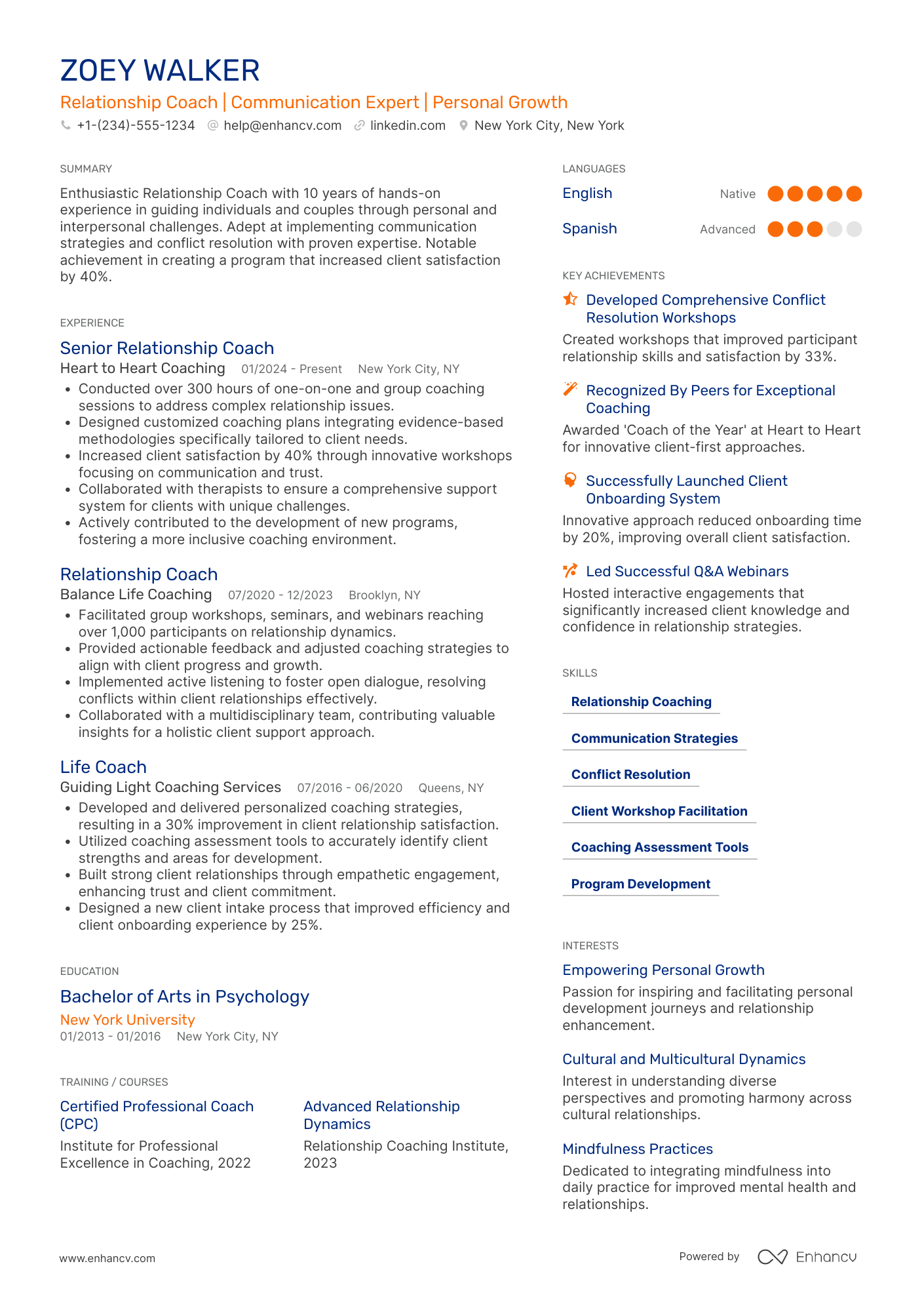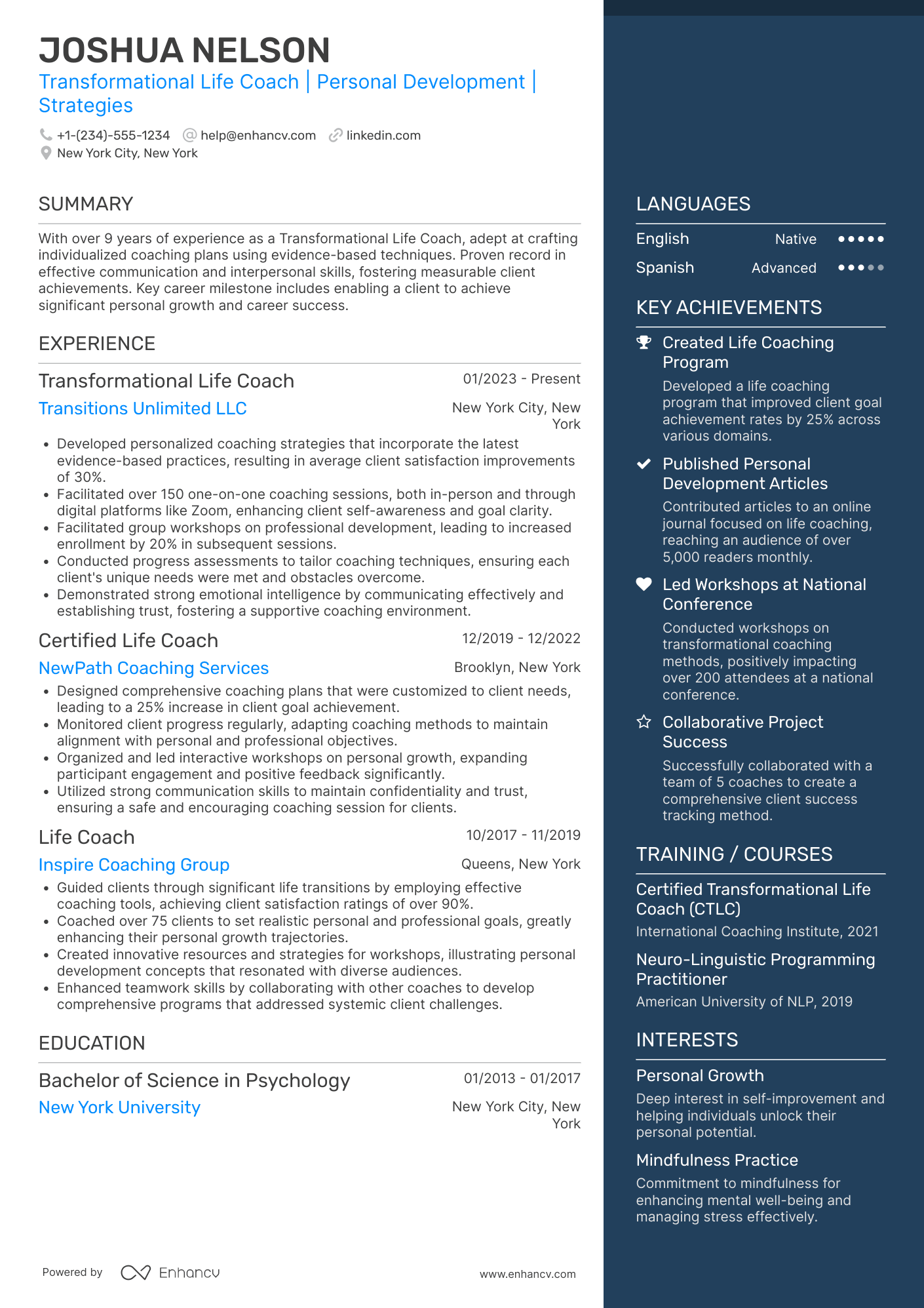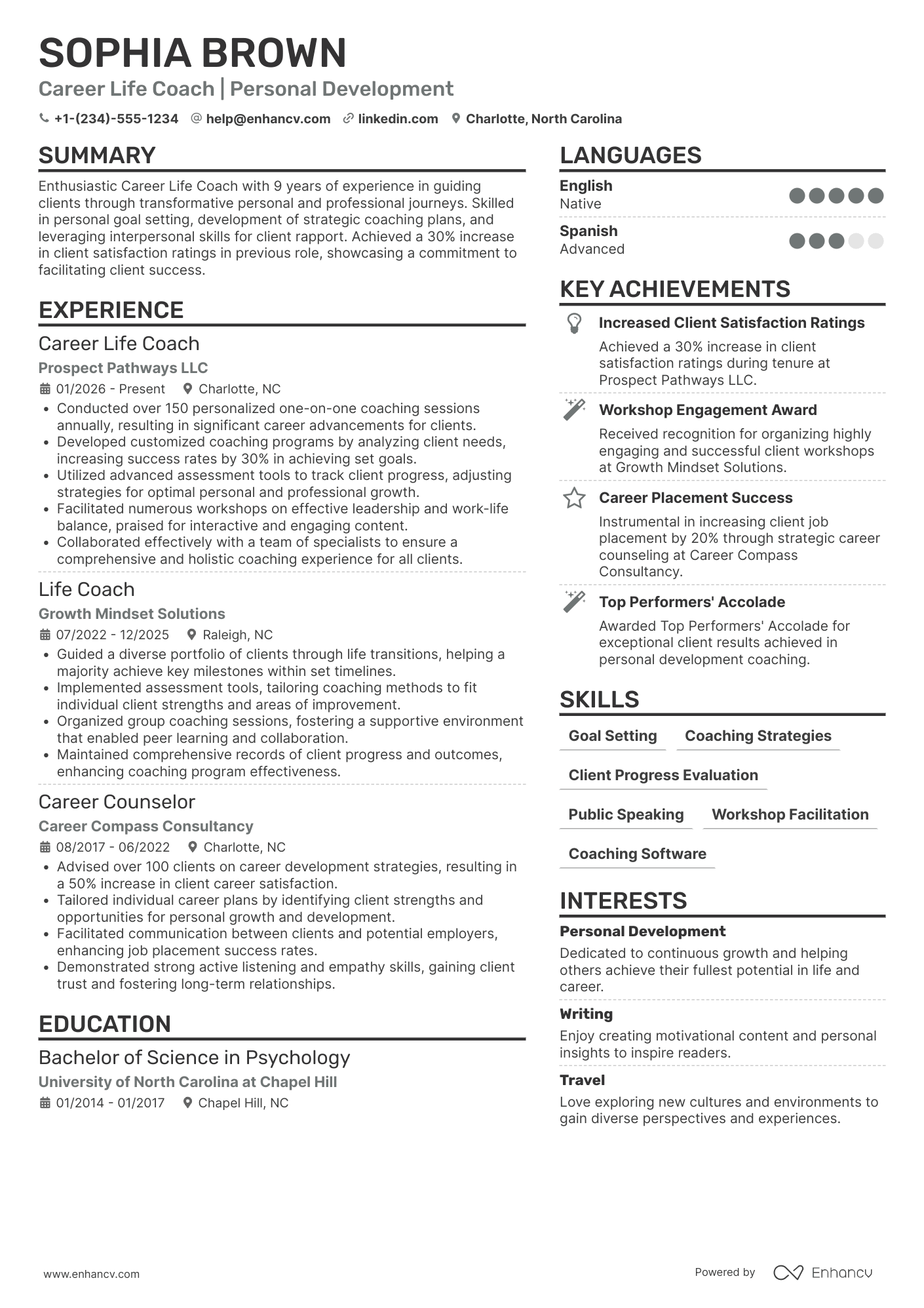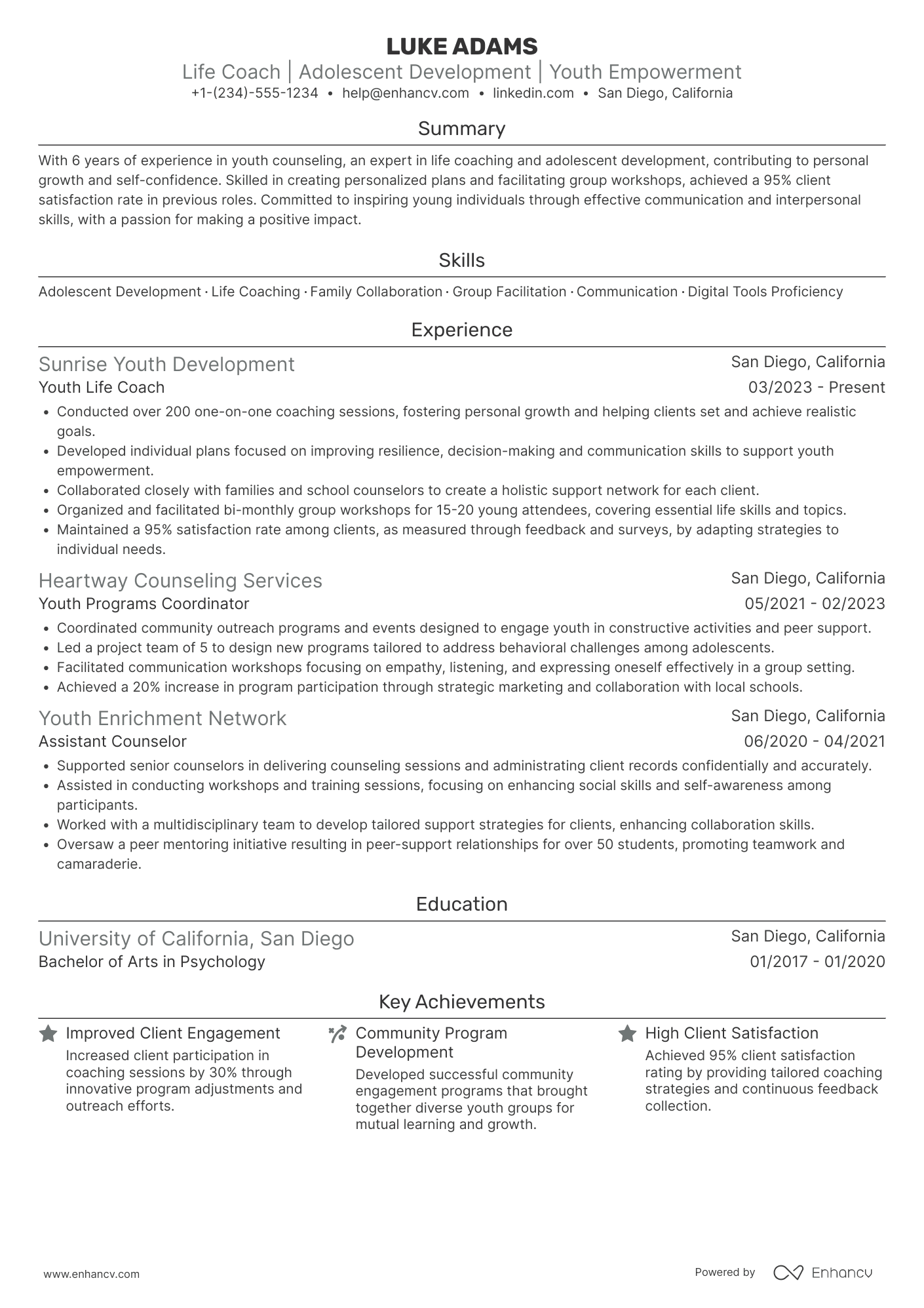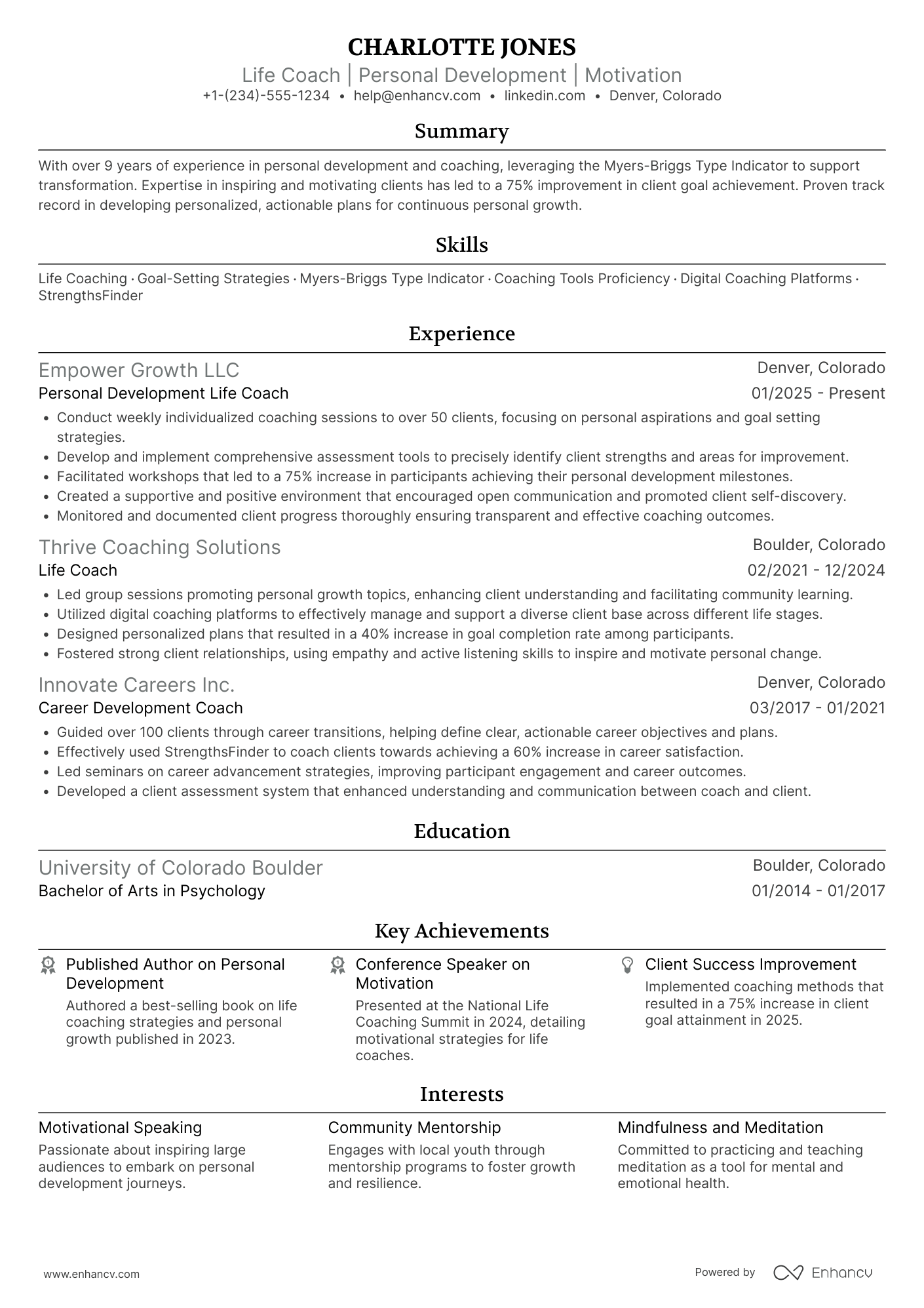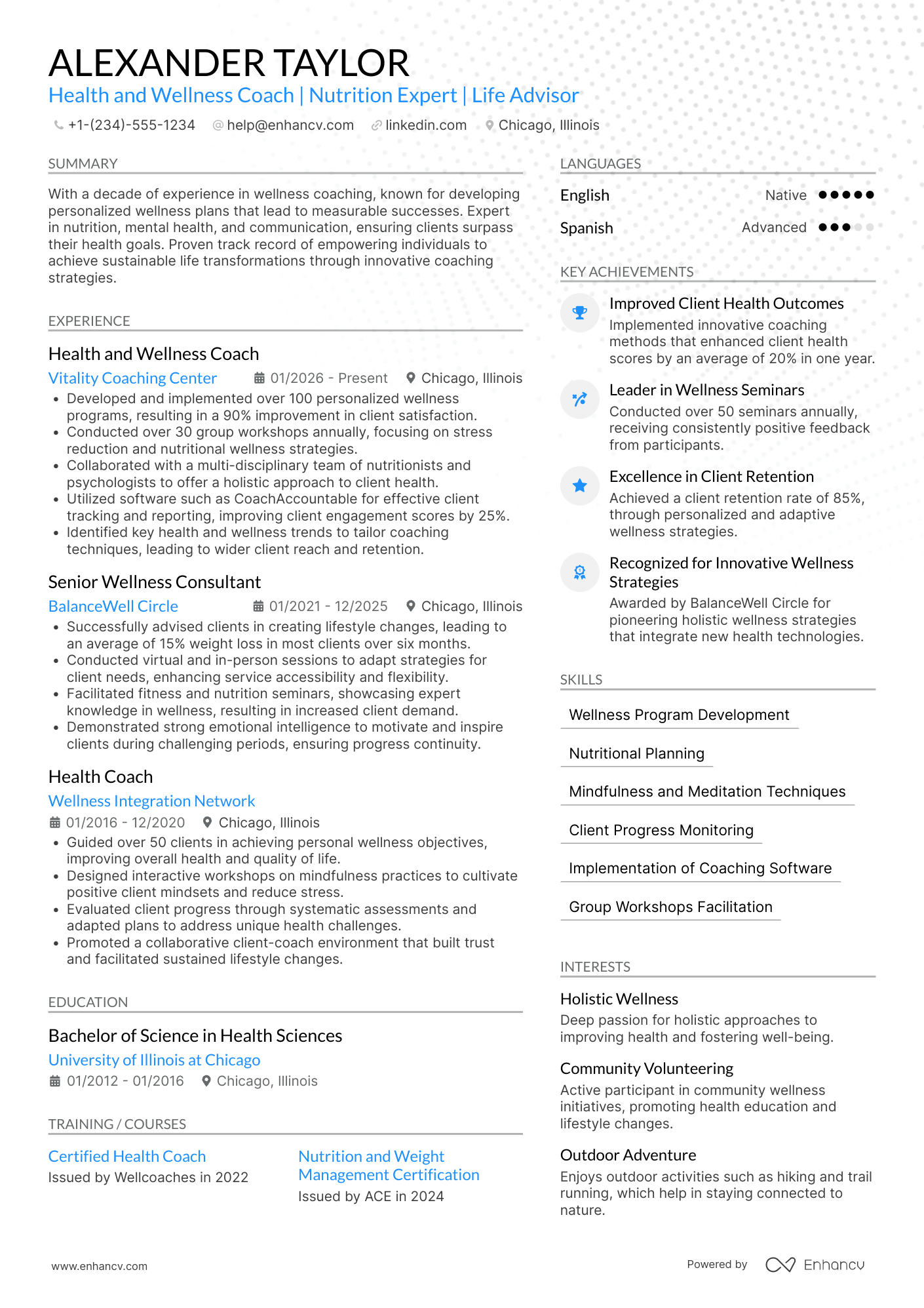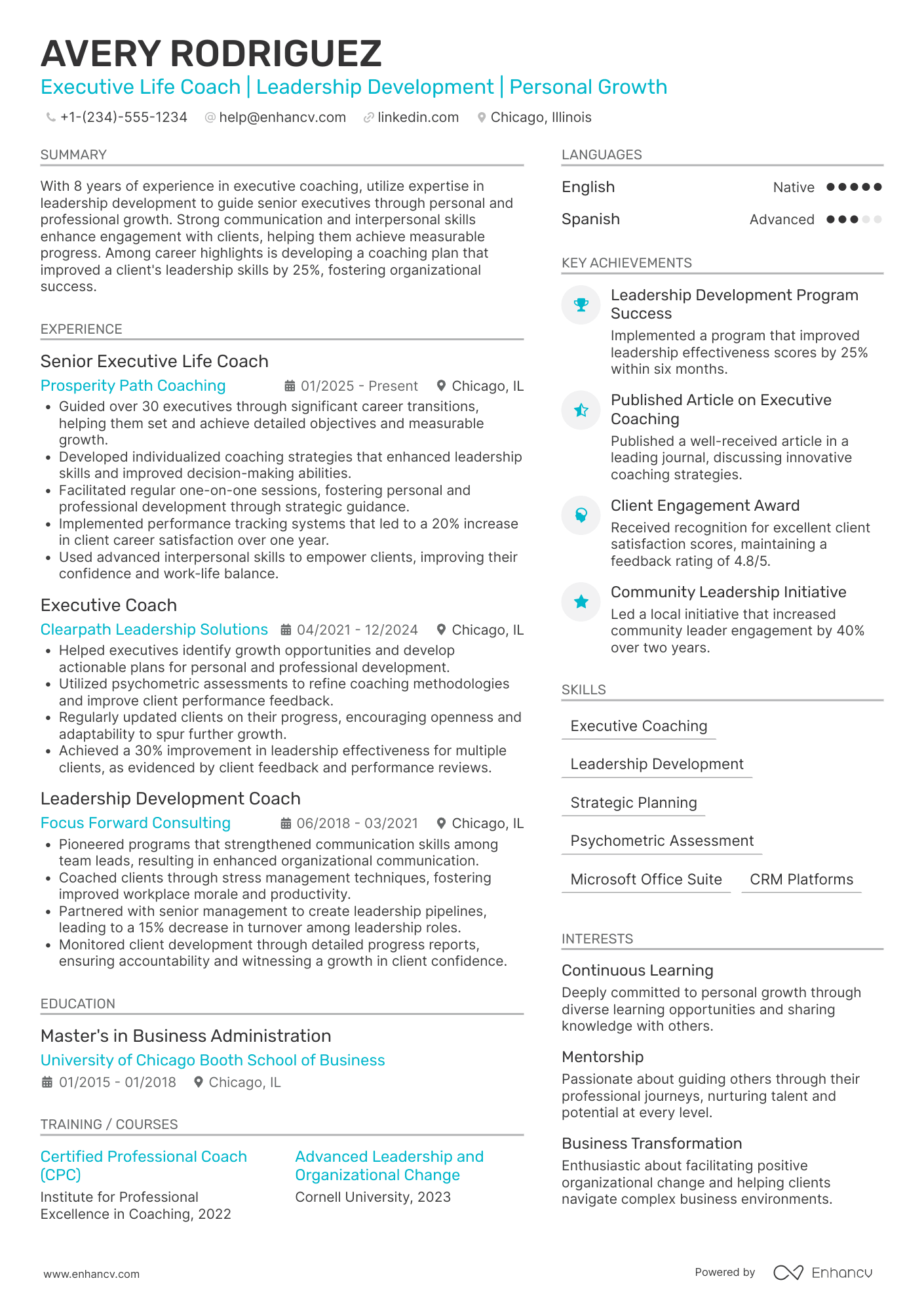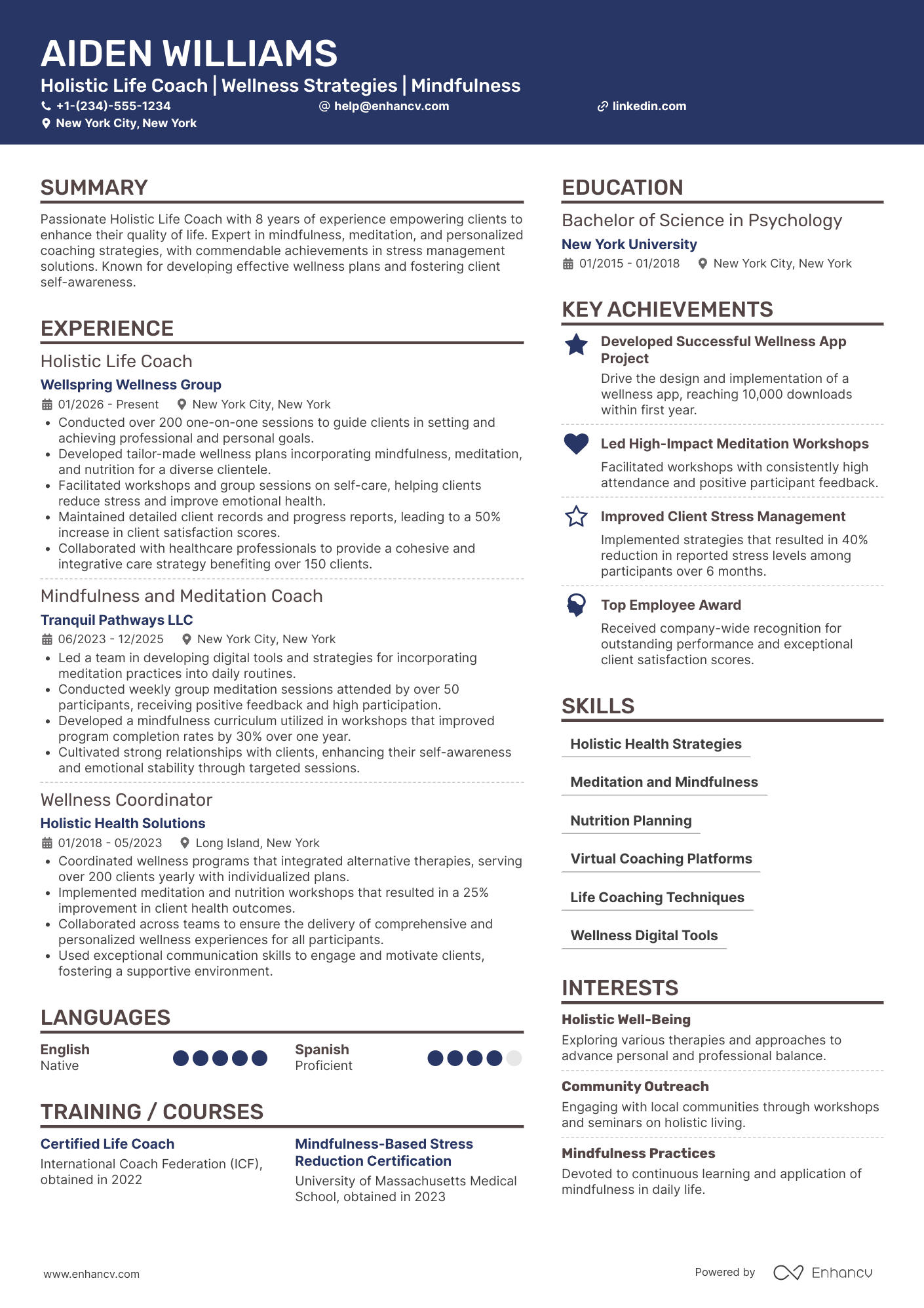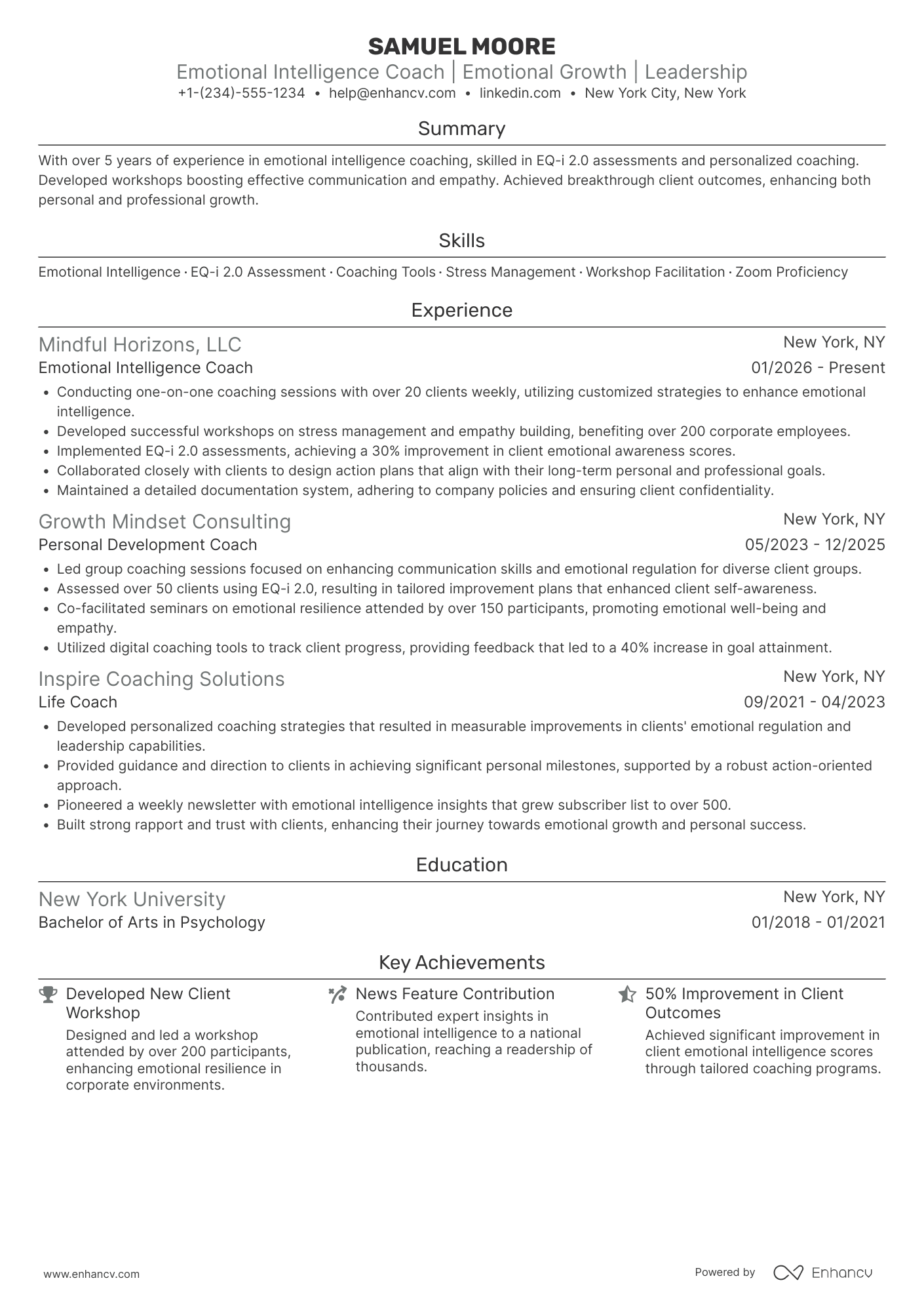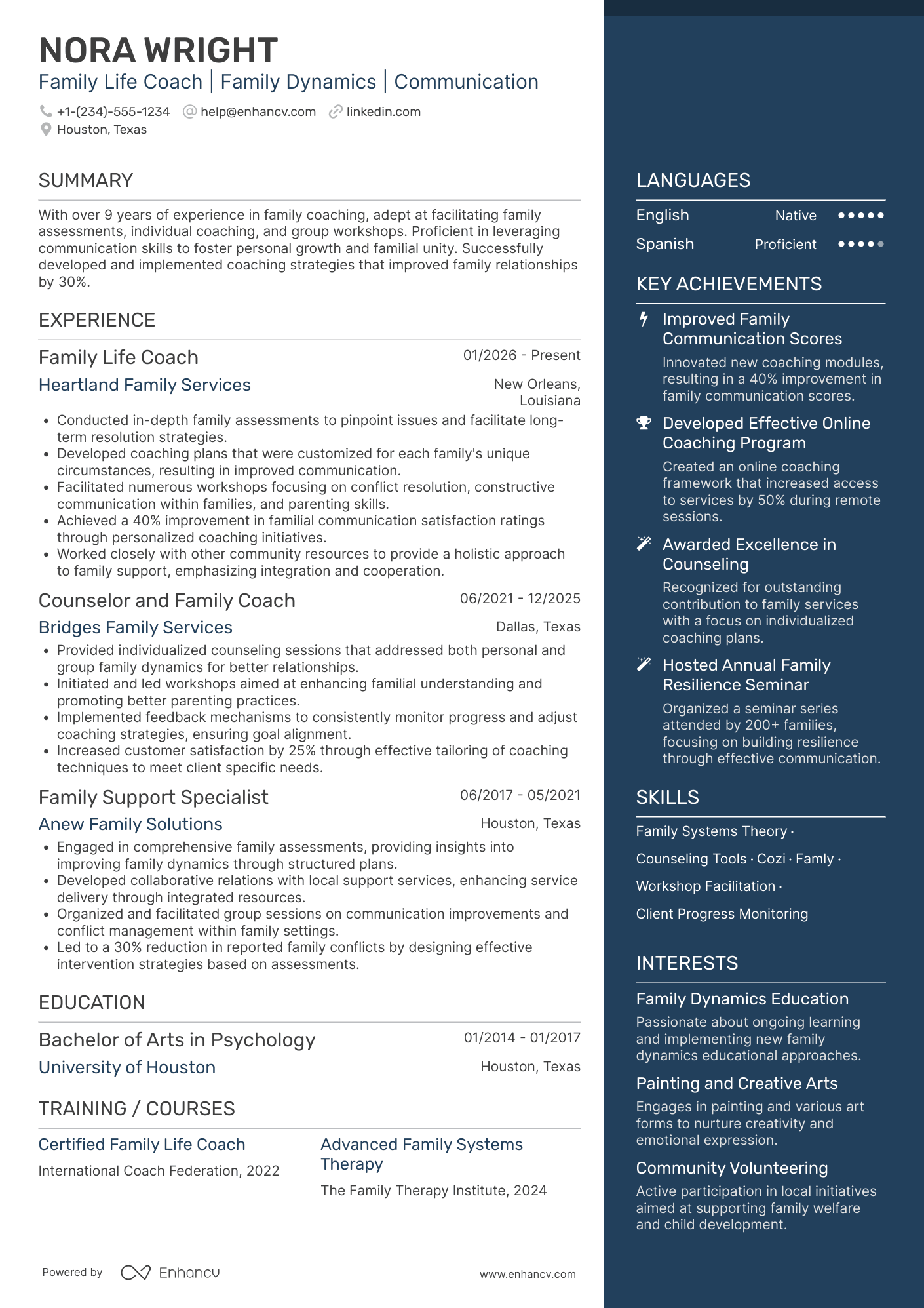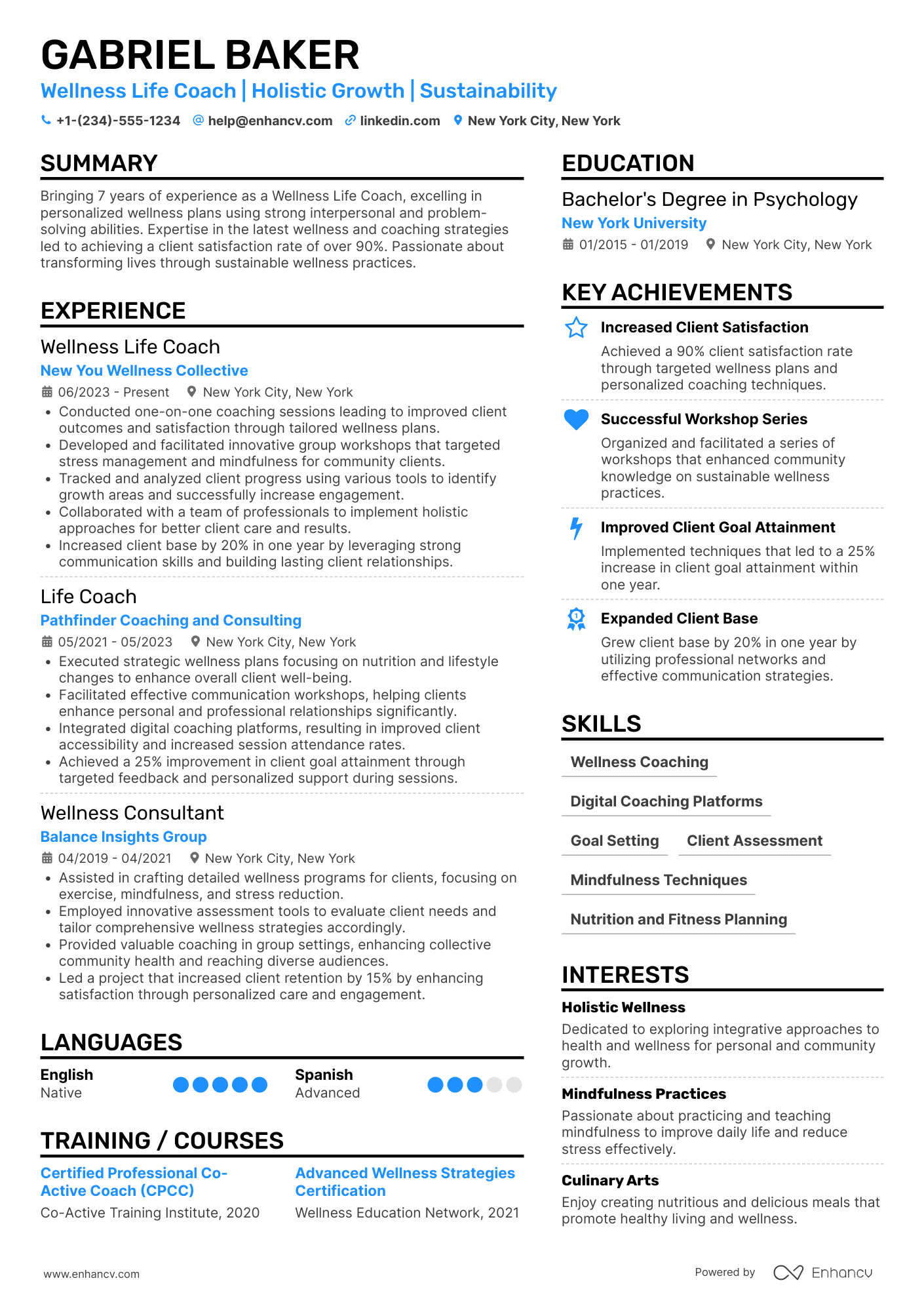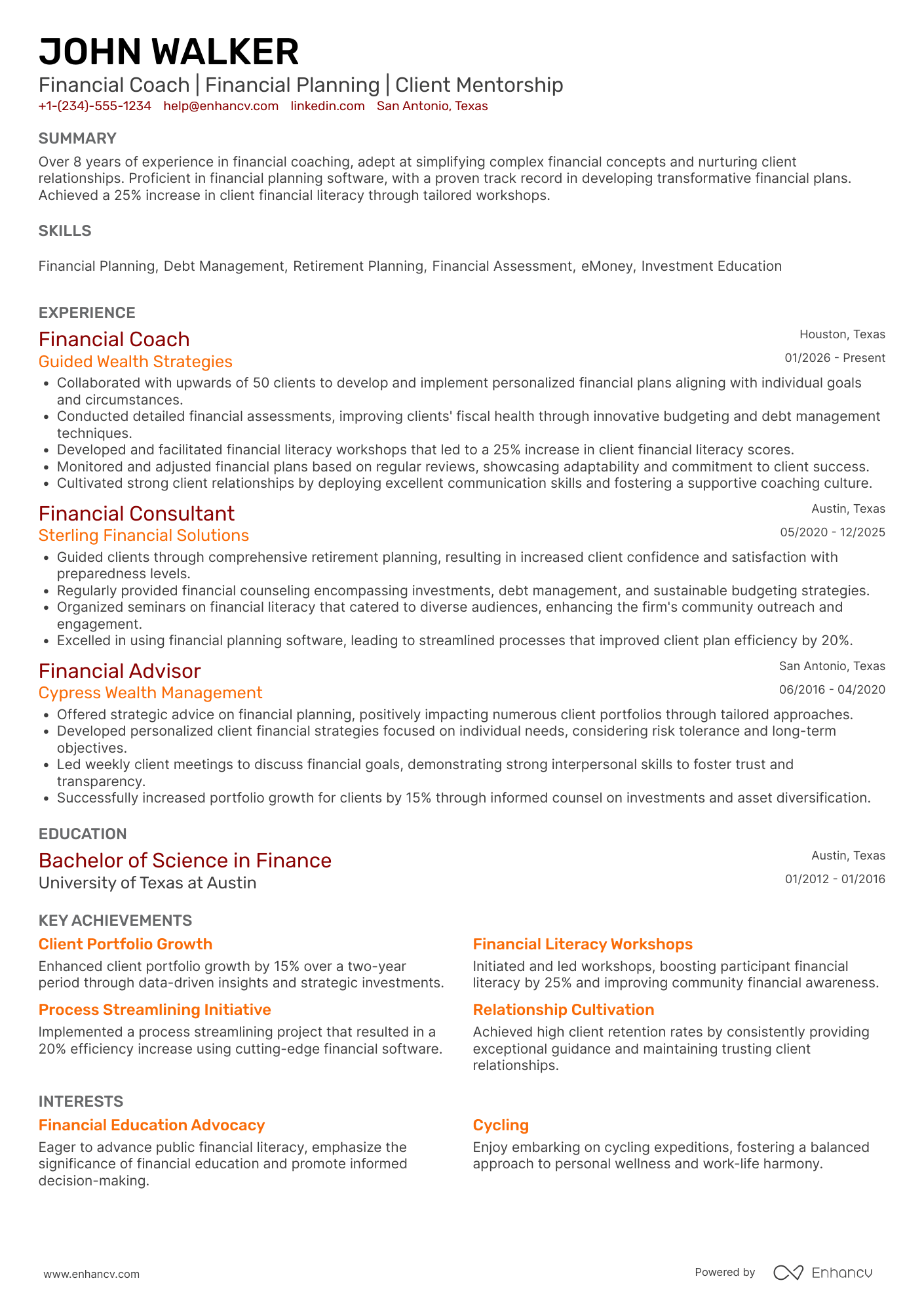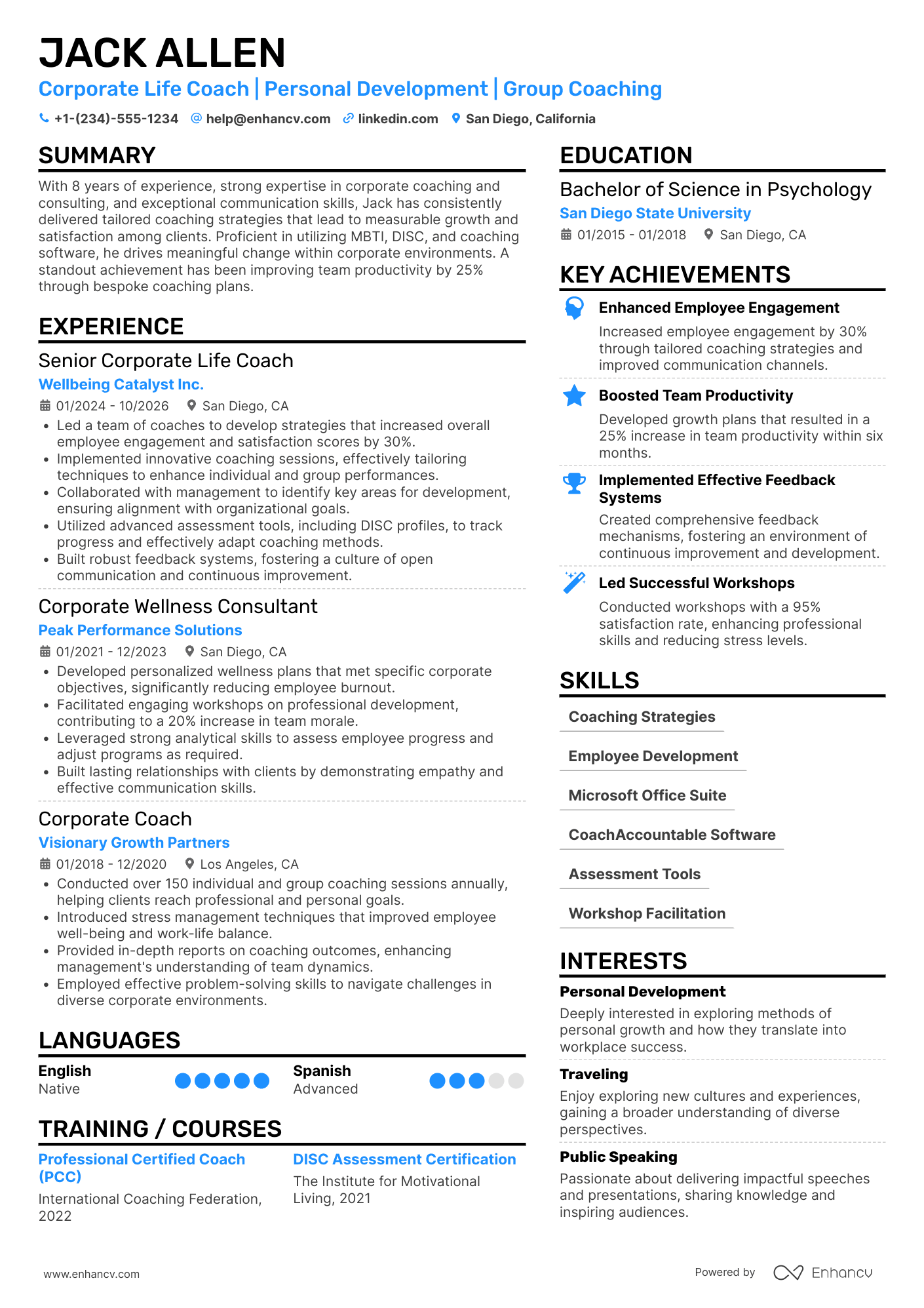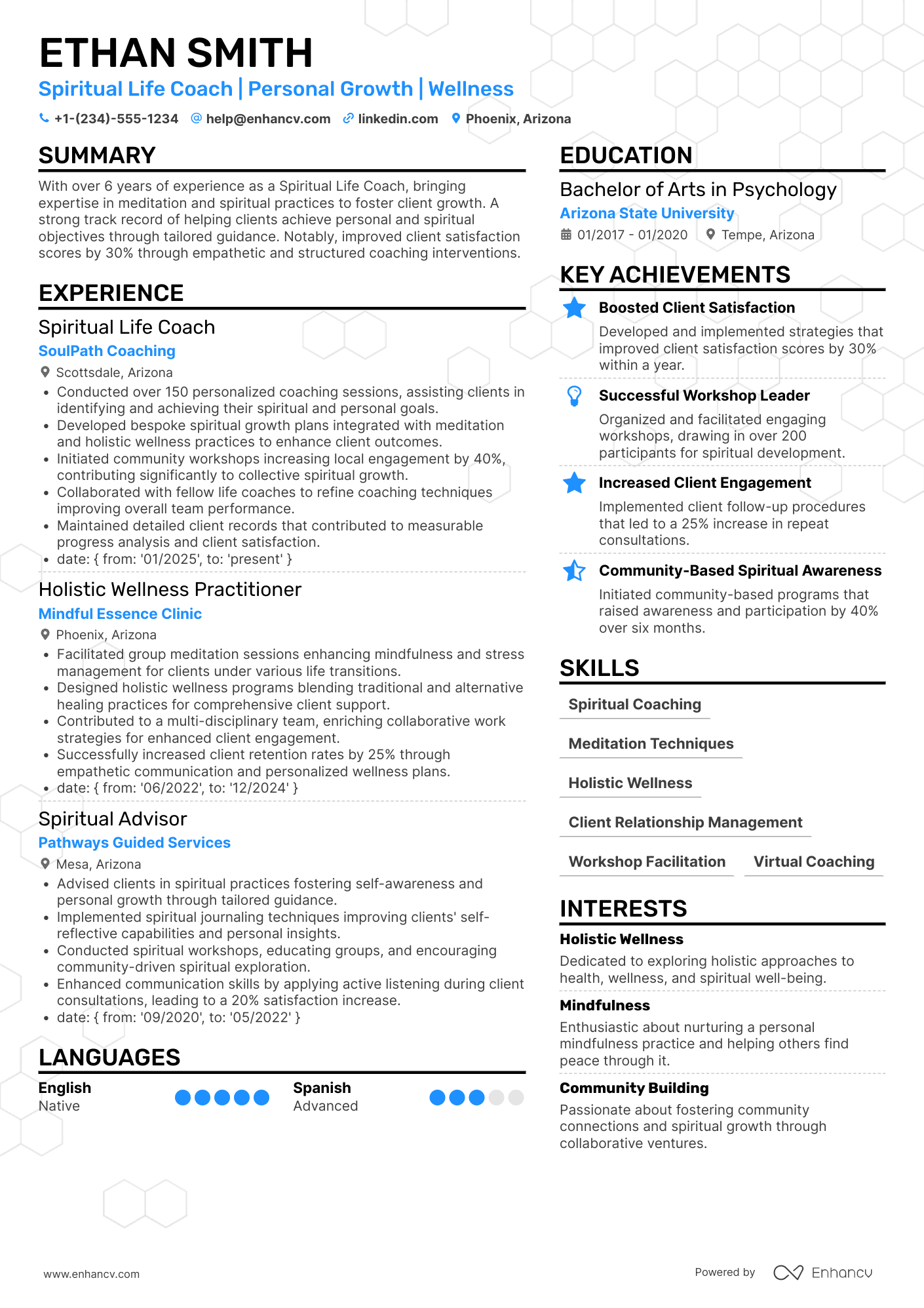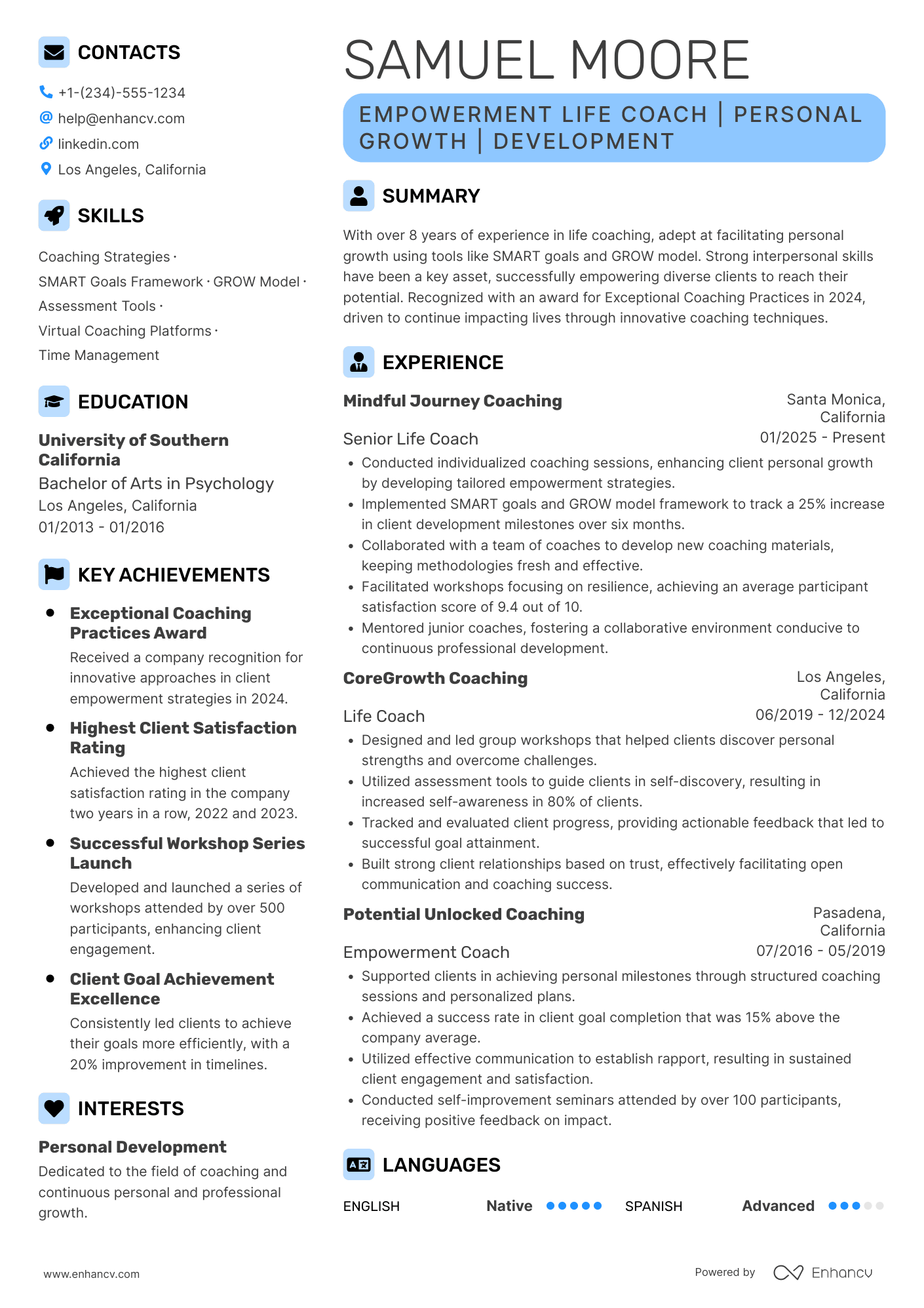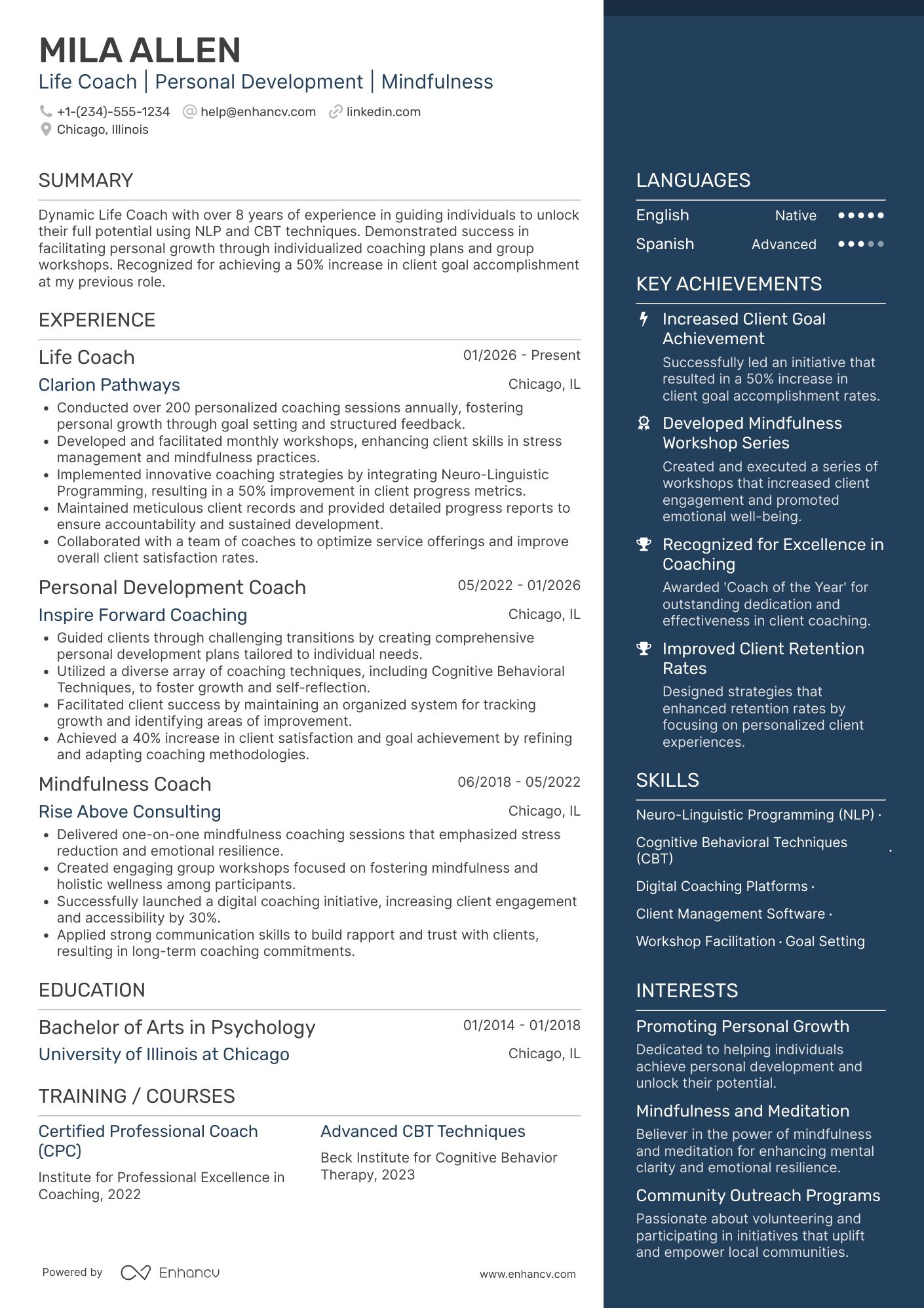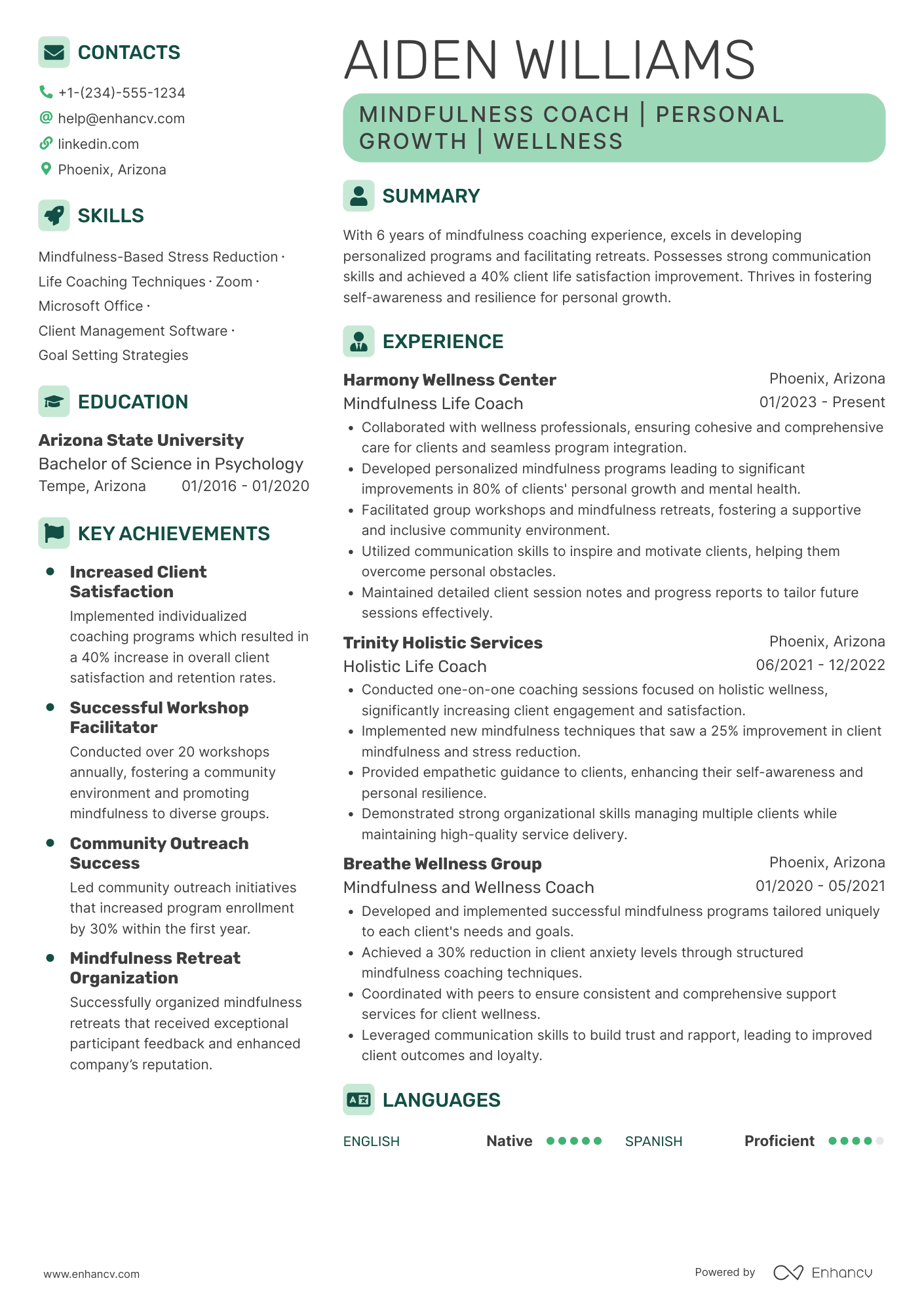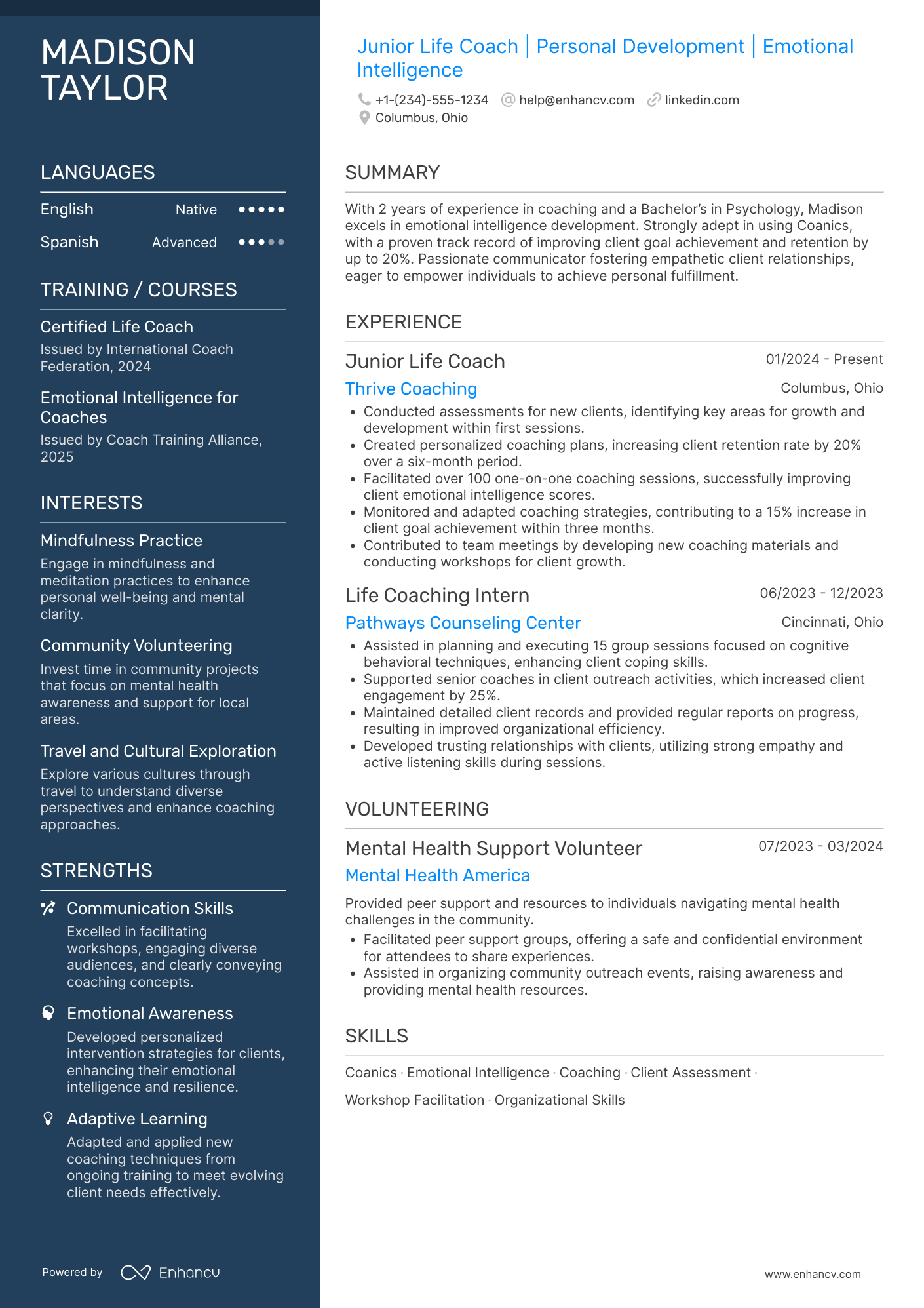
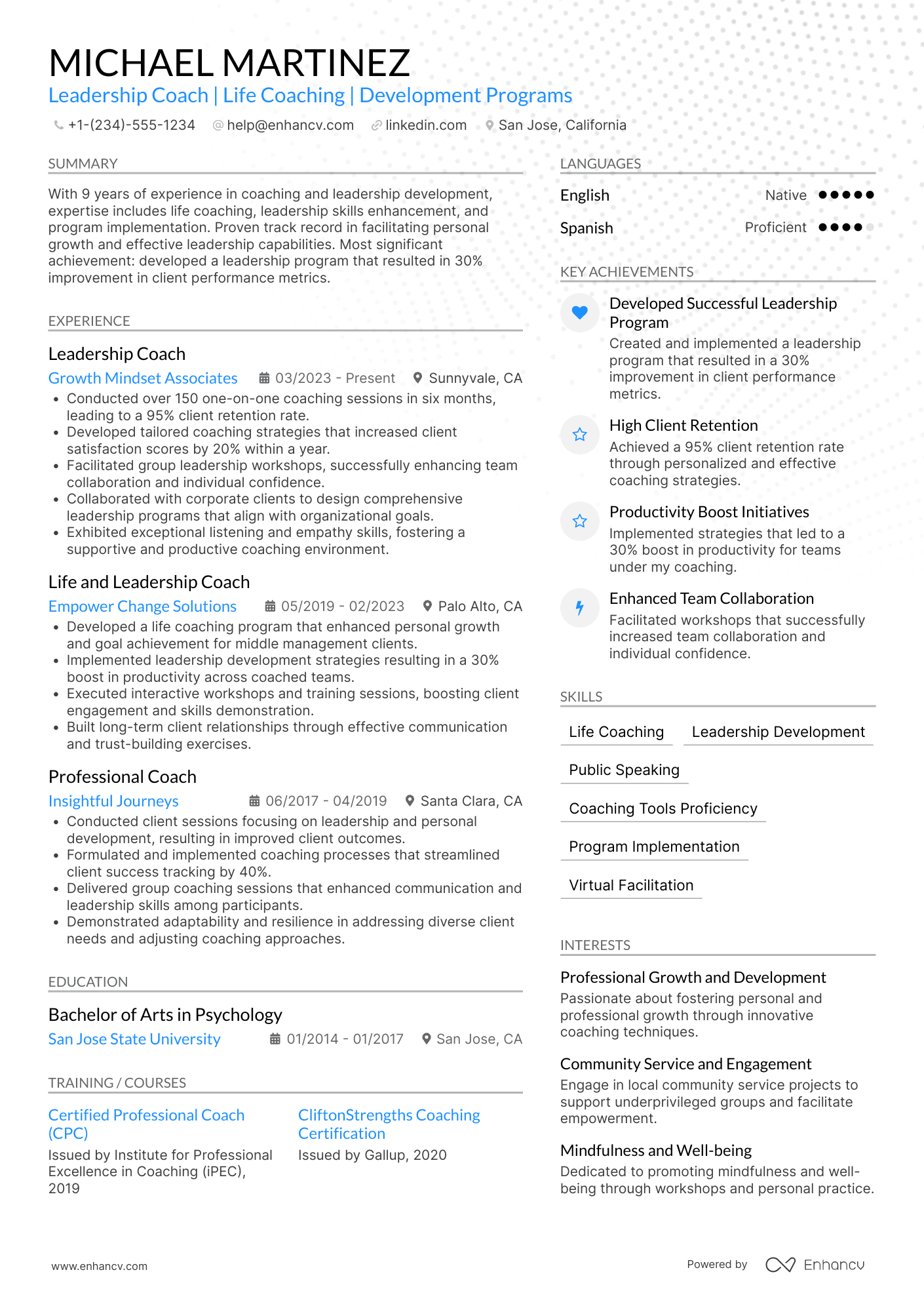
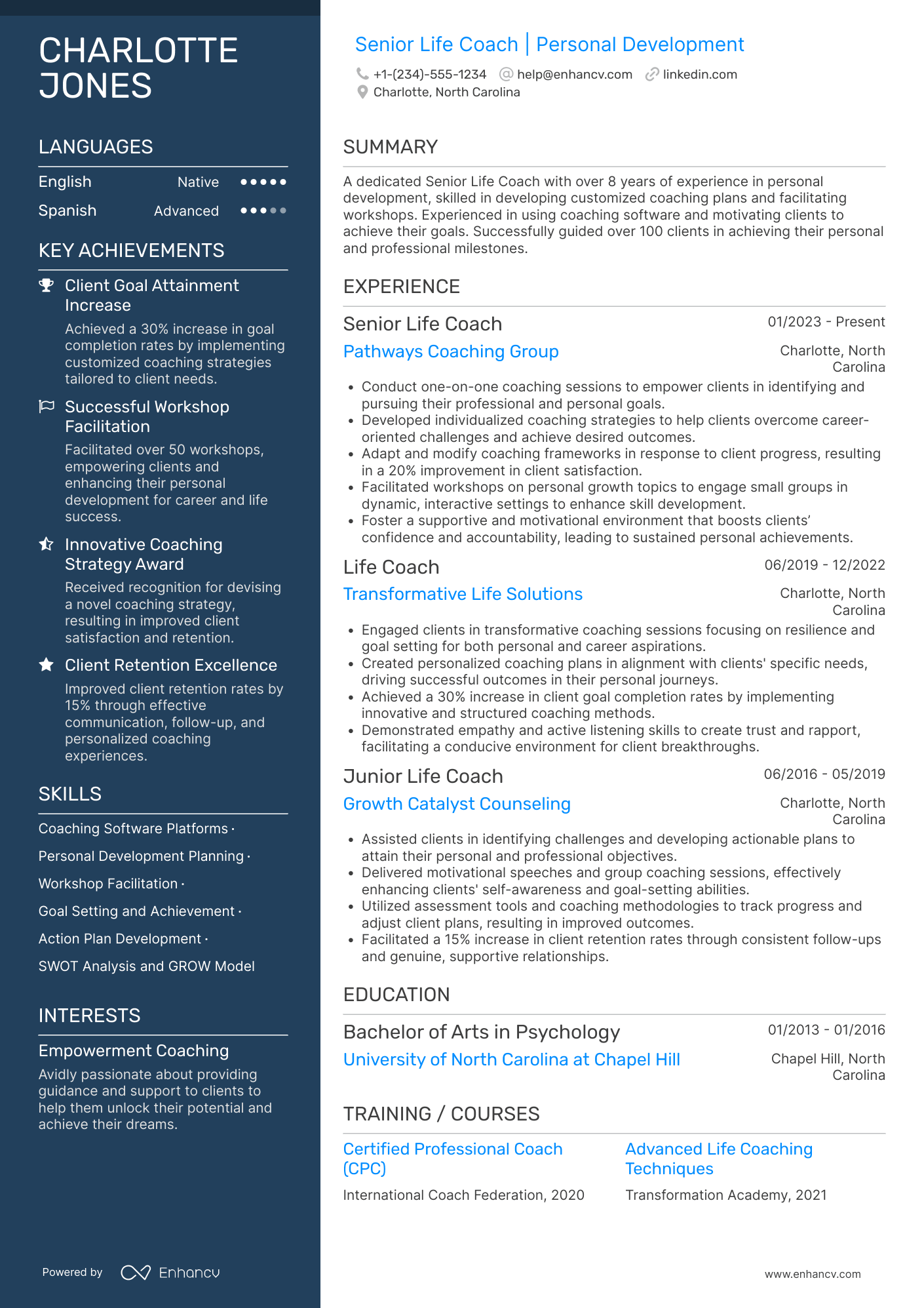
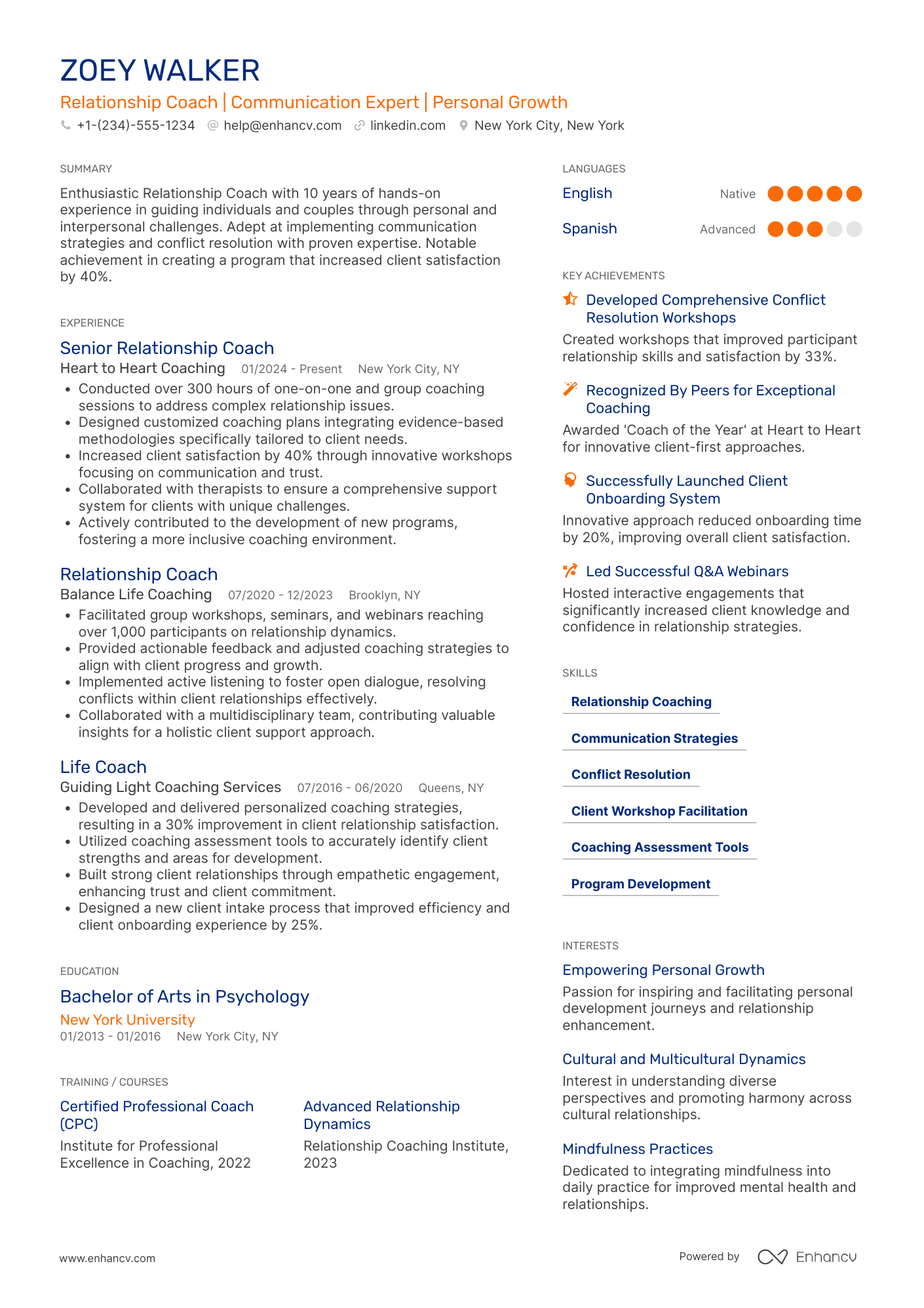
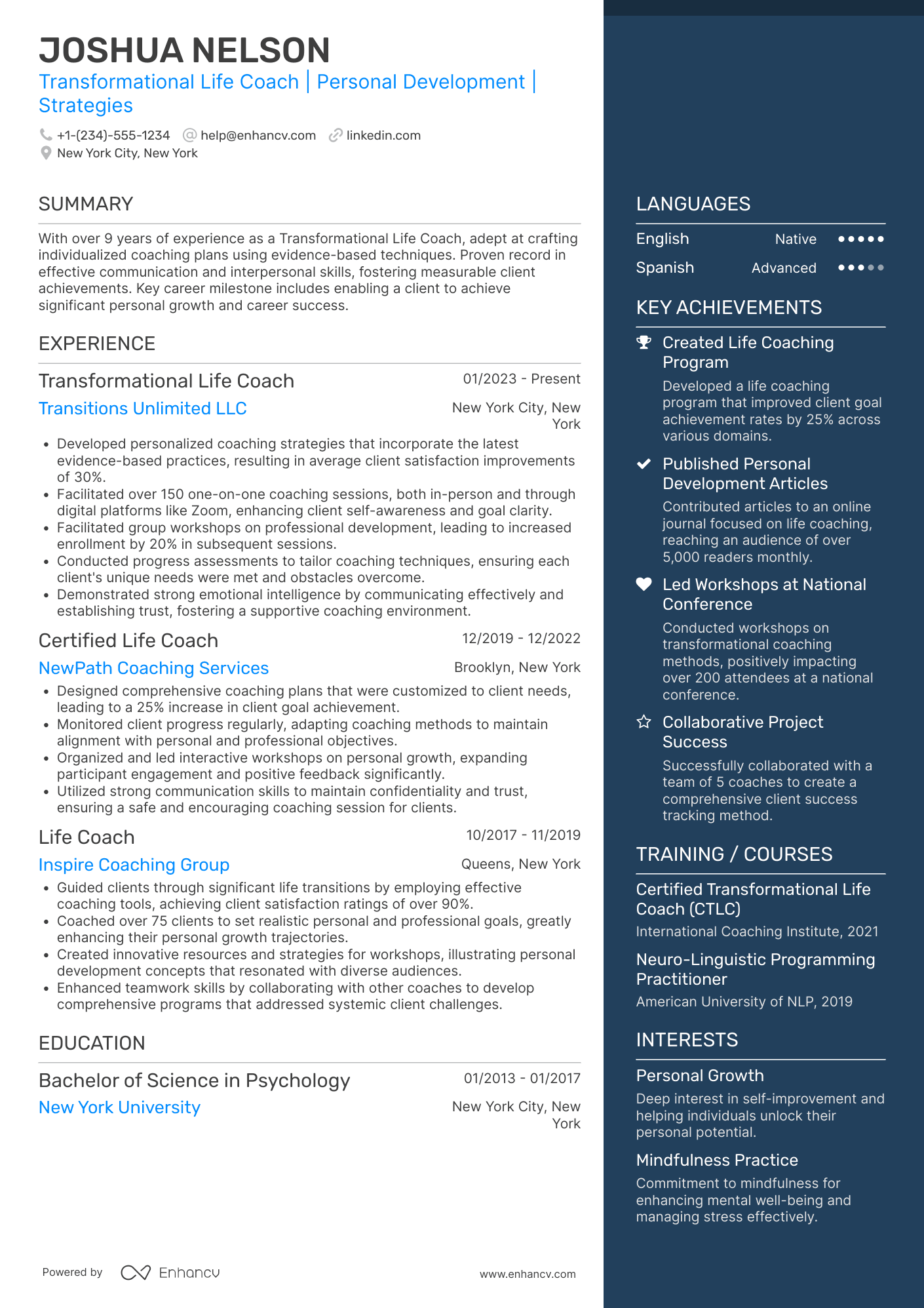
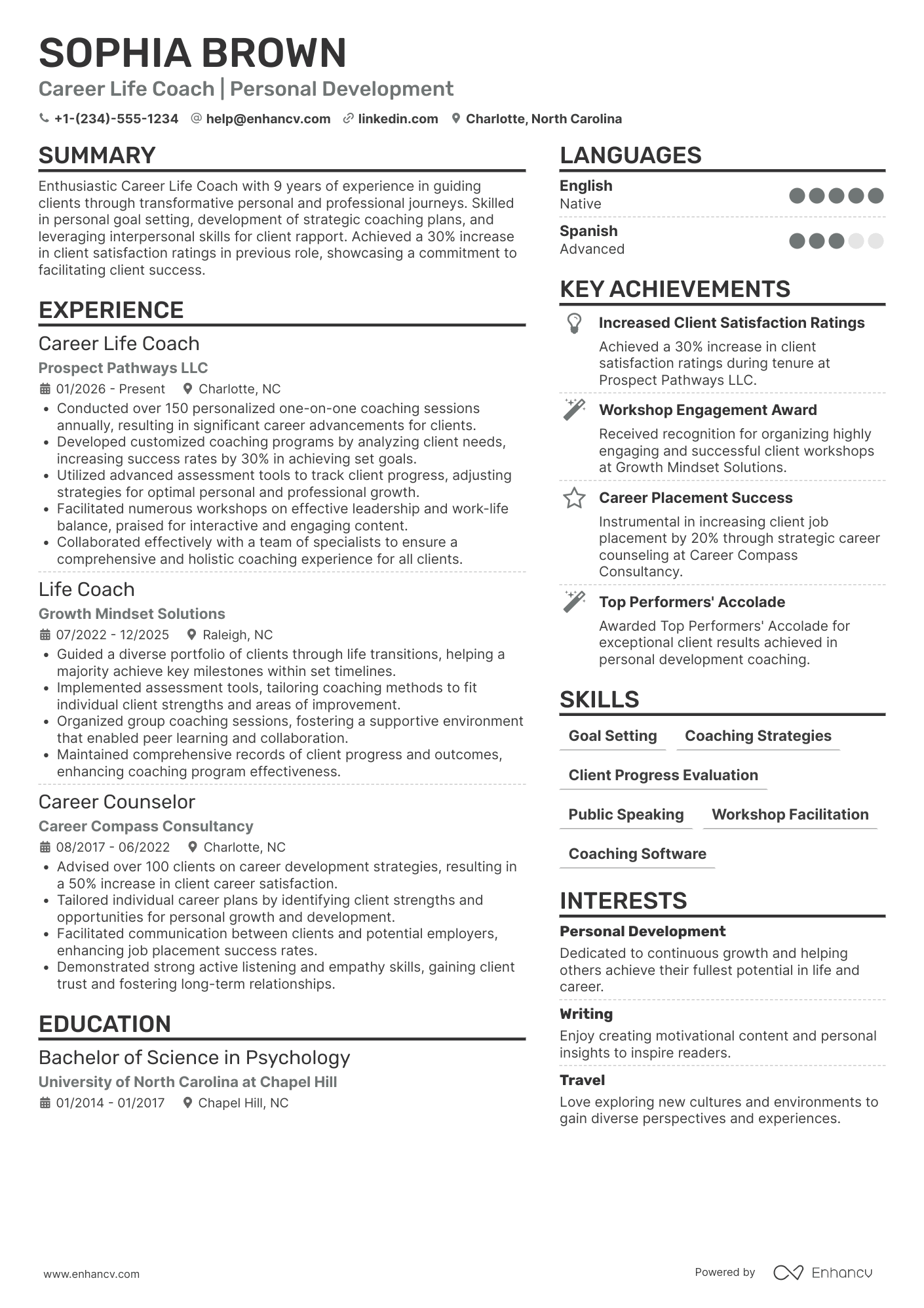
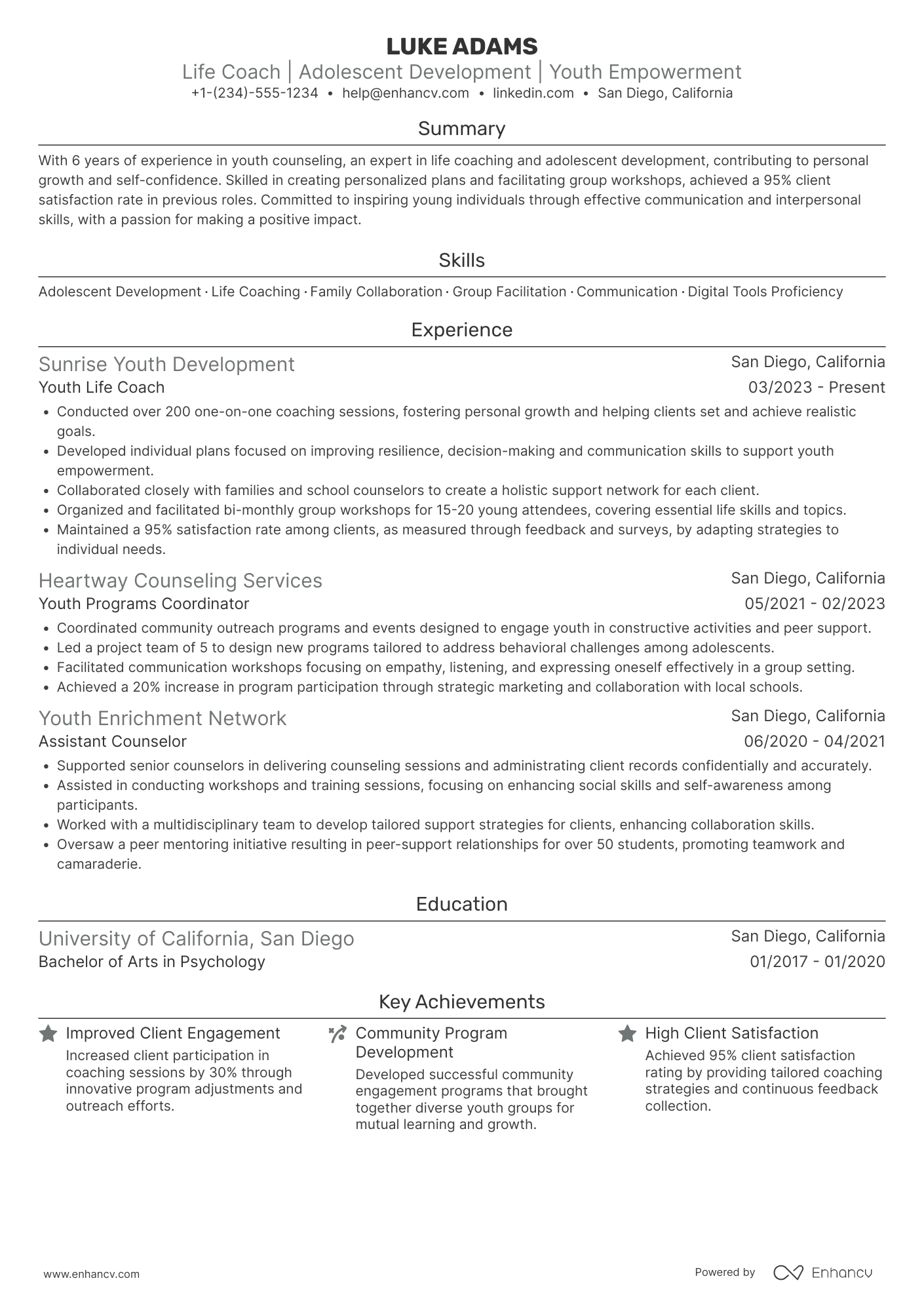
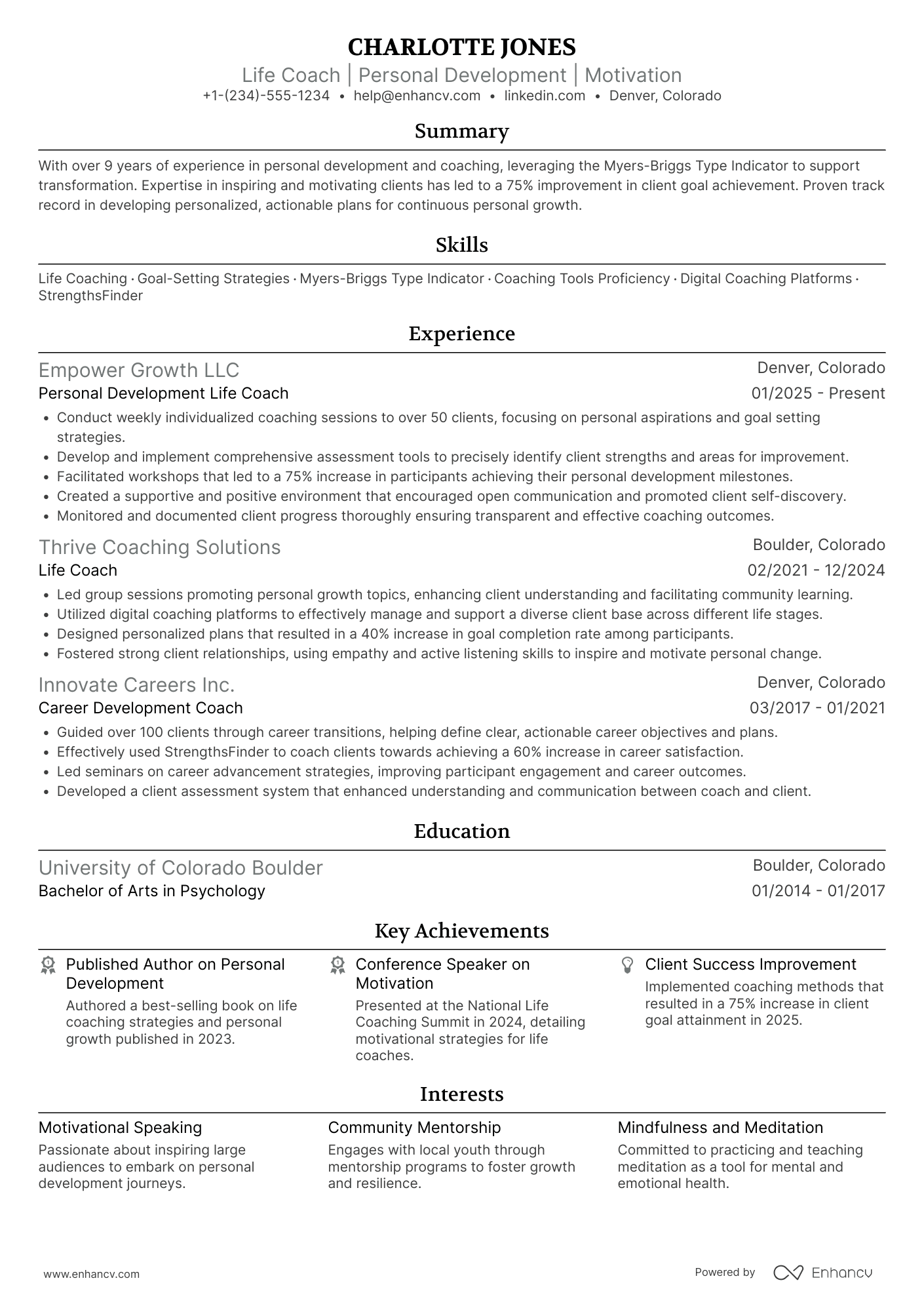
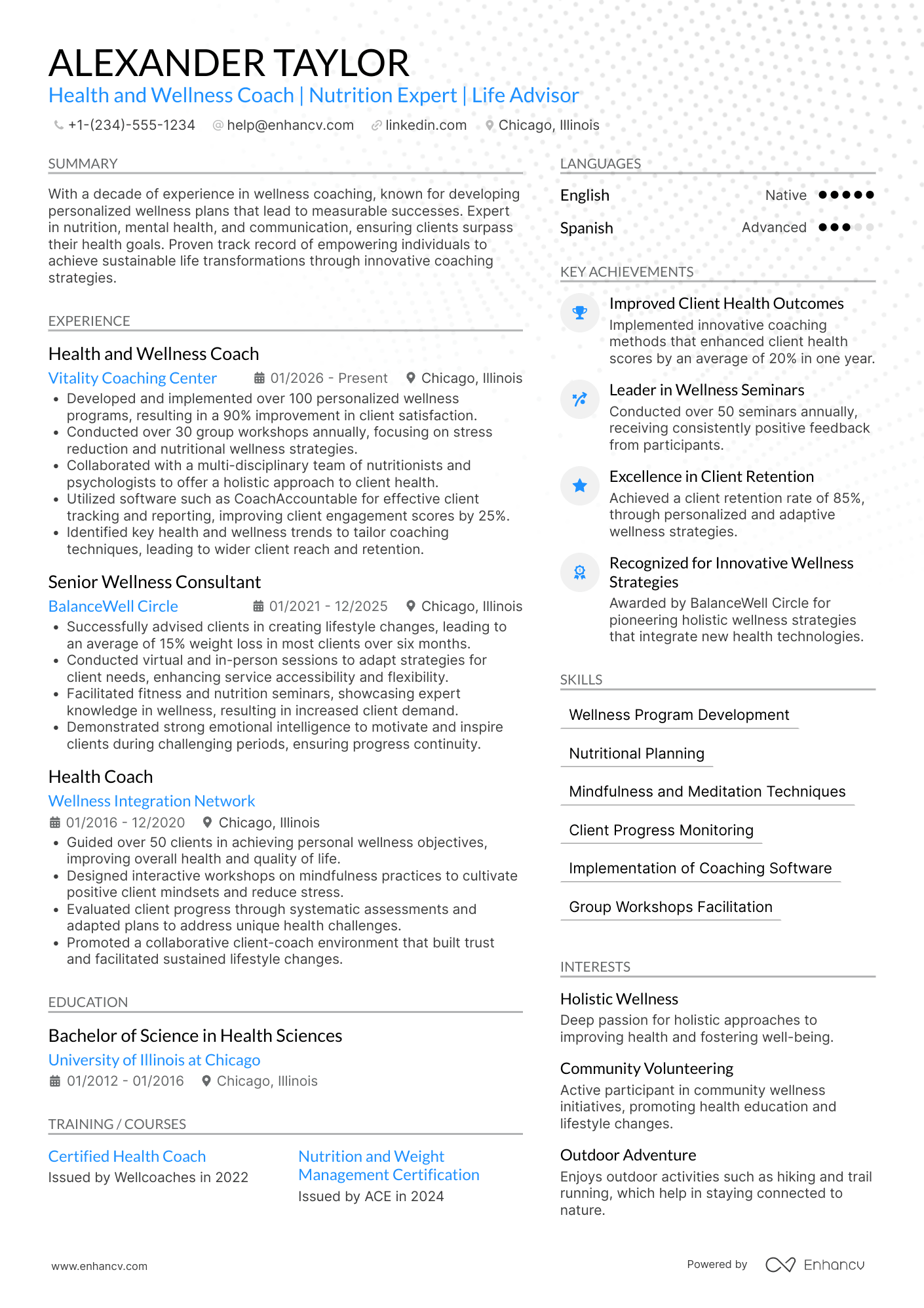
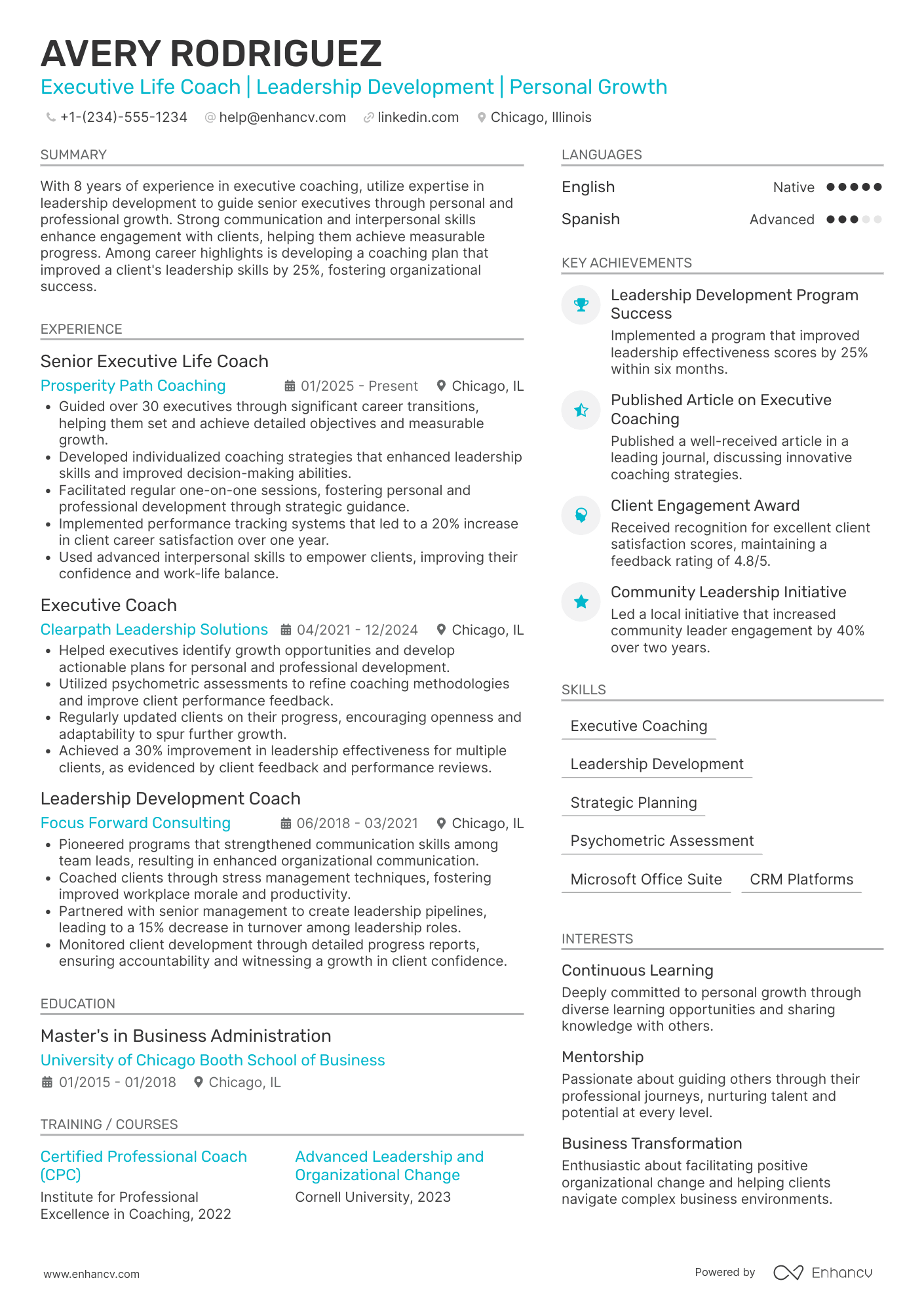
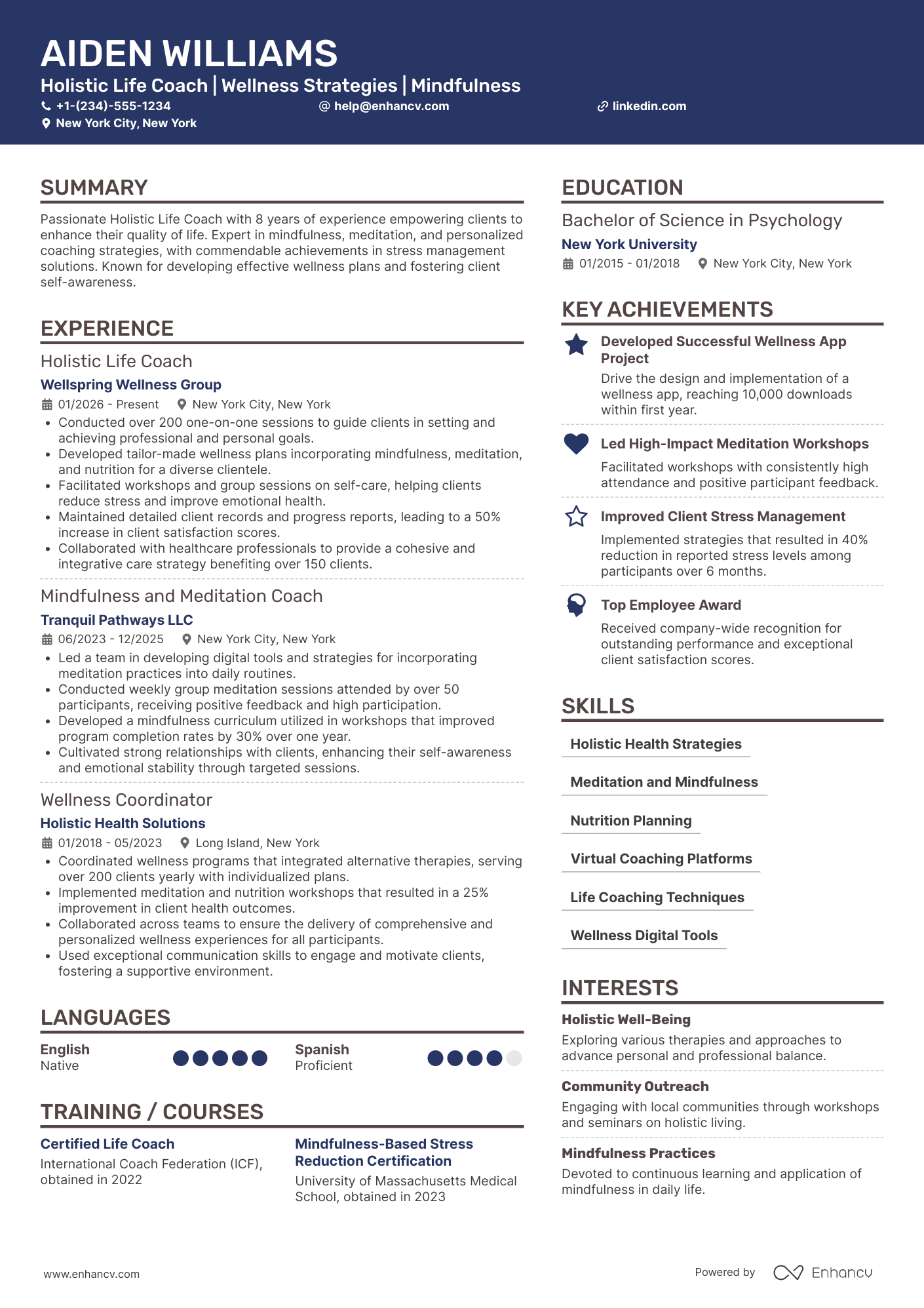
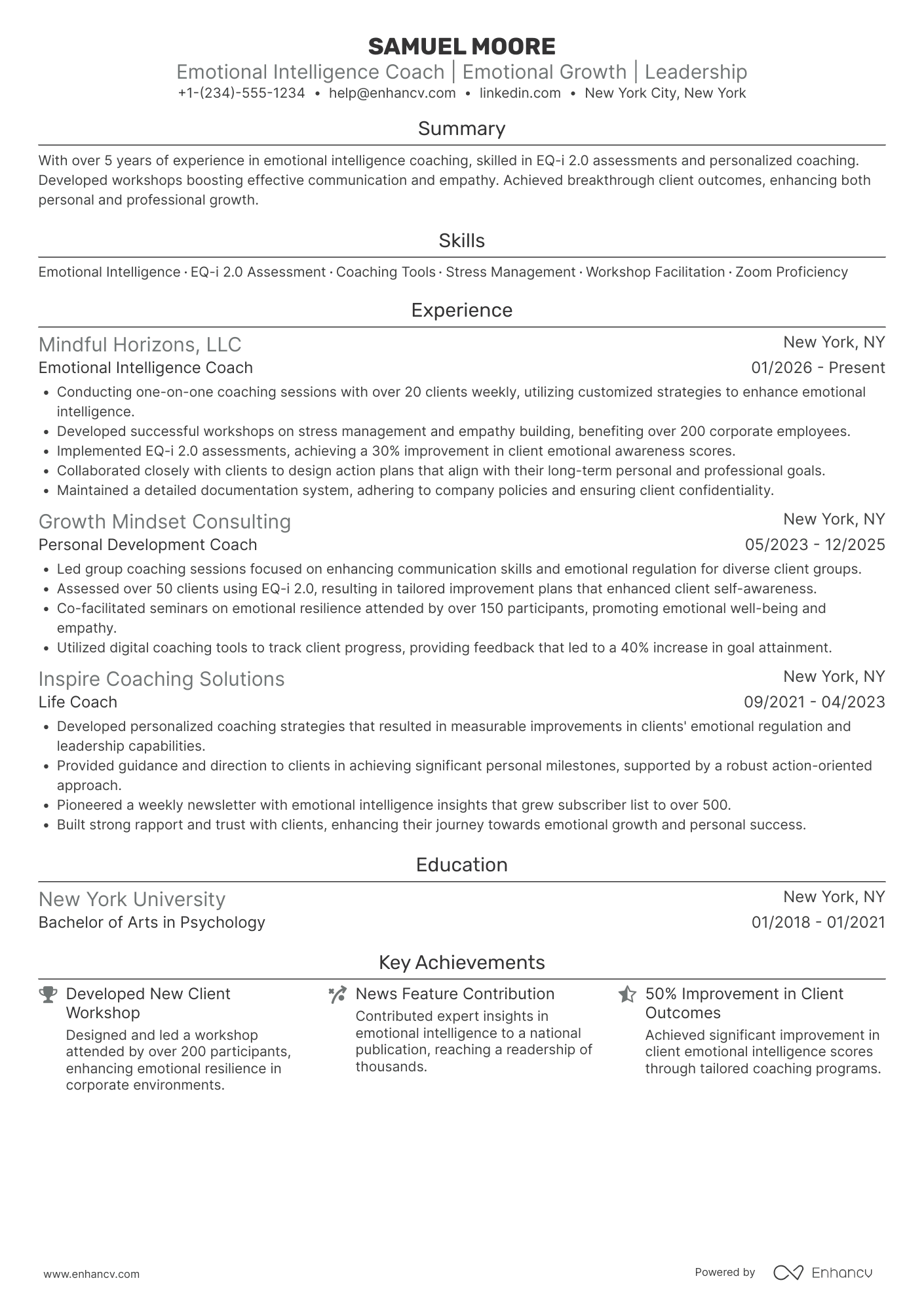
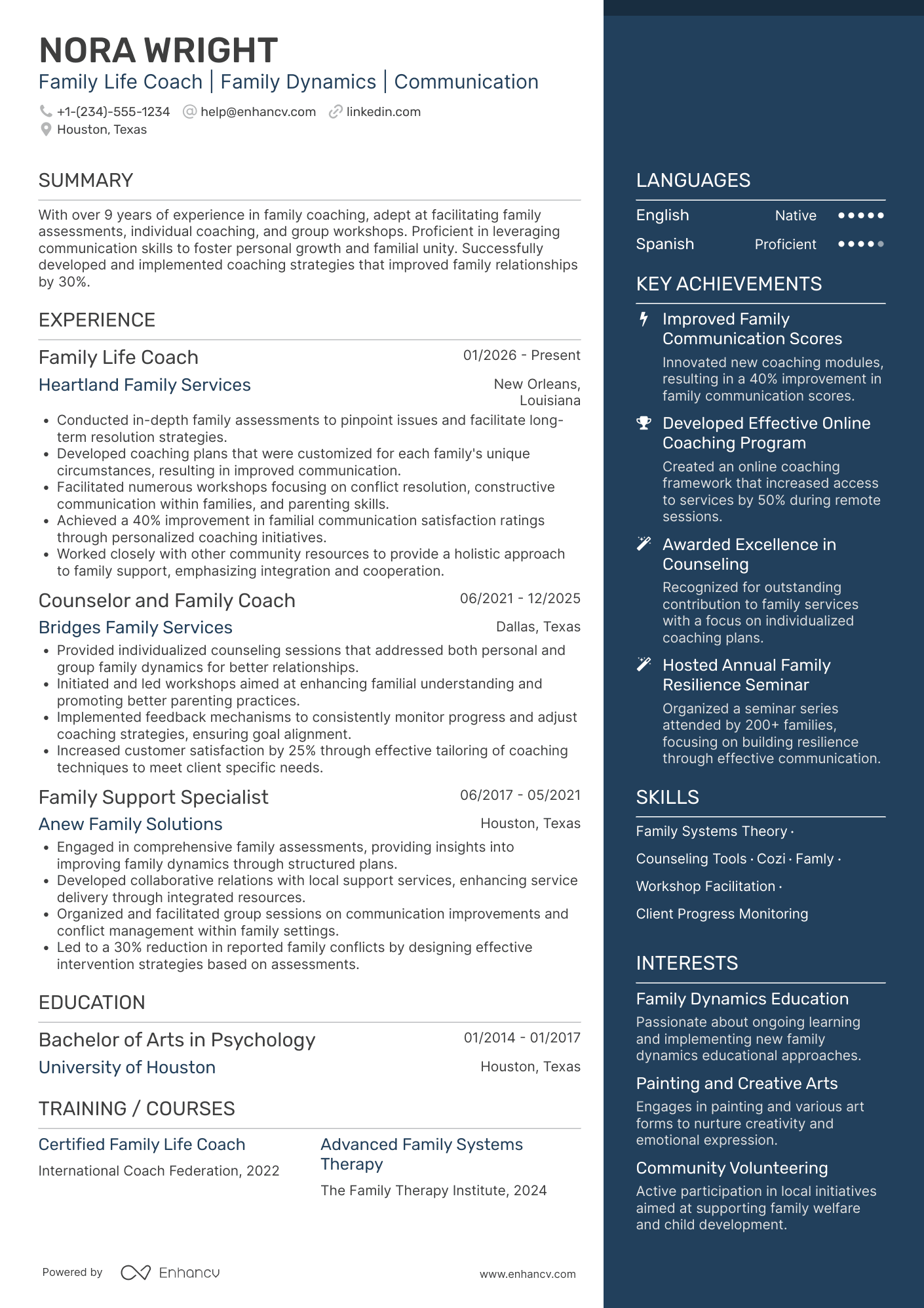
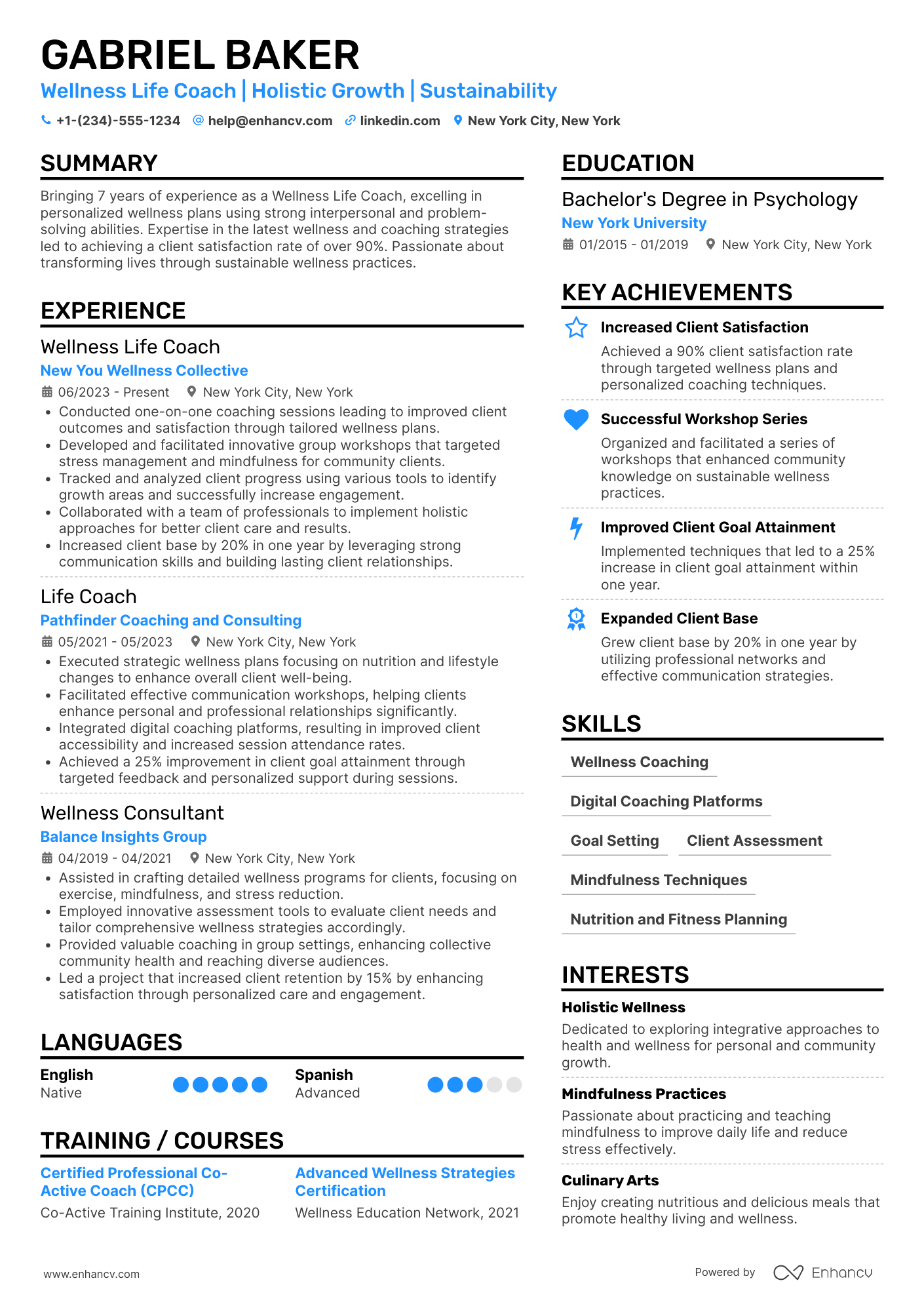
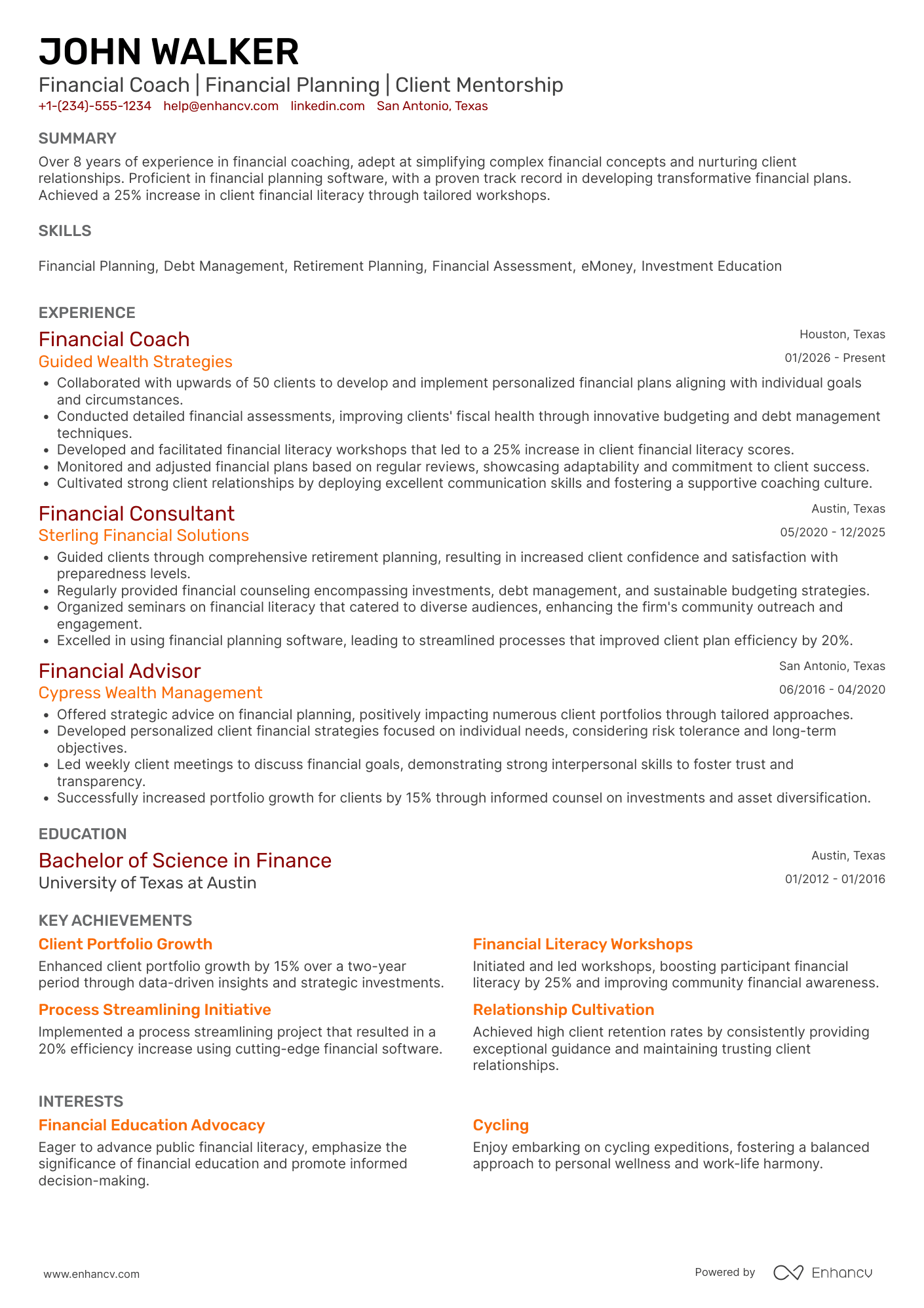
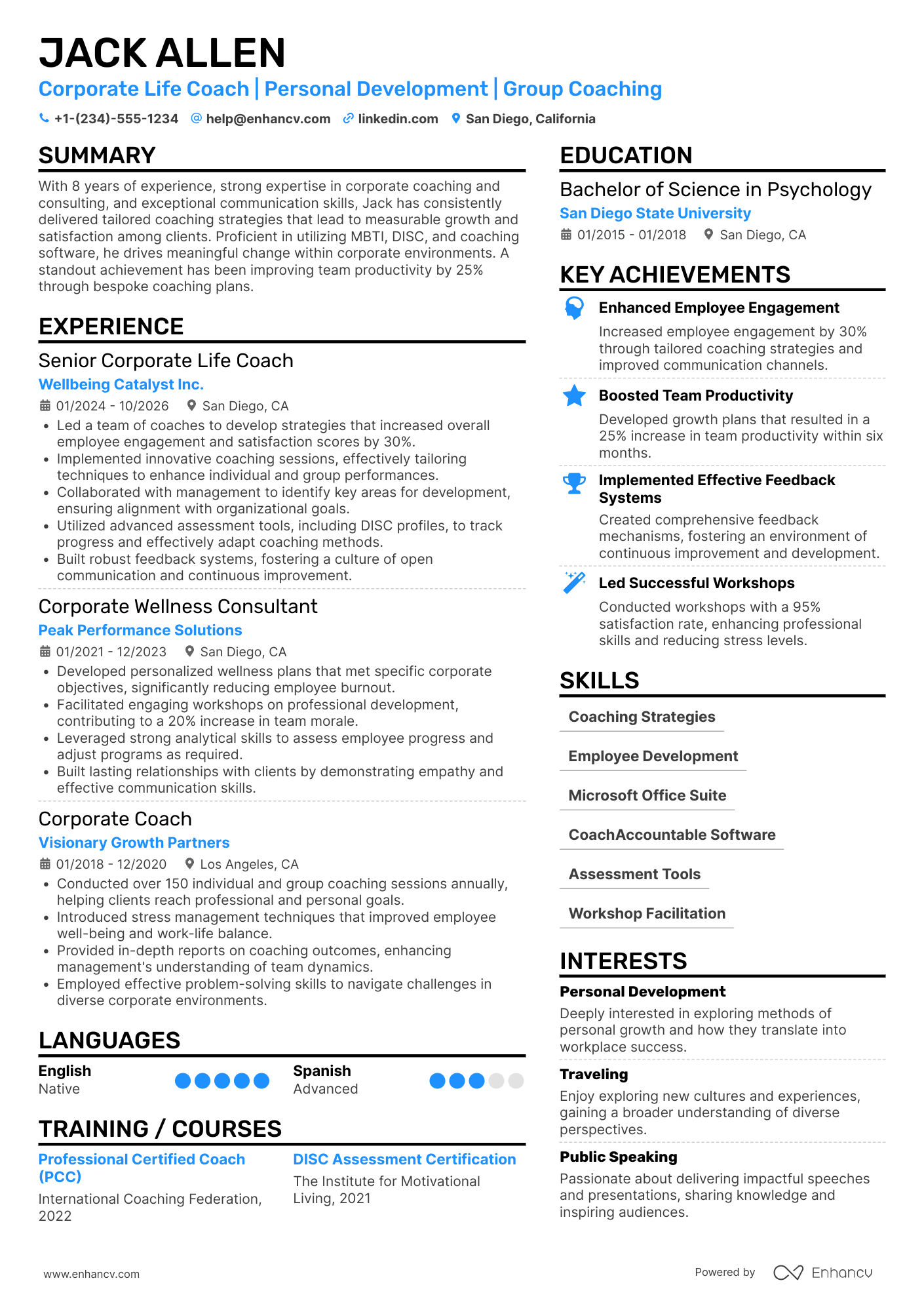
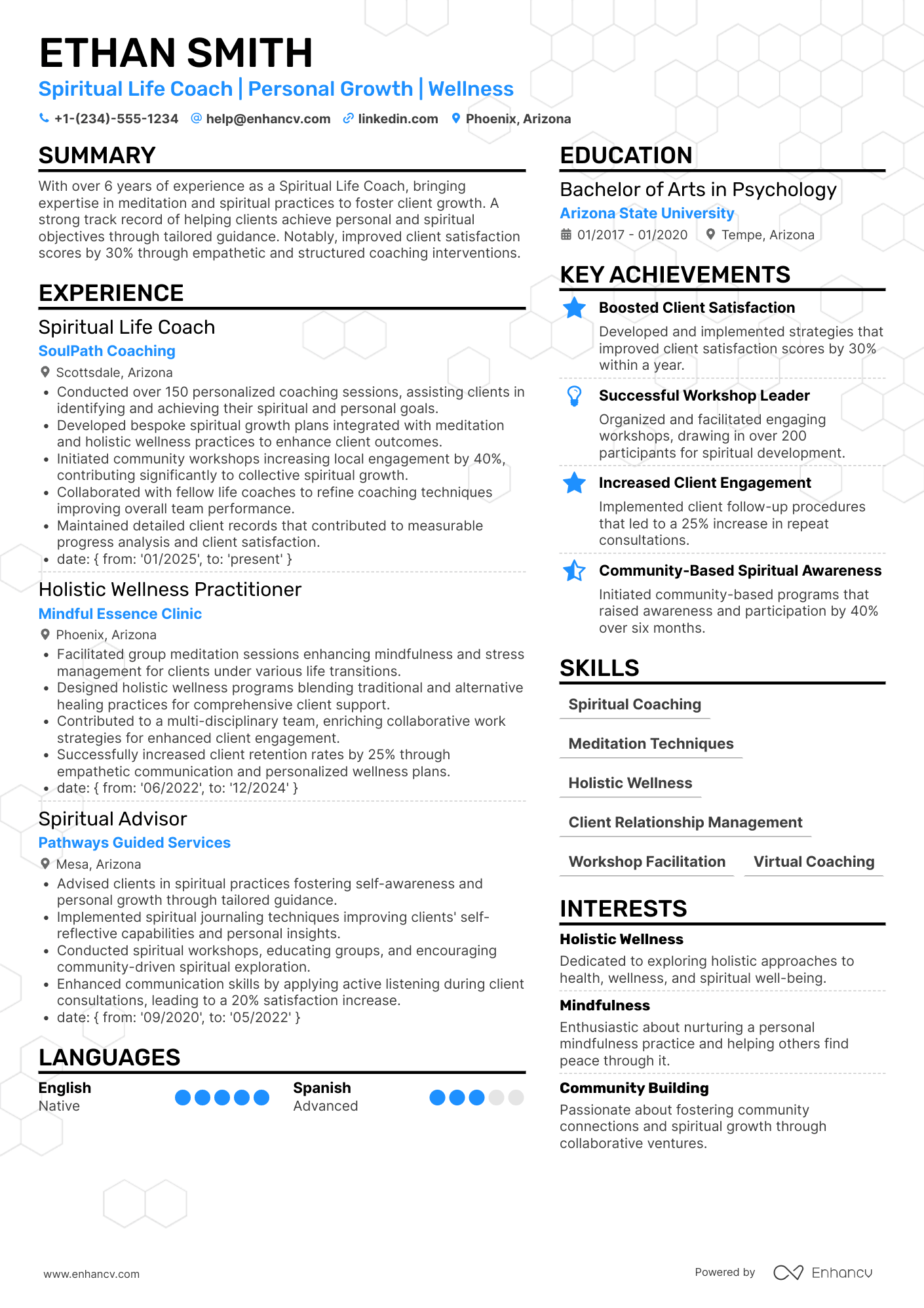
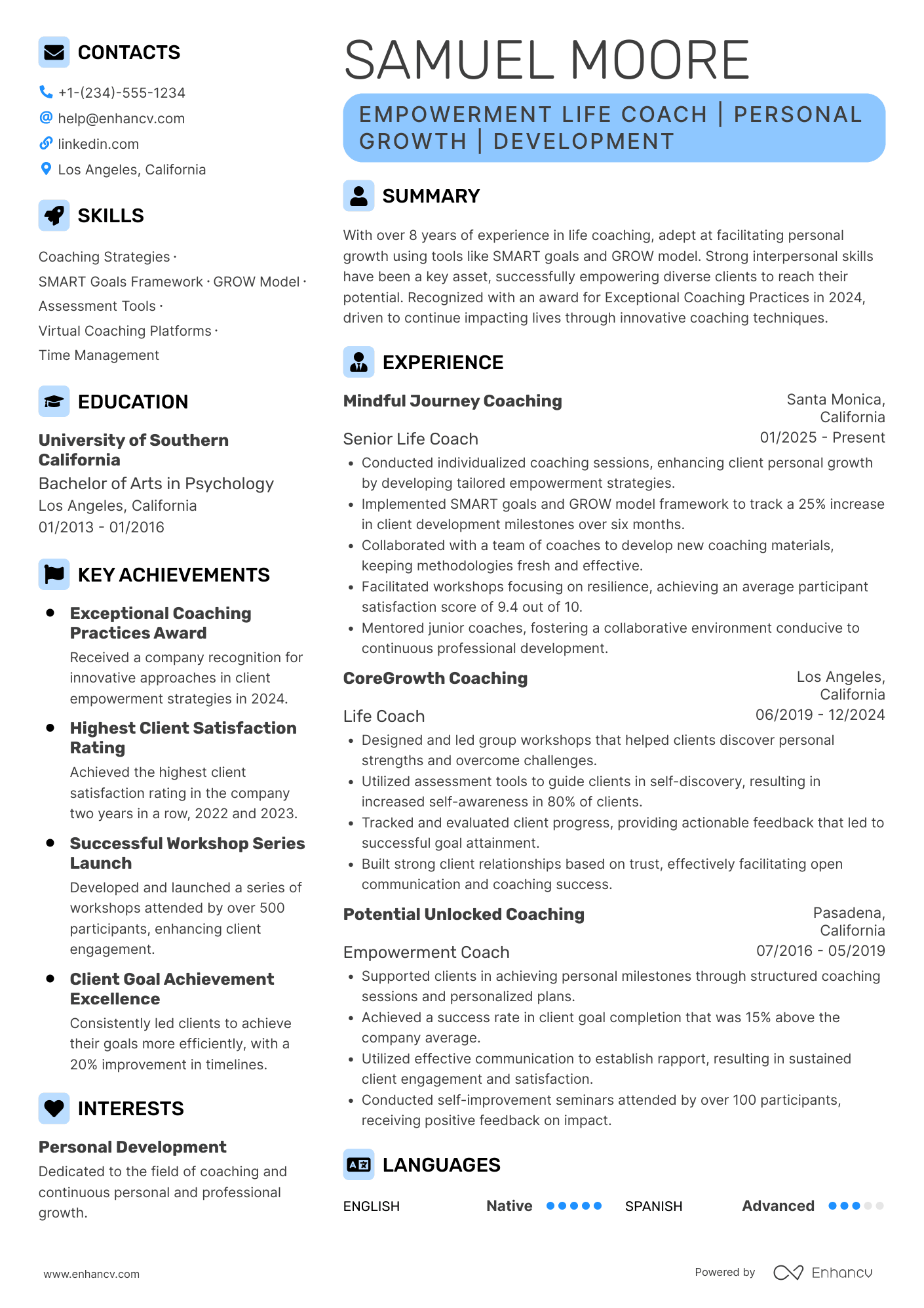
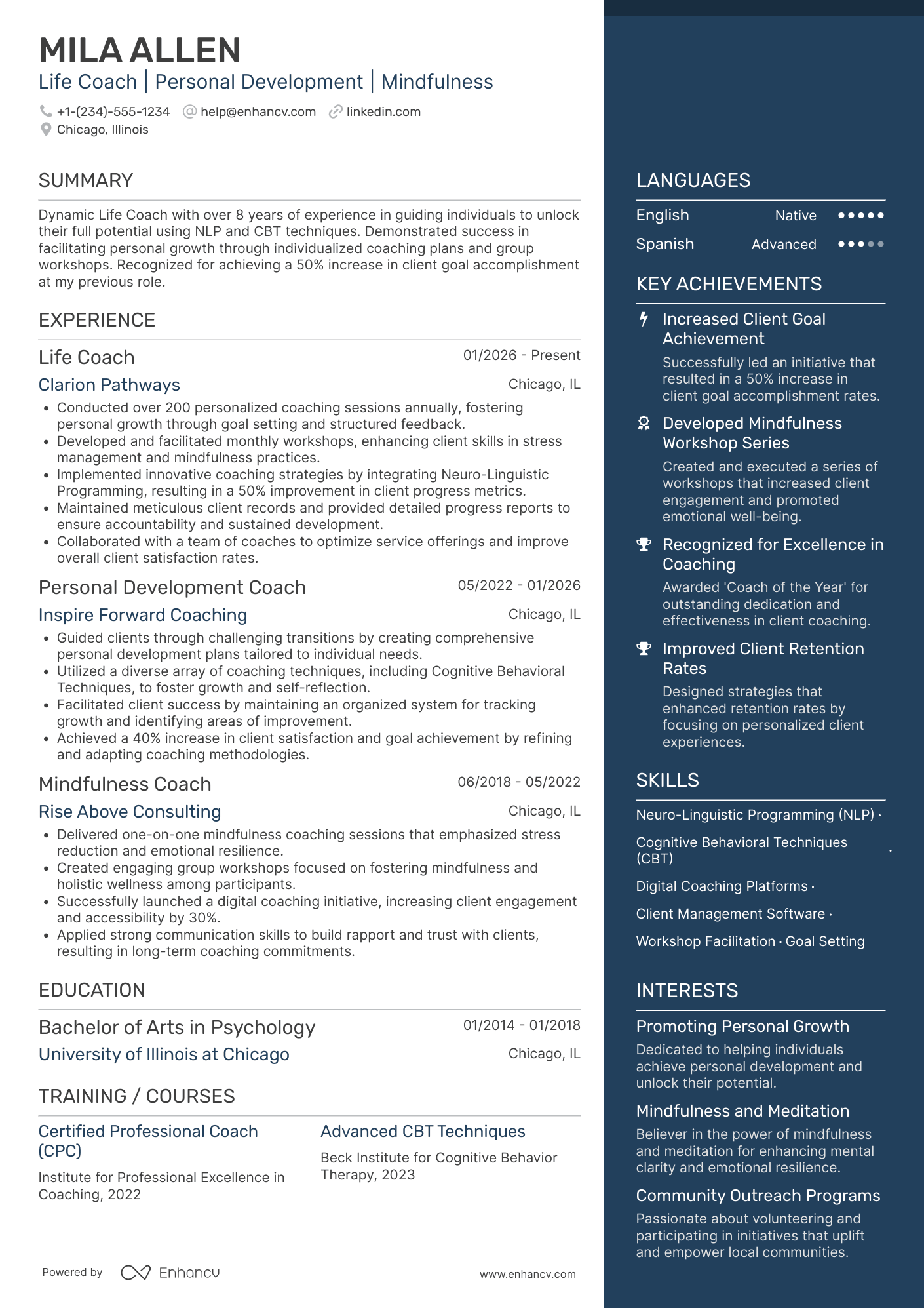
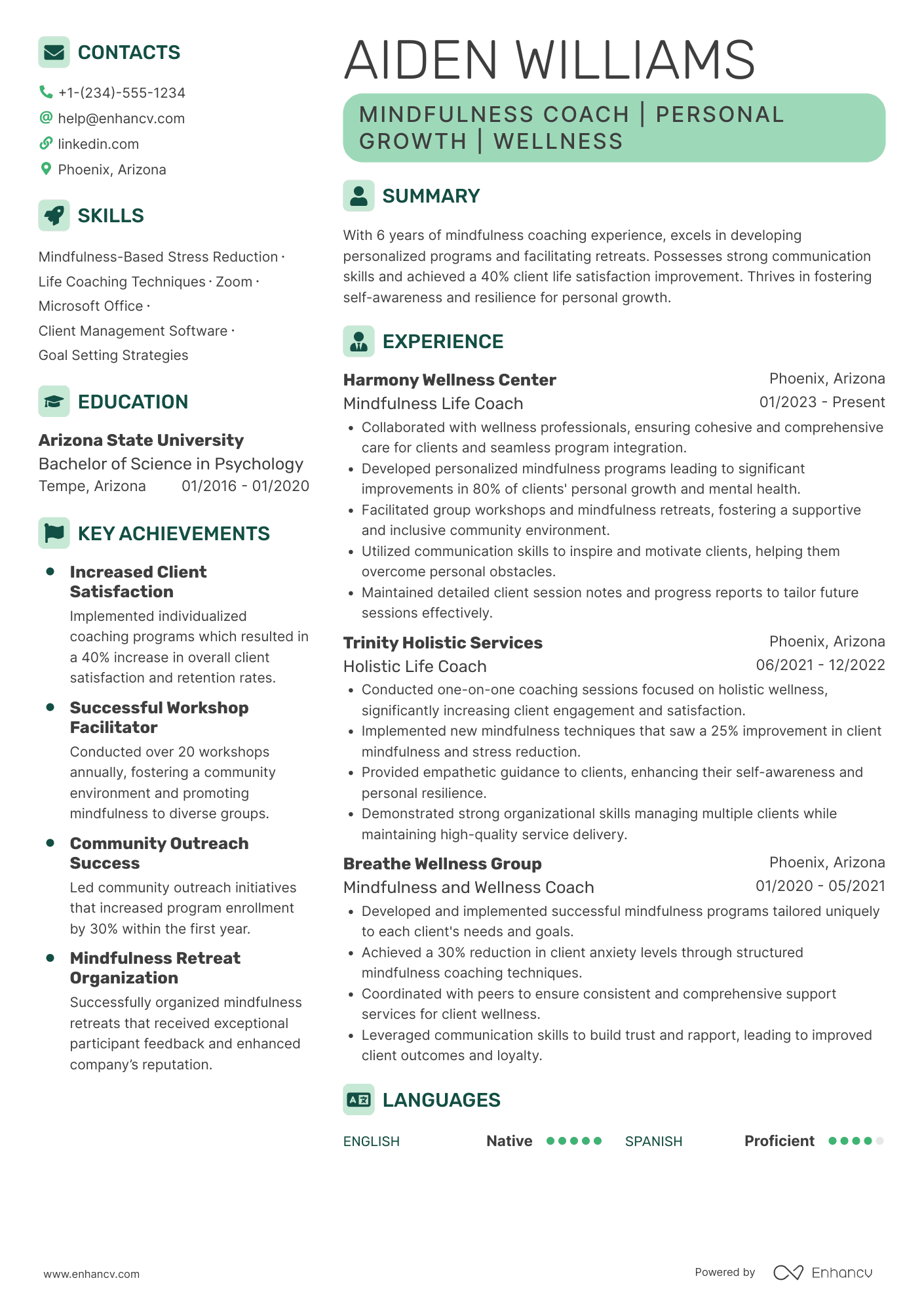
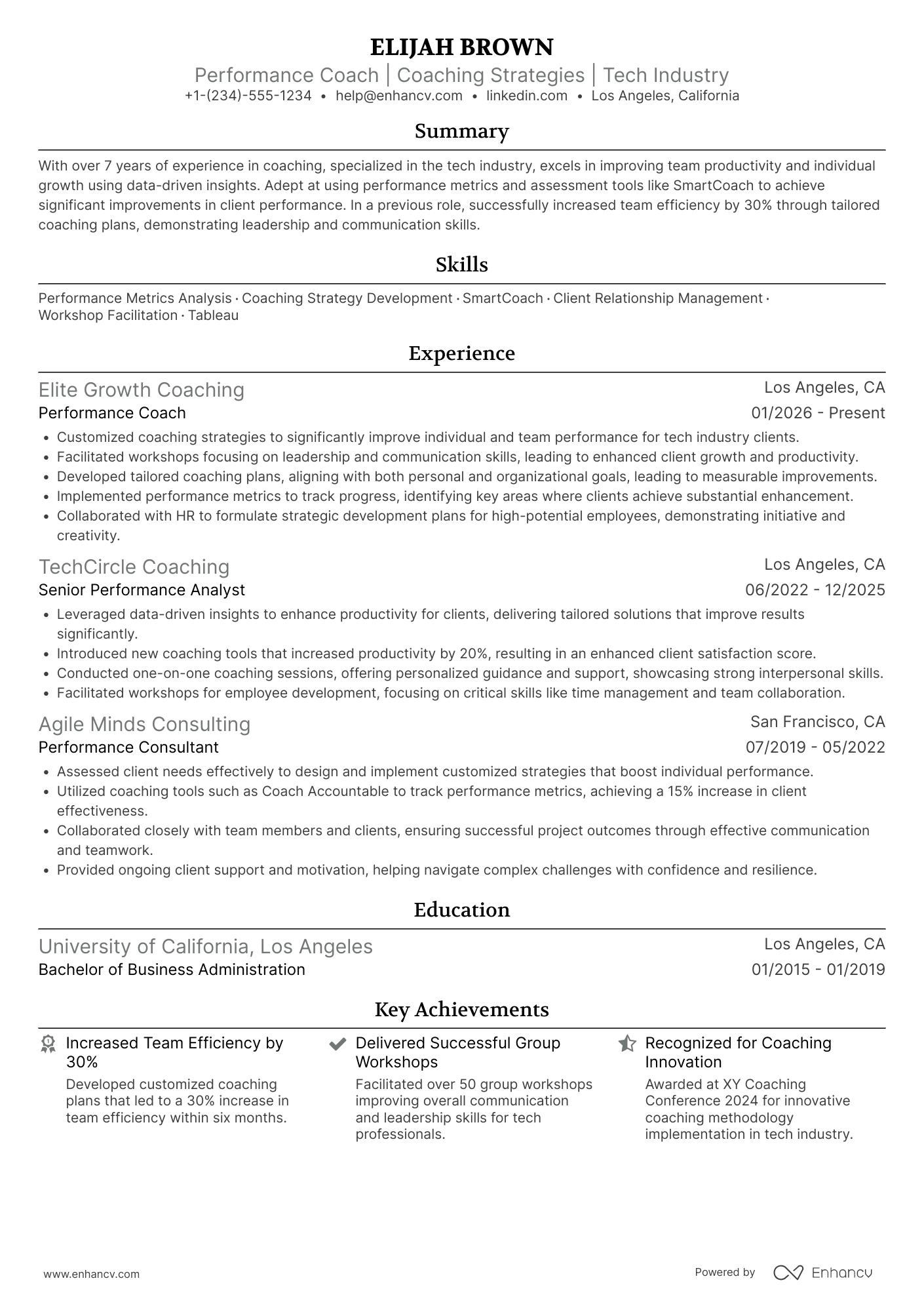
Most coaching resume submissions fail because they read like session notes, not business cases. A coaching resume must translate client work into measurable impact, or it gets filtered by ATS screening and missed in rapid recruiter scans.
A strong resume shows outcomes you delivered, not tools you used or tasks you handled. Knowing how to make your resume stand out means you'll highlight retention gains, client satisfaction scores, goal attainment rates, program enrollment growth, reduced time to competency, and measurable performance improvements.

Key takeaways
- Quantify coaching outcomes like retention, satisfaction, and goal attainment instead of listing tasks or tools.
- Use reverse-chronological format if experienced and hybrid format if switching into coaching.
- Tailor every experience bullet to mirror the frameworks, tools, and populations in the job posting.
- Anchor each listed skill to a specific engagement, action, and measurable result.
- Place certifications like ICF or NBHWC prominently—they directly influence hiring decisions.
- Use AI to sharpen language and add metrics, but stop before it inflates or invents experience.
- Build your coaching resume faster with Enhancv to keep formatting clean and content recruiter-ready.
Job market snapshot for coachings
We analyzed 5,902 recent coaching job ads across major US job boards. These numbers help you understand employer expectations, industry demand, regional hotspots at a glance.
What level of experience employers are looking for coachings
| Years of Experience | Percentage found in job ads |
|---|---|
| 1–2 years | 10.7% (630) |
| 3–4 years | 3.6% (215) |
| 5–6 years | 4.6% (272) |
| 7–8 years | 0.3% (16) |
| 9–10 years | 0.3% (18) |
| 10+ years | 4.3% (256) |
| Not specified | 76.3% (4501) |
Coaching ads by area of specialization (industry)
| Industry (Area) | Percentage found in job ads |
|---|---|
| Education | 51.8% (3060) |
| Finance & Banking | 29.1% (1720) |
| Healthcare | 15.7% (928) |
| Government | 1.2% (72) |
| Manufacturing | 0.8% (49) |
| Retail & E-commerce | 0.5% (28) |
| Travel & Hospitality | 0.4% (24) |
Top companies hiring coachings
| Company | Percentage found in job ads |
|---|---|
| Wal-Mart | 7.0% (412) |
| Taco Bell | 4.7% (278) |
| Pizza Hut | 3.5% (209) |
| 24 Hour Fitness Worldwide, Inc. | 2.5% (146) |
| West Virginia Department of Education | 2.1% (124) |
| UFC Gym | 2.0% (118) |
| Humana Inc. | 2.0% (116) |
| Virginia Beach Public School | 1.5% (90) |
| Orangetheory Fitness | 1.2% (72) |
| Life Time Fitness | 1.0% (60) |
Role overview stats
These tables show the most common responsibilities and employment types for coaching roles. Use them to align your resume with what employers expect and to understand how the role is structured across the market.
Day-to-day activities and top responsibilities for a coaching
| Responsibility | Percentage found in job ads |
|---|---|
| Cpr | 9.6% (568) |
| First aid | 8.9% (525) |
| Coaching | 5.6% (328) |
| Aed | 4.6% (269) |
| Microsoft office | 4.0% (237) |
| Communication | 3.5% (209) |
| Excel | 3.1% (184) |
| Word | 2.5% (147) |
| Data analysis | 2.4% (141) |
| Customer service | 2.3% (133) |
| Performance metrics | 2.2% (132) |
| Food safety | 2.2% (131) |
How to format a coaching resume
Recruiters evaluating coaching resumes look for evidence of client outcomes, program development, and the ability to build trust-based relationships that drive measurable change. The right resume format puts these signals front and center, ensuring applicant tracking systems and hiring managers can quickly identify your coaching methodology, specialization areas, and the tangible results you've delivered.

I have significant experience in this role—which format should I use?
Use a reverse-chronological format to present your coaching career in a clear, progressive timeline that highlights deepening expertise and expanding client impact. Do:
- Lead each role entry with your coaching scope: number of clients, team size, organizational level served, and program ownership.
- Feature your coaching certifications (ICF, CCE, NBHWC), specialized methodologies (motivational interviewing, cognitive behavioral coaching), and domain expertise (executive, wellness, career transition).
- Quantify outcomes using client retention rates, goal-attainment percentages, revenue impact, or satisfaction scores tied directly to your coaching engagements.
I'm junior or switching into this role—what format works best?
A hybrid format works best because it lets you lead with transferable coaching skills while still showing a concise work history that provides context. Do:
- Place a dedicated skills section near the top of your resume, highlighting coaching competencies such as active listening, goal setting, accountability frameworks, and assessment tools.
- Include pro bono coaching engagements, practicum hours, peer coaching projects, or mentorship roles that demonstrate hands-on coaching experience, even outside formal employment.
- Connect every listed skill or project to a specific action and a measurable or observable result.
Why not use a functional resume?
A functional resume strips away the timeline and context that show how your coaching skills were applied in real engagements, making it harder for recruiters to verify the depth and consistency of your experience.
- Career changers with no coaching history: If your prior roles involved mentoring, training, counseling, or facilitation, a functional format can group these transferable competencies to build a coaching narrative.
- New graduates from coaching certification programs: If your only coaching experience comes from practicum hours or supervised sessions, a functional format can foreground those structured learning experiences.
Once you've established a clean, readable format, the next step is deciding which sections to include so every part of your resume serves a clear purpose.
What sections should go on a coaching resume
Recruiters expect a coaching resume to show clear outcomes, the populations you've coached, and the methods you use to drive progress. Understanding what to put on a resume helps you prioritize the right details. Use this structure for maximum clarity:
- Header
- Summary
- Experience
- Skills
- Projects
- Education
- Certifications
- Optional sections: Awards, Volunteer coaching, Languages
Make your experience bullets highlight measurable client or team outcomes, the scope of your coaching caseload, and the results you delivered over time.
Is your resume good enough?
Drop your resume here or choose a file. PDF & DOCX only. Max 2MB file size.
Now that you’ve organized the key parts of your coaching resume, the next step is to write your coaching resume experience section so those details clearly show your impact.
How to write your coaching resume experience
The experience section of your coaching resume should highlight the programs you've delivered, the methodologies you've applied, and the measurable transformations you've driven for individuals or teams. Hiring managers prioritize demonstrated impact—client progress, behavioral change, and organizational outcomes—over descriptive task lists. Building a targeted resume ensures each entry speaks directly to what the employer values most.
Each entry should include:
- Job title
- Company and location (or remote)
- Dates of employment (month and year)
Three to five concise bullet points showing what you owned, how you executed, and what outcomes you delivered:
- Ownership scope: the coaching programs, client portfolios, development initiatives, or organizational partnerships you were directly accountable for.
- Execution approach: the coaching frameworks, assessment instruments, feedback models, or session structures you used to guide client development and inform your practice.
- Value improved: changes to client performance, leadership readiness, team engagement, retention, or well-being that resulted directly from your coaching interventions.
- Collaboration context: how you partnered with HR leaders, senior executives, department heads, or external specialists to align coaching goals with broader organizational priorities.
- Impact delivered: outcomes expressed through client transformations, program reach, stakeholder satisfaction, or business results rather than a summary of sessions conducted or hours logged.
Experience bullet formula
A coaching experience example
✅ Right example - modern, quantified, specific.
Leadership Coach
Northstar Coaching Partners | Remote
2022–Present
Boutique coaching practice supporting high-growth technology companies through leadership development and performance improvement.
- Coached twenty-four managers and senior individual contributors using the GROW model, 360-degree feedback (Culture Amp), and StrengthsFinder, improving engagement survey leadership scores by 14% within two quarters.
- Designed and facilitated a six-week “New Manager” cohort with weekly workshops and practice labs (Miro, Zoom, Google Workspace), reducing first-ninety-day attrition from 12% to 7% across three client teams.
- Implemented a structured coaching intake and goal-tracking system in Notion and HubSpot, cutting scheduling and admin time by 35% and increasing session utilization from 78% to 91%.
- Partnered with HR and people analytics stakeholders to define success metrics and dashboards (Looker Studio), linking coaching goals to promotion readiness and increasing internal promotion rates by 9% year over year.
- Mediated eight cross-functional conflict cases with product managers, designers, and engineering leads using nonviolent communication and interest-based negotiation, reducing escalations to HR by 40% over six months.
Now that you've seen how to structure a strong experience entry, let's look at how to adapt it to match the specific coaching role you're targeting.
How to tailor your coaching resume experience
Recruiters evaluate coaching resumes through both human review and applicant tracking systems, so tailoring your resume to the job description is essential. Tailoring ensures the specific methods, credentials, and outcomes you highlight directly match what the employer is looking for.
Ways to tailor your coaching experience:
- Mirror the coaching frameworks or methodologies named in the job description.
- Match the specific assessment tools or platforms the employer uses.
- Reflect the client populations or demographics the role targets.
- Use the same terminology for development models or program structures listed.
- Highlight relevant certifications or credentialing bodies the posting requires.
- Emphasize measurable client outcomes that align with stated success criteria.
- Include experience with group or one-on-one formats as specified.
- Reference industry or organizational contexts that match the employer's domain.
Tailoring means aligning your real coaching achievements with each role's requirements, not forcing disconnected keywords into your experience section.
Resume tailoring examples for coaching
| Job description excerpt | Untailored | Tailored |
|---|---|---|
| "Facilitate group and individual coaching sessions using ICF core competencies to support leadership development across a global organization." | Coached employees on various topics to help them grow professionally. | Facilitated 120+ individual and group coaching sessions annually using ICF core competencies, supporting leadership development for mid-level managers across 8 global offices. |
| "Design and deliver executive coaching programs grounded in 360-degree feedback, emotional intelligence assessments (EQ-i 2.0), and goal-setting frameworks." | Helped leaders improve their skills through coaching and feedback conversations. | Designed executive coaching programs integrating EQ-i 2.0 assessments and 360-degree feedback, guiding 35 senior leaders through structured goal-setting frameworks that improved leadership effectiveness scores by 27%. |
| "Partner with HR business partners to identify high-potential talent and create individualized coaching plans that drive retention and succession readiness." | Worked with HR to support talent management and employee development initiatives. | Partnered with four HR business partners to build individualized coaching plans for 50 high-potential employees, contributing to a 92% retention rate among participants and accelerating succession readiness for 12 director-level roles. |
Once you’ve aligned your experience with the role’s priorities, quantify your coaching achievements to prove the impact of that work with clear, measurable results.
How to quantify your coaching achievements
Quantifying your achievements shows you improved performance, consistency, and outcomes—not just morale. Focus on measurable shifts in productivity, quality, retention, satisfaction, and delivery speed across teams, cohorts, or programs.
Quantifying examples for coaching
| Metric | Example |
|---|---|
| Cycle time | "Cut new-hire ramp time from eight to five weeks by rebuilding the onboarding plan in Notion and adding weekly role-play sessions." |
| Quality rate | "Reduced QA rework from twelve percent to seven percent by coaching ten reps on call structure and using Gong scorecards for feedback." |
| Retention | "Improved ninety-day retention from eighty-two percent to ninety percent for two cohorts after launching a buddy system and biweekly coaching check-ins." |
| Satisfaction | "Raised post-session learner satisfaction from 4.1 to 4.6 out of five across six workshops by adding prework, live practice, and follow-up drills." |
| Delivery speed | "Increased training throughput from one to three cohorts per month by standardizing materials in Google Slides and training three peer facilitators." |
Turn your everyday tasks into measurable, recruiter-ready resume bullets in seconds with Enhancv's Bullet Point Generator.
Once you've crafted strong bullet points for your experience section, you'll want to apply that same precision to presenting your hard and soft skills throughout your coaching resume.
How to list your hard and soft skills on a coaching resume
Your skills section shows how you coach outcomes, and recruiters and ATS scan it to confirm role fit fast, so aim for a balanced mix of measurable coaching methods and tools plus execution-focused soft skills. Coaching roles require a blend of hard skills like assessment tools, frameworks, and platforms alongside soft skills like active listening, accountability, and adaptability:
- Product strategy and discovery skills
- Data, analytics, and experimentation skills
- Delivery, execution, and go-to-market discipline
- Soft skills
Your skills section should be:
- Scannable (bullet-style grouping).
- Relevant to the job post.
- Backed by proof in experience bullets.
- Updated with current tools.
Place your skills section:
- Above experience if you're junior or switching careers.
- Below experience if you're mid/senior with strong achievements.

Hard skills
- International Coaching Federation competencies
- GROW coaching model
- Motivational interviewing
- Cognitive behavioral coaching techniques
- Strengths-based coaching, CliftonStrengths
- 360 feedback assessments
- Goal setting, OKRs
- Habit formation frameworks
- Session planning, coaching curricula
- Learning management systems, Kajabi, Thinkific
- Zoom, Calendly, Google Workspace
- Coaching notes, client progress tracking
Soft skills
- Ask incisive, non-leading questions
- Listen for patterns and blockers
- Deliver direct, actionable feedback
- Set clear boundaries and expectations
- Align goals with stakeholder needs
- Facilitate difficult conversations
- Build accountability with follow-through
- Adapt coaching style to context
- De-escalate conflict and reset focus
- Coach decisions, not just ideas
- Document commitments and next steps
- Protect confidentiality and trust
How to show your coaching skills in context
Skills shouldn't live only in a bulleted list on your resume. Explore resume skills examples to see how top coaching professionals present their abilities in action.
They should be demonstrated in:
- Your summary (high-level professional identity)
- Your experience (proof through outcomes)
Here's what this looks like in practice.
Summary example
Executive coach with 12 years of experience in leadership development across Fortune 500 organizations. Skilled in 360-degree feedback, motivational interviewing, and ICF-aligned frameworks. Helped C-suite clients improve team retention by 34% through structured accountability programs.
- Signals senior-level expertise immediately
- Names industry-recognized tools and frameworks
- Leads with a measurable client outcome
- Highlights empathy-driven soft skills naturally
Experience example
Senior Leadership Coach
BrightPath Consulting | Remote
March 2018–Present
- Designed a peer-coaching program using the GROW model, boosting manager effectiveness scores by 27% across four departments.
- Partnered with HR directors to implement 360-degree feedback cycles, reducing leadership turnover by 19% within two years.
- Facilitated quarterly executive retreats integrating strengths-based assessments, increasing participant satisfaction ratings from 3.6 to 4.8 out of 5.
- Every bullet includes measurable proof.
- Skills surface naturally through real outcomes.
Once you’ve demonstrated your coaching ability through specific outcomes and real examples, the next step is to apply the same approach when writing a coaching resume with no experience.
How do I write a coaching resume with no experience
Even without full-time experience, you can demonstrate readiness through coaching-adjacent activities. If you're building a resume without work experience, focus on structured projects and certifications that prove your coaching capability:
- Volunteer coaching at nonprofits
- Peer coaching in student groups
- Certification practice client sessions
- Workshop facilitation for small groups
- Mentored coaching under a supervisor
- Pro bono coaching for job seekers
- Coaching capstone or portfolio project
- Athletic or academic team coaching
Focus on:
- Documented coaching hours and outcomes
- Coaching training and certifications
- Structured methods and tools used
- Clear niche and target clients
Resume format tip for entry-level coaching
Use a combination resume to highlight coaching projects and training first, while still listing work history to show reliability and follow-through. Do:
- Lead with a Coaching Projects section.
- Quantify outcomes using client goals met.
- Name tools used: GROW, SMART.
- List training, hours, and supervisors.
- Add a simple coaching process summary.
- Delivered six pro bono coaching sessions using GROW and SMART goals for three job seekers, increasing interview callbacks from two to seven within eight weeks.
Even without formal coaching roles, your education section can demonstrate the foundational knowledge and credentials that qualify you for the position.
How to list your education on a coaching resume
Your education section helps hiring teams confirm you have the foundational knowledge needed for coaching. It validates your training in areas like behavioral science, leadership, and communication.
Include:
- Degree name
- Institution
- Location
- Graduation year
- Relevant coursework (for juniors or entry-level candidates)
- Honors & GPA (if 3.5 or higher)
Skip month and day details—list the graduation year only.
Here's a strong education entry tailored to a coaching resume:
Example education entry
Bachelor of Science in Psychology
University of Michigan, Ann Arbor, MI
Graduated 2019
GPA: 3.7/4.0
- Relevant Coursework: Organizational Behavior, Motivational Psychology, Group Dynamics, Communication Theory
- Honors: Magna Cum Laude, Dean's List (six semesters)
How to list your certifications on a coaching resume
Certifications on your resume show your commitment to learning, proficiency with coaching tools, and alignment with industry standards. They also help hiring teams confirm your coaching skills match the role.
Include:
- Certificate name
- Issuing organization
- Year
- Optional: credential ID or URL
- Place certifications below education when your degree is more recent and directly supports your coaching focus.
- Place certifications above education when they are more recent or more relevant than your degree for the coaching role.
Best certifications for your coaching resume
- International Coaching Federation (ICF) Associate Certified Coach (ACC)
- International Coaching Federation (ICF) Professional Certified Coach (PCC)
- Center for Credentialing and Education (CCE) Board Certified Coach (BCC)
- Certified Professional Co-Active Coach (CPCC)
- Gallup Certified Strengths Coach
- Certified Executive Coach (CEC)
- Hogan Assessment Certification
With your credentials clearly positioned to reinforce your expertise, you can now write your coaching resume summary to highlight that value upfront.
How to write your coaching resume summary
Your resume summary is the first thing a recruiter reads. A strong one instantly connects your coaching background to the specific role you're targeting.
Keep it to three to four lines, with:
- Your title and total years of coaching experience.
- The domain you specialize in, such as executive, career, wellness, or athletic coaching.
- Core skills like active listening, motivational interviewing, goal-setting frameworks, or assessment tools.
- One or two measurable achievements, such as client retention rates or program completion improvements.
- Soft skills tied to real outcomes, like communication that improved team engagement by a specific percentage.

PRO TIP
At this level, prioritize clarity and relevance over breadth. Highlight specific coaching skills, tools you've used, and early wins that show tangible impact. Avoid vague descriptors like "passionate" or "motivated self-starter." Replace them with concrete contributions and measurable results.
Example summary for a coaching
Career coach with three years of experience using CliftonStrengths and motivational interviewing. Guided 120+ clients through career transitions, achieving an 87% placement rate within 90 days.
Optimize your resume summary and objective for ATS
Drop your resume here or choose a file.
PDF & DOCX only. Max 2MB file size.
Now that your summary captures your coaching strengths at a glance, make sure your header presents the essential contact and identification details recruiters need to reach you.
What to include in a coaching resume header
A resume header is the top section with your identity and contact details, and it drives visibility, credibility, and fast recruiter screening for coaching roles.
Essential resume header elements
- Full name
- Tailored job title and headline
- Location
- Phone number
- Professional email
- GitHub link
- Portfolio link
A LinkedIn link helps recruiters verify experience quickly and supports screening.
Don't include a photo on a coaching resume unless the role is explicitly front-facing or appearance-dependent.
Match your job title and headline to the coaching posting, and keep every link current, professional, and easy to scan.
Example
Coaching resume header
Jordan Taylor
Career Coach | Coaching for early-career professionals and career changers
Austin, TX
(512) 555-01XX
your.name@enhancv.com
github.com/yourname
yourwebsite.com
linkedin.com/in/yourname
Once your header clearly identifies who you are and how to reach you, you can strengthen the rest of your resume with additional sections that support your coaching experience.
Additional sections for coaching resumes
Adding extra sections helps you stand out when your core qualifications match other candidates. They showcase unique strengths that reinforce your coaching credibility. For example, listing language skills can demonstrate your ability to coach diverse, multilingual client populations.
- Certifications and licenses
- Languages
- Volunteer coaching experience
- Professional affiliations and memberships
- Publications and speaking engagements
- Hobbies and interests
- Awards and achievements
Once you've strengthened your resume with relevant additional sections, it's worth pairing it with a cover letter to give hiring managers even more context about your coaching qualifications.
Do coaching resumes need a cover letter
A cover letter isn't required for coaching, but it helps in competitive roles or when hiring managers expect one. If you're unsure where to start, understanding what a cover letter is and how it complements your resume can help you decide. It can make a difference when your resume needs context, or when you're targeting a specific team.
Use a cover letter to add value in these cases:
- Explain role and team fit by connecting your coaching style to the team's goals, operating rhythm, and collaboration needs.
- Highlight one or two relevant projects or outcomes, and quantify impact on performance, retention, or delivery when you can.
- Show understanding of the product, users, or business context, and describe how your coaching supports measurable outcomes.
- Address career transitions or non-obvious experience, and clarify how your background maps to coaching responsibilities.
Drop your resume here or choose a file.
PDF & DOCX only. Max 2MB file size.
Even when you decide whether a separate letter adds value to your application, using AI to improve your coaching resume helps you strengthen the document recruiters review first.
Using AI to improve your coaching resume
AI can sharpen your resume's clarity, structure, and impact. It helps refine language and highlight measurable results. But overuse strips authenticity. Once your content feels clear and role-aligned, step away from AI. If you're exploring tools, learn which AI is best for writing resumes before committing to one approach.
Here are 10 practical prompts to strengthen specific sections of your coaching resume:
Strengthen your summary
Quantify experience bullets
Tailor skills to the role
Sharpen action verbs
Refine certification details
Align education entries
Improve project descriptions
Eliminate filler language
Clarify client impact
Check tone consistency
Conclusion
A strong coaching resume proves results with measurable outcomes, highlights role-specific skills, and follows a clear structure that’s easy to scan. It connects your coaching impact to wins, development, retention, and safe, consistent performance.
This approach matches today’s hiring market and stays relevant as expectations rise. When your coaching resume is focused, quantified, and well organized, hiring teams can see your readiness and value fast.
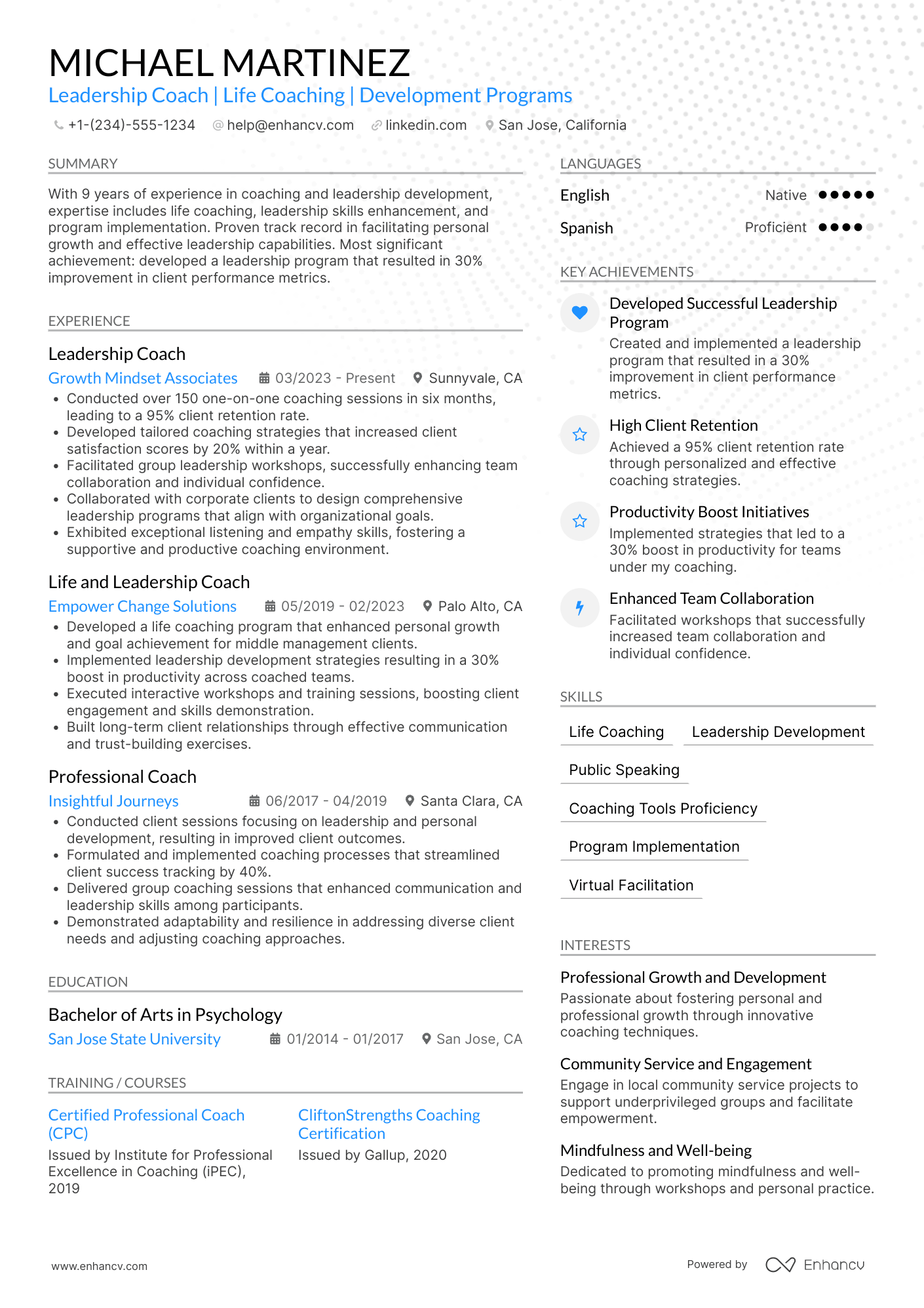
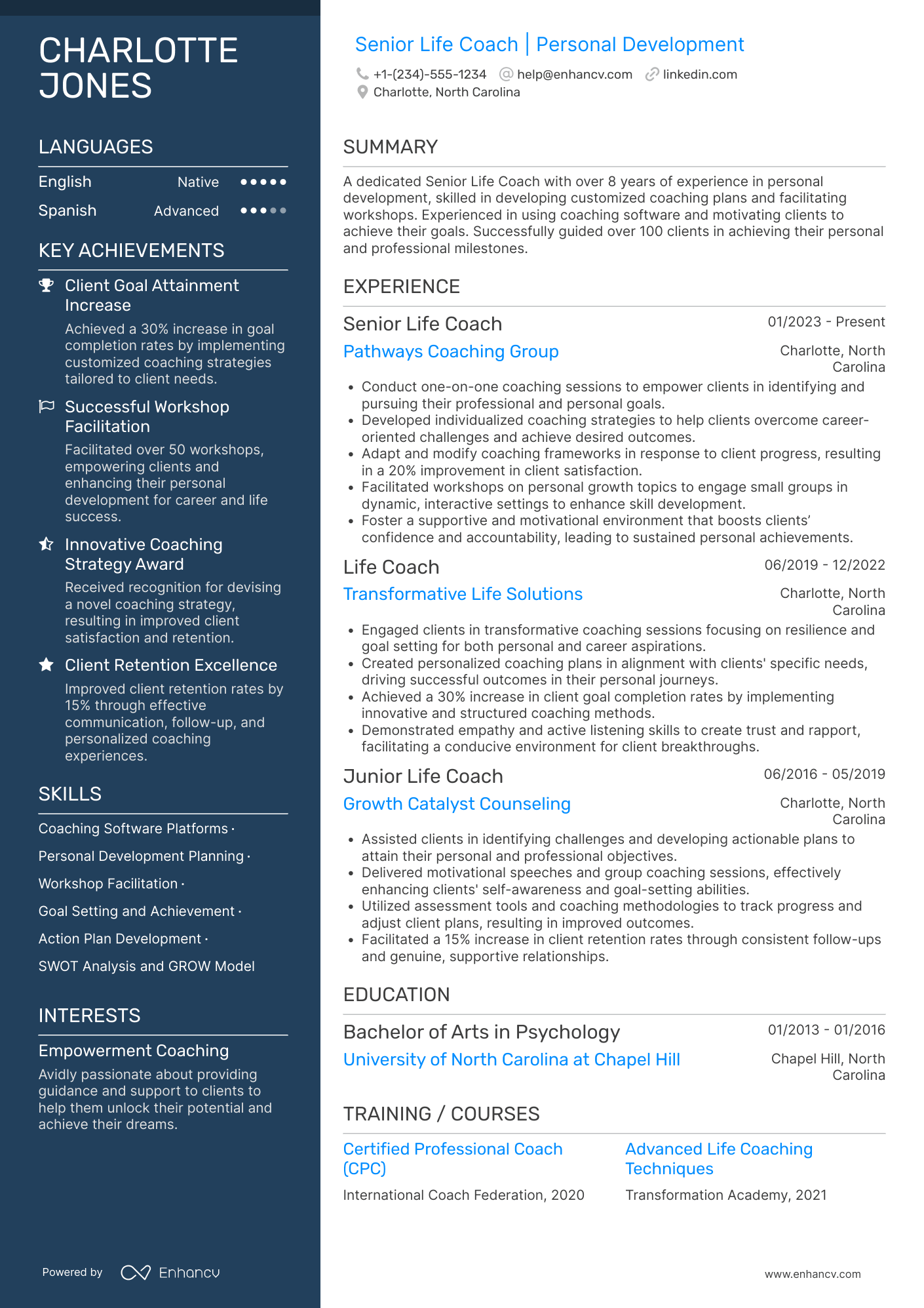
Coaching resume examples
By Experience
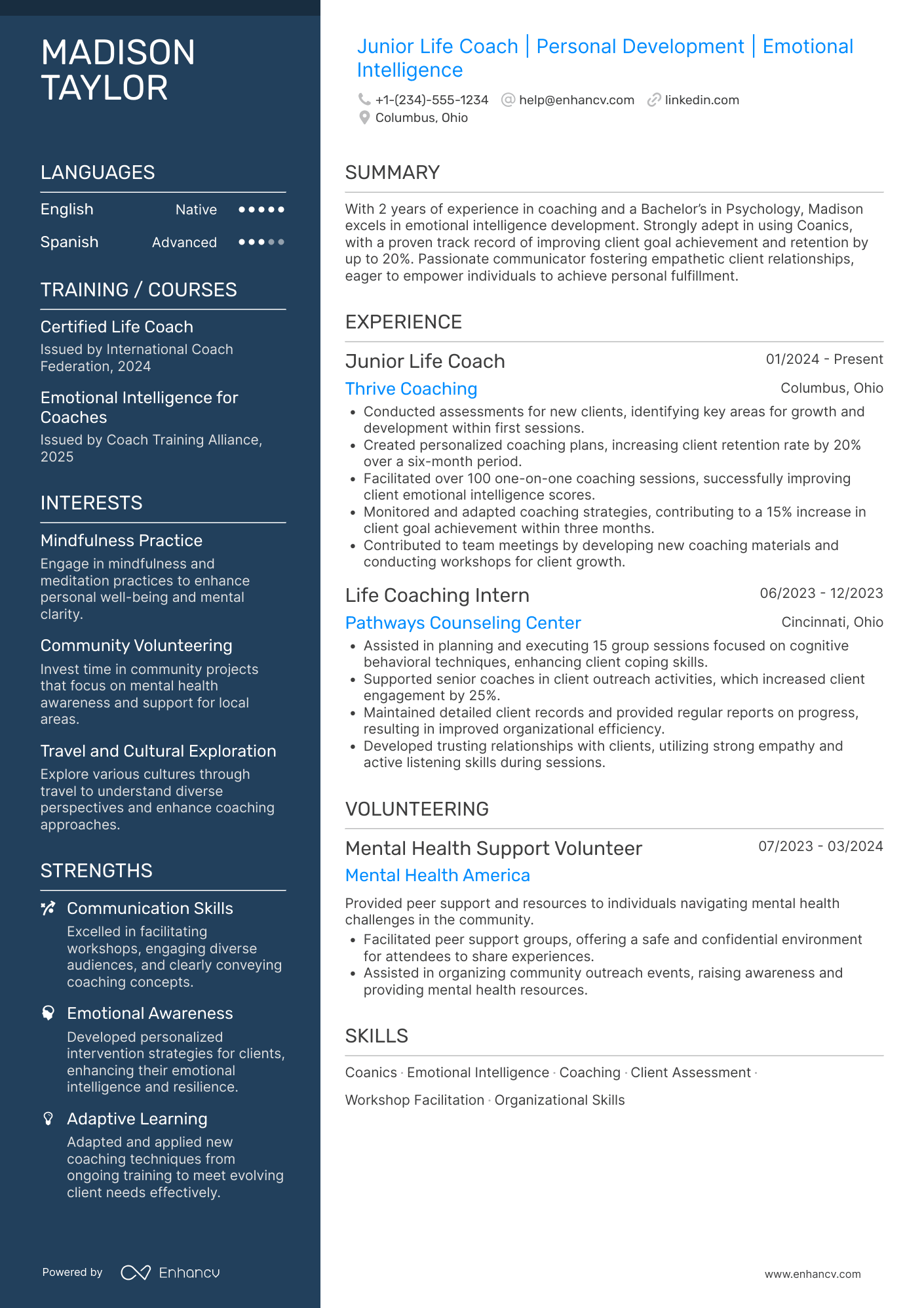
By Role