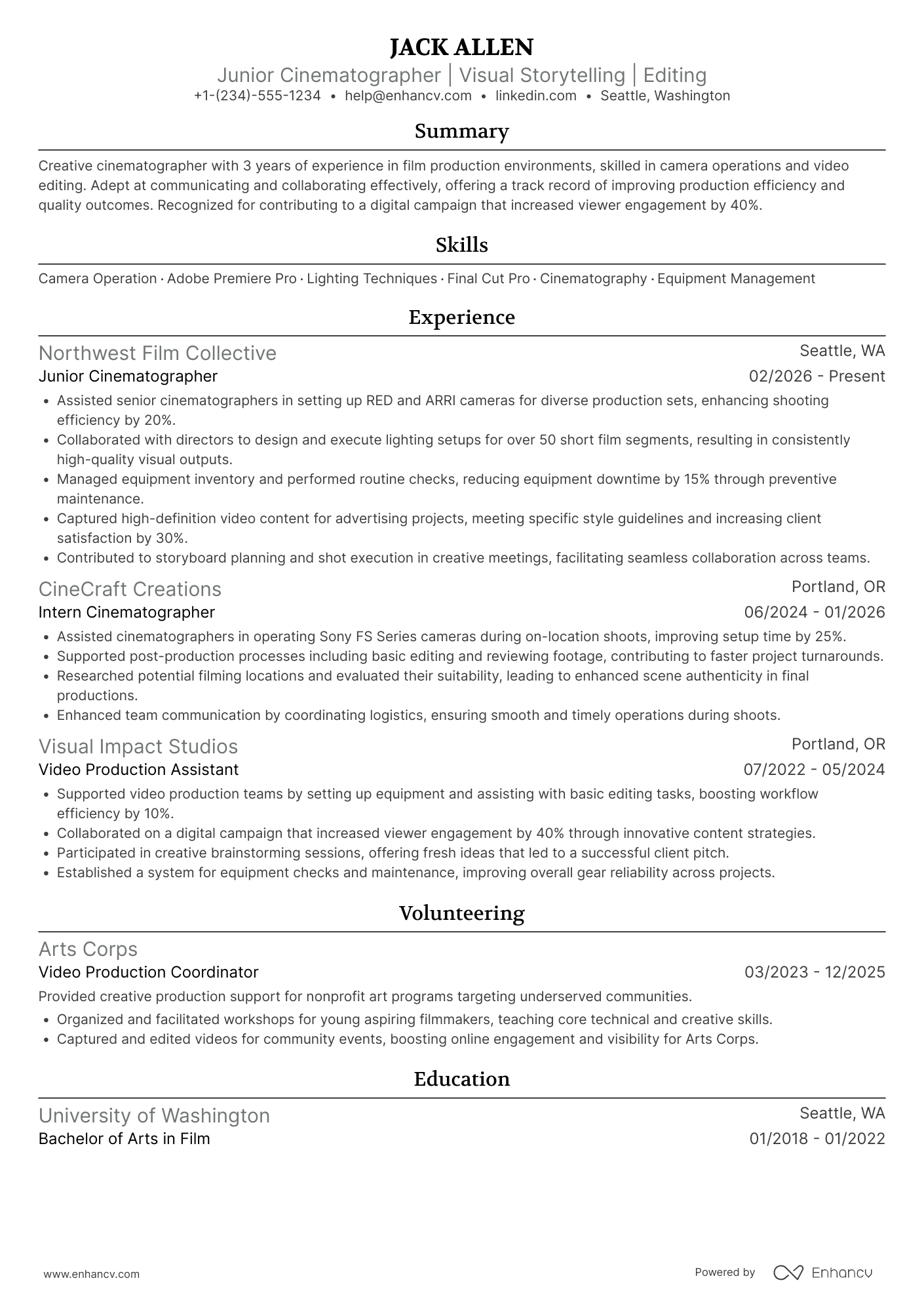
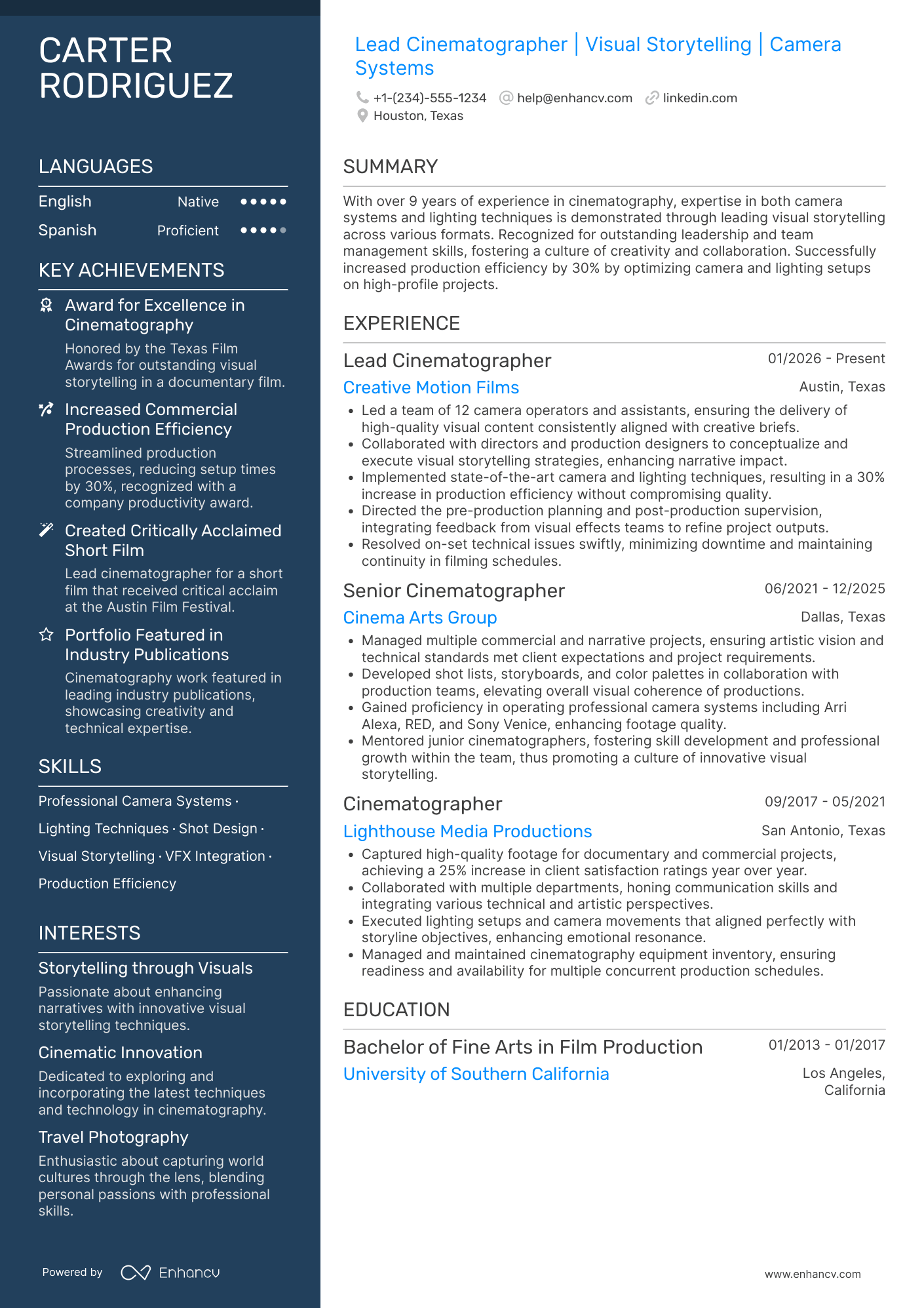
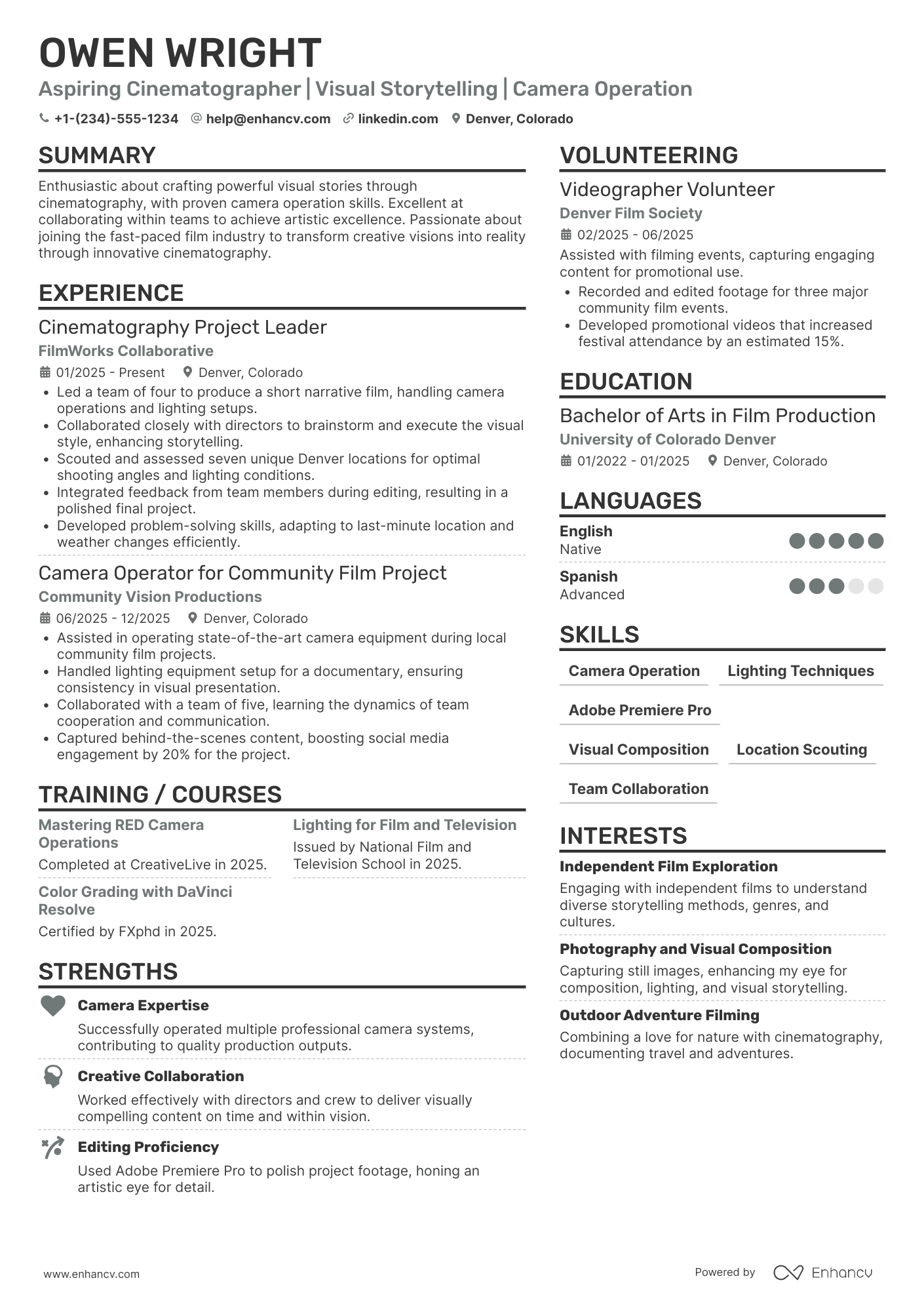
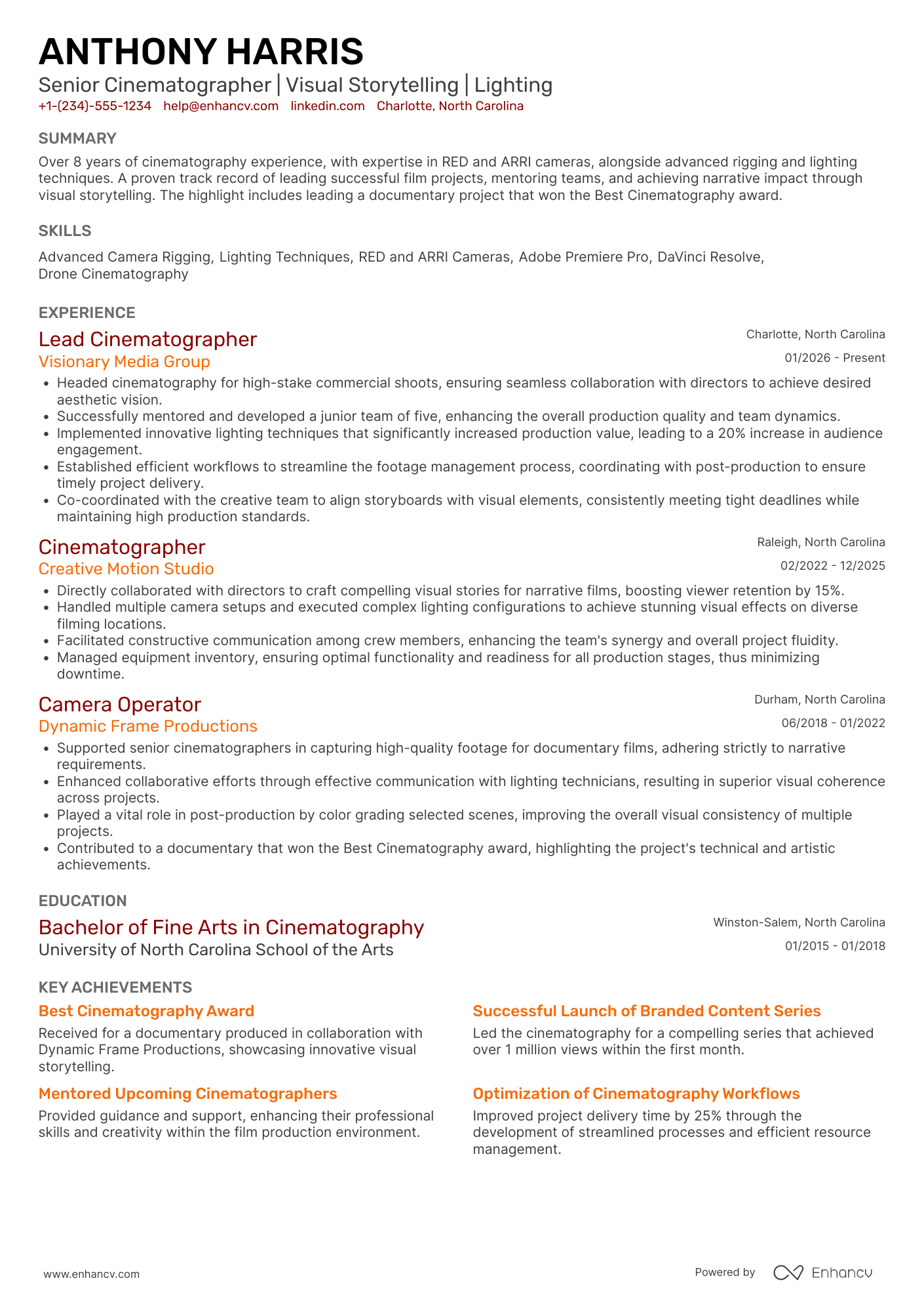
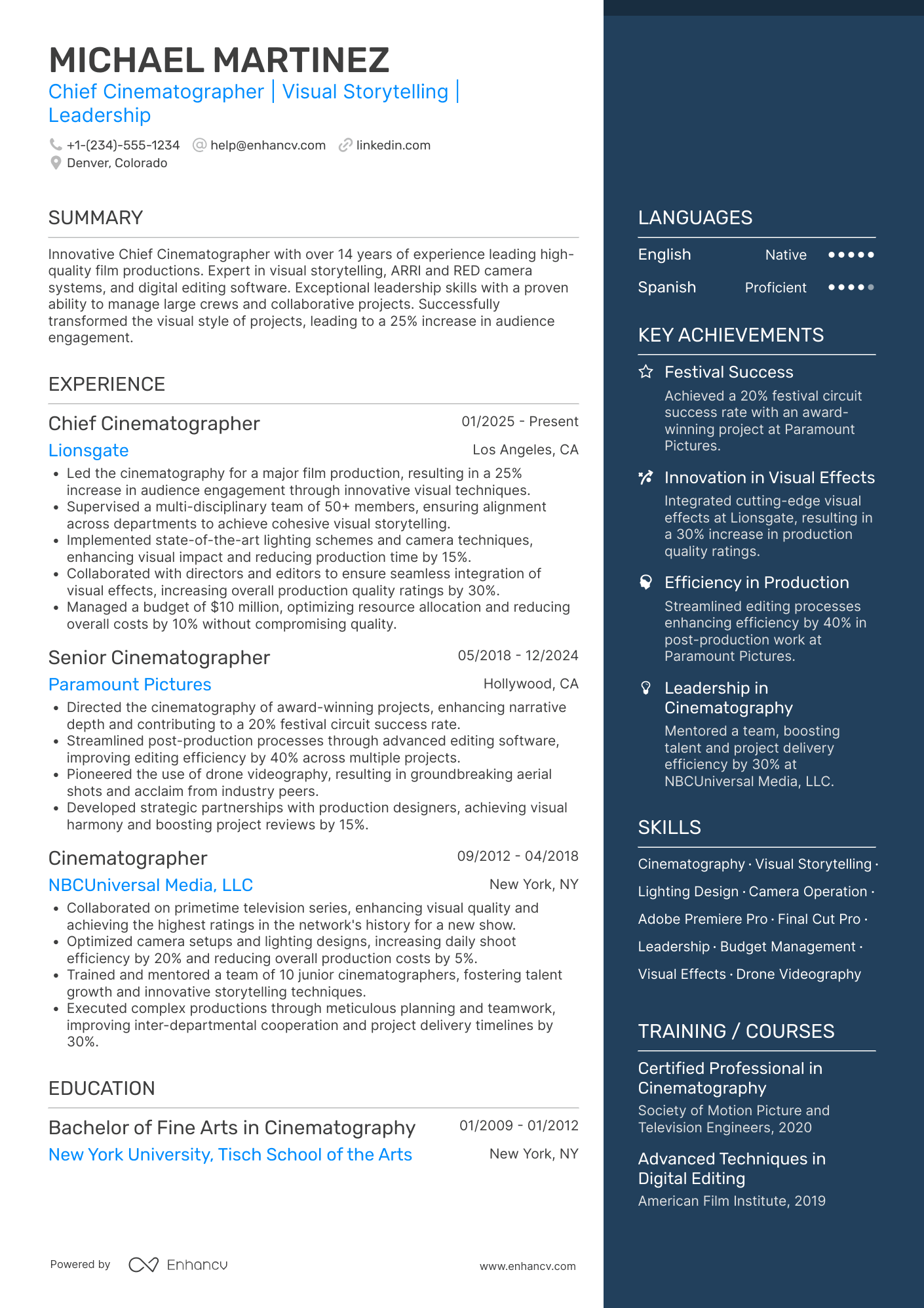
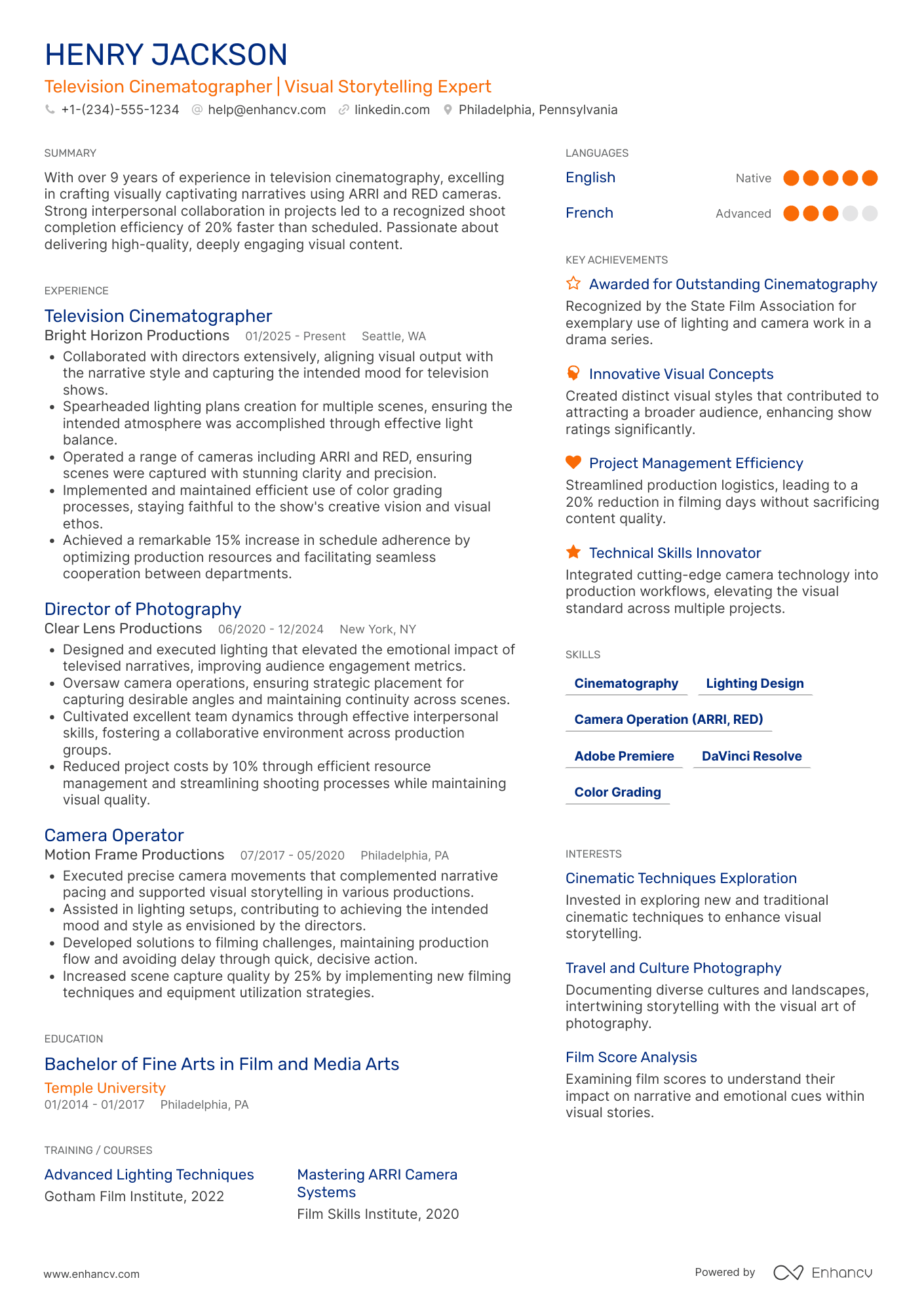
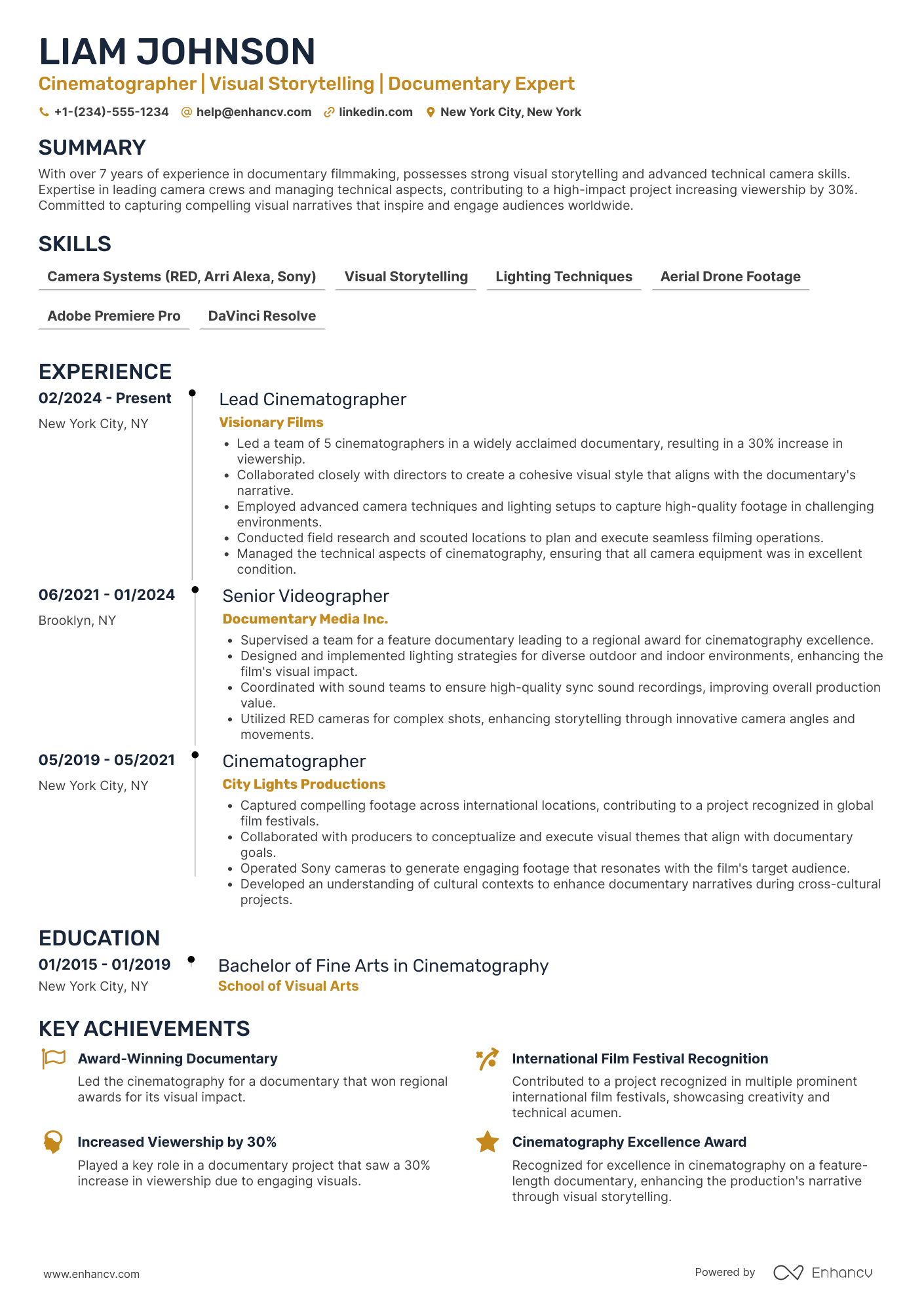
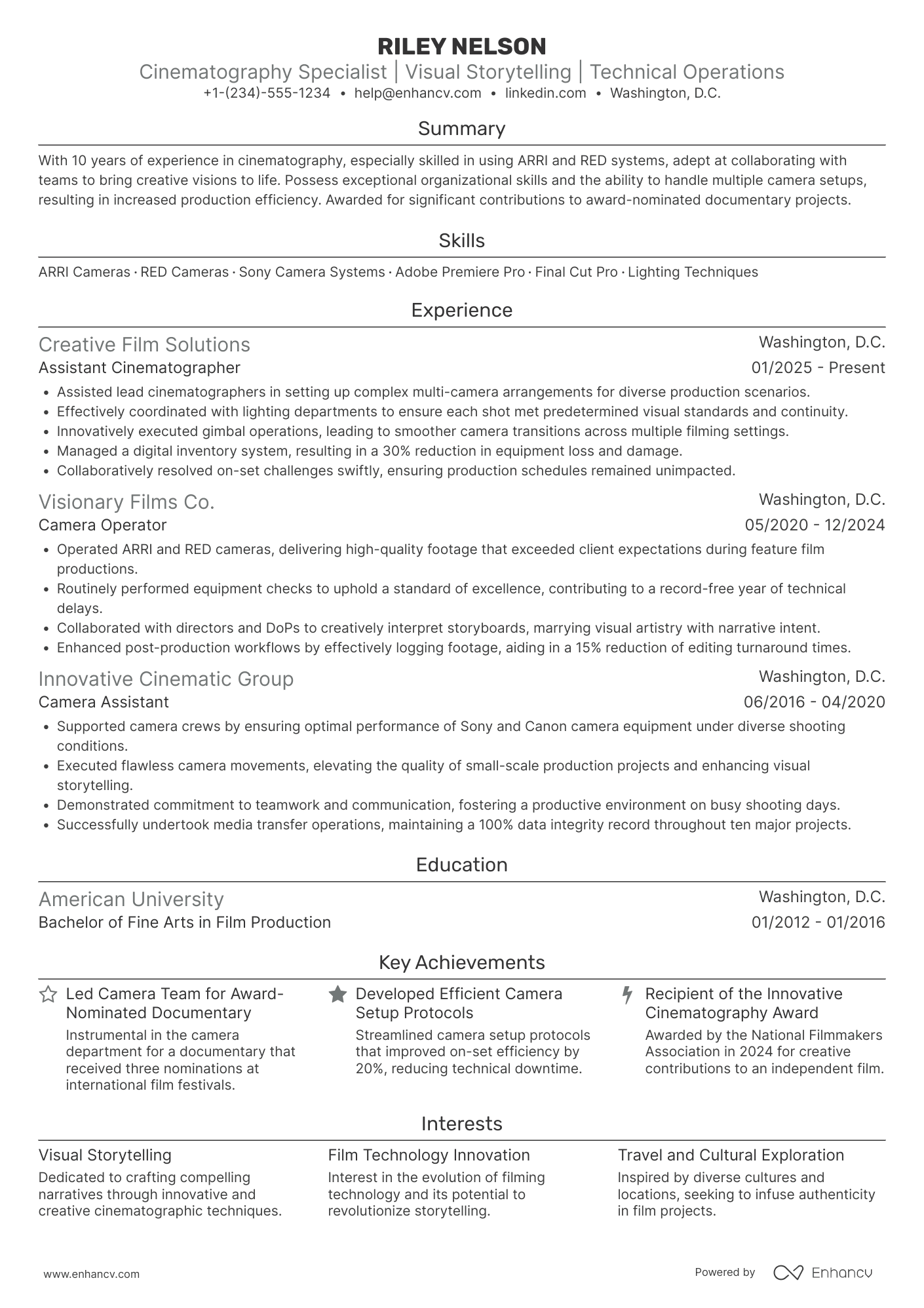
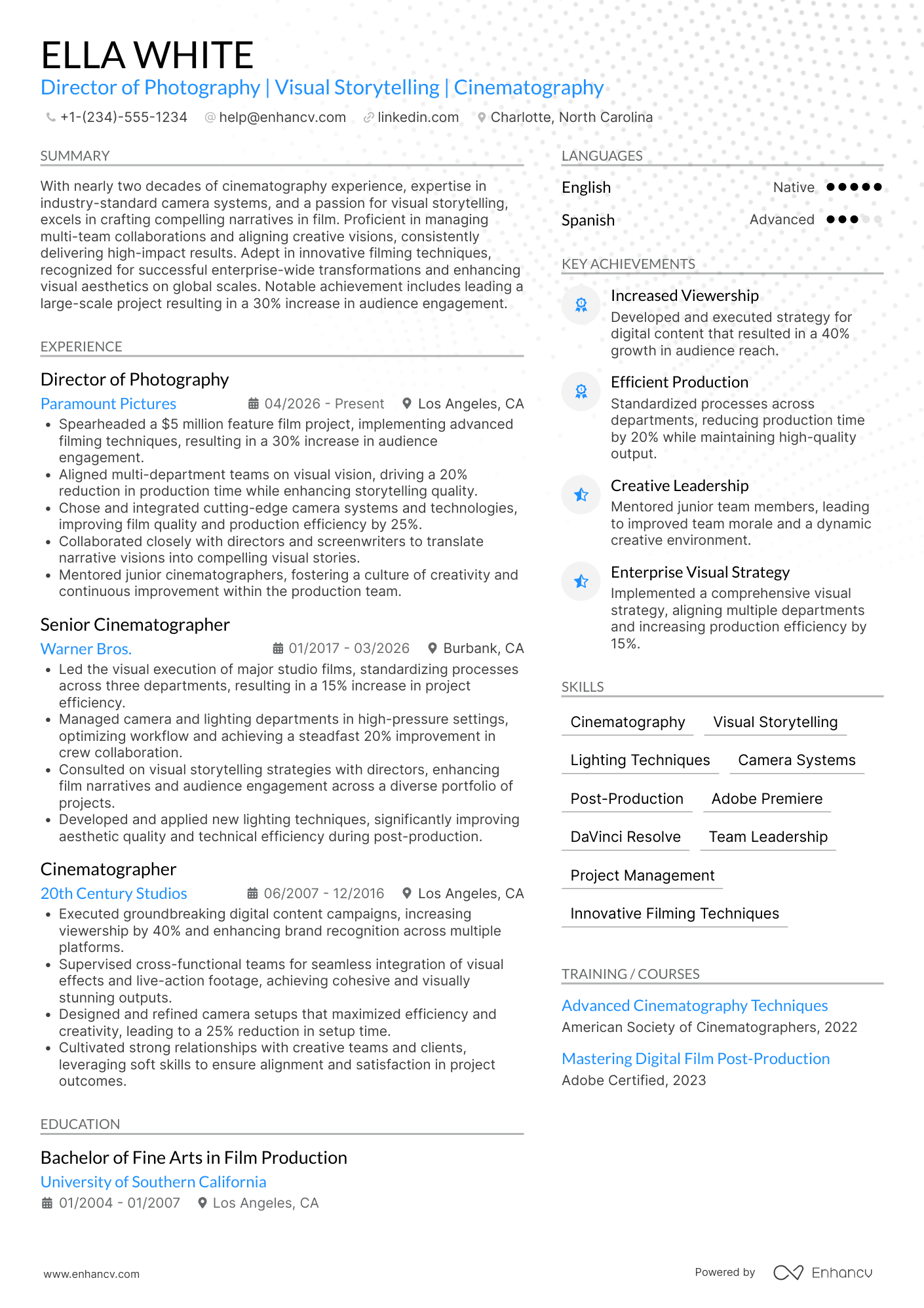
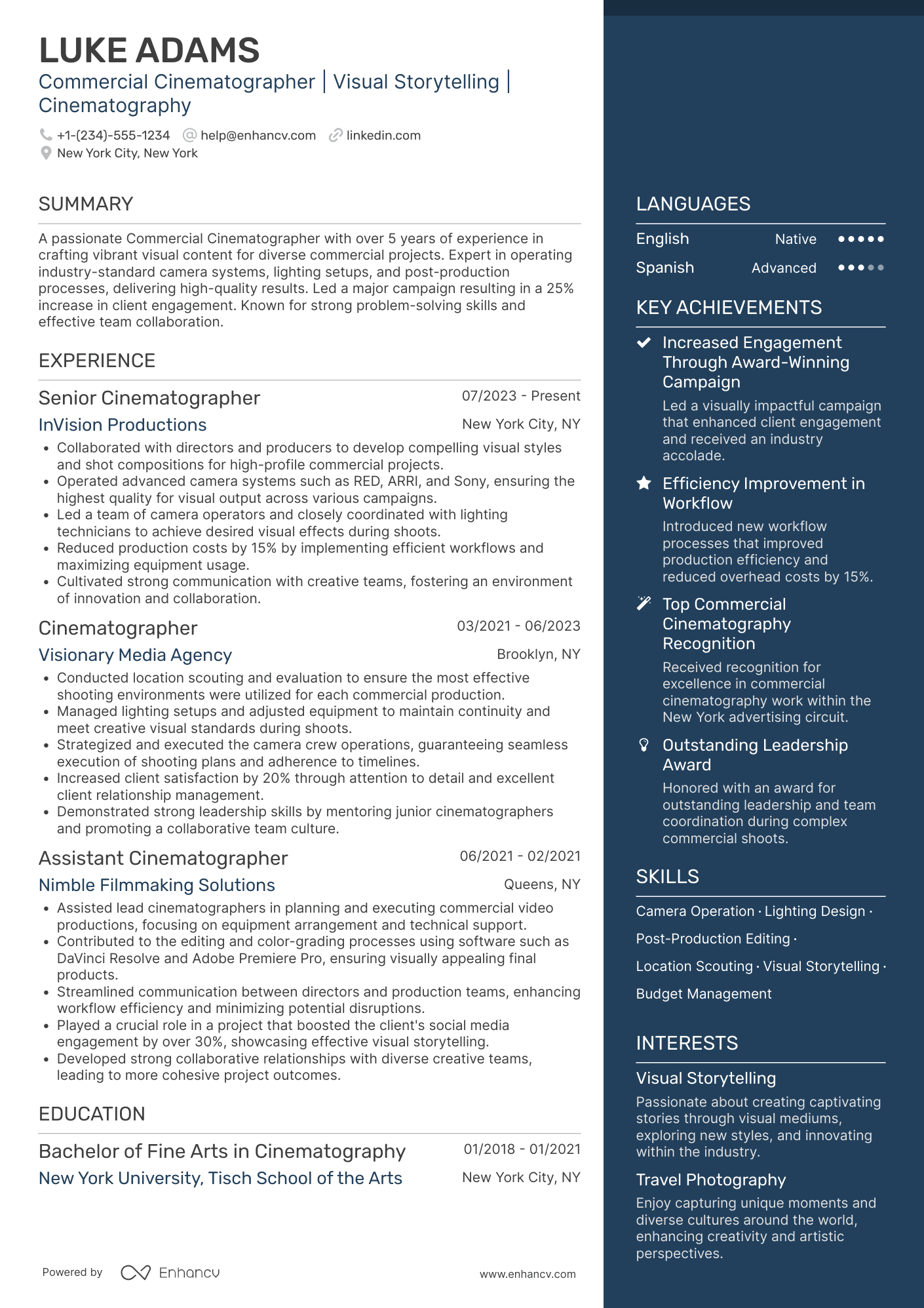
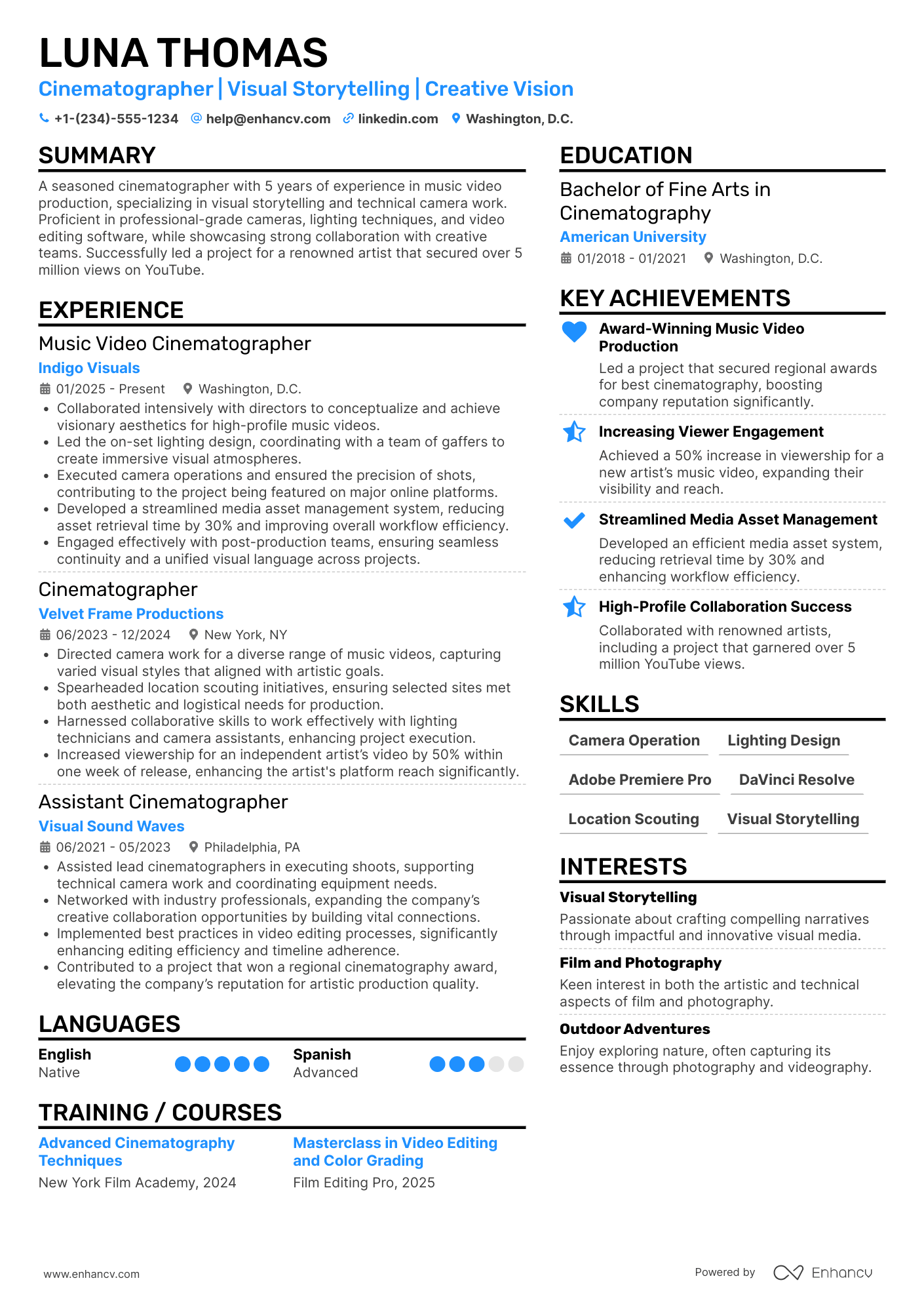
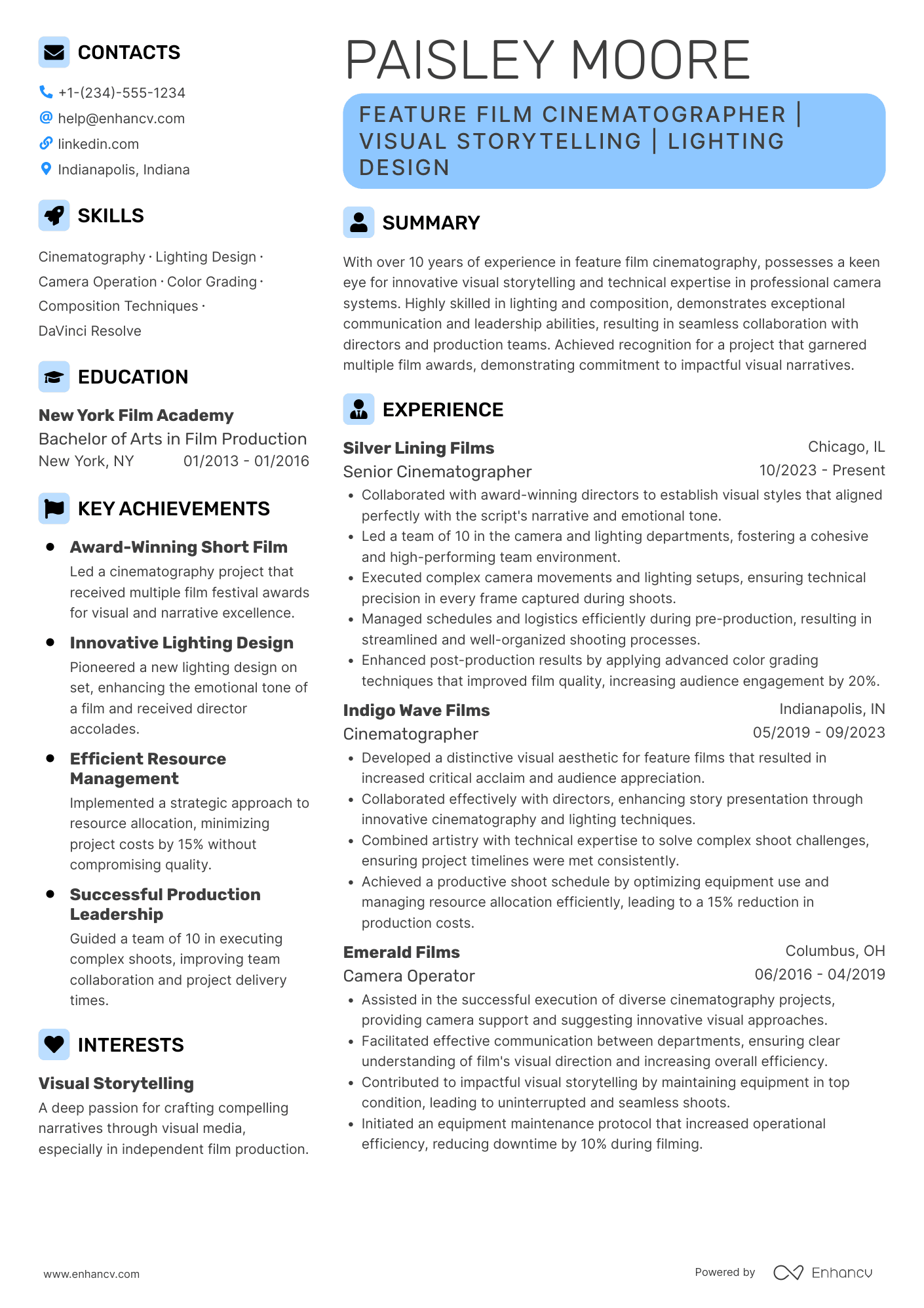
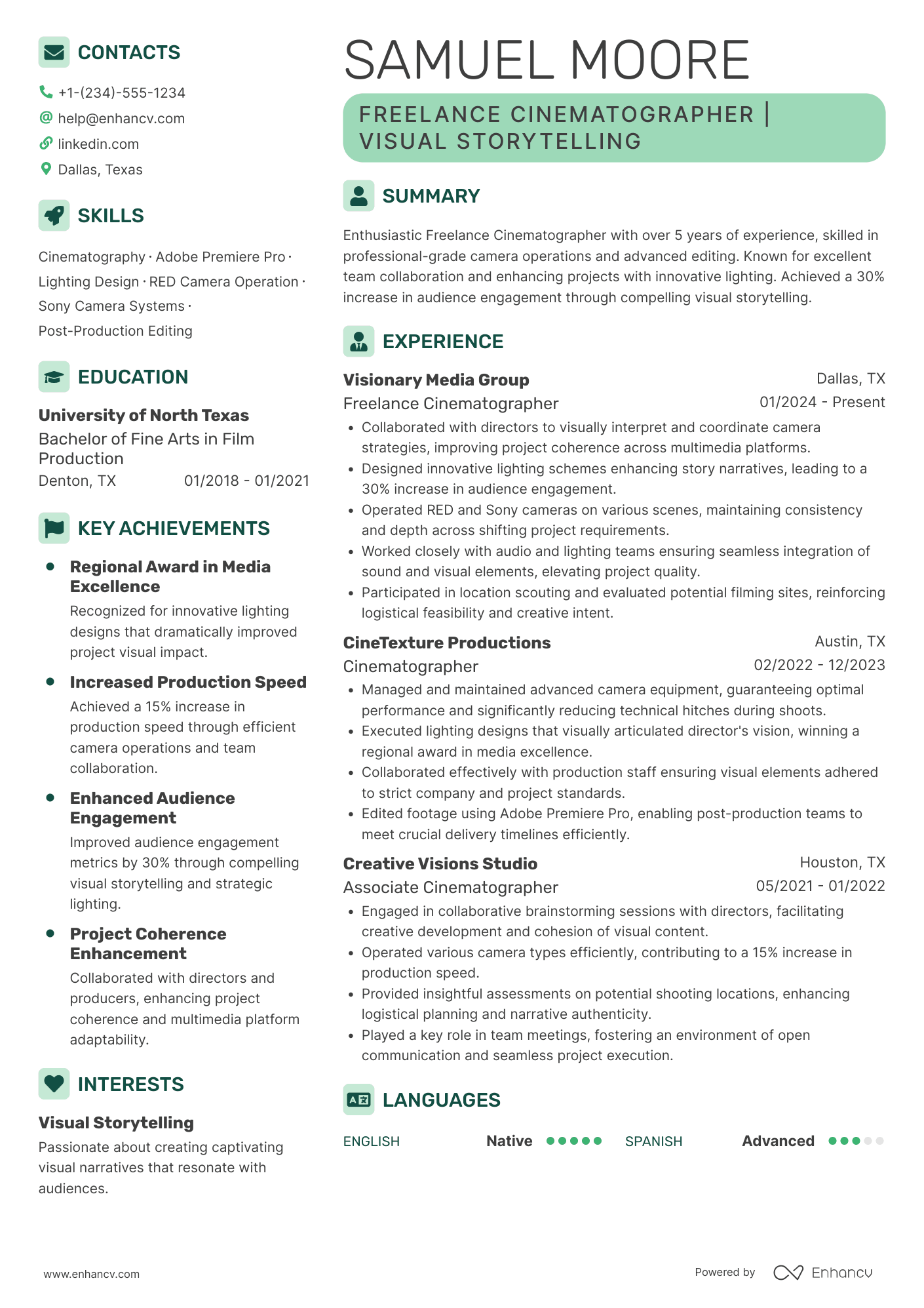
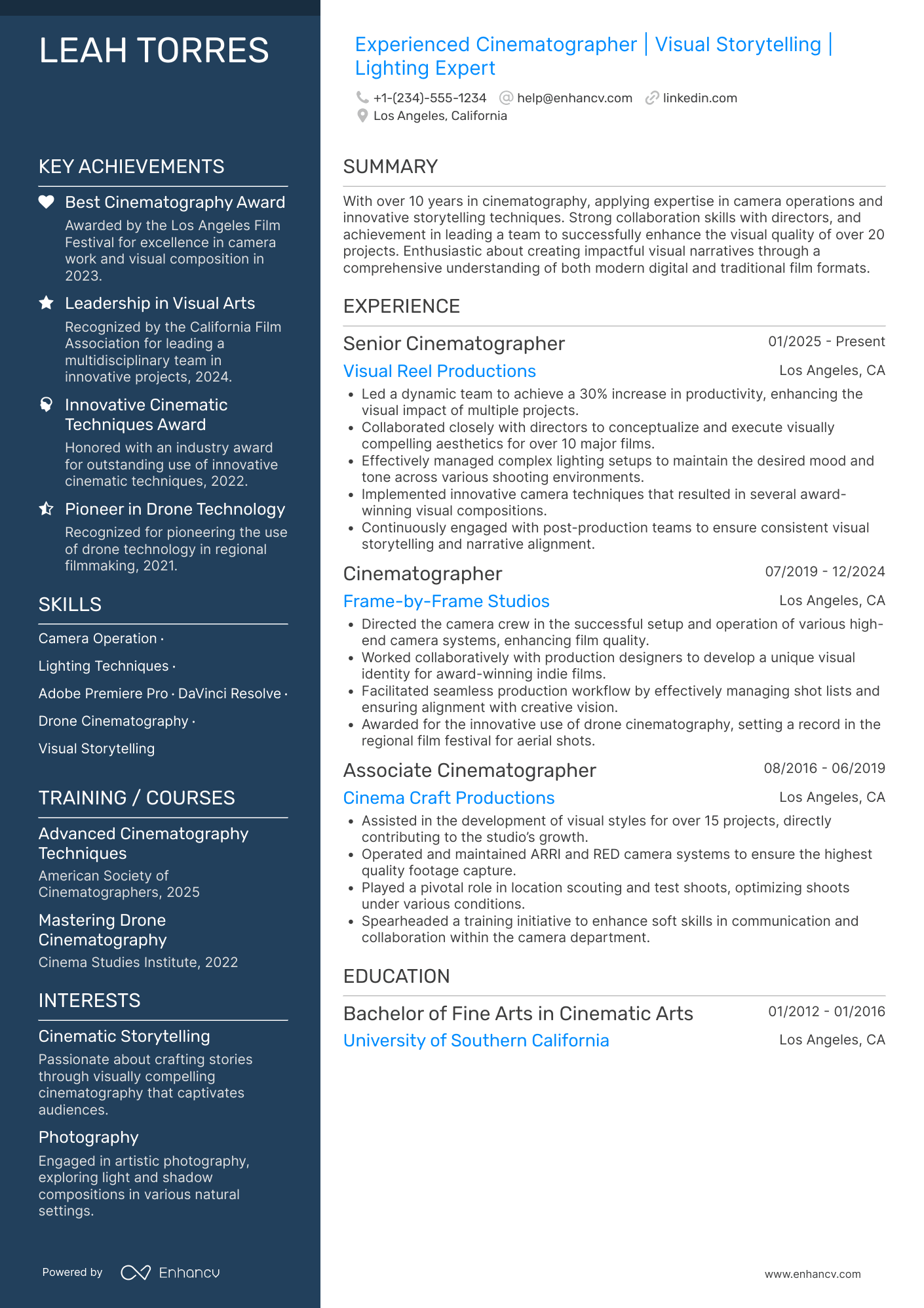
Many cinematographer resume drafts fail because they read like gear lists and shot credits without context. That format gets buried in ATS screening and loses in ten-second recruiter scans, especially when competition includes award-winning reels.
The companion cinematographer cover letter is where you give a producer the why behind your reel — the look you were building, the constraints you shot inside, the director you served.
A strong resume shows what your work delivered and why it mattered. Knowing how to make your resume stand out is critical in this field. You should highlight on-time shoots, budget control, improved lighting consistency, reduced reshoot rates, faster turnaround, higher client approvals, festival selections, and measurable engagement lifts.

Key takeaways
- Quantify cinematography achievements with metrics like reshoot reduction, delivery speed, and budget savings.
- Tailor camera systems, lighting rigs, and color tools to match each job posting's language.
- Use reverse-chronological format for experienced cinematographers and hybrid format for career changers.
- Anchor every listed skill in a specific project outcome within your experience section.
- Include reel links, festival selections, and distribution results to prove real visual impact.
- Enhancv can help you turn vague on-set duties into measurable, recruiter-ready resume bullets.
- Stop editing once your resume accurately reflects your experience—don't let AI inflate claims.
How to format a cinematographer resume
Recruiters evaluating cinematographer resumes prioritize a strong visual portfolio history, technical camera and lighting expertise, and a track record of completed productions across formats like film, television, and commercial work. The right resume format ensures these signals—your progression through increasingly complex projects and your command of industry-standard tools—are immediately visible rather than buried.

I have significant experience in this role—which format should I use?
Use a reverse-chronological format to lead with your most recent and highest-profile productions first. Do:
- Lead each role entry with the scope of your work—production type, budget scale, crew size managed, and whether you served as director of photography or camera operator.
- Highlight technical proficiency with role-specific tools and systems such as ARRI Alexa, RED cameras, DaVinci Resolve, anamorphic lens packages, and lighting rigs relevant to each production.
- Quantify outcomes wherever possible—festival selections, viewership numbers, awards, or on-time delivery under budget constraints.
I'm junior or switching into this role—what format works best?
A hybrid format works best, letting you showcase technical camera and lighting skills prominently while supporting them with relevant production experience or adjacent roles. Do:
- Place a skills section near the top featuring camera systems, lighting setups, color science knowledge, and post-production tools you're proficient in.
- Include short film projects, student work, second-unit roles, gaffer or camera assistant credits, and any freelance or transitional production experience that demonstrates on-set capability.
- Connect each action to a visible result so hiring managers can assess your readiness for larger-scale work.
Why not use a functional resume?
A functional format strips away the production-by-production context that cinematography hiring managers need, making it impossible to evaluate the scope, genre range, and technical demands of each project you've contributed to. A functional format may still be acceptable if you're transitioning from a related field (such as photography, gaffing, or editing), have limited on-set credits, or need to address gaps between productions—but only if every listed skill is tied directly to a specific project and its outcome.
Now that you've established a clean, readable layout, it's time to fill each part of your resume with the right content.
What sections should go on a cinematographer resume
Recruiters expect a clean, production-focused resume that shows your credits, technical strengths, and on-set results. Understanding which resume sections to include helps you organize your content for maximum impact.
Use this structure for maximum clarity:
- Header
- Summary
- Experience
- Skills
- Projects
- Education
- Certifications
- Optional sections: Awards, Publications, Languages
Strong experience bullets should emphasize visual outcomes, production scope, and measurable results, such as faster setups, smoother shoots, and consistent look across scenes.
Is your resume good enough?
Drop your resume here or choose a file. PDF & DOCX only. Max 2MB file size.
Once you’ve organized your resume with the right components, the next step is to detail your work history in a way that shows your impact and fit for cinematography roles.
How to write your cinematographer resume experience
The experience section is where you prove you've shipped real visual work—using industry-standard cameras, lighting setups, and color workflows—while delivering measurable results like on-time delivery, budget adherence, or audience engagement. Hiring managers prioritize demonstrated impact over descriptive task lists, so every line should connect your cinematography skills to outcomes a production team or client actually valued.
Each entry should include:
- Job title
- Company and location (or remote)
- Dates of employment (month and year)
Three to five concise bullet points showing what you owned, how you executed, and what outcomes you delivered:
- Ownership scope: the productions, visual departments, camera units, or shot pipelines you were directly accountable for as a cinematographer.
- Execution approach: the camera systems, lens packages, lighting rigs, color science workflows, or pre-visualization methods you used to shape the look and deliver final footage.
- Value improved: changes to visual quality, post-production efficiency, on-set turnaround time, color consistency, or technical reliability that resulted from your cinematography decisions.
- Collaboration context: how you worked with directors, gaffers, colorists, production designers, VFX supervisors, or clients to align the visual language with the project's creative and logistical goals.
- Impact delivered: outcomes expressed through project scale, distribution reach, festival selection, client retention, or production savings rather than a list of daily tasks you performed on set.
Experience bullet formula
A cinematographer experience example
✅ Right example - modern, quantified, specific.
Director of Photography (Cinematographer)
Northlight Studios | Los Angeles, CA
2022–Present
Boutique commercial and branded-content studio producing campaigns for national consumer, automotive, and tech clients across digital and broadcast.
- Led lighting design and camera strategy for thirty-five shoots using ARRI Alexa Mini LF and RED V-RAPTOR, improving client approval on first cut by 28% through consistent exposure, color, and coverage plans.
- Built repeatable preproduction workflows in ShotDeck, Frame.io, and StudioBinder—shot lists, look books, and camera tests—cutting on-set decision time by 18% and reducing overtime costs by $42K annually.
- Executed complex movement setups with DJI Ronin 2, Steadicam, and Dana Dolly, increasing usable takes per hour by 22% while maintaining safety compliance with stunt coordinators and production managers.
- Partnered with directors, production designers, and gaffers to standardize lighting packages (Aputure 600D, Astera Titan Tubes, and LiteMat) and power plans, reducing lighting setup time by 25% across multi-location days.
- Managed color pipeline from on-set monitoring (Teradek Bolt, Flanders Scientific) through ACES-based dailies in DaVinci Resolve, cutting color revision rounds by 30% and tightening final delivery by two days per project.
Now that you've seen how a strong experience section comes together, let's look at how to adjust those details to match the specific job you're targeting.
How to tailor your cinematographer resume experience
Recruiters evaluate your cinematographer resume through both applicant tracking systems and human review, so tailoring your resume to the job description is essential. Tailoring ensures the specific tools, techniques, and workflows you've used match what the production company or studio is looking for.
Ways to tailor your cinematographer experience:
- Match camera systems and lens packages named in the job description.
- Mirror the post-production color grading software the listing specifies.
- Reference lighting techniques or setups the production style demands.
- Include genre or format experience relevant to the project type.
- Highlight collaboration with directors and gaffers using their workflow terms.
- Use the same terminology for aspect ratios or delivery standards mentioned.
- Emphasize on-location or studio shooting environments the role requires.
- Align your metrics with the production scale or output goals listed.
Tailoring means connecting your real accomplishments to what the role demands, not forcing unrelated keywords into your experience section.
Resume tailoring examples for cinematographer
| Job description excerpt | Untailored | Tailored |
|---|---|---|
| Seeking a cinematographer experienced in ARRI Alexa Mini and anamorphic lenses for narrative feature films with heavy natural-light interior work | Operated cameras on various film sets and handled different lighting conditions. | Shot three narrative features on ARRI Alexa Mini using Hawk V-Lite anamorphic lenses, designing natural-light interior setups that reduced lighting equipment costs by 40% while maintaining consistent exposure across 60+ interior scenes. |
| Looking for a DP skilled in DaVinci Resolve color workflows who can collaborate closely with VFX teams on green-screen compositing for episodic television | Worked on post-production and collaborated with different departments during projects. | Managed on-set color pipelines in DaVinci Resolve for two episodic television series, coordinating ACES color-space handoffs with VFX teams and supervising green-screen compositing across 18 episodes to ensure seamless visual continuity. |
| Cinematographer needed for documentary-style branded content shot run-and-gun on Sony FX6 with gimbal rigs in unpredictable field environments | Filmed content in several locations using handheld and stabilized camera setups. | Captured over 200 hours of documentary-style branded content on Sony FX6 mounted on DJI RS 3 Pro gimbal rigs, adapting to uncontrolled field environments across 15 locations while delivering footage that met strict brand guidelines and broadcast-ready technical specs. |
Once you’ve aligned your experience with the role’s requirements, the next step is to quantify your cinematographer achievements so hiring teams can quickly see the impact behind those choices.
How to quantify your cinematographer achievements
Quantifying your achievements proves you improved quality, speed, and reliability—not just aesthetics. Focus on delivery timelines, reshoot reduction, lighting and camera consistency, budget efficiency, and audience or stakeholder response tied to specific projects.
Quantifying examples for cinematographer
| Metric | Example |
|---|---|
| Delivery speed | "Delivered a six-day commercial shoot one day early by tightening shot lists and using a two-camera RED Komodo setup." |
| Reshoot reduction | "Cut reshoots from four scenes to one by building lighting diagrams in Shot Designer and enforcing on-set exposure checks." |
| Budget efficiency | "Saved $8,500 in rentals by standardizing on Aputure 600D lights and negotiating a three-week package rate." |
| Color consistency | "Reduced color-matching fixes by 30% by capturing X-Rite ColorChecker frames per setup and aligning LUTs in DaVinci Resolve." |
| Stakeholder approval time | "Shortened client review cycles from three rounds to two by sharing Frame.io dailies within six hours and tagging selects with notes." |
Turn vague job duties into measurable, recruiter-ready resume bullets in seconds with Enhancv's Bullet Point Generator.
Once you've crafted strong bullet points for your experience section, the next step is ensuring your skills section effectively highlights the right mix of hard and soft skills for a cinematographer role.
How to list your hard and soft skills on a cinematographer resume
Your skills section shows how you deliver consistent visuals on set, and recruiters and ATS scan this section for camera, lighting, and workflow keywords, so aim for a mostly hard-skill mix supported by role-specific collaboration skills. Cinematographer roles require a blend of:
- Product strategy and discovery skills.
- Data, analytics, and experimentation skills.
- Delivery, execution, and go-to-market discipline.
- Soft skills.
Your skills section should be:
- Scannable (bullet-style grouping).
- Relevant to the job post.
- Backed by proof in experience bullets.
- Updated with current tools.
Place your skills section:
- Above experience if you're junior or switching careers.
- Below experience if you're mid/senior with strong achievements.

Hard skills
Listing relevant hard skills is essential for passing ATS screening and demonstrating technical proficiency:
- Digital cinematography, exposure control
- Lighting design, grip, rigging
- Camera operation: handheld, Steadicam, gimbal
- Lens selection, filtration, matte box
- Shot listing, storyboards, blocking
- Color science, LUT workflows
- ARRI ALEXA, RED DSMC2
- Sony FX series, Canon Cinema EOS
- DaVinci Resolve, Baselight
- Adobe Premiere Pro, Avid Media Composer
- On-set monitoring, video village setup
- Data wrangling, media ingest, backups
Soft skills
Complement your technical abilities with soft skills that demonstrate your on-set leadership and collaboration:
- Aligning visual language with director
- Leading camera, grip, and electric teams
- Communicating lighting plans under time pressure
- Making fast exposure and framing calls
- Prioritizing coverage when schedules slip
- Giving clear, actionable notes to operators
- Coordinating closely with production design
- Managing set etiquette and safety expectations
- Adapting to location constraints and weather
- Resolving creative disagreements professionally
- Owning image continuity across shooting days
- Collaborating with colorist from dailies to final grade
How to show your cinematographer skills in context
Skills shouldn't live only in a bulleted list on your resume. Browse examples of how other professionals present their resume skills for inspiration on integrating them throughout your document.
They should be demonstrated in:
- Your summary (high-level professional identity)
- Your experience (proof through outcomes)
Here's how that looks in practice.
Summary example
Senior cinematographer with 12 years of experience in narrative features and commercial work. Skilled in ARRI Alexa, dynamic lighting design, and collaborative visual storytelling. Led camera departments on productions grossing over $45 million combined.
- Specifies senior-level experience clearly
- Names industry-standard tools directly
- Includes a concrete revenue metric
- Highlights collaboration as a strength
Experience example
Senior Cinematographer
Ember Light Films | Vancouver, BC
March 2019–Present
- Operated ARRI Alexa Mini on eight feature projects, reducing average lighting setup time by 22% through pre-visualization workflows.
- Collaborated with directors and production designers to develop visual palettes, earning two regional cinematography awards across four festival submissions.
- Managed a five-person camera department and implemented DaVinci Resolve dailies review, cutting post-production color correction time by 30%.
- Every bullet includes a measurable outcome.
- Skills appear naturally within real achievements.
Once you’ve anchored your abilities in real project outcomes and responsibilities, the next step is applying that same approach to structuring a cinematographer resume when you don’t have formal experience.
How do I write a cinematographer resume with no experience
Even without full-time experience, you can demonstrate readiness through personal projects and adjacent roles. Our guide on building a resume without work experience covers this approach in detail. Consider showcasing:
- Student short film cinematography credits
- Spec commercials shot for brands
- Music video shoots for artists
- Documentary interviews and b-roll packages
- Second camera operator on sets
- Gaffer and lighting assistant work
- Camera tests and lens comparisons
- Film festival submissions and screenings
Focus on:
- Reel links with timestamps
- Lighting setups and camera settings
- Consistent visual style across projects
- Gear proficiency and workflow evidence
Resume format tip for entry-level cinematographer
Use a hybrid resume format because it highlights projects and tools first, while still showing education and set roles that build credibility. Do:
- Lead with a projects section and reel link.
- List each project with role, year, and format.
- Add camera, lens, and lighting details.
- Quantify results like views or selections.
- Match keywords from the job posting.
- Shot a two-day spec commercial on Sony FX3 and Sigma 24–70mm, lit with Aputure 120d, and delivered a sixty-second cut that reached 12,400 views in seven days.
Even without professional experience, your educational background can serve as a strong foundation for your cinematographer resume.
How to list your education on a cinematographer resume
Your education section helps hiring teams confirm you have foundational training in visual storytelling, camera technology, and film production techniques relevant to the cinematographer role.
Include:
- Degree name
- Institution
- Location
- Graduation year
- Relevant coursework (for juniors or entry-level candidates)
- Honors & GPA (if 3.5 or higher)
Avoid listing specific months or days—use the graduation year only.
Here's a strong education entry tailored for a cinematographer resume.
Example education entry
Bachelor of Fine Arts in Cinematography
American Film Institute, Los Angeles, CA
Graduated 2021
GPA: 3.7/4.0
- Relevant Coursework: Advanced Camera Systems, Lighting for Narrative Film, Digital Color Grading, Visual Composition
- Honors: Dean's List (all semesters), AFI Outstanding Cinematography Award recipient
How to list your certifications on a cinematographer resume
Certifications show your commitment to learning, prove tool proficiency, and signal industry relevance as a cinematographer. They also help hiring teams trust your technical foundation and workflow discipline.
Include:
- Certificate name
- Issuing organization
- Year
- Optional: credential ID or URL
- Place certifications below education when your degree is recent and your certifications add supporting proof, not your main qualification.
- Place certifications above education when they are recent, highly relevant to the role, or stronger signals than older education.
Best certifications for your cinematographer resume
- ARRI Certified User
- RED Certified
- DJI Academy Certification
- Avid Media Composer Certified User
- DaVinci Resolve Certified End User
- Adobe Certified Professional: Premiere Pro
- FAA Part 107 Remote Pilot Certificate
Once you’ve positioned your credentials to support your technical expertise, move on to your cinematographer resume summary to highlight that value upfront.
How to write your cinematographer resume summary
Your resume summary is the first thing a recruiter reads, so it needs to earn their attention fast. A strong opening frames your cinematography skills and experience before anything else on the page does.
Keep it to three to four lines, with:
- Your title and total years of cinematography experience.
- The domain you work in, such as narrative film, documentary, or commercial production.
- Core tools and technical skills like ARRI, RED, DaVinci Resolve, or lighting design.
- One or two measurable achievements, such as festival selections or project budgets managed.
- Soft skills tied to real outcomes, like collaborative direction that improved on-set efficiency.

PRO TIP
At a junior or mid-level, emphasize technical proficiency, camera systems you've operated, and early project contributions. Avoid vague phrases like "passionate storyteller" or "hard worker." Instead, ground every claim in a specific skill, tool, or result. Skip motivational language entirely and let concrete experience speak for itself.
Example summary for a cinematographer
Cinematographer with four years of experience in indie narrative and commercial production. Skilled in ARRI Alexa, RED, and DaVinci Resolve. Shot three short films selected for regional festivals, consistently delivering projects under budget.
Optimize your resume summary and objective for ATS
Drop your resume here or choose a file.
PDF & DOCX only. Max 2MB file size.
Now that your summary captures your professional value, make sure the header above it presents your contact details clearly and correctly.
What to include in a cinematographer resume header
Your resume header lists your key identity and contact details, and it boosts visibility, credibility, and recruiter screening for a cinematographer role.
Essential resume header elements
- Full name
- Tailored job title and headline
- Location
- Phone number
- Professional email
- GitHub link
- Portfolio link
A LinkedIn link helps recruiters verify experience quickly and supports screening.
Don't include photos on a cinematographer resume unless the role is explicitly front-facing or appearance-dependent.
Keep the header to two lines, match the cinematographer job title to the posting, and link to a portfolio that opens fast on mobile.
Example
Cinematographer resume header
Jordan Rivera
Cinematographer | Documentary and Commercial Lighting, Camera Operation, and Color Workflow
Los Angeles, CA | (323) 555-01XX | your.name@enhancv.com github.com/yourname yourwebsite.com linkedin.com/in/yourname
Once your contact details and professional identifiers are set up for quick recognition, you can strengthen your application with additional sections for cinematographer resumes that add relevant context.
Additional sections for cinematographer resumes
When your core experience and skills don't fully capture your range, additional sections help you stand out with role-specific credibility.
- Languages
- Film festivals and screenings
- Professional memberships and guilds
- Publications and interviews
- Awards and nominations
- Hobbies and interests
- Workshops and masterclasses
Once you've strengthened your resume with well-chosen additional sections, it's worth pairing it with a cover letter to give hiring managers even more context about your qualifications.
Do cinematographer resumes need a cover letter
A cover letter isn't required for every cinematographer role, but it often helps in competitive searches or when hiring managers expect context. If you're unsure where to start, learn what a cover letter is and how it complements your resume. It makes the biggest difference when your resume can't show fit, creative intent, or collaboration style.
Use a cover letter to add details your cinematographer resume can't:
- Explain role and team fit: Align your lighting, camera, and on-set workflow with the director, producer, and postproduction pipeline.
- Highlight one or two relevant projects or outcomes: Name the project, your cinematographer responsibilities, and a measurable result like schedule efficiency or reduced reshoots.
- Show understanding of the product, users, or business context: Connect your cinematographer choices to audience, brand tone, distribution platform, and production constraints.
- Address career transitions or non-obvious experience: Clarify shifts between genres, formats, or roles, and explain how that experience supports this cinematographer position.
Drop your resume here or choose a file.
PDF & DOCX only. Max 2MB file size.
Even if you decide not to include a cover letter and rely on your resume to carry the narrative, using AI to improve your cinematographer resume helps you strengthen that story and present it more clearly.
Using AI to improve your cinematographer resume
AI can sharpen your resume's clarity, structure, and impact. It helps tighten language and align content with specific roles. But overuse strips authenticity. Once your resume reads clearly and fits the role, step away from AI. For specific prompt ideas, check out our guide on ChatGPT resume writing prompts.
Here are ten practical prompts to strengthen different sections of your cinematographer resume:
- Strengthen your summary. "Rewrite my cinematographer resume summary to highlight my top skills, years of experience, and signature visual style in three concise sentences."
- Quantify experience bullets. "Add measurable results to each experience bullet on my cinematographer resume, such as project budgets managed, crew sizes led, or festival selections earned."
- Tighten action verbs. "Replace weak or passive verbs in my cinematographer experience section with strong, industry-specific action verbs like 'captured,' 'operated,' or 'directed.'"
- Tailor skills section. "Compare my cinematographer skills section against this job description and recommend which skills to add, remove, or reorder for relevance."
- Refine project descriptions. "Rewrite the project entries on my cinematographer resume to clearly state my role, the format, and the visual techniques I used."
- Clarify education details. "Edit my cinematographer resume's education section to emphasize relevant coursework, thesis projects, and hands-on production training."
- Highlight certifications. "Reorganize the certifications on my cinematographer resume by relevance and add brief context for each credential's industry value."
- Remove redundant language. "Identify and cut any repetitive phrasing or filler words across my entire cinematographer resume without losing important details."
- Align with job posting. "Adjust my cinematographer resume's summary and experience bullets to mirror the language and priorities found in this specific job listing."
- Improve visual consistency. "Review my cinematographer resume for inconsistent formatting, tense shifts, or punctuation errors and suggest corrections section by section."
Stop using AI once your resume sounds accurate, specific, and aligned with real experience. AI should never invent experience or inflate claims—if it didn't happen, it doesn't belong here.
Conclusion
A strong cinematographer resume shows measurable outcomes, role-specific skills, and clean structure. It highlights lighting, camera operation, lens choices, and color workflow with results like faster setups, fewer reshoots, and on-time deliveries.
Keep your cinematographer resume easy to scan with clear sections, focused bullets, and consistent formatting. This approach signals professionalism and readiness for today’s hiring market and the tools teams will use next.