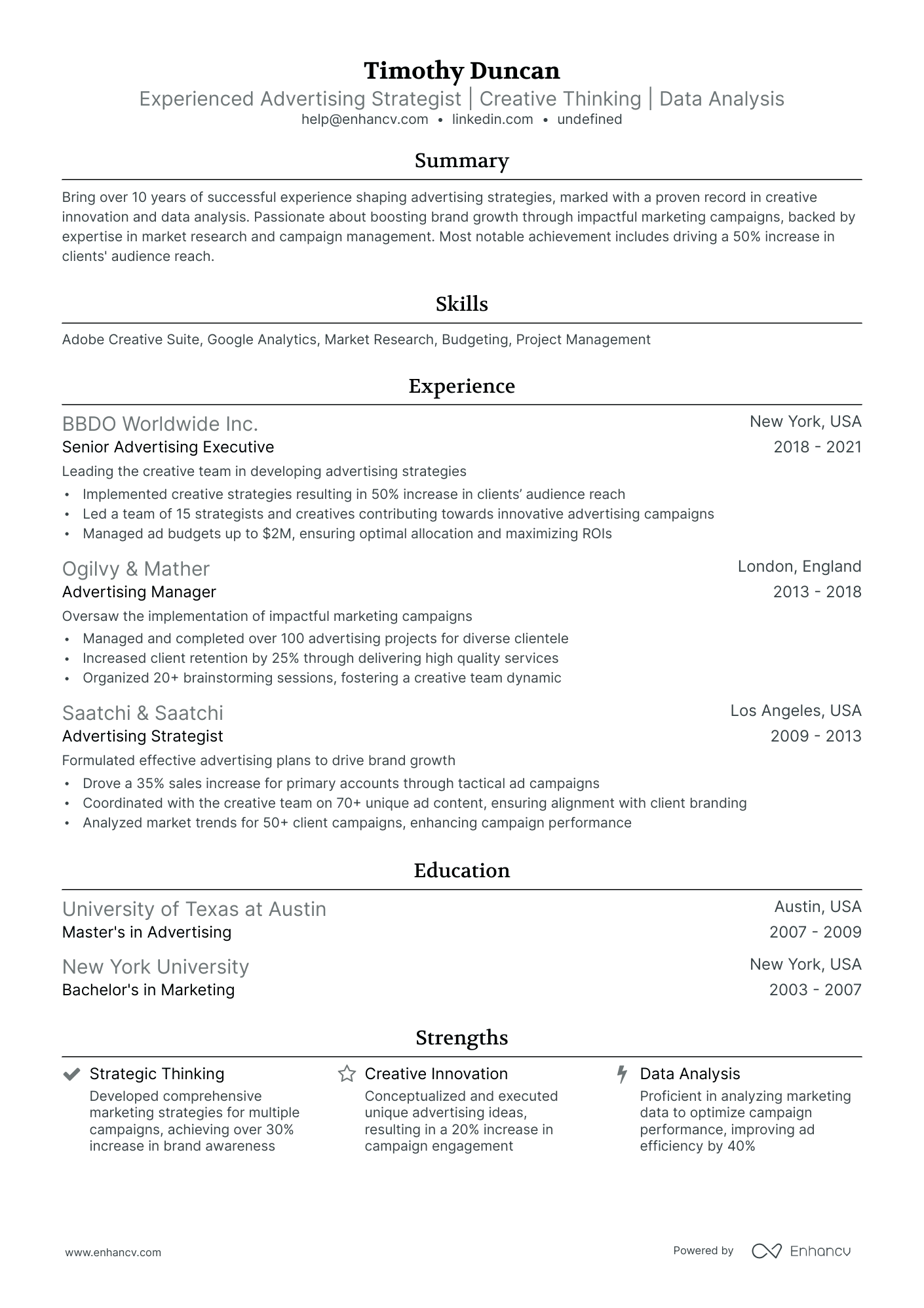
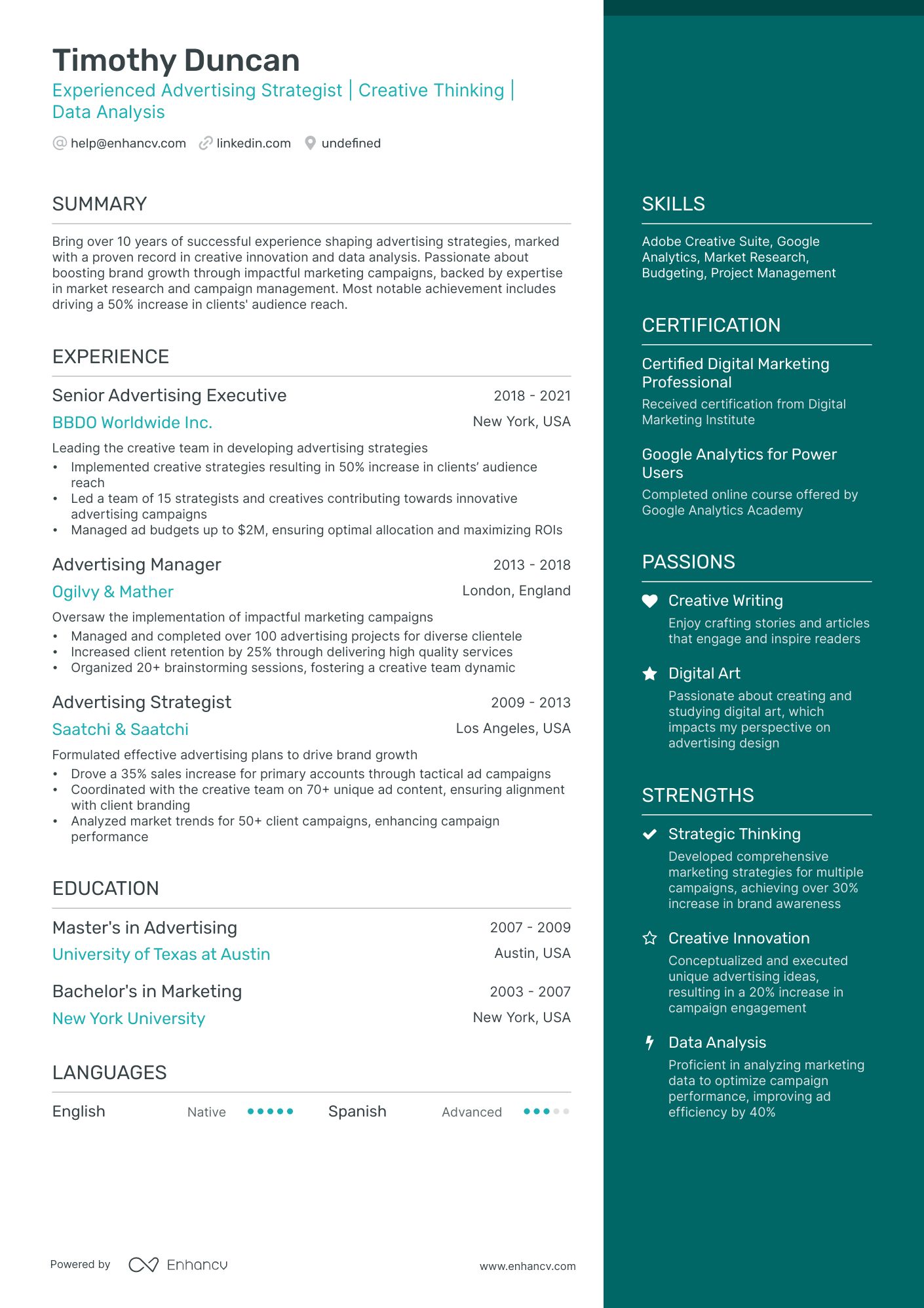
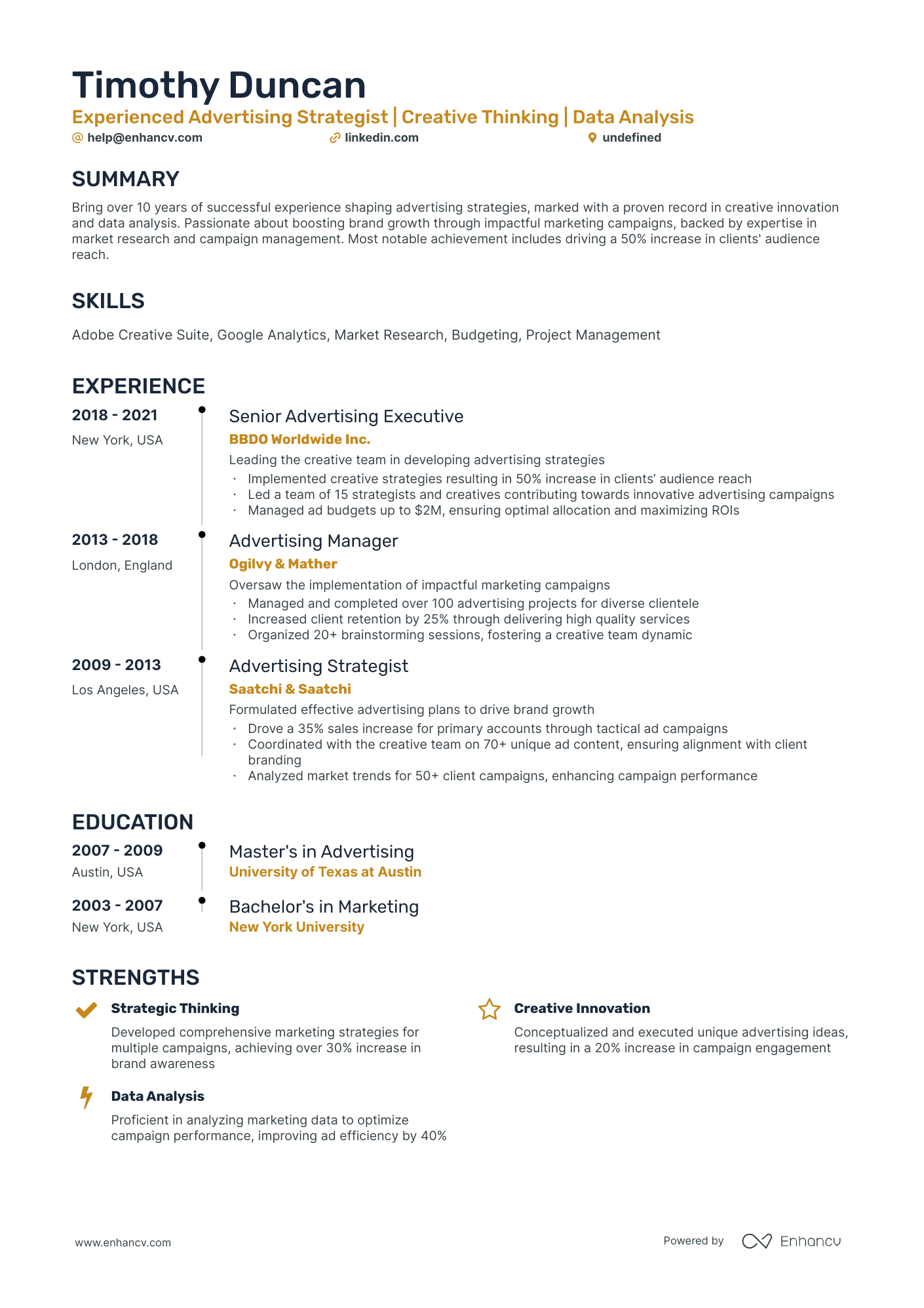
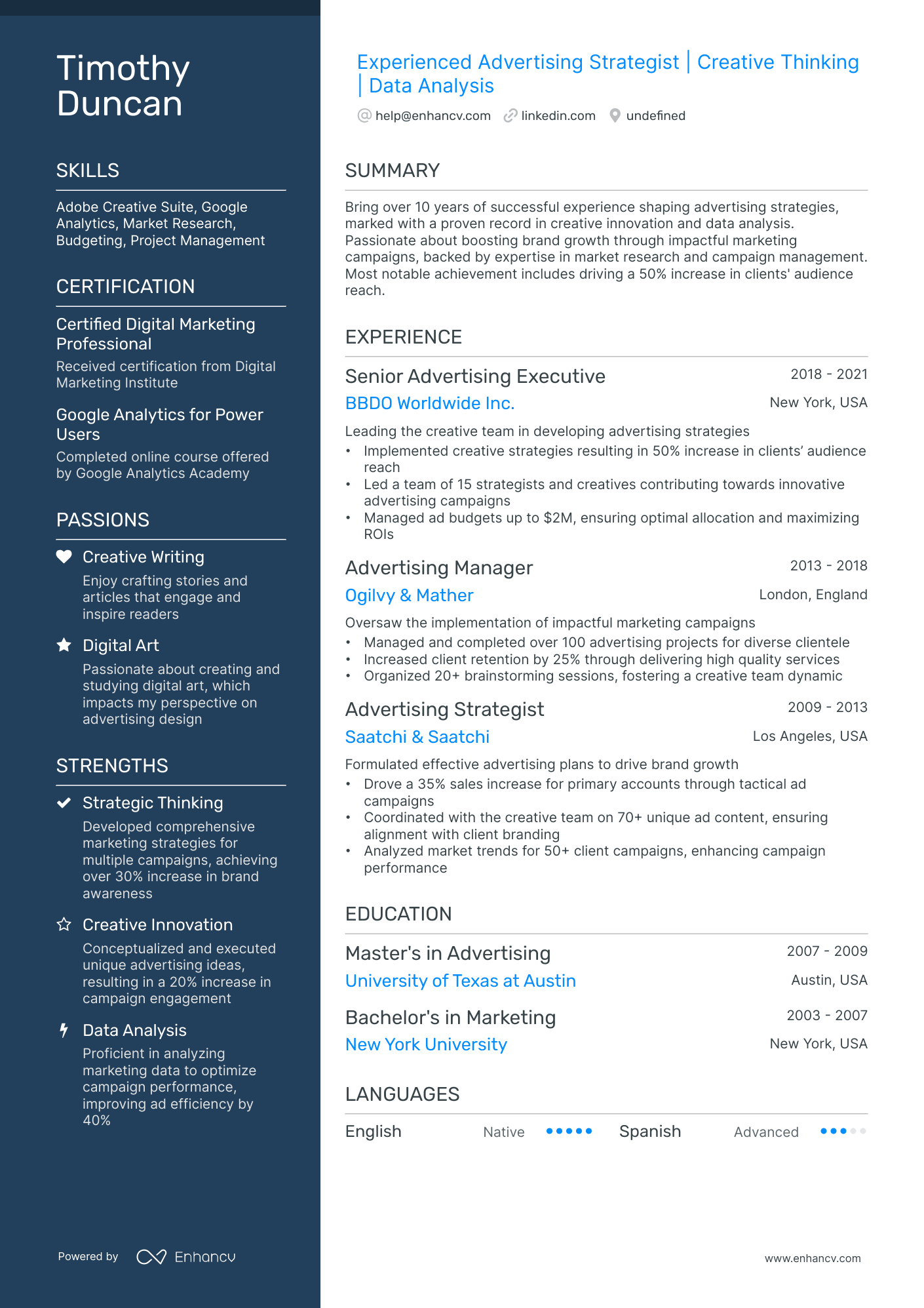
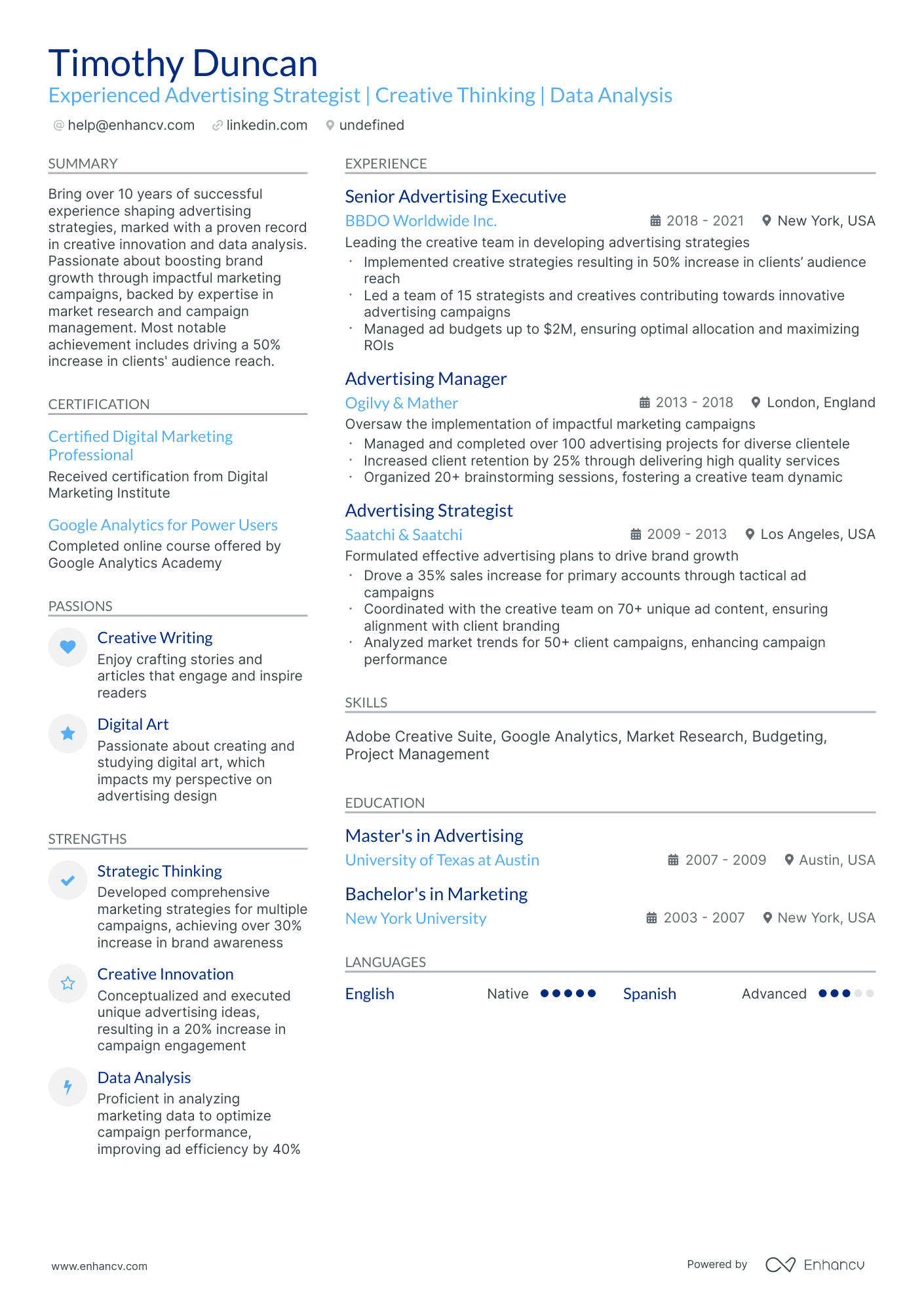
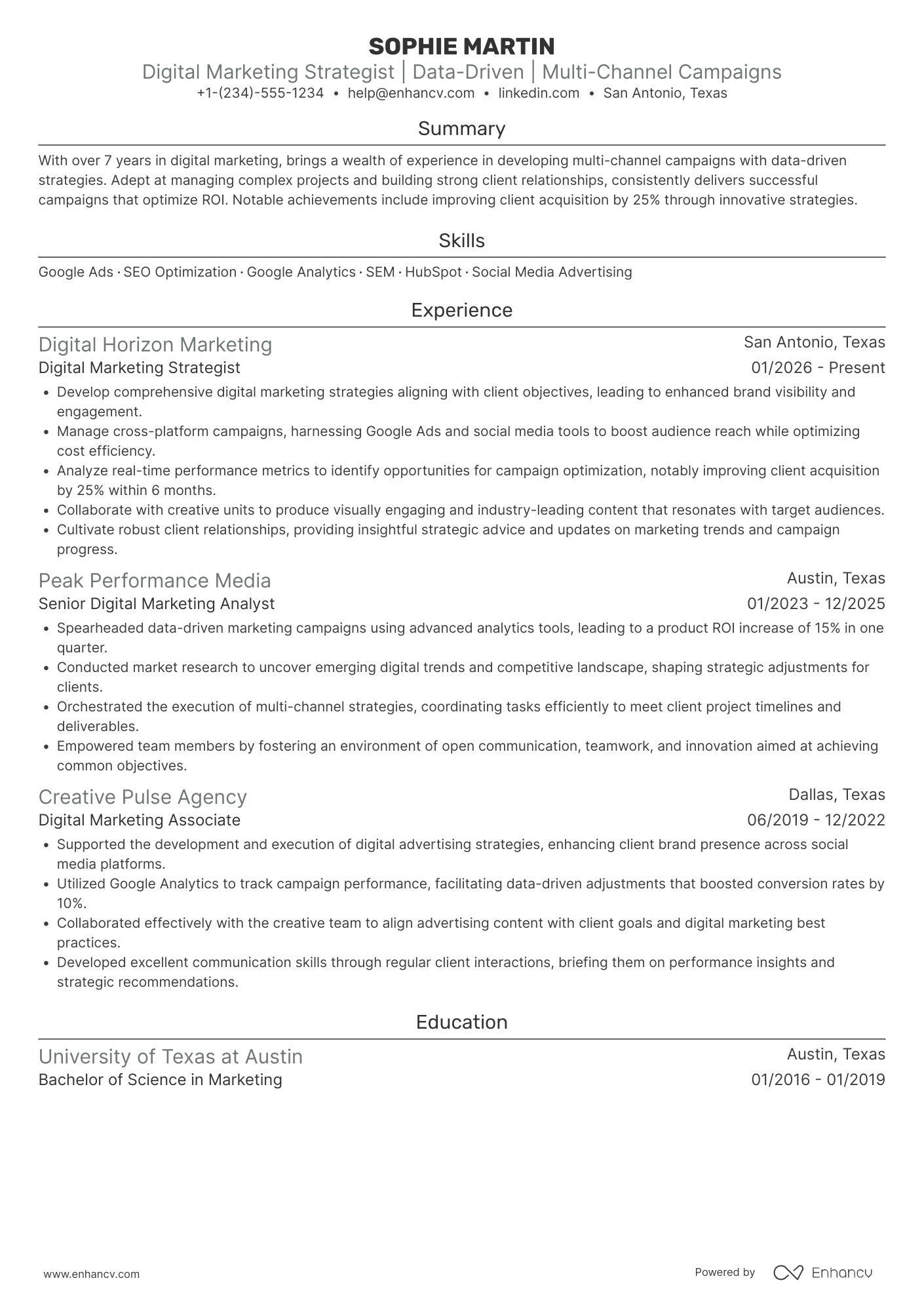
Many advertising agency resumes fail because they read like internal task lists and bury results under tools, clients, and jargon. An advertising agency resume needs fast proof of impact, since applicant tracking systems filter keywords and recruiters scan in seconds amid heavy competition.
A strong resume shows what changed because of your work. Knowing how to make your resume stand out means highlighting revenue lift, cost per acquisition improvements, budget size, campaign reach, on-time launches, brand recall gains, and measurable conversion growth across channels.

Key takeaways
- Anchor every resume bullet to measurable outcomes like revenue lift, cost savings, or conversion growth.
- Use reverse-chronological format for experienced candidates and hybrid format for career changers.
- Mirror the exact platforms, KPIs, and terminology from each job posting you target.
- Place skills above experience if you're junior, below experience if you're senior.
- Demonstrate skills through summary and experience bullets, not just a standalone list.
- Use Enhancv's Bullet Point Generator to turn vague duties into quantified, recruiter-ready statements.
- Stop using AI once your resume accurately reflects real experience without inflated claims.
How to format a advertising agency resume
Recruiters evaluating advertising agency candidates prioritize creative problem-solving, client management breadth, and a proven ability to deliver campaigns that hit measurable business targets. A clean, well-structured resume format ensures these signals surface quickly during both human review and applicant tracking system (ATS) scans. Choosing the right resume layout is just as important as the content itself.

I have significant experience in this role—which format should I use?
Use a reverse-chronological format to present your advertising agency career in a clear, progression-driven narrative. Do:
- Lead each role entry with your scope of ownership—accounts managed, team size, annual billings, and client portfolio breadth.
- Highlight platform and domain expertise relevant to agency work, such as programmatic buying tools, creative suite proficiency, media planning platforms, and cross-channel strategy development.
- Anchor every accomplishment to measurable outcomes like revenue growth, campaign ROI, client retention rates, or award recognition.
I'm junior or switching into this role—what format works best?
A hybrid format works best, letting you lead with relevant skills and supporting them with internships, freelance projects, or transitional experience. Do:
- Place a focused skills section near the top of your resume, covering core advertising competencies like copywriting, media buying, audience segmentation, and creative briefs.
- Include agency internships, freelance campaign work, spec projects, or relevant coursework to demonstrate hands-on exposure to the advertising workflow.
- Connect every listed skill or project to a concrete action and a tangible result so recruiters can assess your potential impact.
Why not use a functional resume?
A functional format strips away the timeline context that advertising recruiters rely on to evaluate campaign involvement, client relationship depth, and professional growth within fast-paced agency environments.
- Career changers moving into advertising from a related creative or marketing field who can map transferable skills—such as project management, client communication, or content creation—directly to agency functions.
- Recent graduates or bootcamp completers with limited formal agency experience but a portfolio of spec campaigns, class projects, or freelance work that demonstrates core advertising competencies.
Now that you've established a clean, readable layout, it's time to fill it with the right sections that highlight your advertising expertise.
What sections should go on a advertising agency resume
Recruiters expect you to present a clear snapshot of your agency experience, client work, and measurable campaign results. Understanding what to put on a resume helps you prioritize the most impactful information.
Use this structure for maximum clarity:
- Header
- Summary
- Experience
- Skills
- Projects
- Education
- Certifications
- Optional sections: Awards, Publications, Languages
Strong experience bullets should emphasize client impact, campaign outcomes, budget and channel scope, and measurable results.
Is your resume good enough?
Drop your resume here or choose a file. PDF & DOCX only. Max 2MB file size.
Once you’ve organized your resume with the right core components, the next step is to write your advertising agency experience in a way that fits that structure and shows your impact.
How to write your advertising agency resume experience
The experience section is where you prove you've shipped campaigns, activated brands, and driven measurable results using the tools and methods advertising agencies rely on daily. Hiring managers prioritize demonstrated impact—revenue influenced, audience growth, client retention—over descriptive task lists that only outline responsibilities.
Each entry should include:
- Job title
- Company and location (or remote)
- Dates of employment (month and year)
Three to five concise bullet points showing what you owned, how you executed, and what outcomes you delivered:
- Ownership scope: the accounts, campaigns, creative deliverables, media channels, or client portfolios you were directly accountable for within the agency.
- Execution approach: the platforms, ad technologies, creative frameworks, research methodologies, or strategic planning processes you used to inform decisions and produce work.
- Value improved: the changes you drove in campaign performance, creative quality, production efficiency, audience engagement, brand consistency, or client satisfaction relevant to your agency role.
- Collaboration context: how you partnered with internal teams—strategists, creatives, media buyers, account leads—or coordinated with clients, vendors, and platform representatives to move work forward.
- Impact delivered: the outcomes you generated expressed as business results, client growth, campaign scale, or revenue contribution rather than a summary of daily activities.
Experience bullet formula
A advertising agency experience example
✅ Right example - modern, quantified, specific.
Performance Marketing Manager
BrightSide Creative | Chicago, IL
2022–Present
Full-service advertising agency managing paid media and creative strategy for twenty-five-plus mid-market ecommerce and software-as-a-service brands.
- Owned multi-channel paid media strategy across Google Ads, Meta Ads Manager, and LinkedIn Campaign Manager, increasing blended return on ad spend from 2.6 to 3.4 while scaling monthly spend from $180K to $310K across eight client accounts.
- Built Looker Studio dashboards with Google Analytics 4, Google Tag Manager, and Supermetrics, cutting weekly reporting time by 60% and improving client on-time deliverables from 85% to 98%.
- Led conversion tracking and attribution fixes—server-side tagging, event schema, and UTM governance—reducing unassigned traffic by 22% and improving lead-to-opportunity match rates by 15% in HubSpot.
- Partnered with creative directors, designers, and copywriters to run structured A/B tests in Optimizely and Meta Experiments, lifting landing page conversion rate by 18% and lowering cost per acquisition by 14% over two quarters.
- Negotiated performance targets and test roadmaps with client stakeholders, aligning media, creative, and web teams in Asana and Slack to ship campaigns two days faster on average and reduce last-minute change requests by 30%.
Now that you've seen how to structure your experience entries, let's look at how to customize them for each specific advertising agency role you're targeting.
How to tailor your advertising agency resume experience
Recruiters evaluate your experience through applicant tracking systems and manual review, both scanning for alignment with the job posting. Tailoring your resume to the job description ensures your strongest qualifications surface immediately against each role's specific requirements.
Ways to tailor your advertising agency experience:
- Mirror the exact ad platforms and buying tools listed in the posting.
- Match creative software and production technologies the agency specifies.
- Use the same terminology for campaign strategies or media planning processes.
- Reflect KPIs like ROAS or engagement rates the role prioritizes.
- Highlight industry verticals or client categories relevant to the agency's portfolio.
- Emphasize cross-functional collaboration with creative and account teams when referenced.
- Include experience with brand compliance or regulatory standards the posting mentions.
- Align your workflow language with the project management frameworks they use.
Tailoring means connecting your real accomplishments to what the role demands, not forcing unrelated keywords into your experience.
Resume tailoring examples for advertising agency
| Job description excerpt | Untailored | Tailored |
|---|---|---|
| "Manage multi-channel campaign launches across paid social, programmatic display, and CTV for CPG clients using platforms like The Trade Desk and Meta Ads Manager." | Managed digital advertising campaigns across multiple channels for various clients. | Managed 12+ concurrent campaign launches across paid social, programmatic display, and CTV for CPG clients, optimizing delivery through The Trade Desk and Meta Ads Manager to achieve a 23% lower cost per acquisition. |
| "Develop creative briefs and coordinate production timelines between copywriters, art directors, and video editors to deliver assets for client approvals within sprint cycles." | Worked with creative teams to produce marketing materials on time. | Developed creative briefs and coordinated two-week sprint cycles across copywriters, art directors, and video editors, delivering 40+ approved assets per quarter while reducing client revision rounds by 30%. |
| "Analyze post-campaign performance using Google Analytics 4 and Datorama dashboards to generate client-facing reports with actionable media mix recommendations." | Created reports on campaign performance for stakeholders. | Built client-facing post-campaign reports in Datorama using Google Analytics 4 data, translating performance insights into media mix recommendations that shifted 15% of spend toward higher-performing channels. |
Once you’ve aligned your experience with the role and agency priorities, quantify your advertising agency achievements to prove that impact with clear, measurable results.
How to quantify your advertising agency achievements
Quantifying your achievements proves you drove outcomes, not just activity. Focus on revenue lift, conversion and engagement changes, cost efficiency, cycle time, and client satisfaction across campaigns, channels, and accounts.
Quantifying examples for advertising agency
| Metric | Example |
|---|---|
| Revenue lift | "Drove a 14% quarter-over-quarter revenue lift for a retail client by optimizing Meta and Google Ads budgets in weekly pacing dashboards." |
| Conversion rate | "Improved landing page conversion rate from 2.1% to 3.0% by coordinating A/B tests in Optimizely and aligning creative with keyword intent." |
| Cost efficiency | "Reduced cost per acquisition by 18% while holding volume steady by restructuring campaigns, adding negatives, and tightening audience exclusions in Google Ads." |
| Turnaround time | "Cut creative turnaround time from five days to three days by standardizing briefs, using Asana templates, and adding a two-step review workflow." |
| Client satisfaction | "Raised client satisfaction from 7.8 to 9.1 out of 10 by setting weekly performance readouts, clarifying approvals, and resolving scope changes within 24 hours." |
Turn vague job duties into measurable, recruiter-ready resume bullets in seconds with Enhancv's Bullet Point Generator.
Once you've crafted strong bullet points to showcase your experience, the next step is ensuring your resume also highlights the right hard and soft skills employers at advertising agencies look for.
How to list your hard and soft skills on a advertising agency resume
Your skills section shows you can plan, launch, and optimize campaigns—recruiters and an ATS (applicant tracking system) scan this section to confirm role fit fast—so aim for a mix of hard skills and job-specific soft skills.
advertising agency roles require a blend of:
- Product strategy and discovery skills.
- Data, analytics, and experimentation skills.
- Delivery, execution, and go-to-market discipline.
- Soft skills.
Your skills section should be:
- Scannable (bullet-style grouping).
- Relevant to the job post.
- Backed by proof in experience bullets.
- Updated with current tools.
Place your skills section:
- Above experience if you're junior or switching careers.
- Below experience if you're mid/senior with strong achievements.

Hard skills
- Google Ads, Microsoft Advertising
- Meta Ads Manager, TikTok Ads
- LinkedIn Campaign Manager
- Programmatic buying, demand-side platforms
- Google Analytics 4, Looker Studio
- Tag Manager, conversion tracking
- Search engine optimization keyword research
- A/B testing, incrementality testing
- Media planning, budget pacing
- Creative brief development, messaging frameworks
- CRM targeting, audience segmentation
- UTM governance, attribution reporting
Soft skills
- Translate client goals into briefs
- Present strategy to stakeholders
- Align creative, media, and analytics
- Manage feedback without scope creep
- Prioritize work across accounts
- Make tradeoffs under tight timelines
- Turn insights into clear next steps
- Write concise, actionable documentation
- Run effective status and kickoff meetings
- Escalate risks early with solutions
- Negotiate expectations and deliverables
- Maintain quality under fast turnarounds
How to show your advertising agency skills in context
Skills shouldn't live only in a bulleted list on your resume. Explore examples of resume skills to see how top candidates present their abilities effectively.
They should be demonstrated in:
- Your summary (high-level professional identity)
- Your experience (proof through outcomes)
Here's what that looks like in practice.
Summary example
Senior account director with 10+ years in full-service advertising, leading cross-functional teams through integrated campaigns using programmatic media buying and audience segmentation. Grew client retention 34% by aligning creative strategy with data-driven performance benchmarks.
- Reflects senior-level experience clearly
- Names role-relevant tools and methods
- Includes a concrete, measurable outcome
- Signals leadership and collaboration skills
Experience example
Senior Account Director
Ridgeline Collective | Chicago, IL
June 2018–March 2024
- Directed integrated campaigns across paid, earned, and owned channels, boosting average client ROI by 27% over three years.
- Partnered with creative, media, and analytics teams to launch a programmatic strategy that cut cost-per-acquisition by 19%.
- Managed a $4.2M annual media budget using Google Campaign Manager, delivering 98% on-time activation across 12 concurrent accounts.
- Every bullet includes measurable proof.
- Skills surface naturally through real outcomes.
Once you’ve demonstrated your agency-relevant strengths through specific examples, the next step is learning how to write an advertising agency resume with no experience by translating those examples into credible resume content.
How do I write a advertising agency resume with no experience
Even without full-time experience, you can demonstrate readiness through:
- Student ad campaign case studies
- Freelance social media ad management
- Campus organization promo campaigns
- Internship or job shadow deliverables
- Spec creative for real brands
- Google Ads certification projects
- Portfolio with copy and design
- Analytics reports from test campaigns
If you're building a resume without work experience, focus on:
- Results with clear metrics
- Portfolio links and campaign assets
- Relevant tools and platforms used
- Process: brief to reporting
Resume format tip for entry-level advertising agency
Use a combination resume format because it highlights skills and projects first, while still showing work history and leadership experience. Do:
- Add a portfolio link near your header.
- Write bullets with tools, actions, and outcomes.
- Tailor keywords to the job description.
- Include role, scope, and target audience.
- List certifications with completion dates.
- Built a Google Ads search campaign in Google Ads, ran keyword research, and improved click-through rate by 28% over two weeks using A/B ad copy tests.
Even without professional experience, your education section can demonstrate the foundational knowledge and relevant coursework that make you a strong candidate for an advertising agency role.
How to list your education on a advertising agency resume
Your education section helps hiring teams at an advertising agency confirm you have the foundational knowledge needed. It validates your training in communications, marketing, design, or strategy.
Include:
- Degree name
- Institution
- Location
- Graduation year
- Relevant coursework (for juniors or entry-level candidates)
- Honors & GPA (if 3.5 or higher)
Skip month and day details—list the graduation year only.
Here's a strong education entry tailored for an advertising agency role.
Example education entry
Bachelor of Arts in Advertising and Public Relations
University of Florida, Gainesville, FL
Graduated 2022
GPA: 3.7/4.0
- Relevant coursework: Consumer Behavior, Creative Strategy, Media Planning, Digital Campaign Analytics
- Honors: Magna Cum Laude, Dean's List (six semesters)
How to list your certifications on a advertising agency resume
Certifications on your resume show your commitment to learning, prove tool proficiency, and signal industry relevance for an advertising agency resume. They also help hiring managers trust your skills beyond job titles.
Include:
- Certificate name
- Issuing organization
- Year
- Optional: credential ID or URL
- Place certifications below education when they are older, less relevant, or you have stronger, recent education credentials to highlight first.
- Place certifications above education when they are recent, highly relevant to the role, or required for the advertising agency position.
Best certifications for your advertising agency resume
- Google Ads Certification
- Meta Certified Digital Marketing Associate
- Google Analytics Certification
- HubSpot Content Marketing Certification
- HubSpot Inbound Marketing Certification
- IAB Digital Media Sales Certification
- Hootsuite Social Marketing Certification
Once you’ve included your credentials where they’re easiest to verify, shift to your advertising agency resume summary to show how those qualifications support the value you deliver.
How to write your advertising agency resume summary
Your resume summary is the first thing a recruiter reads. A strong one instantly connects your experience to what the agency needs right now.
Keep it to three to four lines, with:
- Your current title and total years in advertising or marketing.
- The types of agencies, clients, or industries you've worked across.
- Core skills like media planning, campaign strategy, or creative direction.
- One or two measurable wins, such as revenue growth or engagement lifts.
- Collaborative strengths tied to real outcomes, like cross-functional campaign launches.

PRO TIP
At a junior level, lead with relevant skills, tools, and any early results you drove. Recruiters want to see you can contribute quickly. Avoid vague phrases like "passionate self-starter" or "eager to learn." Replace them with specifics—name the platforms you've used and the campaigns you've supported. Even small metrics, like social engagement rates or project turnaround times, carry more weight than enthusiasm alone.
Example summary for a advertising agency
Junior advertising coordinator with two years of experience supporting integrated campaigns for CPG and retail clients. Managed social content calendars across three accounts, increasing average engagement rates by 24%. Skilled in Google Analytics, Meta Ads Manager, and cross-team coordination.
Optimize your resume summary and objective for ATS
Drop your resume here or choose a file.
PDF & DOCX only. Max 2MB file size.
Now that your summary captures your advertising strengths at a glance, make sure your header presents the essential contact and professional details recruiters need to reach you.
What to include in a advertising agency resume header
A resume header is the top section with your identity and contact details, and it boosts visibility, credibility, and recruiter screening for a advertising agency.
Essential resume header elements
- Full name
- Tailored job title and headline
- Location
- Phone number
- Professional email
- GitHub link
- Portfolio link
A LinkedIn link helps recruiters verify experience quickly and supports screening.
Do not include photos on a advertising agency resume unless the role is explicitly front-facing or appearance-dependent.
Match your header job title to the advertising agency posting and keep every link current, readable, and consistent across platforms.
Example
Advertising agency resume header
Jordan Lee
Copywriter | Brand Campaigns and Social Ads
New York, NY
(212) 555-01XX
your.name@enhancv.com
github.com/yourname
yourwebsite.com
linkedin.com/in/yourname
Once your header clearly identifies you and your key contact details, you can strengthen the rest of your application with additional sections for advertising agency resumes that add relevant context.
Additional sections for advertising agency resumes
Standing out in a crowded talent pool means showcasing skills and experiences that go beyond the standard resume format.
Additional sections help you demonstrate creativity, cultural fit, and industry credibility that hiring managers at any advertising agency actively seek.
Consider adding these sections when relevant to your target role:
- Languages
- Portfolio links and creative campaigns
- Industry awards and recognition
- Publications and thought leadership
- Professional affiliations and ad industry memberships
- Volunteer work with nonprofit branding or pro bono campaigns
- Hobbies and interests tied to creative or cultural trends
Once you've rounded out your resume with the right supplementary sections, it's worth pairing it with a cover letter to strengthen your overall application.
Do advertising agency resumes need a cover letter
An advertising agency resume doesn't always need a cover letter, but it helps in competitive roles or when the advertising agency expects one. If you're unsure about the basics, learn what a cover letter is and how it can make a difference when your fit, outcomes, or context needs explanation beyond bullets.
Use these pointers to decide what to include:
- Explain role or team fit by naming the advertising agency's discipline and how you collaborate with strategy, creative, and account teams.
- Highlight one or two relevant projects or outcomes, and quantify impact like lift in conversions, lower cost per acquisition, or faster launch cycles.
- Show you understand the product, users, or business context by referencing the client category, audience, channel mix, and success metrics.
- Address career transitions or non-obvious experience by connecting past work to agency needs, and clarifying scope, tools, and responsibilities.
Drop your resume here or choose a file.
PDF & DOCX only. Max 2MB file size.
Once you’ve decided whether a cover letter adds value to your advertising agency application, the next step is using AI to strengthen your advertising agency resume so it carries more of the impact on its own.
Using AI to improve your advertising agency resume
AI can sharpen your resume's clarity, structure, and impact. It helps tighten language and highlight results. But overuse dulls authenticity. Once your content feels clear and aligned with your target role, step away from AI. If you're wondering which AI is best for writing resumes, focus on tools that help you refine rather than fabricate.
Here are 10 practical prompts to strengthen specific sections of your advertising agency resume:
- Strengthen your summary. "Rewrite my resume summary to highlight my most relevant advertising agency experience in three concise sentences with measurable results."
- Quantify campaign results. "Add specific metrics to my experience bullets that show the business impact of my work at an advertising agency."
- Sharpen action verbs. "Replace weak or vague verbs in my advertising agency experience section with strong, industry-specific action verbs."
- Align skills strategically. "Compare my skills section to this advertising agency job description and suggest which skills to add or remove."
- Trim redundant language. "Remove filler words and redundant phrases from my advertising agency resume without losing any key details."
- Clarify project contributions. "Rewrite my projects section to clearly define my individual role and contributions within each advertising agency campaign."
- Tailor education details. "Adjust my education section to emphasize coursework and achievements most relevant to an advertising agency career."
- Highlight certifications. "Reorder and rewrite my certifications section to prioritize credentials that matter most to advertising agency hiring managers."
- Improve bullet consistency. "Standardize the structure of all experience bullets on my advertising agency resume using a consistent result-driven format."
- Eliminate jargon overload. "Flag any overused buzzwords in my advertising agency resume and suggest clearer, more specific alternatives."
Stop using AI once your resume sounds accurate, specific, and aligned with real experience. AI should never invent experience or inflate claims—if it didn't happen, it doesn't belong here.
Conclusion
A strong advertising agency resume shows measurable outcomes, role-specific skills, and a clear structure. It highlights results in numbers, names the tools you used, and connects your work to client goals.
Keep your advertising agency resume easy to scan, consistent, and focused on impact. This approach shows you’re ready for today’s hiring market and well-positioned for what teams will need next.