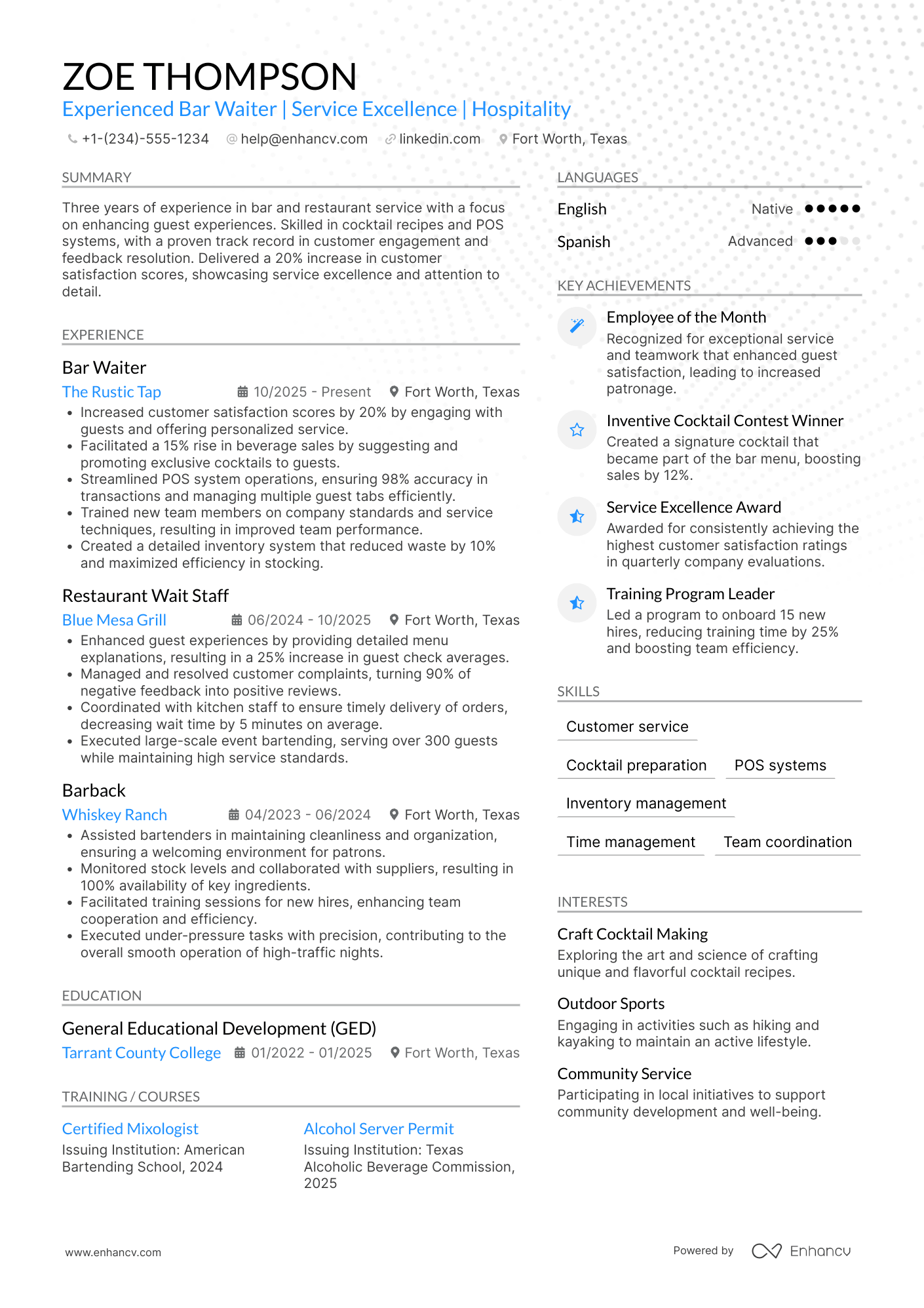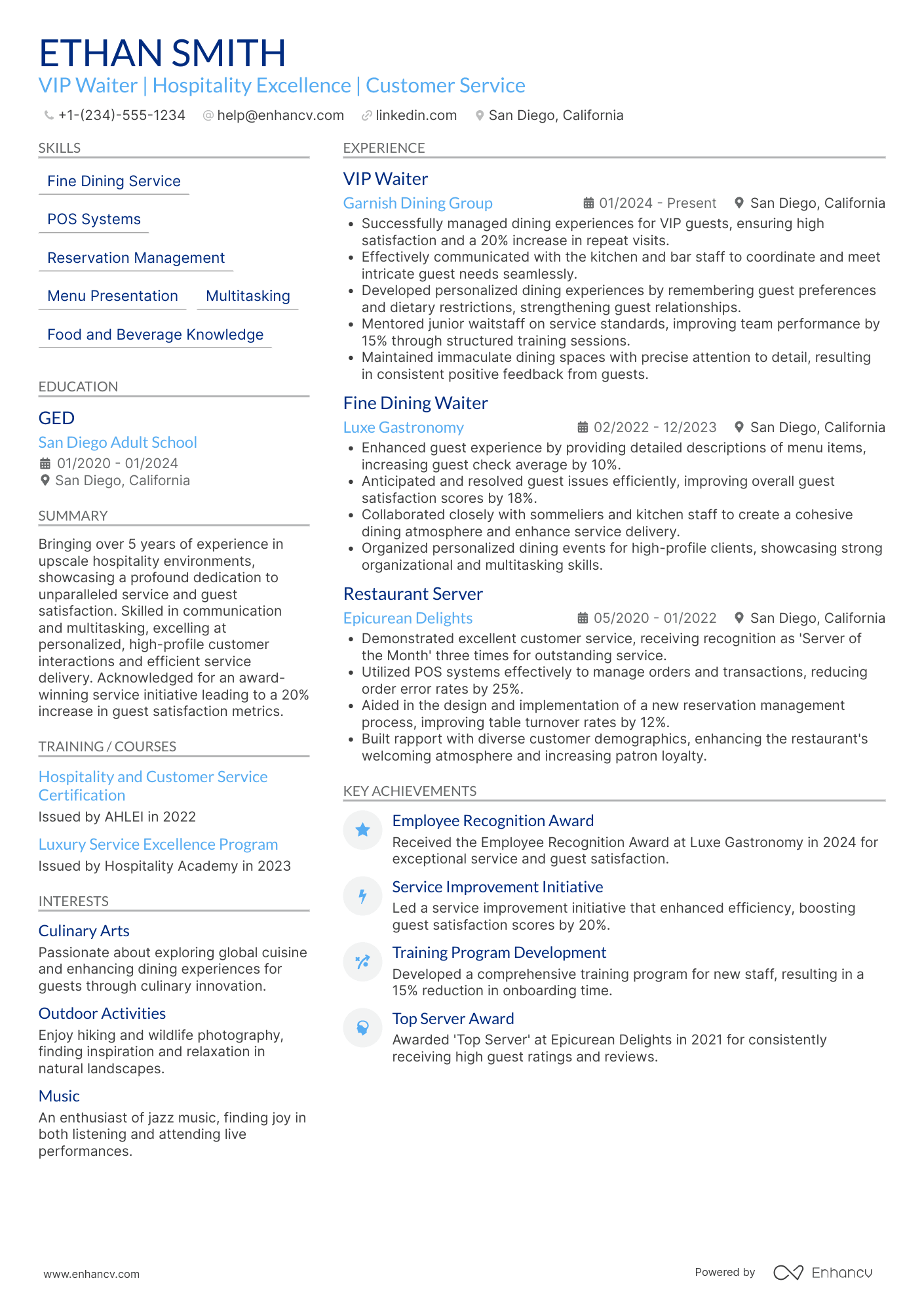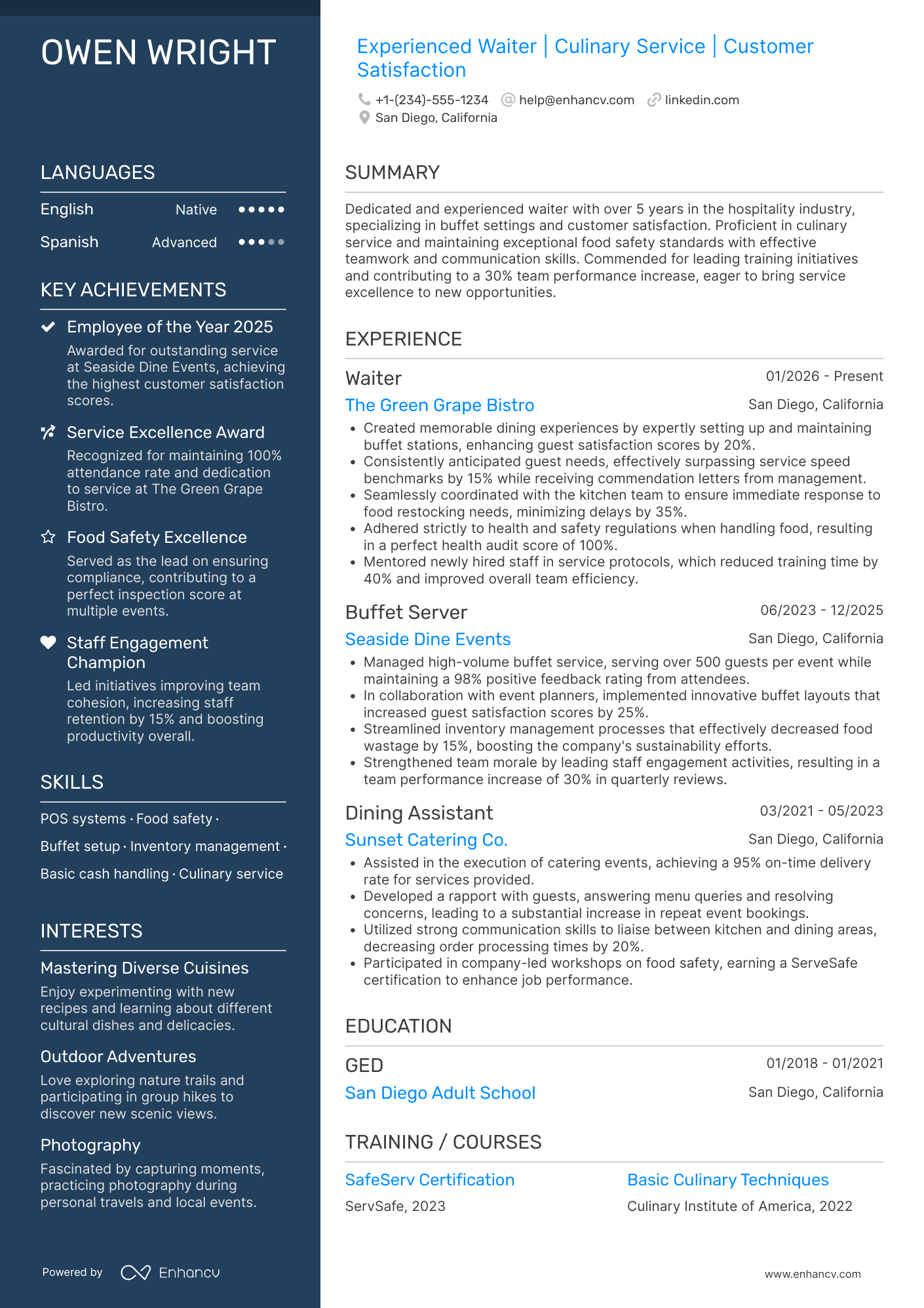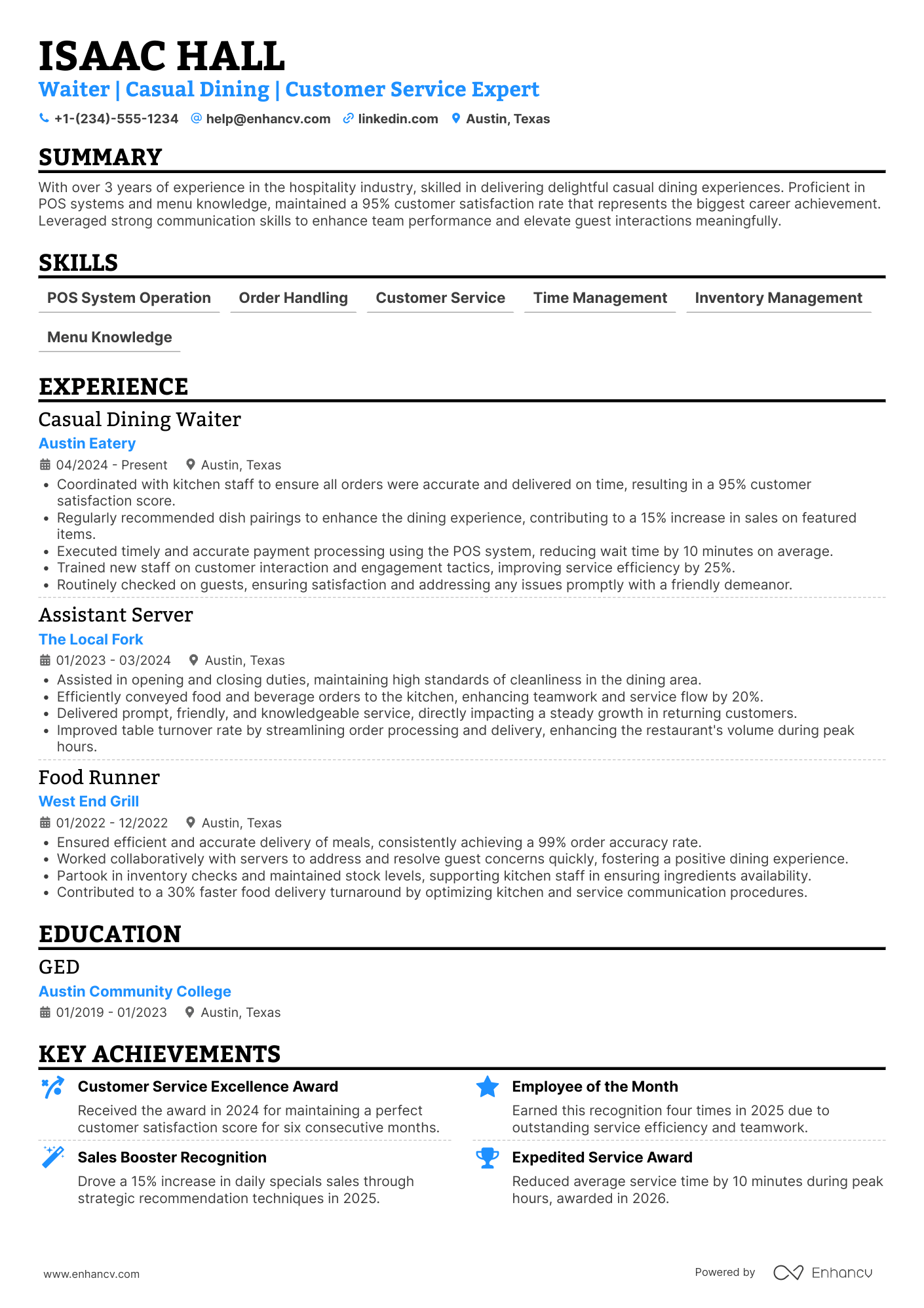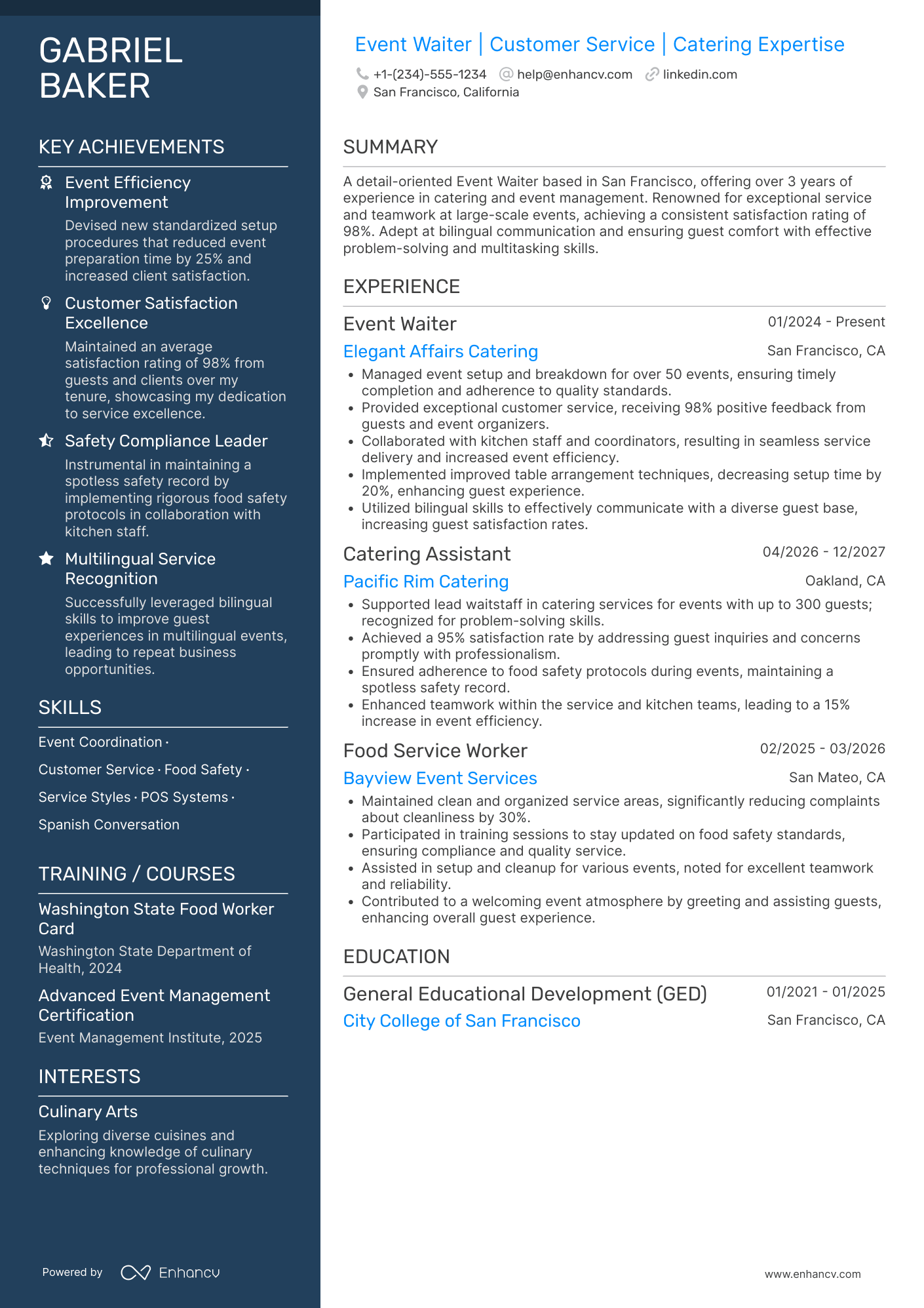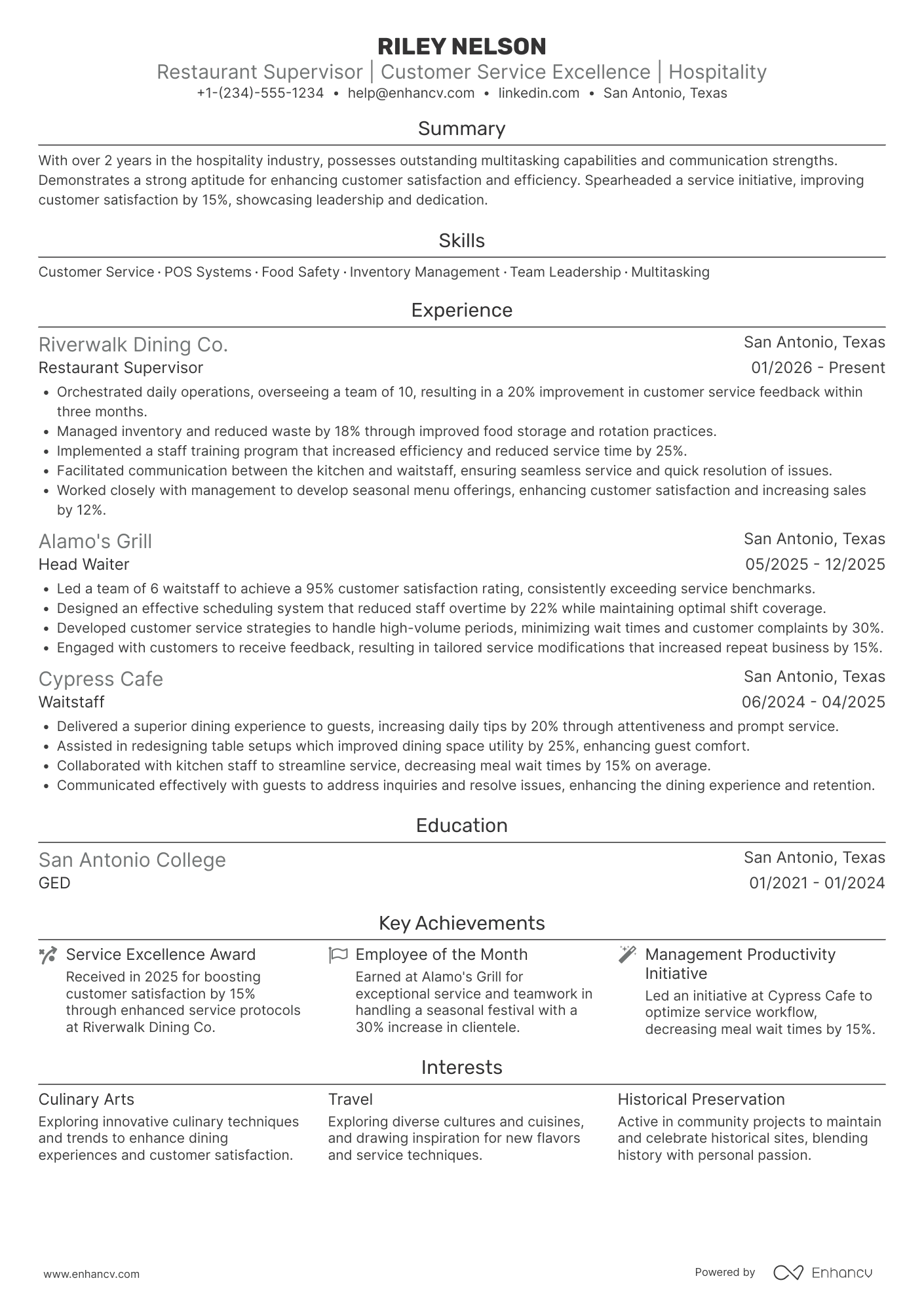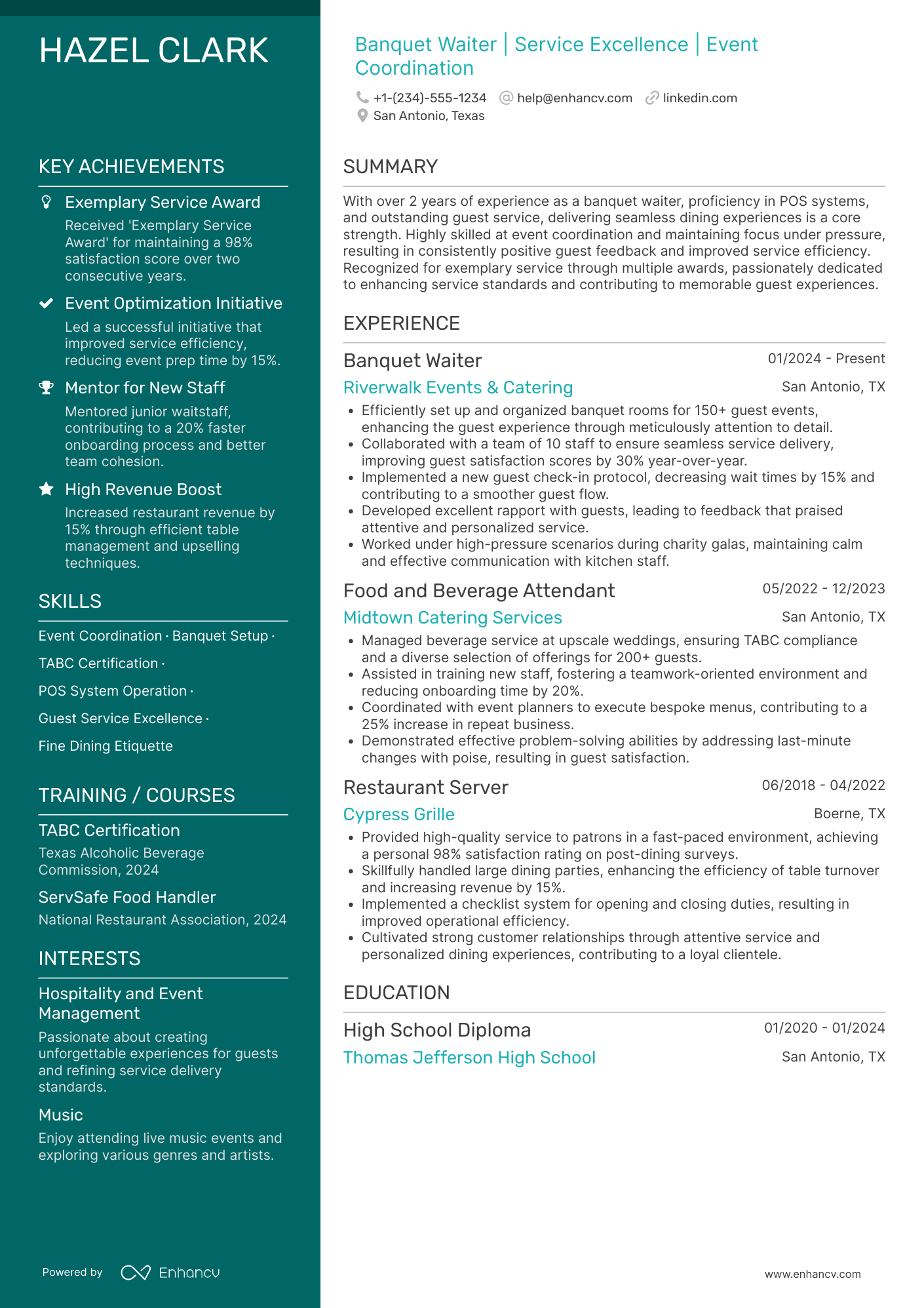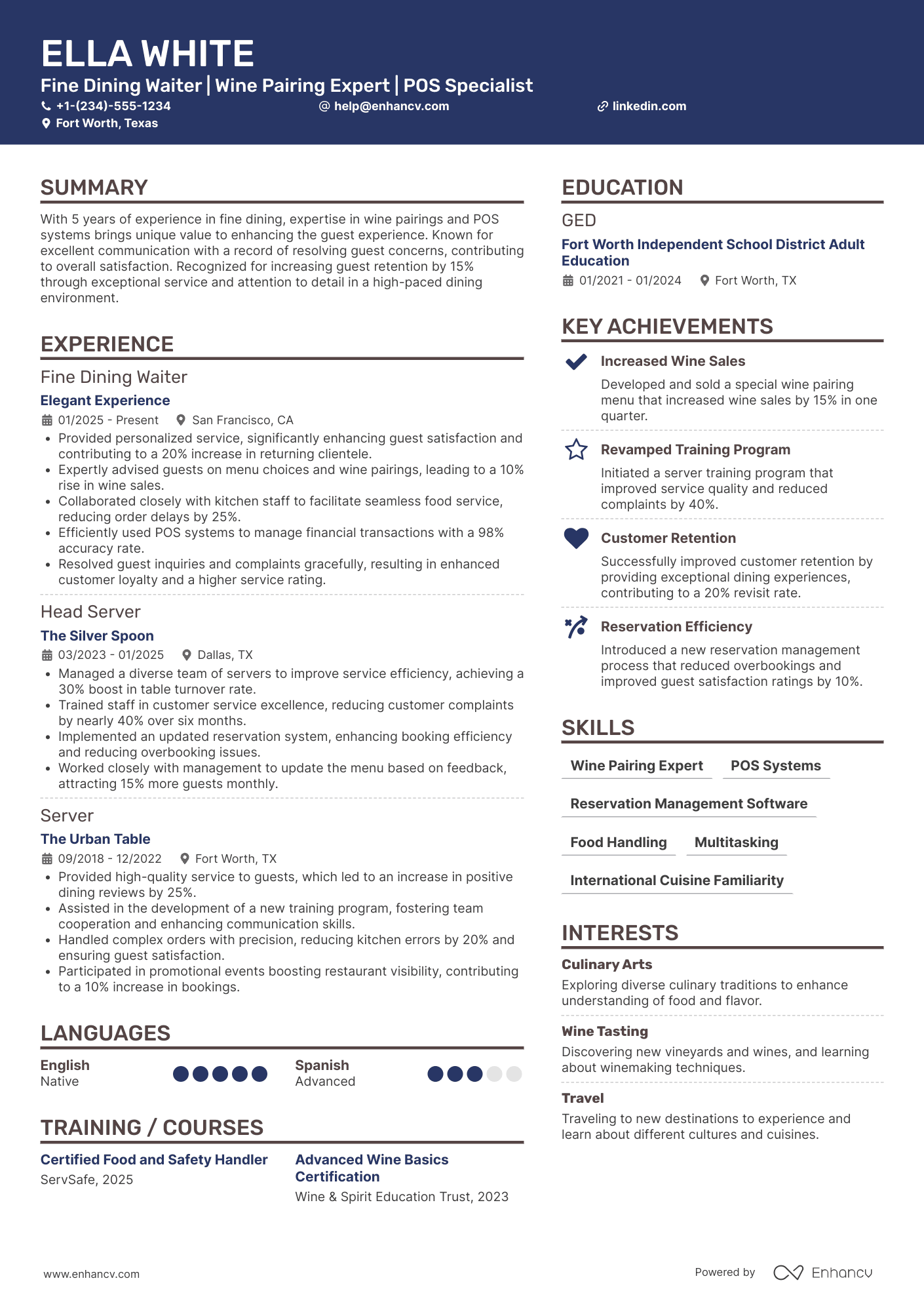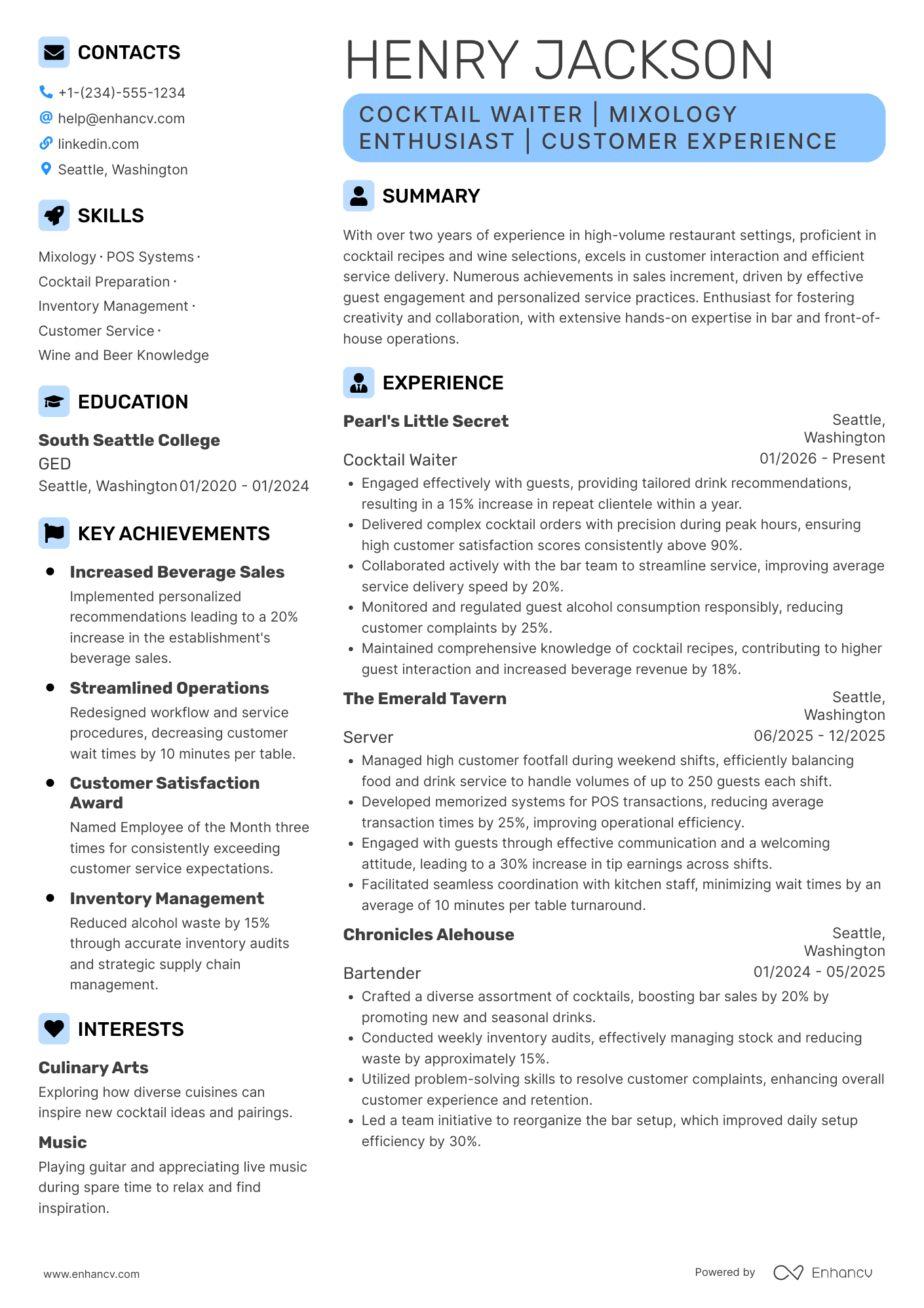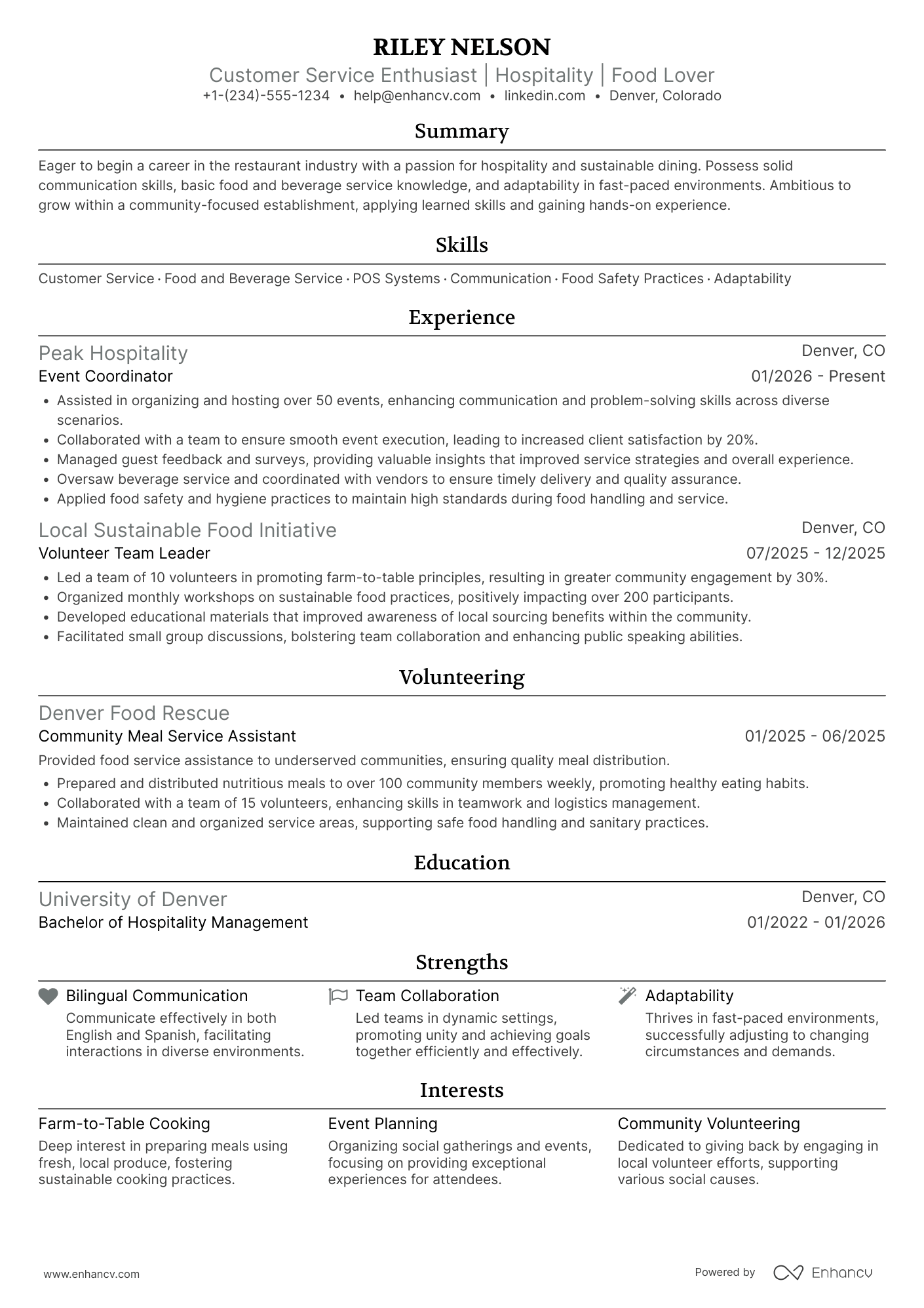
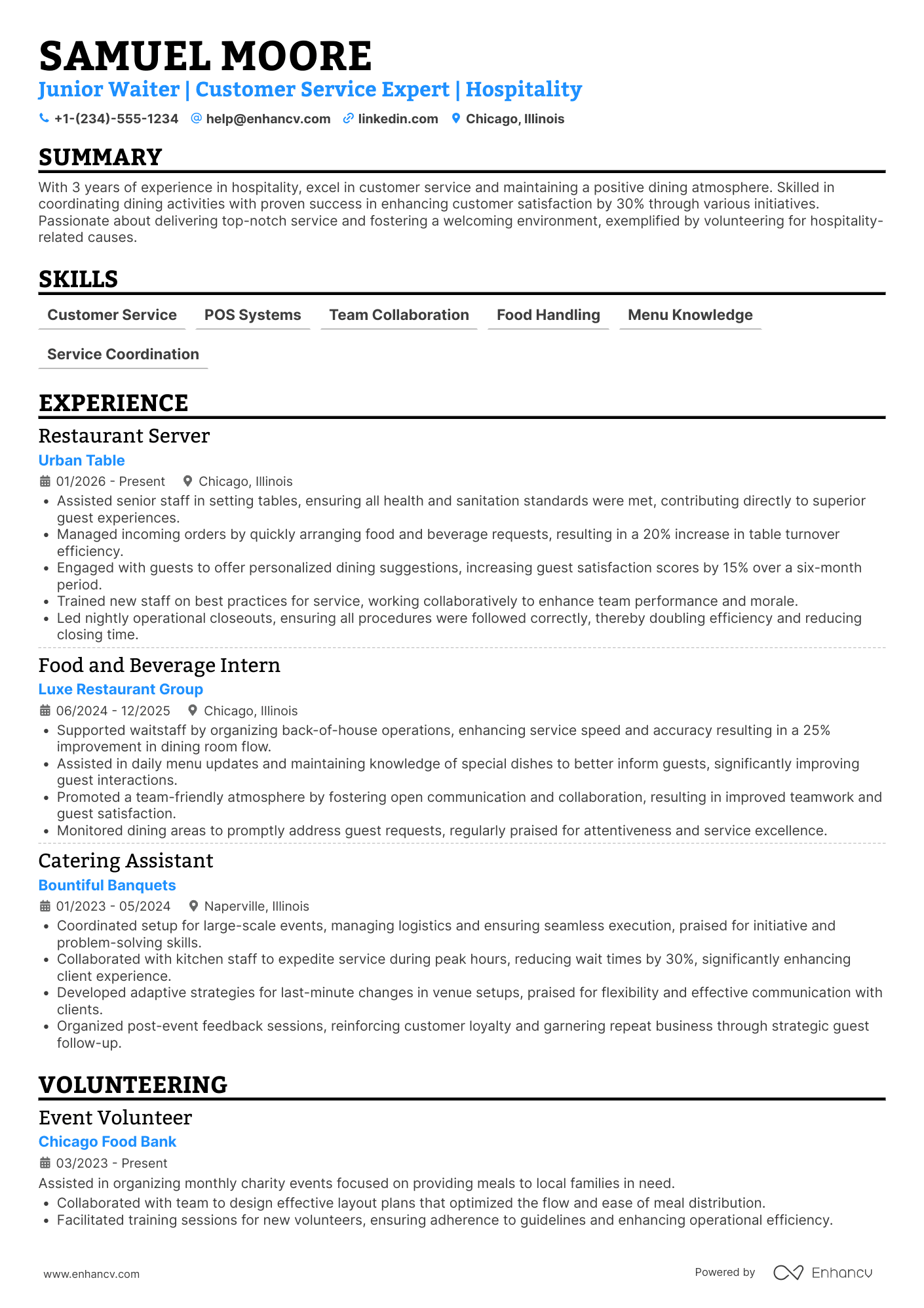
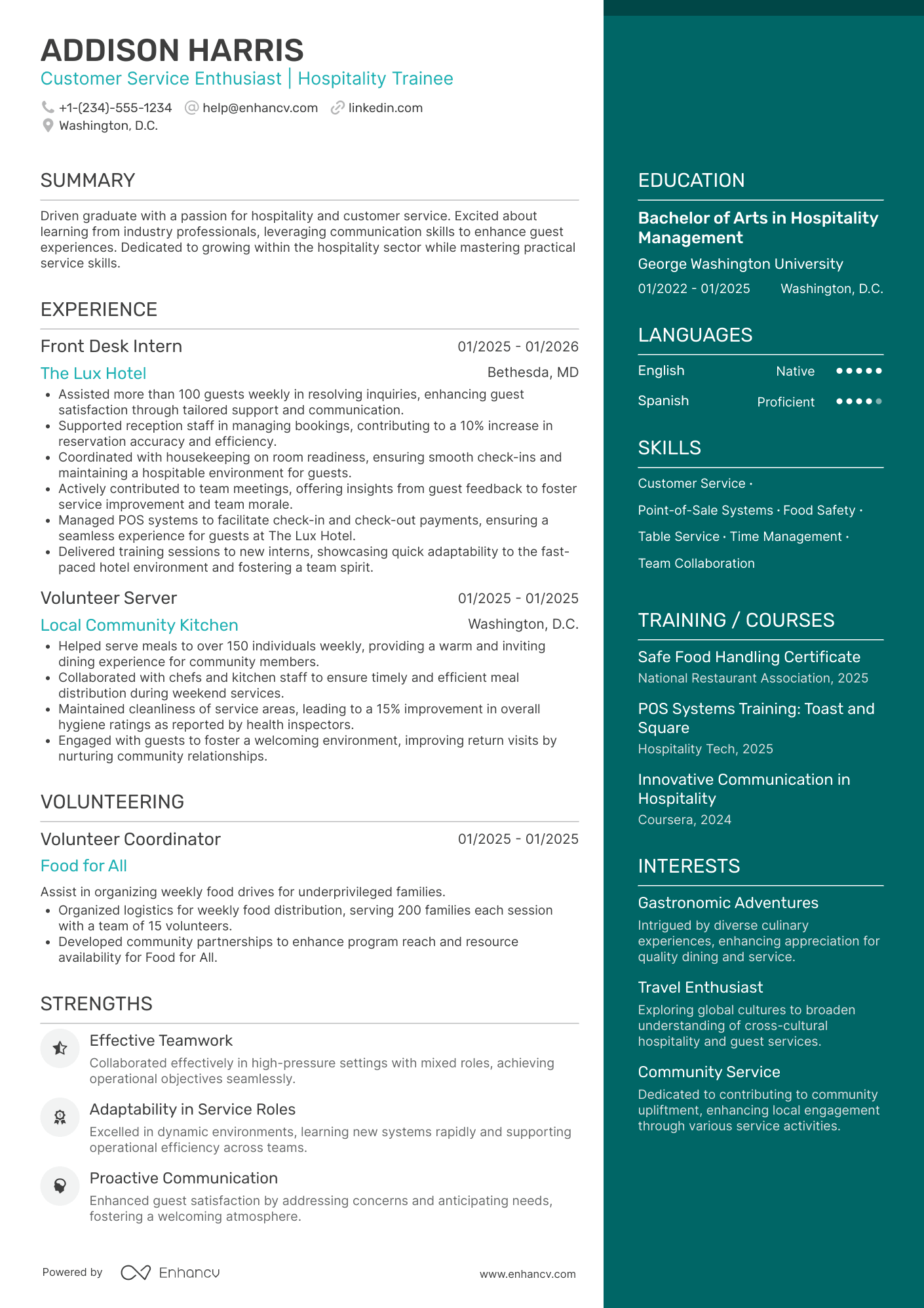
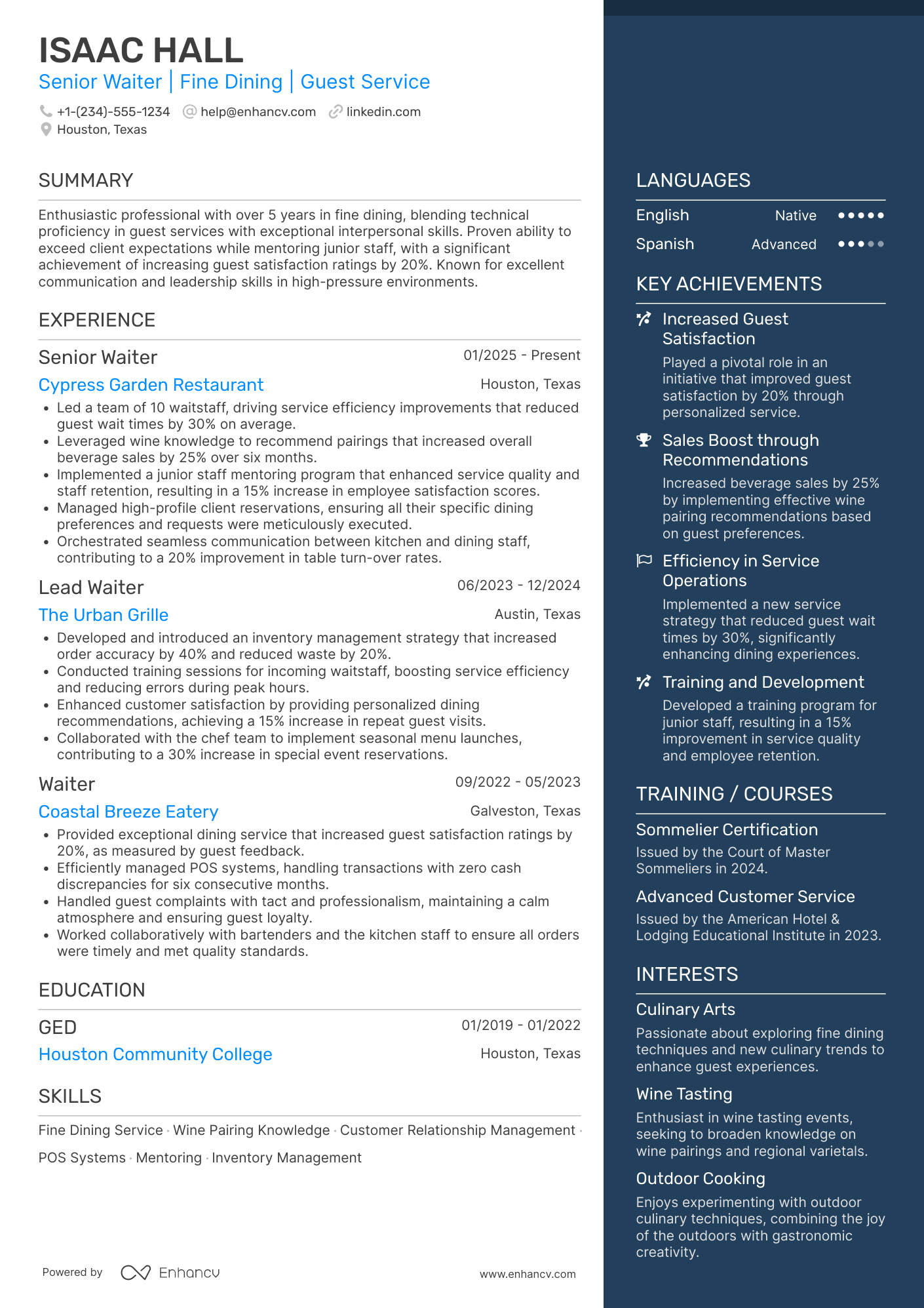
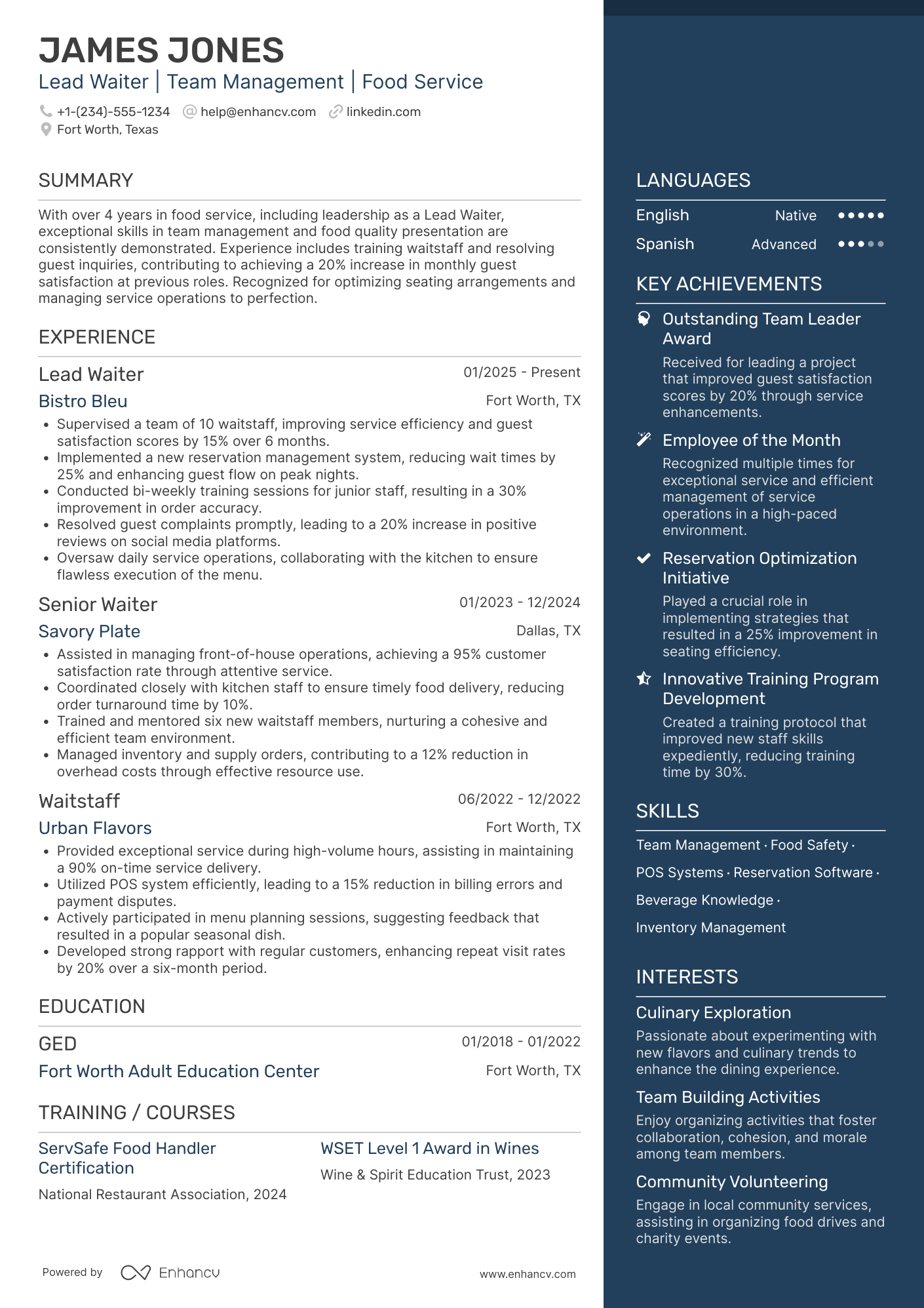
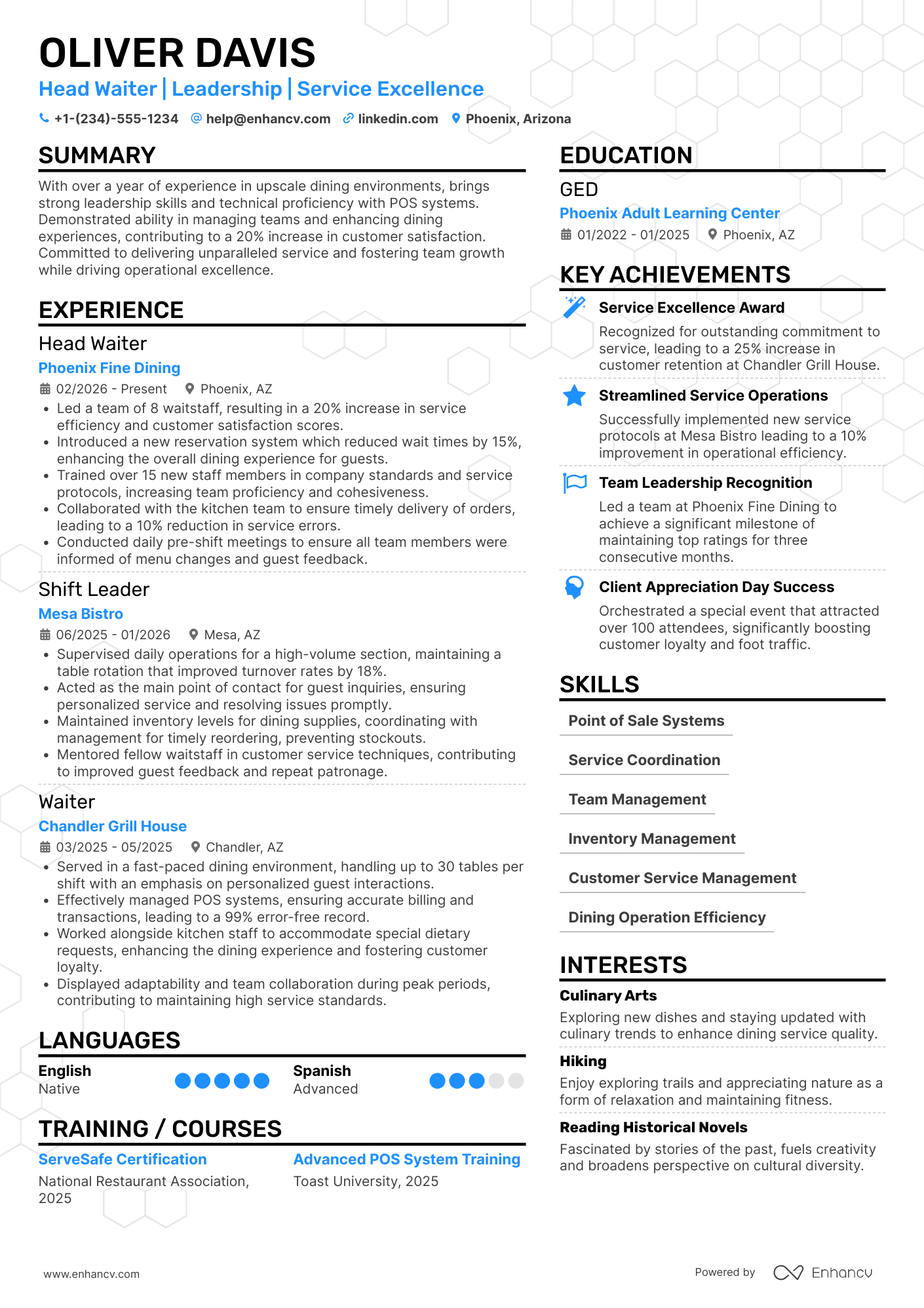
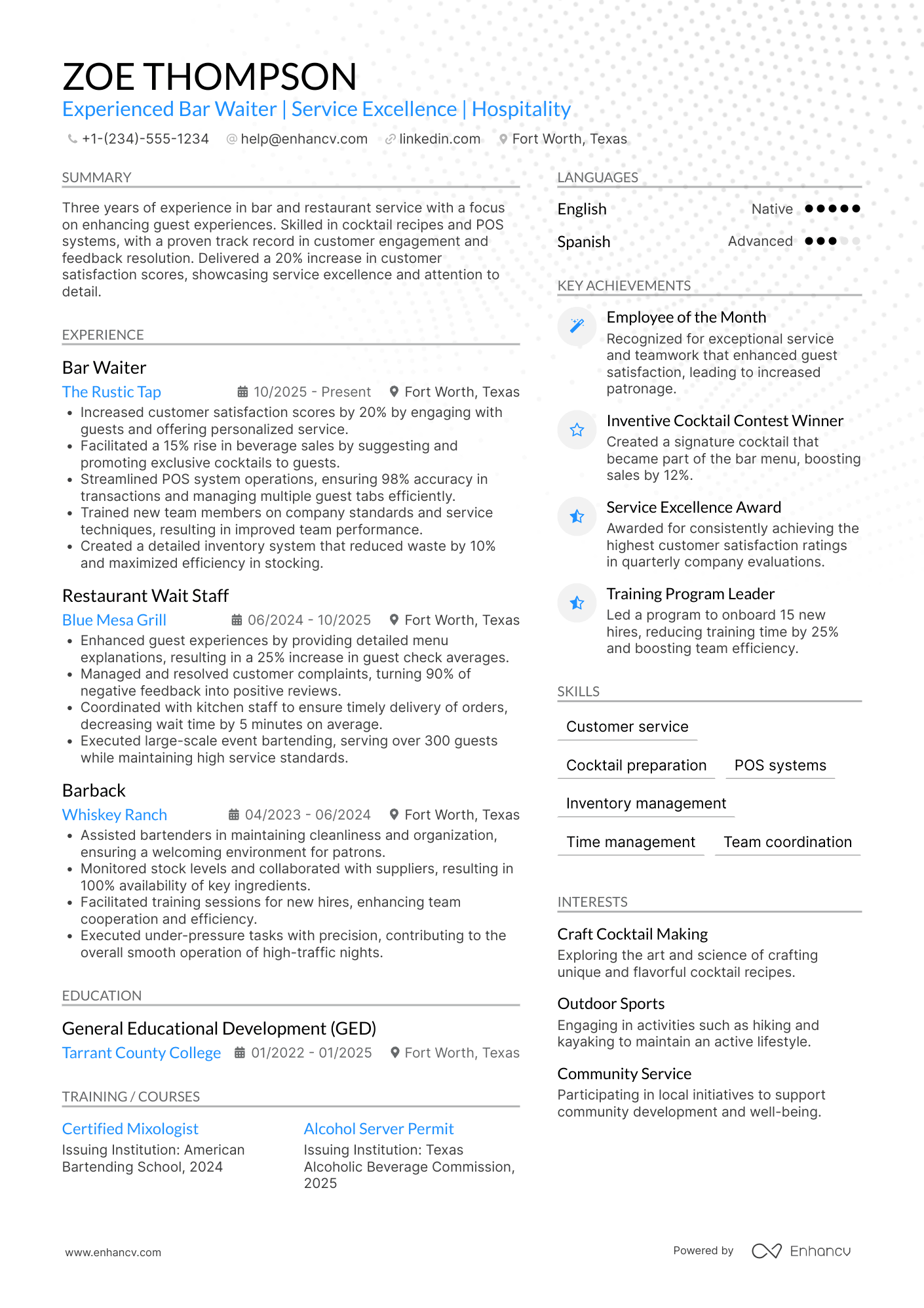
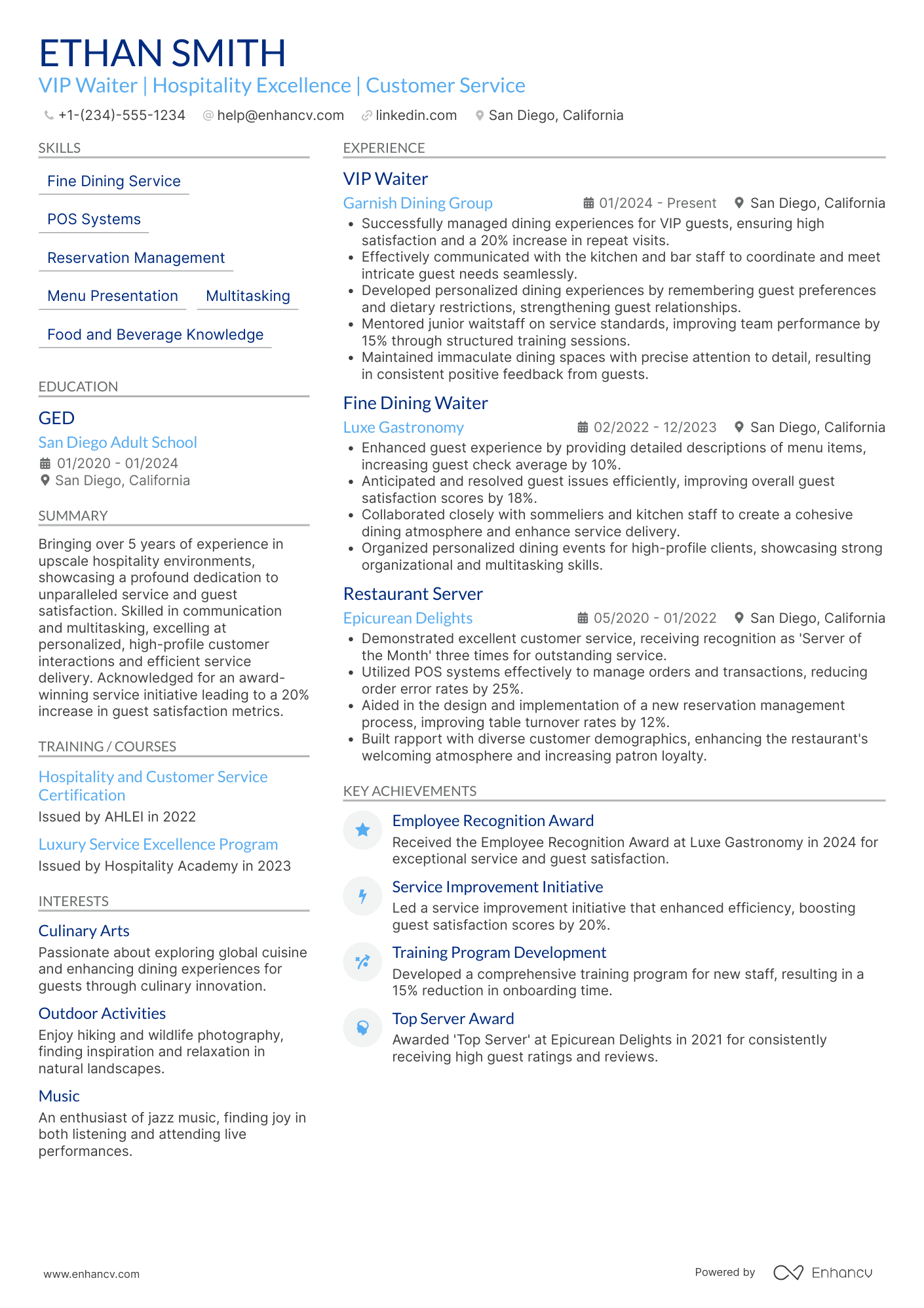
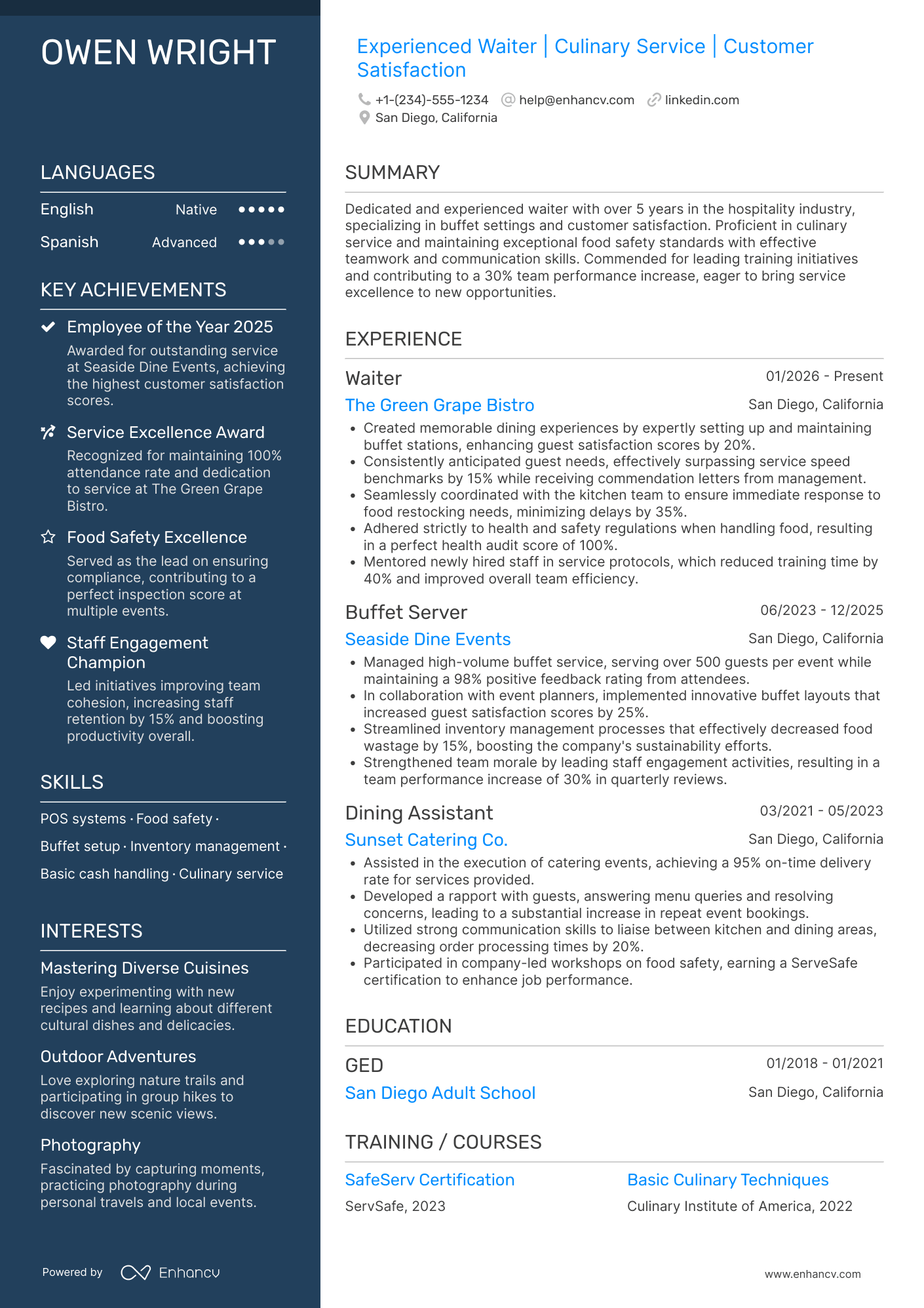
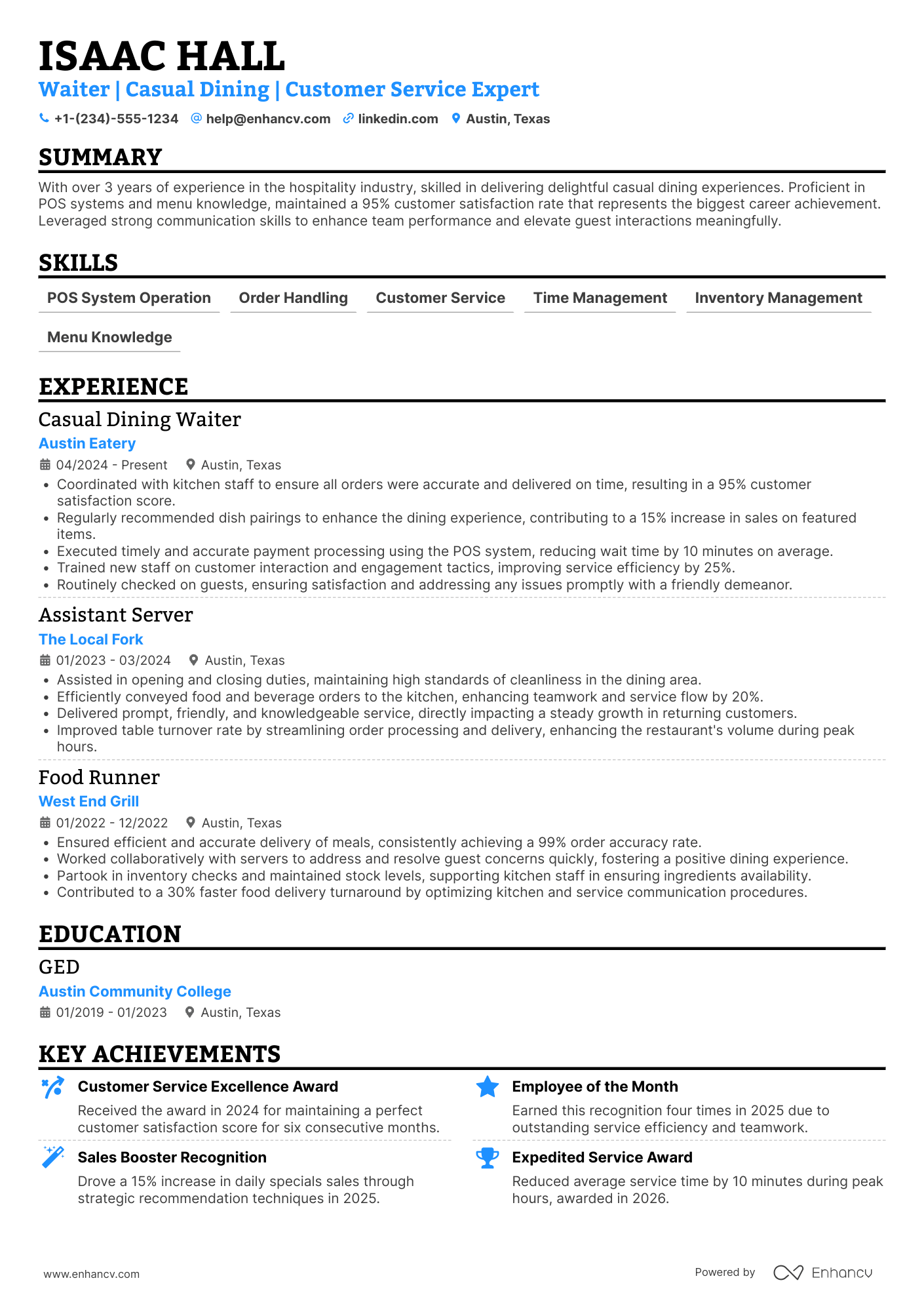
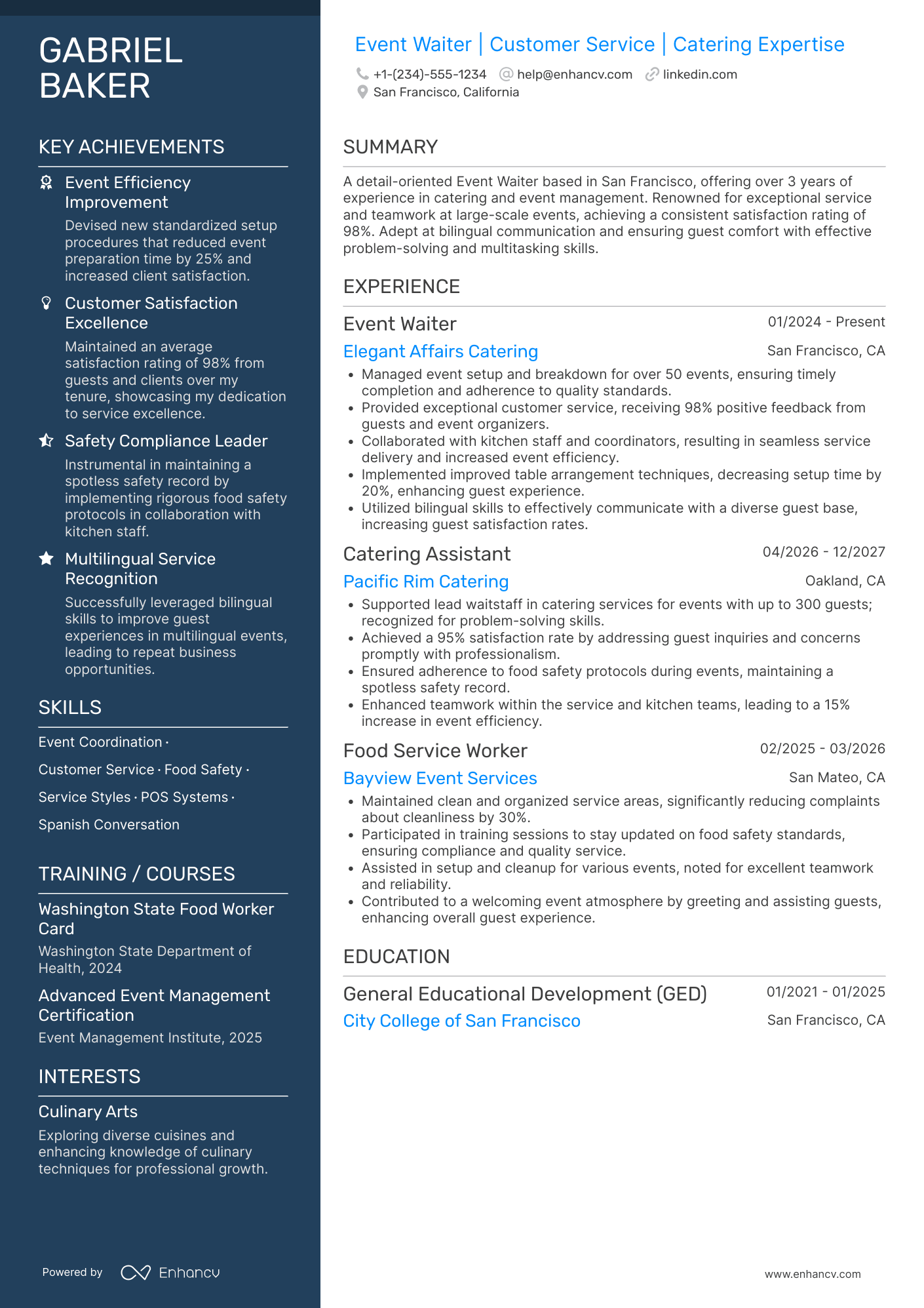
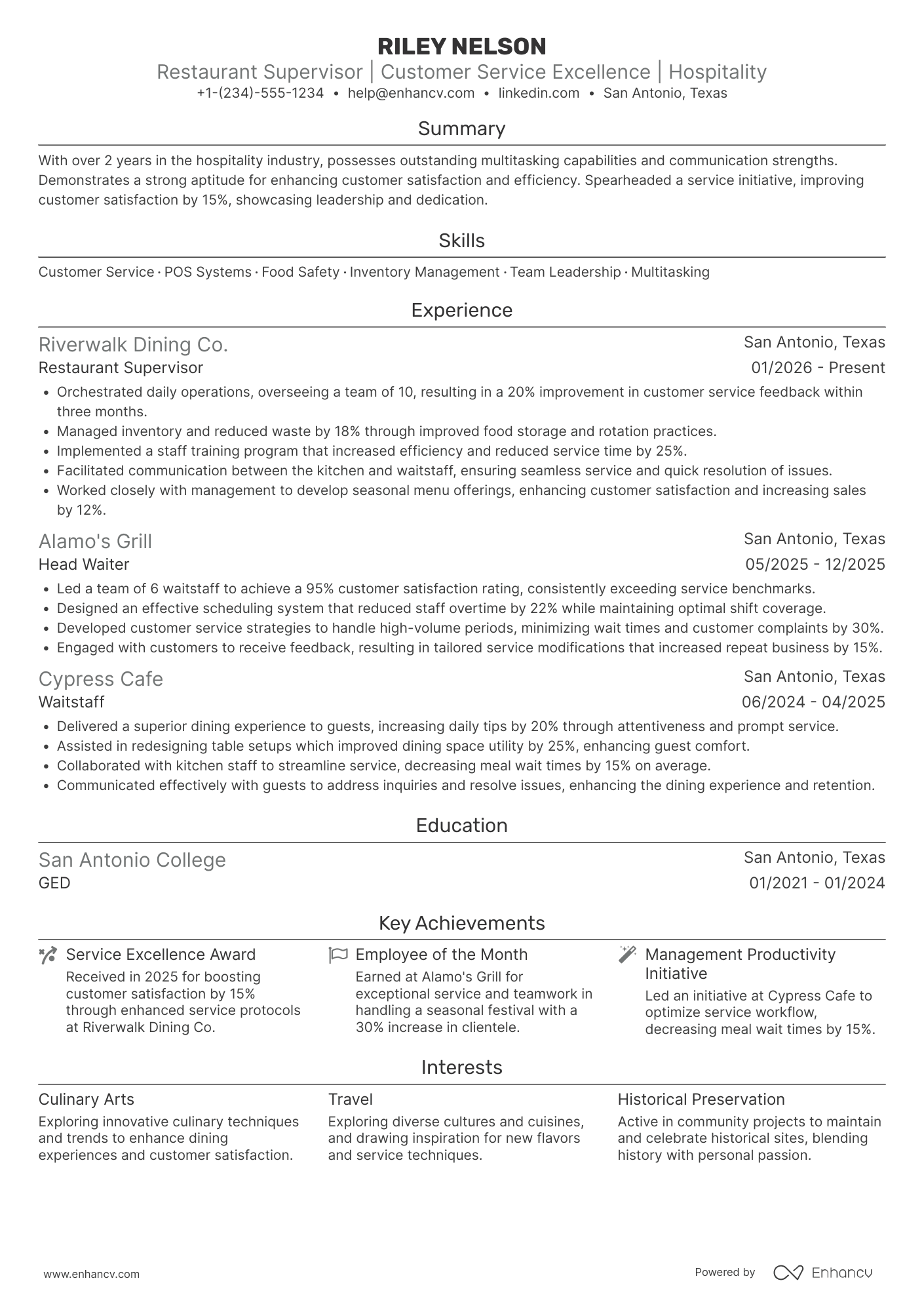
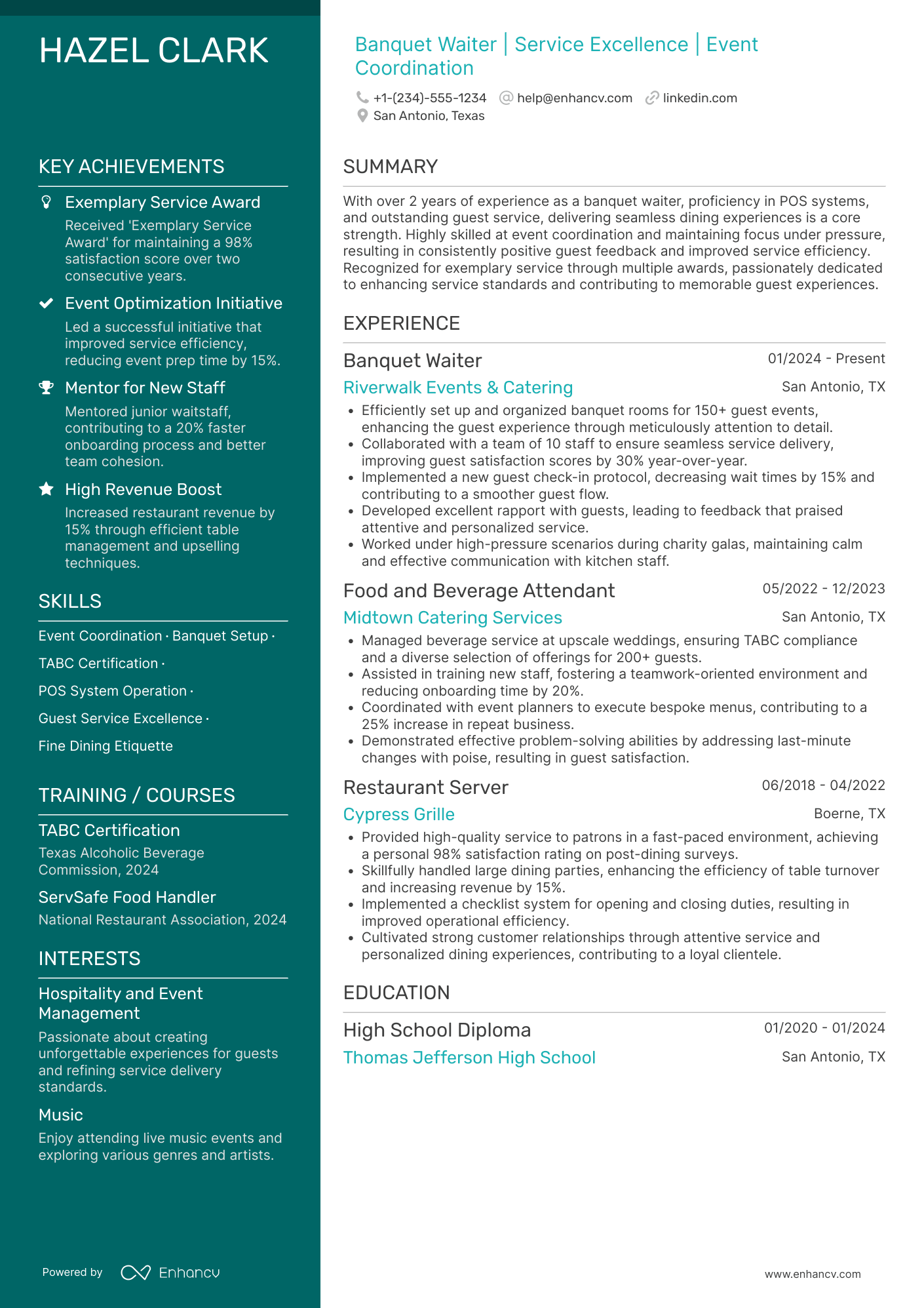
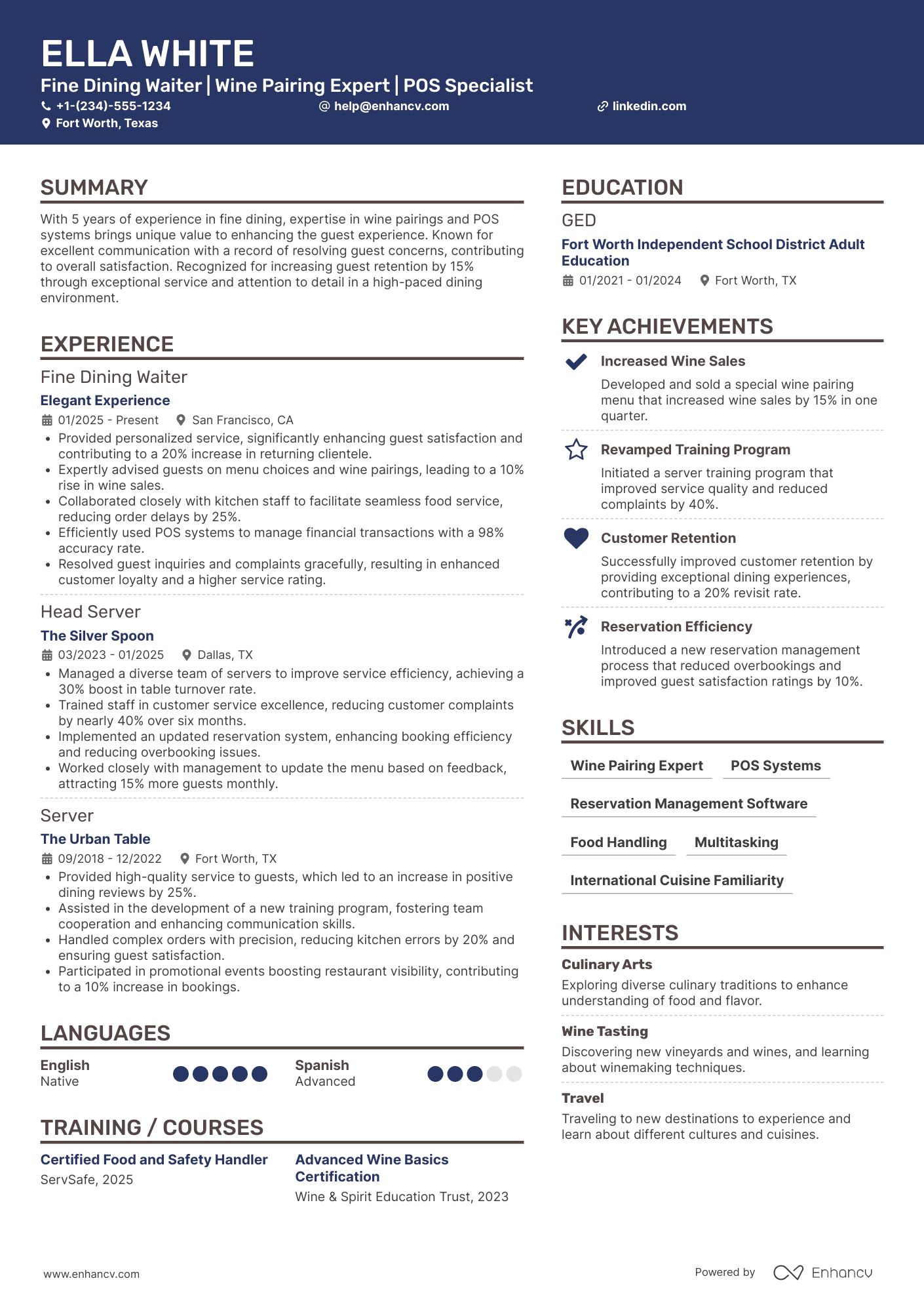
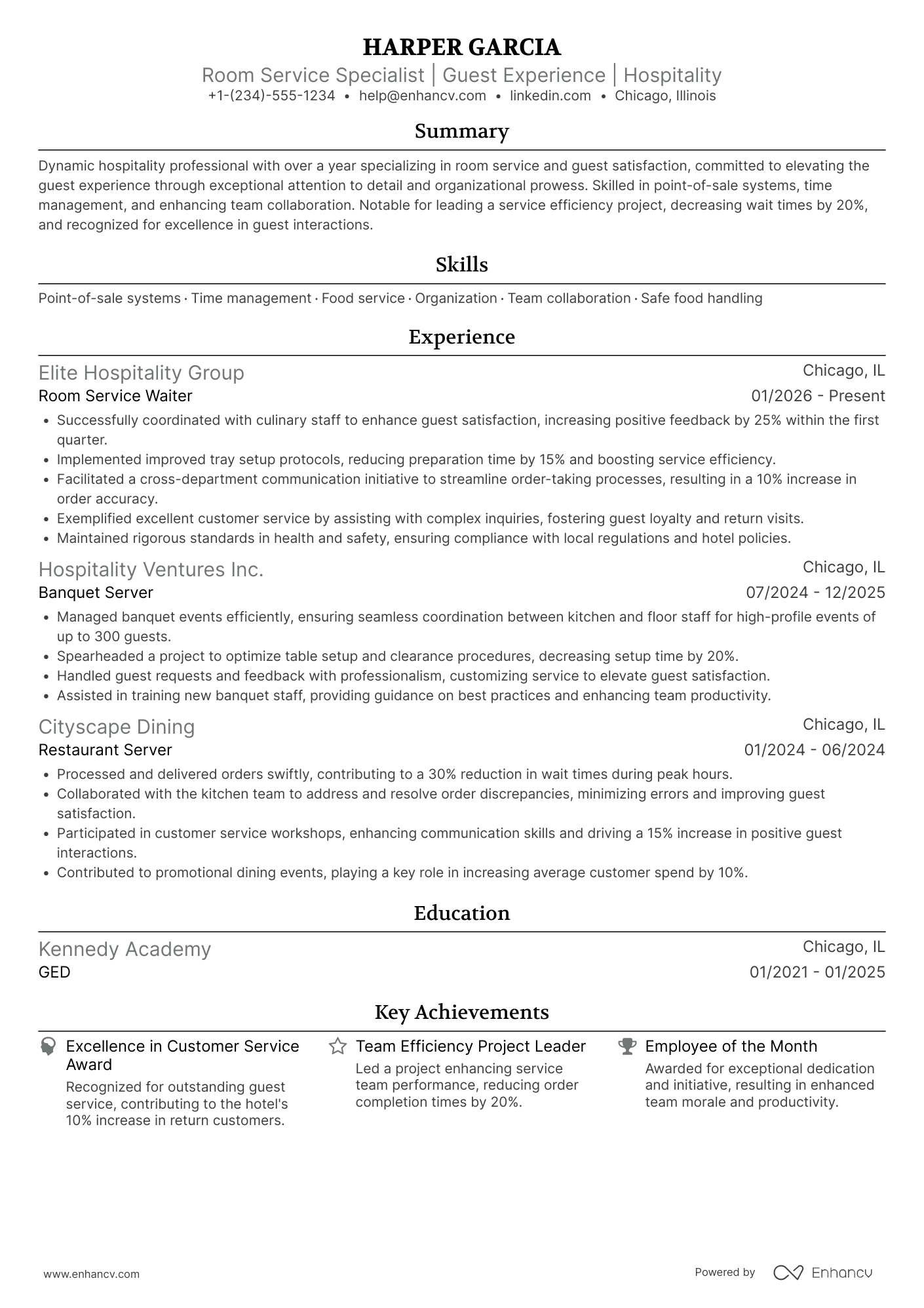
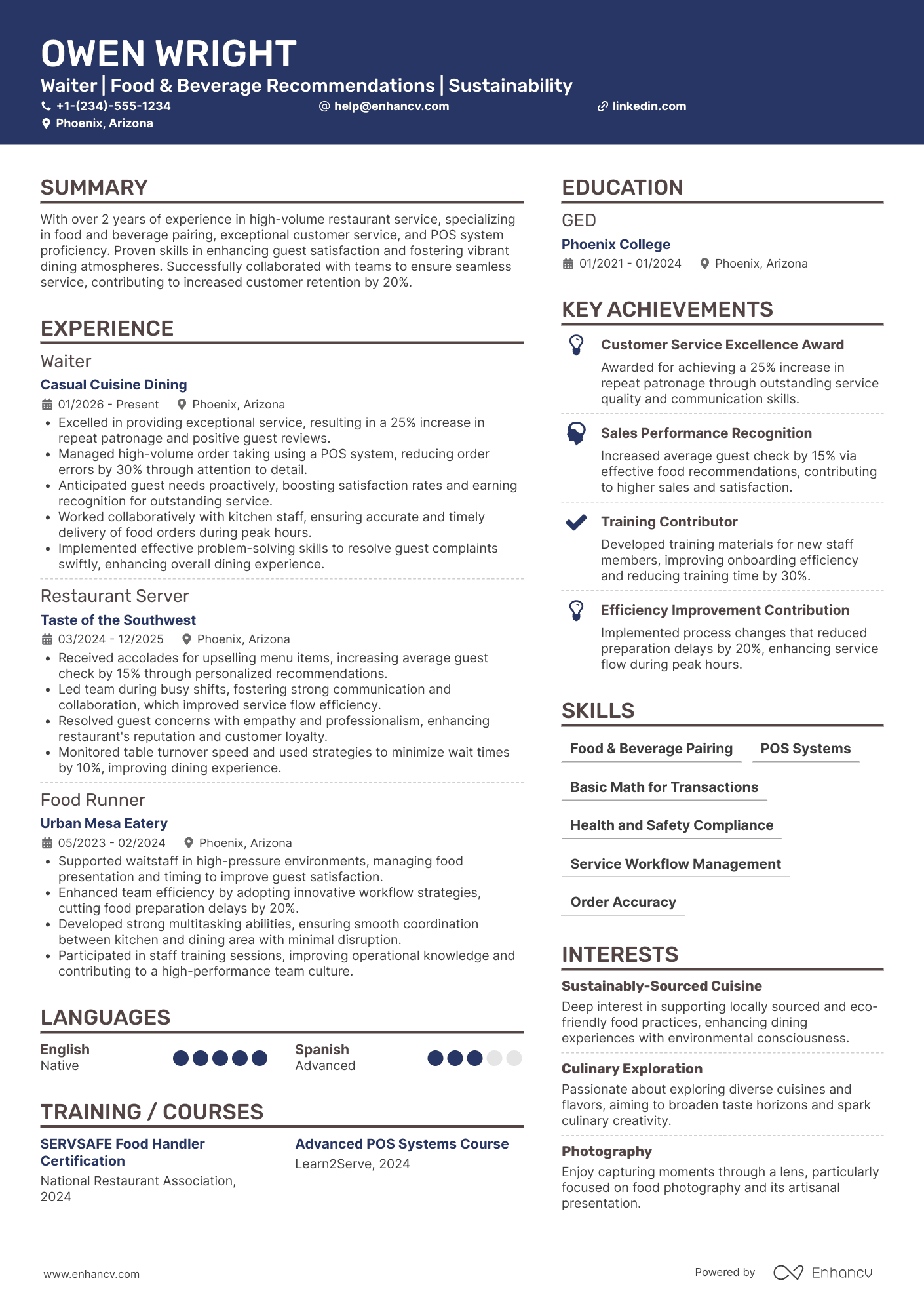
Many waiter resume drafts fail because they read like task lists and bury results, so they don't match keywords or show impact fast. That hurts when an ATS filters applications and recruiters scan in seconds amid heavy competition. If you're unsure where to begin, learning how to write a resume from the ground up can help you avoid these common pitfalls.
A strong resume shows what changed because you were on the floor. You should highlight faster table turns, higher check averages, fewer comps, stronger guest ratings, upsell revenue, and consistent accuracy across high-volume shifts.

Key takeaways
- Quantify service outcomes like table turn times, check averages, and guest ratings in every experience bullet.
- Use reverse-chronological format if you have serving experience; use hybrid format if you're switching careers.
- Tailor each resume to the job posting by mirroring its POS systems, service style, and certifications.
- Place skills above experience when you're entry-level and below experience when you have strong results.
- Write a three-to-four-line summary with your title, environment type, tools, and one measurable win.
- Add certifications like ServSafe or TIPS near education to meet compliance needs and build recruiter trust.
- Use Enhancv to turn routine service tasks into measurable, recruiter-ready bullet points faster.
Job market snapshot for waiters
We analyzed 132 recent waiter job ads across major US job boards. These numbers help you understand skills in demand, career growth patterns, salary landscape at a glance.
What level of experience employers are looking for waiters
| Years of Experience | Percentage found in job ads |
|---|---|
| 1–2 years | 3.8% (5) |
| 3–4 years | 3.0% (4) |
| 10+ years | 0.8% (1) |
| Not specified | 91.7% (121) |
Waiter ads by area of specialization (industry)
| Industry (Area) | Percentage found in job ads |
|---|---|
| Finance & Banking | 75.8% (100) |
| Healthcare | 12.1% (16) |
Top companies hiring waiters
| Company | Percentage found in job ads |
|---|---|
| Compass Group USA Inc | 75.8% (100) |
Role overview stats
These tables show the most common responsibilities and employment types for waiter roles. Use them to align your resume with what employers expect and to understand how the role is structured across the market.
Day-to-day activities and top responsibilities for a waiter
| Responsibility | Percentage found in job ads |
|---|---|
| Customer service | 3.0% (4) |
| Cash register | 2.3% (3) |
| Computer | 2.3% (3) |
| Ordering system | 2.3% (3) |
| Cash handling | 1.5% (2) |
| Communication | 1.5% (2) |
| Handheld equipment | 1.5% (2) |
| Cash-handling | 0.8% (1) |
| Computer systems | 0.8% (1) |
| Credit card handling | 0.8% (1) |
| Elementary math | 0.8% (1) |
| Food handler's card | 0.8% (1) |
How to format a waiter resume
Recruiters hiring for waiter positions prioritize customer service skills, reliability, and the ability to work in fast-paced environments. A clean, well-structured resume format ensures these signals are immediately visible, helping you pass applicant tracking systems and land in the "yes" pile within the six to seven seconds most hiring managers spend on an initial scan.

I have significant experience as a waiter—which format should I use?
Use the reverse-chronological format to lead with your most recent and relevant serving experience. Do:
- Highlight increasing scope and ownership, such as handling high-volume sections, training new staff, or managing opening and closing duties.
- Feature role-specific skills like POS systems (Toast, Aloha, Square), menu knowledge, upselling techniques, and food safety certifications.
- Quantify outcomes tied to guest satisfaction, sales performance, or operational efficiency.
I'm junior or switching into a waiter role—what format works best?
Use a hybrid format to place a focused skills section near the top while still showing any relevant work or volunteer history in chronological order. Do:
- Position transferable skills—such as communication, multitasking, and cash handling—prominently in a dedicated section above your experience.
- Include projects or transitional experience like catering events, food service volunteering, or hospitality coursework that demonstrate industry exposure.
- Connect each action to a clear result, even from non-restaurant roles.
Why not use a functional resume?
A functional resume removes the timeline context that hiring managers rely on to verify your hands-on serving experience, making it harder for them to trust your readiness for the role.
- Edge-case exception: A functional format may be acceptable if you're making a career change from a non-hospitality field, have limited formal work history, or need to address significant resume gaps—but only if you tie every listed skill directly to specific projects, volunteer roles, or measurable outcomes rather than listing abilities in isolation.
Once you've settled on the right format, the next step is filling it with the sections that hiring managers expect to see on a waiter resume.
What sections should go on a waiter resume
Recruiters expect a waiter resume to show clear service experience, speed, accuracy, and guest satisfaction results. Knowing exactly what to put on a resume helps you include the right details without wasting space.
Use this structure for maximum clarity:
- Header
- Summary
- Experience
- Skills
- Projects
- Education
- Certifications
- Optional sections: Awards, Volunteering, Languages
Strong experience bullets should emphasize measurable impact, service volume, upsell results, accuracy, and guest satisfaction outcomes.
Is your resume good enough?
Drop your resume here or choose a file. PDF & DOCX only. Max 2MB file size.
Once you’ve organized your resume with the right information in the right place, the next step is to write your waiter experience section so it supports each part effectively.
How to write your waiter resume experience
The experience section of your waiter resume should spotlight the work you've actually delivered—service styles you've mastered, point-of-sale systems you've operated, and measurable outcomes like table turnover rates or guest satisfaction scores. Hiring managers prioritize demonstrated impact over descriptive task lists, so every line needs to prove you drove results rather than simply carried plates.
Each entry should include:
- Job title
- Company and location (or remote)
- Dates of employment (month and year)
Three to five concise bullet points showing what you owned, how you executed, and what outcomes you delivered:
- Ownership scope: the dining sections, station assignments, menu categories, or front-of-house responsibilities you were directly accountable for as a waiter.
- Execution approach: the reservation platforms, POS systems, upselling techniques, allergen protocols, or service frameworks you used to manage guest experiences and deliver consistent work.
- Value improved: changes to table turnover speed, order accuracy, guest satisfaction, complaint resolution time, or revenue per cover that resulted from your contributions on the floor.
- Collaboration context: how you coordinated with kitchen staff, bartenders, hosts, bussers, and management to maintain seamless service flow and resolve real-time issues during shifts.
- Impact delivered: outcomes expressed through revenue growth, repeat guest rates, team performance improvements, or operational efficiencies rather than routine descriptions of taking orders and serving food.
Experience bullet formula
A waiter experience example
✅ Right example - modern, quantified, specific.
Server
Harbor & Vine Bistro | Charleston, SC
2022–Present
High-volume, 120-seat waterfront restaurant serving seasonal American cuisine with a full bar and private dining.
- Increased average check by 12% by recommending pairings and add-ons using Toast point-of-sale prompts and nightly feature cards, partnering with the bar manager to align upsells with inventory.
- Cut table turn time by eight minutes per party by coordinating coursing in OpenTable and pacing tickets with the kitchen expo during peak service (200+ covers/night).
- Reduced order errors by 35% by standardizing modifiers, allergy flags, and seat numbering in Toast point-of-sale, collaborating with the chef and hosts to confirm special requests before fire.
- Improved guest satisfaction from 4.5 to 4.7 stars on Google and OpenTable by resolving service issues within five minutes, documenting recoveries in the shift log, and aligning follow-ups with the general manager.
- Increased private dining revenue by 9% by supporting banquet event orders, confirming headcounts and timelines with clients, and coordinating room resets with the events lead and bussing team.
Now that you've seen how a strong experience section comes together, let's look at how to adjust those details to match the specific waiter role you're targeting.
How to tailor your waiter resume experience
Recruiters evaluate your waiter resume through both human review and applicant tracking systems. Tailoring your resume to the job description increases your chances of passing both screenings.
Ways to tailor your waiter experience:
- Match the POS systems named in the job description to your entries.
- Mirror the service style listed such as fine dining or casual.
- Use the exact food safety certifications the posting requires.
- Highlight upselling or suggestive selling if the role emphasizes revenue.
- Include experience with reservation platforms the employer currently uses.
- Reflect menu knowledge or allergen protocols when compliance is mentioned.
- Emphasize team coordination if the posting references high-volume service.
- Reference banquet or event service when the role covers large parties.
Tailoring means aligning your real accomplishments with what the employer asks for, not forcing keywords where they don't belong.
Resume tailoring examples for waiter
| Job description excerpt | Untailored | Tailored |
|---|---|---|
| "Deliver food and beverages using our Aloha POS system, maintain table turnover during high-volume dinner service (200+ covers nightly)" | Served food and drinks to customers in a timely manner. | Processed orders and payments through the Aloha POS system while maintaining smooth table turnover across 200+ covers per dinner service. |
| "Upsell seasonal menu items and wine pairings to increase average check size, working closely with the sommelier and kitchen team" | Helped customers with menu choices and took orders accurately. | Upsold seasonal specials and recommended wine pairings in coordination with the sommelier, increasing average check size by 15% over one quarter. |
| "Ensure compliance with local health and allergen safety regulations, accurately communicate dietary restrictions to the back-of-house team using our allergy-tagging protocol" | Followed restaurant rules and made sure customers were satisfied with their meals. | Communicated dietary restrictions and allergen details to back-of-house staff using the restaurant's allergy-tagging protocol, maintaining full compliance with local health and safety regulations across every service. |
Once you’ve aligned your experience with the role’s priorities, quantify your waiter achievements to show the impact of that work in clear, measurable terms.
How to quantify your waiter achievements
Quantifying your achievements shows the business impact behind great service. For waiters, focus on tables served, ticket size, upsells, accuracy, guest satisfaction, and speed during peak shifts.
Quantifying examples for waiter
| Metric | Example |
|---|---|
| Revenue growth | "Increased average check from $28 to $34 by upselling appetizers and cocktails across a 6-table section." |
| Service speed | "Cut table turn time from 62 to 52 minutes on weekend dinner shifts by batching drink orders and pre-bussing." |
| Order accuracy | "Reduced kitchen remakes from 5 per week to 1 per week by confirming modifiers in the point-of-sale system." |
| Guest satisfaction | "Maintained a 4.8/5 guest rating across 120+ post-meal surveys by resolving issues within five minutes." |
| Compliance risk | "Passed three surprise alcohol compliance checks with zero violations by verifying identification for 100% of carded guests." |
Turn your everyday tasks into measurable, recruiter-ready resume bullets in seconds with Enhancv's Bullet Point Generator.
Once you've crafted strong bullet points for your experience section, you'll want to apply that same precision to presenting your hard and soft skills.
How to list your hard and soft skills on a waiter resume
Your skills section shows you can deliver fast, accurate service, and recruiters and an ATS (applicant tracking system) scan this section to match you to the job post; aim for a balance of role-specific hard skills and execution-focused soft skills. waiter roles require a blend of:
- Product strategy and discovery skills.
- Data, analytics, and experimentation skills.
- Delivery, execution, and go-to-market discipline.
- Soft skills.
Your skills section should be:
- Scannable (bullet-style grouping).
- Relevant to the job post.
- Backed by proof in experience bullets.
- Updated with current tools.
Place your skills section:
- Above experience if you're junior or switching careers.
- Below experience if you're mid/senior with strong achievements.

Hard skills
- POS systems: Toast, Square, Clover
- Reservation systems: OpenTable, Resy
- Menu knowledge and upselling
- Order entry accuracy
- Food safety and sanitation
- Allergen and dietary protocols
- Wine, beer, cocktail service
- Cash handling and reconciliation
- Tableside service standards
- Section management and pacing
- Side work and closing procedures
- Tip reporting and checkout
Soft skills
- Prioritize tickets under pressure
- Confirm orders to prevent errors
- Communicate clearly with kitchen
- Coordinate timing with runners
- De-escalate guest complaints fast
- Set expectations and follow through
- Upsell without being pushy
- Stay calm during rushes
- Adapt to last-minute changes
- Own mistakes and fix them
- Support teammates during peak hours
- Maintain professional boundaries
How to show your waiter skills in context
Skills shouldn't live only in a bulleted list on your resume.
They should be demonstrated in:
- Your summary (high-level professional identity)
- Your experience (proof through outcomes)
Here's what that looks like in practice. You can also browse resume skills examples to see how other candidates present their abilities effectively.
Summary example
Senior waiter with eight years of fine dining experience specializing in wine service and guest relations. Skilled in Aloha POS, upselling techniques, and team training—consistently boosting per-table revenue by 18% across seasonal menus.
- Reflects senior-level experience clearly
- References industry-specific tools
- Includes a measurable revenue outcome
- Highlights training and interpersonal skills
Experience example
Senior Waiter
The Capital Grille | Nashville, TN
March 2019–August 2024
- Managed a 12-table section nightly using Toast POS, maintaining a 96% guest satisfaction rating across quarterly surveys.
- Collaborated with sommelier and kitchen staff to redesign the dessert pairing menu, increasing dessert sales by 22%.
- Trained and mentored four junior servers on upselling techniques, contributing to a 15% rise in average check size.
- Every bullet includes measurable proof
- Skills appear naturally through real outcomes
Once you’ve tied your customer service and teamwork strengths to real examples, the next step is learning how to write a waiter resume with no experience so you can present those same strengths without a work history.
How do I write a waiter resume with no experience
Even without full-time experience, you can demonstrate readiness through:
- Catering or banquet event shifts
- Volunteer food service roles
- School cafeteria service support
- Retail cashier and register work
- Customer service call center metrics
- Food runner or busser shifts
- Barista drink and order handling
- Hospitality training or certifications
If you're starting out, this guide on writing a resume without work experience walks you through how to build a compelling application from scratch.
Focus on:
- Cash handling and reconciliation results
- Order accuracy and ticket management
- Food safety compliance training
- High-volume service and pace
Resume format tip for entry-level waiter
Use a hybrid resume format because it highlights relevant skills and measurable projects while still listing your work history, even if it's limited. Do:
- Add a "Relevant Experience" section first.
- Quantify volume, accuracy, and speed.
- List tools like point of sale.
- Include food safety training with dates.
- Tailor bullets to each job posting.
- Volunteered as a waiter at four fundraising dinners, used a point of sale tablet for orders, and maintained 98% order accuracy across 120 guests per event.
Even without direct experience, your education section can highlight relevant coursework, certifications, and skills that demonstrate your readiness for a waiter role.
How to list your education on a waiter resume
Your education section helps hiring managers confirm foundational knowledge. It shows relevant training in hospitality, food safety, or customer service that supports your waiter career.
Include:
- Degree name
- Institution
- Location
- Graduation year
- Relevant coursework (for juniors or entry-level candidates)
- Honors & GPA (if 3.5 or higher)
Keep dates simple. Skip month and day details and list the graduation year only.
Here's a strong education entry tailored for a waiter resume.
Example education entry
Associate of Applied Science in Hospitality Management
Riverside Community College, Sacramento, CA
Graduated 2022
GPA: 3.7/4.0
- Relevant Coursework: Food and Beverage Operations, Customer Service Excellence, Food Safety and Sanitation
- Honors: Dean's List, 2021–2022
How to list your certifications on a waiter resume
Certifications show you keep learning, use service tools correctly, and understand hospitality standards. They help you stand out as a waiter who takes training and guest safety seriously. Include:
- Certificate name
- Issuing organization
- Year
- Optional: credential ID or URL
- Place certifications below education when your degree is recent and your certifications are older or less related to waiter work.
- Place certifications above education when they are recent, role-relevant, or required for the waiter jobs you target.
Best certifications for your waiter resume
- ServSafe Food Handler
- ServSafe Alcohol
- TIPS Alcohol Certification
- National Restaurant Association ServSafe Manager
- CPR and First Aid Certification
- Cicerone Certified Beer Server
- WSET Level One Award in Wines
Once you’ve placed your relevant credentials where hiring managers can find them quickly, move on to your waiter resume summary to highlight those qualifications in a strong opening pitch.
How to write your waiter resume summary
Your resume summary is the first thing a recruiter reads. A strong opening quickly proves you can handle the pace and demands of waiting tables.
Keep it to three to four lines, with:
- Your title and total years of experience in food service.
- The type of dining environment, such as fine dining, casual, or high-volume.
- Core skills like POS systems, menu knowledge, or upselling techniques.
- One or two measurable wins, like average cover counts or tip percentages.
- A soft skill tied to a real outcome, such as communication that reduced order errors.

PRO TIP
At the waiter level, focus on relevant skills, specific tools you've used, and any early results you can quantify. Avoid vague phrases like "passionate team player" or "hard worker." Recruiters want proof of what you've done, not personality descriptors.
Example summary for a waiter
Friendly waiter with two years of experience in high-volume casual dining. Skilled in Toast POS and upselling, consistently increasing average check size by 15%.
Optimize your resume summary and objective for ATS
Drop your resume here or choose a file.
PDF & DOCX only. Max 2MB file size.
Now that your summary captures your strongest qualifications, make sure the header framing it presents your contact details correctly so recruiters can actually reach you.
What to include in a waiter resume header
A resume header lists your key contact details and role fit so recruiters can spot you fast, trust your basics, and screen you quickly.
Essential resume header elements
- Full name
- Tailored job title and headline
- Location
- Phone number
- Professional email
- GitHub link
- Portfolio link
A LinkedIn link lets recruiters confirm your timeline and employers fast, which supports quick screening.
Don't include a photo on a waiter resume unless the role is explicitly front-facing or appearance-dependent.
Keep your header on one to two lines, use a clear job title, and match your contact details to what you check daily.
Waiter resume header
Jordan Rivera
Waiter | High-volume dining, POS systems, and guest service
Chicago, IL
(312) 555-01XX your.name@enhancv.com github.com/yourname yourwebsite.com linkedin.com/in/yourname
Once your contact details and role identifiers are set up at the top, you can strengthen the rest of your application with additional sections that support your waiter experience and fit the job requirements.
Additional sections for waiter resumes
When your core qualifications match other applicants, well-chosen extra sections can set you apart and reinforce your fit for the role.
- Languages
- Certifications (food handler's permit, TIPS, ServSafe)
- Hobbies and interests
- Volunteer experience
- Awards and achievements
- Professional development and training
Once you've rounded out your resume with the right supplementary sections, it's worth pairing it with a strong cover letter to make an even bigger impression.
Do waiter resumes need a cover letter
A cover letter isn't required for a waiter, but it helps in competitive roles or places that expect one. If you're wondering what a cover letter is and when it matters, it can make a difference when you need to add context beyond your resume.
Use a cover letter when it adds clear value:
- Explain fit with the team: Match your service style to the restaurant's pace, standards, and guest experience.
- Highlight one or two outcomes: Share a specific result, like higher check averages, faster table turns, or fewer comps during busy shifts.
- Show you understand the business: Mention the restaurant's menu, typical guests, and what matters most, like speed, upselling, or hospitality.
- Address a transition: Connect non-restaurant work to waiter skills, such as handling complaints, teamwork, cash accuracy, or managing high-volume workflows.
Drop your resume here or choose a file.
PDF & DOCX only. Max 2MB file size.
Once you’ve decided whether to include a cover letter based on the role and employer expectations, the next step is using AI to improve your waiter resume so it matches those requirements more precisely.
Using AI to improve your waiter resume
AI can sharpen your resume's clarity, structure, and overall impact. It helps tighten language and highlight relevant strengths. But overuse makes resumes sound robotic. Once your content feels clear and role-aligned, step away from AI. For specific guidance, explore these ChatGPT resume writing prompts to get started.
Here are 10 practical prompts you can copy and paste to strengthen specific sections of your waiter resume:
Strengthen your summary
Quantify experience bullets
Tighten action verbs
Tailor skills section
Improve job descriptions
Refine education details
Highlight certifications clearly
Align with job posting
Cut unnecessary filler
Showcase relevant projects
Conclusion
A strong waiter resume shows measurable outcomes, role-specific skills, and a clear structure. Use numbers for sales, tips, table turns, guest satisfaction, and accuracy. Highlight service, menu knowledge, point of sale systems, teamwork, and calm problem-solving.
Keep each section easy to scan, with consistent formatting and focused bullet points. This approach matches how hiring teams review resumes today and will keep working as tools and expectations evolve. With clear proof of impact, your waiter resume signals you’re ready to contribute on day one.
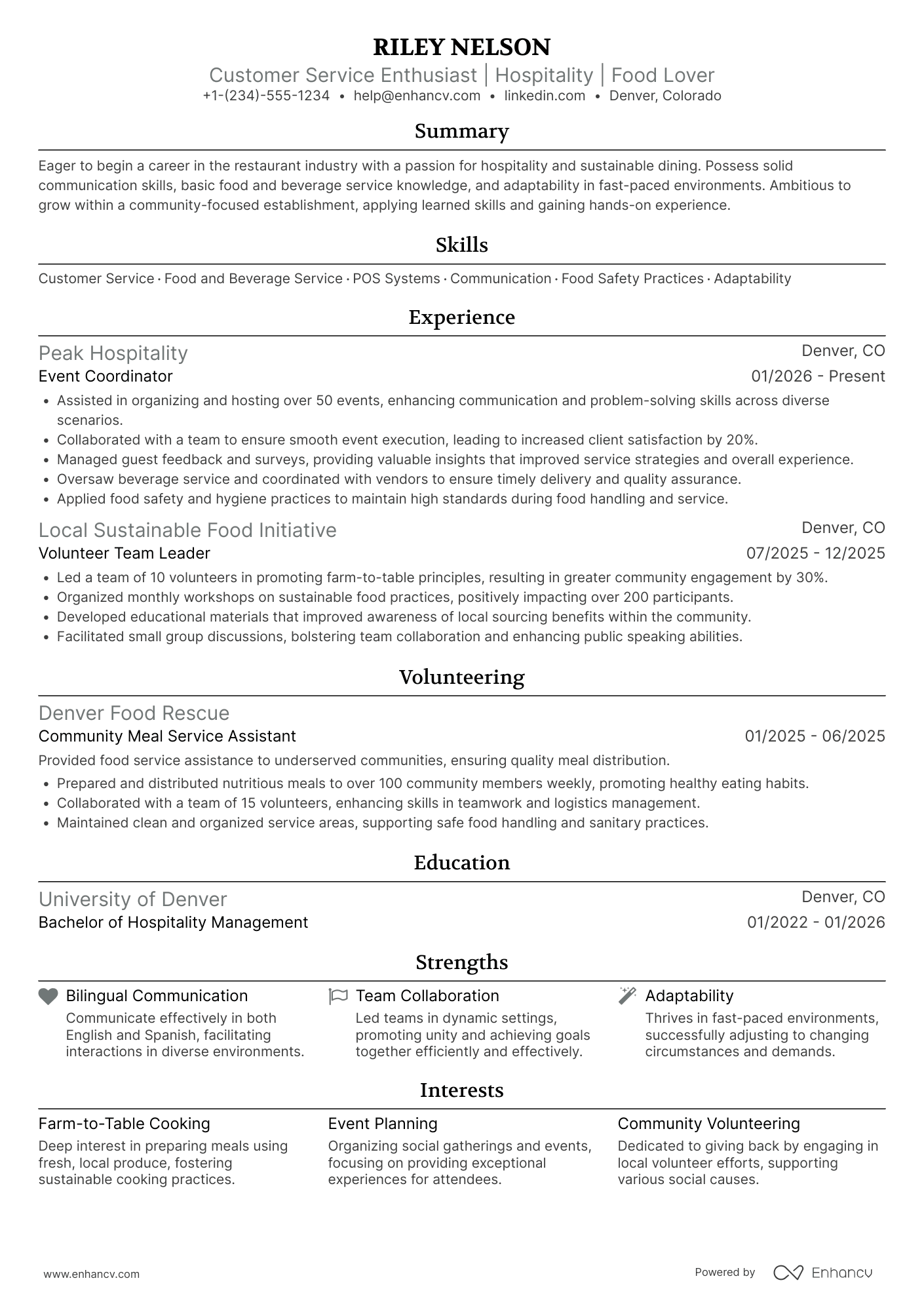
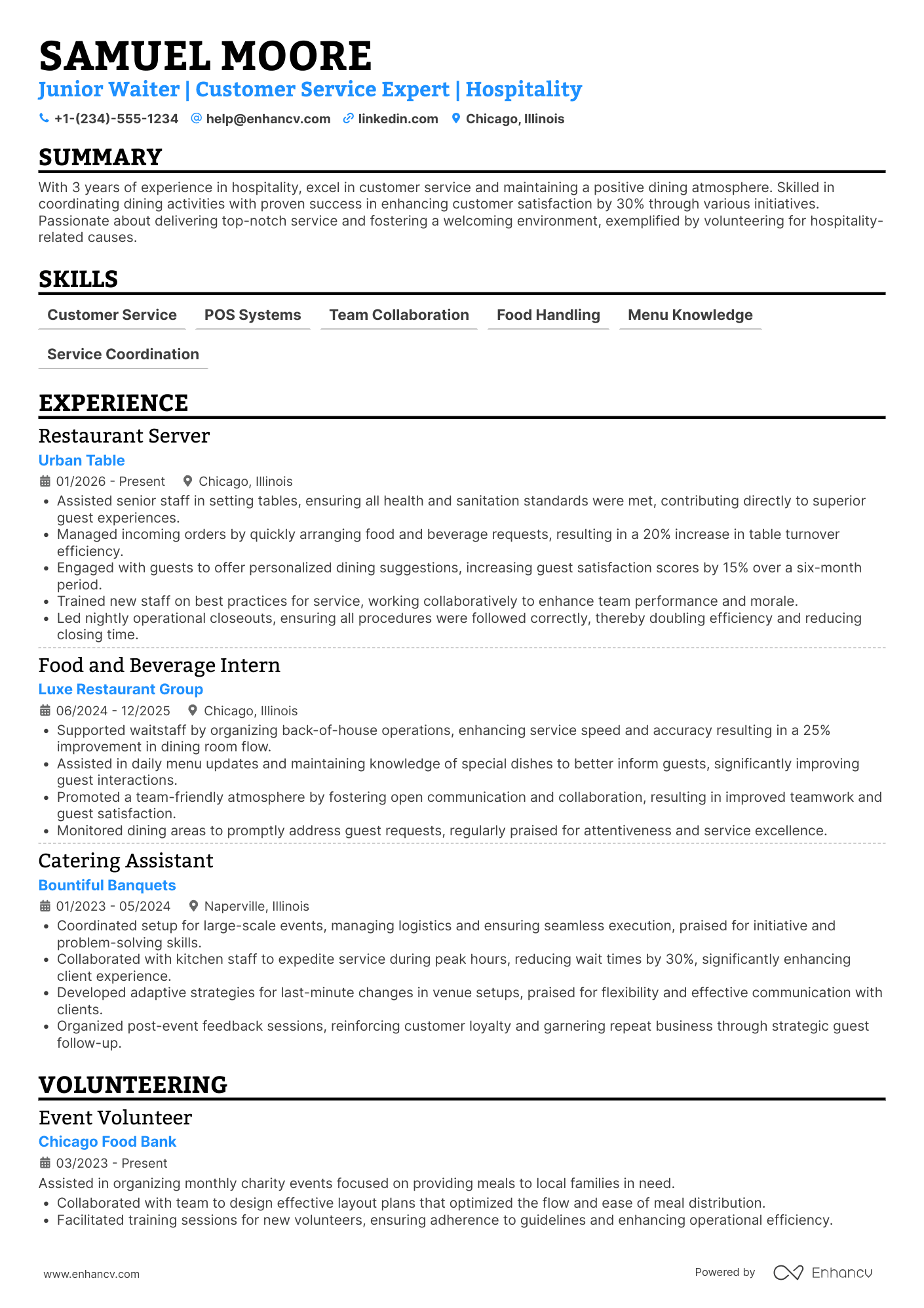
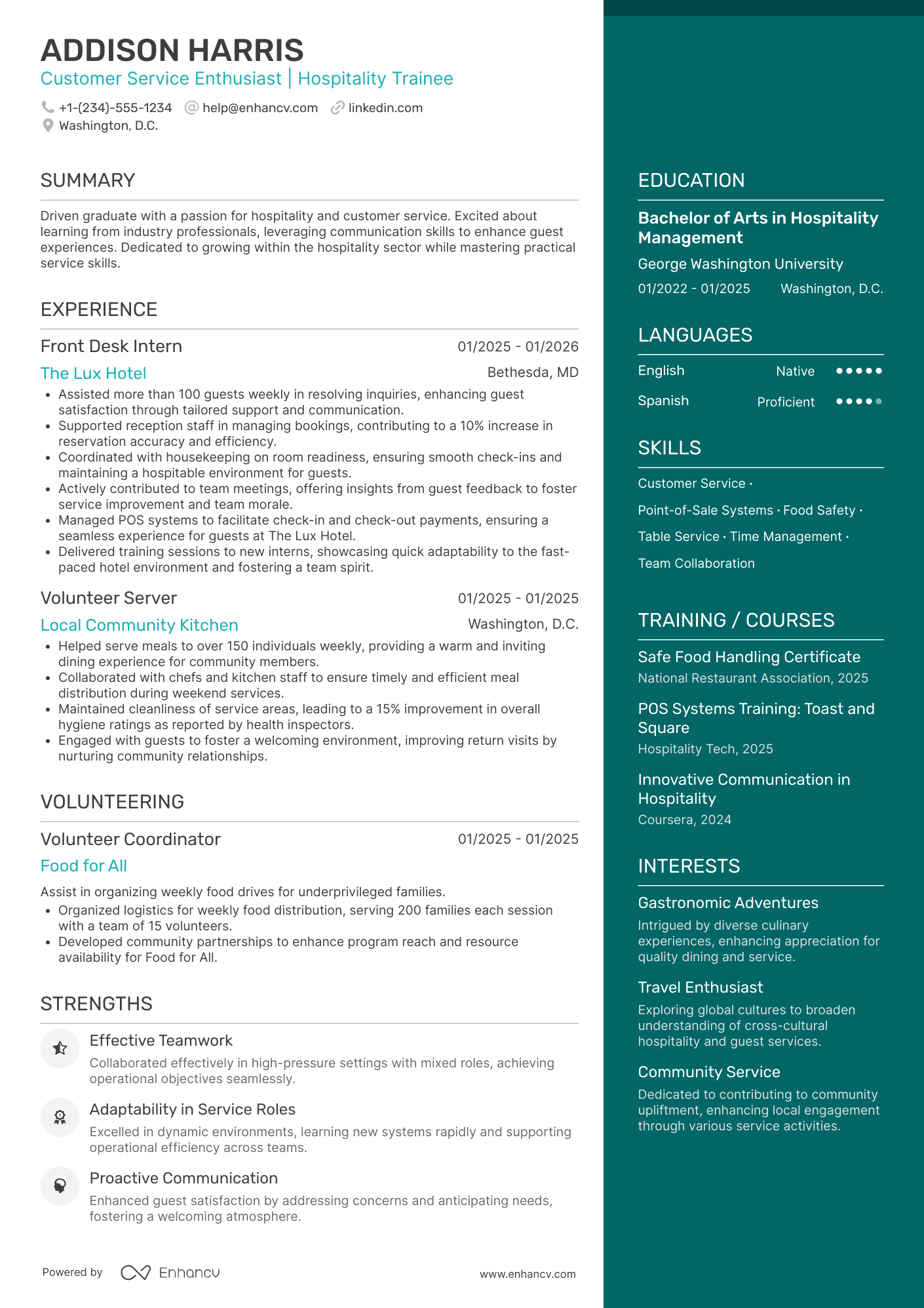
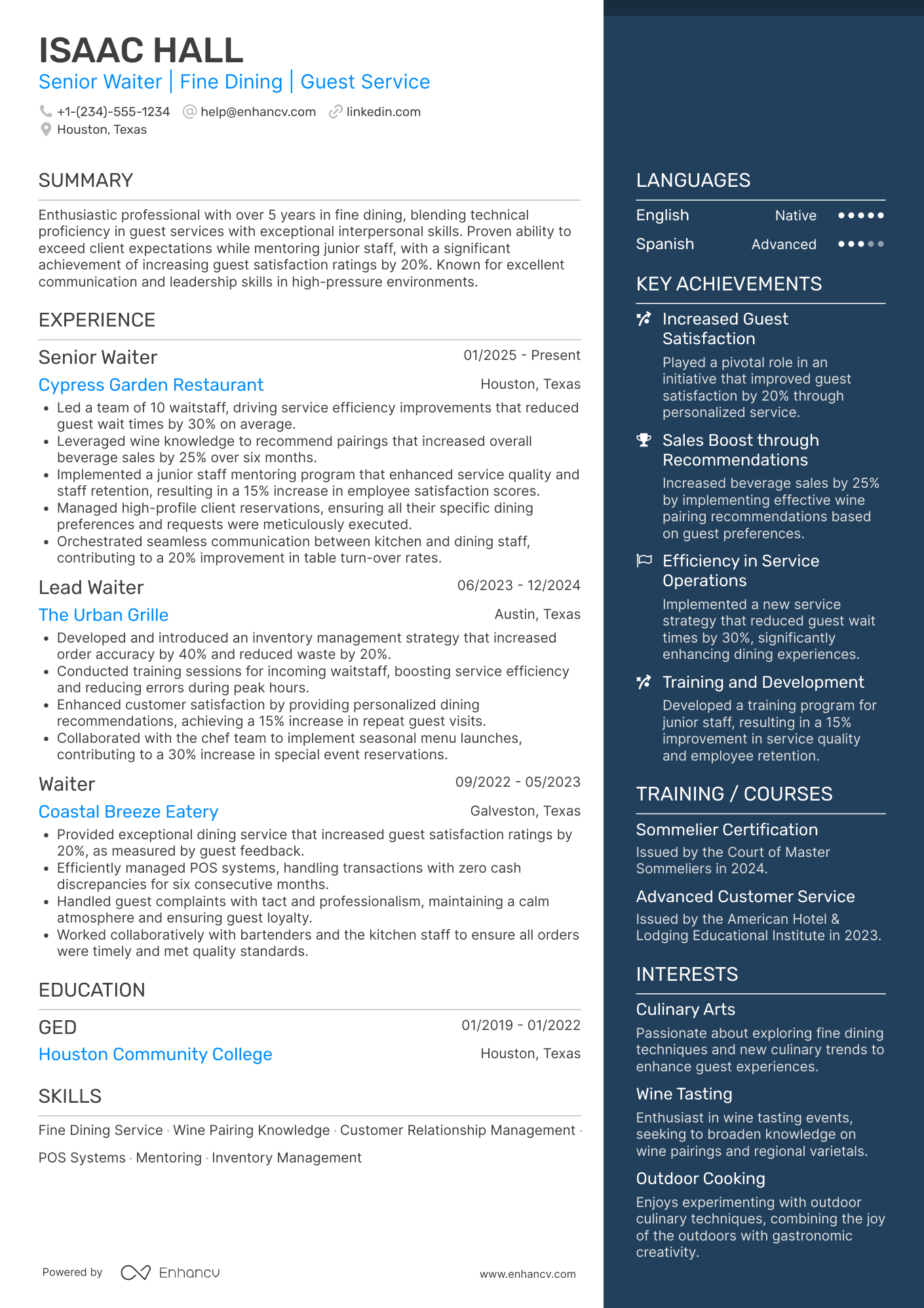
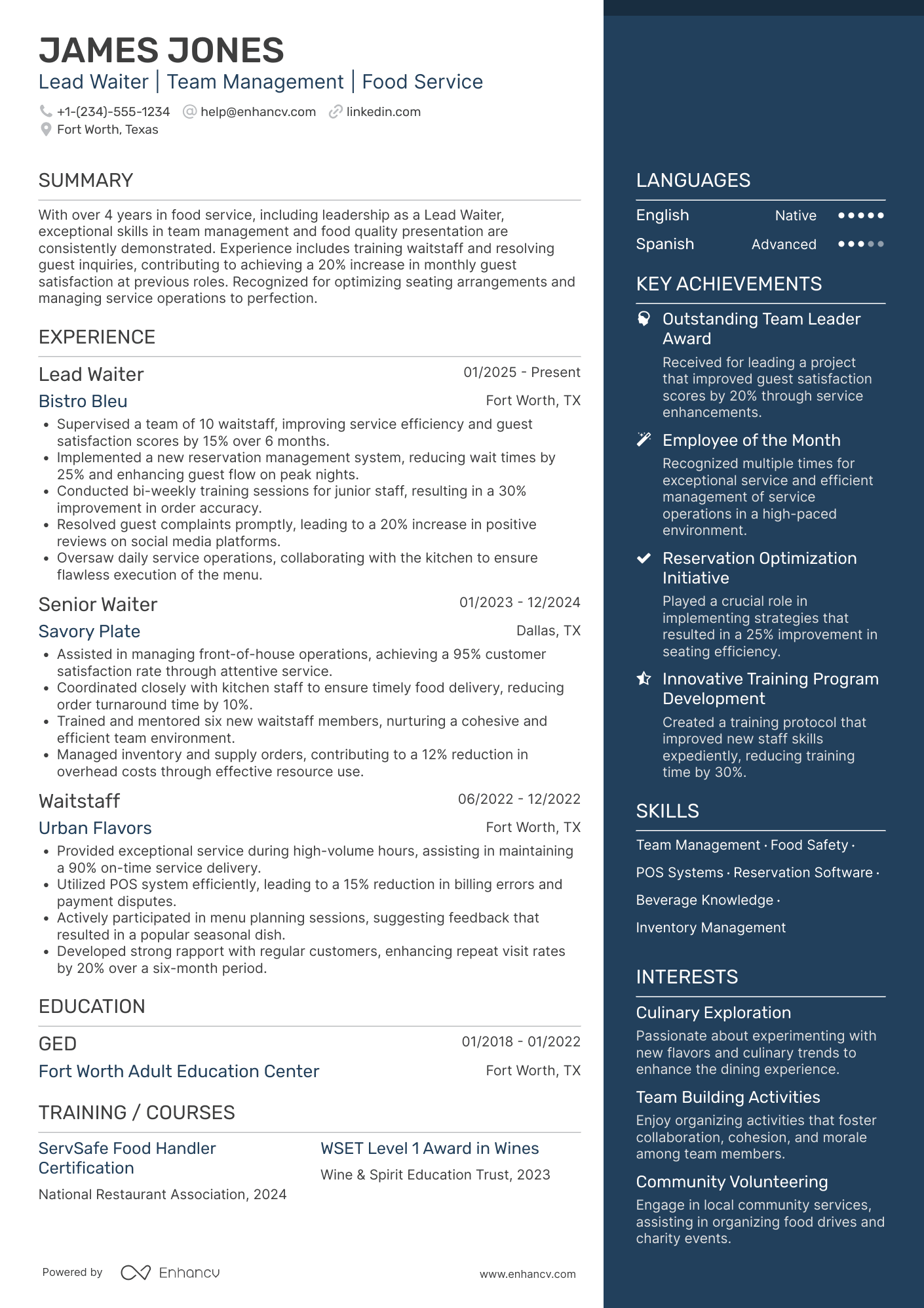
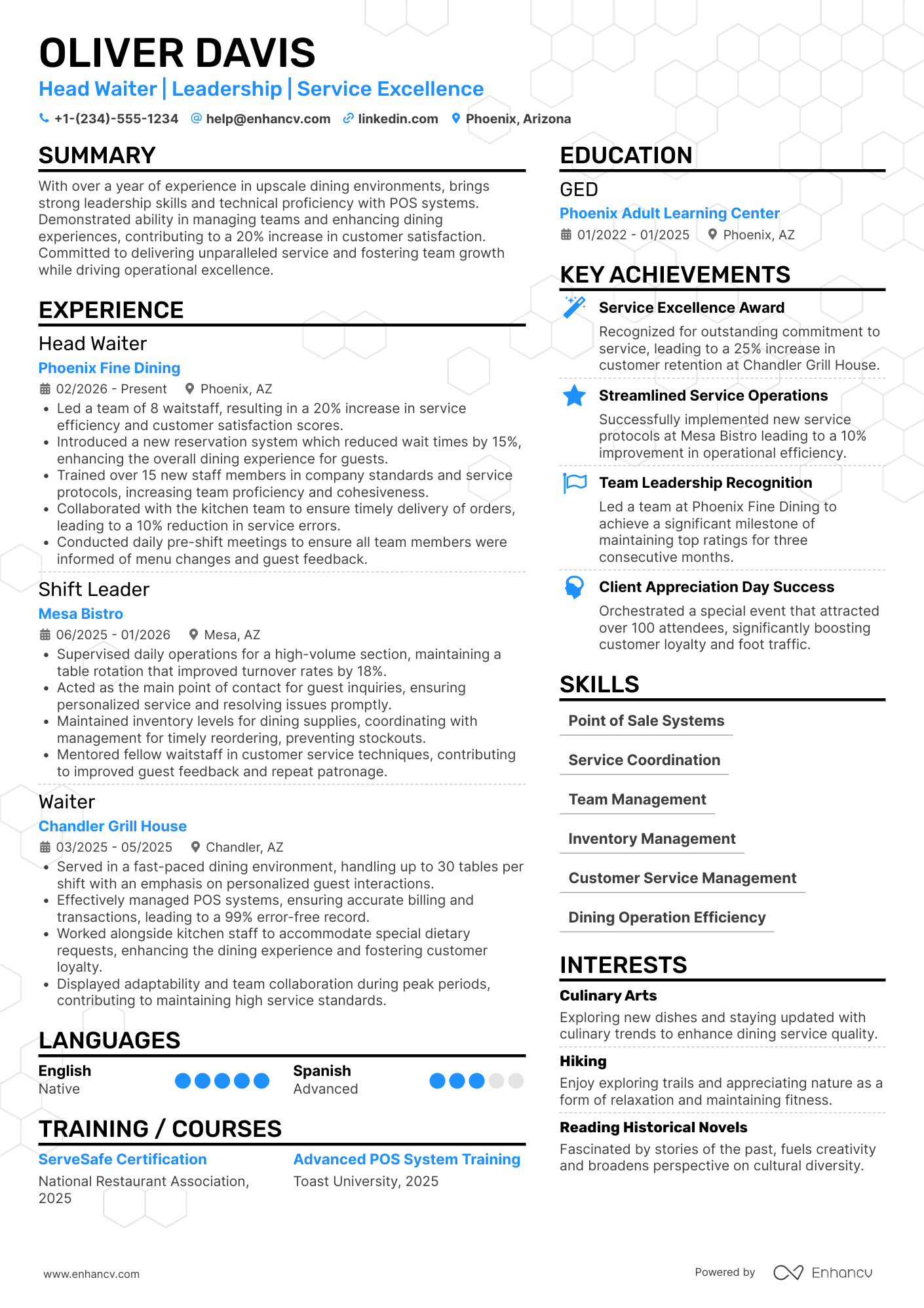
Waiter resume examples
By Experience
By Role