
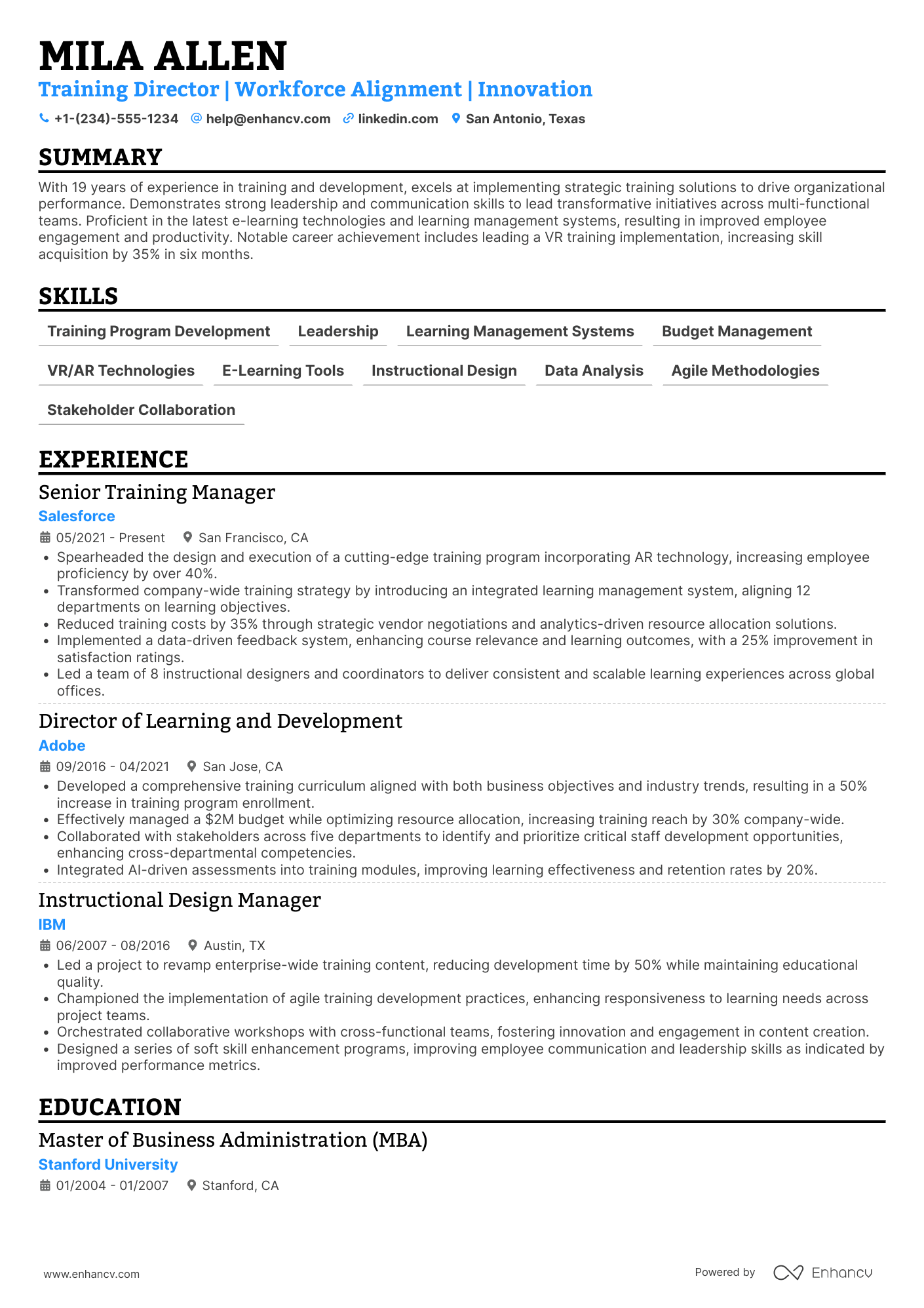
Many training director resume drafts fail because they list courses and platforms without proving business impact. That makes you easy to filter out in ATS screening and fast recruiter scans, especially when competition is high.
A strong resume shows outcomes and leadership, not task lists. If you're unsure where to start, learning how to write a resume that focuses on impact is essential. You should highlight improved time-to-proficiency, higher certification pass rates, reduced onboarding time, adoption across regions, compliance audit results, and measurable performance lift tied to revenue or retention.

Key takeaways
- Quantify training outcomes like completion rates, cost savings, and time-to-competency instead of listing tasks.
- Use reverse-chronological format to showcase leadership progression and program ownership clearly.
- Tailor every experience bullet to mirror the job posting's tools, frameworks, and KPIs.
- Tie each skill to a measurable result in your experience section, not just a standalone list.
- Lead your summary with strategic scope, industry context, and one concrete achievement.
- Add certifications like CPTM or CPLP to validate specialized, current expertise quickly.
- Use Enhancv to turn routine training responsibilities into quantified, recruiter-ready resume bullets.
How to format a training director resume
Recruiters evaluating training director candidates prioritize evidence of leadership scope, program ownership, and measurable organizational impact across progressive roles. A reverse-chronological format ensures these signals are immediately visible, making it easier for both hiring managers and applicant tracking systems to trace your career trajectory and decision-making authority. Choosing the right resume format is the foundation of a strong training director application.

I have significant experience in this role—which format should I use?
Use a reverse-chronological format—it's the strongest choice for a training director resume because it foregrounds your leadership progression and strategic ownership. Do:
- Lead with your most senior roles first, emphasizing scope of responsibility: team size, budget authority, number of programs managed, and cross-functional partnerships.
- Highlight domain expertise in learning management systems (LMS platforms like Cornerstone, SAP SuccessFactors, or Docebo), instructional design methodologies, compliance frameworks, and workforce development strategy.
- Anchor every role to measurable outcomes—think completion rates, cost savings, performance improvements, or employee retention tied directly to training initiatives.
Why hybrid and functional resumes don't work for senior roles
Hybrid formats fragment your leadership narrative by pulling skills out of the roles where you exercised them, making it harder for recruiters to evaluate the scope and context of your decisions. Functional formats are even more problematic—they obscure career progression entirely, dilute accountability for results, and strip away the organizational context that proves you've led at scale. Avoid hybrid and functional formats entirely if you have five or more years of progressive training leadership experience, as these structures will raise more questions than they answer.
- Edge-case exception: A functional format may be acceptable only if you're transitioning into a training director role from a closely related field (such as HR leadership or organizational development) with limited direct training titles on your resume—but even then, every listed skill must be tied to a specific project and a quantifiable outcome.
With your format established, the next step is filling it with the right sections to showcase your qualifications effectively.
What sections should go on a training director resume
Recruiters expect to quickly find proof you can design and scale training programs that improve performance and business results. Knowing what to put on a resume for a training director role helps you prioritize the most impactful information. Use this structure for maximum clarity:
- Header
- Summary
- Experience
- Skills
- Projects
- Education
- Certifications
- Optional sections: Awards, Publications, Leadership
Strong experience bullets should highlight measurable impact, program scope, stakeholder alignment, and outcomes like adoption, proficiency gains, and cost or time savings.
Is your resume good enough?
Drop your resume here or choose a file. PDF & DOCX only. Max 2MB file size.
Once you’ve organized your resume with the right section structure, the next step is to write your training director experience in a way that fits those sections and highlights your impact.
How to write your training director resume experience
The experience section is where you prove you've designed, delivered, and scaled training programs that drive organizational performance. Hiring managers prioritize demonstrated impact—measurable improvements in learner outcomes, workforce capability, and business results—over descriptive task lists. Building a targeted resume ensures each bullet directly supports the role you're pursuing.
Each entry should include:
- Job title
- Company and location (or remote)
- Dates of employment (month and year)
Three to five concise bullet points showing what you owned, how you executed, and what outcomes you delivered:
- Ownership scope: the training programs, learning platforms, curriculum portfolios, compliance frameworks, or instructional teams you were directly accountable for as a training director.
- Execution approach: the instructional design methodologies, learning management systems, needs-assessment frameworks, or evaluation models you used to shape strategy and deliver training initiatives.
- Value improved: changes to employee performance, onboarding efficiency, knowledge retention, compliance rates, skill-gap closure, or training accessibility that resulted from your leadership.
- Collaboration context: how you partnered with department heads, HR leadership, subject-matter experts, external vendors, or executive stakeholders to align training programs with organizational goals.
- Impact delivered: outcomes expressed through program reach, learner proficiency gains, reduced time-to-competency, cost savings, or measurable business results rather than a list of activities performed.
Experience bullet formula
A training director experience example
✅ Right example - modern, quantified, specific.
Training Director
NexaCare Health | Austin, TX
2021–Present
Led enterprise learning for a multi-site healthcare network supporting eight thousand employees across clinical, revenue cycle, and corporate teams.
- Built a role-based onboarding and compliance curriculum in Cornerstone OnDemand (Cornerstone) using ADDIE and SCORM packages, cutting time-to-productivity by 22% and reducing first-ninety-day attrition by 11%.
- Launched a blended learning program (virtual instructor-led training, microlearning, and simulations) in Articulate 360 and Microsoft Teams, improving post-training assessment scores from 78% to 91% across 3,400 learners.
- Partnered with HR, legal, and clinical leaders to redesign annual compliance training with scenario-based modules and knowledge checks, increasing on-time completion from 84% to 98% and lowering audit findings by 35%.
- Implemented a learning analytics dashboard in Power BI by integrating Cornerstone reporting and HRIS data, enabling monthly skills-gap reviews that raised internal fill rate for priority roles by 17%.
- Standardized facilitator enablement with train-the-trainer certification, observation rubrics, and Net Promoter Score tracking, lifting instructor Net Promoter Score from 46 to 63 and reducing rework on course updates by 28%.
Now that you've seen how a strong experience section comes together, let's look at how to adjust yours to match a specific job posting.
How to tailor your training director resume experience
Recruiters evaluate training director resumes through both applicant tracking systems and human review, so tailoring your resume to the job description is essential. Tailoring ensures the skills, tools, and accomplishments you highlight directly match what the employer is looking for.
Ways to tailor your training director experience:
- Mirror the learning management systems or platforms named in the posting.
- Use the exact instructional design methodologies the job description references.
- Reflect compliance or regulatory training requirements specific to their industry.
- Highlight leadership of cross-functional collaboration models they describe.
- Match their KPIs like learner engagement or training completion rates.
- Include domain experience in the specific industry the role serves.
- Align your quality assurance or program evaluation language with theirs.
- Reference the workforce development frameworks or standards they prioritize.
Tailoring means connecting your real achievements to what the role demands, not forcing keywords where they don't belong.
Resume tailoring examples for training director
| Job description excerpt | Untailored | Tailored |
|---|---|---|
| "Design and implement enterprise-wide leadership development programs using ADDIE methodology and Articulate 360 for a workforce of 2,000+ employees." | Developed training programs for employees at various levels across the organization. | Designed and launched a leadership development program using ADDIE methodology and Articulate 360, reaching 2,300 employees across 12 departments and increasing internal promotion rates by 28%. |
| "Manage a $1.5M annual training budget while partnering with department heads to conduct skills gap analyses and align learning initiatives with strategic business goals." | Worked with leadership to plan training activities and manage department resources. | Partnered with eight department heads to conduct quarterly skills gap analyses, aligning a $1.5M training budget with strategic business goals and closing 15 critical competency gaps within one fiscal year. |
| "Evaluate program effectiveness through Kirkpatrick's four-level model and leverage SAP SuccessFactors Learning to track completion rates, assessment scores, and ROI." | Tracked training results and created reports to share with senior management. | Evaluated program effectiveness using Kirkpatrick's four-level model within SAP SuccessFactors Learning, tracking completion rates, assessment scores, and ROI—demonstrating a 34% improvement in on-the-job performance metrics across targeted teams. |
Once you’ve aligned your experience with the role’s priorities, the next step is to quantify your training director achievements so hiring teams can see the results of that work.
How to quantify your training director achievements
Quantifying your achievements proves your programs changed behavior, not just attendance. Focus on cycle time, completion and certification rates, learner satisfaction, compliance risk reduction, and business outcomes like productivity, retention, and cost per learner.
Quantifying examples for training director
| Metric | Example |
|---|---|
| Cycle time | "Cut new-hire onboarding from eight weeks to five by redesigning the curriculum in Cornerstone and standardizing manager checklists across twelve locations." |
| Completion rate | "Raised mandatory training completion from 82% to 97% in sixty days using Workday Learning reminders and weekly compliance dashboards for 1,400 employees." |
| Quality uplift | "Improved post-training assessment pass rate from 76% to 91% by adding scenario-based labs and coaching guides for twenty-five facilitators." |
| Risk reduction | "Reduced audit findings from nine to two by rebuilding SOP training, adding version control in SharePoint, and running quarterly spot checks across three regulated teams." |
| Cost efficiency | "Lowered cost per learner by 28% by converting seven instructor-led courses to blended eLearning in Articulate 360, saving $180,000 annually." |
Turn your everyday tasks into measurable, recruiter-ready resume bullets in seconds with Enhancv's Bullet Point Generator.
Once you've crafted strong bullet points that highlight your impact, the next step is ensuring your resume also showcases the right mix of hard and soft skills employers expect from a training director.
How to list your hard and soft skills on a training director resume
Your skills section shows how you design and scale training programs, and recruiters and ATS scan this section to confirm role fit fast—aim for a balance of hard skills that prove delivery and soft skills that show leadership and stakeholder management. training director roles require a blend of:
- Product strategy and discovery skills.
- Data, analytics, and experimentation skills.
- Delivery, execution, and go-to-market discipline.
- Soft skills.
Your skills section should be:
- Scannable (bullet-style grouping).
- Relevant to the job post.
- Backed by proof in experience bullets.
- Updated with current tools.
Place your skills section:
- Above experience if you're junior or switching careers.
- Below experience if you're mid/senior with strong achievements.

Hard skills
- Learning management systems: Cornerstone, Docebo, Moodle
- Instructional design: ADDIE, SAM
- Curriculum architecture and competency models
- Training needs analysis and skills gap analysis
- Learning evaluation: Kirkpatrick model
- Learning analytics and dashboarding: Power BI, Tableau
- Content authoring: Articulate 360, Rise, Captivate
- Virtual training platforms: Zoom, Microsoft Teams
- HR systems integration: Workday, SAP SuccessFactors
- Change management and adoption planning
- Budgeting, vendor selection, contract management
- Compliance training and audit readiness
Soft skills
- Align training to business goals
- Influence senior stakeholders
- Lead cross-functional program delivery
- Coach managers and facilitators
- Facilitate executive-ready presentations
- Translate needs into learning plans
- Prioritize portfolios under constraints
- Drive accountability and follow-through
- Resolve conflict and build alignment
- Communicate clearly across levels
- Make data-informed decisions
- Manage change with credibility
How to show your training director skills in context
Skills shouldn't live only in a bulleted list on your resume. Explore examples of resume skills shown in context to see how top candidates integrate them effectively.
They should be demonstrated in:
- Your summary (high-level professional identity)
- Your experience (proof through outcomes)
Here's what strong, skills-rich entries look like in practice.
Summary example
Training director with 12 years in healthcare L&D, skilled in curriculum design, Articulate 360, and Kirkpatrick evaluation. Led enterprise onboarding redesign that cut new-hire ramp time by 35% while strengthening cross-departmental collaboration.
- Signals senior-level expertise immediately
- Names industry-specific tools and frameworks
- Includes a concrete, measurable outcome
- Highlights collaboration as a soft skill
Experience example
Senior Training Director
Allegra Health Partners | Remote
March 2019–Present
- Redesigned clinical onboarding curriculum using Articulate 360 and SAP SuccessFactors, reducing ramp time by 35% across four regional offices.
- Partnered with department heads to launch a leadership development track, increasing internal promotion rates by 22% within 18 months.
- Implemented Kirkpatrick Level 3 assessments to measure behavior change, boosting post-training competency scores by 28%.
- Every bullet contains a measurable result.
- Skills surface naturally through real accomplishments.
Once you’ve tied your training director capabilities to measurable outcomes and real examples, the next step is applying that same approach to building a training director resume with no experience, so your transferable strengths still read as job-ready.
How do I write a training director resume with no experience
Even without full-time experience, you can demonstrate readiness through the strategies outlined in our guide on writing a resume without work experience:
- Corporate training internship rotations
- Volunteer onboarding for nonprofits
- Training needs analysis coursework projects
- Learning management system administration practice
- Facilitated workshops for student groups
- Curriculum design capstone deliverables
- Train-the-trainer certification programs
- Cross-functional process documentation initiatives
Focus on:
- Learning programs tied to metrics
- Curriculum design and evaluation evidence
- Learning management system reporting results
- Stakeholder alignment and rollout scope
Resume format tip for entry-level training director
Use a hybrid resume format because it highlights training director projects and tools first, while still showing steady education and work history. Do:
- Lead with a "Training director projects" section.
- List learning management system, authoring, and analytics tools.
- Quantify results: completion, time, and scores.
- Add stakeholders, audience size, and delivery mode.
- Include evaluation methods: surveys, quizzes, and reporting.
- Built a six-module onboarding in an LMS (learning management system), added quizzes and completion tracking, and raised completion from 62% to 91% in four weeks.
Even without direct experience, your educational background can serve as a strong foundation for your training director resume—here's how to present it effectively.
How to list your education on a training director resume
Your education section helps hiring teams confirm you have the foundational knowledge needed for a training director role. It validates your expertise in learning theory, leadership, and organizational development.
Include:
- Degree name
- Institution
- Location
- Graduation year
- Relevant coursework (for juniors or entry-level candidates)
- Honors & GPA (if 3.5 or higher)
Skip month and day details—list the graduation year only.
Here's a strong education entry tailored to a training director resume:
Example education entry
Master of Science in Organizational Leadership
University of Southern California, Los Angeles, CA
Graduated 2018
GPA: 3.8/4.0
- Relevant coursework: Adult Learning Theory, Instructional Design, Talent Development Strategy, Change Management
- Honors: Graduated summa cum laude, Dean's List all semesters
How to list your certifications on a training director resume
Certifications on a resume show a training director's commitment to learning, proficiency with key tools, and alignment with current industry standards. They also help hiring teams confirm specialized expertise quickly.
Include:
- Certificate name
- Issuing organization
- Year
- Optional: credential ID or URL
- Place certifications below education when they're older, less relevant, or supplemental to your degree and core training director experience.
- Place certifications above education when they're recent, role-critical, or required for the training director job you're targeting.
Best certifications for your training director resume
- Certified Professional in Training Management (CPTM)
- Certified Professional in Learning and Performance (CPLP)
- SHRM Certified Professional (SHRM-CP)
- Project Management Professional (PMP)
- Prosci Certified Change Practitioner
- Certified ScrumMaster (CSM)
- Kirkpatrick Four Levels Evaluation Certification
Once you’ve positioned your credentials to support your training expertise, move to your training director resume summary to tie those qualifications to the value you deliver.
How to write your training director resume summary
Your resume summary is the first thing a recruiter reads, so it must instantly communicate your leadership value. A strong summary positions you as a strategic training leader, not just someone who facilitates courses.
Keep it to three to four lines, with:
- Your title and total years of experience in training, learning, or organizational development.
- The industries or domains where you've led training programs.
- Core competencies like LMS administration, instructional design, or curriculum strategy.
- One or two measurable achievements, such as improved retention or reduced onboarding time.
- Soft skills tied to real outcomes, like cross-functional collaboration that drove company-wide adoption.

PRO TIP
At the director level, lead with strategic impact and organizational scope. Highlight how your decisions shaped training outcomes across departments or business units. Avoid vague descriptors like "passionate leader" or "motivated professional." Instead, show ownership of budgets, teams, and measurable results.
Example summary for a training director
Training director with 12+ years leading enterprise learning strategies across healthcare and tech. Built and managed a 15-person L&D team, cutting employee onboarding time by 35% while increasing training completion rates organization-wide.
Optimize your resume summary and objective for ATS
Drop your resume here or choose a file.
PDF & DOCX only. Max 2MB file size.
Now that your summary is crafted to showcase your leadership and impact, make sure the header framing it presents your contact details correctly so recruiters can actually reach you.
What to include in a training director resume header
A resume header lists your key contact and identity details, and it boosts visibility, credibility, and fast recruiter screening for a training director role.
Essential resume header elements
- Full name
- Tailored job title and headline
- Location
- Phone number
- Professional email
- GitHub link
- Portfolio link
A LinkedIn link helps recruiters verify experience quickly and supports screening.
Do not include photos on a training director resume unless the role is explicitly front-facing or appearance-dependent.
Match your header title to the posting and keep every link and contact detail current, readable, and consistent across platforms.
Example
Training director resume header
Jordan Taylor
Training Director | Leadership Development and Learning Programs
Chicago, IL
(312) 555-78XX
jordan.taylor@enhancv.com
github.com/jordantaylor
jordantaylor.com
linkedin.com/in/jordantaylor
Once your contact details and role identifiers are set at the top, add targeted additional sections to strengthen your training director resume with relevant supporting information.
Additional sections for training director resumes
When your core sections don't fully capture your expertise, additional sections can strengthen your credibility and set you apart from other training director candidates. For example, listing language skills can demonstrate your ability to lead training programs across diverse, multilingual teams.
- Languages
- Certifications and professional development
- Publications and presentations
- Industry conference speaking engagements
- Professional affiliations and memberships
- Volunteer training and mentorship experience
- Awards and recognitions
Once you've strengthened your resume with relevant additional sections, it's worth pairing it with a cover letter to give hiring managers even more context about your qualifications.
Do training director resumes need a cover letter
A cover letter isn't required for a training director, but it often helps. If you're wondering what a cover letter is and how it supports your application, it can matter most in competitive searches, leadership roles, or organizations that expect a narrative alongside the resume.
Use a cover letter to add context your resume can't:
- Explain fit with the role and team: Connect your training director approach to the organization's learning culture, stakeholders, and operating model.
- Highlight one or two relevant outcomes: Point to a program you led, the business problem it solved, and measurable results like ramp time, adoption, or performance.
- Show understanding of the product, users, or business context: Reference the audience, workflows, and success metrics the training director role will support.
- Address career transitions or non-obvious experience: Clarify how adjacent work maps to training director responsibilities, and name the skills you'll apply on day one.
Drop your resume here or choose a file.
PDF & DOCX only. Max 2MB file size.
After you decide whether to include a cover letter to add context to your application, use AI to strengthen your training director resume by sharpening your language and aligning it with the role.
Using AI to improve your training director resume
AI can sharpen your resume's clarity, structure, and overall impact. It helps you refine language and highlight measurable results. If you're exploring options, our guide on which AI is best for writing resumes can help you choose the right tool. But overuse strips away authenticity. Once your content feels clear and role-aligned, step away from AI.
Here are 10 practical prompts to strengthen specific sections of your training director resume:
- Sharpen your summary: "Rewrite my training director resume summary to emphasize leadership scope, program results, and strategic learning initiatives in under four sentences."
- Quantify experience bullets: "Add specific metrics—like completion rates, cost savings, or employee performance gains—to these training director experience bullet points."
- Align skills section: "Review this training director skills section and remove generic entries. Replace them with industry-relevant competencies tied to organizational development."
- Strengthen action verbs: "Replace weak or passive verbs in my training director experience bullets with strong, results-driven action verbs."
- Tailor to job posting: "Compare my training director resume experience section against this job description. Identify gaps and suggest targeted revisions."
- Refine certifications section: "Reorder and rewrite my training director certifications section to prioritize credentials most relevant to enterprise learning leadership roles."
- Clarify project descriptions: "Simplify these training director project descriptions so each one clearly states the goal, my role, and the measurable outcome."
- Tighten education section: "Edit my training director education section to highlight relevant coursework, honors, or research tied to adult learning or instructional design."
- Eliminate redundancy: "Scan my full training director resume for repeated ideas or overlapping bullet points. Suggest concise alternatives that preserve unique details."
- Improve readability: "Break down any long or complex sentences across my training director resume into shorter, scannable statements without losing meaning."
Stop using AI once your resume sounds accurate, specific, and aligned with real experience. AI should never invent experience or inflate claims—if it didn't happen, it doesn't belong here.
Conclusion
A strong training director resume shows measurable outcomes, role-specific skills, and a clear structure. It highlights program design, facilitation, stakeholder management, and evaluation. It uses numbers to prove impact, such as completion rates, time-to-competency, and cost savings.
Keep each section focused and easy to scan. A direct summary, targeted experience, and clean formatting help hiring teams compare you fast. This approach signals readiness for today’s hiring market and near-future needs.