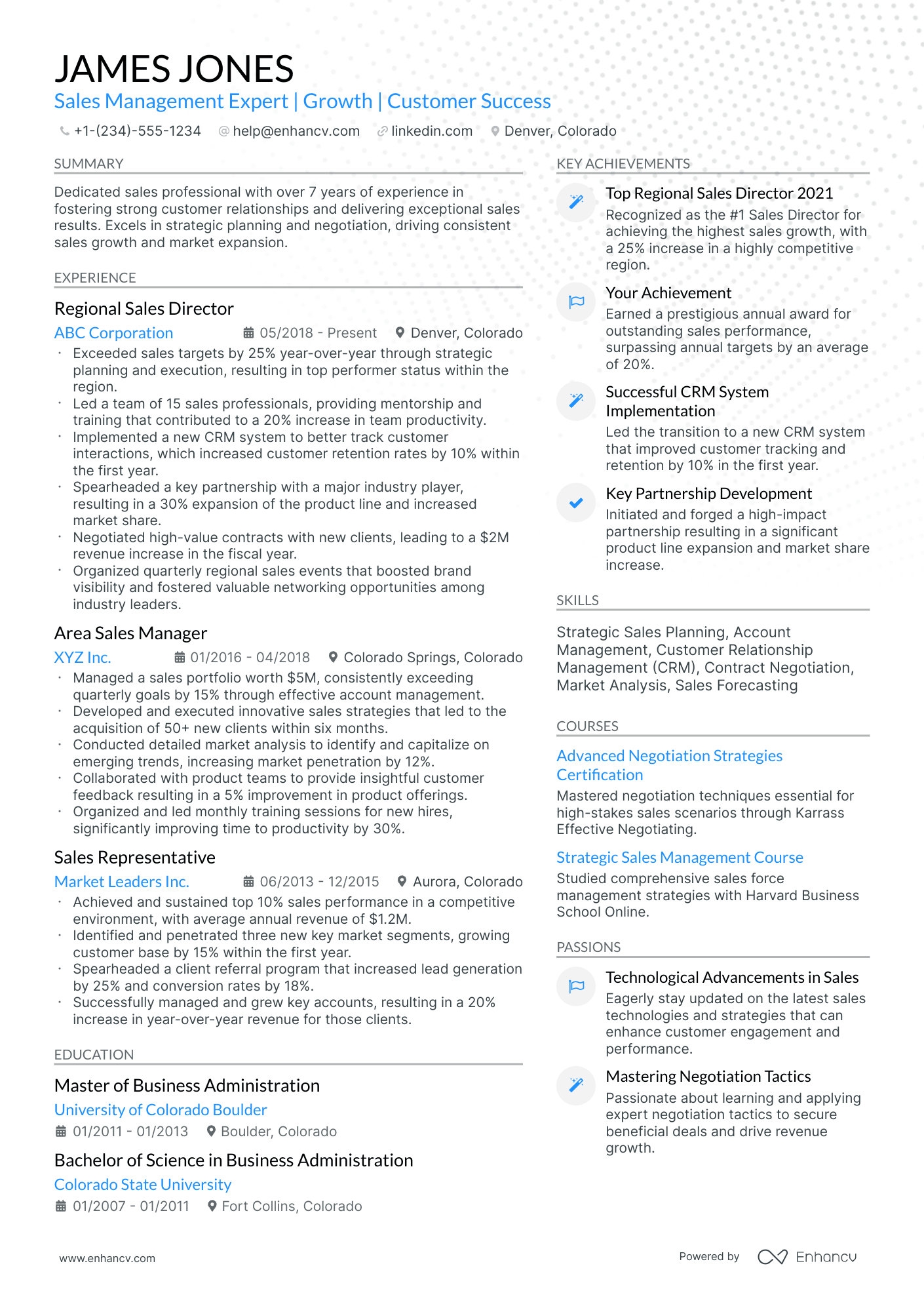
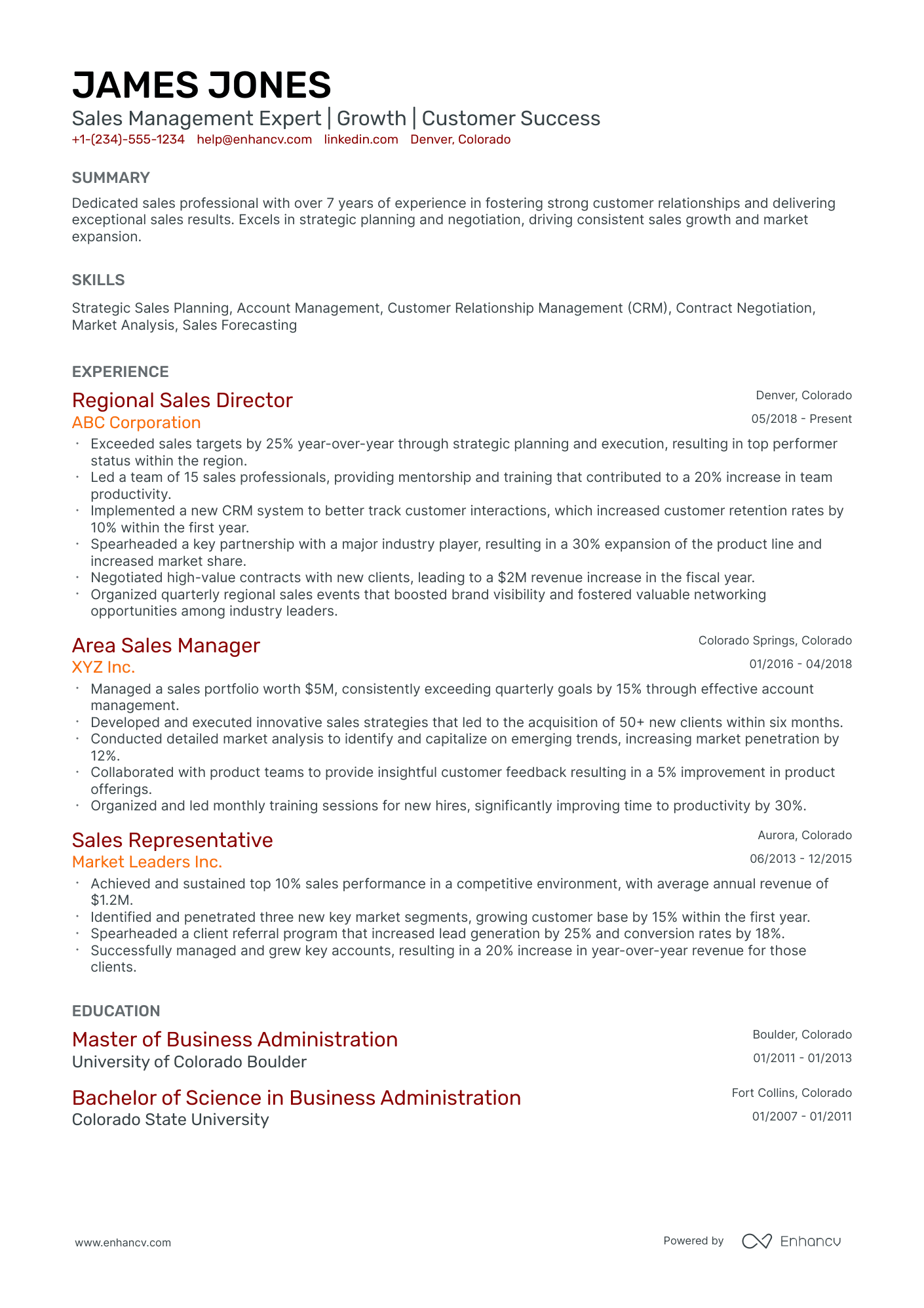
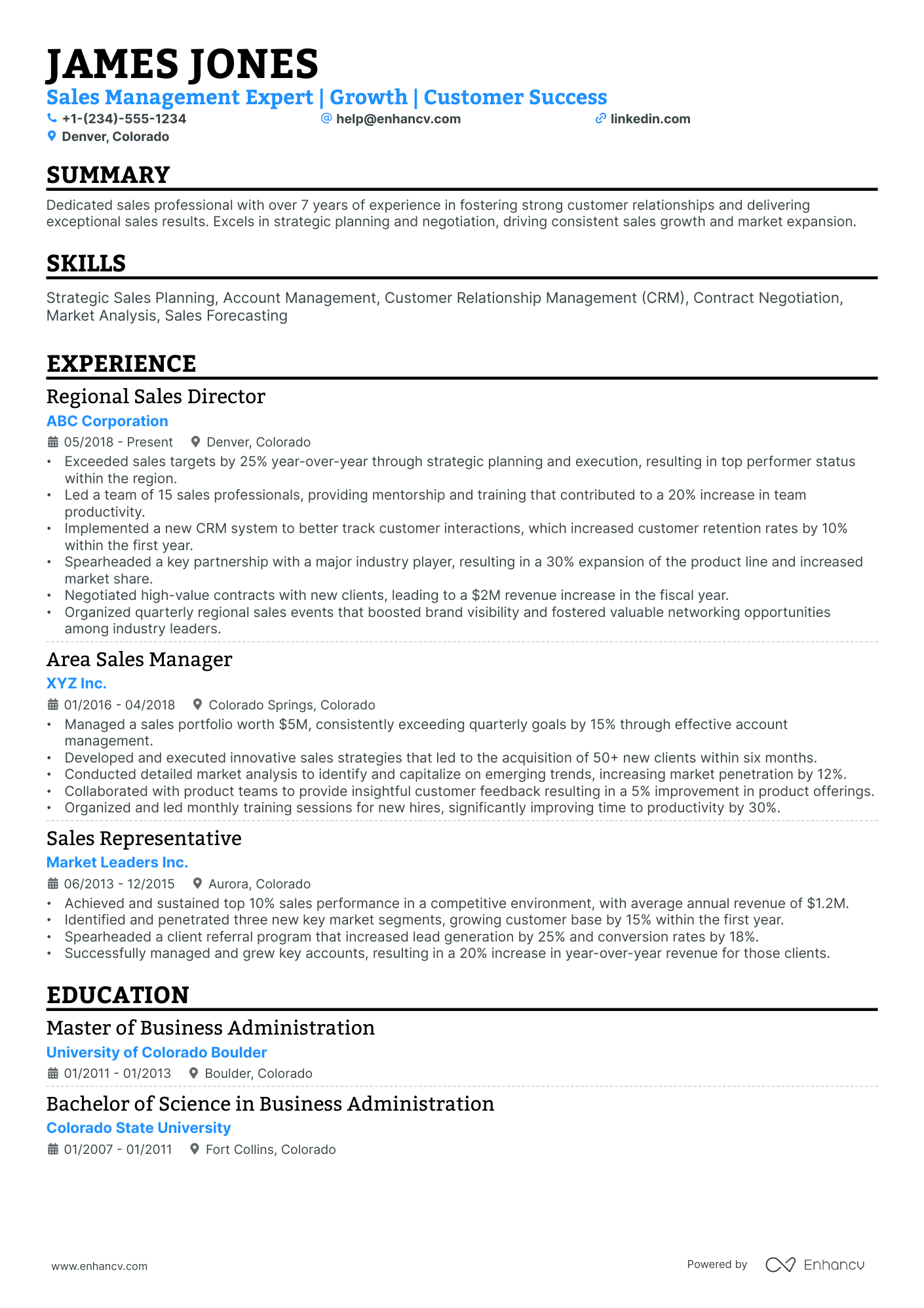
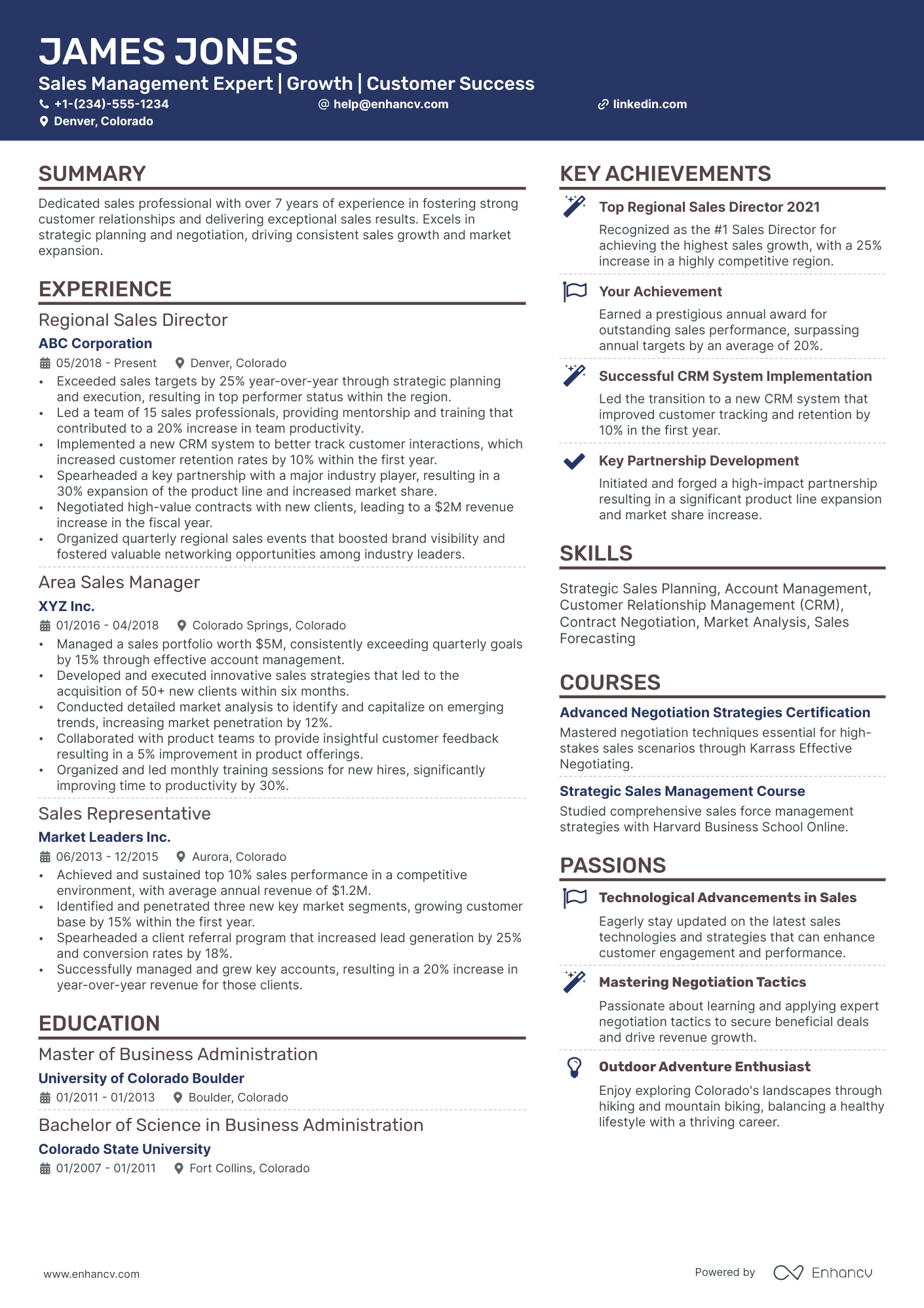
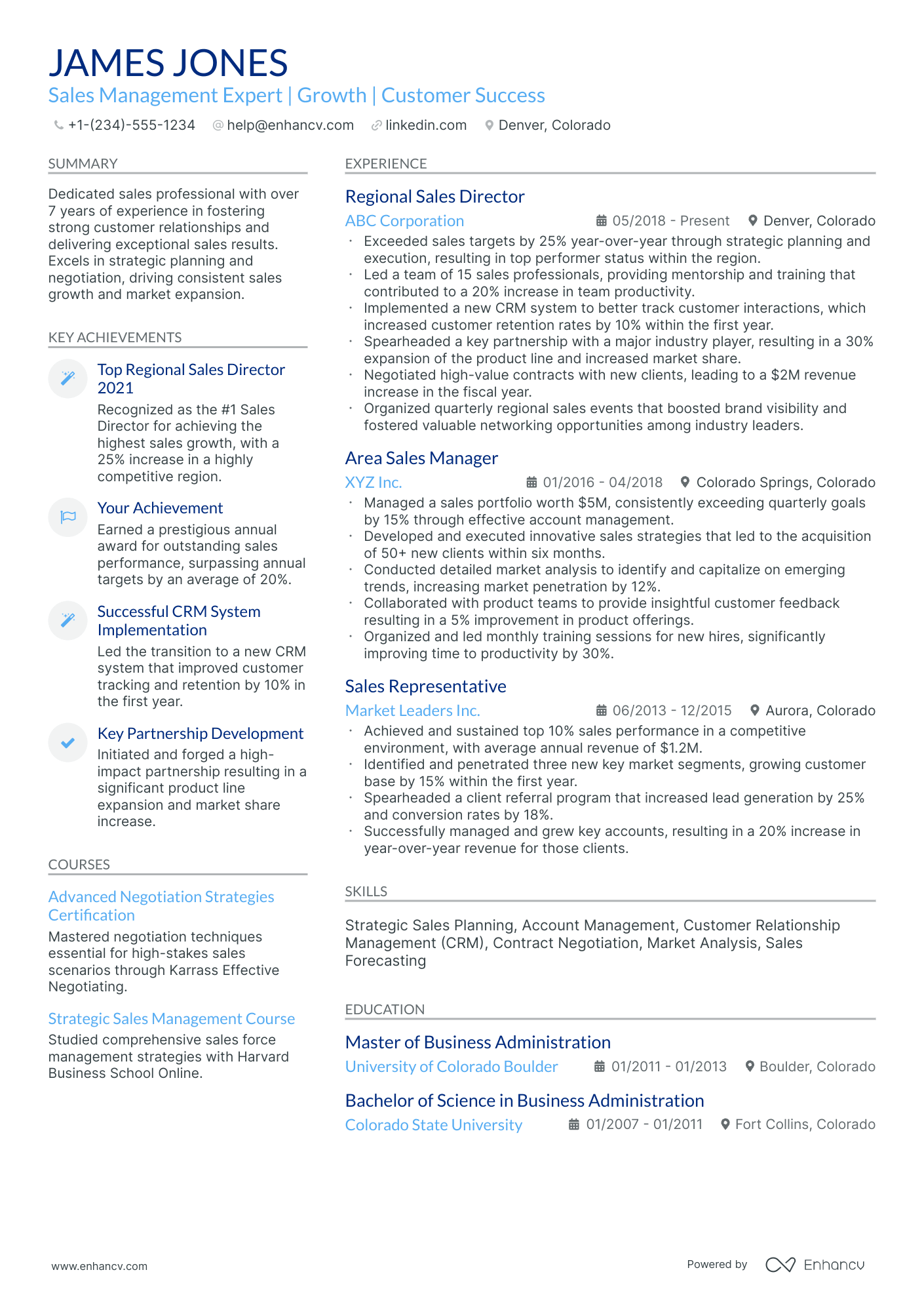
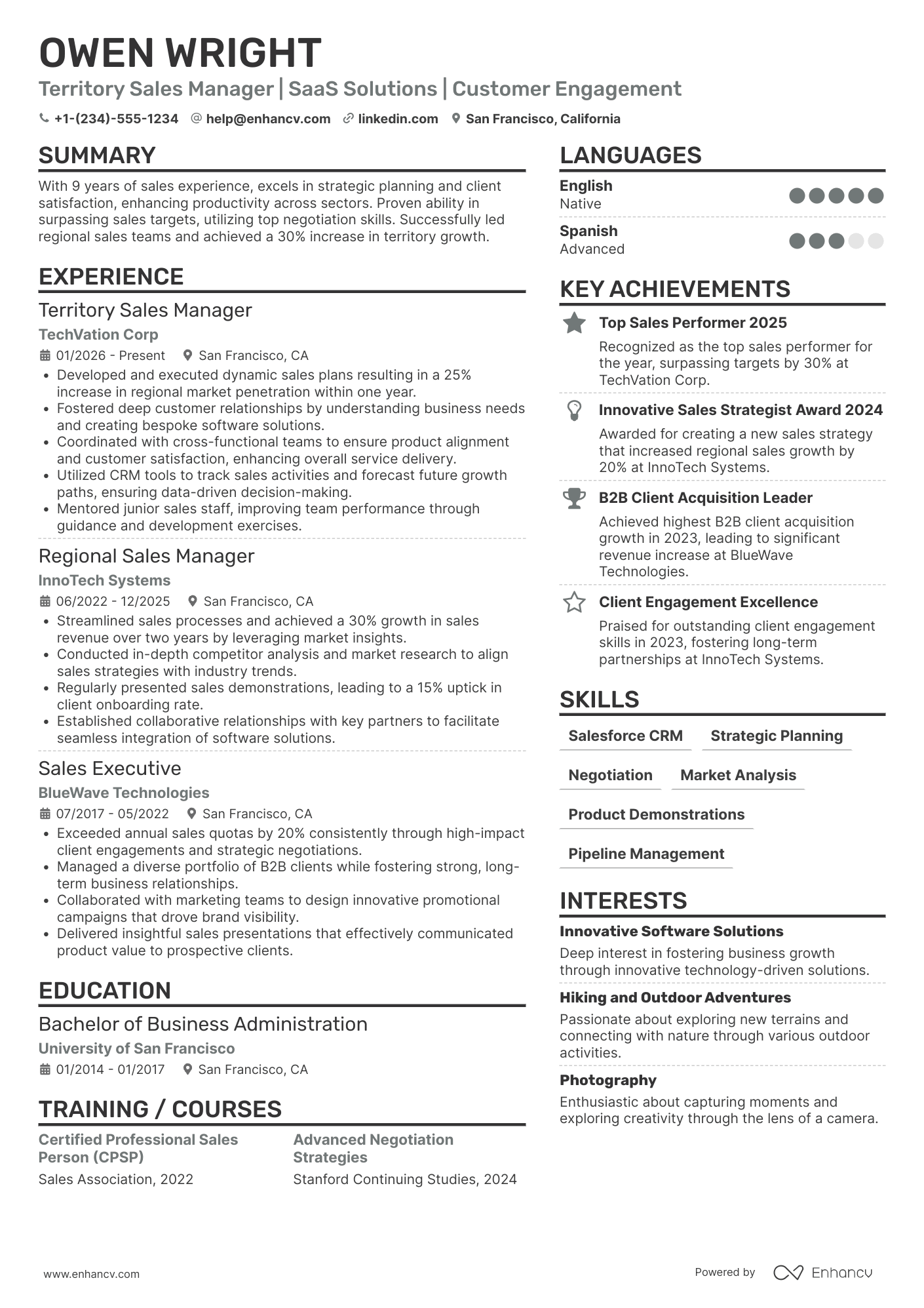
Territory sales manager resume drafts often fail because they read like task lists and bury territory strategy, quota performance, and account growth behind generic sales language. That hurts in ATS screening and fast recruiter scans, where high competition demands immediate proof.
A strong resume shows what you delivered, not what you used. Knowing how to make your resume stand out means highlighting quota attainment, year-over-year revenue growth, pipeline coverage, new logo wins, renewal retention, average deal size, territory expansion, and forecast accuracy across a defined region and book of business.

Key takeaways
- Quantify quota attainment, revenue growth, and pipeline coverage instead of listing generic sales duties.
- Use reverse-chronological format for experienced candidates and hybrid format for career changers.
- Tailor every experience bullet to mirror the job posting's tools, metrics, and terminology.
- Anchor each skill claim to a measurable outcome in your experience or summary section.
- Place certifications above education when they're more relevant to the target role.
- Write a three-to-four-line summary featuring your territory scope, industry, and top metric.
- Use Enhancv's Bullet Point Generator to turn vague responsibilities into recruiter-ready achievement statements.
Job market snapshot for territory sales managers
We analyzed 506 recent territory sales manager job ads across major US job boards. These numbers help you understand regional hotspots, top companies hiring, skills in demand at a glance.
What level of experience employers are looking for territory sales managers
| Years of Experience | Percentage found in job ads |
|---|---|
| 1–2 years | 9.3% (47) |
| 3–4 years | 5.5% (28) |
| 5–6 years | 11.9% (60) |
| 7–8 years | 0.2% (1) |
| 9–10 years | 0.2% (1) |
| 10+ years | 4.0% (20) |
| Not specified | 69.2% (350) |
Territory sales manager ads by area of specialization (industry)
| Industry (Area) | Percentage found in job ads |
|---|---|
| Finance & Banking | 54.9% (278) |
| Healthcare | 15.6% (79) |
| Retail & E-commerce | 14.4% (73) |
| Manufacturing | 6.5% (33) |
| Real Estate & Construction | 3.6% (18) |
| Government | 2.6% (13) |
Top companies hiring territory sales managers
| Company | Percentage found in job ads |
|---|---|
| Hi-Line | 9.3% (47) |
| Uline, Inc. | 7.3% (37) |
| Continental | 4.2% (21) |
| GLOBAL MEDICAL RESPONSE | 4.2% (21) |
| Ingersoll Rand | 3.2% (16) |
| Cornerstone Building Brands | 3.0% (15) |
| US Foods Holding Corp. | 2.4% (12) |
| Hyland Software | 2.2% (11) |
| WillScot Corporation | 2.2% (11) |
Role overview stats
These tables show the most common responsibilities and employment types for territory sales manager roles. Use them to align your resume with what employers expect and to understand how the role is structured across the market.
Day-to-day activities and top responsibilities for a territory sales manager
| Responsibility | Percentage found in job ads |
|---|---|
| Crm | 30.0% (152) |
| Microsoft office | 21.7% (110) |
| Salesforce | 16.8% (85) |
| Excel | 10.3% (52) |
| Powerpoint | 8.5% (43) |
| Word | 8.3% (42) |
| Microsoft excel | 7.9% (40) |
| Sales | 7.9% (40) |
| Salesforce.com | 6.3% (32) |
| Microsoft word | 6.1% (31) |
| Microsoft powerpoint | 3.4% (17) |
| Microsoft office suite | 3.2% (16) |
Type of employment (remote vs on-site vs hybrid)
| Employment type | Percentage found in job ads |
|---|---|
| On-site | 50.6% (256) |
| Remote | 36.4% (184) |
| Hybrid | 13.0% (66) |
How to format a territory sales manager resume
Recruiters evaluating territory sales manager candidates prioritize revenue performance, territory growth metrics, and the ability to manage a defined geographic book of business independently. Choosing the right resume format ensures these signals—quota attainment, pipeline management, and client acquisition results—surface quickly during both ATS parsing and the initial human scan.

I have significant experience in this role—which format should I use?
Use a reverse-chronological format to showcase your track record of territory ownership, quota performance, and progressive sales responsibility. Do:
- Lead each role entry with territory scope and ownership details—region size, account volume, and revenue under management.
- Highlight proficiency with role-specific tools and domains such as Salesforce, HubSpot, territory mapping software, pipeline forecasting, and B2B or B2C sales cycles.
- Quantify outcomes tied to business impact, including revenue growth, market share gains, client retention rates, and quota attainment percentages.
I'm junior or switching into this role—what format works best?
Use a hybrid format to position your transferable sales skills and relevant accomplishments ahead of a shorter work history. Do:
- Place a skills section near the top that highlights territory-relevant competencies like prospecting, CRM management, route planning, and consultative selling.
- Feature project-based or transitional experience—such as managing a sales internship territory, leading a regional campaign, or running an inside sales book—that demonstrates territory-adjacent responsibility.
- Connect every action to a measurable result so recruiters can assess your potential impact in a territory role.
Why not use a functional resume?
A functional format strips away the timeline context that recruiters need to evaluate how you built sales results, managed accounts, and progressed within competitive environments—making it harder to trust your readiness for territory ownership.
- A functional resume may be acceptable if you're transitioning from an adjacent field (such as retail management or customer success) or re-entering the workforce after a gap, but only if every listed skill is anchored to a specific project, quota, or measurable outcome rather than presented as a standalone claim.
Once your format establishes a clean, readable structure, the next step is filling it with the right sections to showcase your qualifications effectively.
What sections should go on a territory sales manager resume
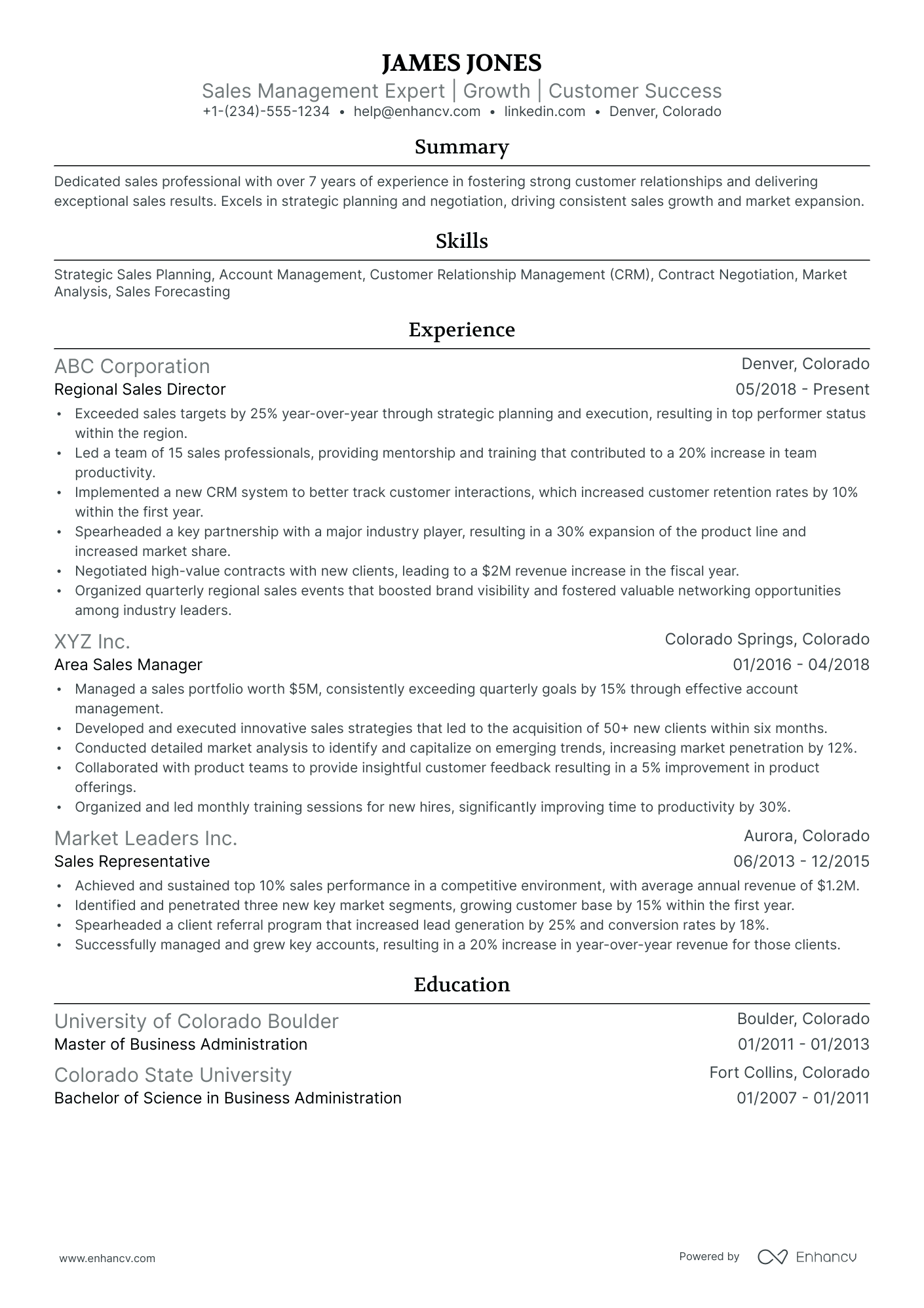
Recruiters expect a territory sales manager resume to show revenue impact, territory ownership, and consistent performance against targets. Knowing what to put on a resume ensures maximum clarity:
- Header
- Summary
- Experience
- Skills
- Projects
- Education
- Certifications
- Optional sections: Awards, Leadership, Languages
Strong experience bullets should emphasize measurable results, territory scope, pipeline impact, and quota attainment.
Is your resume good enough?
Drop your resume here or choose a file. PDF & DOCX only. Max 2MB file size.
Once you’ve organized your resume with the right core components, the next step is to write your territory sales manager experience section so those details clearly show your impact.
How to write your territory sales manager resume experience
The experience section is where you prove you've driven real revenue growth, managed defined territories, and delivered measurable sales outcomes using role-relevant tools like CRM platforms, pipeline management systems, and data-driven forecasting methods. Hiring managers prioritize demonstrated impact—closed deals, expanded accounts, and exceeded quotas—over descriptive task lists that simply outline daily responsibilities.
Each entry should include:
- Job title
- Company and location (or remote)
- Dates of employment (month and year)
Three to five concise bullet points showing what you owned, how you executed, and what outcomes you delivered:
- Ownership scope: the territory, accounts, product lines, or revenue targets you were directly accountable for, including the geographic or vertical markets you managed and the size of the customer base you served.
- Execution approach: the CRM systems, sales methodologies, prospecting tools, forecasting models, or territory planning frameworks you used to prioritize opportunities, manage your pipeline, and close business.
- Value improved: changes to territory revenue, customer retention rates, pipeline velocity, win rates, market penetration, or sales cycle efficiency that resulted from your direct efforts.
- Collaboration context: how you worked with marketing teams, product specialists, channel partners, distributors, customer success managers, or regional leadership to align on strategy and accelerate deal progression across your territory.
- Impact delivered: outcomes expressed through revenue growth, territory expansion, quota attainment, new account acquisition, or market share gains rather than a list of sales activities you performed.
Experience bullet formula
A territory sales manager experience example
✅ Right example - modern, quantified, specific.
Territory Sales Manager
Apex Industrial Solutions | Phoenix, AZ
2021–Present
Mid-market B2B distributor of industrial automation components serving manufacturers across the Southwest.
- Grew territory revenue 28% year over year ($6.4M to $8.2M) by executing account segmentation and weekly pipeline reviews in Salesforce, improving forecast accuracy from 68% to 87%.
- Negotiated and closed a $1.3M, three-year enterprise agreement using MEDDIC and Gong call insights, partnering with procurement and legal to cut contract cycle time 22% (nine weeks to seven weeks).
- Expanded share of wallet in top twenty accounts by 18% through QBRs (quarterly business reviews), Power BI usage dashboards, and joint value plans with customer operations leaders, increasing renewal rate from 90% to 96%.
- Launched a territory routing and visit-cadence model in Microsoft Excel and Google Maps, reducing windshield time 14% and increasing customer touches 25% without adding headcount.
- Coordinated with marketing and sales operations to run an ABM (account-based marketing) campaign in HubSpot and LinkedIn Sales Navigator, generating 112 marketing-qualified leads and converting 19 to opportunities worth $2.1M in pipeline.
Now that you've seen what a strong experience section looks like in practice, let's break down how to customize yours for the specific territory sales role you're targeting.
How to tailor your territory sales manager resume experience
Recruiters evaluate your territory sales manager resume through both applicant tracking systems and manual review. Tailoring your resume to the job description ensures your qualifications register with both.
Ways to tailor your territory sales manager experience:
- Match CRM platforms and sales tools named in the job description.
- Use the same terminology for sales methodologies the posting references.
- Mirror revenue targets or growth KPIs the employer specifies.
- Include industry or vertical experience relevant to the territory.
- Highlight pipeline management frameworks described in the listing.
- Emphasize quota attainment language that reflects the posting's expectations.
- Reference cross-functional collaboration models the role requires.
- Align territory planning strategies with processes the employer outlines.
Tailoring means connecting your real accomplishments to the specific language and priorities in the job posting, not forcing in keywords where they don't belong.
Resume tailoring examples for territory sales manager
| Job description excerpt | Untailored | Tailored |
|---|---|---|
| "Manage and grow accounts across a multi-state territory using Salesforce CRM, with a focus on exceeding quarterly revenue targets in the medical device sector." | Responsible for managing sales accounts and meeting goals. | Managed 120+ accounts across a four-state territory in the medical device sector, leveraging Salesforce CRM to track pipeline activity and exceeding quarterly revenue targets by 18% on average. |
| "Develop new business through cold outreach, trade show engagement, and distributor partnerships to expand market share in building materials." | Helped bring in new customers and worked with partners. | Generated $1.2M in new business within the building materials vertical through cold outreach campaigns, trade show lead conversion, and onboarding three new distributor partnerships that expanded regional market share by 14%. |
| "Conduct territory analysis and route planning to optimize coverage, reduce cost-per-visit, and increase face-to-face selling time with key decision-makers." | Traveled to meet clients and planned daily schedules. | Performed quarterly territory analysis and restructured route planning to cut cost-per-visit by 22%, increasing weekly face-to-face selling time with key decision-makers from 15 to 23 hours. |
Once you’ve aligned your experience with the role’s priorities, quantify your territory sales manager achievements to show the measurable impact of that work.
How to quantify your territory sales manager achievements
Quantifying your achievements shows how you drove revenue and reduced risk across your territory. Focus on growth, pipeline health, retention, win rate, and sales cycle speed using customer relationship management data, quotas, and account coverage.
Quantifying examples for territory sales manager
| Metric | Example |
|---|---|
| Revenue growth | "Grew territory revenue 28% year over year ($3.6M to $4.6M) by expanding top twenty accounts and launching a quarterly business review cadence in Salesforce." |
| Win rate | "Improved win rate from 22% to 31% across mid-market deals by tightening discovery in MEDDIC and standardizing proposals in Microsoft Word templates." |
| Sales cycle time | "Cut average sales cycle from 74 to 52 days by introducing mutual action plans, weekly deal reviews, and automated follow-ups through Outreach." |
| Retention | "Raised renewal rate from 86% to 93% across eighty-five accounts by building a churn-risk dashboard in Salesforce and running monthly adoption check-ins with customer success." |
| Pipeline coverage | "Maintained 3.4x quarterly pipeline coverage for six straight quarters by adding forty net-new opportunities per quarter through targeted LinkedIn Sales Navigator outreach and partner referrals." |
Turn vague job duties into measurable, recruiter-ready resume bullets in seconds with Enhancv's Bullet Point Generator.
Once you've crafted strong bullet points that highlight your achievements, the next step is ensuring your resume also showcases the right mix of hard and soft skills that hiring managers expect from a territory sales manager.
How to list your hard and soft skills on a territory sales manager resume
Your skills section shows how you drive territory revenue, and recruiters and ATS scan it to match you to the job post quickly—aim for a balanced mix of hard skills (sales systems and process) and soft skills (customer-facing execution). territory sales manager roles require a blend of:
- Product strategy and discovery skills.
- Data, analytics, and experimentation skills.
- Delivery, execution, and go-to-market discipline.
- Soft skills.
Your skills section should be:
- Scannable (bullet-style grouping).
- Relevant to the job post.
- Backed by proof in experience bullets.
- Updated with current tools.
Place your skills section:
- Above experience if you're junior or switching careers.
- Below experience if you're mid/senior with strong achievements.

Hard skills
- Territory planning and routing
- Account segmentation and prioritization
- Pipeline management and forecasting
- Salesforce, HubSpot CRM
- Sales enablement platforms
- MEDDICC qualification
- Consultative selling, SPIN selling
- Contract negotiation and pricing
- Channel partner management
- Retail execution and merchandising audits
- Microsoft Excel, Power BI
- Proposal and quote generation
Soft skills
- Run disciplined pipeline reviews
- Lead value-based customer conversations
- Influence without formal authority
- Handle objections and de-escalate
- Align cross-functional stakeholders
- Prioritize high-impact accounts
- Communicate concise deal updates
- Negotiate win-win outcomes
- Coach reps and share playbooks
- Follow through on commitments
- Adapt messaging to buyer roles
- Make fast, data-informed decisions
How to show your territory sales manager skills in context
Skills shouldn't live only in a dedicated skills list. Browse resume skills examples to see how top candidates weave competencies throughout their resumes.
They should be demonstrated in:
- Your summary (high-level professional identity)
- Your experience (proof through outcomes)
Here's what strong, contextual skill placement looks like in practice.
Summary example
Territory sales manager with 10+ years in medical device sales. Grew a $4.2M Midwest territory by 28% using Salesforce pipeline analytics, consultative selling, and strategic distributor partnerships. Known for coaching reps and building lasting physician relationships.
- Signals senior-level expertise immediately
- Names specific tools like Salesforce
- Quantifies territory growth with metrics
- Highlights coaching and relationship-building skills
Experience example
Territory Sales Manager
Apex Medical Solutions | Chicago, IL
March 2019–Present
- Expanded territory revenue from $3.1M to $4.6M over three years by leveraging Salesforce dashboards and targeted account planning.
- Partnered with marketing and clinical teams to launch a rep enablement program, boosting product adoption rates by 22%.
- Mentored four junior reps using structured ride-along coaching, helping each exceed quarterly quota within six months.
- Every bullet includes measurable proof
- Skills surface naturally through real outcomes
Once you’ve demonstrated your sales capabilities through measurable examples, the next step is learning how to present those strengths on a territory sales manager resume when you don’t have direct experience.
How do I write a territory sales manager resume with no experience
Even without full-time experience, you can demonstrate readiness through transferable achievements. If you're building a resume without work experience, focus on projects and activities that show territory-relevant skills:
- Sales internship with territory planning
- Campus ambassador field outreach results
- Retail upselling with weekly targets
- CRM pipeline tracking class project
- Local business prospecting volunteer work
- Case competition go-to-market plan
- Part-time B2B lead generation role
- Product demo support for events
Focus on:
- Territory plan with account tiers
- Pipeline metrics and CRM hygiene
- Prospecting volume and conversion rates
- Revenue impact from sales activities
Resume format tip for entry-level territory sales manager
Use a hybrid resume format. It highlights measurable projects and skills while keeping education and limited work history easy to scan. Do:
- Write a territory sales manager summary with metrics.
- Add a "Projects" section above experience.
- Quantify outreach, meetings, and conversions.
- List CRM tools and sales methods used.
- Tailor territory keywords to each posting.
- Built a 60-account territory plan in HubSpot, ran 120 cold calls and 40 emails, booked eight meetings, and generated $3,200 in pilot revenue.
Once you've positioned your transferable skills and relevant achievements to compensate for limited direct experience, the next step is presenting your education in a way that reinforces your qualifications for the role.
How to list your education on a territory sales manager resume
Your education section helps hiring teams verify foundational knowledge in business, sales strategy, and communication—core skills every territory sales manager needs to succeed.
Include:
- Degree name
- Institution
- Location
- Graduation year
- Relevant coursework (for juniors or entry-level candidates)
- Honors & GPA (if 3.5 or higher)
Avoid listing specific months or days. Use the graduation year only for a cleaner format.
Here's a strong education entry for a territory sales manager resume.
Example education entry
Bachelor of Science in Business Administration
University of Georgia, Athens, GA
Graduated 2019
GPA: 3.7
- Relevant Coursework: Sales Management, Consumer Behavior, Business Analytics, Strategic Marketing
- Honors: Magna Cum Laude, Dean's List (six semesters)
How to list your certifications on a territory sales manager resume
Certifications on your resume show a territory sales manager's commitment to learning, proficiency with sales tools, and relevance to the industry's standards and buyers' expectations.
Include:
- Certificate name
- Issuing organization
- Year
- Optional: credential ID or URL
- Place certifications below education when your degree is recent and your certifications support it without adding stronger role relevance.
- Place certifications above education when they are recent, directly relevant to territory sales manager work, or required for your target industry.
Best certifications for your territory sales manager resume
- Certified Sales Leadership Professional (CSLP)
- Certified Professional Sales Person (CPSP)
- Salesforce Certified Sales Cloud Consultant
- HubSpot Sales Software Certification
- Miller Heiman Group Strategic Selling Certification
- Sandler Sales Certification
- Certified Inside Sales Professional (CISP)
Once you’ve placed your credentials where recruiters can quickly verify them, focus on writing your territory sales manager resume summary to connect those qualifications to the value you’ll deliver.
How to write your territory sales manager resume summary
Your resume summary is the first thing a recruiter reads, so it needs to earn attention fast. A strong opening tied to territory sales management signals you're worth a closer look.
Keep it to three to four lines, with:
- Your title and total years of experience in territory or regional sales.
- The industry or market segment you've sold into, such as medical devices or SaaS.
- Core skills like CRM platforms, pipeline management, or sales forecasting.
- One or two quantified wins, such as revenue growth or quota attainment percentages.
- Soft skills tied to real outcomes, like coaching reps to exceed targets.

PRO TIP
At this mid-level role, emphasize ownership of a defined territory and measurable revenue results. Highlight team coordination, client retention, and quota performance. Avoid vague phrases like "passionate sales professional" or "motivated self-starter." Recruiters want proof of consistent execution, not enthusiasm statements.
Example summary for a territory sales manager
Territory sales manager with six years in B2B medical device sales. Grew Southwest region revenue 34% year over year while managing a $4.2M pipeline across 120 accounts.
Optimize your resume summary and objective for ATS
Drop your resume here or choose a file.
PDF & DOCX only. Max 2MB file size.
Now that your summary is crafted to highlight your strongest selling points, make sure the header above it presents your contact details correctly so recruiters can actually reach you.
What to include in a territory sales manager resume header
Your resume header lists your key contact and profile details, and it boosts visibility, credibility, and recruiter screening for a territory sales manager role.
Essential resume header elements
- Full name
- Tailored job title and headline
- Location
- Phone number
- Professional email
- GitHub link
- Portfolio link
A LinkedIn link lets recruiters verify experience quickly and supports screening.
Don't include a photo on a territory sales manager resume unless the role is explicitly front-facing or appearance-dependent.
Keep the header scannable by placing your territory sales manager title beside your name and using one consistent format across all links.
Territory sales manager resume header
Jordan Lee
Territory Sales Manager | B2B Account Growth and Regional Pipeline Management
Austin, TX
(512) 555-01XX
jordan.lee@enhancv.com
github.com/jordanlee
jordanlee.com
linkedin.com/in/jordanlee
Once your contact details and role focus are clearly presented at the top, you can strengthen the rest of your resume with additional sections that support your territory sales manager qualifications.
Additional sections for territory sales manager resumes
When your core qualifications match other candidates, additional sections can set you apart by showcasing role-specific strengths and personal credibility.
- Languages
- Industry awards and recognition
- Professional affiliations and memberships
- Conferences and speaking engagements
- Volunteer experience
- Hobbies and interests
- Publications
Once you've rounded out your resume with the right supplementary sections, it's worth pairing it with a strong cover letter to maximize your impact.
Do territory sales manager resumes need a cover letter
A cover letter isn't required for a territory sales manager, but it often helps. If you're unsure what a cover letter is and when it adds value, it matters most in competitive searches or when hiring managers expect one. It can make a difference when your resume needs context or a clear match.
Use a cover letter when it adds details your resume can't:
- Explain role or team fit by tying your sales motion to their go-to-market model, territory structure, and partner strategy.
- Highlight one or two relevant projects or outcomes, including quota attainment, pipeline growth, win rates, or expansion results in similar accounts.
- Show understanding of the product, users, or business context, and connect it to your territory plan and deal strategy.
- Address career transitions or non-obvious experience, and explain how it translates to territory planning, prospecting, and account management.
Drop your resume here or choose a file.
PDF & DOCX only. Max 2MB file size.
Once you’ve decided whether to include a cover letter to add context beyond your resume, the next step is using AI to improve your territory sales manager resume so it communicates that value more clearly and efficiently.
Using AI to improve your territory sales manager resume
AI can sharpen your resume's clarity, structure, and impact. It helps tighten language and highlight results that matter to hiring managers. If you're wondering which AI is best for writing resumes, the key is using it to refine—not replace—your own experience. But overuse kills authenticity. Once your content sounds clear and role-aligned, step away from AI tools.
Here are 10 prompts you can copy and paste to strengthen specific sections of your territory sales manager resume:
- Sharpen your summary: "Rewrite my resume summary to clearly position me as a territory sales manager with measurable revenue growth and client retention results."
- Quantify experience bullets: "Add specific metrics like percentages, dollar amounts, and timeframes to these territory sales manager experience bullets."
- Tighten action verbs: "Replace weak or passive verbs in my territory sales manager experience section with strong, sales-specific action verbs."
- Align skills section: "Review this skills list and remove anything irrelevant to a territory sales manager role. Suggest missing hard skills."
- Improve project descriptions: "Rewrite these project descriptions to emphasize territory sales manager contributions, including pipeline impact and regional outcomes."
- Refine education entries: "Adjust my education section to highlight coursework and achievements most relevant to a territory sales manager position."
- Strengthen certifications: "Reorder and rewrite my certifications section to prioritize credentials that matter most for a territory sales manager."
- Remove filler language: "Identify and remove vague or filler phrases from my territory sales manager resume without losing important details."
- Target job descriptions: "Compare my territory sales manager resume against this job posting and flag missing keywords or qualifications."
- Clarify career progression: "Restructure my experience section to clearly show upward career progression toward the territory sales manager role."
Stop using AI once your resume sounds accurate, specific, and aligned with real experience. AI should never invent experience or inflate claims—if it didn't happen, it doesn't belong here.
Conclusion
A strong territory sales manager resume proves impact with measurable outcomes, like revenue growth, quota attainment, and pipeline expansion. It also highlights role-specific skills, including account management, prospecting, negotiation, forecasting, and territory planning. Clear structure keeps results, skills, and experience easy to scan.
This approach shows you’re ready for today’s hiring market and near-future expectations. It signals you can deliver results, manage a territory, and build repeatable sales performance. Keep it focused, consistent, and outcome-driven.