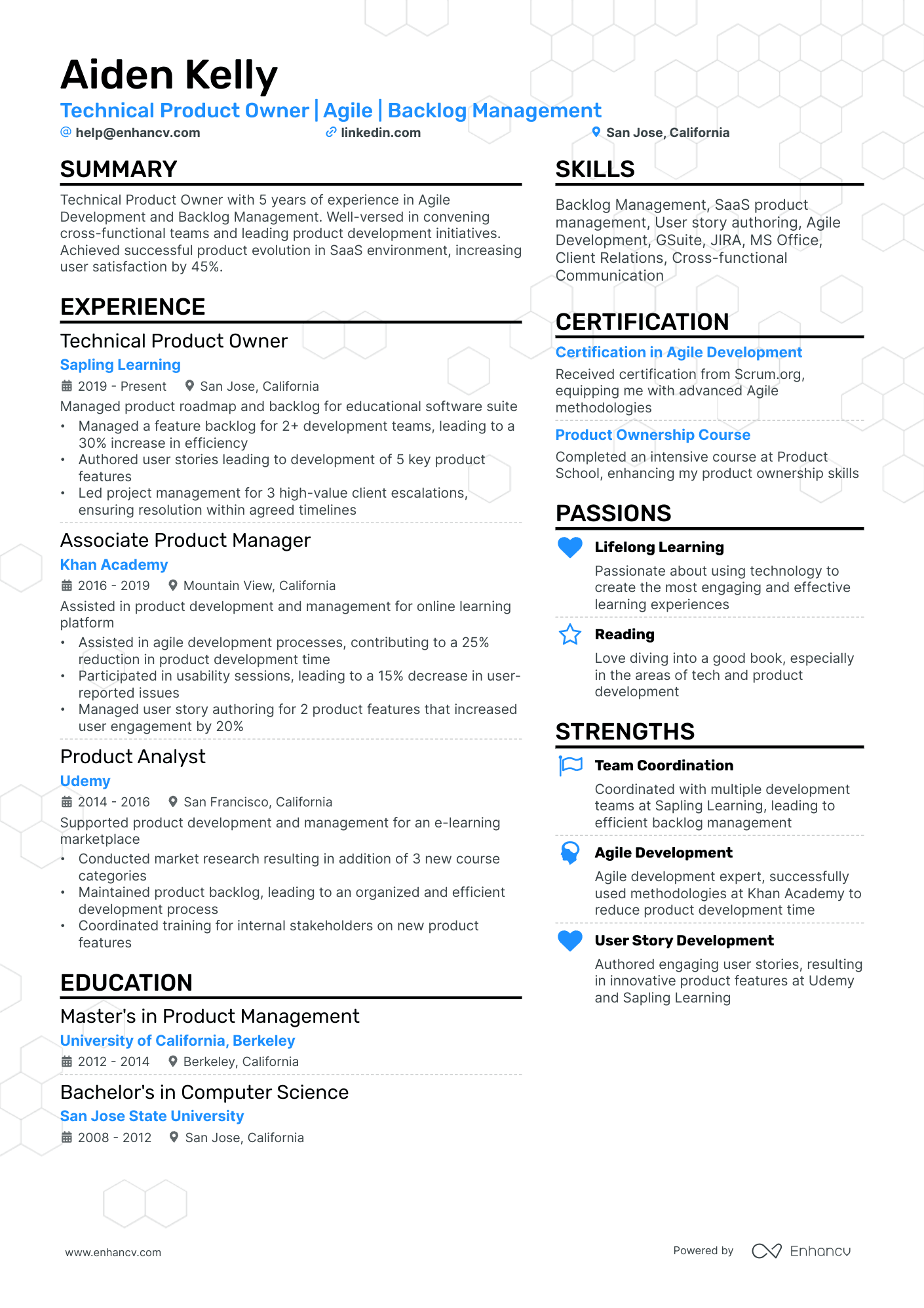
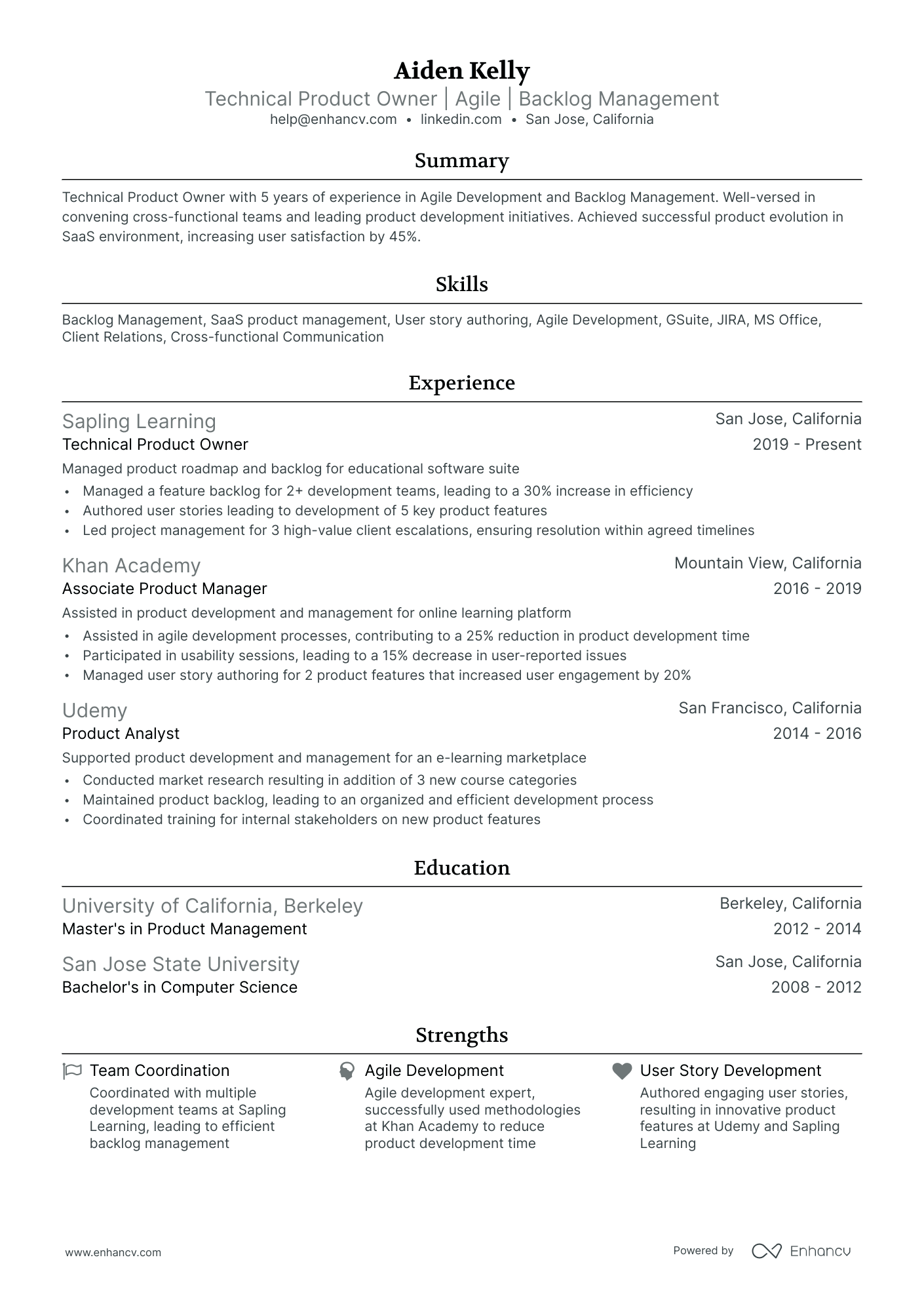
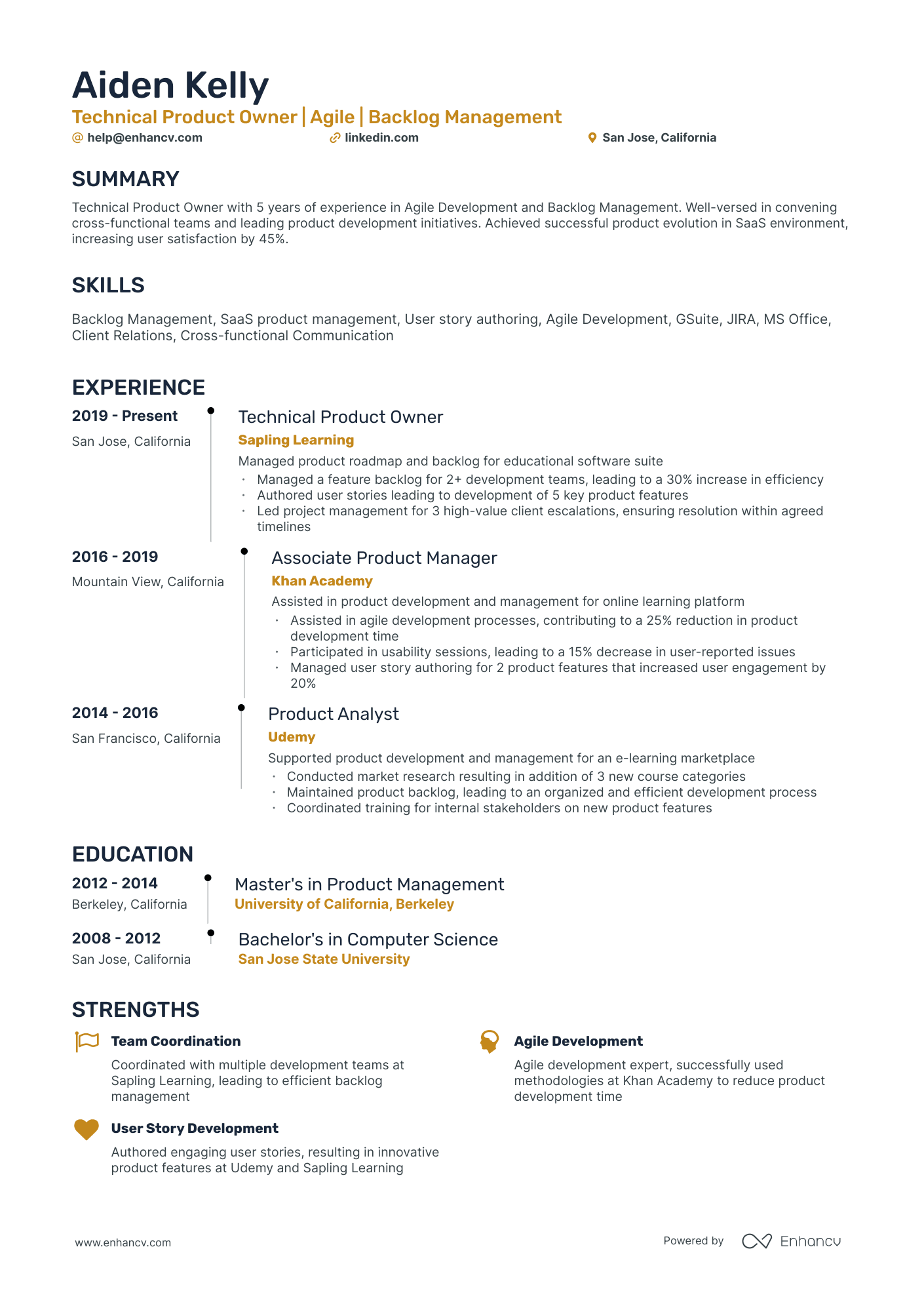
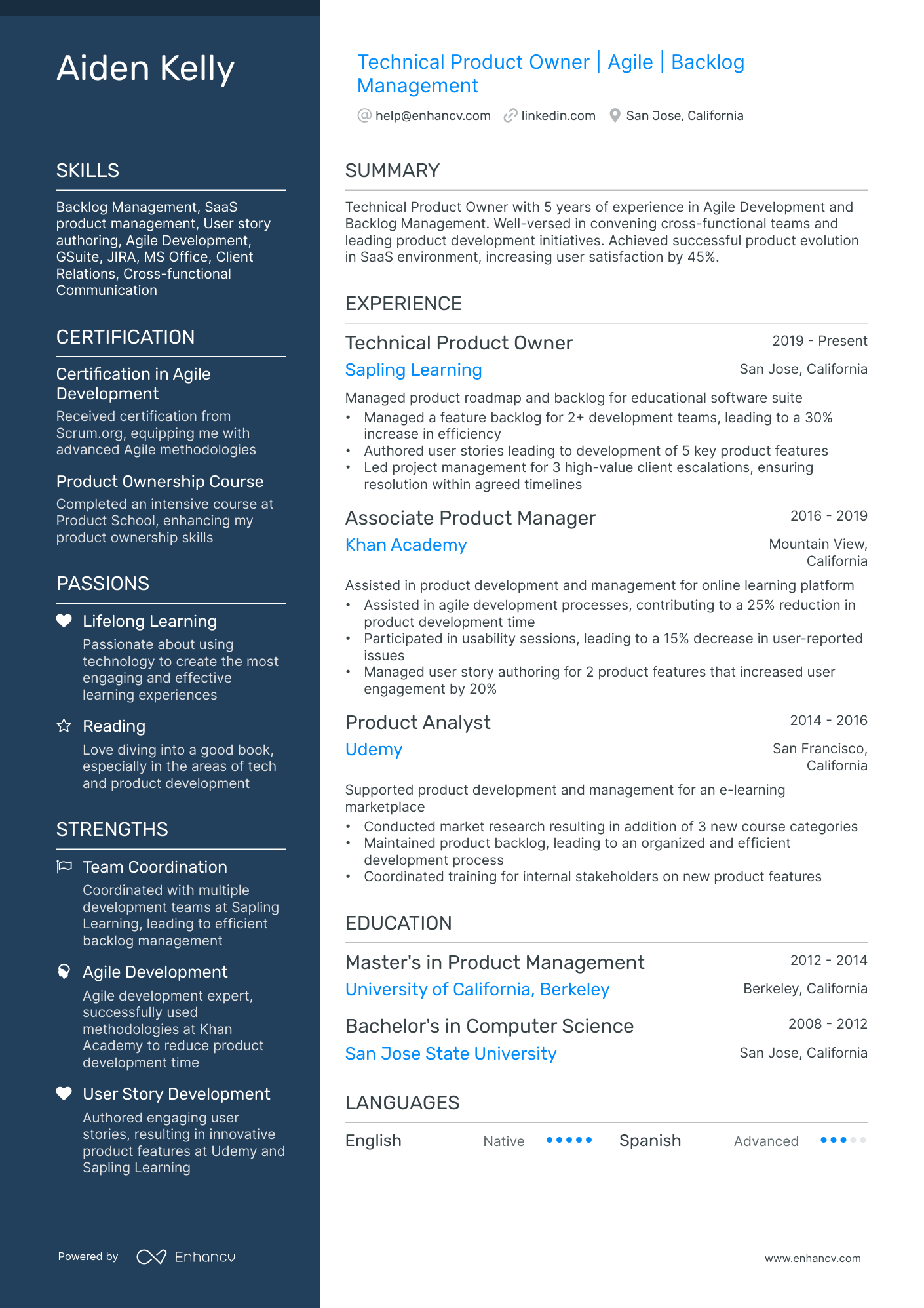
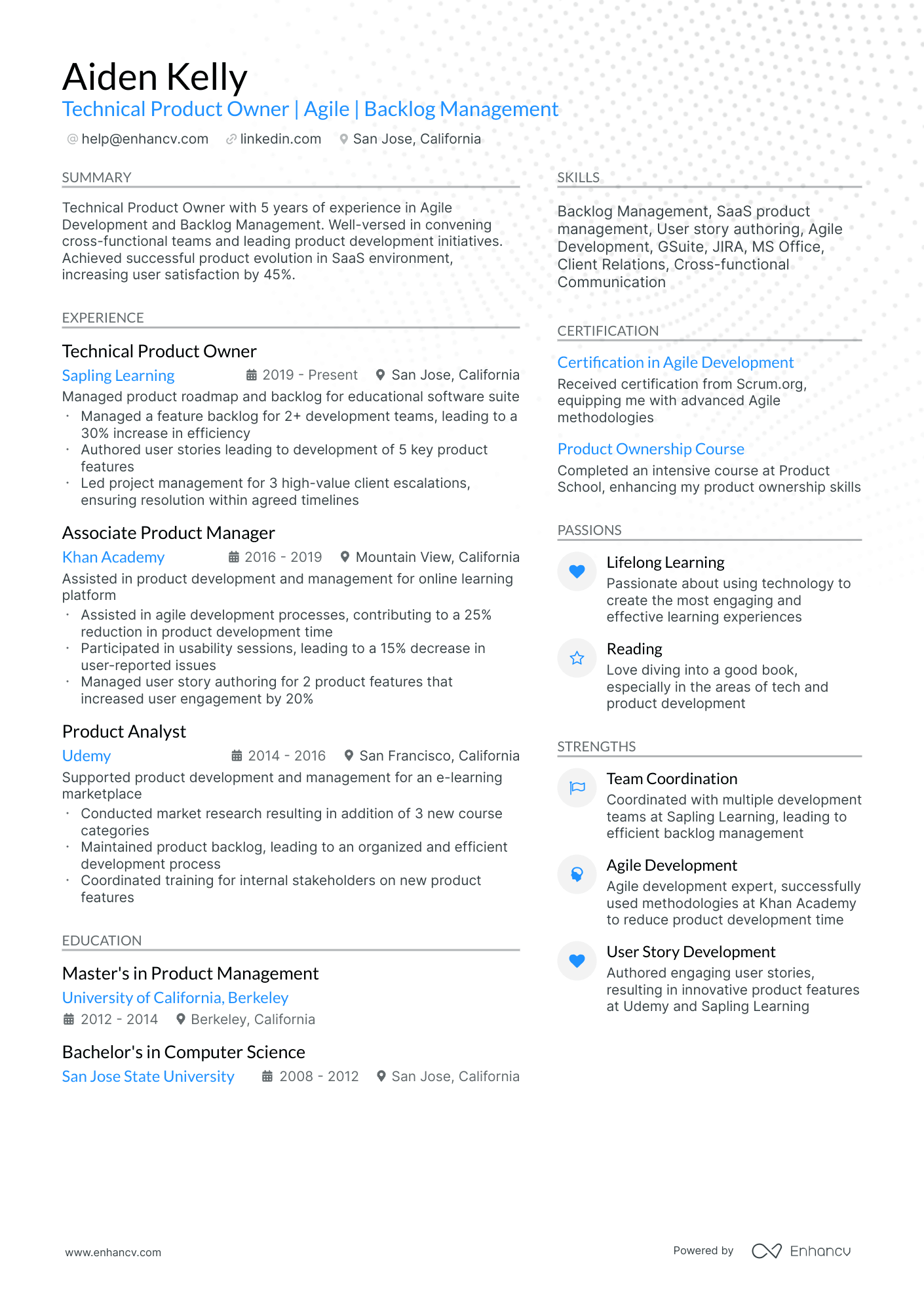
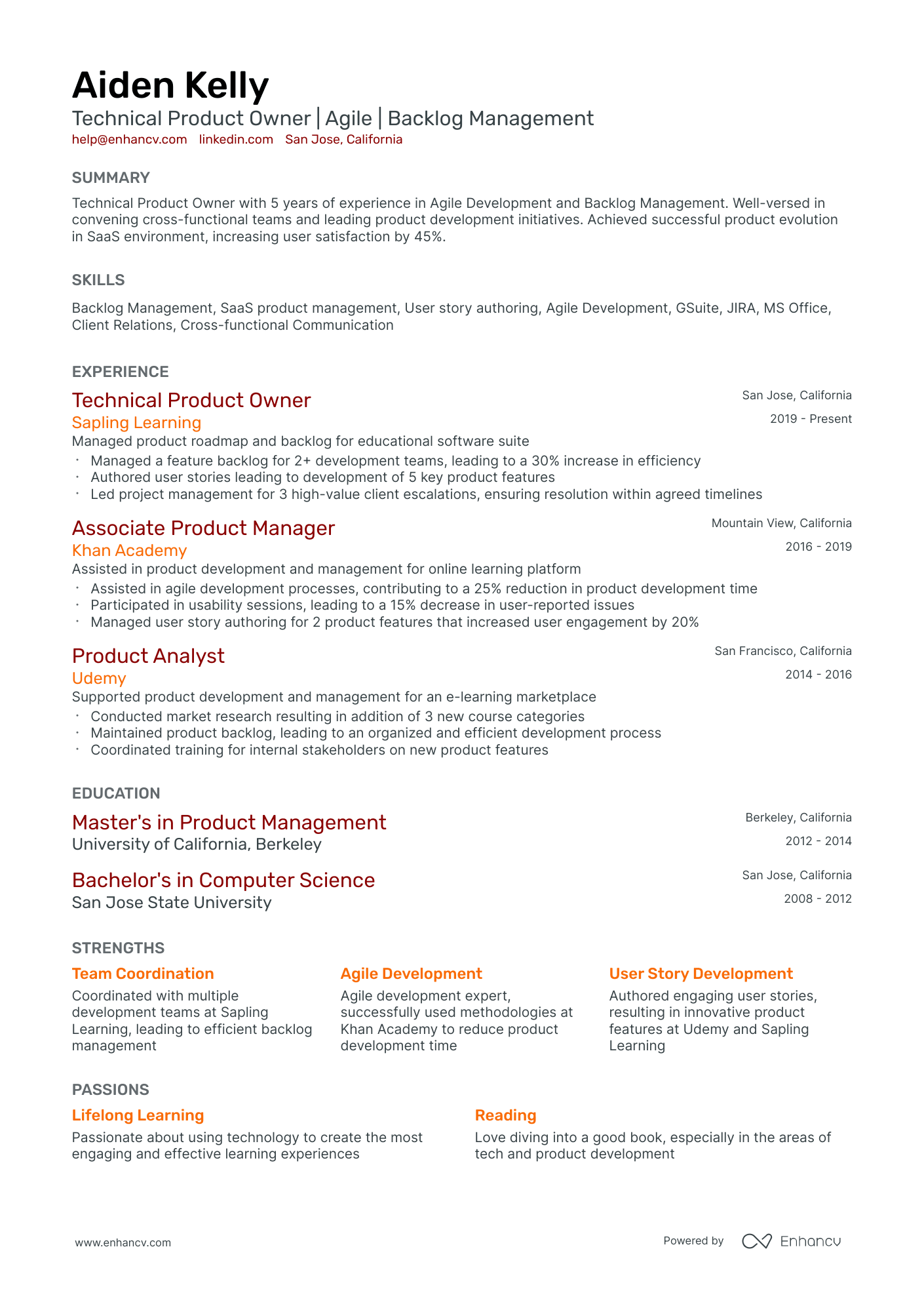
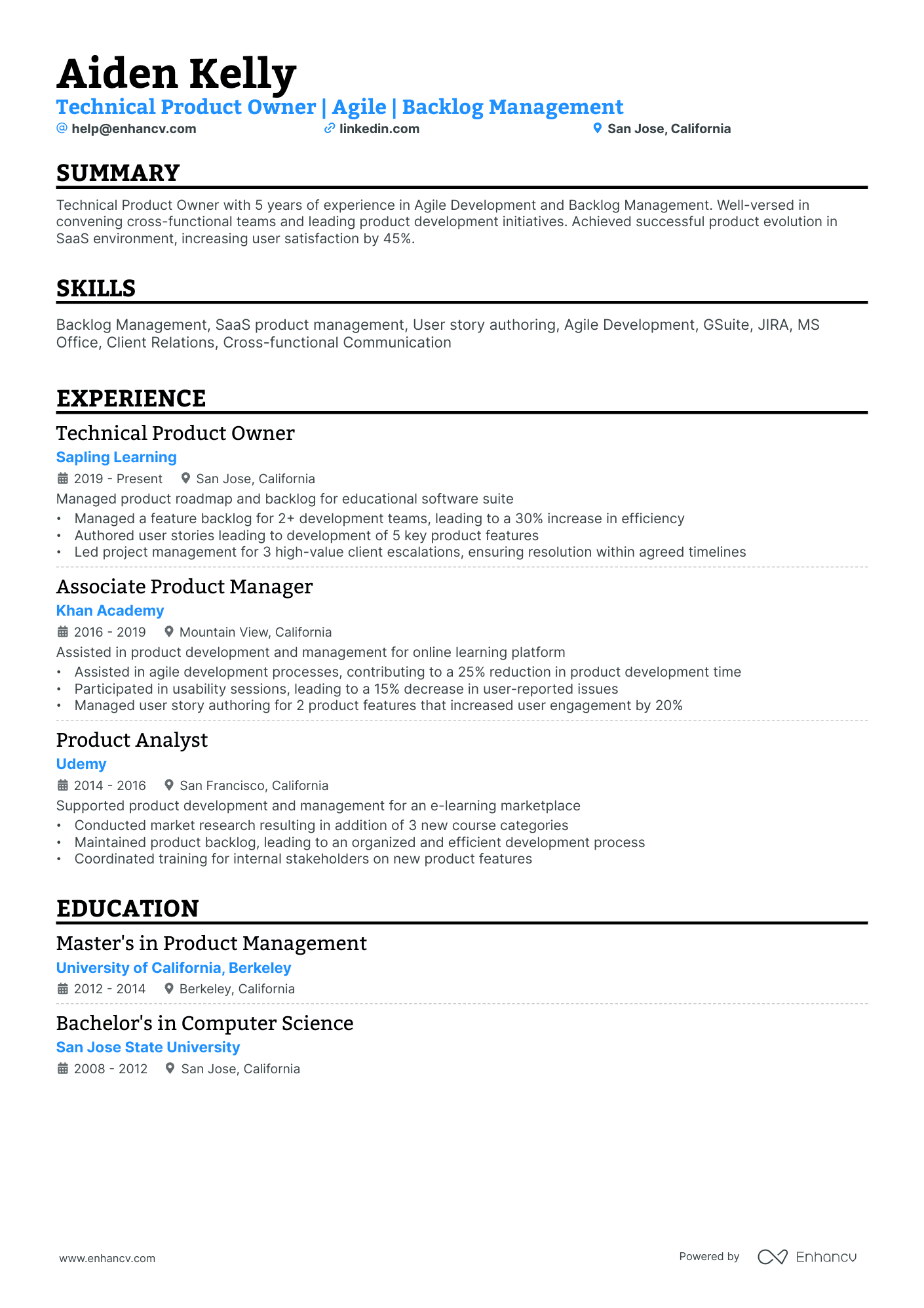
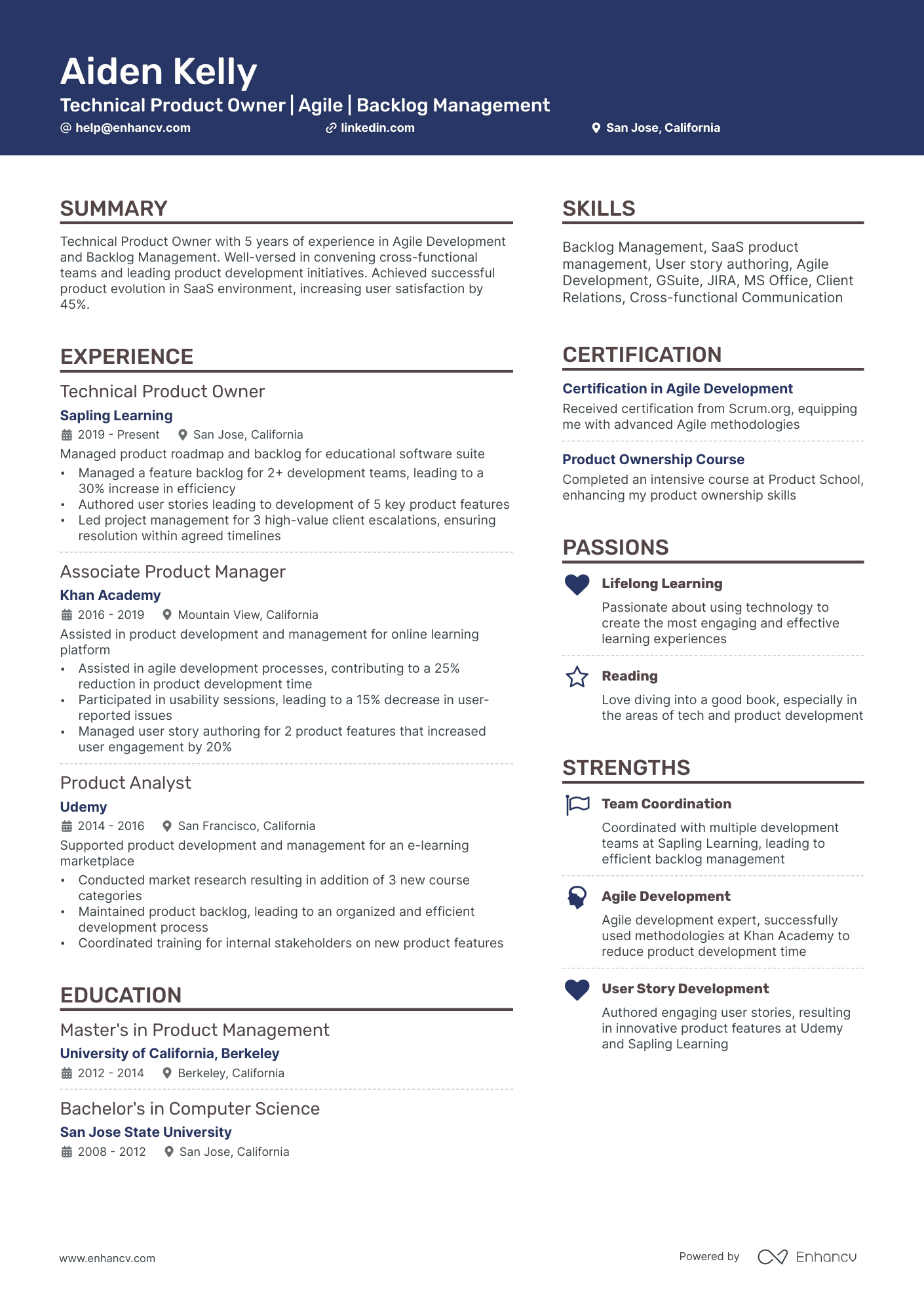
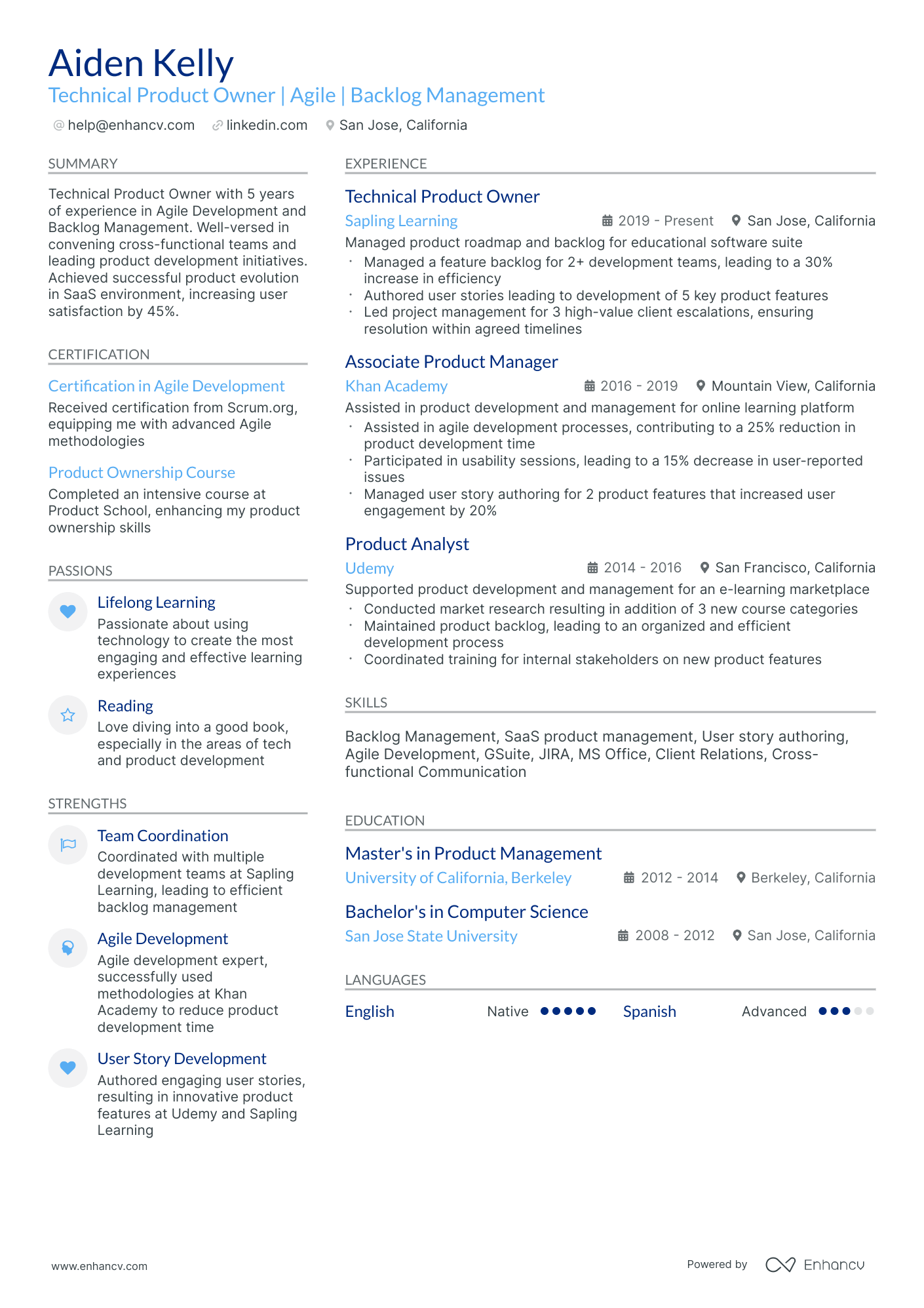
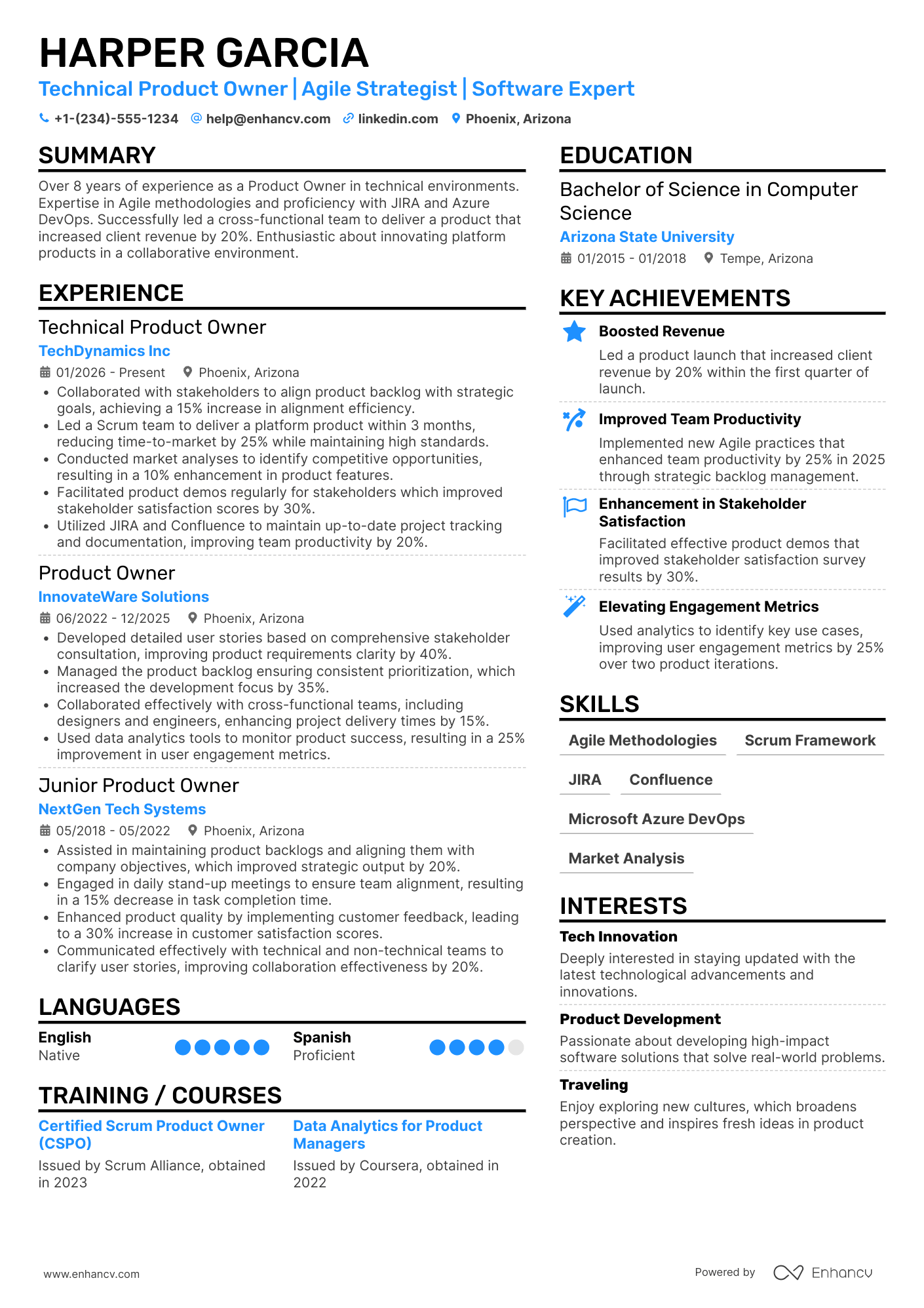
Most technical product owner resumes fail because they read like tool inventories and meeting notes, not decision-ready narratives. That matters when ATS filters keywords, recruiters scan in seconds, and competition is intense.
A strong resume shows what you delivered and why it moved the business. Knowing how to make your resume stand out means highlighting outcomes like reduced cycle time, higher adoption, improved release quality, revenue lift, cost savings, and on-time delivery across multi-team scope.

Key takeaways
- Anchor every resume bullet to a measurable outcome, not a task or meeting.
- Use reverse-chronological format if you have direct technical product owner experience.
- Tailor experience bullets to mirror each job posting's exact tools and terminology.
- Place skills above experience when switching careers or entering the role.
- Quantify delivery speed, reliability, cost savings, and adoption in every section.
- Pair certifications like CSPO or SAFe POPM directly with your education section.
- Use Enhancv's tools to turn vague duties into metric-driven, recruiter-ready bullets.
Job market snapshot for technical product owners
We analyzed 127 recent technical product owner job ads across major US job boards. These numbers help you understand industry demand, employer expectations, experience requirements at a glance.
What level of experience employers are looking for technical product owners
| Years of Experience | Percentage found in job ads |
|---|---|
| 1–2 years | 0.8% (1) |
| 3–4 years | 10.2% (13) |
| 5–6 years | 25.2% (32) |
| 7–8 years | 6.3% (8) |
| 9–10 years | 7.1% (9) |
| 10+ years | 7.1% (9) |
| Not specified | 48.8% (62) |
Technical product owner ads by area of specialization (industry)
| Industry (Area) | Percentage found in job ads |
|---|---|
| Finance & Banking | 58.3% (74) |
| Education | 19.7% (25) |
| Healthcare | 13.4% (17) |
Top companies hiring technical product owners
| Company | Percentage found in job ads |
|---|---|
| Deloitte | 17.3% (22) |
| Johnson & Johnson | 11.8% (15) |
| AllianceBernstein Holding LP | 11.0% (14) |
| Huntington Bancshares Inc | 7.9% (10) |
Role overview stats
These tables show the most common responsibilities and employment types for technical product owner roles. Use them to align your resume with what employers expect and to understand how the role is structured across the market.
Day-to-day activities and top responsibilities for a technical product owner
| Responsibility | Percentage found in job ads |
|---|---|
| Agile | 72.4% (92) |
| Azure devops | 22.0% (28) |
| Scrum | 22.0% (28) |
| Risk management | 19.7% (25) |
| Scaled agile | 18.1% (23) |
| Alteryx designer | 17.3% (22) |
| Cbap | 17.3% (22) |
| Microsoft certified solutions developer | 17.3% (22) |
| Program management professional | 17.3% (22) |
| Project management professional | 17.3% (22) |
| Six sigma | 17.3% (22) |
| Jira | 12.6% (16) |
Type of employment (remote vs on-site vs hybrid)
| Employment type | Percentage found in job ads |
|---|---|
| On-site | 49.6% (63) |
| Hybrid | 44.9% (57) |
| Remote | 5.5% (7) |
How to format a technical product owner resume
Recruiters evaluating technical product owners prioritize evidence of cross-functional leadership, backlog governance, stakeholder alignment, and measurable product outcomes tied to business objectives. A well-chosen resume format ensures these signals surface within the first six seconds of a scan and pass cleanly through an applicant tracking system (ATS).

I have significant experience in this role—which format should I use?
Use a reverse-chronological format—it's the strongest choice for experienced technical product owners. Do:
- Lead each role entry with scope indicators: team size, number of squads or product lines owned, and budget or revenue responsibility.
- Highlight domain-specific tools and frameworks—Jira, Azure DevOps, SAFe, OKRs, API-first product strategies—within the context of each position rather than in a standalone list.
- Anchor every accomplishment to a measurable outcome such as revenue growth, cycle time reduction, or adoption metrics.
I'm junior or switching into this role—what format works best?
A hybrid format works best because it lets you lead with relevant technical and product skills while still showing a clear, chronological work history. Do:
- Place a focused skills section near the top that highlights product ownership competencies such as backlog prioritization, user story mapping, and sprint planning.
- Include project-based entries—side projects, cross-functional initiatives, or certification capstones—that demonstrate product thinking even if your formal title wasn't "product owner."
- Connect every listed skill or project to a concrete action and a visible result so recruiters can assess real capability, not just keyword density.
Why not use a functional resume?
A functional format strips away the timeline and context that recruiters need to evaluate how your product skills developed, making it harder to verify growth, collaboration patterns, or accountability for outcomes.
- A functional resume may be acceptable if you're pivoting into a technical product owner role from a closely related discipline (such as business analysis, scrum mastery, or solutions engineering), have a gap longer than 12 months, or lack formal product owner titles—but only if every listed skill is tied directly to a specific project and a quantifiable result.
With your layout and structure in place, the next step is filling it with the right sections to showcase your qualifications effectively.
What sections should go on a technical product owner resume
What sections should go on a technical product owner resume?
Recruiters expect to see clear ownership of product outcomes, technical fluency, and delivery results across cross-functional teams. Knowing what to put on a resume for this role starts with using this structure for maximum clarity:
- Header
- Summary
- Experience
- Skills
- Projects
- Education
- Certifications
- Optional sections: Open-source work, Publications, Leadership
Your experience bullets should emphasize measurable impact, delivery outcomes, technical scope, and results tied to business goals.
Is your resume good enough?
Drop your resume here or choose a file. PDF & DOCX only. Max 2MB file size.
Once you’ve organized the key components of your resume, the next step is to write your technical product owner experience section so it supports each part with clear, role-relevant impact.
How to write your technical product owner resume experience
The work experience section is where you prove you've shipped real products—not just participated in meetings about them. Hiring managers scanning technical product owner resumes prioritize demonstrated impact through delivered work, role-relevant tools and methods, and measurable outcomes over descriptive task lists.
Each entry should include:
- Job title
- Company and location (or remote)
- Dates of employment (month and year)
Three to five concise bullet points showing what you owned, how you executed, and what outcomes you delivered:
- Ownership scope: the products, platforms, systems, or technical domains you were directly accountable for, including the teams, markets, or user segments they served.
- Execution approach: the frameworks, technologies, and methods you used to prioritize backlogs, make trade-off decisions, and drive delivery—such as Agile ceremonies, data analysis tools, API design reviews, or roadmap planning processes.
- Value improved: the specific dimensions of quality, system performance, reliability, scalability, accessibility, or technical debt reduction your work advanced as a technical product owner.
- Collaboration context: how you partnered with engineering, design, QA, data, architecture, or external stakeholders to align technical feasibility with product direction and business goals.
- Impact delivered: the outcomes your decisions produced, expressed through business results, user-facing improvements, operational scale, or risk mitigation rather than a list of activities you performed.
Experience bullet formula
A technical product owner experience example
✅ Right example - modern, quantified, specific.
Technical Product Owner
NimbusPay | Remote
2022–Present
B2B payments platform processing $3B+ annually across North America with 99.95% uptime targets.
- Owned the API-first payments roadmap in Jira and Confluence, aligning engineering, design, and compliance on quarterly objectives and delivering twelve releases that increased authorization rates by 4.2%.
- Prioritized and refined a 180+ item backlog using user story mapping, WSJF, and acceptance criteria in Gherkin, cutting cycle time from eighteen to eleven days and reducing rework by 23%.
- Led migration from a monolith to domain-based microservices on Kubernetes with Kafka and PostgreSQL, improving p95 checkout latency by 28% and reducing incident volume by 17% through tighter SLOs and error budgets.
- Implemented end-to-end observability with Datadog, OpenTelemetry, and Grafana dashboards, improving mean time to detect by 41% and mean time to resolve by 32% via automated alerts and runbooks.
- Partnered with data and risk teams to ship a rules engine and feature-flagged rollouts using LaunchDarkly and Snowflake analytics, reducing chargebacks by 12% and unlocking $1.1M in annualized revenue.
Now that you've seen how a strong experience section comes together, let's look at how to adjust yours based on the specific role you're targeting.
How to tailor your technical product owner resume experience
Recruiters evaluate your technical product owner resume through applicant tracking systems and manual review, filtering for specific skills and qualifications. Tailoring your resume to the job description ensures your relevant work surfaces quickly.
Ways to tailor your technical product owner experience:
- Match specific tools and platforms listed in the job description.
- Mirror the exact terminology used for agile or scrum methodologies.
- Reflect KPIs and success metrics the posting emphasizes.
- Highlight domain experience in the industry the role targets.
- Emphasize security or compliance ownership if the posting requires it.
- Align your backlog management approach with their stated frameworks.
- Reference cross-functional collaboration models the job description names.
- Include API or system integration experience when technically specified.
Tailoring means aligning your real accomplishments with what the role demands, not forcing disconnected keywords into your experience.
Resume tailoring examples for technical product owner
| Job description excerpt | Untailored | Tailored |
|---|---|---|
| "Own the product backlog for our cloud-native SaaS platform, prioritize features using data-driven frameworks, and collaborate with engineering teams using Agile Scrum methodologies." | Managed product backlog and worked with developers on new features. | Owned and prioritized a 200+ item backlog for a cloud-native SaaS platform, applying RICE scoring to drive sprint planning across three Agile Scrum teams—reducing backlog cycle time by 30%. |
| "Define technical requirements and API specifications for platform integrations, partnering with third-party vendors and internal architects to deliver scalable microservices solutions." | Wrote requirements and helped with system integrations. | Authored technical requirements and RESTful API specifications for 12 platform integrations, collaborating with third-party vendors and internal solution architects to deliver microservices that handled 2M+ daily transactions. |
| "Lead roadmap planning in Jira and Confluence, align cross-functional stakeholders on quarterly OKRs, and translate complex technical constraints into business-facing deliverables." | Created roadmaps and communicated with stakeholders about project goals. | Led quarterly roadmap planning in Jira and Confluence for a 40-person cross-functional organization, translating infrastructure migration constraints into business-facing OKRs that improved stakeholder alignment and delivered 95% on-time execution across four consecutive quarters. |
Once your experience aligns with the role’s priorities, quantify your technical product owner achievements to prove the impact of that work.
How to quantify your technical product owner achievements
Quantifying your achievements proves you shipped measurable outcomes, not just requirements. Focus on delivery speed, reliability, quality, cost, adoption, and risk reduction across releases, teams, and customer-facing systems.
Quantifying examples for technical product owner
| Metric | Example |
|---|---|
| Delivery speed | "Cut sprint cycle time from 14 to 10 days by tightening backlog refinement in Jira and clarifying acceptance criteria with engineering and QA." |
| Reliability | "Reduced production incident rate by 35% in two quarters by prioritizing SLO-based work and adding Datadog alerts for key service endpoints." |
| Quality | "Lowered escaped defects from 18 to 9 per release by enforcing testable user stories and expanding automated regression coverage in CI pipelines." |
| Cost efficiency | "Saved $120K annually by retiring three unused application programming interfaces and consolidating event streams in Kafka and AWS." |
| Security risk | "Reduced critical vulnerabilities from 22 to 6 by driving quarterly dependency upgrades and adding Snyk checks to pull request gates." |
Turn vague job duties into measurable, recruiter-ready resume bullets in seconds with Enhancv's Bullet Point Generator.
With strong, action-driven bullet points in place, the next step is ensuring your skills section presents the right mix of hard and soft skills that technical product owner roles demand.
How to list your hard and soft skills on a technical product owner resume
Your skills section shows you can translate business goals into technical delivery, and recruiters and applicant tracking systems (ATS) scan this section to confirm fit fast—aim for a balanced mix of hard skills and role-specific soft skills. technical product owner roles require a blend of:
- Product strategy and discovery skills.
- Data, analytics, and experimentation skills.
- Delivery, execution, and go-to-market discipline.
- Soft skills.
Your skills section should be:
- Scannable (bullet-style grouping).
- Relevant to the job post.
- Backed by proof in experience bullets.
- Updated with current tools.
Place your skills section:
- Above experience if you're junior or switching careers.
- Below experience if you're mid/senior with strong achievements.

Hard skills
- Product roadmaps, OKRs
- PRDs, user stories, acceptance criteria
- Agile Scrum, Kanban
- Backlog refinement, sprint planning
- Jira, Confluence
- API design basics, REST, GraphQL
- SQL, data modeling fundamentals
- GA4, Mixpanel, Amplitude
- A/B testing, feature flags
- Cloud basics: AWS, Azure, GCP
- CI/CD concepts, GitHub, GitLab
- Observability: Datadog, Grafana, Sentry
Soft skills
- Translate requirements into scope
- Align stakeholders on priorities
- Run discovery and refinement workshops
- Make trade-offs under constraints
- Write clear, testable requirements
- Negotiate timelines and dependencies
- Partner with engineering on feasibility
- Manage risk and unblock delivery
- Communicate decisions and rationale
- Drive cross-functional accountability
- Handle conflict with facts and data
- Own outcomes from launch to iteration
How to show your technical product owner skills in context
Skills shouldn't live only in a dedicated skills list. Explore resume skills examples to see how they can be woven throughout your resume.
They should be demonstrated in:
- Your summary (high-level professional identity)
- Your experience (proof through outcomes)
Here's what strong, skills-rich content looks like in practice.
Summary example
Senior technical product owner with 10 years in fintech, skilled in Jira, API design, and stakeholder alignment. Led cross-functional squads delivering platform migrations that reduced transaction processing time by 35%.
- Signals senior-level depth immediately
- Names role-relevant tools directly
- Leads with a concrete metric
- Highlights cross-functional collaboration
Experience example
Senior Technical Product Owner
Ledger Bridge Financial | Remote
March 2020–August 2024
- Defined API integration requirements in Confluence and Jira, accelerating partner onboarding cycles by 40% across three payment channels.
- Partnered with engineering, design, and compliance teams to ship a real-time fraud detection module, reducing chargebacks by 28%.
- Facilitated sprint planning using SAFe practices, improving on-time delivery rates from 72% to 91% over six quarters.
- Every bullet includes measurable proof.
- Skills surface naturally through real outcomes.
Once you’ve demonstrated your technical product owner strengths through relevant examples, the next step is translating them into a technical product owner resume when you have no experience.
How do I write a technical product owner resume with no experience
Even without full-time experience, you can demonstrate readiness through building a resume without work experience that focuses on transferable projects and artifacts:
- Capstone product delivery with backlog
- Open-source feature spec and release
- Internship supporting sprint planning
- Freelance requirements and acceptance criteria
- Hackathon prototype with user testing
- Product analytics case study write-up
- API integration side project roadmap
- QA bug triage and prioritization
Focus on:
- Backlog artifacts tied to outcomes
- Technical specs with clear acceptance
- Metrics, experiments, and learnings
- Collaboration evidence across teams
Resume format tip for entry-level technical product owner
Use a hybrid resume format. It highlights projects and skills upfront while keeping a clean timeline for internships, coursework, and part-time work. Do:
- Lead with a "Projects" section.
- Quantify impact with metrics and baselines.
- Name tools: Jira, Confluence, SQL.
- Show artifacts: PRD, user stories, roadmap.
- Mirror keywords from job postings.
- Built a Jira backlog and Confluence PRD for an API integration side project, wrote twenty user stories, and cut onboarding time from ten minutes to six.
Even without direct experience, your education section can demonstrate the foundational knowledge and relevant coursework that qualify you for a technical product owner role.
How to list your education on a technical product owner resume
Your education section helps hiring teams confirm you have the foundational knowledge needed. It validates technical and business skills essential for a technical product owner role.
Include:
- Degree name
- Institution
- Location
- Graduation year
- Relevant coursework (for juniors or entry-level candidates)
- Honors & GPA (if 3.5 or higher)
Skip month and day details—list the graduation year only.
Here's a strong education entry tailored to a technical product owner resume.
Example education entry
Bachelor of Science in Information Systems
Georgia Institute of Technology, Atlanta, GA
Graduated 2019
GPA: 3.7/4.0
- Relevant Coursework: Agile Software Development, Systems Architecture, Data Analytics, and Business Process Management.
- Honors: Magna Cum Laude, Dean's List (six consecutive semesters).
How to list your certifications on a technical product owner resume
Certifications on your resume show your commitment to learning, validate tool proficiency, and signal industry relevance for a technical product owner in fast-moving product and delivery environments.
Include:
- Certificate name
- Issuing organization
- Year
- Optional: credential ID or URL
- Place certifications below education when your degree is recent and more relevant than your certifications for a technical product owner role.
- Place certifications above education when they are recent, role-critical, or help you pivot into a technical product owner position.
Best certifications for your technical product owner resume
- Certified Scrum Product Owner (CSPO)
- Professional Scrum Product Owner I (PSPO I)
- SAFe Product Owner/Product Manager (POPM)
- PMI Agile Certified Practitioner (PMI-ACP)
- Pragmatic Institute Certified Product Manager (PMC)
- AWS Certified Cloud Practitioner
- Certified Kubernetes Application Developer (CKAD)
Once you’ve positioned your credentials to reinforce your qualifications, move to your technical product owner resume summary to distill that value into a clear, results-focused introduction.
How to write your technical product owner resume summary
Your resume summary is the first thing a recruiter reads. A strong one immediately signals you're qualified for the technical product owner role.
Keep it to three to four lines, with:
- Your title and total years of experience in product ownership or adjacent roles.
- The domain, industry, or product type you've worked in most recently.
- Core tools and technologies such as Jira, SQL, APIs, or Agile frameworks.
- One or two quantified achievements that show measurable business impact.
- Soft skills tied to real outcomes, like cross-functional collaboration that shortened delivery cycles.

PRO TIP
At the mid-level, emphasize technical fluency, stakeholder communication, and tangible delivery wins. Avoid vague descriptors like "passionate" or "driven." Replace them with specific results. Skip objective statements and focus on what you've already accomplished.
Example summary for a technical product owner
Technical product owner with four years of experience managing B2B SaaS backlogs in Jira. Partnered with engineering to cut sprint spillover by 30%. Skilled in API integrations, SQL, and Agile ceremonies.
Optimize your resume summary and objective for ATS
Drop your resume here or choose a file.
PDF & DOCX only. Max 2MB file size.
Now that your summary captures your strongest qualifications, make sure your header presents the essential contact and professional details recruiters need to reach you.
What to include in a technical product owner resume header
A resume header lists your key identifiers and contact details, helping technical product owner candidates boost visibility, build credibility, and pass recruiter screening fast.
Essential resume header elements
- Full name
- Tailored job title and headline
- Location
- Phone number
- Professional email
- GitHub link
- Portfolio link
A LinkedIn link helps recruiters verify experience quickly and supports screening.
Don't include a photo on a technical product owner resume unless the role is explicitly front-facing or appearance-dependent.
Keep your header to two lines, match your technical product owner title to the posting, and use links that open to current, complete profiles.
Example
Technical product owner resume header
Jordan Lee
Technical Product Owner | APIs, Data Platforms, and Agile Delivery
Austin, TX
(512) 555-01XX | your.name@enhancv.com | github.com/yourname | yourwebsite.com | linkedin.com/in/yourname
Once your contact details and role identifiers are clear at the top, add targeted additional sections to reinforce your qualifications and support the rest of the resume.
Additional sections for technical product owner resumes
When your core sections don't fully capture your expertise, additional sections help you stand out and reinforce your technical product owner credibility.
- Languages
- Certifications (Agile, Scrum, SAFe, or cloud platforms)
- Publications and speaking engagements
- Open source contributions
- Technical tools and platforms proficiency
- Hobbies and interests aligned with technology or product innovation
- Volunteer experience in product or tech mentorship
Once you've rounded out your resume with the right supplementary sections, it's worth turning your attention to the cover letter—a separate but equally strategic document that can reinforce everything your resume presents.
Do technical product owner resumes need a cover letter
A cover letter isn't required for a technical product owner, but it can help in competitive searches or when hiring managers expect one. Understanding what a cover letter is and when to use one makes the biggest difference when your resume needs context or when the role demands tight cross-functional fit.
Use a cover letter to add context your resume can't show:
- Explain role and team fit: Connect your product domain, delivery style, and collaboration approach to the team's stack and operating model.
- Highlight one or two outcomes: Pick one project and quantify impact, such as latency reduction, cost savings, adoption lift, or fewer support tickets.
- Show product and business understanding: Reference the user, the workflow, and the metric you'd optimize, and tie it to a business goal.
- Address transitions or non-obvious experience: Clarify why you're moving roles or industries, and map your experience to the technical product owner scope.
Drop your resume here or choose a file.
PDF & DOCX only. Max 2MB file size.
Once you’ve decided whether to include a cover letter, you can use AI to improve your technical product owner resume faster and more consistently.
Using AI to improve your technical product owner resume
AI can sharpen your resume's clarity, structure, and impact. It helps tighten language, highlight results, and align content with job expectations. But overuse strips authenticity fast. Once your resume reads clearly and fits the role, step away from AI. For practical guidance, explore these ChatGPT resume writing prompts to get started.
Here are 10 practical prompts you can copy and paste to strengthen specific sections of your resume:
- Strengthen your summary: "Rewrite my resume summary to highlight my experience as a technical product owner, emphasizing cross-functional leadership and measurable product outcomes."
- Quantify experience bullets: "Add specific metrics and measurable results to these experience bullet points for a technical product owner role."
- Align skills to job posts: "Compare my skills section against this technical product owner job description and suggest missing relevant skills."
- Tighten project descriptions: "Rewrite my project descriptions to clearly show my technical product owner contributions, decisions made, and business impact delivered."
- Remove filler language: "Identify and remove vague or redundant words from my technical product owner resume without changing the meaning."
- Improve action verbs: "Replace weak or repetitive verbs in my experience section with strong alternatives suited for a technical product owner."
- Refine education relevance: "Rewrite my education section to emphasize coursework and achievements most relevant to a technical product owner career."
- Clarify certification value: "Rewrite my certifications section to briefly explain how each credential supports my qualifications as a technical product owner."
- Fix bullet consistency: "Ensure all experience bullets on my technical product owner resume follow parallel structure, consistent tense, and uniform formatting."
- Tailor for ATS (applicant tracking system) readability: "Optimize my technical product owner resume with keywords from this job posting without stuffing or unnatural phrasing."
Stop using AI once your resume sounds accurate, specific, and aligned with real experience. AI should never invent experience or inflate claims—if it didn't happen, it doesn't belong here.
Conclusion
A strong technical product owner resume shows measurable outcomes, role-specific skills, and a clear structure. It highlights delivery impact, stakeholder alignment, and technical fluency with metrics that hiring teams can verify quickly.
Keep each section scannable and consistent, with results tied to priorities, timelines, and customer value. This approach signals readiness for today’s hiring market and the near-future demands of technical product owner roles.