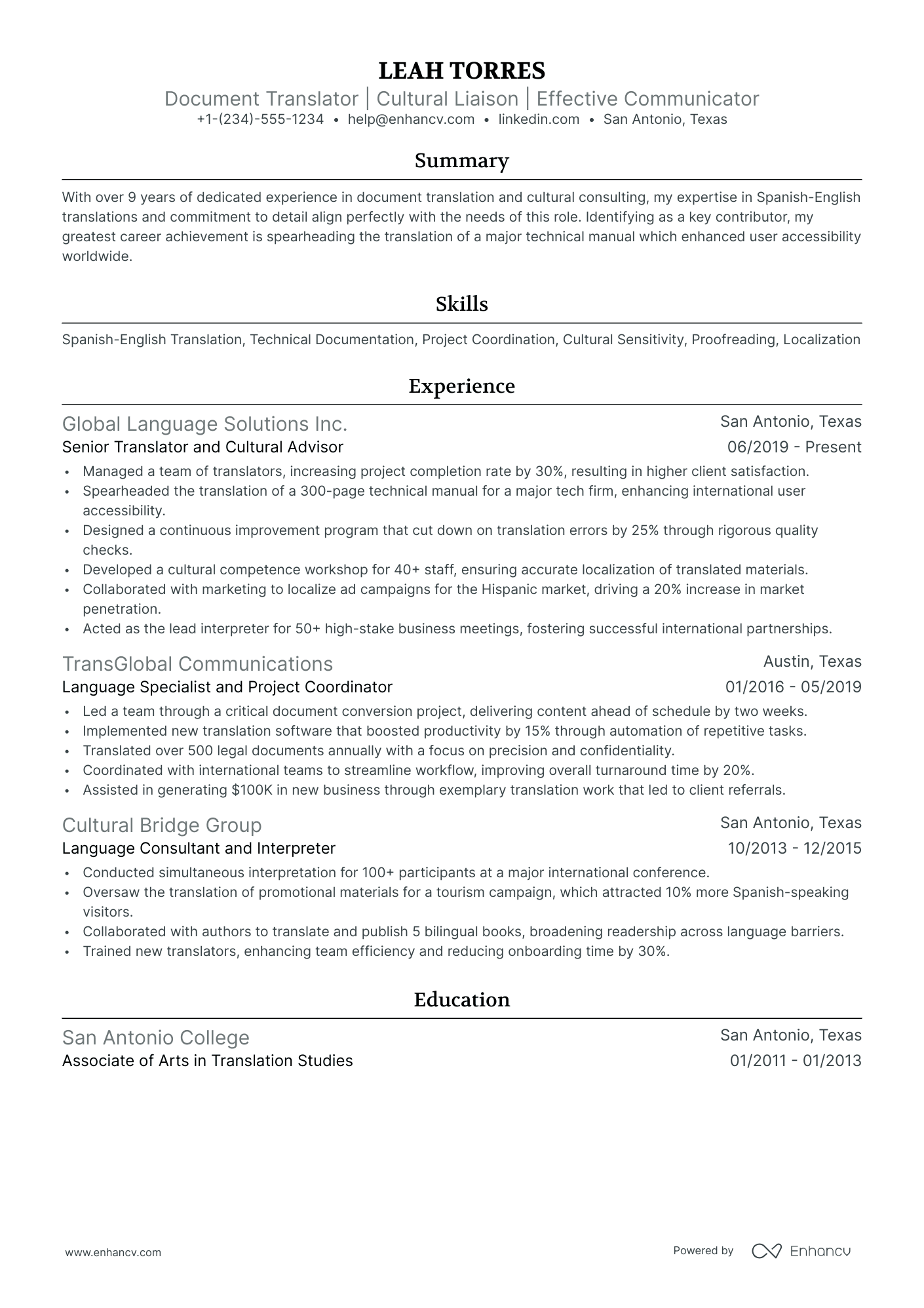
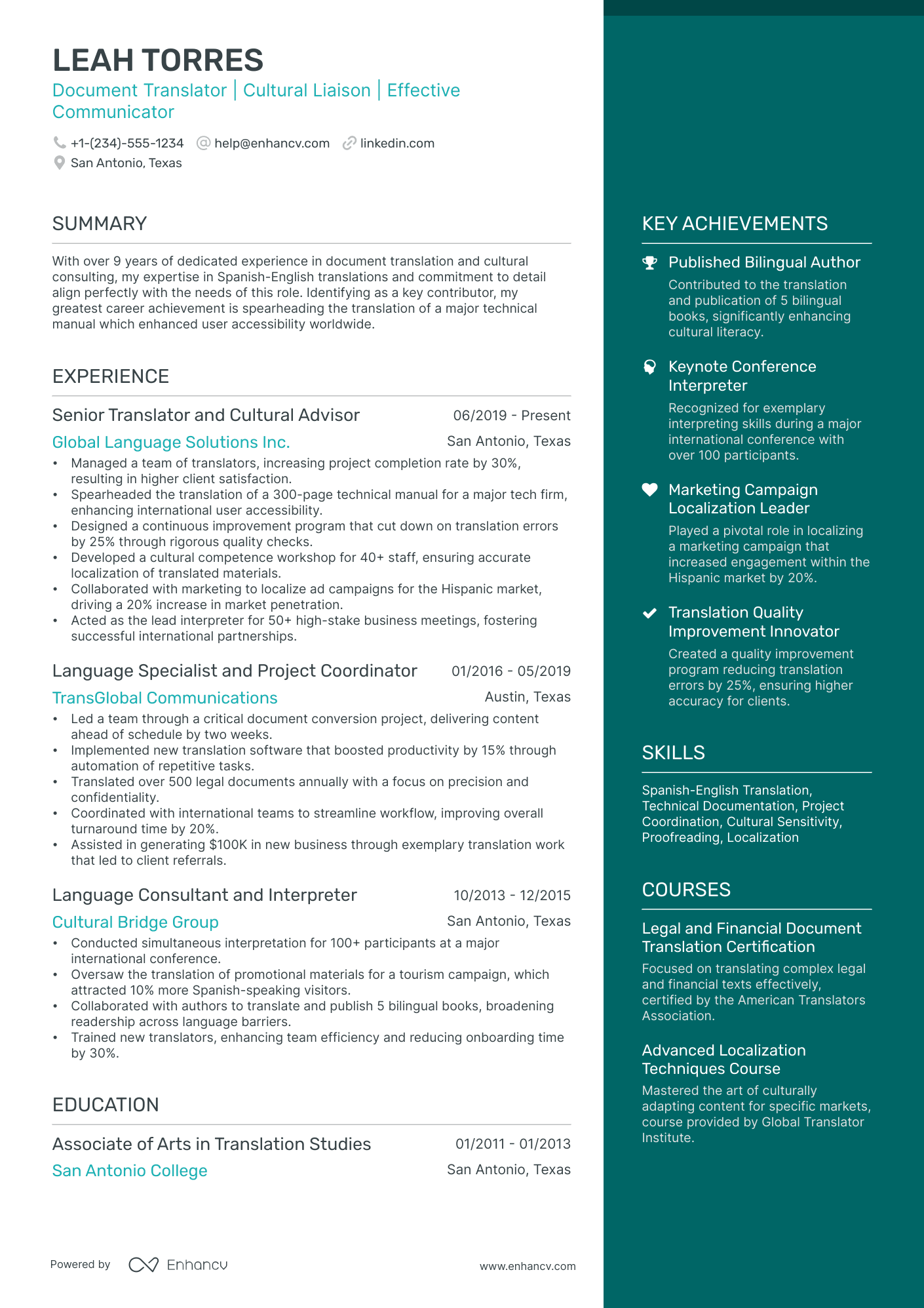
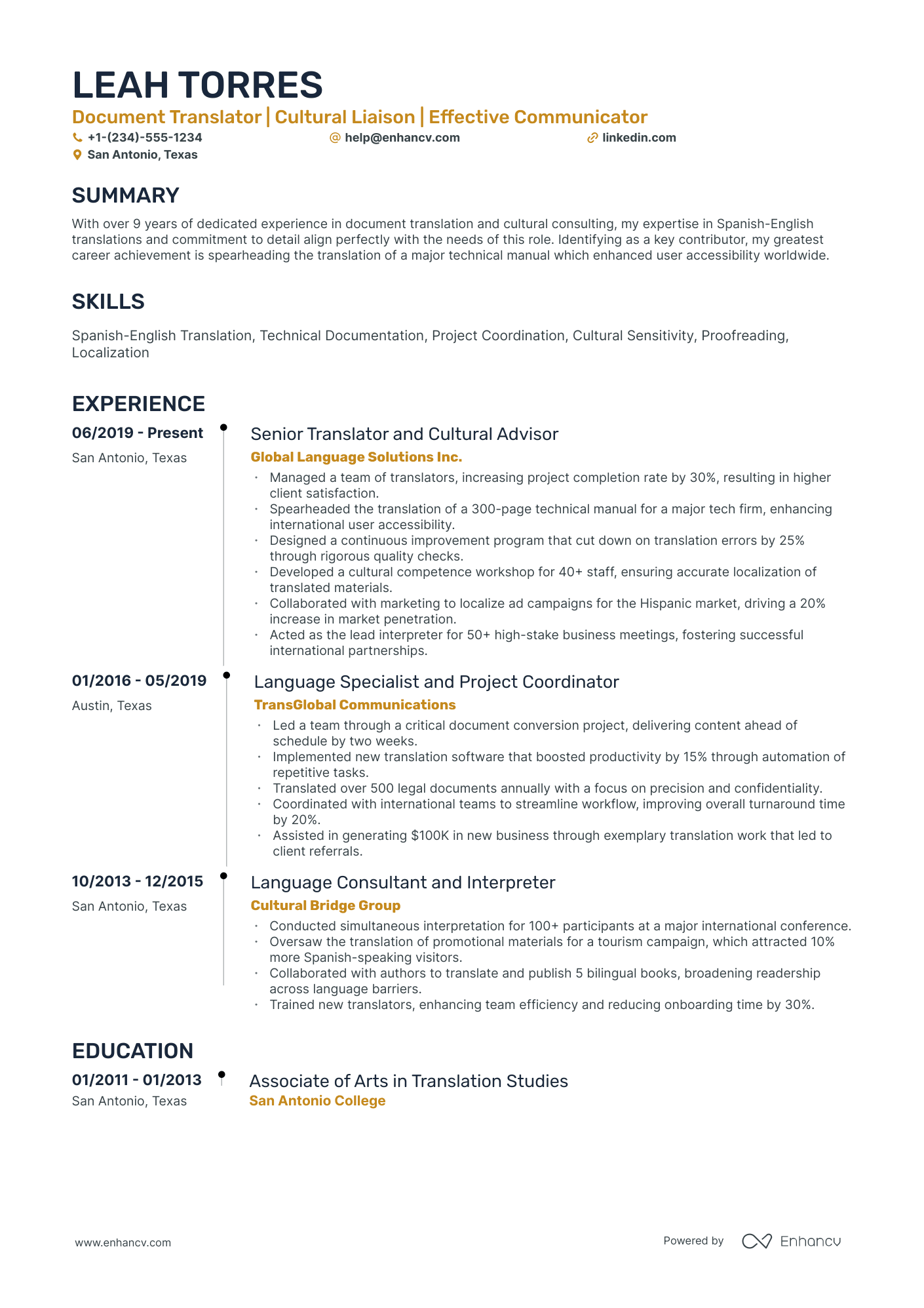
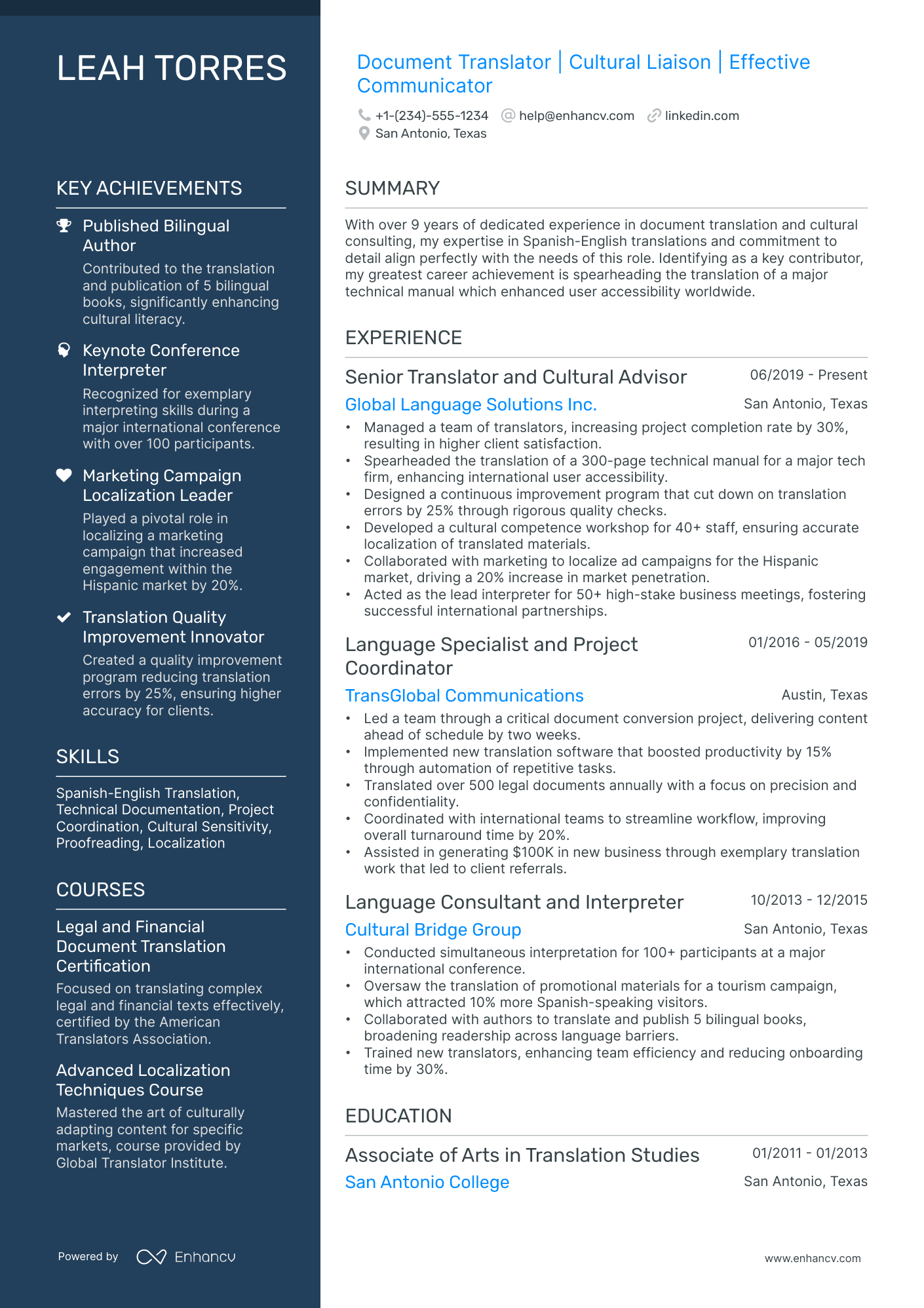
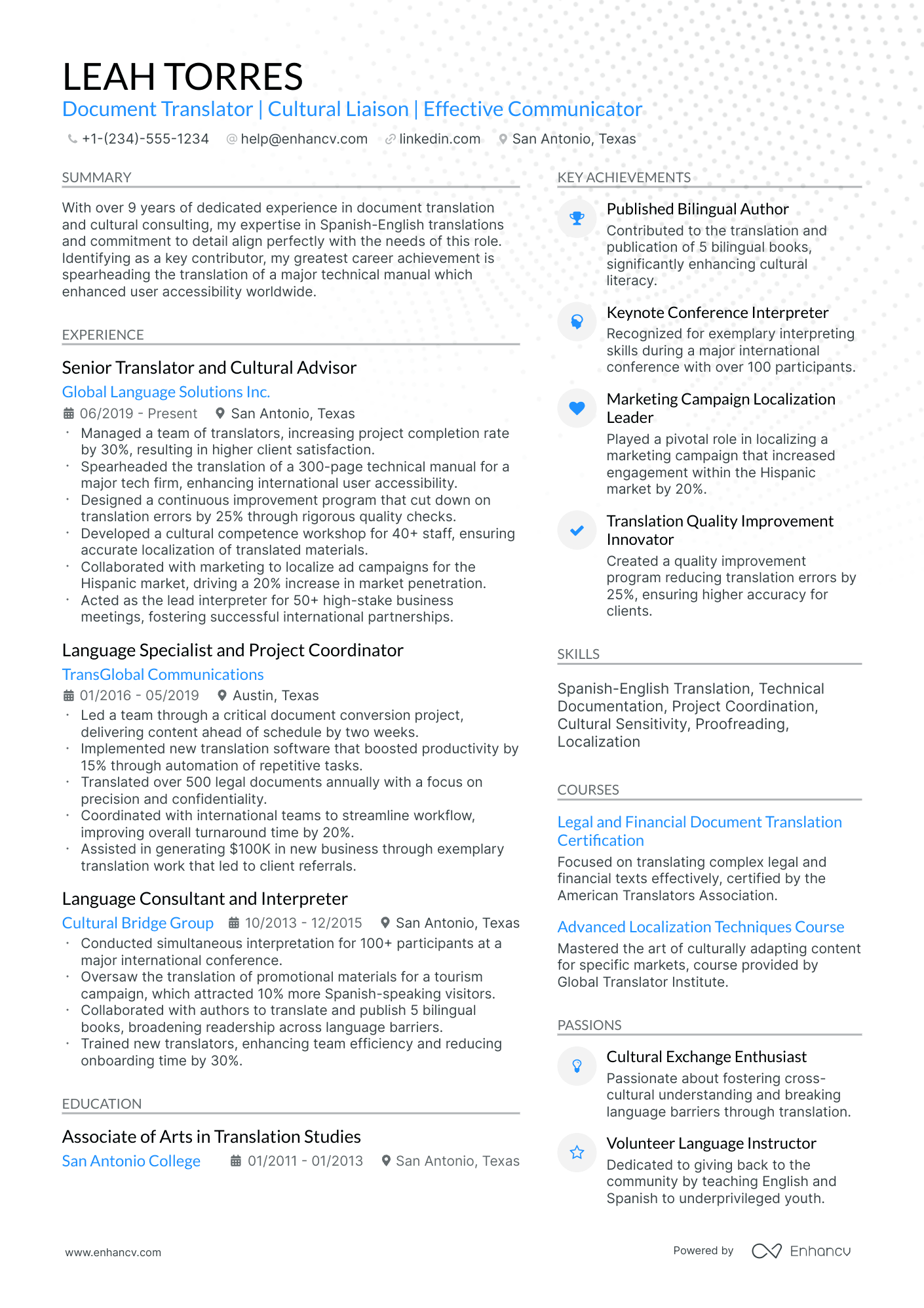
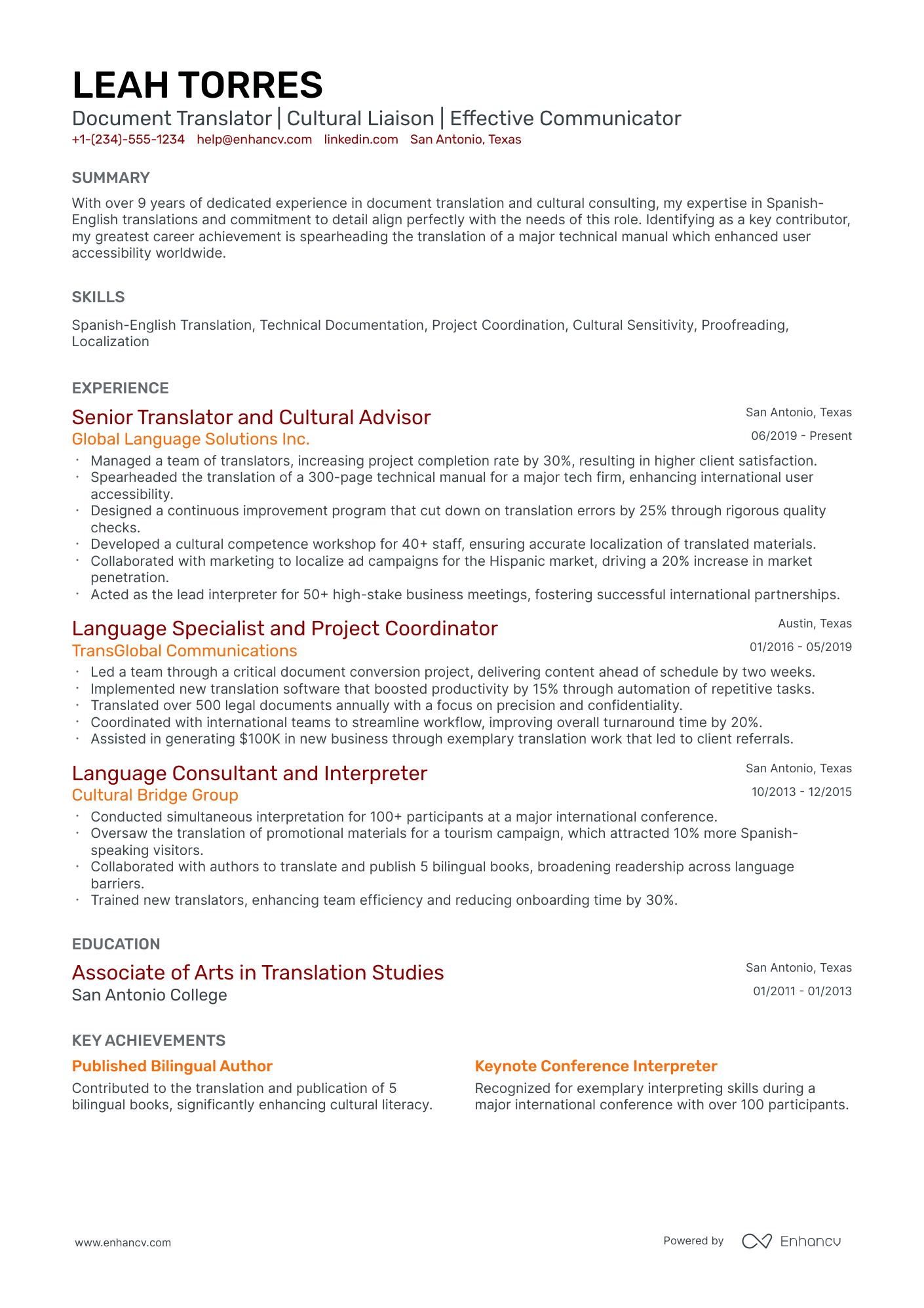
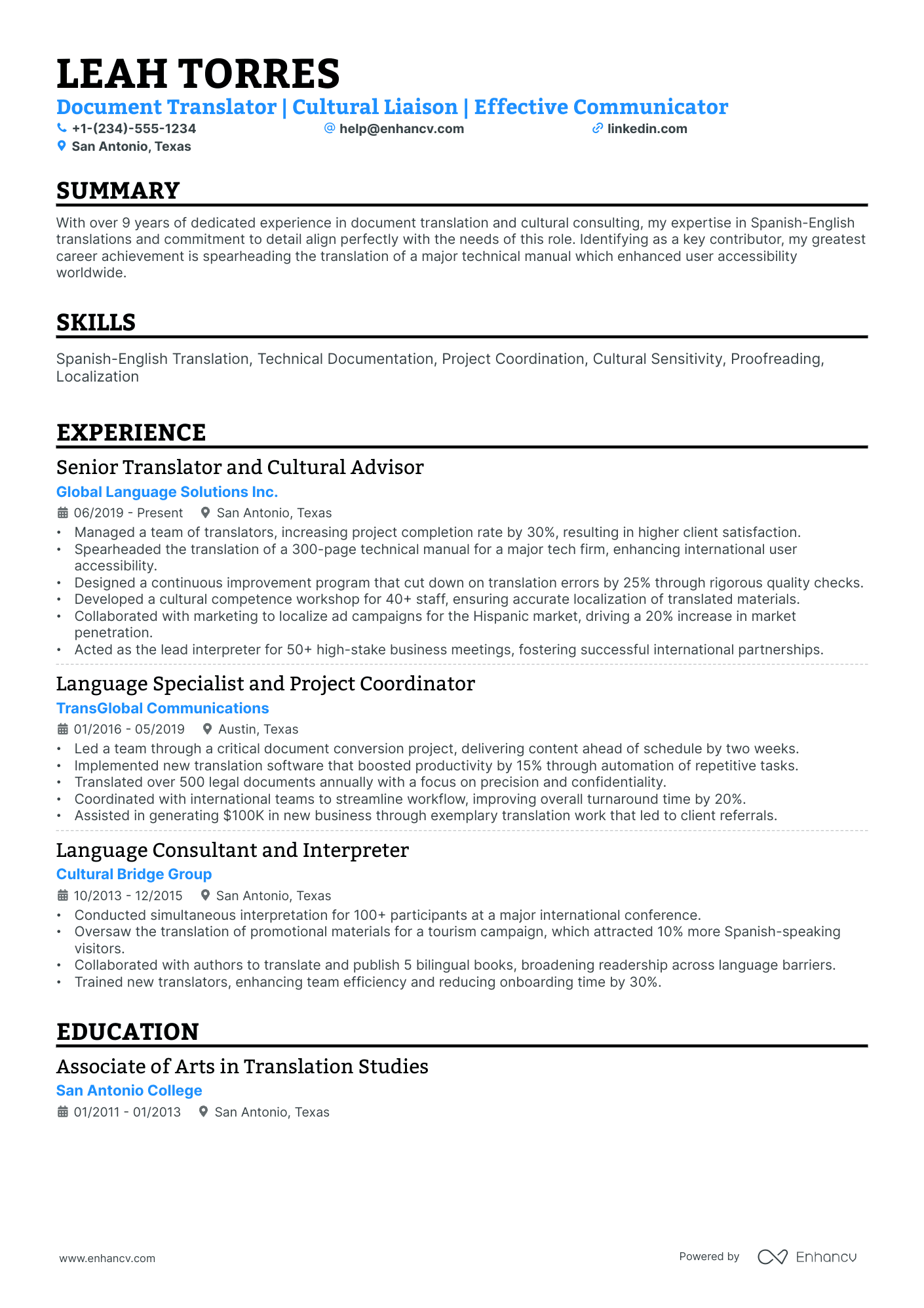
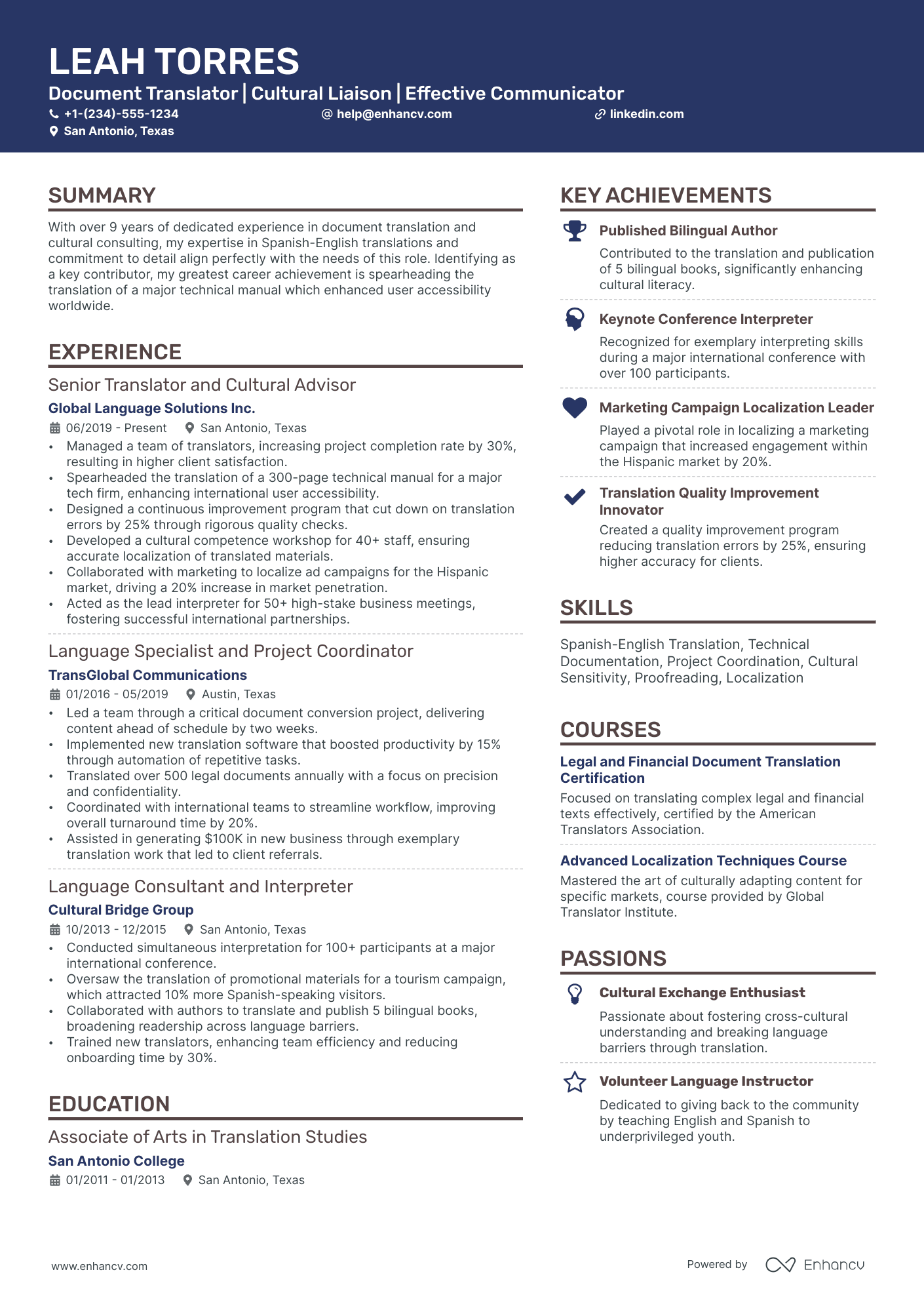
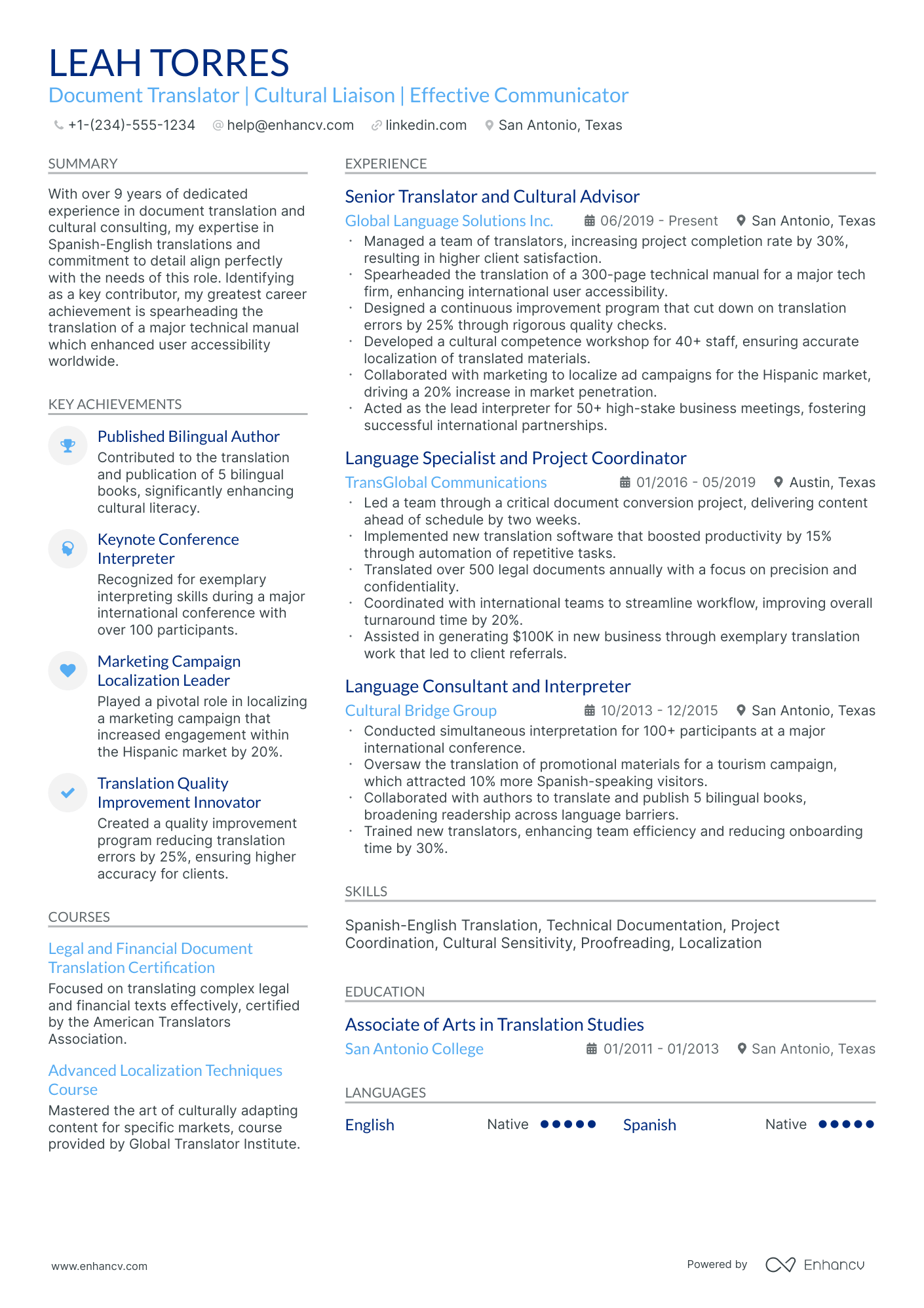
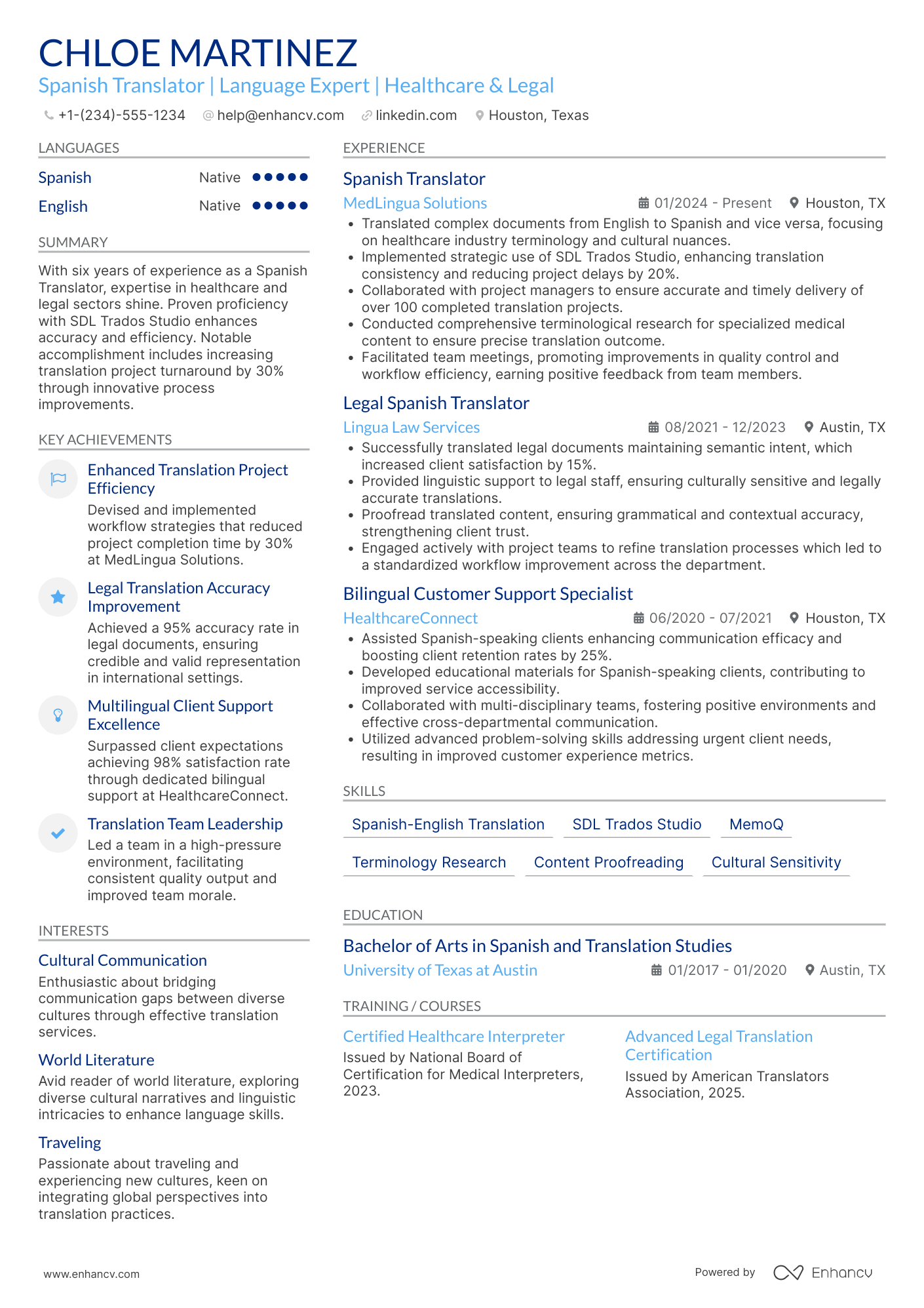
Many Spanish translator resume submissions fail because they read like task lists and bury language pairs, domains, and measurable impact. That hurts in today's hiring process, where an ATS screens keywords and recruiters scan fast in a crowded field. Knowing how to make your resume stand out is essential in such a competitive landscape.
A strong resume shows what changed because of your work. You should highlight on-time delivery rates, word volume and turnaround, error reductions from quality assurance, client satisfaction scores, and revenue protected by accurate legal or medical translations.

Key takeaways
- Quantify translation volume, accuracy rates, and turnaround time in every experience bullet.
- Tailor your resume to each job posting by mirroring its exact tools and domain language.
- Use reverse-chronological format with significant experience or hybrid format when switching careers.
- List CAT tools like SDL Trados or memoQ with specific projects that prove proficiency.
- Anchor every listed skill to a measurable outcome, not a generic duty description.
- Add certifications such as ATA or CCHI directly after education to boost credibility.
- Use Enhancv to turn vague job duties into measurable, recruiter-ready resume bullets fast.
How to format a Spanish translator resume
Recruiters evaluating Spanish translator resumes prioritize proven language proficiency, subject-matter specialization (legal, medical, technical), and a track record of delivering accurate, deadline-driven translation work. A clean, reverse-chronological or hybrid format ensures these signals—certifications, domain expertise, and volume or quality metrics—surface quickly during both human review and ATS parsing. Choosing the right resume format is one of the most important early decisions you'll make.

I have significant experience in this role—which format should I use?
Use a reverse-chronological format to give recruiters a clear, linear view of your growing specialization and output across translation roles. Do:
- Lead with your most recent position and emphasize scope: languages pairs managed, team coordination, and subject-matter domains (e.g., legal, medical, technical).
- Highlight role-specific tools and credentials—CAT tools like SDL Trados or MemoQ, certifications such as ATA or court interpreter credentials, and any terminology management systems you've used.
- Quantify outcomes tied to quality, volume, or business impact rather than listing generic duties.
I'm junior or switching into this role—what format works best?
A hybrid format works best because it lets you lead with relevant language skills and translation competencies while still showing a concise work history. Do:
- Place a dedicated skills section near the top featuring language pairs, CAT tools, and any domain-specific terminology knowledge.
- Include freelance projects, volunteer translation work, academic coursework, or internship experience that demonstrates hands-on translation practice.
- Connect every listed skill or project to a concrete action and a measurable or observable result.
Why not use a functional resume?
A functional format strips away the timeline and context that show how your translation skills developed in real working environments, making it harder for recruiters to verify your proficiency level or domain experience.
- Career changers with strong bilingual skills but no professional translation credits yet, who can tie language abilities to concrete projects or volunteer work.
- Candidates with resume gaps who completed relevant coursework, certifications (e.g., ATA), or freelance projects during that time.
Once your layout and formatting choices are in place, the next step is deciding which sections to include so each one works within that structure.
What sections should go on a Spanish translator resume
Recruiters expect you to present a clear record of Spanish translation work, specialization, and measurable results. Understanding which resume sections to include helps you organize this information effectively.
Use this structure for maximum clarity:
- Header
- Summary
- Experience
- Skills
- Projects
- Education
- Certifications
- Optional sections: Languages, Publications, Volunteering
Strong experience bullets should highlight translation volume, domain scope, quality metrics, turnaround times, and outcomes such as accuracy improvements, fewer revisions, or faster delivery.
Is your resume good enough?
Drop your resume here or choose a file. PDF & DOCX only. Max 2MB file size.
Once you’ve organized your resume with the right components, the next step is to write your Spanish translator resume experience so each role supports those details with clear, relevant proof.
How to write your Spanish translator resume experience
The experience section is where you prove you've delivered real translation work—not just describe what was in your job description. Hiring managers prioritize demonstrated impact, including the tools and methods you used, the projects you shipped, and the measurable outcomes you produced over generic task lists. Building a targeted resume ensures your experience section speaks directly to what each employer is looking for.
Each entry should include:
- Job title
- Company and location (or remote)
- Dates of employment (month and year)
Three to five concise bullet points showing what you owned, how you executed, and what outcomes you delivered:
- Ownership scope: the translation projects, content types, language pairs, client accounts, or localization workflows you were directly accountable for as a Spanish translator.
- Execution approach: the CAT tools, translation memory systems, terminology databases, glossaries, style guides, or quality assurance frameworks you relied on to produce accurate, consistent Spanish translations.
- Value improved: the gains you drove in translation quality, turnaround speed, terminological consistency, cultural accuracy, or error reduction across your Spanish translation deliverables.
- Collaboration context: how you coordinated with project managers, subject-matter experts, editors, localization engineers, or Spanish-speaking end users to align translations with project goals and audience expectations.
- Impact delivered: the concrete results your translation work produced—expressed through project scale, client retention, expanded market reach, compliance milestones, or publication outcomes rather than routine activity.
Experience bullet formula
A Spanish translator experience example
✅ Right example - modern, quantified, specific.
Spanish Translator (EN–ES), Localization
Nimbus Health | Austin, TX (Remote)
2022–Present
Digital health software company supporting over 2 million patients across the United States and Latin America.
- Localized 450,000+ words per quarter for patient-facing web and mobile experiences using memoQ, Xbench, and a termbase—improving linguistic quality assurance pass rates from 92% to 98%.
- Built and maintained a Spanish glossary and style guide in Confluence, aligning with product and clinical stakeholders—cutting terminology-related edits by 35% and reducing reviewer turnaround time by two days.
- Partnered with product managers, designers, and engineers to internationalize user interface strings in Figma and GitHub—reducing truncation and layout defects by 60% across Spanish releases.
- Implemented automated quality checks and translation memory governance in Smartling—saving 18% in localization spend and accelerating release readiness by twenty-four hours per sprint.
- Led in-country reviews with customer support and regional marketing teams, resolving 120+ linguistic issues in Jira—raising Spanish customer satisfaction score from 4.3 to 4.6 in six months.
Now that you've seen how a strong experience section comes together, let's break down how to tailor each element to match the specific job you're targeting.
How to tailor your Spanish translator resume experience
Recruiters evaluate your Spanish translator resume through applicant tracking systems and manual review. Tailoring your resume to the job description by mirroring the posting's language and priorities helps you pass both filters.
Ways to tailor your Spanish translator experience:
- Match CAT tools listed in the posting like SDL Trados or MemoQ.
- Use the exact terminology the employer applies to translation workflows.
- Mirror quality metrics or accuracy standards the job description specifies.
- Highlight industry experience that aligns with the employer's domain focus.
- Reference specific language pairs or dialect expertise the role requires.
- Emphasize localization or transcreation skills when the posting mentions them.
- Include compliance with style guides or glossary management processes mentioned.
- Note collaboration with reviewers or subject matter experts if referenced.
Tailoring means aligning your real accomplishments with what the role demands, not forcing keywords where they don't belong.
Resume tailoring examples for Spanish translator
| Job description excerpt | Untailored | Tailored |
|---|---|---|
| Translate legal documents from English to Spanish using SDL Trados, ensuring compliance with local regulatory terminology for Latin American markets. | Translated documents from English to Spanish for various projects. | Translated 120+ legal documents monthly from English to Spanish in SDL Trados, applying region-specific regulatory terminology for five Latin American jurisdictions with a 99.2% compliance rate on QA reviews. |
| Provide real-time Spanish interpretation for medical consultations in a hospital setting, accurately conveying patient histories and treatment plans using HIPAA-compliant protocols. | Interpreted conversations between Spanish-speaking clients and English speakers. | Delivered real-time Spanish interpretation for 30+ weekly medical consultations, accurately conveying patient histories and treatment plans while maintaining full HIPAA compliance across cardiology and oncology departments. |
| Localize marketing content—including website copy, social media ads, and email campaigns—for Spanish-speaking audiences in the U.S. and Mexico using MemoQ and style guides provided by the brand team. | Helped with translating marketing materials into Spanish. | Localized 200+ pieces of marketing content—website copy, social media ads, and email campaigns—for U.S. and Mexican audiences in MemoQ, following brand style guides and increasing Spanish-language email click-through rates by 18%. |
Once you’ve aligned your experience with the role’s translation needs, quantify your Spanish translator achievements to show the measurable results of that work.
How to quantify your Spanish translator achievements
Quantifying translation work proves business impact beyond language skill. Track volume, turnaround time, quality scores, compliance outcomes, and cost savings. Using numbers on your resume shows how you improved accuracy, reduced risk, and delivered faster for stakeholders.
Quantifying examples for Spanish translator
| Metric | Example |
|---|---|
| Throughput | "Translated 120,000 words per month across legal, marketing, and support content using memoQ and Trados Studio, maintaining consistent terminology across five product lines." |
| Turnaround time | "Cut average turnaround from three days to twenty-four hours for urgent support articles by building reusable translation memories and standardized glossaries." |
| Quality accuracy | "Improved QA pass rate from 92% to 98% by running Xbench checks and resolving terminology, punctuation, and number-format issues before delivery." |
| Compliance risk | "Reduced compliance escalations by 60% by aligning patient-facing Spanish materials with FDA and ISO 17100 requirements and documenting review trails." |
| Cost savings | "Saved $18,000 annually by consolidating vendor glossaries, increasing translation memory leverage to 35%, and reducing rework requests from stakeholders." |
Turn vague job duties into measurable, recruiter-ready resume bullets in seconds with Enhancv's Bullet Point Generator.
Once you've crafted strong, action-driven bullet points for your experience section, it's equally important to highlight the specific hard and soft skills that qualify you for a Spanish translator role.
How to list your hard and soft skills on a Spanish translator resume
Your skills section shows you can translate accurately, keep terminology consistent, and meet deadlines—recruiters scan them fast and applicant tracking systems match them to keywords—so aim for a balanced mix of hard skills like translation tools and job-specific soft skills. Spanish translator roles require a blend of:
- Product strategy and discovery skills.
- Data, analytics, and experimentation skills.
- Delivery, execution, and go-to-market discipline.
- Soft skills.
Your skills section should be:
- Scannable (bullet-style grouping).
- Relevant to the job post.
- Backed by proof in experience bullets.
- Updated with current tools.
Place your skills section:
- Above experience if you're junior or switching careers.
- Below experience if you're mid/senior with strong achievements.

Hard skills
- Spanish to English translation
- English to Spanish translation
- Localization, transcreation
- Computer-assisted translation tools
- SDL Trados Studio, memoQ
- Smartling, Phrase
- Termbase management, glossaries
- Translation memory maintenance
- Quality assurance checks
- Style guides, brand voice
- Subtitling, captioning standards
- Microsoft Word, Excel
Soft skills
- Clarify ambiguous source text
- Negotiate terminology with stakeholders
- Manage multiple deadlines
- Prioritize high-impact edits
- Communicate translation tradeoffs
- Ask targeted context questions
- Coordinate with editors and reviewers
- Incorporate feedback quickly
- Maintain confidentiality standards
- Document decisions for consistency
- Escalate risks early
- Own end-to-end deliverables
How to show your Spanish translator skills in context
Skills shouldn't live only in a bulleted list on your resume. You can explore common resume skills to see how other professionals present their abilities effectively.
They should be demonstrated in:
- Your summary (high-level professional identity)
- Your experience (proof through outcomes)
Here's what that looks like in practice.
Summary example
Senior Spanish translator with 10+ years in legal and medical localization. Skilled in SDL Trados and transcreation, with a 99.2% quality score across 3 million translated words. Known for clear cross-functional communication.
- Reflects senior-level expertise immediately
- Names industry-standard translation tools
- Quantifies quality with a concrete metric
- Highlights communication as a soft skill
Experience example
Senior Spanish Translator
Lionbridge | Remote
March 2018–Present
- Translated 1.8 million words of legal content using SDL Trados, maintaining a 99.5% client approval rate across 12 accounts.
- Collaborated with project managers and in-country reviewers to reduce revision cycles by 30% within the first year.
- Developed a bilingual glossary of 2,400 terms, cutting onboarding time for new translators by 40%.
- Every bullet includes a measurable outcome.
- Skills surface naturally through real achievements.
Once you’ve demonstrated your translation strengths through relevant examples, the next step is to structure a Spanish translator resume with no experience so those examples still stand out to employers.
How do I write a Spanish translator resume with no experience
Even without full-time experience, you can demonstrate readiness through volunteer work, coursework, and freelance projects. Our guide on writing a resume without work experience covers strategies that apply directly to aspiring Spanish translators.
- Volunteer nonprofit document translations
- University translation coursework projects
- Pro bono community clinic translations
- Freelance gig platform translation samples
- Glossary creation for specialized terms
- Subtitled short videos for creators
- Bilingual blog post localization work
- Academic research translation summaries
Focus on:
- Clear Spanish translator portfolio links
- Industry terminology and glossaries
- Quality assurance checks and metrics
- Tool proficiency with evidence
Resume format tip for entry-level Spanish translator
Use a combination resume format because it highlights translation projects, tools, and domains before limited work history. Do:
- Add a "Projects" section above experience.
- Link to a portfolio with three samples.
- List tools used in each project.
- Quantify volume, turnaround, and revisions.
- Include domain glossaries you built.
- Translated five nonprofit intake forms (2,300 words) using Smartcat (computer-assisted translation tool) and a custom glossary, reducing revision requests by 30%.
Even without professional experience, your academic background can demonstrate the language proficiency and cultural knowledge employers look for—making how you present your education especially important.
How to list your education on a Spanish translator resume
Your education section helps hiring teams confirm you have the linguistic and cultural training a Spanish translator needs. It validates your foundational knowledge quickly.
Include:
- Degree name
- Institution
- Location
- Graduation year
- Relevant coursework (for juniors or entry-level candidates)
- Honors & GPA (if 3.5 or higher)
Skip month and day details—list the graduation year only.
Here's a strong education entry tailored for a Spanish translator resume:
Example education entry
Bachelor of Arts in Spanish Language and Translation
University of Arizona, Tucson, AZ
Graduated 2021
GPA: 3.8/4.0
- Relevant coursework: Advanced Spanish Composition, Legal Translation, Comparative Linguistics, Intercultural Communication
- Honors: Magna Cum Laude, Dean's List (all semesters)
How to list your certifications on a Spanish translator resume
Certifications on a resume show a Spanish translator's commitment to learning, proficiency with tools, and relevance to specialized industries, helping employers trust your skills beyond experience alone. Include:
- Certificate name
- Issuing organization
- Year
- Optional: credential ID or URL
- Place certifications below education when they're older, general, or less relevant than your degree for a Spanish translator role.
- Place certifications above education when they're recent, highly relevant, or required for the Spanish translator jobs you target.
Best certifications for your Spanish translator resume
- ATA Certification (American Translators Association)
- CCHI Certified Healthcare Interpreter (Certification Commission for Healthcare Interpreters)
- NBCMI Certified Medical Interpreter (National Board of Certification for Medical Interpreters)
- CIOL Diploma in Translation (Chartered Institute of Linguists)
- SDL Trados Studio Certification
- memoQ Certification
- ISO 17100 Translator Qualification (via certified training provider)
Once you’ve documented your credentials in a clear, easy-to-scan format, you can use the resume summary to highlight them in context and set the tone for the rest of your Spanish translator resume.
How to write your Spanish translator resume summary
Your resume summary is the first thing a recruiter reads, so it must immediately prove your value. A strong summary positions you as the right Spanish translator by highlighting relevant skills and real results.
Keep it to three to four lines, with:
- Your title and total years of professional translation experience.
- The domains you specialize in, such as legal, medical, marketing, or technical translation.
- Core tools and skills like SDL Trados, MemoQ, CAT tools, or certified interpreting abilities.
- One or two measurable achievements, such as volume handled or accuracy rates.
- Soft skills tied to outcomes, like cross-cultural communication that improved client retention.

PRO TIP
At the entry level, focus on specific language pairs, tools you've mastered, and early wins like project turnaround speed. Avoid vague claims like "passionate linguist" or "hardworking team player." Recruiters want proof of skill, not motivation.
Example summary for a Spanish translator
Bilingual English–Spanish translator with two years of experience in legal and medical document translation. Completed 500+ certified translations using SDL Trados with a 99.2% accuracy rate.
Optimize your resume summary and objective for ATS
Drop your resume here or choose a file.
PDF & DOCX only. Max 2MB file size.
Now that your summary captures your translation expertise at a glance, make sure your header provides the essential contact details recruiters need to reach you.
What to include in a Spanish translator resume header
A resume header lists your key contact and professional details, helping Spanish translator candidates boost visibility, build credibility, and pass recruiter screening fast.
Essential resume header elements
- Full name
- Tailored job title and headline
- Location
- Phone number
- Professional email
- GitHub link
- Portfolio link
A LinkedIn link helps recruiters verify experience quickly and supports screening.
Don't include a photo on a Spanish translator resume unless the role is explicitly front-facing or appearance-dependent.
Match your header headline to the job posting and include your Spanish translator specialization, such as legal, medical, or marketing translation.
Spanish translator resume header
Sofia Martinez
Spanish translator | Legal and business translation (EN to ES)
Austin, TX
(512) 555-01XX
sofia.martinez@enhancv.com
github.com/sofimartinez
sofimartinez.com
linkedin.com/in/sofimartinez
Once your header clearly presents your name, contact details, language pairs, and specialization, add relevant additional sections to strengthen the rest of your Spanish translator resume.
Additional sections for Spanish translator resumes
When your core qualifications match other candidates, well-chosen additional sections can set your Spanish translator resume apart with unique credibility. For example, listing language skills with proficiency levels can immediately demonstrate the breadth of your linguistic abilities.
- Languages and proficiency levels
- Publications and translated works
- Professional affiliations and memberships
- Certifications and accreditations
- Conferences and workshops
- Hobbies and interests
- Volunteer translation experience
Once you've rounded out your resume with relevant additional sections, it's worth pairing it with a strong cover letter to make an even greater impression.
Do Spanish translator resumes need a cover letter
A cover letter isn't required for a Spanish translator, but it often helps in competitive roles or teams with strict hiring expectations. If you're unsure about the basics, learning what a cover letter is and how it complements your resume can help you decide. It can make a difference when your resume needs context, or when the role demands close collaboration.
Use a cover letter to add context your resume can't:
- Explain role or team fit: Match your specialization, tools, and workflow to the team's content types and review process.
- Highlight one or two relevant projects or outcomes: Share measurable results, such as fewer revisions, faster turnaround, or improved quality scores.
- Show understanding of the product, users, or business context: Reference the audience, tone, terminology, and any localization constraints you've handled.
- Address career transitions or non-obvious experience: Connect adjacent work, gaps, or new domains to translation skills and relevant subject knowledge.
Drop your resume here or choose a file.
PDF & DOCX only. Max 2MB file size.
After you decide whether to include a cover letter based on the role and employer expectations, you can use AI to improve your Spanish translator resume more efficiently and consistently.
Using AI to improve your Spanish translator resume
AI can sharpen your resume's clarity, structure, and impact. It helps you find stronger phrasing and tighten wordy bullets. But overuse strips authenticity. Once your content feels clear and role-aligned, step away from AI. If you're curious about getting started, explore ChatGPT resume writing prompts tailored for different resume sections.
Here are 10 practical prompts to strengthen specific sections of your Spanish translator resume:
- Strengthen your summary. "Rewrite my Spanish translator resume summary to highlight my specialization, years of experience, and key language pairs in three concise sentences."
- Quantify translation output. "Add measurable results to these Spanish translator experience bullets, focusing on word counts, turnaround times, and accuracy rates."
- Sharpen action verbs. "Replace weak or repetitive verbs in my Spanish translator experience section with precise, industry-relevant action verbs."
- Tailor skills section. "Review this Spanish translator job posting and reorder my skills section to match the employer's top priorities."
- Clarify specialization areas. "Rewrite my Spanish translator resume's specialization list to clearly distinguish legal, medical, and technical translation experience."
- Improve project descriptions. "Make these Spanish translator project descriptions more specific by adding client type, subject matter, and deliverable format."
- Tighten certification details. "Reformat my Spanish translator certifications section so each entry lists the credential, issuing body, and year earned."
- Refine education entries. "Edit my Spanish translator education section to emphasize coursework and thesis work directly relevant to translation."
- Eliminate redundant phrasing. "Remove filler words and redundant phrases from my Spanish translator resume without losing any meaningful detail."
- Align with job posting. "Compare my Spanish translator resume against this job description and flag missing keywords or qualifications I should address."
Stop using AI once your resume sounds accurate, specific, and aligned with real experience. AI should never invent experience or inflate claims—if it didn't happen, it doesn't belong here.
Conclusion
A strong Spanish translator resume proves impact with measurable outcomes and role-specific skills. Highlight translation volume, accuracy, turnaround time, and client or stakeholder satisfaction. Use a clear structure that makes your experience, tools, and language pairs easy to scan.
Keep your Spanish translator resume focused, current, and consistent. Show readiness for today’s market with relevant domains, quality controls, and collaboration skills. A clean layout and precise details help hiring teams trust your work fast.