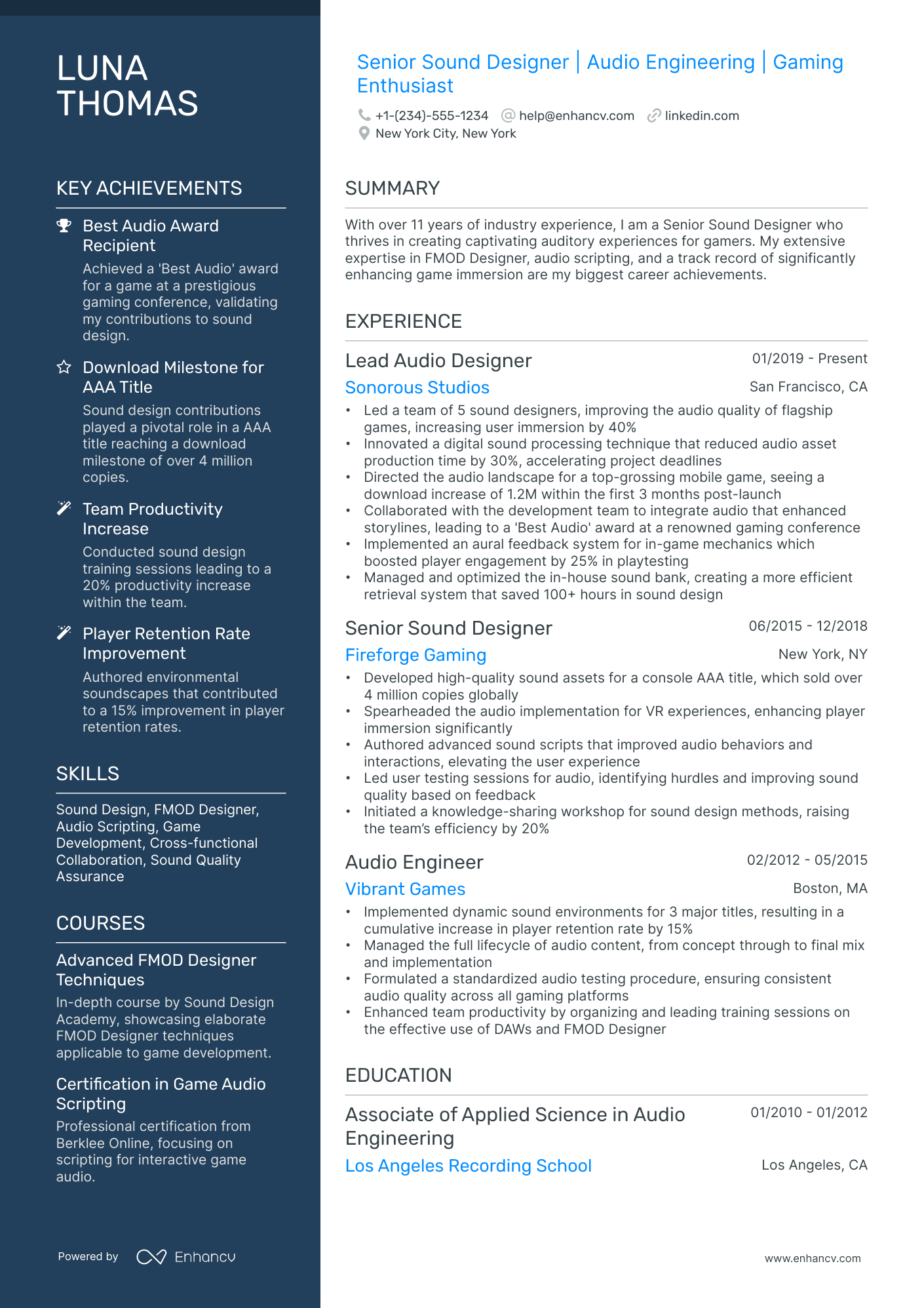
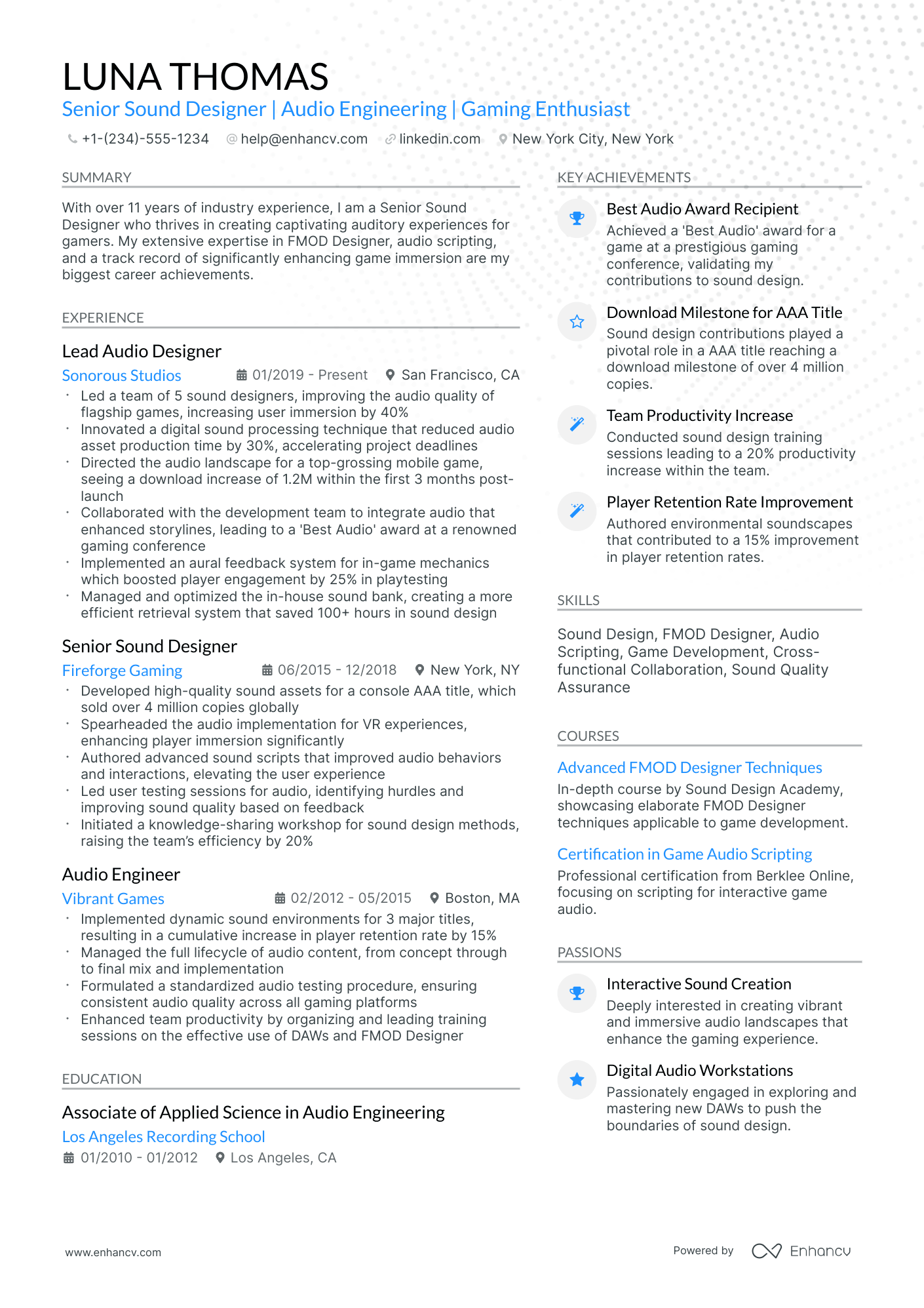
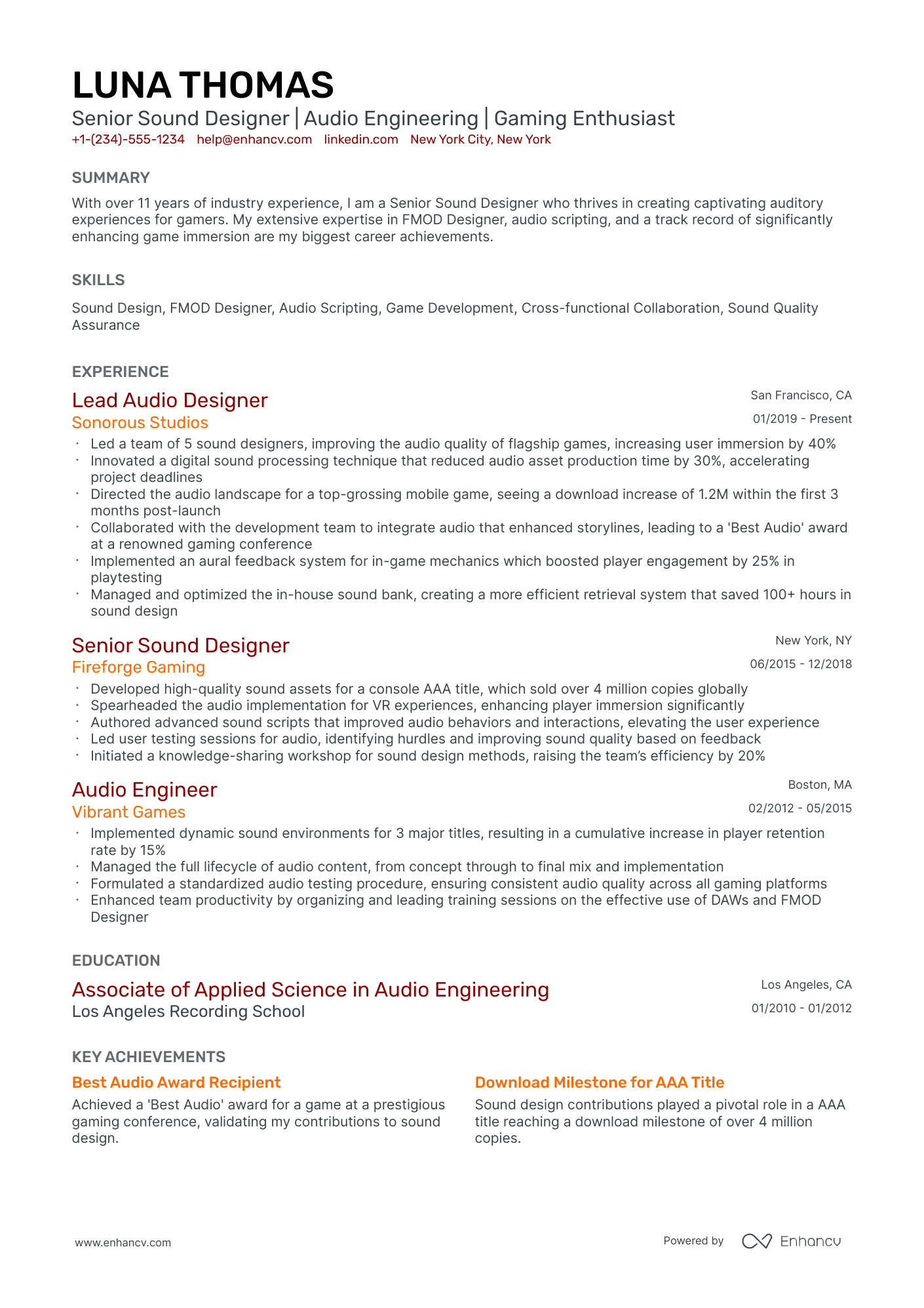
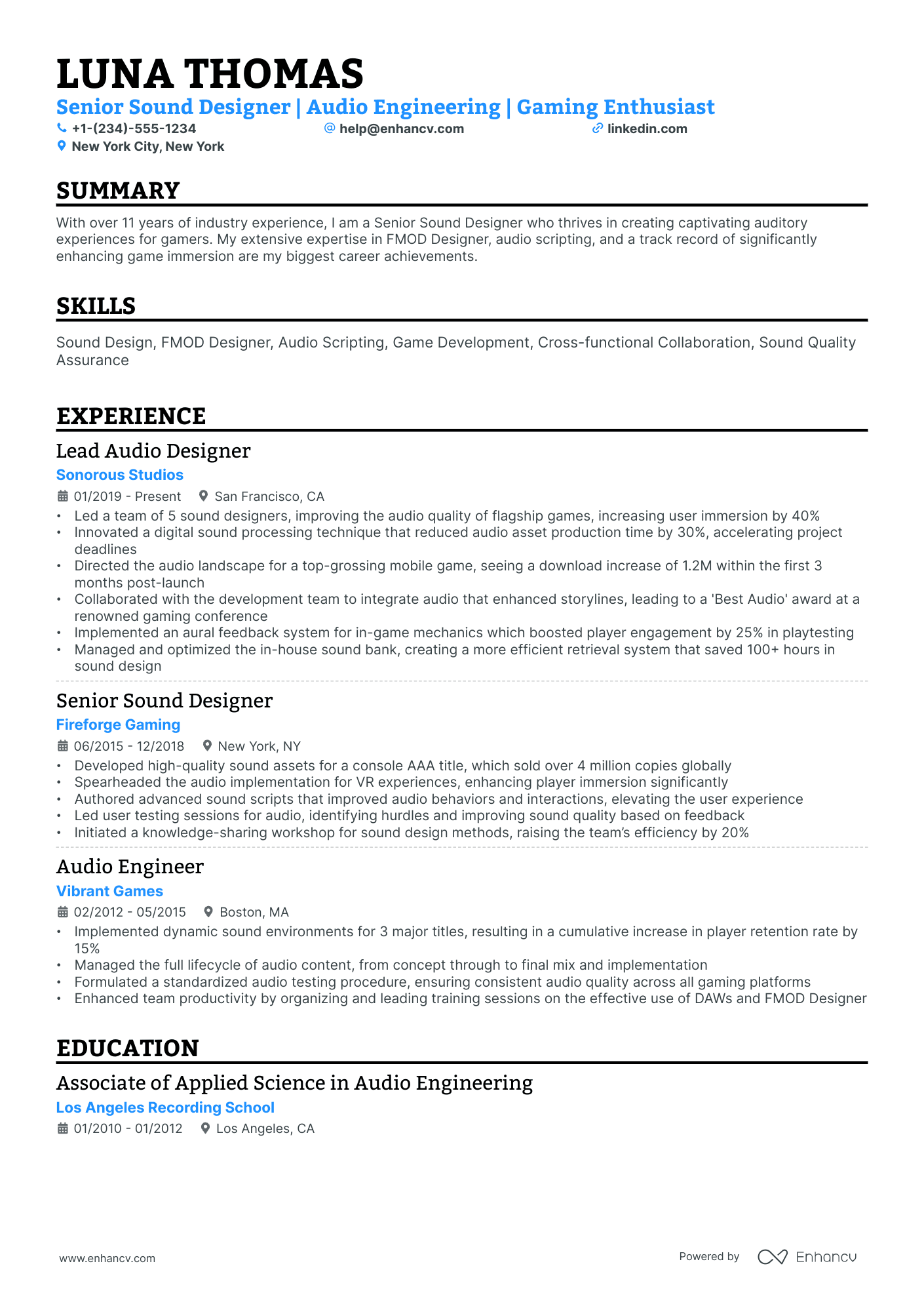
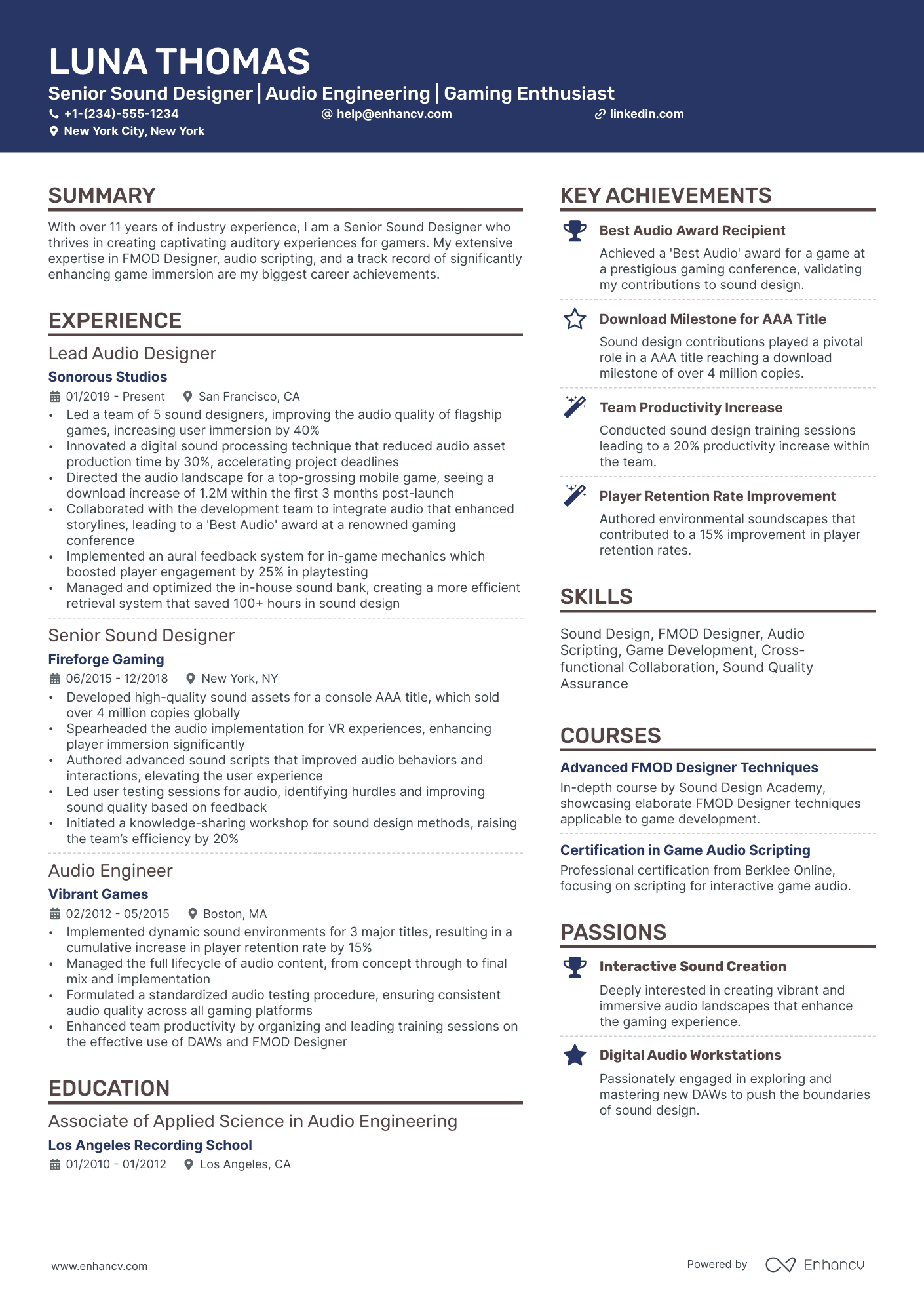
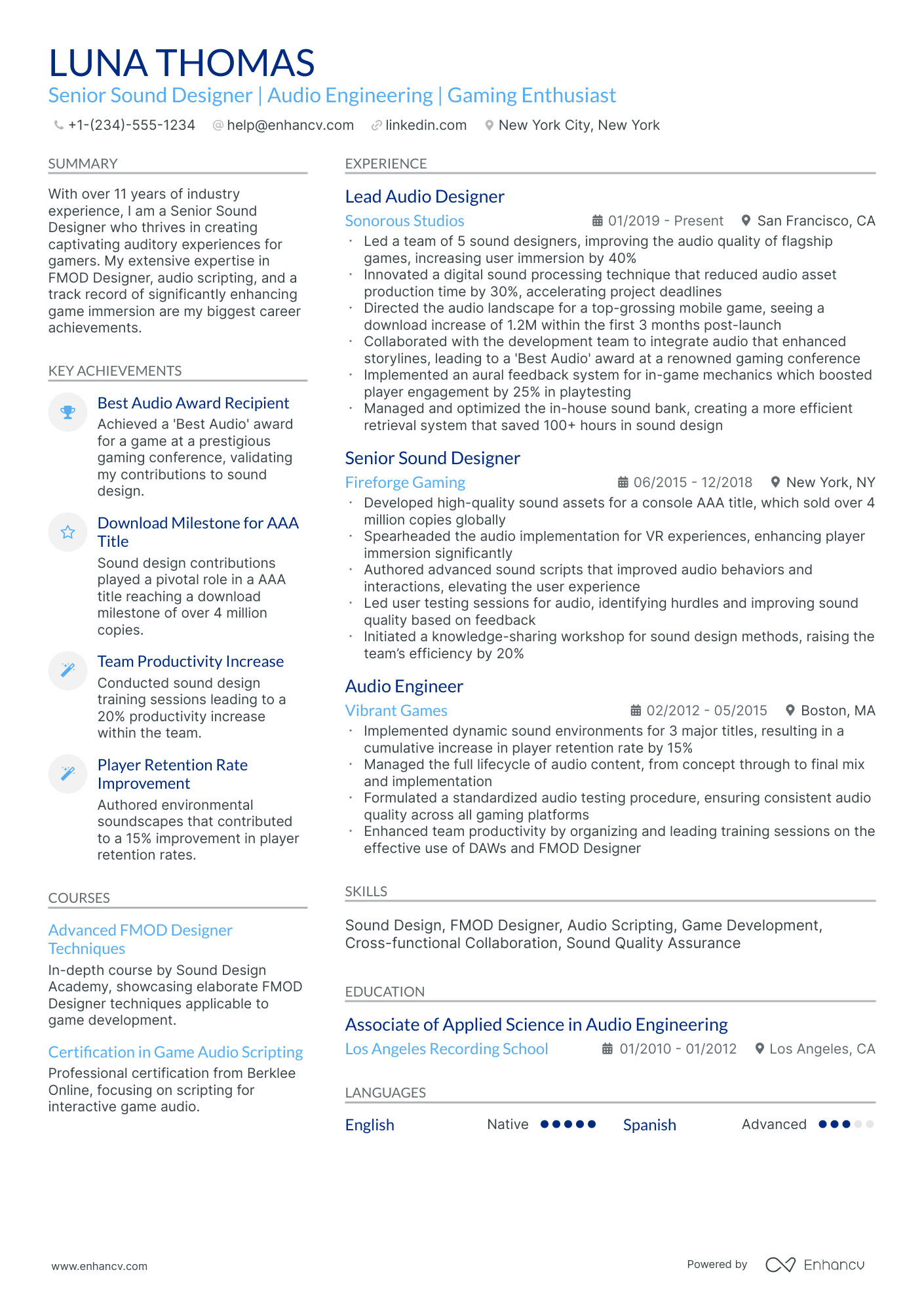
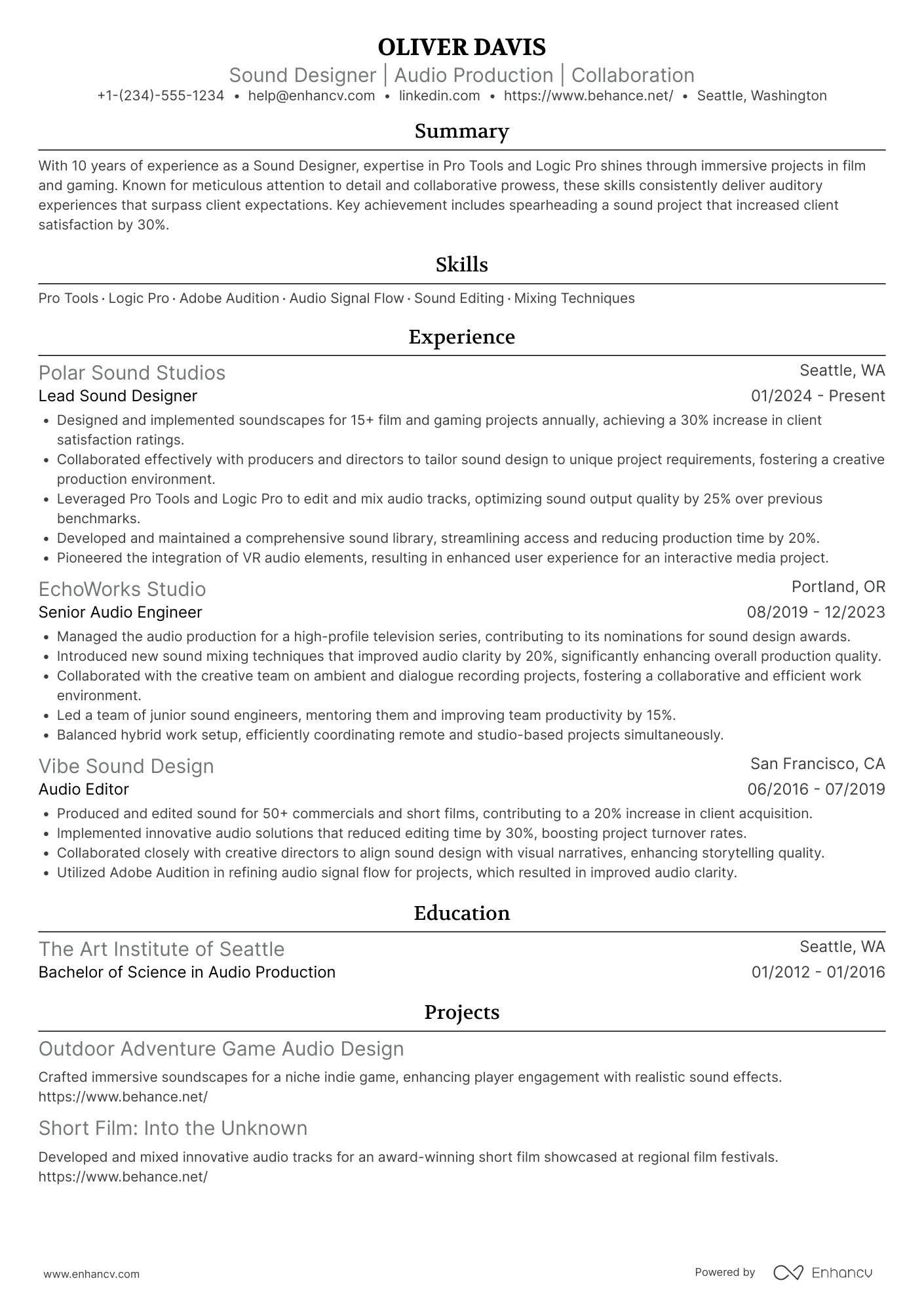
Many sound designer resumes fail because they read like software inventories and task lists, so recruiters can't see impact in a fast scan. A sound designer resume also needs clear keywords and structure to pass ATS screening in a crowded field.
A strong resume shows what changed because of your work, not just what you used. You should highlight shipped titles, mix quality targets met, turnaround time improved, localization delivered, bug rates reduced, player feedback lifted, and pipeline changes that saved hours per release. If you're unsure where to begin, learning how to write a resume with this kind of impact-first mindset is the essential first step.

Key takeaways
- Quantify outcomes like bug reduction, turnaround time, and loudness compliance in every experience bullet.
- Mirror exact tools, middleware, and terminology from the job posting to pass ATS screening.
- Use reverse-chronological format if experienced; use a hybrid format if junior or switching careers.
- Tie every listed skill to a specific project, deliverable, or measurable result on your resume.
- Lead your summary with title, domain, core tools, and one concrete achievement in three lines.
- Include a projects section with demo reel links and credits when you lack full-time experience.
- Use Enhancv to turn vague duties into focused, metric-driven bullets that match the role.
How to format a sound designer resume
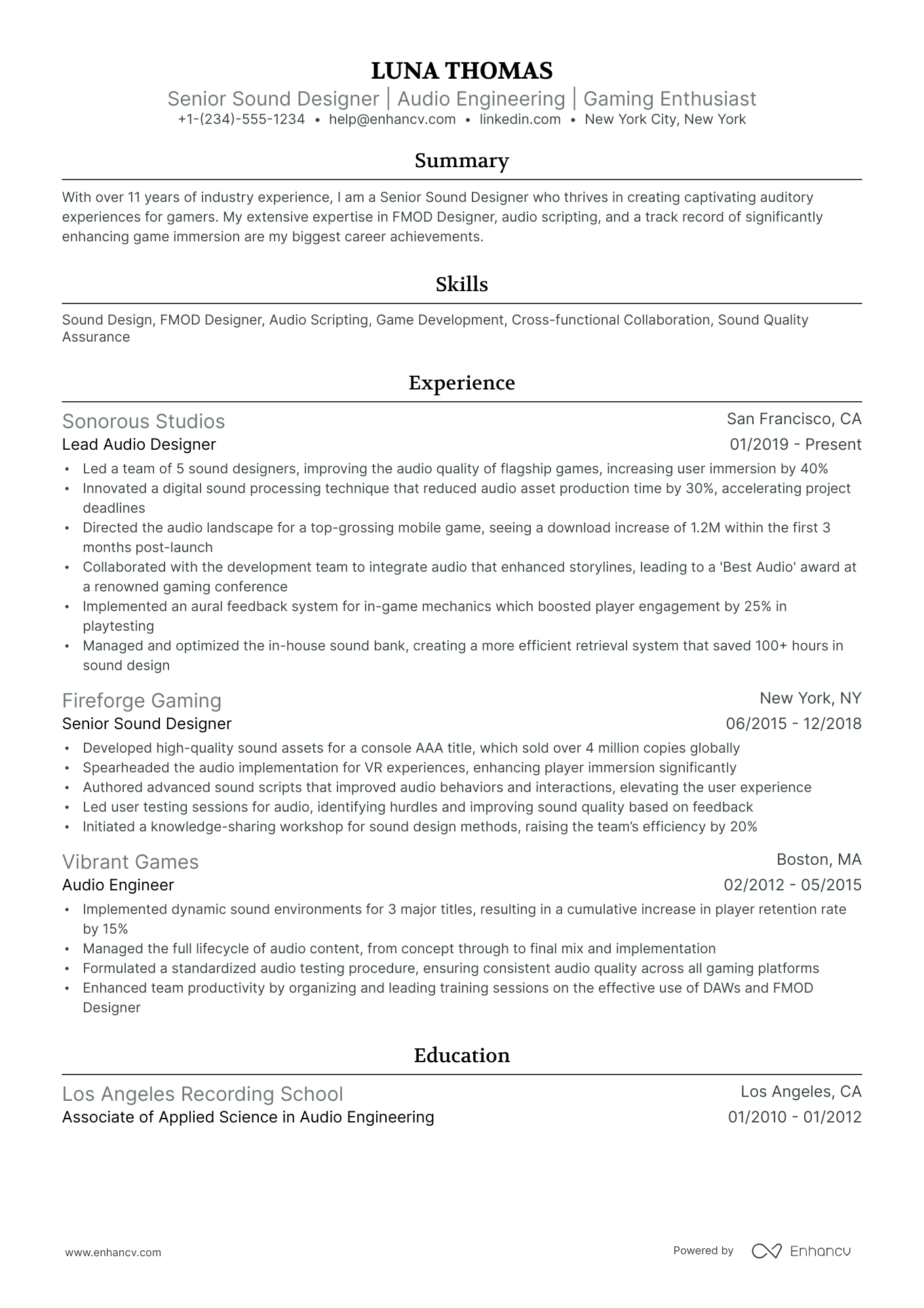
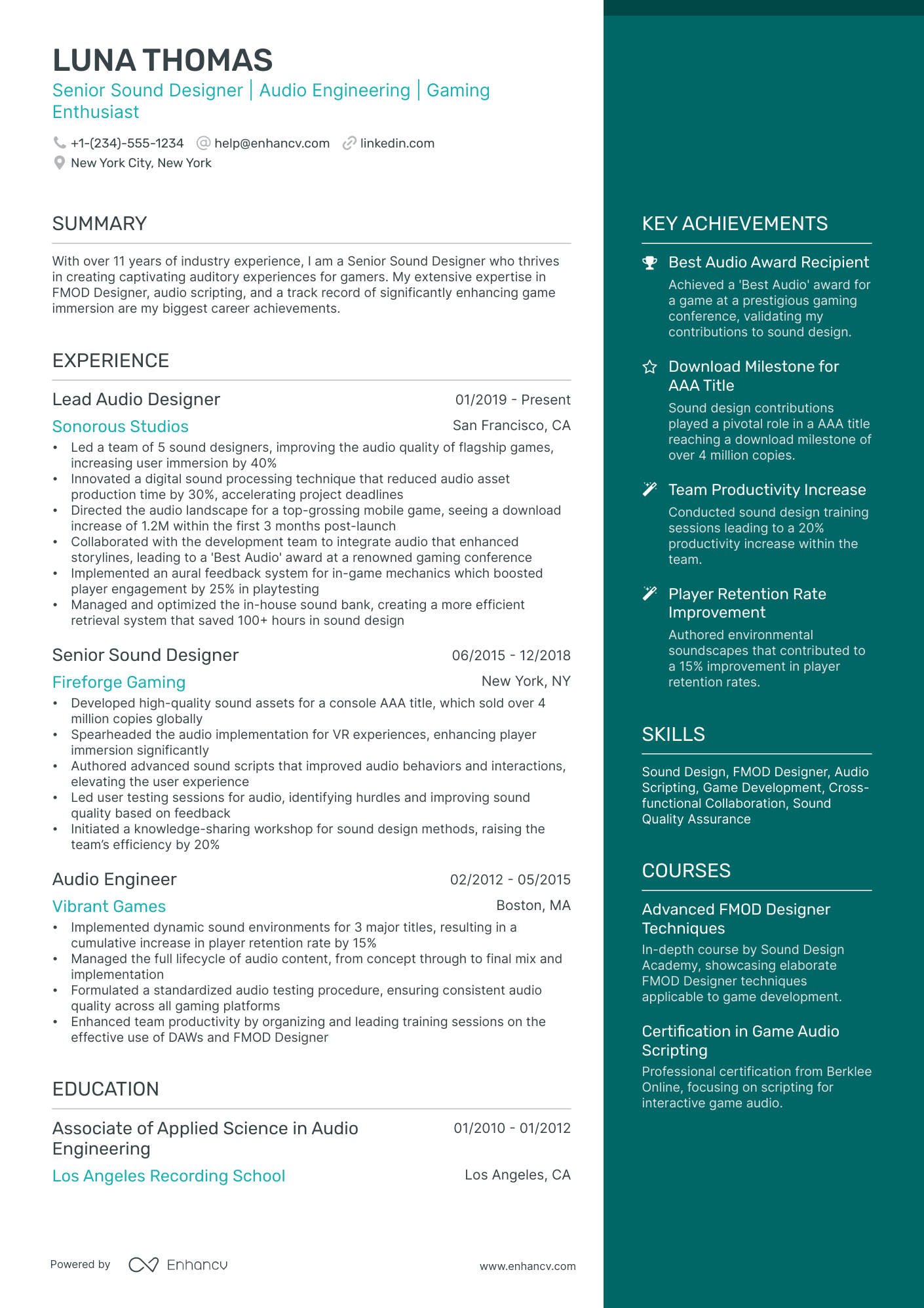
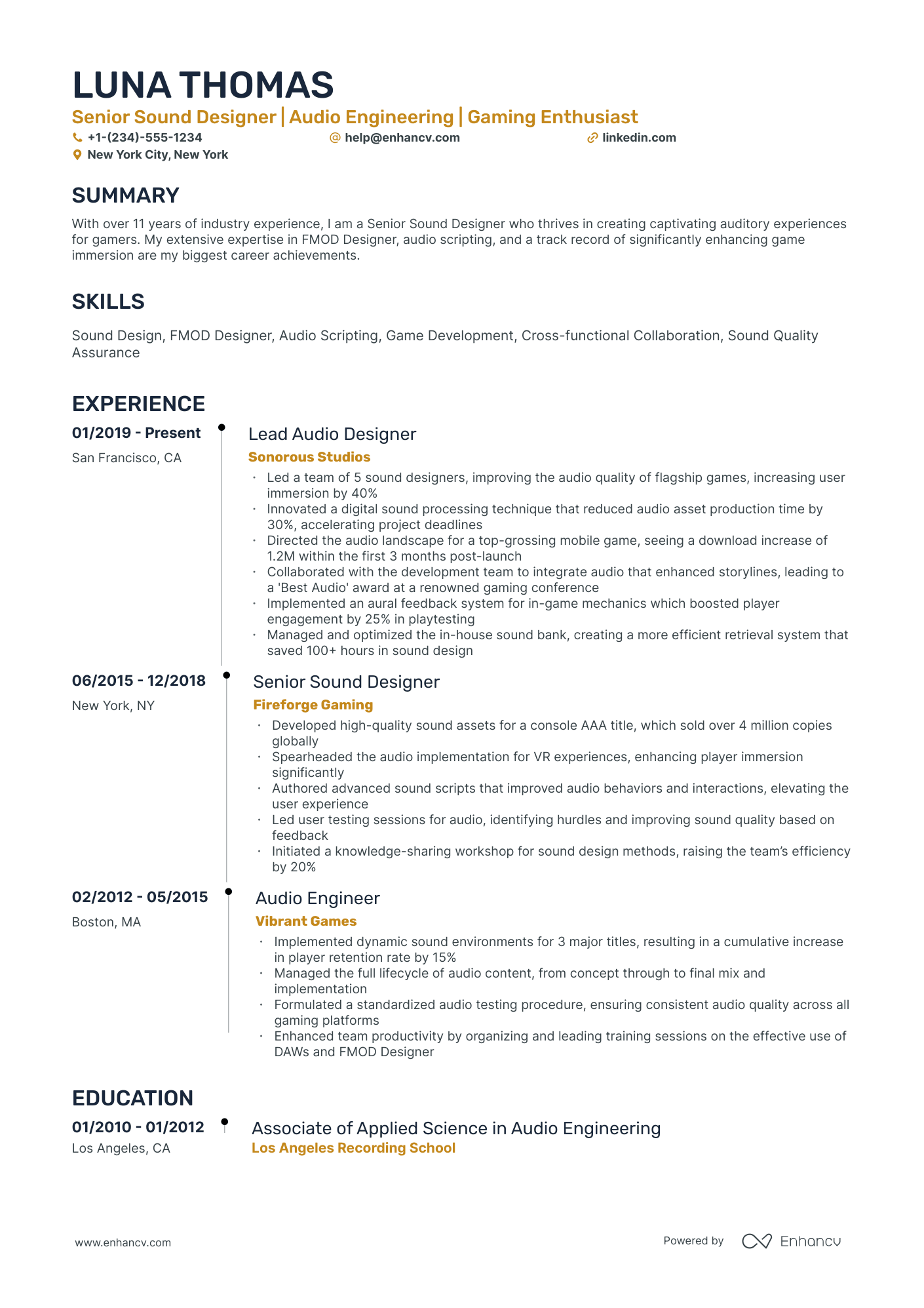
Recruiters evaluating sound designer resumes look for a clear creative and technical skill set, relevant project experience, and evidence of collaboration across production teams. The right resume format ensures these signals surface quickly, both for human reviewers scanning portfolios of work and for applicant tracking systems parsing your document.

I have significant experience as a sound designer—which format should I use?
Use a reverse-chronological format to lead with your most recent and relevant sound design work. Do:
- Highlight the scope and ownership of your projects—feature films, game titles, broadcast series, or immersive installations—and clarify your role on each production team.
- Feature your proficiency with industry-standard tools and domains such as Pro Tools, FMOD, Wwise, Foley recording, field recording, and spatial audio design.
- Quantify outcomes wherever possible, including project scale, audience reach, deadlines met, or efficiency improvements in post-production workflows.
I'm junior or switching into sound design—what format works best?
A hybrid format works best, letting you lead with a focused skills section while still showing relevant experience or project history in chronological order. Do:
- Place your core technical skills—DAWs, middleware, synthesis, field recording—near the top of the resume so recruiters and ATS software catch them immediately.
- Include academic projects, freelance work, game jams, short films, or personal sound libraries to demonstrate hands-on design ability, even without extensive professional credits.
- Connect each listed experience to a concrete action and a measurable or observable result so reviewers understand your impact.
Why not use a functional resume?
A functional format buries the project-by-project context that hiring managers rely on to evaluate a sound designer's creative range, technical growth, and ability to deliver under production constraints. A functional resume might be acceptable if you're transitioning from a related field like music production or audio engineering and have no professional sound design credits yet—but even then, every skill you list should be tied to a specific project, demo reel piece, or measurable outcome rather than presented in isolation.
Now that you've established a clean, readable layout, it's time to fill it with the right sections that showcase your qualifications effectively.
What sections should go on a sound designer resume
Recruiters expect you to present clear credits, tools, and measurable results across production, post-production, and implementation. Understanding which resume sections to include ensures hiring teams find what they need fast.
Use this structure for maximum clarity:
- Header
- Summary
- Experience
- Skills
- Projects
- Education
- Certifications
- Optional sections: Awards, Publications, Languages
Strong experience bullets should emphasize delivered assets, technical scope, collaboration, and measurable outcomes like improved mix quality, faster turnaround, fewer revisions, or smoother in-engine performance.
Is your resume good enough?
Drop your resume here or choose a file. PDF & DOCX only. Max 2MB file size.
Once you’ve organized your resume with the right core components, the next step is to write the experience section in a way that shows the impact of your sound design work.
How to write your sound designer resume experience
The work experience section is where you prove you've shipped audio that reached real audiences—through the tools, techniques, and workflows that define professional sound design. Hiring managers prioritize demonstrated impact over descriptive task lists, so every line should connect what you did to an outcome someone can evaluate.
Each entry should include:
- Job title
- Company and location (or remote)
- Dates of employment (month and year)
Three to five concise bullet points showing what you owned, how you executed, and what outcomes you delivered:
- Ownership scope: the specific titles, platforms, episodes, campaigns, or audio systems you were directly accountable for as a sound designer.
- Execution approach: the DAWs, middleware engines, field recording methods, signal processing chains, or implementation workflows you used to create and deliver final audio.
- Value improved: changes to audio fidelity, mix clarity, asset performance, turnaround speed, file optimization, or creative consistency that resulted from your sound design work.
- Collaboration context: how you coordinated with directors, composers, dialogue editors, game developers, mixers, or post-production teams to align sound design with the broader creative vision.
- Impact delivered: outcomes framed as shipped products, completed deliverables, audience-facing releases, or pipeline improvements rather than a list of daily tasks.
Experience bullet formula
A sound designer experience example
✅ Right example - modern, quantified, specific.
Sound Designer
LumenArc Interactive | Remote
2022–Present
Indie game studio shipping a cross-platform action role-playing game with over two million monthly active players.
- Designed and implemented over eight hundred sound effects and interactive systems in Wwise and Unreal Engine five, reducing audio-related bug reports by thirty-eight percent across three major releases.
- Built a parametric footsteps, cloth, and Foley system using real-time parameter controls, switch containers, and blend containers, cutting content authoring time by twenty-six percent while improving mix consistency to -16 LUFS ±1 across platforms.
- Led full mix and loudness compliance using iZotope RX, FabFilter Pro-Q, and Youlean Loudness Meter, decreasing dialogue masking incidents by forty-one percent in playtests and improving accessibility scores by twelve percent.
- Collaborated with gameplay designers, engineers, and the producer to define an audio event taxonomy, naming conventions, and version control workflow in Perforce, reducing integration time per feature from two hours to forty-five minutes.
- Produced and delivered three hundred fifty localized voice lines with clean edits, de-noise, and batch processing in Reaper, meeting one hundred percent of submission deadlines and reducing re-record requests by twenty-two percent.
Now that you've seen how a strong experience section comes together, let's look at how to adjust yours to match the specific job you're targeting.
How to tailor your sound designer resume experience
Recruiters evaluate your sound designer resume through both applicant tracking systems and manual review. Tailoring your resume to the job description ensures your qualifications connect directly with what hiring teams prioritize.
Ways to tailor your sound designer experience:
- Match specific DAWs and audio middleware tools listed in the posting.
- Mirror the exact terminology used for audio post-production workflows.
- Reflect spatial audio or immersive sound formats the role requires.
- Include relevant industry experience such as gaming or film or broadcast.
- Highlight field recording or Foley techniques when the description references them.
- Align your entries with quality standards or technical compliance requirements mentioned.
- Reference cross-functional collaboration with directors or developers if specified.
- Emphasize asset management systems or naming conventions the team uses.
Tailoring means aligning your real accomplishments with the role's stated priorities, not forcing disconnected keywords into your experience bullets.
Resume tailoring examples for sound designer
| Job description excerpt | Untailored | Tailored |
|---|---|---|
| "Design and implement interactive audio systems for AAA game titles using Wwise and Unreal Engine 5, collaborating with narrative and level design teams to deliver immersive player experiences." | Worked on sound design for various projects using audio software. | Designed and implemented interactive audio systems in Wwise integrated with Unreal Engine 5 for two AAA titles, collaborating directly with narrative and level design teams to build dynamic soundscapes across 30+ game environments. |
| "Create, edit, and mix original sound effects and Foley for episodic streaming content, ensuring delivery meets Netflix loudness standards (–24 LKFS) and tight post-production schedules." | Responsible for creating sound effects and mixing audio for media projects. | Created, edited, and mixed original SFX and Foley for 12 episodes of a streaming series, consistently delivering final mixes at –24 LKFS per Netflix loudness standards while meeting weekly post-production deadlines. |
| "Develop and maintain a scalable sound effects library using SoundMiner, and design procedural audio assets in FMOD for use across multiple VR training simulations." | Managed audio files and helped build a sound library for the team. | Built and maintained a searchable SFX library of 5,000+ assets in SoundMiner, and designed procedural audio in FMOD deployed across four VR training simulations, reducing asset reuse conflicts by 40%. |
Once you’ve aligned your experience with the role’s audio needs and priorities, the next step is to quantify your sound designer achievements so hiring teams can quickly see the impact of your work.
How to quantify your sound designer achievements
Quantifying your achievements proves your audio choices improved the product, not just the mix. Track quality, delivery speed, reliability, and adoption metrics—like loudness compliance, revision cycles, bug rates, and asset throughput across builds.
Quantifying examples for sound designer
| Metric | Example |
|---|---|
| Loudness compliance | "Delivered one hundred twenty assets at -23 LUFS ±1 using iZotope RX and Youlean Loudness Meter, cutting last-minute QC fixes by 60%." |
| Delivery speed | "Reduced average turnaround from three days to one day by templating Pro Tools sessions and standardizing naming across two projects." |
| Bug reduction | "Cut audio bug reports 35% by fixing missing cues, clipping, and loop points in Wwise, verified across five weekly builds." |
| Asset throughput | "Produced two hundred fifty UI and gameplay sound effects in six weeks, maintaining a 95% first-pass approval rate from design leads." |
| Runtime performance | "Lowered in-game audio memory by 18% by optimizing sample rates and streaming settings in FMOD, preventing frame drops on Switch." |
Turn vague job duties into measurable, recruiter-ready resume bullets in seconds with Enhancv's Bullet Point Generator.
With strong bullet points in place, the next step is ensuring your resume highlights the right mix of hard and soft skills that sound design employers are looking for.
How to list your hard and soft skills on a sound designer resume
Your skills section shows recruiters and an ATS (applicant tracking system) that you can design, implement, and mix audio for the target medium, so list role-specific tools and workflows, then balance technical hard skills with collaboration-focused soft skills.
sound designer roles require a blend of:
- Product strategy and discovery skills.
- Data, analytics, and experimentation skills.
- Delivery, execution, and go-to-market discipline.
- Soft skills.
Your skills section should be:
- Scannable (bullet-style grouping).
- Relevant to the job post.
- Backed by proof in experience bullets.
- Updated with current tools.
Place your skills section:
- Above experience if you're junior or switching careers.
- Below experience if you're mid/senior with strong achievements.

Hard skills
- Pro Tools, Reaper
- Logic Pro, Ableton Live
- Sound effects editing
- Field recording, mic technique
- Dialogue editing, noise reduction
- Foley recording, editing
- Sound design for games
- Unity audio, Unreal Engine audio
- Wwise, FMOD Studio
- Spatial audio, Dolby Atmos
- Mixing, mastering
- Loudness standards (LUFS)
Soft skills
- Translate briefs into sound palettes
- Collaborate with directors and producers
- Align audio with narrative intent
- Give and receive precise feedback
- Prioritize tasks under deadlines
- Document systems and naming conventions
- Communicate tradeoffs and constraints
- Own deliverables end to end
- Coordinate handoffs with engineering
- Iterate quickly from playtests and reviews
- Maintain version control discipline
- Advocate for audio quality in scope decisions
How to show your sound designer skills in context
Skills shouldn't live only in a dedicated skills list. Explore resume skills examples to see how top candidates weave competencies throughout their documents.
They should be demonstrated in:
- Your summary (high-level professional identity)
- Your experience (proof through outcomes)
Here's what that looks like in practice.
Summary example
Senior sound designer with 10+ years in game audio. Skilled in Wwise, FMOD, and adaptive sound systems. Led audio direction on three AAA titles, reducing post-launch sound bug reports by 40% through rigorous asset pipeline workflows.
- Reflects senior-level expertise clearly
- Names industry-standard tools directly
- Includes a specific, measurable outcome
- Signals leadership and collaboration ability
Experience example
Senior Sound Designer
Ironclaw Interactive | Remote
March 2019–Present
- Designed and implemented 1,200+ adaptive audio assets in Wwise for two open-world titles, cutting revision cycles by 30% through early prototyping with narrative and design teams.
- Directed a four-person audio team using FMOD and Pro Tools, delivering all milestone builds on schedule across a 14-month production timeline.
- Built a reusable Foley library of 800+ assets, reducing external licensing costs by 25% and accelerating sound design workflows for future projects.
- Every bullet includes measurable proof
- Skills and tools appear naturally in achievements
Once you’ve demonstrated your sound design strengths through relevant examples and results, the next step is applying that same approach to a sound designer resume with no experience so you can present your skills credibly without relying on past roles.
How do I write a sound designer resume with no experience
Even without full-time experience, you can demonstrate readiness through:
- Student film sound post credits
- Game jam audio implementations
- Podcast editing and mixing episodes
- Personal sound redesign reel projects
- Field recording library creation
- Theater or live event mixing
- Audio internships or apprenticeships
- Freelance SFX cleanup gigs
Writing a resume without work experience means focusing on:
- Demo reel with breakdown notes
- Tool stack and workflow evidence
- Credits, platforms, and deliverables
- Measurable audio quality improvements
Resume format tip for entry-level sound designer
Use a hybrid resume format because it highlights projects, tools, and credits first, while still showing education and any work history. Do:
- Lead with a "Projects" section.
- Add links to your reel and credits.
- List tools: Pro Tools, Reaper, Wwise.
- Quantify results: loudness, revisions, deadlines.
- Describe tasks: edit, design, mix, implement.
- Sound designed and mixed a student short in Pro Tools using RX cleanup and custom Foley, cutting dialogue noise 40% and delivering a 5.1 mix on deadline.
Even without professional experience, your educational background can serve as a strong foundation for your resume—here's how to present it effectively.
How to list your education on a sound designer resume
Your education section helps hiring teams confirm you have foundational training in audio engineering, acoustics, or related fields. It validates the technical knowledge behind your creative work.
Include:
- Degree name
- Institution
- Location
- Graduation year
- Relevant coursework (for juniors or entry-level candidates)
- Honors & GPA (if 3.5 or higher)
Omit month and day details—list the graduation year only.
Here's a strong education entry tailored for a sound designer resume.
Example education entry
Bachelor of Fine Arts in Sound Design
Savannah College of Art and Design, Savannah, GA
Graduated 2021
GPA: 3.7/4.0
- Relevant Coursework: Digital Audio Production, Acoustic Theory, Sound Synthesis, Field Recording Techniques, Post-Production Audio
- Honors: Dean's List (six consecutive semesters), Outstanding Senior Thesis in Sound Design
How to list your certifications on a sound designer resume
Certifications on a resume show a sound designer's commitment to learning, prove tool proficiency, and signal industry relevance for specialized audio workflows and pipelines.
Include:
- Certificate name
- Issuing organization
- Year
- Optional: credential ID or URL
- Place certifications below education when your education is recent and more relevant than your credentials.
- Place certifications above education when they are recent, role-specific, or required for the sound designer roles you target.
Best certifications for your sound designer resume
- Avid Pro Tools Certified User
- Avid Pro Tools Certified Operator
- Dolby Atmos for Content Creation Certification
- Dante Certification Level 1
- Dante Certification Level 2
- Apple Certified Pro—Logic Pro
- iZotope RX Certified Operator
Once you’ve positioned your credentials where hiring teams can find them quickly, shift to your sound designer resume summary to connect those qualifications to the value you’ll deliver in the role.
How to write your sound designer resume summary
Your resume summary is the first thing a recruiter reads. A strong one instantly signals you're the right fit for the sound designer role.
Keep it to three to four lines, with:
- Your title and relevant years of experience in sound design.
- The domain you work in, such as film, gaming, or live events.
- Core tools and skills like Pro Tools, FMOD, Wwise, or field recording.
- One or two measurable achievements that show your impact.
- Soft skills tied to real outcomes, such as collaboration that shortened post-production timelines.

PRO TIP
At the junior level, focus on the specific tools you know and any real projects you've contributed to. Highlight relevance and clarity over breadth. Avoid vague phrases like "passionate creative" or "eager team player." Ground every claim in something concrete you've actually done.
Example summary for a sound designer
Sound designer with two years of experience in indie game audio. Built 200+ assets in FMOD and Wwise, reducing revision cycles by 30% through organized delivery and clear team communication.
Optimize your resume summary and objective for ATS
Drop your resume here or choose a file.
PDF & DOCX only. Max 2MB file size.
Now that your summary captures your value as a sound designer, make sure the header framing it presents your contact details correctly so recruiters can actually reach you.
What to include in a sound designer resume header
A resume header is the top section with your key contact details, and it drives visibility, credibility, and fast recruiter screening for a sound designer.
Essential resume header elements
- Full name
- Tailored job title and headline
- Location
- Phone number
- Professional email
- GitHub link
- Portfolio link
A LinkedIn link helps recruiters verify your experience quickly and supports screening.
Do not include a photo on a sound designer resume unless the role is explicitly front-facing or appearance-dependent.
Match your header title and links to the exact sound designer role, and keep every detail consistent across your resume and profiles.
Example
Sound designer resume header
Jordan Rivera
Sound designer | Game audio, implementation, and field recording
Austin, TX
(512) 867-53XX
jordan.rivera@enhancv.com
github.com/jordanrivera
jordanrivera.com
linkedin.com/in/jordanrivera
Once your contact details and role identifiers are clearly presented at the top, you can strengthen the rest of your application with additional sections that add relevant context and support your fit.
Additional sections for sound designer resumes
When your core qualifications match other applicants, well-chosen extra sections can set your sound designer resume apart with unique credibility.
- Languages
- Hobbies and interests
- Professional memberships and affiliations
- Awards and festival selections
- Published sound libraries or sample packs
- Conference presentations and workshops
Once you've rounded out your resume with the right supplementary sections, it's worth pairing it with a cover letter to give hiring managers even more context about your qualifications.
Do sound designer resumes need a cover letter
A cover letter isn't required for most sound designer roles, but it helps in competitive searches or when hiring managers expect context. If you're unsure what a cover letter is and when it adds value, it can make a difference when your resume needs a clear story or specific fit.
Use these tips to decide when to include one and what to say:
- Explain role and team fit by matching your workflow to their pipeline, tools, collaboration style, and review process.
- Highlight one or two relevant projects with measurable outcomes, such as reduced iteration time, improved mix clarity, or higher player feedback scores.
- Show you understand the product, users, and business context by referencing platform constraints, accessibility needs, brand tone, and release cadence.
- Address career transitions or non-obvious experience by connecting adjacent work to sound designer tasks, responsibilities, and results.
Drop your resume here or choose a file.
PDF & DOCX only. Max 2MB file size.
Even if you choose to skip a cover letter and let your resume carry the application, using AI to improve your sound designer resume helps you sharpen that document so it communicates your value faster and more clearly.
Using AI to improve your sound designer resume
AI can sharpen your resume's clarity, structure, and impact. It helps tighten language and highlight relevant strengths. But overuse strips authenticity fast. Once your content is clear and role-aligned, step away from AI entirely. If you're curious about which AI is best for writing resumes, start with tools that focus on structure and keyword alignment rather than generating content from scratch.
Here are 10 practical prompts to strengthen specific sections of your sound designer resume:
- Strengthen your summary. "Rewrite my sound designer resume summary to highlight my core specialties, years of experience, and the types of projects I've worked on in two to three concise sentences."
- Quantify your impact. "Review my sound designer experience bullets and suggest ways to add measurable outcomes like project counts, turnaround times, or team sizes."
- Tighten bullet points. "Edit each experience bullet on my sound designer resume to start with a strong action verb and stay under 15 words."
- Align with job posts. "Compare my sound designer resume skills section against this job description and identify missing keywords I should add."
- Improve project descriptions. "Rewrite my sound designer portfolio project entries to clearly state my role, tools used, and the final deliverable."
- Clarify technical skills. "Organize my sound designer skills section into logical categories like DAWs, middleware, field recording, and post-production tools."
- Refine education details. "Rewrite my sound designer education section to emphasize coursework, thesis projects, or training directly relevant to audio production roles."
- Highlight certifications. "Format my sound designer certifications section to include issuing organizations, completion dates, and relevance to current industry standards."
- Remove filler language. "Scan my sound designer resume for vague phrases like 'responsible for' or 'helped with' and replace them with specific contributions."
- Tailor for industry. "Adjust my sound designer resume language to better fit a posting in game audio, film post-production, or broadcast—whichever I'm targeting."
Stop using AI once your resume sounds accurate, specific, and aligned with real experience. AI should never invent experience or inflate claims—if it didn't happen, it doesn't belong here.
Conclusion
A strong sound designer resume shows measurable outcomes, role-specific skills, and a clear structure. It highlights impact with metrics like turnaround time, revision counts, and mix consistency. It lists tools, workflows, and credits in a clean, scannable format.
When your resume stays focused and easy to review, it signals you can deliver under real production timelines. That clarity supports today’s hiring market and near-future demands, where teams expect speed, consistency, and reliable collaboration from a sound designer.