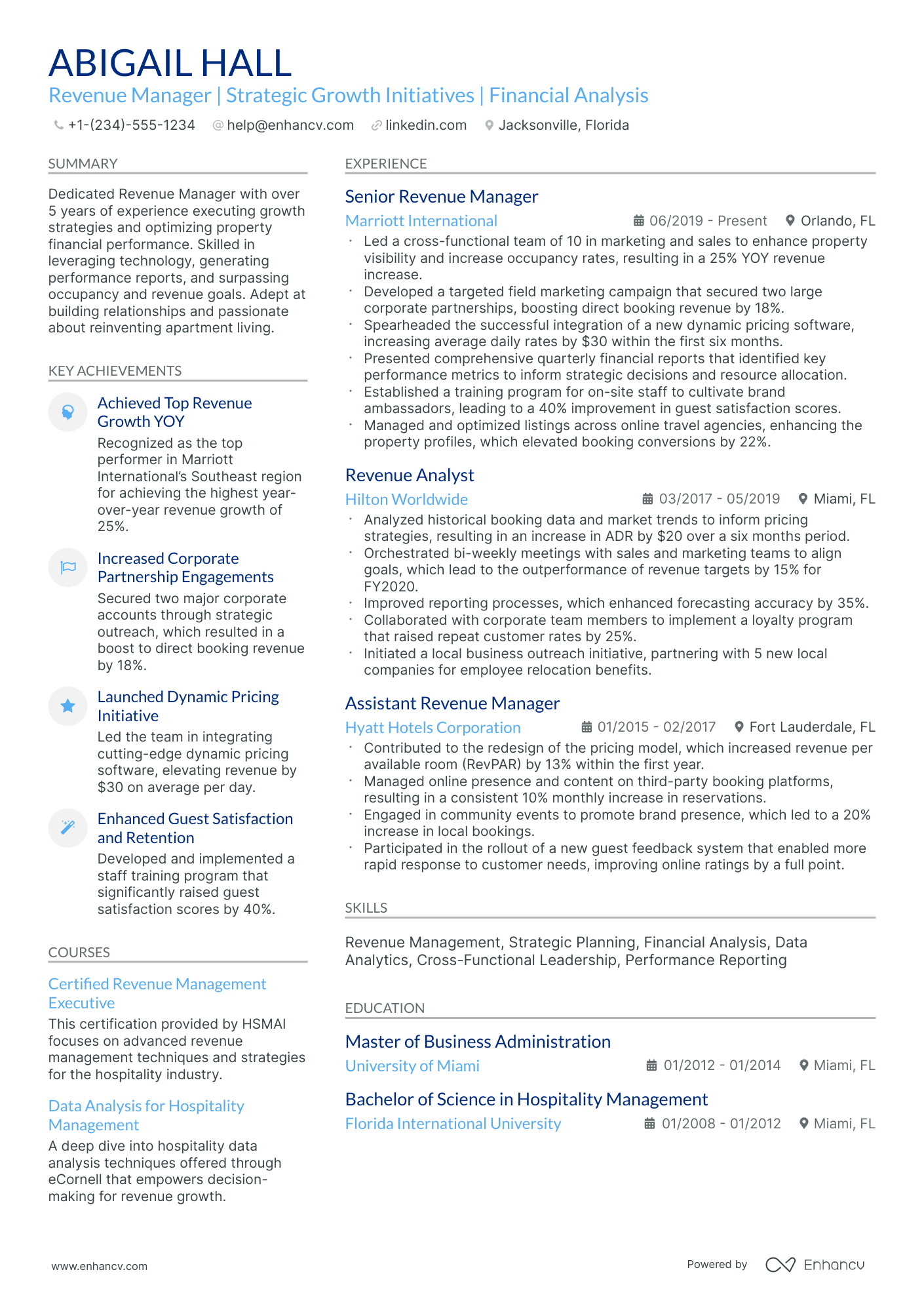
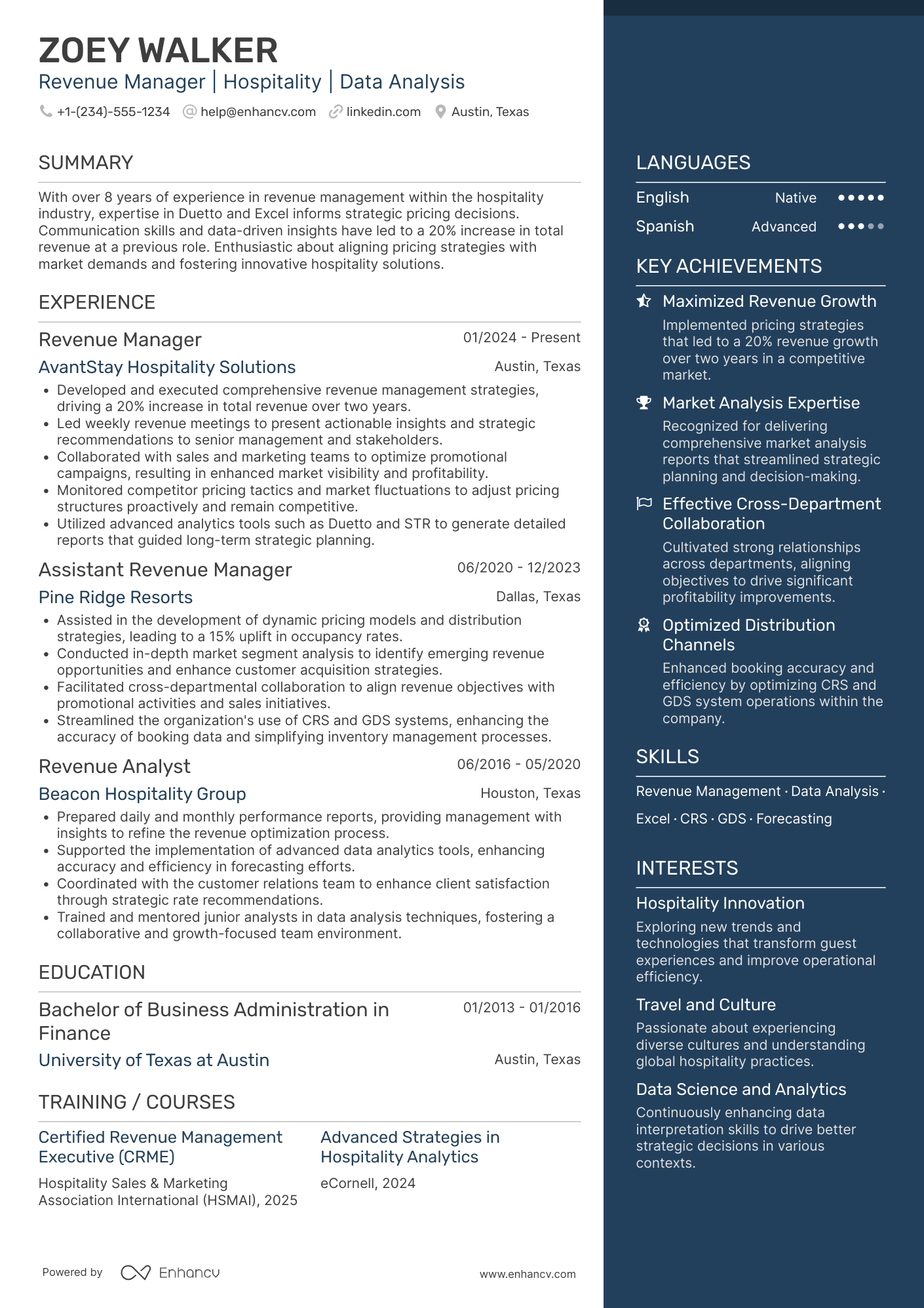
Many revenue manager resume drafts fail because they list systems and duties but don't show revenue impact, pricing decisions, or forecasting accuracy. That costs you in ATS screening and fast recruiter scans, especially when competition is high.
A strong resume shows what changed because of you. Lead with outcomes like RevPAR and net revenue lift, forecast variance reduced, ADR improved, conversion gains, churn reduction, margin expansion, portfolio size managed, and pricing cadence delivered on time. If you're unsure where to begin, learning how to write a resume that highlights impact over duties is the essential first step.

Key takeaways
- Lead every experience bullet with measurable outcomes like RevPAR lift or forecast accuracy improvement.
- Use reverse-chronological format if you have significant experience; use hybrid when pivoting.
- Tailor each resume to the job posting's specific tools, KPIs, and pricing terminology.
- Place skills above experience for junior candidates and below it for senior professionals.
- Anchor every listed skill to a real project, tool, or quantified result.
- Write a three- to four-line summary featuring your title, tools, and strongest metric.
- Use Enhancv's Bullet Point Generator to turn vague duties into recruiter-ready, quantified bullets.
Job market snapshot for revenue managers
We analyzed 167 recent revenue manager job ads across major US job boards. These numbers help you understand regional hotspots, skills in demand, career growth patterns at a glance.
What level of experience employers are looking for revenue managers
| Years of Experience | Percentage found in job ads |
|---|---|
| 1–2 years | 9.6% (16) |
| 3–4 years | 18.0% (30) |
| 5–6 years | 9.6% (16) |
| 7–8 years | 1.2% (2) |
| 9–10 years | 4.8% (8) |
| 10+ years | 6.6% (11) |
| Not specified | 54.5% (91) |
Revenue manager ads by area of specialization (industry)
| Industry (Area) | Percentage found in job ads |
|---|---|
| Finance & Banking | 74.9% (125) |
| Healthcare | 13.2% (22) |
Top companies hiring revenue managers
| Company | Percentage found in job ads |
|---|---|
| Hilton Worldwide | 6.0% (10) |
| Marriott International | 6.0% (10) |
Role overview stats
These tables show the most common responsibilities and employment types for revenue manager roles. Use them to align your resume with what employers expect and to understand how the role is structured across the market.
Day-to-day activities and top responsibilities for a revenue manager
| Responsibility | Percentage found in job ads |
|---|---|
| Revenue management | 25.1% (42) |
| Excel | 22.8% (38) |
| Forecasting | 17.4% (29) |
| Sql | 16.2% (27) |
| Data analysis | 15.0% (25) |
| Microsoft excel | 12.0% (20) |
| Power bi | 9.6% (16) |
| Tableau | 9.6% (16) |
| Asc 606 | 8.4% (14) |
| Project management | 8.4% (14) |
| Python | 7.8% (13) |
| Inventory management | 7.2% (12) |
Type of employment (remote vs on-site vs hybrid)
| Employment type | Percentage found in job ads |
|---|---|
| On-site | 64.7% (108) |
| Hybrid | 23.4% (39) |
| Remote | 12.0% (20) |
How to format a revenue manager resume
Recruiters evaluating revenue manager resumes prioritize evidence of pricing strategy expertise, demand forecasting accuracy, and direct impact on profitability metrics like RevPAR, ADR, or yield optimization. A well-chosen resume format ensures these signals—along with progression in scope and decision-making authority—surface within the first few seconds of a recruiter's scan.

I have significant experience in this role—which format should I use?
Use a reverse-chronological format to present your revenue management career in a clear, progression-driven structure. Do:
- Lead each role entry with your scope of ownership—property count, portfolio size, revenue under management, or team size.
- Highlight proficiency in role-specific tools and domains such as IDeaS, Duetto, STR benchmarking, dynamic pricing models, and channel distribution strategy.
- Quantify outcomes tied directly to business impact, including revenue growth percentages, margin improvements, and forecast accuracy rates.
I'm junior or switching into this role—what format works best?
A hybrid format lets you lead with core revenue management competencies while still showing relevant experience in a timeline structure. Do:
- Place a dedicated skills section near the top featuring pricing analytics, revenue management systems, competitive benchmarking, and data visualization tools.
- Include projects, internships, or transitional roles that demonstrate exposure to demand planning, rate optimization, or financial analysis—even outside traditional hospitality settings.
- Connect every listed action to a measurable result so recruiters can assess your potential impact.
Why not use a functional resume?
A functional format strips away the timeline context that recruiters need to evaluate how your revenue management skills developed and scaled across real business environments.
- Career changers with analytical backgrounds: If you're transitioning from financial analysis, data science, or yield management in another industry and lack direct revenue management job titles, a functional format can foreground transferable pricing and forecasting skills.
- Limited revenue management work history: If you've completed certifications (such as CRME) or relevant projects but have fewer than two years of direct experience, a functional layout can organize capabilities above a short employment section.
- A functional format is acceptable only when you have genuine resume gaps, are making a career pivot into revenue management, or have minimal formal work history—and only if every listed skill is anchored to a project, certification, or measurable result.
Once you've established a clean, readable format, the next step is deciding which sections to include so each one earns its place on the page.
What sections should go on a revenue manager resume
Recruiters expect to see clear evidence that you can grow revenue through pricing, forecasting, distribution, and demand optimization. Understanding what to put on a resume for this role ensures every section pulls its weight.
Use this structure for maximum clarity:
- Header
- Summary
- Experience
- Skills
- Projects
- Education
- Certifications
- Optional sections: Awards, Languages, Leadership
Strong experience bullets should emphasize measurable revenue impact, margin gains, forecast accuracy, scope of portfolio, and results from pricing and channel decisions.
Is your resume good enough?
Drop your resume here or choose a file. PDF & DOCX only. Max 2MB file size.
Once you’ve organized your resume with the right core components, the next step is learning how to write your revenue manager resume experience so each role supports the overall structure.
How to write your revenue manager resume experience
The work experience section is where you prove you've delivered measurable results—not just occupied a role. Hiring managers reviewing revenue manager candidates prioritize demonstrated impact through pricing strategies, demand forecasting, and revenue optimization over generic task descriptions.
Each entry should include:
- Job title
- Company and location (or remote)
- Dates of employment (month and year)
Three to five concise bullet points showing what you owned, how you executed, and what outcomes you delivered:
- Ownership scope: the revenue streams, pricing models, market segments, distribution channels, or inventory systems you were directly accountable for as a revenue manager.
- Execution approach: the forecasting tools, revenue management systems, competitive analysis frameworks, or data modeling methods you used to inform pricing decisions and optimize yield.
- Value improved: changes to rate performance, occupancy balance, demand capture, forecast accuracy, or margin protection that resulted from your strategic actions.
- Collaboration context: how you partnered with sales, marketing, finance, operations, or distribution teams to align pricing strategy with broader commercial objectives.
- Impact delivered: outcomes framed as revenue growth, profitability gains, market share expansion, or cost efficiencies rather than routine activities or responsibilities.
Experience bullet formula
A revenue manager experience example
✅ Right example - modern, quantified, specific.
Revenue Manager
HarborStay Hotels | Austin, TX
2022–Present
Portfolio revenue management for a twenty-property upscale hotel group across Texas and Colorado.
- Led weekly pricing and inventory strategy using IDeaS Revenue Solutions, STR reports, and Tableau dashboards, lifting revenue per available room by 8.6% year over year and improving gross operating profit by 2.1 points.
- Built and automated demand forecasting in Excel Power Query and Python, cutting forecast cycle time from two days to four hours and reducing mean absolute percentage error from 12% to 8% across the portfolio.
- Optimized channel mix and rate parity in SiteMinder and SynXis, lowering online travel agency commissions by 1.4 points and adding $620K in annual net room revenue while maintaining a 98% parity score.
- Partnered with sales, marketing, and property general managers to redesign group displacement and negotiated-rate governance in Salesforce, increasing group contribution margin by 6% and raising peak-night average daily rate by 5%.
- Implemented anomaly monitoring for pickup, cancellations, and overbooking using SQL queries and alerting rules, reducing walk incidents by 32% and cutting last-minute rate overrides by 41%.
Now that you've seen how a strong experience section comes together, let's look at how to adjust yours based on the specific role you're targeting.
How to tailor your revenue manager resume experience
Recruiters evaluate your revenue manager resume through both human review and applicant tracking systems (ATS), so tailoring your resume to the job description is essential. Tailoring ensures the specific tools, strategies, and results you highlight match what the employer is actively seeking.
Ways to tailor your revenue manager experience:
- Mirror the revenue management systems and platforms named in the posting.
- Use the exact pricing strategy terminology the job description references.
- Reflect the specific KPIs or performance metrics the employer prioritizes.
- Highlight experience in the industry or market segment they specify.
- Emphasize demand forecasting methods or models mentioned in the listing.
- Include referenced collaboration workflows with sales or distribution teams.
- Align your experience with their stated channel management approach.
- Showcase familiarity with the compliance or reporting standards they require.
Tailoring means framing your real accomplishments to directly address what the role demands, not artificially inserting keywords where they don't belong.
Resume tailoring examples for revenue manager
| Job description excerpt | Untailored | Tailored |
|---|---|---|
| Develop and execute dynamic pricing strategies using IDeaS RMS to maximize RevPAR across a portfolio of 12 full-service hotels. | Managed pricing for hotel rooms and helped increase revenue. | Built and executed dynamic pricing strategies in IDeaS RMS across a 12-property full-service portfolio, increasing RevPAR by 14% year over year. |
| Analyze market trends, competitor benchmarking data, and demand forecasts in STR and OTA Insight to recommend inventory and rate adjustments. | Reviewed data and made suggestions to improve hotel performance. | Leveraged STR reports and OTA Insight competitive benchmarking to forecast demand shifts, adjusting inventory allocation and rate positioning to capture 8% more market share during peak periods. |
| Partner with sales, marketing, and distribution teams to optimize channel mix and reduce OTA dependency while growing direct booking revenue. | Worked with other departments to support the company's revenue goals. | Collaborated with sales, marketing, and distribution teams to rebalance channel mix, reducing OTA dependency by 11% and growing direct booking revenue by $2.3M annually through targeted rate parity and loyalty program strategies. |
Once you’ve aligned your experience with the role’s priorities, the next step is to quantify your revenue manager achievements so employers can see the measurable impact behind those responsibilities.
How to quantify your revenue manager achievements
Quantifying your achievements shows how your pricing and inventory decisions changed revenue, demand, and risk. Focus on revenue per available room, average daily rate, occupancy, booking pace, forecast accuracy, cancellation impact, and channel mix.
Quantifying examples for revenue manager
| Metric | Example |
|---|---|
| Revenue growth | "Increased revenue per available room by 8.6% year over year by tightening rate fences and optimizing length-of-stay controls in IDeaS across a 220-room hotel." |
| Forecast accuracy | "Improved thirty-day demand forecast accuracy from 78% to 90% by rebuilding pickup models in Excel and aligning assumptions with weekly sales pipeline reviews." |
| Channel mix | "Reduced online travel agency share from 34% to 26% while holding occupancy flat by shifting rate parity strategy and targeting direct campaigns through the booking engine." |
| Pricing cycle time | "Cut weekly pricing update time from six hours to two by standardizing competitor rate shops and automating reports in Power BI and STR." |
| Risk reduction | "Lowered last-minute cancellation exposure by 12% by revising deposit rules for peak dates and monitoring cancellation windows by segment in the property management system." |
Turn vague job duties into measurable, recruiter-ready resume bullets in seconds with Enhancv's Bullet Point Generator.
Once you've crafted strong bullet points to showcase your achievements, the next step is ensuring your resume highlights the right hard and soft skills that revenue management employers are looking for.
How to list your hard and soft skills on a revenue manager resume
Your skills section shows you can forecast demand, optimize pricing, and protect margin, and recruiters and an ATS (applicant tracking system) scan this section to confirm role fit fast—most strong revenue manager resumes lean slightly heavier on hard skills than soft skills. revenue manager roles require a blend of:
- Product strategy and discovery skills
- Data, analytics, and experimentation skills
- Delivery, execution, and go-to-market discipline
- Soft skills
Your skills section should be:
- Scannable (bullet-style grouping).
- Relevant to the job post.
- Backed by proof in experience bullets.
- Updated with current tools.
Place your skills section:
- Above experience if you're junior or switching careers.
- Below experience if you're mid/senior with strong achievements.

Hard skills
- Revenue forecasting
- Demand modeling
- Dynamic pricing
- Yield management
- Inventory optimization
- Rate strategy, rate fences
- Competitive set analysis
- Market segmentation
- KPI reporting, dashboards
- SQL, Excel, Tableau, Power BI
- RMS, channel manager, PMS
- A/B price testing
Soft skills
- Align pricing across teams
- Translate data into actions
- Present trade-offs to leaders
- Negotiate with sales stakeholders
- Push back with evidence
- Prioritize highest-impact levers
- Run tight weekly revenue cadences
- Document decisions and assumptions
- Communicate changes clearly
- Own outcomes end-to-end
- Partner with marketing on campaigns
- Resolve conflicts fast
How to show your revenue manager skills in context
Skills shouldn't live only in a dedicated skills list. Explore resume skills examples to see how other professionals weave competencies throughout their resumes.
They should be demonstrated in:
- Your summary (high-level professional identity)
- Your experience (proof through outcomes)
Here's what strong, skills-rich entries look like in practice.
Summary example
Revenue management director with 12 years in hospitality, skilled in dynamic pricing, IDeaS RMS, and competitive benchmarking. Led portfolio-wide rate optimization that lifted RevPAR 18% year over year while strengthening OTA and direct-channel partnerships.
- Signals senior-level depth immediately
- Names industry-standard tools directly
- Quantifies revenue impact with metrics
- Highlights collaboration as a soft skill
Experience example
Senior Revenue Manager
Crestline Hospitality Group | Remote
March 2019–Present
- Redesigned dynamic pricing models using IDeaS RMS, increasing portfolio RevPAR by 22% across 14 properties within 18 months.
- Partnered with marketing and distribution teams to rebalance channel mix, reducing OTA dependency by 15% while growing direct bookings.
- Built weekly demand forecasting dashboards in Tableau, improving forecast accuracy to 96% and accelerating leadership decision-making.
- Every bullet contains measurable proof.
- Skills surface naturally through outcomes.
Once you’ve tied your revenue manager strengths to measurable outcomes and real examples, the next step is to apply that approach to a revenue manager resume with no experience, so you can translate transferable work into credible proof.
How do I write a revenue manager resume with no experience
Even without full-time experience, you can demonstrate readiness through projects and relevant coursework. Our guide on writing a resume without work experience walks you through strategies that apply directly to revenue management roles.
- Hotel or airline pricing internship
- University revenue analytics capstone
- Dynamic pricing case competition
- Tableau revenue dashboard project
- Advanced Excel forecasting model
- SQL demand and booking analysis
- Revenue management certification coursework
- RMS simulation or sandbox exercises
Focus on:
- Forecast accuracy and variance tracking
- Pricing tests with measured lift
- Market, comp-set, and trend analysis
- Tools: Excel, SQL, Tableau, RMS
Resume format tip for entry-level revenue manager
Use a combination resume format because it highlights revenue manager skills and projects first, while still listing education and limited experience clearly. Do:
- Lead with a skills summary section.
- Add two to four revenue manager projects.
- Quantify results with clear metrics.
- Name tools: Excel, SQL, Tableau.
- Match keywords to each job post.
- Built a Tableau revenue dashboard from sample PMS data, tracking occupancy, average daily rate, and revenue per available room, cutting weekly reporting time 40%.
Even without direct experience, your educational background can serve as a strong foundation for your revenue manager resume—here's how to present it effectively.
How to list your education on a revenue manager resume
Your education section helps hiring teams confirm you have the analytical and business foundations a revenue manager needs. It validates your expertise quickly.
Include:
- Degree name
- Institution
- Location
- Graduation year
- Relevant coursework (for juniors or entry-level candidates)
- Honors & GPA (if 3.5 or higher)
Skip month and day details—list the graduation year only.
Here's a strong education entry tailored for a revenue manager resume.
Example education entry
Bachelor of Science in Hospitality Business Management
Michigan State University, East Lansing, MI
Graduated 2021
GPA: 3.7/4.0
- Relevant Coursework: Revenue Management, Financial Analysis, Hospitality Analytics, Pricing Strategy, Econometrics
- Honors: Dean's List (six semesters), Magna Cum Laude
How to list your certifications on a revenue manager resume
Certifications on a resume show a revenue manager's commitment to learning, proficiency with key tools, and alignment with current revenue and pricing practices across industries. Include:
- Certificate name
- Issuing organization
- Year
- Optional: credential ID or URL
- Place certifications below education when your degrees are recent and more relevant than your credentials.
- Place certifications above education when they're recent, highly relevant to revenue management, or required for the roles you target.
Best certifications for your revenue manager resume
Certified Revenue Management Executive (CRME) Certified Pricing Professional (CPP) Certified Hospitality Revenue Manager (CHRM) Google Data Analytics Professional Certificate IATA Revenue Management and Pricing Tableau Desktop Specialist Microsoft Certified: Power BI Data Analyst Associate
Once you’ve positioned your credentials where recruiters will notice them, you can write your revenue manager resume summary to reinforce that value upfront.
How to write your revenue manager resume summary
Your resume summary is the first thing a recruiter reads, so it needs to earn attention fast. A strong opening frames you as a qualified revenue manager before the rest of your resume does the heavy lifting.
Keep it to three to four lines, with:
- Your title and total years of experience in revenue management.
- The industry or domain you specialize in, such as hospitality, SaaS, or airlines.
- Core tools and skills like revenue management systems, forecasting platforms, or pricing analytics.
- One or two measurable achievements that prove your impact on revenue or profitability.
- Soft skills tied to real outcomes, such as cross-functional collaboration that improved pricing alignment.

PRO TIP
At the mid-level, focus on specific tools you've mastered and results you've driven independently. Highlight ownership of pricing strategies, forecasting accuracy, or revenue growth percentages. Avoid vague descriptors like "passionate" or "motivated self-starter." Replace them with concrete outcomes that show how your work moved the needle.
Example summary for a revenue manager
Revenue manager with five years of experience in hospitality pricing and demand forecasting. Skilled in IDeaS, Duetto, and advanced Excel modeling. Increased RevPAR by 18% year over year through dynamic pricing optimization and competitor benchmarking.
Optimize your resume summary and objective for ATS
Drop your resume here or choose a file.
PDF & DOCX only. Max 2MB file size.
Now that your summary captures your revenue management expertise at a glance, make sure your header—the first thing recruiters see—presents your contact details and professional identity just as effectively.
What to include in a revenue manager resume header
A resume header lists your key contact and professional details, and it boosts visibility, credibility, and recruiter screening for a revenue manager role.
Essential resume header elements
- Full name
- Tailored job title and headline
- Location
- Phone number
- Professional email
- GitHub link
- Portfolio link
A LinkedIn link helps recruiters verify experience quickly and supports screening.
Don't include a photo on a revenue manager resume unless the role is explicitly front-facing or appearance-dependent.
Match your header title and headline to the revenue manager job posting, and keep every link current, relevant, and easy to scan.
Example
Revenue manager resume header
Jordan Lee
Revenue Manager | Hotel Revenue Strategy and Forecasting
Austin, TX
(512) 555-01XX
jordan.lee@enhancv.com github.com/jordanlee yourwebsite.com linkedin.com/in/jordanlee
With your contact details and role identification established at the top, add relevant additional sections to strengthen your revenue manager resume and support the information already presented.
Additional sections for revenue manager resumes
When your core sections don't fully capture your expertise, additional sections help you stand out with role-specific credibility. For example, listing language skills can differentiate you when applying to international hotel groups or global revenue teams.
- Languages
- Certifications
- Industry conferences and speaking engagements
- Publications and research
- Professional affiliations
- Technical proficiencies
- Awards and recognitions
Once you've strengthened your resume with well-chosen additional sections, the next step is pairing it with a cover letter that ties your qualifications together for hiring managers.
Do revenue manager resumes need a cover letter
A cover letter isn't required for a revenue manager, but it helps in competitive searches or when hiring teams expect one. If you're unfamiliar with this document, start by understanding what a cover letter is and when it adds value. It can make a difference when your resume needs context, or when you want to show clear fit fast.
Use a cover letter when it adds information your resume can't:
- Explain role or team fit by tying your strengths to the revenue manager scope, partners, and decision cadence.
- Highlight one or two relevant projects or outcomes, with metrics like revenue lift, margin gains, or forecast accuracy.
- Show understanding of the product, users, and business context, including pricing levers, demand drivers, and constraints.
- Address career transitions or non-obvious experience by translating past work into revenue manager responsibilities and tools.
Drop your resume here or choose a file.
PDF & DOCX only. Max 2MB file size.
Even if you decide a cover letter adds value to your application, using AI to improve your revenue manager resume follows as the most direct way to strengthen the document hiring teams review first.
Using AI to improve your revenue manager resume
AI can sharpen your resume's clarity, structure, and overall impact. It helps refine wording and highlight measurable results. But overuse strips away authenticity. Once your content feels clear and aligned with the revenue manager role, step back. If you're wondering where to start, our guide on which AI is best for writing resumes compares the top options for job seekers.
Here are 10 practical prompts you can copy and paste to strengthen specific sections of your resume:
- Tighten the summary: "Rewrite my revenue manager resume summary to be concise, specific, and focused on measurable business outcomes."
- Quantify achievements: "Add specific metrics and percentages to these revenue manager experience bullets to show measurable impact."
- Strengthen action verbs: "Replace weak verbs in my revenue manager experience section with strong, results-driven alternatives."
- Align skills: "Compare my revenue manager skills section against this job description and identify missing relevant keywords."
- Refine project descriptions: "Rewrite my revenue manager project descriptions to clearly state the challenge, action taken, and result achieved."
- Improve certifications: "Reformat my revenue manager certifications section to highlight relevance, issuing body, and completion dates clearly."
- Clarify education details: "Edit my revenue manager education section to emphasize coursework and honors directly relevant to revenue strategy."
- Remove filler language: "Identify and remove vague or redundant phrases from my revenue manager resume without losing key details."
- Target the role: "Tailor these revenue manager experience bullets to match the specific requirements listed in this job posting."
- Check consistency: "Review my entire revenue manager resume for inconsistent formatting, tense shifts, and misaligned date ranges."
Stop using AI once your resume sounds accurate, specific, and true to your real experience. If it didn't happen, it doesn't belong here.
Conclusion
A strong revenue manager resume highlights measurable outcomes, such as revenue lift, occupancy gains, and pricing accuracy. It shows role-specific skills, including forecasting, rate strategy, demand analysis, and stakeholder communication. Clear structure makes results easy to scan.
Keep your revenue manager resume focused, current, and consistent with today’s hiring priorities. Use clean headings, tight bullets, and metrics that prove impact across channels and segments. This approach shows readiness for the next role and the market ahead.