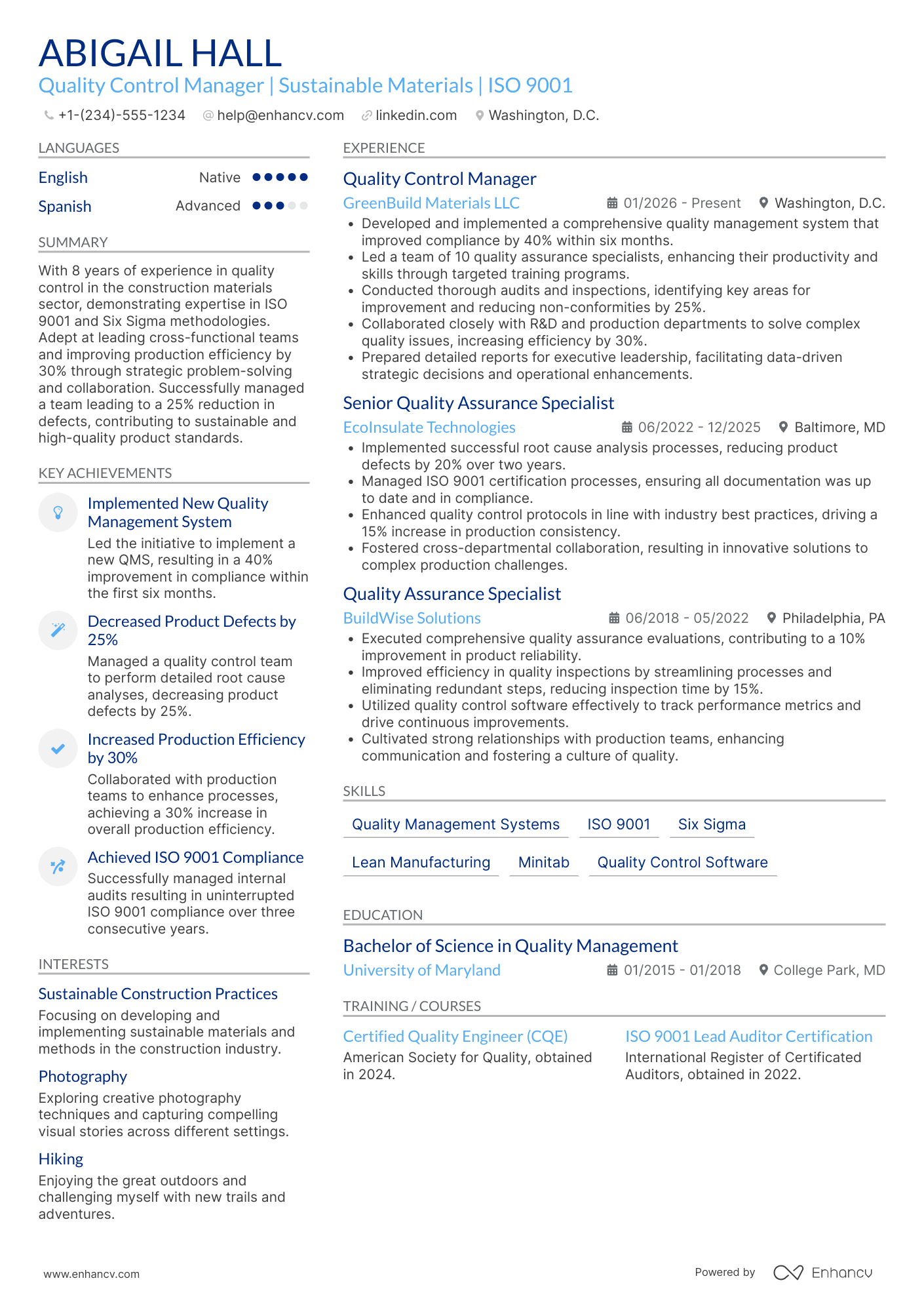
Many quality control manager resume drafts fail because they list tools and duties but don't prove measurable impact across audits, nonconformances, and corrective actions. That gap gets you filtered by ATS screening and missed during fast recruiter scans in a crowded market.
A strong resume shows what you improved and how it changed results, so you can stand out quickly. Knowing how to make your resume stand out starts with highlighting defect reduction percentages, audit pass rates, cost of poor quality savings, scrap and rework cuts, on-time release improvements, and faster containment that protected customers and revenue.

Key takeaways
- Quantify every experience bullet with metrics like defect rates, audit results, or cost savings.
- Use reverse-chronological format if you have dedicated quality control management experience.
- Tailor resume bullets to each job posting's specific standards, tools, and compliance frameworks.
- Place certifications above education when they're recent and directly relevant to the target role.
- Demonstrate skills through measurable outcomes in your experience section, not just in a skills list.
- Write a three- to four-line summary that names your industry, methods, and top achievement.
- Use Enhancv to turn vague quality control duties into sharp, results-driven resume bullets.
Job market snapshot for quality control managers
We analyzed 153 recent quality control manager job ads across major US job boards. These numbers help you understand skills in demand, salary landscape, top companies hiring at a glance.
What level of experience employers are looking for quality control managers
| Years of Experience | Percentage found in job ads |
|---|---|
| 1–2 years | 2.0% (3) |
| 3–4 years | 4.6% (7) |
| 5–6 years | 15.0% (23) |
| 7–8 years | 6.5% (10) |
| 9–10 years | 8.5% (13) |
| 10+ years | 11.1% (17) |
| Not specified | 60.8% (93) |
Quality control manager ads by area of specialization (industry)
| Industry (Area) | Percentage found in job ads |
|---|---|
| Finance & Banking | 49.7% (76) |
| Real Estate & Construction | 21.6% (33) |
| Healthcare | 15.0% (23) |
Top companies hiring quality control managers
| Company | Percentage found in job ads |
|---|---|
| Actalent | 14.4% (22) |
| Turner Construction Company | 9.2% (14) |
Role overview stats
These tables show the most common responsibilities and employment types for quality control manager roles. Use them to align your resume with what employers expect and to understand how the role is structured across the market.
Day-to-day activities and top responsibilities for a quality control manager
| Responsibility | Percentage found in job ads |
|---|---|
| Quality control | 49.7% (76) |
| Microsoft office | 24.2% (37) |
| Quality assurance | 19.0% (29) |
| Construction management | 11.8% (18) |
| Excel | 11.1% (17) |
| Inspection | 9.2% (14) |
| Lean | 9.2% (14) |
| Project management | 8.5% (13) |
| First aid | 7.8% (12) |
| Construction quality management | 6.5% (10) |
| Osha 30-hour | 6.5% (10) |
| Data analysis | 5.9% (9) |
How to format a quality control manager resume
Recruiters evaluating quality control manager candidates prioritize evidence of process ownership, regulatory compliance expertise, and measurable improvements in defect reduction or product consistency. A clear, well-structured resume format ensures these signals surface quickly during both automated screening and manual review.

I have significant experience in this role—which format should I use?
Use a reverse-chronological format to present your quality control management career in a clear, progression-driven timeline. Do:
- Lead with your most recent role and emphasize scope of oversight—team size, number of facilities, product lines, or regulatory frameworks managed.
- Highlight domain-specific expertise such as ISO 9001 auditing, Six Sigma methodology, SPC tools, CAPA management, and FDA or GMP compliance.
- Quantify business impact through metrics like defect rate reductions, cost savings from process improvements, audit pass rates, or customer complaint resolution outcomes.
I'm junior or switching into this role—what format works best?
A hybrid format works best, allowing you to feature transferable quality-focused skills prominently while still showing relevant work history. Do:
- Place a skills section near the top of your resume that highlights core competencies such as root cause analysis, inspection protocols, statistical process control, and compliance documentation.
- Include project-based experience—such as leading a corrective action initiative, conducting internal audits, or managing a quality improvement pilot—even if it came from a different role or industry.
- Connect every skill and action to a concrete result so hiring managers can see your quality mindset in practice.
Why not use a functional resume?
A functional format strips away the timeline and context that hiring managers need to evaluate your hands-on quality control experience, making it difficult to verify where and how you applied your skills.
- Career changers with adjacent experience: If you're transitioning from a role such as lab technician, production supervisor, or regulatory affairs specialist and have directly applicable quality projects or certifications (e.g., ASQ CQM, Six Sigma Green Belt), a functional format can spotlight those qualifications.
- Limited QC-specific job history: If your quality control work was embedded within broader roles—such as manufacturing engineering or operations—and doesn't show clearly in job titles alone.
- Significant employment gaps: If gaps in your work history would distract from strong, relevant quality management skills and project outcomes.
Once you've established a clean, readable format, the next step is deciding which sections to include and how to arrange them for maximum impact.
What sections should go on a quality control manager resume
Recruiters expect a quality control manager resume to show regulated-industry expertise, measurable quality outcomes, and leadership across audits, corrective actions, and continuous improvement. Understanding which resume sections to include ensures maximum clarity:
- Header
- Summary
- Experience
- Skills
- Projects
- Education
- Certifications
- Optional sections: Awards, Publications, Languages
Strong experience bullets should emphasize defect reduction, audit performance, cost-of-quality improvements, compliance results, team scope, and the scale of processes you owned.
Is your resume good enough?
Drop your resume here or choose a file. PDF & DOCX only. Max 2MB file size.
Once you’ve organized your resume with the right components, the next step is to write your quality control manager resume experience section so it supports each part with relevant, role-specific detail.
How to write your quality control manager resume experience
The experience section is where you prove you've shipped real quality outcomes—through audits completed, defect rates reduced, compliance standards met, and inspection systems built using role-relevant tools and methodologies. Hiring managers prioritize demonstrated impact over descriptive task lists, so every bullet should connect your quality control work to a measurable business result. Building a targeted resume ensures each entry speaks directly to the role you're pursuing.
Each entry should include:
- Job title
- Company and location (or remote)
- Dates of employment (month and year)
Three to five concise bullet points showing what you owned, how you executed, and what outcomes you delivered:
- Ownership scope: the quality systems, product lines, production facilities, inspection programs, or teams you were directly accountable for as a quality control manager.
- Execution approach: the tools, frameworks, and methods you relied on to drive quality—such as statistical process control, root cause analysis, ISO standards, Six Sigma, CAPA processes, or audit management platforms.
- Value improved: the specific quality, compliance, reliability, or efficiency dimensions you changed, whether that meant tightening defect tolerances, strengthening regulatory adherence, reducing scrap rates, or improving supplier quality performance.
- Collaboration context: how you partnered with production teams, engineering, supply chain, regulatory bodies, or external auditors to align quality objectives across the organization.
- Impact delivered: the tangible outcomes your quality control leadership produced, expressed through business results, operational scale, or risk reduction rather than routine activities.
Experience bullet formula
A quality control manager experience example
✅ Right example - modern, quantified, specific.
Quality Control Manager
Apex Medical Devices | Minneapolis, MN
2021–Present
FDA-regulated manufacturer of Class II disposable medical devices producing over twelve million units annually.
- Led ISO 13485-aligned quality control operations across incoming, in-process, and final inspection using Minitab, JMP, and SAP QM, cutting customer complaint rate by 32% year over year.
- Implemented statistical process control (SPC) with real-time dashboards in Power BI and automated control charts, reducing out-of-control events by 41% and saving 220 labor hours per quarter.
- Directed nonconformance, corrective action and preventive action (CAPA), and root cause analysis using 8D, 5 Whys, and fishbone analysis with manufacturing engineering and suppliers, lowering scrap from 3.8% to 2.4% within nine months.
- Partnered with R&D, regulatory, and production to strengthen risk controls through PFMEA updates and tightened sampling plans (ANSI/ASQ Z1.4), improving first-pass yield from 94.6% to 97.1%.
- Prepared and hosted three external audits (FDA and notified body) by standardizing batch record review and electronic document control in MasterControl, achieving zero major findings and closing minor findings within fourteen days.
Now that you've seen how a strong experience section comes together, let's look at how to adjust those details to match the specific job you're targeting.
How to tailor your quality control manager resume experience
Recruiters evaluate your quality control manager resume through applicant tracking systems and manual review, so tailoring your resume to the job description is essential. Tailoring ensures the skills, tools, and results you highlight directly match what the employer prioritizes.
Ways to tailor your quality control manager experience:
- Mirror the specific quality standards or methodologies listed in the posting.
- Reference the exact inspection tools or testing systems the employer names.
- Match compliance frameworks like ISO or FDA using the posting's terminology.
- Highlight relevant industry experience such as manufacturing or pharmaceutical sectors.
- Align your documented KPIs with the success metrics the role emphasizes.
- Incorporate the corrective action workflows or audit processes described in the listing.
- Emphasize cross-functional collaboration models the job description references directly.
- Reflect the regulatory or safety requirements the employer identifies as priorities.
Every tailored bullet should connect a real achievement to a specific job requirement rather than forcing keywords where they don't belong.
Resume tailoring examples for quality control manager
| Job description excerpt | Untailored | Tailored |
|---|---|---|
| "Lead CAPA investigations, root cause analysis, and corrective action implementation in an FDA-regulated manufacturing environment." | Helped resolve quality issues and worked on improvements across the department. | Led 40+ CAPA investigations using 8D and fishbone root cause analysis in an FDA-regulated facility, reducing recurring nonconformances by 32% over 18 months. |
| "Develop and maintain SOPs, audit internal processes, and ensure compliance with ISO 9001:2015 and cGMP standards." | Wrote procedures and made sure the team followed company quality policies. | Authored and maintained 25+ SOPs aligned with ISO 9001:2015 and cGMP requirements, and conducted quarterly internal audits that achieved zero major findings across three consecutive external certification audits. |
| "Use statistical process control (SPC) tools to monitor production quality and drive continuous improvement initiatives." | Tracked production data and reported quality metrics to management. | Implemented SPC charting in Minitab across six production lines to monitor Cpk and defect trends, driving continuous improvement projects that lowered scrap rates from 4.1% to 1.8% within one year. |
Once you’ve aligned your experience with the role’s priorities, the next step is to quantify your quality control manager achievements so hiring teams can see the measurable impact of that work.
How to quantify your quality control manager achievements
Quantifying your achievements proves you improved product quality, reduced risk, and sped up delivery. Focus on defect rates, first-pass yield, audit outcomes, cost of poor quality, and inspection throughput across lines, suppliers, and sites.
Quantifying examples for quality control manager
| Metric | Example |
|---|---|
| Defect reduction | "Cut customer defect rate from 1.8% to 0.7% in six months by tightening control plans and using Minitab control charts across three production lines." |
| Audit compliance | "Led ISO 9001 surveillance audit with zero major findings and reduced minor nonconformities from 12 to four by standardizing CAPA workflows in the quality management system." |
| Throughput | "Increased incoming inspection throughput by 28% by redesigning sampling plans to ANSI/ASQ Z1.4 and balancing workloads across two shifts." |
| Cost savings | "Reduced scrap and rework costs by $420K annually by launching Pareto-driven root cause analysis and updating PFMEA and work instructions for five high-volume parts." |
| Supplier quality | "Improved supplier PPM from 1,250 to 430 by implementing supplier scorecards, quarterly audits, and eight-dimensional problem solving with six critical vendors." |
Turn vague job duties into measurable, recruiter-ready resume bullets in seconds with Enhancv's Bullet Point Generator.
Once you've crafted strong bullet points for your experience section, it's equally important to highlight the specific hard and soft skills that reinforce your qualifications as a quality control manager.
How to list your hard and soft skills on a quality control manager resume
Your skills section shows you can prevent defects, meet compliance requirements, and improve process capability—recruiters and an ATS (applicant tracking system) scan this section for keyword match and role fit, so aim for a balanced mix of hard skills and job-specific soft skills.
quality control manager roles require a blend of:
- Product strategy and discovery skills.
- Data, analytics, and experimentation skills.
- Delivery, execution, and go-to-market discipline.
- Soft skills.
Your skills section should be:
- Scannable (bullet-style grouping).
- Relevant to the job post.
- Backed by proof in experience bullets.
- Updated with current tools.
Place your skills section:
- Above experience if you're junior or switching careers.
- Below experience if you're mid/senior with strong achievements.

Hard skills
- ISO 9001 quality management systems
- IATF 16949, APQP, PPAP
- Corrective and preventive action (CAPA)
- Root cause analysis, 8D, 5 Whys
- Statistical process control, control charts
- Measurement system analysis, Gage R&R
- Failure mode and effects analysis (FMEA)
- Audit planning, supplier audits
- Inspection plans, sampling plans (AQL)
- Nonconformance management, MRB
- Minitab, Excel, Power BI
Soft skills
- Lead cross-functional investigations
- Drive corrective action closure
- Coach inspectors and technicians
- Set clear quality expectations
- Communicate risk and tradeoffs
- Influence production and engineering
- Escalate issues with urgency
- Negotiate supplier containment plans
- Run effective quality reviews
- Maintain documentation discipline
- Prioritize defects by impact
- Hold teams accountable to standards
How to show your quality control manager skills in context
Skills shouldn't live only in a bulleted list on your resume. You can explore common resume skills by role to see how other professionals present theirs effectively.
They should be demonstrated in:
- Your summary (high-level professional identity)
- Your experience (proof through outcomes)
Here's what strong, context-driven examples look like in practice.
Summary example
Quality control manager with 12 years in automotive manufacturing. Skilled in Six Sigma, FMEA, and root cause analysis. Led cross-functional teams to reduce defect rates by 34% while maintaining ISO 9001 compliance across three production facilities.
- Reflects senior-level experience clearly
- Names industry-specific tools and methods
- Includes a concrete, measurable outcome
- Highlights leadership as a soft skill
Experience example
Quality Control Manager
Bridgewell Manufacturing | Cleveland, OH
June 2019–Present
- Implemented SPC monitoring across four production lines, reducing scrap rates by 22% within the first year.
- Partnered with engineering and procurement teams to redesign incoming inspection protocols using Minitab, cutting supplier defects by 17%.
- Led CAPA investigations that resolved 95% of nonconformances within 30 days, improving audit readiness scores company-wide.
- Every bullet contains measurable proof.
- Skills appear naturally through real outcomes.
Once you’ve tied your quality control manager abilities to measurable outcomes and real scenarios, the next step is applying that approach to a quality control manager resume with no experience so you can present your strengths credibly without a work history.
How do I write a quality control manager resume with no experience
Even without full-time experience, you can demonstrate readiness through:
- ISO 9001 internal audit coursework
- SPC dashboards from class projects
- CAPA practice using 8D reports
- Laboratory quality control internships
- Supplier quality case study analysis
- Gage R&R measurement exercises
- Volunteer inspection for maker labs
- Process mapping and control plans
If you're building a resume without work experience, focus on:
- Quantified defect reduction results
- Documented CAPA and root cause
- Standards knowledge: ISO 9001
- Data tools: Excel, Minitab
Resume format tip for entry-level quality control manager
Use a hybrid resume format because it highlights quality control manager skills and projects while still showing education and internships. Do:
- Lead with a skills summary tied to tools.
- Add two to four project bullets with metrics.
- List standards, methods, and audits completed.
- Include relevant lab, internship, and volunteer work.
- Use keywords from the job posting.
- Built an SPC dashboard in Excel and Minitab, tracked three CTQs, and reduced out-of-spec measurements from 7.8% to 3.1% over six weeks.
Once you've positioned your transferable skills and relevant experiences to offset a traditional background gap, the next step is ensuring your education section reinforces your qualifications effectively.
How to list your education on a quality control manager resume
Your education section helps hiring teams confirm you have the foundational knowledge needed for a quality control manager role. It validates technical training and academic preparation quickly.
Include:
- Degree name
- Institution
- Location
- Graduation year
- Relevant coursework (for juniors or entry-level candidates)
- Honors & GPA (if 3.5 or higher)
Skip month and day details—list the graduation year only.
Here's a strong education entry tailored to a quality control manager resume.
Example education entry
Bachelor of Science in Industrial Engineering
University of Wisconsin–Madison, Madison, WI
Graduated 2018
GPA: 3.7/4.0
- Relevant coursework: Statistical Process Control, Six Sigma Methodologies, Manufacturing Systems, and Quality Assurance Principles.
- Honors: Magna Cum Laude, Dean's List all semesters.
How to list your certifications on a quality control manager resume
Certifications on your resume show your commitment to continuous learning, proficiency with quality tools, and alignment with regulated industries, which employers expect from a quality control manager.
Include:
- Certificate name
- Issuing organization
- Year
- Optional: credential ID or URL
- Place certifications below education when they are older, less role-specific, or mainly support foundational knowledge.
- Place certifications above education when they are recent, highly relevant, or required for your target quality control manager role.
Best certifications for your quality control manager resume
- ASQ Certified Quality Manager (CQM)
- ASQ Certified Quality Auditor (CQA)
- ASQ Certified Six Sigma Black Belt (CSSBB)
- ISO 9001:2015 Lead Auditor
- ISO 13485:2016 Lead Auditor
- HACCP Certification
- IATF 16949 Internal Auditor
Once you’ve positioned your credentials where hiring teams will notice them, you can write your quality control manager resume summary to connect those qualifications to the impact you deliver.
How to write your quality control manager resume summary
Your resume summary is the first thing a recruiter reads. A strong one instantly signals you're the right quality control manager for the role.
Keep it to three to four lines, with:
- Your title and total years of experience in quality control or quality assurance.
- The industry or domain you specialize in, such as manufacturing, pharmaceuticals, or food production.
- Core tools and methodologies like Six Sigma, SPC, ISO 9001, or root cause analysis.
- One or two measurable achievements, such as defect reduction rates or audit pass percentages.
- Soft skills tied to real outcomes, like cross-functional leadership that improved compliance timelines.

PRO TIP
As a mid-level manager, emphasize team leadership, process ownership, and measurable quality improvements. Highlight how your decisions reduced defects or improved compliance rates. Avoid vague phrases like "passionate about quality" or "results-driven professional." Recruiters want proof, not personality branding.
Example summary for a quality control manager
Quality control manager with eight years in automotive manufacturing. Led a 12-person QC team, reducing product defects by 34% through Six Sigma and ISO 9001 compliance initiatives.
Optimize your resume summary and objective for ATS
Drop your resume here or choose a file.
PDF & DOCX only. Max 2MB file size.
Now that your summary captures your quality control expertise at a glance, make sure your resume header provides the essential contact and professional details recruiters need to reach you.
What to include in a quality control manager resume header
A well-crafted resume header lists your key contact details and role, helping a quality control manager stand out, build credibility, and pass recruiter screening fast.
Essential resume header elements
- Full name
- Tailored job title and headline
- Location
- Phone number
- Professional email
- GitHub link
- Portfolio link
A LinkedIn link lets recruiters confirm titles, dates, and scope quickly, which supports faster screening decisions.
Don't include a photo on a quality control manager resume unless the role is explicitly front-facing or appearance-dependent.
Match your header job title to the posting and align your headline with the industry, products, and compliance standards you support.
Quality control manager resume header
Jordan Lee
Quality Control Manager | GMP, ISO 9001, CAPA, and Audit Readiness
Chicago, IL
(312) 555-01XX
your.name@enhancv.com
github.com/yourname
yourwebsite.com
linkedin.com/in/yourname
Once your contact details and role information are clearly presented at the top, you can strengthen the rest of your application with additional sections that add relevant context and support.
Additional sections for quality control manager resumes
When your core qualifications match other applicants, well-chosen additional sections can set your quality control manager resume apart with specialized credibility. For example, listing language skills can demonstrate your ability to collaborate across global supply chains and international audit teams.
- Languages
- Certifications and licenses
- Industry publications
- Professional affiliations
- Volunteer experience in standards or compliance organizations
- Conference presentations
- Continuing education and training
Once you've rounded out your resume with the right supplementary sections, it's worth pairing it with a strong cover letter to maximize your impact.
Do quality control manager resumes need a cover letter
A cover letter isn't required for a quality control manager, but it often helps. If you're unsure what a cover letter is or when to include one, it matters most for competitive roles or employers that expect one. It can also make a difference when your resume needs context.
Use a cover letter to add value quickly:
- Explain role and team fit: connect your quality approach to the company's quality system, cross-functional partners, and compliance needs.
- Highlight one or two outcomes: cite a defect reduction, audit result, scrap reduction, or release improvement, and name the methods you used.
- Show product and user understanding: reference the product's risks, customer expectations, and how quality decisions affect safety, cost, and delivery.
- Address transitions or non-obvious experience: explain industry changes, gaps, or a move into a quality control manager role with clear, relevant proof.
Drop your resume here or choose a file.
PDF & DOCX only. Max 2MB file size.
Once you’ve decided whether to include a cover letter, you can use AI to refine your quality control manager resume faster and more consistently.
Using AI to improve your quality control manager resume
AI can sharpen your resume's clarity, structure, and overall impact. It helps tighten language and highlight results. But overuse kills authenticity. Once your content sounds clear and role-aligned, step away from AI. If you're exploring options, learn which AI is best for writing resumes before committing to a single tool.
Here are 10 practical prompts to strengthen specific sections of your quality control manager resume:
- Sharpen your summary. "Rewrite my quality control manager resume summary to emphasize leadership scope, industry focus, and measurable process improvements in under four sentences."
- Quantify experience bullets. "Review my quality control manager experience bullets and suggest where I can add specific metrics like defect reduction rates or audit pass percentages."
- Align skills strategically. "Compare my quality control manager skills section against this job description and identify missing technical or regulatory competencies I should add."
- Strengthen action verbs. "Replace weak or repeated verbs in my quality control manager experience section with precise action verbs that convey leadership and problem-solving."
- Tighten project descriptions. "Edit my quality control manager project entries to clearly state the problem, my role, the method used, and the outcome achieved."
- Improve certification relevance. "Reorganize my quality control manager certifications section to prioritize credentials most relevant to this specific job posting."
- Clarify education details. "Rewrite my quality control manager education section to highlight coursework, honors, or thesis work directly tied to quality assurance disciplines."
- Remove filler language. "Identify and remove vague or redundant phrases across my entire quality control manager resume without losing important context or achievements."
- Tailor for ATS readability. "Adjust my quality control manager resume formatting and keyword usage so applicant tracking systems can accurately parse each section."
- Refine accomplishment statements. "Rewrite my quality control manager accomplishment bullets using a clear challenge-action-result structure with specific numbers where possible."
Stop using AI once your resume sounds accurate, specific, and aligned with real experience. AI should never invent experience or inflate claims—if it didn't happen, it doesn't belong here.
Conclusion
A strong quality control manager resume shows measurable outcomes, role-specific skills, and a clear structure. Lead with results like defect reduction, audit readiness, and on-time release rates. Support them with skills in root cause analysis, corrective actions, and process control.
Keep each section scannable, consistent, and focused on impact. This approach shows you can meet today’s expectations and adapt to near-future demands. Hiring teams can quickly see your fit, your judgment, and your ability to deliver.