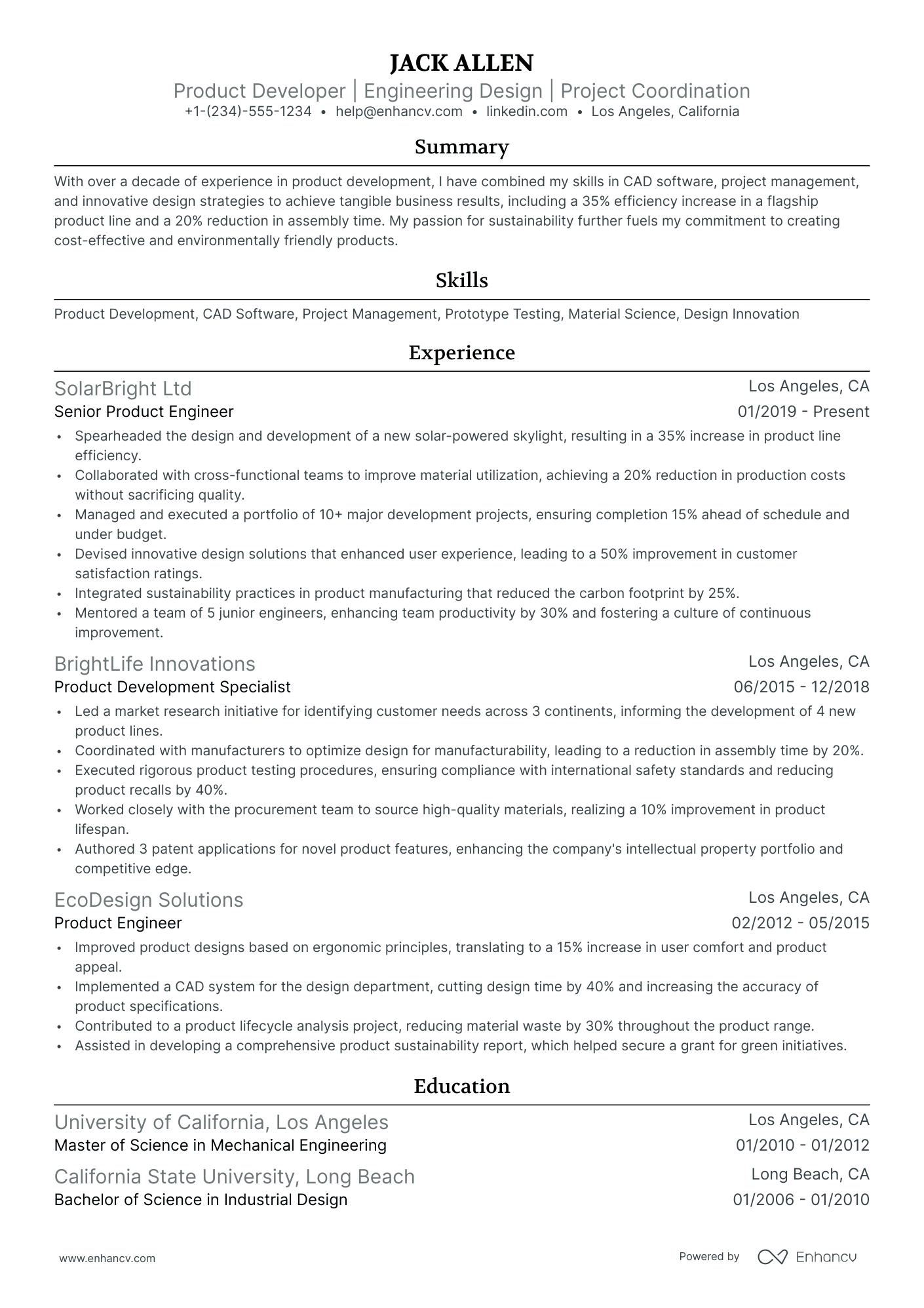
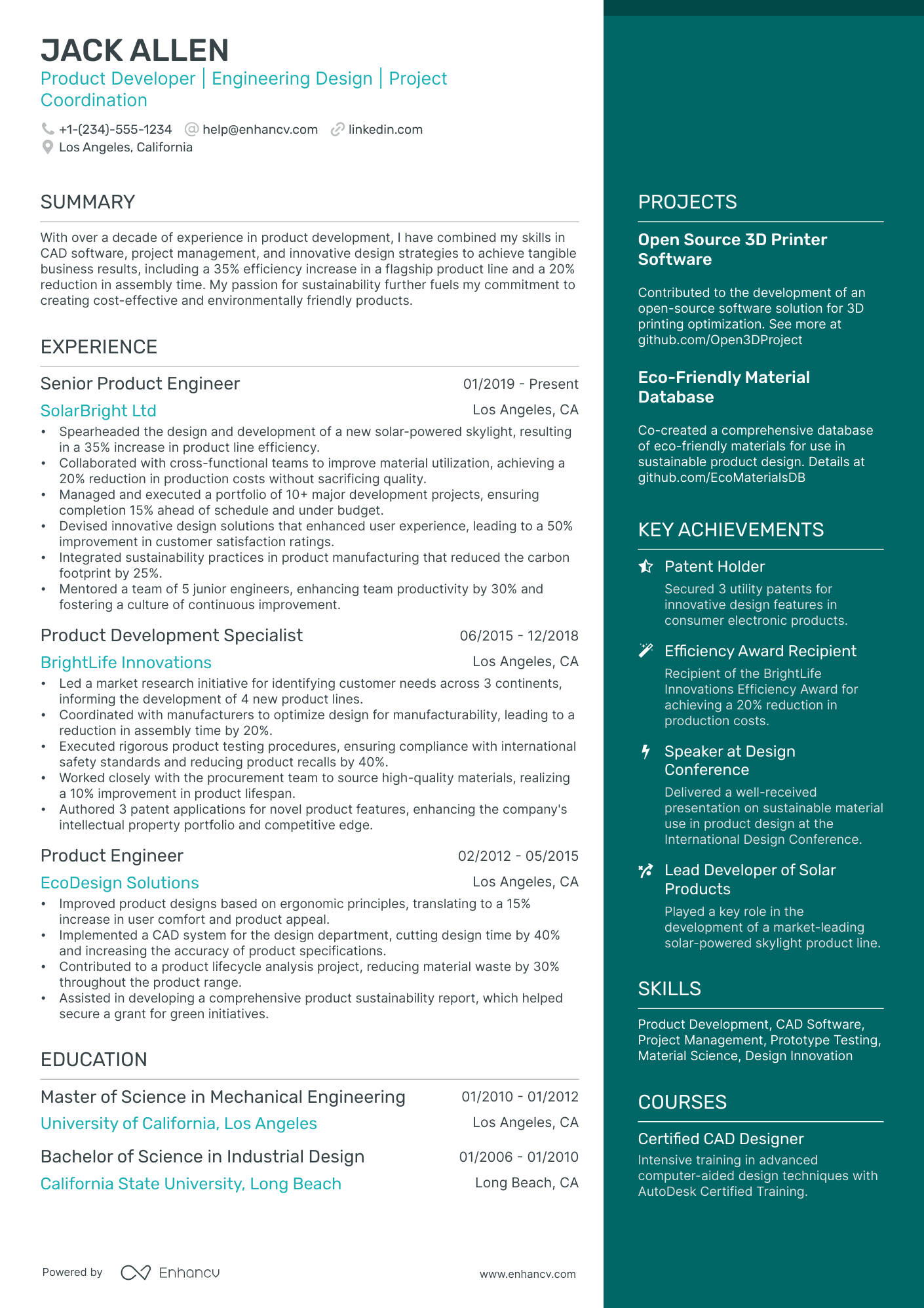
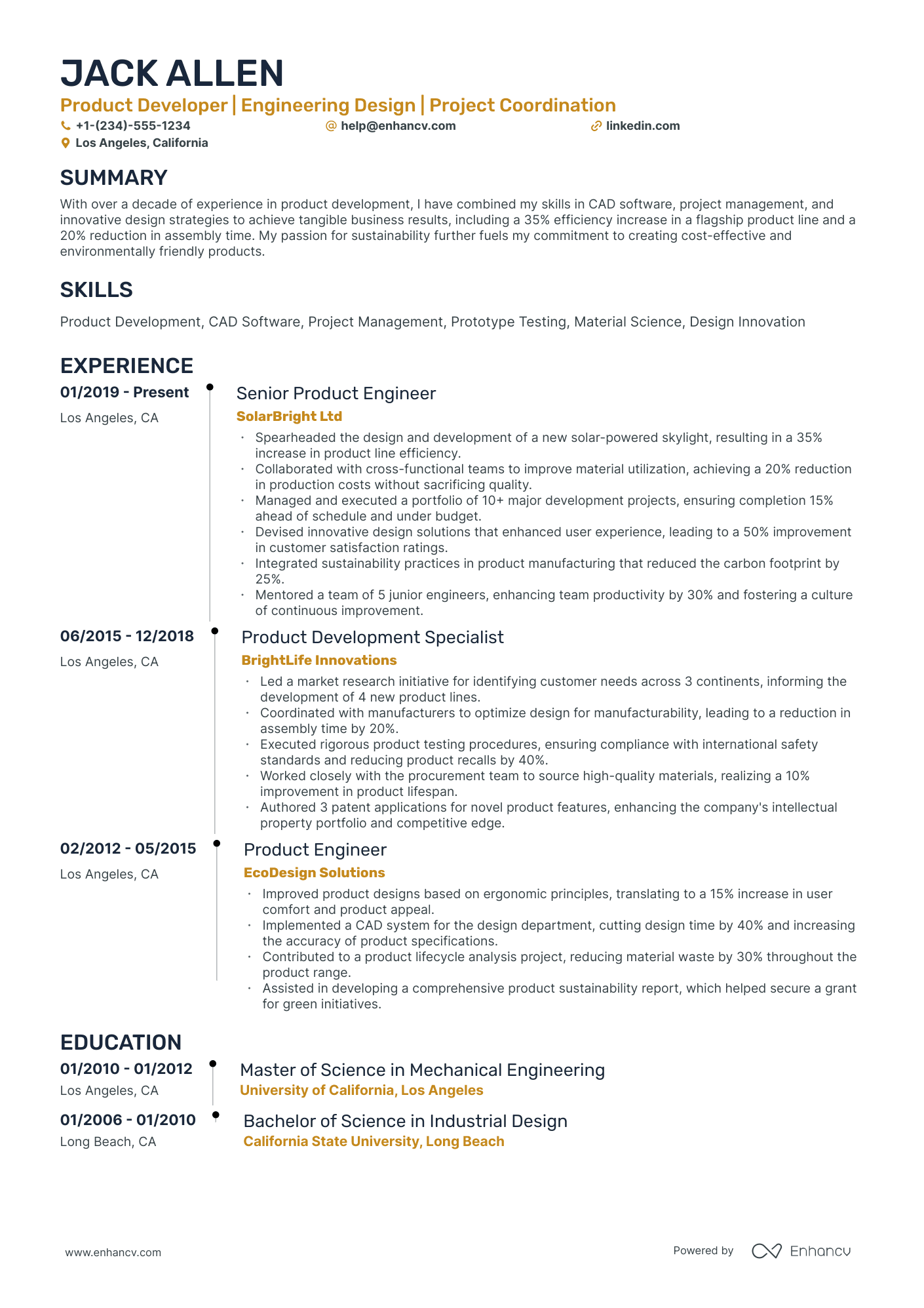
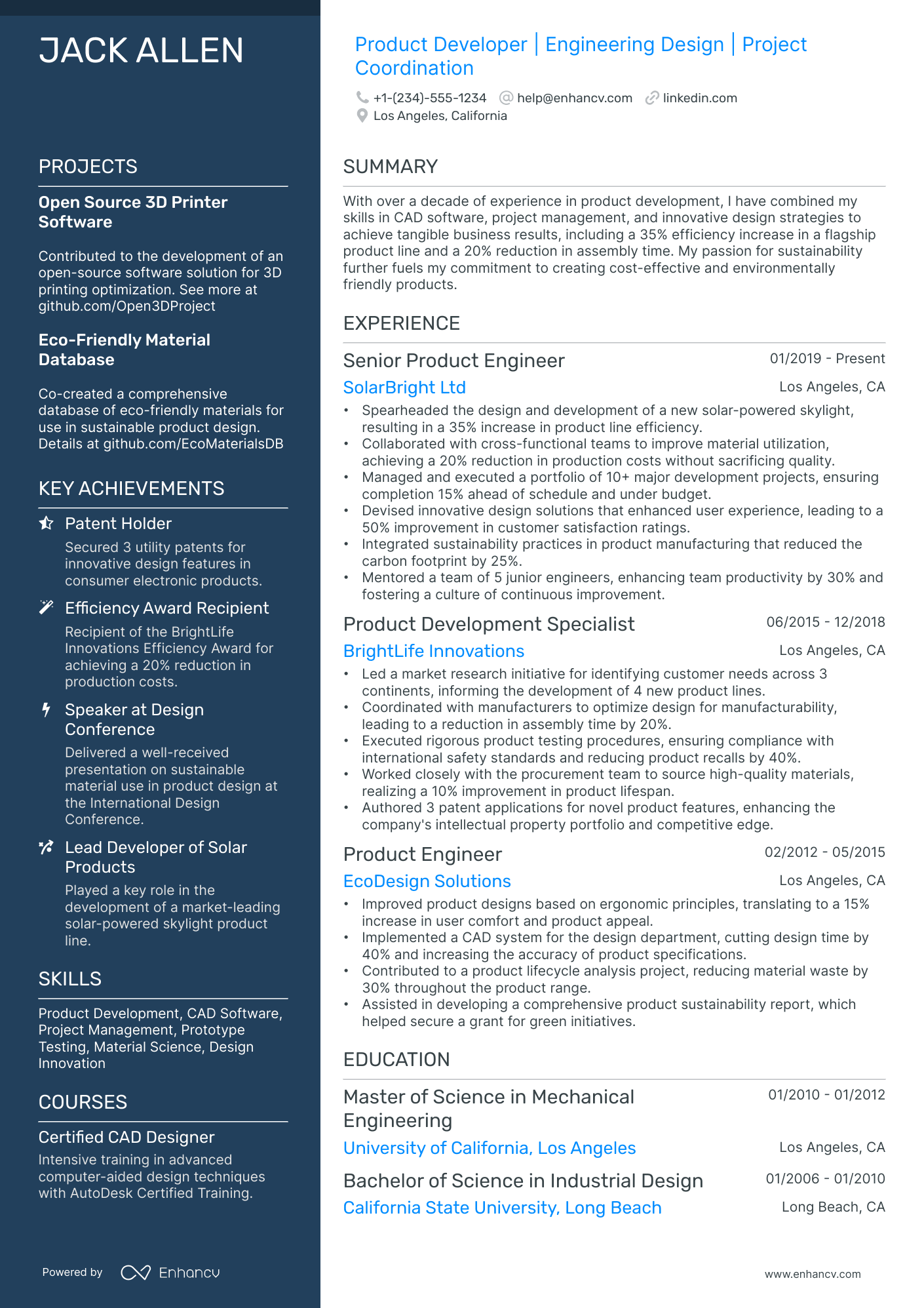
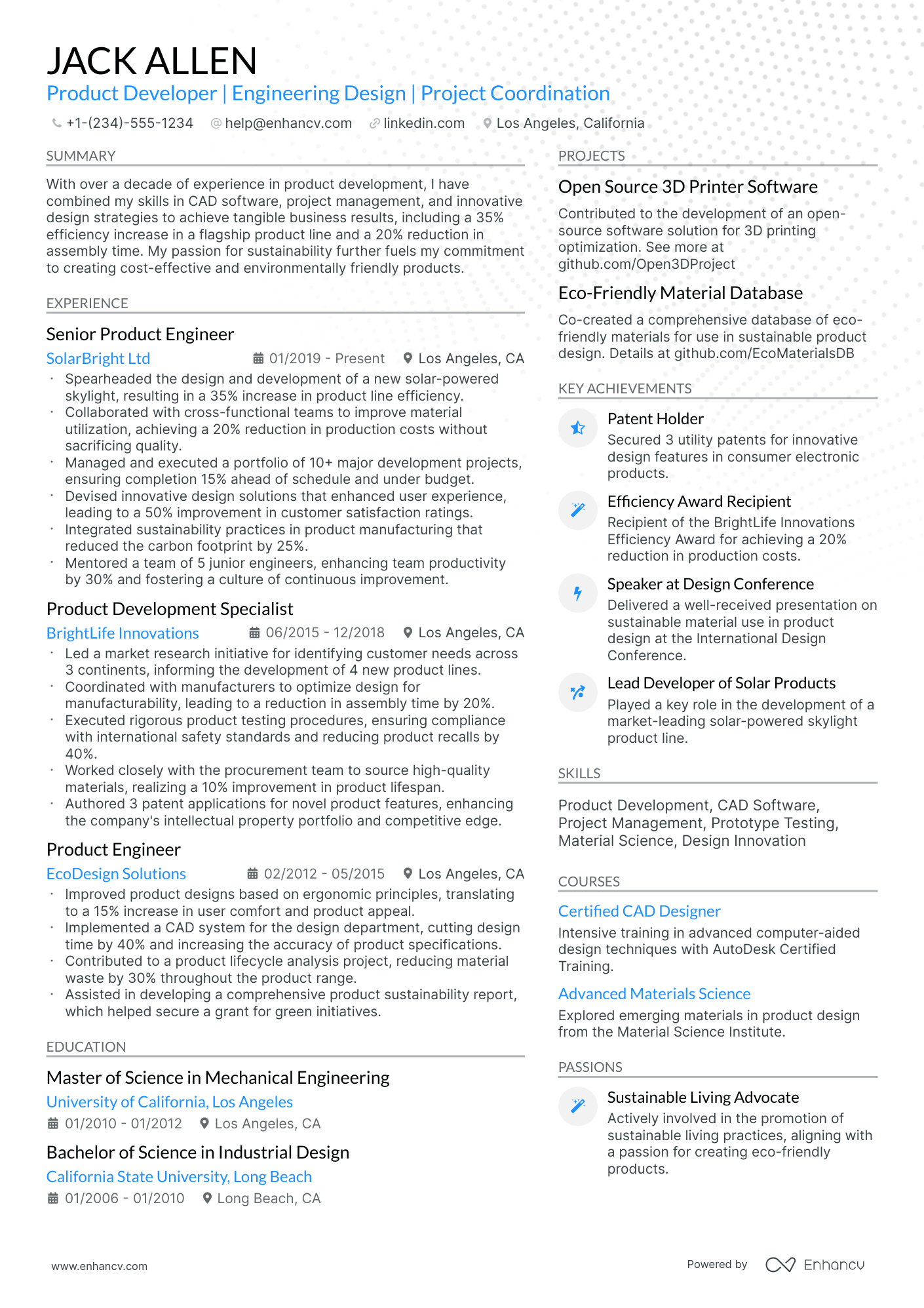
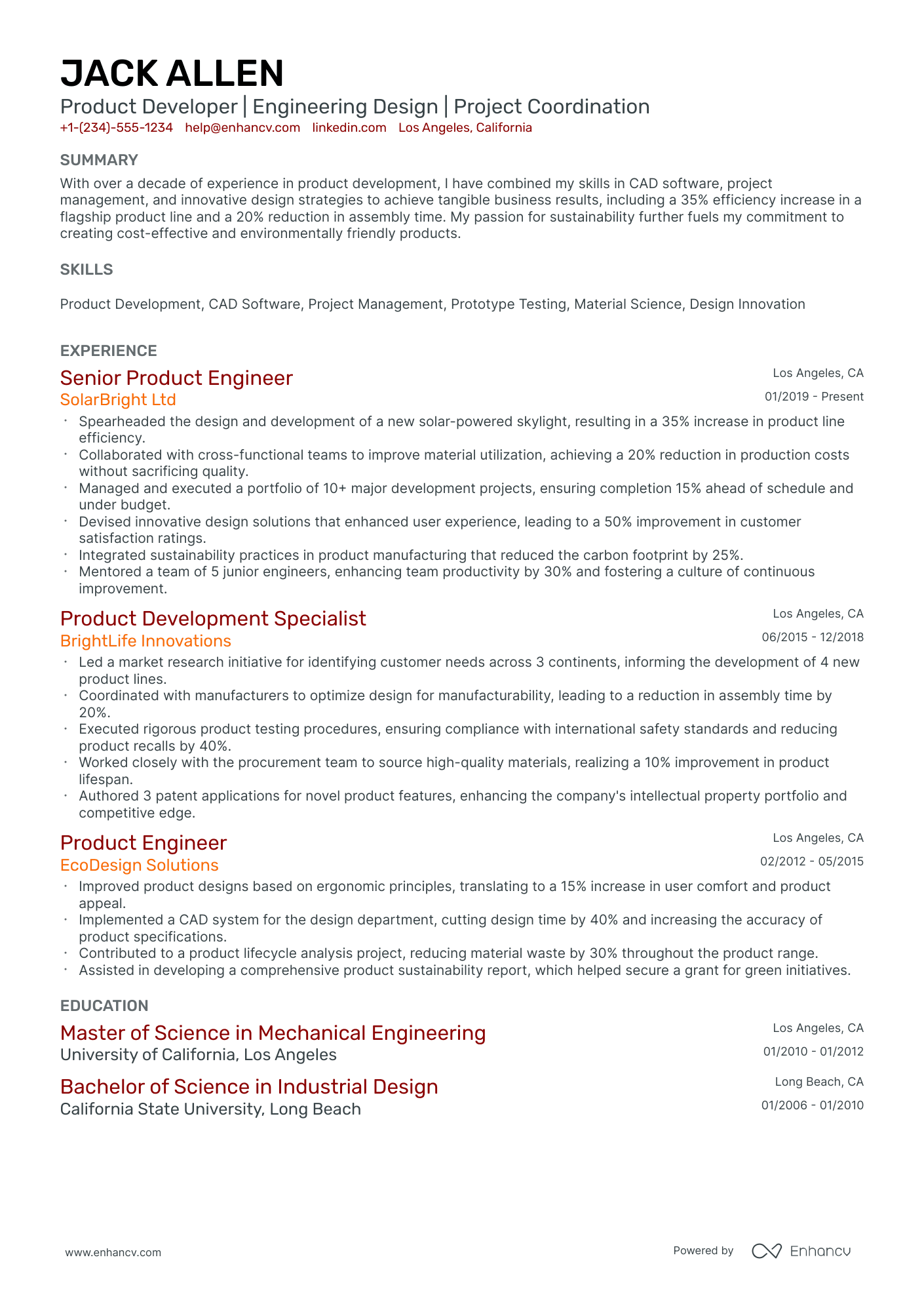
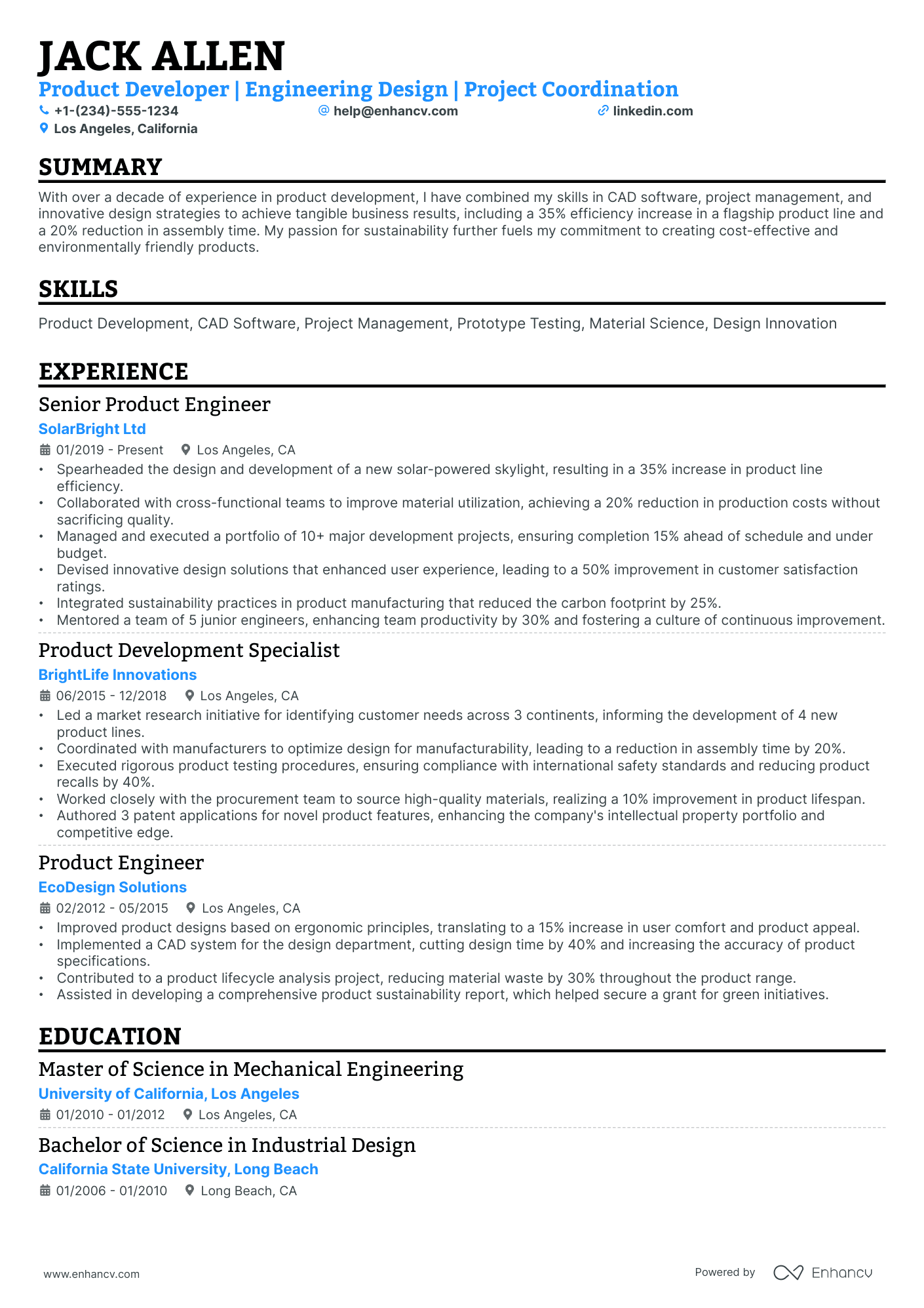
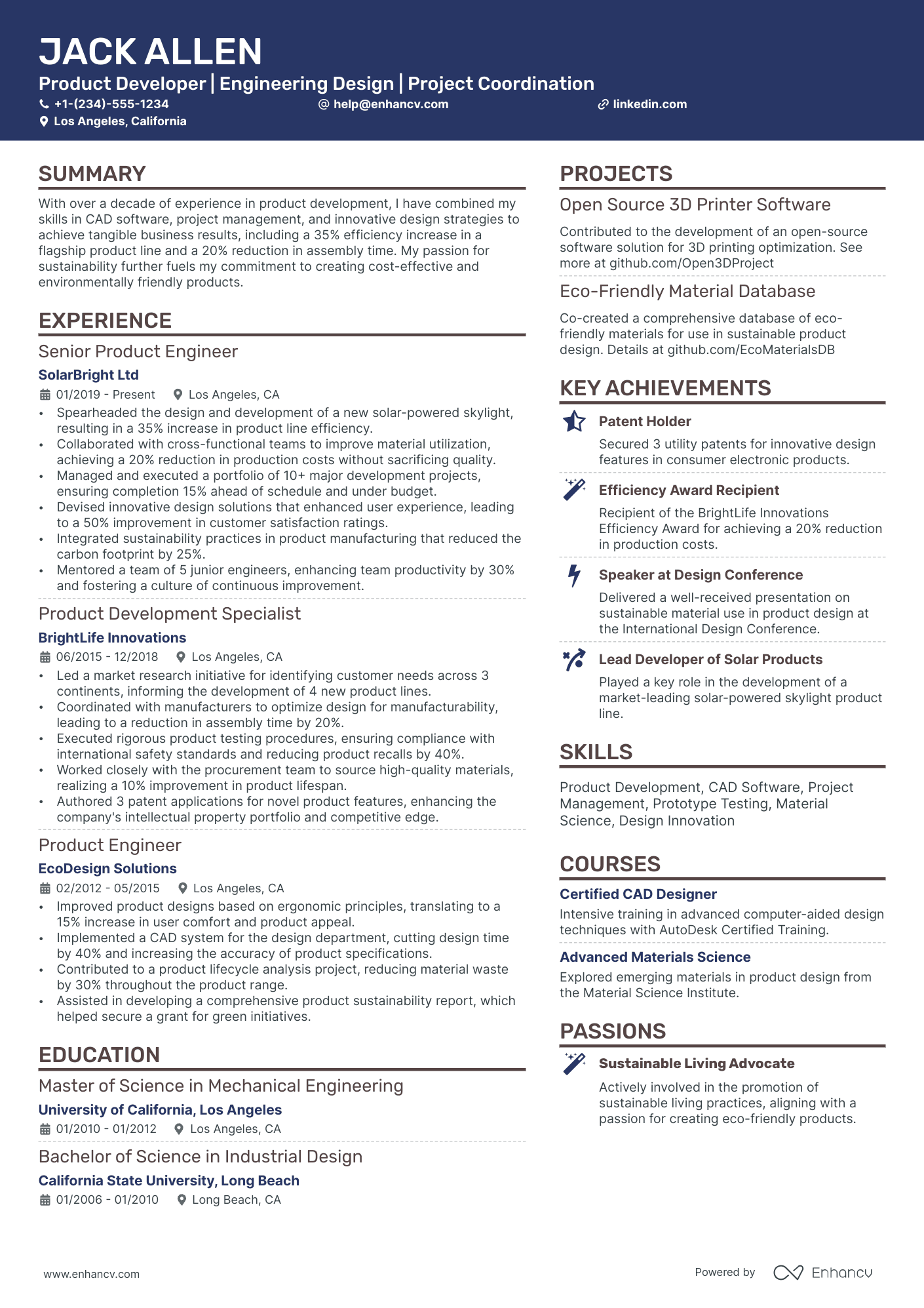
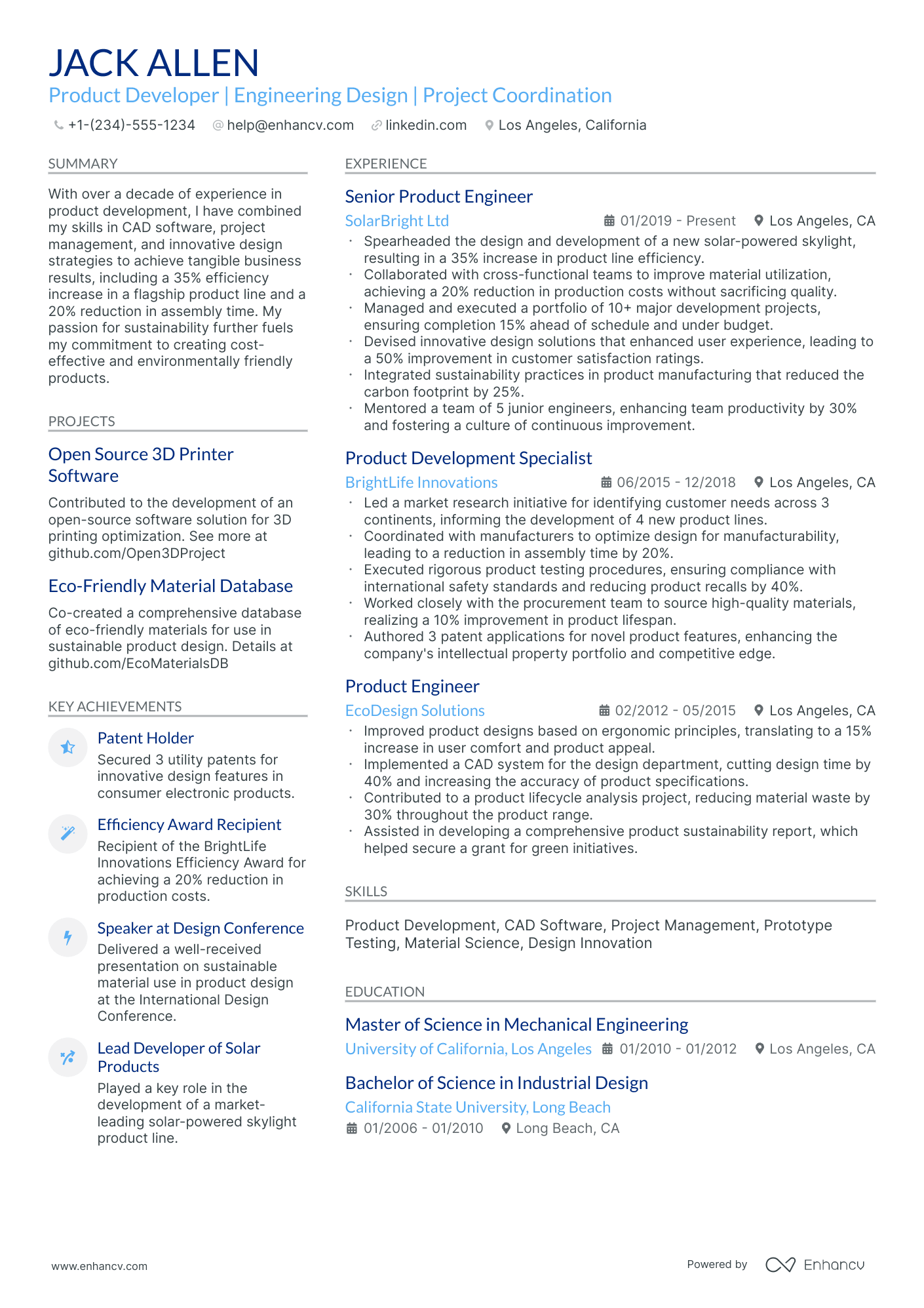
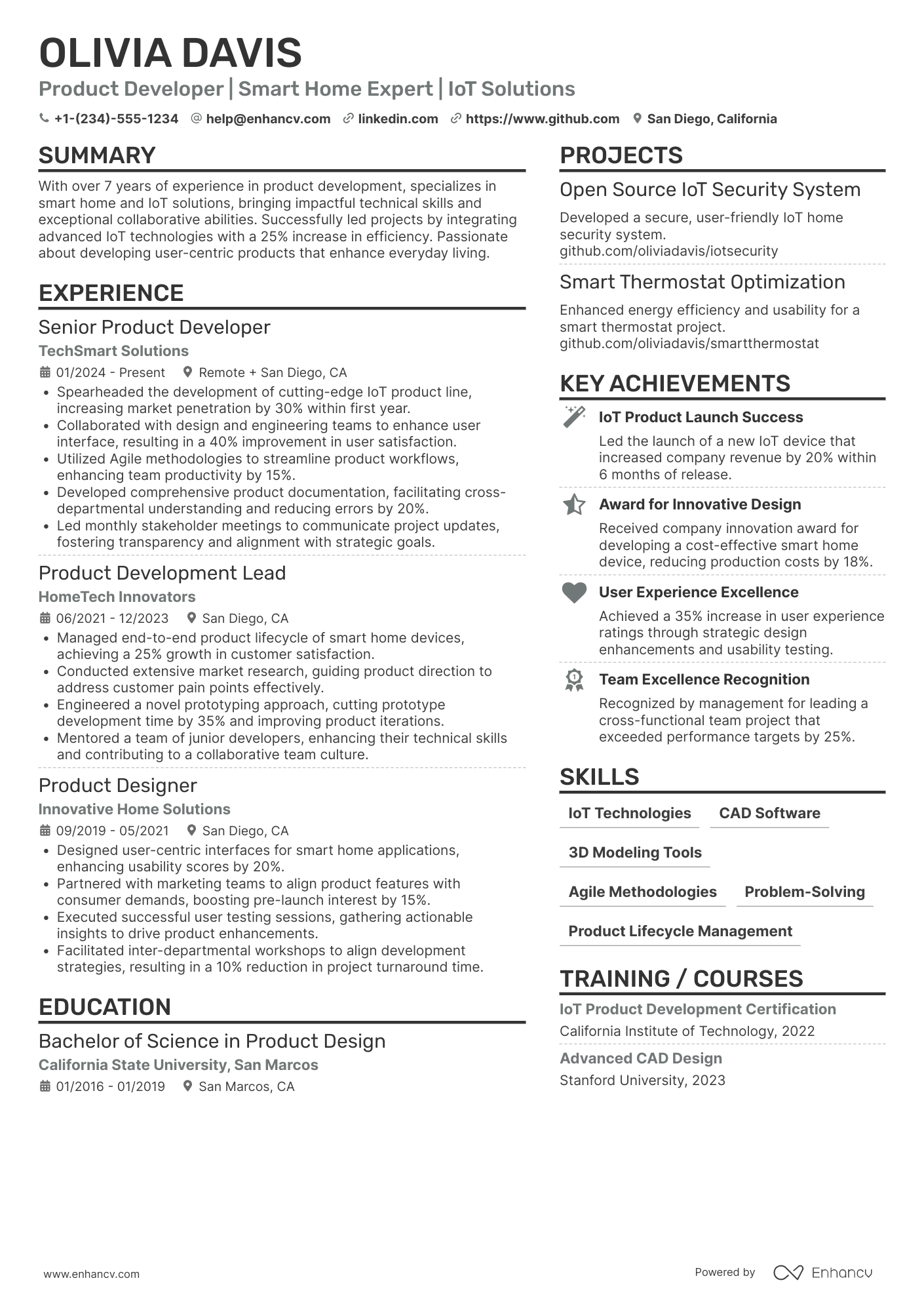
Most product developer resumes fail because they read like task logs and bury the work's impact. A product developer resume must survive ATS filters and a recruiter's ten-second scan in a crowded pipeline.
This guide shows you how to write a resume that leads with outcomes, not tools. You'll highlight shipped launches, cycle-time reductions, defect-rate drops, cost savings, on-time delivery across SKUs, and measurable gains in customer satisfaction or revenue.

Key takeaways
- Lead every experience bullet with a measurable outcome, not a task description.
- Use reverse-chronological format if you're experienced and hybrid format if you're junior.
- Tailor your resume to each job posting by mirroring its tools, methods, and KPIs.
- Quantify achievements using metrics like revenue, cycle time, defect rates, and cost savings.
- Demonstrate skills in context within your summary and experience, not just in a skills list.
- Include projects, prototypes, or open-source work to strengthen a resume without formal experience.
- Use Enhancv to turn vague job duties into focused, metric-driven bullet points faster.
Job market snapshot for product developers
We analyzed 806 recent product developer job ads across major US job boards. These numbers help you understand employer expectations, top companies hiring, role specialization trends at a glance.
What level of experience employers are looking for product developers
| Years of Experience | Percentage found in job ads |
|---|---|
| 1–2 years | 7.2% (58) |
| 3–4 years | 8.1% (65) |
| 5–6 years | 10.4% (84) |
| 7–8 years | 8.2% (66) |
| 9–10 years | 4.5% (36) |
| 10+ years | 7.4% (60) |
| Not specified | 58.1% (468) |
Product developer ads by area of specialization (industry)
| Industry (Area) | Percentage found in job ads |
|---|---|
| Finance & Banking | 56.6% (456) |
| Healthcare | 23.7% (191) |
| Manufacturing | 8.4% (68) |
| Retail & E-commerce | 5.6% (45) |
| Education | 1.9% (15) |
| Telecommunications | 1.2% (10) |
Top companies hiring product developers
| Company | Percentage found in job ads |
|---|---|
| Actalent | 3.8% (31) |
| PwC | 3.3% (27) |
| Caterpillar | 2.5% (20) |
| Advanced Micro Devices, Inc. | 2.1% (17) |
| Ford Motor Company | 1.9% (15) |
| Amazon.com, Inc. | 1.5% (12) |
| Citigroup Inc. | 1.4% (11) |
| Koch Industries, Inc. | 1.2% (10) |
Role overview stats
These tables show the most common responsibilities and employment types for product developer roles. Use them to align your resume with what employers expect and to understand how the role is structured across the market.
Day-to-day activities and top responsibilities for a product developer
| Responsibility | Percentage found in job ads |
|---|---|
| Project management | 18.9% (152) |
| Product development | 14.9% (120) |
| Excel | 11.7% (94) |
| Microsoft office | 9.9% (80) |
| Python | 7.8% (63) |
| Solidworks | 7.7% (62) |
| Agile | 7.2% (58) |
| Cad | 6.9% (56) |
| Word | 6.9% (56) |
| Powerpoint | 6.2% (50) |
| Fea | 5.6% (45) |
| Plm | 5.3% (43) |
Type of employment (remote vs on-site vs hybrid)
| Employment type | Percentage found in job ads |
|---|---|
| On-site | 74.1% (597) |
| Hybrid | 21.8% (176) |
| Remote | 4.1% (33) |
How to format a product developer resume
Recruiters evaluating product developer resumes look for a clear blend of technical proficiency, user-centered thinking, and the ability to move a product from concept through launch. Choosing the right resume format ensures these signals—cross-functional collaboration, iterative development skills, and measurable product outcomes—are immediately visible rather than buried under formatting that disrupts readability or confuses applicant tracking systems.

I have significant experience in this role—which format should I use?
Use a reverse-chronological format to give recruiters a clear, linear view of your product development growth and increasing ownership. Do:
- Lead each role entry with your scope of ownership—product lines managed, team size, and decision authority over roadmap, prioritization, or technical direction.
- Highlight role-specific tools and domains such as Jira, Figma, A/B testing platforms, agile methodologies, API integrations, and the specific product verticals you've worked in.
- Quantify business impact in every bullet using metrics tied to revenue, user adoption, time-to-market, or efficiency gains.
I'm junior or switching into this role—what format works best?
A hybrid format works best because it lets you lead with relevant product development skills while still showing a concise work history that provides context. Do:
- Place a skills section near the top of your resume featuring product development competencies such as wireframing, user story mapping, sprint planning, and data analysis tools.
- Include projects, internships, hackathons, or freelance work where you contributed to building or improving a product, even outside a formal product developer title.
- Link every action to a result so recruiters can see cause and effect—what you did and what changed because of it.
Why not use a functional resume?
A functional format strips away the timeline and context recruiters need to evaluate how you've applied product development skills in real working environments, making it harder to verify your hands-on experience. Functional formats can raise red flags with hiring managers who want to see where, when, and how you contributed to product outcomes.
- A functional resume may be acceptable if you're making a career change into product development from a related field (such as UX design or software engineering), have limited formal work history, or need to address significant resume gaps—but only if every skill listed is tied to a specific project, deliverable, or measurable outcome.
Once your layout and formatting choices are in place, the next step is deciding which sections to include so each one serves a clear purpose on your resume.
What sections should go on a product developer resume
Recruiters expect a product developer resume to quickly show what you built, how you improved it, and the results you delivered. Knowing what to put on a resume helps you prioritize the right content.
Use this structure for maximum clarity:
- Header
- Summary
- Experience
- Skills
- Projects
- Education
- Certifications
- Optional sections: Awards, Publications, Open-source work
Your experience bullets should emphasize measurable impact, shipped outcomes, cross-functional scope, and business results.
Is your resume good enough?
Drop your resume here or choose a file. PDF & DOCX only. Max 2MB file size.
Once you’ve organized the right resume components, the next step is to write your product developer experience section so it supports each part with clear, relevant proof.
How to write your product developer resume experience
Your work experience section should prove you can take a product from concept through delivery, highlighting the tools, methods, and frameworks you used along the way. Hiring managers prioritize demonstrated impact—shipped features, improved processes, and measurable outcomes—over descriptive task lists that only outline responsibilities.
Each entry should include:
- Job title
- Company and location (or remote)
- Dates of employment (month and year)
Three to five concise bullet points showing what you owned, how you executed, and what outcomes you delivered:
- Ownership scope: the products, platforms, feature sets, or systems you were directly accountable for, including the markets or user segments they served and the teams you led or coordinated.
- Execution approach: the development frameworks, prototyping tools, research methods, or technical stacks you used to inform decisions, validate assumptions, and ship work as a product developer.
- Value improved: the specific dimensions of product quality, system performance, user experience, reliability, or operational efficiency you elevated through your contributions.
- Collaboration context: how you partnered with engineering, design, marketing, QA, or external stakeholders to align priorities, resolve dependencies, and move products forward.
- Impact delivered: the business outcomes, user adoption changes, revenue effects, or efficiency gains your work produced—framed as results and scale rather than activity or effort.
Experience bullet formula
A product developer experience example
✅ Right example - modern, quantified, specific.
Senior Product Developer (Consumer Electronics)
LumenWear | Austin, TX
2021–Present
Led end-to-end development for a wearable health device line shipping to over 500,000 customers across North America.
- Drove concept-to-production for two new SKUs using Agile sprints, Jira, and Figma reviews, launching eight weeks faster and generating $4.2M in first-year revenue.
- Built and validated CAD assemblies in SolidWorks and executed tolerance stack-ups, reducing fit-related returns by 18% through tighter DFM (design for manufacturability) controls.
- Partnered with electrical engineers and firmware teams to integrate BLE modules and sensor packages, cutting power draw by 12% and improving battery life by nine percent in field tests.
- Established a supplier qualification and PPAP (production part approval process) workflow with contract manufacturers, lowering incoming defect rates from 2.6% to 1.1% and reducing rework costs by $180K annually.
- Ran DOE (design of experiments) and reliability testing (HALT, drop, sweat, and ingress) in collaboration with quality and compliance, achieving a 22% reduction in test cycle time while meeting FCC and CE requirements.
Now that you've seen how a strong experience section comes together, let's look at how to adjust yours to match a specific job posting.
How to tailor your product developer resume experience
Recruiters evaluate your product developer resume through a combination of human review and applicant tracking systems (ATS). Tailoring your resume to the job description increases your chances of passing both filters.
Ways to tailor your product developer experience:
- Match the specific tools and technologies listed in the job description.
- Mirror the product development methodologies the employer references.
- Use the exact terminology for processes and workflows they mention.
- Reflect the KPIs or success criteria outlined in the posting.
- Highlight relevant domain or industry experience when specified.
- Emphasize quality assurance or reliability standards the role requires.
- Incorporate cross-functional collaboration models the team uses daily.
- Align your experience with accessibility or compliance requirements noted.
Tailoring means aligning your real achievements with what the role demands—not forcing keywords where they don't belong.
Resume tailoring examples for product developer
| Job description excerpt | Untailored | Tailored |
|---|---|---|
| "Lead cross-functional teams through the full product development lifecycle using Agile methodologies, from ideation to launch, for our B2B SaaS platform." | Worked with teams to develop products and bring them to market. | Led a cross-functional team of 12 engineers, designers, and marketers through the full product development lifecycle using Agile sprints, shipping three B2B SaaS features that increased platform adoption by 28% within six months of launch. |
| "Define and track product KPIs using analytics tools such as Amplitude and Mixpanel to drive data-informed decisions across our e-commerce product suite." | Monitored product performance and reported findings to stakeholders. | Defined and tracked 15 product KPIs in Amplitude across a $4.2M e-commerce product suite, using funnel and cohort analyses to drive data-informed roadmap decisions that reduced cart abandonment by 17%. |
| "Collaborate with UX research to conduct user testing and translate insights into actionable product requirements for our mobile health application." | Gathered user feedback and helped improve the product experience. | Partnered with UX research to plan and conduct 30+ moderated usability tests for a mobile health application, translating findings into detailed product requirements that resolved four critical user pain points and lifted task completion rates by 22%. |
Once you’ve aligned your experience with the role’s priorities, quantify your product developer achievements to show the impact of that work with clear, measurable results.
How to quantify your product developer achievements
Quantifying your achievements proves business impact beyond features shipped. For product developers, focus on performance, reliability, quality, delivery speed, and cost—measured through latency, crash rates, defect escape, cycle time, and infrastructure spend.
Quantifying examples for product developer
| Metric | Example |
|---|---|
| Performance | "Reduced API p95 latency from 480 ms to 210 ms by adding Redis caching and query indexing in PostgreSQL." |
| Reliability | "Cut crash-free sessions from 97.8% to 99.4% by fixing null-safety issues and adding Sentry alerts with runbooks." |
| Quality | "Lowered production defect escape rate by 32% by adding contract tests in Jest and enforcing code review checklists." |
| Delivery speed | "Shortened lead time from 12 days to six days by automating builds in GitHub Actions and standardizing release branches." |
| Cost efficiency | "Reduced monthly cloud spend by $8,400 by rightsizing Kubernetes nodes and turning on autoscaling for off-peak traffic." |
Turn vague job duties into measurable, recruiter-ready resume bullets in seconds with Enhancv's Bullet Point Generator.
Once you've crafted strong bullet points for your experience section, the next step is making sure your skills section effectively showcases the right mix of hard and soft skills.
How to list your hard and soft skills on a product developer resume
Your skills section shows how you turn customer needs into shipped products, and recruiters and an ATS (applicant tracking system) scan this section for role-fit keywords—aim for a mix heavy on hard skills supported by a focused set of execution and collaboration soft skills. product developer roles require a blend of:
- Product strategy and discovery skills.
- Data, analytics, and experimentation skills.
- Delivery, execution, and go-to-market discipline.
- Soft skills.
Your skills section should be:
- Scannable (bullet-style grouping).
- Relevant to the job post.
- Backed by proof in experience bullets.
- Updated with current tools.
Place your skills section:
- Above experience if you're junior or switching careers.
- Below experience if you're mid/senior with strong achievements.

Hard skills
- Product requirements documents
- User stories, acceptance criteria
- Roadmapping, backlog management
- Agile Scrum, Kanban
- Jira, Confluence
- Figma, FigJam
- SQL, Excel, Google Sheets
- Google Analytics, Mixpanel, Amplitude
- A/B testing, feature flags
- API basics, REST, Postman
- Go-to-market planning
- Product metrics, OKRs
Soft skills
- Customer interview facilitation
- Clear tradeoff communication
- Cross-functional alignment
- Stakeholder expectation management
- Evidence-based prioritization
- Structured problem framing
- Decision-making under constraints
- Ownership through delivery
- Risk and dependency management
- Writing crisp product specs
- Leading sprint planning
- Post-launch retrospectives and learning
How to show your product developer skills in context
Skills shouldn't live only in a dedicated skills list. Explore more ways to present your resume skills effectively.
They should be demonstrated in:
- Your summary (high-level professional identity)
- Your experience (proof through outcomes)
Here's what that looks like in practice.
Summary example
Senior product developer with 10+ years in fintech, skilled in agile methodologies, Jira, and cross-functional leadership. Led end-to-end product builds that boosted user retention by 34%. Passionate about translating complex requirements into scalable, user-centered solutions.
- Signals senior-level expertise immediately
- Names role-relevant tools and methods
- Leads with a measurable outcome
- Highlights collaboration and leadership
Experience example
Senior Product Developer
Helix Financial Technologies | Remote
June 2019–March 2024
- Redesigned the core lending platform using React and Node.js, reducing loan processing time by 41% across 12 markets.
- Partnered with UX, engineering, and compliance teams to ship a real-time risk dashboard, increasing fraud detection accuracy by 28%.
- Led sprint planning and backlog refinement in Jira, improving on-time delivery rates from 72% to 93% over six quarters.
- Every bullet includes measurable proof
- Skills appear naturally within accomplishments
Once you’ve grounded your product development abilities in real examples and outcomes, the next step is translating that evidence into a product developer resume when you don’t have formal experience.
How do I write a product developer resume with no experience
Even without full-time experience, you can demonstrate readiness through projects and early contributions. Learn how to build a strong resume without work experience by focusing on these areas:
- Capstone product development project
- Internship in product development
- Freelance product development deliverables
- Open-source product development contributions
- Prototype and iteration portfolio
- Supplier or manufacturing collaboration project
- User research and testing studies
- Product requirements document writing
Focus on:
- Shipped prototypes with clear metrics
- Requirements, testing, and iteration
- Cross-functional handoffs and documentation
- Tool proficiency with examples
Resume format tip for entry-level product developer
Use a hybrid resume format because it highlights projects and skills first, while still showing education, internships, and part-time work. Do:
- Lead with a Projects section.
- Use one-line bullets with metrics.
- List tools next to each project.
- Link to a portfolio with prototypes.
- Tailor keywords to each job post.
- Built and iterated a Figma-to-React prototype, ran five usability tests, and improved task completion from 60% to 85% based on findings.
Even without formal work experience, your education section can serve as the foundation of your resume—here's how to present it effectively.
How to list your education on a product developer resume
Your education section helps hiring teams confirm you have the foundational knowledge needed. It validates technical training, design thinking skills, and product development principles relevant to the role.
Include:
- Degree name
- Institution
- Location
- Graduation year
- Relevant coursework (for juniors or entry-level candidates)
- Honors & GPA (if 3.5 or higher)
Skip month and day details—list the graduation year only.
Here's a strong education entry tailored for a product developer resume:
Example education entry
Bachelor of Science in Product Design Engineering
University of Michigan, Ann Arbor, MI
Graduated 2021
GPA: 3.7/4.0
- Relevant Coursework: Human-Centered Design, Rapid Prototyping, Product Lifecycle Management, UX Research Methods
- Honors: Dean's List (six semesters), Graduated magna cum laude
How to list your certifications on a product developer resume
Certifications on a resume show a product developer's commitment to learning, proficiency with key tools, and alignment with industry standards, which helps hiring teams trust your skills faster.
Include:
- Certificate name
- Issuing organization
- Year
- Optional: credential ID or URL
- List certifications below education when your degree is recent and more relevant than the certification to the product developer role.
- List certifications above education when they are recent, role-critical, or your education is older and less aligned with product developer work.
Best certifications for your product developer resume
- Certified Scrum Product Owner (CSPO)
- Professional Scrum Product Owner (PSPO I)
- Project Management Professional (PMP)
- Certified Product Manager (AIPMM CPM)
- Pragmatic Institute Certified (PMC)
- Lean Six Sigma Green Belt
- Autodesk Certified Professional: Fusion 360
Once you’ve placed your credentials where they add the most value, you can write your product developer resume summary to highlight them in the context of your overall fit.
How to write your product developer resume summary
Your resume summary is the first thing a recruiter reads. A strong one instantly signals you're qualified and worth a closer look.
Keep it to three to four lines, with:
- Your title and total years of relevant experience.
- The domain, industry, or product type you've worked in.
- Core tools, technologies, or frameworks you use daily.
- One or two quantified achievements that prove your impact.
- Soft skills tied to real outcomes, not vague descriptors.

PRO TIP
At the junior level, prioritize clarity and relevance over breadth. Lead with specific skills, tools, and early contributions that match the job description. Avoid generic phrases like "passionate team player" or "eager to learn." Replace them with concrete details—name the tools you've used, the products you've shipped, and any measurable results you've delivered, even from internships or academic projects.
Example summary for a product developer
Product developer with two years of experience building SaaS features using React, Node.js, and Figma. Shipped a user onboarding flow that boosted activation rates by 18% within the first quarter.
Optimize your resume summary and objective for ATS
Drop your resume here or choose a file.
PDF & DOCX only. Max 2MB file size.
Now that your summary captures your professional value, make sure the header above it presents your contact details correctly so recruiters can actually reach you.
What to include in a product developer resume header
A resume header lists your key identifiers and contact details, helping product developer candidates boost visibility, build credibility, and pass recruiter screening faster.
Essential resume header elements
- Full name
- Tailored job title and headline
- Location
- Phone number
- Professional email
- GitHub link
- Portfolio link
A LinkedIn link helps recruiters verify experience quickly and supports screening.
Don't include photos on a product developer resume unless the role is explicitly front-facing or appearance-dependent.
Keep your header aligned with the job posting by mirroring the product developer title and highlighting your core product focus in one line.
Product developer resume header
Jordan Lee
Product Developer | Consumer Electronics & Rapid Prototyping
Austin, TX
(512) 555-01XX
jordan.lee@enhancv.com
github.com/jordanlee
jordanlee.com
linkedin.com/in/jordanlee
Once your contact details and role-specific identifiers are set at the top, add targeted additional sections to reinforce the qualifications that support your product developer candidacy.
Additional sections for product developer resumes
Extra resume sections help you stand out when they showcase skills or experiences directly relevant to product development work. For example, listing language skills can be valuable if you work with international teams or global product markets.
- Languages
- Certifications
- Publications
- Hobbies and interests
- Awards and achievements
- Professional affiliations
- Open source contributions
Once you've rounded out your resume with the right supplementary sections, it's worth turning your attention to the cover letter that'll accompany it.
Do product developer resumes need a cover letter
A cover letter isn't required for a product developer, but it often helps. If you're unsure about what a cover letter is and when it adds value, consider that it can make a difference in competitive roles or teams that expect one. Skip it when the application says "no cover letter" or your resume already answers key questions.
Use a cover letter when it adds specific context:
- Explain why you fit the role, team, and product area, and connect your strengths to the job's priorities.
- Highlight one or two projects with clear outcomes, and include scope, constraints, and what you shipped or improved.
- Show you understand the product, users, and business context, and point to one insight or tradeoff you'd handle well.
- Address career transitions or non-obvious experience, and explain the throughline that makes you effective as a product developer.
Drop your resume here or choose a file.
PDF & DOCX only. Max 2MB file size.
Once you’ve decided whether to include a cover letter with your product developer resume, the next step is using AI to improve your product developer resume so your application materials align and perform well together.
Using AI to improve your product developer resume
AI can sharpen your resume's clarity, structure, and impact. It helps tighten language and highlight measurable results. But overuse strips authenticity fast. Once your content feels clear and role-aligned, step away from AI entirely. If you're exploring this approach, check out these ChatGPT resume writing prompts to get started.
Here are 10 practical prompts to strengthen specific sections of your product developer resume:
- Sharpen your summary: "Rewrite my product developer resume summary to emphasize cross-functional leadership, technical skills, and measurable product outcomes in three sentences or fewer."
- Quantify experience bullets: "Add specific metrics to these product developer experience bullets, focusing on revenue impact, user growth, or efficiency improvements."
- Tighten skills relevance: "Review my skills section and remove entries that don't directly relate to a product developer role. Suggest replacements that do."
- Strengthen project descriptions: "Rewrite this product developer project description to clearly state the problem, my contribution, and the measurable result."
- Align with job postings: "Compare my product developer resume experience section against this job description. Identify gaps and suggest targeted edits."
- Improve action verbs: "Replace weak or repetitive verbs in my product developer experience bullets with stronger, more specific alternatives."
- Refine education section: "Rewrite my education section to highlight coursework, projects, or honors most relevant to a product developer career."
- Clarify certification value: "For each certification on my product developer resume, write one sentence explaining its practical relevance to the role."
- Remove filler language: "Identify and remove vague or redundant phrases from my product developer resume. Keep every remaining word purposeful."
- Tailor the summary: "Customize my product developer summary for a senior-level role, emphasizing strategic ownership, stakeholder management, and shipped product results."
Stop using AI once your resume sounds accurate, specific, and aligned with real experience. AI should never invent experience or inflate claims—if it didn't happen, it doesn't belong here.
Conclusion
A strong product developer resume proves impact with measurable outcomes, highlights role-specific skills, and uses a clear structure that’s easy to scan. It connects your work to results like revenue, cost savings, cycle time, quality, and customer adoption.
Keep your experience focused, consistent, and relevant to current and near-future hiring needs. When your resume shows what you built, how you built it, and the results you delivered, you look ready to contribute on day one.