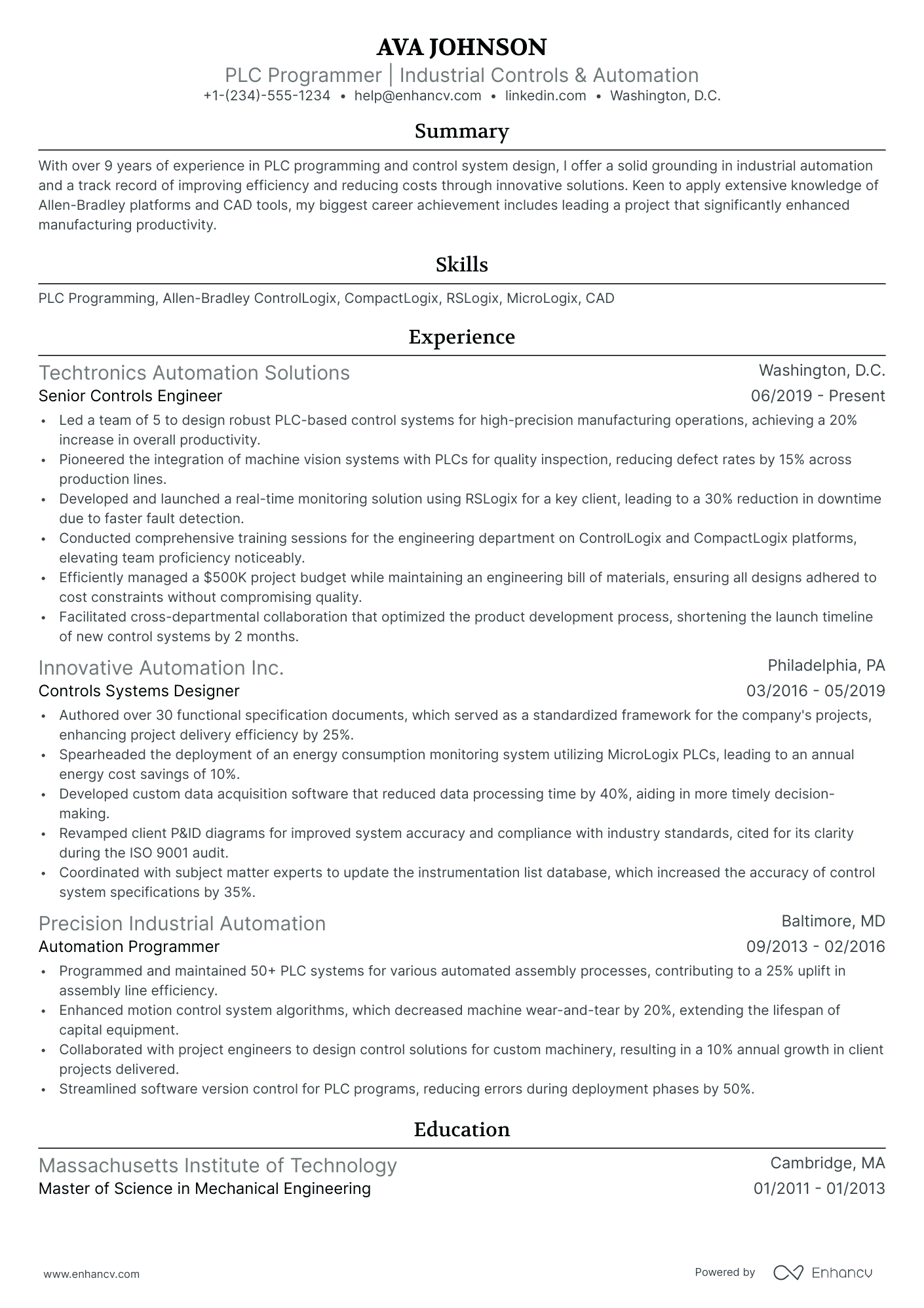
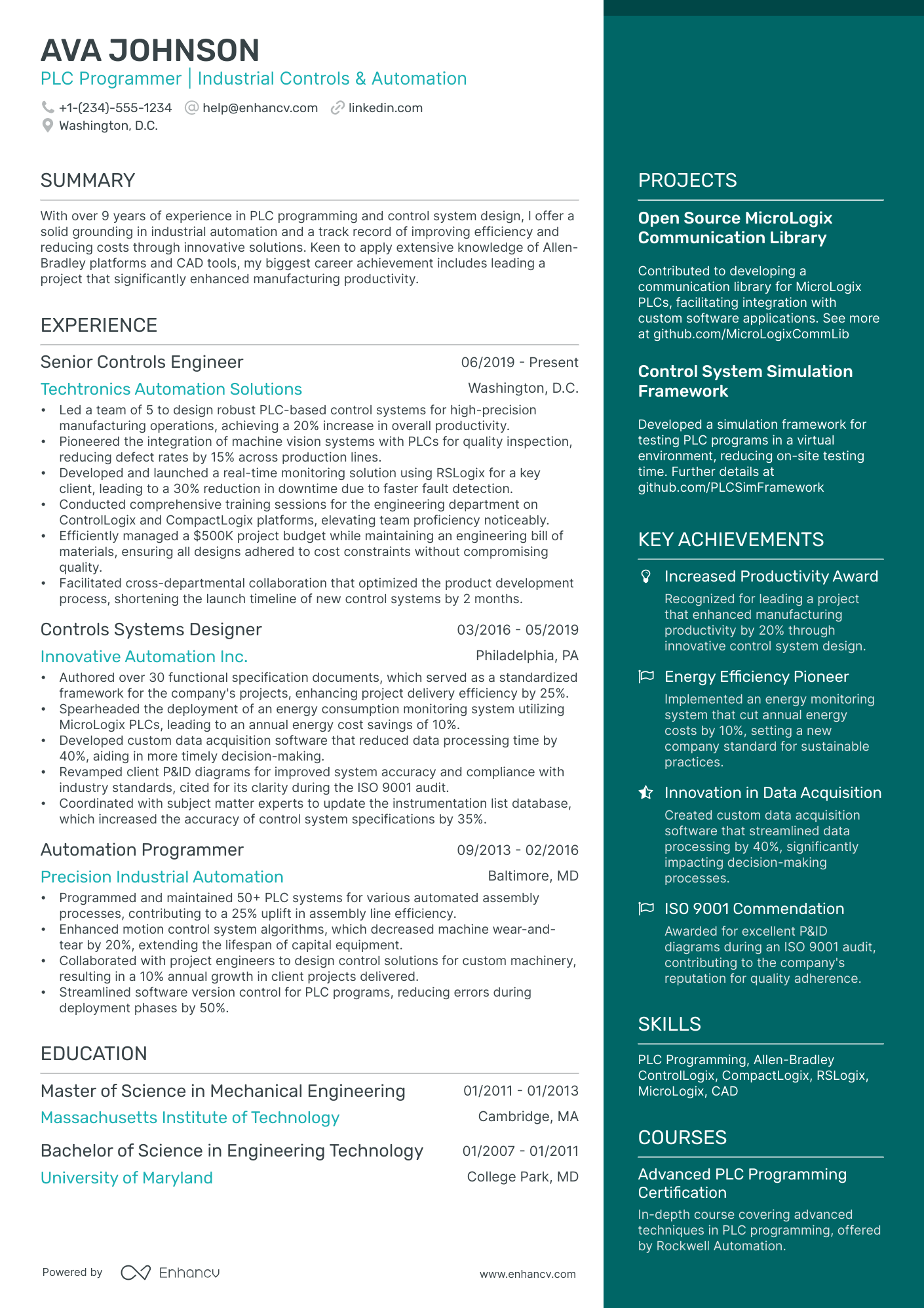
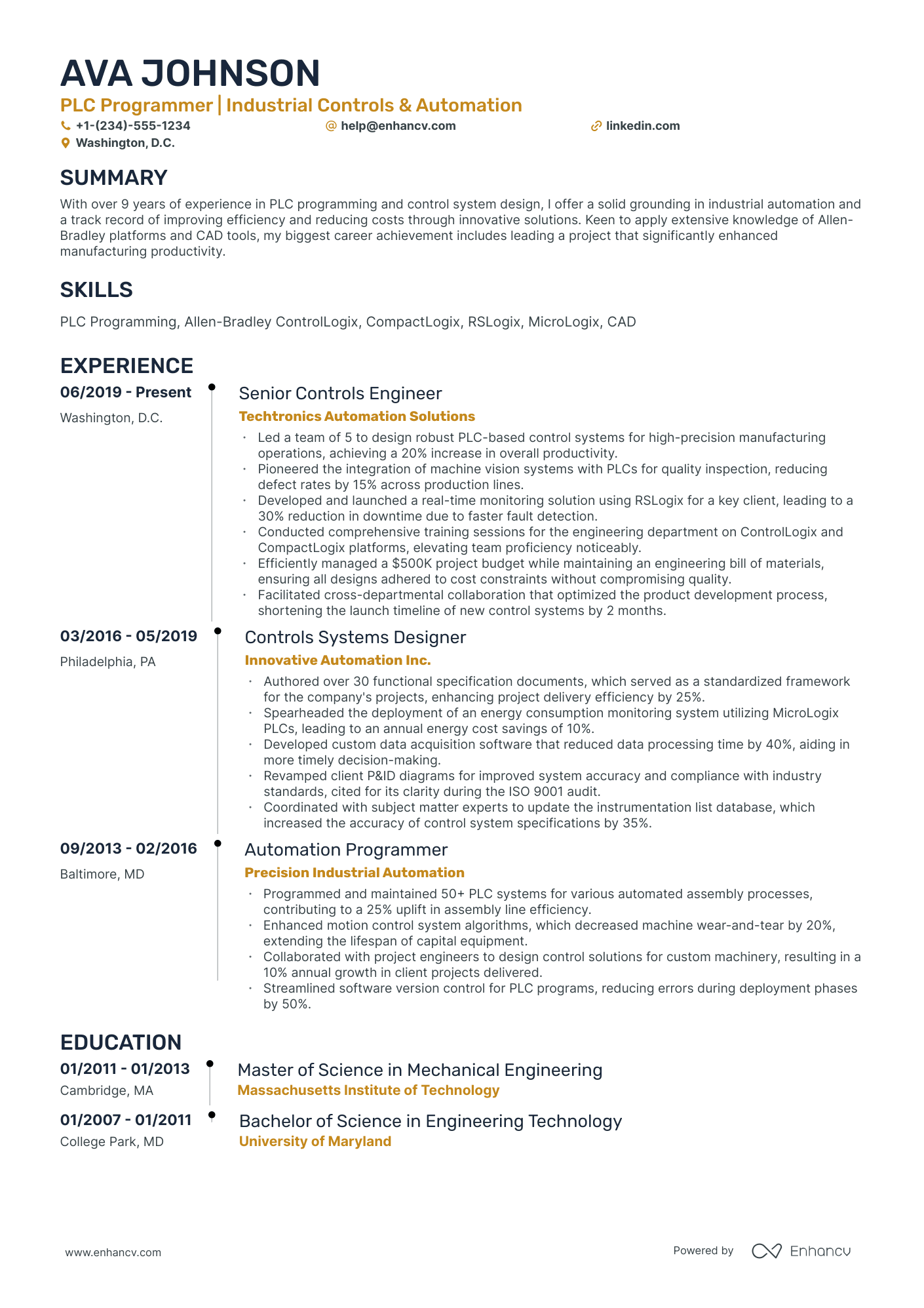
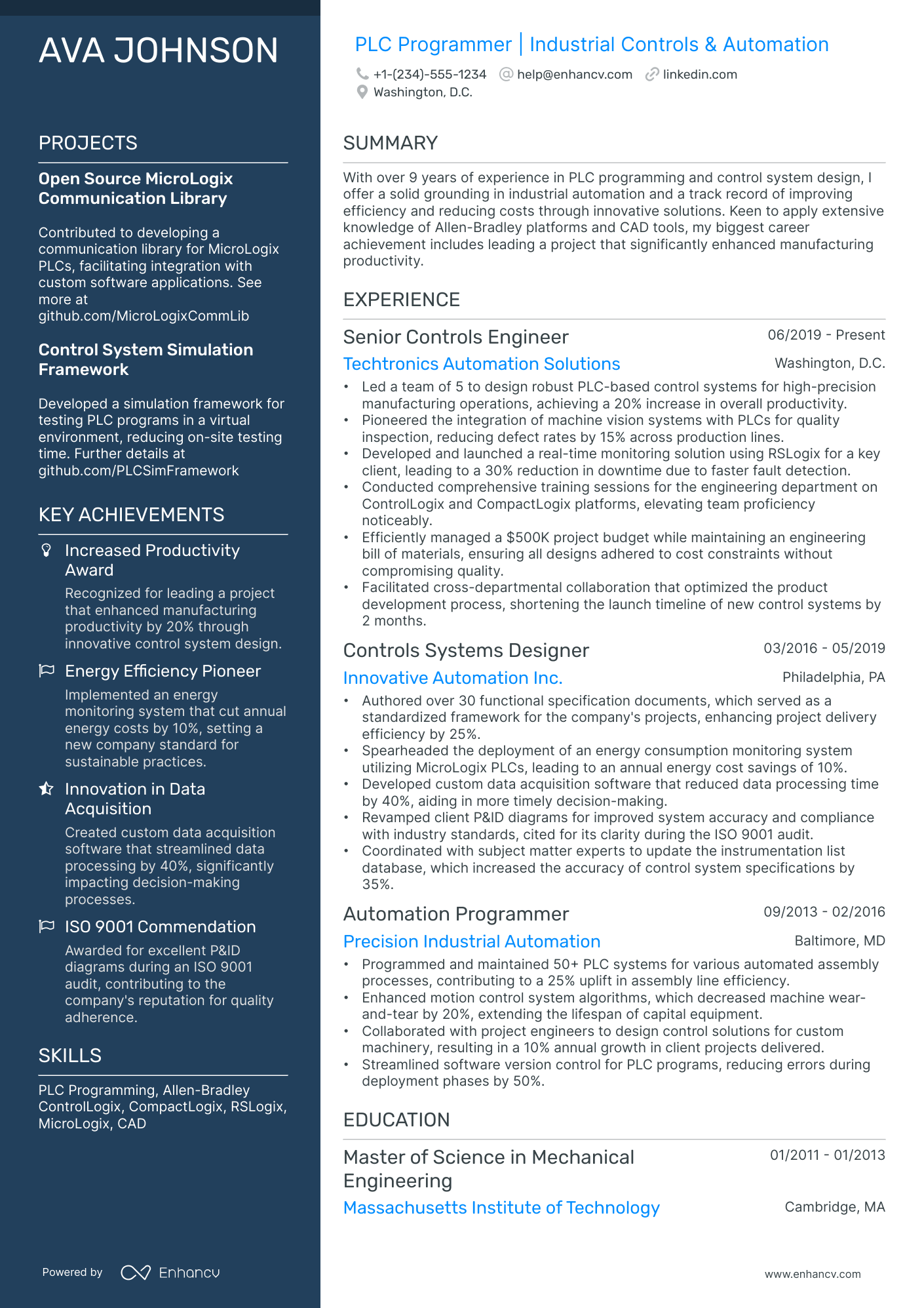
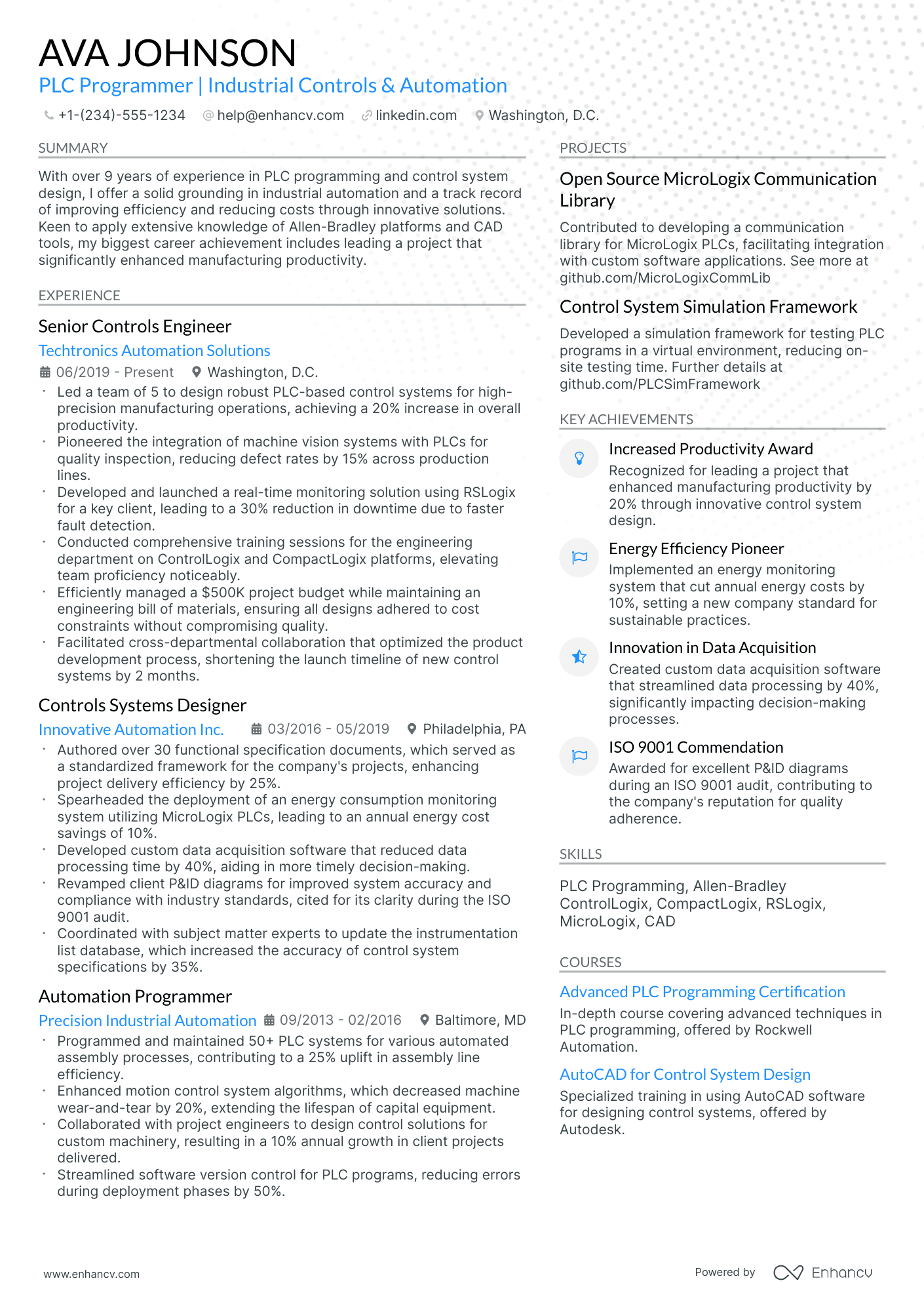
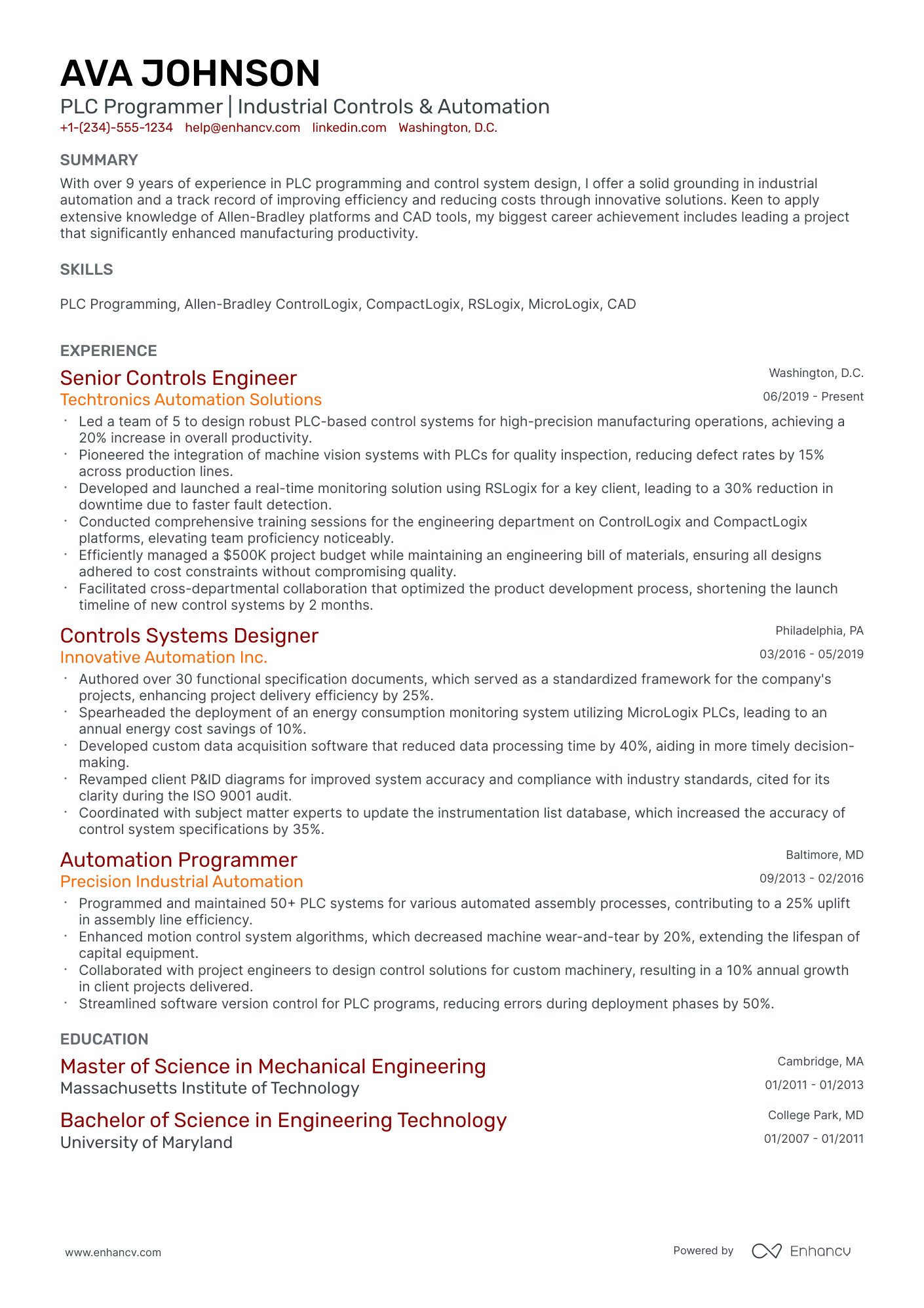
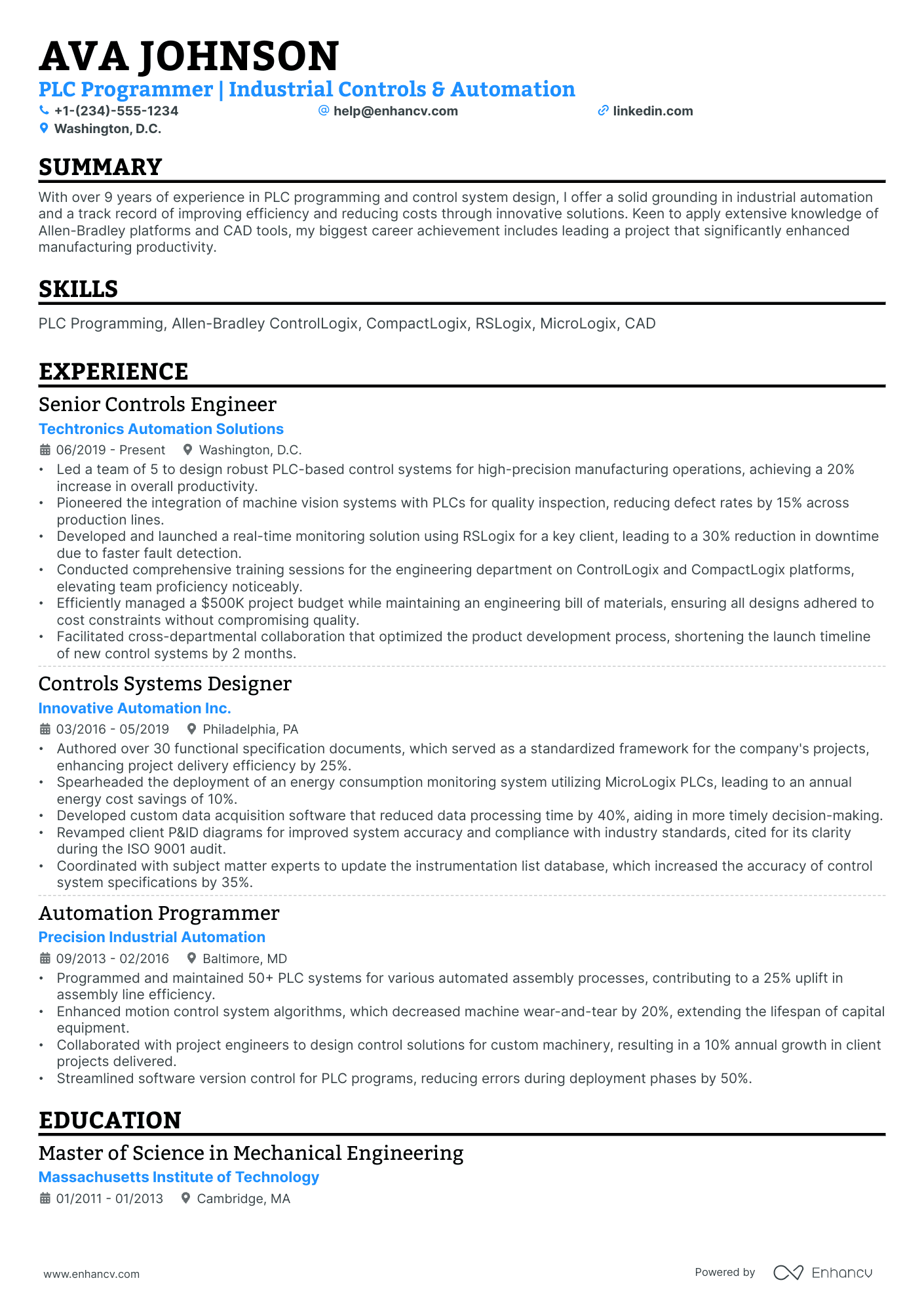
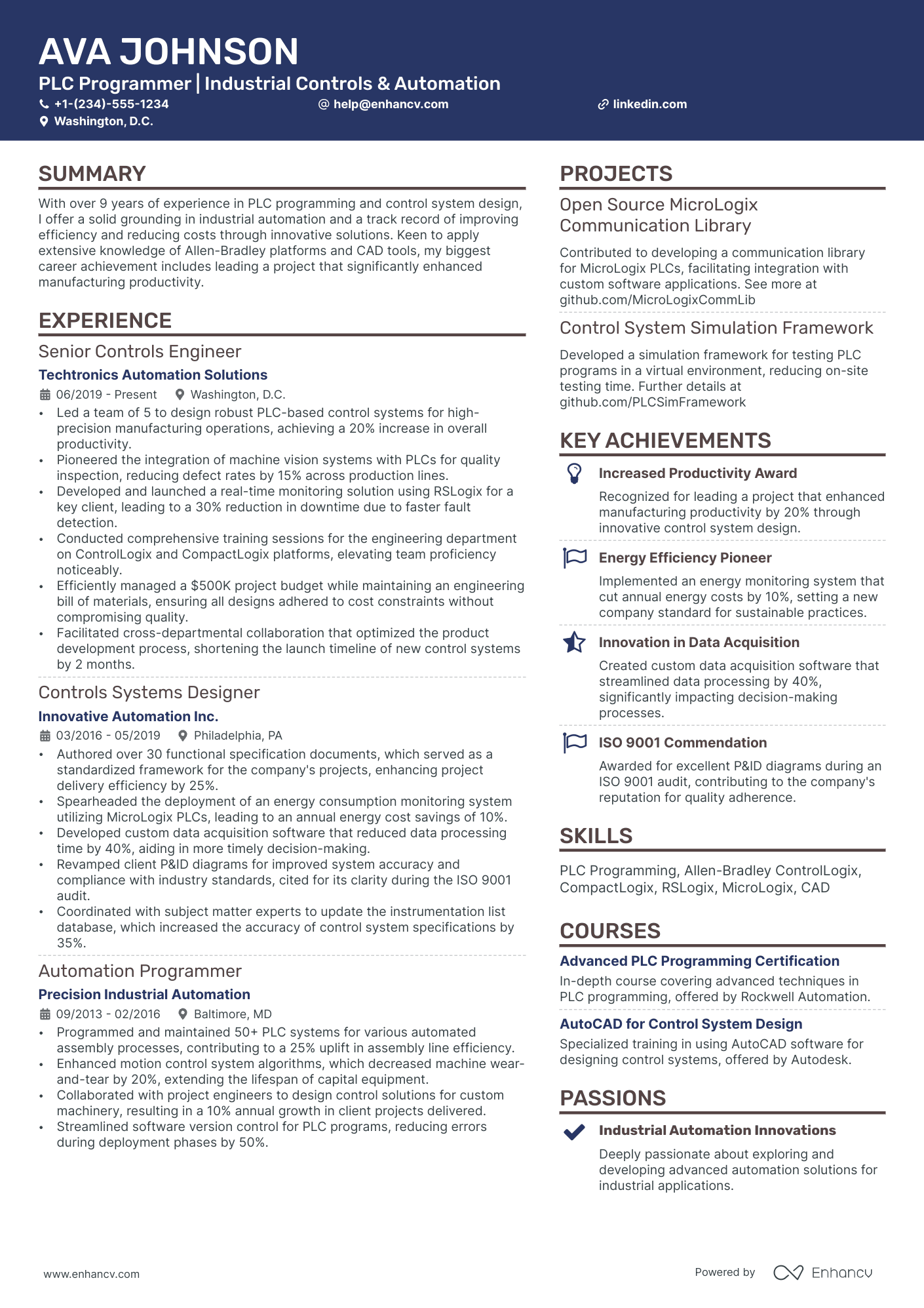
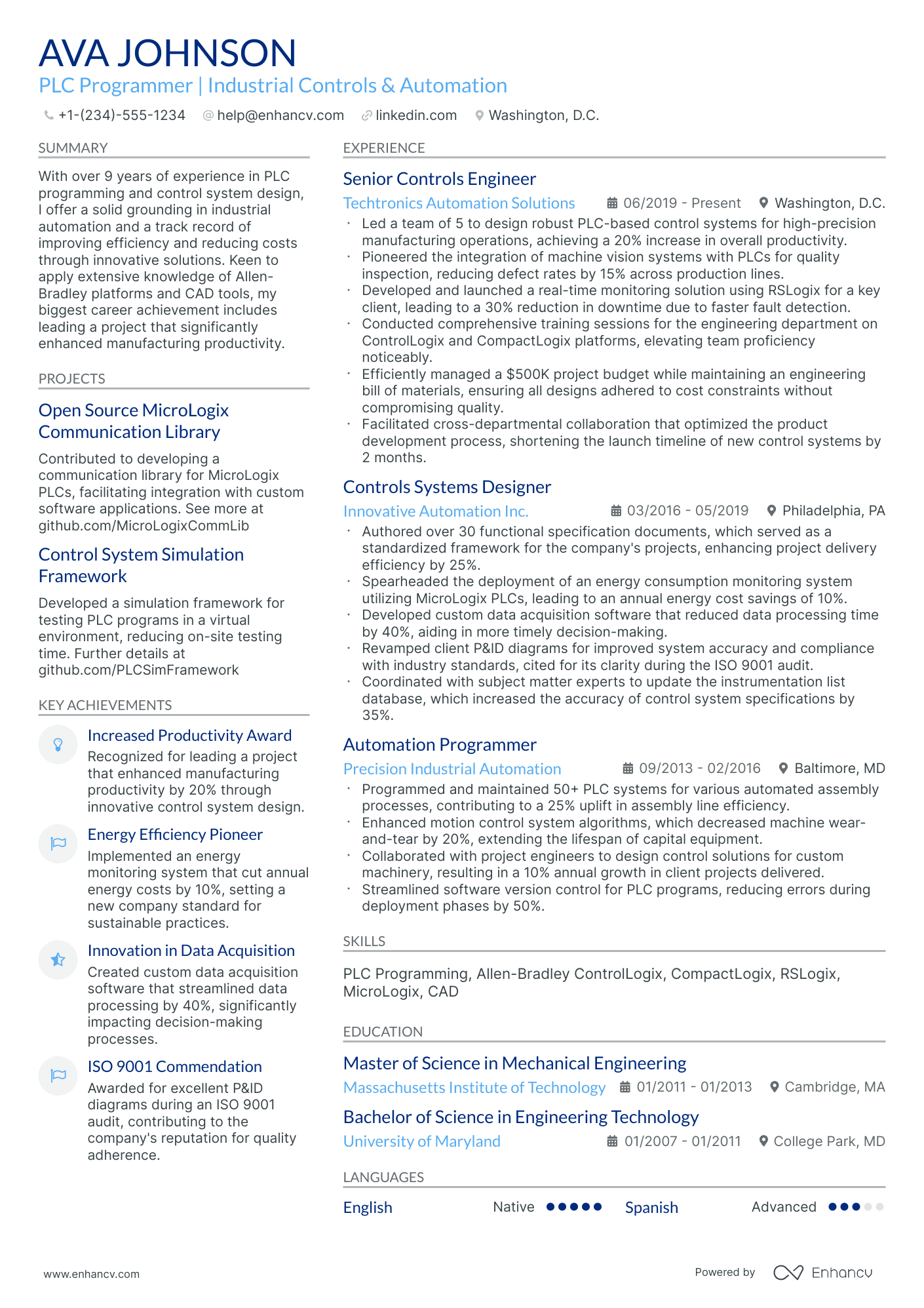
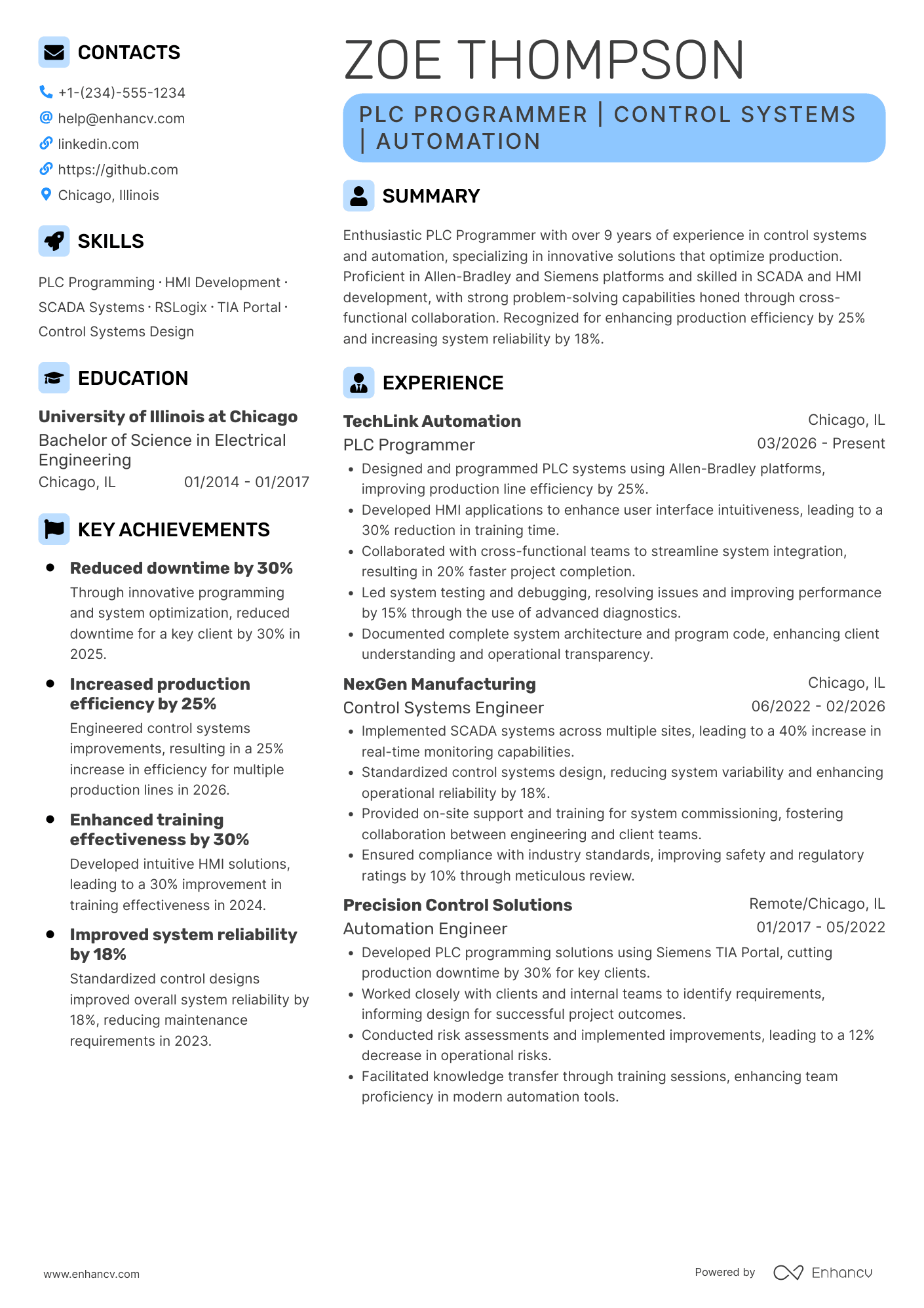
Most PLC programmer resumes fail because they read like wiring diagrams—tool lists and task logs—with no business impact. This PLC programmer resume guide shows how to pass ATS screening and win fast recruiter scans in a crowded field.
A strong resume shows what changed because of your work, not just what you touched. If you're unsure where to begin, learning how to write a resume from scratch can help you build the right foundation. Highlight cycle time reductions, downtime cuts, successful line startups, defect-rate improvements, on-time commissioning, safety incidents prevented, and throughput gains across multiple cells or plants.

Key takeaways
- Quantify every experience bullet with metrics like downtime, cycle time, or throughput gains.
- Tailor PLC platforms, protocols, and terminology to match each job posting directly.
- Use reverse-chronological format if experienced and hybrid format if junior or switching careers.
- Show ownership scope, execution tools, and measurable outcomes in every work entry.
- Place technical skills above experience when you lack extensive PLC programming job history.
- Pair certifications with education to prove current, hands-on readiness beyond your degree.
- Use Enhancv's tools to tighten bullets and align your resume with applicant tracking systems.
How to format a PLC programmer resume
Recruiters evaluating PLC programmer resumes prioritize hands-on programming expertise across specific platforms (Allen-Bradley, Siemens, Mitsubishi), demonstrated troubleshooting ability, and measurable contributions to automation efficiency or uptime. A clean reverse-chronological or hybrid format ensures these signals surface quickly, both for human reviewers scanning in seconds and for applicant tracking systems parsing your work history. Choosing the right resume format is one of the most important decisions you'll make before writing a single bullet point.

I have significant experience in this role—which format should I use?
Use a reverse-chronological format to present your deepest and most relevant PLC programming experience first. Do:
- Lead with your most recent role and clearly define scope: number of PLCs programmed or maintained, facility size, and team oversight responsibilities.
- List platform-specific skills (RSLogix 5000, TIA Portal, FactoryTalk, SCADA integration) within each role to show applied expertise, not just awareness.
- Quantify outcomes tied to production uptime, cycle time reduction, or commissioning timelines.
I'm junior or switching into this role—what format works best?
A hybrid format works best, letting you lead with a focused skills section while still showing a chronological work history. Do:
- Place a dedicated technical skills section near the top, grouping PLC platforms, programming languages (ladder logic, structured text, function block), and communication protocols (EtherNet/IP, Profinet, Modbus).
- Include academic projects, lab work, internships, or personal automation builds that demonstrate real PLC programming and commissioning experience.
- Connect every listed skill to a specific action and its result so recruiters see capability, not just coursework.
Why not use a functional resume?
A functional format strips away the timeline and context recruiters need to verify where and when you applied your PLC programming skills, making it harder to assess your readiness for real-world automation environments.
- A functional format may be acceptable if you're transitioning from a related field (such as electrical maintenance or controls technician work) and have limited direct PLC programming job titles, but only if every listed skill is tied to a specific project, platform, and measurable outcome.
Now that you've established a clean, readable layout, it's time to fill each part of your resume with the right content.
What sections should go on a PLC programmer resume
Recruiters expect to see proof you can design, program, troubleshoot, and commission PLC-controlled systems safely and reliably. Understanding which resume sections to include ensures you present that proof in the order hiring managers expect.
Use this structure for maximum clarity:
- Header
- Summary
- Experience
- Skills
- Projects
- Education
- Certifications
- Optional sections: Awards, Leadership, Languages
Strong experience bullets should emphasize measurable uptime, throughput, scrap reduction, safety improvements, commissioning scope, and the results you delivered across equipment, lines, and facilities.
Is your resume good enough?
Drop your resume here or choose a file. PDF & DOCX only. Max 2MB file size.
Once you’ve organized your resume with the right core sections, the next step is to write your PLC programmer experience in a way that fits that structure and shows your impact.
How to write your PLC programmer resume experience
Your experience section should highlight the automation systems you've built, programmed, and deployed—using role-relevant tools like ladder logic, structured text, or SCADA platforms—alongside the measurable outcomes those projects delivered. Hiring managers prioritize demonstrated impact, such as reduced downtime or improved cycle times, over descriptive task lists that merely catalog daily responsibilities.
Each entry should include:
- Job title
- Company and location (or remote)
- Dates of employment (month and year)
Three to five concise bullet points showing what you owned, how you executed, and what outcomes you delivered:
- Ownership scope: the specific PLC systems, automation lines, control architectures, or facility operations you were directly accountable for maintaining, programming, or commissioning.
- Execution approach: the PLC platforms, programming languages, communication protocols, or diagnostic tools you relied on to design logic, troubleshoot faults, and deliver functioning control systems.
- Value improved: the changes you drove in equipment uptime, production throughput, process reliability, safety compliance, or maintenance response time as a direct result of your programming work.
- Collaboration context: how you coordinated with electrical engineers, maintenance technicians, plant operators, integrators, or equipment vendors to scope requirements, validate logic, and ensure smooth commissioning.
- Impact delivered: the operational or business outcomes your PLC programming produced, expressed through production-scale results, reliability gains, cost reductions, or safety improvements rather than a summary of tasks performed.
Experience bullet formula
A PLC programmer experience example
✅ Right example - modern, quantified, specific.
PLC Programmer
Riverton Packaging Systems | Columbus, OH
2021–Present
High-speed food and beverage packaging OEM delivering turnkey lines for Fortune 500 plants.
- Programmed Allen-Bradley ControlLogix PLCs in Studio 5000 and integrated PanelView HMIs, cutting changeover time by 22% across eight packaging lines.
- Commissioned VFD-driven conveyors and servo axes over EtherNet/IP and CIP Motion, reducing unplanned downtime by 18% and improving OEE from 78% to 86%.
- Built ISA-88 batch sequences and standardized AOIs (add-on instructions), shortening new line bring-up from six weeks to four weeks and lowering defect rates by 15%.
- Implemented safety PLC logic and validated safety circuits to ISO 13849 using GuardLogix and safety relays, eliminating recordable safety incidents for twelve consecutive months.
- Partnered with mechanical engineers, electricians, and plant operations to troubleshoot field issues with Wireshark and FactoryTalk Diagnostics, cutting mean time to repair by 35% and avoiding $240K in lost production.
Now that you've seen how a strong experience section comes together, let's look at how to adjust those details to match the specific job you're targeting.
How to tailor your PLC programmer resume experience
Recruiters evaluate your PLC programmer resume through both human review and applicant tracking systems. Tailoring your resume to the job description increases your chances of passing both screenings.
Ways to tailor your PLC programmer experience:
- Match the specific PLC platforms and programming languages listed in the posting.
- Mirror the exact automation protocols or communication standards the employer names.
- Use the same terminology for control system methodologies referenced in the description.
- Highlight relevant industry experience such as manufacturing or process automation.
- Emphasize safety compliance and reliability standards when the role requires them.
- Reflect the KPIs or performance benchmarks the employer uses to measure success.
- Include HMI or SCADA integration work when the posting references those systems.
- Reference collaboration with electrical or mechanical engineering teams if specified.
Tailoring means aligning your real accomplishments with what the employer asks for, not forcing keywords where they don't belong.
Resume tailoring examples for PLC programmer
| Job description excerpt | Untailored | Tailored |
|---|---|---|
| "Design, program, and troubleshoot Allen-Bradley PLCs using RSLogix 5000 for automated packaging lines in a food manufacturing environment." | Programmed PLCs for various industrial automation projects. | Programmed and troubleshot Allen-Bradley PLCs in RSLogix 5000, supporting 12 automated packaging lines across three food manufacturing facilities with 99.2% uptime. |
| "Develop and maintain ladder logic and structured text programs for Siemens S7-1500 controllers integrated with SCADA systems in water treatment plants." | Wrote PLC code and worked with control systems for plant operations. | Developed ladder logic and structured text programs for Siemens S7-1500 controllers, integrating real-time data with Ignition SCADA across four municipal water treatment plants serving 200,000+ residents. |
| "Lead PLC migration projects from legacy GE Fanuc systems to Rockwell ControlLogix, ensuring zero unplanned downtime during cutover in automotive assembly operations." | Helped upgrade older PLC systems to newer platforms. | Led migration of 18 GE Fanuc Series 90-30 PLCs to Rockwell ControlLogix on an active automotive assembly line, completing all cutovers during scheduled shutdowns with zero unplanned downtime. |
Once your experience aligns with the role’s requirements, quantify your PLC programmer achievements to show the impact of that work with measurable results.
How to quantify your PLC programmer achievements
Quantifying your achievements proves your logic improved uptime, throughput, and safety, not just code quality. Track cycle time, downtime minutes, scrap rate, alarms, commissioning speed, energy use, and safety incidents across lines, cells, or entire plants.
Quantifying examples for PLC programmer
| Metric | Example |
|---|---|
| Throughput | "Increased packaging line throughput 12% by optimizing Siemens S7-1500 scan time and tuning VFD ramp profiles across six conveyors." |
| Downtime | "Cut unplanned downtime from 9.5 to 4.1 hours per month by rewriting alarm handling in Rockwell Studio 5000 and adding watchdog timers." |
| Quality | "Reduced reject rate 18% by improving vision-trigger timing and interlocks in Ladder Logic, syncing encoder counts with servo moves." |
| Delivery speed | "Delivered a full cell retrofit two weeks early by standardizing function blocks, reusing HMI faceplates, and automating IO checkout scripts." |
| Safety risk | "Lowered safety-related nuisance trips 30% by validating safety PLC inputs, correcting E-stop debounce, and updating safety validation test cases." |
Turn vague job duties into measurable, recruiter-ready resume bullets in seconds with Enhancv's Bullet Point Generator.
Once you've crafted strong bullet points for your experience section, you'll want to apply the same level of precision to presenting your hard and soft skills.
How to list your hard and soft skills on a PLC programmer resume
Your skills section shows you can design, troubleshoot, and validate industrial control systems, and recruiters and an ATS (applicant tracking system) scan this section to match keywords fast—aim for mostly hard skills with a smaller set of role-specific soft skills. PLC programmer roles require a blend of:
- Product strategy and discovery skills.
- Data, analytics, and experimentation skills.
- Delivery, execution, and go-to-market discipline.
- Soft skills.
Your skills section should be:
- Scannable (bullet-style grouping).
- Relevant to the job post.
- Backed by proof in experience bullets.
- Updated with current tools.
Place your skills section:
- Above experience if you're junior or switching careers.
- Below experience if you're mid/senior with strong achievements.

Hard skills
- Allen-Bradley RSLogix 5000, Studio 5000
- Siemens TIA Portal, STEP 7
- Ladder logic, function block, structured text
- Human machine interface development, FactoryTalk View, WinCC
- SCADA integration, Ignition, Wonderware System Platform
- Industrial networks: EtherNet/IP, PROFINET, Modbus TCP
- Motion control, servo drives, VFD configuration
- Safety PLCs, safety relays, safety circuits
- Instrumentation, analog I/O scaling, PID tuning
- Electrical schematics, panel design, AutoCAD Electrical
- Commissioning, site acceptance testing, factory acceptance testing
- Version control and change management, Git
Soft skills
- Translate process needs into logic
- Clarify requirements with stakeholders
- Write testable functional specifications
- Troubleshoot under production pressure
- Communicate downtime impact clearly
- Coordinate electricians and technicians
- Document changes for handoff
- Prioritize fixes by risk and throughput
- Escalate safety issues immediately
- Own commissioning punch lists
- Train operators on new sequences
- Lead root cause analysis sessions
How to show your PLC programmer skills in context
Skills shouldn't live only in a dedicated skills list. Browse our resume skills library to see how PLC-related competencies are presented across different roles.
They should be demonstrated in:
- Your summary (high-level professional identity)
- Your experience (proof through outcomes)
Here's what that looks like in practice.
Summary example
Senior PLC programmer with 12 years in automotive manufacturing. Skilled in Allen-Bradley, Siemens TIA Portal, and SCADA integration. Reduced production downtime 30% through optimized ladder logic and cross-functional troubleshooting.
- Reflects senior-level expertise clearly
- Names industry-standard tools and platforms
- Quantifies impact with a strong metric
- Highlights collaboration as a soft skill
Experience example
Senior PLC Programmer
Vantage Automation Systems | Detroit, MI
March 2018–Present
- Programmed and maintained Allen-Bradley ControlLogix PLCs across six assembly lines, cutting unplanned downtime by 25%.
- Collaborated with mechanical and electrical engineers to integrate SCADA dashboards, improving real-time fault detection by 40%.
- Developed reusable structured text modules using Rockwell Studio 5000, reducing new line commissioning time from ten days to six.
- Every bullet includes measurable proof.
- Skills appear naturally within achievements.
Once you’ve demonstrated your automation and controls abilities through specific projects and outcomes, the next step is to apply that same evidence-based approach to writing a PLC programmer resume with no experience.
How do I write a PLC programmer resume with no experience
Even without full-time experience, you can demonstrate readiness through projects, labs, and self-directed learning. Our guide on building a resume without work experience walks you through proven strategies for entry-level candidates.
- PLC lab assignments and capstones
- Personal automation projects on trainers
- Internship or co-op maintenance support
- Controls-related volunteer or maker work
- Relevant coursework with ladder logic
- Simulation work in PLC software
- Electrical panel wiring practice projects
- Troubleshooting logs from lab faults
Focus on:
- PLC programmer tools and versions
- Ladder logic and structured text
- Industrial networking and I/O mapping
- Documented results and measurements
Resume format tip for entry-level PLC programmer
Use a hybrid resume format because it highlights projects and technical skills first, while still showing education and any related experience. Do:
- Put a Projects section near the top.
- List PLC programmer tools: Studio five thousand, TIA Portal, FactoryTalk View.
- Show I/O counts, cycle times, and uptime.
- Add links to code samples on GitHub.
- Tailor keywords to each job posting.
- Built a bottle-sorting PLC programmer simulation in Studio five thousand with sixteen digital I/O and fault handling, cutting simulated jam downtime by thirty percent.
Even without hands-on work history, your education section can demonstrate the technical foundation employers need to see—here's how to present it effectively.
How to list your education on a PLC programmer resume
Your education section helps hiring teams confirm you have the technical foundation for a PLC programmer role. It validates your knowledge of controls, electrical systems, and programming principles.
Include:
- Degree name
- Institution
- Location
- Graduation year
- Relevant coursework (for juniors or entry-level candidates)
- Honors & GPA (if 3.5 or higher)
Skip month and day details—list the graduation year only.
Here's a strong education entry tailored to a PLC programmer resume:
Example education entry
Bachelor of Science in Electrical Engineering Technology
Milwaukee School of Engineering, Milwaukee, WI
Graduated 2021
GPA: 3.7/4.0
- Relevant Coursework: Industrial Automation, Programmable Logic Controllers, Control Systems, and Digital Electronics.
- Honors: Magna Cum Laude, Dean's List all semesters.
How to list your certifications on a PLC programmer resume
Certifications on your resume show a PLC programmer's commitment to learning, proficiency with automation tools, and alignment with current industry standards, which helps recruiters trust your technical readiness faster.
Include:
- Certificate name
- Issuing organization
- Year
- Optional: credential ID or URL
- Place certifications below education when your degree is recent and directly relevant, and your certifications are older or general.
- Place certifications above education when they are recent, role-specific, or required for the job, especially if your education is older.
Best certifications for your PLC programmer resume
- Rockwell Automation Certified Control Systems Technician
- Siemens Certified Programmer (TIA Portal)
- ISA Certified Automation Professional (CAP)
- TÜV Rheinland Functional Safety Engineer (IEC 61508)
- CompTIA Network+
- OSHA 30-Hour General Industry
Once you’ve positioned your credentials where recruiters can spot them quickly, shift to your PLC programmer resume summary to connect those qualifications to the value you deliver.
How to write your PLC programmer resume summary
Your resume summary is the first thing a recruiter reads. A strong one instantly connects your skills and experience to the PLC programmer role.
Keep it to three to four lines, with:
- Your title and total years of hands-on PLC programming experience.
- The industries you've worked in, such as automotive, food processing, or packaging.
- Core tools like Allen-Bradley, Siemens TIA Portal, RSLogix 5000, or ladder logic.
- One or two measurable achievements, such as reduced downtime or faster cycle times.
- Practical soft skills tied to outcomes, like cross-functional troubleshooting or vendor coordination.

PRO TIP
At this level, focus on specific tools you've used, industries you've supported, and early wins you can quantify. Avoid vague phrases like "passionate self-starter" or "eager to learn." Recruiters want to see what you've actually done with PLCs, not aspirational statements about your potential.
Example summary for a PLC programmer
PLC programmer with three years of experience in automotive manufacturing using RSLogix 5000 and Allen-Bradley CompactLogix. Reduced conveyor system downtime by 22% through optimized ladder logic and proactive fault diagnostics.
Optimize your resume summary and objective for ATS
Drop your resume here or choose a file.
PDF & DOCX only. Max 2MB file size.
Now that your summary is crafted to highlight your strongest qualifications, make sure the header above it presents your contact details correctly so recruiters can actually reach you.
What to include in a PLC programmer resume header
A resume header is the top section with your key identifiers, and it boosts visibility, credibility, and recruiter screening for a PLC programmer.
Essential resume header elements
- Full name
- Tailored job title and headline
- Location
- Phone number
- Professional email
- GitHub link
- Portfolio link
A LinkedIn link helps recruiters verify your experience quickly and supports screening.
Do not include photos on a PLC programmer resume unless the role is explicitly front-facing or appearance-dependent.
Keep the header to one or two lines, match your job title to the posting, and use consistent formatting across all links.
Example
PLC programmer resume header
Jordan Miller
PLC Programmer | Allen-Bradley, Siemens, and Factory Automation
Cleveland, OH
(216) 555-01XX
your.name@enhancv.com
github.com/yourname
yourwebsite.com
linkedin.com/in/yourname
Once your contact details and role identifiers are clear at the top, you can strengthen the rest of the document with additional sections that support your PLC programmer qualifications.
Additional sections for PLC programmer resumes
When your core qualifications match other applicants, additional sections can set you apart by showcasing relevant expertise and industry credibility.
- Languages
- Certifications and licenses
- Industry publications and technical papers
- Professional affiliations and memberships
- Hobbies and interests
- Continuing education and training
Once you've strengthened your resume with targeted additional sections, pairing it with a well-crafted cover letter can further set your application apart.
Do PLC programmer resumes need a cover letter
A cover letter isn't required for a PLC programmer, but it can help in competitive roles or when hiring managers expect one. If you're unfamiliar with the format, start by understanding what a cover letter is and how it complements your resume. It makes the biggest difference when your resume needs context or when the job demands close collaboration.
Use a cover letter to add details your resume can't:
- Explain role and team fit: Match your experience to the shift schedule, plant environment, travel needs, and cross-functional partners.
- Highlight one or two relevant projects or outcomes: Name the line or system, your PLC platform, and the measurable result, such as reduced downtime or faster changeovers.
- Show understanding of the product, users, or business context: Connect your work to operators, maintenance, safety, quality, throughput, and compliance requirements.
- Address career transitions or non-obvious experience: Clarify moves from electrician to PLC programmer, gaps, consulting work, or adjacent controls experience that supports the role.
Drop your resume here or choose a file.
PDF & DOCX only. Max 2MB file size.
If you choose to include a cover letter, pair it with an AI-driven resume review to quickly strengthen your PLC programmer resume and keep your application consistent.
Using AI to improve your PLC programmer resume
AI can sharpen your resume's clarity, structure, and impact. It helps tighten wordy bullets, quantify achievements, and align content with job postings. But overuse makes resumes sound robotic. Once your content is clear and role-aligned, step away from AI. If you're wondering which AI is best for writing resumes, the answer depends on the level of customization and control you need.
Here are 10 practical prompts to strengthen specific sections of your PLC programmer resume:
- Sharpen your summary. "Rewrite my PLC programmer resume summary to highlight years of experience, core specializations, and one measurable career achievement in under four sentences."
- Quantify experience bullets. "Review my PLC programmer experience bullets and suggest specific metrics, percentages, or time savings I can add to demonstrate measurable impact."
- Align with job postings. "Compare my PLC programmer resume skills section against this job description and identify missing keywords or technical competencies I should include."
- Strengthen project descriptions. "Rewrite my PLC programmer project descriptions to follow a clear problem-action-result structure with concrete outcomes for each project."
- Tighten wordy bullets. "Shorten each of my PLC programmer experience bullets to one concise line without losing technical detail or measurable results."
- Improve technical skills. "Organize my PLC programmer skills section into logical categories like programming languages, hardware platforms, communication protocols, and software tools."
- Highlight certifications clearly. "Reformat my PLC programmer certifications section to emphasize relevance, issuing bodies, and completion dates in a scannable layout."
- Refine education details. "Suggest how to present my PLC programmer education section to emphasize relevant coursework, capstone projects, or lab experience."
- Eliminate vague language. "Flag any vague or generic phrases in my PLC programmer resume and suggest specific, technical replacements grounded in real job responsibilities."
- Tailor for ATS readability. "Review my PLC programmer resume for formatting issues, missing keywords, or structural problems that could hurt applicant tracking system compatibility."
Stop using AI once your resume sounds accurate, specific, and aligned with real experience. AI should never invent experience or inflate claims—if it didn't happen, it doesn't belong here.
Conclusion
A strong PLC programmer resume proves impact with measurable outcomes, role-specific skills, and a clear structure. Use metrics like downtime reduced, cycle time improved, defects lowered, or startups delivered on schedule. Keep sections easy to scan, and make every line earn its place.
Show you’re ready for today’s and near-future hiring market by aligning your skills with real plant needs. Highlight PLC programming, HMI and SCADA work, troubleshooting, safety standards, and clean documentation. Pair those skills with results, and your resume will stand up to fast reviews.