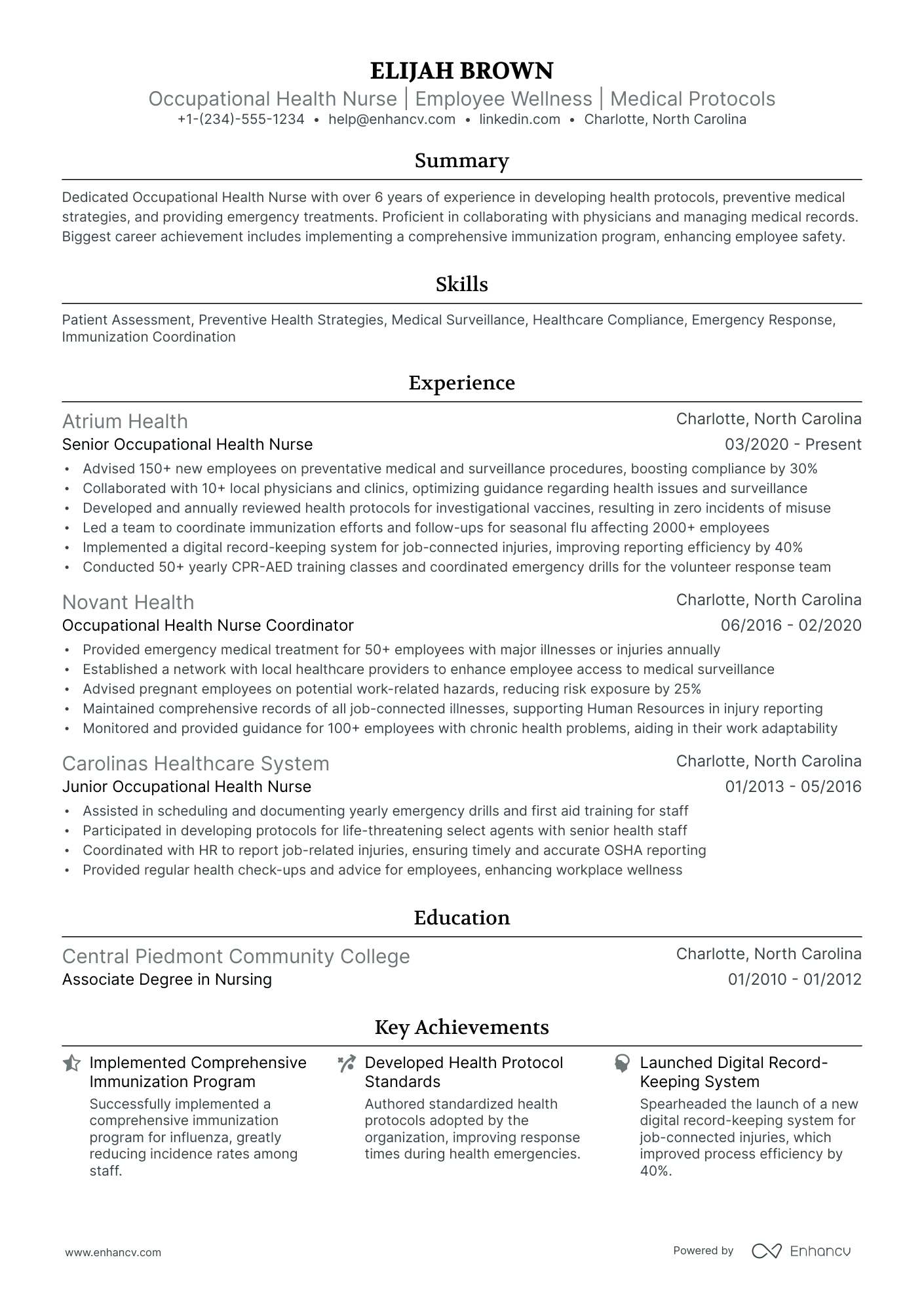
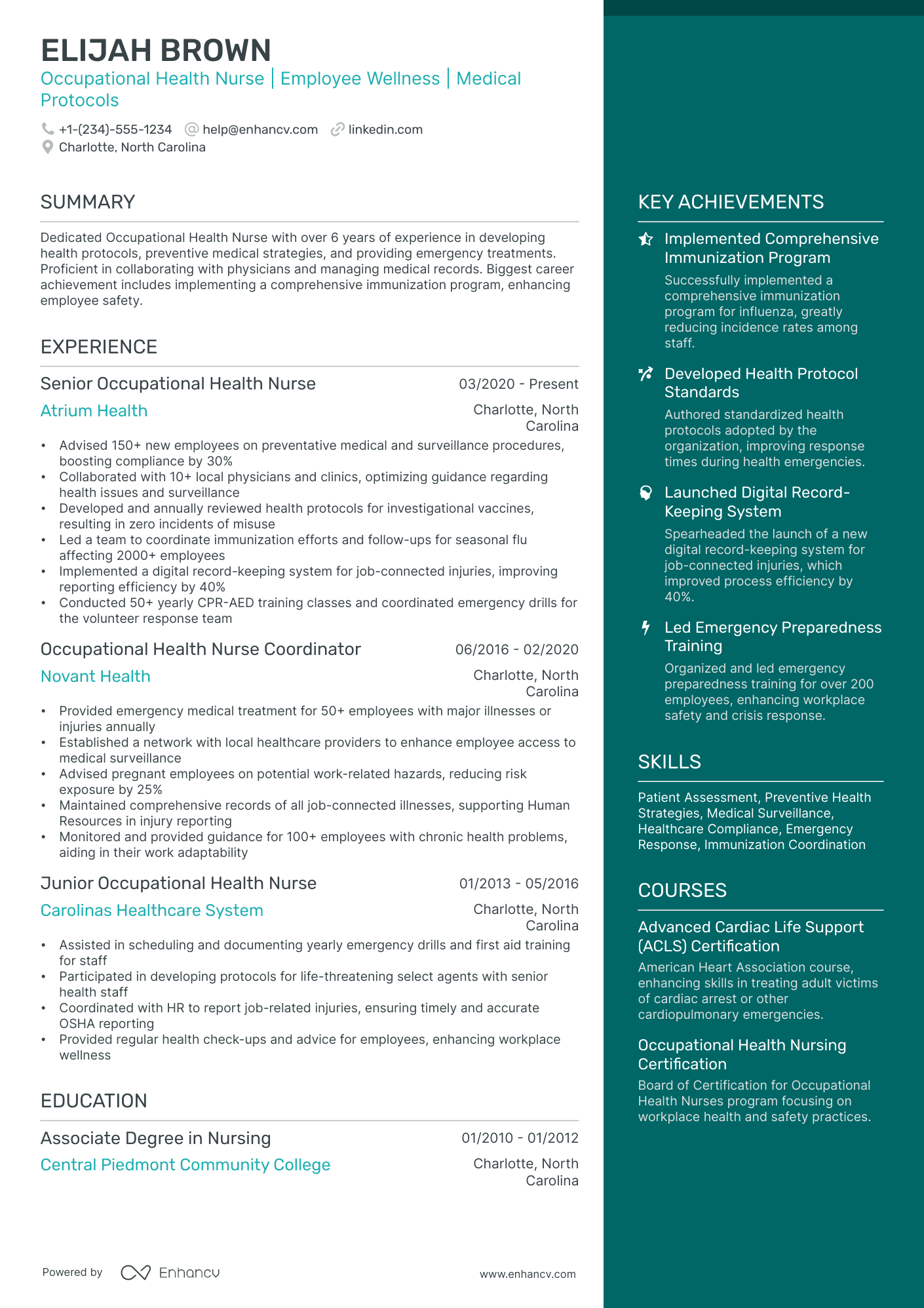
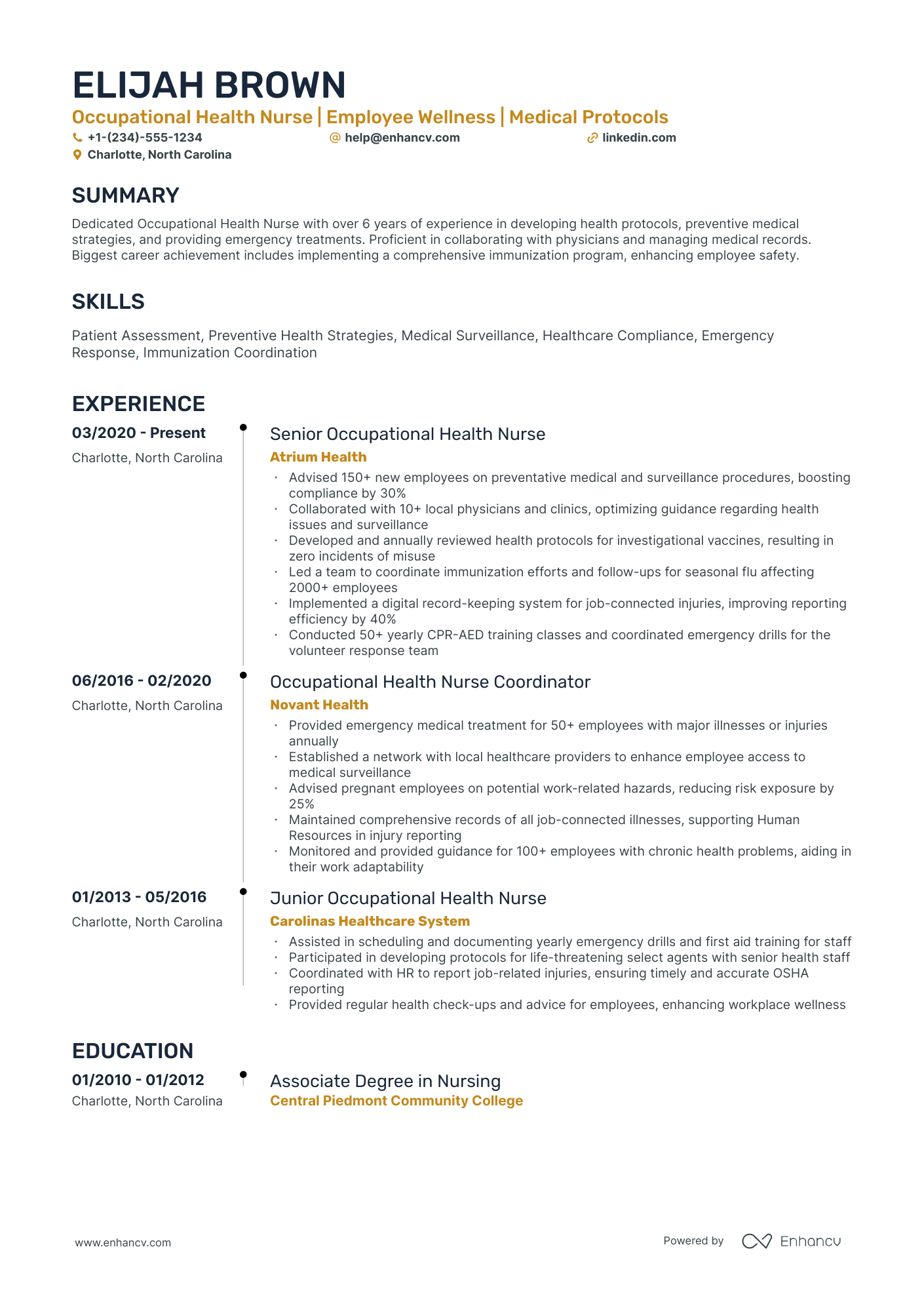
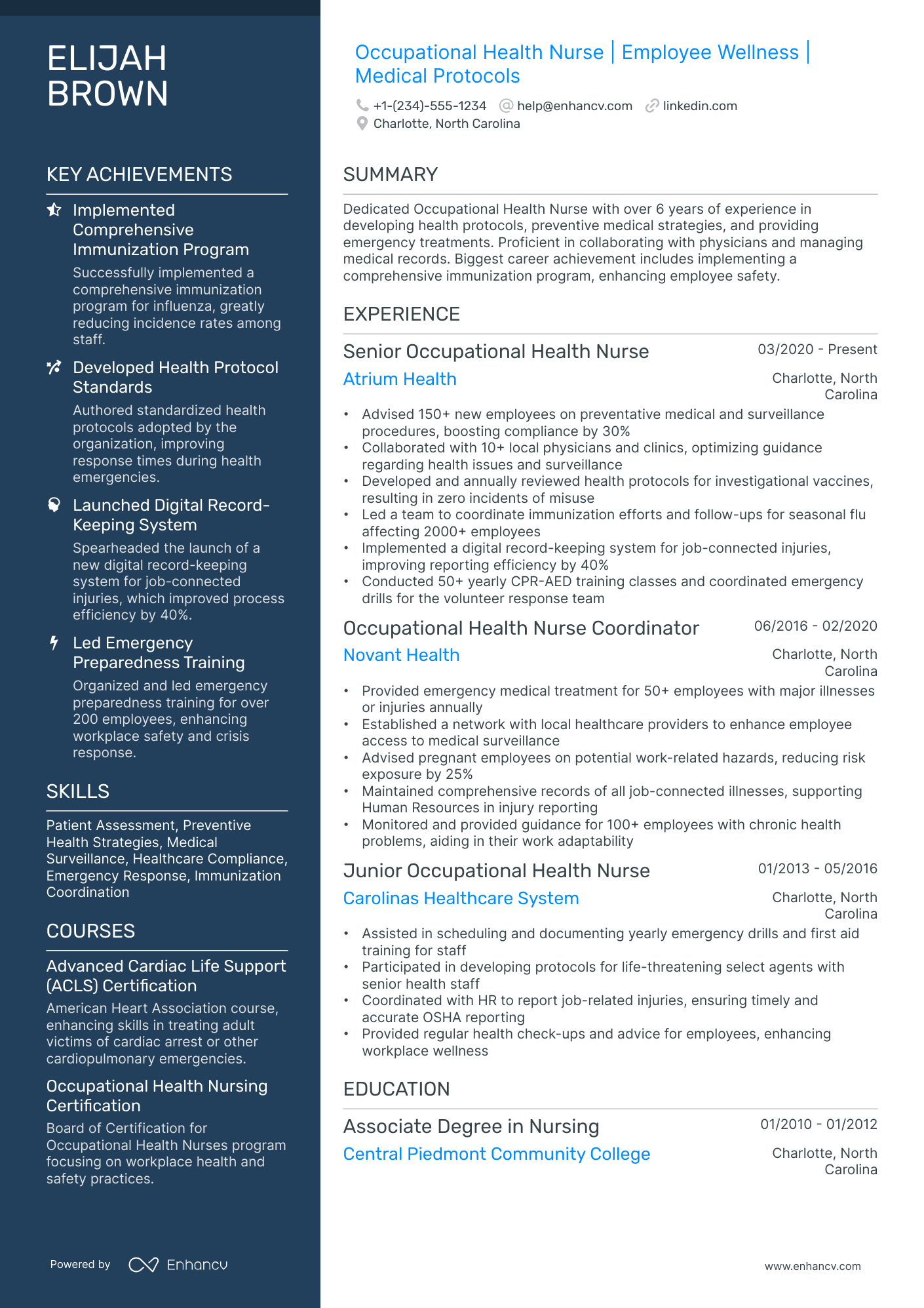
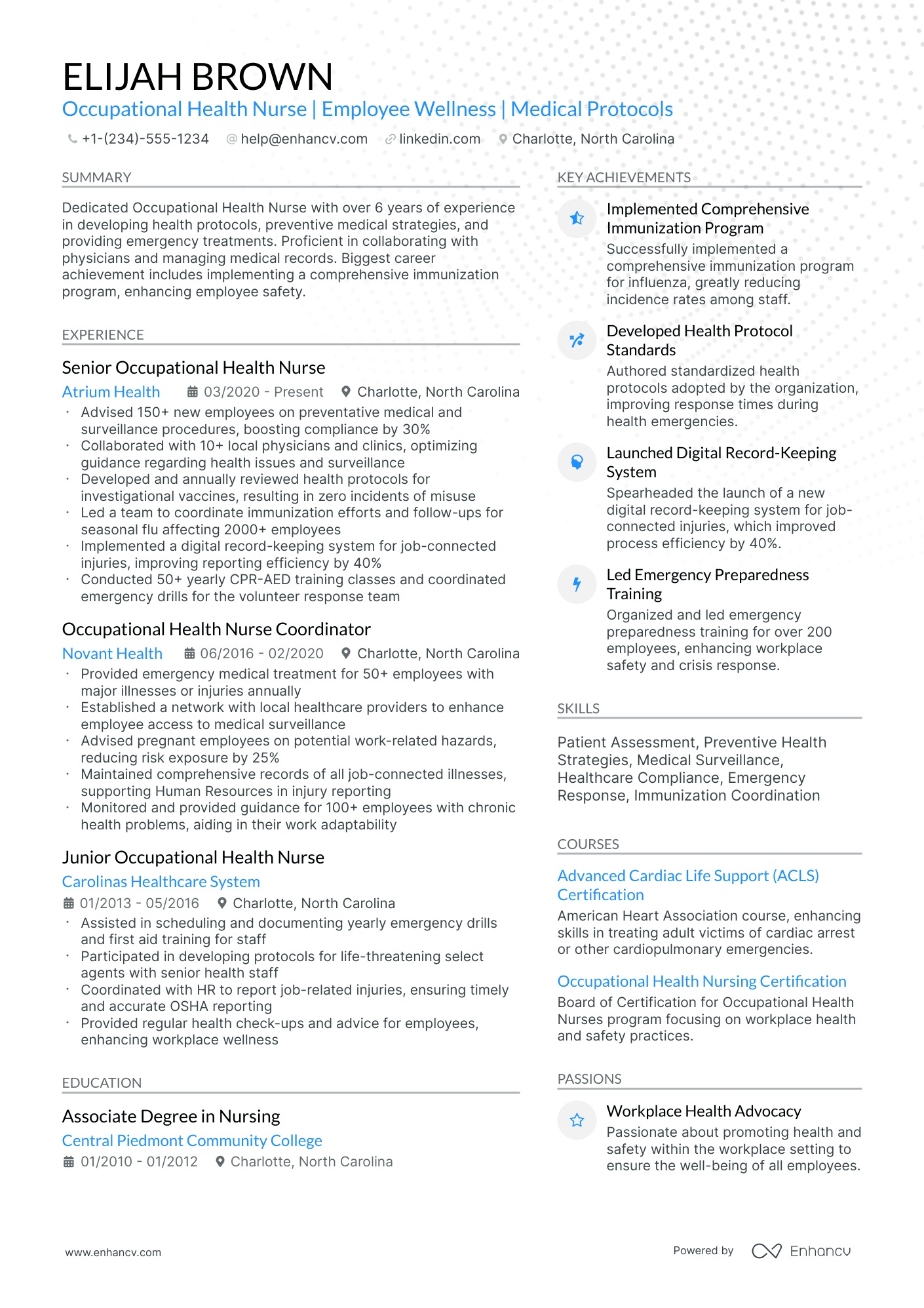
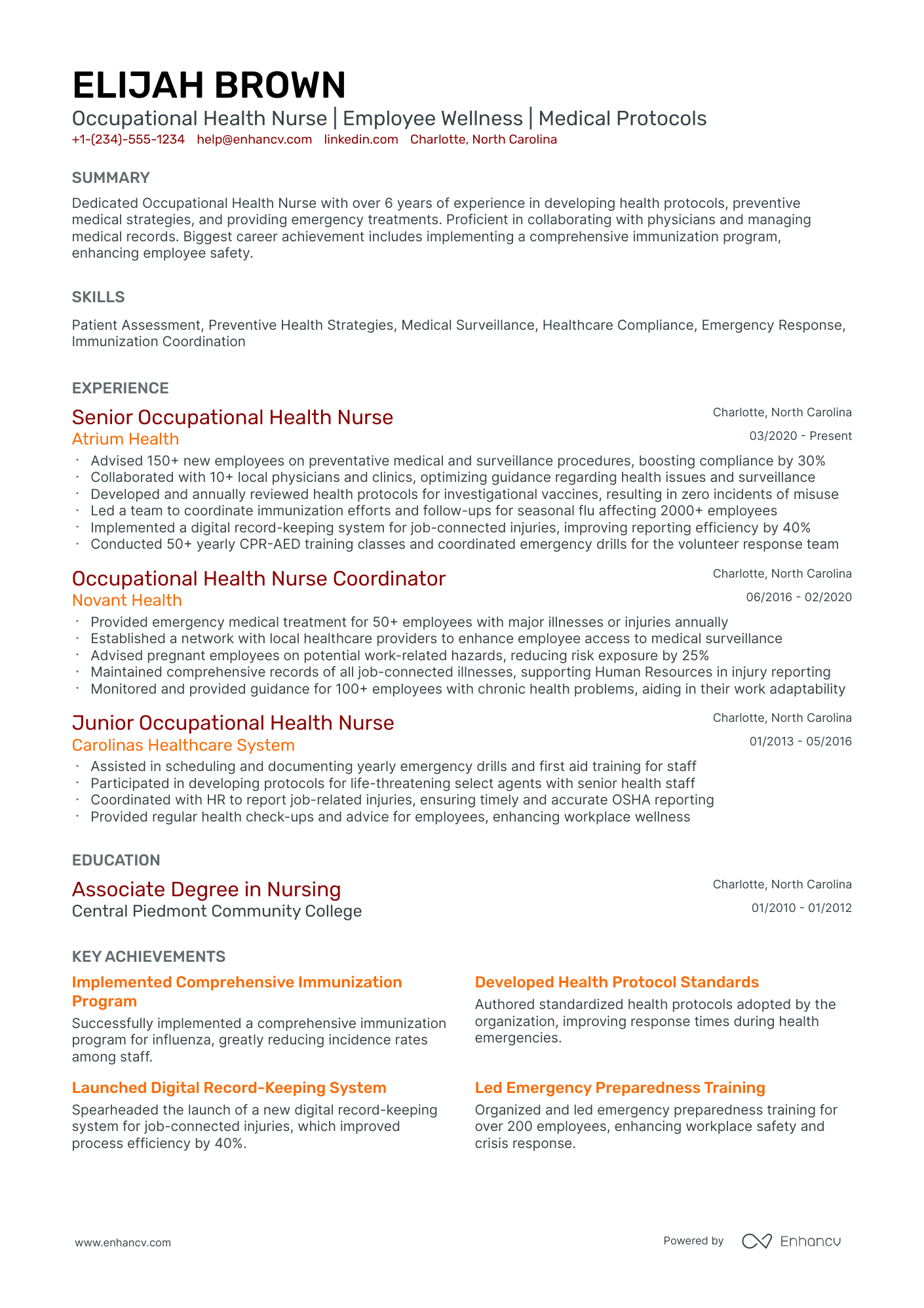
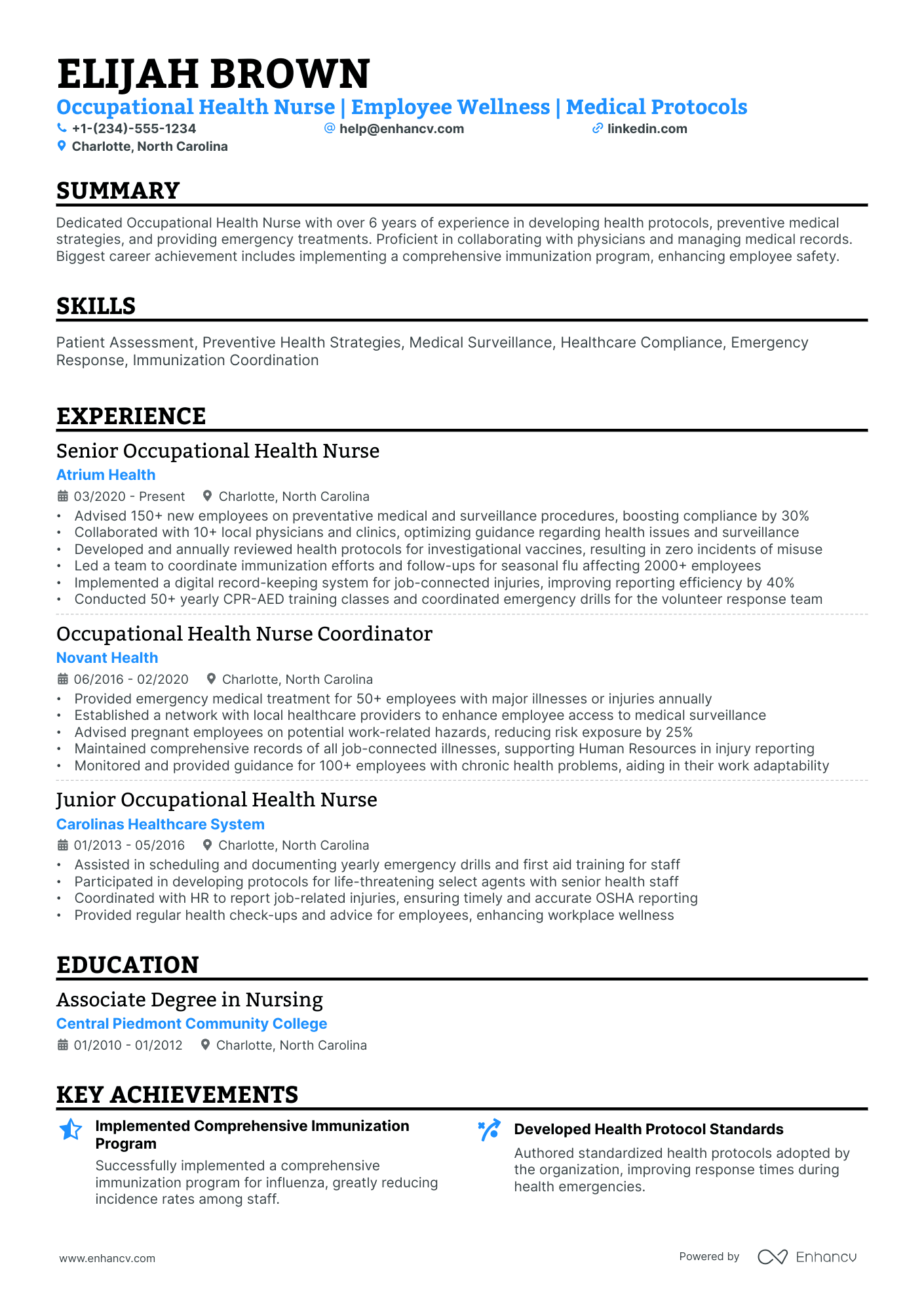
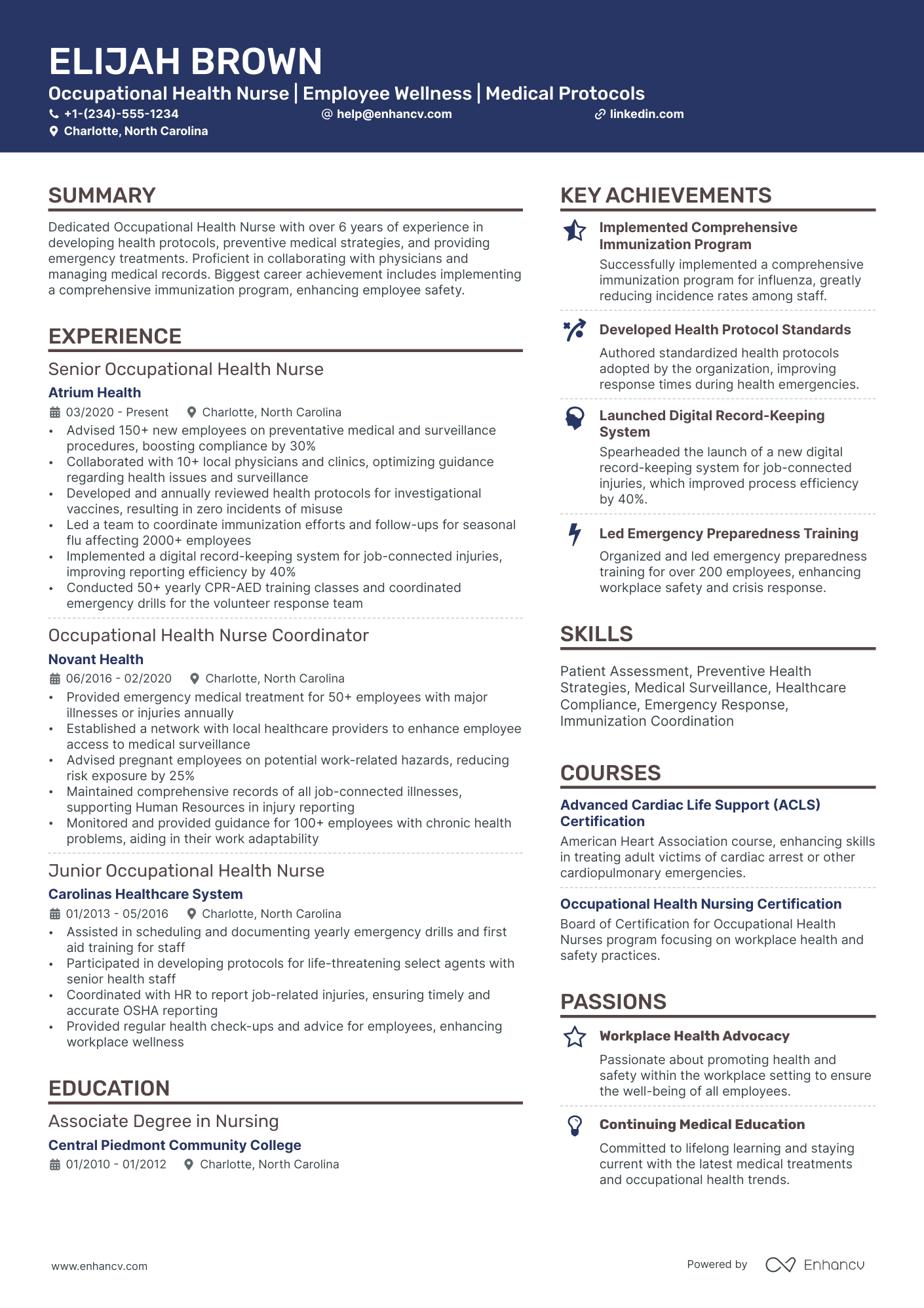
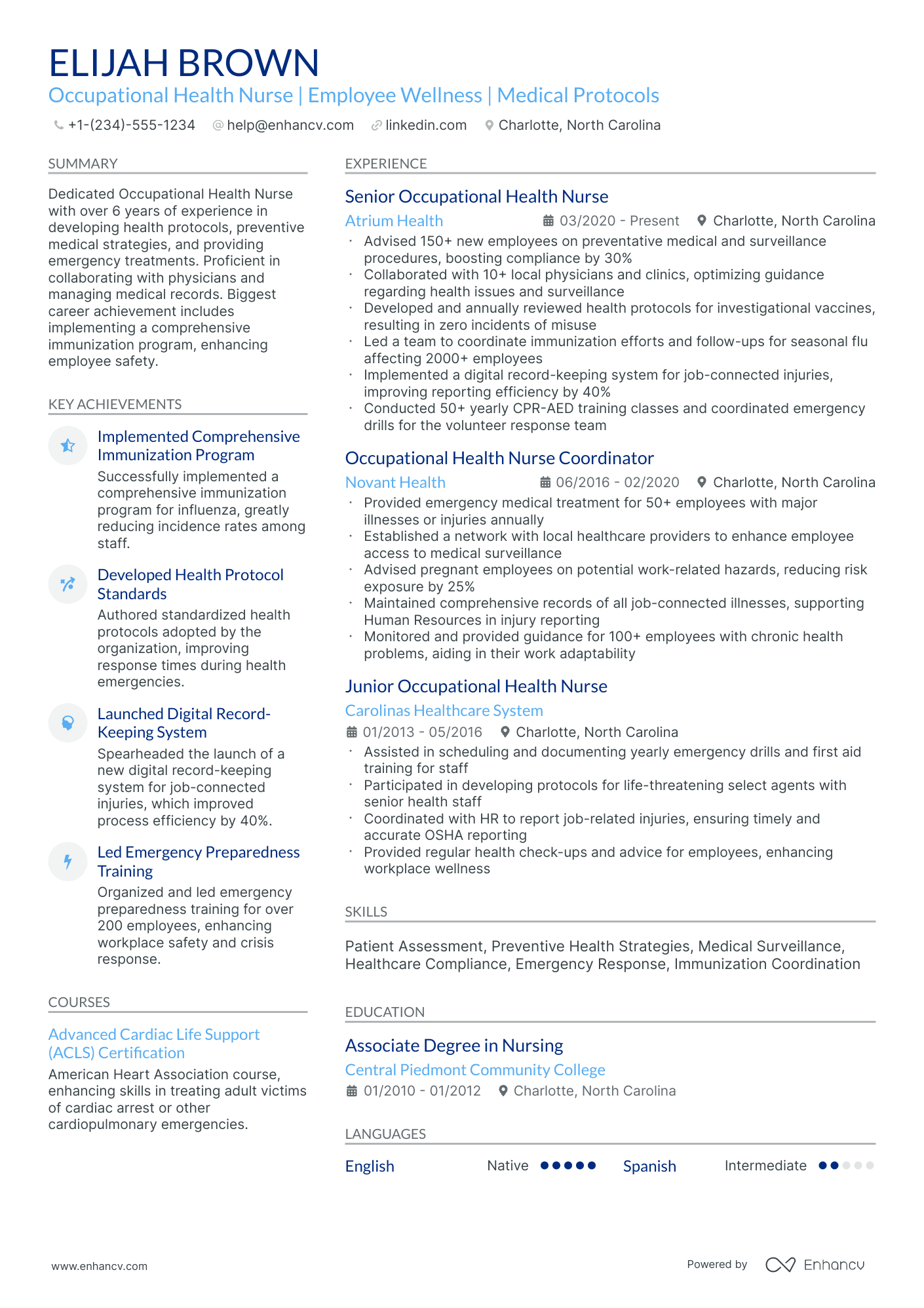
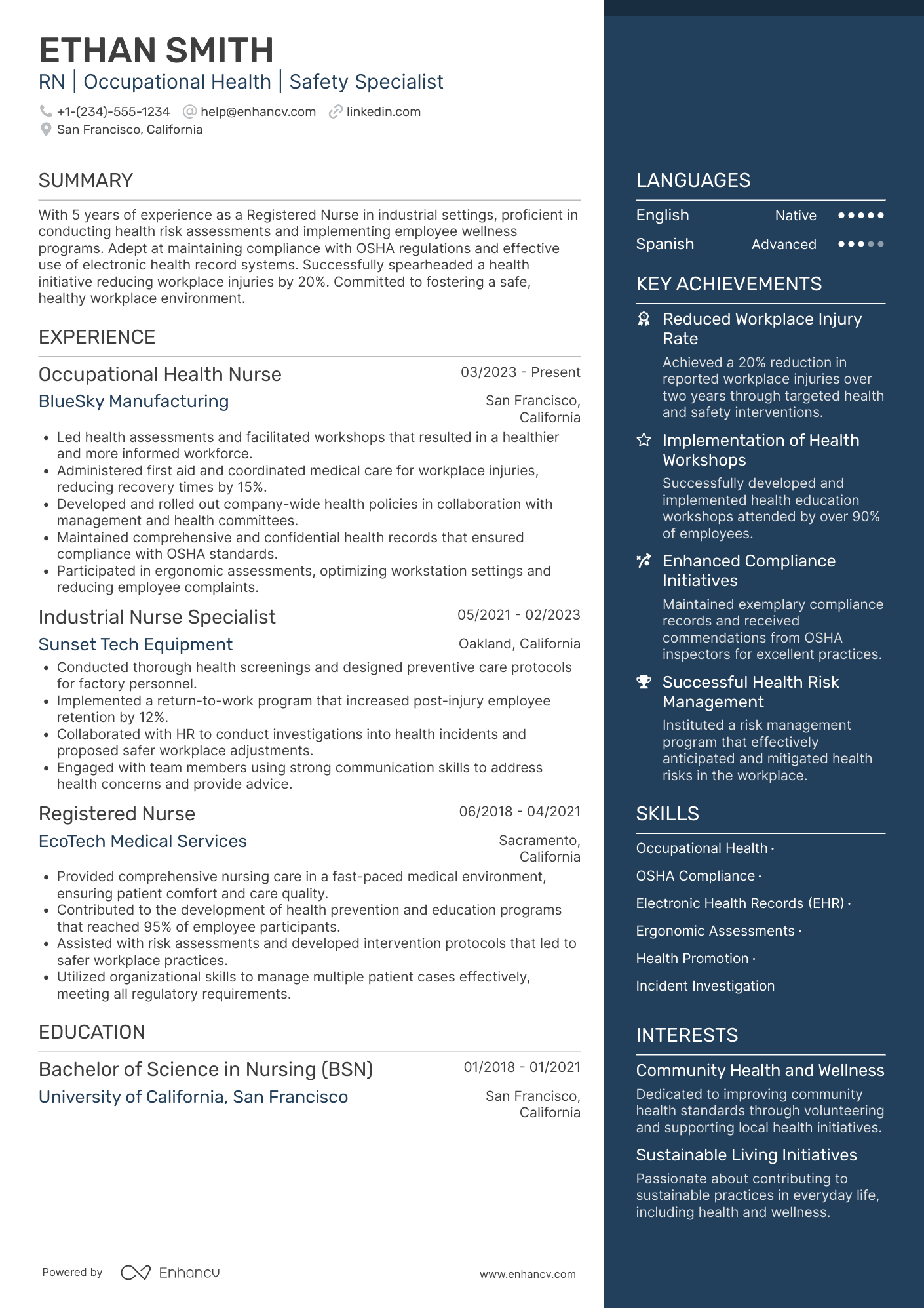
Many occupational health nurse resume drafts fail because they bury compliance impact under task lists and generic clinic duties. That costs you in ATS screening and fast recruiter scans, where high competition rewards clear, role-specific results.
A strong resume shows how you protect workers and reduce risk. Knowing how to make your resume stand out starts with highlighting outcomes like reduced recordable incidents, faster return-to-work timelines, audit-ready documentation, vaccination program coverage, and fewer lost workdays across defined headcount.

Key takeaways
- Quantify injury reductions, return-to-work timelines, and compliance audit results in every experience bullet.
- Use reverse-chronological format if experienced; use a hybrid format when transitioning into occupational health.
- Mirror the job posting's exact regulatory terms, software names, and surveillance methods throughout your resume.
- Tie every listed skill to a specific action and measurable outcome, not just a keyword.
- Place certifications like COHN or COHN-S near your education to signal specialized occupational health expertise.
- Write a three- to four-line summary featuring your setting, core skills, and strongest metric.
- Use Enhancv's Bullet Point Generator to turn routine duties into recruiter-ready, quantified resume bullets.
How to format a occupational health nurse resume
Recruiters evaluating occupational health nurse resumes prioritize clinical competency in workplace health, regulatory compliance knowledge (OSHA, workers' compensation), and the ability to manage employee health programs across diverse settings. Choosing the right resume format ensures these signals surface quickly during both human review and applicant tracking system (ATS) parsing, where disorganized layouts can bury your strongest qualifications.

I have significant experience in this role—which format should I use?
Use a reverse-chronological format to clearly present your progression in occupational health nursing and the expanding scope of your clinical and programmatic responsibilities. Do:
- Lead with your most recent role and highlight the scope of your practice—number of employees served, sites managed, and program ownership.
- Feature role-specific competencies such as case management, workplace hazard assessment, OSHA recordkeeping, return-to-work coordination, and health surveillance protocols.
- Quantify outcomes tied to cost savings, injury reduction, compliance audit results, or improvements in employee wellness metrics.
I'm junior or switching into this role—what format works best?
A hybrid format works best, allowing you to lead with a focused skills section while still providing a chronological work history that shows how you've applied those skills. Do:
- Place a skills section near the top that highlights occupational health competencies such as health screenings, injury triage, OSHA compliance, and employee wellness education—even if gained through clinical rotations or adjacent nursing roles.
- Include projects, certifications, or transitional experience that demonstrates direct relevance, such as completing a COHN certification, coordinating a flu vaccination drive, or conducting workplace safety audits during a practicum.
- Connect every listed skill to a specific action and a measurable or observable result to show practical application rather than theoretical knowledge.
Why not use a functional resume?
A functional format strips away the timeline and context that hiring managers need to evaluate where, when, and how you applied your occupational health nursing skills, making it harder to verify your readiness for the role. Avoid a functional format entirely if you have any relevant clinical or occupational health experience that can be placed in a chronological or hybrid structure.
- A functional resume may be acceptable if you're a registered nurse transitioning from an unrelated specialty (such as pediatrics or med-surg) with no direct occupational health experience, or if you have a significant employment gap—but even then, every listed skill must be tied to a specific project, clinical rotation, or certification outcome rather than presented in isolation.
With your format established, the next step is filling it with the right sections to present your qualifications effectively.
What sections should go on a occupational health nurse resume
Recruiters expect to see you can deliver compliant, outcomes-driven employee health services in occupational and industrial settings. Understanding which resume sections to include will help you use this structure for maximum clarity:
- Header
- Summary
- Experience
- Skills
- Projects
- Education
- Certifications
- Optional sections: Awards, Leadership, Volunteering
Strong experience bullets should emphasize measurable impact, case volume and scope, compliance outcomes, and results in injury prevention, return-to-work, and incident response.
Is your resume good enough?
Drop your resume here or choose a file. PDF & DOCX only. Max 2MB file size.
Once you’ve organized the key resume components, the next step is to write your occupational health nurse experience section so those details translate into clear, job-relevant impact.
How to write your occupational health nurse resume experience
The experience section is where you prove you've delivered real results as an occupational health nurse—through clinical interventions, workplace safety programs, regulatory compliance efforts, and employee wellness initiatives that produced measurable outcomes. Building a targeted resume means hiring managers see demonstrated impact over descriptive task lists, so every bullet should reflect work you shipped, tools or methods you applied, and the tangible difference you made.
Each entry should include:
- Job title
- Company and location (or remote)
- Dates of employment (month and year)
Three to five concise bullet points showing what you owned, how you executed, and what outcomes you delivered:
- Ownership scope: the employee populations, workplace health programs, injury prevention initiatives, case management caseloads, or clinic operations you were directly accountable for as an occupational health nurse.
- Execution approach: the clinical assessment protocols, surveillance tools, electronic health record systems, OSHA compliance frameworks, return-to-work methodologies, or ergonomic evaluation techniques you used to guide decisions and deliver care.
- Value improved: changes to workplace injury rates, employee health outcomes, regulatory compliance status, return-to-work timelines, program accessibility, or organizational risk reduction tied to your occupational health nursing practice.
- Collaboration context: how you partnered with safety teams, human resources, industrial hygienists, physicians, insurance carriers, union representatives, or external regulatory agencies to advance health and safety objectives.
- Impact delivered: outcomes expressed through reductions in recordable incidents, improvements in workforce wellness metrics, successful audit results, or cost containment—framed as results and scale rather than activity.
Experience bullet formula
A occupational health nurse experience example
✅ Right example - modern, quantified, specific.
occupational health nurse
Riverton Manufacturing Group | Columbus, OH
2021–Present
Supported a one thousand two hundred employee automotive parts plant with twenty-four seven operations and high-risk industrial exposures.
- Implemented an electronic occupational health record workflow in Epic, cutting incident documentation time by 35% and improving OSHA 300 log accuracy to 98% through standardized templates and audit checks.
- Led hearing conservation and respiratory protection programs using NIOSH protocols, audiometry software, and spirometry testing, reducing recordable noise-related threshold shifts by 22% year over year.
- Conducted fit testing and exposure surveillance with qualitative and quantitative methods, partnering with EHS, industrial hygiene consultants, and plant leadership to lower respirator noncompliance from 18% to 6%.
- Coordinated post-offer and periodic medical surveillance, drug screening chain-of-custody, and return-to-work plans in collaboration with HR, supervisors, and workers’ compensation carriers, cutting lost-time days by 17% and lowering claim costs by 12%.
- Delivered targeted safety and ergonomics training using root cause analysis and job hazard analysis findings, decreasing first aid cases by 14% and improving near-miss reporting volume by 28% through a streamlined reporting workflow in the EHS management system.
Now that you've seen what a strong experience entry looks like, let's break down how to adapt yours to match the specific job you're targeting.
How to tailor your occupational health nurse resume experience
Recruiters evaluate your occupational health nurse resume through applicant tracking systems and manual review, filtering for specific qualifications and skills. Tailoring your resume to the job description by mirroring the posting's language and priorities increases your chances of passing both screenings.
Ways to tailor your occupational health nurse experience:
- Match workplace health surveillance tools and software named in the posting.
- Use the exact regulatory terminology like OSHA standards from the listing.
- Mirror injury reduction or return-to-work metrics the employer prioritizes.
- Highlight industry-specific experience such as manufacturing or construction settings.
- Emphasize compliance program development if the role requires regulatory oversight.
- Reference case management workflows or triage protocols the posting describes.
- Include health promotion or ergonomic assessment methods the employer values.
- Align your documentation practices with the electronic health record systems listed.
Tailoring means connecting your real accomplishments to what the employer asks for, not forcing unrelated keywords into your experience.
Resume tailoring examples for occupational health nurse
| Job description excerpt | Untailored | Tailored |
|---|---|---|
| Conduct workplace health surveillance programs, including audiometric testing, spirometry, and biological monitoring for employees exposed to hazardous substances. | Performed various health screenings for employees. | Administered audiometric testing, spirometry, and biological monitoring for 400+ employees exposed to hazardous substances as part of an ongoing workplace health surveillance program. |
| Manage workers' compensation cases from initial injury reporting through return-to-work coordination, using OccuMed EHR to document all case activity. | Helped with injury cases and paperwork. | Managed 60+ workers' compensation cases annually from initial injury reporting through return-to-work coordination, documenting all case activity and outcomes in OccuMed EHR. |
| Develop and deliver site-specific health education programs on topics including respiratory protection, bloodborne pathogen exposure, and ergonomic injury prevention. | Provided health education to staff on various topics. | Developed and delivered site-specific training on respiratory protection, bloodborne pathogen exposure, and ergonomic injury prevention across three manufacturing facilities, reducing recordable injuries by 18% year over year. |
Once you’ve aligned your experience with the role’s requirements, quantify your achievements to show the measurable impact of that work.
How to quantify your occupational health nurse achievements
Quantifying your achievements proves clinical, compliance, and business impact. Focus on case volume, injury rates, return-to-work speed, audit results, vaccination coverage, and cost savings from fewer claims and lost-time days.
Quantifying examples for occupational health nurse
| Metric | Example |
|---|---|
| Injury rate | "Cut OSHA recordable injuries from 3.2 to 2.1 per 100 full-time employees in twelve months by improving incident triage and ergonomic referrals." |
| Return-to-work time | "Reduced average return-to-work cycle time from fourteen to nine days across forty-five cases by coordinating modified duty plans with HR and supervisors." |
| Compliance audits | "Achieved a ninety-eight percent score on a corporate health and safety audit by updating exposure control plans and closing twenty-two corrective actions early." |
| Immunization coverage | "Raised flu vaccination coverage from sixty-two percent to eighty-one percent for one thousand two hundred employees using on-site clinics and Microsoft Excel tracking." |
| Claims cost | "Lowered workers' compensation claim costs by $180,000 year over year by early case management, vendor coordination, and tighter documentation in the electronic health record." |
Turn vague job duties into measurable, recruiter-ready resume bullets in seconds with Enhancv's Bullet Point Generator.
With strong bullet points in place, the next step is ensuring your occupational health nurse resume highlights the right mix of hard and soft skills.
How to list your hard and soft skills on a occupational health nurse resume
Your skills section shows you can prevent workplace injuries, manage regulatory requirements, and coordinate care—recruiters and an ATS (applicant tracking system) scan this section to match keywords, so aim for a balanced mix of role-specific clinical hard skills and job-critical soft skills. occupational health nurse roles require a blend of:
- Product strategy and discovery skills.
- Data, analytics, and experimentation skills.
- Delivery, execution, and go-to-market discipline.
- Soft skills.
Your skills section should be:
- Scannable (bullet-style grouping).
- Relevant to the job post.
- Backed by proof in experience bullets.
- Updated with current tools.
Place your skills section:
- Above experience if you're junior or switching careers.
- Below experience if you're mid/senior with strong achievements.

Hard skills
- OSHA recordkeeping, 300/300A/301
- Workers' compensation case management
- Return-to-work, transitional duty programs
- Fit testing, respiratory protection programs
- Audiometry, hearing conservation programs
- Spirometry testing and interpretation
- Immunizations, vaccine program management
- Drug and alcohol testing coordination
- Pre-placement and periodic exams
- Exposure assessment, hazard identification
- EHR documentation, Epic, Cerner
- Emergency response, first aid, CPR, AED
Soft skills
- Triage and prioritize urgent cases
- Communicate clinical findings clearly
- Educate employees on prevention
- Coach leaders on safe practices
- Coordinate care across vendors
- De-escalate high-stress situations
- Document decisions with rationale
- Manage confidential information
- Resolve conflicts with empathy
- Advocate for evidence-based changes
- Follow up to close care loops
- Influence without formal authority
How to show your occupational health nurse skills in context
Skills shouldn't live only in a bulleted list on your resume. Browse resume skills examples to see how top candidates weave competencies throughout their documents.
They should be demonstrated in:
- Your summary (high-level professional identity)
- Your experience (proof through outcomes)
Here's how that looks in practice.
Summary example
Occupational health nurse with 12 years in manufacturing settings, skilled in OSHA compliance, ergonomic assessments, and case management using OHM software. Reduced recordable injury rates by 34% through proactive surveillance programs and cross-departmental safety collaboration.
- Reflects senior-level experience clearly
- Names role-specific tools and methods
- Includes a strong measurable outcome
- Highlights collaboration as a soft skill
Experience example
Senior Occupational Health Nurse
Trident Steel Corporation | Gary, IN
March 2018–Present
- Implemented a hearing conservation program using audiometric tracking software, reducing noise-related incidents by 27% across three plant facilities.
- Partnered with HR and safety teams to redesign return-to-work protocols, cutting average lost workdays from 14 to 6 per case.
- Conducted over 1,200 annual health screenings and managed OSHA 300 logs, achieving zero reporting violations during two consecutive compliance audits.
- Every bullet includes measurable proof
- Skills appear naturally within achievements
Once you’ve demonstrated your occupational health nurse abilities through specific examples and outcomes, the next step is to apply that approach to a resume when you have no experience, so you can still present relevant strengths clearly.
How do I write a occupational health nurse resume with no experience
Even without full-time experience, you can demonstrate readiness through clinical training and academic projects. Our guide on writing a resume without work experience covers this in detail. Consider showcasing:
- Occupational health nurse clinical rotations
- OSHA-compliant safety training coursework
- Employee health screening practicums
- First aid and CPR certifications
- Immunization clinic volunteer shifts
- Case management simulation projects
- Exposure incident documentation exercises
- EHR charting labs and audits
Focus on:
- OSHA reporting and documentation accuracy
- Screening workflows and vaccination protocols
- Exposure control and incident follow-up
- EHR proficiency with audit trail
Resume format tip for entry-level occupational health nurse
Use a combination resume format because it highlights relevant skills and training first, while still showing clinical and project experience. Do:
- Lead with a targeted summary for occupational health nurse roles.
- Add a skills section tied to evidence.
- List rotations and practicums like jobs.
- Quantify screenings, audits, or training hours.
- Include OSHA, HIPAA, and EHR details.
- Completed employee health screening practicums by documenting 60 respiratory screenings in an EHR, achieving 98% chart completeness on faculty audit.
Once you've structured your resume to highlight strengths beyond direct work history, presenting your education effectively becomes your most powerful tool for demonstrating relevant qualifications.
How to list your education on a occupational health nurse resume
Your education section lets hiring teams quickly confirm you hold the clinical and safety training an occupational health nurse needs. It validates your foundational knowledge at a glance.
Include:
- Degree name
- Institution
- Location
- Graduation year
- Relevant coursework (for juniors or entry-level candidates)
- Honors & GPA (if 3.5 or higher)
Skip month and day details—list the graduation year only.
Here's a strong education entry tailored for an occupational health nurse:
Example education entry
Bachelor of Science in Nursing
University of Cincinnati, Cincinnati, OH
Graduated 2021
GPA: 3.7/4.0
- Relevant Coursework: Epidemiology, Workplace Health Promotion, Toxicology, Community Health Nursing, Environmental Health and Safety
- Honors: Magna Cum Laude, Dean's List (all semesters)
How to list your certifications on a occupational health nurse resume
Certifications show an occupational health nurse's commitment to ongoing learning, proficiency with clinical and safety tools, and alignment with current workplace health standards. Learn more about how to list certifications on your resume effectively.
Include:
- Certificate name
- Issuing organization
- Year
- Optional: credential ID or URL
- Place certifications below education when they are older, broadly applicable, or less relevant than your degree and core clinical training.
- Place certifications above education when they are recent, role-specific, or required for the occupational health nurse positions you target.
Best certifications for your occupational health nurse resume
- Certified Occupational Health Nurse (COHN)
- Certified Occupational Health Nurse-Specialist (COHN-S)
- Basic Life Support (BLS)
- Advanced Cardiovascular Life Support (ACLS)
- OSHA 30-Hour General Industry
- Certified Case Manager (CCM)
- Certified Safety Professional (CSP)
Once you’ve positioned your credentials where hiring managers can find them fast, turn to your occupational health nurse resume summary to connect those qualifications to your most relevant strengths.
How to write your occupational health nurse resume summary
Your resume summary is the first thing a recruiter reads. A strong one instantly positions you as a qualified occupational health nurse worth interviewing.
Keep it to three to four lines, with:
- Your title and total years of nursing or occupational health experience.
- The industry or setting you've worked in, such as manufacturing, corporate, or construction.
- Core skills like workplace injury assessment, OSHA compliance, or health surveillance programs.
- One or two measurable achievements, such as injury rate reductions or program participation increases.
- Soft skills tied to outcomes, like employee communication that improved return-to-work rates.

PRO TIP
At this level, focus on clinical skills, relevant certifications, and early measurable contributions. Highlight familiarity with OSHA standards and employee wellness tools. Avoid vague phrases like "passionate about helping others" or "team player." Instead, tie every detail to a specific workplace health outcome or efficiency gain.
Example summary for a occupational health nurse
Occupational health nurse with three years of experience in manufacturing settings. Reduced recordable injury rates by 18% through proactive screening protocols and OSHA-compliant wellness programs. Skilled in case management, health surveillance, and return-to-work coordination.
Optimize your resume summary and objective for ATS
Drop your resume here or choose a file.
PDF & DOCX only. Max 2MB file size.
Now that your summary captures your professional value, make sure your header presents your contact details correctly so recruiters can actually reach you.
What to include in a occupational health nurse resume header
A well-crafted resume header lists your key contact and professional links, improving visibility, credibility, and recruiter screening for a occupational health nurse role.
Essential resume header elements
- Full name
- Tailored job title and headline
- Location
- Phone number
- Professional email
- GitHub link
- Portfolio link
A LinkedIn link helps recruiters verify experience quickly and supports screening.
Do not include photos on a occupational health nurse resume unless the role is explicitly front-facing or appearance-dependent.
Match your header job title to the posting and keep formatting consistent so recruiters can scan it in seconds.
Example
Occupational health nurse resume header
Jordan Taylor, RN, COHN-S — Occupational health nurse | OSHA compliance, injury triage, and return-to-work coordination
Phoenix, AZ
(602) 555-01XX
jordan.taylor@enhancv.com
github.com/jordantaylor yourwebsite.com linkedin.com/in/jordantaylor
Once your contact details and professional identifiers are clear at the top of the page, add targeted optional sections to strengthen the rest of your occupational health nurse resume.
Additional sections for occupational health nurse resumes
Adding extra sections helps you stand out when your core qualifications match other occupational health nurse candidates competing for the same role. For example, listing language skills on your resume can be especially valuable when serving multilingual workforces.
- Languages
- Certifications and licenses
- Professional affiliations
- Publications
- Continuing education
- Volunteer experience in workplace health
- Conference presentations
Once you've strengthened your resume with these supplementary sections, the next step is pairing it with a well-crafted cover letter to make an even stronger impression.
Do occupational health nurse resumes need a cover letter
A cover letter isn't required for an occupational health nurse, but it often helps in competitive roles or strict hiring processes. If you're unsure what a cover letter is or how it complements your resume, it can make a difference when employers expect clear alignment with safety, compliance, and onsite care needs.
Use a cover letter to add context your resume can't:
- Explain role or team fit by connecting your experience to the site's hazards, workforce needs, and safety culture.
- Highlight one or two relevant projects or outcomes, such as reducing recordable incidents, improving return-to-work timelines, or strengthening vaccination compliance.
- Show understanding of the business context by referencing the workforce, shift patterns, regulatory requirements, and how occupational health supports productivity and risk reduction.
- Address career transitions or non-obvious experience by translating skills from clinical, emergency, or case management work into occupational health nurse responsibilities.
Drop your resume here or choose a file.
PDF & DOCX only. Max 2MB file size.
Even if you decide a cover letter adds value for your application, using AI next helps you strengthen your occupational health nurse resume faster and with more consistency.
Using AI to improve your occupational health nurse resume
AI can sharpen your resume's clarity, structure, and impact. It helps you articulate complex responsibilities in concise, compelling language. If you're wondering which AI is best for writing resumes, the key is using it as a refinement tool, not a replacement. Once your content feels clear and role-aligned, step away from AI.
Here are 10 practical prompts to strengthen specific sections of your occupational health nurse resume:
Strengthen your summary
Quantify experience bullets
Sharpen skills relevance
Improve action verbs
Tailor to job postings
Clarify certifications
Refine education details
Tighten project descriptions
Eliminate redundancy
Align tone consistently
Conclusion
A strong occupational health nurse resume shows measurable outcomes, role-specific skills, and a clear structure. Highlight injury reduction, case closure rates, compliance audit results, and return-to-work timelines. Pair those results with triage, surveillance, vaccination programs, and incident investigation experience.
Keep sections easy to scan, and align your experience with the job posting. Use consistent titles, dates, and metrics to show impact and accountability. This approach positions you well for today’s hiring market and near-future expectations.