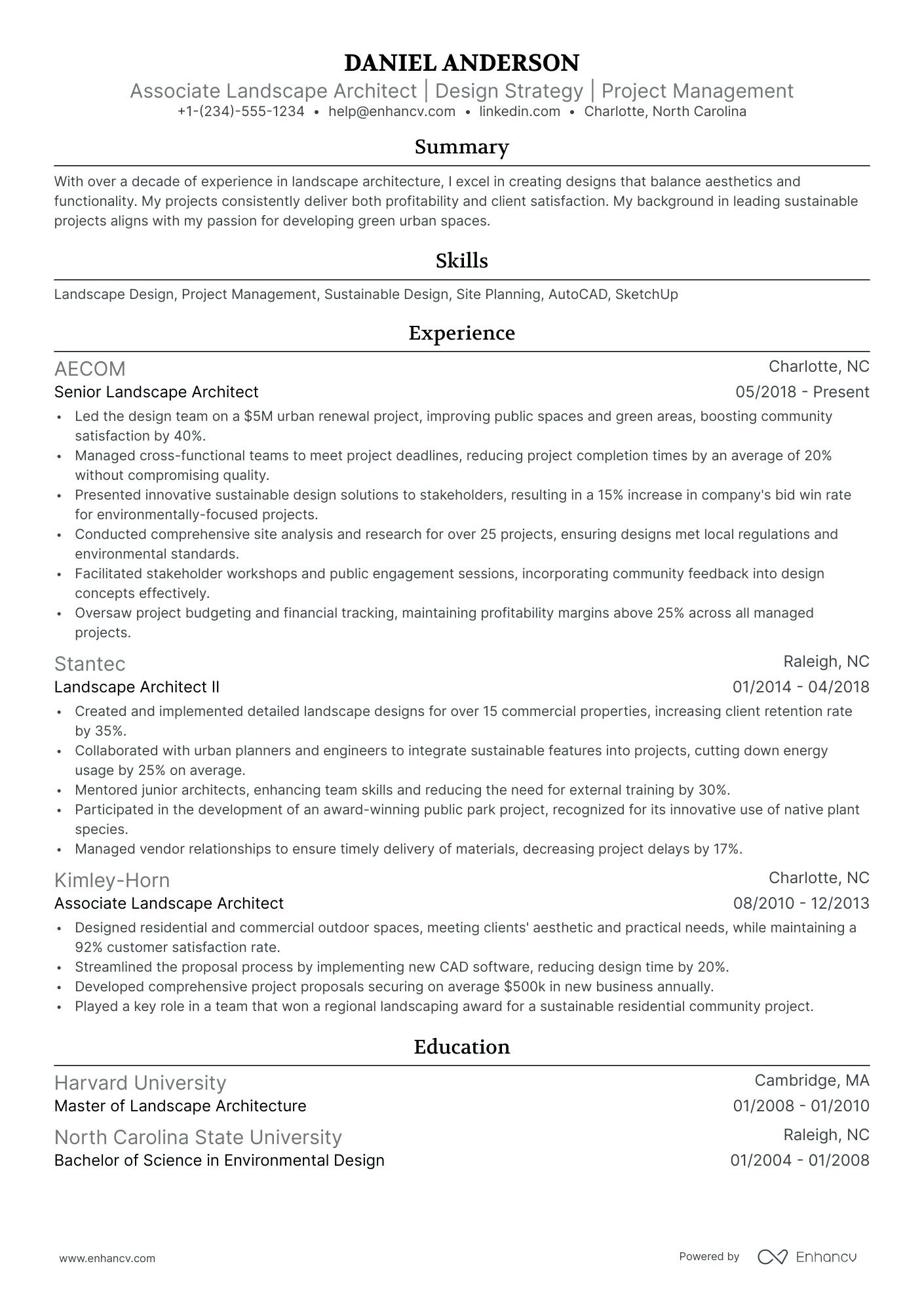
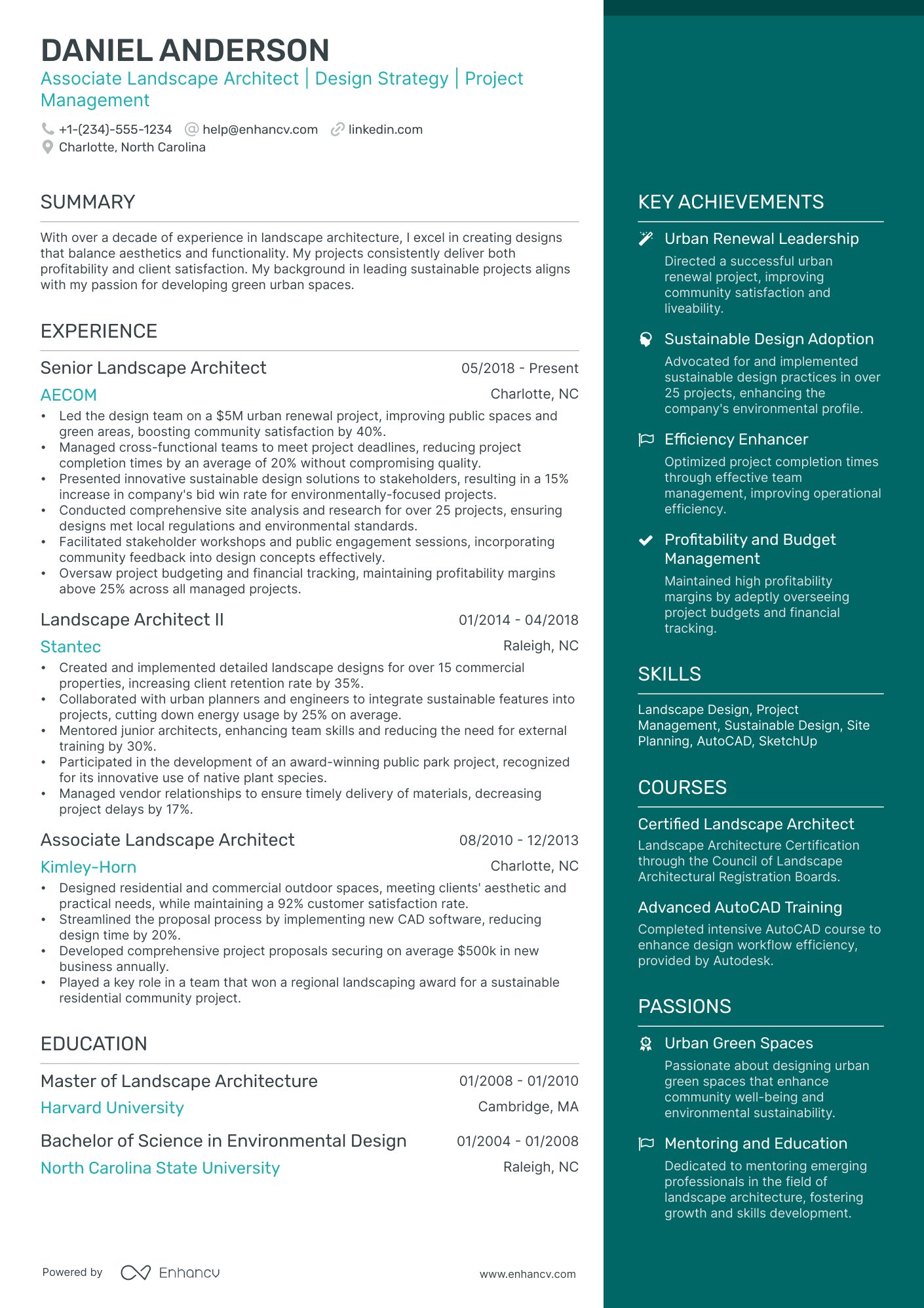
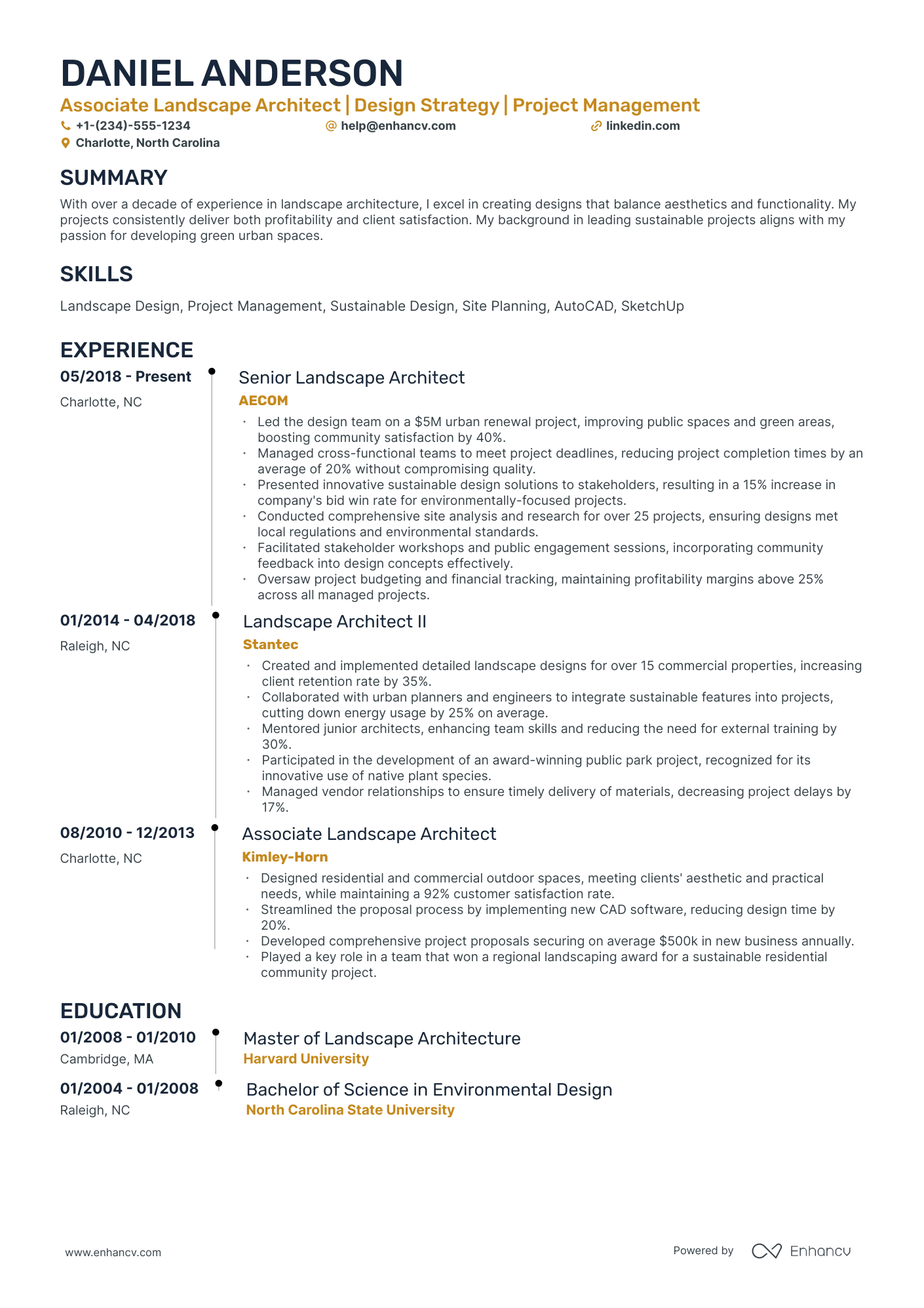
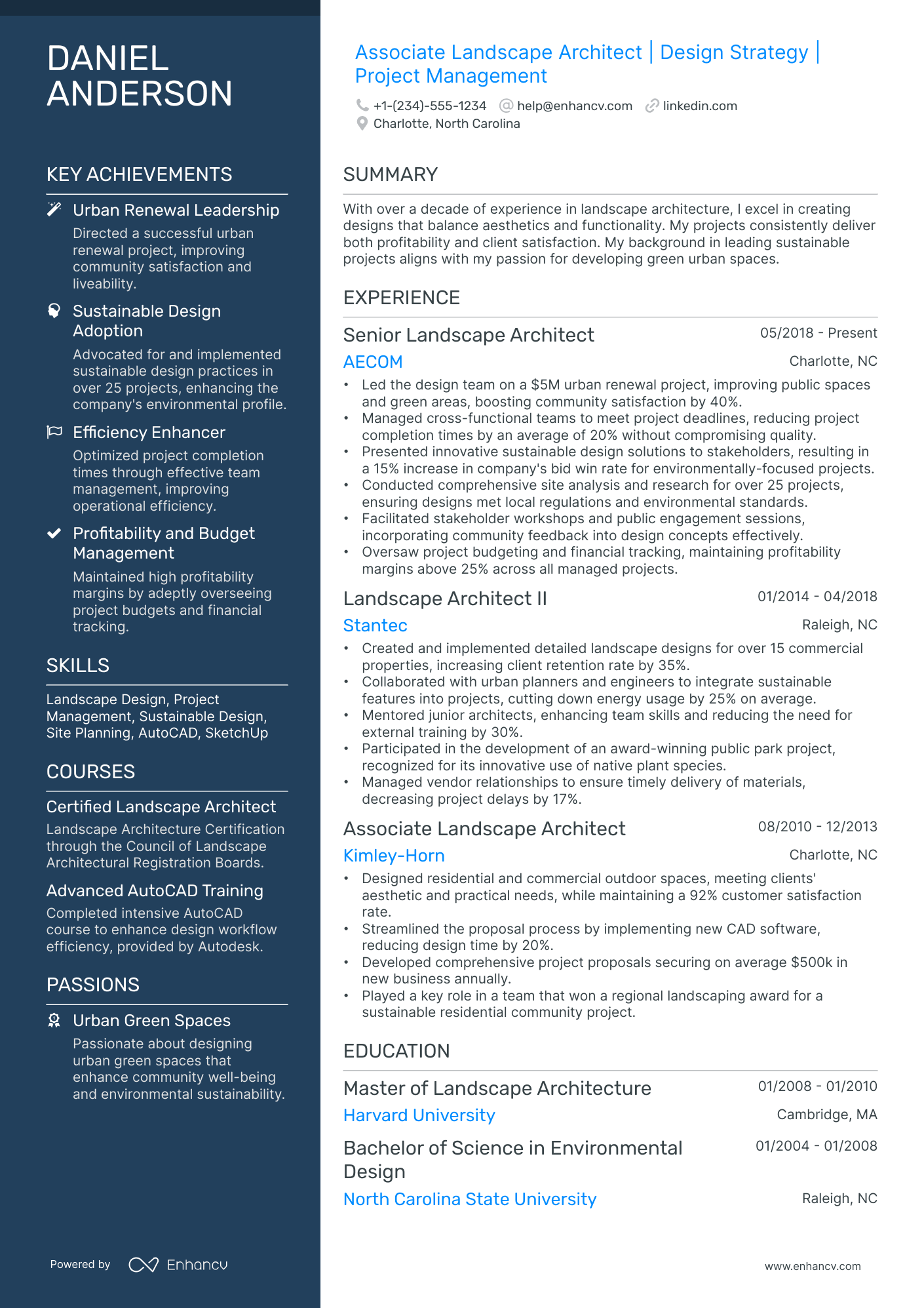
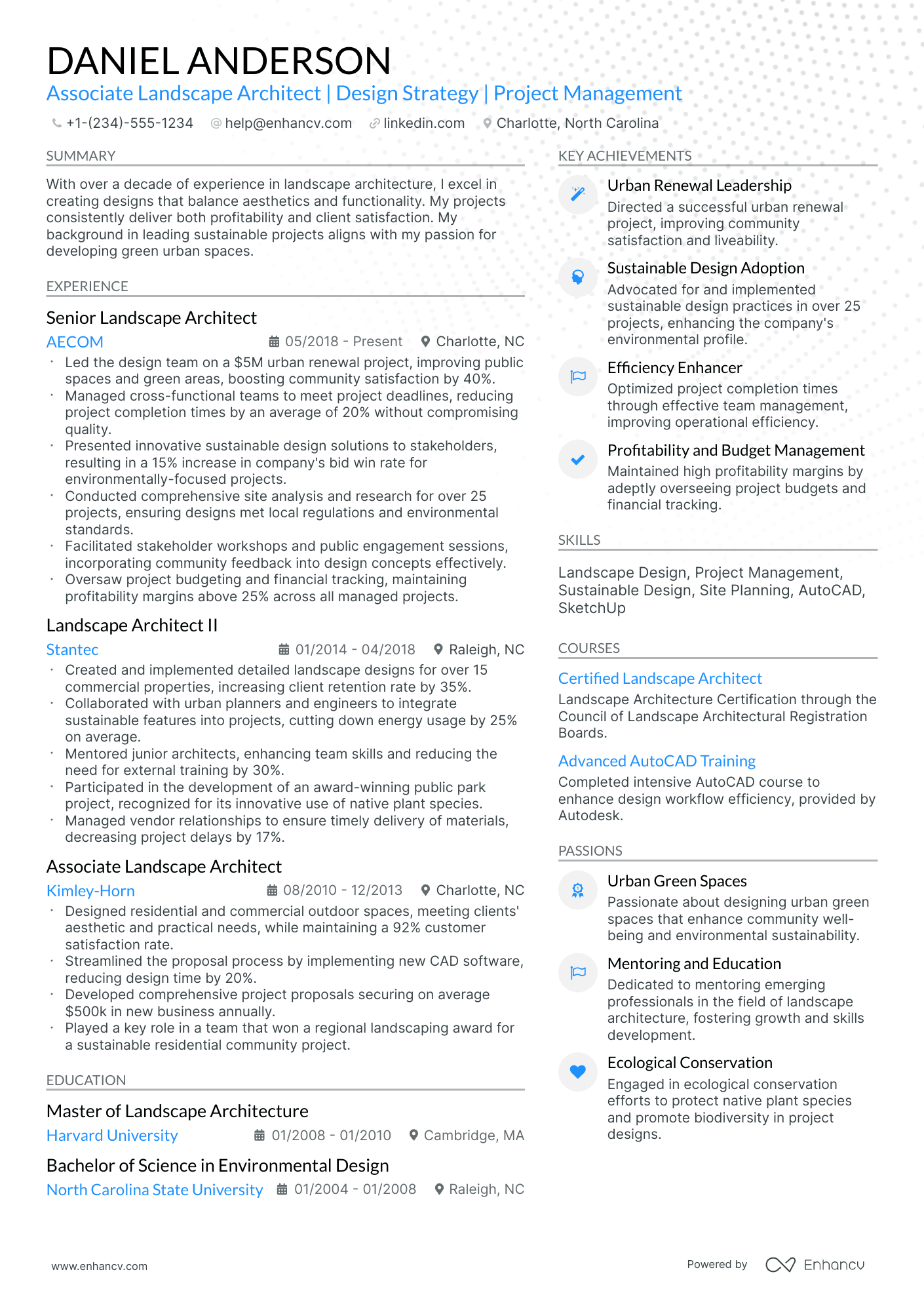
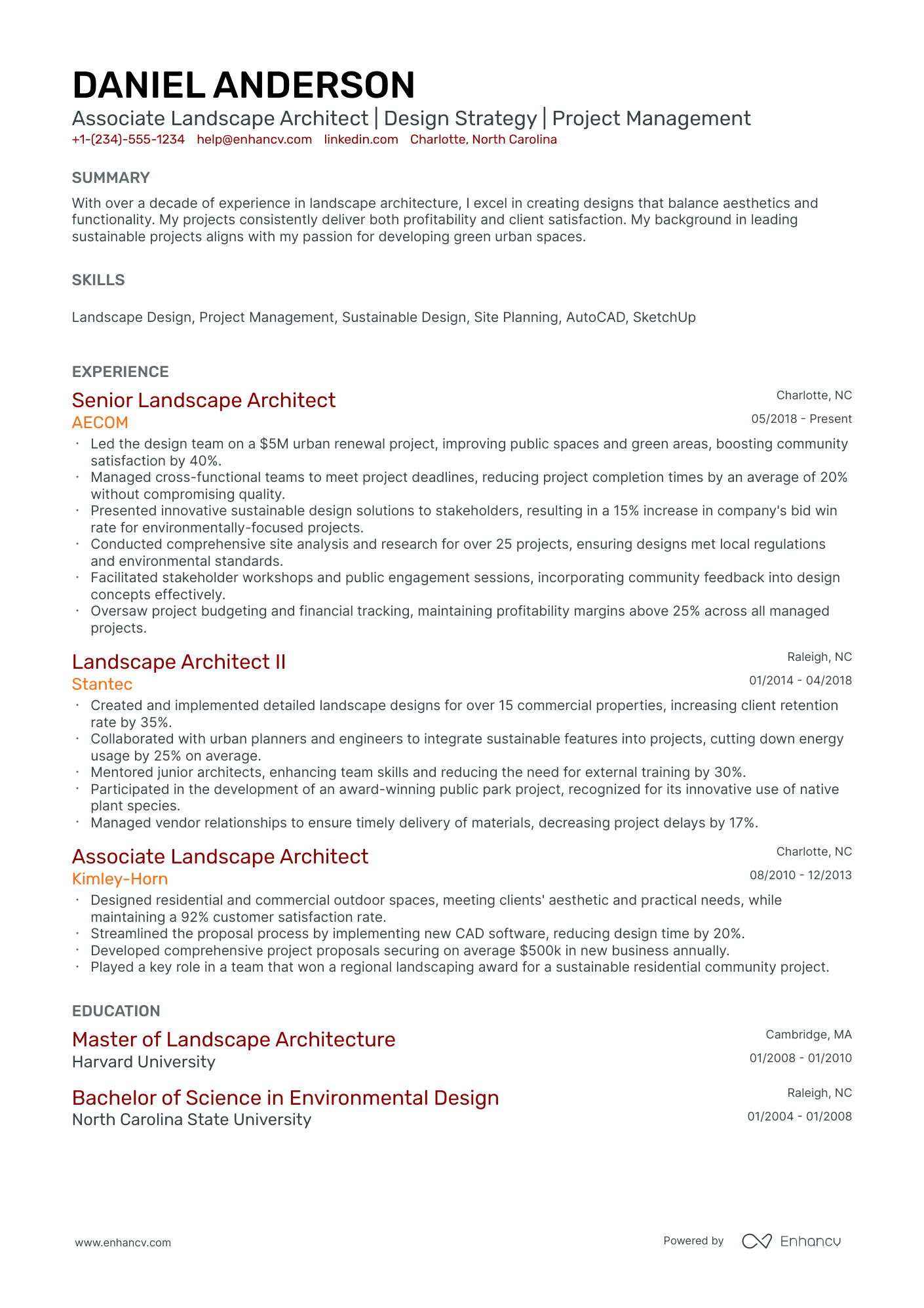
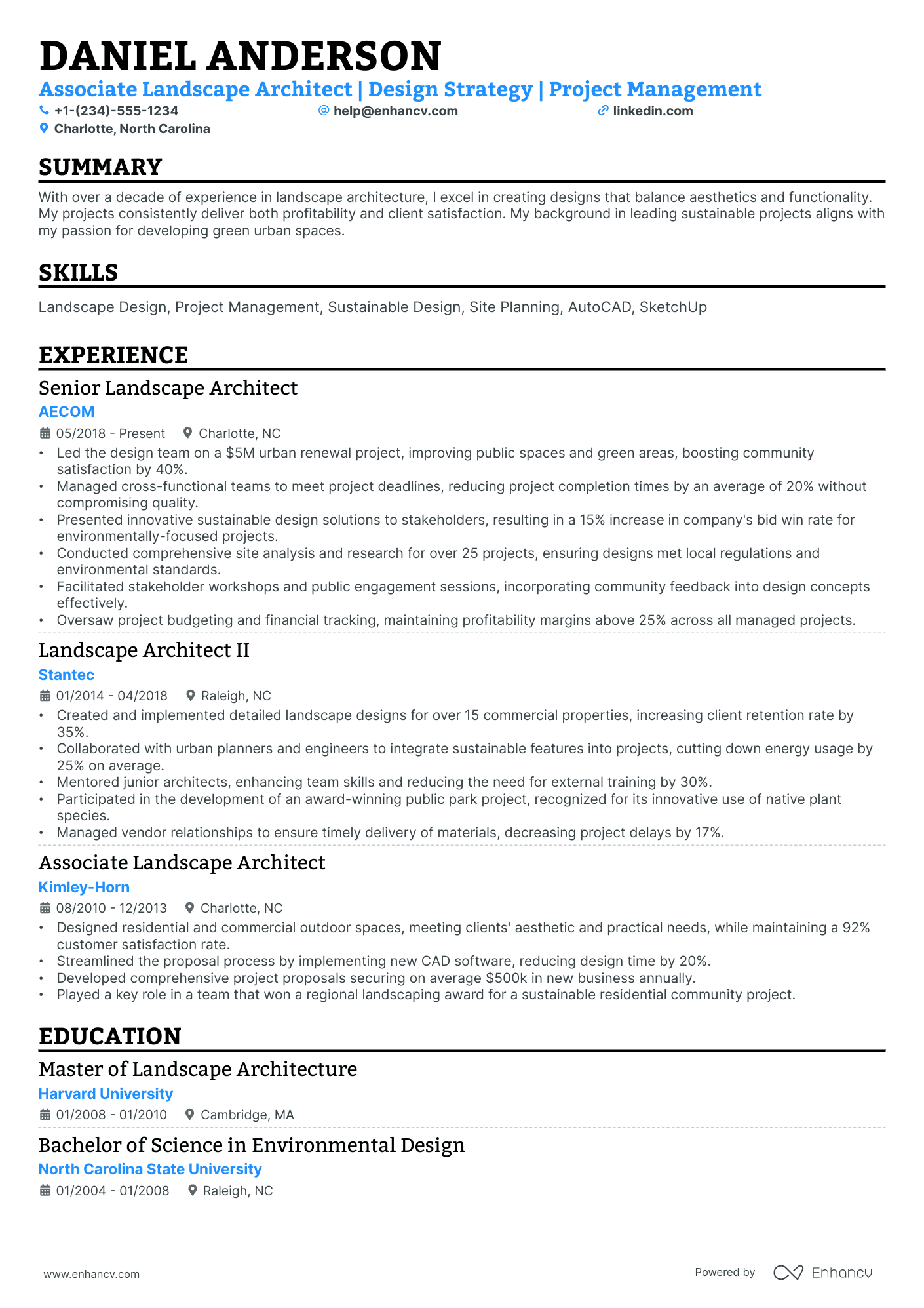
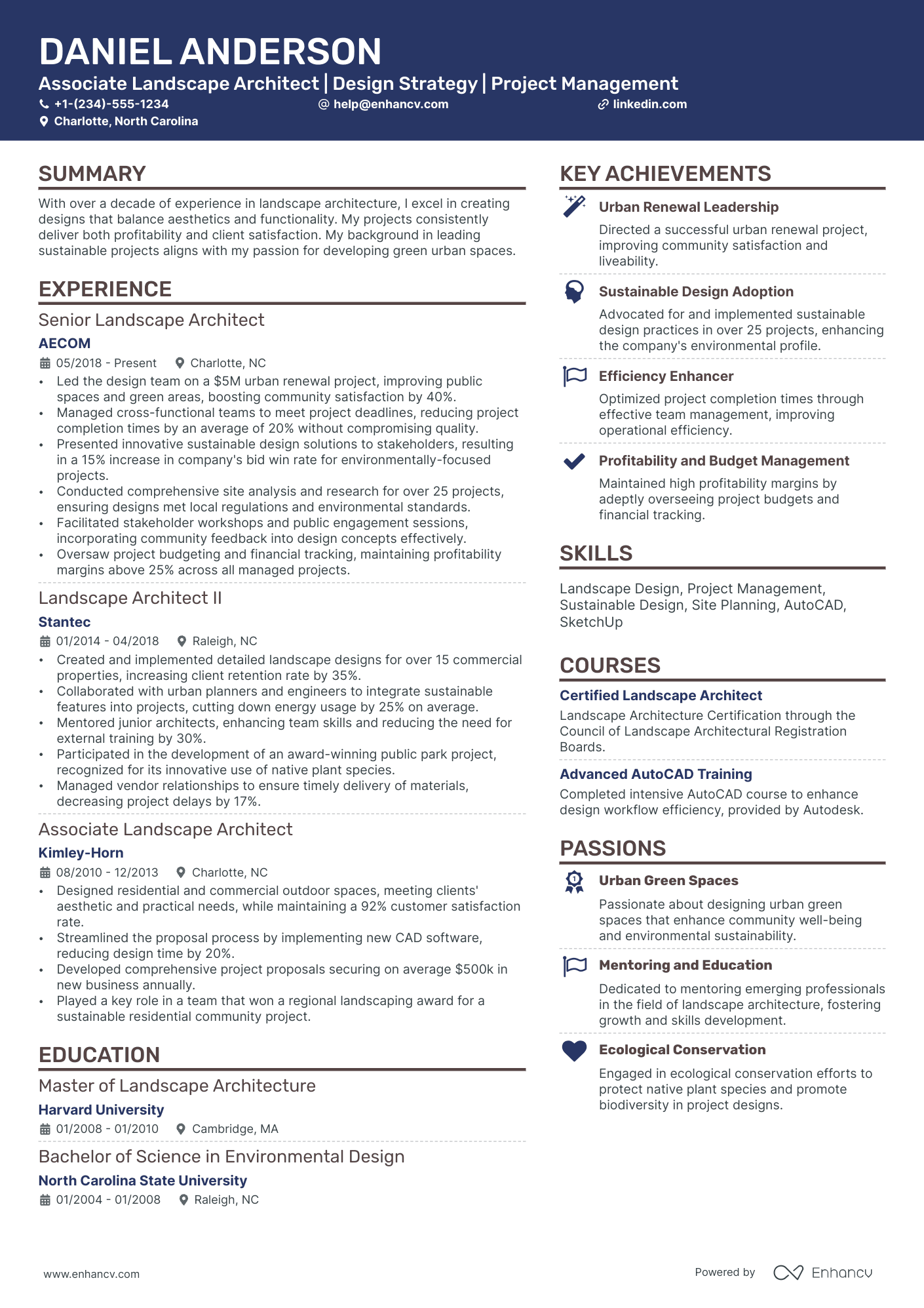
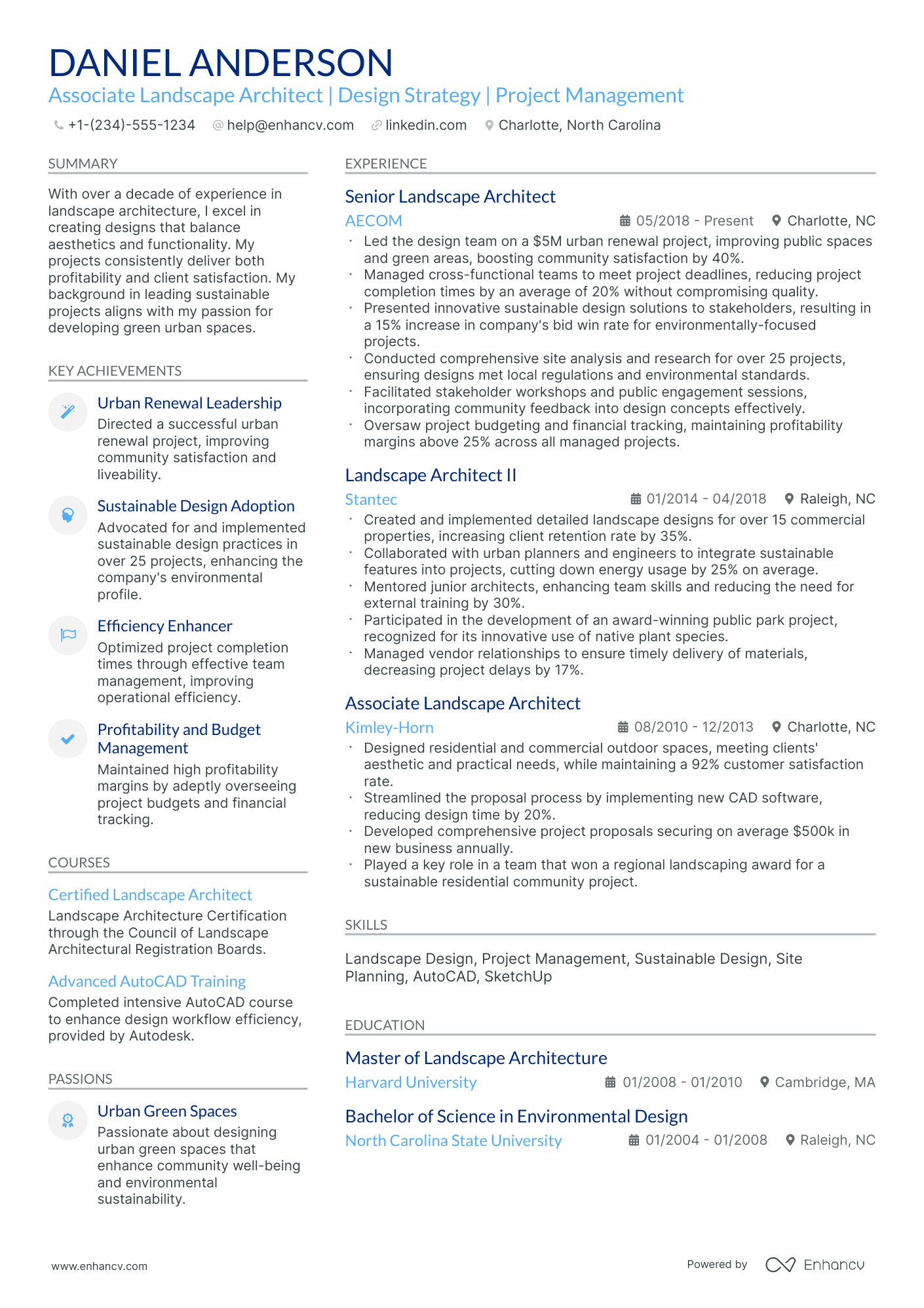
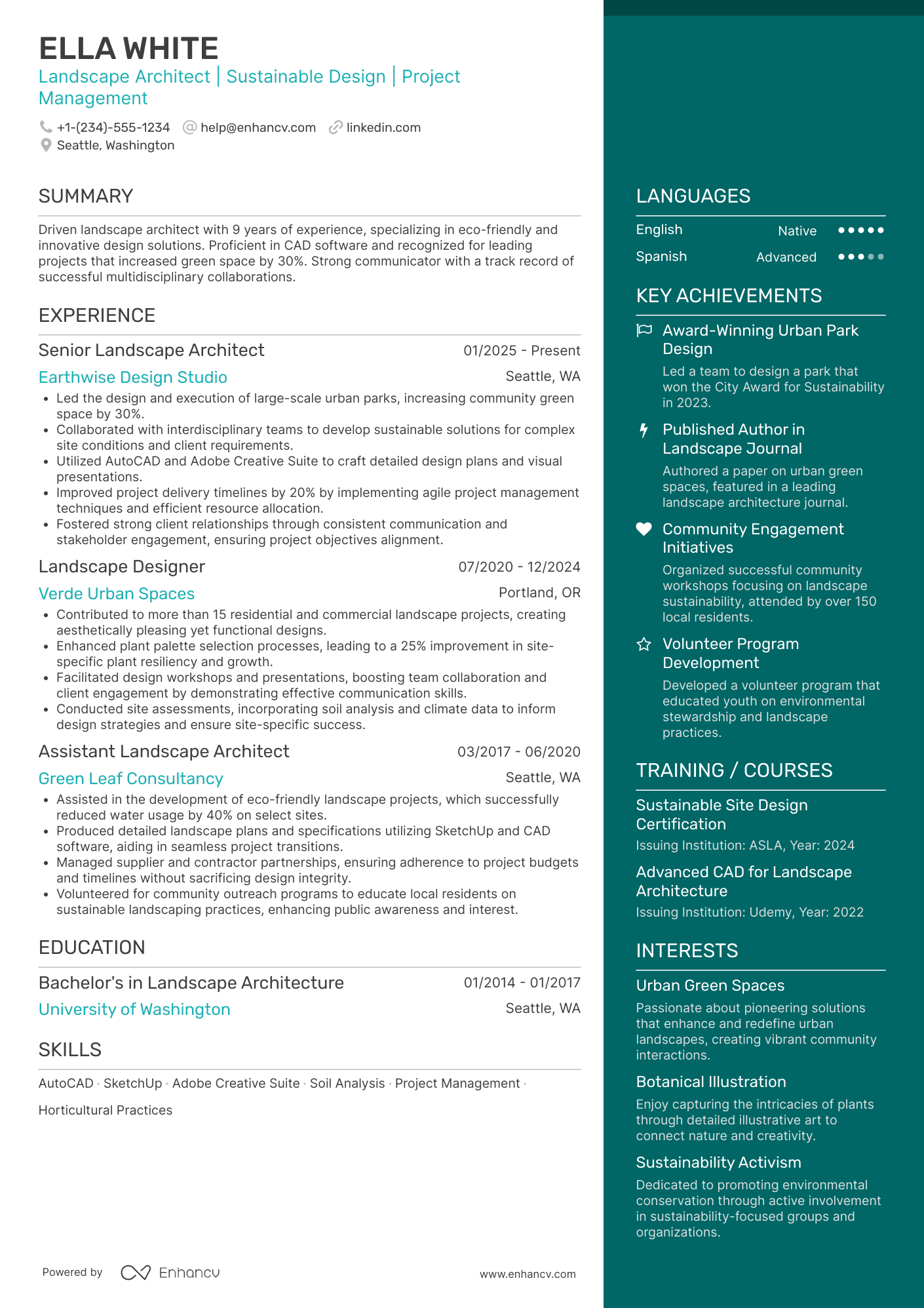
Most landscape architect resume drafts fail because they read like project logs, not hiring documents. A landscape architect resume that buries outcomes and keywords gets filtered by ATS software and skimmed past in seconds.
A strong resume shows what changed because of your work. If you're unsure where to begin, learning how to write a resume that highlights impact is the essential first step. You should highlight budget managed, acres designed, permitting approvals won, schedule acceleration, reduced change orders, improved stormwater performance, increased park usage, and client satisfaction scores.

Key takeaways
- Quantify project outcomes like budgets, acreage, and schedule gains in every experience bullet.
- Use reverse-chronological format for senior roles and hybrid format for career changers.
- Tailor each resume to the job posting's exact software, terminology, and project scope.
- Place skills above experience if you're junior, below it if you're senior.
- Back every listed skill with a measurable result in your experience section.
- Pair certifications like LARE, LEED, or SITES AP directly with your education section.
- Use Enhancv to turn vague duties into sharp, recruiter-ready bullets aligned with each role.
Job market snapshot for landscape architects
We analyzed 72 recent landscape architect job ads across major US job boards. These numbers help you understand employment type trends, top companies hiring, salary landscape at a glance.
What level of experience employers are looking for landscape architects
| Years of Experience | Percentage found in job ads |
|---|---|
| 1–2 years | 8.3% (6) |
| 3–4 years | 19.4% (14) |
| 5–6 years | 4.2% (3) |
| 7–8 years | 11.1% (8) |
| 9–10 years | 5.6% (4) |
| 10+ years | 12.5% (9) |
| Not specified | 34.7% (25) |
Landscape architect ads by area of specialization (industry)
| Industry (Area) | Percentage found in job ads |
|---|---|
| Finance & Banking | 51.4% (37) |
Top companies hiring landscape architects
| Company | Percentage found in job ads |
|---|---|
| Actalent | 15.3% (11) |
Role overview stats
These tables show the most common responsibilities and employment types for landscape architect roles. Use them to align your resume with what employers expect and to understand how the role is structured across the market.
Day-to-day activities and top responsibilities for a landscape architect
| Responsibility | Percentage found in job ads |
|---|---|
| Autocad | 58.3% (42) |
| Sketchup | 50.0% (36) |
| Adobe creative suite | 41.7% (30) |
| Civil 3d | 38.9% (28) |
| Photoshop | 29.2% (21) |
| Lumion | 27.8% (20) |
| Microsoft office | 27.8% (20) |
| Indesign | 20.8% (15) |
| Gis | 18.1% (13) |
| Illustrator | 18.1% (13) |
| Enscape | 16.7% (12) |
| Land f/x | 15.3% (11) |
Type of employment (remote vs on-site vs hybrid)
| Employment type | Percentage found in job ads |
|---|---|
| On-site | 70.8% (51) |
| Hybrid | 29.2% (21) |
How to format a landscape architect resume
Recruiters evaluating landscape architect resumes prioritize design proficiency, project scope, technical software skills, and measurable environmental or community outcomes. A clear, well-structured resume format ensures these signals surface quickly during both automated screening and manual review.

I have significant experience as a landscape architect—which format should I use?
Use a reverse-chronological format to present your deepest and most relevant project experience first. Do:
- Lead with your most recent role and emphasize scope: site acreage, project budgets, team size, and client type (municipal, commercial, residential).
- Highlight proficiency in role-specific tools and domains such as AutoCAD, SketchUp, GIS, Revit, stormwater management, grading plans, and LEED or SITES certification frameworks.
- Quantify outcomes tied to sustainability targets, cost savings, regulatory approvals, or community impact.
- Directed master planning for a 45-acre mixed-use urban park, managing a $3.2M budget and coordinating across five engineering disciplines to deliver the project two months ahead of schedule with full municipal approval.
I'm junior or switching into landscape architecture—what format works best?
A hybrid format works best, letting you lead with relevant skills and design competencies while still showing a concise work history. Do:
- Place a skills section near the top featuring core competencies like planting design, site analysis, grading, AutoCAD, and Adobe Creative Suite so ATS systems and recruiters see them immediately.
- Include academic studios, internships, volunteer design-build projects, or related work (urban planning, environmental science, civil engineering) as transitional experience.
- Connect every listed skill or project to a specific action and a tangible result.
- Site analysis (skill) → Conducted topographic and drainage assessments for a 10-acre campus redesign (action) → Informed a grading plan that reduced projected stormwater runoff by 20% (result).
Why not use a functional resume?
A functional format strips away project timelines and employment context, making it difficult for hiring managers to verify the depth and progression of your landscape architecture experience.
- A functional format may be acceptable if you're transitioning from a related field like civil engineering or environmental planning and lack direct landscape architecture job titles, but only if you anchor every listed skill to specific design projects and measurable outcomes.
Once your layout and formatting choices are in place, the next step is deciding which sections to include so each one serves a clear purpose on your resume.
What sections should go on a landscape architect resume
Recruiters expect a landscape architect resume to show your design capability, technical execution, and built project outcomes at a glance. Knowing exactly what to put on a resume helps you prioritize the right content from the start.
Use this structure for maximum clarity:
- Header
- Summary
- Experience
- Skills
- Projects
- Education
- Certifications
- Optional sections: Awards, Publications, Volunteering
Strong experience bullets should emphasize project scope, your role, measurable outcomes, and impact on budgets, schedules, permitting, sustainability, and client satisfaction.
Is your resume good enough?
Drop your resume here or choose a file. PDF & DOCX only. Max 2MB file size.
Once you’ve organized your resume with the right components, focus next on writing your experience section so each role clearly supports the qualifications those components highlight.
How to write your landscape architect resume experience
Your work experience section should highlight the design projects you've delivered, the site planning tools and sustainable methods you've applied, and the measurable outcomes your work produced—from completed installations to budget savings and environmental performance gains. Hiring managers prioritize demonstrated impact over descriptive task lists, so every bullet should prove you moved a project forward rather than simply participated in one.
Each entry should include:
- Job title
- Company and location (or remote)
- Dates of employment (month and year)
Three to five concise bullet points showing what you owned, how you executed, and what outcomes you delivered:
- Ownership scope: the site designs, master plans, planting palettes, grading packages, or client accounts you were directly accountable for as a landscape architect.
- Execution approach: the tools, software, and methods you used to deliver work—such as AutoCAD, SketchUp, GIS analysis, stormwater modeling, SITES rating criteria, or local code compliance reviews.
- Value improved: the changes your designs drove in environmental performance, water efficiency, habitat restoration, constructability, maintenance cost reduction, or regulatory approval timelines.
- Collaboration context: how you coordinated with civil engineers, architects, municipal reviewers, nursery suppliers, contractors, or community stakeholders to advance a project from concept through construction administration.
- Impact delivered: the tangible results your landscape architecture work produced, expressed through project scale, client retention, sustainability certifications earned, construction milestones met, or budget and schedule performance rather than routine activity.
Experience bullet formula
A landscape architect experience example
✅ Right example - modern, quantified, specific.
Landscape Architect
CivicScape Studio | Austin, TX
2021–Present
Designed public realm and mixed-use landscapes for municipal clients and private developers across Central Texas.
- Led schematic design through construction administration for eight urban park and streetscape projects (sixty-two acres total) using AutoCAD, Civil 3D, and Adobe Creative Cloud; cut design-to-permit timelines by 18% through standardized sheet sets and detail libraries.
- Produced grading, drainage, and paving plans with Civil 3D surfaces and hydrology calculations; reduced field rework by 22% by resolving ADA slopes, spot elevations, and inlet tie-ins during 90% construction document reviews with civil engineers.
- Built Revit and SketchUp models and delivered Enscape walkthroughs for three mixed-use courtyards; improved client approval rates from first presentation by 30% and shortened decision cycles by two weeks.
- Developed planting plans and irrigation coordination packages using GIS site analysis, climate-adapted palettes, and water budget calculations; lowered potable irrigation demand by 28% and increased native species coverage to 70% across four sites.
- Managed consultant and stakeholder coordination (architects, engineers, arborists, and city reviewers) and ran biweekly RFIs and submittal reviews; reduced change orders by 15% and kept construction within 2% of the approved landscape budget.
Now that you've seen how a strong experience section comes together, let's look at how to adjust yours to match the specific job you're targeting.
How to tailor your landscape architect resume experience
Recruiters evaluate your landscape architect resume through applicant tracking systems and manual review, scoring candidates on how closely their experience matches the posting. Tailoring your resume to the job description keeps your resume competitive in both rounds.
Ways to tailor your landscape architect experience:
- Match design software like AutoCAD or SketchUp named in the posting.
- Mirror the exact grading or drainage terminology the employer uses.
- Reflect site analysis methods or environmental review processes listed.
- Include LEED or SITES accreditation experience when the role requires it.
- Emphasize stormwater management or erosion control if compliance is mentioned.
- Highlight collaboration with civil engineers or urban planners as described.
- Align project scale or land use types with the job description scope.
- Reference planting design or hardscape standards the employer specifies.
Tailoring means aligning your real project outcomes and technical skills with what the employer asks for, not forcing disconnected keywords into your bullets.
Resume tailoring examples for landscape architect
| Job description excerpt | Untailored | Tailored |
|---|---|---|
| Develop grading and drainage plans for commercial sites using AutoCAD Civil 3D and coordinate with civil engineers on stormwater management solutions. | Worked on site plans and collaborated with other teams on various projects. | Developed grading and drainage plans for 12 commercial sites in AutoCAD Civil 3D, coordinating with civil engineers to design stormwater management solutions that reduced runoff volume by 30%. |
| Lead schematic design through construction documentation for public park projects, incorporating native planting strategies and ADA-compliant pathway systems. | Helped design outdoor spaces and created documents for construction purposes. | Led schematic design through construction documentation for three public park projects totaling 45 acres, specifying native planting palettes and designing ADA-compliant pathway systems that passed municipal review without revision. |
| Prepare planting plans and irrigation designs for mixed-use residential developments using Land F/X, ensuring compliance with local water-efficiency ordinances. | Created planting designs and worked on irrigation layouts for residential projects. | Prepared planting plans and irrigation designs in Land F/X for a 200-unit mixed-use residential development, selecting drought-tolerant species and drip irrigation systems that met county water-efficiency ordinance requirements and cut projected irrigation use by 40%. |
Once you’ve aligned your experience with the role’s priorities, the next step is to quantify your landscape architect achievements so employers can see the impact of your work.
How to quantify your landscape architect achievements
Quantifying your achievements proves your designs improved budgets, timelines, safety, and user experience. Track construction cost, schedule adherence, stormwater performance, change orders, and client approval cycles across projects and phases.
Quantifying examples for landscape architect
| Metric | Example |
|---|---|
| Cost savings | "Value-engineered planting and paving packages across three parks, cutting estimated construction costs by $185K while meeting municipal standards and bid alternates." |
| Delivery speed | "Reduced permit set turnaround from eight weeks to five by standardizing CAD details in AutoCAD and building a reusable specification checklist." |
| Stormwater performance | "Modeled bioswale and permeable paving in EPA SWMM to capture the first 1.0 inch of rainfall, reducing peak runoff by 32% on a twelve-acre site." |
| Quality control | "Cut construction change orders from 14 to six by tightening grading callouts and spot elevations in Civil 3D and issuing pre-bid clarifications." |
| Stakeholder approvals | "Improved client approval speed by 40% by presenting SketchUp and Lumion visualizations plus a two-option materials board for each design milestone." |
Turn vague job duties into measurable, recruiter-ready resume bullets in seconds with Enhancv's Bullet Point Generator.
Once you've crafted strong bullet points for your experience section, the next step is ensuring your resume also highlights the right hard and soft skills that landscape architecture employers are looking for.
How to list your hard and soft skills on a landscape architect resume
Your skills section shows you can turn site constraints into buildable designs—recruiters and an ATS (applicant tracking system) scan this section to confirm role fit—so aim for a balanced mix of technical tools, design and documentation skills, and job-specific collaboration. landscape architect roles require a blend of:
- Product strategy and discovery skills.
- Data, analytics, and experimentation skills.
- Delivery, execution, and go-to-market discipline.
- Soft skills.
Your skills section should be:
- Scannable (bullet-style grouping).
- Relevant to the job post.
- Backed by proof in experience bullets.
- Updated with current tools.
Place your skills section:
- Above experience if you're junior or switching careers.
- Below experience if you're mid/senior with strong achievements.

Hard skills
- AutoCAD, Civil 3D drafting
- SketchUp, Rhino modeling
- Revit, BIM coordination
- Adobe Creative Cloud
- ArcGIS, QGIS mapping
- Site grading and drainage
- Construction documents, details
- Planting design, specifications
- Irrigation design, layout
- Stormwater management, LID
- Cost estimating, quantity takeoffs
- ADA accessibility compliance
Listing the right hard skills ensures ATS systems and hiring managers immediately see your technical qualifications.
Soft skills
- Translate client goals into scope
- Lead stakeholder design reviews
- Present concepts to nontechnical audiences
- Coordinate with civil and architecture teams
- Negotiate tradeoffs and constraints
- Prioritize tasks across deadlines
- Manage RFIs and submittal reviews
- Incorporate permitting feedback fast
- Maintain design intent through value engineering
- Document decisions and approvals clearly
- Resolve field issues with contractors
- Own quality control on deliverables
Don't underestimate the value of soft skills on your resume—they demonstrate how you collaborate with teams, manage stakeholders, and navigate complex project dynamics.
How to show your landscape architect skills in context
Skills shouldn't live only in a bulleted list on your resume. Explore resume skills examples to see how professionals in different fields present their abilities effectively.
They should be demonstrated in:
- Your summary (high-level professional identity)
- Your experience (proof through outcomes)
Here's what that looks like in practice.
Summary example
Senior landscape architect with 12 years designing resilient urban greenspaces using AutoCAD, GIS analysis, and sustainable stormwater management. Led multidisciplinary teams on 30+ municipal projects, reducing client review cycles by 40% through streamlined design presentations.
- Reflects senior-level expertise immediately
- Names role-specific tools and methods
- Quantifies impact with clear metrics
- Highlights leadership and communication skills
Experience example
Senior Landscape Architect
Verdura Design Group | Portland, OR
June 2018–Present
- Designed 15 public park master plans using AutoCAD Civil 3D and GIS, increasing community green coverage by 22% across three districts.
- Collaborated with civil engineers and urban planners to integrate bioswale systems, cutting stormwater runoff by 35% on residential developments.
- Mentored four junior designers on planting design and grading techniques, reducing project revision rates by 28% within one year.
- Every bullet includes measurable proof
- Skills appear naturally within achievements
Once you’ve tied your abilities to real project outcomes and constraints, the next step is applying the same approach to a landscape architect resume when you have no experience.
How do I write a landscape architect resume with no experience
Even without full-time experience, you can demonstrate readiness through:
- University landscape design studio projects
- Community park volunteer design work
- Internship or job shadow hours
- Competition entries and juried reviews
- Campus landscape improvement proposals
- Planting plans for local nonprofits
- Residential concept designs for friends
- Construction detailing class assignments
If you're in this situation, our guide on building a resume without work experience offers proven strategies to showcase your potential.
Focus on:
- CAD and BIM deliverables
- Site analysis and grading basics
- Code-aware, buildable documentation
- Quantified project outcomes and scope
Resume format tip for entry-level landscape architect
Use a combination resume format because it highlights projects and technical skills while still showing relevant experience substitutes and education. Do:
- Lead with a project portfolio section.
- List tools: AutoCAD, SketchUp, GIS.
- Quantify scope: area, budget, hours.
- Add deliverables: plans, sections, details.
- Include planting and materials specifications.
- Produced a planting plan for a local nonprofit using AutoCAD and i-Tree, specifying twenty-two native species and increasing estimated canopy coverage by 18%.
Since your education section carries the most weight when you lack professional experience, presenting it effectively is essential.
How to list your education on a landscape architect resume
Your education section helps hiring teams confirm you have the foundational design, ecology, and technical training required for a landscape architect role.
Include:
- Degree name
- Institution
- Location
- Graduation year
- Relevant coursework (for juniors or entry-level candidates)
- Honors & GPA (if 3.5 or higher)
Skip month and day details—list the graduation year only.
Here's a strong education entry tailored for a landscape architect resume.
Example education entry
Bachelor of Landscape Architecture
University of Georgia, Athens, GA
2021 | GPA: 3.7/4.0
- Relevant Coursework: Site Planning, Planting Design, Stormwater Management, Urban Ecology, GIS for Landscape Analysis
- Honors: Magna Cum Laude, Dean's List (six semesters)
How to list your certifications on a landscape architect resume
Certifications on a resume show a landscape architect's commitment to learning, proficiency with industry tools, and alignment with current standards, codes, and practices.
Include:
- Certificate name
- Issuing organization
- Year
- Optional: credential ID or URL
- Place certifications below education when your degree is recent and your certifications add secondary support.
- Place certifications above education when they are recent, highly relevant, or required for the roles you target.
Best certifications for your landscape architect resume
- Landscape Architect Registration Examination (LARE)
- LEED Green Associate
- LEED AP Neighborhood Development
- SITES AP (Accredited Professional)
- Certified Arborist (International Society of Arboriculture)
- Certified Professional in Erosion and Sediment Control (CPESC)
- OSHA 30-Hour Construction Safety
Once you’ve placed your credentials where hiring managers can quickly verify them, you can write your landscape architect resume summary to connect those qualifications to the value you bring.
How to write your landscape architect resume summary
Your resume summary is the first thing a recruiter reads. A strong one instantly signals you're qualified and worth interviewing for this landscape architect role.
Keep it to three to four lines, with:
- Your title and total years of landscape architecture experience.
- Domain focus, such as residential, commercial, urban, or environmental design.
- Core tools like AutoCAD, SketchUp, GIS, Revit, or Adobe Creative Suite.
- One or two measurable achievements, such as projects delivered or budgets managed.
- Soft skills tied to real outcomes, like client collaboration or cross-functional coordination.

PRO TIP
At this level, prioritize relevant technical skills, tools, and any early project contributions. Highlight coursework or certifications if work experience is limited. Avoid vague phrases like "passionate designer" or "hard worker." Show what you've done, not what you hope to become.
Example summary for a landscape architect
Landscape architect with two years of experience in residential and park design. Proficient in AutoCAD, SketchUp, and GIS. Contributed to 12 site plans, reducing client revision cycles by 30%.
Optimize your resume summary and objective for ATS
Drop your resume here or choose a file.
PDF & DOCX only. Max 2MB file size.
Now that your summary captures your professional value, make sure the header above it presents your contact details clearly so recruiters can actually reach you.
What to include in a landscape architect resume header
A resume header is the top section with your key details, and it drives visibility, credibility, and recruiter screening for a landscape architect role.
Essential resume header elements
- Full name
- Tailored job title and headline
- Location
- Phone number
- Professional email
- GitHub link
- Portfolio link
A LinkedIn link helps recruiters verify your experience quickly and supports fast screening.
Don't include a photo on a landscape architect resume unless the role is explicitly front-facing or appearance-dependent.
Use a job-matched title, keep links short, and ensure every item is readable on one glance.
Example
Landscape architect resume header
Jordan Lee
Landscape architect | Site planning, planting design, and construction documentation
Austin, TX
(512) 555-01XX
jordan.lee@enhancv.com
github.com/jordanlee
jordanlee.com
linkedin.com/in/jordanlee
With your contact details and professional identifiers in place at the top, add relevant additional sections to round out your landscape architect resume and support the information above.
Additional sections for landscape architect resumes
Extra resume sections help you stand out when your core qualifications match other candidates—showcasing unique strengths that prove your fit for the role.
- Languages — listing language skills on your resume can be a differentiator when working with diverse communities or international project teams.
- Professional affiliations (e.g., ASLA membership)
- Publications and research
- Awards and design competitions
- Volunteer work (e.g., community garden or habitat restoration projects)
- Conferences and continuing education
- Hobbies and interests (e.g., botanical illustration, hiking, photography)
Once you've strengthened your resume with relevant additional sections, pairing it with a well-crafted cover letter can further set your application apart.
Do landscape architect resumes need a cover letter
A cover letter isn't required for every landscape architect role, but it helps in competitive searches or firms that expect one. If you're wondering what a cover letter is and when to use one, it can make a difference when your resume needs context, or when the hiring team compares similar portfolios.
Use it to add context your resume can't:
- Explain role and team fit by linking your strengths to the firm's project types, delivery model, and collaboration style.
- Highlight one or two relevant projects with clear outcomes, such as permitting wins, cost savings, schedule improvements, or measurable performance results.
- Show understanding of the product, users, or business context by referencing site constraints, stakeholder needs, maintenance realities, and client priorities.
- Address career transitions or non-obvious experience by mapping past responsibilities to landscape architect work, tools, and project phases.
Drop your resume here or choose a file.
PDF & DOCX only. Max 2MB file size.
Whether or not you include a cover letter, using AI to improve your landscape architect resume helps you strengthen the document hiring teams review first and align it with the role.
Using AI to improve your landscape architect resume
AI can sharpen your resume's clarity, structure, and overall impact. It helps refine language and highlight measurable results. But overuse strips authenticity. Once your content feels clear and role-aligned, step away from AI tools. If you're curious about which AI is best for writing resumes, start with tools that focus on structure and quantification rather than generating content from scratch.
Here are 10 practical prompts to strengthen specific sections of your landscape architect resume:
- Strengthen your summary. "Rewrite my landscape architect resume summary to highlight core design specialties and years of relevant experience in under four sentences."
- Quantify project impact. "Add measurable outcomes to these landscape architect experience bullets, focusing on project scale, budgets managed, or areas designed."
- Tailor skills precisely. "Compare this landscape architect job posting to my skills section and recommend which technical skills to prioritize or add."
- Sharpen experience bullets. "Rewrite these landscape architect experience bullets using strong action verbs and remove any vague or redundant phrasing."
- Highlight certifications. "Reorganize my landscape architect certifications section to emphasize the most industry-relevant credentials first."
- Refine project descriptions. "Edit these landscape architect project descriptions to clearly state my specific role, tools used, and deliverables produced."
- Improve education relevance. "Rewrite my education section to emphasize coursework and achievements most relevant to a landscape architect position."
- Remove filler language. "Identify and remove filler words or generic phrases from my landscape architect resume without changing the core meaning."
- Align with job posting. "Adjust my landscape architect resume experience section to better mirror the responsibilities described in this job posting."
- Clarify software proficiency. "Reformat my landscape architect skills section to clearly distinguish between advanced, intermediate, and beginner software proficiencies."
Stop using AI once your resume sounds accurate, specific, and aligned with real experience. AI should never invent experience or inflate claims—if it didn't happen, it doesn't belong here.
Conclusion
A strong landscape architect resume shows measurable outcomes, role-specific skills, and a clear structure. It highlights project results, technical tools, and collaboration, with dates, scope, and responsibilities that hiring teams can scan fast.
Keep your landscape architect resume focused, consistent, and easy to verify. This approach matches today’s hiring market and near-future expectations, and it positions you as ready to deliver on day one.