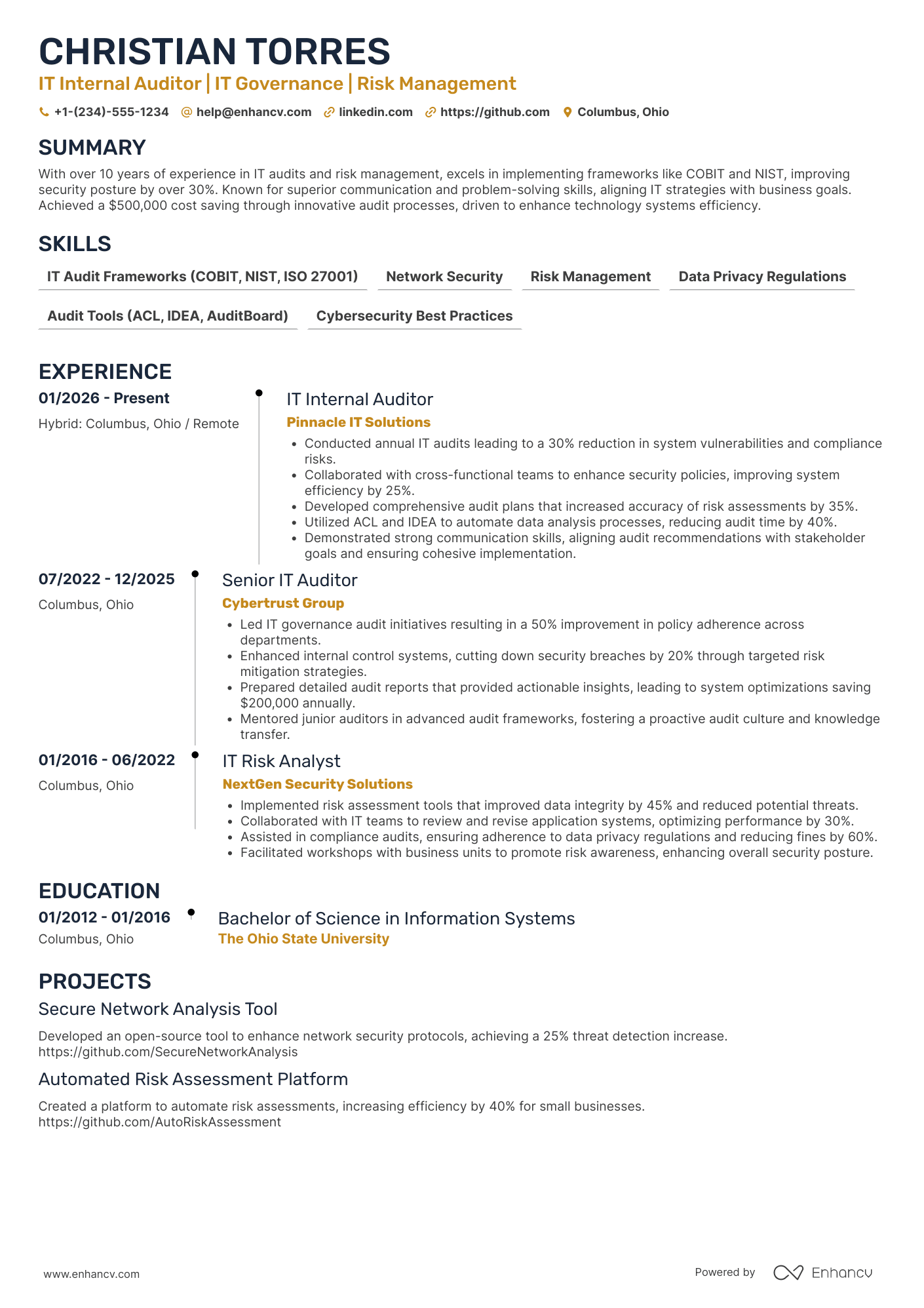
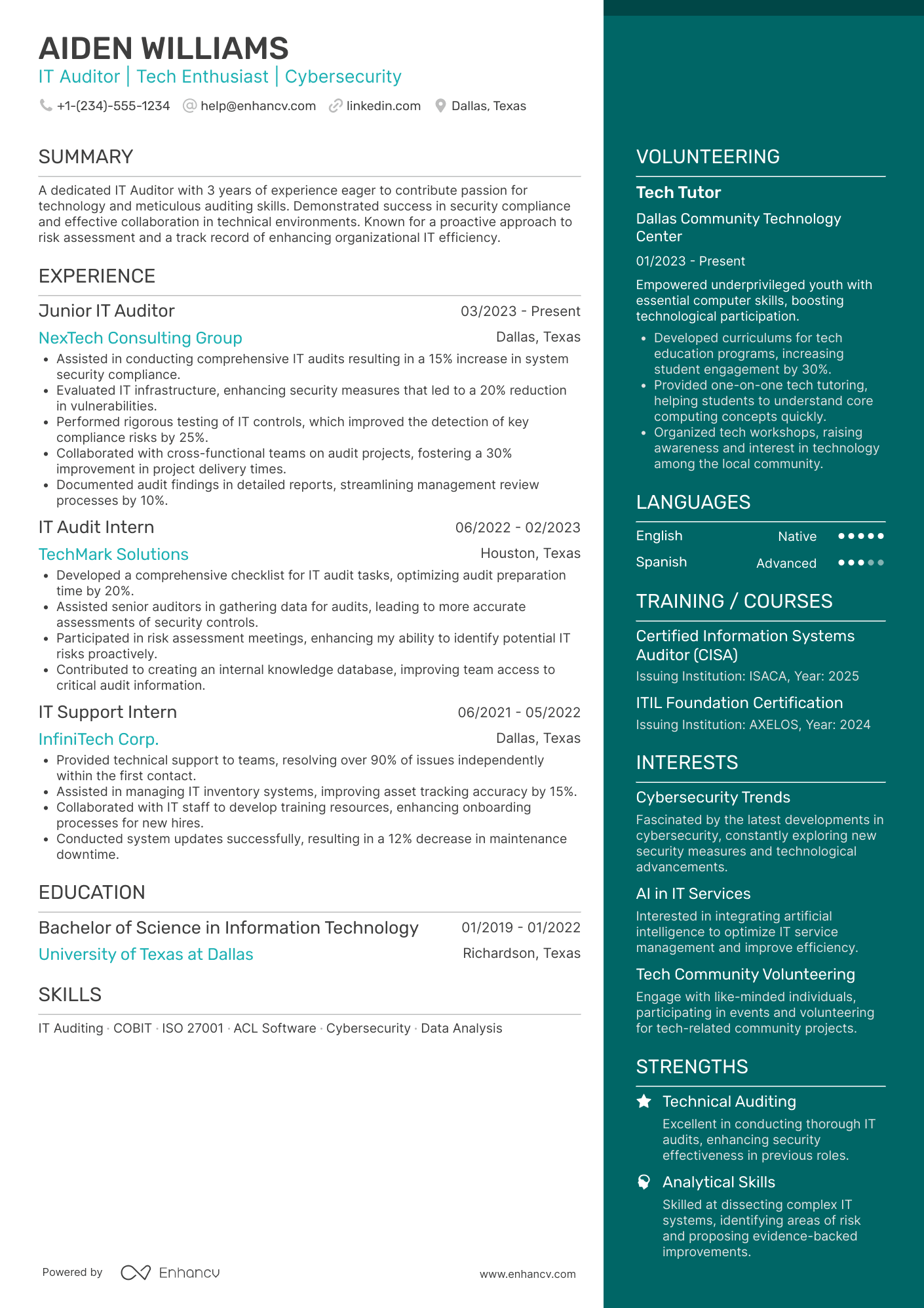
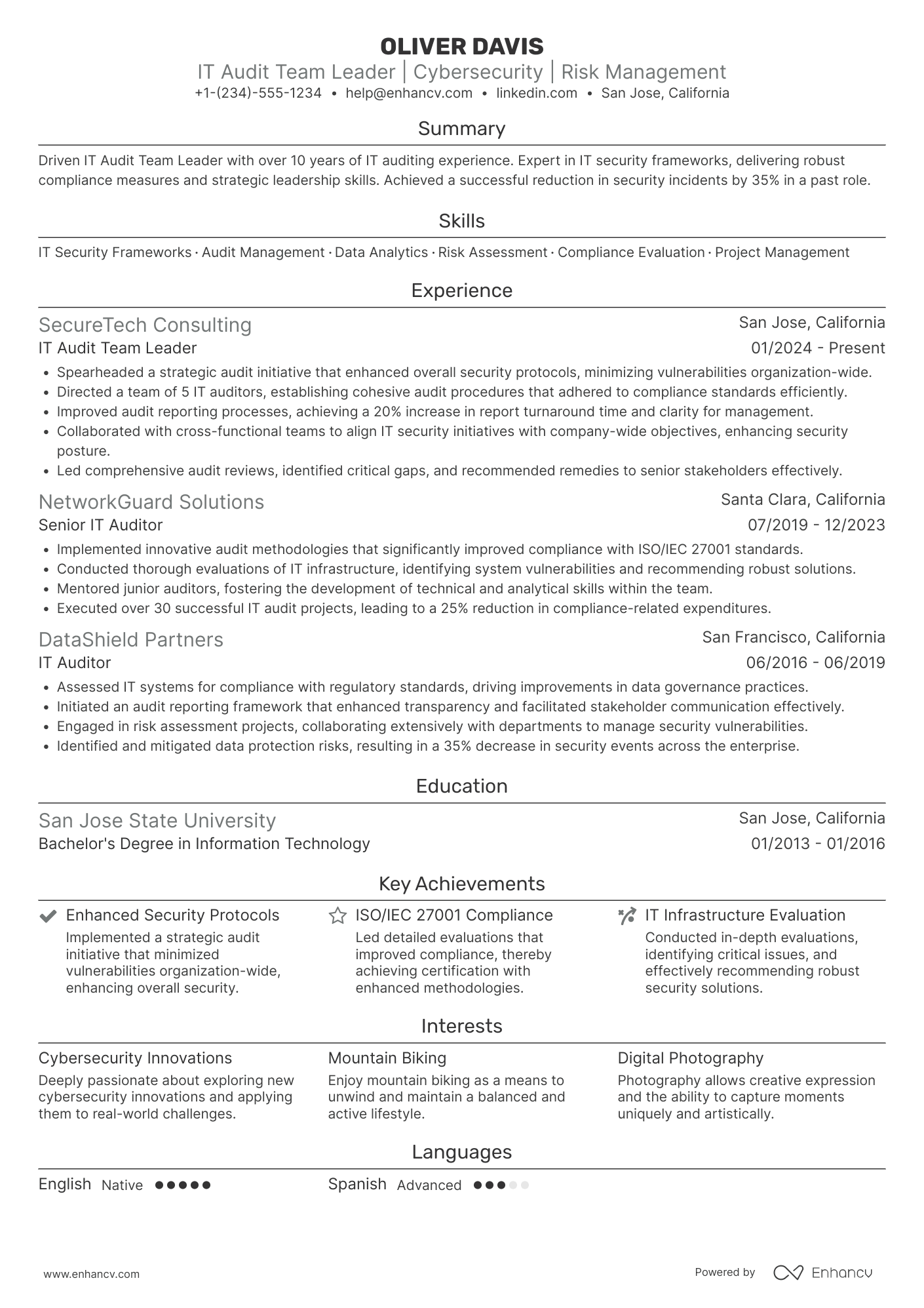
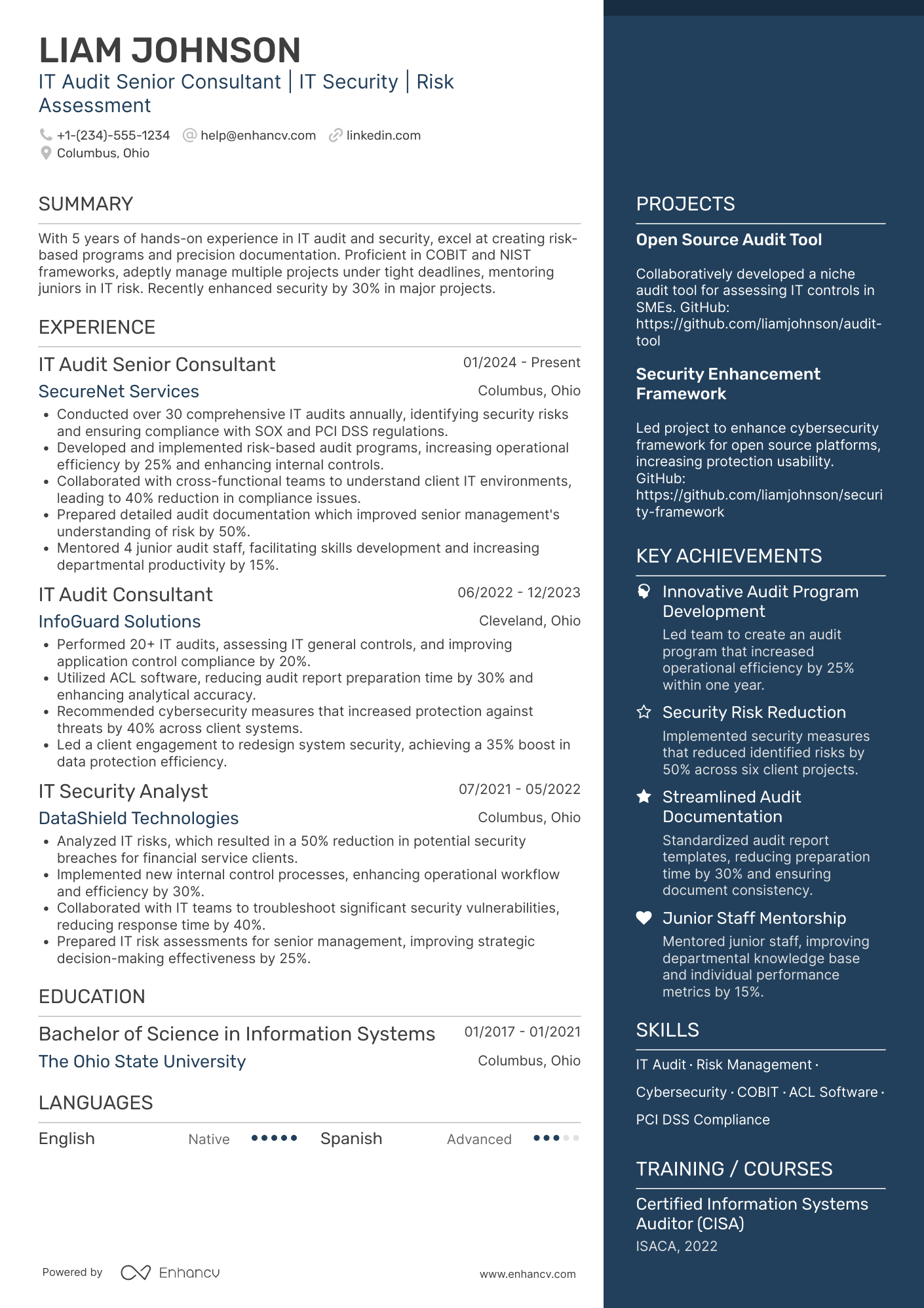
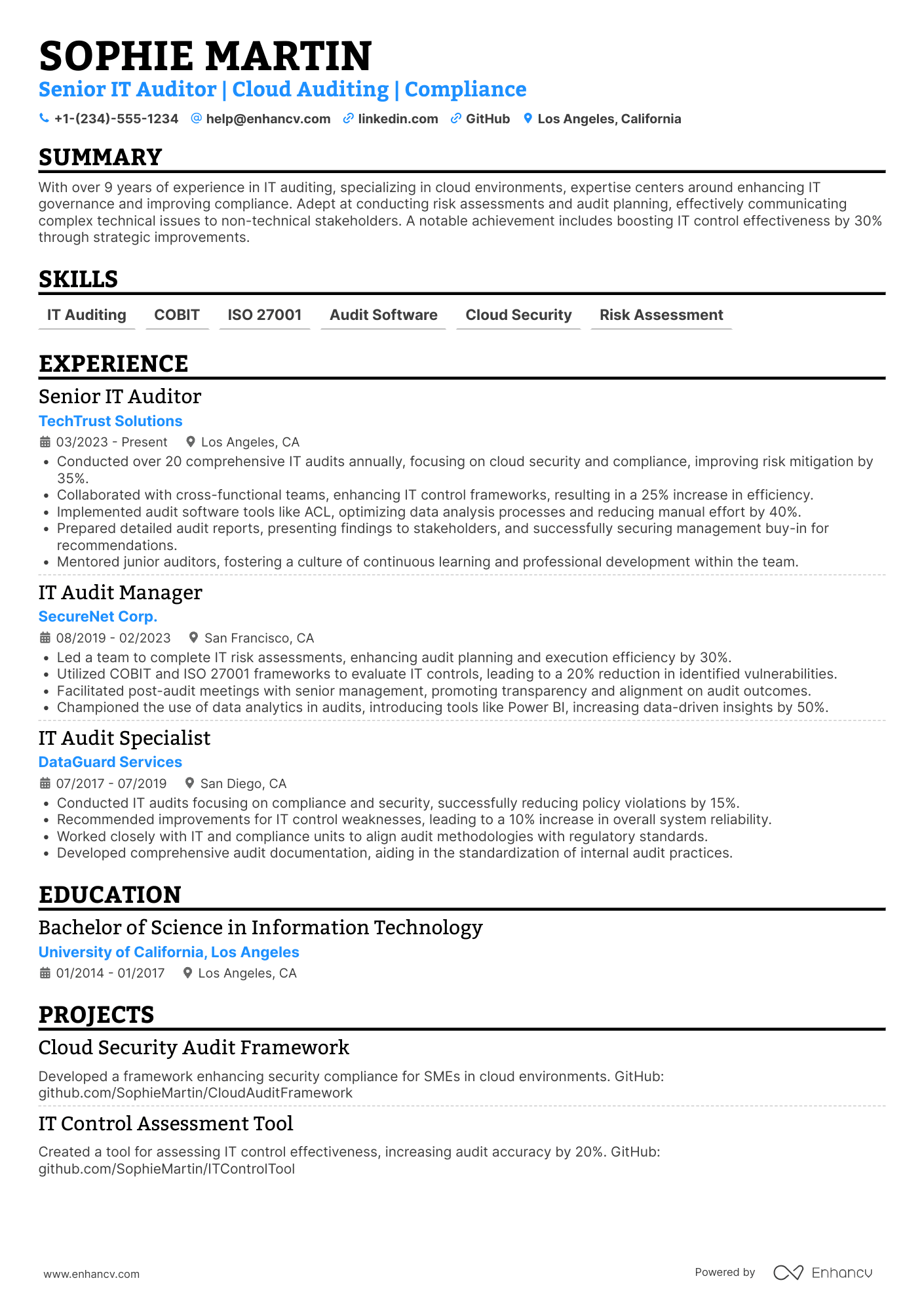
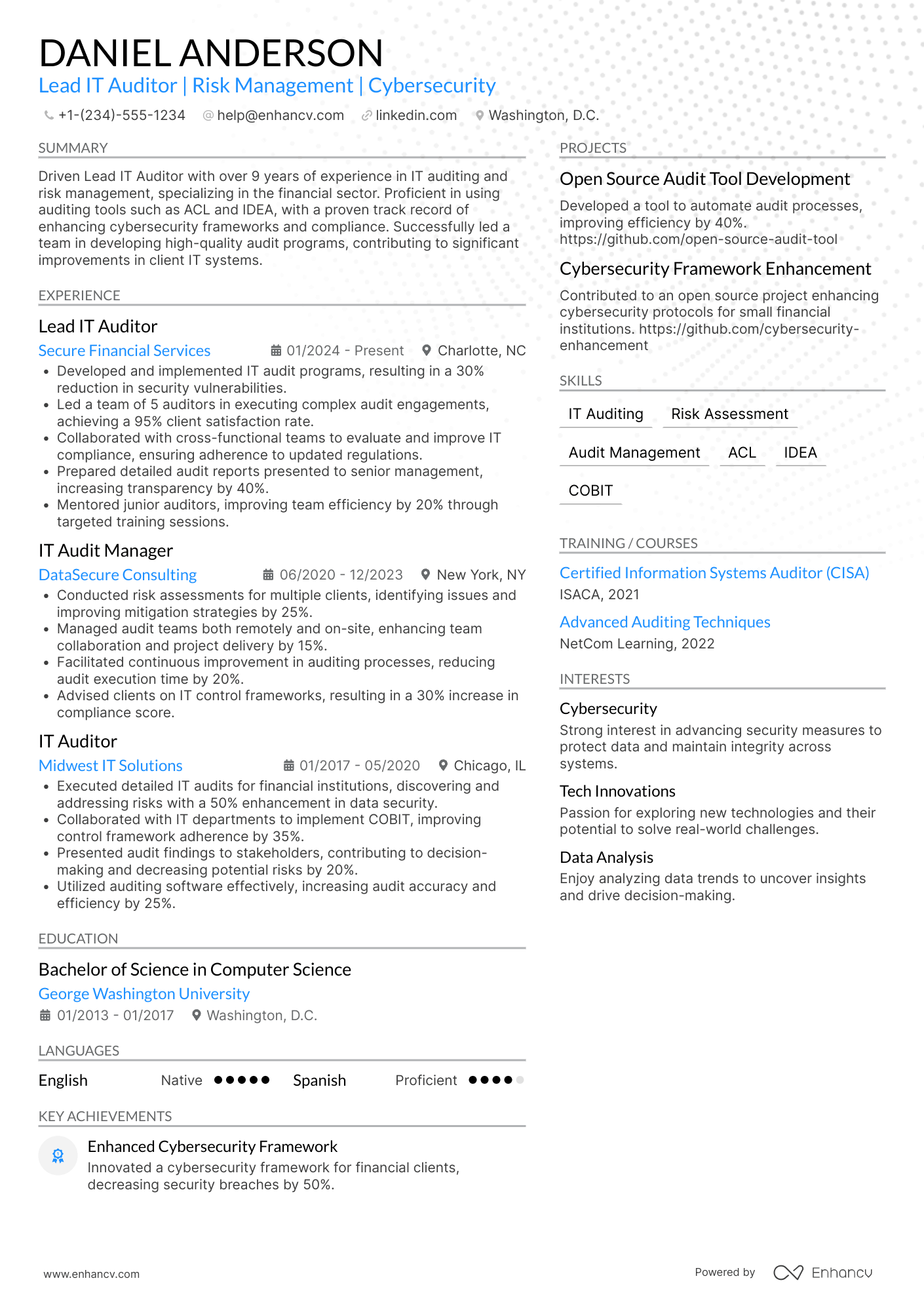
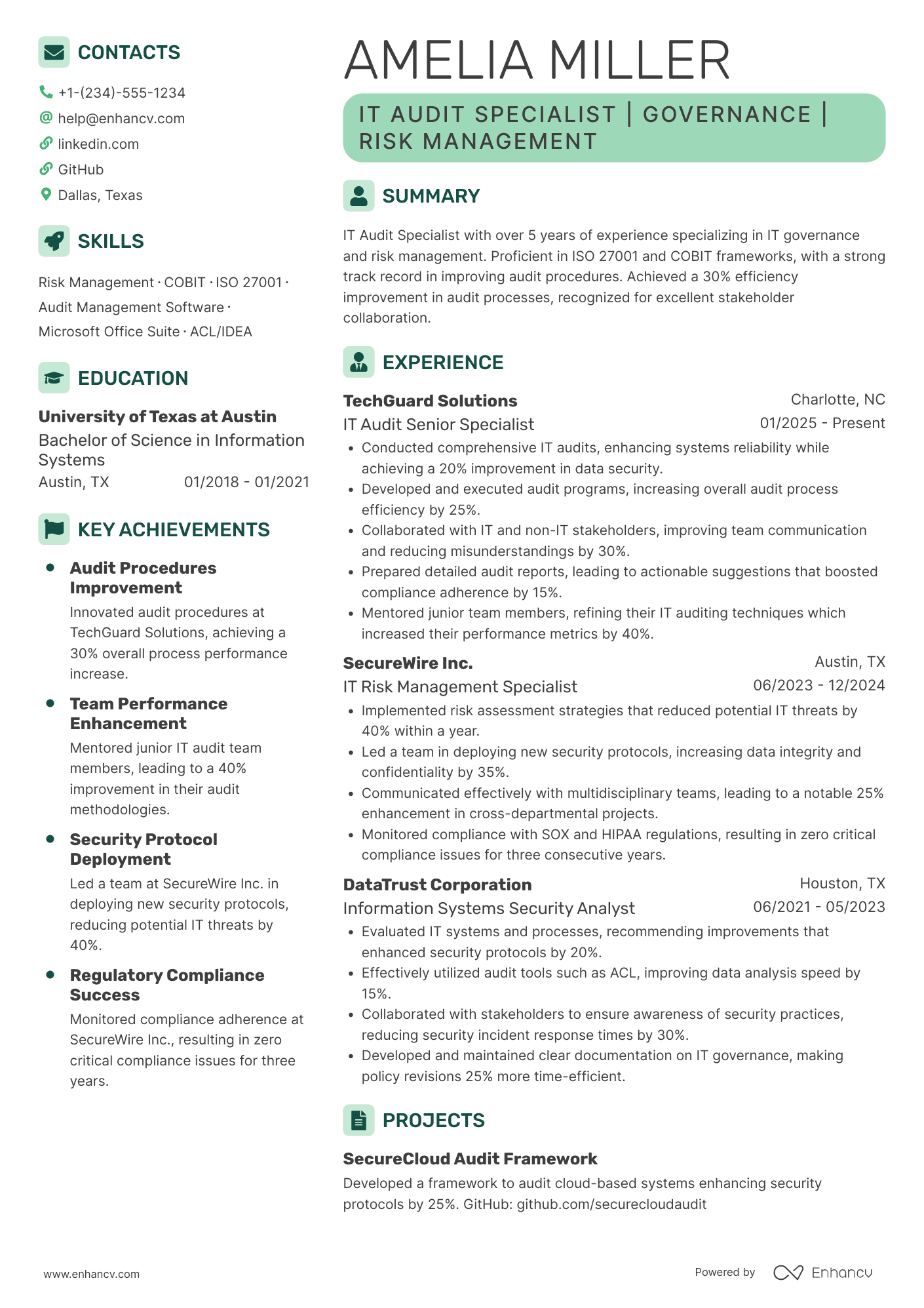
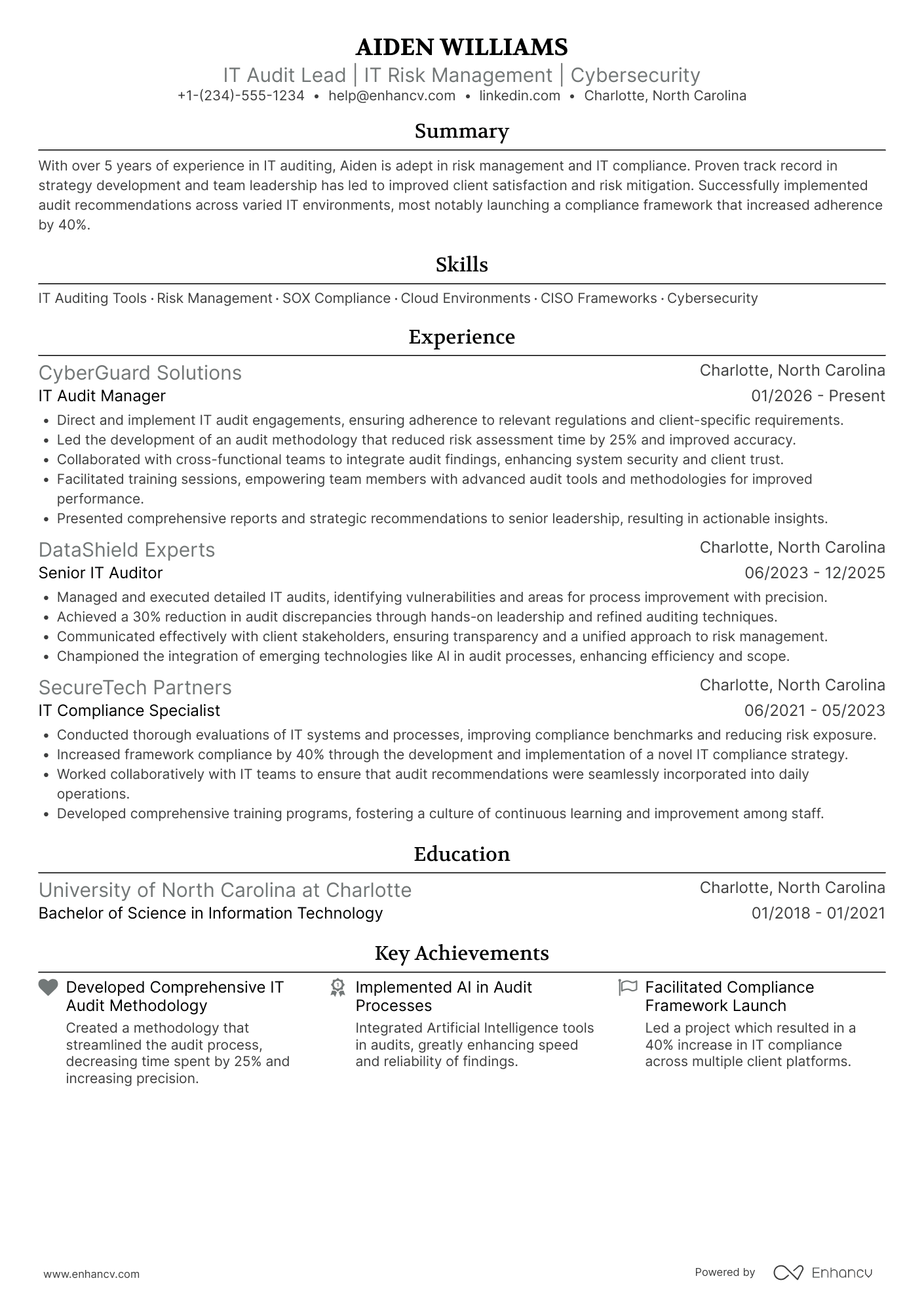
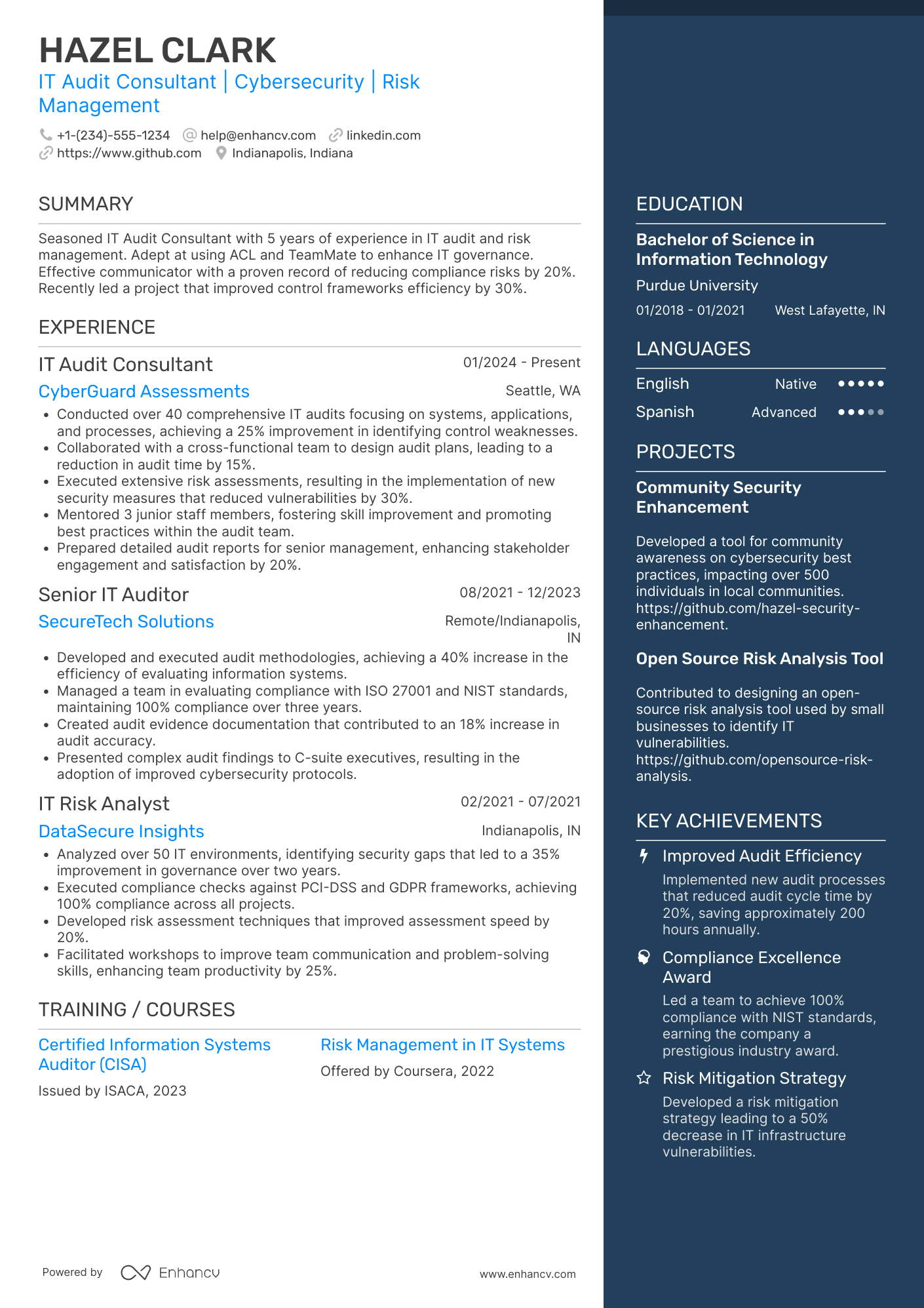
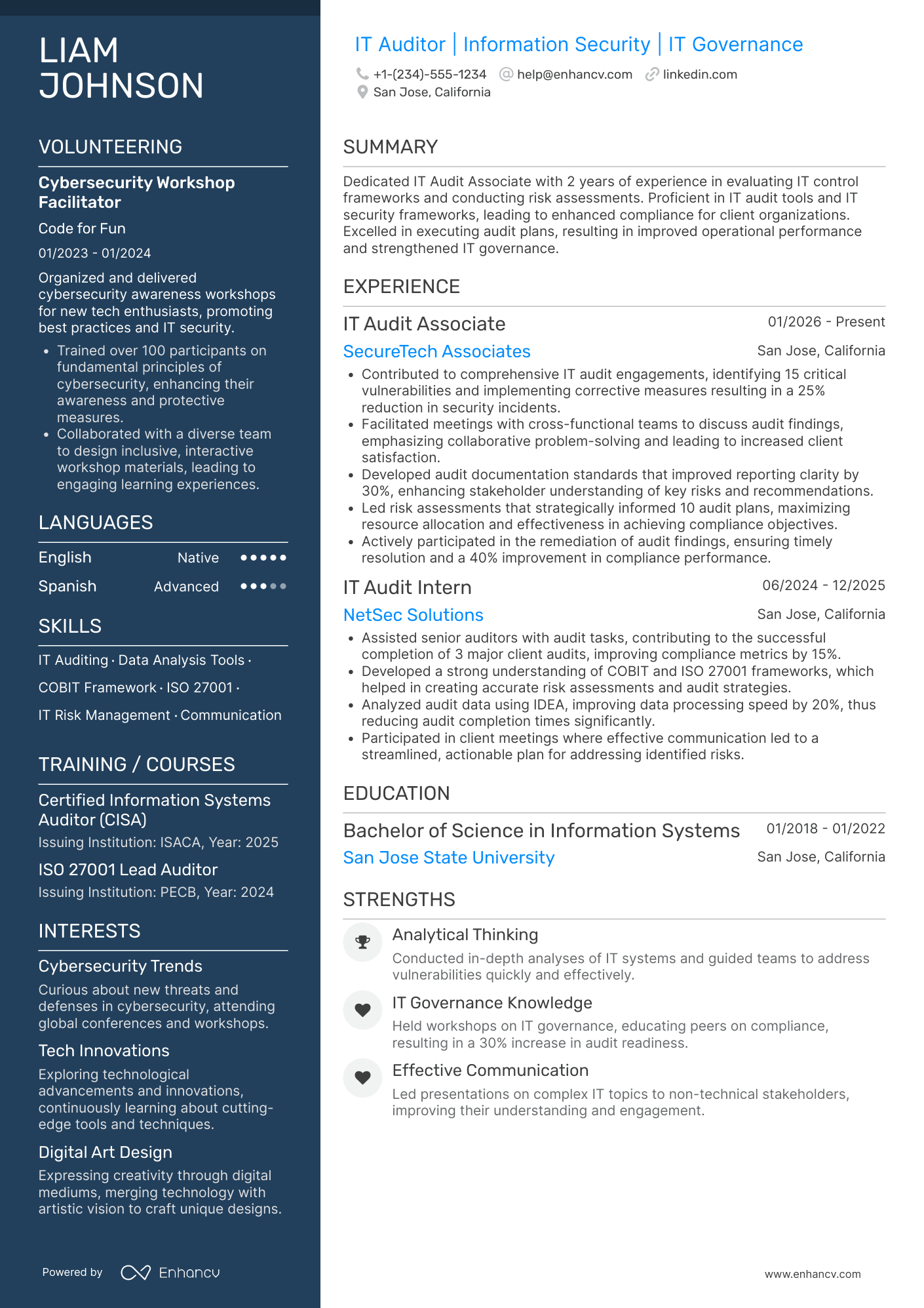
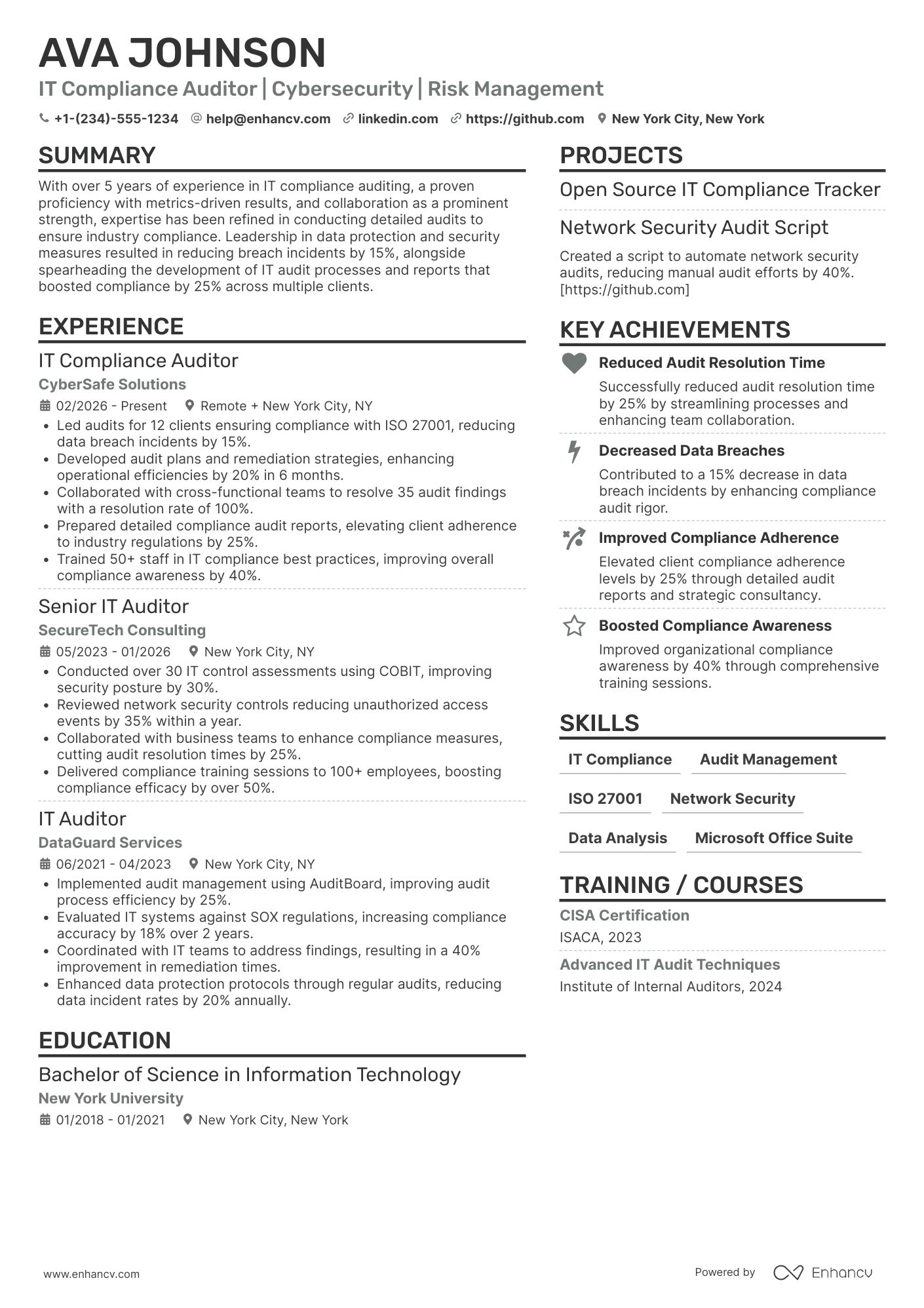
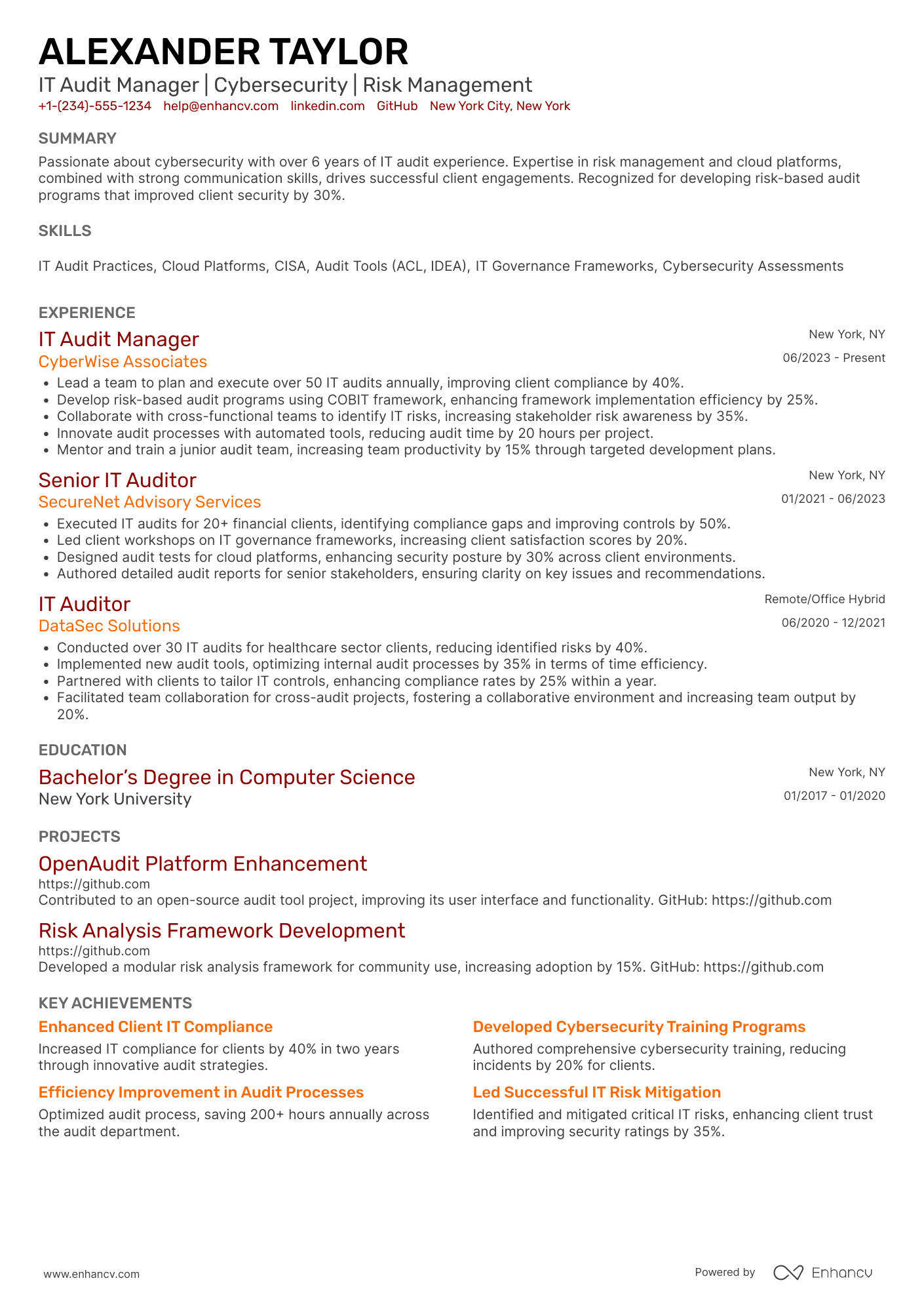
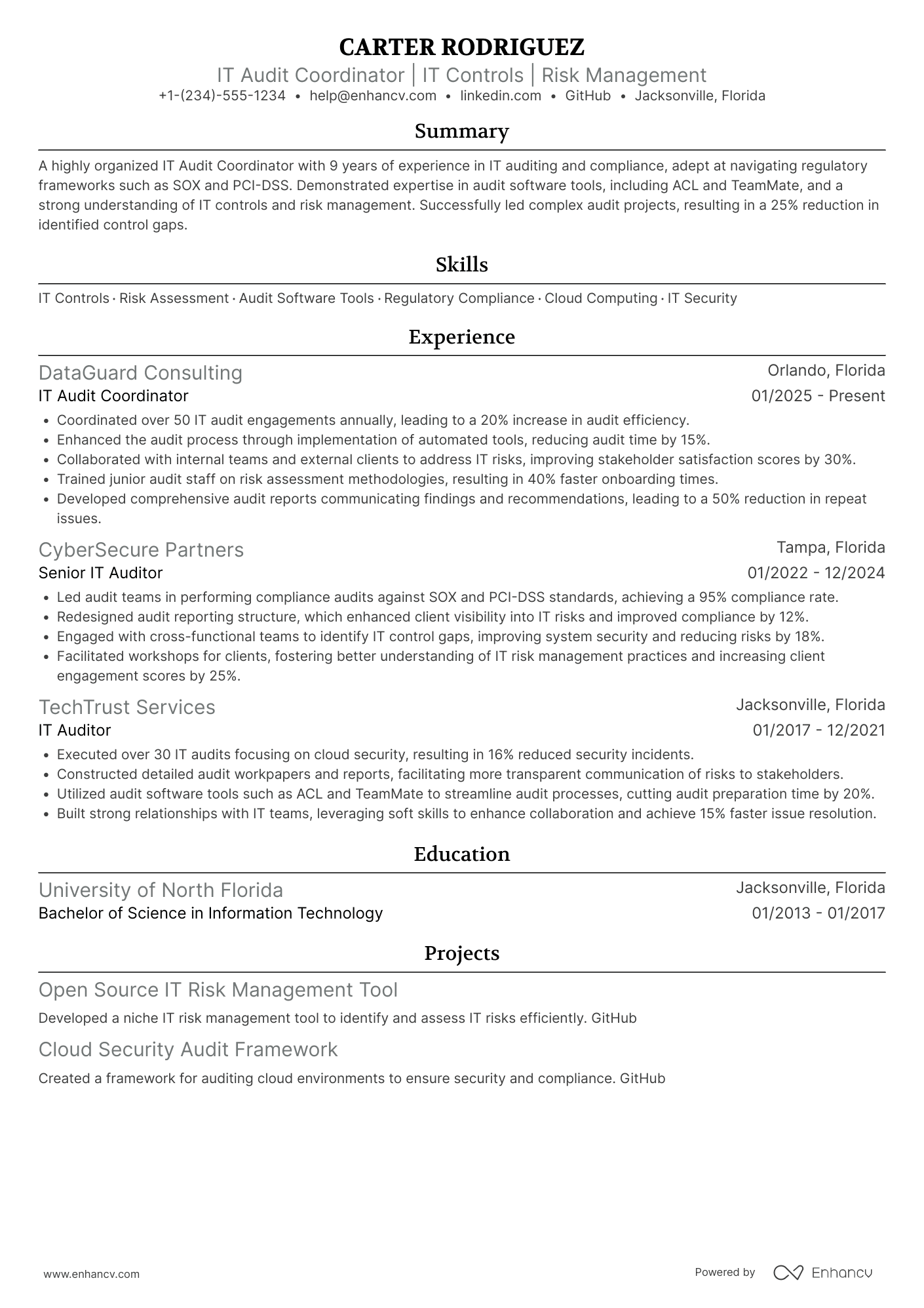
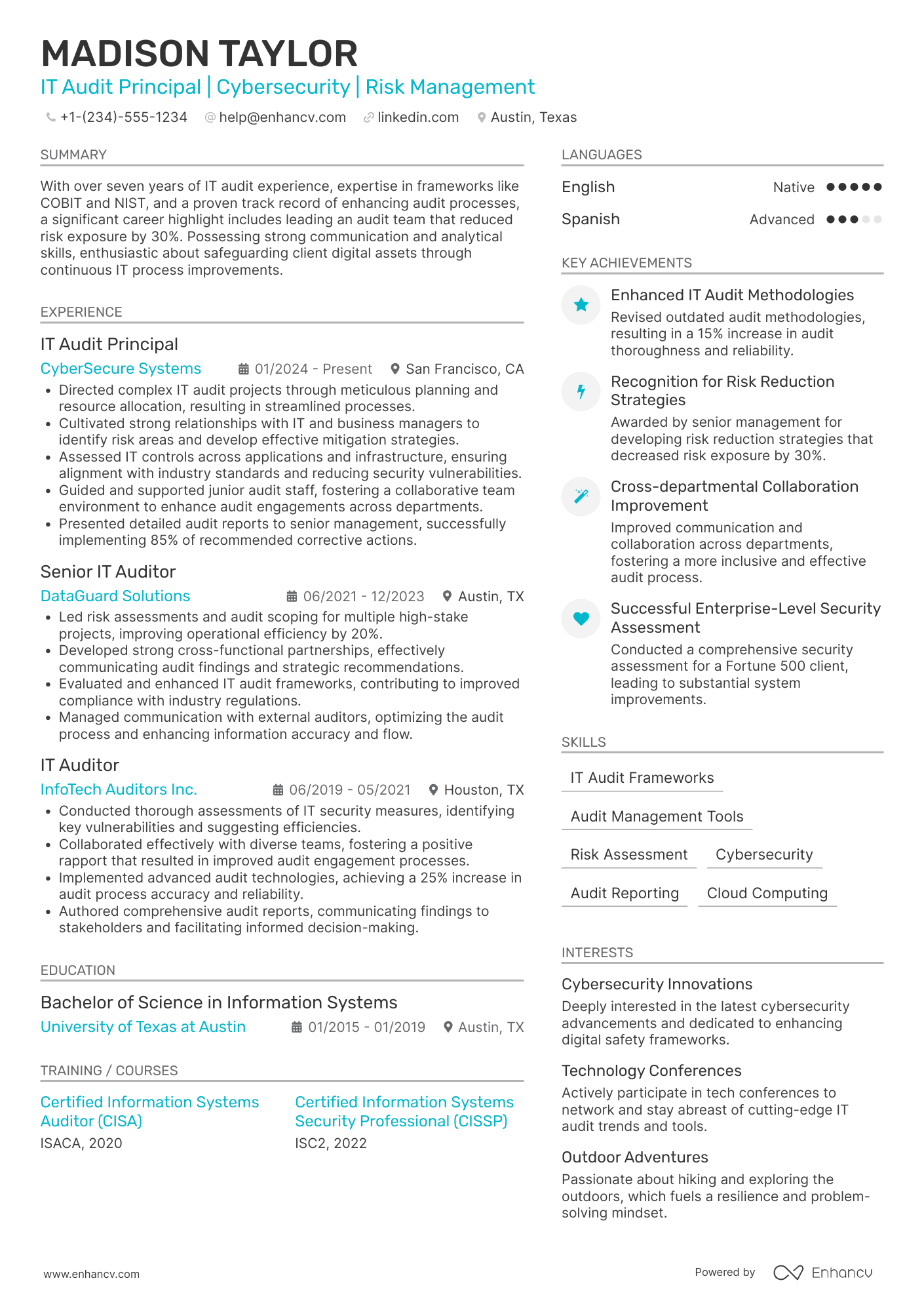
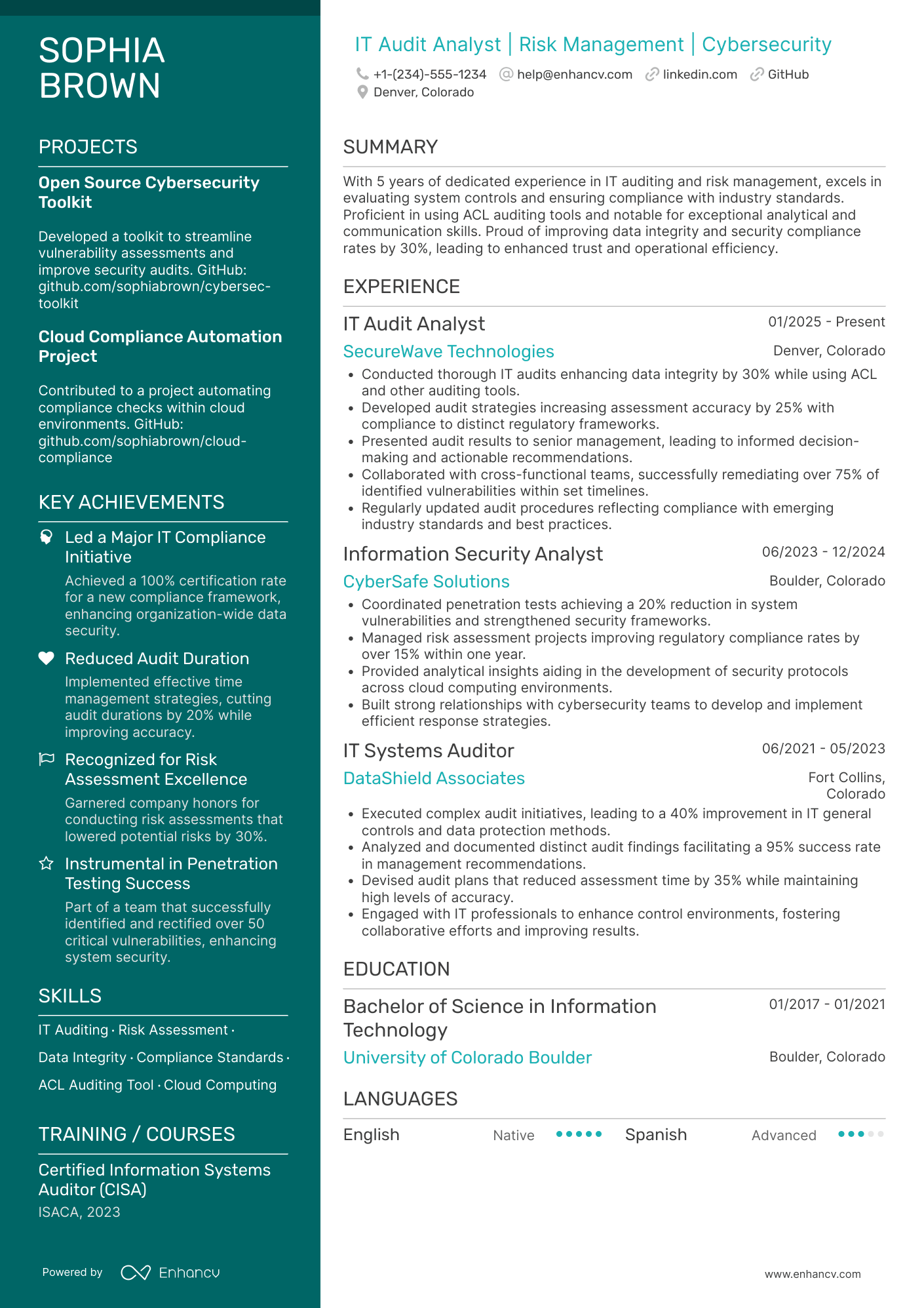
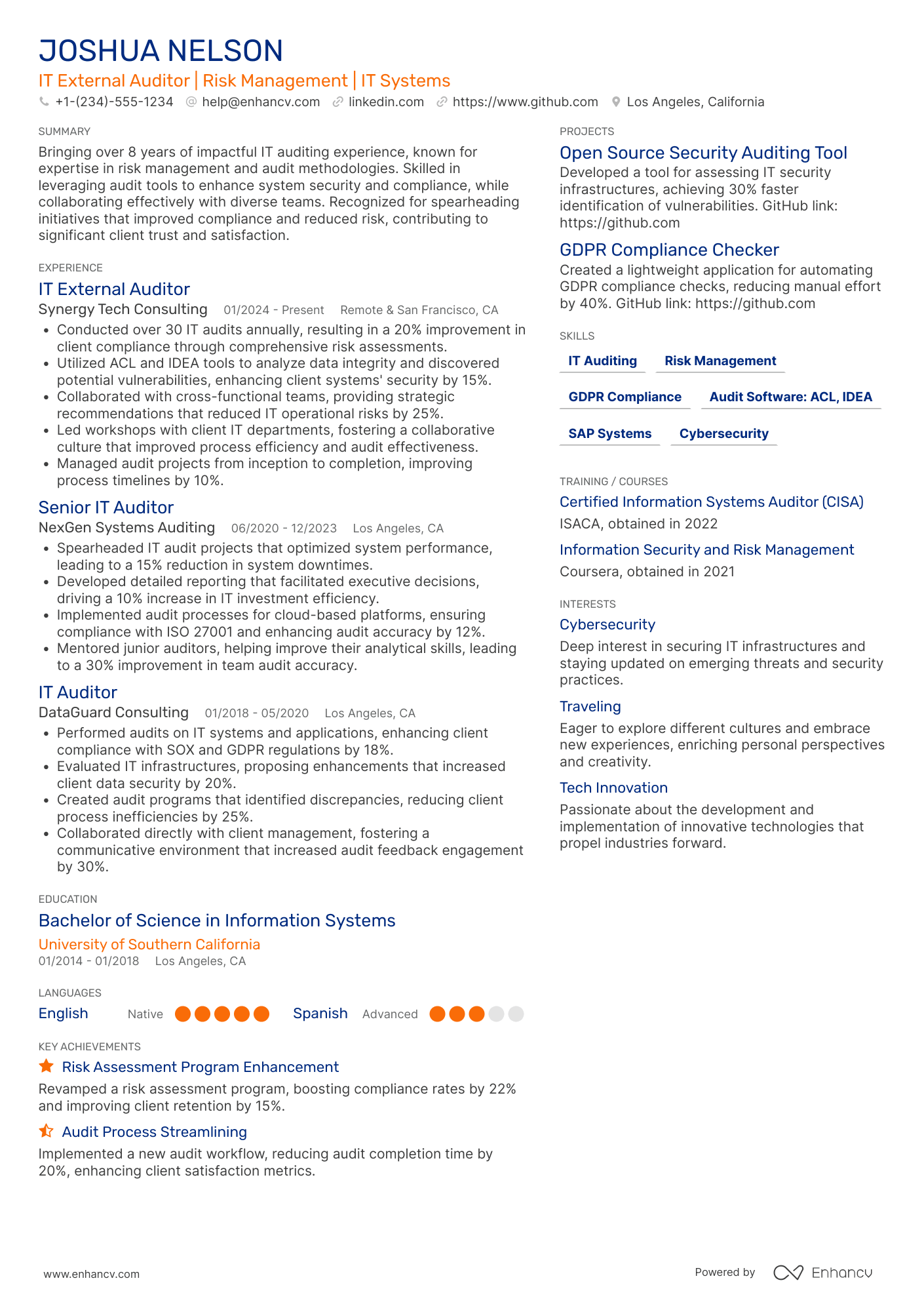
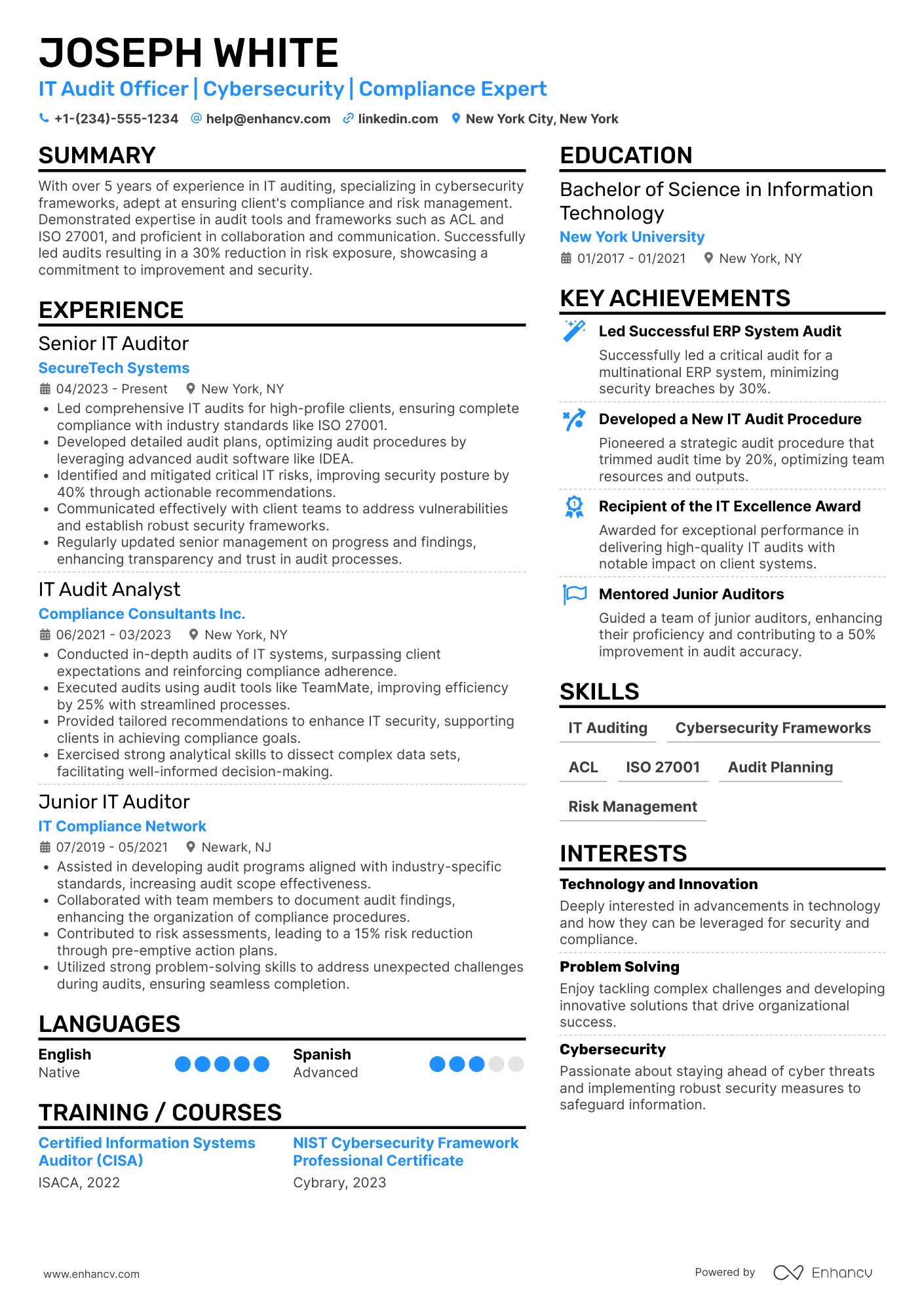
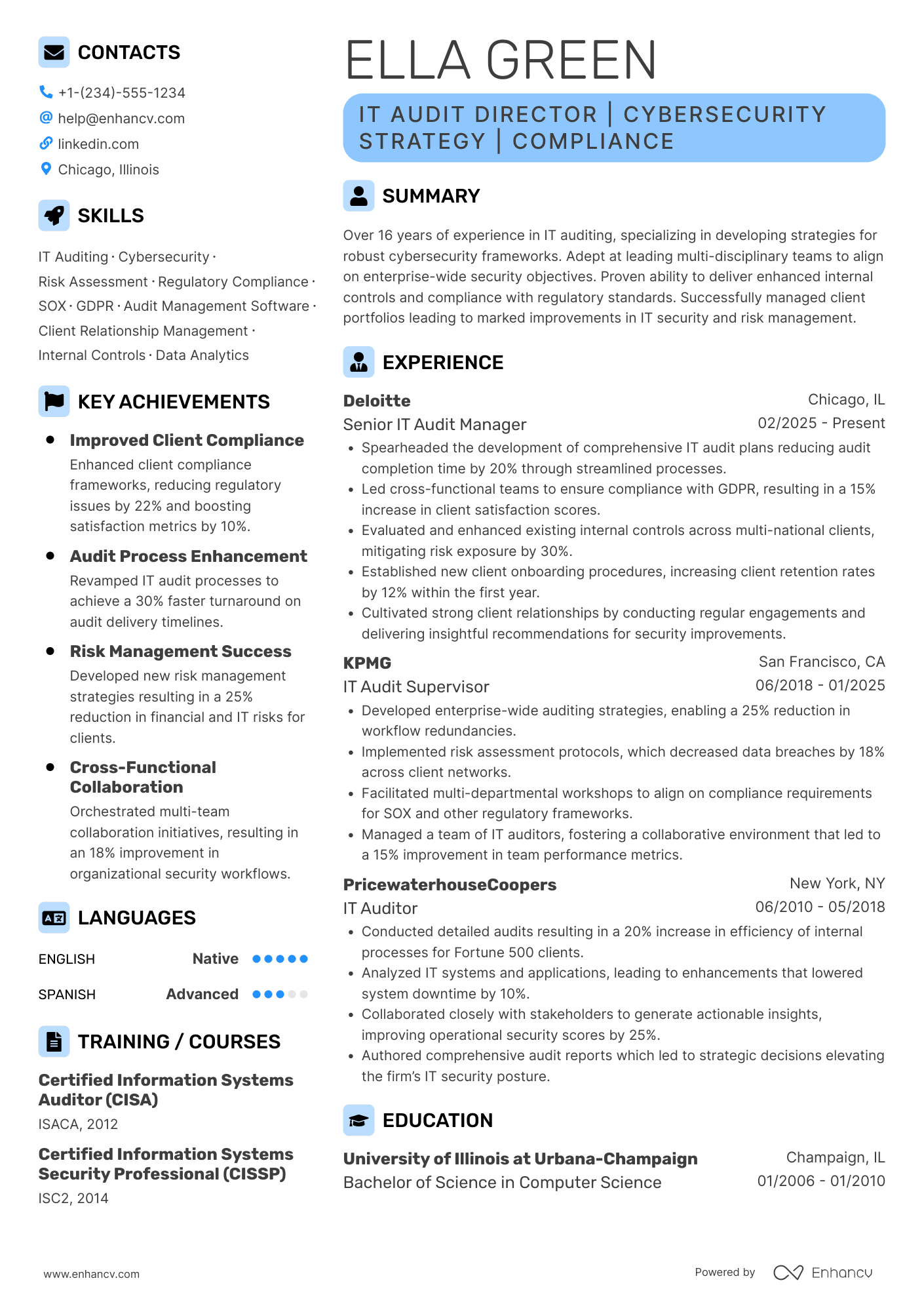
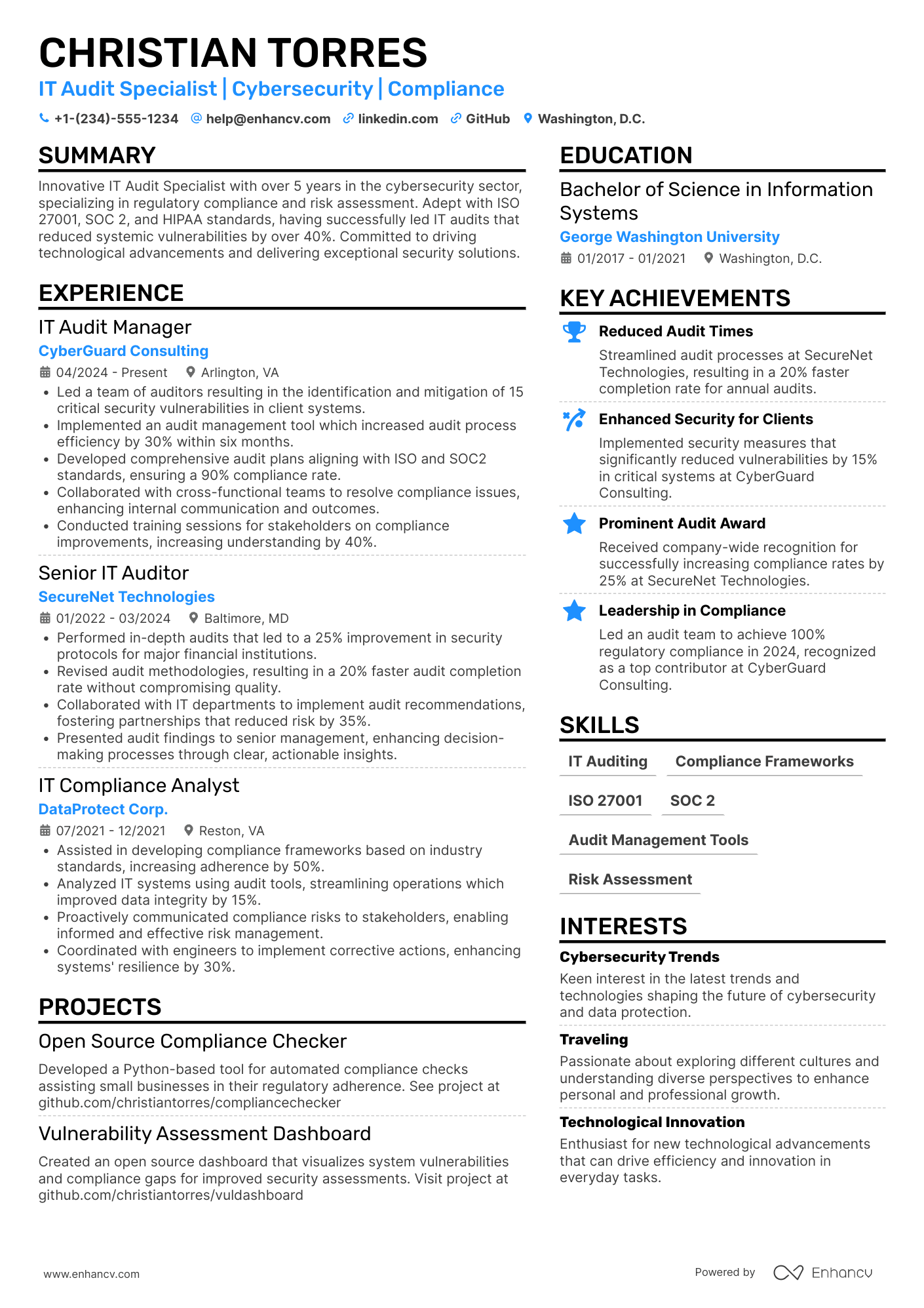
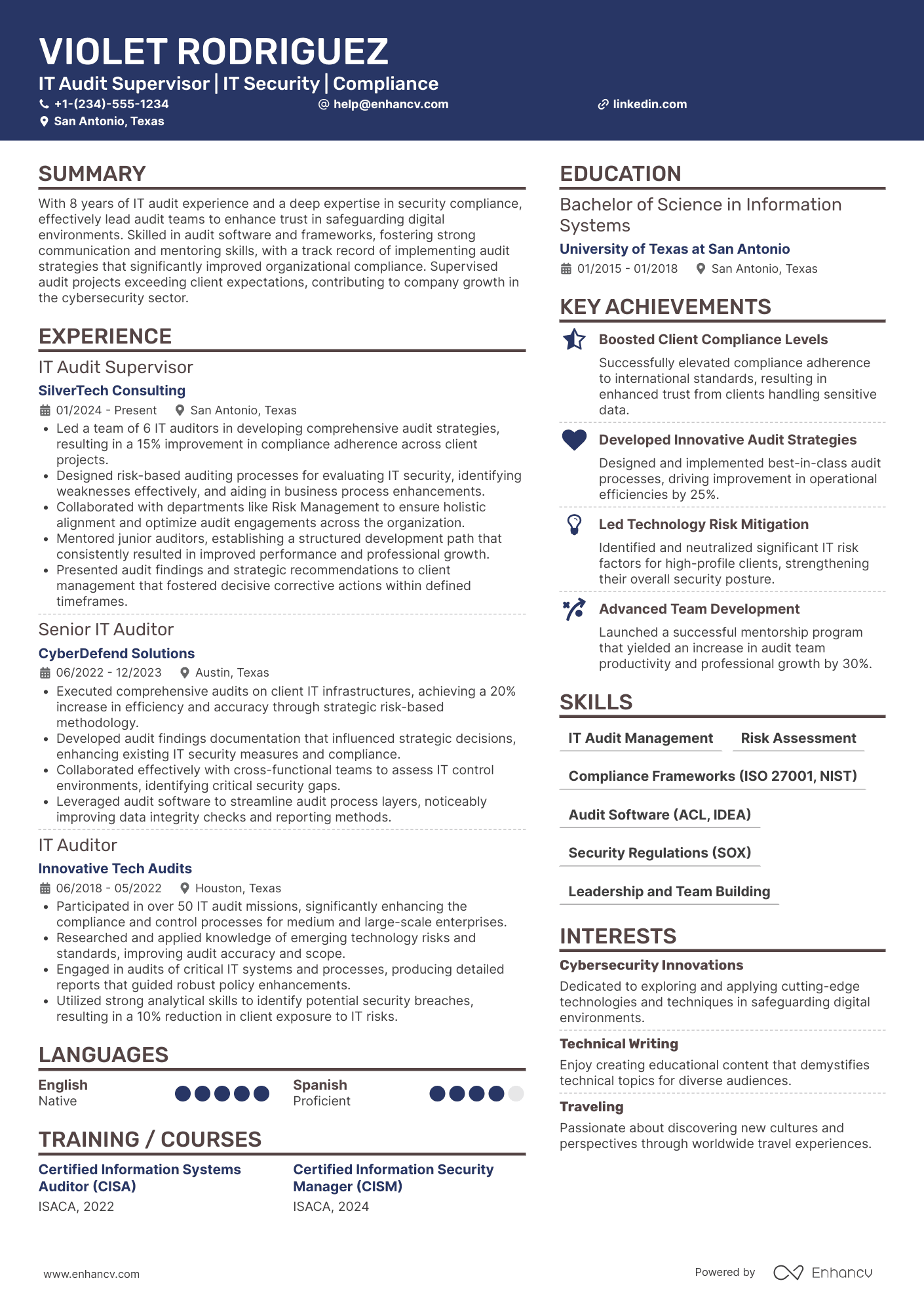
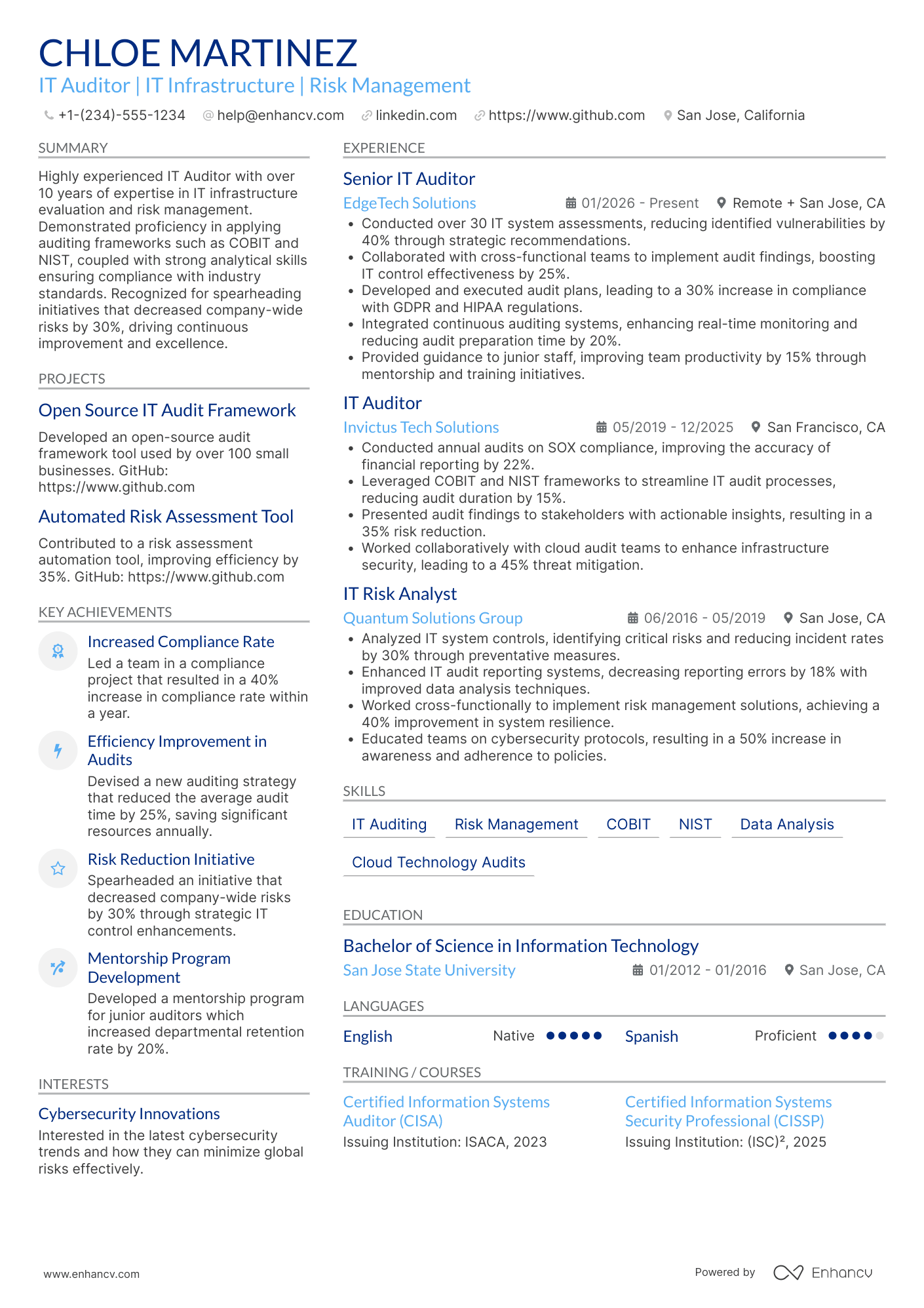
Most IT auditor resumes fail because they list frameworks and tasks but don't show audit scope, risk impact, or control results. In today's ATS and fast recruiter scans, that reads generic, so you get filtered out in a crowded market. Knowing how to make your resume stand out is critical in this competitive field.
A strong resume shows what changed because of your work. You should highlight risk reduction, audit coverage, and measurable outcomes like issues closed, findings severity, remediation timelines, SOX readiness, and fewer repeat findings. Include scope, stakeholders, and delivery impact.

Key takeaways
- Quantify audit outcomes like findings reduced, remediation timelines, and cost savings in every experience bullet.
- Use reverse-chronological format for experienced auditors and hybrid format for career changers or juniors.
- Tailor your resume to each job posting by mirroring its exact frameworks, tools, and compliance standards.
- Demonstrate skills through measurable results in your experience section, not just in a standalone skills list.
- Place certifications like CISA or CISSP above education when they're recent and directly relevant.
- Write a three- to four-line summary that names your domain, core tools, and one quantified achievement.
- Use Enhancv to turn vague audit duties into specific, metrics-driven resume bullets that pass recruiter screening.
Job market snapshot for IT auditors
We analyzed 2,828 recent IT auditor job ads across major US job boards. These numbers help you understand skills in demand, experience requirements, top companies hiring at a glance.
What level of experience employers are looking for IT auditors
| Years of Experience | Percentage found in job ads |
|---|---|
| 1–2 years | 11.9% (336) |
| 3–4 years | 15.5% (439) |
| 5–6 years | 7.0% (198) |
| 7–8 years | 1.0% (29) |
| 9–10 years | 2.1% (58) |
| 10+ years | 4.5% (126) |
| Not specified | 59.8% (1690) |
IT auditor ads by area of specialization (industry)
| Industry (Area) | Percentage found in job ads |
|---|---|
| Finance & Banking | 51.8% (1464) |
| Healthcare | 21.8% (617) |
| Government | 14.7% (416) |
| Education | 4.2% (120) |
| Manufacturing | 3.5% (100) |
| Retail & E-commerce | 1.2% (34) |
| Energy | 0.7% (21) |
| Travel & Hospitality | 0.6% (18) |
| Media & Entertainment | 0.6% (17) |
Top companies hiring IT auditors
| Company | Percentage found in job ads |
|---|---|
| Elevance Health | 5.0% (141) |
| State of Florida | 4.7% (133) |
| TUV SUD | 4.7% (132) |
| Molina Healthcare Inc. | 2.9% (83) |
| US Bank | 2.9% (83) |
| Capstone Logistics | 1.8% (50) |
| Truist Financial Corporation | 1.8% (50) |
| Wipfli LLP | 1.7% (48) |
| Capital One | 1.6% (44) |
| CVS Health | 1.3% (38) |
Role overview stats
These tables show the most common responsibilities and employment types for IT auditor roles. Use them to align your resume with what employers expect and to understand how the role is structured across the market.
Day-to-day activities and top responsibilities for a IT auditor
| Responsibility | Percentage found in job ads |
|---|---|
| Microsoft office | 16.5% (466) |
| Accounting | 14.6% (414) |
| Excel | 13.9% (394) |
| Auditing | 12.9% (364) |
| Audit | 10.4% (293) |
| Data analysis | 8.0% (225) |
| Microsoft excel | 7.6% (214) |
| Risk assessment | 7.0% (197) |
| Data analytics | 6.9% (194) |
| Word | 6.6% (188) |
| Risk management | 5.9% (166) |
| Internal controls | 5.5% (155) |
Type of employment (remote vs on-site vs hybrid)
| Employment type | Percentage found in job ads |
|---|---|
| On-site | 65.6% (1856) |
| Hybrid | 25.3% (716) |
| Remote | 9.1% (256) |
How to format a IT auditor resume
Recruiters evaluating IT auditor resumes prioritize evidence of audit methodology expertise, regulatory framework knowledge, and measurable risk reduction outcomes. A clear, well-structured resume format ensures these signals surface quickly during both automated screening and manual review.

I have significant experience in this role—which format should I use?
Use a reverse-chronological format to present your audit career in a linear, progression-focused structure that highlights growing scope and accountability. Do:
- Lead with your most recent role and emphasize the breadth of your audit ownership—number of systems reviewed, departments covered, and stakeholder relationships managed.
- Feature role-specific tools and domains prominently, including frameworks like COBIT, ISO 27001, and NIST, as well as platforms such as ACL, SAP GRC, or ServiceNow.
- Quantify outcomes in every experience entry, tying your audit work to measurable business impact such as cost savings, risk reduction percentages, or compliance gap closures.
I'm junior or switching into this role—what format works best?
A hybrid format works best, placing a focused skills section above a concise experience section so reviewers immediately see your relevant competencies. Do:
- Position technical skills and certifications (CISA, CompTIA Security+, SQL, data analytics tools) near the top of the resume so applicant tracking systems and recruiters register them first.
- Highlight academic projects, internships, or transitional experience where you performed control testing, risk assessments, or compliance reviews, even outside a formal audit title.
- Connect every listed action to a clear result, demonstrating that you understand the purpose behind audit tasks, not just the procedures.
Why not use a functional resume?
A functional format strips away the timeline and context that hiring managers need to evaluate how your audit skills were applied in real work environments, making it harder to verify your competency and growth.
- A functional format may be acceptable if you're transitioning from a related field (such as general accounting or cybersecurity) or returning after a career gap, but only if every listed skill is anchored to a specific project, engagement, or outcome rather than presented as a standalone claim.
With your format established, the next step is filling it with the right sections to present your qualifications effectively.
What sections should go on a IT auditor resume
Recruiters expect to see clear evidence that you can assess controls, manage risk, and deliver audit results that improve compliance and security. Understanding which resume sections to include helps you present that evidence effectively.
Use this structure for maximum clarity:
- Header
- Summary
- Experience
- Skills
- Projects
- Education
- Certifications
- Optional sections: Awards, Publications, Languages
Strong experience bullets should emphasize audit scope, control and compliance outcomes, quantified risk reduction, stakeholder impact, and remediation results.
Is your resume good enough?
Drop your resume here or choose a file. PDF & DOCX only. Max 2MB file size.
Once you’ve organized your resume with the right components, the next step is to write your IT auditor resume experience section so it supports each part with clear, relevant proof.
How to write your IT auditor resume experience
The experience section is where you prove you've delivered meaningful audit work—not just participated in it. Hiring managers want to see the controls you've assessed, the frameworks you've applied, and the measurable risk reductions or compliance improvements you've driven, because demonstrated impact always outweighs a descriptive task list.
Each entry should include:
- Job title
- Company and location (or remote)
- Dates of employment (month and year)
Three to five concise bullet points showing what you owned, how you executed, and what outcomes you delivered:
- Ownership scope: the IT environments, control frameworks, audit programs, systems, or business units you were directly accountable for evaluating and reporting on as an IT auditor.
- Execution approach: the audit methodologies, regulatory standards, risk assessment tools, data analytics platforms, or testing techniques you used to plan engagements, gather evidence, and form conclusions.
- Value improved: the changes you drove in control effectiveness, security posture, regulatory compliance, process efficiency, remediation timelines, or organizational risk exposure through your audit work.
- Collaboration context: how you partnered with internal stakeholders such as information security teams, infrastructure engineers, compliance officers, external auditors, or executive leadership to align audit findings with business priorities and drive remediation.
- Impact delivered: the outcomes your audit work produced—expressed through scope of coverage, reduction in risk, strengthened compliance positioning, or improvements to governance—rather than a summary of tasks performed.
Experience bullet formula
A IT auditor experience example
✅ Right example - modern, quantified, specific.
IT Auditor
Apex Financial Services | Charlotte, NC
2022–Present
Regional banking and payments provider supporting 2M+ customer accounts across cloud and on-prem systems.
- Led SOX and SOC 2 IT general controls testing across AWS, Active Directory, and ServiceNow, reducing high-risk findings by 38% year over year.
- Automated evidence collection and control testing using Python and SQL against Splunk logs and ServiceNow tickets, cutting audit fieldwork time by 25% (about 120 hours per quarter).
- Performed access reviews for 1,500+ privileged accounts in Active Directory and AWS Identity and Access Management (IAM), identifying and remediating 210 orphaned accounts and lowering unauthorized access risk by 30%.
- Partnered with security engineering and system owners to validate vulnerability management controls in Tenable and Jira, improving critical patch compliance from 72% to 94% within two quarters.
- Presented audit results and remediation plans to IT leadership and business stakeholders, driving on-time closure of 90% of action items within 60 days.
Now that you've seen how a strong experience entry comes together, let's look at how to adapt yours to match a specific job posting.
How to tailor your IT auditor resume experience
Recruiters evaluate your IT auditor resume through both human review and applicant tracking systems. Tailoring your resume to the job description ensures your qualifications align with what hiring managers actively seek.
Ways to tailor your IT auditor experience:
- Match specific audit tools and technologies named in the posting.
- Use the exact compliance frameworks referenced like SOX or COBIT.
- Mirror the risk assessment methodologies the employer prioritizes.
- Include relevant industry experience such as financial services or healthcare.
- Emphasize security control testing if the role highlights cybersecurity.
- Align your metrics with the KPIs or success criteria listed.
- Reference the collaboration models described like cross-functional audit teams.
- Highlight experience with specific ERP or GRC platforms they mention.
Tailoring means aligning your real accomplishments with the role's requirements, not forcing keywords where they don't naturally belong.
Resume tailoring examples for IT auditor
| Job description excerpt | Untailored | Tailored |
|---|---|---|
| Conduct IT general controls (ITGC) testing across financial systems, focusing on logical access, change management, and computer operations in compliance with SOX requirements. | Performed audits of IT systems and controls. | Executed ITGC testing across 12 financial applications, evaluating logical access, change management, and computer operations to ensure SOX compliance, identifying 15 control deficiencies across two audit cycles. |
| Evaluate cloud security configurations in AWS and Azure environments using CIS Benchmarks, and document findings aligned with NIST 800-53 controls. | Reviewed cloud infrastructure for security issues. | Assessed AWS and Azure cloud security configurations against CIS Benchmarks, mapping 85+ findings to NIST 800-53 control families and reducing misconfigurations by 30% within one quarter. |
| Lead risk assessments for ERP systems (SAP, Oracle) to identify segregation of duties (SoD) conflicts and recommend remediation strategies using GRC tools. | Helped with risk assessments and access reviews. | Led SoD risk assessments for SAP and Oracle ERP environments using SAP GRC Access Control, identifying 40+ role conflicts and delivering remediation plans that resolved 90% of high-risk violations before the next audit period. |
Once you’ve aligned your experience with the role’s priorities, quantify your IT auditor achievements to show the measurable impact of that work.
How to quantify your IT auditor achievements
Quantifying your achievements shows how your audits reduced risk, improved compliance, and sped up remediation. Use numbers like audit coverage, control effectiveness, findings severity, remediation cycle time, and cost savings from automation.
Quantifying examples for IT auditor
| Metric | Example |
|---|---|
| Risk reduction | "Cut high-risk findings by 38% across 22 applications by tightening access reviews and validating privileged accounts in Active Directory." |
| Audit coverage | "Expanded SOX ITGC testing from 45 to 80 key controls across four systems, improving coverage while keeping the audit calendar on track." |
| Remediation speed | "Reduced average remediation cycle time from 41 to 24 days by tracking action plans in Jira and running weekly owner check-ins." |
| Quality accuracy | "Lowered evidence rework rate from 18% to 6% by standardizing sampling templates and adding a two-step review before submission." |
| Cost efficiency | "Saved $52,000 annually by automating log collection and control evidence pulls with PowerShell scripts and ServiceNow workflows." |
Turn vague job duties into measurable, recruiter-ready resume bullets in seconds with Enhancv's Bullet Point Generator.
With strong bullet points in place, the next step is ensuring your IT auditor resume highlights the right mix of hard and soft skills to match what employers are looking for.
How to list your hard and soft skills on a IT auditor resume
Your skills section shows you can assess technology risk, test controls, and report findings—recruiters and applicant tracking systems scan this section for keyword matches and role fit, so aim for a balanced mix of hard skills and job-specific soft skills. IT auditor roles require a blend of:
- Product strategy and discovery skills.
- Data, analytics, and experimentation skills.
- Delivery, execution, and go-to-market discipline.
- Soft skills.
Your skills section should be:
- Scannable (bullet-style grouping).
- Relevant to the job post.
- Backed by proof in experience bullets.
- Updated with current tools.
Place your skills section:
- Above experience if you're junior or switching careers.
- Below experience if you're mid/senior with strong achievements.

Hard skills
- IT general controls (ITGC) testing
- SOX compliance audits
- SOC one and SOC two reviews
- ISO 27001, NIST CSF, COBIT
- Risk and control matrices
- Access reviews, segregation of duties
- Change management controls
- Vulnerability management, patch compliance
- Cloud controls: AWS, Azure
- SQL audit sampling and testing
- GRC tools: ServiceNow, Archer
- Audit workpapers and evidence management
Soft skills
- Translate risk into business impact
- Interview control owners effectively
- Write clear, actionable findings
- Challenge assumptions with evidence
- Prioritize high-risk audit areas
- Coordinate across IT and security teams
- Manage audit timelines and scope
- Lead walkthroughs and control testing
- Escalate issues early and clearly
- Negotiate remediation plans and deadlines
- Maintain independence and professional skepticism
- Present results to stakeholders
How to show your IT auditor skills in context
Skills shouldn't live only in a dedicated skills list. Explore resume skills examples to see how other professionals weave competencies throughout their resumes.
They should be demonstrated in:
- Your summary (high-level professional identity)
- Your experience (proof through outcomes)
Here's what that looks like in practice.
Summary example
Senior IT auditor with 10 years in financial services, specializing in SOX compliance, COBIT frameworks, and SAP GRC. Led enterprise-wide control assessments across 12 business units, reducing audit cycle time by 30% through cross-functional collaboration and risk-based prioritization.
- Signals senior-level expertise immediately
- Names specific frameworks and tools
- Quantifies efficiency gains clearly
- Highlights collaboration as a strength
Experience example
Senior IT Auditor
Whitmore Financial Group | Charlotte, NC
March 2019–Present
- Executed 45+ IT general control audits annually using ACL Analytics and COBIT 2019, identifying control gaps that cut remediation costs by 22%.
- Partnered with infrastructure and application teams to redesign access management workflows, reducing unauthorized access incidents by 40%.
- Led SOC 2 Type II readiness assessments for three cloud platforms, collaborating with external auditors to achieve zero critical findings across all engagements.
- Every bullet includes measurable proof
- Skills appear naturally within achievements
Once you’ve demonstrated your IT auditor skills through results and relevant examples, the next step is to apply that same approach to building an IT auditor resume when you have no experience.
How do I write a IT auditor resume with no experience
Even without full-time experience, you can demonstrate readiness through projects and academic work. Our guide on writing a resume without work experience covers this in detail. Here are some ways to build your profile:
- Information security coursework and labs
- Internal control case study analyses
- Audit-style capstone project deliverables
- Home lab: Windows, Linux, SIEM
- Vulnerability scans with documented remediation
- Internship in IT operations support
- Compliance mapping: SOC 2, ISO 27001
- CTF writeups on access controls
Focus on:
- IT auditor methods and standards
- Evidence-driven findings and metrics
- Control testing and documentation
- Tools: SIEM, scanners, spreadsheets
Resume format tip for entry-level IT auditor
Use a skills-based resume format because it highlights audit-relevant projects, labs, and coursework when work history is limited. Do:
- Lead with an IT auditor skills summary.
- Group projects by audit domain and tool.
- Quantify results: coverage, time, findings.
- Add standards used: NIST, SOC 2.
- Link to a redacted project repo.
- Built a home lab and ran Nessus scans on ten hosts, documented twenty-six findings, and reduced critical vulnerabilities by eighty percent after remediation verification.
Even without hands-on experience, your academic background can carry significant weight—so presenting your education strategically is the next essential step.
How to list your education on a IT auditor resume
Your education section helps hiring teams confirm you have the foundational knowledge needed for the IT auditor role. It validates your academic background in relevant fields quickly.
Include:
- Degree name
- Institution
- Location
- Graduation year
- Relevant coursework (for juniors or entry-level candidates)
- Honors & GPA (if 3.5 or higher)
Skip month and day details—list the graduation year only.
Here's a strong education entry tailored to an IT auditor resume.
Example education entry
Bachelor of Science in Management Information Systems
University of Illinois at Urbana-Champaign, Urbana, IL
Graduated 2021
GPA: 3.7/4.0
- Relevant Coursework: IT Governance, Database Management, Network Security, Accounting Information Systems, Internal Auditing Principles
- Honors: Dean's List (six consecutive semesters), Beta Gamma Sigma Honor Society
How to list your certifications on a IT auditor resume
Certifications on your resume show an IT auditor's commitment to continuous learning, hands-on tool proficiency, and alignment with current audit and security standards.
Include:
- Certificate name
- Issuing organization
- Year
- Optional: credential ID or URL
- Place certifications below education when they're older, less relevant, or you want to keep the focus on a recent degree.
- Place certifications above education when they're recent, highly relevant, or required for the IT auditor roles you're targeting.
Best certifications for your IT auditor resume
Certified Information Systems Auditor (CISA) Certified Information Systems Security Professional (CISSP) Certified in Risk and Information Systems Control (CRISC) ISO/IEC 27001 Lead Auditor Certified Internal Auditor (CIA) GIAC Systems and Network Auditor (GSNA) CompTIA Security+
Once you’ve highlighted the credentials that validate your expertise, use your IT auditor resume summary to connect those qualifications to the value you bring.
How to write your IT auditor resume summary
Your resume summary is the first thing a recruiter reads, so it needs to earn attention fast. A strong opening signals you understand IT audit fundamentals and can deliver real value from day one.
Keep it to three to four lines, with:
- Your title and relevant years of IT audit experience.
- The domain or industry you've worked in, such as financial services or healthcare.
- Core tools and frameworks like ACL, SAP GRC, COBIT, or ISO 27001.
- One or two measurable achievements that show your early impact.
- Soft skills tied to outcomes, such as clear documentation or cross-team communication.

PRO TIP
At the entry level, emphasize technical skills, relevant certifications, and specific contributions from internships or early roles. Avoid vague descriptors like "passionate" or "motivated self-starter." Recruiters want to see what you know and what you've done, not how you feel about the work.
Example summary for a IT auditor
IT auditor with two years of experience in financial services. Conducted SOX compliance testing using ACL Analytics, identifying 15 control gaps. Skilled in COBIT frameworks and cross-departmental communication.
Optimize your resume summary and objective for ATS
Drop your resume here or choose a file.
PDF & DOCX only. Max 2MB file size.
Now that your summary captures your IT auditor expertise at a glance, make sure your header provides the essential contact details recruiters need to reach you.
What to include in a IT auditor resume header
A resume header lists your key identity and contact details, helping IT auditor candidates boost visibility, build credibility, and pass recruiter screening faster.
Essential resume header elements
- Full name
- Tailored job title and headline
- Location
- Phone number
- Professional email
- GitHub link
- Portfolio link
A LinkedIn link helps recruiters verify experience fast and supports screening with consistent titles, dates, and certifications.
Don't include a photo on a IT auditor resume unless the role is explicitly front-facing or appearance-dependent.
Match your header job title to the posting and keep links short, readable, and consistent across every profile.
IT auditor resume header
Jordan Lee
IT auditor | SOX & ITGC Testing, Risk Assessments, SOC Reports
Austin, TX
(512) 555-01XX
jordan.lee@enhancv.com
github.com/jordanlee
jordanleeaudit.com
linkedin.com/in/jordanlee
Once your contact details and key identifiers are in place at the top of your resume, add relevant additional sections to round out your qualifications and support the role.
Additional sections for IT auditor resumes
Beyond core qualifications, additional sections help you stand out when competing against equally certified IT auditor candidates.
They showcase unique strengths and deepen your professional credibility.
Consider adding these sections to your IT auditor resume:
- Certifications (CISA, CISSP, CRISC, ISO 27001 Lead Auditor)
- Languages
- Professional affiliations (ISACA, IIA, AICPA)
- Publications and conference presentations
- Continuing education and training
- Volunteer work in compliance or cybersecurity outreach
- Hobbies and interests
Once you've strengthened your resume with relevant additional sections, pairing it with a well-crafted cover letter can further set your application apart.
Do IT auditor resumes need a cover letter
An IT auditor cover letter isn't required for most applications, but it helps in competitive roles or regulated industries with strict hiring expectations. If you're unsure what a cover letter is and when to use one, it can make the difference when your resume needs context, or when the role demands precise stakeholder communication.
Use a cover letter to add clarity that your resume can't:
- Explain role and team fit by matching your audit scope experience to the team's environment, tools, and reporting cadence.
- Highlight one or two relevant projects or outcomes, using metrics like control coverage, remediation cycle time, or reduced high-risk findings.
- Show understanding of the product, users, and business context, such as how system changes affect security, availability, and financial reporting.
- Address career transitions or non-obvious experience by connecting prior roles to audit planning, evidence quality, and risk-based testing.
Drop your resume here or choose a file.
PDF & DOCX only. Max 2MB file size.
Whether you include a cover letter or not, the next step is strengthening your IT auditor resume itself—here’s how using AI can help you improve it.
Using AI to improve your IT auditor resume
AI can sharpen your resume's clarity, structure, and impact. It helps refine language and highlight measurable results. But overuse kills authenticity. If you're wondering which AI is best for writing resumes, focus on tools that enhance rather than replace your own voice. Once your content feels clear and role-aligned, step away from AI.
Here are 10 practical prompts to strengthen specific sections of your IT auditor resume:
Strengthen summary focus
Quantify audit results
Align skills precisely
Sharpen experience bullets
Tailor certification placement
Clarify project contributions
Improve education relevance
Eliminate filler language
Tighten scope descriptions
Optimize for screening
Conclusion
A strong IT auditor resume shows measurable outcomes, role-specific skills, and a clear structure. It highlights audit planning, risk assessment, controls testing, and reporting, backed by metrics such as findings reduced, coverage increased, or remediation time improved.
Keep sections easy to scan, and align your experience to what hiring teams need now. A focused, results-based IT auditor resume signals you can protect systems, meet compliance demands, and support change in today’s market.