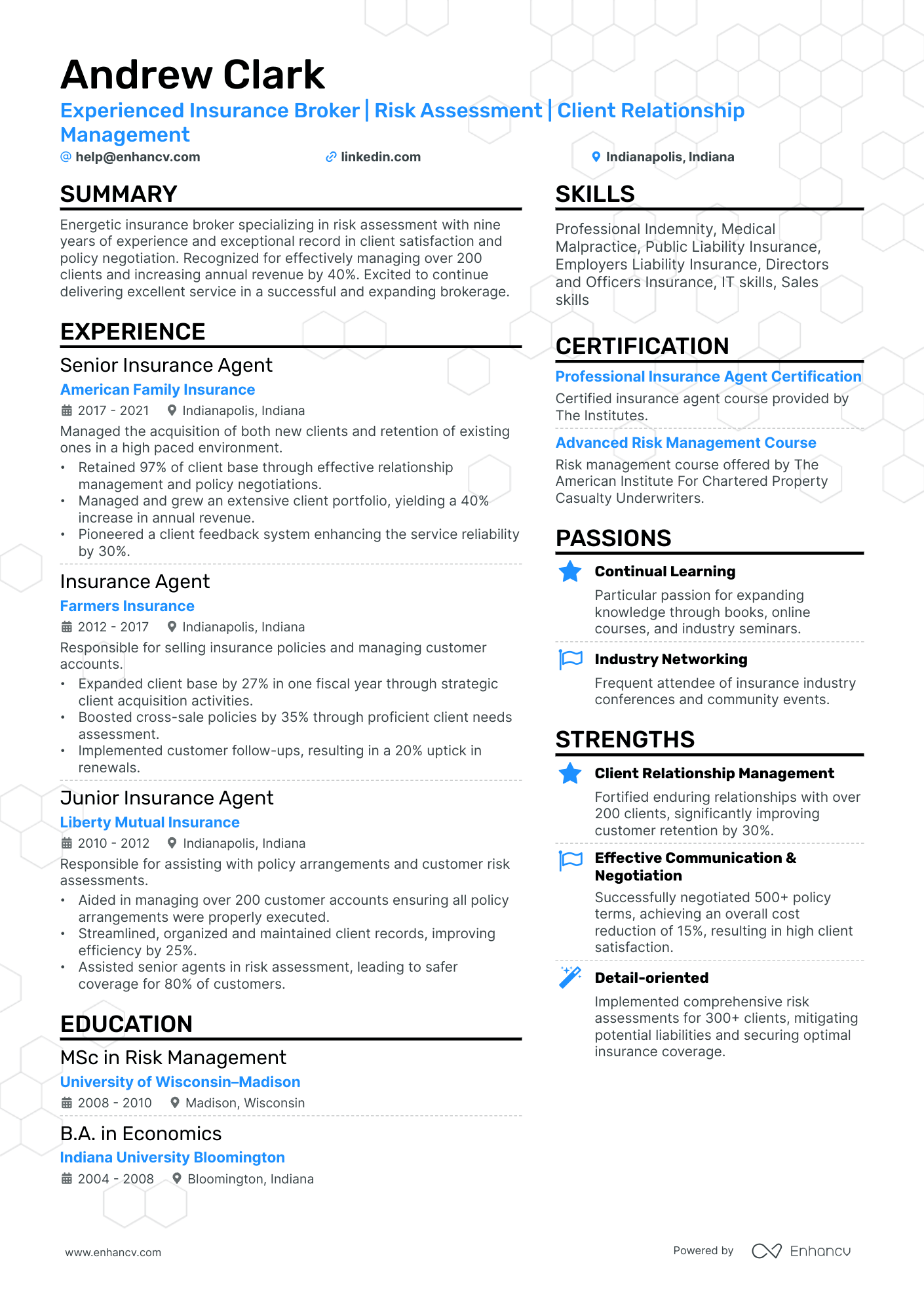
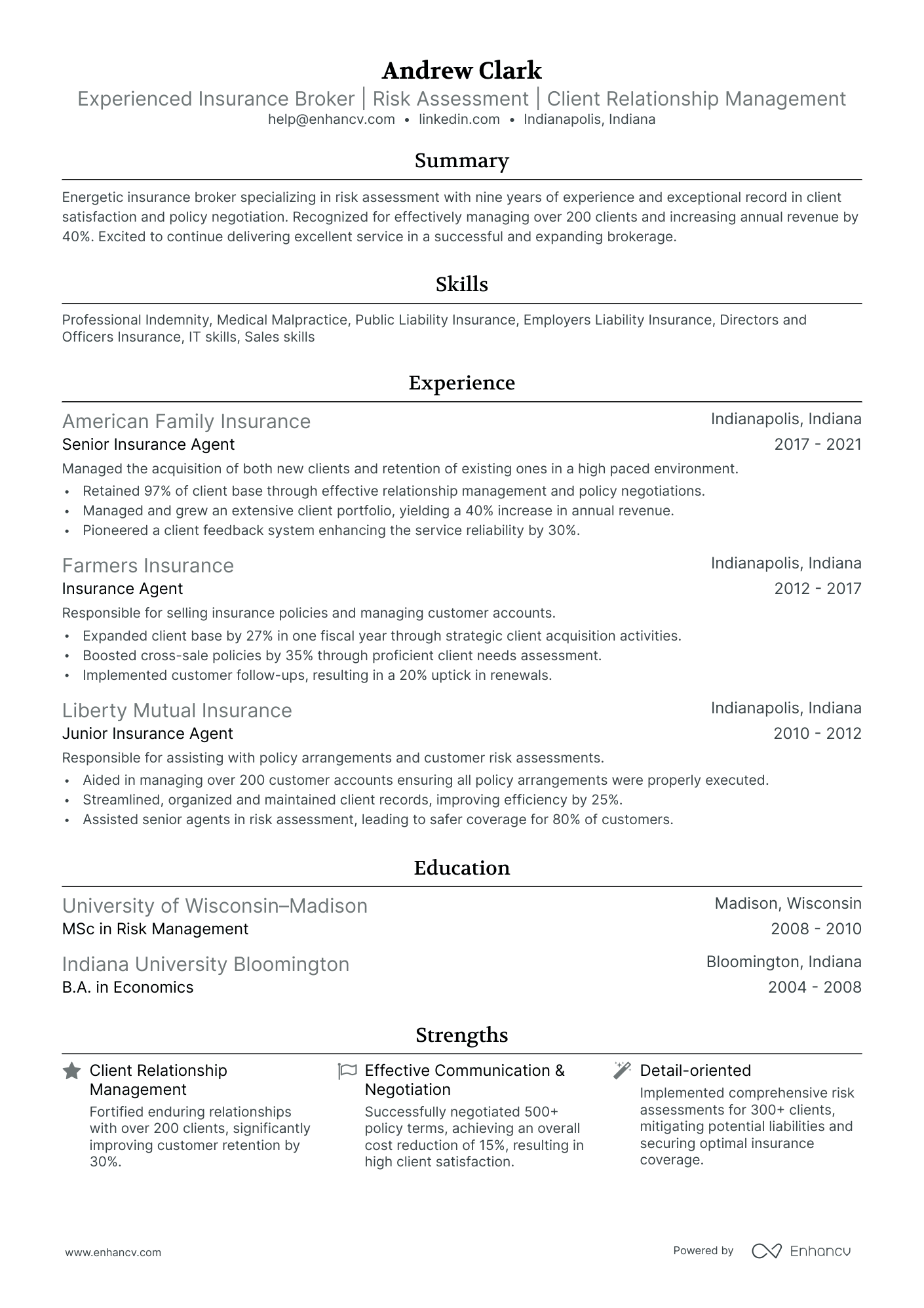
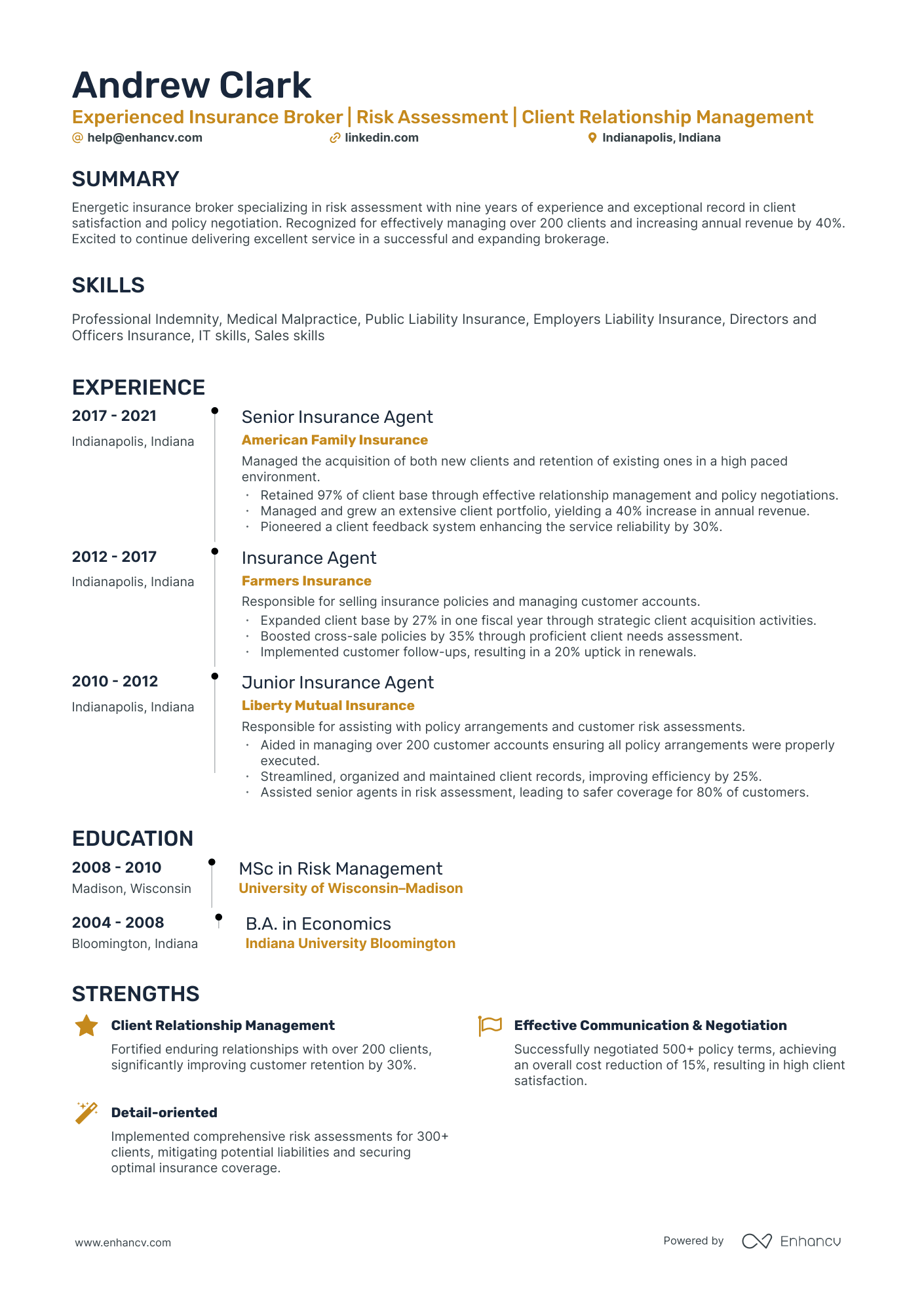
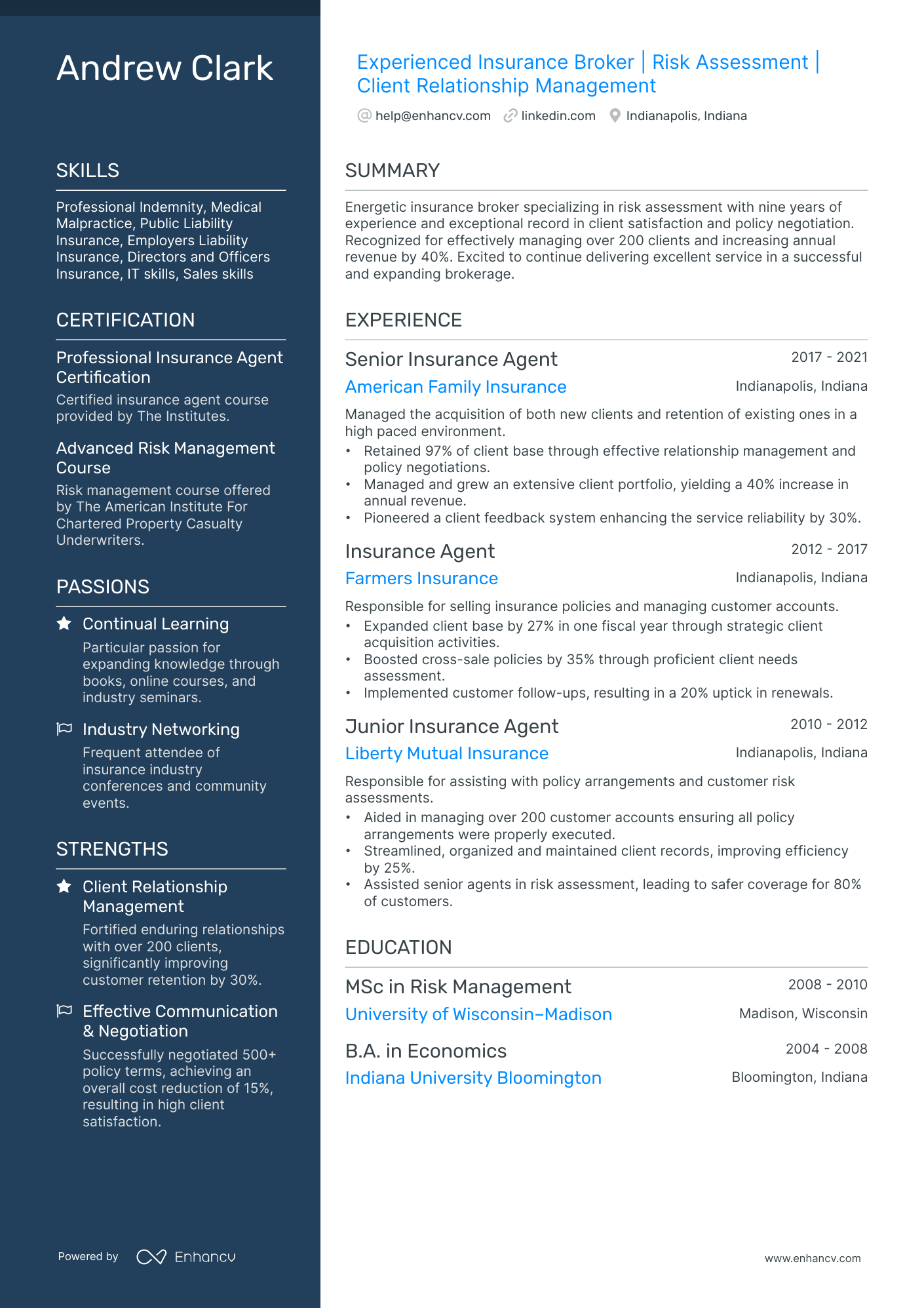
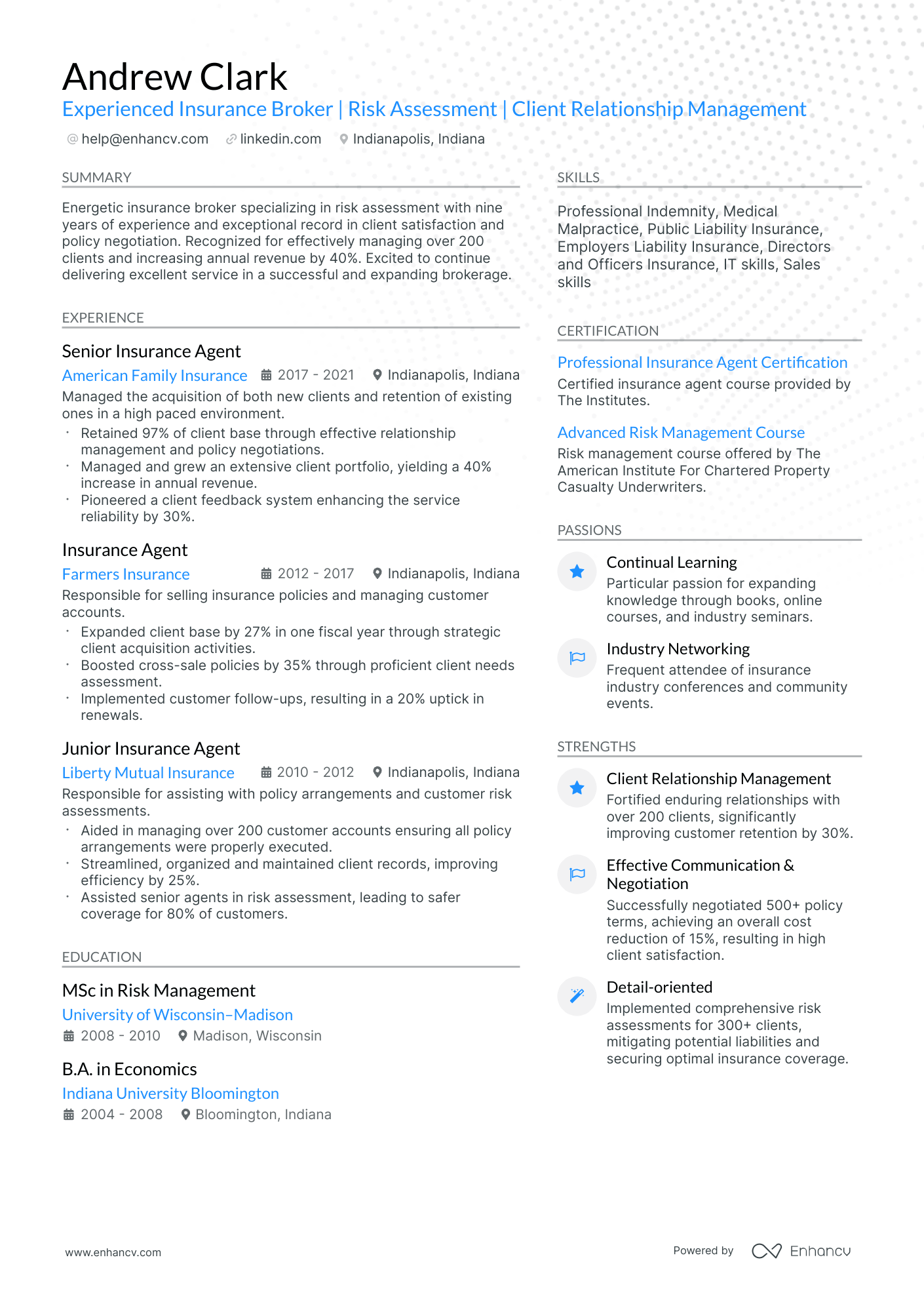
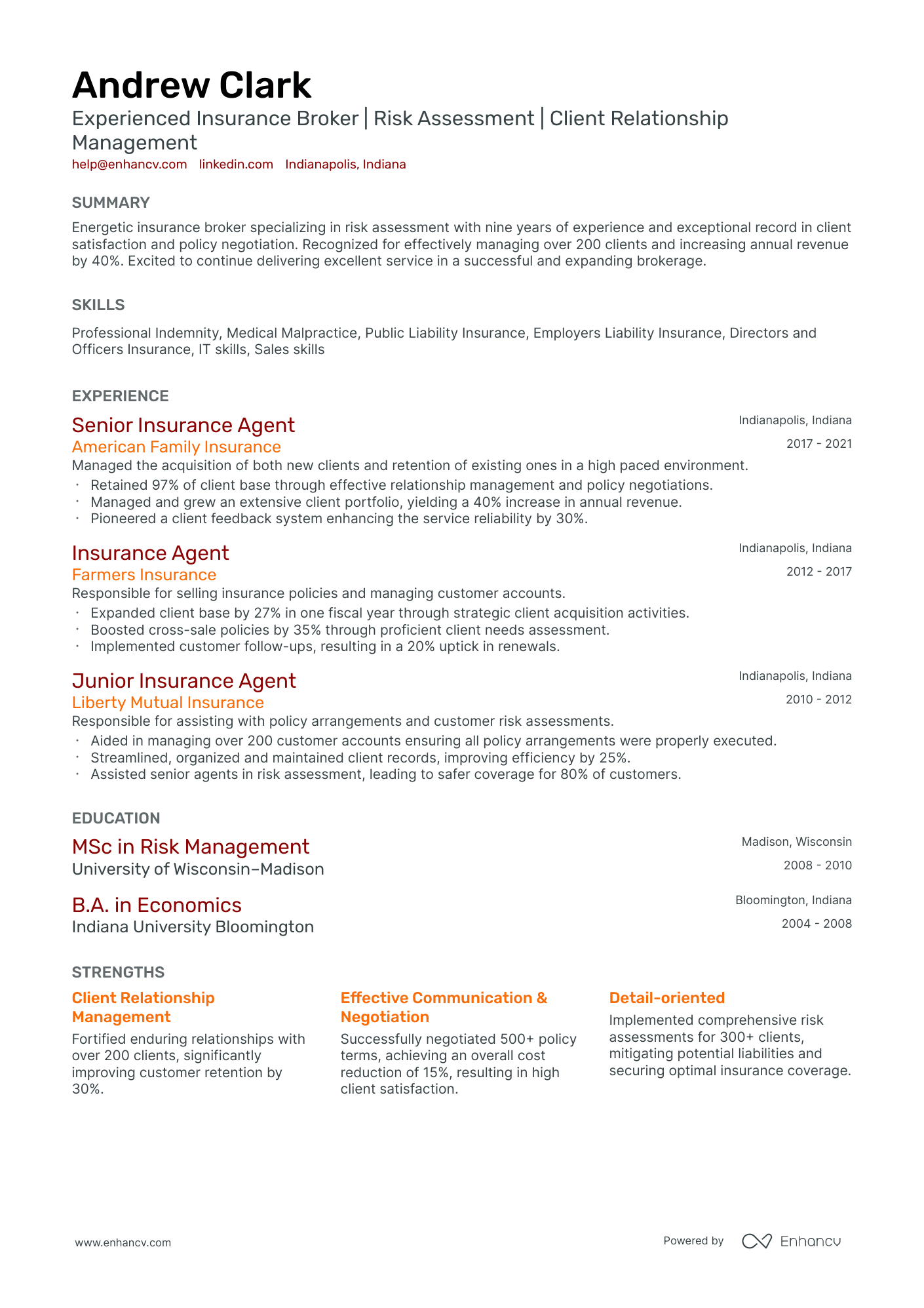
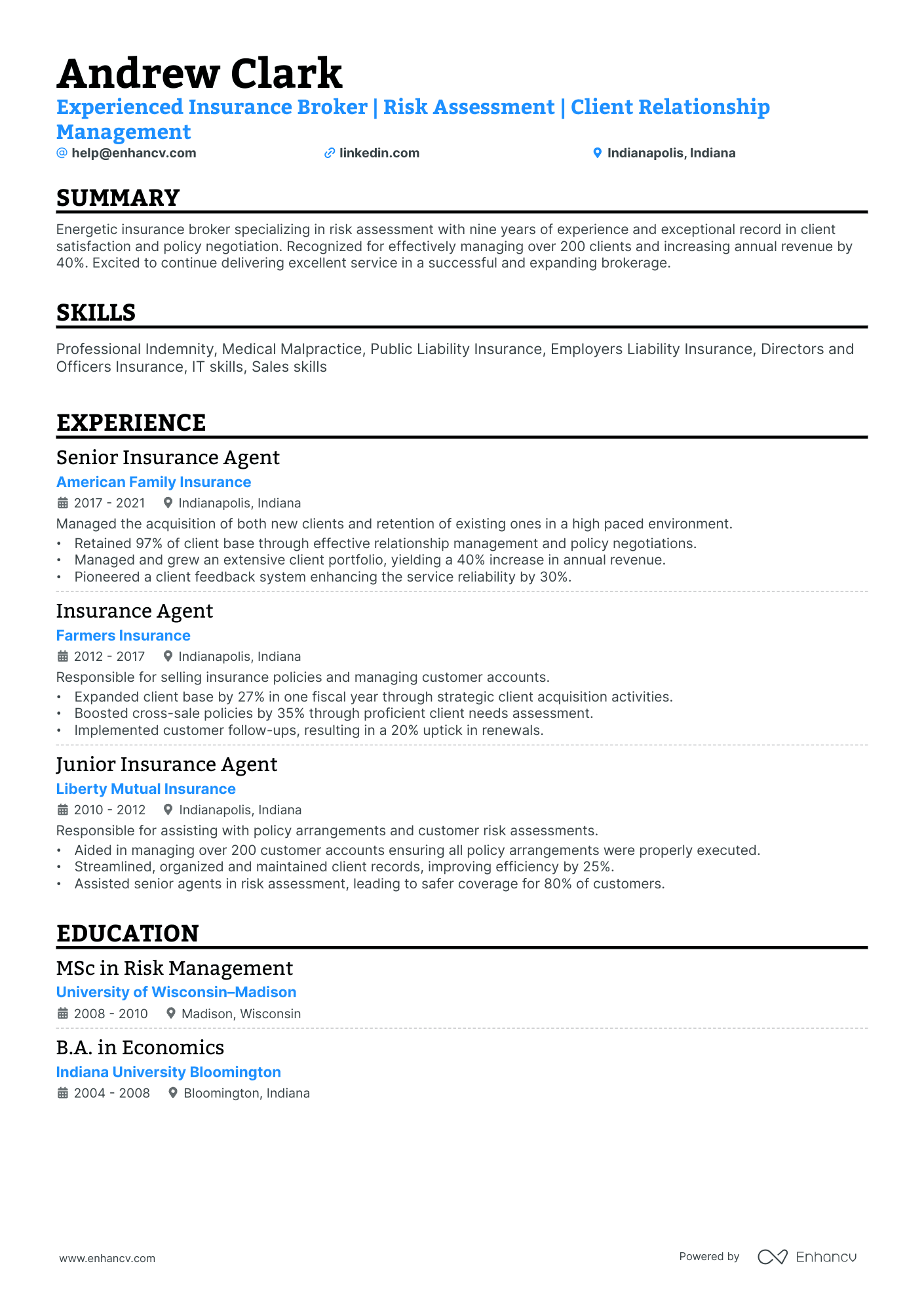
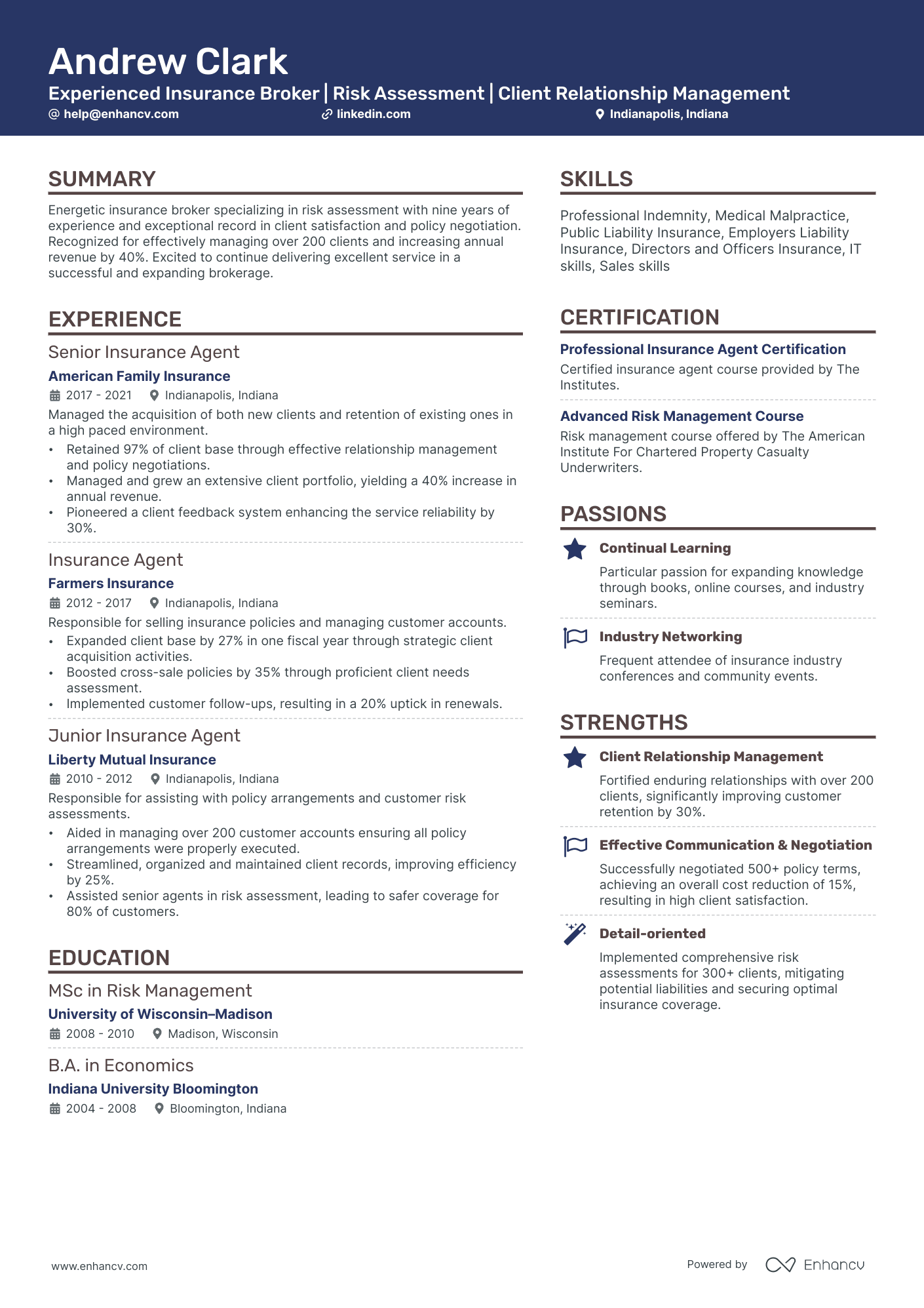
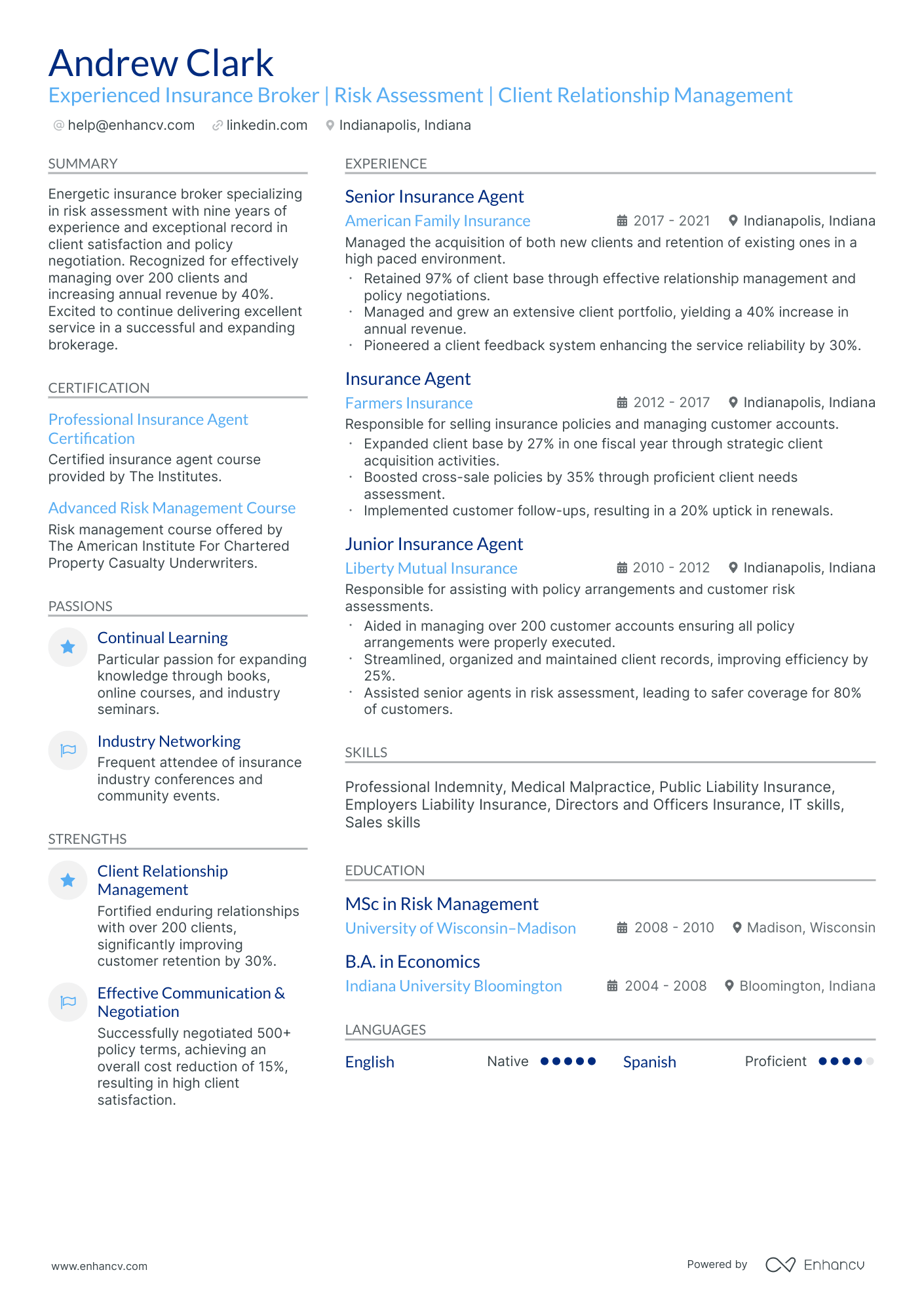
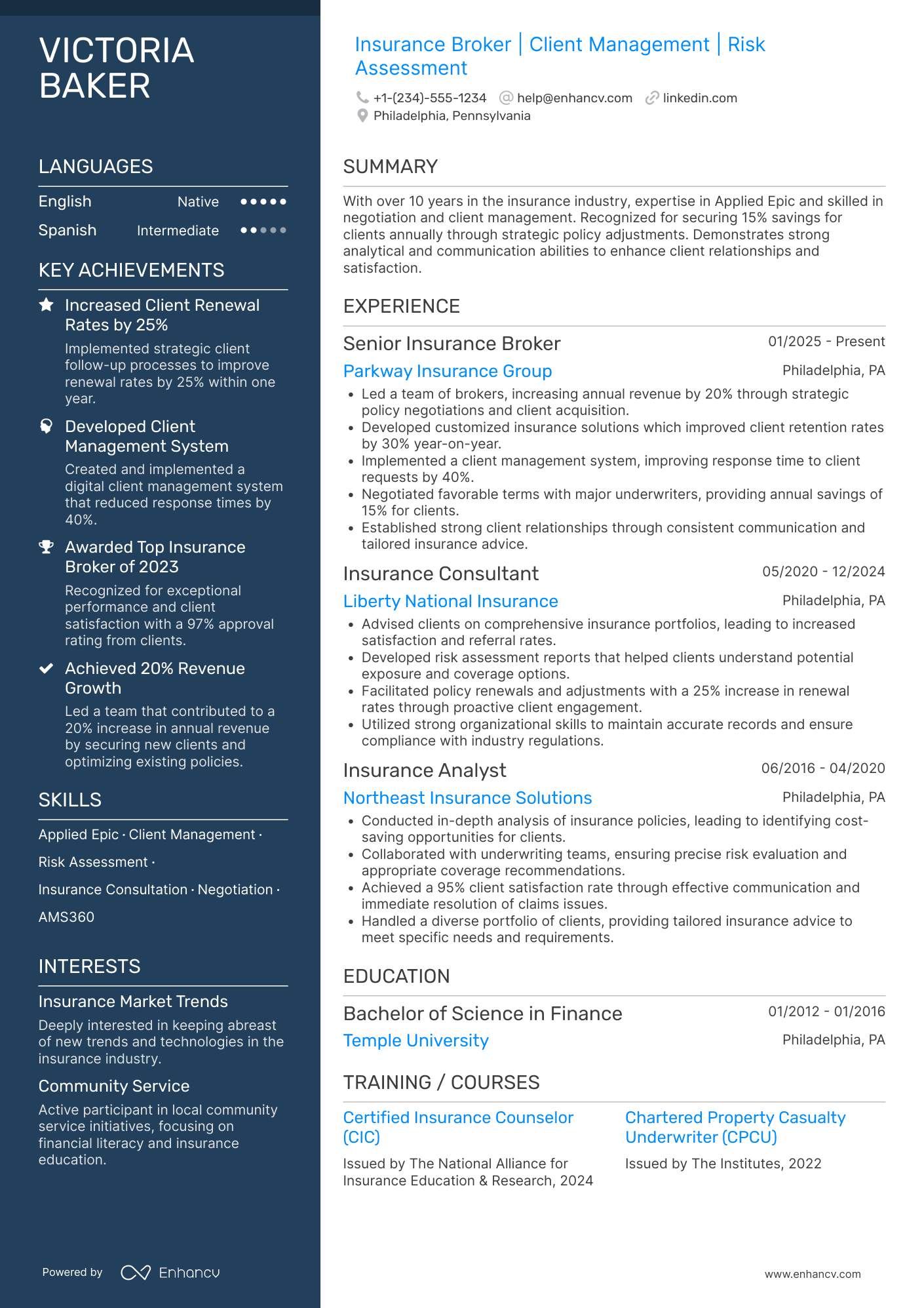
Many insurance broker resumes fail because they list policies and platforms but don't show measurable revenue, retention, or risk outcomes. That hurts in ATS screening and fast recruiter scans, where high competition rewards clear impact.
A strong resume shows how you drive results and manage accounts. If you're unsure where to begin, learning how to write a resume that emphasizes impact over duties is the first step. You should highlight premium growth, renewal lift, loss ratio improvement, and cross-sell wins. Add scope and proof: book size, client count, average deal value, bind rate, and turnaround time.

Key takeaways
- Quantify premium growth, retention rates, and bind ratios in every experience bullet.
- Use reverse-chronological format if you have direct brokerage or sales experience.
- Tailor resume keywords to match each job posting's platforms, lines, and compliance terms.
- Name specific tools like Applied Epic, Salesforce, or EZLynx to pass ATS screening.
- Place certifications like CPCU or CIC near education to strengthen credibility fast.
- Lead your summary with title, years of experience, domain focus, and one measurable win.
- Use Enhancv to turn vague duties into concise, metric-driven resume bullets.
How to format a insurance broker resume
Recruiters evaluating insurance broker resumes prioritize evidence of client portfolio growth, policy expertise across commercial and personal lines, and the ability to close and retain accounts. A clean, well-structured format ensures these revenue-driving signals surface quickly during both human review and applicant tracking system (ATS) scans. Choosing the right resume format is the foundation for making that happen.

I have significant experience in this role—which format should I use?
Use a reverse-chronological format to put your deepest client relationships, book-of-business growth, and carrier expertise front and center. Do:
- Lead each role entry with scope and ownership details—number of accounts managed, premium volume overseen, and market segments served.
- Highlight role-specific tools and domains such as Applied Epic, AMS360, surplus lines placement, risk assessment frameworks, and state licensing credentials.
- Quantify outcomes tied to revenue generation, client retention rates, and cross-selling performance.
I'm junior or switching into this role—what format works best?
A hybrid format works best because it lets you lead with transferable skills and relevant credentials while still showing a clear employment timeline. Do:
- Place a dedicated skills section near the top featuring insurance-specific competencies such as policy analysis, quoting platforms, risk evaluation, and client needs assessment.
- Include projects or transitional experience—internships at agencies, insurance coursework, or a Property & Casualty license—to demonstrate industry commitment.
- Connect every skill to a concrete action and a measurable result so hiring managers see practical application rather than a keyword list.
Why not use a functional resume?
A functional resume strips away the timeline context that hiring managers need to evaluate how you built client relationships, earned trust, and developed product knowledge over time.
- A functional format may be acceptable if you're transitioning from a related field (such as underwriting, claims adjusting, or financial advising) and have limited direct brokerage experience—but only if every listed skill is tied to a specific project, client interaction, or measurable outcome.
Once you've established a clean, readable format, the next step is deciding which sections to include so each one earns its place on the page.
What sections should go on a insurance broker resume
Recruiters expect a clean, standard resume that quickly proves you can sell, retain, and service insurance accounts while meeting compliance requirements. Understanding which resume sections to include helps you build a document that covers every angle hiring managers look for. Use this structure for maximum clarity:
- Header
- Summary
- Experience
- Skills
- Projects
- Education
- Certifications
- Optional sections: Awards, Leadership, Languages
Strong experience bullets should emphasize measurable premium volume, new business growth, retention, cross-sell and upsell results, book of business size, and client outcomes.
Is your resume good enough?
Drop your resume here or choose a file. PDF & DOCX only. Max 2MB file size.
Once you’ve organized the key resume components, the next step is to write your insurance broker resume experience so your work history supports each section with relevant, results-focused detail.
How to write your insurance broker resume experience
Your experience section should spotlight the policies you've placed, the client portfolios you've managed, and the measurable results you've driven—whether that's premium growth, retention rates, or claims satisfaction. Hiring managers prioritize demonstrated impact over descriptive task lists, so every bullet should connect your daily work to a concrete outcome. Building a targeted resume for each application ensures the most relevant achievements surface first.
Each entry should include:
- Job title
- Company and location (or remote)
- Dates of employment (month and year)
Three to five concise bullet points showing what you owned, how you executed, and what outcomes you delivered:
- Ownership scope: the book of business, product lines, market segments, client accounts, or renewal cycles you were directly accountable for as an insurance broker.
- Execution approach: the quoting platforms, underwriting guidelines, risk assessment frameworks, carrier management tools, or CRM systems you used to evaluate coverage options and deliver tailored recommendations.
- Value improved: changes to policy retention, binding ratios, premium volume, claims turnaround, coverage accuracy, or compliance adherence that resulted from your work.
- Collaboration context: how you partnered with underwriters, claims adjusters, carrier representatives, risk managers, or clients to structure competitive coverage and resolve complex policy needs.
- Impact delivered: outcomes framed around portfolio growth, client acquisition, loss ratio improvements, revenue generation, or service-level gains rather than routine activities.
Experience bullet formula
A insurance broker experience example
✅ Right example - modern, quantified, specific.
Insurance Broker
HarborPoint Insurance Group | Austin, TX
2022–Present
Independent commercial lines brokerage serving mid-market construction, manufacturing, and professional services clients across Texas.
- Won $1.4M in new annualized premium by prospecting in LinkedIn Sales Navigator, qualifying in HubSpot, and presenting coverage comparisons in Applied Epic.
- Reduced quote turnaround time 35% (three days to two) by standardizing submissions, building carrier-ready templates in Microsoft Excel, and tracking service-level agreements in Applied Epic.
- Improved bind rate 18% by running exposure reviews, updating schedules of values, and negotiating terms with eight carriers through carrier portals and email workflows.
- Cut endorsement errors 40% by auditing policies against ACORD forms, implementing a two-step quality checklist, and partnering with account managers and carrier underwriters to resolve discrepancies.
- Increased client retention seven points by leading quarterly coverage reviews over Zoom, documenting changes in Applied Epic, and coordinating loss control recommendations with clients and carrier risk engineers.
Now that you've seen how a strong experience section comes together, let's look at how to adjust yours to match the specific job you're targeting.
How to tailor your insurance broker resume experience
Recruiters evaluate your insurance broker resume through both applicant tracking systems and manual review. Tailoring your resume to the job description ensures your qualifications stand out in both screening methods.
Ways to tailor your insurance broker experience:
- Match the insurance platforms and quoting systems named in the posting.
- Mirror the exact policy types and coverage lines they specify.
- Use their terminology for underwriting standards and risk assessment methods.
- Reflect retention rates or book-of-business growth metrics they prioritize.
- Include relevant industry verticals like commercial or personal lines experience.
- Highlight compliance frameworks and state licensing requirements they mention.
- Align your carrier relationship management approach with their stated workflows.
- Emphasize client consultation models or needs analysis processes they reference.
Tailoring means aligning your real accomplishments with the employer's stated priorities, not forcing disconnected keywords into your experience bullets.
Resume tailoring examples for insurance broker
| Job description excerpt | Untailored | Tailored |
|---|---|---|
| Assess client risk profiles and recommend appropriate commercial property and casualty coverage using Applied Epic management system | Handled insurance policies and worked with clients on their coverage needs. | Assessed risk profiles for 120+ commercial clients annually, recommending tailored property and casualty coverage options and managing all policy documentation through Applied Epic. |
| Develop and maintain a book of business worth $2M+ by prospecting new accounts and cross-selling personal and commercial lines | Responsible for growing the client base and selling insurance products. | Grew and retained a $2.4M book of business by prospecting 30+ new accounts per quarter and cross-selling personal auto, homeowners, and commercial general liability lines to existing clients. |
| Negotiate competitive terms with carrier partners including Hartford, Travelers, and Chubb while ensuring compliance with state regulatory requirements | Worked with insurance carriers to get quotes and processed paperwork for clients. | Negotiated renewal terms and new policy pricing with Hartford, Travelers, and Chubb, securing an average 12% premium reduction for clients while maintaining full compliance with state Department of Insurance regulations. |
Once you’ve aligned your experience with the role’s priorities, quantify your achievements to show the measurable impact of that work.
How to quantify your insurance broker achievements
Quantifying your achievements proves business impact beyond relationships. Focus on premium and revenue growth, retention, quote-to-bind speed, compliance accuracy, and loss ratio or claims outcomes across your book.
Quantifying examples for insurance broker
| Metric | Example |
|---|---|
| Revenue growth | "Grew annual written premium from $2.1M to $3.0M in twelve months by cross-selling umbrella and cyber coverage to mid-market clients." |
| Retention rate | "Improved client retention from 86% to 93% across a 140-account book by adding quarterly renewal reviews and proactive market checks." |
| Cycle time | "Cut quote-to-bind time from nine days to four by standardizing intake forms and tracking submissions in Salesforce." |
| Compliance accuracy | "Maintained 99.5% documentation accuracy across 600 policies by using agency management system checklists and monthly internal audits." |
| Risk reduction | "Reduced average loss ratio from 62% to 54% for a 25-client construction segment by tightening endorsements and improving certificate tracking." |
Turn vague job duties into measurable, recruiter-ready resume bullets in seconds with Enhancv's Bullet Point Generator.
With strong bullet points in place, the next step is ensuring your resume highlights the right mix of hard and soft skills that insurance broker roles demand.
How to list your hard and soft skills on a insurance broker resume
Your skills section shows you can assess risk, place coverage, and retain clients; recruiters and an ATS (applicant tracking system) scan this section for role-specific keywords, then validate them in your experience, so aim for a balanced mix of hard skills and job-relevant soft skills. insurance broker roles require a blend of:
- Product strategy and discovery skills.
- Data, analytics, and experimentation skills.
- Delivery, execution, and go-to-market discipline.
- Soft skills.
Your skills section should be:
- Scannable (bullet-style grouping).
- Relevant to the job post.
- Backed by proof in experience bullets.
- Updated with current tools.
Place your skills section:
- Above experience if you're junior or switching careers.
- Below experience if you're mid/senior with strong achievements.

Hard skills
- Risk assessment and underwriting analysis
- Coverage placement and market quoting
- Policy analysis, endorsements, renewals
- Claims support and loss advocacy
- CRM: Salesforce, HubSpot
- Agency management systems: Applied Epic, Vertafore AMS360
- Comparative raters: EZLynx, Applied Rater
- Certificate of insurance issuance
- Regulatory compliance, E&O controls
- Carrier submissions and binders
- Excel reporting and pipeline tracking
- RFP responses and proposal writing
Soft skills
- Consultative needs discovery
- Clear coverage explanations
- Objection handling and negotiation
- Cross-functional coordination with carriers
- Stakeholder management with decision-makers
- Prioritization across renewals and new business
- Follow-up discipline and responsiveness
- Documentation rigor and handoff clarity
- Calm escalation management during claims
- Ethical judgment and compliance-minded decisions
- Ownership of retention and upsell targets
- Adaptation to changing carrier appetite
How to show your insurance broker skills in context
Skills shouldn't live only in a bulleted list on your resume. Explore curated resume skills examples to see how top candidates in your field present their abilities.
They should be demonstrated in:
- Your summary (high-level professional identity)
- Your experience (proof through outcomes)
Here's what strong, skill-rich entries look like in practice.
Summary example
Senior insurance broker with 12 years in commercial property and casualty. Skilled in risk analysis, Applied Epic, and consultative renewals. Grew portfolio revenue 34% over three years while maintaining a 96% client retention rate.
- Reflects senior-level expertise clearly
- Names industry-standard tools
- Quantifies revenue and retention outcomes
- Signals consultative, client-facing strengths
Experience example
Senior Commercial Insurance Broker
Ridgeline Risk Partners | Denver, CO
March 2018–Present
- Managed a $22M commercial portfolio using Applied Epic and Zywave, reducing renewal processing time by 18% year over year.
- Partnered with underwriters and claims teams to structure tailored coverage plans, improving client satisfaction scores by 27%.
- Conducted quarterly risk assessments for 140+ accounts, identifying coverage gaps that saved clients an estimated $1.3M in potential losses.
- Every bullet includes measurable proof
- Skills surface naturally through real outcomes
Once you’ve tied your abilities to real outcomes and responsibilities, the next step is applying that same approach to structuring an insurance broker resume when you don’t have direct experience.
How do I write a insurance broker resume with no experience
How do I write a insurance broker resume with no experience?
Even without full-time experience, you can demonstrate readiness through:
- Insurance licensing coursework completion
- Agency internship or job shadowing
- Customer-facing retail sales experience
- CRM-based lead tracking practice
- Policy quoting case studies
- Claims intake volunteer support
- Compliance training and documentation
Our guide on writing a resume without work experience walks you through strategies for showcasing transferable skills and relevant projects.
Focus on:
- Licensing progress and exam status
- Sales results with hard metrics
- Insurance broker workflow familiarity
- Compliance and documentation accuracy
Resume format tip for entry-level insurance broker
Use a combination resume format because it highlights relevant skills and projects first, while still showing a clear work history. Do:
- Lead with a targeted summary and licensing status.
- Add a "Relevant projects" section with metrics.
- Include insurance broker tools used, like a CRM.
- Quantify sales, calls, quotes, and conversions.
- Mirror the job description keywords in bullets.
- Built a CRM lead tracker and quoting workflow for a mock insurance broker book of business, producing 30 quotes and a 20% close rate in two weeks.
Even without direct experience, your education section can demonstrate the foundational knowledge and relevant coursework that qualify you for an insurance broker role.
How to list your education on a insurance broker resume
Your education section helps hiring teams confirm you have the foundational knowledge needed for an insurance broker role. It validates your understanding of finance, risk, and business principles.
Include:
- Degree name
- Institution
- Location
- Graduation year
- Relevant coursework (for juniors or entry-level candidates)
- Honors & GPA (if 3.5 or higher)
Skip month and day details—list the graduation year only.
Here's a strong education entry tailored to an insurance broker resume.
Example education entry
Bachelor of Science in Finance
University of Georgia, Athens, GA
Graduated 2021
GPA: 3.7/4.0
- Relevant coursework: Risk Management, Insurance Law, Business Statistics, Financial Analysis
- Honors: Magna Cum Laude, Dean's List (six semesters)
How to list your certifications on a insurance broker resume
Certifications on your resume show your commitment to learning, proficiency with insurance tools and regulations, and relevance in today's market as an insurance broker. They also help hiring teams trust your product knowledge and compliance readiness.
Include:
- Certificate name
- Issuing organization
- Year
- Optional: credential ID or URL
- Put certifications below education when your degree is recent and more relevant than older credentials.
- Put certifications above education when they are recent, role-relevant, or required for the insurance broker jobs you target.
Best certifications for your insurance broker resume
- Chartered Property Casualty Underwriter (CPCU)
- Certified Insurance Counselor (CIC)
- Associate in Risk Management (ARM)
- Chartered Life Underwriter (CLU)
- Associate in General Insurance (AINS)
- Accredited Advisor in Insurance (AAI)
- Certified Risk Manager (CRM)
Once you’ve positioned your credentials where recruiters will see them quickly, shift to your insurance broker resume summary to connect those qualifications to the value you deliver.
How to write your insurance broker resume summary
Your resume summary is the first thing a recruiter reads. A sharp, specific opening signals you understand insurance brokerage and deserve a closer look.
Keep it to three to four lines, with:
- Your title and total years of insurance brokerage experience.
- Domain focus, such as commercial lines, personal lines, or specialty risk.
- Core skills like policy analysis, risk assessment, or carrier negotiation.
- One or two measurable wins, such as retention rates or book-of-business growth.
- Client-facing strengths tied to real outcomes, like relationship building that drove renewals.

PRO TIP
At this level, prioritize specific skills, relevant licenses, and early client-facing results. Avoid vague phrases like "passionate professional" or "hard worker." Focus on what you've done, not who you hope to become.
Example summary for a insurance broker
Licensed insurance broker with two years of experience in personal and commercial lines. Grew a $1.2M book of business while maintaining a 94% client retention rate through proactive policy reviews.
Optimize your resume summary and objective for ATS
Drop your resume here or choose a file.
PDF & DOCX only. Max 2MB file size.
Now that your summary clearly communicates your value as an insurance broker, make sure your header presents the essential contact and professional details recruiters need to reach you.
What to include in a insurance broker resume header
A resume header is the top section with your key identifiers, and it boosts visibility, credibility, and recruiter screening for a insurance broker role.
Essential resume header elements
- Full name
- Tailored job title and headline
- Location
- Phone number
- Professional email
- GitHub link
- Portfolio link
A LinkedIn link helps recruiters verify experience quickly and supports screening with consistent titles, dates, and licenses.
Do not include photos on a insurance broker resume unless the role is explicitly front-facing or appearance-dependent.
Match your header title to the job posting and include your license type or specialization in the headline for faster sorting.
Example
Insurance broker resume header
Jordan M. Taylor
Insurance Broker | Commercial Lines and Employee Benefits Specialist
Chicago, IL
(312) 555-01XX
your.name@enhancv.com
github.com/yourname
yourwebsite.com
linkedin.com/in/yourname
Once your contact details and professional identifiers are set at the top, add targeted additional sections to provide supporting context that strengthens the rest of your insurance broker resume.
Additional sections for insurance broker resumes
When your core qualifications match other candidates, well-chosen additional sections can set your insurance broker resume apart with unique credibility. For example, listing language skills on your resume can signal your ability to serve diverse client bases and navigate multilingual carrier communications.
- Languages
- Professional affiliations and memberships
- Industry certifications and continuing education
- Volunteer work and community involvement
- Awards and sales achievements
- Publications or industry thought leadership
- Hobbies and interests
Once you've strengthened your resume with relevant additional sections, the next step is pairing it with a cover letter that adds even more context to your candidacy.
Do insurance broker resumes need a cover letter
A cover letter isn't required for an insurance broker, but it helps in competitive roles or when hiring managers expect one. If you're unsure about the purpose and structure, our guide on what a cover letter is explains when and why it matters. It can make a difference when your resume needs context, or when you want to show fit fast.
Use it to add context your resume can't:
- Explain role or team fit: Match your book of business, lines, and client types to the team's focus and sales model.
- Highlight one or two outcomes: Name a renewal win, retention lift, or new business result, and state your role and the measurable impact.
- Show product and user understanding: Reference the carrier mix, underwriting constraints, and how you advise clients on coverage, risk, and cost tradeoffs.
- Address transitions or non-obvious experience: Connect a career change, employment gap, or adjacent role to insurance broker skills and compliance expectations.
Drop your resume here or choose a file.
PDF & DOCX only. Max 2MB file size.
Even if you decide a cover letter won’t add value for this application, using AI to improve your insurance broker resume helps you strengthen the document that hiring teams will review first.
Using AI to improve your insurance broker resume
AI can sharpen your resume's clarity, structure, and impact. It helps tighten language and highlight results. But overuse strips authenticity. Once your content feels clear and role-aligned, step away from AI. If you're wondering which AI is best for writing resumes, start with tools that prioritize accuracy over generic phrasing.
Here are 10 practical prompts to strengthen specific sections of your insurance broker resume:
- Strengthen your summary. "Rewrite my insurance broker resume summary to highlight my top three client-facing strengths in under four sentences."
- Quantify your results. "Add measurable outcomes to these insurance broker experience bullets, focusing on revenue growth, retention rates, or policy volume."
- Tighten bullet points. "Shorten each of my insurance broker experience bullets to one concise line starting with a strong action verb."
- Align with postings. "Compare my insurance broker resume skills section against this job description and identify missing keywords."
- Clarify certifications impact. "Rewrite my insurance broker certifications section to explain how each credential applies to commercial or personal lines."
- Improve skills relevance. "Remove generic entries from my insurance broker skills list and suggest industry-specific replacements tied to underwriting or risk assessment."
- Refine education details. "Edit my insurance broker education section to emphasize coursework or honors relevant to insurance, finance, or risk management."
- Showcase client projects. "Rewrite this insurance broker project description to emphasize the client problem, my strategy, and the measurable result."
- Eliminate filler language. "Identify and remove vague or redundant phrases across my entire insurance broker resume without losing key details."
- Tailor for specialization. "Adjust my insurance broker experience section to emphasize my expertise in commercial property and casualty lines specifically."
Stop using AI once your resume sounds accurate, specific, and aligned with real experience. AI should never invent experience or inflate claims—if it didn't happen, it doesn't belong here.
Conclusion
A strong insurance broker resume shows results, role-specific skills, and a clear structure. Lead with measurable outcomes like premium growth, retention rates, policy volume, and revenue. Highlight prospecting, risk assessment, carrier negotiations, renewal management, and compliance.
Keep every section easy to scan and tied to the role. Use concise bullets, consistent formatting, and keywords that match today’s postings. This approach shows you’re ready for current hiring needs and near-future expectations.