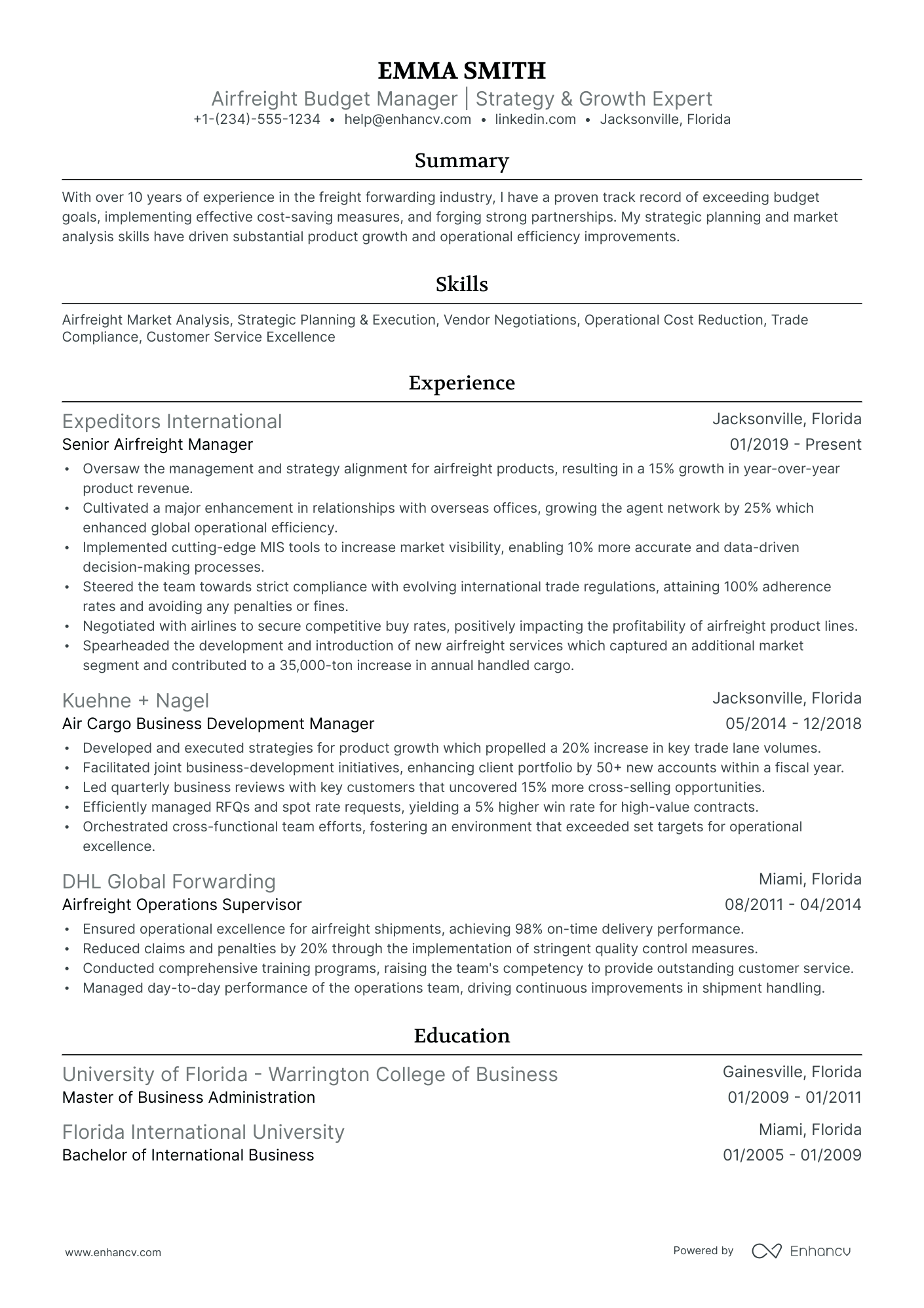
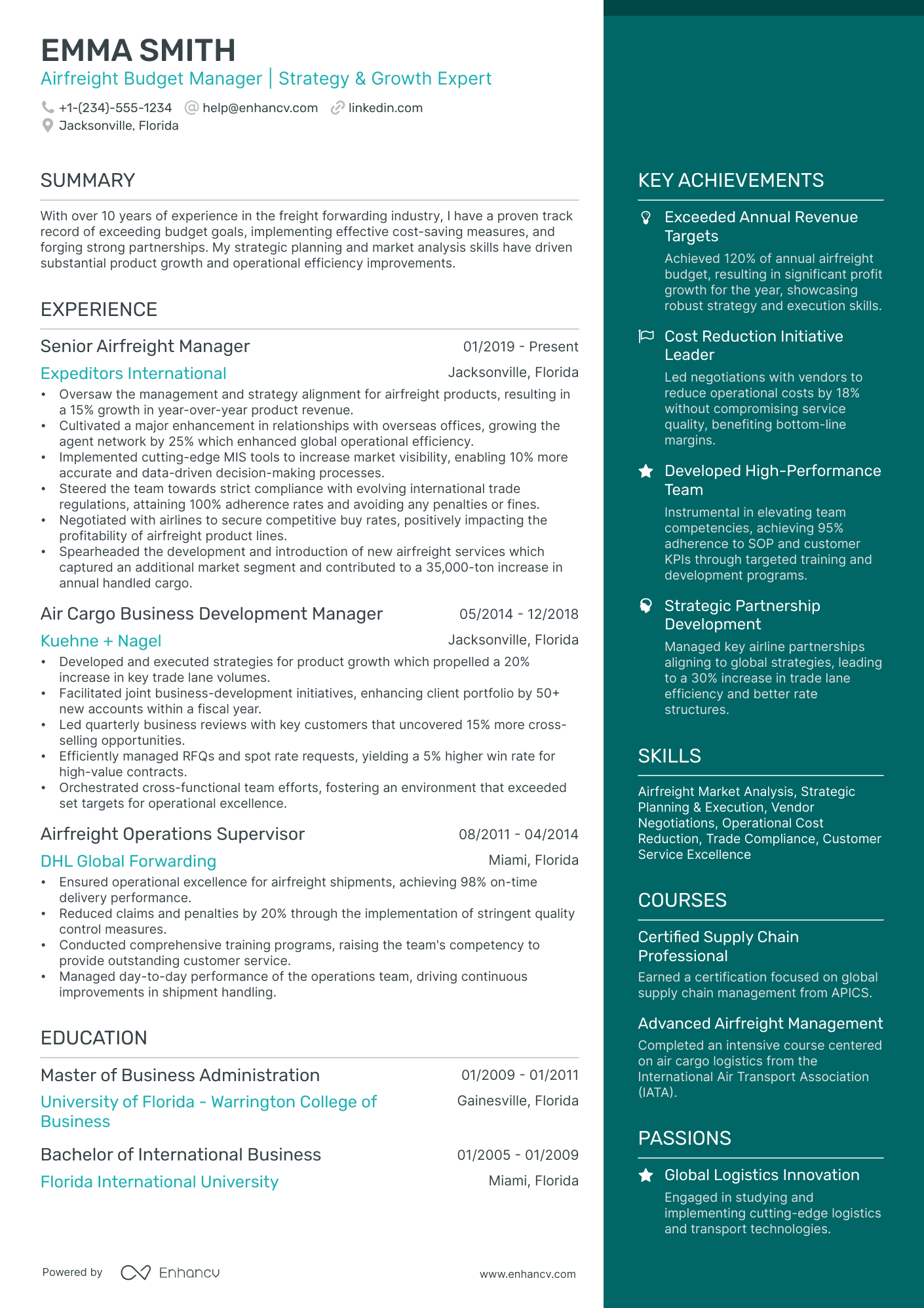
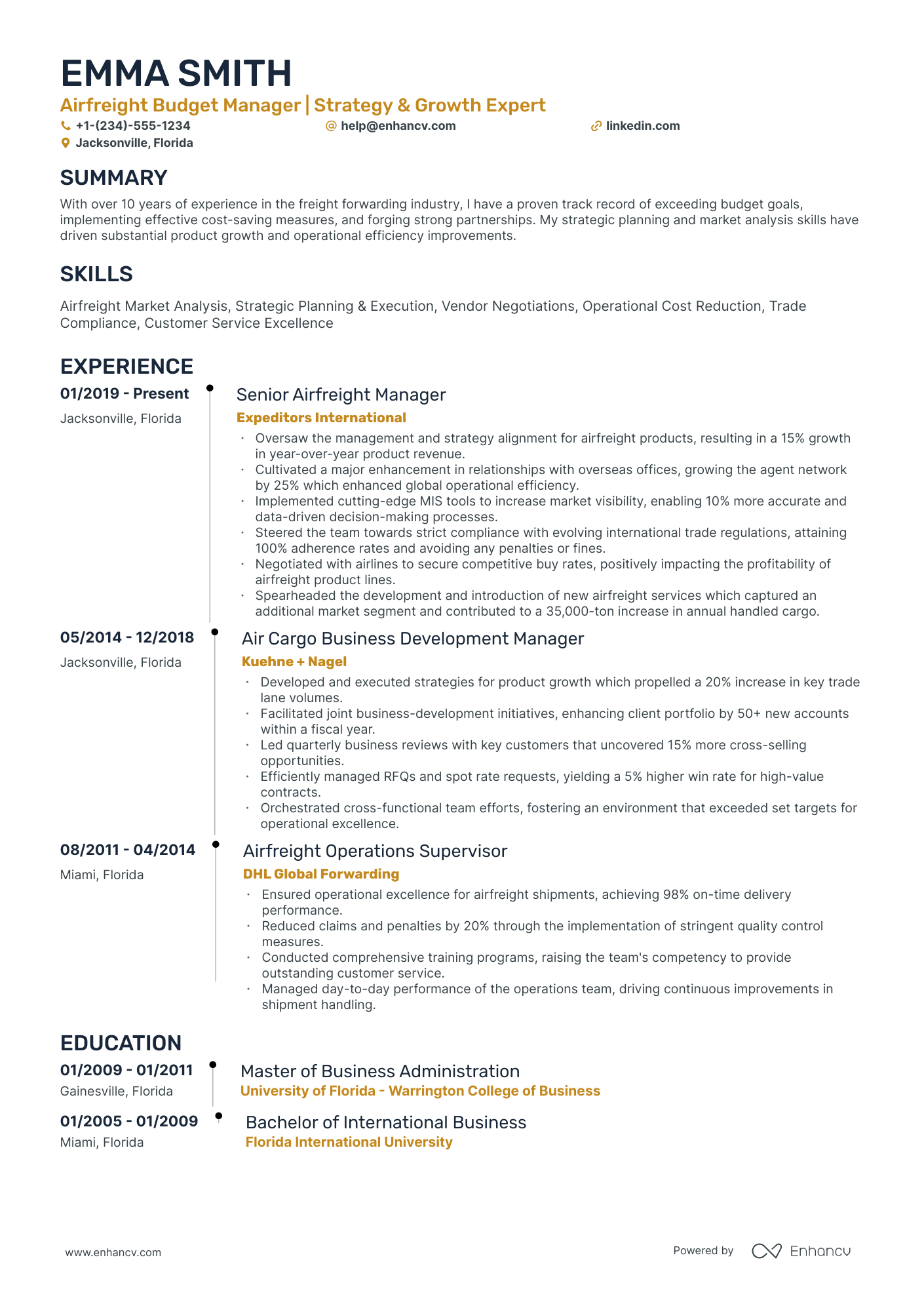
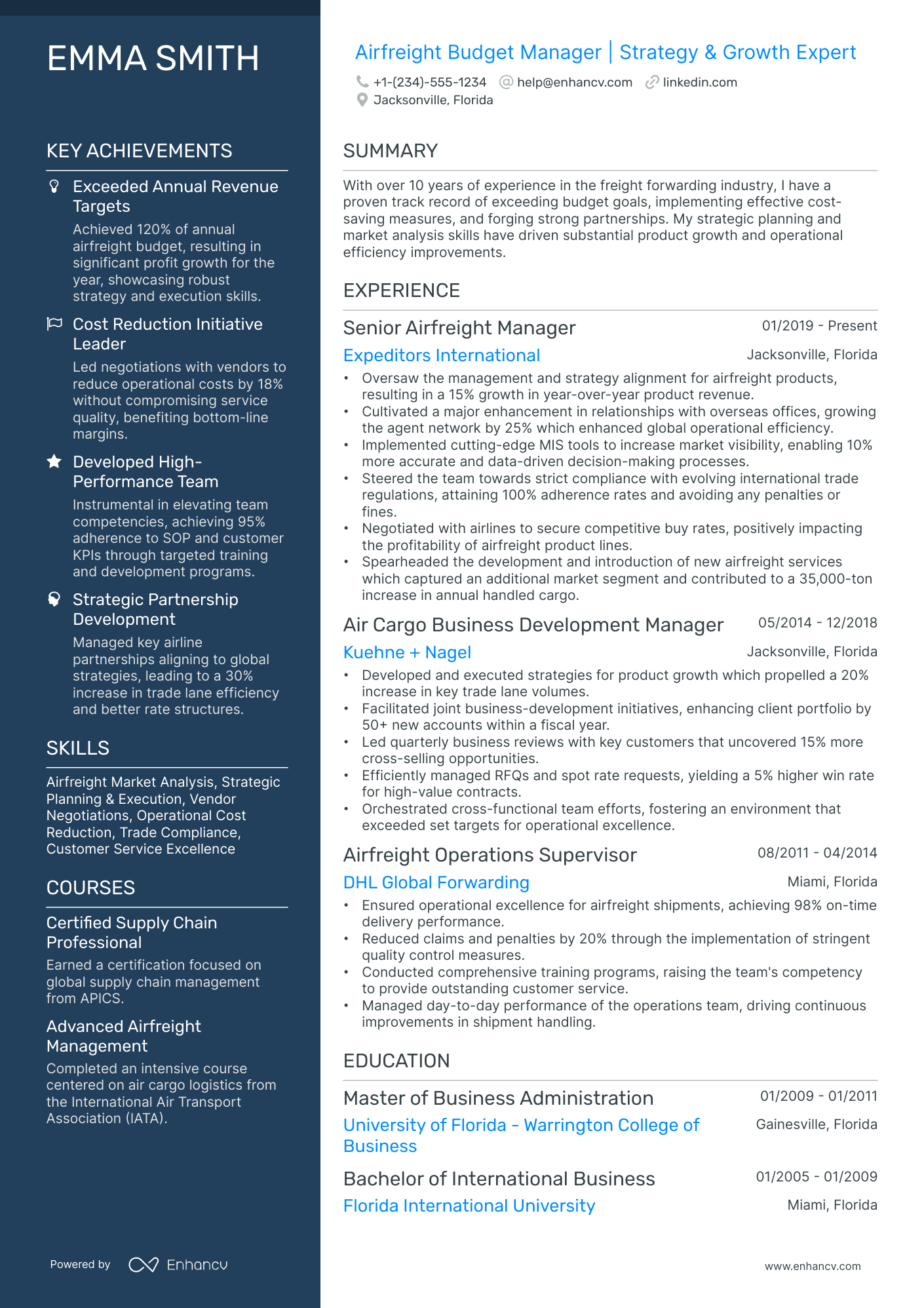
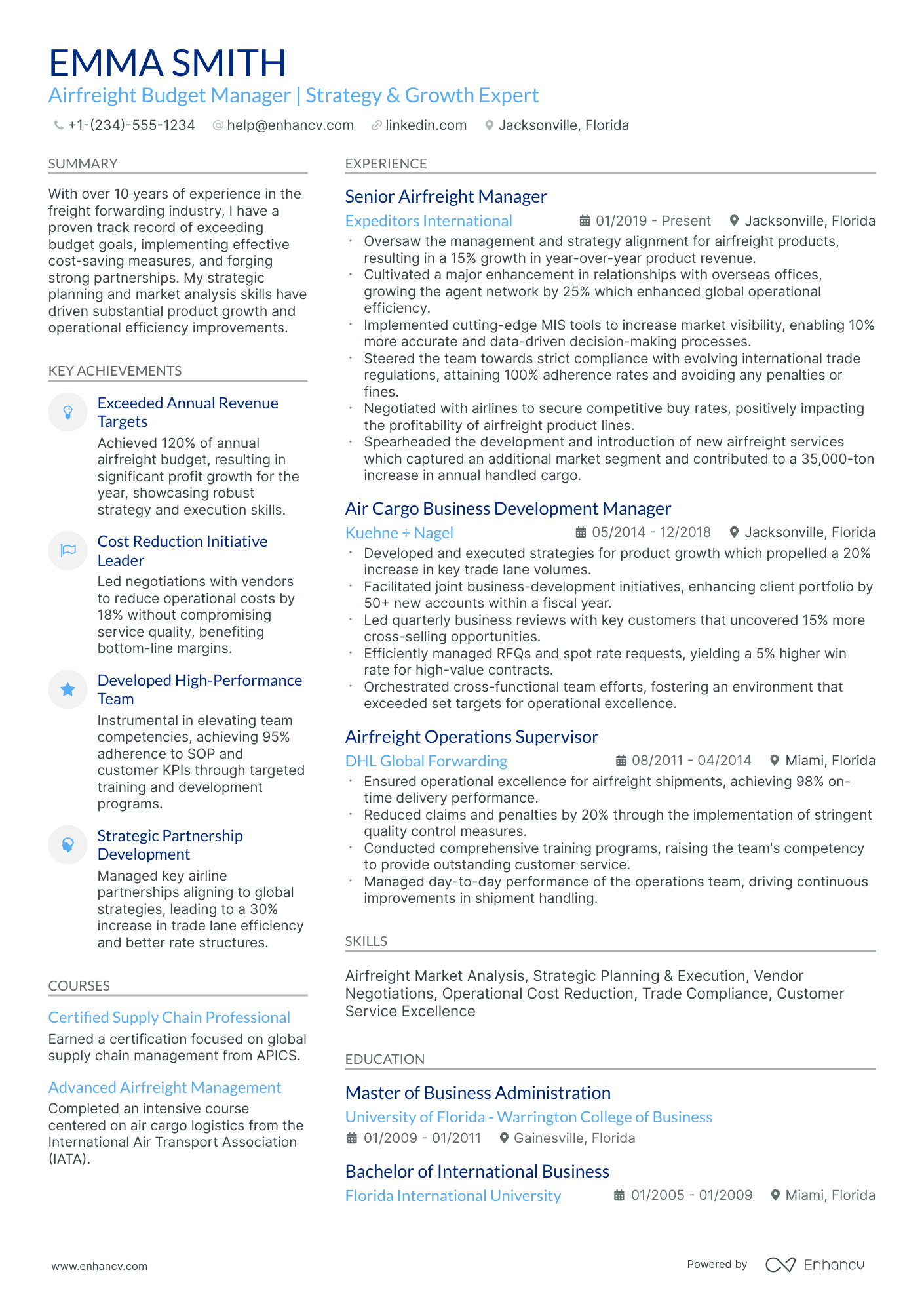
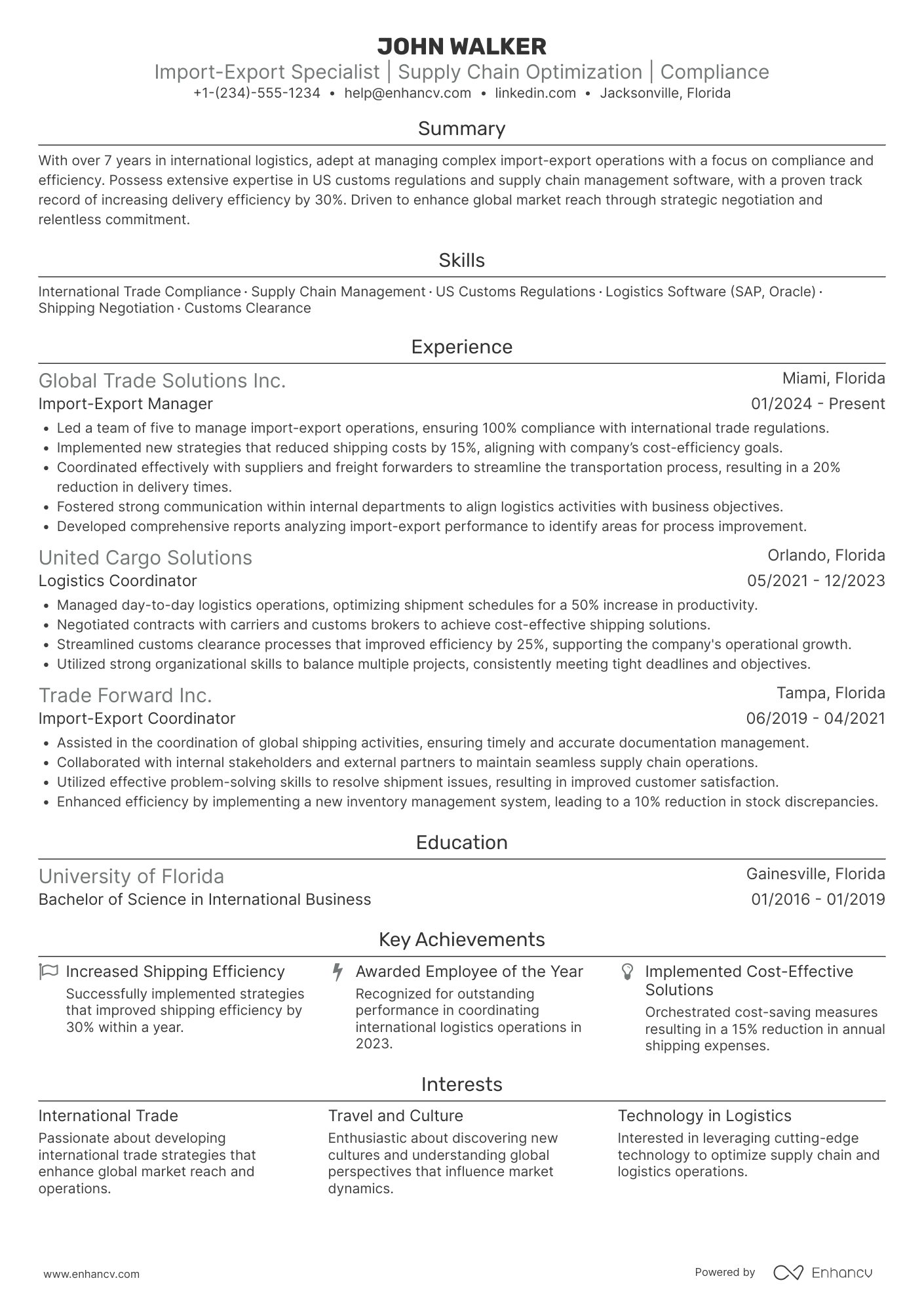
Import export manager resume guides often miss the details that get you shortlisted. Many fail because they bury compliance, Incoterms, and shipment scope behind generic duties, so ATS filters and fast recruiter scans overlook your fit. Understanding how to make your resume stand out is critical in this specialized field.
A strong resume shows outcomes, not task lists. You should quantify cost savings from freight negotiations, on-time delivery rates, customs clearance cycle time, audit findings reduced, shipment volume, lanes managed, and avoided penalties.

Key takeaways
- Quantify outcomes like cost savings, clearance time, and on-time delivery instead of listing duties.
- Use reverse-chronological format for experienced candidates and hybrid format for career switchers.
- Tailor every experience bullet to mirror the job description's specific tools and terminology.
- Anchor skills in measurable results within your summary and experience sections.
- Place certifications above education when they're recent and directly relevant to the role.
- Entry-level candidates should lead with trade projects, coursework, and compliance certifications.
- Use Enhancv's Bullet Point Generator to turn vague responsibilities into recruiter-ready resume bullets.
How to format a import export manager resume
Recruiters evaluating import export manager candidates prioritize compliance knowledge, logistics coordination across international markets, and the ability to manage documentation, vendor relationships, and regulatory requirements simultaneously. A clear, well-structured resume format ensures these signals surface quickly during both human review and applicant tracking system (ATS) scans.

I have significant experience in this role—which format should I use?
Use a reverse-chronological format to showcase your progression through increasingly complex trade operations, compliance responsibilities, and cross-border logistics management. Do:
- Lead with your most recent role and emphasize scope—countries managed, shipment volumes, team size, and regulatory jurisdictions you oversee.
- Highlight role-specific expertise in customs brokerage, Incoterms, import/export licensing, ERP systems (SAP, Oracle), and trade compliance frameworks like ITAR, EAR, or CTPAT.
- Quantify outcomes tied to cost savings, shipment accuracy, cycle time reductions, or audit results.
I'm junior or switching into this role—what format works best?
A hybrid format works best, letting you lead with relevant trade compliance skills and certifications while still showing employment history in chronological order. Do:
- Place a skills section near the top featuring import/export regulations, freight forwarding terminology, Harmonized Tariff Schedule (HTS) classification, and any trade compliance certifications (e.g., Certified Customs Specialist, Licensed Customs Broker).
- Include internships, supply chain projects, or logistics-adjacent roles that demonstrate exposure to cross-border documentation, vendor coordination, or regulatory research.
- Connect every skill to an action and a result so recruiters see practical application, not just keyword lists.
Why not use a functional resume?
A functional format strips away the timeline of your career, making it difficult for recruiters to verify where and when you applied trade compliance skills, managed shipments, or handled regulatory audits—context that's essential for establishing credibility in import/export management. A functional format may be acceptable if you're transitioning from a related field like freight forwarding, customs brokerage, or warehouse management and have no direct import/export manager title—but only if you tie every listed skill to a specific project, shipment scenario, or measurable outcome rather than presenting skills in isolation.
Once you've established a clean, readable format, the next step is deciding which sections to include so each one strengthens your candidacy.
What sections should go on a import export manager resume
Recruiters expect to see clear proof you can manage cross-border shipments, ensure compliance, and optimize costs and timelines. Knowing what to put on a resume for this role helps you prioritize the right content.
Use this structure for maximum clarity:
- Header
- Summary
- Experience
- Skills
- Projects
- Education
- Certifications
- Optional sections: Languages, Awards, Leadership
Your experience bullets should emphasize measurable impact—cost savings, on-time delivery rates, compliance outcomes, shipment volume and value, and the scope of regions, modes, and stakeholders you managed.
Is your resume good enough?
Drop your resume here or choose a file. PDF & DOCX only. Max 2MB file size.
Once you’ve organized the key resume components, focus next on writing your import export manager experience section to show how you delivered results in each area.
How to write your import export manager resume experience
Your work experience section should demonstrate the international trade operations you've managed, the logistics and compliance tools you've used, and the measurable outcomes you've delivered across global supply chains. Hiring managers prioritize demonstrated impact—reduced transit times, cost savings, regulatory compliance rates—over descriptive task lists.
Each entry should include:
- Job title
- Company and location (or remote)
- Dates of employment (month and year)
Three to five concise bullet points showing what you owned, how you executed, and what outcomes you delivered:
- Ownership scope: the trade lanes, product categories, shipping volumes, customs processes, or vendor relationships you were directly accountable for as an import export manager.
- Execution approach: the freight management platforms, customs brokerage systems, Incoterms frameworks, trade compliance software, or documentation methods you used to coordinate shipments and make sourcing or routing decisions.
- Value improved: the changes you drove in shipment accuracy, customs clearance speed, freight cost efficiency, regulatory compliance rates, or supply chain risk exposure tied to your import export operations.
- Collaboration context: how you coordinated with freight forwarders, customs brokers, warehouse teams, overseas suppliers, government agencies, or internal finance and procurement departments to keep goods moving across borders.
- Impact delivered: the business outcomes your work produced—expressed through improvements in delivery reliability, duty optimization, trade compliance standing, or overall supply chain performance rather than a list of daily activities.
Experience bullet formula
A import export manager experience example
✅ Right example - modern, quantified, specific.
Import Export Manager
BlueRiver Industrial Supply | Houston, TX
2021–Present
Global distributor of industrial components shipping to thirty-plus countries across North America, Europe, and Asia.
- Led end-to-end compliance for 1,200+ annual shipments using SAP Global Trade Services (SAP GTS), Automated Commercial Environment (ACE), and Harmonized System (HS) classification, cutting customs holds by 38% year over year.
- Negotiated carrier and freight forwarder contracts and optimized Incoterms 2020 selection across lanes, reducing landed costs by 9% and improving on-time delivery from 92% to 97% in partnership with procurement and warehouse leads.
- Implemented denied party screening and export controls workflows in Descartes and Microsoft Excel Power Query, lowering screening turnaround time by 55% and preventing three high-risk transactions flagged under Office of Foreign Assets Control (OFAC) rules.
- Streamlined documentation—commercial invoices, packing lists, certificates of origin, and letters of credit—via SharePoint templates and DocuSign approvals, cutting document cycle time from two days to six hours while improving audit readiness.
- Collaborated with sales, finance, and customs brokers to resolve duty disputes and post-entry corrections, recovering $180K in overpaid duties and reducing duty variance to under 1.5% of monthly spend.
Now that you've seen how a strong experience section comes together, let's look at how to adjust yours to match the specific job you're targeting.
How to tailor your import export manager resume experience
Recruiters evaluate your import export manager resume through applicant tracking systems and manual review, scanning for alignment with the posted role. Tailoring your resume to the job description ensures your qualifications register with both screening methods.
Ways to tailor your import export manager experience:
- Match trade compliance software and ERP systems named in the posting.
- Mirror the exact terminology used for Incoterms and shipping methods.
- Reflect specific KPIs like shipment accuracy or customs clearance time.
- Highlight experience with relevant regulatory bodies such as CBP or BIS.
- Emphasize tariff classification or duty optimization if the role requires it.
- Include industry-specific supply chain knowledge matching the job description.
- Align your language with referenced freight forwarding or logistics frameworks.
- Incorporate mentioned documentation standards for letters of credit or bills of lading.
Tailoring means aligning your real accomplishments with what the employer needs rather than forcing disconnected keywords into your experience bullets.
Resume tailoring examples for import export manager
| Job description excerpt | Untailored | Tailored |
|---|---|---|
| Manage end-to-end import/export operations, ensuring compliance with U.S. Customs and Border Protection (CBP) regulations, HTS classification, and Free Trade Agreement (FTA) qualification across 12+ countries. | Handled international shipping and made sure everything followed the rules. | Managed end-to-end import/export operations across 15 countries, ensuring full compliance with CBP regulations, accurate HTS classification, and FTA qualification—reducing duty spend by 18% annually. |
| Coordinate with freight forwarders, customs brokers, and 3PL providers using SAP Global Trade Services (GTS) to optimize landed costs and maintain on-time delivery rates above 95%. | Worked with vendors and logistics partners to ship products internationally. | Coordinated with freight forwarders, customs brokers, and 3PL providers through SAP GTS, optimizing landed costs by 12% while maintaining a 97% on-time delivery rate across ocean and air freight lanes. |
| Lead export control screening processes under EAR and ITAR, manage denied-party screening, and maintain accurate export licenses and documentation for controlled goods shipments. | Ensured proper documentation was completed for all outgoing shipments. | Led export control screening under EAR and ITAR for 200+ controlled goods shipments monthly, managing denied-party screening through Visual Compliance and maintaining a 100% audit-pass rate on export license documentation. |
Once you’ve aligned your experience with the role’s requirements, quantify your import export manager achievements to show the measurable impact of that work.
How to quantify your import export manager achievements
Quantifying your achievements shows how you improved speed, accuracy, compliance, and cost across shipments. Focus on cycle time, customs holds, error rates, freight spend, and on-time delivery for lanes, countries, and carriers you managed.
Quantifying examples for import export manager
| Metric | Example |
|---|---|
| Cycle time | "Reduced door-to-port cycle time from nine to six days by standardizing booking cutoffs in SAP and aligning carrier schedules across three APAC lanes." |
| Compliance | "Cut customs holds by 38% by implementing a trade compliance checklist and HTS classification audits for 250 stock keeping units across the United States and Mexico." |
| Cost savings | "Lowered ocean freight spend by $420,000 annually by renegotiating rates with two carriers and shifting 18% volume to a lower-cost service level." |
| Accuracy | "Improved commercial invoice accuracy from 92% to 99.2% by adding a two-step review in Excel and training five coordinators on Incoterms 2020." |
| Delivery | "Increased on-time delivery from 86% to 95% by tracking milestones in CargoWise and escalating exceptions within four hours for 60 monthly shipments." |
Turn vague job duties into measurable, recruiter-ready resume bullets in seconds with Enhancv's Bullet Point Generator.
With strong bullet points in place, the next step is ensuring your skills section highlights the right mix of hard and soft skills that hiring managers expect from an import export manager.
How to list your hard and soft skills on a import export manager resume
Your skills section shows you can keep shipments compliant, on time, and cost-effective, and recruiters and an ATS (applicant tracking system) scan this section to match your fit fast—aim for mostly hard skills with a smaller set of role-specific soft skills. import export manager roles require a blend of:
- Product strategy and discovery skills.
- Data, analytics, and experimentation skills.
- Delivery, execution, and go-to-market discipline.
- Soft skills.
Your skills section should be:
- Scannable (bullet-style grouping).
- Relevant to the job post.
- Backed by proof in experience bullets.
- Updated with current tools.
Place your skills section:
- Above experience if you're junior or switching careers.
- Below experience if you're mid/senior with strong achievements.

Hard skills
- Incoterms 2020
- Harmonized System codes
- Customs clearance, brokerage coordination
- Import and export compliance
- Denied party screening
- Letters of credit, trade finance
- Commercial invoices, packing lists
- Bills of lading, airway bills
- Freight forwarding, carrier management
- Landed cost modeling
- SAP, Oracle NetSuite
- Excel pivot tables, Power Query
Soft skills
- Cross-functional alignment with sales and ops
- Vendor and broker negotiation
- Clear escalation and risk communication
- Deadline-driven shipment prioritization
- Root-cause problem solving for delays
- Ownership of compliance decisions
- Stakeholder updates across time zones
- Process improvement mindset
- Conflict resolution with carriers and suppliers
- Detail-focused document review
- Calm execution under disruption
- Coaching coordinators and specialists
How to show your import export manager skills in context
Skills shouldn't live only in a dedicated skills list. You can explore common resume skills to identify which ones align with import export management.
They should be demonstrated in:
- Your summary (high-level professional identity)
- Your experience (proof through outcomes)
Here's what strong, skill-rich entries look like in practice.
Summary example
Import export manager with 12 years in automotive parts logistics. Skilled in SAP GTS, trade compliance, and tariff classification. Reduced customs clearance delays by 35% through streamlined documentation workflows and proactive carrier negotiations.
- Reflects senior-level expertise clearly
- Names industry-specific tools
- Leads with a measurable outcome
- Signals negotiation and collaboration skills
Experience example
Senior Import Export Manager
Caldwell Global Logistics | Detroit, MI
June 2018–Present
- Coordinated with freight forwarders and customs brokers using SAP GTS, cutting shipment processing time by 28% across 14 trade lanes.
- Led a cross-functional compliance team to implement new CTPAT protocols, achieving zero audit violations over three consecutive years.
- Renegotiated carrier contracts alongside procurement, saving $420K annually while maintaining 97% on-time delivery performance.
- Every bullet includes measurable proof
- Skills surface naturally through outcomes
Once you’ve anchored your abilities in real-world examples, the next step is to apply that approach to building an import export manager resume with no experience.
How do I write a import export manager resume with no experience
Even without full-time experience, you can demonstrate readiness through:
- Customs compliance coursework and labs
- Freight forwarder or broker internship
- Incoterms and trade documentation projects
- ERP or Excel shipment tracking
- Supplier and carrier quote comparisons
- University import export case competition
- Volunteer logistics for nonprofit shipments
- Trade compliance certification training
If you're building a resume without work experience, focus on:
- Accurate trade documentation samples
- Customs compliance and Incoterms knowledge
- Shipment tracking and data reporting
- Vendor, broker, and carrier coordination
Resume format tip for entry-level import export manager
Use a combination resume format because it highlights trade skills and projects first, while still showing relevant experience substitutes and education. Do:
- Add a "Projects" section with trade documents.
- List tools: Excel, ERP, and TMS.
- Quantify results: costs, time, errors.
- Include Incoterms and HTS research examples.
- Tailor keywords to each job post.
- Built an Excel shipment tracker for a class import export project, logging twenty-five shipments and cutting documentation errors by 30% through validation checks.
Once you've structured your resume around transferable skills and relevant projects, the next step is presenting your education in a way that reinforces your qualifications for an import export manager role.
How to list your education on a import export manager resume
Your education section helps hiring teams confirm you have the foundational knowledge needed for an import export manager role. It validates expertise in trade, logistics, and business operations.
Include:
- Degree name
- Institution
- Location
- Graduation year
- Relevant coursework (for juniors or entry-level candidates)
- Honors & GPA (if 3.5 or higher)
Omit month and day details—list the graduation year only.
Here's a strong education entry tailored for an import export manager resume.
Example education entry
Bachelor of Science in International Business
Georgetown University, Washington, D.C.
Graduated: 2019
GPA: 3.7/4.0
- Relevant Coursework: Global Supply Chain Management, International Trade Law, Customs Regulations, and Foreign Exchange Markets.
- Honors: Magna Cum Laude, Dean's List (all semesters).
How to list your certifications on a import export manager resume
Certifications on your resume show an import export manager's commitment to learning, proficiency with trade tools, and relevance to current regulations and compliance standards.
Include:
- Certificate name
- Issuing organization
- Year
- Optional: credential ID or URL
- Place certifications below education when they're older, less relevant, or you need education to anchor your qualifications first.
- Place certifications above education when they're recent, highly relevant, or required for the import export manager roles you target.
Best certifications for your import export manager resume
Certified Customs Specialist (CCS) Certified Export Specialist (CES) Certified Global Business Professional (CGBP) International Compliance Professional (ICP) IATA Dangerous Goods Regulations (DGR) Certification FIATA Diploma in Freight Forwarding APICS Certified Supply Chain Professional (CSCP)
Once you’ve positioned your credentials to reinforce your qualifications, shift to your import export manager resume summary to tie those strengths into a clear, results-focused snapshot.
How to write your import export manager resume summary
Your resume summary is the first thing a recruiter reads. A strong one instantly signals you're qualified for the import export manager role.
Keep it to three to four lines, with:
- Your title and total years of experience in trade or logistics management.
- Domain focus such as international freight, customs compliance, or supply chain operations.
- Core skills like tariff classification, Incoterms, ERP systems, or trade documentation.
- One or two quantified achievements showing cost savings, efficiency gains, or volume handled.
- Soft skills tied to real outcomes, such as cross-functional coordination or vendor negotiation.

PRO TIP
At this mid-level role, emphasize hands-on management of trade operations and measurable results. Highlight compliance expertise, cost reductions, and process improvements you've driven. Avoid vague phrases like "passionate professional" or "results-oriented team player." Recruiters want specifics, not self-praise.
Example summary for a import export manager
Import export manager with seven years overseeing international shipments across 15 countries. Reduced freight costs by 22% through carrier negotiations and streamlined customs clearance, cutting average processing time by three days.
Optimize your resume summary and objective for ATS
Drop your resume here or choose a file.
PDF & DOCX only. Max 2MB file size.
Once your summary captures your core qualifications, pair it with a well-structured header that ensures recruiters can quickly identify and contact you.
What to include in a import export manager resume header
A resume header lists your key identity and contact details, which improves visibility, builds credibility, and helps recruiters screen your import export manager application fast.
Essential resume header elements
- Full name
- Tailored job title and headline
- Location
- Phone number
- Professional email
- GitHub link
- Portfolio link
A LinkedIn link lets recruiters verify roles, dates, and recommendations quickly, which speeds up screening.
Do not include photos on a import export manager resume unless the role is explicitly front-facing or appearance-dependent.
Use a specific import export manager headline that matches the job posting and includes your core domain, such as customs compliance or global logistics.
Example
Import export manager resume header
Jordan Lee
Import Export Manager | Customs Compliance and Global Logistics
Houston, TX
(713) 555-12XX
your.name@enhancv.com
github.com/yourname
yourwebsite.com
linkedin.com/in/yourname
Once your header clearly identifies you and your contact details, add targeted additional sections to reinforce the qualifications it introduces.
Additional sections for import export manager resumes
When your core qualifications match other candidates, well-chosen additional sections can set your import export manager resume apart. For example, listing language skills on your resume can be especially valuable in international trade roles.
- Languages
- Certifications and licenses
- Industry conferences and trade missions
- Professional affiliations and memberships
- Publications and white papers
- Hobbies and interests
- Volunteer experience in international organizations
Once you've strengthened your resume with relevant additional sections, the next step is pairing it with a well-crafted cover letter to make your application even more competitive.
Do import export manager resumes need a cover letter
A cover letter isn't required for an import export manager, but it often helps in competitive searches or when hiring teams expect one. If you're unsure what a cover letter is and how it complements your resume, it's worth learning before you apply. It can make a difference when your resume needs context, or when the role demands tight cross-functional coordination.
Use a cover letter to add details your resume can't show quickly:
- Explain role and team fit: Link your experience to the company's lanes, regions, compliance needs, and how you partner with sales, finance, and logistics.
- Highlight one or two outcomes: Share a project with measurable results, like reducing clearance delays, cutting demurrage costs, or improving on-time delivery.
- Show business understanding: Reference the product type, key markets, customers, and risks, including Incoterms, documentation flow, and carrier or broker constraints.
- Address transitions or non-obvious experience: Clarify a move between industries, a gap, or transferable work in procurement, operations, or customer support.
Drop your resume here or choose a file.
PDF & DOCX only. Max 2MB file size.
Even if you decide to include a cover letter to add context to your application, AI tools can help you strengthen your import export manager resume faster and more consistently.
Using AI to improve your import export manager resume
AI can sharpen your resume's clarity, structure, and impact. It helps refine phrasing and highlight measurable results. But overuse risks sounding robotic. Once your content feels clear and role-aligned, step away from AI. If you're wondering which AI is best for writing resumes, focus on tools that let you stay in control of your content.
Here are 10 practical prompts to strengthen specific sections of your import export manager resume:
Sharpen your summary
Quantify experience bullets
Strengthen action verbs
Tailor skills section
Improve certification descriptions
Refine education details
Tighten project descriptions
Remove redundant phrasing
Optimize for relevance
Fix inconsistent formatting
Conclusion
A strong import export manager resume shows measurable outcomes, like lower landed costs, faster customs clearance, and fewer compliance issues. It highlights role-specific skills, including Incoterms, trade documentation, freight coordination, and supplier and broker management.
Keep the structure clear with a focused summary, impact-driven experience, and relevant skills. This format proves you can deliver results now and adapt to changing regulations, supply chains, and hiring needs.