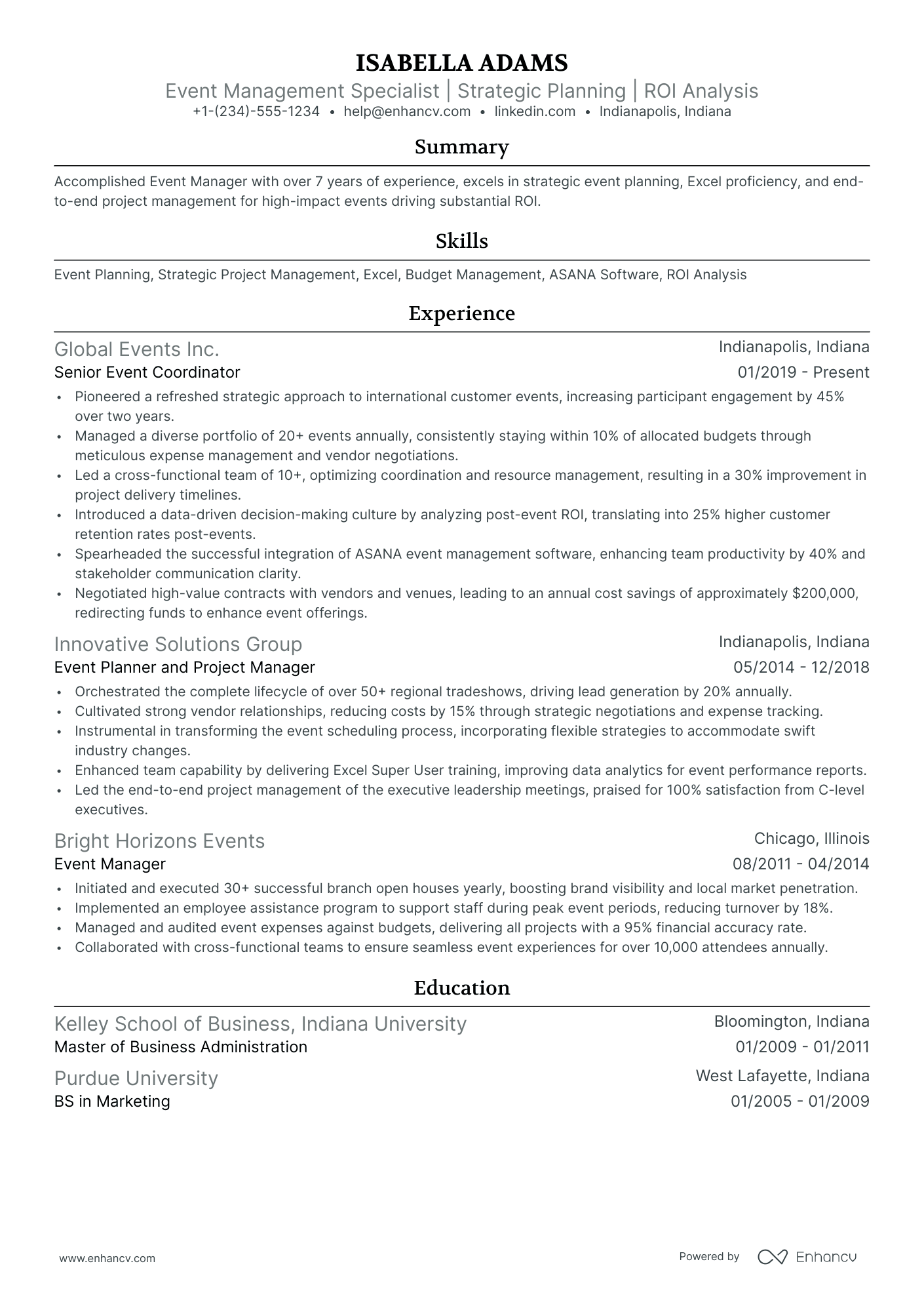
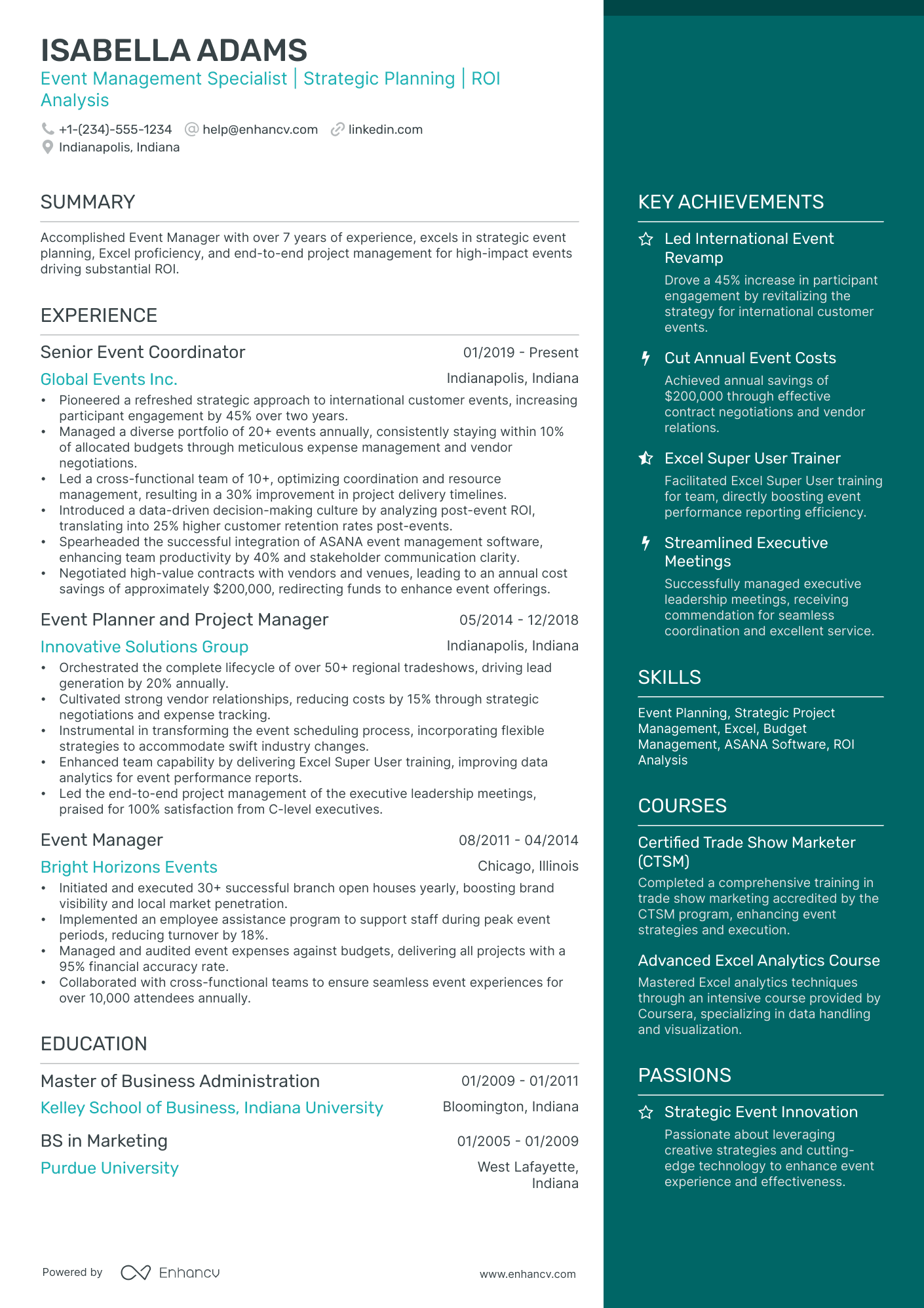
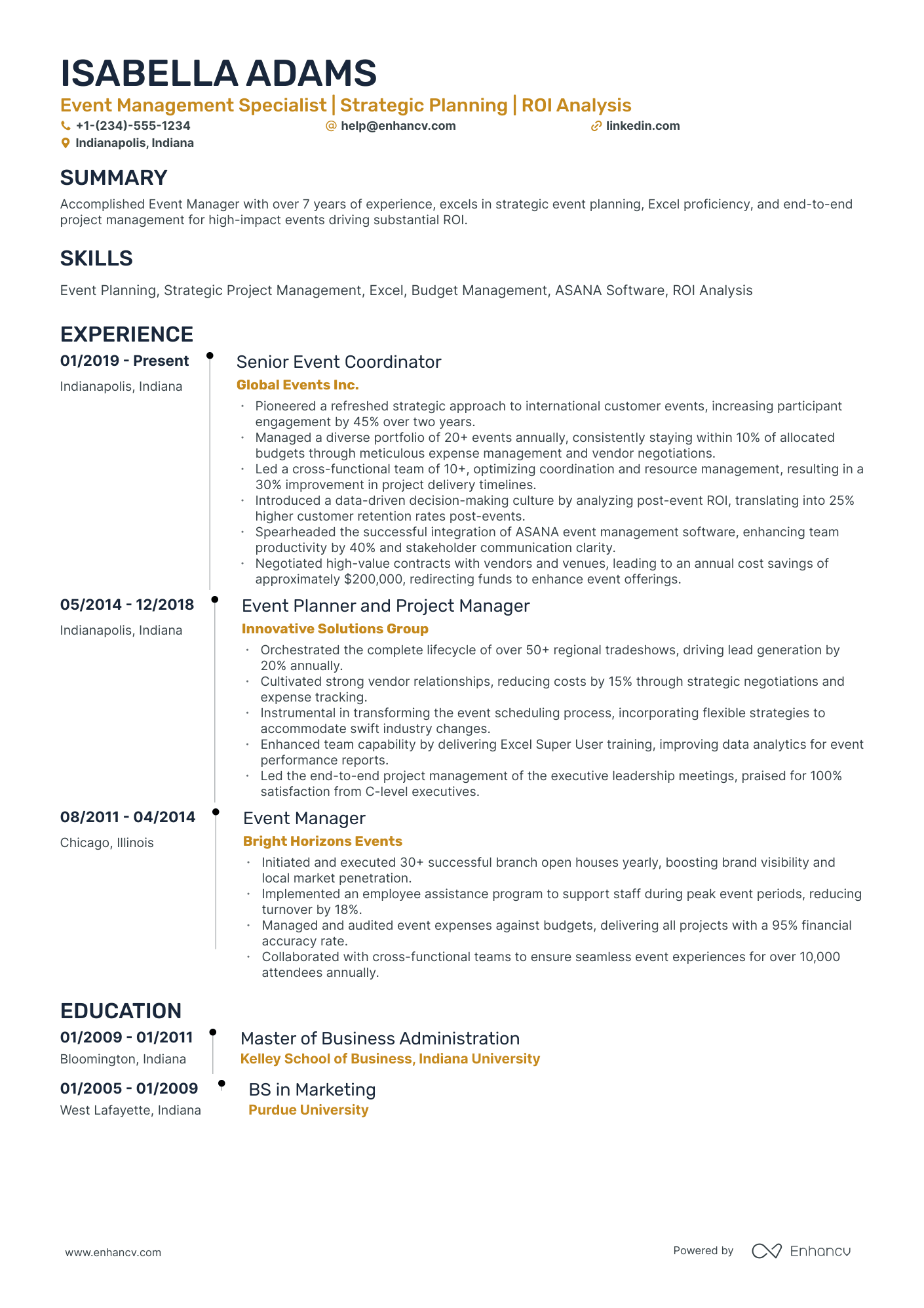
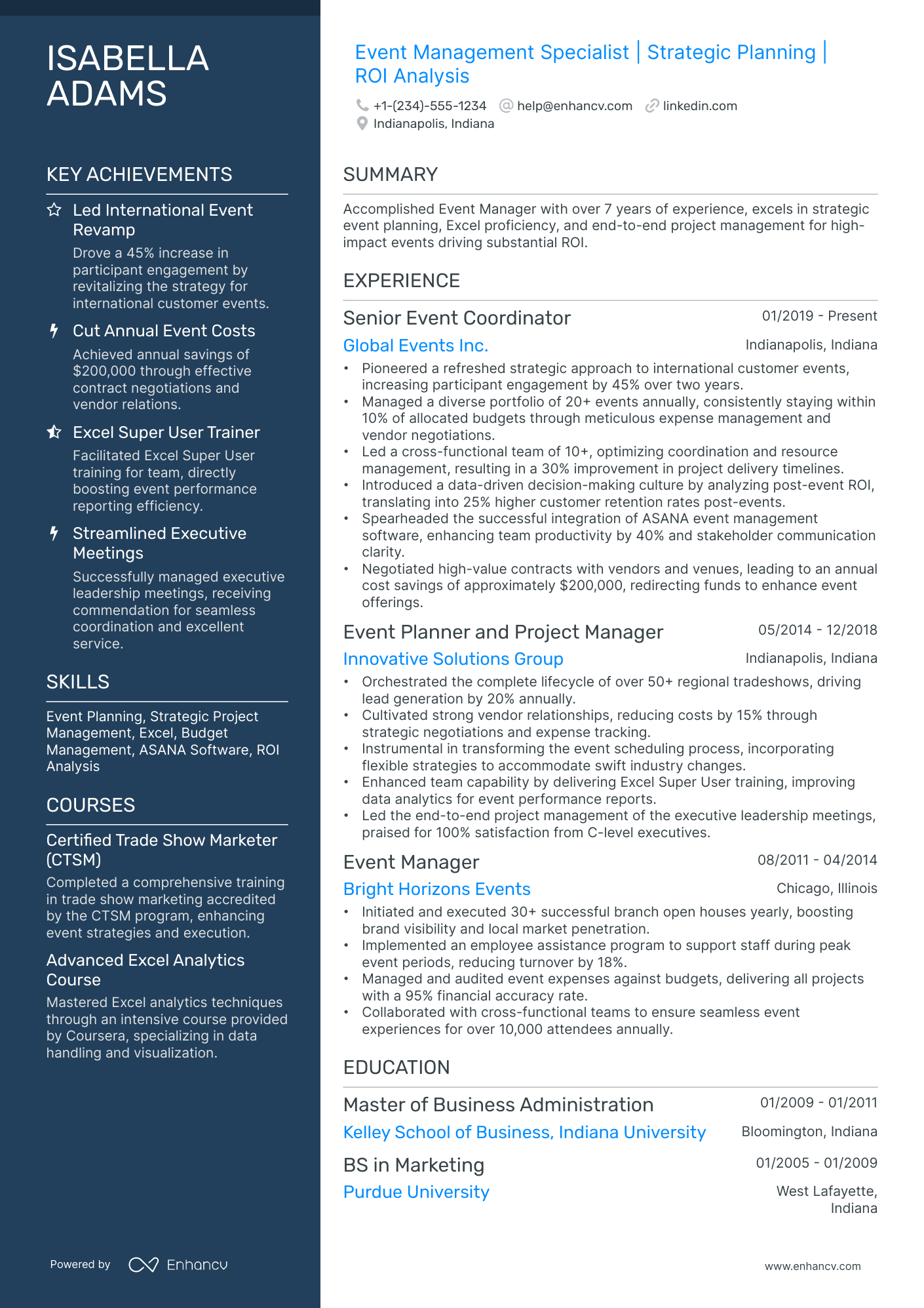
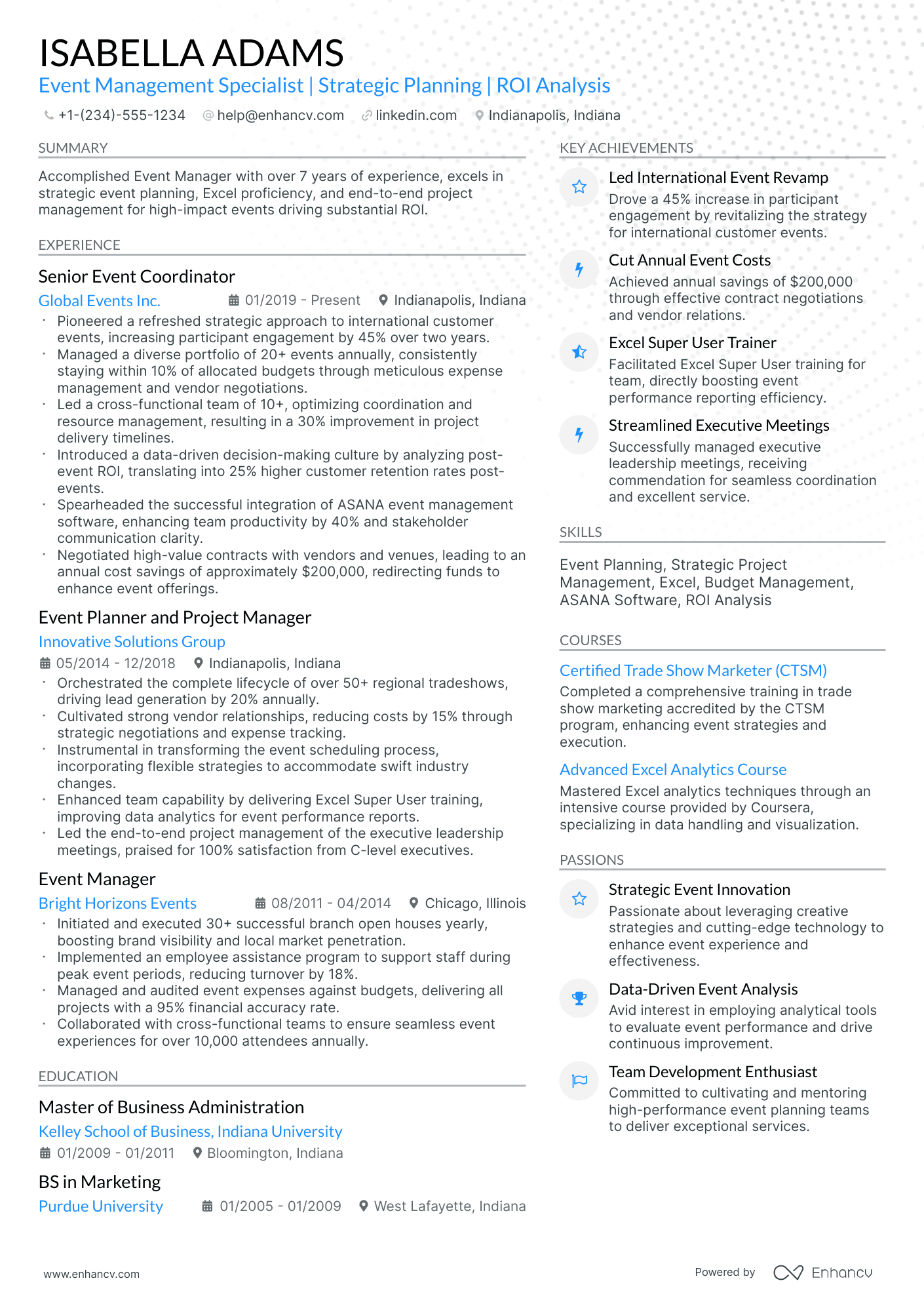
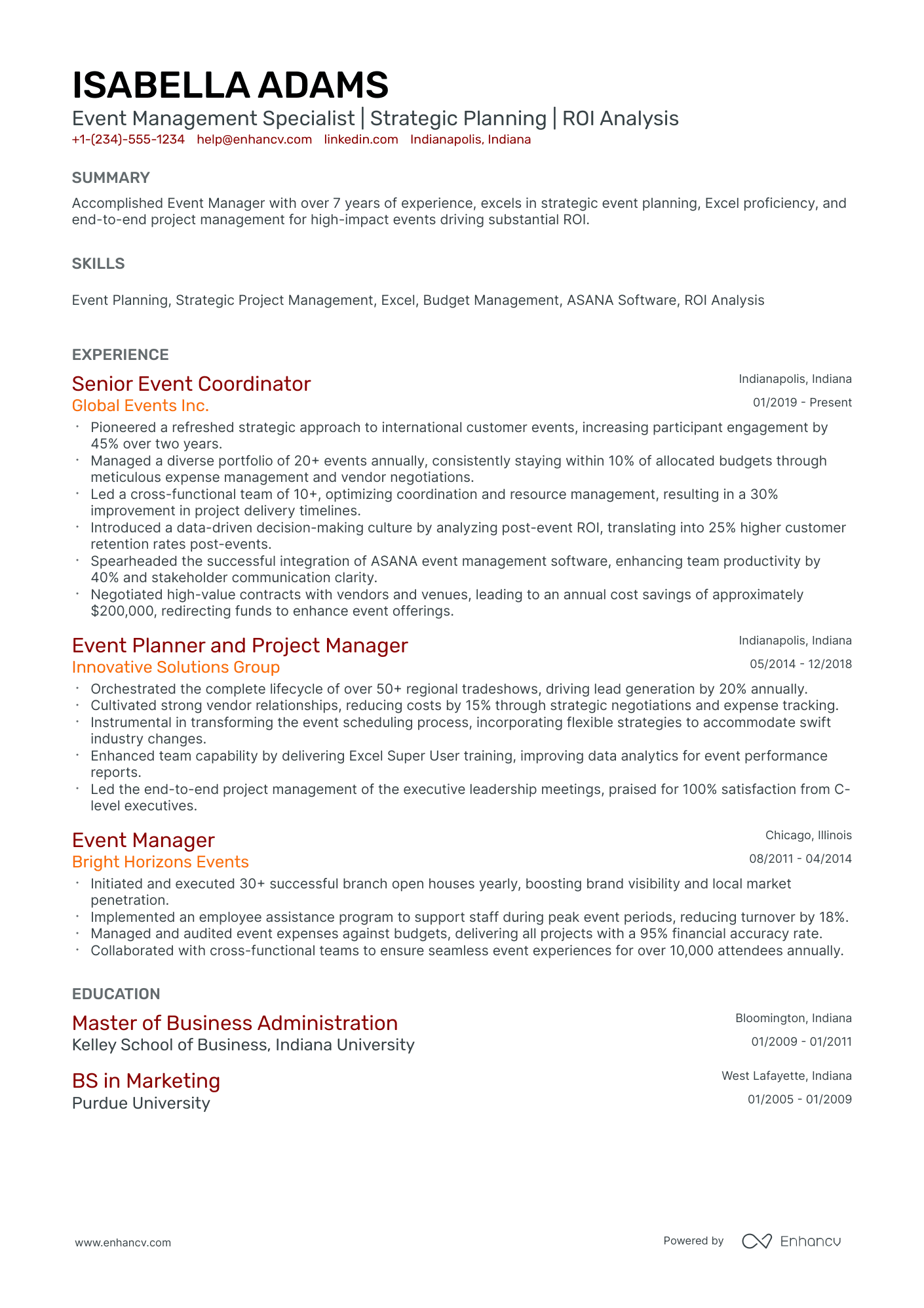
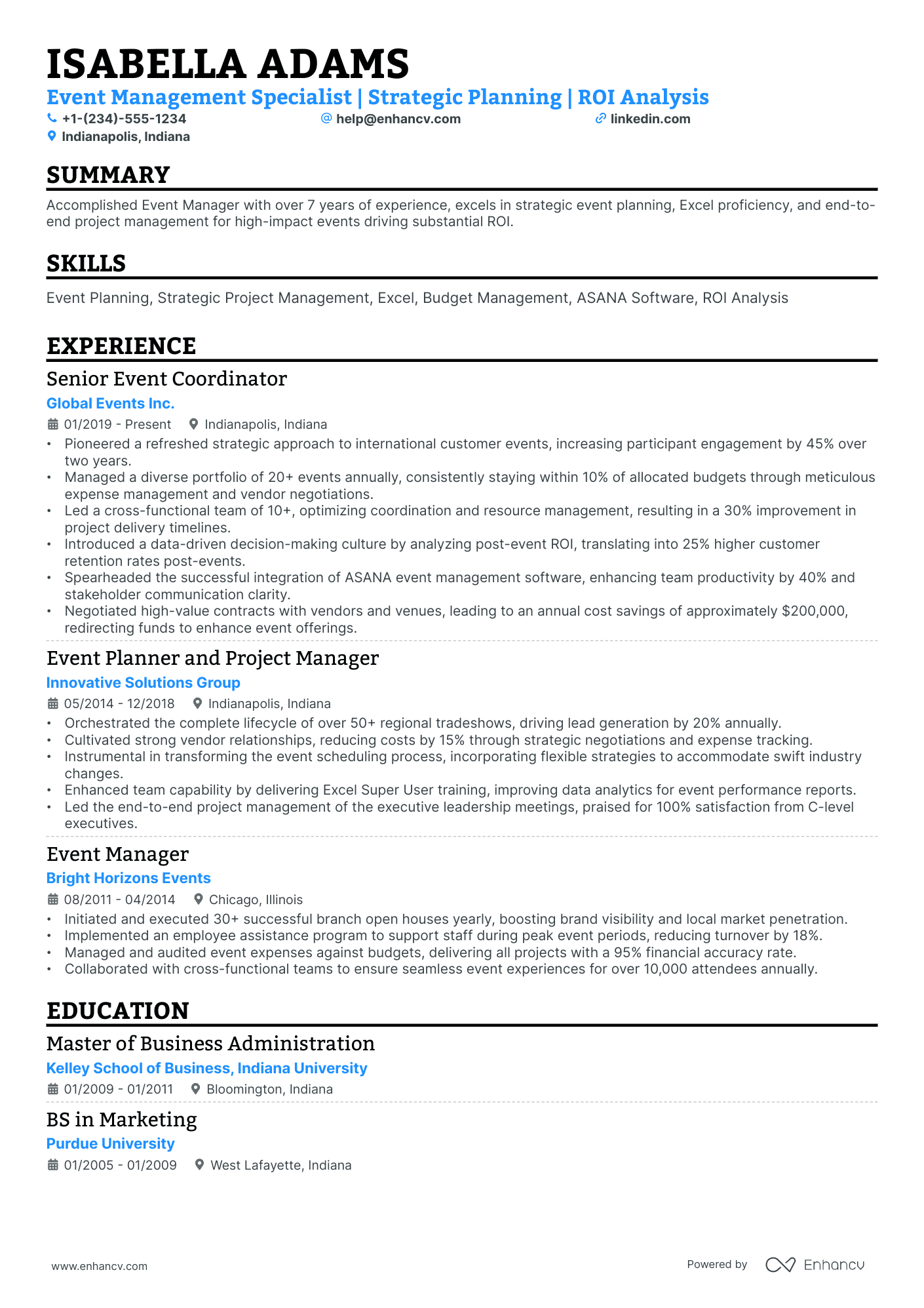
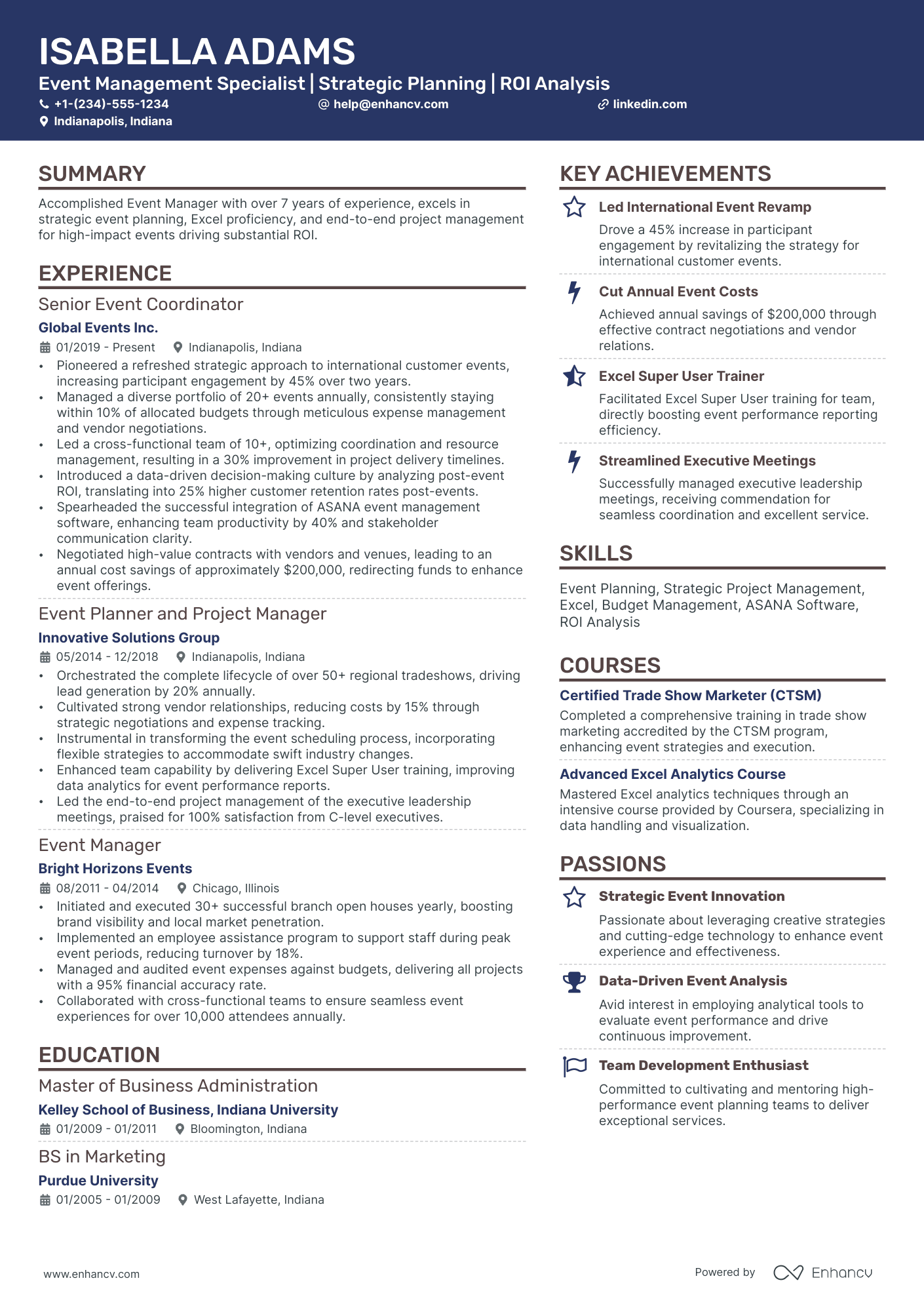
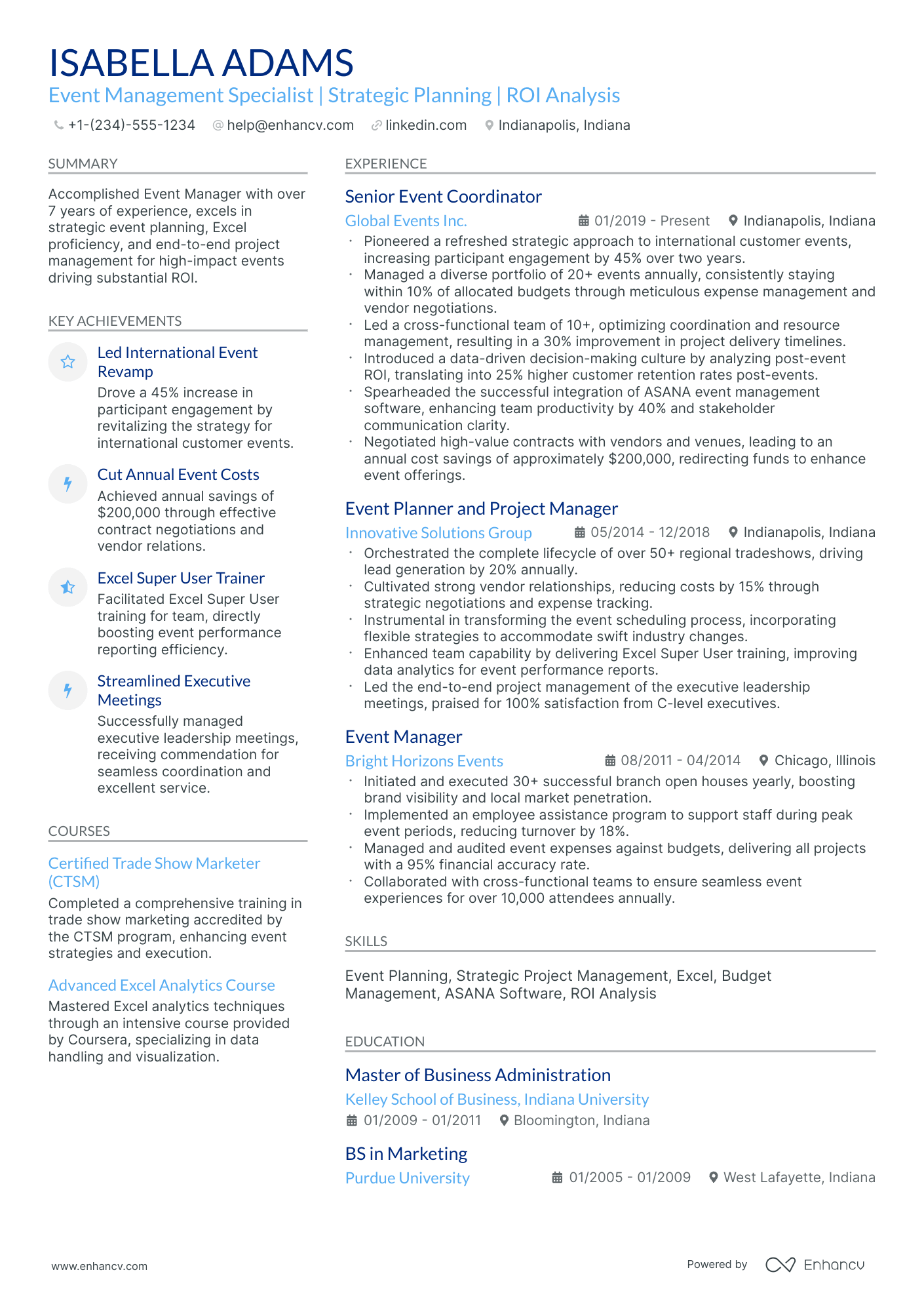
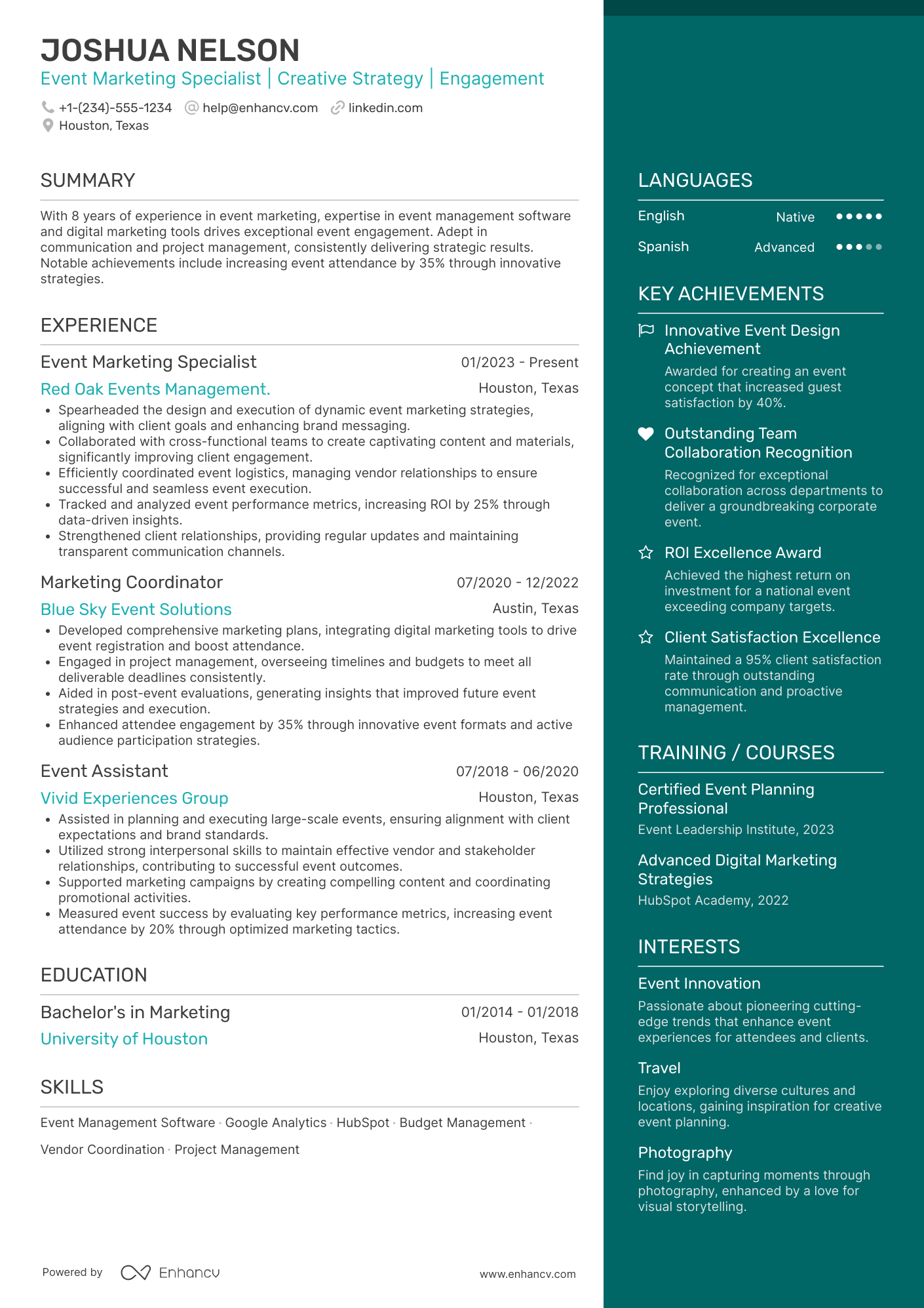
Many event marketing resumes fail because they read like task lists and bury results under tools and vendor names. In today's ATS screening and rapid recruiter scans, that lack of proof makes you blend in fast.
A strong resume shows what changed because of your work and how you measured it. Knowing how to make your resume stand out starts with highlighting attendance lift, qualified pipeline influenced, budget managed, sponsorship revenue, on-time delivery across venues, post-event satisfaction, and conversion rates from registration to show-up.

Key takeaways
- Quantify event outcomes like pipeline influenced, attendance rates, and cost savings in every bullet.
- Use reverse-chronological format for experienced hires and hybrid format for career switchers.
- Mirror the job posting's platforms, KPIs, and event terminology throughout your experience section.
- Weight your skills section toward hard skills and back each one with proof in experience bullets.
- Lead your summary with years of experience, domain focus, and one measurable achievement.
- Add certifications like CMP or Google Analytics to validate specialized event marketing expertise.
- Use Enhancv to turn vague duties into sharp, metrics-driven bullets that pass ATS screening.
Job market snapshot for event marketings
We analyzed 173 recent event marketing job ads across major US job boards. These numbers help you understand skills in demand, employment type trends, top companies hiring at a glance.
What level of experience employers are looking for event marketings
| Years of Experience | Percentage found in job ads |
|---|---|
| 1–2 years | 5.2% (9) |
| 3–4 years | 8.7% (15) |
| 5–6 years | 9.2% (16) |
| 7–8 years | 6.9% (12) |
| 9–10 years | 0.6% (1) |
| 10+ years | 2.9% (5) |
| Not specified | 67.1% (116) |
Event marketing ads by area of specialization (industry)
| Industry (Area) | Percentage found in job ads |
|---|---|
| Finance & Banking | 61.8% (107) |
| Healthcare | 17.3% (30) |
| Retail & E-commerce | 5.8% (10) |
Top companies hiring event marketings
| Company | Percentage found in job ads |
|---|---|
| LeafFilter North, LLC | 24.9% (43) |
| Microsoft Corporation | 6.9% (12) |
Role overview stats
These tables show the most common responsibilities and employment types for event marketing roles. Use them to align your resume with what employers expect and to understand how the role is structured across the market.
Day-to-day activities and top responsibilities for a event marketing
| Responsibility | Percentage found in job ads |
|---|---|
| Event marketing | 17.9% (31) |
| Powerpoint | 16.2% (28) |
| Excel | 13.9% (24) |
| Project management | 13.9% (24) |
| Microsoft office | 13.3% (23) |
| Salesforce | 13.3% (23) |
| Hubspot | 9.8% (17) |
| Outlook | 9.8% (17) |
| Word | 8.7% (15) |
| Lead generation | 7.5% (13) |
| Ai | 6.9% (12) |
| Budgeting | 5.8% (10) |
Type of employment (remote vs on-site vs hybrid)
| Employment type | Percentage found in job ads |
|---|---|
| On-site | 68.2% (118) |
| Remote | 16.2% (28) |
| Hybrid | 15.6% (27) |
How to format a event marketing resume
Recruiters evaluating event marketing resumes prioritize campaign ownership, budget management, cross-functional coordination, and measurable ROI from live, virtual, or hybrid events. Choosing the right resume format ensures these signals surface quickly during both human review and applicant tracking system (ATS) parsing. A clean, well-structured resume layout makes all the difference.

I have significant experience in this role—which format should I use?
Use a reverse-chronological format to present your event marketing career in a clear, progressive timeline that highlights growing scope and accountability. Do:
- Lead with your most recent role and emphasize the scale of events managed, team size, and budget ownership.
- Feature role-specific tools and domains—event management platforms (Cvent, Splash, Bizzabo), marketing automation (HubSpot, Marketo), CRM systems, and vendor negotiation.
- Quantify business impact through pipeline generated, attendance growth, cost savings, or post-event conversion rates.
I'm junior or switching into this role—what format works best?
A hybrid format works well because it lets you lead with transferable event marketing skills while still showing a concise work history that provides context. Do:
- Place a dedicated skills section near the top featuring event coordination, audience engagement strategies, promotional content creation, and analytics tools.
- Highlight projects or transitional experience—volunteer event planning, campus activations, internship campaigns, or freelance coordination—that demonstrate hands-on event execution.
- Connect every action to a result so recruiters can see direct cause and effect, even in entry-level work.
Why not use a functional resume?
A functional format strips away the timeline and context that recruiters need to evaluate how your event marketing skills were applied in real work or project settings, making it harder to verify scope and growth. A functional resume might be acceptable if you're entering event marketing from an unrelated field, have a limited work history, or are addressing a significant resume gap—but only if every listed skill is tied directly to a specific project, campaign, or measurable outcome.
Once your format establishes a clean, scannable structure, the next step is deciding which sections to include so each one earns its place on the page.
What sections should go on a event marketing resume
Recruiters expect a clean, role-focused resume that shows you can plan, promote, and execute events that drive measurable business results. Understanding which resume sections to include ensures maximum clarity:
- Header
- Summary
- Experience
- Skills
- Projects
- Education
- Certifications
- Optional sections: Awards, Leadership, Languages
Your experience bullets should highlight event scope, budget ownership, cross-functional coordination, and outcomes such as registrations, attendance rate, pipeline influenced, revenue, and return on investment.
Is your resume good enough?
Drop your resume here or choose a file. PDF & DOCX only. Max 2MB file size.
Once you’ve organized your resume with the right structure and supporting sections, you can focus on writing your event marketing experience in a way that fits that framework.
How to write your event marketing resume experience
Your work experience section should spotlight events you've planned and executed, the marketing tools and methods you used to promote them, and the measurable outcomes each event generated. Hiring managers prioritize demonstrated impact—registrations driven, engagement rates lifted, revenue influenced—over descriptive task lists that only outline day-to-day duties.
Each entry should include:
- Job title
- Company and location (or remote)
- Dates of employment (month and year)
Three to five concise bullet points showing what you owned, how you executed, and what outcomes you delivered:
- Ownership scope: the event programs, campaign calendars, venue partnerships, budgets, or brand activations you were directly accountable for—including their scale, audience segments, and format (virtual, hybrid, or in-person).
- Execution approach: the platforms, frameworks, and methods you relied on to plan, promote, and produce events—such as marketing automation tools, CRM systems, project management software, A/B testing for promotional campaigns, or audience segmentation strategies.
- Value improved: the specific dimensions of event performance you strengthened, whether that means registration conversion rates, attendee engagement, sponsor satisfaction, lead quality, post-event pipeline velocity, or cost efficiency across your event portfolio.
- Collaboration context: how you coordinated with cross-functional partners—sales, design, content, product marketing, external vendors, speakers, or sponsors—to align event strategy with broader go-to-market goals and deliver a seamless attendee experience.
- Impact delivered: the business outcomes your events produced, expressed through results and scale rather than activity—think pipeline generated, brand awareness expanded, audience growth achieved, or revenue directly attributed to your event programs.
Experience bullet formula
A event marketing experience example
✅ Right example - modern, quantified, specific.
Event Marketing Manager
Nimbus Analytics | Austin, TX
2022–2025
B2B software company serving mid-market operations teams with a product-led growth motion and a lean in-house marketing team.
- Owned end-to-end field and virtual event strategy across twelve conferences, six webinars, and four customer roundtables, generating $3.4M in influenced pipeline and increasing marketing-qualified leads by 28% year over year in Salesforce.
- Built a repeatable event operations system using Asana, Airtable, and Zapier—standardizing timelines, vendor intake, and lead routing—and cut launch time per event by 35% while reducing missed handoffs to sales by 60%.
- Partnered with product marketing, design, and sales to develop event messaging, booth creative, and talk tracks; improved booth-to-meeting conversion from 9% to 14% and lifted on-site demo completion rate by 22% using QR tracking and UTM governance.
- Negotiated sponsorships, venues, and production contracts, reallocating spend toward top-performing channels and lowering cost per lead by 18% while maintaining attendee satisfaction at 4.6 out of 5 via post-event surveys in Qualtrics.
- Launched an account-based marketing event program with HubSpot workflows and LinkedIn Matched Audiences, coordinating with account executives on target lists; drove a 31% increase in meeting show rate and shortened sales cycle by nine days for event-sourced opportunities.
Now that you've seen how to structure your experience entries, let's focus on aligning them with the specific requirements of each job posting.
How to tailor your event marketing resume experience
Recruiters evaluate your event marketing resume through both human review and applicant tracking systems, so tailoring your resume to the job description is essential. Tailoring your experience section ensures the most relevant skills, tools, and achievements surface immediately.
Ways to tailor your event marketing experience:
- Mirror the exact event platforms and registration tools listed in the posting.
- Match terminology for event formats like hybrid virtual or experiential.
- Reflect the specific KPIs or success metrics the employer prioritizes.
- Highlight experience with the CRM or marketing automation system they use.
- Include relevant industry or vertical experience when the role requires it.
- Emphasize sponsor management or vendor coordination if the posting mentions either.
- Align your budget language with the scale and scope they describe.
- Reference cross-functional collaboration models outlined in the job description.
Tailoring means aligning your real accomplishments with what the employer values—not forcing keywords where they don't belong.
Resume tailoring examples for event marketing
| Job description excerpt | Untailored | Tailored |
|---|---|---|
| Plan and execute large-scale trade shows and conferences using Cvent, managing budgets of $500K+ and coordinating with cross-functional teams to drive lead generation. | Helped plan events and worked with different teams on marketing projects. | Planned and executed 12+ annual trade shows and conferences using Cvent, managing budgets up to $750K and coordinating with sales, design, and product teams to generate 3,000+ qualified leads per year. |
| Develop and manage experiential marketing activations that increase brand awareness, tracking performance through post-event surveys, social media engagement, and foot traffic analytics. | Created marketing campaigns and tracked results for various brand initiatives. | Designed experiential marketing activations for product launches and pop-up events, increasing brand awareness by 40% as measured through post-event surveys, a 55% lift in social media engagement, and foot traffic analytics via RFID tracking. |
| Own end-to-end event promotion across email, paid social, and partner channels using HubSpot and Meta Ads Manager to hit registration targets and maximize attendance rates. | Promoted events through digital channels and helped increase attendance. | Led end-to-end promotional campaigns for 20+ events annually using HubSpot email workflows and Meta Ads Manager, exceeding registration targets by 25% and achieving a 78% average attendance rate through A/B-tested paid social and partner channel strategies. |
Once you’ve aligned your experience with the role’s priorities, quantify your event marketing achievements to show the measurable impact of that work.
How to quantify your event marketing achievements
Quantifying your achievements proves business impact and shows repeatable execution. Focus on pipeline and revenue influenced, registration-to-attendance conversion, cost per attendee, sponsor retention, and delivery speed against deadlines.
Quantifying examples for event marketing
| Metric | Example |
|---|---|
| Pipeline influenced | "Generated $420K in influenced pipeline from a two-city roadshow by integrating HubSpot tracking, UTM standards, and Salesforce campaign attribution." |
| Conversion rate | "Increased registration-to-attendance from 38% to 52% across six webinars by adding calendar holds, segmented reminders in Marketo, and A/B-tested subject lines." |
| Cost efficiency | "Reduced cost per attendee 27% for an eight-hundred-person conference by renegotiating venue packages and shifting print signage to QR-based digital guides." |
| Sponsor retention | "Renewed nine of ten sponsors for the next event cycle by delivering post-event ROI reports within five business days and securing three co-marketing commitments." |
| Delivery speed | "Cut speaker onboarding time from ten days to six by standardizing intake forms, building a content checklist in Asana, and templating briefing decks." |
Turn vague job duties into measurable, recruiter-ready resume bullets in seconds with Enhancv's Bullet Point Generator.
Once you've crafted strong, action-driven bullet points for your experience section, the next step is ensuring your skills section presents the right mix of hard and soft skills to match the event marketing role.
How to list your hard and soft skills on a event marketing resume
Your skills section shows you can plan, promote, and measure events, and recruiters and applicant tracking systems scan it for role keywords—aim for a mix weighted toward hard skills, with fewer soft skills that support execution and stakeholder work. event marketing roles require a blend of:
- Product strategy and discovery skills.
- Data, analytics, and experimentation skills.
- Delivery, execution, and go-to-market discipline.
- Soft skills.
Your skills section should be:
- Scannable (bullet-style grouping).
- Relevant to the job post.
- Backed by proof in experience bullets.
- Updated with current tools.
Place your skills section:
- Above experience if you're junior or switching careers.
- Below experience if you're mid/senior with strong achievements.

Hard skills
- Event strategy and planning
- Budgeting and forecasting
- Vendor sourcing and contracts
- Sponsorship packages and sales enablement
- Speaker and agenda programming
- Registration platforms: Cvent, Eventbrite
- Email marketing: HubSpot, Mailchimp
- CRM and lead tracking: Salesforce
- Paid social and search: Meta Ads, Google Ads
- Marketing analytics: Google Analytics 4
- UTM tracking and attribution
- Post-event reporting and ROI
Soft skills
- Align stakeholders on goals
- Run tight project timelines
- Communicate with executives
- Negotiate win-win terms
- Write clear event briefs
- Coordinate cross-functional teams
- Prioritize under pressure
- Make data-informed decisions
- Own end-to-end delivery
- Handle onsite issues fast
- Manage sponsor relationships
- Lead post-mortem reviews
How to show your event marketing skills in context
Skills shouldn't live only in a bulleted list on your resume.
They should be demonstrated in:
- Your summary (high-level professional identity)
- Your experience (proof through outcomes)
Here's what strong event marketing examples look like in practice. You can also explore curated resume skills examples for more inspiration.
Summary example
Senior event marketing strategist with 10+ years driving B2B tech conferences, product launches, and hybrid experiences. Skilled in HubSpot, Cvent, and cross-functional collaboration. Increased qualified pipeline from flagship events by 45% year over year.
- Signals senior-level expertise immediately
- Names industry-relevant platforms and tools
- Leads with a concrete metric
- Highlights collaboration as a soft skill
Experience example
Senior Event Marketing Manager
Vantage Growth Partners | Remote
March 2020–Present
- Planned and executed 12+ annual hybrid events using Cvent and Zoom Events, generating $3.2M in attributed pipeline revenue.
- Partnered with sales, design, and product teams to develop event content strategies that boosted post-event engagement by 38%.
- Built automated lead-nurture workflows in HubSpot, shortening average event-lead conversion time from 60 days to 34 days.
- Every bullet includes measurable proof
- Skills surface naturally through real outcomes
Once you’ve tied your event marketing abilities to measurable outcomes and real examples, the next step is applying that same approach to an event marketing resume with no experience so you can present relevant strengths clearly.
How do I write a event marketing resume with no experience
Even without full-time experience, you can demonstrate readiness. Writing a resume without work experience is possible through:
- Campus event promotion roles
- Student club event sponsorships
- Volunteer festival marketing support
- Social media event campaigns
- Street team flyer distribution
- Email invitations and follow-ups
- Event registration and check-in
Focus on:
- Metrics: reach, registrations, attendance
- Tools: Canva, Mailchimp, Eventbrite
- Budget, vendors, and timelines
- Target audience and channel mix
Resume format tip for entry-level event marketing
Use a combination resume format because it highlights relevant projects and tools upfront while still showing work history, even if it is unrelated. Do:
- Add a "Projects" section near top.
- Quantify results: clicks, sign-ups, turnout.
- Name tools used: Canva, Mailchimp, Eventbrite.
- Describe your role and scope.
- Match keywords from the job post.
- Built an Eventbrite landing page and Mailchimp invite for a campus panel, driving 120 registrations and a 68% attendance rate in two weeks.
Even without formal work experience, your education section can serve as a strong foundation for your event marketing resume.
How to list your education on a event marketing resume
Your education section helps hiring teams confirm you have foundational knowledge in marketing, communications, or business principles relevant to event marketing.
Include:
- Degree name
- Institution
- Location
- Graduation year
- Relevant coursework (for juniors or entry-level candidates)
- Honors & GPA (if 3.5 or higher)
Avoid listing month or day details—use the graduation year only.
Here's a strong education entry tailored to event marketing:
Example education entry
Bachelor of Science in Marketing
University of Oregon, Eugene, OR
Graduated 2021
GPA: 3.7/4.0
- Relevant coursework: Event Planning & Promotion, Integrated Marketing Communications, Consumer Behavior, Brand Strategy
- Honors: Magna Cum Laude, Dean's List (six consecutive semesters)
How to list your certifications on a event marketing resume
Certifications on your resume show your commitment to learning, prove tool proficiency, and signal industry relevance in event marketing. They help employers trust you can plan, promote, and measure events with confidence. Include:
- Certificate name
- Issuing organization
- Year
- Optional: credential ID or URL
- Put certifications below education when they're older, less relevant, or you want your degree and coursework to lead.
- Put certifications above education when they're recent, highly relevant to event marketing, or required for the roles you target.
Best certifications for your event marketing resume
- Certified Meeting Professional (CMP)
- Certified Special Events Professional (CSEP)
- Digital Event Strategist (DES)
- Google Analytics Certification
- HubSpot Inbound Marketing Certification
- Meta Certified Digital Marketing Associate
- Professional Certified Marketer (PCM) in Digital Marketing
Once you’ve positioned your credentials to support your event marketing expertise, focus on your event marketing resume summary to spotlight that value upfront.
How to write your event marketing resume summary
Your resume summary is the first thing a recruiter reads. A strong one immediately signals you're qualified for an event marketing role.
Keep it to three to four lines, with:
- Your title and total years of event marketing experience.
- The domain you specialize in, such as B2B tech conferences or consumer brand activations.
- Core skills like budget management, vendor coordination, and marketing automation platforms.
- One or two measurable achievements, such as attendance growth or cost savings.
- Soft skills tied to outcomes, like cross-functional collaboration that shortened planning cycles.

PRO TIP
At this level, focus on relevant skills, specific tools, and early wins that prove you can execute. Avoid vague phrases like "passionate team player" or "motivated self-starter." Replace them with concrete contributions and measurable results from internships or first roles.
Example summary for a event marketing
Event marketing coordinator with two years of experience planning B2B tech meetups. Managed logistics for 12 events annually, boosting average attendance by 30% through targeted email campaigns in HubSpot.
Optimize your resume summary and objective for ATS
Drop your resume here or choose a file.
PDF & DOCX only. Max 2MB file size.
Now that your summary effectively frames your event marketing expertise, make sure the header above it presents your contact details correctly so recruiters can reach you without any friction.
What to include in a event marketing resume header
A resume header is the top section with your key details, and it boosts visibility, credibility, and recruiter screening for event marketing roles.
Essential resume header elements
- Full name
- Tailored job title and headline
- Location
- Phone number
- Professional email
- GitHub link
- Portfolio link
Including a LinkedIn link helps recruiters verify experience quickly and supports screening.
Do not include photos on a event marketing resume unless the role is explicitly front-facing or appearance-dependent.
Match your headline to the job posting and keep every link current, readable, and aligned with event marketing work.
Example
Event marketing resume header
Jordan Lee
Event Marketing Specialist | Experiential Campaigns and Partner Events
Austin, TX
(512) 555-01XX
jordan.lee@enhancv.com
github.com/jordanlee
yourwebsite.com
linkedin.com/in/jordanlee
Once your top-of-page details clearly identify you and make it easy to reach you, add additional sections to round out your event marketing resume with supporting context.
Additional sections for event marketing resumes
When your core qualifications align closely with other candidates, additional sections can set your event marketing resume apart with unique credibility.
- Languages
- Certifications and professional development
- Industry conferences and speaking engagements
- Volunteer event coordination
- Professional affiliations and memberships
- Publications and media features
- Hobbies and interests
Once you've rounded out your resume with sections that highlight your full range of qualifications, the next step is pairing it with a strong cover letter to make an even greater impact.
Do event marketing resumes need a cover letter
Event marketing resumes don't always need a cover letter. Understanding what a cover letter is and when it helps matters—it can make a difference when the role is competitive, the hiring manager expects one, or your resume doesn't clearly show fit or context.
Use these guidelines to decide when to include one:
- Explain role or team fit by tying your experience to the event marketing goals, audience, channels, and cross-functional partners.
- Highlight one or two relevant projects or outcomes, such as registrations, pipeline influence, attendance rate, or post-event engagement.
- Show you understand the product, users, or business context by referencing the customer segment, buying cycle, and how events support revenue or retention.
- Address career transitions or non-obvious experience by connecting past work to event marketing skills, tools, and measurable results.
Drop your resume here or choose a file.
PDF & DOCX only. Max 2MB file size.
Even if you decide a cover letter won’t add value for an event marketing role, using AI to improve your event marketing resume helps you strengthen the document hiring teams review first.
Using AI to improve your event marketing resume
AI can sharpen your resume's clarity, structure, and impact. It helps you find stronger phrasing and tighten loose descriptions. But overuse kills authenticity. If you're wondering which AI is best for writing resumes, the key is choosing one that enhances your real experience rather than fabricating it. Once your content feels clear and role-aligned, step away from AI.
Here are 10 practical prompts to strengthen specific sections of your event marketing resume:
- Strengthen your summary. "Rewrite my resume summary to highlight my event marketing experience, focusing on measurable outcomes and core competencies in two to three sentences."
- Quantify experience bullets. "Add specific metrics like attendance numbers, revenue generated, or engagement rates to these event marketing experience bullets."
- Tighten action verbs. "Replace weak or passive verbs in my event marketing experience section with strong, industry-relevant action verbs."
- Align skills strategically. "Compare my skills section against this event marketing job description and suggest missing keywords I should include."
- Refine project descriptions. "Rewrite this event marketing project description to emphasize my role, the strategy used, and the measurable result achieved."
- Clarify education relevance. "Revise my education section to highlight coursework, thesis work, or activities directly relevant to event marketing careers."
- Showcase certifications clearly. "Reorganize my certifications section to prioritize credentials most valued in event marketing roles today."
- Eliminate filler language. "Identify and remove vague or redundant phrases from my event marketing resume without losing important details."
- Improve bullet consistency. "Standardize the format, tense, and structure across all experience bullets in my event marketing resume."
- Tailor for specific roles. "Adjust my event marketing resume to match this job posting's priorities, reordering sections and bullets for strongest alignment."
Stop using AI once your resume sounds accurate, specific, and aligned with real experience. AI should never invent experience or inflate claims—if it didn't happen, it doesn't belong here.
Conclusion
A strong event marketing resume proves impact with measurable outcomes, role-specific skills, and a clear structure. Lead with results like attendance growth, pipeline influenced, revenue, and sponsor retention. Back them with skills in planning, budgeting, vendor management, and post-event reporting.
Keep your event marketing resume easy to scan, consistent, and focused on what you delivered. This approach matches today’s hiring market and stays relevant as teams prioritize efficiency and accountability. With clear results and clean formatting, you’re ready to apply with confidence.