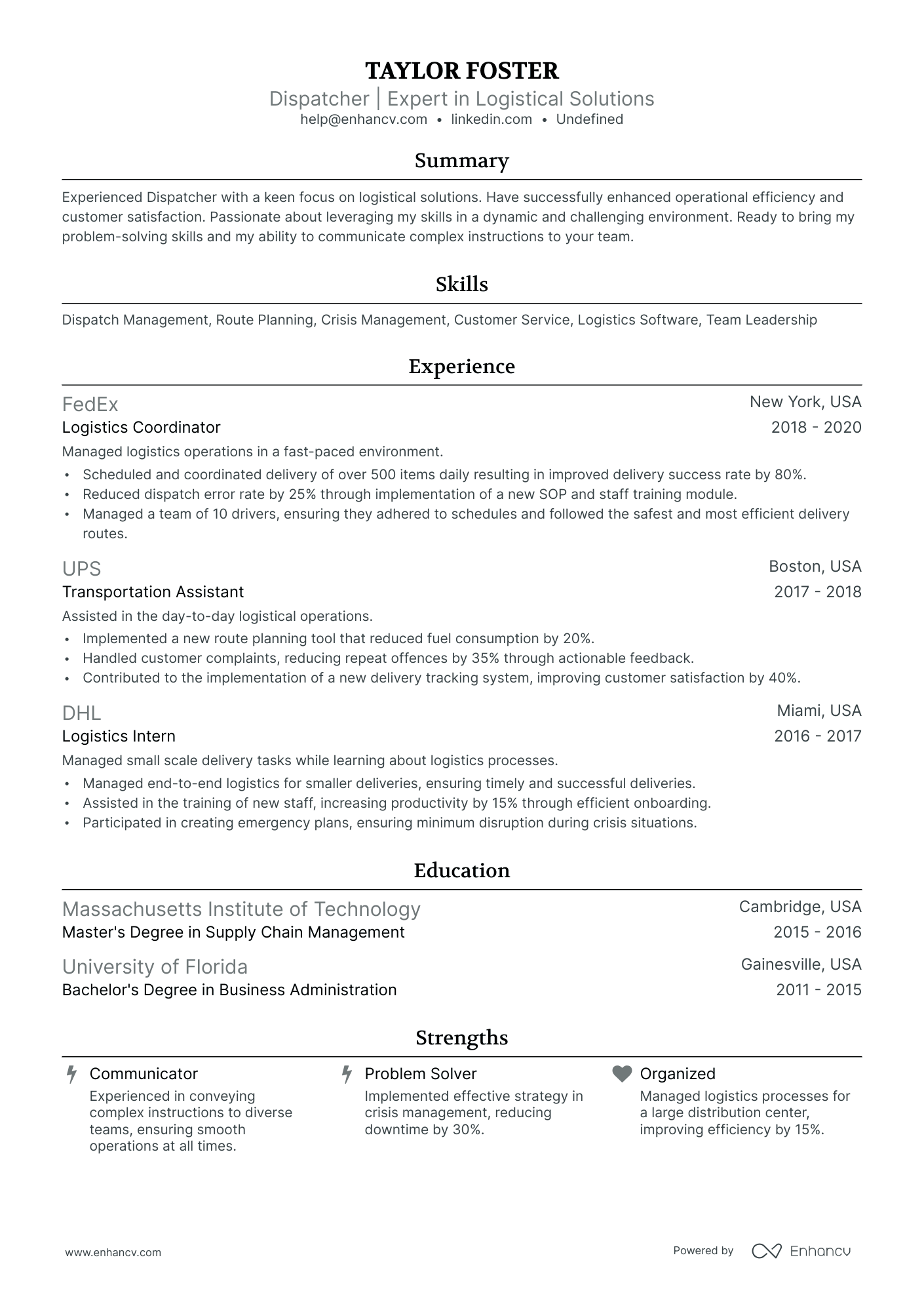
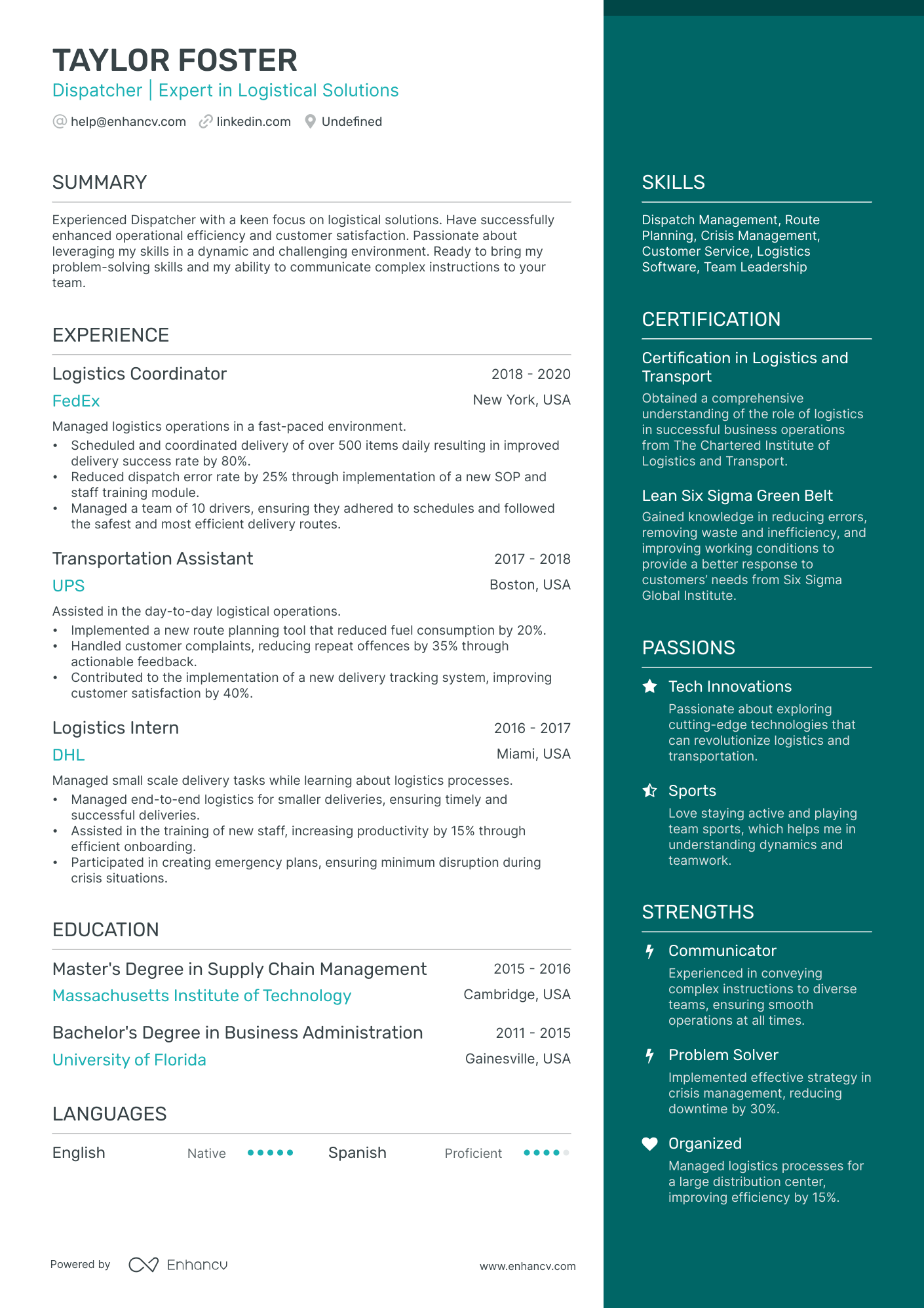
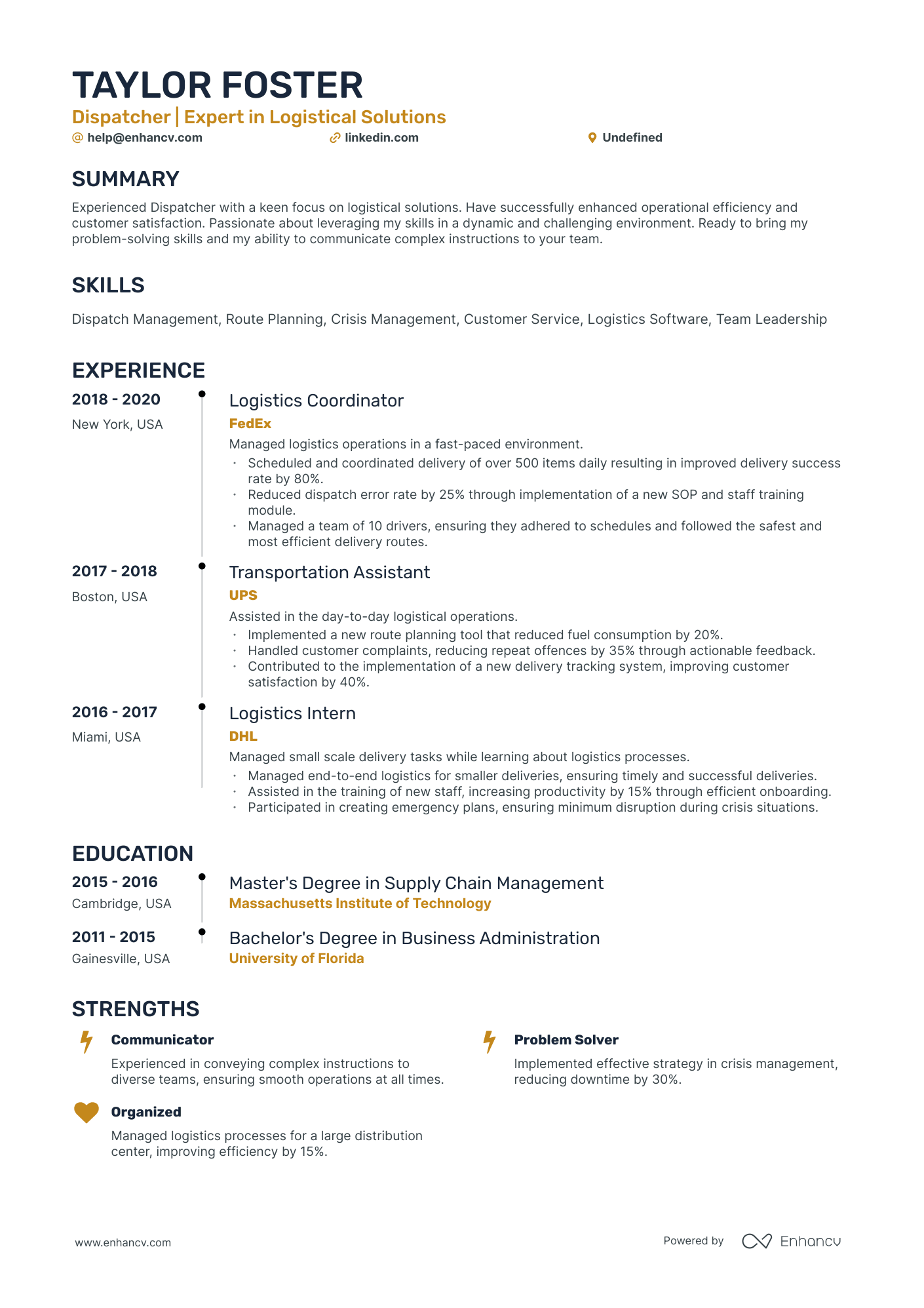
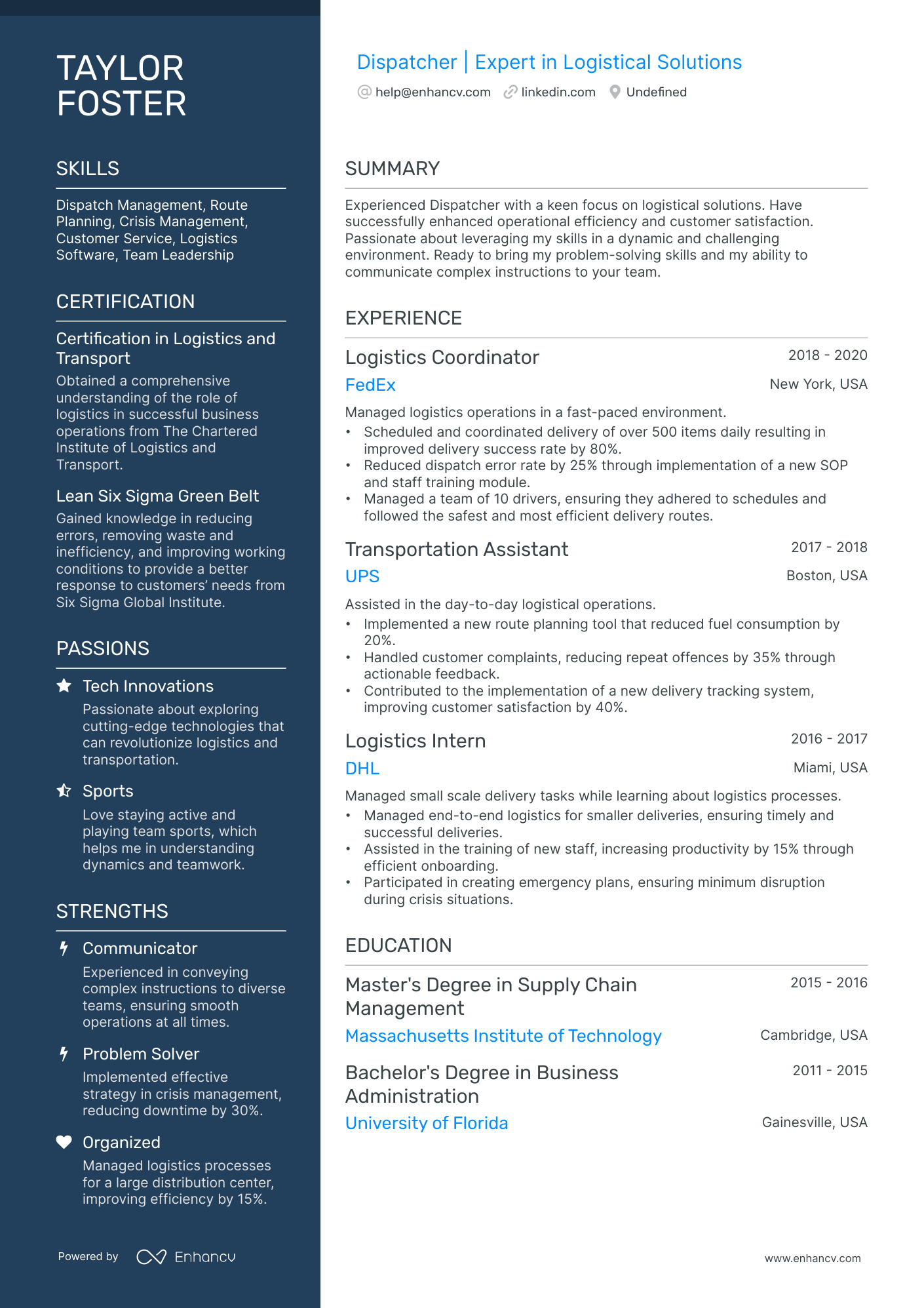
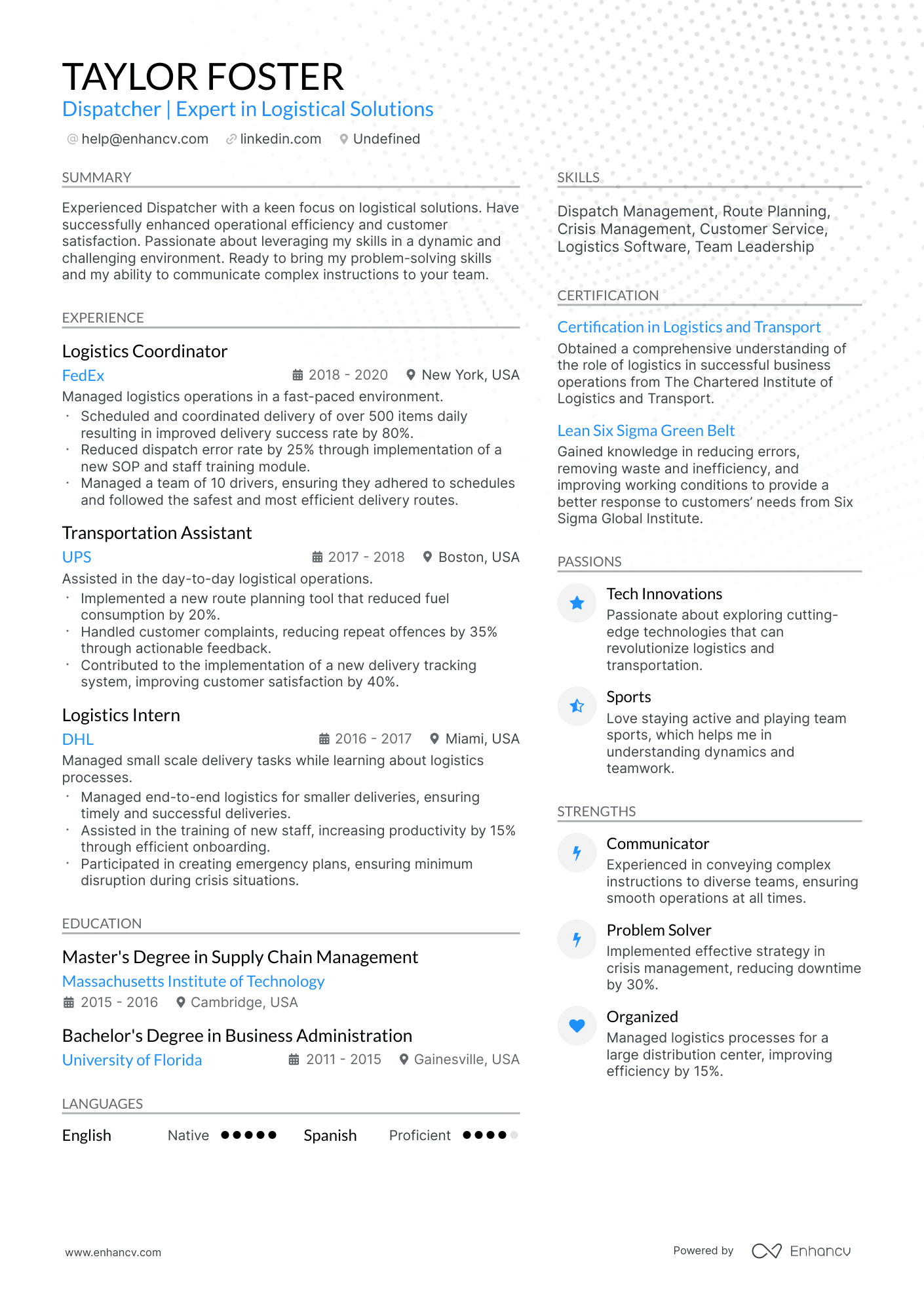
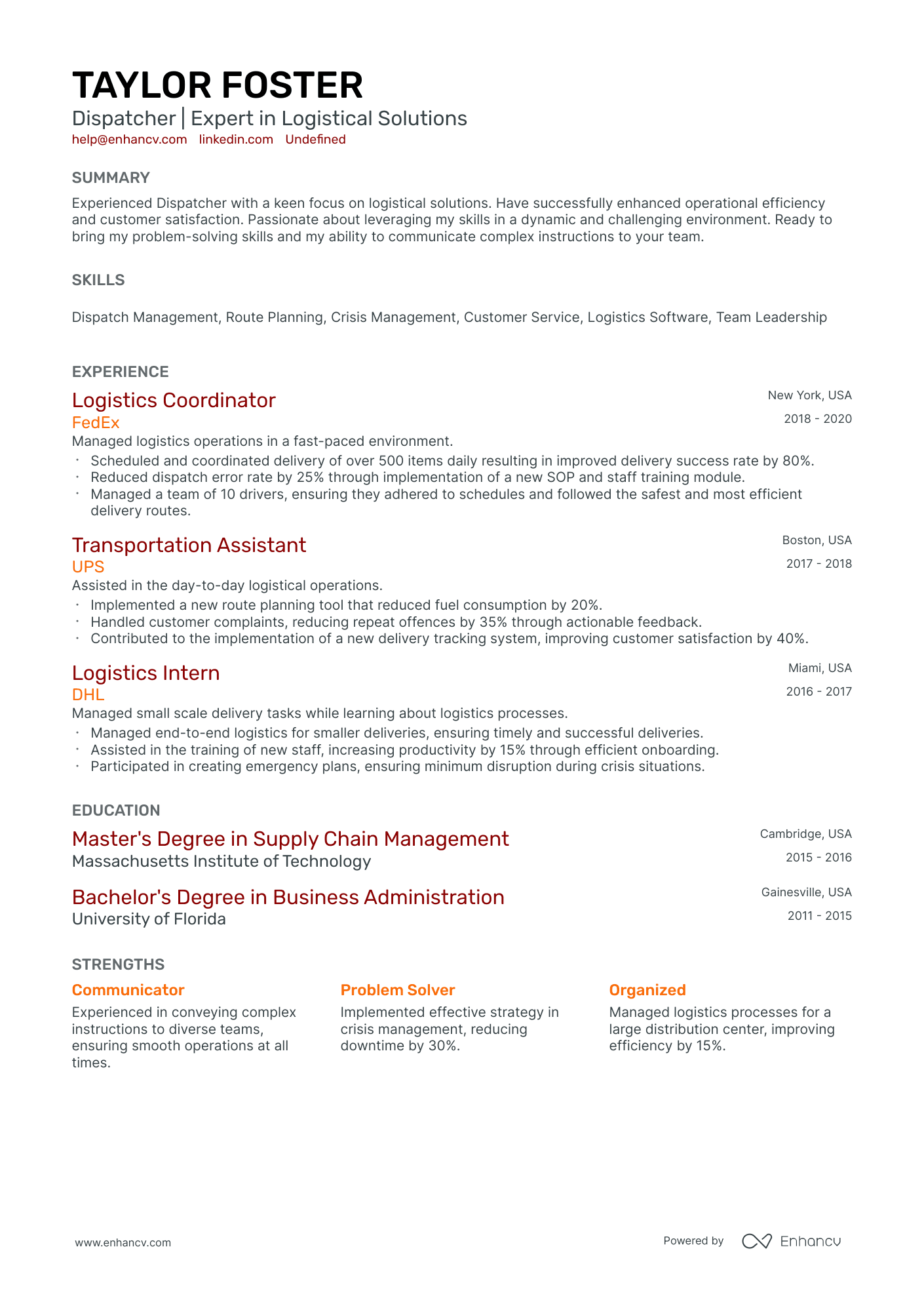
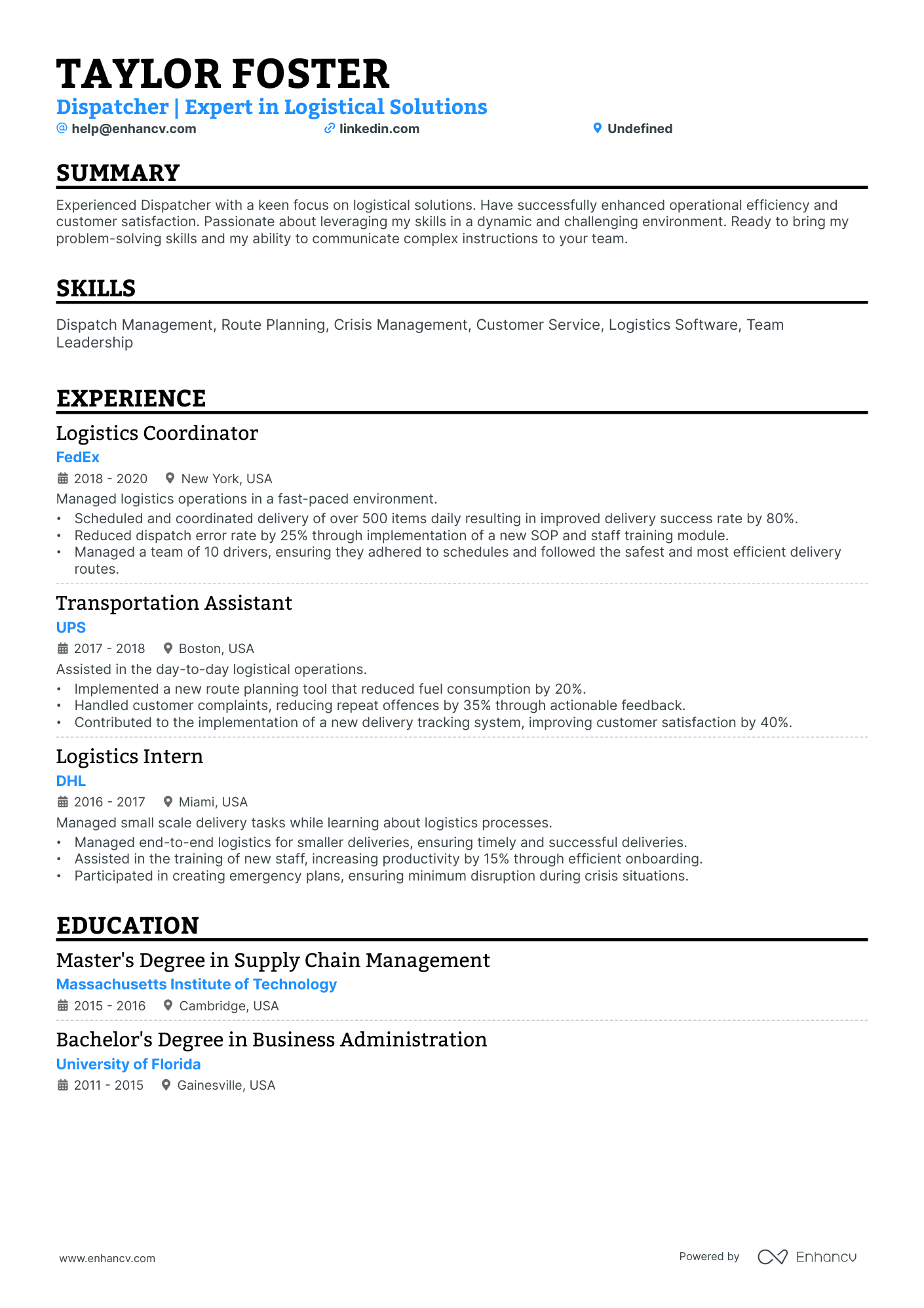
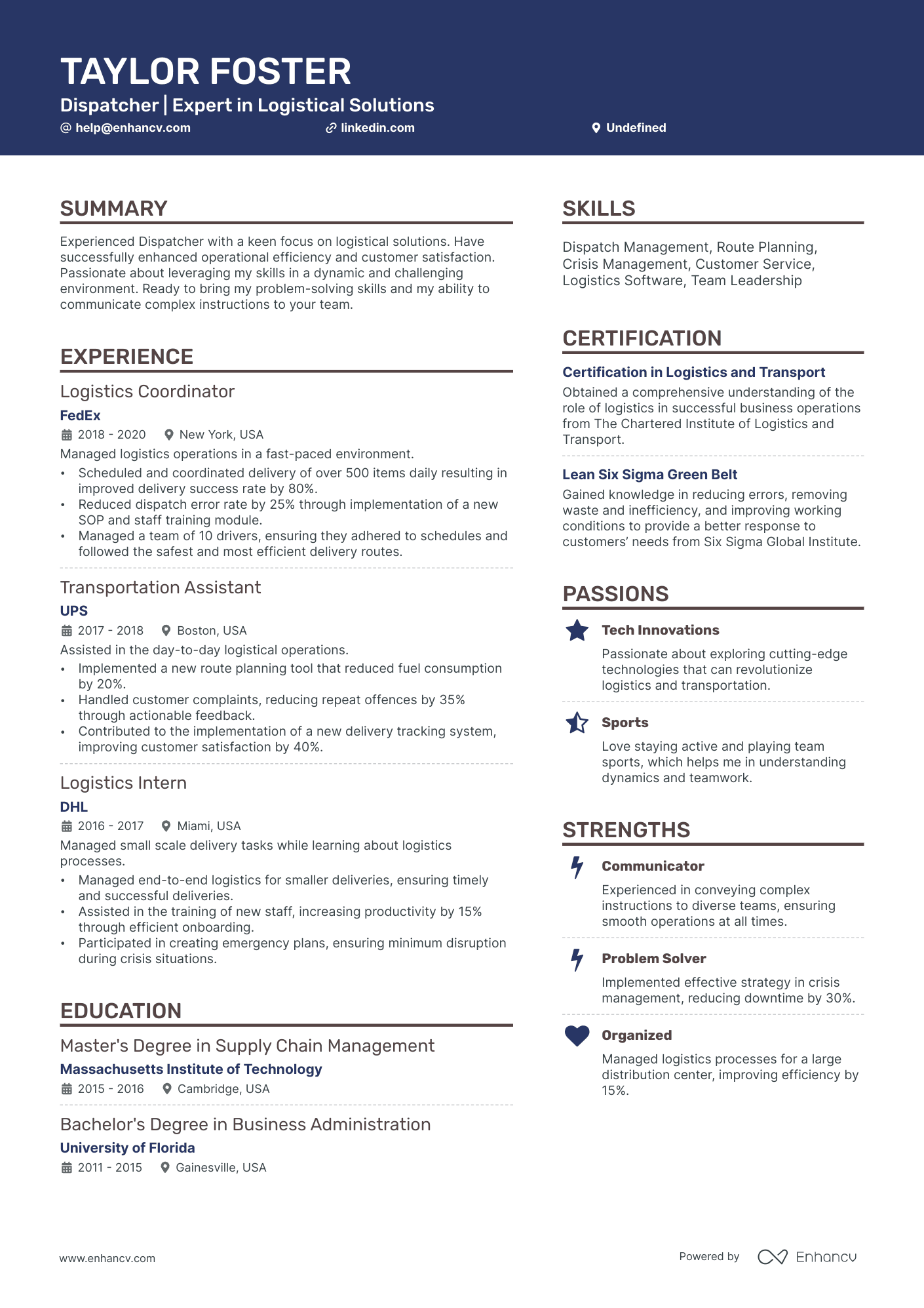
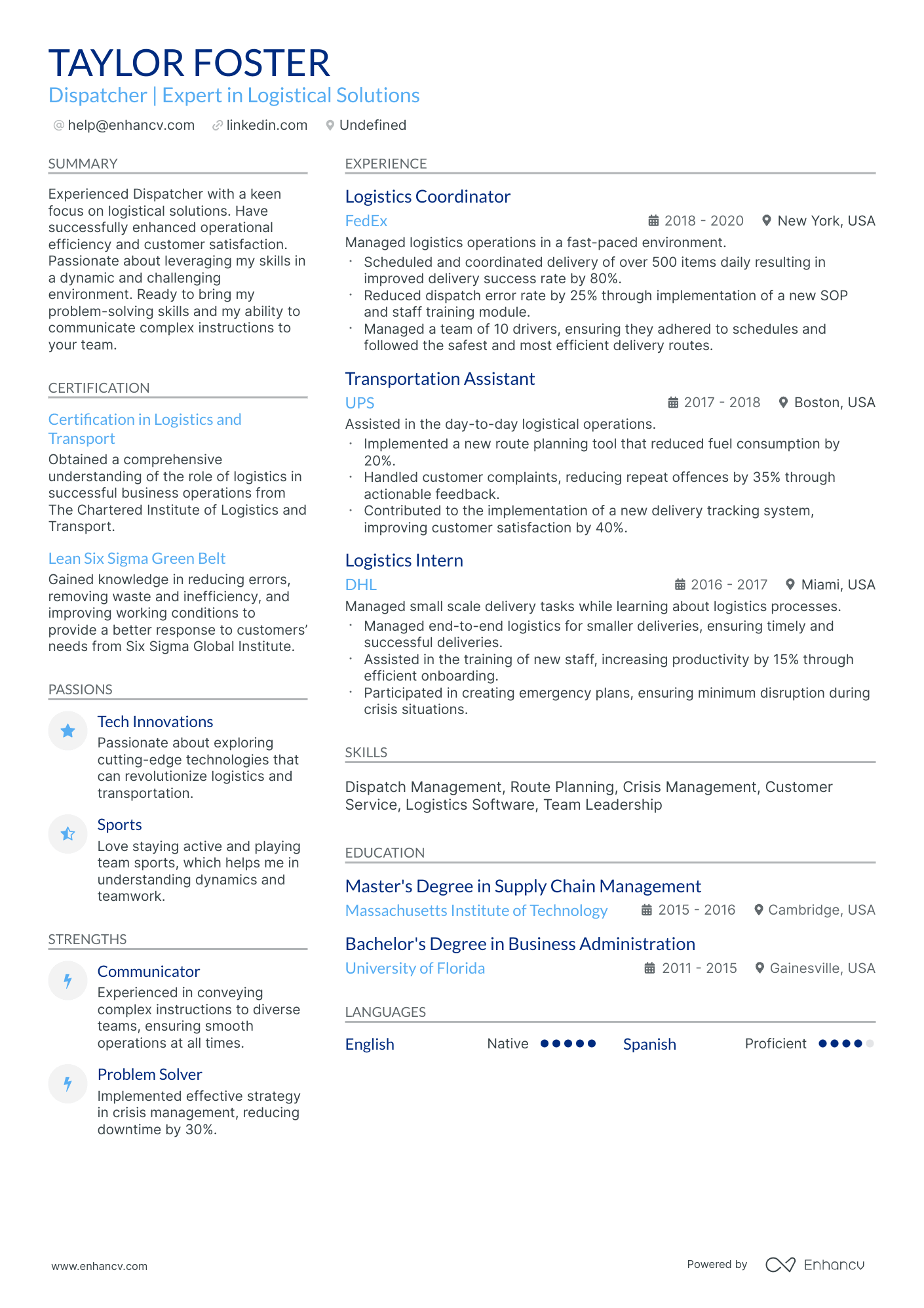
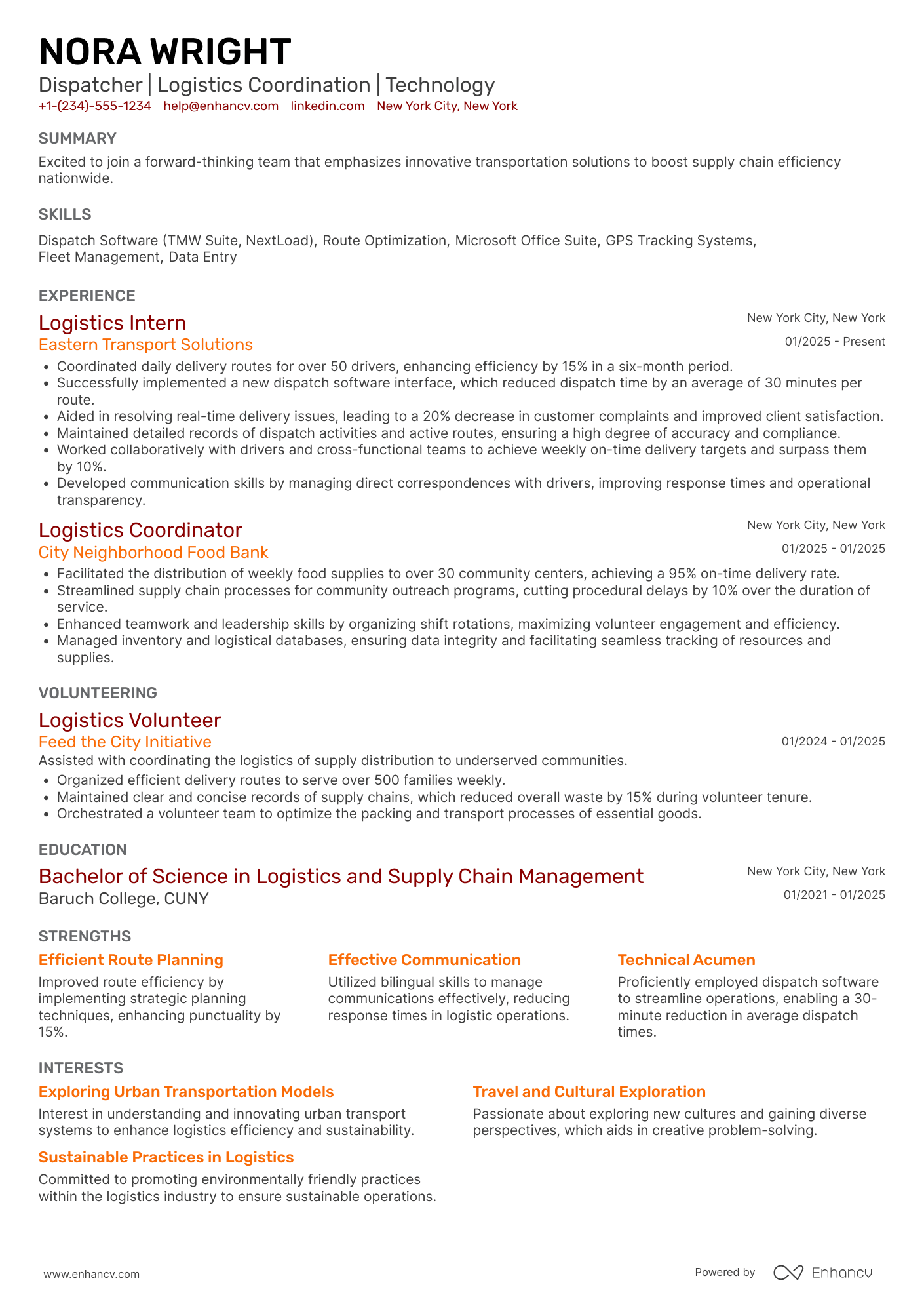
Many entry level dispatcher resume drafts fail because they read like shift logs, not proof of decision-making under pressure. In today's hiring process, ATS screening and rapid recruiter scans favor clear keywords, impact, and scannable structure. Understanding how to make your resume stand out is essential when competing for dispatcher roles.
A strong resume shows how you kept operations moving and reduced risk. You should highlight faster call handling, accurate priority triage, fewer dispatch errors, improved response times, higher customer satisfaction scores, clean incident documentation, and steady coverage during peak volume.

Key takeaways
- Quantify call volume, response times, and accuracy to prove dispatcher impact immediately.
- Choose a hybrid format if you lack direct dispatch experience.
- Tailor every experience bullet to mirror the job posting's exact tools and terminology.
- Tie each listed skill to a specific outcome in your experience or summary section.
- Place certifications like EMD, CPR, or NIMS prominently to signal job-ready preparedness.
- Use AI to tighten language and align keywords, but stop before it inflates claims.
- Build and refine your dispatcher resume faster with Enhancv's structured tools.
How to format a entry level dispatcher resume
Recruiters screening entry-level dispatcher resumes prioritize clear communication skills, familiarity with dispatching software or protocols, and any evidence that you can stay calm under pressure while coordinating multiple tasks. Your resume format determines how quickly a hiring manager spots these signals, so choosing the right structure ensures your strongest qualifications aren't buried.

I have significant experience in this role—which format should I use?
Use a reverse-chronological format to place your most recent and relevant dispatcher experience at the top. Do:
- Lead each role entry with scope details such as call volume handled, team size coordinated, or geographic coverage area.
- Highlight proficiency with role-specific tools like computer-aided dispatch (CAD) systems, two-way radio operation, GPS tracking platforms, and records management software.
- Quantify outcomes wherever possible—response time improvements, error reductions, or call resolution rates.
I'm junior or switching into this role—what format works best?
A hybrid format works best because it lets you lead with a focused skills section while still showing any relevant work or volunteer history in chronological order. Do:
- Place a skills section near the top that highlights dispatch-relevant abilities like multitasking, active listening, geographic knowledge, and familiarity with emergency protocols.
- Include projects, internships, volunteer work, or coursework that involved coordination, logistics, or real-time communication—even if the title wasn't "dispatcher."
- Connect every skill or experience to a concrete action and a measurable or observable result.
When does a functional resume make sense?
A functional format can work in a narrow set of circumstances for entry-level dispatcher candidates:
- You're transitioning from a different field (such as customer service, logistics, or military communication) and need to reframe transferable skills for dispatch work.
- You have a gap in your work history but completed relevant certifications, training programs, or volunteer dispatch roles during that time.
- You have minimal formal work experience but can demonstrate dispatcher-relevant competencies through coursework, simulations, or structured projects.
- A functional format is acceptable when you genuinely lack chronological work history to display, such as a recent graduate or career changer, but switch to a hybrid or reverse-chronological format as soon as you accumulate any direct dispatch or coordination experience.
Once you've established a clean, readable format, the next step is deciding which sections to include so each one works together to present your qualifications effectively.
What sections should go on a entry level dispatcher resume
Recruiters expect an entry level dispatcher resume to quickly show you can manage high-volume calls, prioritize incidents, and coordinate clear, accurate communication under pressure. Knowing what to put on a resume ensures you include only the sections that strengthen your candidacy.
Use this structure for maximum clarity:
- Header
- Summary
- Experience
- Skills
- Projects
- Education
- Certifications
- Optional sections: Languages, Volunteering, Leadership
Strong experience bullets should emphasize measurable outcomes, call volume and response times, accuracy and compliance, and coordination impact across teams and systems.
Is your resume good enough?
Drop your resume here or choose a file. PDF & DOCX only. Max 2MB file size.
Once you’ve organized the key resume components, the next step is learning how to write your entry level dispatcher resume experience so each part supports your qualifications.
How to write your entry level dispatcher resume experience
Your work experience section should prove you can coordinate dispatch operations, use scheduling and communication tools effectively, and produce outcomes that kept logistics running smoothly. Hiring managers prioritize demonstrated impact—routes optimized, response times shortened, resources allocated—over descriptive task lists that simply restate a job description.
Each entry should include:
- Job title
- Company and location (or remote)
- Dates of employment (month and year)
Three to five concise bullet points showing what you owned, how you executed, and what outcomes you delivered:
- Ownership scope: the dispatch queues, service areas, vehicle fleets, driver schedules, or call volumes you were directly accountable for managing on a daily or shift basis.
- Execution approach: the computer-aided dispatch software, two-way radio systems, GPS tracking platforms, ticketing tools, or prioritization methods you relied on to assign resources and make real-time routing decisions.
- Value improved: the changes you drove in response times, on-time delivery rates, scheduling accuracy, fleet utilization, or error reduction that strengthened overall dispatch reliability.
- Collaboration context: how you coordinated with drivers, field technicians, warehouse teams, emergency personnel, customer service representatives, or supervisors to resolve conflicts, relay critical updates, and keep operations aligned.
- Impact delivered: the tangible results your work produced—expressed through service-level improvements, volume handled, downtime prevented, or cost efficiencies gained—rather than a summary of routine duties.
Experience bullet formula
A entry level dispatcher experience example
✅ Right example - modern, quantified, specific.
Entry-Level Dispatcher
MetroLink Towing & Roadside Assistance | Phoenix, AZ
2024–Present
Twenty-four-seven roadside assistance provider dispatching towing and mobile repair across the Phoenix metro area.
- Dispatched an average of sixty to eighty service calls per shift using a computer-aided dispatch (CAD) system and GPS tracking, cutting average assignment time from five minutes to three minutes.
- Prioritized high-risk incidents using emergency call triage protocols and Eighthundred megahertz radio procedures, improving on-time arrival rate from eighty-two percent to ninety percent within three months.
- Verified caller locations and incident details using RapidSOS, Google Maps, and call recordings, reducing wrong-location dispatches by thirty-five percent.
- Coordinated with drivers, supervisors, and law enforcement via radio, SMS, and phone to manage rotating coverage zones, increasing completed jobs per shift by twelve percent.
- Documented call outcomes, unit statuses, and service exceptions in the customer relationship management system (customer relationship management) and Excel, improving end-of-shift reconciliation accuracy to ninety-eight percent.
Now that you've seen how a strong experience section looks in practice, let's break down how to tailor each element to match the specific entry level dispatcher role you're applying for.
How to tailor your entry level dispatcher resume experience
Recruiters evaluate your entry level dispatcher resume through applicant tracking systems and manual review, filtering for specific qualifications. Tailoring your resume to the job description ensures your relevant skills and background stand out immediately.
Ways to tailor your entry level dispatcher experience:
- Match the exact CAD or dispatch software listed in the posting.
- Mirror the communication protocols and radio systems they reference.
- Use their terminology for call prioritization or incident classification.
- Highlight experience with multi-line phone systems if specified.
- Emphasize compliance with local emergency response standards they mention.
- Include logistics or transportation coordination if the role requires it.
- Reference their specific scheduling or routing platforms by name.
- Align your workflow language with their dispatch procedures and SOPs.
Tailoring means connecting your real accomplishments to what the employer asks for—not forcing keywords where they don't belong.
Resume tailoring examples for entry level dispatcher
| Job description excerpt | Untailored | Tailored |
|---|---|---|
| "Receive and prioritize 911 and non-emergency calls using CAD (computer-aided dispatch) software to coordinate police, fire, and EMS response units." | Answered phone calls and helped direct resources to where they were needed. | Received and triaged 911 and non-emergency calls using CAD software, prioritizing incidents by severity to coordinate timely police, fire, and EMS response across a 12-unit coverage area. |
| "Monitor GPS-based AVL systems to track fleet locations in real time, ensuring optimal unit assignment and reduced response times in compliance with department protocols." | Tracked vehicles and made sure they got to the right places on time. | Monitored real-time fleet positions through GPS-based AVL systems, assigning the nearest available unit to each incident and helping reduce average response times by 15% in compliance with department dispatch protocols. |
| "Maintain accurate dispatch logs and incident records in Tyler New World Systems, coordinating with field personnel via multi-channel radio communication during high-volume shifts." | Kept records of calls and communicated with team members during shifts. | Documented all dispatch activity and incident details in Tyler New World Systems during shifts averaging 200+ daily calls, coordinating with field personnel across four radio channels to ensure accurate, real-time information flow. |
Once you’ve aligned your experience with the dispatcher role’s priorities, the next step is to quantify your achievements so hiring managers can quickly see your impact.
How to quantify your entry level dispatcher achievements
Quantifying your achievements proves you keep operations moving under pressure. Focus on call volume, dispatch speed, accuracy, compliance, and safety outcomes, plus the tools you used like computer-aided dispatch systems.
Quantifying examples for entry level dispatcher
| Metric | Example |
|---|---|
| Call volume | "Handled 80–110 inbound calls per shift and dispatched an average of 45 service tickets using a computer-aided dispatch system." |
| Dispatch speed | "Reduced average time from call intake to dispatch from 2:45 to 1:55 by using call scripts and clearer unit status checks." |
| Accuracy rate | "Maintained 98% address and unit assignment accuracy across 300+ dispatches, verified through daily supervisor audits." |
| Compliance | "Achieved 100% adherence to radio protocol and incident documentation standards across six weeks, with zero report rework requests." |
| Safety risk | "Flagged 12 high-risk calls in one quarter and ensured priority routing and officer safety notes were added before dispatch." |
Turn vague job duties into measurable, recruiter-ready resume bullets in seconds with Enhancv's Bullet Point Generator.
Once you've crafted strong bullet points for your experience section, you'll want to apply that same precision to presenting your hard and soft skills on your entry level dispatcher resume.
How to list your hard and soft skills on a entry level dispatcher resume
Your skills section shows you can triage calls, use dispatch systems, and coordinate fast under pressure—recruiters and an ATS (applicant tracking system) scan this section for role keywords, so aim for a balanced mix of job-specific tools and execution-focused soft skills. entry level dispatcher roles require a blend of:
- Product strategy and discovery skills.
- Data, analytics, and experimentation skills.
- Delivery, execution, and go-to-market discipline.
- Soft skills.
Your skills section should be:
- Scannable (bullet-style grouping).
- Relevant to the job post.
- Backed by proof in experience bullets.
- Updated with current tools.
Place your skills section:
- Above experience if you're junior or switching careers.
- Below experience if you're mid/senior with strong achievements.

Hard skills
- Computer-aided dispatch (CAD)
- Emergency medical dispatch (EMD)
- Priority dispatch protocols
- Call-taking and triage
- Unit status management
- Radio codes and ten-codes
- Two-way radio operation
- Automatic number identification, automatic location identification
- Geographic information systems (GIS) mapping
- Incident documentation, call logs
- Service level tracking
- Microsoft Excel, Google Sheets
Listing relevant hard skills like CAD systems and radio protocols ensures your resume passes ATS filters for dispatcher roles.
Soft skills
- Calm, clear call control
- Active listening under stress
- Rapid prioritization decisions
- Accurate information capture
- Closed-loop communication
- Multi-tasking across channels
- Escalation judgment
- Conflict de-escalation
- Cross-team coordination
- Shift handoff discipline
- Policy and procedure adherence
- Composure during high volume
Don't underestimate the importance of soft skills on your resume—dispatchers rely on composure, active listening, and clear communication every shift.
How to show your entry level dispatcher skills in context
Skills shouldn't live only in a bulleted list on your resume. Explore how other dispatcher candidates present their resume skills for inspiration on contextual placement.
They should be demonstrated in:
- Your summary (high-level professional identity)
- Your experience (proof through outcomes)
Here's how strong dispatcher candidates weave skills into real resume sections.
Summary example
Detail-oriented dispatcher with two years of experience coordinating emergency and non-emergency calls using CAD systems. Reduced average response times by 18% through optimized unit allocation and clear communication with field personnel across multi-agency operations.
- Reflects appropriate early-career experience level
- Names role-relevant tools like CAD
- Quantifies impact with response-time metric
- Highlights communication as a soft skill
Experience example
Emergency Dispatcher
Pinecrest Regional Communications Center | Dayton, OH
June 2022–May 2024
- Processed 120+ daily calls using CAD software, collaborating with police and EMS teams to cut average dispatch time by 15%.
- Maintained 99.2% call-logging accuracy by following standardized protocols and coordinating quality reviews with shift supervisors.
- Trained four new hires on multi-line phone systems and radio procedures, reducing onboarding time by three weeks.
- Every bullet includes a measurable outcome.
- Skills surface naturally through real tasks.
Once you’ve tied your dispatcher capabilities to real tasks and outcomes, the next step is translating that into a resume format that works even when you have no direct experience.
How do I write a entry level dispatcher resume with no experience
Even without full-time experience, you can demonstrate readiness through:
- Campus security dispatch volunteer shifts
- Customer service call logging practice
- Incident report documentation coursework
- Radio communication training simulations
- Scheduling or routing class projects
- Emergency management club participation
- Volunteer event operations coordination
- CRM ticketing and escalation work
If you're building your application from scratch, our guide on creating a resume without work experience walks you through strategies that apply directly to entry level dispatcher roles.
Focus on:
- Accurate call intake documentation
- Clear radio and phone protocols
- Prioritized dispatch and escalation
- Tools: CAD, maps, spreadsheets
Resume format tip for entry-level entry level dispatcher
Use a combination resume format. It highlights dispatcher-relevant skills and projects while still showing steady work, volunteering, or coursework. Do:
- Lead with a dispatcher skills summary.
- Add a projects section above work.
- Quantify volume, accuracy, and time.
- List tools: CAD, radios, maps.
- Mirror keywords from job postings.
- Logged 120 mock calls in Excel, applied priority codes, and reduced documentation errors by 30% through a standardized call intake template.
Once you've structured your resume to highlight transferable skills and relevant strengths, the next step is presenting your education effectively—often one of the strongest sections for candidates without direct experience.
How to list your education on a entry level dispatcher resume
Your education section helps hiring teams confirm you have the foundational knowledge needed for an entry level dispatcher role. It validates relevant training in communication, crisis response, and public safety.
Include:
- Degree name
- Institution
- Location
- Graduation year
- Relevant coursework (for juniors or entry-level candidates)
- Honors & GPA (if 3.5 or higher)
Skip month and day details—list the graduation year only.
Here's a strong education entry tailored for an entry level dispatcher resume.
Example education entry
Bachelor of Science in Criminal Justice
Metro State University, Denver, CO
2023
GPA: 3.7/4.0
- Relevant Coursework: Emergency Communications, Crisis Intervention, Public Safety Administration, Geographic Information Systems
- Honors: Magna Cum Laude, Dean's List (2021–2023)
How to list your certifications on a entry level dispatcher resume
Certifications on your resume show an entry level dispatcher's commitment to learning, familiarity with dispatch tools, and alignment with public safety or service standards. They also signal readiness to follow procedures and communicate clearly under pressure.
Include:
- Certificate name
- Issuing organization
- Year
- Optional: credential ID or URL
- Put certifications below education when they're older, less relevant, or you need education to lead your qualifications.
- Put certifications above education when they're recent, highly relevant, or required for the entry level dispatcher role you target.
Best certifications for your entry level dispatcher resume
- Emergency Medical Dispatcher (EMD) Certification
- Public Safety Telecommunicator (PST) Certification
- Cardiopulmonary Resuscitation (CPR) and Automated External Defibrillator (AED) Certification
- National Incident Management System (NIMS) ICS-100
- National Incident Management System (NIMS) ICS-200
- Federal Emergency Management Agency (FEMA) IS-700: National Incident Management System
Once you’ve included your credentials in a clear, easy-to-scan format, you’re ready to write your entry level dispatcher resume summary to highlight those qualifications upfront.
How to write your entry level dispatcher resume summary
Your resume summary is the first thing a recruiter reads. A strong one immediately signals you're qualified for the entry level dispatcher role.
Keep it to three to four lines, with:
- Your title and relevant experience, even if under two years.
- The industry or domain you've worked in, such as logistics or emergency services.
- Core tools and skills like CAD software, two-way radio systems, or route optimization.
- One or two measurable contributions, such as response times improved or calls handled daily.
- Soft skills tied to real outcomes, like clear communication that reduced dispatch errors.

PRO TIP
At the entry level, emphasize relevant skills, tools you've used, and any early wins with numbers. Highlight coursework, internships, or certifications that prove readiness. Avoid vague phrases like "passionate hard worker" or "looking for a great opportunity."
Example summary for a entry level dispatcher
Detail-oriented dispatcher with one year of experience coordinating logistics routes using CAD software. Managed 80+ daily calls while maintaining a 98% accuracy rate in dispatching assignments.
Optimize your resume summary and objective for ATS
Drop your resume here or choose a file.
PDF & DOCX only. Max 2MB file size.
Now that your summary is ready to highlight your strengths at a glance, make sure your header provides the essential contact details recruiters need to actually reach you.
What to include in a entry level dispatcher resume header
A resume header lists your key contact details and role target, boosting visibility, credibility, and recruiter screening for a entry level dispatcher.
Essential resume header elements
- Full name
- Tailored job title and headline
- Location
- Phone number
- Professional email
- GitHub link
- Portfolio link
A LinkedIn link helps recruiters verify experience quickly and supports screening.
Do not include photos on a entry level dispatcher resume unless the role is explicitly front-facing or appearance-dependent.
Keep the header on one to two lines, match the job title to the posting, and use a professional email to avoid screening issues.
Example
Entry level dispatcher resume header
Jordan Lee
Entry level dispatcher | Emergency communications and call handling
Phoenix, AZ
(602) 555-01XX
jordan.lee@enhancv.com
github.com/jordanlee
yourwebsite.com
linkedin.com/in/jordanlee
Once your contact details and role focus are clear at the top, add the additional sections to reinforce key qualifications and round out your entry-level dispatcher resume.
Additional sections for entry level dispatcher resumes
When you lack professional experience, additional sections help demonstrate relevant skills, certifications, and personal qualities that set you apart as an entry level dispatcher. For example, listing language skills on your resume can be a significant advantage when dispatching in multilingual service areas.
- Languages
- Certifications (CPR, First Aid, FEMA, EMD)
- Volunteer experience
- Relevant coursework
- Technical proficiencies
- Hobbies and interests
- Professional affiliations
Once you've strengthened your resume with relevant additional sections, pairing it with a well-crafted cover letter can further set your application apart.
Do entry level dispatcher resumes need a cover letter
An entry level dispatcher resume doesn't always need a cover letter. It helps when the role is competitive or the employer expects one. If you're unsure where to start, learning what a cover letter is and how it complements your resume can clarify when it's worth including one. It can make a difference when your resume needs context or your fit is not obvious.
Use a cover letter to add details your entry level dispatcher resume can't show:
- Explain role or team fit by matching your scheduling, communication, and prioritization approach to the specific shift, environment, and call volume.
- Highlight one or two relevant projects or outcomes, such as reducing response times in a simulation or improving handoff accuracy in a team exercise.
- Show understanding of the product, users, or business context, like public safety callers, fleet drivers, field technicians, or service level targets.
- Address career transitions or non-obvious experience by connecting prior roles to dispatch tasks, such as de-escalation, route planning, or incident documentation.
Drop your resume here or choose a file.
PDF & DOCX only. Max 2MB file size.
Once you’ve decided whether to include a cover letter based on the role and employer expectations, you can use AI to refine your entry level dispatcher resume faster and more effectively.
Using AI to improve your entry level dispatcher resume
AI can sharpen your resume's clarity, structure, and overall impact. It helps tighten language and highlight relevant skills for entry level dispatcher roles. If you're curious about which AI is best for writing resumes, start with tools that let you control the output rather than auto-generate entire sections. But overuse dulls authenticity. Once your content reads clearly and aligns with the role, step away from AI assistance.
Here are 10 practical prompts you can copy and paste to strengthen specific sections of your resume:
- Strengthen your summary: "Rewrite my resume summary to highlight my strongest qualifications for an entry level dispatcher position in two to three concise sentences."
- Quantify experience bullets: "Add measurable results to my experience bullet points that demonstrate relevant achievements for an entry level dispatcher role."
- Tighten action verbs: "Replace weak or passive verbs in my experience section with strong action verbs suited to an entry level dispatcher resume."
- Align skills section: "Review my skills section and remove items irrelevant to an entry level dispatcher position, then suggest replacements."
- Improve education details: "Rewrite my education section to emphasize coursework, training, or achievements directly applicable to an entry level dispatcher job."
- Refine certifications: "Reorganize my certifications section so the most relevant credentials for an entry level dispatcher role appear first."
- Clarify project descriptions: "Simplify my project descriptions so they clearly show transferable skills for an entry level dispatcher position."
- Remove redundancy: "Identify and eliminate redundant phrases across all sections of my entry level dispatcher resume."
- Tailor to job postings: "Compare my resume against this job description and suggest edits to better match this entry level dispatcher opening."
- Fix formatting consistency: "Review my entry level dispatcher resume for inconsistent formatting in dates, bullet styles, and section headings."
Stop using AI once your resume sounds accurate, specific, and aligned with real experience. AI should never invent experience or inflate claims—if it didn't happen, it doesn't belong here.
Conclusion
A strong entry level dispatcher resume shows measurable outcomes, role-specific skills, and a clean structure. Highlight call volume, response times, accuracy, and customer satisfaction when you can. Emphasize calm communication, prioritization, documentation, and comfort with dispatch and mapping systems.
Keep each section easy to scan, with consistent formatting and focused bullets. This approach signals readiness for today’s hiring market and near-future needs. It helps employers see you can support teams, follow protocols, and deliver reliable results.