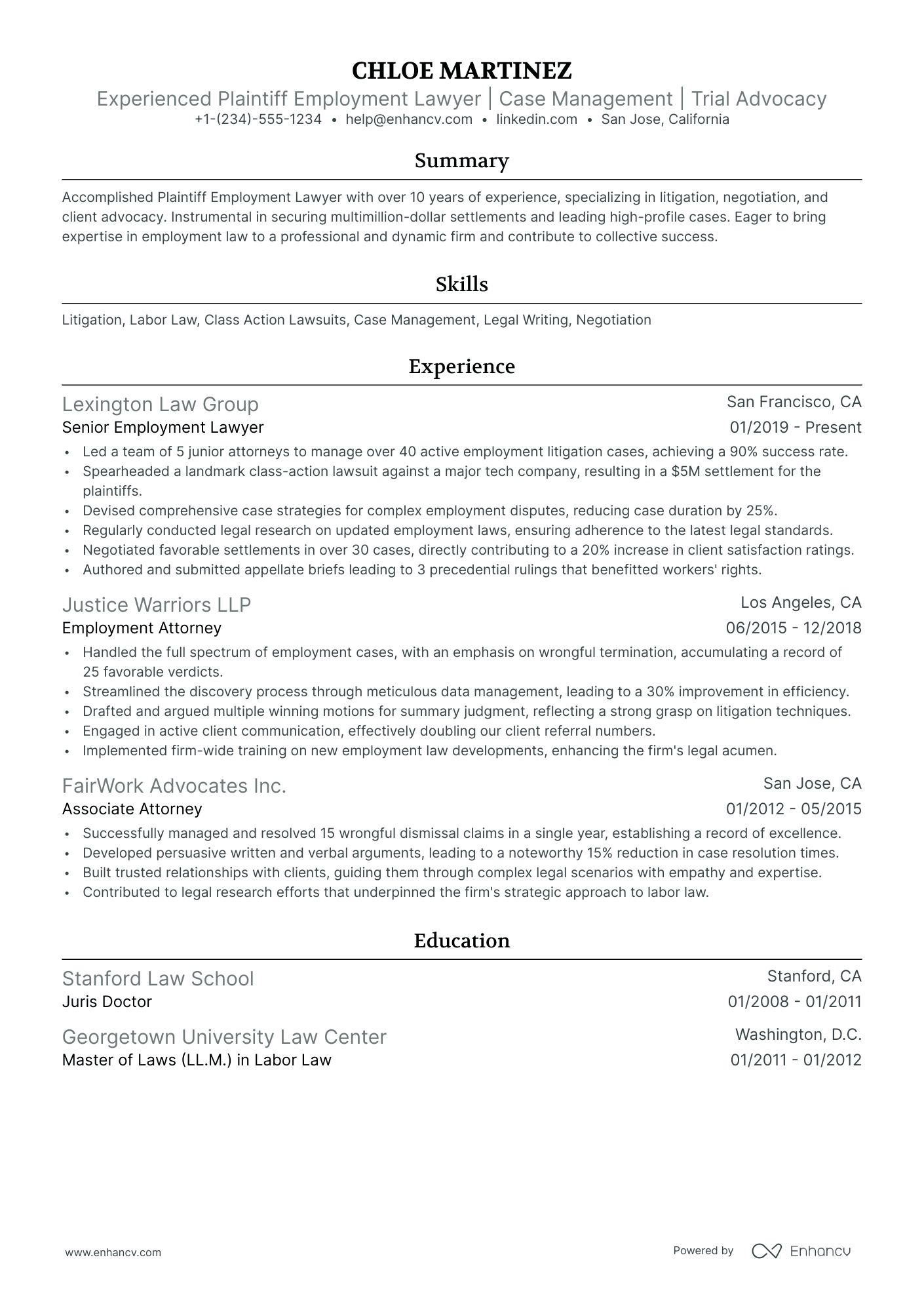
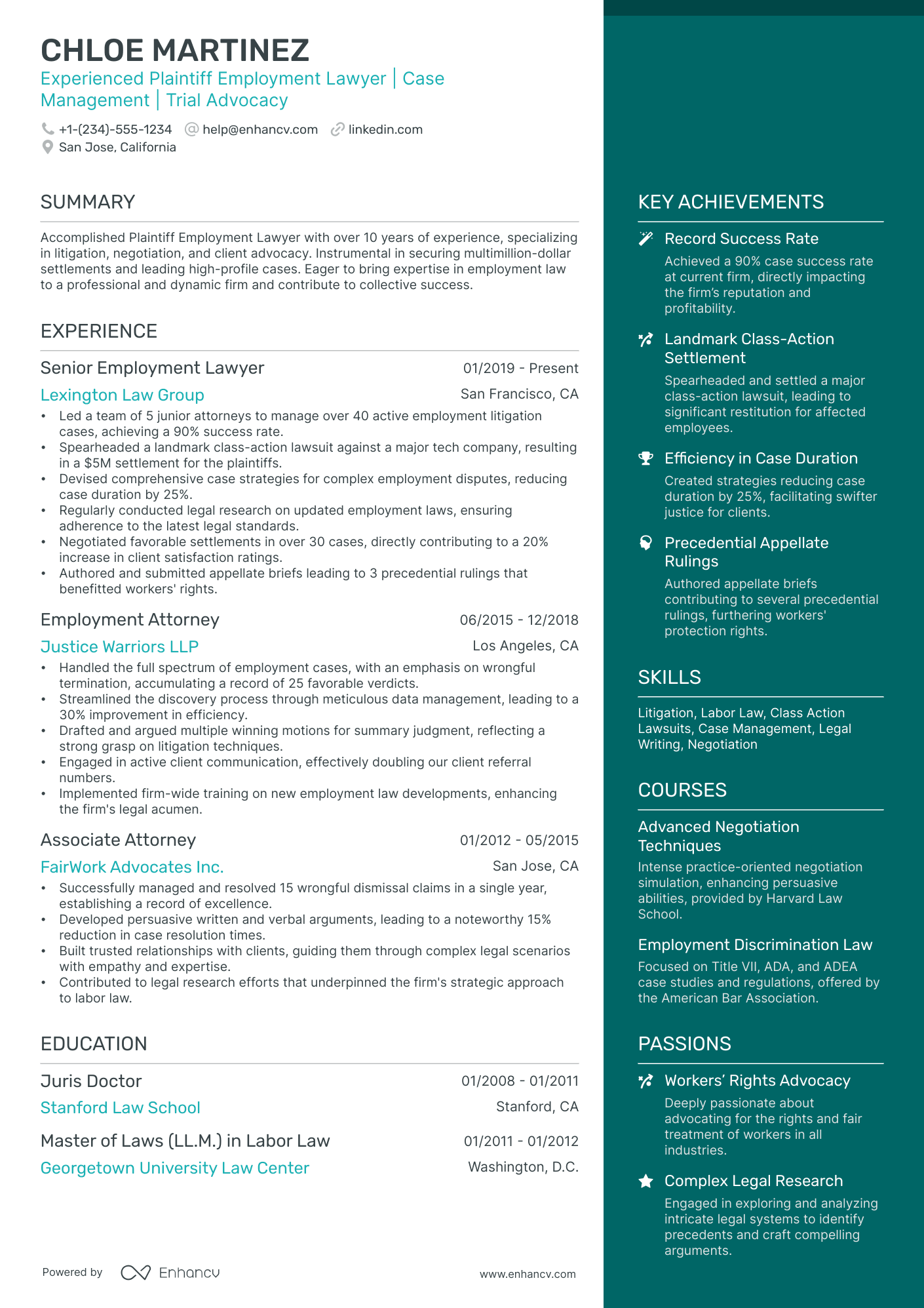
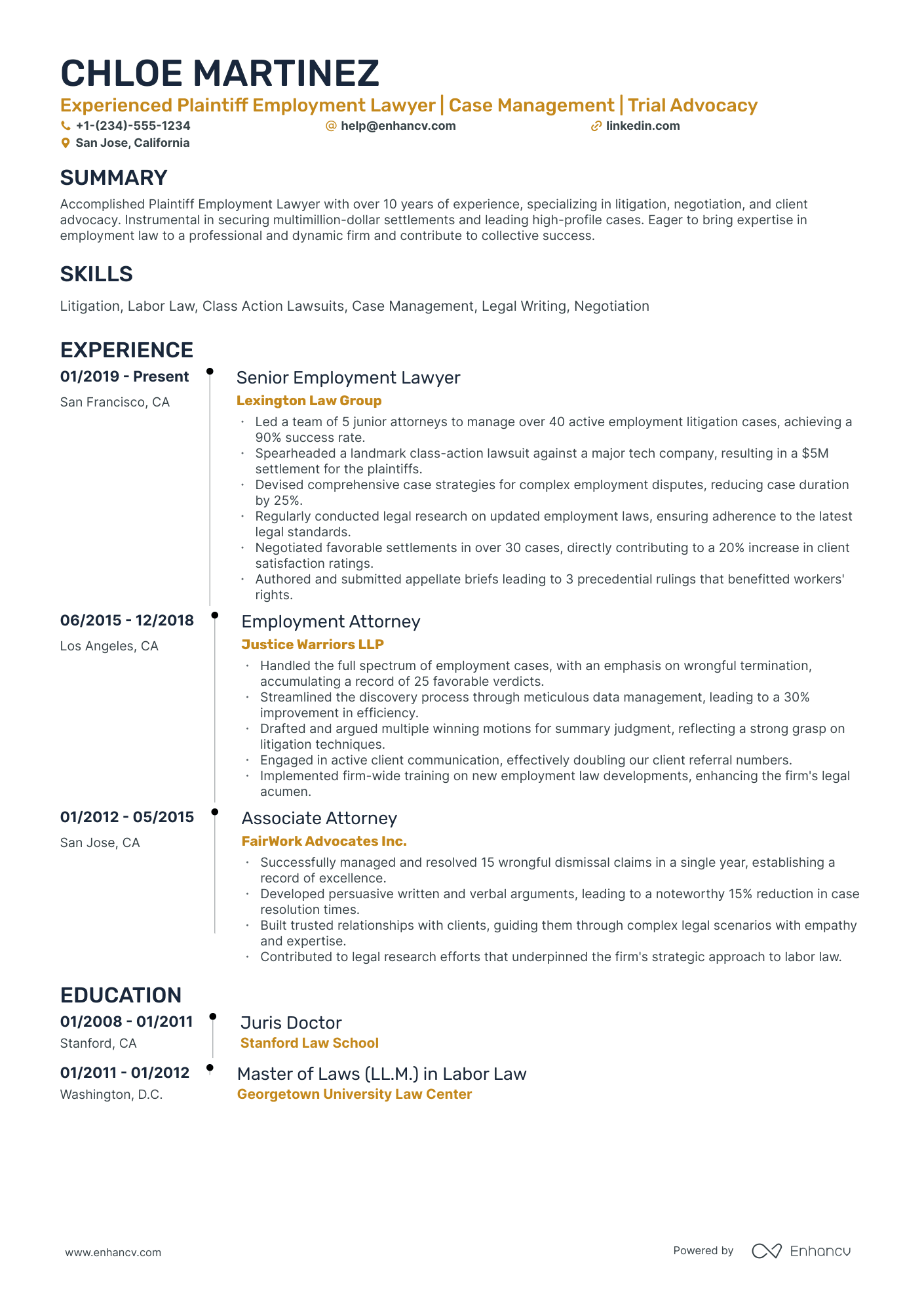
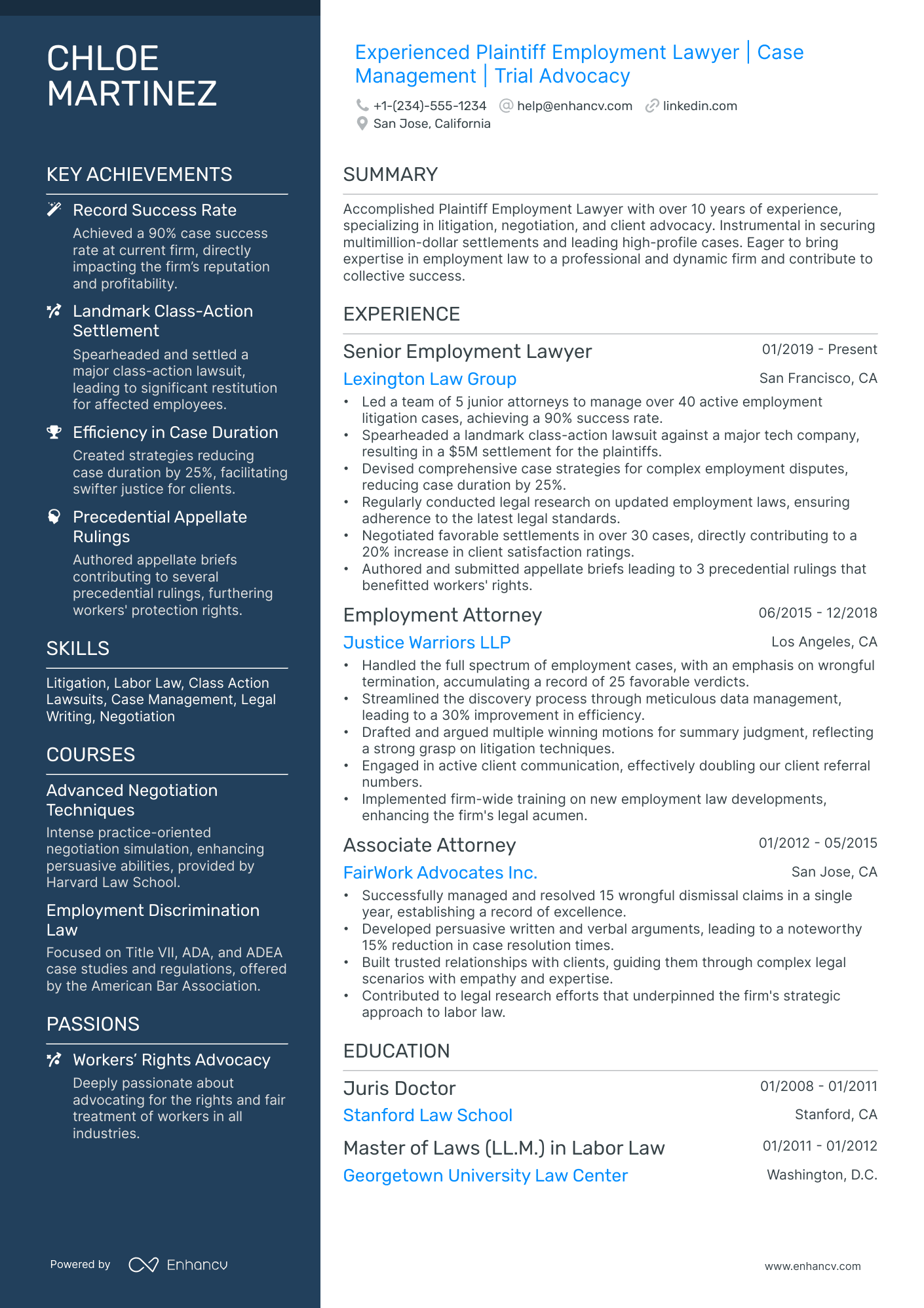
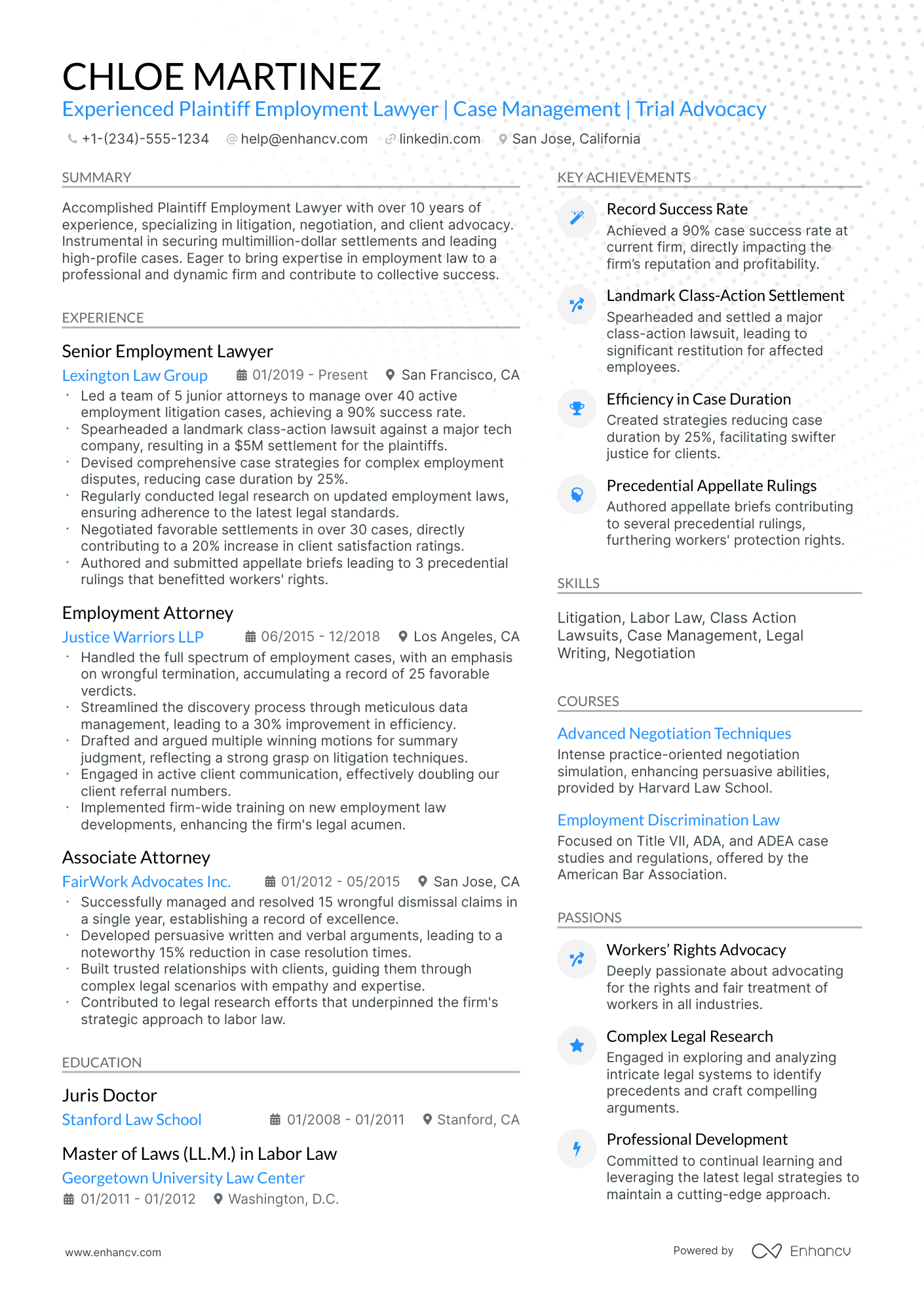
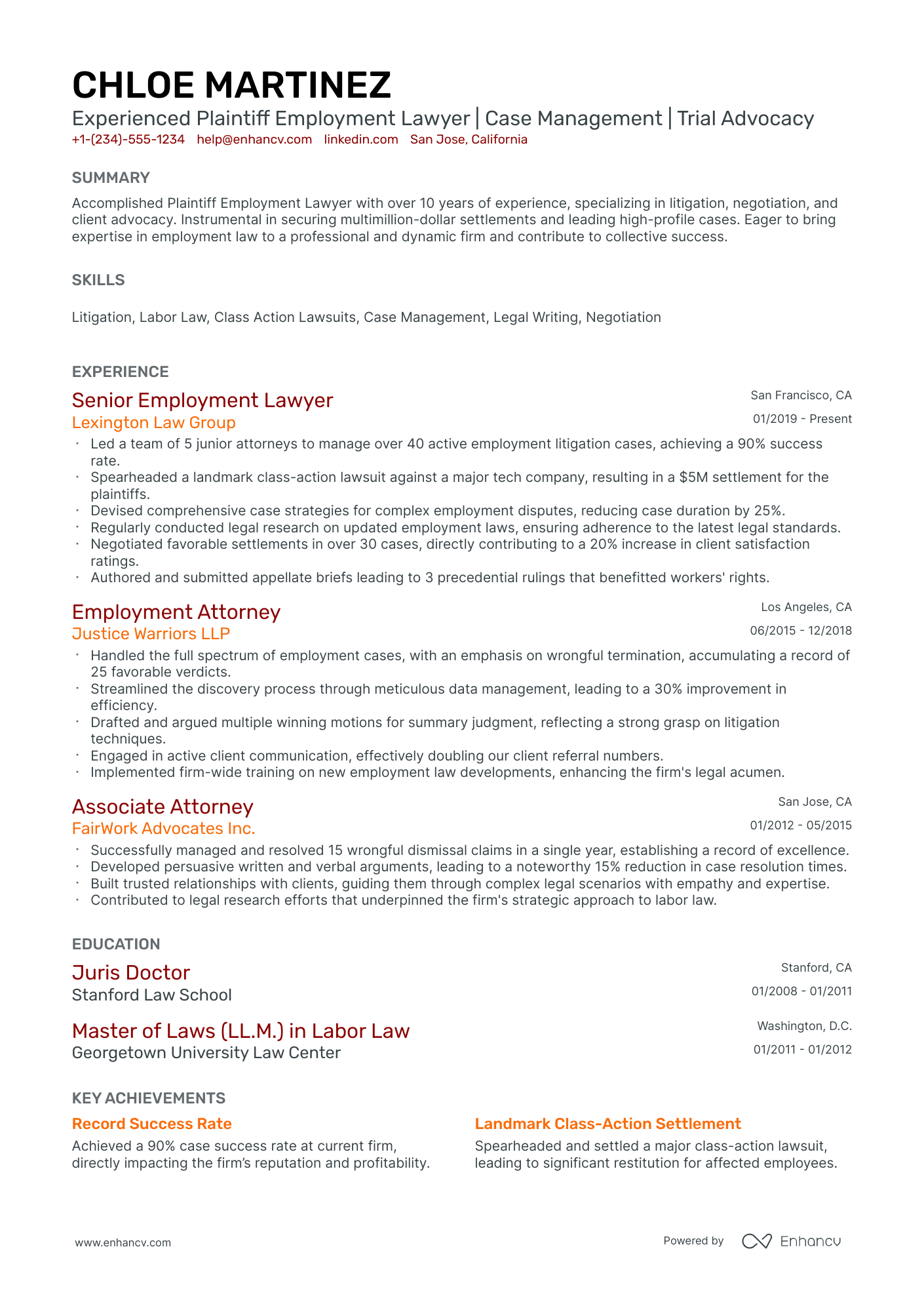
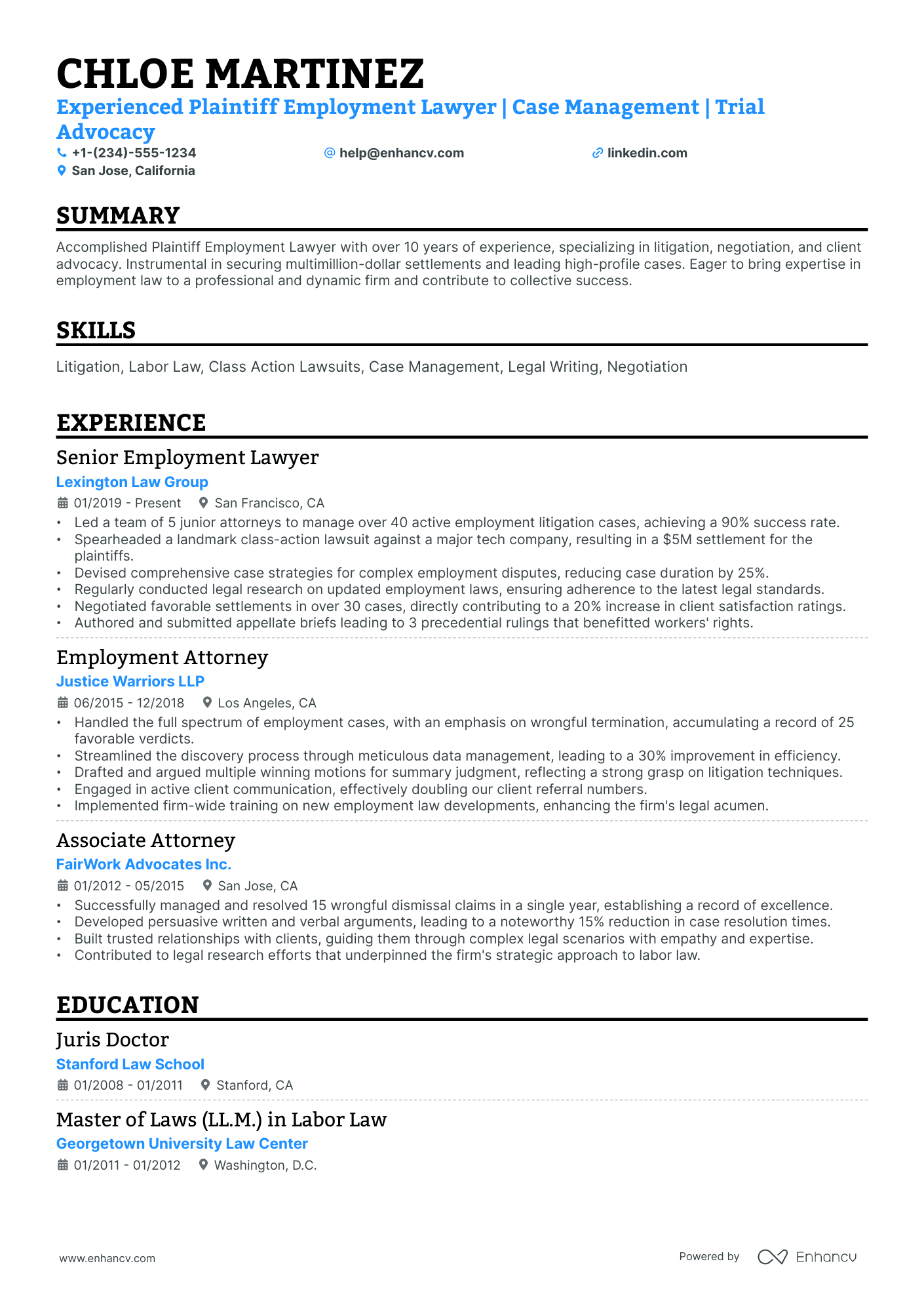
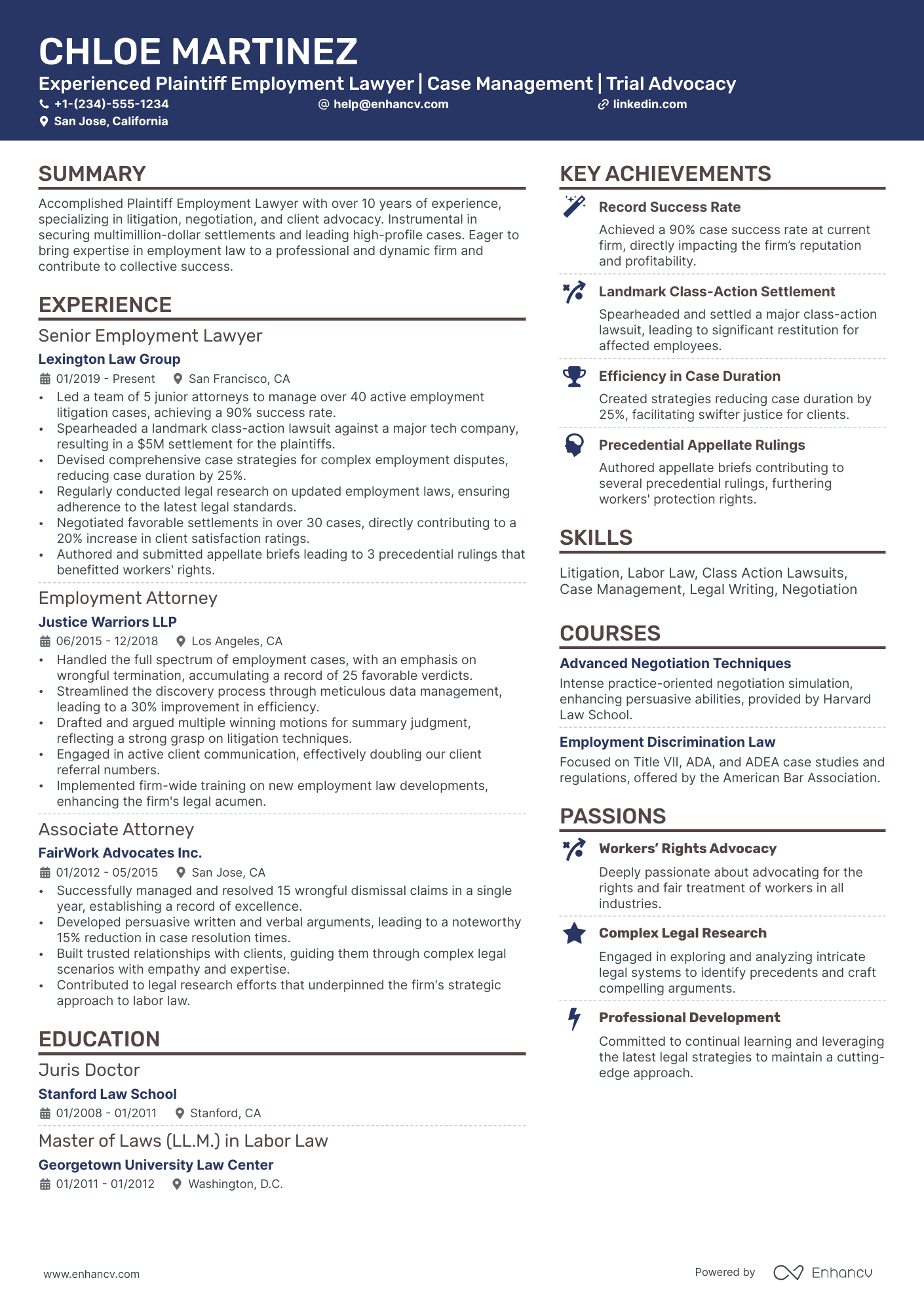
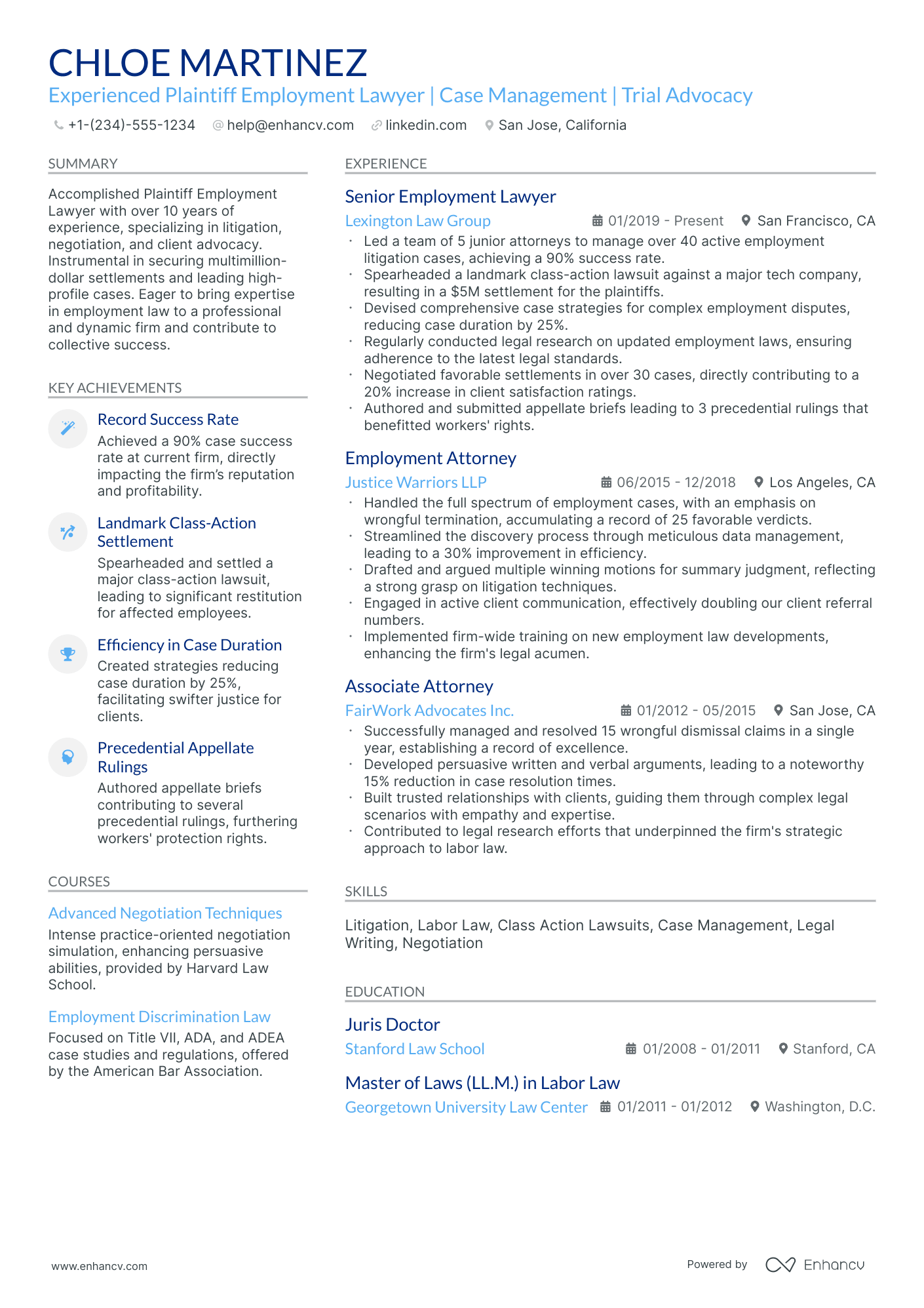
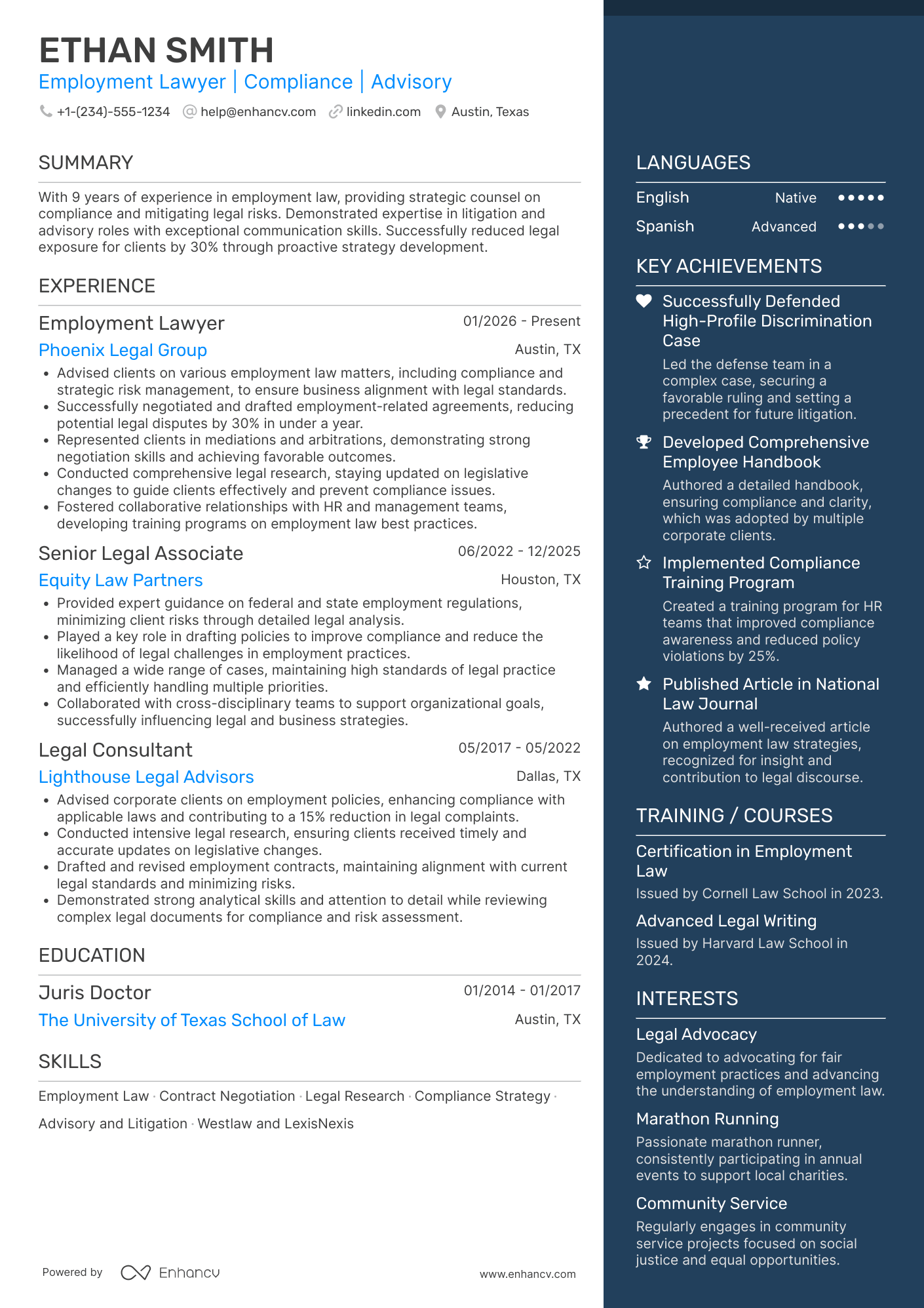
Many employment lawyer resume drafts fail because they read like case logs, not decision-ready summaries. That hurts in today's hiring process, where ATS filters keywords and recruiters scan in seconds amid heavy competition. If you're unsure where to begin, understanding how to write a resume that communicates value quickly is a critical first step.
A strong resume shows what you delivered, not just what you did. You should highlight wins like reduced settlement exposure, improved compliance audit scores, shortened investigation timelines, managed multi-state matters, and protected the business through sound risk assessments.

Key takeaways
- Quantify case outcomes, settlement values, and compliance improvements in every experience bullet.
- Use reverse-chronological format to show progressive responsibility and growing caseload ownership.
- Tailor your resume to each job posting by mirroring its statutes, tools, and terminology.
- Demonstrate skills through measurable results in your summary and experience, not just a skills list.
- Avoid hybrid or functional formats if you have five or more years of employment law experience.
- Use AI to refine language and fill keyword gaps, but stop before it inflates or invents claims.
- Build your resume faster with Enhancv, then pair it with a cover letter for competitive roles.
How to format a employment lawyer resume
Recruiters evaluating employment lawyer resumes prioritize depth of litigation experience, subject-matter expertise in labor and employment law, and a clear record of case outcomes and client advisory work. A well-chosen resume format ensures these signals surface immediately, making it easier for both human reviewers and applicant tracking systems to assess qualifications at a glance.

I have significant experience in this role—which format should I use?
Use the reverse-chronological format—it's the strongest choice for an experienced employment lawyer because it foregrounds your career trajectory, growing caseload responsibility, and deepening expertise. Do:
- Lead each role entry with scope and ownership: team size, practice group leadership, client portfolio value, or jurisdictional reach.
- Highlight domain-specific competencies such as Title VII litigation, FLSA collective actions, NLRB proceedings, workplace investigations, and employment arbitration.
- Quantify outcomes and business impact in every position, including case results, settlement values, cost savings, and compliance program effectiveness.
Why hybrid and functional resumes don't work for senior roles
Hybrid and functional formats reorganize experience around skill categories, which obscures the progression from associate to lead counsel and dilutes evidence of leadership scope, decision ownership, and accountability for high-stakes outcomes. For a senior employment lawyer, this means hiring partners and general counsel can't quickly trace how your litigation authority, client relationships, and practice management responsibilities expanded over time—exactly the signals they need to see. Avoid hybrid and functional formats entirely if you have five or more years of progressive employment law experience, leadership over cases or teams, or a track record of measurable client results.
- A functional resume may be acceptable only if you're transitioning into employment law from a related practice area (such as general civil litigation or HR compliance) and have limited direct employment law titles on your resume—but even then, tie every listed skill to specific matters, projects, or outcomes rather than presenting them in isolation.
Now that you've established a clean, readable layout, it's time to fill it with the right sections that highlight your qualifications as an employment lawyer.
What sections should go on a employment lawyer resume
Recruiters expect to see a clear, case-driven resume that highlights your employment law expertise, client impact, and litigation or advisory outcomes. Knowing which resume sections to include and how to order them is essential for making that happen.
Use this structure for maximum clarity:
- Header
- Summary
- Experience
- Skills
- Projects
- Education
- Certifications
- Optional sections: Awards, Publications, Languages
Strong experience bullets should emphasize measurable outcomes, case scope, risk reduction, negotiated results, and the business impact of your counsel.
Is your resume good enough?
Drop your resume here or choose a file. PDF & DOCX only. Max 2MB file size.
Once you’ve organized the key resume components, focus next on writing your employment lawyer experience section since it shows how you’ve applied those details in practice.
How to write your employment lawyer resume experience
Your experience section should demonstrate the legal work you've delivered, the employment law tools and methods you've applied, and the measurable outcomes you've achieved for clients and organizations. Hiring managers prioritize demonstrated impact—case results, compliance improvements, and risk mitigation—over descriptive task lists that simply catalog daily responsibilities. Building a targeted resume that aligns each bullet with the employer's priorities is the fastest way to pass both ATS filters and human review.
Each entry should include:
- Job title
- Company and location (or remote)
- Dates of employment (month and year)
Three to five concise bullet points showing what you owned, how you executed, and what outcomes you delivered:
- Ownership scope: the caseloads, practice areas, client portfolios, compliance programs, or employment policy frameworks you were directly accountable for managing and advancing.
- Execution approach: the legal research platforms, litigation strategies, regulatory frameworks, negotiation methods, or dispute resolution techniques you used to advise clients, build cases, and deliver sound employment law counsel.
- Value improved: changes to organizational compliance posture, litigation exposure, settlement efficiency, workplace policy clarity, or risk reduction that resulted from your legal work.
- Collaboration context: how you partnered with HR departments, in-house counsel teams, C-suite executives, regulatory agencies, opposing counsel, or expert witnesses to achieve favorable employment law outcomes.
- Impact delivered: outcomes expressed through case resolutions, policy overhauls, audit results, regulatory clearances, or organizational changes rather than a recounting of routine legal tasks.
Experience bullet formula
A employment lawyer experience example
✅ Right example - modern, quantified, specific.
Employment Counsel
Pinnacle Logistics Group | Chicago, IL
2021–Present
National third-party logistics provider with six thousand employees across fifty-plus sites supporting retail and healthcare supply chains.
- Led twenty-two workplace investigations (harassment, retaliation, wage and hour) using NAVEX Global case management and structured interview protocols; cut average resolution time from twenty-eight to sixteen days and reduced repeat complaints by twenty-four percent.
- Negotiated and finalized nine settlement agreements and separation packages in collaboration with HR and outside counsel; lowered annual Employment Practices Liability Insurance (EPLI) claim spend by thirty-one percent while maintaining a zero adverse finding rate in audit sampling.
- Implemented a litigation hold and eDiscovery workflow in Relativity and Microsoft Purview with information technology; improved preservation compliance from seventy-eight to ninety-six percent and reduced document review hours by forty percent.
- Advised executives and HR on National Labor Relations Act (NLRA) and Fair Labor Standards Act (FLSA) issues, including handbook updates and manager training; decreased policy exceptions by thirty-five percent and avoided two threatened unfair labor practice charges.
- Managed outside counsel across eight active matters using matter budgets and quarterly scorecards; delivered on-time filings at a ninety-eight percent rate and came in twelve percent under forecasted legal spend.
Now that you've seen how a strong experience section comes together, let's look at how to adjust yours to match a specific job posting.
How to tailor your employment lawyer resume experience
Recruiters evaluate your resume through applicant tracking systems and manual review, both of which scan for alignment with the posted role. Tailoring your resume to the job description increases your chances of passing both filters.
Ways to tailor your employment lawyer experience:
- Match employment statutes and regulatory frameworks listed in the posting.
- Mirror the exact terminology used for litigation or dispute resolution processes.
- Highlight experience with case management software named in the description.
- Align your compliance and audit work with stated organizational priorities.
- Emphasize collective bargaining or labor relations work when referenced.
- Include relevant industry experience such as healthcare or financial services.
- Reflect collaboration models like cross-functional counsel or HR partnership.
- Quantify outcomes using the same success criteria the posting describes.
Tailoring means aligning your real accomplishments with what the employer needs—not forcing disconnected keywords into your experience bullets.
Resume tailoring examples for employment lawyer
| Job description excerpt | Untailored | Tailored |
|---|---|---|
| Represent employers in EEOC charges and state agency complaints, including position statements and mediations | Handled various employment disputes and legal matters for clients. | Represented employers in 40+ EEOC charges and state agency complaints annually, drafting position statements and securing favorable outcomes in 85% of mediations. |
| Advise clients on compliance with FMLA, ADA, and Title VII, including policy drafting and workplace investigations | Provided legal advice to companies on employment law issues. | Counseled mid-size and enterprise clients on FMLA, ADA, and Title VII compliance, drafting employee handbooks and leading 30+ workplace investigations into harassment and discrimination claims. |
| Litigate wage and hour class actions in federal court, managing discovery and depositions through trial | Participated in litigation and assisted with case preparation. | Managed all phases of wage and hour class action defense in federal court—including e-discovery of 50,000+ documents, 25 depositions, and two jury trials resulting in defense verdicts under the FLSA and state wage statutes. |
Once you’ve aligned your experience with the role’s requirements, the next step is to quantify your employment lawyer achievements so employers can see the impact behind those responsibilities.
How to quantify your employment lawyer achievements
Quantifying your achievements proves business impact, not just legal knowledge. Focus on case volume, cycle time, settlement value, compliance outcomes, risk reduction, and training reach to show how you protect revenue and reduce exposure.
Quantifying examples for employment lawyer
| Metric | Example |
|---|---|
| Case cycle time | "Cut average investigation-to-resolution time from 45 to 28 days across 60 employee relations matters by standardizing intake checklists and interview templates." |
| Litigation outcomes | "Resolved 18 wage-and-hour claims with a 94% favorable outcome rate, including $1.2M avoided exposure through early mediation and targeted discovery." |
| Compliance risk | "Reduced EEOC charge escalation rate from 22% to 12% in one year by revising policies, coaching HR, and implementing a documented accommodation workflow." |
| Contract accuracy | "Lowered severance agreement redlines by 35% and eliminated missed clause errors across 120 agreements by building clause libraries and version control in Microsoft Word." |
| Training reach | "Delivered 14 manager trainings to 430 leaders, increasing post-training policy quiz scores from 76% to 92% and cutting repeat conduct complaints by 18%." |
Turn vague job duties into measurable, recruiter-ready resume bullets in seconds with Enhancv's Bullet Point Generator.
With your bullet points clearly showcasing your achievements, it's equally important to ensure your resume highlights the right hard and soft skills that employment law firms prioritize.
How to list your hard and soft skills on a employment lawyer resume
Your skills section shows you can advise, investigate, and litigate employment matters, and recruiters and ATS scan this section for job-match keywords, so aim for a balance of hard skills and role-specific soft skills that support client outcomes. employment lawyer roles require a blend of:
- Product strategy and discovery skills.
- Data, analytics, and experimentation skills.
- Delivery, execution, and go-to-market discipline.
- Soft skills.
Your skills section should be:
- Scannable (bullet-style grouping).
- Relevant to the job post.
- Backed by proof in experience bullets.
- Updated with current tools.
Place your skills section:
- Above experience if you're junior or switching careers.
- Below experience if you're mid/senior with strong achievements.

Hard skills
- Employment law compliance counseling
- Title VII, ADA, FMLA
- Wage and hour audits, FLSA
- Workplace investigations, EEOC charges
- Drafting policies, handbooks, agreements
- Employment litigation, motion practice
- Discovery strategy, eDiscovery review
- Depositions, witness preparation
- Arbitration and mediation advocacy
- Settlement negotiations, demand responses
- HRIS data review, Excel
- Legal research: Westlaw, LexisNexis
Soft skills
- Translate law into business actions
- Advise executives and HR partners
- Lead sensitive employee interviews
- De-escalate conflict under pressure
- Write clear, defensible recommendations
- Prioritize risk by impact and likelihood
- Manage timelines across stakeholders
- Negotiate toward durable resolutions
- Challenge assumptions with evidence
- Maintain confidentiality and discretion
- Coordinate with outside counsel
- Own outcomes from intake to close
How to show your employment lawyer skills in context
Skills shouldn't live only in a dedicated skills list. Explore examples of resume skills shown in context to see how top candidates weave competencies into their summaries and experience sections.
They should be demonstrated in:
- Your summary (high-level professional identity)
- Your experience (proof through outcomes)
Here's how that looks in practice.
Summary example
Employment lawyer with 12 years advising Fortune 500 companies on FMLA, ADA, and Title VII compliance. Skilled in EEOC mediation and collective bargaining strategy. Reduced litigation exposure by 40% through proactive workplace policy overhauls.
- Reflects senior-level expertise clearly
- Names specific statutes and frameworks
- Quantifies risk-reduction impact
- Signals negotiation and strategy skills
Experience example
Senior Employment Counsel
Alderman & Pierce LLP | Chicago, IL
March 2017–Present
- Defended employers in 85+ EEOC charges using e-discovery platforms, resolving 70% before formal litigation.
- Partnered with HR leadership to redesign termination protocols, cutting wrongful dismissal claims by 35%.
- Led cross-functional training on ADA accommodations for 200+ managers, reducing compliance violations by 50%.
- Every bullet proves impact with numbers.
- Skills surface naturally through real outcomes.
Once you’ve demonstrated your employment law capabilities through relevant examples, the next step is to apply that approach to building an employment lawyer resume when you don’t have formal experience.
How do I write a employment lawyer resume with no experience
Even without full-time experience, you can demonstrate readiness through:
- Employment law clinic casework
- Labor and employment internships
- Pro bono workplace rights matters
- Law review employment law notes
- Mock trial or moot court
- Mediation or arbitration practicums
- Compliance policy drafting projects
- Title VII research memoranda
If you're in this situation, our guide on writing a resume without work experience walks you through how to position academic and project-based accomplishments effectively.
Focus on:
- Employment law writing samples
- Research depth and citations
- Case outcomes and impact
- Compliance and policy experience
Resume format tip for entry-level employment lawyer
Use a combination resume format because it highlights employment law projects and writing samples before limited work history. Do:
- Lead with an employment law projects section.
- Quantify outcomes from clinics and pro bono.
- Add a writing samples line with topics.
- List relevant coursework under education.
- Include tools like Westlaw and LexisNexis.
- Drafted Title VII and wage-hour research memo in employment law clinic using Westlaw and LexisNexis; supported settlement strategy, contributing to $12,000 client recovery.
Even without traditional work experience, your education section can carry significant weight on your resume—here's how to present it effectively.
How to list your education on a employment lawyer resume
Your education section lets hiring teams confirm you hold the right legal credentials. It validates foundational knowledge in labor law, litigation, and regulatory compliance essential for any employment lawyer.
Include:
- Degree name
- Institution
- Location
- Graduation year
- Relevant coursework (for juniors or entry-level candidates)
- Honors & GPA (if 3.5 or higher)
Skip month and day details—list the graduation year only.
Here's a strong education entry tailored to an employment lawyer resume.
Example education entry
Juris Doctor (JD)
Georgetown University Law Center, Washington, D.C.
Graduated 2019
GPA: 3.7/4.0
- Relevant Coursework: Employment Discrimination Law, Labor Relations, Federal Civil Procedure, Workplace Safety Regulation
- Honors: Dean's List (six semesters), Order of the Coif
How to list your certifications on a employment lawyer resume
Certifications on a resume show an employment lawyer's commitment to ongoing learning, proficiency with key tools, and relevance in a changing workplace law landscape.
Include:
- Certificate name
- Issuing organization
- Year
- Optional: credential ID or URL
- Place certifications below education when they're older, less relevant, or supplemental to your legal degree and bar admission.
- Place certifications above education when they're recent, highly relevant to employment law, or required for the roles you target.
Best certifications for your employment lawyer resume
- Senior Professional in Human Resources (SPHR)
- Professional in Human Resources (PHR)
- Certified Information Privacy Professional, United States (CIPP/US)
- Certified Compliance and Ethics Professional (CCEP)
- Workplace Investigations Certificate (Association of Workplace Investigators)
- Certified Mediator (State Court ADR Program)
- Certified Labor Relations Professional (CLRP)
Once you’ve positioned your credentials where hiring managers can find them fast, move to your employment lawyer resume summary to frame those qualifications in a clear, results-focused opening.
How to write your employment lawyer resume summary
Your resume summary is the first thing a recruiter reads. A strong one instantly signals you're qualified for an employment lawyer role.
Keep it to three to four lines, with:
- Your title and total years of employment law experience.
- Domain focus, such as labor relations, workplace discrimination, or wage and hour compliance.
- Core skills like EEOC litigation, FMLA counseling, collective bargaining, or regulatory audits.
- One or two quantified achievements that show real legal impact.
- Soft skills tied to outcomes, such as negotiation that resolved disputes or client advisory that reduced claims.

PRO TIP
At the mid-level employment lawyer stage, emphasize substantive case experience, regulatory knowledge, and measurable wins. Highlight specific practice areas and tools you've mastered. Avoid vague phrases like "passionate legal professional" or "hardworking team player." Ground every claim in evidence.
Example summary for a employment lawyer
Employment lawyer with six years of experience in EEOC litigation and workplace compliance. Resolved 85% of discrimination claims pre-trial. Skilled in FMLA counseling, labor arbitration, and drafting employer policies across healthcare and tech sectors.
Optimize your resume summary and objective for ATS
Drop your resume here or choose a file.
PDF & DOCX only. Max 2MB file size.
With your summary crafted to highlight your employment law expertise, make sure the header that frames it presents your contact details accurately and professionally.
What to include in a employment lawyer resume header
A resume header lists your key identifying and contact details, and it boosts visibility, credibility, and recruiter screening for a employment lawyer role.
Essential resume header elements
- Full name
- Tailored job title and headline
- Location
- Phone number
- Professional email
- GitHub link
- Portfolio link
A LinkedIn link helps recruiters verify experience quickly and supports screening.
Do not include photos on a employment lawyer resume unless the role is explicitly front-facing or appearance-dependent.
Match your header job title to the posting and keep contact details consistent across your resume, LinkedIn, and bar records.
Example
Employment lawyer resume header
Jordan M. Carter
Employment Lawyer | Wage and Hour, Discrimination, and Compliance Counsel
Chicago, IL
(312) 555-01XX
your.name@enhancv.com
github.com/yourname
yourwebsite.com
linkedin.com/in/yourname
Once your header clearly identifies you and your key credentials, you can strengthen the rest of your application with additional sections for employment lawyer resumes that provide supporting details.
Additional sections for employment lawyer resumes
Extra resume sections help you stand out when competing against equally qualified employment lawyer candidates with similar credentials and experience.
They showcase unique strengths that standard sections can't capture, adding role-specific credibility and depth. For example, listing language skills can be a differentiator when advising multilingual workforces or handling matters across jurisdictions.
Consider including these sections on your employment lawyer resume:
- Languages
- Publications and legal scholarship
- Bar admissions and jurisdictions
- Professional affiliations (e.g., National Employment Law Council)
- Speaking engagements and CLE presentations
- Pro bono work in labor and employment matters
- Awards and peer recognitions
Once you've strengthened your resume with well-chosen additional sections, it's worth pairing it with a cover letter to make an even stronger case for your candidacy.
Do employment lawyer resumes need a cover letter
An employment lawyer resume doesn't always need a cover letter, but it often helps in competitive searches or when firms expect one. If you're unsure where to start, learning what a cover letter is and how it complements your resume can clarify when one is worth writing. It can make a difference when your fit, focus, or results won't be obvious from bullet points alone.
Use a cover letter to add context and proof:
- Explain role and team fit by matching your employment law focus to the firm's practice mix, client types, and case volume.
- Highlight one or two relevant outcomes, such as winning a dispositive motion, reducing exposure in a settlement, or improving investigation turnaround time.
- Show you understand the business context by referencing the employer's industry, workforce model, and risk areas, like wage and hour, leave, or retaliation.
- Address transitions or non-obvious experience by connecting prior work to employment lawyer tasks, such as policy drafting, training, or agency responses.
Drop your resume here or choose a file.
PDF & DOCX only. Max 2MB file size.
Once you’ve decided how to handle a cover letter for your employment lawyer application, the next step is using AI to improve your employment lawyer resume so you can strengthen the document that carries the most weight.
Using AI to improve your employment lawyer resume
AI can sharpen your resume's clarity, structure, and impact. It helps refine language and highlight relevant achievements. But overuse strips authenticity. Once your content reads clearly and aligns with your target role, step away from AI. If you're wondering which AI is best for writing resumes, the answer depends on how you use it—targeted prompts beat generic automation every time.
Here are 10 practical prompts to strengthen specific sections of your employment lawyer resume:
- Strengthen summary focus. "Rewrite my employment lawyer resume summary to emphasize litigation experience, workplace compliance knowledge, and client counseling skills in under four sentences."
- Quantify case outcomes. "Add measurable results to my employment lawyer experience bullets, such as case volumes handled, settlement amounts recovered, or claim resolution timelines."
- Sharpen skills relevance. "Review my skills section and remove entries that don't directly relate to employment lawyer responsibilities like EEOC compliance, mediation, or labor arbitration."
- Improve action verbs. "Replace weak or repetitive verbs in my employment lawyer experience section with stronger alternatives like negotiated, litigated, counseled, or drafted."
- Refine certification details. "Rewrite my certifications section to clearly show how each credential supports my qualifications as an employment lawyer."
- Align with job postings. "Compare my employment lawyer resume against this job description and identify missing keywords or responsibilities I should address."
- Tighten education section. "Edit my education section to highlight coursework, honors, or clinics directly relevant to an employment lawyer career path."
- Clarify project descriptions. "Rewrite my project descriptions to clearly show my employment lawyer role, the legal issue addressed, and the outcome achieved."
- Eliminate redundancy. "Identify and remove duplicate or overlapping information across all sections of my employment lawyer resume."
- Improve readability. "Simplify overly complex sentences in my employment lawyer resume so each bullet is concise, specific, and easy to scan quickly."
Stop using AI once your resume sounds accurate, specific, and aligned with real experience. AI should never invent experience or inflate claims—if it didn't happen, it doesn't belong here.
Conclusion
A strong employment lawyer resume shows measurable outcomes, role-specific skills, and a clear structure. Highlight wins in negotiations, investigations, policies, and litigation, with numbers when possible. Keep sections easy to scan, with consistent titles and clean formatting.
This approach signals readiness for today’s hiring market and the near-future one. It helps employers quickly see your judgment, compliance knowledge, and ability to reduce risk and resolve disputes. With focused details and tight organization, your employment lawyer resume will compete well.