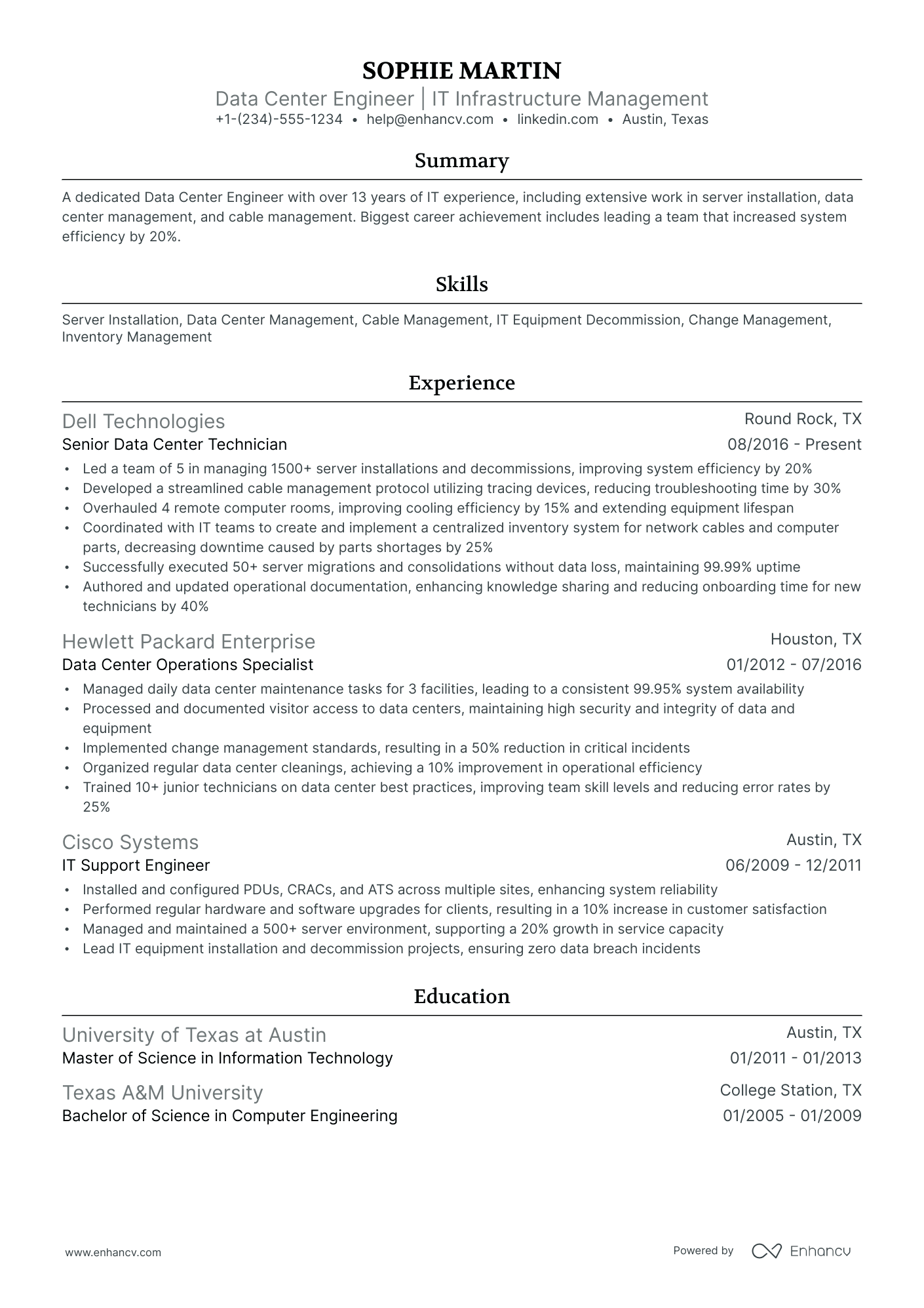
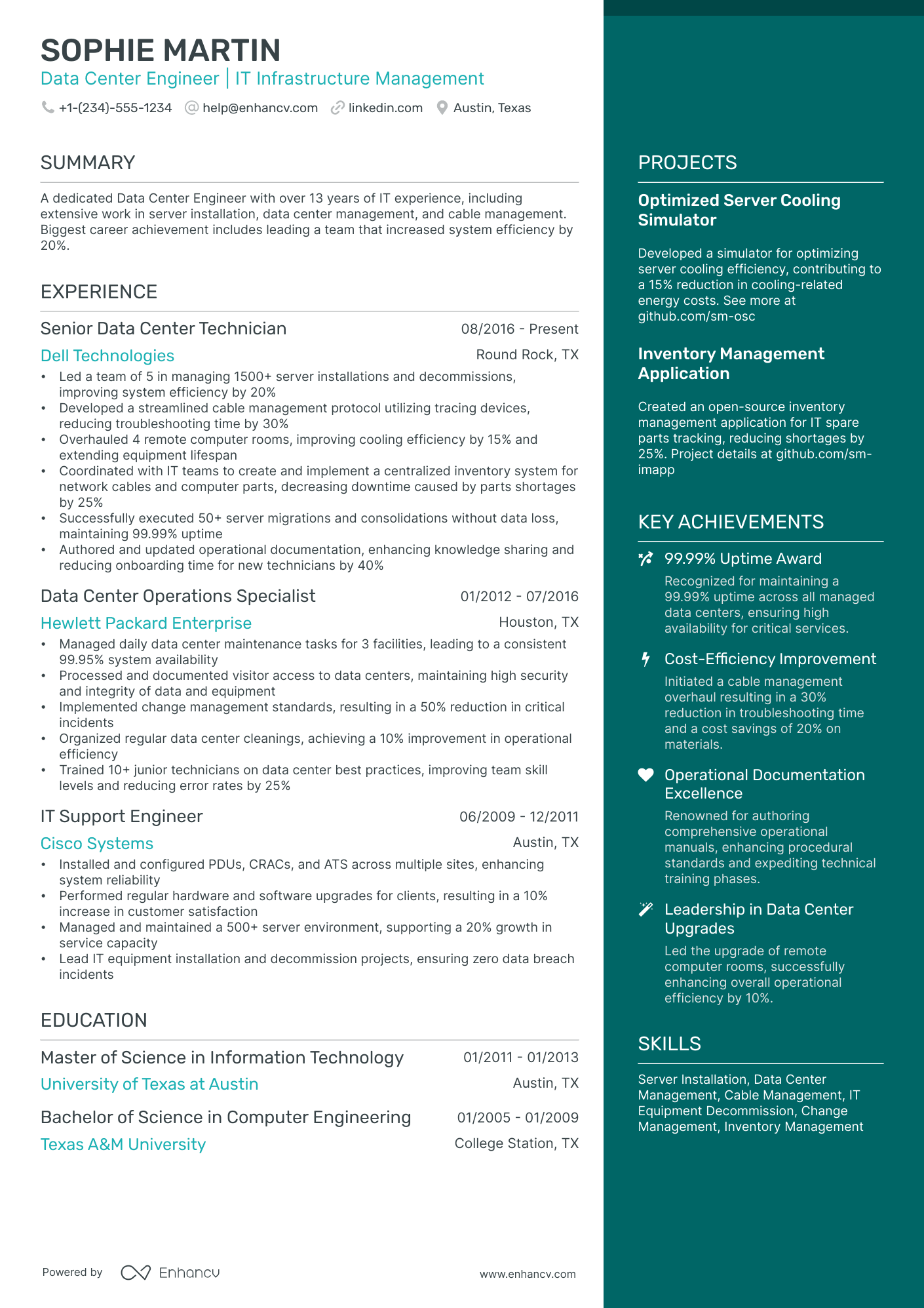
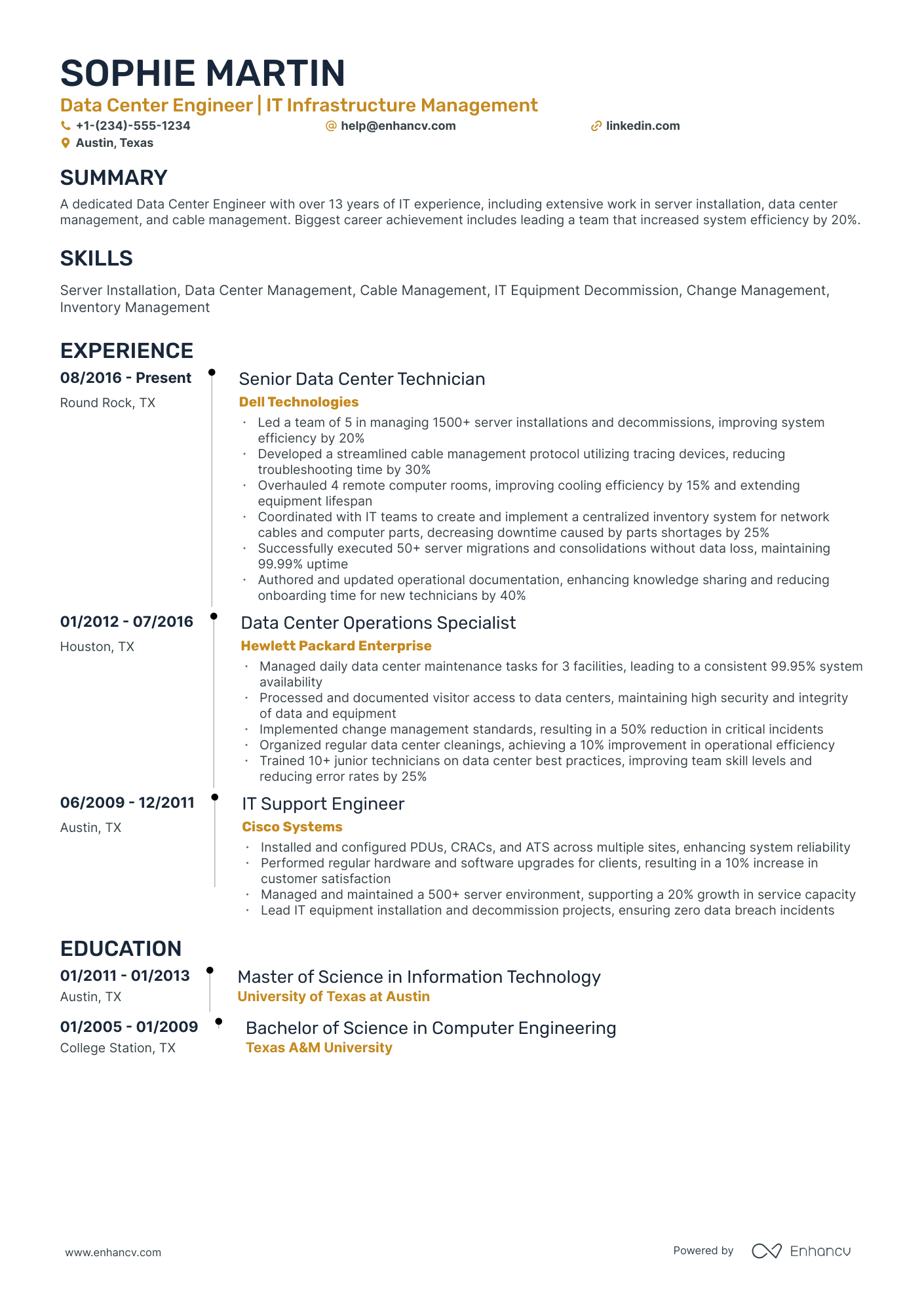
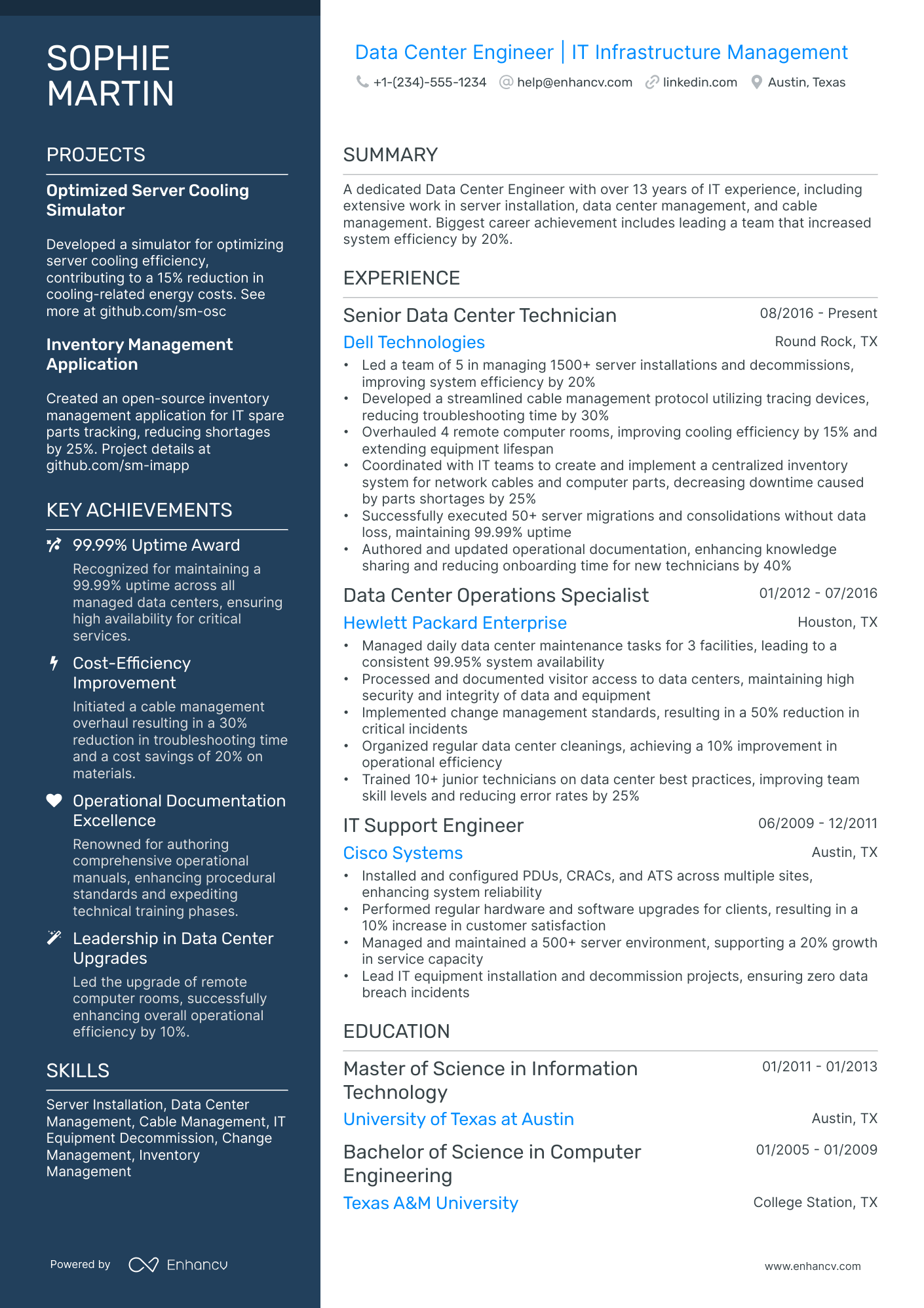
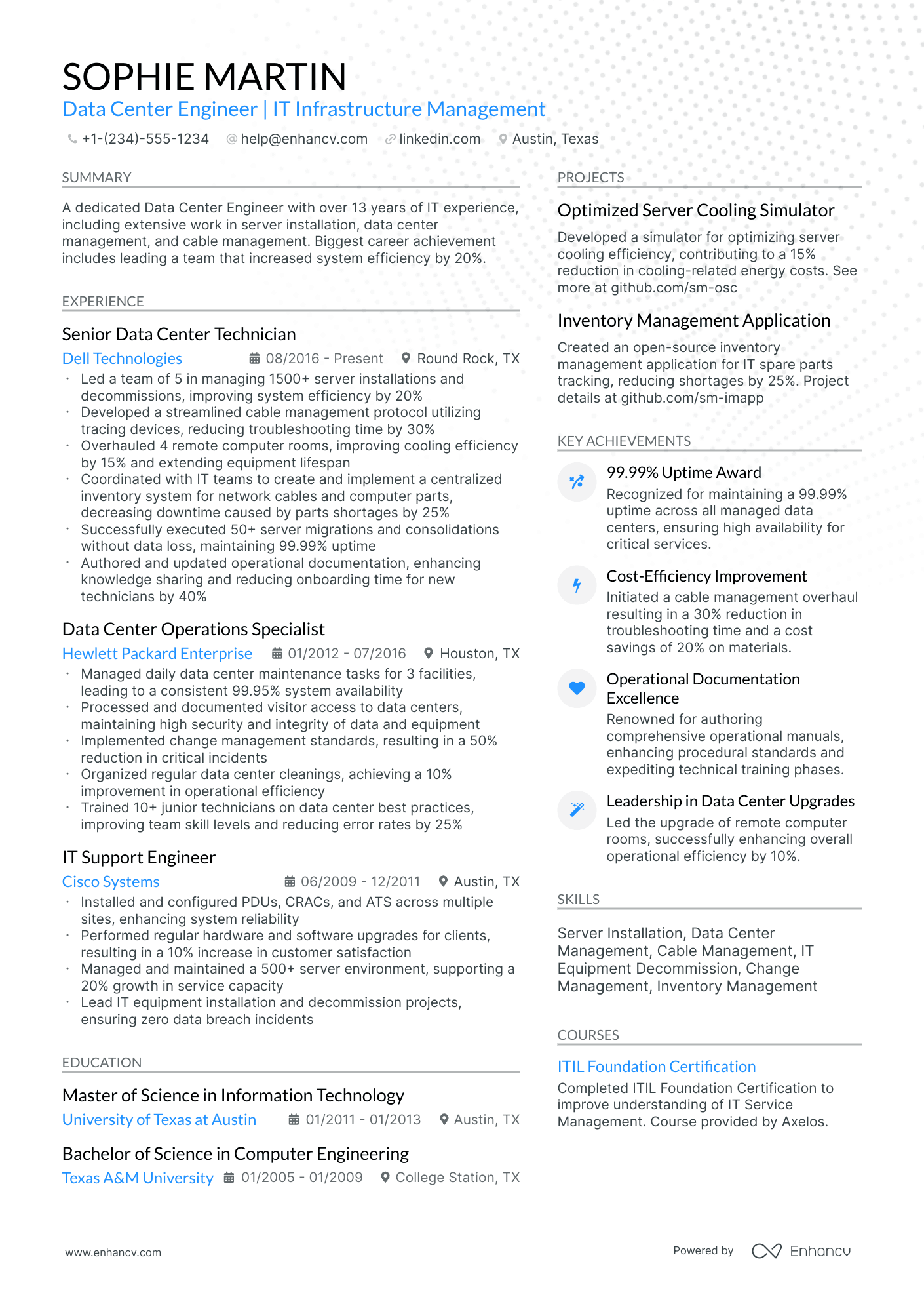
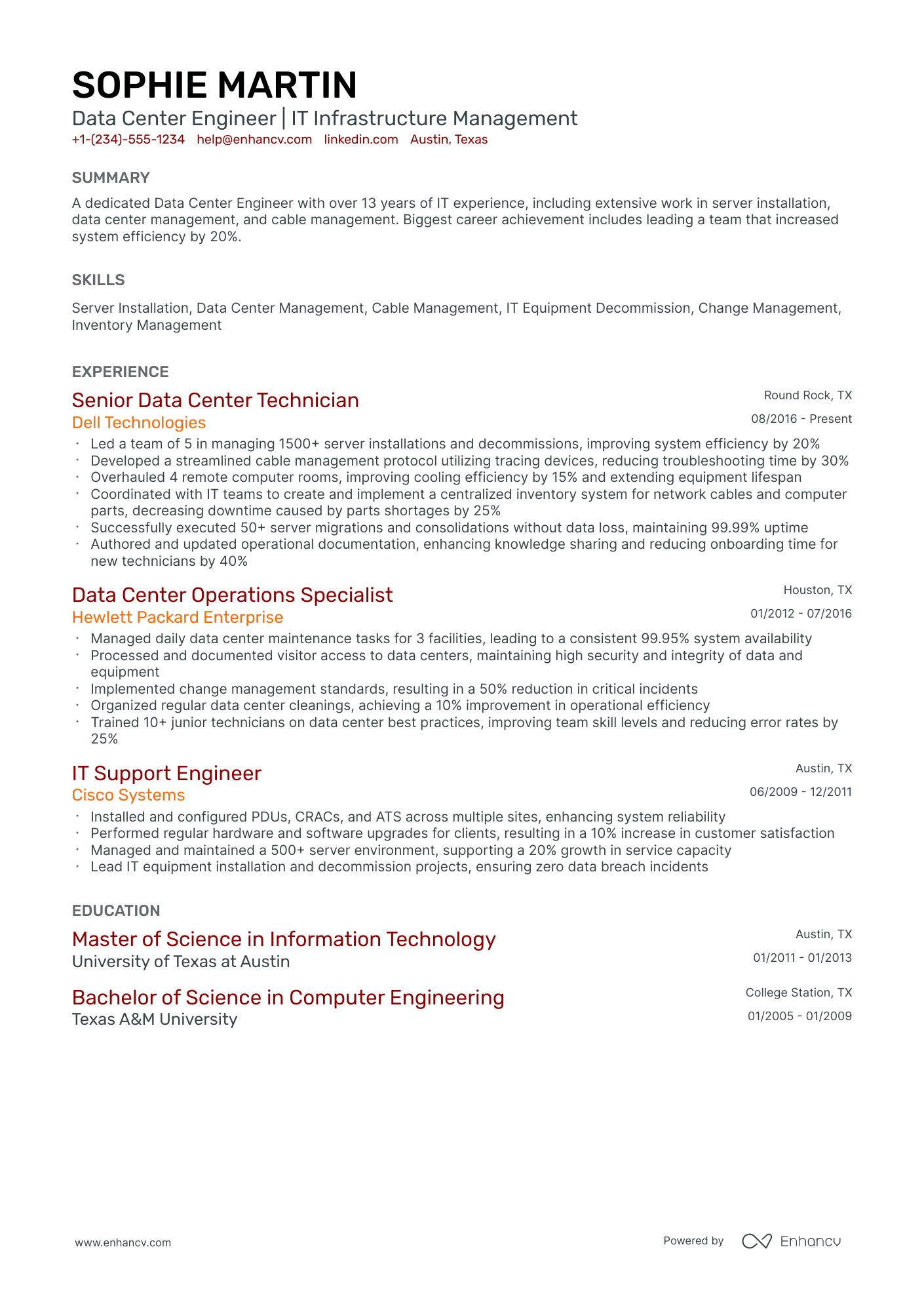
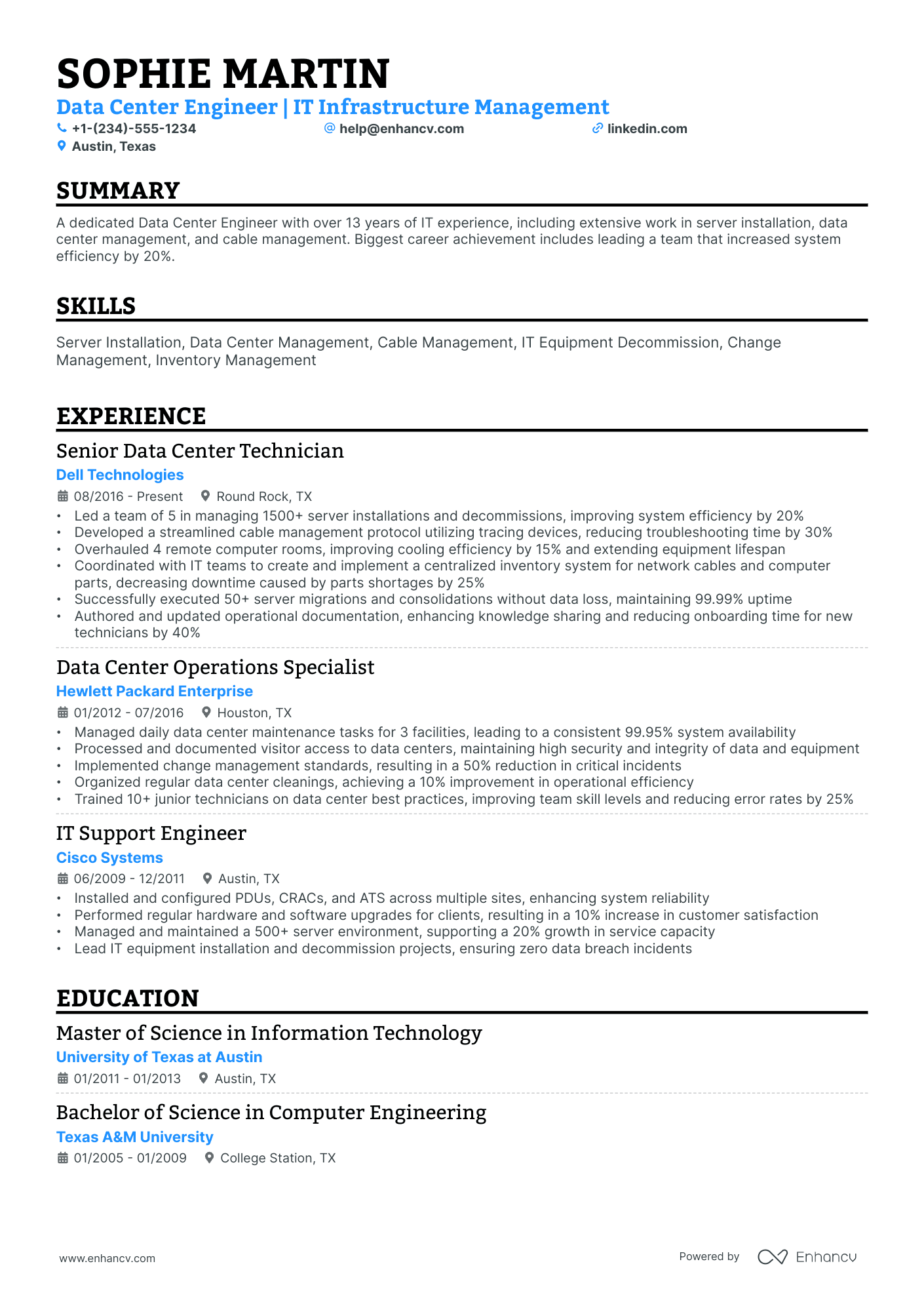
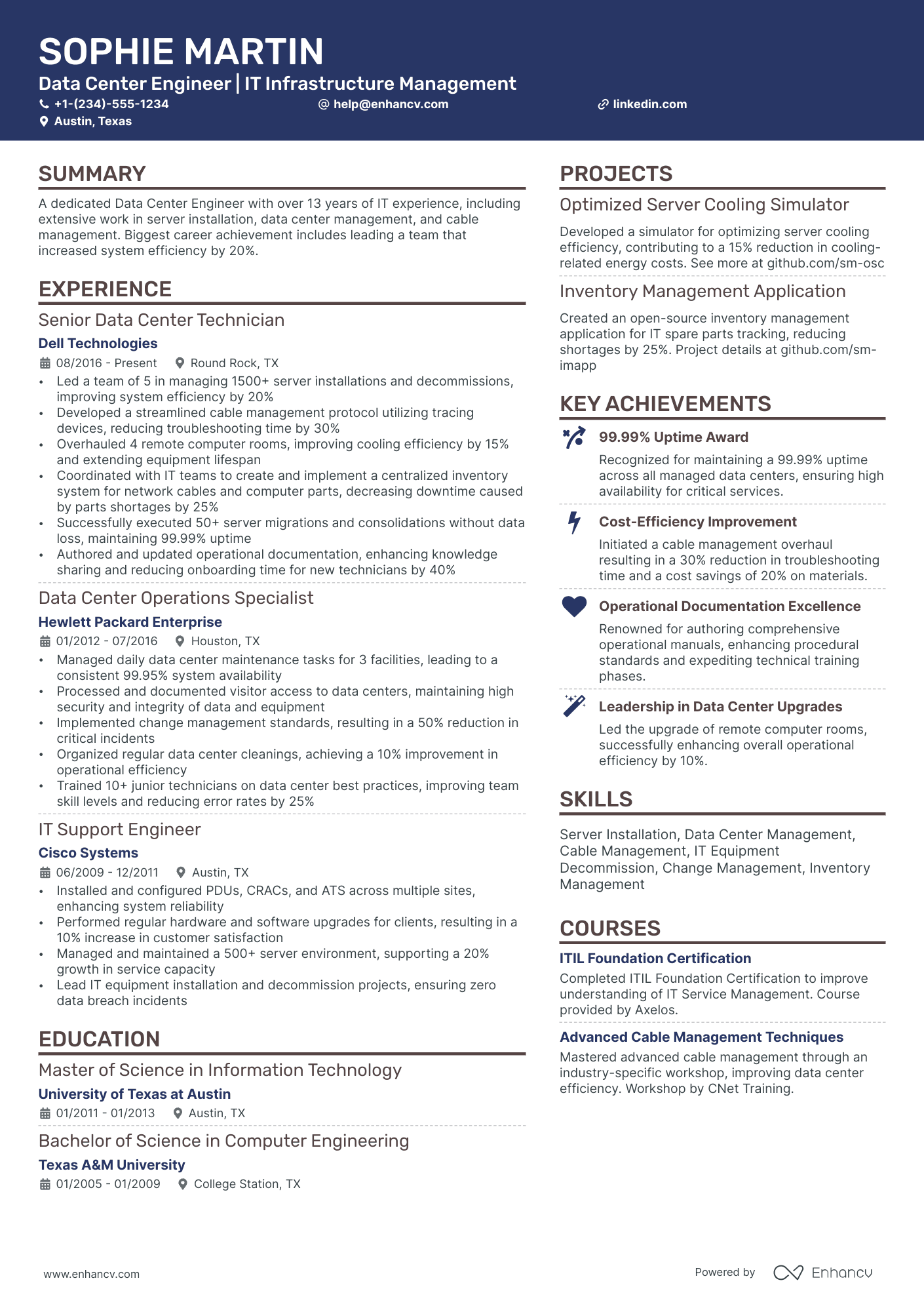
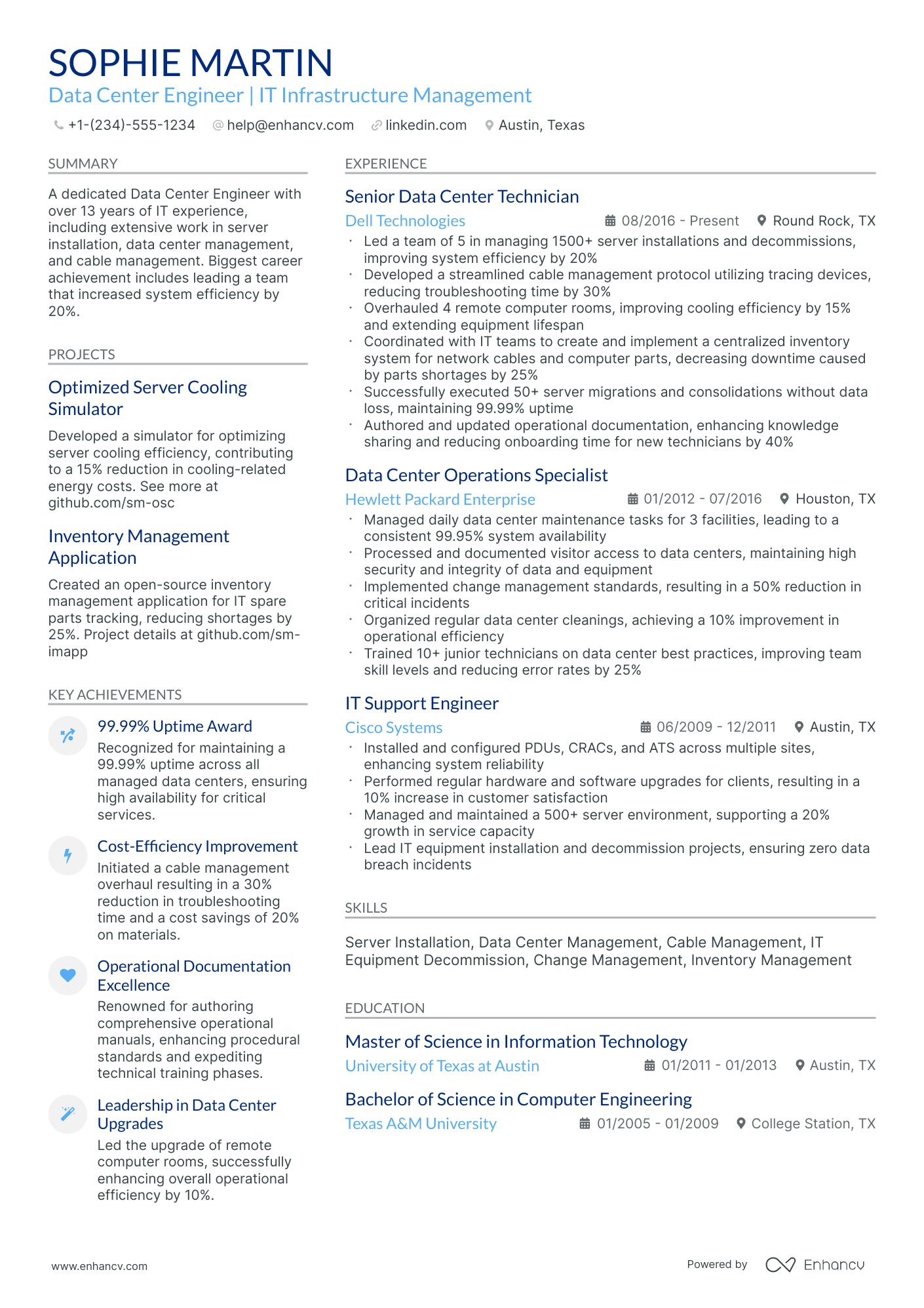
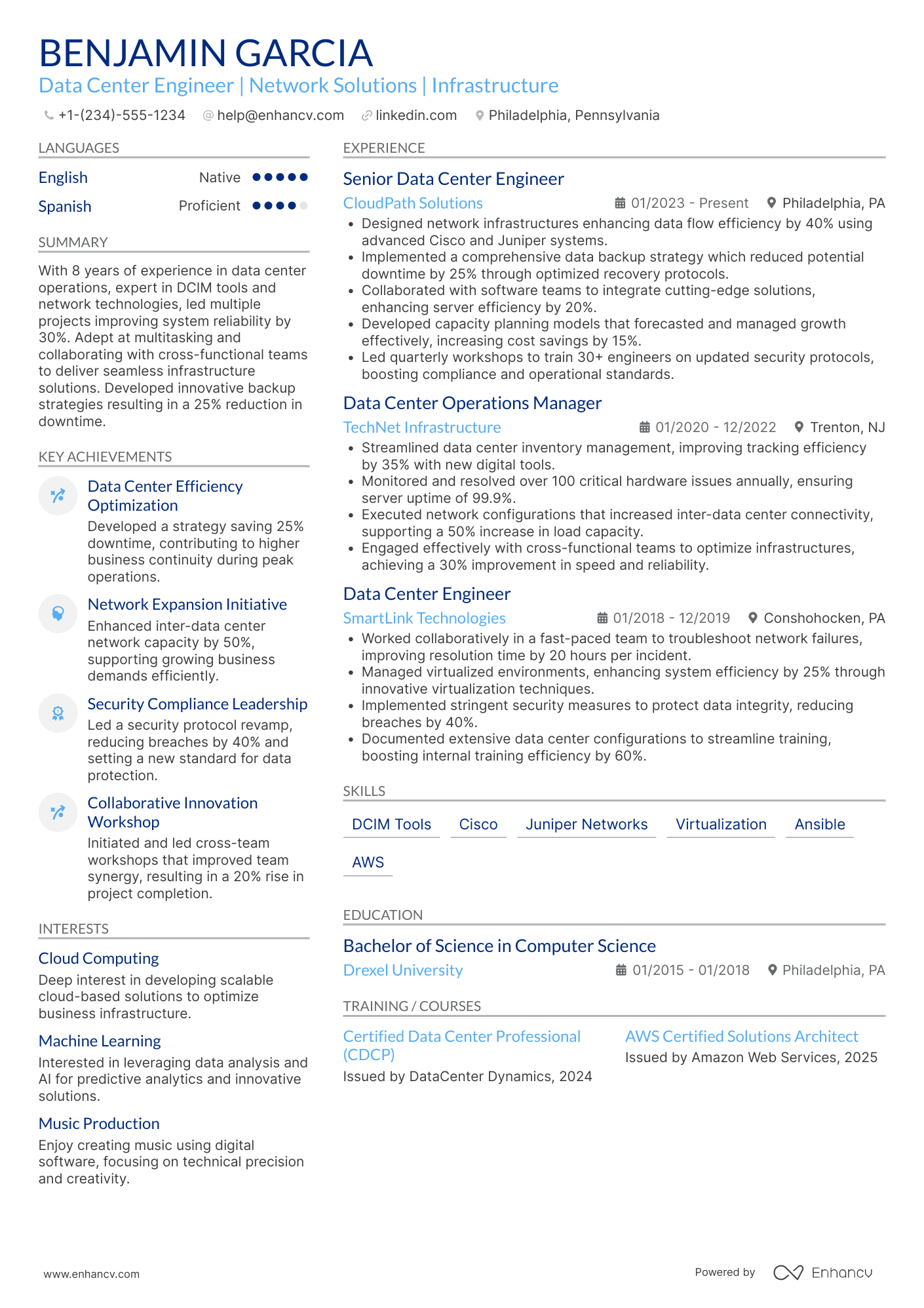
Most data center engineer resume submissions fail because they read like task logs and bury impact under tool lists. That hurts in ATS screening and fast recruiter scans, where high-volume competition rewards clear, comparable results.
This guide shows you how to lead with outcomes and scope, not duties. You'll highlight uptime gains, incident reductions, power and cooling efficiency, rack builds delivered on schedule, capacity reclaimed, audit pass rates, and change success. If you need a refresher on the fundamentals first, our guide on how to write a resume covers the basics before you dive into role-specific strategies.

Key takeaways
- Lead every experience bullet with a measurable outcome like uptime, cost savings, or incident reduction.
- Use reverse-chronological format for experienced candidates and hybrid format for career switchers.
- Mirror the job posting's exact tools, platforms, and compliance standards throughout your resume.
- Quantify achievements across five areas: availability, incidents, energy efficiency, delivery speed, and security risk.
- Demonstrate soft skills through real outcomes, not vague phrases like "team player" or "self-starter."
- Build your resume faster with Enhancv, then tailor each version to the specific role you're targeting.
- Place certifications above education when they're recent and directly relevant to the posting.
Job market snapshot for data center engineers
We analyzed 107 recent data center engineer job ads across major US job boards. These numbers help you understand employment type trends, experience requirements, regional hotspots at a glance.
What level of experience employers are looking for data center engineers
| Years of Experience | Percentage found in job ads |
|---|---|
| 1–2 years | 1.9% (2) |
| 3–4 years | 4.7% (5) |
| 5–6 years | 13.1% (14) |
| 9–10 years | 7.5% (8) |
| 10+ years | 7.5% (8) |
| Not specified | 72.9% (78) |
Data center engineer ads by area of specialization (industry)
| Industry (Area) | Percentage found in job ads |
|---|---|
| Finance & Banking | 57.0% (61) |
| Healthcare | 27.1% (29) |
Top companies hiring data center engineers
| Company | Percentage found in job ads |
|---|---|
| Amazon.com, Inc. | 49.5% (53) |
| ZP Group | 11.2% (12) |
Role overview stats
These tables show the most common responsibilities and employment types for data center engineer roles. Use them to align your resume with what employers expect and to understand how the role is structured across the market.
Day-to-day activities and top responsibilities for a data center engineer
| Responsibility | Percentage found in job ads |
|---|---|
| Technical writing | 27.1% (29) |
| Building management systems | 26.2% (28) |
| Electrical power management system | 25.2% (27) |
| Cooling towers | 24.3% (26) |
| Pumps | 21.5% (23) |
| Diesel generators | 20.6% (22) |
| Air handlers | 19.6% (21) |
| Centrifugal chillers | 19.6% (21) |
| Motors | 19.6% (21) |
| Troubleshooting | 19.6% (21) |
| Ups | 19.6% (21) |
| Wet cell batteries | 19.6% (21) |
How to format a data center engineer resume
Recruiters evaluating data center engineer candidates prioritize hands-on technical skills, infrastructure experience, and the ability to maintain uptime and reliability at scale. A clean, well-structured resume format ensures these signals—certifications, environment scope, and operational impact—are immediately visible to both hiring managers and applicant tracking systems.

I have significant experience in this role—which format should I use?
Use a reverse-chronological format to present your deepest and most relevant data center experience first. Do:
- Lead with your most recent role and clearly define the scope of environments you managed—number of racks, power capacity, facility tier level, and team size.
- Highlight role-specific tools and domains such as DCIM platforms, BMS/EPMS systems, hot/cold aisle containment design, structured cabling standards, and capacity planning methodologies.
- Quantify operational outcomes and business impact, including uptime percentages, cost reductions, efficiency improvements, and incident response metrics.
- Managed a 5 MW, Tier III colocation facility across 1,200 racks, achieving 99.999% uptime over 18 months while reducing cooling energy costs by 22% through hot aisle containment retrofits.
I'm junior or switching into this role—what format works best?
A hybrid format works best, letting you lead with relevant technical skills while supporting them with any hands-on experience you do have. Do:
- Place a dedicated skills section near the top of your resume, grouping competencies by category—power distribution, cooling systems, network infrastructure, monitoring tools, and physical security.
- Include lab projects, homelab builds, internships, or IT support roles where you handled hardware deployment, cabling, rack-and-stack, or environmental monitoring.
- Connect every action to a clear result, even at a small scale, to demonstrate your understanding of operational accountability.
- Skill: Server hardware deployment → Action: Racked and cabled 40 servers during a university data center refresh → Result: Completed migration two days ahead of schedule with zero connectivity issues post-cutover.
Why not use a functional resume?
A functional format strips away the timeline and context that hiring managers need to evaluate your hands-on data center exposure, making it harder to verify where and how you developed your technical competencies.
- A functional resume may be acceptable if you're transitioning from a related field (such as network administration, facilities management, or electrical work) and have no direct data center job titles—but only if you anchor every listed skill to a specific project, certification lab, or measurable outcome rather than presenting skills in isolation.
Once you've established a clean, readable format, the next step is deciding which sections to include and how to organize them for maximum impact.
What sections should go on a data center engineer resume
Recruiters expect a data center engineer resume to show clear ownership of infrastructure operations, reliability, and incident response. Knowing what to put on a resume for this role is critical for making the right impression. Use this structure for maximum clarity:
- Header
- Summary
- Experience
- Skills
- Projects
- Education
- Certifications
- Optional sections: Leadership, Open-source work, Volunteering
Strong experience bullets should emphasize measurable uptime and performance improvements, incident reduction, automation impact, and the scale and criticality of the environments you supported.
Is your resume good enough?
Drop your resume here or choose a file. PDF & DOCX only. Max 2MB file size.
Once you’ve organized your resume with the right components, the next step is to write your data center engineer resume experience section so it supports each part with relevant, role-specific impact.
How to write your data center engineer resume experience
Your experience section should highlight infrastructure you've built, maintained, or improved—along with the specific tools, platforms, and methodologies you used to deliver results. Hiring managers prioritize demonstrated impact over descriptive task lists, so every bullet should connect your work to a measurable outcome like reduced downtime, increased capacity, or improved operational efficiency. Building a targeted resume ensures each bullet speaks directly to the role you're pursuing.
Each entry should include:
- Job title
- Company and location (or remote)
- Dates of employment (month and year)
Three to five concise bullet points showing what you owned, how you executed, and what outcomes you delivered:
- Ownership scope: the data center environments, server fleets, network infrastructure, power and cooling systems, or facility operations you were directly accountable for.
- Execution approach: the hardware platforms, monitoring tools, configuration management systems, capacity planning frameworks, or compliance standards you applied to diagnose issues, maintain uptime, and deliver infrastructure projects.
- Value improved: the changes you drove in system reliability, power usage effectiveness, thermal performance, incident response time, network throughput, or physical security posture across your facilities.
- Collaboration context: how you coordinated with network engineers, facilities teams, vendors, security operations, cloud architects, or site reliability engineers to execute migrations, upgrades, or disaster recovery plans.
- Impact delivered: the outcomes your work produced—expressed through improvements in availability, cost reduction, scale of infrastructure managed, or risk eliminated—rather than a list of daily responsibilities.
Experience bullet formula
A data center engineer experience example
✅ Right example - modern, quantified, specific.
Data Center Engineer
Equinix | Ashburn, VA
2021–Present
Supported a multi-tenant colocation campus with high-density deployments and strict uptime requirements for enterprise and cloud customers.
- Led rack-and-stack and structured cabling for 1,200+ servers across five halls; cut average deployment time 28% by standardizing build sheets, labeling, and acceptance checklists in ServiceNow.
- Implemented power and cooling optimization using DCIM (Sunbird) and BMS telemetry; reduced PUE from 1.42 to 1.35 and lowered hot-aisle inlet temperature variance 18% through airflow balancing and blanking panel enforcement.
- Automated firmware and BIOS compliance checks with Ansible and Redfish across 900+ nodes; improved patch compliance from 74% to 96% and reduced security exception tickets 40% in partnership with security and platform engineering.
- Diagnosed and resolved network and hardware incidents using Splunk, Wireshark, and vendor logs; cut mean time to repair 33% and prevented $180K in service credits by restoring three priority customer environments within service level agreements.
- Coordinated maintenance windows with customer success, facilities, and vendors to execute UPS battery replacements and generator load-bank tests; achieved 100% on-time completion and reduced change-related incidents 22% through stricter change controls and peer reviews.
Now that you've seen how a strong experience section looks in practice, let's break down how to adjust yours based on the specific job posting you're targeting.
How to tailor your data center engineer resume experience
Recruiters evaluate your data center engineer resume through both human review and applicant tracking systems (ATS). Tailoring your resume to the job description ensures your qualifications register with both.
Ways to tailor your data center engineer experience:
- Match specific infrastructure tools and platforms named in the posting.
- Mirror the job description's terminology for power and cooling systems.
- Reflect uptime or availability KPIs the employer highlights.
- Include relevant compliance standards like SOC 2 or ISO 27001.
- Emphasize redundancy and disaster recovery if the role requires them.
- Align your experience with referenced ITIL or DCIM frameworks.
- Highlight cross-functional collaboration with network or security teams mentioned.
- Reference capacity planning or scalability methods the posting prioritizes.
Tailoring means aligning your real accomplishments with what the employer asks for, not forcing keywords where they don't belong.
Resume tailoring examples for data center engineer
| Job description excerpt | Untailored | Tailored |
|---|---|---|
| Manage physical infrastructure including power distribution, cooling systems, and structured cabling across multiple colocation facilities. Ensure 99.99% uptime SLA compliance. | Responsible for maintaining data center equipment and handling various infrastructure tasks. | Managed power distribution units, CRAC cooling systems, and structured cabling across four colocation facilities, maintaining 99.99% uptime SLA compliance over 18 consecutive months. |
| Perform root cause analysis on critical incidents using DCIM tools such as Sunbird or Nlyte. Coordinate with cross-functional teams to implement corrective actions and prevent recurrence. | Troubleshot issues in the data center and worked with other teams to fix problems. | Conducted root cause analysis on 30+ critical incidents annually using Sunbird DCIM, coordinating corrective actions with network, facilities, and security teams to reduce recurring failures by 40%. |
| Plan and execute hardware deployment projects including server rack installations, network switch upgrades, and UPS capacity expansions following ASHRAE thermal guidelines. | Helped install new hardware and supported upgrade projects as needed. | Led hardware deployment projects—server rack installations, network switch upgrades, and 500 kVA UPS capacity expansions—across two sites, following ASHRAE thermal guidelines to keep inlet temperatures within recommended ranges. |
Once your experience aligns with the role’s requirements, quantify your data center engineer achievements to show the measurable impact behind each contribution.
How to quantify your data center engineer achievements
Quantifying your achievements proves you improved uptime, performance, cost, and risk—not just "kept things running." Focus on availability, incident reduction, power and cooling efficiency, deployment speed, and security or compliance outcomes.
Quantifying examples for data center engineer
| Metric | Example |
|---|---|
| Availability | "Improved service availability from 99.90% to 99.99% by tuning failover on Cisco Nexus and validating redundancy during quarterly disaster recovery tests." |
| Incident reduction | "Cut critical incidents 35% quarter over quarter by tightening change controls in ServiceNow and adding automated post-maintenance health checks in Python." |
| Energy efficiency | "Reduced power usage effectiveness from 1.62 to 1.48 by optimizing hot-aisle containment and recalibrating cooling setpoints across two 1.5 MW halls." |
| Delivery speed | "Reduced rack deployment time from five days to two by standardizing bill of materials, pre-staging firmware, and automating validation with Ansible." |
| Security risk | "Closed 120 high-severity vulnerabilities in thirty days by patching iDRAC, ESXi, and switch firmware, maintaining 100% change-window compliance." |
Turn your everyday tasks into measurable, recruiter-ready resume bullets in seconds with Enhancv's Bullet Point Generator.
With strong bullet points in place, the next step is ensuring your resume highlights the right mix of hard and soft skills that data center engineering roles demand.
How to list your hard and soft skills on a data center engineer resume
Your skills section matters because data center engineers must prove reliable uptime and safe change execution—recruiters and applicant tracking systems scan this section for keyword matches and role fit, and strong resumes balance mostly hard skills with targeted soft skills. data center engineer roles require a blend of:
- Product strategy and discovery skills.
- Data, analytics, and experimentation skills.
- Delivery, execution, and go-to-market discipline.
- Soft skills.
Your skills section should be:
- Scannable (bullet-style grouping).
- Relevant to the job post.
- Backed by proof in experience bullets.
- Updated with current tools.
Place your skills section:
- Above experience if you're junior or switching careers.
- Below experience if you're mid/senior with strong achievements.

Hard skills
- Data center operations
- Change management, ITIL
- Incident response, root cause analysis
- Power systems, UPS, generators
- Cooling systems, HVAC, airflow management
- Structured cabling, fiber optics
- Rack and stack, hardware break-fix
- Network fundamentals, TCP/IP, BGP, OSPF
- Linux administration, Bash
- VMware vSphere, virtualization
- Monitoring, alerting, Grafana, Prometheus
- Security controls, access management
Soft skills
- Own on-call escalations
- Communicate during incidents
- Write clear runbooks
- Coordinate cross-team changes
- Prioritize risk over speed
- Escalate with full context
- Document root cause and actions
- Maintain strict change discipline
- Manage vendors and technicians
- Audit work against standards
- Drive post-incident follow-ups
- Keep stakeholders updated
How to show your data center engineer skills in context
Skills shouldn't live only in a dedicated skills list. You can explore common resume skills by role to see how other engineers present their competencies effectively.
They should be demonstrated in:
- Your summary (high-level professional identity)
- Your experience (proof through outcomes)
Here's what strong, skill-rich resume entries look like in practice.
Summary example
Senior data center engineer with 10+ years designing resilient colocation environments. Skilled in DCIM platforms, capacity planning, and cross-functional vendor management. Led a Tier III facility upgrade that improved power usage effectiveness by 22%.
- Reflects senior-level expertise clearly
- Names role-relevant tools and methods
- Leads with a measurable outcome
- Highlights collaboration as a soft skill
Experience example
Senior Data Center Engineer
Bridgepoint Infrastructure Services | Dallas, TX
March 2019–Present
- Redesigned cooling architecture using CFD modeling, reducing annual energy costs by 18% across two facilities.
- Partnered with network and security teams to migrate 1,200 servers to a hyperconverged infrastructure within six months.
- Implemented automated DCIM monitoring with Nlyte, cutting unplanned downtime by 35% year over year.
- Every bullet includes measurable proof
- Skills appear naturally through real outcomes
Once you’ve tied your technical strengths to real outcomes, the next step is learning how to build a data center engineer resume with no experience so you can present those strengths without relying on a work history.
How do I write a data center engineer resume with no experience
Even without full-time experience, you can demonstrate readiness through:
- Home lab rack and cabling
- Virtualization cluster build and monitoring
- Network switch configuration and VLANs
- Linux server install and hardening
- Hardware break-fix volunteer work
- Internship or campus IT support
- Cloud lab simulating data center workloads
- GitHub documentation and runbooks
Our guide on building a resume without work experience walks through these strategies in more detail.
Focus on:
- Uptime-focused troubleshooting with tickets
- Power, cooling, and rack basics
- Networking fundamentals with configurations
- Monitoring, logs, and incident notes
Resume format tip for entry-level data center engineer
Use a hybrid resume format because it highlights projects and technical skills first, while still showing education and any IT support history. Do:
- Put a Skills section above Experience.
- Add a Projects section with metrics.
- List tools: Linux, SNMP, IPMI.
- Quantify results: uptime, latency, time.
- Include tickets, runbooks, and diagrams.
- Built a three-node Proxmox home lab with VLANs, SNMP monitoring, and IPMI checks, cutting incident response time from ten minutes to three minutes.
Once you've structured your resume to highlight transferable skills and relevant projects, the next step is presenting your education in a way that reinforces your technical foundation.
How to list your education on a data center engineer resume
Your education section helps hiring teams confirm you have the foundational technical knowledge a data center engineer needs. It validates your training in networking, systems, and infrastructure.
Include:
- Degree name
- Institution
- Location
- Graduation year
- Relevant coursework (for juniors or entry-level candidates)
- Honors & GPA (if 3.5 or higher)
Skip month and day details—list the graduation year only.
Here's a strong education entry tailored for a data center engineer resume.
Example education entry
Bachelor of Science in Information Technology
George Mason University, Fairfax, VA
Graduated 2021
GPA: 3.7/4.0
- Relevant Coursework: Network Architecture, Server Administration, Operating Systems, Power and Cooling Infrastructure
- Honors: Magna Cum Laude, Dean's List (six semesters)
How to list your certifications on a data center engineer resume
Certifications on your resume show your commitment to learning, prove tool proficiency, and confirm industry relevance as a data center engineer. They also help hiring teams trust your skills when your experience spans multiple environments.
Include:
- Certificate name
- Issuing organization
- Year
- Optional: credential ID or URL
- Place certifications below education when they are older, broadly applicable, or less relevant to the data center engineer role you want.
- Place certifications above education when they are recent, highly relevant, or required for the data center engineer role you target.
Best certifications for your data center engineer resume
- Cisco Certified Network Associate (CCNA)
- Cisco Certified Network Professional (CCNP) Enterprise
- CompTIA Network+
- CompTIA Security+
- VMware Certified Professional—Data Center Virtualization (VCP-DCV)
- Microsoft Certified: Azure Administrator Associate
- ITIL 4 Foundation
Once you’ve positioned your credentials to reinforce your technical qualifications, use that same focus to craft a data center engineer resume summary that quickly highlights your most relevant value.
How to write your data center engineer resume summary
Your resume summary is the first thing a recruiter reads. A strong one immediately signals you're qualified for the data center engineer role.
Keep it to three to four lines, with:
- Your title and total years of relevant experience.
- Domain focus, such as colocation, enterprise, or cloud infrastructure.
- Core tools and skills like DCIM software, power distribution, and cooling systems.
- One or two quantified achievements that prove your impact.
- Soft skills tied to real outcomes, such as cross-team coordination or vendor management.

PRO TIP
At this level, lead with hands-on technical skills and measurable contributions. Highlight specific tools, certifications, and infrastructure types you've worked with. Avoid vague phrases like "passionate team player" or "hardworking self-starter." Replace them with concrete results, such as uptime percentages or capacity improvements.
Example summary for a data center engineer
Data center engineer with four years of experience managing colocation and enterprise environments. Skilled in DCIM, UPS maintenance, and structured cabling. Reduced unplanned downtime by 30% through preventive maintenance scheduling.
Optimize your resume summary and objective for ATS
Drop your resume here or choose a file.
PDF & DOCX only. Max 2MB file size.
Now that your summary is ready to showcase your expertise, make sure the header above it presents your contact details correctly so recruiters can reach you.
What to include in a data center engineer resume header
A resume header lists your key identity and contact details, helping a data center engineer stand out in searches, build credibility, and pass recruiter screening fast.
Essential resume header elements
- Full name
- Tailored job title and headline
- Location
- Phone number
- Professional email
- GitHub link
- Portfolio link
A LinkedIn link lets recruiters confirm your roles and dates quickly, which speeds up screening.
Don't include a photo on a data center engineer resume unless the role is explicitly front-facing or appearance-dependent.
Use a clear, keyword-matched title and keep all links short, working, and easy to scan on one page.
Example
Data center engineer resume header
Jordan Patel
Data Center Engineer | Power, Cooling, and Network Operations
Ashburn, VA
(571) 555-01XX
jordan.patel@enhancv.com
github.com/jordanpatel
jordanpatel.com
linkedin.com/in/jordanpatel
Once your name and key contact details are in place, you can strengthen your application with the additional sections for data center engineer resumes that support and reinforce the information above.
Additional sections for data center engineer resumes
When your core qualifications match other candidates, additional sections can set you apart and reinforce your data center engineer expertise.
- Languages
- Certifications and training
- Industry publications and technical writing
- Professional affiliations and memberships
- Hobbies and interests
- Volunteer work in STEM education
Once you've rounded out your resume with the right supplementary sections, it's worth pairing it with a strong cover letter to make an even greater impact.
Do data center engineer resumes need a cover letter
A cover letter isn't required for a data center engineer, but it helps in competitive roles or strict hiring processes. If you're unsure where to start, learn what a cover letter is and when it adds the most value. It can make a difference when your resume needs context, or when the team expects a clear fit story.
Use a cover letter when it adds specific, job-relevant detail:
- Explain role or team fit by matching your environment to theirs, such as colocation, hyperscale, or edge sites, and the shift model.
- Highlight one or two relevant projects or outcomes, such as reducing incident rates, improving capacity planning accuracy, or speeding up break-fix resolution.
- Show understanding of the product, users, or business context, such as uptime targets, change windows, compliance needs, or customer impact during maintenance.
- Address career transitions or non-obvious experience by connecting prior work to data center engineer tasks, tools, and operational expectations.
Drop your resume here or choose a file.
PDF & DOCX only. Max 2MB file size.
Even if a cover letter isn’t required for every data center engineer role, AI can help you strengthen your resume faster and more consistently, which makes it the next step.
Using AI to improve your data center engineer resume
AI can sharpen your resume's clarity, structure, and overall impact. It helps tighten language and highlight measurable results. But overuse strips authenticity fast. Once your content is clear and role-aligned, step away from AI entirely. For practical prompts and strategies, check out our guide on ChatGPT resume writing.
Here are 10 prompts you can copy and paste to strengthen specific sections of your data center engineer resume:
Strengthen your summary
Quantify experience bullets
Tighten action verbs
Align skills section
Improve project descriptions
Refine certification entries
Clarify education details
Remove redundant phrasing
Tailor for ATS
Sharpen accomplishment focus
Conclusion
A strong data center engineer resume shows measurable outcomes, role-specific skills, and a clear structure. Highlight uptime, incident reduction, power and cooling efficiency, and project delivery with numbers. Keep sections scannable, and align skills with the role.
This approach proves you can run reliable operations today and adapt to near-future needs. When your impact is quantified and your experience is easy to follow, hiring teams can move fast and decide with confidence.